Sunday, 9 January 2011

Traffic Movements at Sedgeley Junction 1962-1963 (Part 18)

This is the last of a series of posts describing traffic movements I observed whilst unofficially working Sedgeley Junction signal box.

As described in Part 1, you can find the passenger timings here and the freight timings here. The notes are intended to go with a copy of the Train Register Book which is missing so, forty seven years later, the meaning of some of the original notes is not very clear. The original notes appear in italics with minimal editing, sometimes followed by my recent comments attempting clarification. The numbers in brackets have been added to assist in locating entries.

Sedgeley Jn. Friday 14th June 1963

A short evening session.

(1) At 6.01 p.m., I 'Call attention' to Horsley Fields for the down and 'chop' his 'Train Entering Section' for the Up Western. Not realising he's 'in section', I've not 'sent him on' to Dudley, so the approaching train whistles at the adverse distant signal. I quickly 'get the road' for him and pull off for large 'Prairie' 4158 with a W.R. 4-coach corridor set.
(2) T39 goes up - 8725 with a Fowler tender and 1 Van, 1 Open wagon, 1 loaded 'BBE', 1 Van, 5 Plate wagons, a W.R. brake marked 'LLANELLY', a 'Midland Tar Distillers' tank wagon and a B.R. brake.
(3) 5269 eases an Excursion train downhill. It's crowded with children and adults. (4) At 6.39 p.m., the single-unit DMU forming the Up Snow Hill doesn't get our distant because T39 is still clearing Dudley, but we keep him moving.
(5) The Parcels Engine (46457 tender first) takes one 'GUV' and one LMR 'BG' to Walsall.
(6) T39 returns on the down, in a hurry, with Vans, Conflats, a B.R. brake, more Vans, more Conflats and a W.R. brake.
(7) 8769 takes 20 coal.
[No further details]
(8) 'Super D' 9173 takes 10 coal and a B.R. brake.
[No further details]
(9) T63 takes 4 open, 6 coal and a Plate wagon.
[No further details]

My notes suddenly stop here. I'm not sure why.

Friday, 7 January 2011

How to lose 10,000 railway wagons

In Part 5 of my series of posts on traffic movements at Sedgeley Junction, I describe movements of 9th February 1963.

A note I made on the same day awards my personal 'Oscar' for what I describe as the "best non-political laugh of the New Year". The award was given to to this cry-from-the-heart published in the 'WE1' special notice for January 1963 concerning missing condemned wagons:-

LOCOMOTIVE COAL SUPPLIES

There are approximately 10,000 wagons marked "COND - ONE JOURNEY ONLY LOCO COAL" which have not yet been reported as having arrived at Motive Power Depots. These wagons have been removed from the stock book of British Railways and it is therefore strictly forbidden for wagons marked in this way to be used for any other purpose than the storage of loco coal. As they arrive at M.P.D. the C.M.& E.E. staff is to be advised so that report of arrival can be made to the Central Stock Registry on form CSR2.

On the Footplate (Part 2)

In Part 1, we talked about getting the locomotive ready for service and moving, light engine, to its train

When the locomotives reaches its train, it will normally stand clear until called on by the Guard. The Guard "owns" the train and is responsible for deciding when the engine can couple up.

When the driver 'buffers up', he will attempt to stop with the buffers compressed so that the train can be fairly tightly attached to its train. The driver will then ensure that the locomotive is put in a condition where no further movement can occur. In preservation, this will usually be engine handbrake on, reverser in mid-gear, regulator closed fully and cylinder drain cocks open. If the front of the engine is next to the train, the cylinder drain cocks are sometimes closed to avoid the area between engine and coaches turning into a sauna.

"The space for the fireman to stand is quite restricted" - Lisa attaches 'Royal Pioneer to its train

The actual business of coupling up is usually carried out by the fireman, once he's come to a clear understanding with the driver that it's "safe to go under". He then ducks under the buffers, grabs the engine coupling and swings it over the drawhook on the leading vehicle. This is easier said than done as locomotive couplings are quite substantial since they transmit the full 'pulling power' to move the train. If the driver 'squeezed up' well, the space for the fireman to stand is quite restricted and there are all sorts of obstructions to bump into like vacuum brake and steam heating hoses and the end corridor connection on the coach is usually just where the fireman would prefer to stand. Generally, a screw coupling is used. Once the coupling is on the drawhook, it is tightened up by rotating a threaded screw using a built-in tommy bar incorporating a counterweight. The idea is that, on straight track, the buffers will be equally compressed but on curves, the buffers on the inside of the curve will be further compressed and the buffers on the outside of the curve will slacken slightly. At all times, the buffers should remain under some compression, so that the train cannot bang in and out. The comfort of the passengers depends upon this buffer compression and screw adjustment being correctly carried out.

Passenger trains have an 'automatic' brake which is described in more detail in an earlier article. Brakes on the locomotive and the train can be applied by the driver, the guard or by a passenger operating what used to be called the 'Communication Cord' but is now usually referred to as the 'PCD' (Passenger Communication Device). Although main line railways including main line preserved steam use air brakes (featuring the British Railways 2-pipe system), preserved railways usually use the Vacuum Brake system. This requires a continuous brake pipe extending from the locomotive along the length of the train.

The fireman has to interconnect the flexible, reinforced vacuum hose on the locomotive to a similar hose on the leading vehicle and flexible hoses will be provided between vehicles along the length of the train. Each vacuum hose terminates in a metal coupling provided with two 'horns' - a cranked lower horn which interlocks with the lower horn on the adjacent metal coupling and a straight, slotted upper horn which locates in a slot in the adjacent metal coupling. To prevent the hoses from pulling apart, a spring pin on the end of a short chain is attached to each metal coupling. Each pin is pushed through the associated slot in the upper horn. The position of the flexible vacuum hose varies from vehicle to vehicle, sometimes hanging down below solebar level, sometimes fixed to a branch pipe terminated well above solebar level (usually called a 'High Hose'). At each end of the train, the unused vacuum hose must be connected to a dummy coupling or 'stopper' to allow vacuum to be created.

In the steam heating season, the locomotive may be required to heat the train. Steam is taken from the boiler, regulated to a lower pressure (usually between 25 and 50 p.s.i. in preservation) and piped along the train to a series of radiators in the coaches. Flexible hoses are used to connect between vehicles. Each steam heating hose terminates in a metal coupling with a cranked lower 'horn' and a straight, slotted upper horn. In this case, two hinged clips are used to secure a pair of joined hoses. Each hose connection is provided with an isolating cock and an automatic drip valve to help clear water from the pipework. At each end of the train, the free end of the steam heating hose is attached to a chain, to prevent it striking trackwork, since there is no dummy coupling. Instead, the isolating cock must be closed to prevent escape of steam.

This picture shows the rear of the train, with the flexible vacuum hose on the left placed on the 'dummy coupling'. Steam is being intentionally vented from the steam heating hose on the right, to remove condensate from the system.

To be continued ...

Traffic Movements at Sedgeley Junction 1962-1963 (Part 17)

This is one of a series of posts describing traffic movements I observed whilst unofficially working Sedgeley Junction signal box.

As described in Part 1, you can find the passenger timings here and the freight timings here. The notes are intended to go with a copy of the Train Register Book which is missing so, forty seven years later, the meaning of some of the original notes is not very clear. The original notes appear in italics with minimal editing, sometimes followed by my recent comments attempting clarification. The numbers in brackets have been added to assist in locating entries.

Sedgeley Jn. Saturday 8th June 1963

(1) T39 goes up with Stanier 2-6-0 42979 making a nice noise. The load is 1 Plate wagon, 3 Vans, 3 Mineral wagons (one loaded with pipe fittings and elbows), 5 Tube wagons and a W.R. brake van stencilled 'MAESGLAS'.
(2) We get a report that they've stopped work at Great Bridge until the Ganger has carried out track repairs following an earlier incident involving WR3 off the road. Apparently, when the Breakdown Crane had finished working at 6.0 a.m., it came from Great Bridge to Sedgeley Junction and sent on to Dudley Port High Level.
(3) The down Diesel Parcels Unit is held outside the box so that we can explain that Dudley Port High Level has Blocked Back whilst he handles both the Dudley Port Local and the steam-hauled parcels.
(4) Dudley Port sends us the Up Local and, as soon as we give 'Train Out Of Section' for the passenger, offers the parcels. The steam-hauled parcels is soon whistling imperiously at our Up Branch Home which is 'On' because the Up Passenger has not yet cleared Dudley. As soon as we clear the signal 'Mickey Mouse' 46456 scampers by with one clean, new-looking 'BG', one Long Wheel Base 4-wheel parcels van, one 'CCT' and one B.R. 'BG'.
(5) T47 is reported as "37, 17 off at Round Oak". He comes up with 8713, four 3-container wagons, 16 open wagons loaded with railway wheelsets, 3 Plate wagons loaded with steel bars, 2 Plate wagons loaded with steel slabs, 2 open wagons loaded with steel drums, various open wagons, 1 coke wagon, 6 coal wagons and a B.R. brake. T39 (dragging his own brake van) is working hard at the rear.
(6) The Walsall local at 9.03 a.m. has changed from a 'Gloucester' twin to a 'Metro-Cammell twin.
(7) WR1 goes down slowly headed by 8424 with an old (M.R.?) brake, mineral wagons, L.M.R. brake, a Plate wagon (presumably as a barrier wagon because of the overhamg on the following wagon), loads of steel rods in steel open wagons, 4 rods to a wagon and overhanging each end (see sketch below: previously, I've seen these rods carried on bogie bolsters), a few open wagons, one load of coke and a W.R. brake.
(8) The parcels at 10.10 a.m. comprises the engine and one clean 'BG'.
(9) 8733 is in charge of T65 today. The headcode is "top and middle" (one lamp on the chimney, one in the middle of the buffer beam). The load is 2 Vans, 2 loaded Conflats, 3 Mineral wagons of scrap, 20 Mineral wagons loaded with coal or slack, 1 Van, 1 Open wagon, 3 Banana vans, 4 Mineral wagons loaded with steel turnings and a B.R. brake. 8269 is banking.
(10) It gets quite busy around 11.0 a.m. As I send 'Call Attention' to Horsley Fields for the Down light engine at 10.55, he is trying the send 'Call Attention' for the Up Walsall, which causes a general stir!
(11) T47 returns downhill tender first with 26 empties and his B.R. brake.
(12) We get a report that 12030 has failed and requires assistance back to shed.
[I assume that 12030 was the Great Bridge diesel-electric shunter but I've only just realised that this number is an early-series build]
(13) Horsley Fields sends us T39 with 30 Dudley's, assisted by a banker, and then closes unofficially for a while.
(14) T39 passes us making a lot of smoke. The load is 1 empty Mineral wagon, 8 loads of coal, 8 empty Plate wagons, 2 Tube wagons loaded with tubes, 4 bogie bolsters 'BBE' loaded with steel bar (the bar is about 3 inches square and the ends of the bars are painted blue and white for identification), 6 empty Mineral wagons and an L.M.R. brake. T63 is giving a helping hand at the rear.
(15) T39 returns downhill tender first with 1 Mineral wagon loaded with fabricated tubes, 2 open wagons, 10 loaded Conflats and an L.M.R. brake.
(16)WR1 on the Up is reported as 30 equal to 36. It's a train of slack and I count the wagons with tight couplings to see how much work the train engine is doing. He seems to be doing the lion's share of the work with 21 wagons. T63 is pushing the rest of the train and the W.R. brake van. The fireman on T63 is hosing down the footplate as he passes the box.
(17) At 1.0 p.m., T65 passes on the down with 45 empties and a B.R. brake. The engine is 8733, tender first, and I notice he has a Fowler tender (like the engine off T39 we saw earlier).
(18) The engine and brake on the down is WR2, 8748 tender first and a B.R. brake marked 'RU' (restricted use). 8748 is returning to Great Bridge to work another train.
(19) Horsley Fields offers us WR2 on the Up and then closes again unofficially for a while.
(20) WR2 passes us with 8748 making a lot of smoke, but hauling 25 loads of coal, leaving 9 wagons and the brake van for the banker to push. One load of coal is in an all-steel open wagon which, unlike the rest of the train, is very clean. The B.R. brake is marked 'BRISTOL-MANCHESTER-SALTLEY-BRISTOL CIRCUIT'.

Wednesday, 5 January 2011

Traffic Movements at Sedgeley Junction 1962-1963 (Part 16)

This is one of a series of posts describing traffic movements I observed whilst unofficially working Sedgeley Junction signal box.

As described in Part 1, you can find the passenger timings here and the freight timings here. The notes are intended to go with a copy of the Train Register Book which is missing so, forty seven years later, the meaning of some of the original notes is not very clear. The original notes appear in italics with minimal editing, sometimes followed by my recent comments attempting clarification. The numbers in brackets have been added to assist in locating entries.

Sedgeley Jn. Tuesday 4th June 1963

(1) The first Up Walsall comprises two 'Metro-Cammell' twins.
(2) We take on a light engine on the Up. It's the 'Parcels Engine', 46421, and we 'loose him in' (clear the Up Home only after bringing him 'under control'), expecting him to shunt across to go to Dudley Port High Level. But he steams straight past towards Dudley. Apparently he's not found his Guard yet!
(3) The steam-hauled Snow Hill passes on the down. Large Prairie 4140 is bunker-first on 3 W.R. corridor coaches with an older E.R. corridor coach on the rear.
(4) Having found his guard, 46421 goes tender-first to Dudley Port High Level.
(5) There's a second steam-hauled Snow Hill, this time with 4165 bunker-first. The load is four W.R. coaches, the last a brake-end.
(6) Then we have the 6.15(!) parcels on the down.
[Presumably the exclamation mark is because he's late running]. We nearly bring him to a stand waiting for the road.The train is a 'BG', a short LMR bogie parcels vehicle and a 'GUV'.
(7) Dudleyport local, goes down. The driver is struggling to adjust the sun blind as he's heading straight into the morning sun.
(8) The Up 'Western' at 8.01 a.m. is formed of half a twin and a 3-car set.
(9) 8375 brings T39 up and Dudley takes him up the Loop. The train is 1 old mineral wagon loaded with coke, 2 Open wagons, 2 loaded 'BBE' bogie bolsters and a B.R. brake.
(10) The returning Dudleyport local on the Up appears to be a single unit attached to half a twin.
(11) T312 arrives with one empty Palethorpes van.
[Arrives from Dudley Port High Level, I presume].Stanier 2-6-4T 42604 bunker-first goes down with one van and positions three vans on the loading dock - Blackpool, Crewe and Cardiff. He picks up the two brake vans from the previous Sunday 'Pig Special' and he's ready to leave at 8.45 a.m. but has to wait a while as T47 has been offered from Horsely Fields.
(12) Dudley takes T47 up the Main. Having cleared the Up Home for T47, we also let T312 draw up to the box on the Third Line. T47 has 8529 on a train which I counted as 20 Open wagons and 20 Tanks, with T39 banking. The telephoned report for T47
[which may or may not be more accurate] was "37 equal to 43, 20 for Round Oak and 17 tanks for Stourbridge.
(13) WR1 is a mixed train hauled by 8459 with an odd lamp iron.
[I think this refers to 'Western' pattern lamp irons, allowing the use of 'Western' pattern lamps].
(14) The Up Walsall at 8.30 a.m. is a twin.
(15) The Up Walsall at 9.05 a.m. is a clean, new-looking twin.
(15) When T39 returns light engine on the down, he is stopped and, at Control's request, invited to clear Palethorpes. But the driver declines, until he's finished his booked work.

Traffic Movements at Sedgeley Junction 1962-1963 (Part 15)

This is one of a series of posts describing traffic movements I observed whilst unofficially working Sedgeley Junction signal box.

As described in Part 1, you can find the passenger timings here and the freight timings here. The notes are intended to go with a copy of the Train Register Book which is missing so, forty seven years later, the meaning of some of the original notes is not very clear. The original notes appear in italics with minimal editing, sometimes followed by my recent comments attempting clarification. The numbers in brackets have been added to assist in locating entries.

Sedgeley Jn. Monday 3rd Jun 1963 (Whitsun Bank Holiday)

(1) The Walsall Local has been strengthened to a Metropolitan-Cammell 3-car set.
(2) The first 'Special' from Snow Hill passes at 10.37 a.m. It's a 'Swindon' 3-car DMU with buffet facilities in the centre car and it's packed.
(3) The Up Walsall at 11.04 a.m. is a crowded 'Gloucester' 3-car set.
(4) The 'Western' on the Down is three single units coupled together!
(5) The Up Snow Hill at 11.16 is filled to capacity. Right behind is an express - 8680 hauling ten packed non-corridors heading for Stourport.
(6) Next, Dudleyport offers a special from Nuneaton which has travelled down the Stour. 'Standard' class 4MT 4-6-0 number 75018 rushes past with 8 corridor coaches.
(7) The 'Swindon' unit re-appears with another 'Special' from Snow Hill. We almost bring him to a stand before we can 'get the road' from Dudley East.
Once again, the whole train (including the 1st Class accommodation) is crowded.
(8) 2V90 on the Up is a special from Sutton Park. It's a crowded Metropolitan-Cammell 3-car set.
(9) Special 1X68 is reported 12 o'clock at Bloxwich. It's another crowded train for Stourport, made up of 8 non-corridors with 8733 in charge. We're told that Dudley has another 100 passengers waiting to join this train!
Alas, that was the end of my period of observation.

Tuesday, 4 January 2011

Traffic Movements at Sedgeley Junction 1962-1963 (Part 14)

This is one of a series of posts describing traffic movements I observed whilst unofficially working Sedgeley Junction signal box.

As described in Part 1, you can find the passenger timings here and the freight timings here. The notes are intended to go with a copy of the Train Register Book which is missing so, forty seven years later, the meaning of some of the original notes is not very clear. The original notes appear in italics with minimal editing, sometimes followed by my recent comments attempting clarification. The numbers in brackets have been added to assist in locating entries.

Sedgeley Jn. Saturday 25th May 1963

(1) T39 roars uphill with 'Super D' 9173. The load is 2 Tube wagons, vans, 5 mineral wagons and an LMR brake van.
(2) Newly-painted and shining, the Walsall parcels roars up to Dudley.
(3) Today, there's a 'Parspec' (Party Special) to Paddington, 1Z46. Apparently, there are 440 people from Ratcliffe's and Norton Harty waiting at Dudleyport Low Level for this train. We take on a '4' (Express Passenger) from Horsley Fields and are not surprised that he spends a long time in section loading at Dudleyport Low Level. Eventually, the train comes blasting up the bank - 'Lydham Manor' leading 'Granville Manor', both 'bulled up' for their trip. There's a Great Western pattern 3-character reporting number frame on the leading smokebox showing 'Z46'. The well-loaded train is mainly B.R. stock, with a W.R. Buffet Car in chocolate-and-cream and one E.R. coach. Quite a spectacle!
I can't remember any train which surprised me more than this double-headed slice of the Great Western. I think these 'Manors' were the only 'Western' tender engines I saw at Sedgeley Junction (I don't count Stanier 8Fs re-allocated to Western M.P.D.). I presume the train originated in Birmingham and came 'Empty Stock' through Swan Village, taking the Great Bridge branch to join the South Stafford at Horsley Fields.
(4) The Parcels is 46429 with a B.R. 'BG', a 4-wheel Fruit van and another B.R. 'BG'.
(5) T47 is wired to Dudley as "42 equal to 44 Stourbridge". Dudley takes the train up the 'Third Line', 8526 leading a mixed train of Cement wagons, sheeted Open wagons, Plate, 15 loads of coal and T39 banking.
There's a comment about an 'odd headlamp on the chimney'. I think this probably refers to 'Western' pattern lamp irons on 8526, allowing the use of 'Western' pattern lamps.
(6) 8430 does down with WR1 and Coil wagon, coal in steel Mineral wagons, 2 Conflats, Bogie Bolsters loaded with steel rod, an Open wagon loaded with broken beer bottles (!), 'Boplates' loaded with fabricated steelwork and a B.R. brake van.
(7) Looking towards Dudleyport, we see the 'Stockport' parcels arriving on the Down Stour - a 'Black 5' with one 'BG' and seven Vans.
(8) The Parcels runs down to Dudleyport, returning a little later with two vans off the 'Stockport' and his 'BG'.
(9) T39 goes up to Dudley with two pairs of Single Bolsters, carrying bar steel, six empty Plate wagons, one Van, 2 loaded Mineral wagons, four empty Plate wagons, one loaded 'Conflat' and an LMR brake.
(10) T47 returns from the 'Western' with 5 Tube wagons and a B.R. brake. This is a 'Special Load' which Control want at Norton Junction, not Bescot.
(11) T39 backs downhill tender-first with 4 loaded container wagons and an LMR brake.
(12) WR2 goes down. It's 8450 with a long train of EMWs (Empty Mineral Wagons) and an S.R. brake.
(13) Control advise us that "37 is coming to clear Palethorpes". Later, Control advise that WR1 is coming up, once the driver has 'dropped' three, reducing the load to 37. Apparently, the driver said that 40 was too many.
(14) Eventually, 8430 struggles up the Loop with WR1 - a train of coal and slack. 5395 (off T63) is providing banking assistance.
(15) 8766 is the engine off T37. He goes down Palethorpes, picks up 6 empty Cattle wagons and an LMR brake, leaving the sidings clear.
(16) The Omnibus Telephone circuit reveals more freight planning. WR2 is due to leave Norton Junction at 2.15 p.m. with 2 Stourport and 5 Round Oak. Great Bridge has 9 Stourport and 3 Stourbridge waiting. WR2 will pick up the waiting loads at Great Bridge and, with a combined load of only 19, will take the train up to Dudley without a banker.

Monday, 3 January 2011

Traffic Movements at Sedgeley Junction 1962-1963 (Part 13)

This is one of a series of posts describing traffic movements I observed whilst unofficially working Sedgeley Junction signal box.

As described in Part 1, you can find the passenger timings here and the freight timings here. The notes are intended to go with a copy of the Train Register Book which is missing so, forty seven years later, the meaning of some of the original notes is not very clear. The original notes appear in italics with minimal editing, sometimes followed by my recent comments attempting clarification. The numbers in brackets have been added to assist in locating entries.

Sedgeley Jn. Saturday 18th May 1963

(1) The Walsall Parcels runs.
(2) T39 goes Up. 4914 has vans, 1 Tube wagon, 1 Empty (mineral wagon), 1 Plate wagon, 1 loaded BBC (bogie bolster), 2 mi neral wagons loaded with scrap and an LMS bauxite brake van.
(3) The Dudleyport local comes off the branch and heads for Dudley.
(4) Once the Dudleyport local has cleared, we pull off for T39, propelling his brake down the main, having dropped his train at Dudley.
(5) The Up Parcels is 46457 with two LMR full brakes.
(6) 8450 eases WR1 gently downhill. The train is open wagons looaded with carboys, mineral wagons with slag, a dozen coal, a loaded BBE, 16 Tube wagons and a BR brake.
(7) 8375 goes Up with T47 comprising 7 steel open wagons loaded with wagon wheelsets, 2 sheeted opens, 20 loads of slack, 2 open, 1 Plate, 2 Tube, 1 Double Bolster, 4 Plate, 2 Tube and a BR brake. T39 is storming away at the back, still attached to his brake.
(8) The Parcels returns on the down, with just one LMR 'BG'.
(9) T65 passes on the Up, with 8680 on the front. The load is 10 coal, Conflats, 10 coal, one Ferry Van, 7 coal, 1 van, 1 open with sheeted carboys and a BR brake. 45146 (T63) is providing banking assistance.
(10) At 11.30 a.m., 4914 takes T39 up with 2 loaded 'BBE', 2 Plate Wagons, 2 open wagons, 1 Benzene tank wagon, 6 coal wagons and a BR brake.
(11) Later, T39 returns on the Down with a Plate Wagon, Tube Wagon, a few Vans and the Brake.
(12) At Noon, 8410 with a W.R. Brake stencilled 'PADDINGTON' goes down off WR2.
(13) Having disposed of his train, the engine off T47 goes down tender first.
(14) On the Down, T65's engine is also tender first, being hustled along by 45 "empties".
(15) WR1 is 'wired' as "25 equal to 32 Stourport." We took him as a '3-2' and offer that to Dudley East, but he accepts a '1-4'. He's having a bit of trouble coming up the bank. His lamps are one on the chimney and one on the left buffer beam (looking from the cab). The train is power station slack with a W.R. brake and T63 providing banking assistance.
(16) T63 scuttles downhill light engine, ready for his next banking turn.
(17) WR2 makes an appearance on the Up with a mixed train of about 30 coal, 3 'Hybar', 1 short 'PLATE' wagon and the 'PADDINGTON' W.R. brake.

Sunday, 2 January 2011

Modern Railways in Malaysia

The famous Moorish architecture of the original British-built Kuala Lumpur station survives.

At the end of March, 2010, I spent a few days days in Kuala Lumpur, giving me an opportunity to have a look at the current railway operations. Of course, the British introduced railways into Malaya (as it then was) in the days of steam but the operation is diesel and electric now.

Each day I made time for a ride on the Rapid Transit, the Monorail or the suburban system operated by KTM Berhad. The itineraries are detailed in my travel reports:- 30th March, 31st March and 1st April.

There are two Rapid Transit (or Light Rail) lines in Kuala Lumpur - the Kelana Jaya line featuring driverless trains and the Ampang line. I didn't get to travel on the Ampang Line but it uses fairly conventional North American style multi-coach trains with drivers. I didn't have enough time to try out the High Speed Line - a standard gauge line which links KL Sentral to the Airport.

The state-owned KTM operates the extensive metre-gauge main lines. The KTM suburban system radiating from Kuala Lumpur was electrified at 25 kV a.c. some years ago. My company tendered for some of the telecommunications equipment forming part of that project, but we didn't get any of the business.

Of course, I wanted to see the fantastic Moorish-architecture of the original Kuala Lumpur station. It survives (as the heading photograph shows) but a little down-at-heel. Until my visit, I didn't know that the railway headquarters, next to Kuala Lumpur old station, was also in the Moorish style, as the picture below shows.

I understand that there are plans to move the railway staff to a modern building and convert the old building into a luxury hotel.

The original station has lost its importance since a new main station, KL Sentral, has been built a little further south, so as to provide improved transfer facilities to other lines and motor coaches. The new station has all the appeal of the present Birmingham New Street Station, with narrow, dark platforms buried underground.

The British origins of the railway mean that left-hand running is in use. In the Kuala Lumpur suburban area, there is overhead electrification, power operation of points and route signalling using colour lights. There appeared to be some form of automatic train control - the track transponders I spotted appeared to be of the type I'd seen in Japan (there's a brief report on Japanese 'Automatic Train Stops' here, with a link to pictures).

I took a short trip north to Sentul and back from KL Sentral, passing through the original station. Most of the trains were 3-car EMUs. When a diesel electric passed dragging a 3-car EMU, I first supposed that the diesel had been pressed into service to recover a failure. But then I saw a loaded flat car attached to the rear of the EMU and I was perplexed. Later observations clarified the situation. It appears that some of the fleet of EMUs have become unrepairable through funding difficulties. The service is being maintained using the dead EMUs simply as coaches, dragged around by a diesel-electric locomotive. The flat car carries a packaged generator and a fuel tank. The generator output is then connected to the EMU to provide lighting and air conditioning. One set I saw was 'top-and-tailed' with a locomotive at each end. The picture below shows the rear of this set, with the generator flat car and trailing locomotive, on its way from Kuala Lumpur to Klang.

I discovered that Kuala Lumpur old station houses an old-fashioned (and badly-lit) museum of smaller artefacts which I found fascinating.

On my last day in Kuala Lumpur I made a journey by EMU down the Klang Valley Line to Port Klang (originally called Port Swettenham after the Englishman who promoted its suitability for development as a major port). The EMU was well-patronised and the ride was similar to the British Class 323. We passed the La Farge cement works where all the cement tankers and a couple of locomotives were in the white La Farge livery. We passed a maintenance depot for diesel electrics. Freight container traffic on the line was quite heavy. At Port Klang I spoke briefly to the jolly driver who was being relieved. He spoke quite good English and was happy for me to take photographs of the cab.

Heavy investment in railways is planned for the future. According to 'The Star', in August 2010 new electric trains were introduced on the route north from Kuala Lumpur to Ipoh. The picture below (at Kuala Lumpur old station) was taken for 'The Star' by Azhar Mahfof.

There are a number of picture collections:-

KTM Suburban.
By EMU to Port Klang.
KTM Museum, Kuala Lumpur.
Kuala Lumpur Light Rail, Mass Transit, Rapid Transit.
Kuala Lumpur Monorail.

For more information, checkout the Wikipedia entry.

Thursday, 30 December 2010

Review of the Year - 2010

It's hard for me to believe that this is the fifth 'Review of the Year' I've produced since starting this blog. It's even harder to believe I've really had all these wonderful experiences. Yes, I think I've been exceptionally fortunate. Forgive me if I draw attention only to the highlights. The year has had its bad bits and boring bits but I'm sure we don't want to dwell on those.

I've grouped the activities into 'TRAVEL', 'RAILWAYS' and a little bit on 'BREWOOD'.

TRAVEL< /p>

My Mother was always an intrepid traveller, although her opportunities were rather limited. I've only developed the taste for it in the last few years, but I've tried to make up for lost time.

Java, Bali, Sarawak, Sabah, Kuala Lumpur

The 'Pandaw' fleet are all based on the design of the original 'Irrawaddy Flotilla' flat-bottomed river craft used in Burma

When I discovered that the 'Pandaw' company had started river cruises in Borneo, the idea immediately appealed and, through the Travel Club Wexas, arrangements were made. To make best use of the cost of flying to the Far East, we "topped and tailed" the river trip with other visits. For some time, I'd wanted to visit Borobudur - the largest Buddhist monument in South East Asia. This is situated on the island of Java, which is part of Indonesia. After Borobudur, I would see a little of Yogjakarta before flying to the Indonesian island of Bali. Then on to Sarawak in Borneo, to look at the city of Kuching before joining the river cruise at Sibu. After exploring the Rajang River, I would fly on to Sabah for a couple of nights before flying to Kuala Lumpur. After a couple of days exploring the city, I would return to England.

If that sounds exhausting, it was, but it was also one of the most stimulating trips I've undertaken. Click for detailed reports on the trip

The Arctic

'Prince Albert II' anchored off Storstappen Island, Norway.

I'd enjoyed my earlier trip to the Antarctic Peninsula, so I decided to visit the 'Other End' of our world on the luxurious exploration ship 'Prince Albert II', operated by Silversea. I flew via Oslo to Tromso where I joined the ship which headed north. We made one stop on mainland Norway at Nordkapp, then headed further north to the group of islands known as Svalbard. We virtually circumnavigated the main island, Spitsbergen, getting as far as 81 degrees north before ending our cruise at the town of Longyearbyen.

This trip provided a host of unforgettable memories. Click for detailed reports on the trip

Burma

The Swezigon, a revered massive stupa in the Bagan area.

On this visit, I took the 'Road to Mandalay' cruise ship north from Mandalay to Bhamo. It was good to see my friends on the ship again and we had some marvellous experiences on our various trips ashore. We visited a number of schools where 'Road to Mandalay' distributed stationery and we also cruised past a number of other schools where the pupils were lined up on the river bank to say 'Thank You' for stationery delivered by smaller boats. The trip ended at magical Bagan. During a road trip to Mount Popa, I was invited to participate in the official opening ceremony of a new school building at Htee Pu - this was a very moving experience for me.

Click for detailed reports on the trip

RAILWAYS

During 2010, I added some more technical pieces to the blog on railway signalling describing the arrangements at Spring Vale Sidings and Princes End. Both these boxes are long gone but many of the principles described are still in use. All the articles on railway signalling are here.

At the request of my friend Phil, I started the lengthy process of transcribing traffic notes I made at Sedgeley Junction in 1962/3. Phil also organised a splendid slideshow attended by some invited fans of the South Stafford Line.

During my visit to Indonesia, I snatched a little time to look at the railway system in Java - see Part 1 and Part 2. Returning via Kuala Lumpur, I also made a few journeys on the Mass Transit system and the KTM suburban railways. There's a brief report here.

Jan, on Thomas, collects the Single Line Staff leaving Shackerstone (photo: Sam Brandist)

'Thomas' celebrated his 65th birthday in 2010. I was involved at Shackerstone on a number of dates, but I missed the 'official' birthday celebrations on 1st May 2010 due to a prior engagement. See reports (part 1) and (part 2).

The 'prior engagement' was driving the '8F' at Peak Rail on the day the turntable was inaugurated by Pete Waterman.
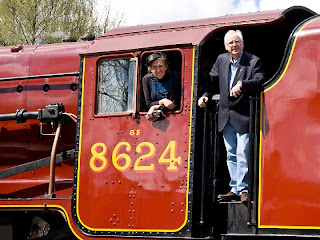
Jan Ford and Pete Waterman on the '8F' after turning (Photo: Sheila Rayson)

On 15th May 2010, I travelled to Liverpool by rail for the OLCO Annual General Meeting. There's a brief report (with pictures) here.

On the 27th June, 2010 I reluctantly had to declare 68013 a failure at Peak Rail after the link in the dome between the regulator handle and the regulator valve became detached. I finished the day as supernumary on 'Penyghent'. There's a report here.

The 'Anything Goes' weekend at Peak Rail featured two-train working with the passenger train and a demonstration freight train. This time, 68013 behaved but there were one or two problems with the diesel locomotives as the report describes.

Intense activity around the Steaming Bays at the Kinver track

'Lionsmeet' was held at Kinver on 31st July. My report is here.

5542 waiting to depart from Shenton

My first 'turn' on a 'Light Prairie' came on 22nd August at Shackerstone. There's a short report here.

My trip to Burma included a train ride from Katha to Naba and back. I travelled in the locomotive cab both ways. See reports 'Cab Ride from Katha' and 'Cab Ride back to Katha'.

On the left D6586, on the right 33021 in the North Yard at Shackerstone.

During the year, I had a number of turns on the DMU at Shackerstone but the booked turn on 25-Sep-2010 was changed into conductor driver on a visiting 'Class 33'. I got to drive two visiting 'Class 33' during the day so I was quite happy. There's a report here.

'Planet' on a passenger train passes 'Rocket' during the 180th anniversary workings.

The 'Planet' replica was in service at the Museum of Science and Industry in Manchester throughout the year and I had a number of driving turns. To celebrate the 180th anniversary of the opening of the Liverpool and Manchester Railway, 'Planet' was joined by the 'Rocket' replica and train. I was rostered as driver on the 19th September and there's a report here.

5786 at Shenton

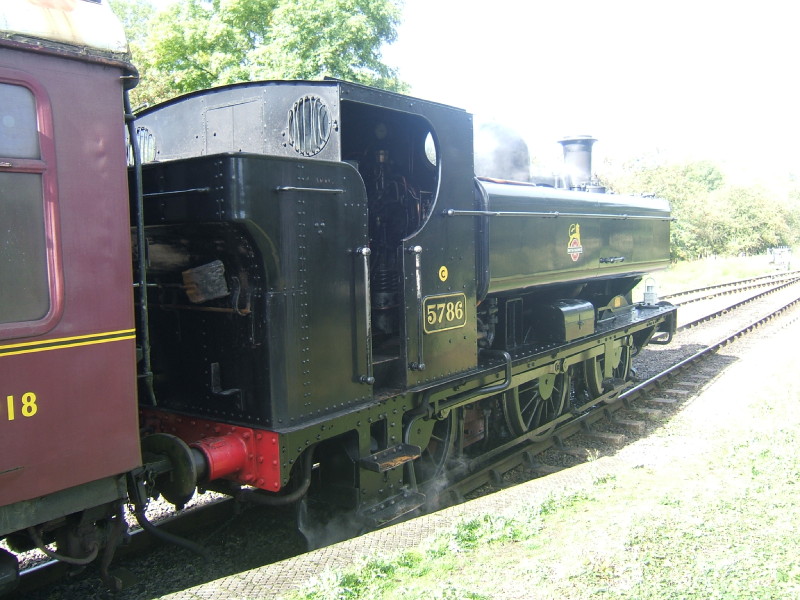
On the 2nd October at Shackerstone, I had a very pleasant day on the visiting Pannier Tank 5786. These are capable, versatile engines and, as my friend John likes to remind me (after I used the phrase on a railway video) "You can do anything with a Pannier'". More pictures.

In December, I did a couple of 'Santa Special' days at Peak Rail (see report).

BREWOOD

During the year, I've spent a fair bit of time in the Small Barn used by Ford Electronics where I work.

Brewood Hall is bit like the Forth Bridge in that maintenance or improvement work never ceases. In 2010, the new oak door to the Ice House and the new oak double gates to the yard adjacent to the Big Barn were installed. Then I discovered that the wooden main gates at the front of the house were decaying quite badly so I'm trying to arrange repair of these. The small brick shelter for the Buddha image in the garden has been completed, replacing the tent-like structure perviously in use. Inside the house, the list of things to do keeps extending.

On 21st July 2010, the ladies of Inner Wheel visited for a 'Faith Supper' and a short tour of the principal rooms (see report).

In 2010, Barnfield Sandbeds in Brewood became a public open space. High-quality sand was extracted from the 14-acre site until around 1970, after which nature reclaimed it. South Staffordshire Council, in conjunction with Friends of Barnfield Sandbeds have done a marvellous job. My pictures are here.

Earlier reviews:

2009
2008
2007
2006

Wednesday, 29 December 2010

Peak Rail 'Santa Specials' 2010

This view shows the rear of a down train, hauled by 'Penyghent', standing in the down platform at Darley Dale. The single lamp on the right of the buffer beam (looking from the cab - that's left looking at the photograph) is the essential tail lamp.

I had a couple of driving turns at Peak Rail on the 2010 'Santa Specials', both on the 'Austerity' tank, which is currently posing as 68013. As usual, we ran four 7-coach round trips in the day. Every train was fully pre-booked.

A year ago, we were able to top-and-tail using the 'Austerity' and the 'Class 8' but, sadly, the tender engine has moved away from Peak Rail so this year the 'Austerity' worked the service with the main-line diesel 'Penyghent'.

Derbyshire had had quite heavy snowfalls but I was fortunate in that the two days I was there the weather wasn't bad at all, although the wind rather whistled through the locomotive cab!

It was already getting dark by the last round trip so we needed the two lamps lit - one white lamp over each front buffer (Express) on the way to Matlock where we brought one white lamp into the cab and arranged the red 'shade' on the other lamp to give a red tail lamp as we were dragged back to Rowsley.

Because of the very cold weather, we shunted the tank wagon which had provided our water supply into the shed at the end of the day. Although we'd only used power in the up direction, we supplied the very essential steam heating to the train throughout the day so we'd boiled a fair drop of water!

Running the 'Santa Specials' requires a great deal of volunteer assistance in all departments, to ensure that all visitors have a good experience.

After the arrival of a down train at Darley Dale, the signalman and trainee open the gates to road traffic.

A few more photographs are here.

An English Winter 2010

Brewood Hall in the snow. Tai is rolling in the snow just outside the garden wall

It's still December as I write this but we're having one of the hardest winters I can remember.

In early November it became cold and windy with very hard frost and then we had snow. It snowed a number of times, although we only had about 3 or 4 inches in Brewood. The snow was still on the ground on Christmas Day but this morning, it's virtually all gone. Today it's wet, foggy and very overcast. At least it's warmer.

As usual, our transport services crumbled on the arrival of adverse weather. Road, rail and air were very adversely affected. But most British architecture performs badly in cold weather. Apart from thermal losses through windows, walls and roofs which modern Building Regulations seek to minimise through increasing restrictions, we have the curious tradition of putting a lot of our plumbing on the outside of buildings.

Since Brewood Hall is a Grade 2 Listed Building, it's difficult to make performance improvements so we experienced intermittent loss of water supply and a couple of leaks (so far). The building has partial central heating which is very expensive to run so most of the time the problem is trying to keep warm indoors.

My dog, Tai, is completely unfazed by these weather conditions and still loves to go out for long walks, delighting in rolling in the snow when he finds an attractive spot.

Thursday, 9 December 2010

Cyclone Giri

'Road to Mandalay' volunteers packing clothing for the first relief trip (Photo: Dr. Hla Tun)

At the end of October 2010, Cyclone Giri made landfall in Rakhine State, Myanmar and also in Bangladesh. For over 12 hours, there were winds over 100 m.p.h. and a tidal surge of 3 to 4 metres.

Some two and a half years earlier, when Cyclone Nargis hit the Delta area of Myanmar, the loss of life was very high because the area is low-lying and people were unable to escape the tidal surge. In Rakhine State which is hilly, more people were able were able to flee the tidal surge but none-the-less it's estimated that the destruction of buildings has made another 70,000 people homeless in Myanmar.

Once again, the 'Road to Mandalay' team have organised relief for the affected areas.

The work started by collecting surplus 'Road to Mandalay' and 'The Governor's Residence' staff uniforms (about 330 items) and clothing, sandals and shoes left by guests which were packed into sacks. Staff also donated money to assist cyclone victims.

Rakhine State is in the remoter North West of Myanmar with poor roads.

There is still need for continuing medical relief work in the Delta Region and so the trips to Rakhine State form a "second front".

First Trip

The first trip was commenced on 8th December 2010, involving a journey of some 24 hours using bus and boat. Doctor Hla Tun opened a free mobile clinic and distributed the available clothing at the townships of Myay Pon and Min Pya which lay in the worst-affected areas. On the first trip to Rakhine State, 1,467 patients were treated.

First trip: Victims waiting for treatment.

Second Trip

The second trip to Rakhine State extended from 19th January 2011 to 24th January 2011. Clinics were opened on three different islands at the villages of Kyoon Thar Yar, Nga Pa Thon and Kokko. Larger boats were used to cross the sea and then bullock carts transferred the medical supplies and old uniforms to the clinic sites. If the tide was low, small boats were needed to ferry the supplies ashore. The RTM Team were assisted by the local midwife and other health personnel. Translators were required because the RTM Team did not speak the local Rakhine Tribe language. Being winter, it was very cold and the old uniforms distributed to the victims were very welcome since most of them lacked adequate shelter. This trip treated a further 1,552 patients, bringing the total to 3,019.

Transfer of supplies from bullock cart to boat for transfer to another island.

Third Trip

The third trip commenced on 6th April 2011 and lasted for six days (whilst the 'Road to Mandalay' had stopped operation for two weeks during the Myanmar Water Festival). On this trip, 642 patients were treated, bringing the total for Rakhine State to 3,661.

There are more pictures of the relief work in Rakhine State here.

See the Wikipedia report here.

[Statistics added 15-May-2012: Further additions 30-May-2012].

Wednesday, 6 October 2010

Traffic Movements at Sedgeley Junction 1962-1963 (Part 12)

This is one of a series of posts describing traffic movements I observed whilst unofficially working Sedgeley Junction signal box.

As described in Part 1, you can find the passenger timings here and the freight timings here. The notes are intended to go with a copy of the Train Register Book which is missing so, forty seven years later, the meaning of some of the original notes is not very clear. The original notes appear in italics with minimal editing, sometimes followed by my recent comments attempting clarification. The numbers in brackets have been added to assist in locating entries.

Sedgeley Jn. Friday 10th May 1963

A short period of observation this time.

(1) 4873, tender first, goes down with 39. The load is 4 vans, 2 Plate wagons, 4 vans, 6 sheeted open wagons, 12 vans, 2 Ferry wagons and a LNER brake van.
(2) 6429, also tender first, takes the Parcels down - 1 LMS Full Brake, 1 BR Full Brake.
(3) A light engine on the down is for Tyseley - 6403 chimney leading gently heading home.
(4) 4910 on the Up has 20 coal, 1 Hybar, 2 Ferry wagons, 1 Plate, 20 coal, 1 van, 1 Tube and an LNER brake van. 8269 is providing banking assistance.
(5) T63 goes up with 20 Dudleys comprising vans, open wagons, a 4-wheel Trestle EA, a dozen slack, coal, a van, a Tube and an LMS fitted brake.

Traffic Movements at Sedgeley Junction 1962-1963 (Part 11)

This is one of a series of posts describing traffic movements I observed whilst unofficially working Sedgeley Junction signal box.

There's an introduction to the box and a simplified signalling diagram here.

As described in Part 1, you can find the passenger timings here and the freight timings here. The notes are intended to go with a copy of the Train Register Book which is missing so, forty seven years later, the meaning of some of the original notes is not very clear. The original notes appear in italics with minimal editing, sometimes followed by my recent comments attempting clarification. The numbers in brackets have been added to assist in locating entries.

Sedgeley Jn. Saturday 4th May 1963

(1) After the Up Walsall, the Parcels up at 8.30 a.m. is 46456 facing Dudley with a 4-wheel long wheel base luggage van, an LMR full brake and a Siphon 'G'.
(2) T47 comes up behind 8767 with 23 container wagons, 3 tarpaulined mineral wagons, 2 container wagons, 4 tarpaulined open wagons, 2 plate wagons, 12 slack, low wagon, a loaded Trestle 'E', 6 coal and a BR brake. 4914 is banking.
(3) Later, we're told "WR1 will run with Stourbridges" and he comes up behind 8724 with 6 mineral wagons of coal, 2 empty mineral wagons, open wagon, mineral wagon loaded with slag, open wagon, sand wagon, BR brake, 2 mineral wagons loaded with scrap, 1 'Midland Tar Distillers' tank wagon and a WR brake marked 'Ruabon'.
(4) T39 goes down with 2 mineral wagons loaded with scrap, 2 Tube wagons and an LMS brake.
(5) The Parcels engine backs down to Dudley Port, dragging the Siphon and full brake.
(6) The Stockport Parcels is seen to arrive at Dudley Port High level with a 'Scot', a full brake and 6 vans.
(7) The Parcels engine returns early from Dudley Port with two vans, the BG and the Siphon.
(8) T65 goes up with 8747 going very well. The load is 42 (actual) for Stourbridge, coal, vans, a Tube wagon, one empty Conflat, more coal, vans (south Wales empties) and an LMR brake van with a pounding banker.
(9) T63 follows up. He's already approaching our home signal by the time we're able to offer him to Dudley on the Main. 4840 has a train made up of tarpaulined Hybars, a Tube wagon, GWR-style 20-ton coal wagons and a SR brake.
(10) 47 is advised as loading back with Bescots. He passes on the down with 4 Tube wagons, 1 loaded Plate wagon, 2 Tube, 3 Plate, 2 Tube, 1 Plate, 4 Tube and a BR brake van (17 equal to 26).
(11) 8474 rattles by on the down with an LMR brake after working WR2.
(12) WR1 passes on the Up, advised as 38 equal to 43 Stourbridge. The load is an open, a Plate, 2 Plate with ingots, 2 coal, Pipe wagons loaded with drain pipes, a Plate wagon with a Match Truck, 6 Pipe wagons and a BR brake. T63 is providing banking assistance.
(13) T65 passes Engine and (piped) Brake.

Thursday, 30 September 2010

Traffic Movements at Sedgeley Junction 1962-1963 (Part 10)

This is one of a series of posts describing traffic movements I observed whilst unofficially working Sedgeley Junction signal box.

As described in Part 1, you can find the passenger timings here and the freight timings here. The notes are intended to go with a copy of the Train Register Book which is missing so, forty seven years later, the meaning of some of the original notes is not very clear. The original notes appear in italics with minimal editing, sometimes followed by my recent comments attempting clarification. The numbers in brackets have been added to assist in locating entries.

Sedgeley Jn. Saturday 20th April 1963

(1) 8175 with a grey S.R. brake passes on the down (off the 'Cuckoo'?).
(2) The 7.25 a.m. down is a 3-car DMU set 325. He's showing Empty Coaching Stock headlights on the rear!
(3) 8674 T47: 4910 T39: 28 equal to 32 Stourbridge with a LMR brake painted bauxite.
(4) Notice Dudleyport local going the wrong way!
[Without the train register, I can't be sure what this cryptic note means. I suspect we pulled off to Horsley Fields for a down Dudleyport but the driver stopped whilst we got the road to Dudleyport and cancelled the train to Horsley Fields].
(5) Dudley stops the 'Western' turning out '47' then sends on '39' which is to remain.
(6) 3H47 goes up the Loop while the returning Dudley Port local rolls out of High Level. The down Stour Parcels is just arriving 'on top'.
(7) At 8.14 a.m. 46429 has run round his van
[I think this means run round between the two crossovers to the Up Loop at Sedgeley Jn.] and puffs up to Dudleyport.
(8)'39' goes to 'The Port' early with six mineral wagons (2 with steel turnings, 4 with scrap) and an LMS brake.
(9)'39' comes off pushing two steel turnings and his brake. He stands on the Up Main, clear of the crossover while we wait for the Down Walsall to clear Horsley Fields.
(10) WR1 goes down behind 8415, BBC, low BBC(?), 6 tarpaulined wagons, BBC and a WR brake (BBC loaded with rods).
(11) 10.55 a.m. Parcels is two vans and a BG.
(12) T63, behind 4914 is "15=20 Dudleys", slowed by Dudley. (13) 8747 is going powerfully at the head of WR1 with 65 on - 2 mineral wagons of sand (one with 'Timken' axleboxes) odd wagons, Conflat, steel turnings, coal, a BR brake and T63 pounding at the rear. He's 'wired' "Round Oak and Stourbridge only".
(14) 8478 takes WR2 down, reported as 18=30 with Tube wagon, Plate wagon loaded with 4-inch square bars, 4 mineral wagons loaded with coal, one steel open painted (in amateur fashion) "To be cleaned before 6.44 loading" and a WR brake marked 'Bristol St. Phillips Marsh'.
(15) 8415 has ten 3-container wagons, tube wagons, loads of plate, bar, rods, ten coal wagons and a BR brake.

Liverpool & Manchester 180th Celebrations

'Planet' on a passenger train passes 'Rocket' waiting for its next working.

The Liverpool & Manchester Railway can claim to be the world’s first inter-city passenger railway. The original opening ceremony on 15th September 1830 was marred by an accident involving William Huskisson MP, a keen supporter of the new railway, now better remembered as "the world’s first railway casualty". The injured Huskisson was carried by 'Northumbrian' at speed to Eccles for treatment but died of his injuries. Notwithstanding this inauspicious start, the railway was a great success and still forms an important part of England's railway network.

The Manchester terminal station was in Liverpool Road and a number of the original buildings survive. Although rapid growth in passenger numbers required new facilities elsewhere and the Liverpool Road station closed to passengers in 1844, the site remained in use as an important Goods Depot until 1975. When the site closed, a group of far-sighted Mancunians set up the Liverpool Road Station Society to preserve the unique collection of buildings as a working steam museum. That initiative has now become the Museum of Science & Industry, Manchester which likes to be known as 'MOSI' (that always makes me think "Let's mosey on down to MOSI").

In 2005, the Liverpool and Manchester railway was 175 years old and MOSI hosted a 4-day celebration which they called 'Riot of Steam', featuring replicas of the contenders at the earlier Rainhill Trials. I was lucky enough to take part in this event, managing a drive on all of the replicas and giving a talk on the design of early locomotives. My 'Riot of Steam' pictures are here.

The 180th anniversary of the line in 2010 was marked in various ways. At Edgehill station, Liverpool, the Arts Group Metal provided an exhibition starting on the 15th September and going on until the 23rd October. Edgehill claims to be the oldest passenger railway station in the world still in use.

On 11th September, there was an open day at Eccles Station, organised by the Friends of Eccles Station, with street theatre, a brass band, family activities, refreshments and free return trips from Eccles to Patricroft.

At MOSI, the museum's 'Planet' replica was joined by the replica 'Rocket' with its own train. These locomotives gave passenger rides on the museum's line on the 11th and 12th September, the 15th September (the date of the original opening ceremonies) and the 18th and 19th September. I was 'Planet' driver during the afternoon of the 19th and, when we'd finished, I moved across to 'Rocket' as fireman. Charlie from the National Railway Museum let me drive the last passenger trip but, because the fire had been deliberately run-down prior to disposal, the low boiler pressure gave us some problems reversing at the ground frame.

'Rocket' has undergone a number of changes since I was last on her in 2005 - new trailing wheelset, new water barrel, new brake system, a handbrake added, new firebox, boiler tubes closer to the original design.

'Rocket', showing the driving axle and slip eccentrics. The transverse shaft is operated from the foot treadle on the footplate to change direction.

The 'Rocket' replica has Slip Eccentric reversing. This type of motion was also fitted to the 'Planet' class. It was a few years before Gab motion became common and this was quickly superceded by Link motion which not only gave reliable reversing but offered variable cut-off for more efficient working.

'Rocket' - Note rectangular valve chest mounted underneath the LH cylinder; transverse shafts with valve setting levers pointing downwards at 'five o'clock'; Eccentric rods terminated in burnished handles with semi-circular recesses engaged with round bosses on valve setting levers

The set-up of the Slip Eccentric motion on 'Rocket' is more straightforward than on 'Planet' because the cylinders on 'Rocket' are high up at the back, next to the driver. The levers for manually setting the valves drive through transverse shafts. Locking the valves to the (rather splindly) extended eccentric rods is also simpler. Each eccentric rod has a semi-circular recess which is engaged with a round boss on the valve setting lever so that the extended eccentric rod imparts the required motion to the valve setting lever and (through the transverse shaft) the valve. To start the engine manually, the driver knocks the extended eccentric rods out of mesh with the valves, works the valves as required and then re-engages the extended eccentric rods with the valve bosses. Link motion, when it appeared, with its distinctive curved, slotted expansion links was a massive improvement! The simple 'semi-circular recess and boss' method of disengaging the eccentric from the valve can be seen on many stationary engines.

The day I was there, the weather was rather indifferent (it rained intermittently and was cold) but I think the public and the railway operating staff still enjoyed themselves - I certainly did.

My pictures of the 180th event.

Two 'Cromptons'

On the left D6586, on the right 33021 in the North Yard at Shackerstone.

The Birmingham Railway Carriage and Wagon 'Type 3' diesel electrics became 'Class 33' but were often referred to as 'Cromptons' after the manufacturer of their electrical equipment, Crompton Parkinson.

My first 'hands on' experience with a 'Crompton' was on the Mince Pie Specials at the Battlefield Line with 33019 'Griffon' on 1st January 2008. That locomotive is still at Shackerstone but, for the recent Diesel Gala, two more 'Class 33' visited the line. Before these visitors left, it was decided to put them in service on the weekend of 25th and 26th September 2010. That meant that I was not needed for my rostered DMU turn on the 25th, but I was asked to turn up as a 'Conductor Driver' so that a driver from the owners' group could drive his '33' later in the day.

I arrived just as Simon was 'striking up' one of the vistors, 33021. Simon explained that the other '33' was being used for the service trains on Saturday but that a battery charge would be needed before we attempted an engine start. A new set of batteries were already on order and would be fitted before the locomotive left Shackerstone. With the two visitors coupled together, 33021 drew D6586 down to the charging point and Simon placed the locomotive on charge. With the handbrake on D6586 firmly applied, I then 'split' the two engines and drove 33021 through the station to the south end. The signalman had just arrived so Simon made arrangements for us to carry out the Line Inspection with our 'Light Engine'.

Simon invited me to drive, so we set off for an uneventful run down to Shenton where we changed ends and I drove back to Shackerstone. I seem to remember this dyed-in-the-wool steam enthusiast muttering "I could get used to this" at some point in the journey. Having signed off the line as fit-for-service at the signal box, we returned through Shackerstone station and buffered up to the waiting D6586.

The Sulzer 8LDA28 engine in the '33' is arranged for 'air start', like a number of main-line diesel electric designs. This means that the batteries are used to drive the Pre-Start Compressor to charge the main air receiver and this compressed air is then used to 'crank' the engine for starting. Simon showed me how another locomotive (in this case 33021) can be 'piped' to provide air for starting. Very soon, D6586 was started so it only remained to 'park up' 33021 ready to work the service on the following day and put D6586 on the waiting train (six coaches including the visiting Observation Car E1719E).

This took me a little longer than it should have done but we were ready to take the 11.30 a.m. service out a few minutes late with the cheerful secondman and Pete as a supernumary. We had a good trip down to Shenton, the presence of a number of permanent way restrictions making the driving more interesting.

At Shenton, once the locomotive was 'hooked-off', I drew forward into the headshunt and changed ends. When running round with a main-line diesel on the Battlefield Line, the driver always changes ends so as to be at the front of the movement. This involves changing ends three times for each run-round. It's possible to change ends by walking through the engine room although it's noisy and the gangways are narrow. On D6586 the engine room is clean, but I've been on some locomotives that are swimming in oil, so passing through the engine room in such cases is definitely not recommended. Most drivers prefer to avoid passing through the engine room so, when changing ends, they'll climb down at one end, walk along the ballast and climb back up at the other end.

Once attached to the train, I created the vacuum, watched for the temporary drop in vacuum as the guard carried out his brake continuity test and waited for the secondman to relay the Guard's 'Rightaway'. It was a bright, sunny morning so we had a pleasant trip back through the Leicestershire countryside, meeting numerous pheasants along the way who scurried along the track ahead and, as always, seemed very reluctant to move to a place of safety. Somehow, they always appear to escape unhurt. Ian, from the owners' group, was on the platform by the time we arrived back at Shackerstone, so I turned the locomotive over to him for the rest of the day and had a fairly easy time in the right hand seat.

For once, I was glad of an easy turn as I was faced with an 11-hour shift on the footplate of 68013 at Peak Rail the following day.

My pictures are here.

Wednesday, 29 September 2010

Railways on the Air 2010

The 'Radio Shack' at Shackerstone viewed from an arriving train.

I was unaware of this interesting annual event until I turned up at Shackerstone on 25th September 2010 and found members of Hinckley Amateur Radio and Electronics Society on Platform 2, in a tent sprouting a very professional-looking aerial system.

Every year, amateur radio enthusiasts set up temporary radio stations at participating preserved railways and try to collect as many 'contacts' as possible. For more details, click here.

There were a few pictures but they're currently missing, sorry .

Tuesday, 28 September 2010

Beyer Peacock, Gorton

During the 2009 Transport Festival, the Museum of Science and Industry in Manchester organised bus trips to the former Beyer Peacock Boiler Shop at Gorton

The Beyer Peacock works was established in 1854, ultimately expanding to occupy a site of around 22 acres and employ over 2000 workers. The site lay on the south side of the M.S. & L. line out of Manchester (which became part of the Great Central), in between the stations of Ashburys and Gorton. This line was eventually electrified as part of the Manchester, Sheffield and Wath route through the Woodhead Tunnels.

Plan of the site in 1950 (note that north is downwards). Click on the plan for a high-resolution version.

The plan above gives an idea of the range of skills involved in manufacturing a locomotive, with 'Shops' for the various disciplines all integrated on a single site.

The period after WWII was particularly busy as railways around the world attempted to recover from the ravages of the conflict. Later, as demand for steam locomotives reduced, Beyer Peacock produced diesel-hydraulics but the Glory Days were over and in 1966 the famous Gorton Works closed, although diversified production of steel roofing systems and large fans continued on other sites.

Around 8,000 locos were built by Beyer Peacock. More than 1,000 of them were of the articulated 'Beyer Garratt' type.

The first Beyer Garratt to emerge from Gorton in 1909 was the 'K1' for Tasmania. Repatriated and restored, this locomotive now works on the Welsh Highland Railway. On the 17th August 2009, as a publicity event, the 'K1' was taken back to her birthplace at Gorton during the 2009 Transport Festival at the Museum of Science and Industry in Manchester (MOSI). This co-incided with the 'Great Garratt Gathering' at MOSI with full-size and model Garratts. The K1, as the world's first Garratt, took pride of place alongside 'William Francis' and MOSI's resident 1930 Beyer-Garratt, which ran on the South African Railways until 1972.

Much of the Beyer Peacock works at Gorton has been razed to become a modern Industrial Estate but the huge boiler shop remains, now owned by Manchester City Council. It now serves in various roles as storage, taxi inspection garage and cleansing department maintenance garage for the city.

As part of the 2009 Transport Festival, bus trips were run from MOSI to visit the Boiler Shop on Saturday and Sunday 15, 16 August 2009. I managed to join a trip on the Sunday.

The museum preserves extensive documents and drawings from Beyer Peacock. In addition, Manchester Library has a collection of photographs taken around the works.

Wikipedia have an article on Beyer Peacock here.

There's an interesting site on Beyer Peacock here.

A useful list of Garratts built at Gorton can be found here.

My post on the 2009 Transport Festival and the Great Garratt Gathering is here and my pictures are here.

Pictures taken on my trip to the Boiler Shop are here.