skip to main |
skip to sidebar
Events of Thursday, 28th April, 2016
In the post on the previous day's activities, here I described how the smaller fishing vessels clustered overnight around Bar Wel Island. On Thursday morning, by the time we were enjoying our accustomed sustaining breakfast on deck, many of these boats had either already left for a day's fishing or were preparing to go out. But quite a few of the odd-looking squid fishing vessels remained, probably having returned after a night's fishing.
Squid fishing is usually carried out at night, assisted by numerous powerful electric lamps (mercury vapour Lamps, producing a rather eerie blue light). These lamps are arrayed along a series of improbably long booms extended horizontally out from the hull. No two vessels seem alike in the details of the rigging of the booms, although they generally appeared to be converted from fairly elderly 'trawler' types, similar in layout to the one we'd visited earlier in our cruise (described here), having a stayed derrick mast (either wood or steel) on the foredeck with a single boom to unload the catch and load supplies. Usually, the booms were made of what appeared to be a series of substantial steel tubes joined together with couplers to produce the required length but I also saw trusses made from smaller tubes with welded cross-bracing. The booms require a complex series of guy ropes to support them and these ropes terminate on the derrick mast on the foredeck and on a smaller stern derrick or on the superstructure.
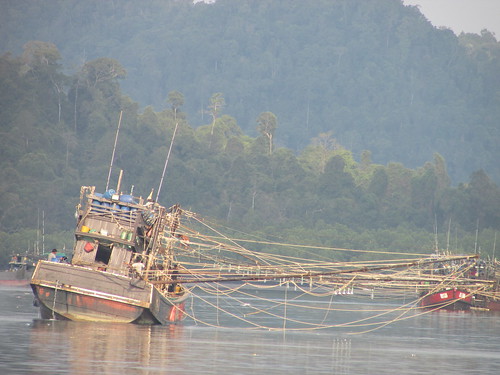
The fishing fleet at Ba Wel: A stern view shows the length of the steel lighting booms, which are supported by guying from a steel derrick mast on the foredeck and a smaller steel mast at the stern.
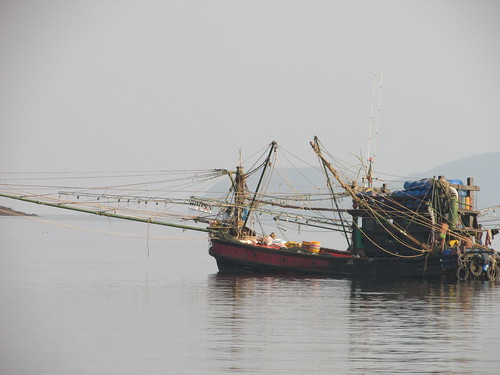
The fishing fleet at Ba Wel: This Squid Fisher has a wooden Derrick mast and both tubular and truss booms to support the lamps.
Squid are an important food source in many parts of the world. There's an introduction to the creature here. There's a little about fishing for shortfin squid here. The lighting system attracts the nocturnal squid to the fishing vessel, gathering in the unlit area beneath the hull, waiting for prey. A series of lines, carrying metal 'lures', are lowered into the water and 'jigged' up and down, encouraging the squid to attack the lures, in which they become entangled. Periodically, the lines are raised to recover the catch. Modern Squid Fishing vessels are equipped with Jigging Manchines which lower the lines, 'jig' them, raise the lines and invert the lures so that the squid fall off automatically (as outlined here) but I saw no evidence of this type of equipment in use at Ba Wel.
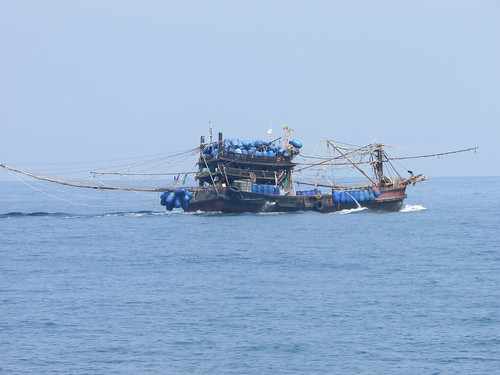
A Squid fishing vessel under way (pictured on a previous day).
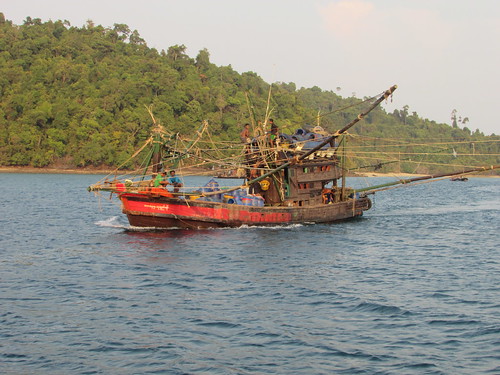
A rather ungainly-looking squid fishing vessel at Ba Wel Island (pictured on a previous day). Six men can be seen, plus, I assume, one in the wheelhouse.
After enjoying the usual sustaining breakfast, we made our return to Kawthaung under engine power: our final opportunity to enjoy simply being at sea. After a few days around the undeveloped islands, the sheer size and the bustle around Kawthaung came as something of a shock.

Arriving back at Kawthaung.
'Meta IV' anchored in the harbour and all the guests said 'Goodbye' to the crew. We piled into the dinghy with our luggage and Aung transferred us to Myoma Jetty. My Australian friends and I were booked on the afternoon flight back to Yangon, so, once Aung had retrieved the car, he drove us towards the airport. It took me a while to adjust to the level of road traffic, much of it motor cycle taxis of a distinctive design, apparently quite modern but with the driver on the right of the machine, more suited to driving on the left of the road (as Burma did, until the sudden change to driving on the right mandated in 1970).

Around Kawthaung.
As our flight did not leave for a few hours, Aung had arranged for us to relax in the luxury of the Victoria Cliff Hotel & Resort. After a light lunch in the restaurant which offered stunning views of the Andaman Sea, I relaxed in the shade by the swimming pool. It was very hot, and I couldn't muster the energy for anything requiring more exertion.
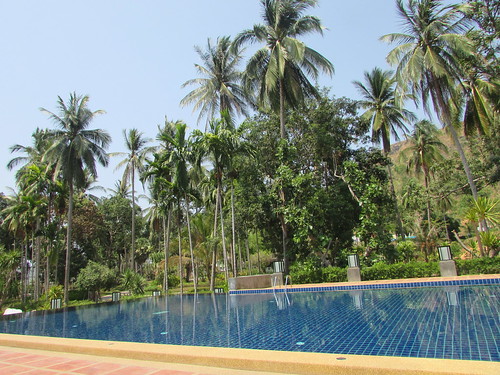
Around Kawthaung: The swimming pool at the Victoria Cliff Hotel & Resort.
Aung picked us up in plenty of time for the final road journey to Kawthaung Airport, where we left Aung. I'm afraid that, after the comfort at the Victoria Cliff, Kawthaung Airport was rather basic but, eventually, our flight arrived and I boarded with some relief.
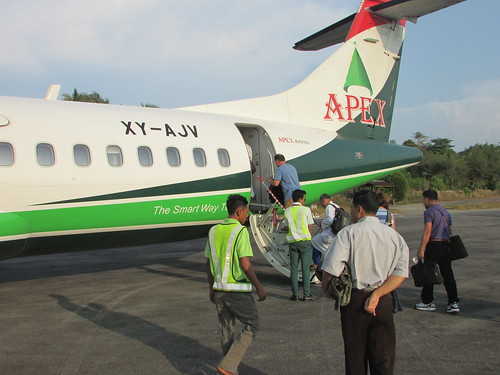
Kawthaung-Dawei-Yangon by air: Boarding the Apex flight to Yangon
On the way back to Yangon, we made the scheduled brief stop at Dawei, arriving at the Domestic Terminal at Mingalardon on time. My checked bag appeared fairly quickly, my transport was waiting and I was soon returned to the Doctor's house, where I was staying the night. The next morning I had another early start, as I was to fly north with the Doctor to Bagan.
Related posts
Next post in this series.
All my posts on my trip to Myanmar in 2016 can be found here.
My pictures
If necessary, pictures in this article can be viewed uncropped by clicking on the image. To view in other resolutions or download, select from the albums below:-
The Fishing Fleet at Ba Wel.
Sailing back to Kawthaung.
Around Kawthaung.
Kawthaung - Dawei - Yangon by air.
All my pictures on this trip.
Events of Wednesday, 27th April, 2016
Following breakfast, the guests readied themselves for a landing by dinghy on Oh Way Island for more swimming and snorkelling. As we approached the island, we passed close to a motor boat towing three or four dugout canoes. The motor boat had a wooden, framed hull and the usual long-tail arrangement driving a 2-blade propellor.
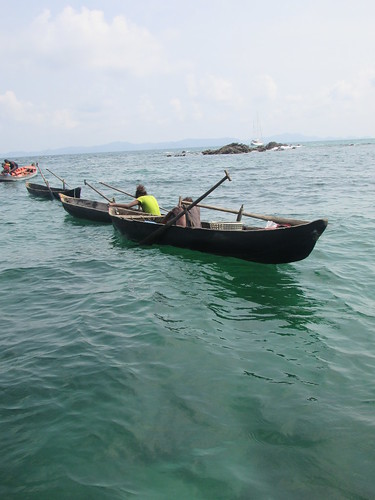
Passing local fishermen on our way from 'Meta IV' (moored in the
background) to the beach on Oh Way Island.
I'm confused as to the total number of canoes as they appeared to be at the point of 'parting the tow' so that the dugouts could operate independently but nobody seemed very interested in actually doing anything and the boats were slowly drifting into a tangle in front of us. I clearly hadn't quite adjusted to the slower pace of life in this area. I knew from earlier observations that, when action to manoeuvre the dugouts became essential, this would be achieved by rowing whilst standing, using the T-handled oars 'crossed', left hand working the right oar and right hand the left one.
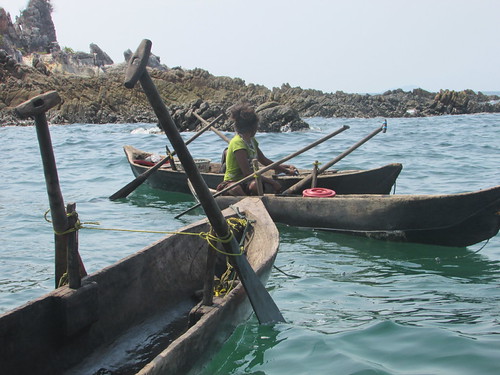
Detail of the dugout canoes, showing how the T-handled oars are tied to the posts serving as 'rowlocks'.
We left the local 'fishing fleet' to disentangle itself and they passed out of view as we rounded a small, rocky headland to make our landing. Each beach we visited seemed to be trying to exceed the tranquility and pristine beauty of the previous one.
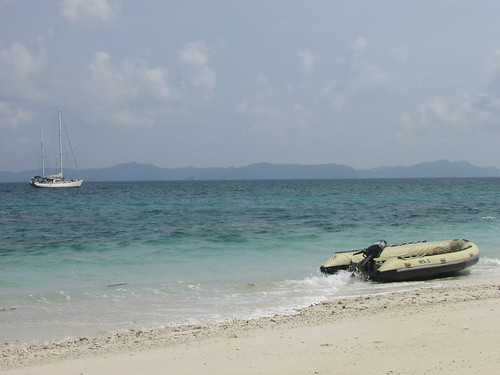
The shore at Oh Way Island with 'Meta IV' at anchor and our dinghy beached.
In an attempt to emulate the local 'pace', I neither swam, went beachcombing nor took photographs but 'enjoyed the moment', merely managing a couple of pictures of flotsam. In addition to the usual broken coral and pieces of wood, there was a well-preserved fishing 'creel' and, disappointingly, lumps of expanded polystyrene and a plastic bottle.
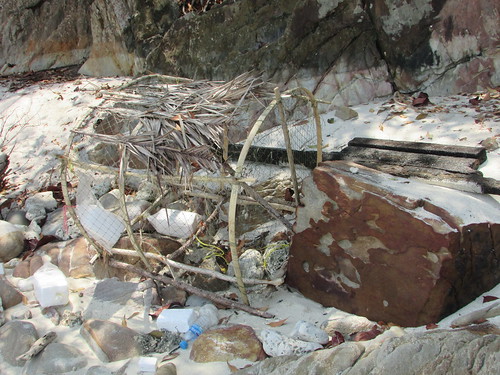
Beach visit: Flotsam.
I'm not sure how long we were on the island before Aung announced that it was time to return to our yacht for lunch. It's amazing how doing nothing stimulates the appetite. Our exploration of Lampi Marine National Park had come to an end. In the afternoon, we sailed back to where we'd spent our first night at sea, Ba Wel Island.
The crew 'set sail', literally, and to the accompaniment of only slight splashing noises from the sea against the hull and occasional flapping sounds from the sails as the wind altered, we made out majestic progress back to Ba Wel Island.

Under sail back to Ba Wel Island
The guests spent the next few hours mainly relaxing on deck whilst the captain and crew took turns at the helm.
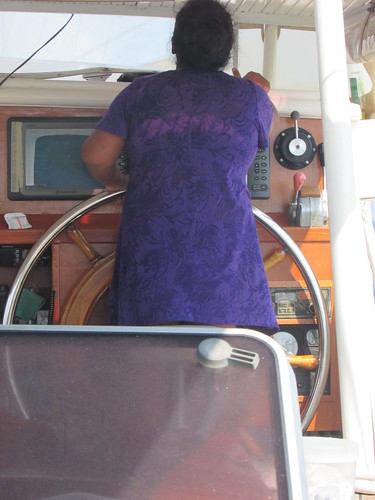
Under sail back to Ba Wel with our Thai lady cook at the helm.
From time to time we passed fishing vessels of the types with which we'd become familiar - smaller wooden craft with 'long-tail' propulsion, larger vessels with inboard engines similar to the one we'd visited earlier in the trip (see The Mergui Archipelago (day 3)) and, finally, squid fishers with ungainly-looking booms deployed sideways, supported by a complex array of ropes.

One of the smaller fishing vessels we passed as we were under sail back to Ba Wel Island.
We anchored off Ba Wel Island in early evening as other fishing vessels returned for the night, clustering around us in a number of friendly groups.
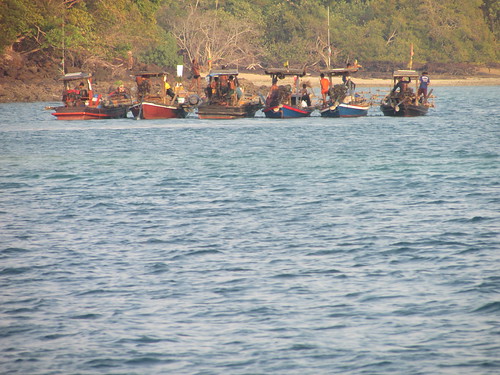
Fishing boats clustered in an overnight group at Ba Wel.
The dinghy took us ashore for what was our very last beach visit. Although the landing beach was deserted, a child's swing, comprising two ropes suspending a wooden seat from the branch of a tree, suggested that children came here to play. Having tested the soundness of the construction (I wouldn't have wanted to damage their play equipment or myself), I couldn't resist trying it out, to the amusement of my fellow guests. A short walk led us to a second beach, with views in a different direction. Here, there was a broad, white sand beach, shelving very gently into a flat, calm sea.
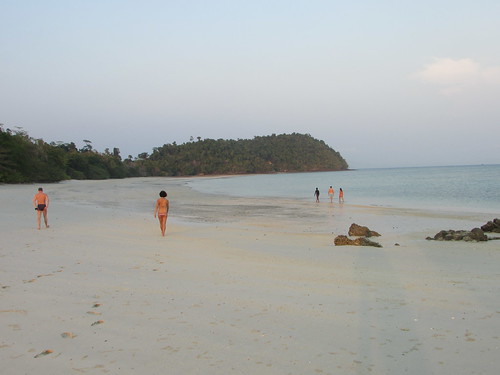
Return to Ba Wel: A gently-shelving white beach and a flat-calm sea.
Since this was my last opportunity, I had a very gentle swim in the wonderfully warm water. As I emerged from the sea, I noticed that, further out, a number of squid fishing boats appeared to be preparing for a night fishing. As I walked back up the beach, I was attracted by the leaf-pattern formed by sand excavated by an unseen sand-dweller.
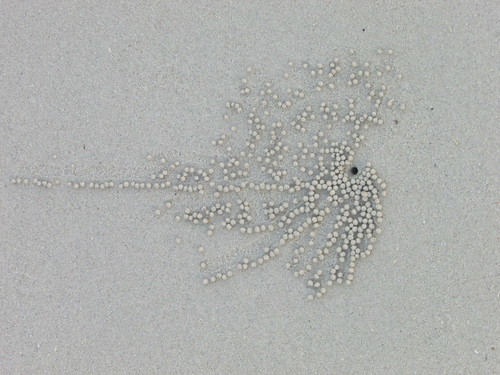
Return to Ba Wel: The leaf-pattern of sand excavated by an unseen sand-dweller.
As usual, I couldn't resist an attempt at an 'arty' shot of the sunset.
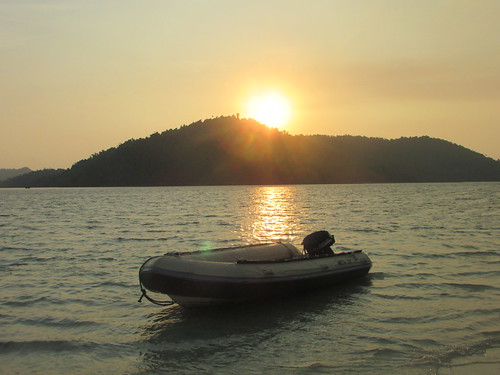
Sunset on Ba Wel Island.
As one of the last 'day' fishing vessels returned for the night, there was just time for a last picture of 'Meta IV' at anchor in the sheltered bay before boarding the dinghy for the short trip back to 'Meta IV', our final dinner and our final night aboard.
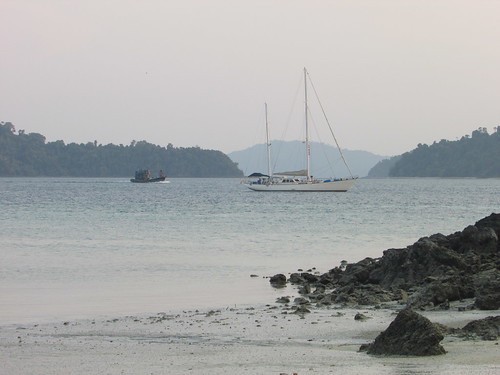
Return to Ba Wel: 'Meta IV' at anchor.
After it was fully dark, I was fascinated by a line of eerie green/blue lights stretching across our horizon. Of course, this was the fleet of squid fishing boats I'd noticed earlier. I was quite content to leave them to fish whilst I slept.
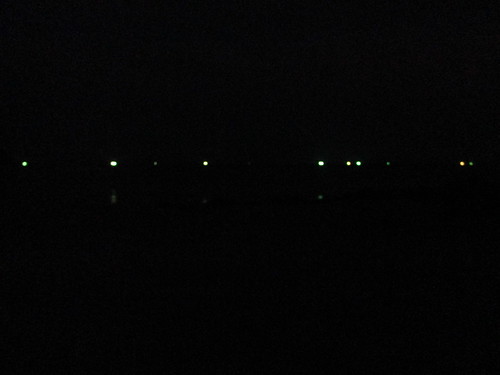
Return to Ba Wel: The eerie green/blue lights of a number of squid fishing boats working at night.
Related posts
Next post in this series.
All my posts on my trip to Myanmar in 2016 can be found here.
My pictures
If necessary, pictures in this article can be viewed uncropped by clicking on the image. To view in other resolutions or download, select from the albums below:-
Beach visit (60) and local fishermen.
Under sail back to Ba Wel.
Return to Ba Wel Island.
Events of Tuesday, 26th April, 2016
Once again, we enjoyed a very adequate and varied breakfast in the dining area towards the rear of the open deck. I'm afraid we made some good-natured fun of the captain and crew reminding them that it was our fourth day on a sailing yacht and we hadn't yet seen a sail unfurled. They explained that the morning's itinerary was a journey of a few hours to Kyunn Philar East to replenish our fresh water tanks and they set about raising sail for the cruise. There wasn't a lot of space on deck for handling the ropes and windlasses which control the sails and the inexpert help of the guests was not required, so we watched with interest whilst keeping out of the way.
I mentioned in an earlier post that 'Meta IV', though originally having a ketch rig, had been simplified to a 'Bermuda-rigged Sloop' with simply a headsail and main sail, both supported by the mainmast. The 'mizzenmast' originally used by the ketch rig, whilst still present, carries no sail.
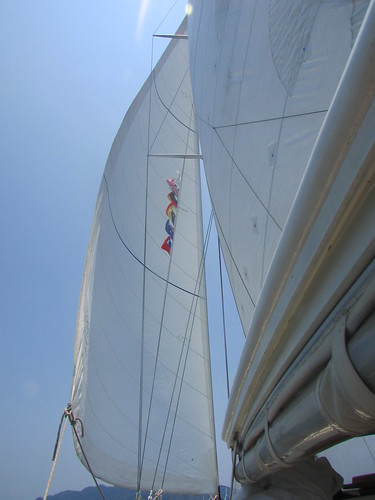
Under sail to Kyunn Philar: L: Headsail R: Mainsail. Note 'Guest flags', celebrating the countries of origin of the Guests.
When not in use, the triangular mainsail is stowed horizonally, folded into a canvas 'pouch' carried by the horizontal boom to which the bottom edge of the mainsail is secured. A headrope attached to the top corner of the mainsail is carried over a pulley at the top of the mainmast and led down to deck level where a winch or windlass near the cockpit is used to manage the raising and lowering.
The headsail, also triangular, is managed by a furler mechanism. The 'forestay' (which runs from the top of the mainmast to the bow) becomes a shaft which is rotated by ropes to unfurl or furl the headsail. When not in use, the headsail is thus tightly coiled around the forestay, ready for use. The control ropes are also taken to winches or windlasses near the cockpit. Bringing the winches and windlasses near the cockpit makes sail management easier with a small crew.
Most of the windlasses on 'Meta IV' are from Maxwell Marine. Headquartered in Auckland, New Zealand the company produces a wide range of winches/windlasses/capstans and associated equipment for boats.
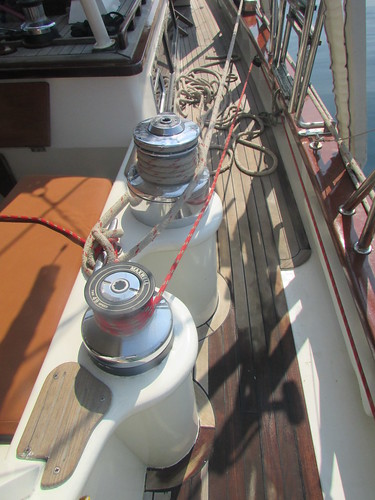
Windlasses by Maxwell Marine on the starboard side of 'Meta IV'.
The headsail furler on 'Meta IV' is from Harken Inc. who are based in Pewaukee, Wisconsin. Their product range includes headsail and mainsail handling equipment, winches, pulley blocks and related accessories.
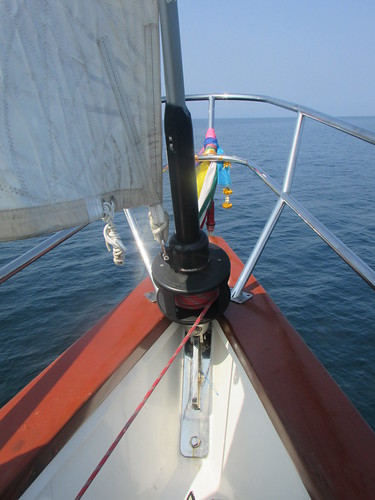
Lower end of Harken Headsail Furler on 'Meta IV'. Note the coloured scarves attached to the bow.
Once the sails had caught the wind, the diesel engine was shut down and we continued at around 8 knots. As we made our silent but majestic progress toward Kyunn Philar East, we passed a group of squid-fishing vessels. Although the basic boat design was similar to large, wooden fishing vessels we'd already seen when squid fishing is in progress, with massive, elaborately-guyed horizontal booms extended on both sides, and a complex system of ropes and pulleys for handling the lures, the vessels acquire a very weird appearance. I hope to write more about this interesting industry later.
Squid fishing vessel.
After around three hours cruising, we approached Kyunn Philar East so the foresail was furled, the mainsail was lowered and our diesel engine was restarted as we manoeuvred towards land. Three fishing boats were anchored together in the bay. Steel hulled, fairly large, they appeared rather more modern than other vessels we'd seen and the wheelhouse was perched on top of the superstructure with all-round windows. A massive net was piled high on the foredeck together with a novel design of derrick presumably for handling the net. Three crew members on the nearest boat viewed the visitors with interest.
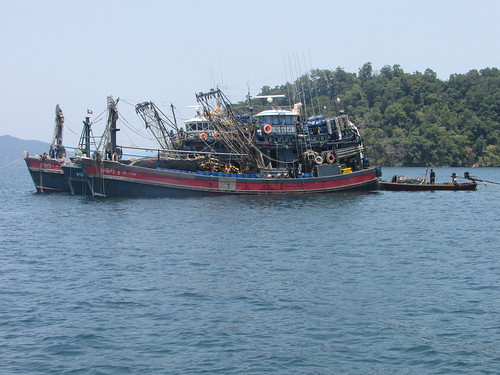
Fishing Boats anchored at Kyunn Philar.
A low, wooded hill led down to the water's edge. There were few buildings visible but one narrow patch of hillside had been largely cleared of trees and a flight of concrete steps led straight up from the shore to the top of the hill where a golden pagoda stood on a concrete platform supported by concrete piles.
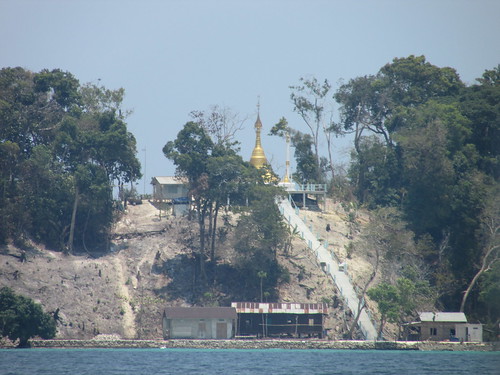
Kyunn Philar Pagoda.
Looking to the right, there was activity about 100 yards off the beach where three smaller fishing boats clustered around a rectangular, moored raft which carried a building with a corrugated iron roof and woven bamboo sides.
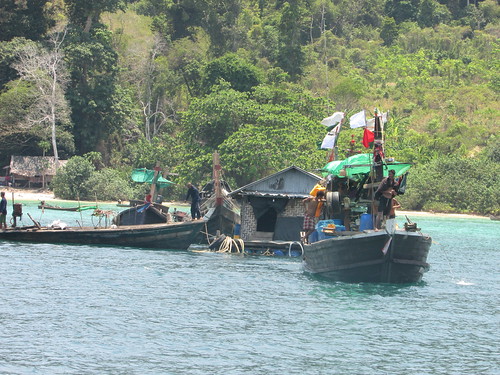
Kyunn Philar East, Mergui Archipelago: The floating Water Station.
Seeing a number of plastic hoses dangling from the raft, I concluded that this was where we would replenish our water tanks. I assumed that a pipeline ran down the hillside and extended across the sea bed to the raft. There was no sound of a pump on the raft, suggesting that, having dammed a suitable perennial stream, the hose permanently discharged freshwater into the sea. As we slowly approached the raft, the three fishing vessels moved away and 'Meta IV' attempted to throw a mooring line to a man on the raft.
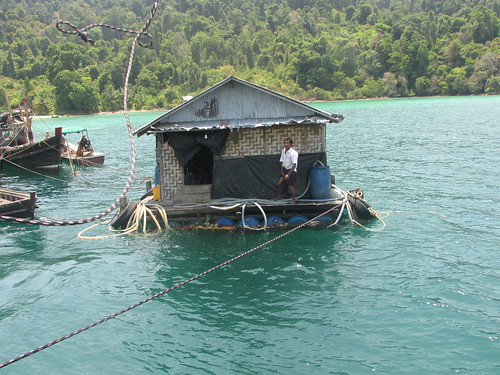
The Water Station raft. One line is already attached to the raft on the right and a second has been thrown.
It took a few minutes to secure two lines to the raft and receive the end of one of the plastic hoses. Set in our deck on the port side was the filler for the one freshwater tank. With the metal cap unscrewed, the end of the hose was inserted and the watering process started.
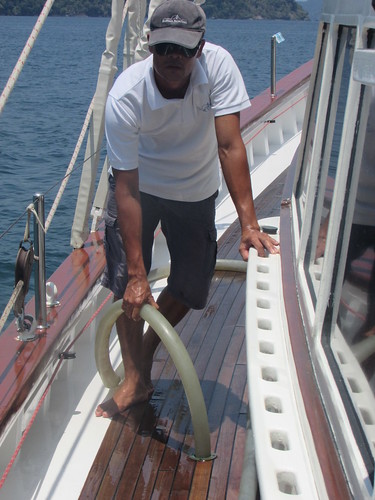
The Captain filling the port fresh water tank.
When the port tank was full, the hose was transferred to a similar filler on the starboard side deck to fill the other tank.
The sea around the raft was teeming with fish in a circling frenzy, presumably after food.
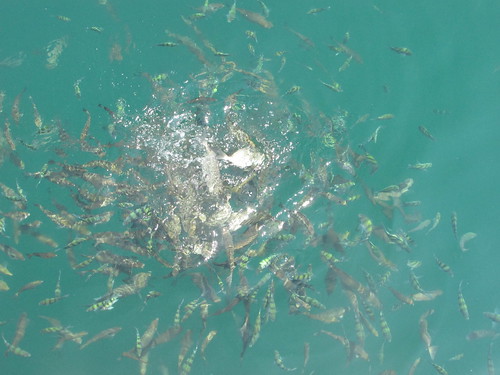
Fish in a frenzy by the water station raft.
On completion of taking on water, we manoeuvred away from the raft using the engine and then went back to 'sail power'.
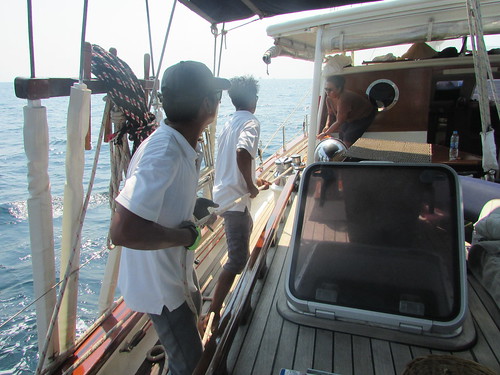
Sail power: Unfurling the headsail.
With the Captain at the helm, we sailed around Kyunn Philar Island towards the west side, passing various fishing boats on the way.

The Captain at the helm of 'Meta IV' under sail.
We anchored off a beach with coral reefs and transferred to the dinghy which took us nearer to the shore allowing my fellow guests to take to the water for snorkelling. I stayed in the dinghy, quite happy in the peacefulness of the spot. Even when Aung, who was the 'boat driver', donned snorkel gear, left the boat and swam to make sure that all the snorkellers were safe, I was quite content to be adrift, alone in the dinghy. Aung returned and we landed on the beach, ready to take the guests back to 'Meta IV'.

Kyunn Philar: We spent the afternoon in this tranquil bay.
I had neither the inclination to swim nor explore very far: I was content to sit in the sun and enjoy the moment. As dusk approached, Aung summoned the snokellers and returned us to our ship in the dinghy.
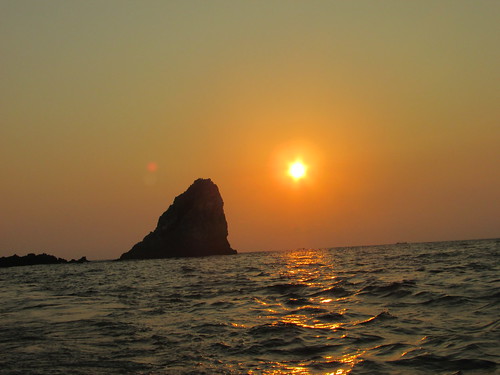
As dusk approached, we returned to 'Meta IV' in the dinghy.
As usual, dinner was the main event of the evening, after which I was ready to retire for the night.
Related posts
You can read about the following day aboard 'Meta IV' here.
All my posts on my trip to Myanmar in 2016 can be found here.
My pictures
If necessary, pictures in this article can be viewed uncropped by clicking on the image. To view in other resolutions or download, select from the albums below:-
Sailing Vessel 'Meta IV'.
Under sail to Kyunn Philar.
Kyunn Philar East, Mergui Archipelago.
Sail power.
Viewing coral and on the beach.
Events of Monday, 25th April 2016
Wooden-hulled fishing boats of the Mergui Archipelago
Once again, we took our morning tea or coffee on deck as fishing vessels set off in various directions around us and the sun rose higher in the sky. Each ship was notably individual but perhaps we can distinguish some typical characteristics. The wooden-hulled boat shown at rest below (there's also a larger version of the image available) had a crew of six.
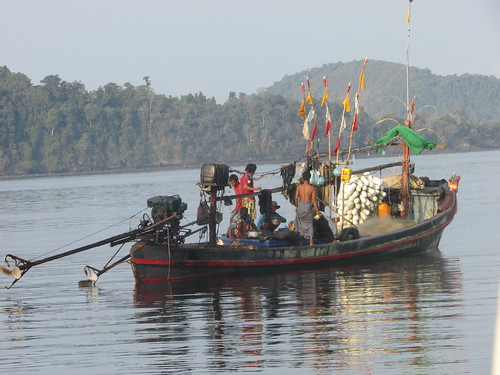 The Fishing Fleet at Nyaung Wee: A typical wooden-hulled drift net fishing vessel with two engines and 'long-tail' 2-blade propellors. Six crew can be seen.
Click here for a larger view.
Tied to the bow (on the right) a number of coloured scarves can be made out, with some cut flowers. These are presumably to propitiate the malign spirits, the 'Nats'. In Burma, belief in the 'Nats' co-exists with Buddhism. There is a square-section post near the bow which carries a series of drooping leaves, I assume again to please the 'Nats'. This post carries a cross-arm to support a covering (furled away in this picture). When extended towards a similar crossarm on a second square post, this covering provides some protection against the intense heat of the sun. The bow post also supports what appears to be a VHF radio antenna. On the foredeck, there's a large pile of white plastic moulded floats presumably attached to the top edge of a long fishing net arranged to hang vertically when deployed. The rather gay-looking flagpoles are attached to floats and and are intended to be attached to the fishing nets to assist finding the net again prior to hauling in a catch. Each flagpole has a battery-operated beacon near the top, no doubt invaluable when fishing at night. The deck is provided with an untidy string of electric light bulbs running fore-and-aft for use after dark, but I couldn't work out what provides the power. Elsewhere, large car batteries driving a solid-state inverter are common.
The crew can be seen towards the stern apparently finishing breakfast, in an area with a number of large moulded plastic boxes as used to store the 'catch'. Towards the stern, there's a shorter square post topped with a small 'table' which carries a moulded plastic fuel drum for diesel, which is fed to the engine through an uncertain-looking arrangement of flexible hoses.
The motive power is provided by a 'long tail' arrangement, common in Asia. The engine is mounted on the centreline of the hull above the sternpost on a pivoting and tilting frame. The engine spins a long propeller shaft carried in a tube with a propeller (in this case, a 2-blade propeller) at the far end, hence the name. The long propeller shaft is necessary to place the propeller at a reasonably shallow 'angle of attack' to the water for effective propulsion. The 'helmsman' controls the boat by physically manoeuvring the engine, lowering the propeller into the water for drive or lifting it clear as required.The propeller blades are protected by a steel rod 'bumper' welded underneath (a bit like a 'tail skid' on early aircraft) to prevent damage when operating in shallow water. Directional control is achieved by pivoting the whole engine and 'long tail' assembly left or right, producing 'thrust vectoring'. In Thailand, motor car engines frequently provide the motive power for 'long-tail' boats but, in Myanmar, I think I've only seen the rugged Chinese-made single cylinder compression-ignition (diesel) engines used, presumably a consequence of Myanmar's long period of isolation from Western markets. The exposed engine flywheel also drives a small water pump which lifts water from the sea, circulates it through the engine to provide cooling and expels it through a pipe attached to the long tube housing the propeller shaft. The end of this tube is shaped so that the water is discharged against the rear of the propeller blades, throwing up an impressive spray.
The boat illustrated, like many, also has a second, similar engine. I'm not sure whether this is to improve the top speed, increase reliability, improve manoeuvrability or for other reasons. The second engine is mounted on the gunwale (the strong top edge of the side of the boat) on the port (left) side a little forward of the stern on a separate pivoting and tilting frame.
The picture below shows a rather extreme example of this type of wooden-hulled boat, in this case provided with three 'long tail' engines.
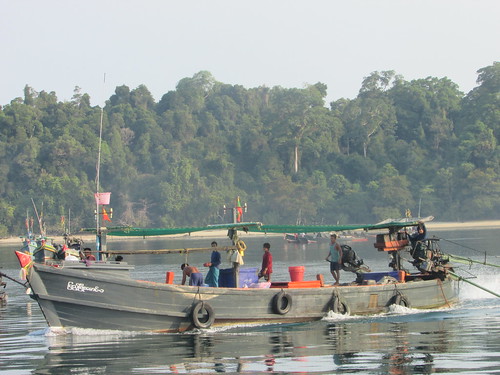 This extreme example of the wooden fishing vessel, seen leaving Nyaung Wee had three engines and long-tail propellers and a crew of seven.
Click here for a larger view.
Again, there are scarves and (rather dessicated-looking) flowers on the bow, on the left of the picture. There are three square-section vertical posts, this time all tall enough to carry a green sun-shade almost the full length of the deck. This green shade is deployed and securely tied in place with the usual string of electric light bulbs underneath. The post near the bow also supports a VHF radio antenna and, on a steel cross-arm, two navigation lights. The second square post also carries a steel cross-arm with two navigation lights, plus a small Myanmar National Flag. The post near the stern has a wooden platform carrying moulded plastic fuel drums for diesel and, above this platform, there's a small rectangular, permanent roof which is presumably a sun-shade for the fuel. Diesel has a much higher flashpoint than petrol, making it a much safer fuel from the point of view of flammability.
To provide motive power, the first engine is mounted on the centre line (being controlled by a man I take to be the 'Captain'), the second engine (which does not appear to be in use) is on the port side, a little ahead of the stern and a third engine is mounted on the starboard side, significantly further forward and being controlled by one of the crew.
Steel-hulled fishing boats of the Mergui Archipelago
A group of larger fishing vessels remained at anchor and, silhouetted against the sun, I thought they looked vaguely threatening.
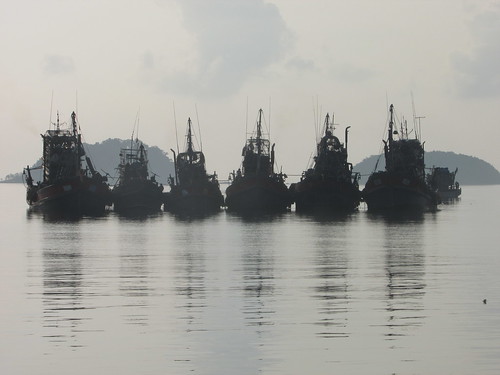 Larger fishing vessels anchored at Nyaung Wee.
After we'd enjoyed a generous breakfast, our host said "Would you like to visit a fishing boat?" and we all enthusiastically said "Yes!" so, a little later, we all piled into the dinghy and I discovered that our destination was to be one of the larger vessels I'd photographed earlier. Now the sun was illuminating the boats, the sense of menace had gone but their size meant they were still imposing! These were steel-hulled vessels, which seemed intended for deep sea fishing. There were variations in design between the various ships: most were painted in a livery of grey, with the upper part of the hull in red. The bow of each boat carried the expected scarves: more puzzling was that the name of each vessel had been deliberately, but not completely effectively, obscured by a rectangle of material. An anti-fisheries protection measure? I wondered.
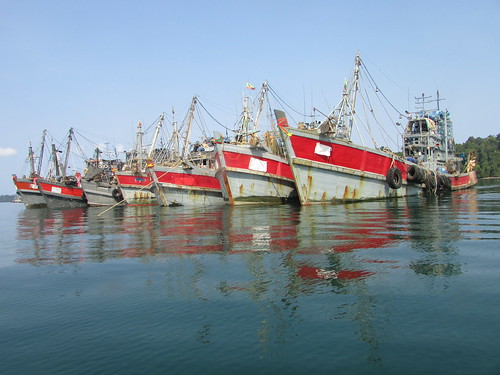 Visiting a fishing trawler.
We approached the port side of the outside vessel of the group. The foredeck of the boat mounted a serious-looking derrick, with a derrick mast using 'stiff-leg' staying and a single boom (other vessels nearby also had derricks, but with the mast guyed). The top of the derrick mast carried the familiar series of drooping leaves and Myanmar National Flag. The 2-storey superstructure (with the wheelhouse at the forward end, deck level) extended towards the stern of the boat and, with the addition of extensive storage on the roof of the superstructure for a large number of moulded, plastic drums (I assumed for the 'catch'), the ship towered above us. At the stern, on both sides, large metal-bound wooden boards were stowed - 'otterboards' used to keep the open end of the large conical fishing net dragged behind a trawler from closing. This seemed to fit with the heavy-duty winch on the port side, just level with the wheelhouse (I assume that there was a second, similar winch on the starboard side) and the row of large tyres hanging from the port side level with the foredeck (to prevent damage to a 'side trawl' net being hauled aboard).
Our inflatable dinghy came alongside the hull and, with my impaired mobility, I thought "I wonder if this is completely wise?". A couple of my fellow-passengers climbed onto the deck successfully, so I thought I'd better try. Just to my left, I spotted a scupper in the hull of the vessel. 'Scuppers' are openings in the 'wall' ('bulwark') around the deck provided to allow water to drain off the deck and I realised that this opening offered a reasonable foothold. So I stood on the inflated tube forming the side of our dinghy, moved slightly to the left and with some difficulty managed to lift my left foot and wedge it into the aperture of the scupper. Reaching upwards, I grasped the steelwork and, with some effort (and, I think, with some assistance from behind) clambered onto the deck.
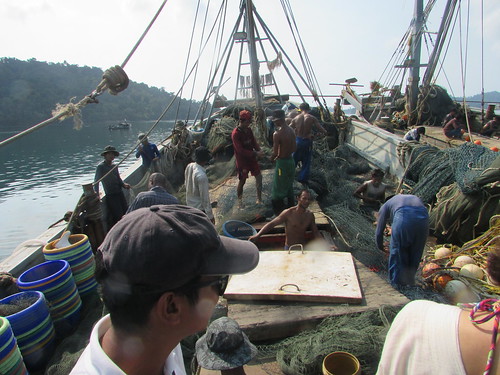 On board a moored fishing trawler at Nyaung Wee Island, Mergui Archipelago.
Every inch of deck seemed to be covered with green fishnet and I counted 12 men engaged in repairing the nets. In addition, I spotted what I took to be the Captain and Mate relaxing in the shade outside the wheelhouse. I took a picture of the 'net repair kit' - a number of plastic moulded shuttles, each loaded with a length of variously-coloured polypropylene rope.
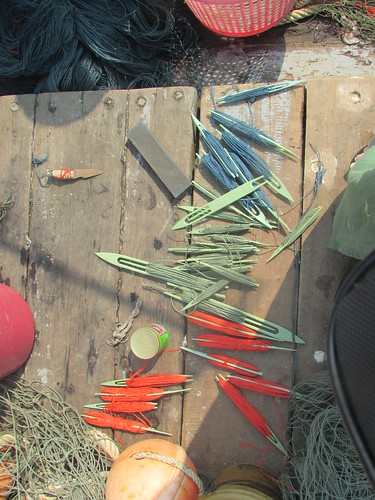
'Net repair kit'.
One of the men was standing in the hatchway to the forward hold, and he sorted a selection of decent-sized fish plus a number of the ubiquitous squid into a plastic bowl for us to take back to the cook on 'Meta IV', for which we paid with two trays of canned local beer. After watching the net repairing activities for a while and taking more photographs, it was time to leave the boat. By reversing the procedure I'd used to clamber aboard, I descended to our waiting dinghy without incident. When everybody was back on board, we headed back to 'Meta IV'.
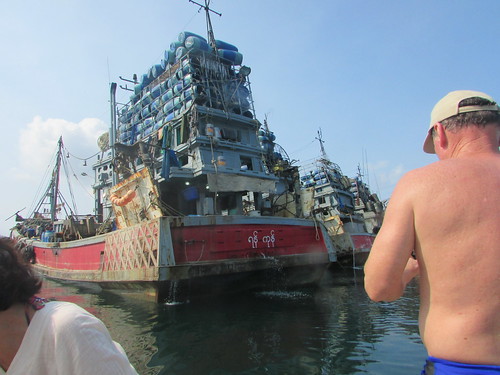 View of the stern of the fishing vessel we had just visited.
On our way back to our yacht, we paused briefly at one of the smaller wooden-hulled boats where the crew were happy to exchange more fish for cans of drink. While this transaction was in progress, the smiling captain relaxed near the bow, smoking a cigarette, shaded from the sun by the rather tattered roof covering.
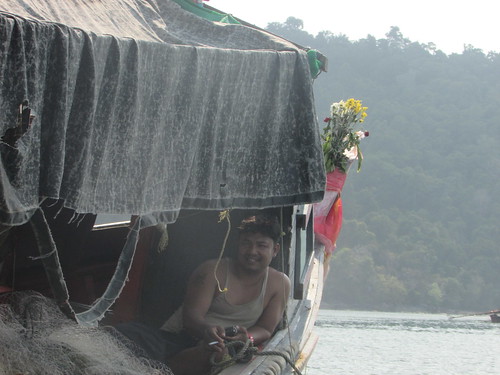 The captain of a smaller fishing boat relaxing. Note the coloured scarves and spray of flowers attached to the bow.
The mangrove forests of Lampi Island.
Once we were safely back on 'Meta IV' she set off north towards the the west coast of Lampi Island within Lampi Marine National Park, the only marine national park in Myanmar. There are two perennial rivers on Lampi Island and we anchored offshore near one of these, Lampi South River. Once again, we all piled into the dinghy for a cruise part of the way upstream on the river.
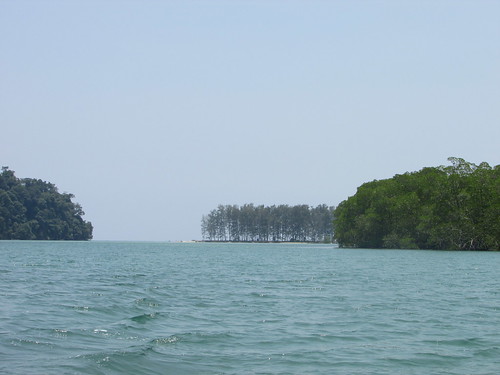 Looking back to the sea as we head upriver to the Mangrove Forest of Lampi South River.
No riverbank was visible on either side - the vegetation overhung the water. As we continued, the elaborate the other-worldly root systems of mangrove appeared all around us - they give the trees the appearance that they are capable of walking. The complex adaptations provide filtration of the high salt levels possible in tidal areas and help resist the effect of wave action.
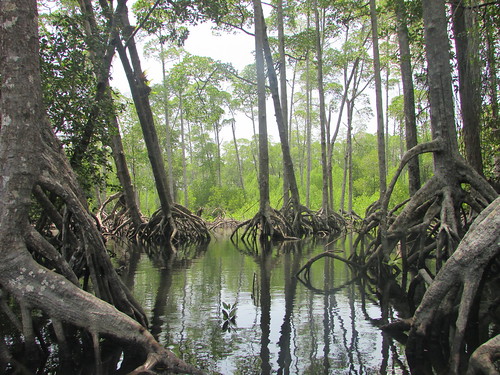 Mangrove Forest, Lampi South River.
With the noisy outboard stopped, we were able to drift with the current for a while, emphasising the 'other-world' feel of these locations.
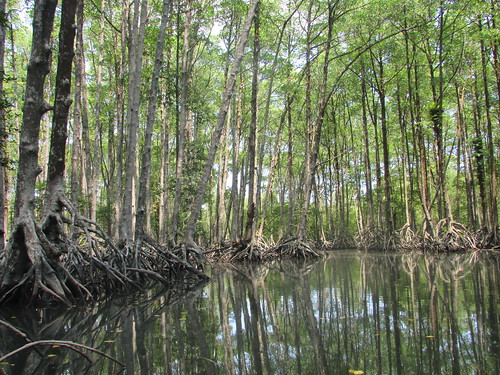 Mangrove Forest, Lampi South River.
There's a Wikipedia article on mangroves here and I've written about visiting mangroves in the Asmat area of Indonesia here and at Bako National Park, Sarawak, Malaysia here.
Beach Visit to Island 60
After our fascinating trip by inflatable dinghy to Lampi South River, our ship continued northwards to a small, uninhabited island known, I believe, as 'Island 60' where another beach visit had been offered. Whilst we were preparing to go ashore by dinghy, we were passed by a group of local fishing boats. The wooden-hulled lead boat had a 'long tail' propulsion system and carried a Myanmar National Flag, allowing it to tow six dug-out canoes, each carrying one person. As far as I could make out, the motor boat held a man and woman, the towed boats carried an old woman, a girl, a boy, a woman, a man and another woman.
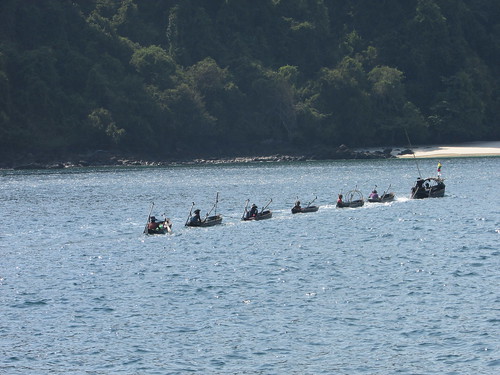 Local Fishing Boats near Island 60.
As I watched, the raft of seven boats passed a couple of stationary boats - a large dug-out fitted with a 'long tail' motor with one man aboard which had towed a smaller dug-out carrying a woman to their current position. By the time our dinghy has taken us ashore, there was no sign of the other boats and we were alone on a pristine beach allowing swimming, snorkelling and beachcombing.
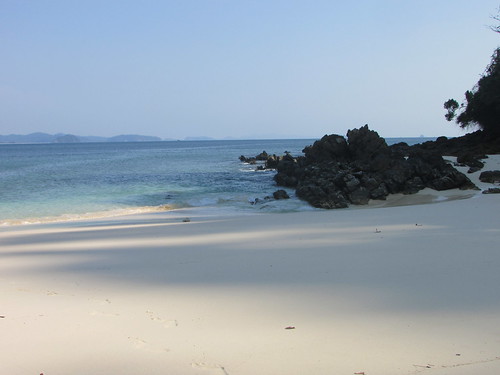 The Beach on Island 60.
Ko Phaar Island and Hornbills
By the time we left the beach at Island 60, it was late afternoon but our host promised one more excursion by dinghy to see hornbills. We took the dinghy to a location a couple of hundred yards from the shore of the heavily-wooded island of Ko Phaar and waited as dusk darkened the sky. Before long, the distinctive silhouette of a hornbill was spotted, heading for Ko Phaar Island and passing overhead close to our position. I managed to capture a not-very-good image of this solitary bird.
 A single Hornbill returning to Ko Phaar Island.
After a few minutes, three hornbills approached from a different direction. We were clearly in the right place, at the right time, for hornbills continued to appear, in ones, twos and threes, from various directions, heading for their overnight roosts high in the trees of Ko Phaar Island.
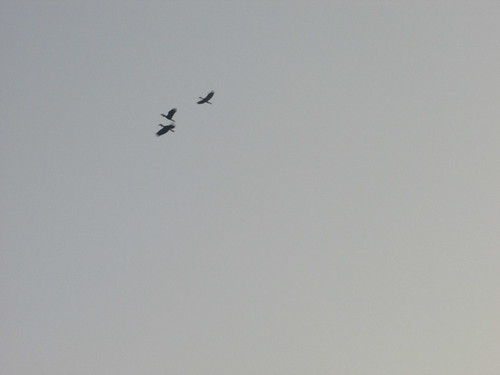 The Hornbills of Ko Phaar Island.
I'd seen the Hornbills in captivity elsewhere, (such as at Port Moresby Country Park, Papua New Guineau, as described here) but to see numerous birds in the wild, returning to roost on Ko Phaar Island, was a wonderful sight.
There's a Wikipedia article on this interesting family of birds here.
After a fairly intensive day, we returned to 'Meta IV' for another splendid dinner, after which I was quite ready to retire to my cabin.
Related posts
My report on the following day aboard 'Meta IV' can be found here.
All my posts on my trip to Myanmar in 2016 can be found here.
My pictures
Pictures in this article can be viewed uncropped by clicking on the image. To view in other resolutions or download, select from the albums below:-
The Fishing Fleet at Nyaung Wee
Visiting working fishing vessels.
Mangrove Forest.
The Beach on Island 60 and Fishing Boats.
Ko Phaar Island, Mergui Archipelago.

