Showing posts with label Malta. Show all posts

Wednesday, 12 December 2012

Return to Malta (Part 8)

Events of Saturday 30th November 2012

Rain had been forecast for the day we were leaving so when I decided to have a final walk to Ghajn Tuffieha Bay, I took a packable raincoat. There was a fairly strong wind producing much larger waves than earlier in the week and rain seemed to be 'spitting'. However, I still enjoyed the exercise. Returning to the hotel past Ghajn Tuffieha Tower and along the cliff path, the rain was getting worse and the raincoat proved a wise addition. By the time I reached the hotel, the rain was sluicing down so I spent the rest of the morning working on the computer as heavy rain battered the windows. Fortunately, by the time we were ready to leave the hotel, the storm had passed.

Dean drove us to the airport at Luqa and returned the hire car. After check-in there was plenty of time in hand before boarding our Air Malta flight back to Heathrow.

It had been a very enjoyable Return to Malta for me. I was surprised at the extent of the, I suppose, inevitable changes which had occurred. My visit to the Lascaris War Rooms (described in Return to Malta (Part 7) induced me to find out more about the suffering and bravery on the island during the second world war and I've referenced a book and a film in that article.

References

During my stay, I'd acquired a number of publications about Malta which are listed below.

'Top 10 Malta & Gozo' published Dorling Kindersley (ISBN: 978-1-4053-6091-3)

I'm not a great fan of the 'Top 10 beaches ... towns ... temples ... bars & restaurants' format but there is a lot of good information in here. There are maps in the fold-out front cover and rear cover, plus a curiously-shaped pull-out map and guide which is plasticised.
'Malta History & Tradition' published BDL Publishing (ISBN: 978-99957-20-96-4)
A slightly more conventional approach produced in Malta with excellent photographs. There are maps in the fold-out front and rear covers.
'AA/Macmillan Malta and Gozo Traveller's Map' published AA/Macmillan (ISBN: 0-7495-0062-X)
This double-sided fold-up map is inexpensive and fine for most purposes.
'The mAZe Street Atlas Malta and Gozo' published Uptrend Publishing (ISBN: 978-99932-99-12-7)
This is a detailed 'A to Z' style street atlas with comprehensive street indexes produced in Malta and suitable for serious navigation.
Photographs

The photographs on this trip are grouped into a number of 'sets' on Flickr. Links in earlier posts take you to these 'sets'. All the 'sets' form a 'collection' on Flickr titled Malta.

Saturday, 1 December 2012

Return to Malta (Part 7)

Events of Thursday 29th November 2012

Ann and Dean had made arrangements for the day so I decided to travel to Valletta on the Route 44 Arriva bus (see their website here). The bus left from a stop just outside the hotel at 08:50 and took about an hour to reach Valletta. The route took in a number of small towns where the streets appeared quite unsuitable for buses but we got through unscathed. The bus was fitted with a passenger information indicator showing route number, destination and name of the next stop. This was backed up by computer-controlled voice announcements. I was quite impressed that the displayed information changed correctly throughout the journey.

Valletta Bus Station

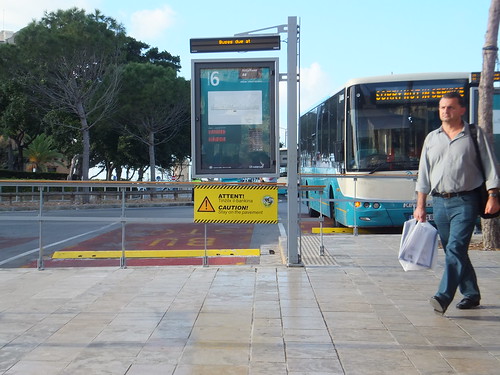
On my first visit to Malta, the buses (then individually owned) left from a series of stands arranged in a circle around the Triton Fountain. Now, the buses go around the fountain to a dropping-off point before moving into either a bus parking area or a series of new stands with a dozen or so stands angled to a concourse. Buses drive into the stand, pick up passengers and then back the loaded bus out of the stand, hoping to avoid all the other movements of buses arriving and departing. I had hoped that this type of bus station had been thoroughly discredited by now but apparently not. Each stand has a sign facing the bus driver reminding the driver (in English and Maltese) to check his mirror before reversing and seek assistance if in difficulty. One would have hoped such instruction would be redundant. The bus station at Valletta is clearly new and a series of ugly, bright orange kiosks set in a line along the concourse were still being fitted out by builders.

Part of the new bus station in Valletta.

Entering Valletta

Valletta is built on a peninsula thrusting north-east with Marsamxett Harbour on the left and Grand Harbour on the right. The older buildings are 16th century, built by the Order of Saint John of Jerusalem (the 'Knights Hospitalers'). The city lies inside massive walls and bastions (the sticking-out bits of wall with a pointed plan which improve the ability of defenders to resist outside attacks).

Most passengers arriving at the new bus station walk through the City Gate area, now a breech in the huge walls following demolition of the previous City Gate in 2011. Major building work is in progress to create a complex comprising a new Parliament Building, Open Air Theatre, Freedom Square and Gate all designed by Renzo Piano. This work is on the site of the former Royal Opera House destroyed by bombing in the Second World War. Once past the building site, you enter Triq-Ir-Repubblika (Republic Street), a wide pedestrian thoroughfare which runs through the centre of the city to Fort St. Elmo at the tip of the promontory. A grid of streets and passages extends on both sides of Republic street. Somewhat bewildered by the activity in the City Gate area, I made my way to one of the most famous buildings in Valletta, Saint John's Co-Cathedral.

Saint John's Co-Cathedral

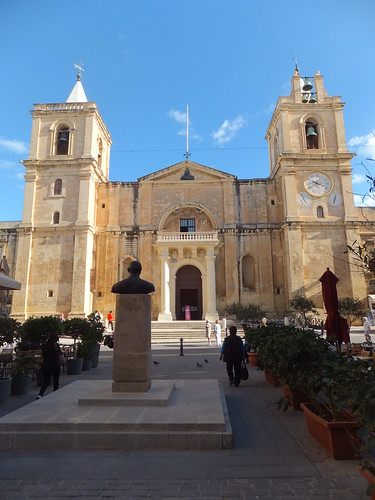
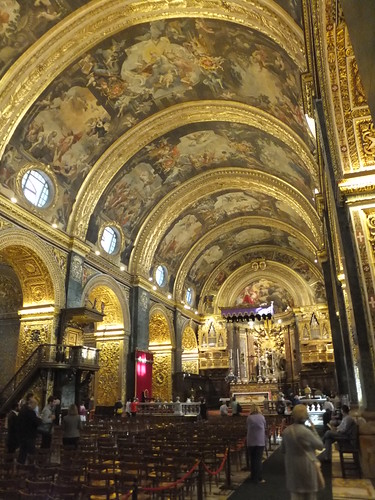
The external appearance of the building is austere but inside redecoration has resulted in a riot of the Baroque.

Externally, Saint John's Co-Cathedral is austere ...

... internally, it's a riot of the Baroque.

In addition to its religious function, Saint John's Co-Cathedral serves as an important museum. Even the (highly recommended) Cathedral Website refers to the Cathedral as "one of the most popular cultural attractions visited by tourists in Malta". In the Oratory, two famous paintings by Carravagio are displayed together with other works of art. There are Galleries of Tapestries, Sacred Vestments and Choral Books.

Exploring Valletta

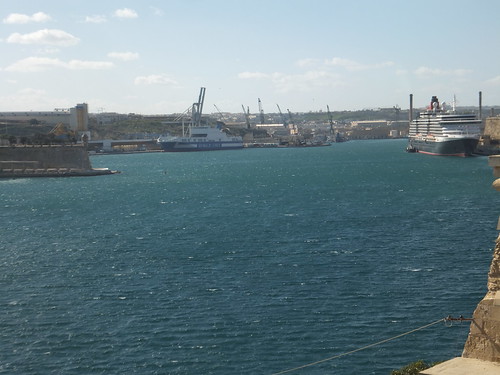
I was happy to explore on foot, walking towards Fort St. Elmo and then turning right to view Grand Harbour from the Siege Bell Monument which commemorates the victims of the Second World War Siege. I continued walking along the waterfront, past the Fish Market and then went up a series of steps behind waterfront properties leading to a sign to Lascaris War Rooms, with a modern apartment block and elderly offices on the landward side. It all looked rather improbable.

Grand Harbour viewed from the Siege Bell Monument. The Cunard cruise ship 'Queen Victoria' is berthed on the right.

Lascaris War Rooms

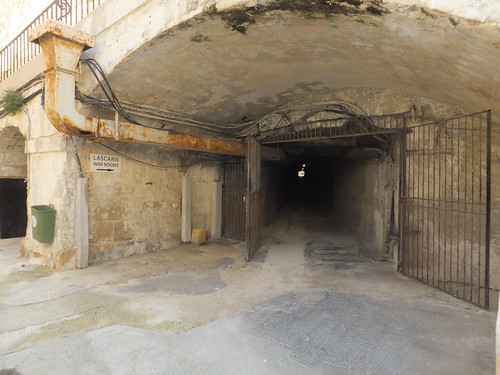
I entered the offices which are now in use by various government departments but, I guessed, originally military. A photocopied sign to 'Lascaris' led me to the upper floor and a small square where a further sign confirmed that a pedestrian tunnel cut through the rock was the route.

The tunnel leading to the Lascaris War Rooms.

Some distance down this tunnel, I found an open door on my left. I had arrived! Having paid my admission fee, I was ushered into an adjacent room where a small group of visitors were waiting for the tour to start. We were in a complex of rooms cut into the rock deep underground below Upper Barracca Gardens.

One room had been converted into a cinema where we watched a black and white newsreel film from the Second World War describing the convoys which just managed to avoid the collapse of Malta under the fierce Axis bombing. It was this bombing which led to the award of the George Cross collectively to the people of Malta. Our well-informed guide then led us through a series of rooms which have been restored to their World War II appearance, using original furniture and fittings.

In World War II, the defence of Malta and all Allied offensive operations in the Mediterranean was directed from this top-secret location which had an Operations Room for each of the services, supported by various offices and a meeting room. The accommodation was modest. Documents were produced by typewriter, communication was by primitive-looking direct-line telephones with a cord switchboard to handle other calls.

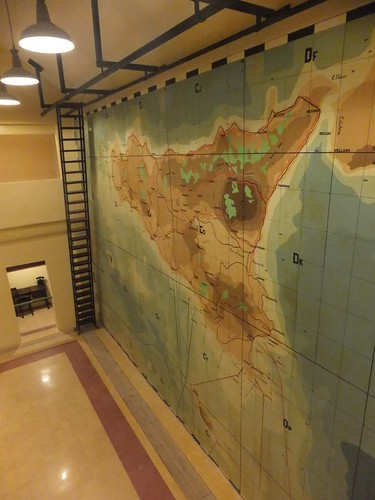
The army control room, with its large wall map showing Sicily. Malta is right at the bottom of the map.

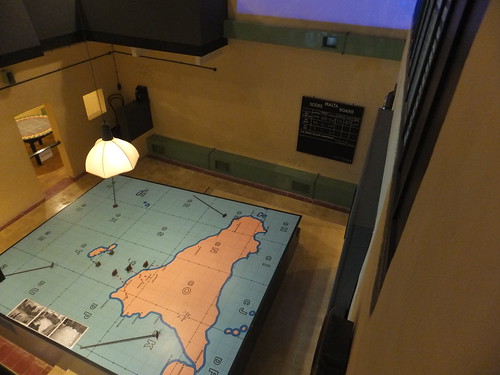
The highlight of the tour was probably the large RAF Fighter Control Room with its large (original) map table. As we stood on the balcony, looking down on the map table, we were shown another wartime film of the work of the Control Room.

The RAF Fighter Control Room.

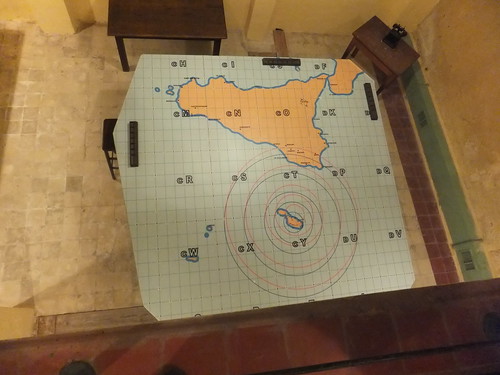
Next, we entered the Naval Control Room, supervised from a curious glass-fronted wooden office on the balcony. Beyond this, there was a room holding small memorabilia. The original function of this room was not known, so it has been restored in 'bland museum' style. We saw a passage going on to other parts of the complex but water ingress may prevent these areas being opened to the public.

The oddly-shaped map table in the Naval Control Room.

Post-war, the complex became Mediterranean Fleet HQ until 1967 and then NATO used it for ten years as a Strategic Communications Centre.

I found this a fascinating visit and followed up afterwards by obtaining the book and film listed below in 'References'. I left the War Rooms through the second tunnel entrance, climbing up to Upper Barracca Gardens near to the Bus Station.

Starting in 2009, the restoration of the complex was carried out by Fondazzjoni Wirt Artna (the Malta Heritage Trust) which operates a number of heritage sites, described on their website. The Lascaris War Rooms website is not yet developed at the time of writing.

Casa Rocca Piccola

Based on Ann's recommendation, I visited Casa Rocca Piccola. This has a fairly modest frontage on Republic Street but inside opens out into a large private dwelling. It was built in the 16th century for Don Pietro La Rocca, a Knight of Malta. It is the ancestral home of the present 9th Marquis de Piro who describes it as "the only privately owned Palazzo open to the public in Valletta". Part of the frontage has been converted into a restaurant specialising in Sicilian cuisine called 'La Giara' and another part forms the Casa Rocca shop selling local craft and with an excellent selection of books on Malta.

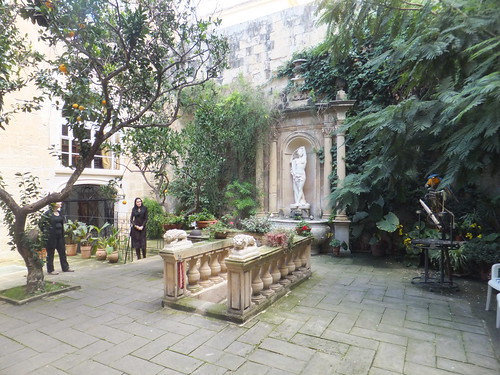
I paid the admission fee in the shop and was told a tour would be starting in a few minutes. Shortly, I was directed to a charming internal courtyard with trees, statues and a colourful resident parrot.

The courtyard at Casa Rocca Piccola.

There were just two of us for the tour - an English-speaking French lady and myself. We were joined by an elegant young lady guide who led us into the house and up the main marble staircase to the first floor. An elderly gentleman passed us and wished us "Good Afternoon". From his proprietorial manner, I correctly deduced that this was the current Marquis whose home we were in. I say 'elderly' but I realised afterwards that he was only one year my senior. We went into a pleasant sitting room overlooking the street. Next, we visited the private chapel, still in use today. To make the chapel appear larger, there is a trompe l'oeil painted on the ceiling giving the illusion of a large dome.

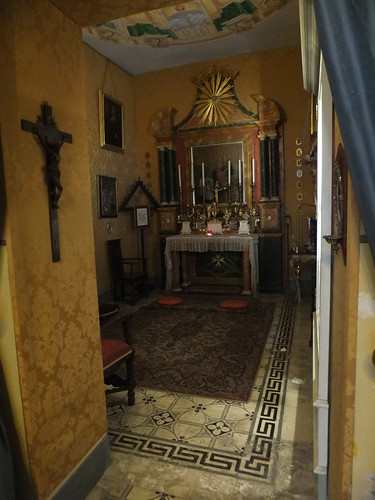
The private chapel at Casa Rocca Piccola.

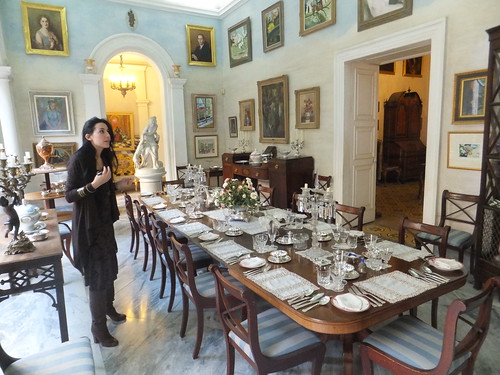
We passed through a series of rooms, part museum, part home. A small dining room with a heavily-carved wooden table and chairs appeared to be the present family dining room. Later, we came to the formal dining room, an impressive room filled with light from windows along one side overlooking the courtyard. The table was set for ten diners with the family's porcelain, cutlery and glassware.

The formal Dining Room at Casa Rocca Piccola.

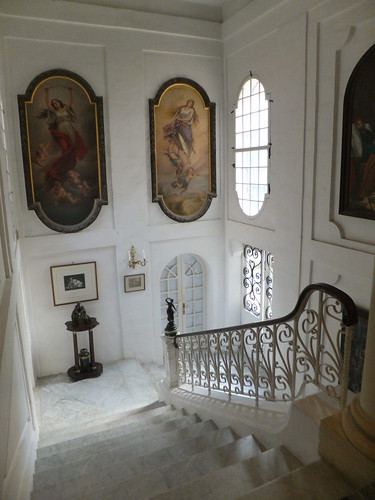
The tour took us through a number of rooms, some large and formal, some small and intimate (like the family archives room) before we descended to the ground floor using the main stairs.

The Main Stairs at Casa Rocca Piccola.

Finally, what else should a Maltese Palazzo with a private chapel have? Private air raid shelters, cut into the rock 100 feet below ground - a large one accommodating 150 people and a smaller one for the family. Having explored these constructions, a separate exit led us out to the courtyard, concluding a fascinating visit. See the Casa Rocca Piccola website

A walking tour of Valetta

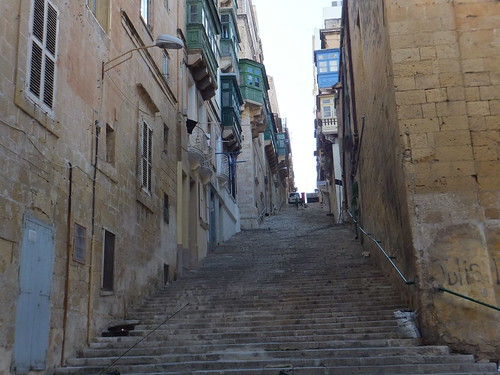
I didn't manage the Harbour Cruise I'd hoped to do. I'd established that Captain Morgan Cruises operate the harbour cruise, starting from Sliema. But I was told that the public ferry from Valetta to Sliema had been cancelled 'due to bad weather'. I decided to explore on foot and descended the long flights of steps to reach the public ferry terminal where the Sliema Ferry docks. Although the waters of Marsamxett Harbour seemed calm, the timetable board carried a 'CANCELLED' sign. Of course, I could have taken a bus to Sliema but, looking across Marsamxett Harbour to the modern skyline of Sliema, I decided that I was becoming too tired and that it was time to return to the hotel.

Valetta is full of charming aspects ...

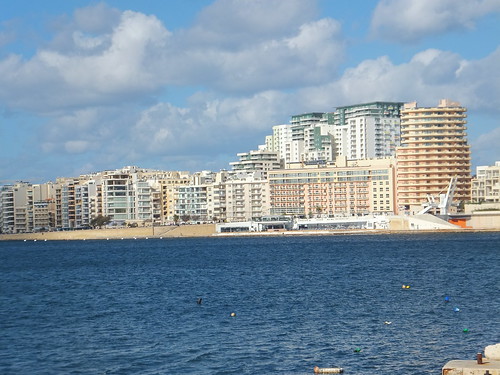
... but I find Sliema appalling.

I made my way back to the Bus Station where I found the correct stand and the electronic display confirmed I had just a few minutes wait for the Route 44 bus. A bus arrived, displaying the correct route and destination but, almost immediately, the display went to 'SORRY NOT IN SERVICE' and the driver got out to have discussions with some sort of Inspector. When he returned, he set a different route and destination, loaded a few passengers and departed. I looked again at the electronic display and the bus I was waiting for had magically been erased, giving me almost half an hour before the next service. "This", I thought, "is more like the Arriva I know". I passed the time with a walk to nearby Upper Barracca Gardens, overlooking Grand Harbour. I returned in time for the next bus. Again, a bus arrived carrying the correct route and destination. To my surprise, both the electronic display on the stand and on the bus went blank. The driver got off to check his bus display, looked puzzled, and got back on to re-cycle everything. This time, he produced a display of '*****' but, by the time he'd got off to check, it had gone blank again. He re-cycled the equipment a few times, failing to produce any display. He got off again saying "It's gone crazy". While we chatted, the correct display suddenly re-appeared. Both relieved, we boarded the bus, followed by a few other passengers. However, I noticed that the internal 'Next Stop' display wasn't working, nor were there any voice messages throughout the journey. After a couple of stops, the bus was packed. At the next pick-up, I heard a passenger complain that she didn't know what bus this was, so I presumed the displays on the outside of the bus had stopped working again.

In the 'old days' it was conventional for the Maltese to complain about their owner-driver buses which were, indeed, rather clapped-out. Now, it seems, they complain about the service provided by multi-national Arriva. This, I believe, is called 'progress'.

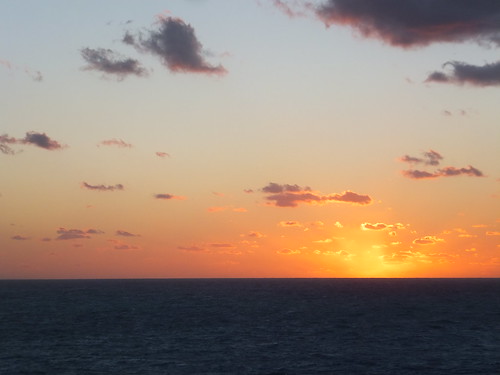
Traffic was heavy as we made our way through various towns (Msida, Birkirkara, Mosta, Mgarr) back to Golden Bay but, once on the bus, I wasn't too worried. Back at the hotel I met up with Ann and Dean and captured the sunset. The following day, we would fly back to England.

Sunset at Golden Bay.

References

The book 'Malta Convoy' by Shankland and Hunter is a factual account of the 'Pedestal' Convoy to Malta in 1942 (ISBN: 0-00-632964-0).

'Malta Story' is a 1953 black and white film starring Alec Guiness and Jack Hawkins re-issued as a DVD by ITV. Covering similar events to the book in a fictionalised manner, it gives a good impression of the work of the Lascaris War Rooms (using a replica of the War Rooms re-created in Pinewood Film Studios).

Photographs

Round and about Valletta.
Lascaris War Rooms.
Casa Rocca Piccola.

All the photographs on this trip form a collection titled Malta.

[Additions 9-Dec-2012, 10-Dec-2012, 12-Dec-2012]

Friday, 30 November 2012

Return to Malta (Part 6)

Events of Wednesday 28th November 2012

A Day with History

Ann was spending the day at the Spa so Dean and I decided to visit some of the very old temples.

Hagar Qim and Mnajdra Temples

We drove to Hagar Qim where there is a new visitor centre, not there when Dean last visited about 12 years previously and certainly not there when I visited in what now seems pre-historic times. The Mnajdra Temples are a few hundred yards walk away, so the visitor centre serves for both temple complexes. Both sites are in the care of Heritage Malta (see their website).

Both Dean and I were impressed with the interpretation of the history of the temples. The various people involved in the studies of the temples are mentioned with their various theories but there's a frank admission that we may never have a complete understanding of the temple builders' intentions.

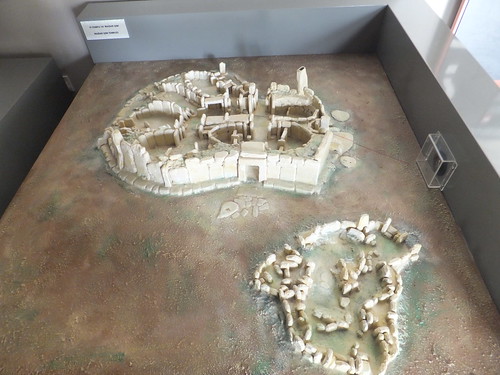
A model of the Hagar Qim Temples in the visitor centre illustrates the theory regarding the alignment of stones to catch the sun at the solstice.

The 'orientation' included a rather 'arty' high-definition video which wasn't very informative - Hagar Qim is 5,000 years old and Mnajdra 3,500 years old - that was it. We made our way down the path towards the six foot chain link fence topped with razor wire and lights which surrounded the temples. Admission to the compound was past a wooden checkpoint where a member of security staff carefully studied our tickets before entering information into a computer. It all felt rather like Berlin in the Cold War.

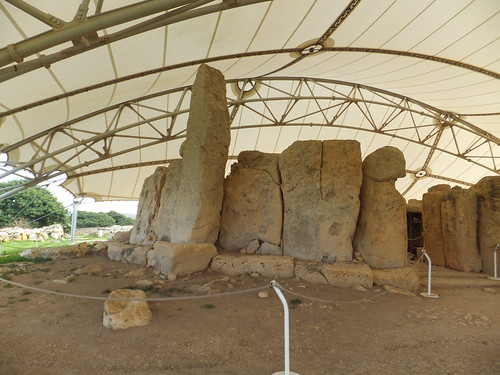
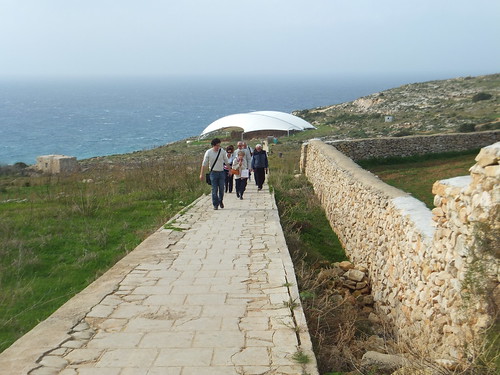
However, all that could be seen on the temple site was a large, white dome looking like an alien flying saucer. This was the European Union co-funded answer to the short-term preservation of the stones, which huddled, diminished, underneath. This takes us back to the old question of 'curatorial ethics' and what actions are responsible in looking after important artefacts. In Malta, the argument that the stones must be protected against rain and ultra violet while long-term conservation methods are developed has clearly won, depriving the present generation of the ability to sense the spiritual significance the constructions were meant to convey. The fabric dome is supported by huge steel arches which are visually intrusive once you are underneath the roof - it's impossible to see the stones in the context of the landscape.

The stones appear diminished by the protective shelter.

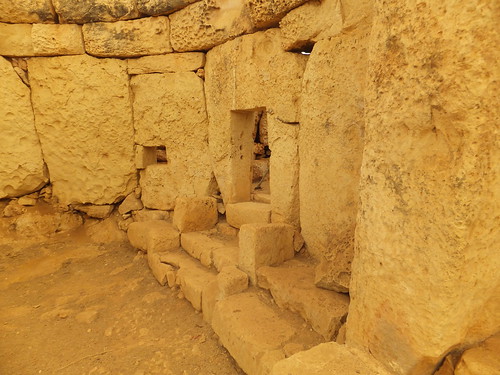
It's difficult to take any photographs which don't include parts of the roof structure or the various weather measuring instruments which are dotted around the inside of the structure to gather data on the effect of the roof. Visitors are constrained to only certain area by barriers which, whilst sad, is more understandable - much of the construction uses softer types of limestone where visitor-created abrasion literally wears the structure away.

'Porthole Stone' at Hagar Qim (and protective shelter).

Mnajdra lies a few hundred yards away from Hagar Qim, reached by a straight, modern causeway sloping downhill to a second fence, checkpoint and ticket inspection. The stones are hidden beneath their own protective structure, similar to that a Hagar Qim.

The causeway leading to Mnajdra's protective shelter.

Dean and I agreed that, for some reason, Mnajdra does not seem quite as diminished by its protective shelter as does Hagar Qim but we cannot agree with the 'Brief Guide' handed out to visitors by Heritage Malta which states:-
"Part of the charm of Mnajdra Temples lies in the fact that no modern development is visible from the site, so that it still may be appreciated in its original setting".
I don't know whether that terrible dissonance with reality is due to official myopia or casualness in updating the photographs in the brief guide (which show the 'flying saucer') whilst leaving the text unchanged.

Mnajdra, showing corbelled partial roof.

Despite the disappointments at Hagar Qim and Mnajdra, Dean and I agreed to look at one more Temple complex -Tarxien.

Tarxien Temples

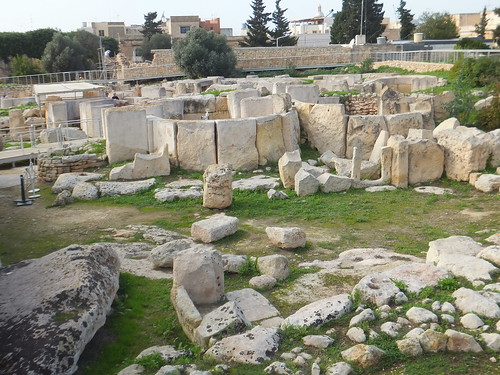
In contrast to the open, cliff-top location of Hagar Qim and Mnajdra, the Tarxien Temples are situated in an urban area south-east of Valletta. The usual hard-to-follow series of road signs led us through a series of narrow streets to a stone-built ticket office providing the only visible evidence of the site.

General view of Tarxien Temple Site.

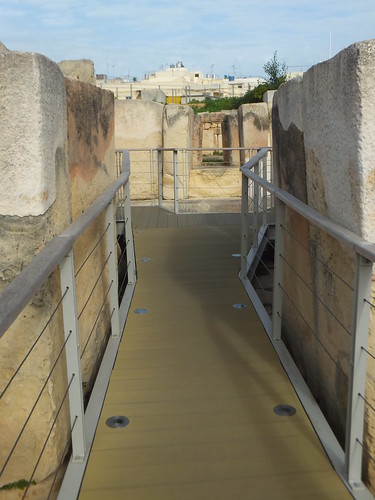
To my great relief, Tarxien has yet to receive a Protective Shelter, although a sign displayed as we entered the site confirmed that the European Union is co-financing such a shelter. An extended walkway has already been provided. This is a steel-framed structure with handrails and a wooden pavement which zig-zags around the site varying between a few inches and a few feet above the ground, eventually returning the visitor to the ticket office. The modernity of this walkway makes it visually intrusive but at least it achieves its aim of improving accessibility and the higher sections of the walkway make it easier to appreciate the site layout.

The modern walkway threads through the ancient stone temples.

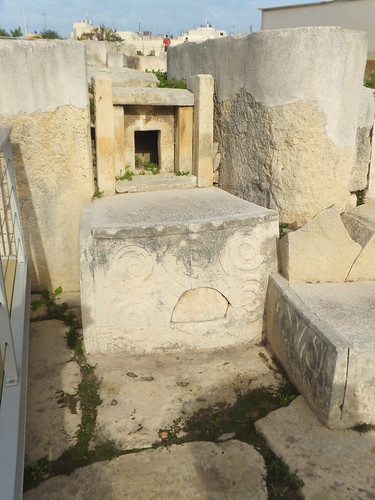
The complex includes four temples built between 3600 B.C. and 2500 B.C. There is some rather unfortunate 'modern' restoration. The later temples incorporate impressive stone reliefs featuring spiral patterns and animals.

Carved reliefs at Tarxien.

Tarxien is hemmed in by by a modern church and cemetery, a wall separating a public road, a very tall stone wall (under repair at the time of our visit) separating a neglected garden and the ticket office. None the less, I enjoyed my visit.

We set off in the direction of our hotel. On the previous Monday, we'd cancelled a planned visit to Rabat and Mdina in order to visit the Aviation Museum so we decided to visit these locations before completing the journey to Golden Bay.

Domvs Romana, Rabat

We parked in Rabat near to the Roman Villa. It was my first visit to the museum site operated by Heritage Malta as 'Domvs Romana'. The exhibits are housed in a stone building, entered via an elegant Neo-Classical facade.

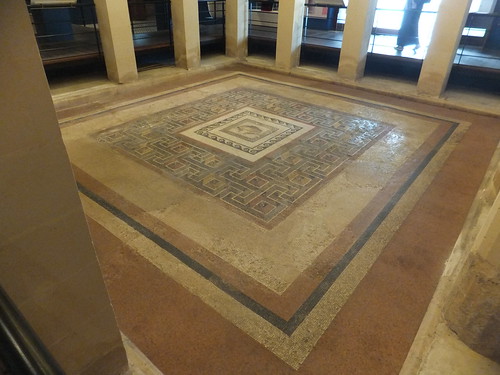
One of the mosaic floors in the Domvs Romana museum.

The mosaic pavements in the Domvs Romana are regarded as some of the oldest and best in the western Mediterranean. They were discovered in 1881 in the remains of a rich and sumptuously decorated town house of the Roman period. In addition to the mosaics, the museum houses a collection of Roman artefacts, statues and architectural stonework.

At the rear of the museum, there's an open-air site showing the foundations of the rear of the village and three adjacent houses.

The open-air site at the rear of the museum.

There are a few pictures of the museum in the 'Mdina and Rabat' set (link below).

Mdina and Rabat

Mdina was the original capital of Malta and the only fortified city on the island until the 16th century when the Knights of St. John moved the capital to Valletta because of its harbour and fortified their new capital. This led to a period of neglect for Mdina, ended by an earthquake in 1693 which caused serious damage. Rebuilding following the earthquake produced the dignified city which is little changed today.

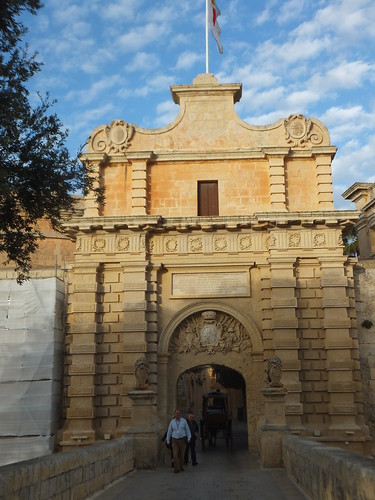
Mdina's Main Gate.

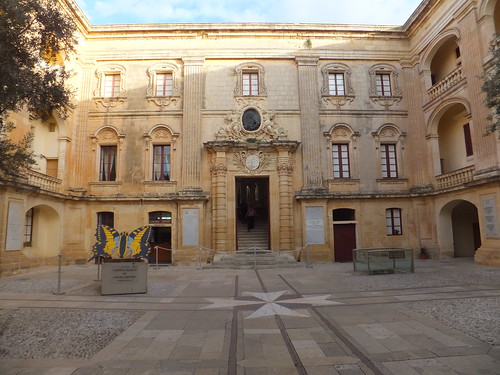
Like many visitors, I was enchanted by the place. The streets are mainly pedestrianised, with pretty horse drawn carriages (with rubber tyres) quietly providing transport for less athletic visitors. The imposing Palazzo Vilhena now houses a Natural History Museum.

Palazzo Vilhena is now a museum.

St. Pauls Cathedral is topped by an elegant dome recognisable from miles away but not visible when close to the impressive frontage.

The frontage of St. Paul's Cathedral, Mdina.

With some reluctance, I tore myself away from this very attractive place and Dean and I completed our journey back to the hotel to meet Ann.

Photographs

Hagar Qim and Mnajdra Temples.
Tarxien Temples.
Mdina and Rabat.

All the photographs on this trip form a collection titled Malta.

[Revised 3-Dec-2012]

Tuesday, 27 November 2012

Return to Malta (Part 5)

Events of Tuesday 27th November 2012

Interlude on Gozo

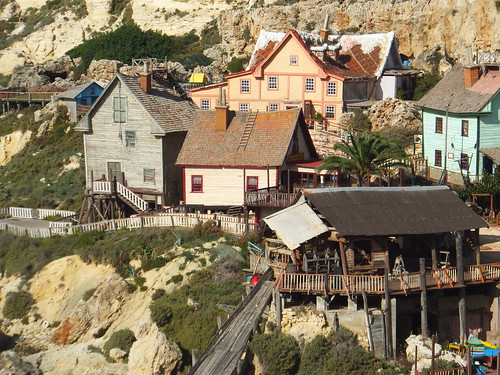
On Tuesday, we made a trip by car to the island of Gozo. On the way to the ferryport, Dean detoured to Anchor Bay, where the set constructed for the 'Popeye' film of 1980 remains as a Theme Park. There's more information on the 'Popeye Village' website (look for the 'stop sound' button on the top left of the screen to silence the irritating singing). The village certainly looked the part, nestling against the cliffs.

Popeye Village, Malta.

We carried on towards the ferryport. Major road improvements are underway and a completely new ferryport is being used whilst still under construction. This is another project being supported by European Union funding.

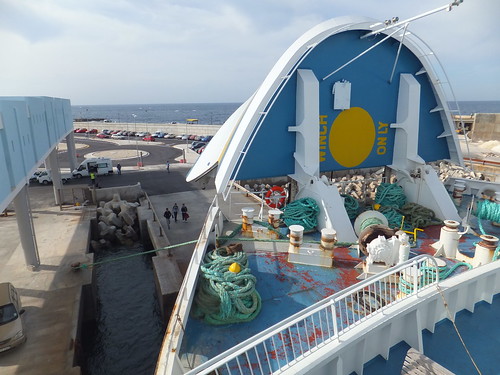
A modern Ro-Ro ferry was just arriving from Gozo and, within a few minutes, the hinging bow section had been raised, the loading ramp 'unfolded' and foot passengers and vehicles were streaming off.

Foot passengers and vehicles leaving the ferry from Gozo.

We were in a queue of vehicles waiting to board and, looking at the length of the queue and the capacity of the car deck, it was clear we'd have no problem boarding. We parked the car and made our way up to the main deck. Ann settled here and Dean and I prowled the ferry independently looking for photographic opportunities.

Late foot passengers arriving showing the bow section hinged upward for unloading/loading.

Our ferry was the "Melita", built in 2002 by Malta Shipbuilding Company Limited as their 'HULL-180'. The ferry is basically double-ended, with a hinging bow section at each end and two bridges for control. So we were able to depart with the minimum of fuss, as what had been the 'stern' on arrival became the 'bow' for our crossing to Gozo and the helmsman moved to what was now the 'Forward' bridge. I noticed that the vessel wasn't completely symmetrical as an anchor was only provided on one of the two ends.

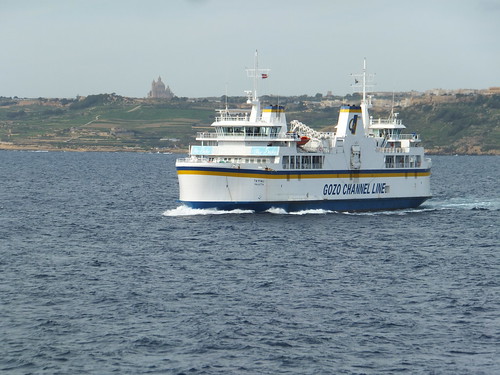
We left the dock, rounded the breakwater and set off across a very calm Mediterranean under a hot sun. After about ten minutes sailing, we passed a similar ferry, the "Ta' Pinu" heading away from Gozo.

The "Ta' Pinu" ferry heads for the mainland.

Another ten minutes saw us approaching the dock at Mgarr Harbour and before long we were driving onto Gozo, still not having paid. We decided (correctly) that they now collect fares on the return journey. Dean drove to the major town, Victoria (also called Rabat) and parked near Pjazza Indipendenza where there was a small tourist market. Ann had a drink at an open-air cafe whilst Dean and I went exploring the Cittadella 'the old fortified city of the Island of Gozo'. It's built on high ground surrounded by tall walls. Like many of the old parts of the mainland, the Cittadella is being restored by grant money but, in this case, the grant is supplied by Iceland, Liechtenstein and Norway through the EEA Financial Mechanism administered by EEA Grants and the Ministry for Gozo. Within the Citadel, there's a Cathedral with a 17th-century Baroque facade, Courts of Justice and Armoury together with Museums of Folklore, Natural Science and Archaeology.

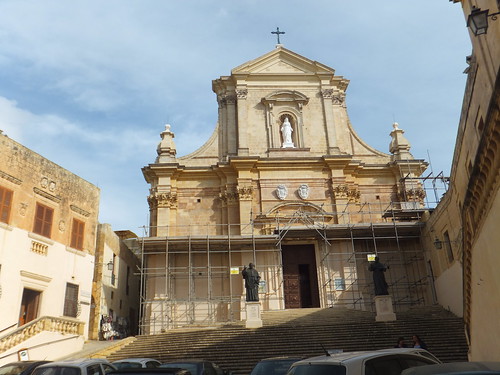
'Assumption of Our Lady' Cathedral in the Citadel, Gozo.

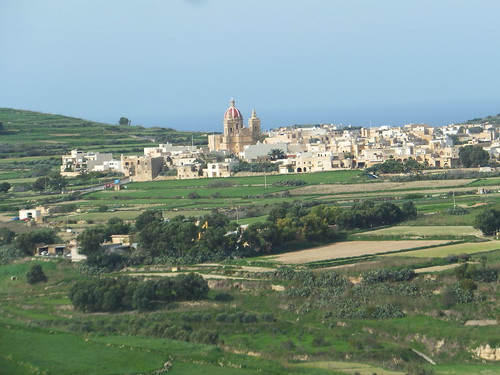
We'd only time to visit a small museum dedicated to the (rather improbable) co-operation agreements between Gozo and Japan and Gozo and China (why did I think of the film 'The Mouse that Roared'?). Climbing the Battlements gave splendid views across Gozo in all directions. Noticeable is the way the undulating land has been terraced to assist crop cultivation and the fact that the landscape is dotted with fairly grand, domed churches.

View from the Battlements of the Citadel.

We then drove to Gozo's Craft Village at Ta' Dbiegi, in the west of the island near Gharb. Unlike the mainland's converted Nissen Huts, Ta' Dbiegi is purpose-built with a number of stone buildings.

A short drive took us to Dwejra Point, a popular tourist destination because of nearby free-standing Fungus Rock, the Azure Window and the Inland Sea.

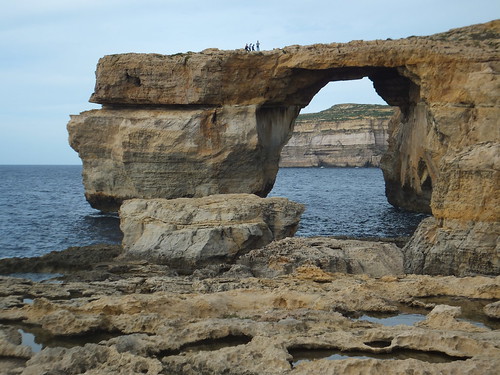
The Azure Window. Note the people standing on top.

The Azure Window is a rock in the sea still linked to the main cliffs by a 'bridge' of stone. Despite the 'DANGER' signs, quite a few people were climbing up and crossing the 'bridge', so Dean aqnd I did likewise.

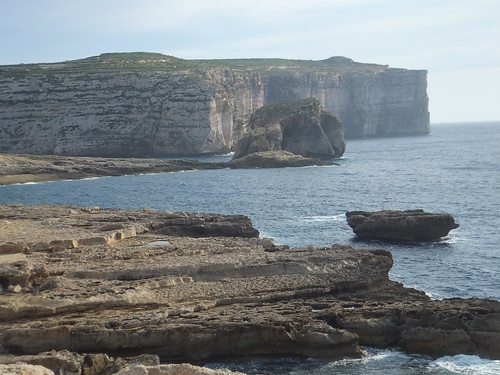
View from the top of the Azure Window looking south, showing Fungus Rock.

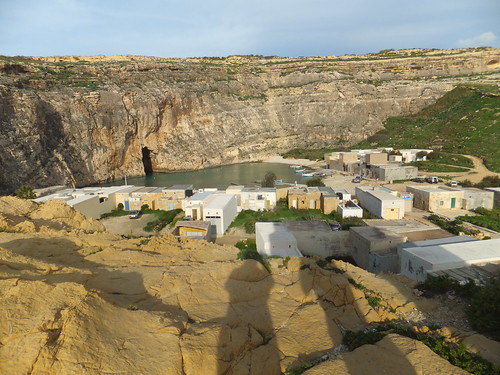
The Marketing Department just about got away with 'The Azure Window' but I think they rather oversold the 'Inland Sea' which is a pool, almost completely surrounded by boathouses and dwellings built in stone, separated from the sea by massive cliffs. A tunnel pierces the cliffs joining the Inland Sea to the Mediterranean.

The Inland Sea, showing the tunnel mouth.

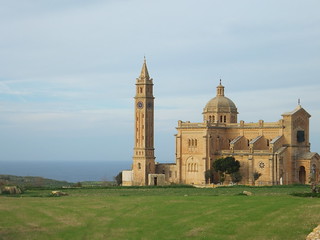
We next went to Ta' Pinu Church, which seemed a very elaborate building for such a rural area.

Looking north towards Ta' Pinu Church, with the Mediterranean in the background.

This became a place of pilgrimage following accounts of Our Lady speaking to a local woman where people can give thanks for blessings received or ask for help. Hundreds of framed testimonials are displayed. The Church (a minor Basiiica) is now called Ta' Pinu National Shrine, according to its website here.

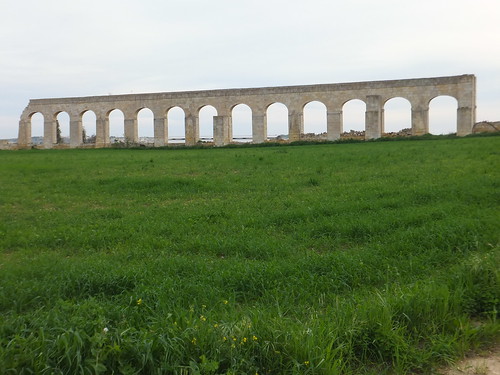
Preserved Section of Aqueduct.

Returning to Victoria, we passed a preserved section of aqueduct, now isolated in a field. Dean drove to the ferryport at Mgarr by a circuitous route, allowing us to see a little more of the island. A toll booth collected the fare and we were immediately waved onto a waiting ferry - the 'Melta' again. By the time we'd parked on the car deck and made our way onto the main deck, the ferry had left the dock for the twenty minute trip to the mainland. Since the morning, a wind had developed and the sea was 'livelier'.

By the time we were back on the mainland, it was fairly dark. There remained only a fairly short journey back to Golden Bay at the end of a splendid, but tiring day.

Photographs:

Malta.

[Revised 28-Nov-2012}

Monday, 26 November 2012

Return to Malta (Part 4)

Events of Monday 25th November 2012

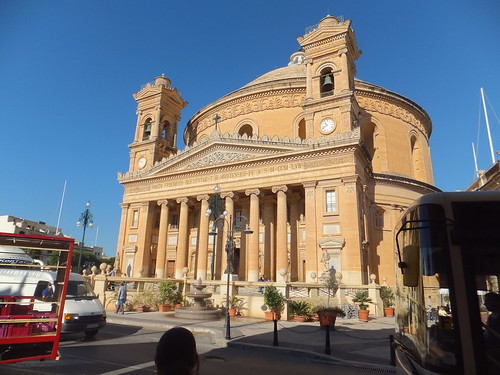
Ann decided to relax in the hotel in the morning, so Dean proposed that he and I visited Mosta followed by Rabat. It didn't take long to drive to Mosta and Dean managed to park near the famous 'Mosta Dome', more properly called the Rotunda of Saint Marija Assunta. This Roman Catholic church was consecrated in 1871 to replace an earlier church on the site. It is famous both for the size of its dome and the fact that a German bomb which fell through the dome during a service in 1942 failed to explode, an event called 'The Bomb Miracle'. There's more information in a Wikipedia article.

The Rotunda of Saint Marija Assunta, Mosta.

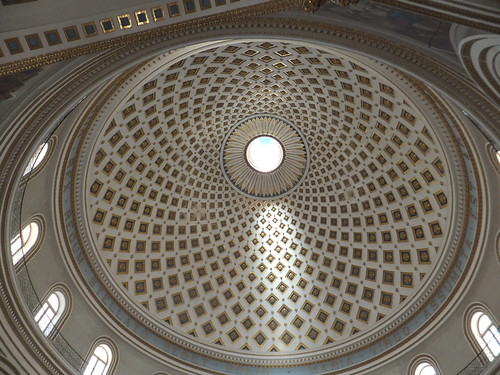
The church is certainly impressive, so I include the obligatory shot looking up at the inside of the 122 feet diameter rotunda.

The decorated inside of the rotunda.

We set off for Rabat but, remembering we'd pass near the Aviation Museum at Ta' Qali which neither of us had visited, we changed plans and headed for the museum. The museum was very impressive due, I am sure, to the dedication of the volunteers and the European Union funding.

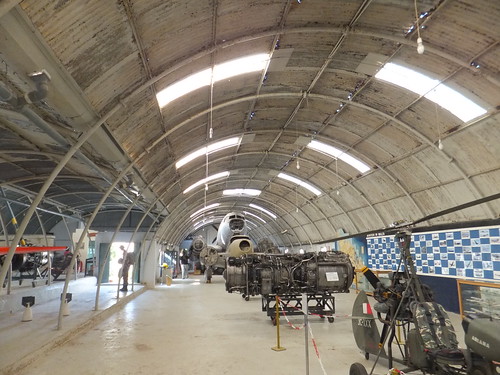
General view of one bay of the original building at Malta Aviation Museum

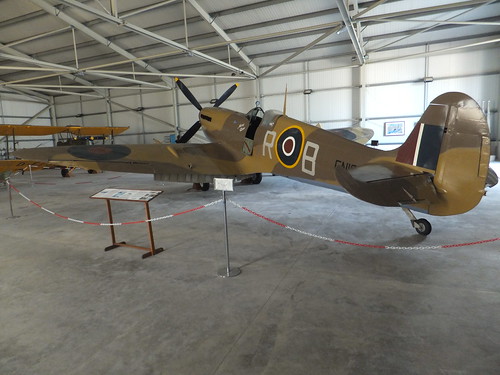
The original museum building (formed from two Nissen Huts side-by-side) has been supplemented by both a large building able to display a number of complete aircraft and a slightly smaller building called 'The Air Battle of Malta Memorial Hanger'.

Mark IX Spitfire number EN199 displayed in the Air Battle of Malta Memorial Hanger.

The range of exhibits is impressive and the access exemplary. In most cases, you can get up close to exhibits and view all sides. In addition to a wide range of complete aircraft, aircraft engines and accessories, there's a complete Link Trainer - the first aircraft simulator used for training pilots. There's a large collection of detailed models of aircraft.

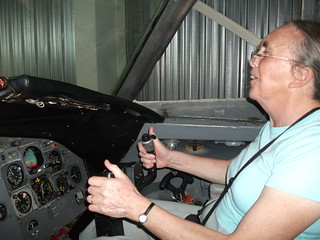
There's a complete cockpit and forward door section of a BAC 1-11. Access is via the aircraft's airstairs. I've flown as a passenger in BAC 1-11s a few times but never ended up in the P2 (co-pilot) seat until this visit.

Jan in the co-pilot's seat of a BAC 1-11.

My pictures don't do justice to the items on display. There's more information on the Malta Aviation Museum website or, preferably, make a visit.

In the afternoon, we all went to Saint Julian's by car. Ann had an appointment at the Spa at the Hilton Hotel so Dean and I explored the area on foot. On my first visit to Malta, I'd stayed at St. Julian's but the changes since then have been so massive, I recognised nothing. Dean found the hotel where he and Ann had stayed some years before but he was amazed at the changes. The Hilton Hotel is possibly the tallest building in Malta - it certainly gets my award as the ugliest, beating off fierce competition from the surrounding developments. We walked downhill to the sea and a small, rocky cove. Moving on, we passed The Westin Resort. At least they'd retained the limestone wall and triumphal arch of whatever was before. Slightly inland, we came to a multi-level shopping mall with a number of "Gentlemen's Clubs" nearby in a fair imitation of London's Soho. Returning to the sea, we came to St. George's Bay - much nicer. It even had a sandy beach (although I suspect this was man-made).

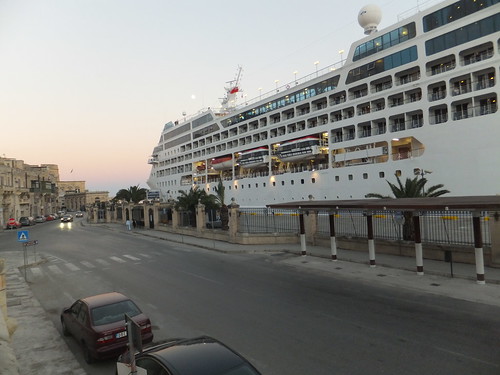
By the time we'd walked back to the Hilton, Ann was ready for us so Dean retrieved the car from the multi-storey underground car park and took us via Sliema to various parts of Valetta. The most incongruous sight was visiting cruise ship 'Pacific Princess' moored almost at the side of our road opposite traditional three-storey buildings of stone.

'Pacific Princess' preparing to leave Valetta.

'Pacific Princess' had only berthed that morning and, when we saw her, she was preparing to leave. I'd noticed the ship was berthed with three radar scanners working. That puzzled me although imminent departure seemed the most probable reason. The useful website MarineTraffic.com confirmed the ship's movements.

As we left Valetta and headed back to Golden Bay, we saw Cunard's 'Queen Elizabeth' arriving. Afterwards, MarineTraffic.com confirmed the ship's arrival from Limassol for a brief stay of just under one day.

Photographs:

Malta.

[Revised 27-Nov-2012]
Return to Malta (Part 3)

Events of Sunday 25th November 2012

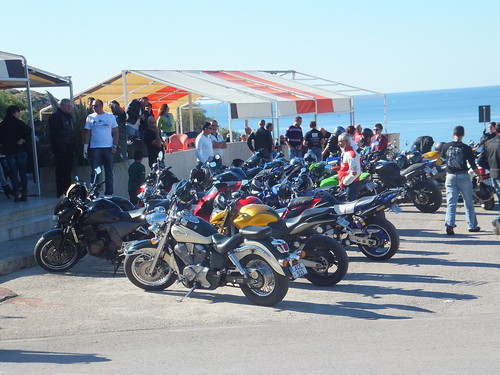
After breakfast in Flavours Restaurant I took a 'deep paddle' up to my waist in Golden Bay (still not warm enough for me to swim - I see a pattern emerging). I'd heard the roar of a number of motor bikes since earlier in the morning. When I left the beach for the main road, I discovered that Golden Bay is the 'Matlock Bath' of Malta.

At 9 o'clock, I counted 60 motor bikes at the Apple's Eye restaurant, with more arriving every minute. In addition to the usual range of Japanese machines, there were 'Triumph', 'Harley', off-road 'trials' bikes and, no doubt, many other types. There was plenty of exuberant driving, particularly on the straight road to Ghajn Tuffieha. There were also a few low-slung, expensive sports car in the mix so, from time to time, the distinctive roar of a 'V8' engine could be heard.

Motor bikes at Golden Bay.

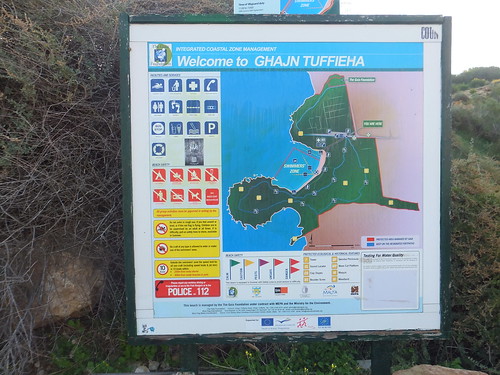
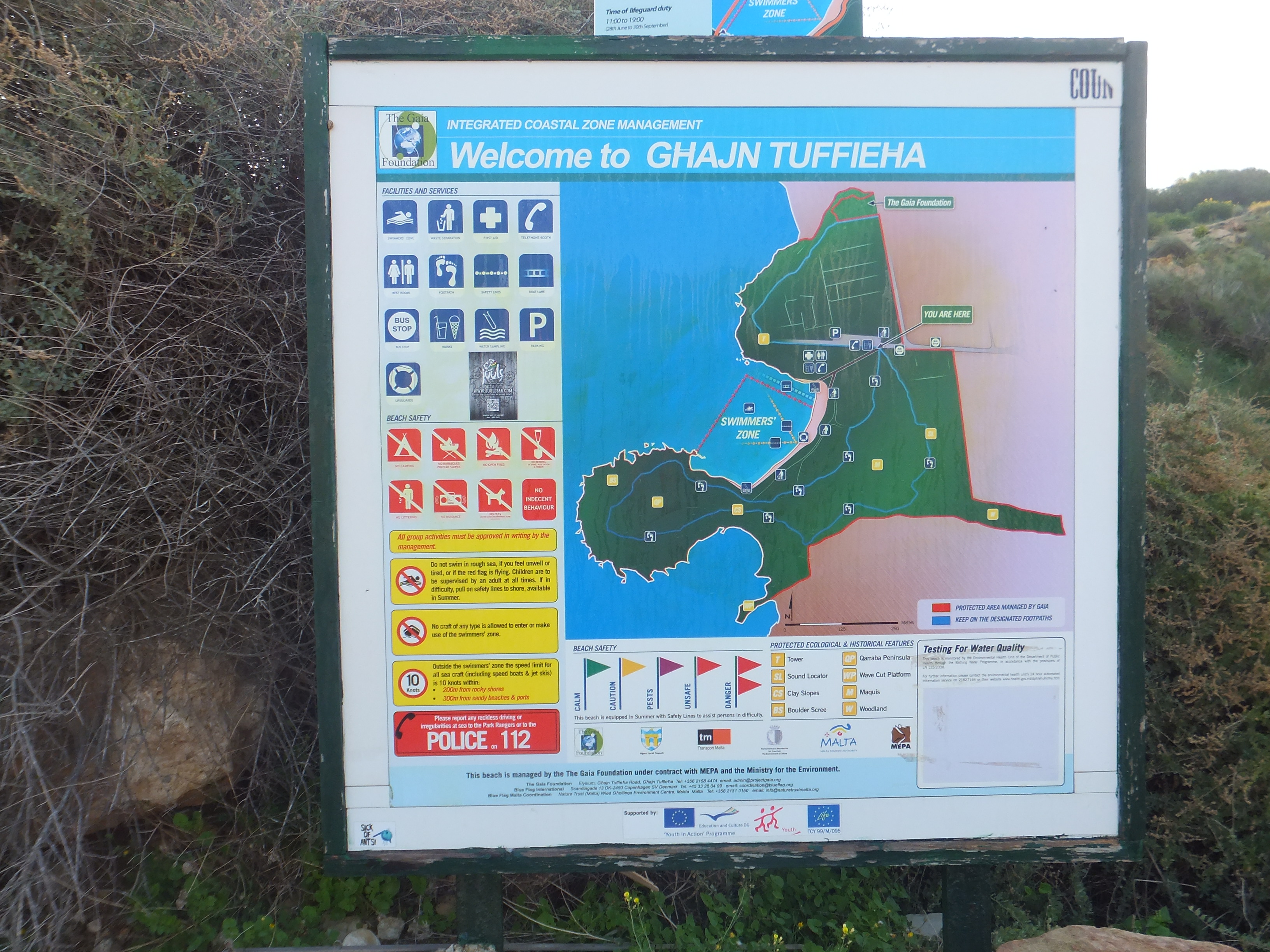
I walked up to Ghajn Tuffieha Bay which I shared the beach with just one man doing morning exercises near the (closed) cafe. The area is managed for the government by the Gaia Foundation and they have a website here.

Plan of Ghajn Tuffieha Bay on the Gaia noticeboard.

Click here for an enlarged view of the Plan..

I tried the sea, but the water still wasn't warm enough for me to do other than a 'deep paddle'. I spent a while walking on the cliffs but, although the sun was very warm, it was still very damp underfoot on the cliffs from the heavy rain of a few days earlier. The clay in the soil mixed with the scree made a tenacious aggregate which attempted to suck my shoes off at every step (it was too rough for barefoot). By the time I'd walked back to Golden Bay, I found my shoes had acquired a layer of 'cement' which proved very hard to remove.

The number of motor bikes parked near Apple's Eye had increased to at least 150. In the hotel, I met up with Ann and Dean taking a late breakfast before leaving on foot for a horse ride. Ann and Dean remained in the hotel.

The stables were less than a mile from the hotel. It took a while for all the people booked to arrive and get mounted but we set off at 11.30 with a girl from the stables up front, a couple of experienced riders free and the rest of the riders on leads to what I took to be the proprietor. We took the public road for about half a mile, passing cars and a couple of buses before turning off into Il Majjistral Nature and History Park. This is 'Malta's first natural national park' - there's a brief description here. We trekked along rough tracks around the hillside behind our hotel. The area was fairly windswept and barren, sprinkled with small, abandoned buildings. Presumably because it was Sunday, there were numerous parked cars dotted around with families enjoying a picnic. We rejoined the public road where we had left it and, after running the gauntlet of various cars and buses, arrived back at the stables an hour after we'd left.

Horse riding in Il Majjistral Nature and History Park.

In the afternoon, we all went out by car. Ann wanted to visit the Ta' Qali Craft Village near Rabat. A series of Nissen huts on a World War II airfield have been converted into industrial units occupied by a variety of craft workshops. Since it was Sunday, only some of the businesses were open but Ann spent some time in the stonecraft workshop whilst Dean and I visited the large glassblowing business and explored some of the abandoned Nissen Huts.

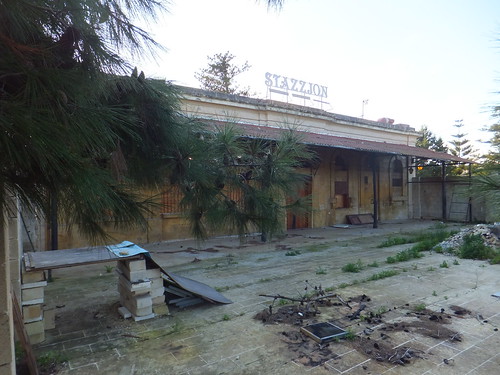
We then drove to Rabat where Ann and Dean took me to the former railway station at Museum, the ultimate terminus of the metre gauge Malta Railway line from Valetta. First opened in 1883, the railway went bankrupt in 1890 but was taken over by the government and, after further rebuilding, re-opened in 1892, finally closing in 1931. Traces of the railway can be found in some places. The Museum station operated as a restaurant and railway museum until a few years ago but it is currently boarded up.

Museum Station Building (rail side).

Some Railway references:

Wikipedia.
Malta Railway Website.
'The Malta Railway'.


The fortifications of Rabat loom over the old station and major restoration work is currently in progess.

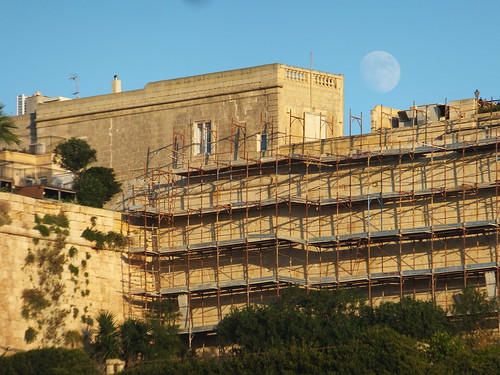
Rabat viewed from the old station. At four o'clock in the afternoon, the moon is visible.

Rabat itself was very busy and parking was a problem so, promising to return, we headed towards Valetta and the former film studios at Kalkara. Although Malta became a popular destination for film-makers, the facility we visited appears closed. The remains of various sets and the large outside pool used for 'tank shots' can still be seen but major building work seems to be producing a 'Smart City'. The MFS website is well worth a look and there's a list of films made in Malta here.

Derelict sets and the huge Tank at Malta Film Studios.

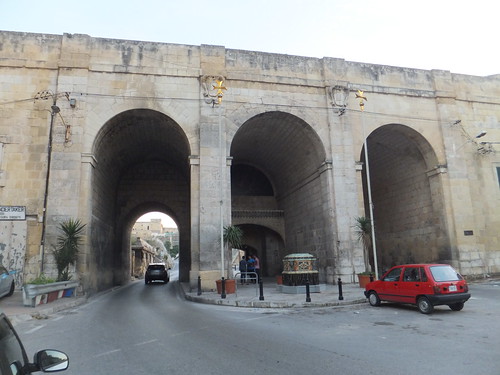
Valetta and the Three Cities is an impressive and confusing area where the ancient and modern meet in surprising ways. The massive medieval fortifications are everywhere, pierced to allow roads through in tunnels or huge arches. The sea is always at hand with a remarkable mix of small boats and large ships, particularly around Grand Harbour.

Ancient and modern around Valetta.

As it started to get dark, Dean drove us back to the hotel where we enjoyed a buffet dinner in Flavours Restaurant.

Photographs

Malta.

[Revised 27-Nov-2012]