Showing posts with label Burma-2012. Show all posts

Sunday, 18 November 2012

Sunday in Yangon

Events of Sunday, September 23rd, 2012

I was up early and took breakfast around 6.00 a.m. in the Restaurant of 'Road to Mandalay', still at her midstream mooring at Bagan. After saying a final 'goodbye' to staff on the ship, 'local boats' took us ashore about 7.00 a.m. We made the steep climb up the steps for the last time and joined our respective guides and buses to be transferred to Bagan Airport.

All went well on our flight back to Yangon so it was still quite early when I met up with my guide for the day in Yangon, a pretty young lady with excellent English. Of course, my idea of an itinerary was not quite the usual - A trip on the 'Circle Line', tracking down a 'plinthed' locomotive in the '"People's Park" and a visit to a bookshop with English-language books on Burmese History.

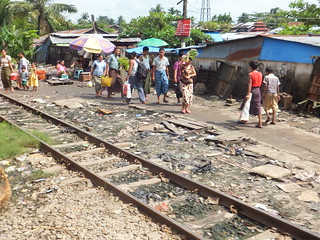
We started off by spending a couple of hours travelling part way around the 'Circle Line', ending up at Yangon Central Station. This part of the day is described separately here, but I've included a link to the pictures below as a lot of the photographs are 'social history' rather than 'railway technical'.

Life alongside the 'Circle Line'

On a previous trip, I'd driven past the "People's Park" in Yangon and spotted a couple of 'plinthed' locomotives and, more improbably, a gunboat. On that occasion, I didn't have the opportunity to stop but, this time, we parked our vehicle and walked along the outside of the fence to where I'd seen the exhibits. We spotted a steam locomotive and brake van which a sign claimed to be the first locomotive in Burma, but it was rather hidden by trees so we determined to go inside the Park in the hope of getting a better view. There was no sign of the larger locomotive or the gunboat which our driver believed had been scrapped.

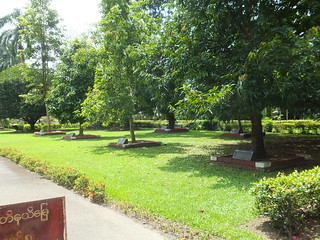
Inside the park, we walked towards the locomotive but found our way stopped by civilian security guards - that part of the park was currently off-limits. The reason given was rather curious. Apparently that corner of the part has a number of commemorative tree dedicated to member's of Burma's military regime. Following the slight liberalisation which is taking place, there were fears that Burmese might attempt acts of vandalism on these trees so the public are not allowed in.

Commemorative Trees in the "People's Park".

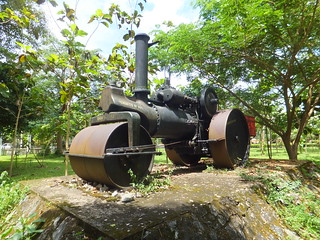
However, just outside the restricted area, we did find a 'plinthed' Aveling Barford steam roller, a long way from its birthplace in Grantham.

An Aveling Barford steam roller, a long way from home.

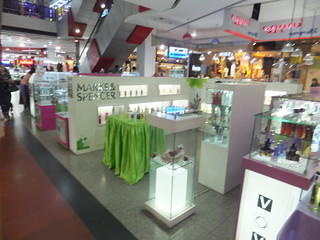
For a bookshop with English-language books, my guide recommended Tab Book Centre, not far from the "People's Park". This is situated in the Taw Win Centre, a modern shopping mall of the type I detest but the bookshop was excellent. I didn't expect to find a 'Marks and Spencer' shop selling cosmetics, but the picture below shows it's there. I'm afraid I think it's a 'fake' store.

The 'Marks and Spencer' store in the Taw Win Centre.

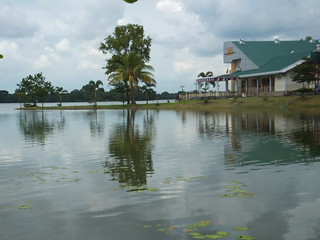
It was time to head out of the city towards the airport for my international flight back to Bangkok. With a little time in hand, we stopped for a snack at an open-air restaurant, with gardens and a garden centre, overlooking Inya Lake. The gardens are particularly popular with young couples at the weekend and we saw lots of young people enjoying their free time.

Part of Inya Lake, viewed from the open-air restaurant, showing the sailing club.

After this relaxing break, we continued to the airport. I said goodbye to my guide and driver and started my long journey back to Birmingham. Check-in ticketed my luggage for all three legs (Yangon-Bangkok, Bangkok-Dubai, Dubai-Birmingham) and I wondered if I'd ever see it again (in fact, it popped out on the luggage carousel at Birmingham safely). Security at Yangon was painless and prompt and the flight to Bangkok pleasant.

I'd a few hours to wait at Bangkok for my next flight to Dubai. Emirates now have a well-appointed but not too large Lounge which I was able to use. First of all, I was able to have a shower and change my clothes which made me much more relaxed. I passed the time snacking and working on the computer.

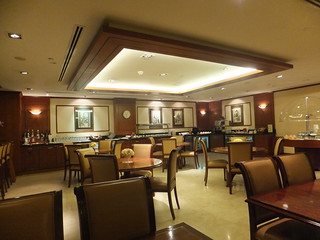
The comfortable 'Emirates' lounge at Bangkok Airport.

My inbound flight was late but I was still in a reasonably good mood by the time I boarded the A380 for Dubai. Although I slept a little, I was quite tired by the time we arrived in Dubai. I woke up enough to make my way to the huge (and busy) lounge in Dubai. The wait here wasn't long and then it was off to join my final flight to Birmingham. Here, Emirates provided a car back home so before long I was at Brewood, exhausted but happy after another wonderful trip.

Photographs:

Circle Line Revisited
People's Park, Yangon
Yangon (includes pictures from earlier trips).

Saturday, 17 November 2012

Last Night on 'Road to Mandalay'

Events of Saturday, September 22nd, 2012

I spent the day looking at initiatives by the 'Road to Mandalay' Social Contribution. I made both a morning and afternoon visit to the Bagan Medical Clinic (described here), visited what I have come to regard as 'old friends' at Htee Pu (described here) and, I hope, made new friends at Nga Minn May (described here).

Sunset was at 6.00 p.m. so the Farewell Cocktail Party on the Top Deck was held in total darkness, relieved by some electric lights and candles.

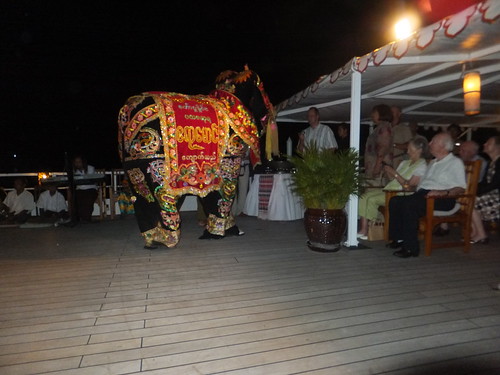
The 'Elephant' introduces himself to the guests.

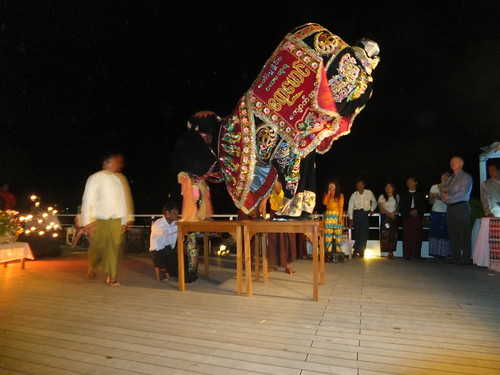
We were entertained by a traditional Elephant Dance where two men in an elaborately- dance decorated elephant costume dance to music and song before performing remarkable balancing feats, still in the elephant costume.

The 'Elephant' balances on his forelegs.

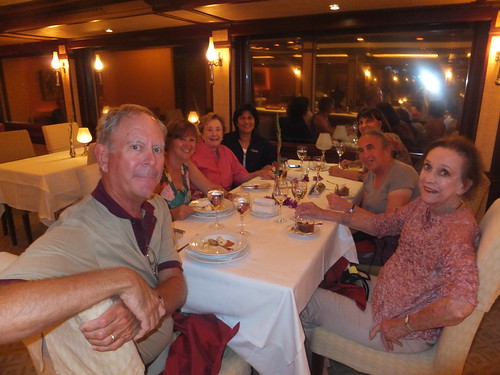
The Farewell Dinner was served in the Restaurant at 8.00 p.m. and I had been invited to join Margot and Audrey and their friends.

Smiling faces at the Farewell Dinner.

Before retiring for the night, I had to complete my packing as luggage was to be available no later than 6.00 a.m. Sunday morning. However, 'Road to Mandalay' staff would then ensure that my case magically appeared in the luggage hall at Yangon Airport without further intervention on my part. And so to bed.

Photographs:

Elephant Dance on the 'Road to Mandalay'

Visit to Nga-Minn-May School

Events of Saturday, September 22nd 2012

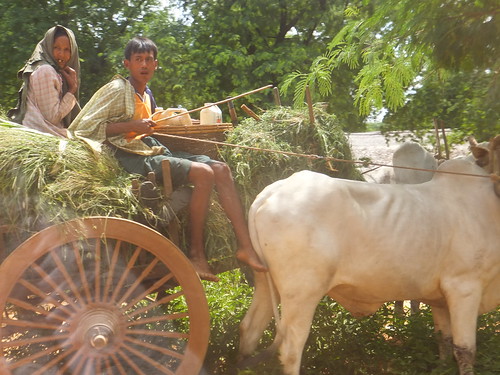
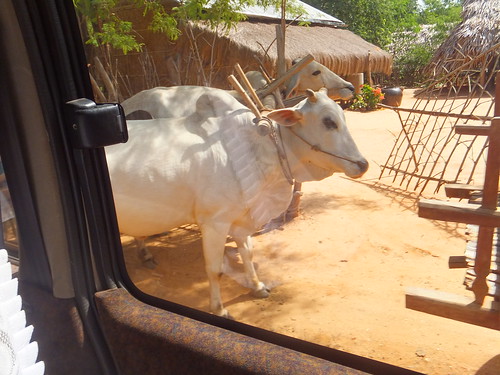
After our visit to Htee Pu school (described here), it took about three quarters of an hour to drive to Nga-Minn-May. I'd not visited this village before and my trip allowed me to see the refurbishment carried out at the school with the support of the 'Road to Mandalay' Social Contribution. The last part of the journey involved slow travel on rutted dirt roads. We became even slower as we were forced to follow a bullock cart until the young driver turned onto a side track.

Passing a bullock cart on the approach to Nga-Minn-May.

Our car pulled up near to a large school building. I was surprised at just how many adults and children from the village were watching our arrival from under the shade of an ancient tree.

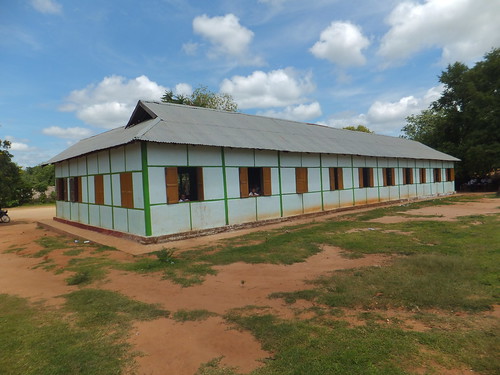
First, Doctor Hla Tun and the group of men from the village who had organised the refurbishment showed me around the school. It was quite a large wooden-framed structure with a 'wing' at each end and a verandah across the front. The roof was corrugated iron. The walls had originally been wooden planks but the refurbishment had removed the wooden cladding and replaced it with brickwork faced with cement for durability. The new walls had been painted pale blue on the outside with the exposed wooden framing picked out in green.

The refurbished school building at Nga-Minn-May

Concrete had been placed around the vertical timbers where they entered the ground to prevent (or at least delay) rotting. The building certainly looked smart and the group of men from the village who'd been involved in the project seemed rightly proud.

The group of men from the village who had organised the refurbishment

Although it was a non-school day, the children (including the nursery children) were waiting in their various classes for our visit. As always in Burmese schools, discipline was impressive. Some of the original wooden cladding from the building had been adapted to form simple internal partitions to give the different classes some slight isolation from one another.

Doctor Hla Tun had brought a number of pairs of spectacles (from the donation made by Ruth and Linda) for distribution to the group of elderly villagers squatting in the school yard where we had parked. The Doctor supervised the selection of the most effective spectacles for each person.

Schoolchildren waiting around the ancient tree before the distribution of stationery.

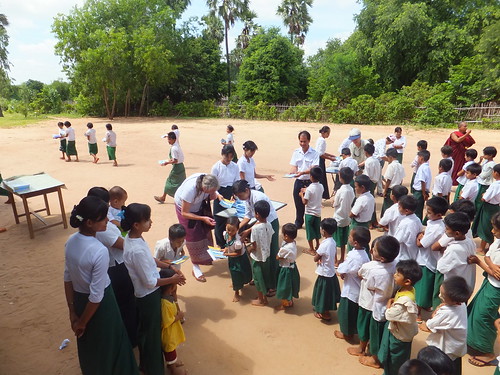
It was then time to distribute the stationery to the waiting schoolchildren. The tables bearing the stationery were moved out into the dusty schoolyard to leave room for the children to line-up and teachers helped to make up the 'kits' for each child. The actual distribution by Doctor Hla Tun and Jan then proceeded quite quickly. Finally, a table and two chairs had been set-up near our vehicle, and we were invited to take a snack before starting our journey back to Bagan. Here, the Doctor carried on giving consultations at the Bagan Medical Clinic. I observed the work for an hour or two but then, shattered, returned to the ship leaving the Doctor and his colleagues to complete the day's work. There's a report on my visits to the Clinic that day here.

Photographs: Nga-Minn-May School.

Friday, 19 October 2012

Htee Pu School Visit

Events of Saturday, September 22nd 2012

After spending a little time at the Bagan Medical Clinic (described here), Doctor Hla Tun had arranged that we would go by road to Htee Pu village and make a distribution of stationery at the school. The Doctor had arranged to hire a decent air-conditioned vehicle from Bagan Monastery so, once the stationery was loaded, we set off. The route to Htee Pu is now becoming quite familiar to me - taking the Mount Popa road from Nyaung Oo, and finally taking the dusty, unmade road to Htee Pu village.

On the final leg, we got stuck behind a bullock cart on a narrow section and there was no alternative to creeping along behind the cart until it reached a spot wide enough for the driver to pull over and let us through. I found this a timely reminder of just how different life in Htee Pu is from what I'm used to.

Once the bullock cart reached a wide spot, it pulled over to let us through.

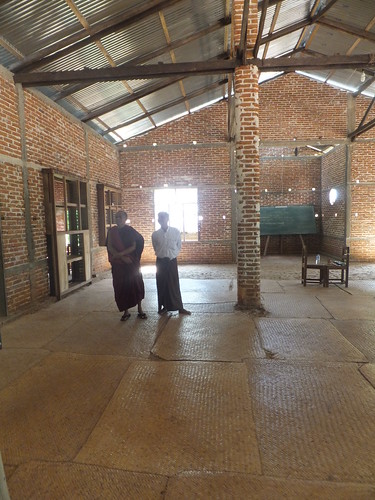
We parked and started to unload the stationery when Ruth and Linda arrived by car with San to take part in the distribution of spectacles to a number of elderly villagers. We were greeted by the head monk and we first looked at progress on the new, large assembly hall which is still unfinished but already in use.

The new, large assembly hall is unfinished but already in use.

The elderly villagers were squatting in the school yard and Doctor Hla Tun, Ruth and Linda organised the distribution of reading glasses and the selection of the spectacles which gave the best results. This was a very light-hearted event with a lot of laughter, particularly when one recipient managed to wear her glasses upside down.

A lady from Htee Pu with her new reading glasses.

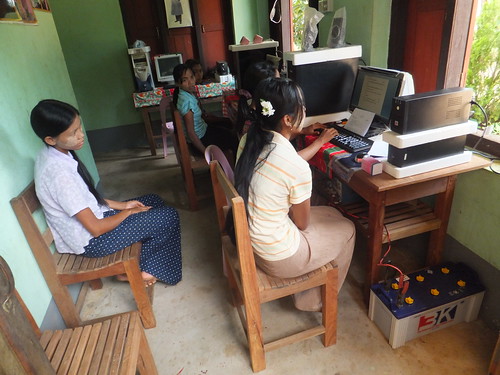
The head monk then proudly showed us the new computer department with, I think, three computer stations. Although it was Saturday and not a school day, four girls were carrying out keyboard exercises on the computers - some exercises in Burmese, some in English. The computers appeared to be powered from large wet lead-acid batteries via inverters. There was also a large solar panel in the yard outside presumably used to re-charge the batteries.

The Computer Department at Htee Pu School.

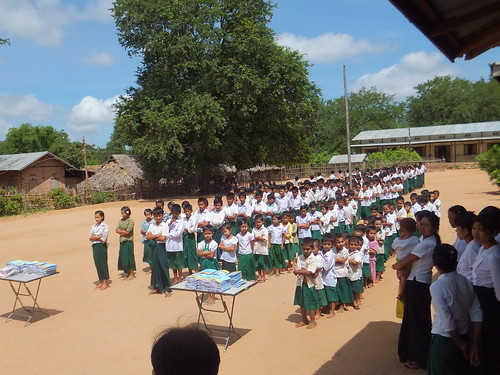
We met the headmaster who took us to look at the primary school classrooms. School day or no school day, all the pupils were present. I was surprised to discover that, even in Grade 1, English is being taught. In the mean time, a group of teachers had set up tables in the school yard and unpacked the stationery we were to distribute. All the pupils were now summoned from the various schoolrooms where they had been quietly waiting and they formed four lines to receive their stationery.

As the children line up to await the stationery distribution, their discipline is impressive.

The teachers were rapidly making up 'kits' of stationery to be given to the pupils so Ruth, Linda, Doctor Hla Tun and Jan were able to complete the distribution quite quickly.

Ruth, Linda, Doctor Hla Tun and Jan distribute the stationery.

Once the stationery distribution was complete, the children returned to their classrooms and Ruth, Linda and Jan continued on a tour of inspection.

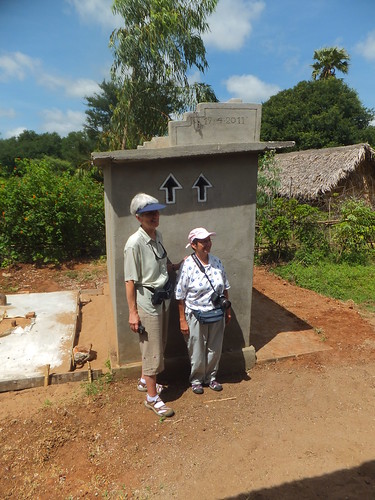
At many schools, toilet provision remains primitive and comprises a couple of small wooden shacks with a hole in the floor. The 'Road to Mandalay' Social Contribution has donated a number of solidly-constructed toilet blocks connected to a septic tank at various schools. One such block was completed at Htee Pu in 2011 and a second was under construction.

Ruth and Linda near the substantial toilet block.

The 'Road to Mandalay' Social Contribution has donated a number of school buildings at Htee Pu. I was delighted to see that the building which I had the honour of opening in 2010 (described here) has had the original dirt floor upgraded to brick.

Smiling children in one of the classrooms which now have brick floors.

In one of the classrooms, a group of girls performed a traditional dance for the visitors.

An impromptu dance performance.

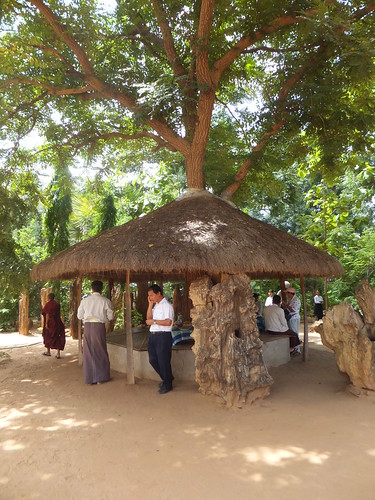
Before we left, we were invited to a simple meal. Hospitality is an important part of the Burmese culture. One of the larger trees had a low plinth built around the trunk, with a thatched roof circling the trunk at head height. This formed a very pleasant, cool shelter where we could relax for a few minutes before moving on.

The shelter where we were offered food.

The next destination for Doctor Hla Tun and I was the school at Nga-Minn-May where the 'Road to Mandalay' Social Contribution had recently funded refurbishment of the school building, described in a separate post.

Photographs:

Visit to Htee Pu School.

[Expanded 23-Oct-2012]

Sunday, 23 September 2012

The Bagan Medical Clinic

Events of Saturday, September 22nd 2012

Saturday was my last full day in Myanmar. The ship had arranged quite an intensive and varied series of options for the Guests but Doctor Hla Tun had invited me to accompany him for part of the day so I did none of the set options. I met the Doctor at 7.45 a.m. and we were transferred ashore by one of the local boats. They are powered by a Chinese diesel engine, so starting them up requires the boatmen to crank a starting handle furiously before the engine splutters into life. There were steep steps to reach the top of the bank and I'm sure they were steeper than last year. We walked the short distance to the medical clinic.

Bagan Medical Clinic.

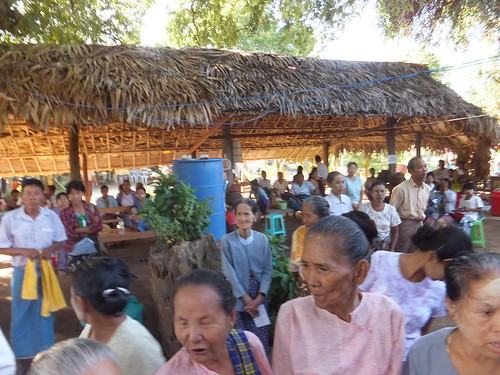
A number of buildings seem to have appeared since last year. There's a substantial covered, open sided, raised area which waiting patients use to sleep if they need to wait until the next day for an appointment or if they cannot return home on the day they receive treatment. There's a simple shelter with some seats which patients can use whilst waiting in the day.

The shelter for waiting patients, just before 8.00 a.m.

Some patients have been travelling up to 150 km for an appointment, often by fairly primitive and slow methods. Although the Clinic provides a free meal for waiting patients (paid for by the local Monastery), private enterprise seems to have given rise to one or two food establishments as well.

The project has been carried out by the 'Road to Mandalay' Social Contribution in conjunction with the Head Monk of the monastery at every stage. One young monk who I'd met the year before seemed to be permanently based at the clinic and another monk seemed to be in charge of making announcements on a public address system which has appeared. The Head Monk himself is a familiar figure in the Clinic. He arrived at the Clinic a few minutes after Doctor Hla Tun and I and he made another visit in the afternoon on that day. The Clinic itself has spawned a much larger awning at the front of the building and an additional lean-to awning at the side.

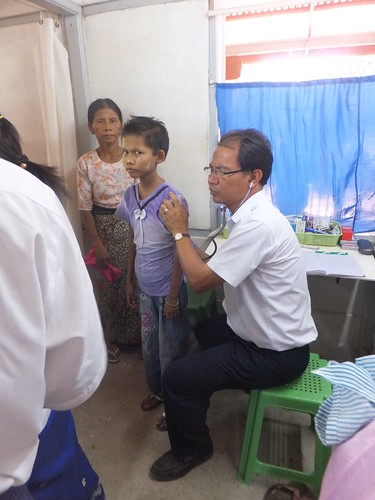
On Clinic days, there are normally three Doctors at work but one was away on the day I visited. Whenever possible, Doctor Hla Tun also carries out consultations working (as do all the staff) punishing hours. Of the seven support staff (not counting monks) I think there are two trained nurses. The other assistants have been trained by Doctor Hla Tun to provide professional assistance in registration, injections and dispensing.

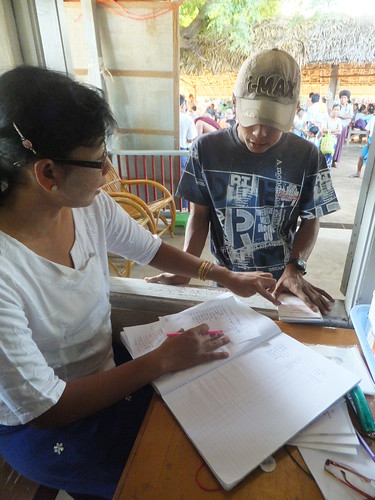
Early each day, the Clinic starts making bookings for the day through a window marked 'Registration'. Existing patients will have a record book with details written by the doctor which the patient looks after and brings back for any further treatment. New patients are issued with a record book as necessary. As the pile of record books for waiting patients grows during registration, brief patient details are entered in a 'Daybook'.

Patient Registration at the Bagan Medical Clinic.

Normally, patients are dealt with in the order in which they register but serious conditions or other factors are used to assign a medical priority as well. On the day I visited, the pressure of patient numbers was not so high, probably because many of the country people would have been involved in bringing their harvest in. With only two doctors present to start the consulations (Doctor Hla Tun would not be able to carry out consultations until the afternoon) the day's 'List' was stopped at 270. Unsuccessful patients would either have to overnight or make a second journey on a later date.

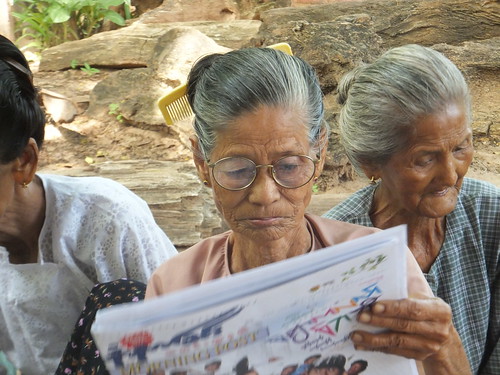
Before the Clinic started, Linda and Ruth (two Guests on the ship and also Donors) arrived to be involved in the distribution of spectacles. The elderly in Myanmar suffer the same age-related defects of vision as we do. In the absence of an eyesight test chart, a number of out-of-date newspapers were provided, so the queue of elderly which had formed as if by magic, were issued with a pair of spectacles and a section of newsprint to check the improvement. Alternative spectacles were then tried until the best effect was achieved. A number of photographs were taken to record the event.

Spectacles being selected for issue to the waiting patients.

As the spectacle selection process continued outside the Clinic, the Doctors started their consultations and the function of the 'Announcement monk' became clear. To make sure that the right patient appears, a small public address system has been fitted and the monk with the microphone declaims the next patient. Certain monks are used to broadcasting readings from the Buddhist Scriptures using a similar Public Address system in the Monastery on special days and these monks develop a very effective speaking voice.

When I was there, two doctors shared one small consulting room and the second room, with two unpadded examination couches was allocated to the third doctor and the assistant giving injections. In addition, two chairs had been set up on the front verandah so that two of the assistants could measure and record blood pressure before the patient saw a doctor, making better use of the doctors' time.

Two Health Assistants checking the blood pressure of two monks who have travelled from a remote monastery to be seen by a doctor.

Doctor Hla Tun had arranged for us to visit two schools during the day, Htee Pu and Nga Minn May and so, at around 9.30 a.m., he had to leave the consultations to the other two Doctors and we walked to the nearby monastery to load the stationery to be distributed at the schools into the monastery car which had been hired for our transport. The visit to Htee Pu is described here and to Nga Minn May here.

Doctor Hla Tun resumes consultations in the afternoon, after our road trip.

It was late afternoon before we were back at the Bagan Medical Clinic and there were still lots of waiting patients. Doctor Hla Tun immediately returned to giving consultations and I was invited to observe.

Assistants at work in the dispensary/office area.

After an hour or two, I'm afraid I was so exhausted that I decided to return to the ship, leaving the Doctor and his colleagues (who are clearly made of 'sterner stuff') to complete the day's work.

Photographs:

Life at Bagan Medical Clinic.

[Revised 19-Oct-2012, 17-Nov-2012]

Saturday, 22 September 2012

Bagan

Events of Friday, 21th September 2012

I got up at 5.30 a.m., knowing that the Captain would be sure to leave Shwe Kyet Yet River Station before the announced time of 6.30 a.m. I've commented to the Captain before that he's only happy when his ship is moving. Sure enough, shortly after six o'clock we quietly slipped away from our moorings, gently moved astern to get clear of all the barges and tugs moored upstream of us and slowly turned to starboard to face downstream. It was a bright, clear morning promising to be a hot day.

The 'Road to Mandalay' manoeuvres away from her berth at Shwe Kyet Yet before sailing downstream and passing under the new road bridge in the background.

We cleared the two bridges at Sagaing and made good speed, sailing with the current. There was time for a leisurely breakfast and a bit of 'blogging' before the Doctor gave an illustrated presentation on the 'RTM Social Initiative' in the Observation Lounge. This was very well received by an appreciative audience.

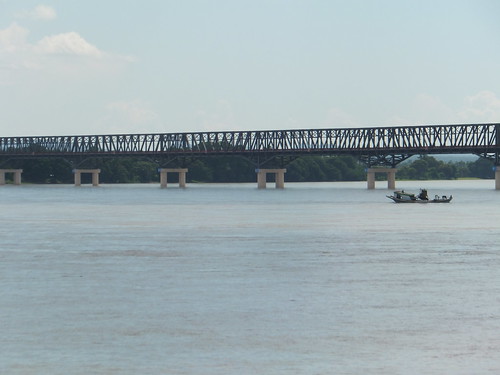
On the way to Bagan, we had another chance to admire the new long road and rail bridge that now spans the river. One of my new friends on the ship is a Civil Engineer and he commented that, with its conventional, rivetted steel truss design, the bridge looks like something built in the '30s, rather than something just completed.

Just part of the new long road and rail bridge across the Ayeyarwaddy north of Bagan.

I took buffet lunch in the quiet restaurant, although many Guests preferred to take the meal on the Top Deck under the awning. Before 3.0 p.m. we anchored midstream opposite the 'Road to Mandalay' Jetty at Bagan, ahead of schedule. Two local boats were ready to ferry the Guests ashore for an afternoon tour of Bagan.

There were just five of us in coach number 6 with our regular guide, the charming Nang. Shortly after leaving the parking area at the jetty, we passed the Bagan Medical Clinic. I'd arranged to visit the Doctor there on the way back from the tour, so we carried on to the famous Ananda Temple. Well, we got as far as looking at the outside when one of our group decided that a visit to a laquerware workshop was essential so Nang re-planned the afternoon and deferred going inside the Ananda Temple until the next day. Instead, we took some dusty by-roads and stopped next at a smaller temple I'd not previously seen.

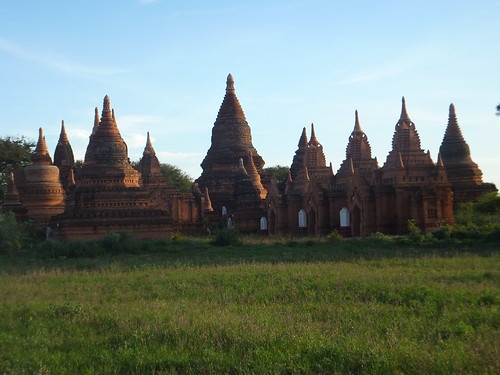
I've now visited the Bagan Plain a number of times but I still experience a sense of awe at the sight of hundreds upon hundred of pagodas seemingly scattered at random.

A group of pagodas on the Bagan Plain.

We visited a number of groups of small pagodas, some with wonderful wall paintings, in addition to spending time at the 'Everstand' laquerware factory (where some of the staff remembered me from previous visits).

The 'Everstand' Laquerware Factory.

We finished at the 'Sunset Pagoda' where hundreds of tourists had gathered on the fifth level (the climb was even tougher than I remembered) to watch the sunset effects.

The 'Sunset Pagoda'.

By the time we arrived at the Clinic it was almost dark and I was shattered. The Doctor had a further ten patients to see so I decided to return to the ship since I would see the Clinic in daylight the following day. A quick shower, dinner with Arun, watch a traditional marionette performance in the Observation Lounge and, eventually, to bed.

The following day, Saturday, would be my last full day on the ship and all Sunday would be spent travelling, so I'm not sure when my next post will be.

Photographs:

Shwe Kyet Yet to Bagan, downstream.
Incomparable Bagan.
'Everstand' Laquerware.
Sunset in Bagan.
Marionette Show on 'Road to Mandalay'.

Friday, 21 September 2012

Mandalay

Events of Thursday, 20th September 2012

We'd spent the night anchored off Mingun. In the early morning light the mysterious, earthquake-damaged bulk of the Unfinished Pagoda looked particularly impressive. The Captain took the ship the last few miles downstream to Mandalay - perhaps one of the best-known city names in the world but probably one of the least-explored by Westerners. Part of that fame derives from Rudyard Kipling's poem 'The Road to Mandalay' which gained a new lease of life when performed as a song, originally by Oley Speakes in the United States of America. Of course 'Road to Mandalay' refers to the River Ayeyarwaddy which was the original (and perhaps still today) the best way of reaching Mandalay from the former capital of Yangon. The British linked these two cities with a metre gauge railway which, at one time, was the Pride of the East but today it is run-down and slow. Until recently, roads provided a poor alternative for long distances but there is now a dual carriageway road extending north from Yangon, although I've only travelled on a small section of it or viewed it from an aircraft. Flying is certainly the fastest way from Yangon to Mandalay, if not the most enjoyable.

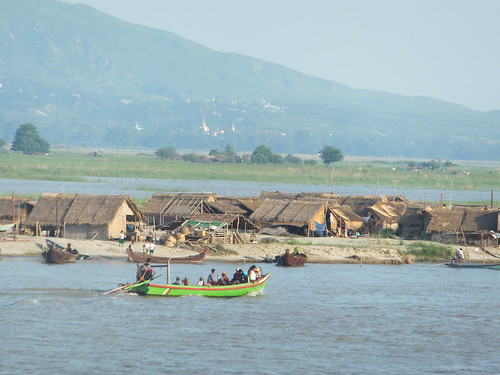
After about forty minutes cruising downstream from Mingun, we passed a thriving small village constructed from bamboo right by the river on a sand bar.

A small village between Mingun and Mandalay.

At Mandalay, we once again moored mid-stream at a location usually called 'Mandalay Pier'. Our Fast Boats were moored side-by-side against the hull of a larger, unpainted ship tied up to the quay. All the Guests were, by now, quite used to being transferred ashore by our Fast Boats but this time we had the novel experience of also walking through the unpainted ship which appeared to be waiting for fitting-out. It should be an impressive craft when finished. Once again, the Guests were divided into smaller parties between a number of buses. I was in Bus 6, with the lady guide Nang.

We set off east on one of the city's main streets (26th Street, I think). Almost all the buildings are modern. The population of Mandalay is around two million but I always think it must be more because every street teems with the commerical life of Myanmar's second largest city.

Bicycles and motor bicycles in Mandalay waiting for traffic signals to change.

One of the most noticeable features of the city is the wide, square moat around the brick battlements built to protect the Royal Palace. The battlements are a nineteenth century construction on the grand scale - each side of the square is 2.2 km in length. All the original palace buildings were wooden and destroyed by bombing during the second world war but a replica has been constructed which we were to visit later. We drove north keeping the moat on our right and then turned east. At the foot of Mandalay Hill, we stopped and transferred to a pickup truck provided with a tilt cover and longitudinal seating. This type of vehicle is used as a 'local bus' and they can be seen everywhere carrying amazing numbers of passengers, looking like an attempt to enter the 'Guiness Book of Superlatives' for largest number of people carried by a four-wheeled vehicle.

Our pick-up made the hair-raising climb up the zig-zag route leading to the summit of Mandalay Hill, where there's a temple complex. In bare feet, we entered a lift (elevator) which raised us to the level of the temple. The temple commands splendid views in every direction. Of course, serious pilgrims walk from the base of the Hill. There are wide, concrete steps (about 2,000 of them), covered with 'tin' roofs for this purpose and we saw plenty of Burmese using this route. I noticed that two Army Officers who arrived to pray at the main shrine, parked their Jeep near the lift and made use of it.

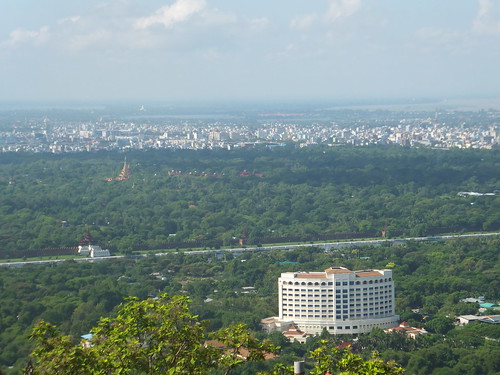
View of the City from Mandalay Hill. Ignoring the modern hotel in the foreground, the Royal Palace moat and battlements can be seen nearer the camera with the reconstructed buildings of the Royal Palace peeking through the trees further away. The modern city is in the background, on the far side of the (not visible) moat on the other side of the Royal Palace.

Next, having changed back to our bus, we went to the Kuthodaw Paya which was started in 1857. It has a central, golden stupa based on the Swezigon near Bagan. The entire Tripitaka, the Buddhist canon, is engraved on 729 marble slabs, each housed in a white-painted small stupa. This has been accepted by the 'Guiness Book of Superlatives' as the "world's biggest book".

Each of the white stupas at the Kuthodaw Paya contains one of the 729 engraved marble slabs of the Tripitaka.

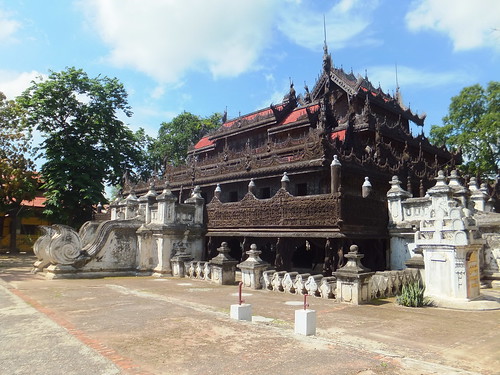
The Shwenandaw Kyaung, usually called the 'Golden Palace Monastery' has an interesting history. It is the only original building from the Mandalay Royal Palace to survive. It is the building where King Mindon died and his son, Thibaw, had the whole building moved to its present site in 1880 as a monastery. The building thus avoided destruction by bombing in the second world war. As we came out, a party of high school students visiting Mandalay were just having the 'Group Shot' taken, prior to going inside the building. I couldn't resist taking my own 'Group Shot' which I showed to the Group Leader and some of the students.

The Shwenandaw Kyaung (Golden Palace Monastery).

We then passed through the battlements of the Royal Palace site and drove to the reconstructed Royal Palace, spending some time exploring the mainly empty buildings and touring an interesting small museum. It was about 11.30 a.m. by the time we were back on the bus and we drove to the Sedona Hotel, reputedly the best international hotel in Mandalay. I had stayed at the Sedona during an earlier holiday ('Far East 2'). This time, we all enjoyed an excellent buffet lunch in pleasant surroundings.

After lunch, the tour was to continue to see Gold Leaf production and the famous Mahamuni Temple, finishing at Amarapura and U Bein's famous teak bridge. However, the Doctor asked if I would like to visit Taung Be Lar School and I said 'Yes, please'. I had visited the places on the afternoon tour before and, although I'd have very happily gone again, the opportunity to see Monastic School No. 21 again was irresistible. I went with the Doctor and Sammi in an air-conditioned vehicle from the Sedona Hotel to the 'Road to Mandalay' River Station at Shwe Kyet Yet. The ship was already berthed there, having travelled downstream since putting the guests ashore at Mandalay Pier earlier in the day.

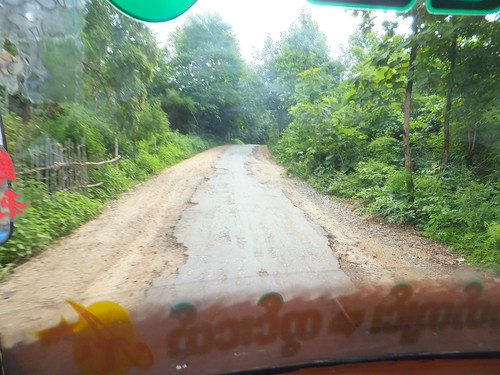
In ten minutes, I managed to shower and change and then the Doctor and I returned ashore where a 'local taxi', a rather dusty 4-door saloon was waiting for us. 'Air Conditioning' in these vehicles is achieved by winding all the windows fully open - actually, this arrangement suits me. We drove over the new road bridge and continued to the foot of the Sagaing Hills. Here, we turned left onto an unmetalled, dusty road with a number of religious teaching centres left and right. The road then entered open, undulating country which could have been miles from anywhere with just a few bamboo houses scattered around. We paused at one rutted junction whilst the Doctor and the driver considered the right route. As we set off again, the Doctor explained to me "The banyan tree is the marker". It was the right route and after passing a herdsman with his animals and some small businesses which seemed to be extracting and crushing stone, we came to the school building, set on a slight rise and with good views of the river downstream of Sagaing.

Taung Be Lar School.

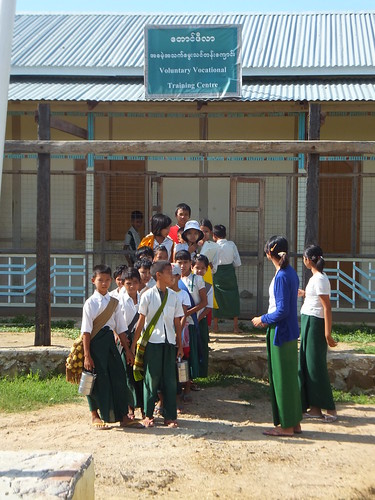
'Road to Mandalay' has provided renovation and other support to this school which serves a very poor rural area, but some later extensions funded by a local donor appear to have run out of budget before the work was complete. We had a look round the main school building and walked to a multi-purpose building a few hundred yards away labelled as a Voluntary Vocational Training Centre but also used by pupils from the school.

Pupils leaving the multi-purpose building at Taung Be Lar.

By the time we arrived back at the main school building, the stationery that the Doctor had brought with us had been laid out on a table by the teachers, ready for distribution. Each child was to receive two ruled exercise books, two pencils and a short plastic ruler. Doctor Hla Tun and I handed out the stationery to each child individually and gave the balance (to cover absentees and some stock) to the teachers. Some erasers and pencil sharpeners were also included in the stock left with the teachers.

Distribution of stationery at Taung Be Lar.

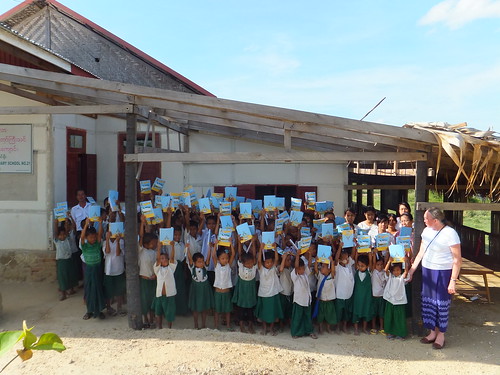
The event was fully recorded by our taxi driver using my camera, including 'group shots' with the pupils proudly displaying their new exercise books.

The pupils at Taung Be Lar proudly display their new exercise books.

We set off by car to return to Shwe Kyet Yet and the waiting ship. The taxi driver decided to return by a different route, which crossed the railway near a station. The Doctor said that there was time for me to take photographs, so I spent a happy half hour taking pictures around the station.

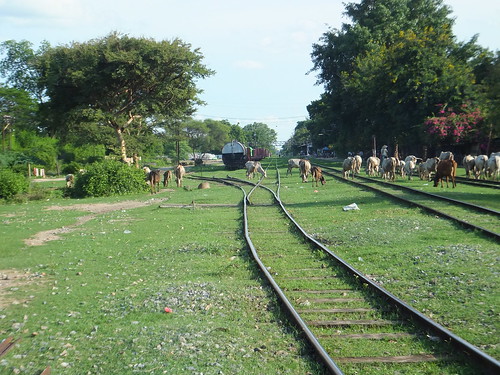
The station was called Ywa Taung and, although it's on a 'main line', a herd of cattle was grazing undisturbed up and down the station area. Just before we left, a freight train arrived, complete with a guard's brake van similar to those I'd seen in Thailand.

Ywa Taung Station. The single platform and station building are visible in the background.

Back at the ship, I was pleased to have a shower and a bit of a rest - it had been a hot, tiring but very enjoyable day. In the evening, I was included in a dinner party on the top deck with a number of my new friends before the day was rounded-off by a display of 'Tribal Costumes of Myanmar' in the Observation Lounge, modelled by students from Mandalay and introduced by San. My 'nightcap' was a cup of tea in the Piano Bar and then I retired, to recharge both the camera battery and my own 'batteries', ready for the next day.

Photographs:

Arriving at Mandalay.
Mandalay Hill and the "World's Largest Book".
Shwenandaw Kyaung.
Taung Be Lar School.
Ywa Taung Station.

[Revised 19-Oct-2012]
An Elephant Experience

Events of Wednesday, 19th September 2012

A later start meant that there was time for Morning Tea in my cabin whilst I was getting ready. As always, this arrived on time, beautifully presented on a small tray. Somehow, the almost fanatical attention to detail by the Hotel Staff made the food and drink taste better.

The ship had left the overnight mooring at 'first light' and continued downstream for almost three hours to anchor midstream opposite the large village of Thabeikkyin, by which time I'd enjoyed a leisurely breakfast including porridge and poached eggs on toast.

I was in the group of Guests transferred by the second Fast Boat to the landing steps (for fairness, this alternated day by day). The landing steps were crowded with curious locals just watching the arrivals but, as always, they would readily smile and reply if greeted with a "Mingala Bar". A series of buses were drawn up at the side of the road, each bearing the 'Road to Mandalay' sign and with a printed number taped to the windscreen. The lady guide Nang directed me to Bus 5 and suggested I occupied the front, left passenger seat. As I've mentioned before, most of the vehicles remain right-hand drive, despite now driving on the right (a change introduced after General Ne Win of Myanmar had visited President Nixon in the U.S.A. some time ago). Apart from having to clamber over the engine cover to reach this seat and the fairly limited leg room, I found this position most congenial. We set off on the climbing road leaving the village with the engine straining. The road just kept on climbing, twisting around the contours of the hill we were ascending, giving continually changing views.

Although the 'road bed' was wide enough for two vehicles to pass, in common with many of Burma's roads, the 'sealed' tarmac surface is much narrower, necessitating that vehicles may have to move off the tarmac when passing. One another. This, of course, tends to break down the edge of the tarmac so that the tarmac strip becomes narrower in places. Combined with the effects of weather and lack of maintenance, the road surface is, to say the least, less than ideal. I was fascinated to watch the driver expertly position the road wheels so as to miss the worst of the pot holes. Most of the traffic coming towards us was motor bicycles and the bus just held to the tarmac strip while the drivers assistant leaned out of the open door furiously waving to approaching traffic to move out of our way. I was afraid that the 'bike rider might lose control because of the sometimes sudden steep drop moving off the tarmac onto the 'road bed', but they always seemed to make it. Being a passenger in Burma can be quite frightening - being a driver must be terrifying.

Although the 'road bed' is often wide enough for two vehicles to pass, the tarmac may be much narrower.

We were now travelling along a fairly high plateau with 'bush' extending towards the distant mountains. We passed through a number of surprisingly large villages. They don't see many foreign tourists north of Mandalay so our fleet of buses was an object of great interest and there was a lot of waving and cheering.

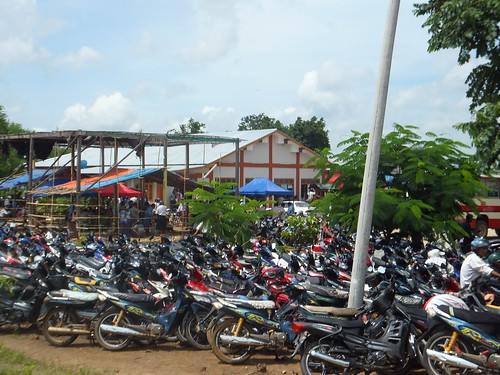
One village seemed to be choked solid with motor bicycles and their riders. They were all waiting for attention at the local registration office for these vehicles which deals with annual license re-registration (and, I believe, insurance) on one or two days in the year. There were hundreds upon hundreds of machines and it was clear that their owners were in for a long wait. I'd seen a similar scene in Mawlamyine at the beginning of this trip.

After driving for, perhaps, half an hour all the buses stopped and the Guests got off. We were each issued with a stout bamboo stick as a 'trekking pole' and directed along an uneven path through the bush. A trumpeting call indicated that there were elephants nearby and the path came to a large clearing where eight working elephants were lined up, with their respective 'Oozie' (called the 'mahout' in some other countries) seated on the neck of their charge, with their legs pushed behind the ears of the elephant. The name and age of each elephant had been painted on the animal's hide, in Roman characters, presumably for the visitor's benefit. To one side, a bamboo shelter had been erected for local villagers involved in the timber extraction industry to watch the proceedings. There was another shelter as a 'refreshment station', a bamboo 'table' with bananas and sugar cane for us to feed to the elephants and a tall bamboo tower (with two sets of bamboo ladders) to allow the Guests to board a 2-person 'Howdah' on the elephant's back for a short ride.

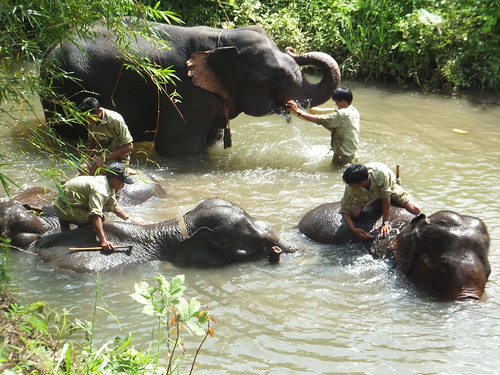
There's nothing more impressive than a line of working elephants each with their 'Oozie'. They are part of the Forestry Service and the men had smart, lightweight khaki uniforms with badges. Even today, elephants have a manoeuvrability, strength and intelligence which is hard to match with a machine. One or two guests started feeding the elephants so I picked a younger, smaller elephant and fed it for a time. At one side of the clearing, there was a steep, muddy bank down to a small river perhaps fifteen feet below. Four of the elephants descending this bank without difficulty and entered the river for washing. Elephants are fastidious creatures and require regular washing, preferably by immersion.

Oozies washing elephants.

The Oozies scrubbed away at the tough hide until it was time for a demonstration of obedience. The elephants clambered back to the clearing and, on command, all the elephants knelt.

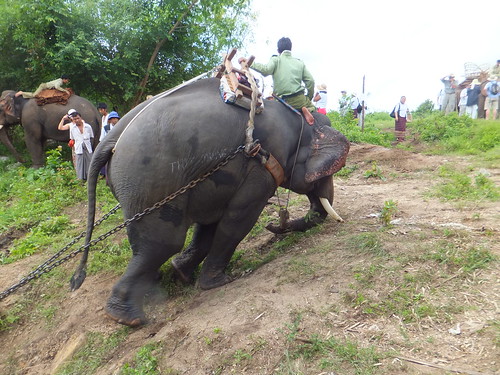
Next, we had a demonstration of strength. Two elephants were equipped with a simple, stout harness attached to chains. The 28-year old elephant called Thit Daung Sein scooped up a large log with its tusks and held it in place with its trunk whilst dragging an even larger log by chain. The first log, estimated at just under a ton in weight, was casually tossed over the edge of the steep bank to roll into the water. The second log (about one ton in weight) was then dragged into the river. A slightly smaller elephant, Htun Chein, dragged a slightly smaller log into the river. Thit Daung Sein then amazed by climbing back up the steep slope, dragging the large log out behind.

Thit Daung Sein braces for a moment before completing the dragging out of the large log.

The second elephant, Htun Chein, was still standing in the river. First, he scooped up his log and positioned it vertically against the steep slope, ready for dragging out once the chain was attached. He then scooped up the smaller log with his tusks, locked it in place with his trunk, climbed up the bank carrying the smaller log and dragged out his log with the chain. It was an incredible demonstration.

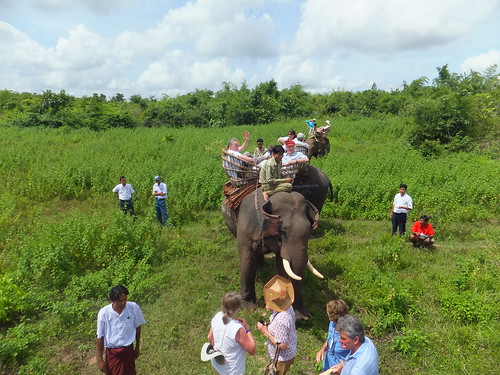
All the elephants were then equipped with a two-person 'howdah' in the form of a double basket made from bamboo so that all the Guests could have an elephant ride, boarding from the special 'tower' I had a ride on a rather vocal 24-year old elephant called Zaw Chin Ni.

Jan enjoys an elephant ride (Photo: Dr. Hla Tun).

This trip, I bought a wooden elephant bell. They carried no stock, so the bell was taken off one of the elephants. With great reluctance, I made my way back to the waiting buses with the other Guests.

The buses then took us back to Thabeikkyin. When we passed the motor bicycle registration centre, the waiting crowds seemed even larger than before. Many had parked their motor bicycles and were taking refreshments at an adjacent cafe.

The motor bicycle registration centre, showing just some of the waiting vehicles.

The Fast Boats transferred us back to our ship which then continued its journey downstream, arriving at Mingun and anchoring overnight midstream just as it was becoming dark. I had dinner with Edward, Ulrika and Arun before going to the Observation Lounge at 9.30 p.m. for the performance of a Yamayana play.

Photographs:

An Elephant Experience.