Showing posts with label Railway Signalling. Show all posts

Thursday, 9 June 2022

Llandudno in April

Following the success of a recent day trip by rail to New Brighton (report here), I decided to make a trip to another favourite destination, Llandudno. I booked any Anytime Return online and decided on First Class. This was a questionable decision, since all Transport for Wales (TfW) trains are standard class only, apart from the Premium First service between Cardiff and Holyhead I mentioned in my post here). In addition, Avanti have a 'Voyager' service, currently between Holyhead and Crewe which has a First Class section. Although we are in the phase of 'Living with Covid', railway timetables are still not back to normal and services are liable to disruption at short notice.

Getting there: Friday, 22nd April 2022

I took the customary 07:30 bus to Wolverhampton, discovering that the £2.60 single fare has risen to £2.80. The pedestrian approach to the station still entails an ever-changing obstacle course as work continues on the modest yet late-running extension of the West Midlands Metro tram service from the current terminus at St. Georges to the railway station.


Wolverhampton Station, showing continuing work on the Metro extension, with the railway in the background (Llandudno trip)


Entrance to Wolverhampton Station with yellow arch and name displayed (Llandudno trip)

I had a few minutes to wait before my train, giving me a chance to study the fire alarm map showing the odd-shaped, vaguely triangular site which the new, unloved building occupies. My train 9S44, a 'Pendolino' service from London Euston to Edinburgh via Birmingham arrived on time. Although this train is only allowed 29 minutes to Crewe, the friendly staff in the First Class section found time to provide a glass of orange juice with two rounds of toast and preserves so that I arrived at Crewe in good spirits. Checking Railcam UK on my 'phone (see post here), I discovered that the Diesel Multiple Unit (DMU) in the north end bay platform 9 would form train 1D82 to Chester at 09:51, but the passenger information displays showed an earlier departure from platform 11 at 09:17. A quick check on Railcam UK showed train 1K33 already approaching platform 11 from Chester. A fair number of passengers got off and a reasonable number boarded but the refubished Class 153, operating as a 2-car train provided plenty of space. I noticed extensive tree-cutting as we made the usual speedy run to Chester, arriving in bay platform 1.

Then I was a little unsure of the best train forward. There seemed to be three departures in the next 30 minutes which would all take me to Llandudno Junction but that day arrangements seemed a little disarranged. When in doubt, I normally take the first available service, particularly remembering I needed a connecting service from Llandudno Junction to take me to Llandudno itself. I took the first departing DMU, from platform 3 which I think was 1D33 from Manchester to Holyhead, quite well turned out in TfW livery, well-patronised but not crowded. Chester Power Box controls the line up to the vicinity of the short (99 yards) Rockliffe Hall Tunnel beyond which there is a section of modernised signalling controlled from a Railway Operating Centre (ROC).

The Wales ROC, situated just west of Cardiff Central station opened in 2010 and in 2018 added the North Wales Desk with a single workstation for the Rhyl area, controlling the section from the Chester Power Box boundary in the east to the Llandudno Junction boundary in the west. The control code for signal numbers in the Rhyl workstation area is 'FH', which I assume stands for Fflint-Holyhead.

We made the usual progress, bursts of high speed running alternating with frequent station stops where a flurry of passengers boarded and alighted. During our stop at Fflint (a station I'd travelled from a few months earlier, described in the post Rail Travel in January 2022), I took a couple of pictures showing the well-proportioned station building on the Down side, presumably a relic of the Chester and Holyhead railway company.


Fflint Down Side Station Building (Llandudno trip)

Near Fflint, we passed an Avanti 'Voyager' on the Up line - the 08:55 Holyhead to Crewe, reporting number 1A23. We were under the control of Llandudno Junction's colour-light signals by the time we stopped at Bae Colwyn, which was still known as Colwyn Bay when I was growing up. At that time, like Rhyl, it was an important destination for holiday-makers using the railways, as testified by the broad steps of the footbridge


Colwyn Bay station footbridge, Down side (Llandudno trip)

At Llandudno Junction, we used platform 3 which is one face of the through platform island and, as I hoped, I found the connecting shuttle service to Llandudno waiting in plaform 2, the remaining terminal bay let-into the west end of through-platform island 1 and 3. In steam days, there were two adjacent bays let-into this island, with a similar island platform on the Down side now simplified to a flanking platform 4. As I waited for our departure, a Down train quietly rolled into platform 4, paused briefly and then noisily set off towards Conway. The train was Mark 4 Driving Van Trailer leading a train of Mark 4 coaches and being propelled by a Class 66 diesel electric. It was clearly one of the TfW Preium First services from Cardiff to Holyhead but it was a while before I realised it must have been the 06:45 from Cardiff, running late.

My train was a Class 175 with just a handful of passengers, quite attractive inside, carrying Covid warning signs with pictograms advising mask-wearing, distance-keeping and regular hand washing. We left on time at 10:59 for the short journey through Deganwy, with views of Conwy castle and the estuary of the Conwy river, to Llandudno.


TfW 3-car Class 175 in platform 2 (bay) at Llandudno Junction
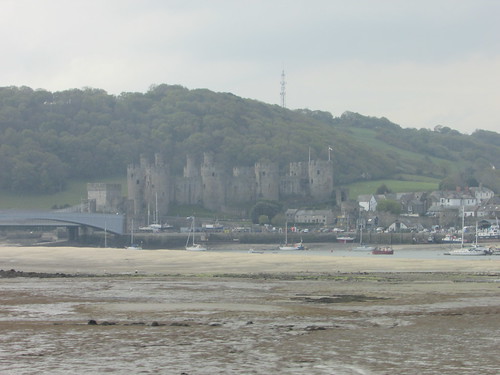

Conwy castle and the estuary of the Conwy river

On arrival at Llandudno station, I walked across the booking hall of the modernised station building, through the automatic glass doors and headed along Vaughan Steet to the sea front. The appearance of the sea front betrays its Victorian origins. A broad, pedestrian promenade around the curving bay is flanked by a road with attractive hotels on the landward side with the bulk of the Great Orme to the west and the Little Orme to the east. The weather was dry and reasonably warm but overcast, rendering the offshore wind farm virtually invisible.


Llandudno beach, showing the Pier and the Great Orme (Llandudno trip)

I took the promenade west past the bandstand and, once past the shingle, continued along the sandy beach for a time, returning to the promenade before choosing my next target, either the pier or the Great Orme Tramway. I decided to look at the tram so I crossed to Church Walks, the fairly steep approach to the lower terminus of the tramway, passing hotels and boarding houses on both sides along the way. I discovered that the tram was operating so I purchased a ticket to travel to the summit and back.

The Great Orme Tramway

The Great Orme Tramway ascends on a route about one mile long from Victoria Station to Summit Station at the top of the Great Orme headland in two, completely separate stages requiring passengers to change between lower and upper trams at the Halfway Station which includes the Engine House controlling the cables for both sections. Both sections follow the geography of the land, with changes in gradient and variable curvature. It is a type of cable railway called a Funicular where descending and ascending cars are linked by cable, reducing haulage power requirements.

As built, haulage was by winches operated by steam engines located in one Engine House at Halfway Station. On the lower section, each car was connected by cable to a winch at the Engine House with two cable drums so that as one car is hauled uphill, the other descends. The Upper section is similar but, because the powered winch is at the lower end of the section, a third cable links the upper end of the two cars via an Idler pulley at the Summit station. Electric winches finally replaced the steam engines in 1957. For more information, see Book Reference [1].

Around 2000, funding from the Lottery, the European Union and the Local Authority allowed comprehensive modernisation. There's more information on the Great Orme Tramway website here together with Book Reference [1] and Book Reference [2].

The lower terminus is called Victoria Station because it is built on the site of the former Victoria Hotel. It was some time before the incongruity of this single-track station sharing its name with the rather larger terminus in London (briefly described here) struck me.


Llandudno: Victoria Tram Station in 2014

There are normally three tram departures an hour (although additional services can be added in very busy periods). The tram station was bustling with people and I failed to board the first tram but the overcast was giving way to blue sky and bright sun so I was content to wait for the next service which took me to Halfway Station.


Tram No. 5 ready to leave Victoria Station with a full load.

The lower section shares the route with a public right-of-way for most of its length and uses 'inset' track to provide a level road surface. The haulage cable is below road level with a slot between the rails allowing each car to be connected to the cable. A passing loop is provided at the midpoint of the lower section with the line below the loop arranged as '2-rail' and that above the loop as '3-rail', as explained in the Wikipedia article here). Although the line from the lower section loop to Halfway Station is classed as '3-rail', there are actually 4 rails, with the middle two close together.


Great Orme Tramway: View of passing loop on the lower section from an ascending tram, showing the descending tram approaching the loop.


Great Orme Tramway: View of lower section tramshed at Halfway Station. Note two tracks, side-by-side ('3-rail') as far as the lower passing loop.

At Halfway Station, a brisk walk through the Engine House with the other passengers took us to the waiting upper section tram which departed once we had all boarded.

The upper section passes through unfenced moorland using sleepered track with stone ballast. The haulage cable is above ground, supported on a variety of pulley wheels. A passing loop is provided at the midpoint of the upper section and the line both above and below the loop is arranged as '2-rail'.


Great Orme Tramway: View of the upper section from an ascending tram, with the passing loop visible on the left. Note the level crossing. On the upper section, exit from the loop to either 'uphill' or 'downhill' sections is via a 'trailable' set of points allowing a car leaving the loop to force the points to the correct position. A special Tumbler mechanism then holds the points in that position, so that the returning car is directed to the correct side of the loop. For more information about the 'trailable' points and the Tumbler mechanism, refer to the report on an accident which occured in 2009 here.


Great Orme Tramway: View of upper section passing loop from ascending tram nearing exit points. Note extra 'crossings' to accommodate the cable joining the trams via the Idler pulley at Summit Station


Llandudno: Great Orme Tramway: This small building at Summit Station houses the large Idler pulley on the third cable which connects both upper section trams. Winding for both the Upper and Lower sections is from Halfway Station.


Great Orme Tramway: View of Summit Station and Museum. Note the telecommunications tower

The Summit area was quite busy when we arrived and the car park was well-patronised. There's a large restaurant, various amusements and small museum next to the tram station which outlines the history of the Great Orme. The haze had largely cleared and it was pleasantly warm. I walked for a while taking in the sea views and re-visited the museum but, with limited time, I boarded the next descending tram.


Great Orme Tramway: View of 'top hat' cable pulleys from descending tram on upper section. Note cables clipped to sleeper ends

At Halfway Station, windows give a view of the winch gear as you walk through the engine house to board the tram for the remaining section.


Great Orme Tramway: View of upper tramway cable haulage motor (blue) and gearbox (white) with twin winch drums visible in the background at Halfway Station


Great Orme Tramway: View of lower tramway cable haulage motor (blue) and gearbox (white) with twin winch drums just visible in the background at Halfway Station

On the lower section, there's a road/tram crossing with conventional traffic lights for road vehicles and the usual row of white lights applying to the tram (horizontal row: stop, vertical row: proceed). I believe that a magnet under the tram should ensure that trams always receive a 'proceed' signal: if not, the tram attendant issues an 'emergency stop' and winching (of both cars) halts until the system is reset which I'm told involves a 'magnet on a stick'.


Great Orme Tramway: Road signal (red) and tram signal (proceed) viewed from descending tram on lower section

Llandudno Town

Rather than retrace my steps back to the promenade, I turned into Mostyn Street, the town's major traditional shopping area. Encouraged by the good weather, the street was quite busy. I called in a one shop selling discounted new books, but refrained from making a purchase. I remember trams running along Mostyn street because trams operated along an eight mile route to Colwyn Bay until 1956. There's a Wikipedia article here.

Already fairly tired by my adventures, I determined to have lunch before making the return journey home so I turned into Vaughan Street to reach the promenade and the Imperial Hotel where I enjoyed a leisurely lunch in the enclosed terrace restaurant with panoramic views of the sea.


Imperial Hotel, Llandudno, viewed from the promenade in 2011.

Suitably fortified, I spent a few more minutes on the promenade enjoying the sea air and the sun before walking back to the railway station to start my return journey.

The Return Journey

That's the point at which things started to go wrong. I'd intended to catch a shuttle to Llandudno Junction, connecting with an Avanti 'Voyager' to Crewe. Then, an Avanti London service would take me to Stafford where West Midlands Trains would complete the journey to Wolverhampton. At Llandudno, I walked confidently up to the automatic glass doors and was surprised that they failed to open. Undaunted, I moved to the adjacent manual glass doors and found them locked. Then I noticed a small paper notice secured to the glass giving station closing times. It appeared the station had closed ten minutes previously. Through the glass, I could see the train I intended to catch in the platform and I was temporarily bemused. A kindly pedestrian passing by had seen this little pantomime played out and called "When it's locked, you have to go round the side and through the little gate". Thanking him profusely, I hurried to the car park at the side of the building and found the gate giving access to the platforms, in time to see my train depart.

I was anxious to be on my way but the next train to Llandudno Junction was not for an hour. Before the pandemic, taxis could frequently be found waiting outside but, with a reduced timetable in use post-Covid, the station was very quiet. Then I noticed a taxi office at the far end of the station building. The street door of the taxi office led to a waiting area and an internal door led to a counter behind which a base station radio operator was visible. I ordered a taxi to take me to Llandudno Junction which, to comply with the company's 'Covid Safe' rules, was done by shouting details from the waiting area. I waited in the street for about ten minutes for the taxi to arrive and the cheerful driver quickly drove me to Llandudno Junction station.

I hastened over the footbridge to platform 1 which was crowded with passengers supervised by two well-built security men as an already well-loaded DMU arrived. It took a little while to fit all the waiting passengers together with the security men onto the train and I settled for a cramped standing position next to a door. It appeared that there had been some prior dislocation to the services but I never discovered the details. Using Railcam UK on my mobile phone, I found out that I'd caught the 14:34 from Holyhead to Cardiff, reporting number 1V97, and that we were being closely followed by the 14:50 Holyhead to Crewe Avanti 'Voyager' service, reporting number1A53, so I came up with a plan to disembark at Rhyl and transfer to the 'Voyager'. The surge of passengers and bicycles getting off and on at Rhyl meant that I was trapped at the wrong side of the vestibule and, as the doors closed, I resigned myself to continuing to stand until Chester.

But I was disappointed when we were brought to a stand at Saltney Junction where the former Great Western Line from Wrexham trails in from the right. Railcam UK showed the line ahead clear to Chester but there was a Cardiff to Holyhead service, reporting number 1W94, approaching from Wrexham. "Surely", I thought to myself, "they won't cross this in front of us?". But they did, so we sat there, sardines in a tin, whilst I watched on screen as 1W94 made what seemed its agonisingly slow progress in front of us to Chester and 1A53 waited a block behind us. I can remember when there was quadruple track, paired by use, from Saltney Junction over the Roodee Viaduct and through the tunnels into Chester which allowed two trains to simultaneously approach the station. The arrangements were simplified by British Rail to a simple double-track junction with only two lines over the Roodee Viaduct and additional slow lines (this time paired by direction) commencing nearer Chester which was the arrangement inherited by Chester Power Signal Box in 1984.


Chester: West end of Roodee Viaduct in 2014. Note Guard Rails between Running Rails over the bridge.

My screen showed train 1W94 being crossed to bay platform 2 so, once he was clear, I was not surprised that we were routed into the adjacent through platform 3, leaving through platform 4 available to handle train 1A53 behind us. Once off the crowded train, I made my way over the footbridge to catch 1A53, the Avanti 'Voyager' to Crewe, which was 8 minutes 'down' on departure. There was plenty of space in First Class and I managed a welcome cup of tea on the journey before we arrived in bay platform 9 at Crewe, having lost a further minute on the short journey.

The late running destroyed my chance of connecting with Avanti 'Pendolino' service 9M84 from Blackpool to London via Birmingham which would have returned me to Wolverhampton in style. Instead, I disconsolately watched this train depart from platform 5 whilst I was still heading to the footbridge from platform 9.

Whilst I was trying to work out the next departure towards home, another 'Pendolino' arrived in platform 5 from the Manchester line and the public address announced that it was not in service so, intrigued, I sought more information from Railcam UK which revealed an Empty Stock working, reporting number 5T25 from Longsight Carriage Maintenance Depot to Widnes Transport Technology at Ditton Junction. Longsight is Alstom's centre for bogie maintenance and Widnes Transport Technology is the 13,000 square metre train modernisation and repainting facility opened by Alstom in 2017.

I decided to catch the West Midlands Trains 17:33 stopping train to Euston, reporting number 1U40, alighting at the first stop, Stafford. I made myself comfortable in the rear First Class section of the 8-car Siemens 'Desiro' Electric Multiple Unit (EMU) in bay platform 7, awaiting departure. We were 4 minutes late leaving, awaiting the arrival of a late-running Shrewsbury-Crewe DMU in adjacent bay platform 8 because bays 7 and 8 share a common 'throat' track.

As we passed the remodelled junctions at Norton Bridge (outlined in the post here), we passed a Class 66 hustling a container train north on the Down Slow. Railcam UK revealed this as the 09:32 from Felixstowe via the Northampton Loop due at the O'Connor Freightliner Terminal, Ditton at 19:41.

By now rather tired, I just managed to get off at Stafford platform 1 before the doors closed and the train left. There was a Wolverhampton service expected on platform 4, so I hurried across the passenger bridge, grateful for working lifts.

I was puzzled to see the signal at the end of platform 4 displaying a single, flashing yellow, since I'd never seen a flashing yellow displayed at that location before. Railcam UK clarified that the approaching train was not a passenger but a fast freight: the 15:49 from Garston Car Terminal to Dagenham Dock Reception Ground Frame, due there 23:10. This train, reporting number 6L48, is routed via the Crewe Independent Lines, thr Trent Valley, Northampton Loop, Camden. Stratford and Ripple Lane. This train is allowed to travel at 60 miles an hour and was certainly shifting as it swept through the platform with a Class 66 heading a long train of empty 'Carflats'.

The public address then announced a platform change for the expected passenger train to platform 1 so all the passengers trooped across to platform 1, either using the stairs or the lifts. By the time I was back on platform 1, I realised I no longer had my Canon camera with me.

At first thinking I'd left it on a seat on platform 4, I decided to miss the approaching Wolverhampton train and return to platform 4 to search but I found no camera. Then I became certain that, in my haste to leave the Euston train at Stafford, I'd in fact left the camera on the train seat which was speeding towards London.

I then took the next service to Wolverhampton (a Cross Country 'Voyager from Manchester, reporting number 1O68) and made a report to the West Midlands Train staff at Wolverhampton. The supervisor at Wolverhampton explained that West Midland Trains use a third party website called MissingX to deal with lost property enquiries, although he didn't display much confidence in the arrangements. So I finally caught a taxi home after a mixed day of good and not-so-good experiences.

Book References

[1] 'Great Orme Tramway: The First 80 Years' by R.C. Anderson (Light Rail Transit Association)
[2] 'The Great Orme Tramway: Over a century of service by Keith Turner (Gwasg Carreg Gwalch 2003) ISBN 0-86381-817-X
[3] ‘British Railways Layout Plans of the 1950’s - Volume 10: LNW Lines in North Wales, Chester and Wirral areas’ (Signalling Record Society) ISBN: 1-873228-12-0
[4] ‘A Regional History of the Railways of Great Britain: Volume 11 North and Mid Wales’ by Peter E Baughan, published by David & Charles (ISBN 0-7153-7850-3) [2].

Related articles on other websites

Great Orme Tramway
Collision on the Great Orme Tramway 15 September 2009
British Rail Class 153
British Rail Class 175
Funicular (Wikipedia)
Llandudno and Colwyn Bay Electric Railway


Related posts on this website

Llandudno by Train
Rail Travel in January 2022
A Trip to the Seaside (Part 2)
Trip to Holyhead (Part 1: Crewe to Llandudno)
Llandudno (2014)
Return to Llandudno
A Trip to the Seaside (Part 1)
Llandudno Railway Station
The Holyhead to Crewe Railway Line
Watching The Trains Go By
Return to Manchester (Norton Bridge remodelling)

My pictures

Llandudno trip (This trip)
North Wales Line (Crewe - Llandudno) All pictures
Crewe Area rail All pictures
Great Orme Tramway All pictures
Llandudno Earlier pictures

Depending on the display device, the right hand edge of pictures may not display. To see an uncropped image, click on the picture. Alternately, you can find the image by following the 'My pictures' links and display or download the image in various resolutions.

Sunday, 14 November 2021

To Stockport by Rail

On Friday, 5th November 2021, I made a brief visit to Stockport for a business meeting, travelling between Wolverhampton and Stockport using the 'CrossCountry' services in both directions via Stoke-upon-Trent. As the 2021 United Nations Climate Change Conference, also known as COP26, was taking place in Glasgow to agree how our world could be saved, bizarrely both my journeys entirely 'under the wires' featured Class 221 diesel multiple unit haulage because of non-electrified mileage at the beginning (northbound service from Reading) or end (southbound service to Southampton) of the route.

Timetables and operations have been altered because of the Covid Pandemic and I was quite surprised to see how busy services were, operated in both directions by two 4-car Class 221 coupled together

For many years I was a volunteer at Manchester's Museum of Science and Industry (there are a number of posts here), so I was a frequent traveller both by road or by train to Manchester. By train, I used the routes through either Stoke-upon-Trent or Crewe which normally called at Stockport. But, my most recent train journey to or through Stockport was some time ago so I welcomed a chance to see what had changed. Not much, it appeared. Since Avanti West Coast took over the 'Pendolino' services between London and Manchester from Virgin, they have also taken over management of Stockport station but, of course, they host the services of a number of other Train Operating Companies, including 'CrossCountry'.

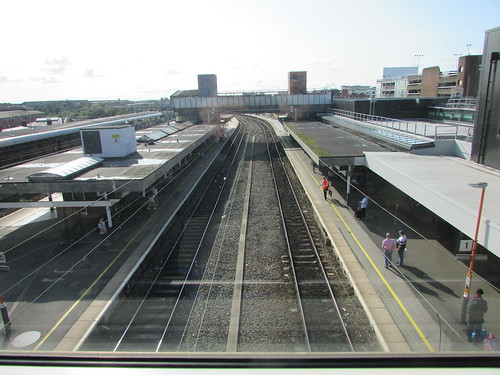
I won't repeat my distaste for the 'new' (and still incomplete) Wolverhampton station. Fortunately, I didn't have long to wait on draughty platform 2 for my train. The rather modest accommodation on island platform 2/3 with simple, flat canopies remains as constructed by British Railways, albeit with some internal modernisation.


Wolverhampton Station: view from second overbridge looking towards Birmingham showing left platform 2, right platform 1. There was formerly a Middle Siding between the two tracks for which the overhead catenary remains (Blackpool by Electric Train)

I found my reserved seat (a couple who'd commandeered my seat sheepishly apologised and immediately moved elsewhere). The journey to Stockport was incident-free and on time but I'm still not a great fan of the Bombardier design. The Class 221 has 'tilting technology' to allow higher maximum speed but I understand it was taken out of use years ago to limit maintenance costs. Allowance for the six degrees of tilt either way results in the body being narrower at roof level that floor level, giving a distinctly 'narrow-bodied' feel to the passenger compartment.

Each coach has a Cummins QSK19 underfloor-mounted 6-cylinder, 6-litre turbo diesel driving an electric generator to power one traction motor on each bogie. To generate 750 h.p., the engine is run at up to 1800 r.p.m. which I find generates uncomfortable noise and vibration. Dellner autocouplers are provided.


'Cross Country' Voyager in 2010: detail of Dellner autocoupler with twin horns below.

Approaching Stockport, the appearance of the London and North Western designed signal box at Edgeley Junction Number 1 always makes me smile. In general, the route from Euston to Manchester is now commanded by a chain of modern Railway Operating Centres and Signalling Control Centres but, through Stockport, the main line is still controlled by a group of venerable signal box structures, even if now bereft of their original mechanical signalling equipment. These are Edgeley Junction No. 1 (where the line from Buxton converges), Edgeley Junction No. 2 (where the line from Chester converges), Stockport No. 1 (south end of station) and Stockport No. 2 (north end of station). Nearer Manchester, Heaton Norris Junction, a more modern brick structure retaining a mechanical frame survived for some years but has now been abolished.


Edgeley Junction No. 1 signal box.

Stockport station is a strange amalgam of two very-recognisable London and North Western station buildings on island platforms 1/2 and 3/4 (internally modernised) which lead via a subway to a modern booking hall on the town side which gives access to a 'new' platform.
The 'new' platform is numbered '0' and unusual platform numbering, including the use of '0', intrigues me. There are a couple of posts here and here on the topic.


Stockport: View from platform 0 looking towards Crewe in 2013 showing two '0' platform signs (the smaller '4' sign is the stop marker for 4-coach trains).

Stockport: View from platform 3 in 2013 showing the LNWR station building on platform 1/2.


Stockport: View from platform 0 looking towards Crewe in 2013 showing the LNWR station building on platform 1/2.


Stockport: View from platform 2 looking towards Manchester in 2013 showing the LNWR station building on platform 3/4.


Stockport: Modern station building on Up side in 2013.

After my meeting, I returned to Stockport station with less than ten minutes to wait for a Southampton-bound 'Cross Country' which would deliver me back to Wolverhampton in around one hour. Being a Friday and late afternoon, the train was very full but I managed to find an unused seat so that wasn't too bad at all.

Related posts in this blog

The Buxton Branch.
Zen and the Art of Platform Numbering.
Platform Numbering Revisited.

My pictures

Pictures taken on earlier travels in Stockport area are here:-
Manchester Area Rail

Wednesday, 24 June 2020

Power Signal Box, Togyaunggalay

Events on Sunday 5th May 2019, Yangon area 

In the post Return to Burma, I mentioned a visit to Togyaunggalay (Romanisation of Myanmar words can be a bit variable and there are various English spellings of the placename). My friend Doctor Hla Tun had arranged a visit to the elderly power signal box at Togyaunggalay station on the day I arrived in Myanmar. Earlier that day we'd visited the recently-commissioned Railway Operation Control Center in Yangon (described in a post here) after which the Doctor drove us through Yangon's heavy traffic to the junction station at Togyaunggalay.

The railway network around Yangon is shown below. Togyaunggalay station is situated on the double track main line from Yangon through Bago to Mandalay. A junction just north of the station connects the single line serving Dagon University. A junction south of the station leads to the single line to Thilawa.

Railways around Yangon (displayed on Togyaunggalay station)

In 2018, after visiting the railway at Bago, I'd travelled through Togyaunggalay by train (there's a description of that trip here) so I was pleased to have the opportunity to confirm the signalling arrangements. 

On our arrival in 2019, we reported to the Station Master and were conducted along the main platform to the concrete signal box and climbed the steps to the operating floor. The loud noise emanating from the ground floor equipment room indicated that the incoming overhead 3-phase electricity supply was absent and that the system was being run by the standby generator. The first floor equipment room was locked, so I couldn't study the relay interlocking equipment but continued to the second floor where we were welcomed by the signalman.

 Togyaunggalay signal box on 9th May 2018: Note radio antenna on left and incoming overhead 3-phase electricity supply terminated on frame on the right (Bago - Yangon by train).

The railway signalling console was of the 'NX' pattern (there's a very brief explanation of this type of control in the section 'NX' pushbuttons of the post here) and used 'Mosaic' construction.The signalling console looked rather small, situated near one corner of the room. A desk just to the right was furnished with red and green flags, a number of telephones, two VHF radiotelephones for train control and a power amplifier and microphone for making announcements to waiting passengers. The windows overlooking the tracks behind the signalling console had been largely blocked by a large blackboard covered in what appeared to be useful telephone numbers. Above the blackboard was the usual framed drawing of the track layout and a clock. To the left, on a small shelf, was the customary Buddhist shrine.

Togyaunggalay: The operating floor of the signal
cabin, showing the Korean 'NX' signalling panel

A Mosaic Diagram, as the name implies, assembles a series of small 'tiles' into a frame. Each 'tile' has part of the signalling diagram on its face, together with the associated control switches and lamp indications. Each 'tile' can be individually removed for maintenance.

Mosaic Diagram Togyaunggalay - centre (Myanma Railways 2019)

I assumed that the siting of the blackboard was at least partly so that the lamp indications on the console were easier to see in bright sunlight, but nonetheless, I found some of them hard to interpret (or missing). They explained that spares, particularly the filament lamps used for indications, had become hard or impossible to source. They'd been forced to modify the circuits (in places using two lamps in series) but admitted that the result was not altogether satisfactory. Despite this, the signalman was carrying out his crucial tasks with the usual studied calm typical of signalmen everywhere.

Mosaic Diagram Togyaunggalay - detail (Myanma Railways 2019)

The flat desk area in front of the inclined control panel held two train register books and two books of paper Line Clear forms. 

Togyaunggalay Power Signal Box: Signalman completing Paper Line Clear Form

The Train Register Books serve a similar function to those used in the United Kingdom (described in a post here) although in Myanmar movements are separated into two books, one for 'Up' trains, one for 'Down'. Because of the importance of these logbooks, pages are individually numbered.

Train Register Book (Down Trains) Togyaunggalay

The British introduced railways into Burma (as Myanmar was then called) so signalling originally followed British practice, with reliance on telegraphy, telephony and special signalling equipment (like electric tablet systems for single lines). This relied on an open wire system using telegraph poles supporting cross-arms carrying porcelain insulators to which copper wires were attached. Remnants of this system can be seen throughout the country (invariably using an old length of rail as the 'pole') but, as far as I can determine, they have all fallen into disuse. Voice communication across the railway now uses VHF radiotelephones, allowing signalmen or stationmasters to authorise train movements from one 'block station' to the next. The permission is given to drivers in the form of a 'Paper Line Clear Form', shown in the picture below. Because of the vital nature of these forms, they are individually numbered, completed with some care and authorised with a rubber stamp.

Book of paper Line Clear forms: Togyaunggalay (MyanmaRailways 2019)

The pictures below show a local train from Yangon to Dagon University. In the first picture, the train has just arrived. The freight train seen waiting on the left was unusual in having a number of men travelling in open bogie wagons type SMBV, perched on piles of rock. The Doctor explained that the 'rock' was extremely valuable jade and the men were security.

The second picture shows the signalman's assistant or 'runner' delivering the Paper Line Clear Form to the driver of the passenger train, authorising travel on the branch to Dagon University.

A freight waits for the signal (L) as a local Yangon-Dagon University arrives (R)

The signal box 'runner' delivers the paper Line Clear form to the driver

At the end of a fascinating tour, I made sure I checked out the throbbing standby generator on the ground floor - a substantial Daewoo packaged diesel alternator. Its claim to being 'sound proof' was a little undermined by the need to leave all the access doors open to prevent overheating (the outside air temperature was around 40 degrees Celsius that day).

Standby Generator Togyaunggalay (Myanma Railways 2019)

They explained that, even with the access doors open, the water-cooled diesel engine required periodic replenishment of water. Illustrating this point, as we left, a railwayman had just pushed a small platelayer's trolley along the platform line outside to the signal box, loaded with a plastic dustbin and a large plastic tub, both filled with water!

Cooling water for the Standby Generator at Togyaunggalay (MyanmaRailways 2019)

A most interesting day. I'd visited both the Railway Operation Control Center in Yangon and Togyaunggalay power signal box on the day I'd arrived in Myanmar and, later in the trip, I was to tour 'Mandalay Tower', the power signal box controlling Mandalay area.

My pictures

All my railway pictures around Yangon during my visit to Myanmar in 2019 are in the album below. Pictures may be viewed in various sizes or downloaded for non-commercial use.

Wednesday, 20 May 2020

Train Movements at Euston (2)

At the time of writing, the world is suffering from the serious, new respiratory disease Covid-19 and the U.K. is currently in 'Lockdown'. Only essential travel is permitted, resulting in train passenger numbers collapsing and revised timetables.

In the post Train Movements at Euston, I documented a few evening departures on 16th April 2020.

I've documented more incomplete fragments of arrivals and departures during the restricted Covid-19 timetable below.

I'm sorry the information is fragmentary. This is partly due to the internet becoming notoriously unreliable in these strange times, despite having a 'fibre to the cabinet' feed which on a good day produces at least 40 MBPS. With most people at home during 'Lockdown', at present internet speed is sometimes as poor as 0.2 MBPS with a 'ping' of 2 seconds, or it even becomes totally unresponsive.

Note 'VT' is the TOC code for Avanti, 'LM' is the TOC code for West Midland Trains.

Evening movements on 15th May 2020

Plat Nbr Dep Destination Nbr Arr From TOC
1 1F27 19:44 Liverpool 1M14 18:48 Crewe VT
2 1P06 19:18 Preston 1M13 17:58 Crewe VT
3 9G42 19:28 Wolverhampton 1B24 18:55 Wolverhampton VT
4 1B22 17:54 Wolverhampton
5 5D91
6 1H05 19:08 Manchester 1A52 18:19 Liverpool VT
7 1H07 Manchester 1A54 18:41 Manchester VT
9 2D46 19:15 Watford
.... Later ....
1 9G47 21:28 Wolverhampton 1M15 19:57 Crewe VT
3 9G45 20:44 Wolverhampton 1A59 19:49 Manchester VT

Lunchtime movements on 16th May 2020

Plat Nbr Dep Destination Nbr Arr From TOC
1 1H11 13:08 Manchester 1A02 10:54 Manchester VT
2 1H08 12:08 Manchester 1A05 11:43 Liverpool VT
3 1F15 12:51 Liverpool 1A06 11:59 Preston VT
4 1S63 12:12 Crewe 5S63 11:49 Wembley CS VT
5 9G50 12:31 Wolverhampton 1B04 11:28 Wolverhampton VT

Engineer's Trains on 16th May 2020

In the evening, three engineer's trains from Bescot arrived. The first was 6G50, a train of bogie ballast hoppers top-and-tailed by a pair of GB Railfreight Class 66. This continued to Euston before re-appearing on the Down Fast and slowly making its way to the work site which, as far as I could determine, was north of Primrose Hill Tunnels. Later, 7G52 arrived. This was hauled by another GB Railfreight Class 66. As it slowly passed the Railcam UK camera at Camden, also heading towards Euston, I could see it was an assortment of engineering materials with a number of bogie open wagons at the rear. I didn't follow matters but on Sunday morning these trains, together with Colas Yellow plant vehicle and 6G51 which appeared to be another ballast train were all showing up in describer berths apparently north of Primrose Hill Tunnels, surrounded by more berths displaying '****' in red, probably as a signalman's reminder of the work in progress.

Morning movements on 20th May 2020

At the time I wrote this, the Government were encouraging our railway system to increase services to help get the country back to work so just after 08:30 on Wednesday, 20th May 2020 I made another quick 'snapshot' of long-distance trains at Euston

Plat Nbr Dep Destination Nbr Arr From TOC
1 1R04 W'ton 05:45 VT
2 1H15 09:20 Manchester 1R12 11:43 W'ton 06:45 VT
3 1H63 09:40 Manchester 1R06 W'ton 06:04 VT
4 5H12 0741 Wembley CS VT
5 9P54 08:43 Preston 1R07 08:10 Lancaster VT
6 1F13 09:07 Liverpool 1R08 08:20 Manchester VT
7 1U27 08:46 Crewe 1U00 08:06 Crewe LM
8 1Y32 19:32 Birmingham LM
9 Local
10 Local
11 Local
12 5R11 09:12 Wembley CS 1R11 08:39/td> Liverpool VT
13 1Y08 08:13 Northampton LM
14 1S48 09:10 Glasgow 1R10 08:23 Manchester VT
15 0M16 Off sleeper?
16 1Y09 09:13 Birmingham 2B14 07:39 Bletchley lm


Sunday, 19 April 2020

Train Movements at Euston

Evening Departures on 16th April 2020

At the time of writing, the world is suffering from the serious, new respiratory disease Covid-19 and the U.K. is currently in 'Lockdown'. Only essential travel is permitted, resulting in train passenger numbers collapsing and revised timetables.

In the post Watching The Trains Go By I outlined how you can remotely monitor train movements in real time and, using the network of cameras operated by Railcam UK, actually see live views at selected locations.

There's another site called Open Train Times which offers similar timetable and signalling diagram information (without the cameras) which I've found excellent. Whereas Railcam UK works well on a 'Smartphone' or a larger display, Open Train Times really needs a decent-sized display. In complex areas, some detail is lost using Railcam UK but the signalling diagrams in Open Train Times make fewer concessions and include 'route set' data, where available from Network Rail, and will appeal to signalling enthusiasts. Open Train Times also allows you to customise the presentation by separately toggling on and off data showing signal numbers, signal symbols and unoccupied train describer berths.

On Thursday evening 16th April 2020, I decided to use Railcam UK 'app' on my 'Smartphone' to see what long-distance expresses were running out of Euston that evening. This was the day the U.K. Government announced that the lockdown would continue for at least another three weeks and television was showing the usual fare of repeats.

At about 8.15 p.m. I made a list of the trains scheduled to leave Euston in the next hour, recording the platform, the train reporting number displayed for the departure, the final destination, the time due to arrive at that destination, a reference to my explanatory note, the ATOC code for the Train Operating Company (TOC) and, finally, the reporting number in the arrival 'berth' (usually indicating the previous journey undertaken by the unit). I didn't include the various local services and the d.c. electrics, except for one typical example of a Northampton service (2N62). I also ignored the various multiple units displaying a train reporting number starting with '5' indicating 'Empty Stock'.

Plat Nbr Dep Destination Arr Note TOC In
2 1P07 20:30 Crewe 23:00 #2 VT 1M15
4 9G45 20:40 Wolverhampton 22.33 #1 VT 1B57
5 1F28 21:03 Liverpool 23:33 #3 VT 1A60
11 2N63 20:45 Northampton 22:05 #4 LM -
15 1S25 21:16 Inverness #6 CS -
14 1P09 21:10 Preston 23.59 #5 VT 1A62

During the evening, I'd periodically return to the Railcam UK signalling diagram screen to see how well things were going. Every so often, I'd also check the Railcam U.K. camera on the main lines at Camden to confirm there really were trains going by, but it was getting dark so the pictures weren't terribly exciting on the small screen I was using (particularly for a steam enthusiast). Then, I made some notes on each train, in the order of departure which appear below.

#1: 9G45

This Wolverhampton service by an Avanti West Coast Class 390 (with a train reporting number starting with '9') made a right-time departure with booked stops at Watford, Milton Keynes, Rugby, Coventry, Birmingham International, Birmingham New Street, Sandwell & Dudley. At Wolverhampton the empty stock would make the short journey to Oxley Sidings where Alstom, the builders of the Class 390, have a Traincare Depot'. I noted that the ATOC code for Avanti remains 'VT' because, until recently, these trains were operated by Virgin Trains. There's a Wikipedia article on the Class 390 here.

#2: 1P07

This Avanti West Coast Class 390 'Pendolino' should have left at 20:30 but was 14 minutes late departing for an unknown reason. It was booked via the Trent Valley Line calling at Tamworth, Lichfield, Stafford, Crewe, Warrington, Wigan and, finally, Preston.

#3: 1F28

Avanti West Coast Class 390 also serve Liverpool. This train was booked to stop at Watford, Milton Keynes, Nuneaton, Crewe, Runcorn and Liverpool Lime Street. Alstom also have a Traincare Depot at Edge Hill, Liverpool.

#4: 2N63

Northampton is served by a regular stopping service operated by West Midland Trains, ATOC code 'LM' (because the franchise was formerly operated by London Midland). The homely-sounding 'West Midland Trains' is, in fact, a joint venture between Abellio (part of Dutch National Railways), East Japan Railway and Mitsui Group. These services are normally routed on the Slow lines to Roade Junction as they generally stop everywhere and most of the stations only have platform access to the slow lines

#5: 1P09

This Avanti West Coast Class 390 'Pendolino' left on time and was booked via the Trent Valley Line calling at Tamworth, Lichfield, Stafford, Crewe, Warrington, Wigan and, finally, Preston.

#5: 1S25

Almost all movements at Euston are Electric Multiple Units (EMU). The notable exception is the locomotive-hauled Caledonian Sleeper, operated by Serco with traction provided by GB Railfreight (GBRf). The rolling stock for this service, a 16-coach rake, was fairly recently renewed at enormous expense and initially suffered a number of technical problems but seems to have settled down. Due to Covid-19, a temporary timetable is in use. After departure at 21:16, stops were scheduled at Watford Junction, Brinklow on the Trent Valley Line (Brinklow?), Crewe, Preston, Carlisle, Lockerbie and Edinburgh Waverley (where I assume diesel traction replaces electric). The train then continues, with intermediate stops, to Inverness arriving at 08:40 on Friday. The timetable information showed Class 92 'Voltaire' (92038) hauling the train, which is limited to 80 m.p.h.

There's a Wikipedia article on the Class 92 here. I've had an interest in the design which can develop 6,760 horse power since being involved in design work and testing on one of the safety systems some years ago. My short post Crewe International Electric Maintenance Depot has links to detail pictures of the Class 92.

Earlier in the evening, the Empty Stock for the Caledonian Sleeper had been brought from Wembley Carriage Sidings by a locomotive currently 'trapped' at the buffer stop end of platform 15, showing on the Railcam UK signallingdisplay as 0A95 (the '0' signifying Light Engine). The Caledonian Sleeper set of on its long journey and, shortly afterwards, 0A95 followed slowly up Camden bank.

I logged onto the Railcam U.K. camera on the main lines at Camden to watch '1S25' pass. There was certainly a Class 92 on the front, followed by 16-coaches in the distinctive Caledonian Sleeper livery. Then I kept watching for the light engine which eventually appeared on the camera at 21:31 travelling slowly - a diesel-electric (Class 66 perhaps) with the big 'GBRf' logo on the side. I realised that a freight train from Camden Road direction has been 'turned out' onto the down slow. Railcam UK showed that the train was 4M92, operated by Freightliner and being worked by locomotive 66555, which had left Felixstowe at 18:12 and was due to arrive at Lawley Street (Birmingham) at 00:06 on Friday. Its route was via Rugby and Nuneaton, from where it would reach Lawley Street by branching onto the former Midland Railway line to Birmingham.

I continued to use the Railcam UK signalling display to see the Freightliner train making rapid progress on the Down Slow and the light locomotive diverged onto the Down Carriage Line before 'dropping out of sight' as it continued onto uncontrolled lines in Wembley Carriage Sidings.

We may be under 'lockdown' but it's still possible to 'Watch the Trains go by!

My pictures

My pictures taken before we were in 'Lockdown' can be selected, viewed or downloaded, in various sizes, from the albums below:-

London: Euston Station.
London & Birmingham Railway (showing the line approaching Euston).

Wednesday, 5 February 2020

Railway Operation Control Center, Yangon

Until 2018, Yangon Central Station in Myanmar had been controlled by an elderly Westinghouse 'Style L' miniature lever frame. Back in 2014, through the kind offices of my friend Doctor Hla Tun, I visited the installation and that visit is described here.

In 2014, ambitious plans were emerging for the modernisation of the main line from Yangon to Mandalay and the important Circle Line around Yangon in a major scheme with the Japanese Government through the Japan International Cooperation Agency.

During my visit to Myanmar in October 2017, signs of the modernisation work were apparent. Some point installations had been equipped with new Kyosan a.c. electric point machines but the earlier colour light signals and the Westinghouse miniature lever frame remained in use. Examples of the work in progress are shown in the pictures below.


Reinstated surface after installing new cables and signal post on platform 9 at Yangon (Yangon - Mahlwagon c/w)


New track circuit installation at Yangon Central Station (Yangon - Mahlwagon c/w)


New Kyosan point machine at Yangon. Note elevated mounting (Mahlwagon - Yangon Central Station c/w)


New Location Case Y10C (Yangon Central Station Movements 1-Oct-2017)


New Kyosan a.c. point machine at Yangon. Note cable termination box right foreground, still wrapped in green plastic (Yangon Central Station Movements 1-Oct-2017)

In May 2018, following a visit to Bago by car, I returned by train to Yangon. Near my destination, I could see the progress of the modernisation work. More point installations had been equipped with Kyosan a.c. electric point machines and the new signal posts had been fitted with colour light signal heads, although not yet brought into use, as shown in the pictures below.


Bago - Yangon by train 9th May 2018: Approaching Yangon Central on Down Main showing L: Replacement signal P7, not yet commissioned (3-aspect colour light with 'box' of 3x3 lights above), R: Existing signal P7 (Siemens).


Bago - Yangon by train 9th May 2018: Approaching Yangon Central on Down Main showing Down Local signals L: R141/R139, R: Replacement R141/R139 colour light with both theatre-type and 'box' of 3x3 lights above, subsidiary aspect below, not yet commissioned.


Bago - Yangon by train 9th May 2018: Approaching Yangon Central on Down Main showing L: Existing signal R140, R: Replacement signal R140 not yet commissioned (colour light with 'box' of 3x3 lights above)

Since all the new signal posts seemed to be near the old signals and carried the same numbers, it appeared that most of the modernisation work involved a renewal of equipment, rather than a fundamental re-think.

Before my next trip to Myanmar in May 2019, I had learnt that the replacement signalling equipment at Yangon Central Station had been commissioned, controlled from a new 'Operation Control Center' (yes, 'American' spelling) in another part of the station buildings. Doctor Hla Tun arranged an official visit on the day I arrived in Yangon, Sunday 5th May 2019. We first met the Yangon Station Master in his offices on platform 1, then one of his staff conducted us to the road approach side of the station buildings and an existing entrance to offices on the upper floors. The white-painted stucco of the post-war station building had become rather stained as is common in the humid climate but the walls in the immediate area of the Operation Control Center entrance had been nicely repainted.


The entrance to the Operation Control Center in Yangon (Myanma Railways 2019)

We climbed the steep stairs to the first floor and it was clear that part of the area had been recently partitioned off to form the Operation Control Center. Access was through double-doors with glazed panels and a security lock. Immediately inside the doors there was a deep step up onto computer sub-flooring. The Operation Control Center was windowless, artificially-lit and air-conditioned. In one corner, three men were working at a group of desks.


Operation Control Center, Yangon: Administrative section. Double access doors on right. Note deep step up to computer flooring (Myanma Railways 2019)

The actual control was being carried out in an adjacent corner of the room by two men seated at a row of desks with two computer monitors, each provided with a computer 'mouse', together with numerous telephones and two V.H.F. radio-telephones.


Yangon Operation Control Center (Myanma Railways 2019)

The signalman actually controlling trains that day on the the large computer monitor remembered my visit to the 'old' installation in 2014. A second signalman, with a smaller 'mimic' monitor, managed the frequent radio traffic. Studying the large colour computer monitor confirmed that the whole of Yangon Central Station had been transferred to the new control system, retaining the original signal numbers (prefixed 'R', presumably from a time when Yangon was known as 'Rangoon'. However, to the east, the vital junctions at Pazundaung, formerly a separate scheme provided by Siemens, were now controlled from Yangon with signals retaining their original numbers (prefixed 'P').


Operation Control Center, Yangon: Main signalling display at 09:53 (Myanma Railways 2019)

Yangon is a busy station and the position had changed after 8 minutes when I took the picture below.


Computer Monitor Display at 10:01, Operation Control Center, Yangon (Myanma Railways 2019)
Click for larger view.


Studying the above picture 'Computer Monitor Display at 10:01' allows a fair understanding of the design:-

Tracks: Tracks are represented on the screen by a thick line: white if the track is unoccupied, red if a train is present, yellow if a route has been set. Perpendicular lines indicate the ends of the track circuit and the track circuit number appears in the form 'R[number]T' (Yangon area), 'P[number]T' (Pazundaung area) or 'A[number]T' (Automatic area), plus some 'funnies' like 'ART', 'RT', suffix 'AT' (for approach track) and 'R65T' divided into two sections. In many cases, the same references as the earlier Westinghouse system are retained.

Points(turnouts): The current position of points is indicated by a continuous thick track line. A break in the track line shows the route is not set. A set of three inclined thin lines indicates the 'NORMAL' position and the adjacent reference in the form '108' is the reference number. For crossover points, a suffix letter 'A' or 'B' identifies the two ends. The same references as the earlier system are retained.

Running (main) Signals: Graphical symbols represent different signal types, including 2-aspect, 3-aspect and searchlight (R65,R66,R73,R74 shown as 1-aspect) running signals. Where a subsidiary aspect is provided, this is represented by adding to the symbol an empty 'right-angled triangle with one curved side'. When the subsidiary is 'off', a diagonal line is added to the symbol. If the signal leads to more than one route, a route indicator is normally provided, represented by adding a separate square to the symbol. The running signal number appears in the form 'R[number]' (Yangon area), 'P[number]' (Pazundaung area) or 'A[number]' (Automatic area). The same references as the earlier system are retained.

Ground (shunting) Signals: Represented by a 'right-angled triangle with one curved side' symbol, with an additional horizontal line which is replaced by a diagonal line when the signal is 'off'. The ground signal number appears in the form 'R[number]' (Yangon area). The same references as the earlier system are retained.

Limit of Shunt: This symbol, representing a physical Limit of Shunt board, is a square enclosing a disc and appears, unnumbered and inactive, on the Up Main and Up Local, in the rear of signals P3 and P5. Because of the long-distance trains starting and finishing at Yangon, a station pilot locomotive is kept quite busy transferring coaching stock between the carriage sidings and various platforms. I presume this type of shunting movement, authorised by a subsidiary signal, must not continue beyond the Limit of Shunt board.

'NX' pushbuttons: In traditional, mechanical lever frames, each lever is generally associated with a single set of points or a single signal. Earlier power frames retained this approach, but later approaches adopted 'route-setting' where a simple action by the signalman automatically set the whole route from one signal to the next (if safe to do so) before clearing the signal. One method introduced by Westinghouse was 'One Control Switch' (OCS) where each signal was associated with a panel of turn switches, with one switch for each route beyond the signal (there's a very brief description of 'OCS' in the section 'Sandbach' of the post here). An alternative development, called 'NX' ('eNtrance-eXit') placed push buttons or turn switches on a track diagram of the controlled area. To set a route from one signal to the next, the signalman simply activated the switch at the first signal (the entrance) and a similar switch at the desired next signal (the exit). Because of the operational simplicity, 'NX' became widespread. The picture below shows the arrangement of a typical conventional 'NX' panel at Insein signal cabin.


Insein Signal Cabin showing 'NX' control Panel

In modern systems controlled from computer monitors, there's no physical control panel required. The track layout, with 'virtual switches', is digitally generated on the monitor screen, as shown in the picture 'Computer Monitor Display at 10:01' above. The 'virtual switches' are the white circles with an alphanumeric reference centred on the thick lines representing tracks. I assume the desired button is operated by 'point and click' with the computer 'mouse'. Normally, a button would serve as the exit button for the route in the rear and the entrance button for the route in advance but there are a few routes without an obvious entrance button so I'm not certain.

Crank Handles, Yangon: Top left of the monitor are three crank handle releases. During failures or maintenance motor points can be operated locally by inserting a large special key, called a 'Crank Handle' and 'cranking' the mechanism by hand. The key is normally released electrically from the supervising signalling control when required and, until the key is returned, the signalling control will be unable to set routes remotely. At a station like Yangon, it's possible to divide the system into 'East' and 'West', so that releasing a crank handle for one end of the station does not prevent normal route setting from continuing at the other end. Under normal operation, the crank handle 'IN' virtual indication is displayed. When remote release of the key is authorised, the virtual indication crank handle 'PERMIT' is displayed. Once the key is removed crank handle 'OUT' is shown until the crank handle has been replaced. I'm afraid I didn't discover the scope of the 'Yangon Maintenance' crank handle.

Crank Handles, Pazundaung: Top right of the monitor are two more crank handle releases. I presume the 'Pazundaung' release allows points in the area to be locally operated by cranking but I'm not sure about the 'Pazundaung Maintenance' release. Since the screen display still shows a signal box symbol at Pazundaung (a rectangle enclosing a line representing a traditional lever frame with a 'dot' representing the signalman), it's possible there's some form of local control panel at Pazundaung for use under abnormal conditions.

KYI APPROACH ACK: Bottom left of the monitor is a 'virtual switch and lamp' which also generates an audible alarm when a train approaches on the Automatic Section from Khyee Myin Daing direction under Track Circuit Block rules.

KCR & KM APPROACH ACK: Bottom right of the monitor are two 'virtual switch and lamp' activated when a train approaches on the Automatic Section from Mahlwagon direction under Track Circuit Block rules on either the Circle Line or the Main Line from Mandalay.

Communication area: Across the bottom of the screen are reserved areas for messages issued by the system, plus a group of 'soft keys'.

Interpreting the 'Computer Monitor Display' picture above

From left to right and top to bottom:-
1. A westbound train from platform 6 West is occupying track circuit R1T, placing automatic signal A1 at 'danger'.
2. Track circuit R23T (platform 1) is occupied by a train.
3. Track circuit R24T (platform 2) is occupied by a train.
4. Track circuit R40T (track 9) is occupied by a train.
5. Track circuit R42T (track 10) is occupied by a train.
6. Track circuit R54T (track 8) is occupied by a train but adjacent track circuits R60T and R61T are indicating 'route set', suggesting a shunting move in progress.
7. Points 95A, 95B and 96 are shown 'REVERSE' in yellow, suggesting that they've been 'called' to that position. 8. Track circuit R68T2 (down local) is occupied by a train.
9. Track circuit P2AT (down goods Pazundaung) is occupied by a train.


We watched movements for a while as I took more pictures showing the whole computer monitor or an area of the screen. Some of the pictures aren't very good I'm afraid but you can find them here. I was only able to look at the new equipment room through the glazed panel of the door to the room so I couldn't learn much.


New Signalling Equipment Room at Yangon's Railway Operation Control Center (MyanmaRailways 2019)

At the invitation of the Station Master's staff, the Doctor and I had a closer look at some of the 'outside equipment' (signals, point machines, location equipment cabinets) to complete our fascinating visit.


New outside signalling equipment, Yangon Central Station (Myanma Railways 2019)


3-aspect colour light R87 with subsidiary aspect R103 at Yangon Central Station (MyanmaRailways 2019)


Two Kyosan a.c. electric point machines type NS-CM at Yangon Central Station, with a third machine and position light shunting signal in background (MyanmaRailways 2019)


Location Case Y12C at Yangon Central Station, described as a 'Signalling Box' and made by Daido Signal Co, Ltd. Appears to mount the Track Feeds and Track Relays for local track circuits (MyanmaRailways 2019)

Related posts on this website

Final day in Yangon and the Circle Line (visit in 2017)
Bago - Yangon by train (trip in 2018)
Return to Burma

Myanma Railways (Index)

My pictures

Myanma Railways 2019
The Circle Line (Yangon - Mahlwagon c/w in 2017)
The Circle Line (Mahlwagon - Yangon Central Station c/w in 2017)
Bago to Yangon by Train (trip in 2018)