skip to main |
skip to sidebar
This is the 16th and last post describing an 'Expedition Cruise' with Noble Caledonia in 2020 under the title 'Across the Tropic of Capricorn'.
Events of Friday 28th/Saturday 29th February 2020
I was booked to leave Cairns for home on the noon flight to Melbourne. Most of the Noble Caledonia passengers were travelling later that afternoon but a few, with different flight arrangements, were leaving earlier so a transfer to the airport had been arranged for 09:45 which I joined.
There were brief "good byes" as we were dropped-off outside Departures then I had a brief struggle to get my luggage to the right check-in queue. Fortunately, it didn't take long to complete the fomalities and then, with plenty of time in hand, I made my way to the Quantas Lounge to await my flight at the end of my very brief, but interesting, visit to Cairns.
The relaxed atmosphere in the spacious Lounge was just what I needed and, for once, I was glad of the effective air conditioning as the day was rapidly warming up.

Business Class Lounge, Cairns Airport, Australia

View from Business Class Lounge, Cairns Airport, Australia
I faced a long journey back to my local airport, Birmingham in the UK, comprising four 'legs' with changes in Melbourne, Singapore and Dubai:-
CNS-MEL 3h 15m 1432m 2305km
MEL-SIN 7h 40m 3743m 6024km
SIN-DXB 7h 30m 3633m 5847km
DXB-BHX 7h 00m 3482m 5603km
This amounts to over 1 day actually in the air and, allowing for transit times, well over 30 hours from Cairns to Birmingham. This is really a minor hardship compared with the journeys travellers in previous centuries had to undertake.
The short leg to Melbourne was in economy class. I was already tiring on arrival but managed to find my way to the departure gate successfully for the Emirates Business Class leg to Singapore.

Melbourne Airport, Australia: View during taxiing, with city in the distance.
I was looked after very well on the flight to Singapore, during which I learnt that the same aircraft would be continuing from Singapore to Dubai, after a crew change at Singapore, but that all passengers would have to disembark, transit through security with their hand baggage and then re-board. I'd also been told that there was a new Emirates Lounge at the airport so I thought it might be an idea to have a look at it. Despite the comfortable flight to Singapore, I was starting to get exhausted so I had some difficulty locating the lounge after quite a long walk. I was warmly welcomed and, when I mentioned that I was a bit worried about the walk from the lounge to the departure gate for re-boarding, they insisted on arranging 'Assistance' in the form of an athletic young man pushing me in a wheelchair, which made resuming my previous seat on the waiting aircraft simple and quick.

Having flown Melbourne-Singapore in this aircraft, I transited two security checks to re-board and continue to Dubai!
Safely back on board the two-engined widebody, we took off on our long flight to Dubai. The new crew were as attentive as the earlier crew and I managed some reasonable sleep during the flight. The massive airport in Dubai is a noisy and confusing place at the best of times but, after three flights that day, I was particularly confused but managed to navigate to the relative quiet of the huge Emirates lounge near my departure gate to await boarding.
The Emirates flight from Dubai to Birmingham was on an four-engined Airbus A380. Although I loved the long-lasting Boeing 747 design (now retired from service by major airlines), I've never warmed to the even-bigger A380, although I can appreciate the technical achievement. Boarding involved a lift from the lounge to Departure level, then a short walk to the three air bridges connecting to the waiting aircraft. Waiting to board the lift, I took the picture below.

Boarding the A380 from Dubai to Birmingham in 2020. Note the three air bridges.
Although I love travelling, I always experience a thrill on returning home so, as we lost altitude approaching Birmingham and the familar landscape of England appeared on a dull, February morning, I started to become alert with excitement (and, perhaps, a little relief). We landed safely, I retrieved by luggage without incident and reported to Emirates, who were providing a car home. There was a minor delay waiting for the car, because flights at Birmingham had been subject to some dislocation that morning, but soon I was speeding back home after a fairly serious journey from Australia.
Within three weeks of my return, England had imposed a full lockdown in an attempt to delay the spread of the Coronavirus Pandemic. A three-month lockdown was followed by a plethora of frequently-changed regulations, culminating in a further full lockdown in November 2020 (when I finally managed to complete this post).
Related posts on this website
This post is in the series labelled 'Tropic of Capricorn’. The first post is here.
Clicking on the 'Next report' link (where shown) will display the post describing the next events. In this way, you may read about the trip in sequence.
Alternately, clicking on the 'All my Tropic of Capricorn reports' link displays all the posts on this trip in reverse date-of-posting order.
All my Tropic of Capricorn reports
My pictures
Cairns Airport, Australia
Singapore (Changi) Airport
Dubai Airport, U.A.E.
Birmingham Airport, England
In February 2020, just before the Coronavirus pandemic transformed everybody's lives, I sailed on 'Caledonian Sky' for the second time on a Noble Caledonia cruise titled 'Across the Tropic of Capricorn' which is chronicled in a series of posts. Clicking here displays all these posts in reverse date-of-posting order or alternately, to read the posts in chronological order, clicking here displays the first post and then follow the link to the next post.
I'd first sailed on 'Caledonian Sky' in 2015, on a cruise titled 'From the Coral Sea to the South China Sea' which gave rise to a series of posts labelled 'Caledonian Sky’.
Clicking here displays all these posts in reverse date-of-posting order.The post here describes itself as "more than you wanted to know about the ship", but note that I don't know what changes may have occurred during the subsequent refit of the ship. Another post from that cruise here describes various visits to the bridge and one visit to the Engine Control Room during that trip.

A visit to the Engine Control Room of 'Caledonian Sky' in 2015.
During my second cruise on 'Caledonian Sky' in 2020, there was still an 'Open Bridge' policy, and I made three visits. On 15th February, we were on our way to the island of Tanna, in Vanuatu.

On autopilot, heading for Tanna, on 15-Feb-2020 ('Caledonian Sky' Bridge 2020)
When I returned to the bridge on 24th February, we were heading for Rabaul on East New Britain (part of Papua New Guinea).

ECDIS screen as we head through St. Georges Channel heading for Rabaul ('Caledonian Sky' Bridge 2020).
My last visit was on 26th February, as we made our way towards Port Moresby (Papua New Guinea). As usual, we were on autopilot, with a least one person keeping watch. Suddenly, the calm was broken by three different electronic alarms wailing. I tucked myself in a corner of the bridge, hoping they wouldn't decide to clear the bridge. First, they silenced the noisy alarms. Then, I noticed that the 'swish' of the air conditioning had ceased and that certain indicators had gone blank, so I assumed some sort of power failure.
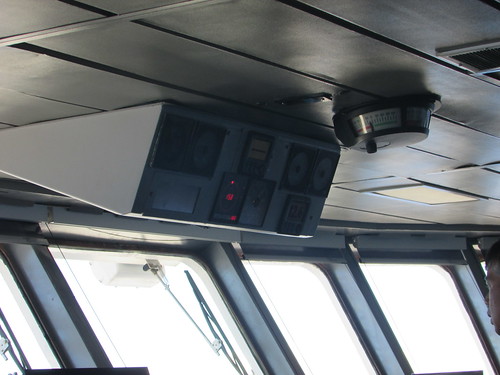
"Some of the indicators had gone blank" 'Caledonian Sky' Bridge 2020.
There were a few telephone calls and other crew members arrived, including the Captain but the usual air of studied calm continued. The only real change was that one of the crew moved to the Anschutz autopilot console and controlled the small 'conning wheel' whilst carefully studying the heading display so I assumed we were temporarily under manual control.

'Caledonian Sky' Bridge 2020 with the ship being steered manually from the Anschutz autopilot console on the right.
After a few minutes of murmured conversation and more phone calls, we were clearly back on autopilot and the crew member abandoned his position by the 'conning wheel'. The air conditioning restarted and the Captain retired to his cabin, a few yards away. The incident was over.
My pictures
'Caledonian Sky' Bridge (2015).
'Caledonian Sky' Bridge 2020.
Engine Control Room, 'Caledonian Sky' (2015).
This is the 15th post describing an 'Expedition Cruise' with Noble Caledonia in 2020 under the title 'Across the Tropic of Capricorn'.
Events of Friday 28th February 2020
I awoke reasonably refreshed at the Hilton Hotel in Cairns, dressed and went downstairs for buffet breakfast in the large restaurant on the ground floor which overlooked Chinaman Creek. Bright sunshine had replaced the rain I'd experienced the previous evening. Some of my fellow-passengers from 'Caledonian Sky' drifted in and one asked if I'd seen the cruise ship 'Queen Elizabeth' arrive. I had not, but I decided that a morning walk towards the Cruise Terminal was indicated. I've seen 'Queen Elizabeth' in a number of ports around the world during my travels, but I only discovered during my post-trip research that the ship's arrival that morning was the very first time such a large, 'Vista' class cruise ship had berthed in Cairns following a project to widen and deepen the shipping channel. There's an outline of the project on the Ports North website here, with a video of 'Queen Elizabeth's' arrival here.
I left the hotel, joined the Foreshore Walk and headed south towards the cruise terminal. Although the whole area has been landscaped and a modern, concrete sea wall constructed, the many abandoned wooden piles standing in the creek were enough to indicate that this had been the original commercial port.

Hilton Hotel and Foreshore Walk viewed from the modern fishing pier, Cairns.
A little further on, this was confirmed on passing a small, modern cafe named 'Wharf One'.

Chinaman Creek, Cairns, looking north towards the sea with 'Wharf One' cafe on the left and Marlin Wharf and Marina in the background.
The transit sheds for Wharf 2 and Wharf 3 have been retained but 're-purposed'. 'Shed 2' is now Hemingway's Brewery ("a waterfront gastro-brewpub that showcases local provenance in a vibrant setting" according to their website here). 'Shed 3' has become 'Cairns Cruise Liner Terminal' but as I approached, the terminal was dwarfed by the massive bulk of 'Queen Elizabeth'.

'Queen Elizabeth' docked at Cairns Cruise Liner Terminal.
The road in front of the terminal carried signs saying 'CLOSED ON SHIP DAYS' and this was enforced by rising bollards in the raised position, a heavy-duty barrier, also raised, and a lady security guard. I had to research the barrier, as I wasn't sure of the correct name for this type of product - it's a 'Hostile Vehicle Mitigation Product'! The one in my picture was supplied by Australian firm AVS-elli and their website confirmed it was a LW7 Folding Block Barrier, the heaviest in their range - in fact, their website showed a picture of the very installation at Cairns! I also noticed, with interest, the remains of an early 3 foot 6 inch gauge siding leading to the transit shed inset into the road surface not using tramway rail but conventional rail and double check rails.

Cairns Cruise Liner Terminal, showing railway siding, raised road barriers and various coaches awaiting the cruise passengers.
As I walked back north, a large, modern catamaran called 'Tropic Sunbird' operated by 'Sunlover Reef Cruises' headed into Chinaman Creek, to give the passengers a chance to see (and photograph) the cruise ship. The catamaran slowly turned through 180 degrees, then returned north at speed.

'Queen Elizabeth' viewed from Wharf One, as a 'Tropic Sunbird' inspects the cruise ship.
In the above picture, you can also see overhead conveyors and loading gantries in the background. I was intrigued but lacked time to find out more until I returned home when I found out that almost all the sugar grown in Australia comes from Queensland and that over 80% is exported. Queensland Sugar Limited (often referred to simply as 'QSL') is a not-for-profit organisation owned by the Queensland sugar industry. The conveyors I'd seen were part of Cairns Sugar Terminal which has a storage capacity of around 250,000 tonnes of raw sugar. The terminal is owned by Sugar Terminals Limited (STL) and managed by QSL under an operating agreement.
The tug 'Gulf Explorer', operated by Tim North Marine was moored at the Fishing Jetty, with the three crew relaxing on the jetty in the shade of the superstructure. I assumed she'd assisted 'Queen Elizabeth' to the berth.

Tug moored at the Fishing Jetty, Chinaman Creek, Cairns. 'Gulf Explorer', 25m long 8m beam 30 ton bollard, was built in 1972 by Carrington Slipways, Newcastle, Australia.
I'd toyed with the idea of walking to Cairns railway station but it's modern and buried under the car park of Cairns Central Shopping Centre a few blocks away so I knew I'd be disappointed. Now, if the original station on McCloud Street had survived, that would have been different.

Cairns Railway Station around 1890, from a glass negative in John Oxley Library, Queensland (Public Domain)
Queensland Rail now operates two contrasting rail services from Cairns: the 'Spirit of Queensland' diesel-electric Tilt Train makes five trips each week between Cairns and Brisbane, covering the 1,681 km distance in 24 hours whilst two services a day serve tourists on the 37 km long Kuranda Scenic Railway. There's a short history of the Kuranda line on the railway's website here.
Instead, I returned to my hotel to complete my packing and have a few minutes on the balcony of my room looking out over the city.

View from my room at the Hilton Hotel, Cairns, looking across Trinity Bay to the airport.
I was puzzled by the glazed domes on top of a modern building to my left. Only later did I find out that Cairns Zoom and Wildlife Dome is a rather odd synthesis of Zip Line experience and wildlife park perched on top of a Casino. I'm afraid I approve of neither the gambling nor the creatures in captivity (no matter how well looked after) but (alhough I haven't tried it) the zip lining sounds fun.
I was booked to leave Cairns for home on the noon flight to Melbourne. Most of the Noble Caledonia passengers were travelling later that afternoon but a few, with different flight arrangements, were leaving earlier so a transfer to the airport had been arranged for 09:45 which I joined.
To avoid the ongoing road works, the coach drove to the airport using a route partly different from that used on our arrival the previous afternoon, offering some different views of Cairns - white-painted Cairns City Library with its columned frontage followed by Cairns Aquarium. Then, a block with St. Monica's High School, the modern St. Monica's Cathedral and the Dioscese of Cairns offices. Next, we passed through an area filled with modern apartment blocks followed by Cairns Hospital.

Cairns, Australia: view from Abbott Street showing Florence Street with Cairns Aquarium on left (City to Airport)

St. Monica's High School, Cairns, Australia (City to Airport)

Dioscese of Cairns offices, Cairns, Australia (City to Airport)
There were brief "good byes" as we were dropped-off outside Departures then I had a brief struggle to get my luggage to the right check-in queue. Fortunately, it didn't take long to complete the fomalities and then, with plenty of time in hand, I made my way to the Quantas Lounge to await my flight at the end of my very brief, but interesting, visit to Cairns.
Related posts on this website
This post is in the series labelled 'Tropic of Capricorn’. The first post is here.
Clicking on the 'Next report' link will display the post describing the next events. In this way, you may read about the trip in sequence.
Next report
Alternately, clicking on the 'All my Tropic of Capricorn reports' link displays all the posts on this trip in reverse date-of-posting order.
All my Tropic of Capricorn reports
My pictures
Cairns Airport, Australia
Cairns, Queensland, Australia
Hilton Hotel, Cairns, Australia
[Link to 'Next Report' added 5-Nov-2020]
This is the 14th post describing an 'Expedition Cruise' with Noble Caledonia in 2020 under the title 'Across the Tropic of Capricorn'.
Events of Thursday 27th February 2020
My previous post in this series here describes leaving the ship 'Caledonian Sky' on the morning of 27th February, transferring to Port Moresby's airport on taking a Charter Flight to Cairns by Air Niuguini Boeing 737.
I'd not previously visited Cairns, so I arrived with a sense of anticipation (although I was still very tired). The airport staff were friendly and helpful. Immigration was via automatic gates, reading my passport. I 'fluffed' it the first time, because they'd added a couple of on-screen questions to the process about prior travel, because of Coronavirus (Covid-19) but I got it right the second time. My checked bag arrive promptly and Customs was straightforward, so I was soon in the Arrivals Hall where we were directed outside to a series of modern tour buses where the driver helped to load baggage into the hold. We soon set off for our one night stop in Cairns, at the Hilton Hotel, with both public address and air conditioning working in the coach. The shortest route to the city was only around 7 km, but we took a rather longer route because of congestion caused by road works.
Cairns is green, modern and well laid out. Our journey to the hotel gave us glimpses of Cairn's facilities - the Tobruk Memorial Pool, sports grounds, schools, the Night Market and upmarket retail outlets, like Bulgari.

Cairns, Australia (View from Coach travelling from Airport to City). Note rainwater gulley in the kerbing.
After our driver had a bit of a struggle turning the huge coach out of Marlin Drive into the steeply-graded access road outside the Hilton, we disembarked and this time porters whisked away the heavy cases. A representative from the local tour company directed us to reception where, within seconds, we were furnished with keycards to our pre-allocated rooms and assured that our bags would be taken to our rooms shortly.
The Hilton is large, formed by two serpentine wings back-to-back, each a mirror image of the other, leaving an airy, green atrium-like space in between. The east wing has unobstructed views of Chinaman Creek (and Cairns Cruise Line Terminal) whilst the west wing, in which I was housed, offered views of the city and north-west across the bay to the airport (although the nearby Sebel Cairns Harbour Lights Hotel was an obstructive presence limiting sightlines to the north). The room was large and well equipped, if rather clinical but the large balcony allowed the views to be enjoyed.

Hilton Hotel, Cairns
Despite feeling tired following a frustrating day of travel, I determined to go for a late afternoon walk. The nearby marina area seemed an obvious initial destination and I set off, in tee shirt and slacks, with the temperature around 30 degrees Celsius but with the earlier bright sun turning to overcast. Then, it started to rain.
"Oh", I thought cheerfully, "It'll just be a tropical shower and will soon stop".
In the Marlin Wharf area of the marina I discovered a fleet of modern catamaran ferries of various sizes which were involved in Great Barrier Reef tours. I'd not realised that Cairns regards itself as the best base for visiting the Great Barrier Reef - the faster boats take only 35 minutes to whisk passengers to waters for exploring the Great Barrier Reef by snorkelling, scuba diving and local boat trips. I only found out afterwards that there are also regular ferries to two nearby islands - Fitzroy Island (interesting website here and Green Island (more information here.

Marlin Marina, Cairns, Queensland.
As the rain increased, I watched a rather bedraggled group of passengers disembarking from a ferry which had just arrived, no better dressed for the rain than I was.

Marlin Marina Cairns, with passengers disembarking in the rain.
As I fumbled in the rain to take the picture above, a large landing craft quietly passed, heading purposefully into Chinaman Creek. It was green-hulled, with a massive yellow-painted deck crane and stacked with 20-foot shipping containers loaded transversely in the load space. When I returned home, the distinctive configuration of the vessel allowed me to identify it as the LCT 'Albatross Bay' (more information at here), operated by Sea Swift. This company provides various marine services, particularly scheduled general cargo, up and down the east coast of Australia, through the Torres Strait, Cape York Peninsula, and Northern Territory. I think 'Albatross Bay' is normally on the service between Cairns and Weipa but I was intrigued to learn that Sea Swift also have the last cargo and passenger vessel in Australia, the MV 'Trinity Bay' which operates regularly from Cairns to Thursday Island, which I visited in 2015. My visit to Thursday Island is described here.

LCT 'Albatross Bay' 64m by 15m 1551 DWT built 2014 arriving at Cairns
The rain showed no sign of abating, so I went into the adjacent modern shopping mall called The Pier, described as an "Upscale complex of boutiques, wellness clinics, restaurants, cafes & bars next to the Marlin Marina". It was very quiet partly, no doubt, because it was late afternoon and raining.

The Pier shopping mall, Cairns.
Unimpressed, I walked through the complex to the entrance nearer to my hotel. A number of local people were waiting by the doors for the rain to ease but after a few minutes I joined the more adventurous young people who had decided to just get wet. I'd noticed the kerbs with broad rainwater gullies on the way in from the airport but I'd failed to realise their significance. Only afterwards did I discover that February is one of the wettest months in Cairns which, with an annual rainfall of 39 inches, is around one third wetter than my home county!
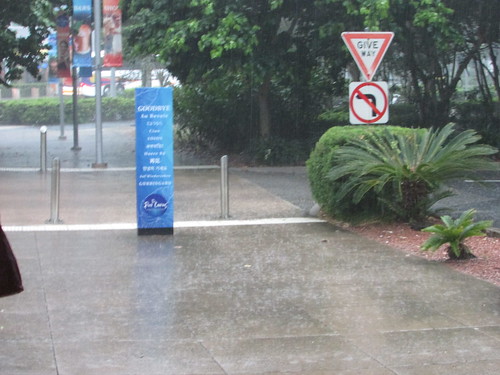
View from the Pier Complex, Cairns as the rain bounces off the pavement.
I hurried across the path through a wooded area and entered the Reef Fleet Terminal, with its much-admired modern architecture which, with rain streaming down my face, I failed to notice. Inside, the building was laid out as a series of shops and sales counters, each serving one of the tour and ferry operators.
Reef Fleet Terminal
There were not many people in here, either, but one shop still open selling tours and souvenirs also had a good range of snacks so I made some purchases to serve as my evening meal. The very friendly lady assistant supplied a stout paper carrier bag and I braved the rain again, dashing back to the hotel and hastening through reception to the bank of lifts and my room. I wasted no time in running a hot bath and I ended up happily backing-up the day's photographs to my laptop computer whilst enjoying my snacks before slipping between the sheets of the huge bed.
Related posts on this website
This post is in the series labelled 'Tropic of Capricorn’. The first post is here.
Clicking on the 'Next report' link will display the post describing the next events. In this way, you may read about the trip in sequence.
Next report
Alternately, clicking on the 'All my Tropic of Capricorn reports' link displays all the posts on this trip in reverse date-of-posting order.
All my Tropic of Capricorn reports
My pictures
Cairns Airport, Australia
Cairns, Queensland, Australia
Hilton Hotel, Cairns, Australia
[Text on Sea Swift added 28-Mar-2020]
This is the 13th post describing an 'Expedition Cruise' with Noble Caledonia in 2020 under the title 'Across the Tropic of Capricorn'.
Events of Thursday 27th February 2020
I'd been to Port Moresby once before, in 2015, on my first trip aboard 'Caledonian Sky' under the title 'From the Coral Sea to the South China Sea'. All my posts on that trip (in reverse order of posting) can be found here.
In 2020, We sailed into the broad, natural harbour at Port Moresby, the capital of Papua New Guinea, on a warm, sunny morning. After the disappointments of failing to visit any of the Solomon Islands and then being refused entry by the Provincial Authorities in Rabaul we were quite relieved to finally dock. The quay we moored at was a large, barren concrete expanse (with a number of apparently new road vehicles in store).

The quay we moored at was a large, barren concrete expanse (Port Moresby's Docks 2020)
At a nearby jetty was the 'SMS Tangguh'. A bit of research later revealed that this Landing Craft, 50m long 12m beam Indonesian-built in 2007, was one of the smallest ships operated by Wintermar Offshore Shipping based in Indonesia, which serves the offshore oil and gas industry in Asia.

Landing Craft 'SMS Tangguh', 50m long, 12m beam, Indonesian-built in 2007 (Port Moresby's Docks 2020)
In the opposite direction, another jetty was the home of three similar landing craft, in military grey.

Three Landing Craft in military grey, with new construction in the background extending the city (Port Moresby's Docks 2020)
I was initially surprised at the lack of on-shore activity, until I discovered that, in 2018, the international cargo terminal had been relocated further into Port Moresby Harbour, about 10 km away, at Mokutea Island. The safe waters of the harbour still provide an anchorage for ships awaiting berths, so I recorded what I could see.

General cargo vessel 'Vimaru Pearl' 101m long, 20m beam 8,889 Summer DWT, built Nishi Shipbuilding, Japan, operated by Eastern Dragon Shipping in Vietnam (Port Moresby's Docks 2020)
'Kmarin Jasmine' (with prominent external hawse pipes through which the anchor chains pass) is a bulk carrier operated by Kmarin Group in South Korea. The KMarin fleet of 66 vessels includes 10 Gas Carriers, 15 Tankers, 38 Bulk Carriers and 3 Container Ships.

Bulk Carrier 'Kmarin Jasmine' 180m long, 30m beam 37,430 DWT, built by Hyundai Vietnam in 2014 (Port Moresby's Docks 2020)
'Kumul Arrow' is a hard-working open hatch gantry crane vessel operated by Gearbulk which I first saw during my 2015 trip. It's 187m long, 29m beam, 41,619 DWT and was built by Hyundai Heavy Industries in 1985. The two gantry cranes probably each have a capacity of 40 tonnes with 13 cubic metre grabs. The view below of her starboard side shows how the grabs discharge over the side via conveyors. She appears to be a regular on the China-Port Moresby run.

'Kumul Arrow' in 2020 - an open hatch gantry crane vessel operated by Gearbulk. 187m long with 29m beam and 41,619 DWT it was built by Hyundai Heavy Industries in 1985. The two gantry cranes probably each have a capacity of 40 tonnes with 13 cu. metre grabs. This view of starboard side shows how the grabs discharge via conveyors. (Port Moresby's Docks)
Careful study afterwards showed that the vessel in the background (black hull, yellow funnel) is an oil/chemical tanker operated by Turkish K Tankering and Ship Management, part of the Kaptanoglu Group which, among other activities, builds ships. I found the brief family history here interesting. Further study suggested that this tanker is berthed on the opposite side of Port Moresby Harbour at an oil terminal forming part of the small Napa Napa oil refinery operated by Puma Energy. There's a Wikipedia article on Puma Energy here
Looking to the north, I could see the Poreporena Villages, built out over the waters of the harbour on stilts.

Poreporena Villages (Port Moresby's Docks 2020)
I'm afraid it was little consolation that the national government in Port Moresby had confirmed that the actions of the provincial authority in Rabaul in preventing our landing was not lawful. The expedition team displayed copies of correspondence between the Governor of the East New Britain Provincial Government and the Hon. Jelta Wong MP, Minister for Health and HIV/AIDS based in the National Capital District of Port Moresby on the ship's notice board. The Minister's letter is below:-

Minister's reply to Governor, page 1
Click for larger size

Minister's reply to Governor, page 2
Click for larger size
The additional sailing time from Rabaul to Port Moresby meant that all the passengers were being transferred directly to Port Moresby Airport to catch the charter flight to Cairns which had been part of the original programme. There was time for breakfast on board, although not quite in the leisurely fashion we'd previously enjoyed, before a convoy of, I think, three rather run-down coaches arrived to collect us all. After we'd confirmed that our heavy luggage was on the dock, it was bundled into the luggage hold of the appropriate bus and we clambered aboard for the drive to the airport. I found a seat near the back of my bus and after a few extra checks that we had everybody, the buses set off. We had two local guides on the bus who told us a little about the city but with a noisy engine, windows open for ventilation (there was no air conditioning and the electric fans weren't working) and no public address system, their commentary was completely inaudible beyond the first few rows of seats.

Our bus to the airport: Port Moresby, Papua New Guinea, 2020
Our route to the airport took us by a modern dual carriageway through undulating terrain and suburban sprawl.

View from bus to the airport: Port Moresby, Papua New Guinea, 2020
On arrival at Jacksons International Airport, each guest had to retrieve their heavy luggage from the hold and drag it into the airport terminal. A check-in desk was opened to deal with our charter and I found myself near the end of a queue with my fellow guests. The first two passengers were quickly checked-in and issued with boarding passes, allowing them to take the escalator up to Departures. Check-in continued, with heavy luggage taken away by conveyor, but no more board passes were printed, so as each passenger was dealt with, they were asked to wait nearby. There weren't many seats in the check-in hall but, fearing a protracted wait, I secured one. Nothing happened for some time, except that the building became much busier as passengers arrived for other flights, were issued with boarding passes and continued to departures. Then, one of the Expedition Crew travelling with us announced that the problem had been sorted. We'd supposed to have caught an aircraft at Rabaul on the original schedule and transited through Port Moresby. Apparently, the airline had not cancelled the bookings for the Rabaul-Port Moresby leg, so the airline computer would not issue boarding passes for Port Moresby-Cairns because we'd not checked in a Rabaul. If that was the case, I wondered, why had two boarding passes been printed and why were we able to check-in our heavy baggage? However, I waited as patiently as I could and, eventually, about six named printed boarding passes arrived and were distributed to the lucky passengers. Thereafter, every five or ten minutes, further small batches of boarding passes appeared until there were just three of us, including the writer, disconsolately waiting for boarding passes. Finally, these arrived and at least security and immigration were fairly painless. The airport's Duty Free was very modest by modern standards and I found my fellow passengers waiting in the restaurant and bar area. By this time, I'm afraid, I was just keen to board the aircraft - I'd found the transfer from the ship particularly tedious.
At last, we boarded the Air Niuguini Boeing 737 which took us the 522 miles to Cairns in around 1 hour 35 minutes. Simple, but welcome, refreshments were served during the flight.
Related posts on this website
This post is in the series labelled 'Tropic of Capricorn’. The first post is here.
Clicking on the 'Next report' link will display the post describing the next events. In this way, you may read about the trip in sequence.
Next report
Alternately, clicking on the 'All my Tropic of Capricorn reports' link displays all the posts on this trip in reverse date-of-posting order.
All my Tropic of Capricorn reports
I'd made an earlier visit to Papua New Guinea in 2015. The short time I was in Port Moresby during that trip is described here.
My pictures
'Caledonian Sky' 2020
'Caledonian Sky' Bridge 2020
Port Moresby's Docks (2015 and 2020).
Port Moresby, Papua New Guinea (2015 and 2020).
This is the 12th post describing an 'Expedition Cruise' with Noble Caledonia in 2020 under the title 'Across the Tropic of Capricorn'.
Friday 21st February 2020 - Thursday 27th February 2020
On Friday morning, we had made a very pleasant visit to Ureparapara (as described here) but we were back on board in time for lunch.
With all our planned landings to various destinations in the Solomon Islands cancelled because of emergency measures to prevent the spread of the coronavirus infection, we were now faced with over five days at sea to cover the 1,000 nautical miles to reach our intended destination at Rabaul in Papua New Guinea.
Whilst we enjoyed lunch on board, the ship started the long journey in very calm sea conditions, making around 13.5 knots. At 5 p.m. guest lecturer Roy Clare gave another well-received lecture talking about some of the historical explorers who sailed these waters before another splendid dinner.
During Saturday 22nd, the expedition team laid on a variety of ship-board entertainments with lectures, yoga and whisky-tasting on offer. Various islands of the Solomon Islands chain were a hazy presence a few miles away on the starboard side. The picture below is the best image I managed to snatch of the Solomon Islands!
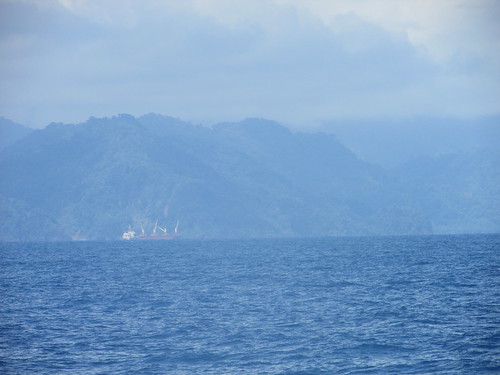
View of the Solomon Islands, and unidentified ship, from 'Caledonian Sky' (Crossing the Solomon Sea)
The in-cabin entertainment provided further distractions, when required. My cabin (or 'suite' as Noble Caledonia not unreasonably prefer) had a large, wall mounted flat-screen television facing the two armchairs. In addition to a handful of satellite television channels, the live 'Ship Channels' offered a view ahead of the ship, commentary and slides when lectures were being delivered and a ship position display, derived from the ship's Electronic Chart Display and Information Systems (ECDIS). ECDIS integrates electronic charts, radar, ship position derived from GPS, the Automatic Identification System (AIS) and other ship systems. There's a post with a description of the use of AIS and ECDIS here. The ship position channel was a favourite of mine, allowing me to monitor our progress. It became apparent that our this part of the Solomon Sea was used by a fair amount of shipping, as shown by the picture below with our ship (red icon) heading more-or-less north west towards the green island on the left called New Britain and our intended destination Rabaul. Two ships on similar tracks were, to port, 'Nol Genesis' and, to starboard, 'Sunrise Serenity' whilst heading south east was 'Sevilla Knutsen'.

In-cabin ship position display showing 'Caledonian Sky' (red icon) heading 308 degrees at 13.4 knots, with 'Nol Genesis', 'Sevilla Knutsen' and 'Sunrise Serenity' in the vicinity (Crossing the Solomon Sea)
Click for larger view
'Sevilla Knutsen' was close enough for me to attempt a picture through my cabin portholes and, after the trip, I confirmed the details of this Liquefied Natural Gas (LNG) tanker.

'Sevilla Knutsen' LNG tanker of Knutsen OAS: 290m by 45.8m 97730 DWT built DSME (Daewoo, S. Korea) in 2010 (Crossing the Solomon Sea)
Because our course was roughly north-west, at 2.0 a.m. on Sunday 23rd the Ship's Clocks moved back another hour and, during the day, in addition to Holy Communion by the Reverend Sarah Clare, more lectures and entertainments were available. The Captain, Ulf Peter Lindstrom, invited all passengers to a Cocktail Party at 6.30 p.m. followed by the Captain's Dinner in the Restaurant on deck 2.
Monday 24th followed the now-familiar pattern but with the anticipation that we should arrive in Rabaul Harbour around 6.0 p.m., so passengers were encouraged to congregate on deck to watch our entrance to Karavia Bay, with its Bee Hives island rock formations and surrounded by currently-dormant volcanoes.

Approaching Rabaul, Papua New Guineau, from the sea. The Bee Hives island rock formations are just visible far left.
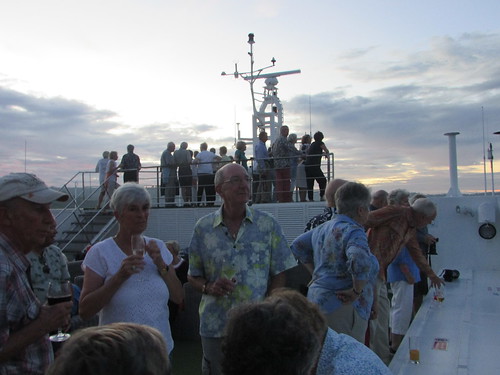
Passengers expectantly watch our approach to Rabaul, Papua New Guineau.
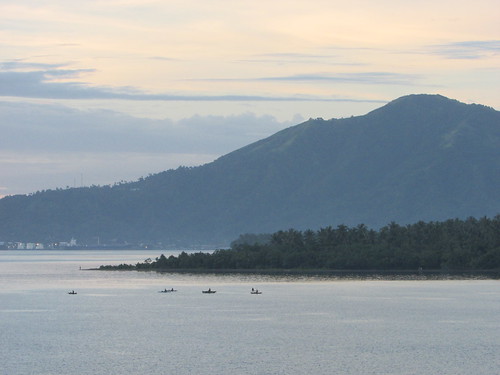
Rabaul, Papua New Guineau, from 'Caledonian Sky', at sunset as 1- and 2-man canoes fish.
The ship remained in Karavia Bay awaiting clearance to dock whilst the passengers went to dinner, held in the open air on the Lido Deck as the 'Caledonian Sky BBQ' with a wide range of food on offer buffet-style.

Caledonian Sky BBQ, 2020: the amazing buffet table.

Caledonian Sky BBQ, 2020
After the splendid meal, some of the staff demonstrated their singing talents and then the tables on which the buffet food had been laid-out were cleared away to leave a dance floor for the guests to use.

Caledonian Sky BBQ, 2020: Staff demonstrate their vocal talent.

Caledonian Sky BBQ, 2020: Passengers enjoying dancing.
Sadly, we were not welcomed by the Provincial Authorities in Rabaul and, after some hours of wrangling, at 11.30 p.m. the Captain decided that we would leave Rabaul and sail for another two and a half days to the capital of Papua New Guinea, Port Moresby. So we remained at sea on Tuesday 25th and Wednesday 26th, finally arriving at Port Moresby on a warm, sunny morning on Thursday 27th February 2020.
Related posts on this website
This post is in the series labelled 'Tropic of Capricorn’. The first post is here.
Clicking on the 'Next report' link will display the post describing the next events. In this way, you may read about the trip in sequence.
Next report
Alternately, clicking on the 'All my Tropic of Capricorn reports' link displays all the posts on this trip in reverse date-of-posting order.
All my Tropic of Capricorn reports
My pictures
Crossing the Solomon Sea
Rabaul, Papua New Guinea, from the sea in 2020
'Caledonian Sky' 2020
'Caledonian Sky' Bridge 2020
Lectures aboard 'Caledonian Sky' 2020
[Text added & pictures embedded 29-Mar-2020]
This is the eleventh of a group of posts describing an 'Expedition Cruise' with Noble Caledonia in 2020 under the title 'Across the Tropic of Capricorn'.
Events of Friday 21st February 2020
The visit to Ureparapara was added to the programme only two days previously, when Noble Caledonia decided that the planned visits to the Solomon Islands were no longer viable. Overnight, the ship had sailed from our previous mooring off Ambryn Island around 170 nautical miles to Ureparapara.
The island is a large, volcanic caldera which has collapsed on one side, allowing the surrounding sea to flood the cone, producing a horse-shoe shaped island. Deception Island in Antarctica (which I’ve visited a couple of times in 2007 and then 2016) has similar origins.
Many of the passengers were on deck as the ship made its entrance to the caldera at Ureparapara.

View from 'Caledonian Sky' as we approach the flooded caldera: Ureparapara, Vanuatu.
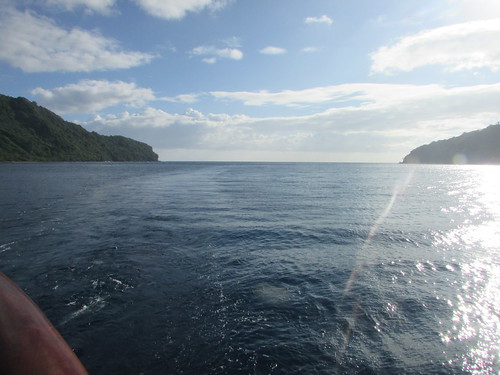
View of open sea from 'Caledonian Sky', inside the flooded caldera: Ureparapara, Vanuatu.
At 08:45, the ship started taking passengers ashore by Zodiac for a wet landing into the shallows of a narrow beach area of black, sticky mud-like volcanic sand.

View from Zodiac as we go ashore at Ureparapara, Vanuatu.
A group of impressive male dancers welcomed us, moving to the beat of a hand-held percussion bamboo instrument. All the men were painted all over in black with white rings around torso, arms and legs. They wore grass skirts and large clusters of sea shells around each ankle, producing a distinctive accompaniment as they stamped the ground. Young children from the village nearby watched the proceedings with interest.

Male dancers painted all over in black with white rings around torso, arms and legs on Ureparapara, Vanuatu.

A group of children on Ureparapara, Vanuatu.
Nearby, a group of more modern musicians were playing and singing. There was one bongo drummer, three acoustic guitars and one small 4-string banjo-like locally-made instrument. Like almost all the men, they were dressed in colourful tee-shirts with shorts but the musicians were also adorned with headbands carrying hibiscus flowers.
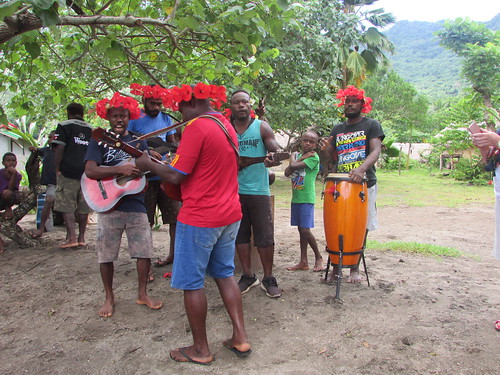
A group of modern musicians playing and singing on Ureparapara, Vanuatu.
There had been a ‘USAID’ project here for a large sign carried the project title ‘Land and Vegetation Cover and Improving Food Security for Building Resilience to a Changing Climate in Pacific Island Communities’. The rest of the sign was in Bismala, the Pidjin language widely understood in Vanuatu. There's a list of English-based Pidjins on Wikipedia here and Bislama is discussed in the interesting Wikipedia article here.
We walked towards the village, where the most buildings were timber framed, with woven bamboo walls and thatched roofs, either erected on a small plinth of flat stones or lifted a few inches above the ground.

House under construction, Ureparapara, Vanuatu

Ureparapara, Vanuatu.
The church of Saint Barnabas was a slightly more substantial construction with a sawn timber frame and corrugated sheet roof but still retaining woven bamboo panels for the walls. A large gas cylinder standing vertically nearby served as the church bell.
A group of kneeling young boys in grass skirts were playing a pebble-tossing game in a small, square area marked-out by four straight poles.
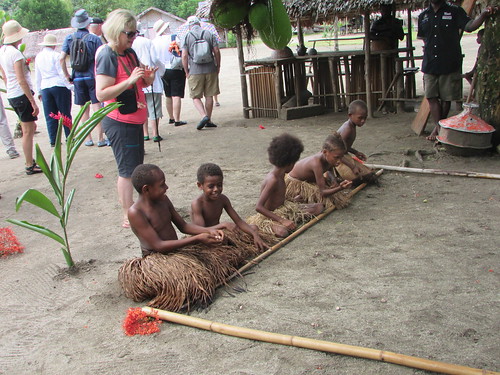
Young boys playing a pebble-tossing game on Ureparapara, Vanuatu.
All the visitors were seated in wooden stands around a performance area. The end bench seat quite near me suddenly collapsed as people tried to sit.

Collapse of bench seat, Ureparapara, Vanuatu.
Various locally-made benches and chairs quickly appeared and everybody was successfully seated. I couldn't resist the suspicion that this minor incident was symptomatic of a laid-back approach to life by the hospitable islanders.
First, a group of nine ladies in grass skirts danced for us.

Female dancers, Ureparapara, Vanuatu
Next, three men formed a percussion band. The hand-held bamboo instrument we’d seen as we arrived was now fixed between two waist-high poles and supplemented by two other musicians - one with what looked like some sort of gourd with seeds inside which was shaken and the other with a long pole held upright and struck against a baseplate laid on the ground. In the meantime, the ladies had each armed themselves with bamboo staffs.

Lady dancers chat as three musicians prepare: Ureparapara, Vanuatu.
Ten male dancers then performed, all wearing grass skirts with a thin cloak made from long plant fronds and with clusters of sea shells around each ankle. Each wore distinctive headgear, representing different aspects of life on the island.

Ten male dancers, each with headgear representing different aspects of life on Ureparapara, Vanuatu.
The ship's passengers then continued to explore the village. Another band started to play. The musicians were in modern dress but plus the thin cloak made from plant fronds. The line-up was drummer, two men each playing a sort of Pan-Pipe with four notes and four men each playing an instrument similar to a xylophone comprising ten bamboo pipes, each a different length, assembled together on an inclined frame. The note was struck by striking the open top of the desired bamboo pipe with a paddle. The overall effect was splendid.
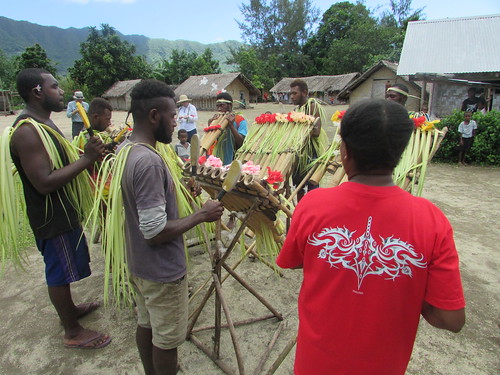
The Band: Drum, Pan Pipes and four bamboo xylophones: Ureparapara, Vanuatu.
At a shelter next to the band, fruit and fresh coconut milk was offered to the visitors. A couple with a child, all in traditional dress, prepared a local dish, inevitably involving coconut, which was then offered to the ship’s passengers.

A couple with a child offered local food to the visitors: Ureparapara, Vanuatu.
Near the sea, an elaborate diagrammatic map of the village had been created with pebbles set in clean sand, decorated with hibiscus and other blooms. I presume the 'Store' is what the the english call a 'Shop'. The 'Nakamal' is the men's hut where men relax and drink Kava. I assume 'Keeping House' refers to a store house.
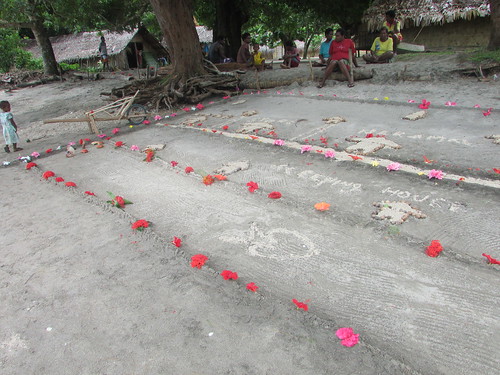
A diagrammatic map of the village had been created with pebbles set in raked sand: Ureparapara, Vanuatu.
It was a very friendly, relaxed visit and we spent some time just chatting to the villagers and listening to the live music. Eventually we moved towards the Zodiac landing place and, by noon, we had transferred back to the ship after a very enjoyable visit to Ureparapara.
Related posts on this website
This post is in the series labelled 'Tropic of Capricorn’. The first post is here.
Clicking on the 'Next report' link will display the post describing the next events. In this way, you may read about the trip in sequence.
Next report
Alternately, clicking on the 'All my Tropic of Capricorn reports' link displays all the posts on this trip in reverse date-of-posting order.
All my Tropic of Capricorn reports
My pictures
This blog post was first published on the ship via a satellite link with limited capacity so the link to my pictures was added later.
Ureparapara, Vanuatu
[Link to pictures added 11-Mar-2020: Pictures embedded 31-Mar-2020]


