Showing posts with label Loco-profile. Show all posts

Thursday, 17 September 2020

Locomotive Profile: Great Western '4575' Class

The influence of George Jackson Churchward (1857-1933) on the history of the Great Western Railway (GWR) was immense. Churchward was assistant to the revered William Dean (1840-1905), Chief Locomotive Engineer of the GWR, for a number of years and in that time he had started to formulate his own policies for equipping the GWR with the finest motive power possible, based on a few standard classes using scientific design principles. When Dean retired in 1902, Churchward became Chief Mechanical Engineer of the GWR, serving in that role until 1922. In a flurry of activity after he took over, Churchward laid down the template for locomotive design which served the GWR until the end of steam locomotive design in the UK.

In 1903, 4-6-0 locomotive number 98 emerged from Swindon works representing the first of his standard designs. It featured two outside cylinders with 10-inch piston valves and represented a maturing of ideas incorporated in 4-6-0 number 100 built the previous year. Two other prototypes for standard designs emerged in 1903, again with two outside cylinders and piston valves - a freight 2-8-0 locomotive number 97 which was the forerunner of the famous '28XX' class and a large-wheeled 2-6-2 tank number 99. Significantly, in a triumph of the foundrymans' art, in all three designs, one cylinder, its valve chest, associated internal passages and half the saddle to support a 'drumhead' smokebox were combined in a single casting. In each case, two castings bolted together on the centreline of the locomotive formed the complete 2-cylinder 'engine'.

Churchward had a cautious approach and these prototypes were intended to run for a couple of years to prove the soundness of the design before further orders were placed but motive power needs meant that a small-wheel version of the 2-6-2 tank, number 115, appeared in 1904 and its success in the West Country and Wales led to ten further locomotives (numbered 3101-3110) being built in Wolverhampton works in 1905-1906. Number 115 was eventually renumbered 4400 and the ten later locomotives 4401-4410.

Further experience suggested an increase in driving wheel diameter would be helpful and twenty more 'Light Prairies' were built at Wolverhampton with 4 feet 7½ inch diameter wheels, with more to follow built at Swindon. Various modifications were introduced to these popular engines - top feed, an extended smokebox, superheaters with boiler pressure raised from 180 p.s.i. to 200 p.s.i. and an extended coal bunker bringing the weight up to around 56 tons 13 cwt. Cylinders were 16½ x 24 inch. 

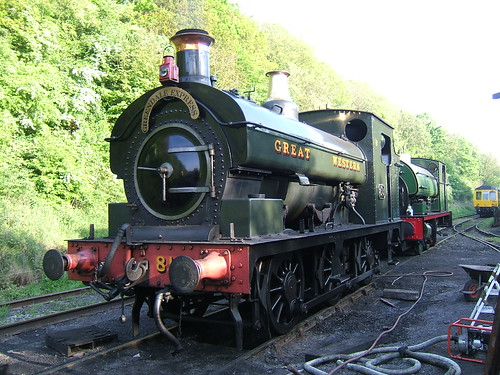
Preserved locomotive 5542 of the '4575' class has proved popular with both visitors and crews on her various lisits to the Battlefield Line. The Wikipedia article on this locomotive says:-
In 1904 G J. Churchward introduced the 2-6-2T locomotive No 115 that was to be the forerunner of the 45xx class locomotives. The prototype, built at Swindon, very quickly proved most useful, and a further 10 examples were soon constructed at Wolverhampton locomotive works. The new locos sported copper topped chimneys and were originally numbered in the 31xx series but were re-numbered as the 44xx class. They were well equipped for use on the steep and twisting Great Western branch lines, particularly in and around the West Country. They were noted for excellent acceleration but with 4ft 1½in wheels their speed was restricted. Various modifications were soon introduced amongst other things, increased coal capacity, superheated boilers with increased pressure, at that time 180 p.s.i, and greater cylinder capacity.

Locomotive 5526 (also a member of the '4575' class) has proved equally popular on her visits to the Battlefield Line. 

References

[ 1] ‘A Pictorial Record of Great Western Engines’ by J. H. Russell (Oxford Publishing Company Vol. 1 & 2 1975: reprinted as one volume 1978) SBN 0 86093 02 6.
[ 2] ‘Great Western Steam’ by W. A. Tuplin (George Allen and Unwin 1958).

Related posts on other websites

GWR 4575 Class (Wikipedia)
GWR 4575 Class 5542 (Wikipedia)

Related posts on this website

The following posts talk about members of the '4575' class:-

'Cold Turkey Gala' at the Battlefield Line (5526 & 5542)
Preparing 5542 (part 2) 
3 Sep 2018
5542 at the Battlefield Line 28 Aug 2018
More Fish and Chips 15 Jul 2018
Santa Specials at the Battlefield Line 2017 19 Dec 2017
On the Footplate 5 Dec 2017
GWR 'Light Prairie' 5542 22 Aug 2010

My photograph albums

Where necessary, clicking on an image above will display an 'uncropped' view or, alternately, pictures may be selected, viewed or downloaded, in various sizes, from the albums listed:-

5526 GWR Locomotive
5542 GWR Locomotive
5521 GWR Locomotive
5553 G.W.R. Locomotive
4588 G.W.R. Locomotive


Tuesday, 26 November 2019

Loco Profile: D.C. Electric Locomotives in the former Soviet Union

Background

The development of railways in what was to become, for a time, the Soviet Union, started in the days of the Russian Empire of the Tsars, using steam traction.

The first reference to electric traction I've found was a short tram line in Kiev, opened in 1892. But, as early as 1926, following the turmoil of the Russian Revolution, Electric Multiple Units were operating in Azerbaijan from Baku to Sabunchi (around 11 km route length).

Between 1928 and 1932, General Electric locomotives were introduced on the Kashuri-Zestafoni and Suram Pass lines (around 66 km route length west of Gori towards Black Sea) of the Zakavkazskaya Railway and then on the Mineral'nye Vody-Kislovdsk line in Caucasus (around 56 km route length on Murmansk Line).

In 1934, PB21-01 (named to honour the Politburo) and operating at 3kV d.c., built at Kolomna Works, gave satisfactory performance between Tbilisi and Khasari.

The OR22-01 was introduced in 1938. This Co-Co design operated from 20 kV a.c. and used Mercury Arc Rectifiers to rectify power to the motors.

By 1941, 1,870 route km had been electrified.

After World War II, the Soviet Union designed a series of 1-section and 2-section 3 kV d.c locomotives but, in 1957, 25kV a.c. was chosen for all new work. By 1991, the Western Lines, the Caucasus and Trans-Siberian had been electrified, using various methods.

The first post-World War II design for freight work was the 'T8' (for Tbilisi 8-axle), a 2-section 3 kV d.c locomotive which also appeared as a 1-section design. The 1-section had a cab each end: the 2-section had one cab in each section. The class name was changed to commemorate Vladimir Lenin, and each driving end carries his initials in Cyrillic characters which look rather like 'Bn' since his name in Russian is 'Влади́мир Ленин'. In Roman letters, the family is known as 'VL' and successive classes are VL8 (introduced 1953), VL10 (introduced 1961) and VL11 (introduced 1975). Some units no longer carry the 'VL' prefix.

VL8

According to the list on the 'Railfan Europe' site here, the VL8 (introduced in 1953) is almost extinct, although I photographed VL8-310 in Azerbaijan.


Azerbaijan Railways: VL8-310 2-section Bo-Bo 3 kV d.c.

VL10

In 1961, the first VL10 was produced in Tbilisi followed by 17 more. From 1967 to 1977, large numbers were series-built at both Tbilisi and, from 1969 to 1976, Novocherkassk, totalling 1,902 units. I believe the class is referred to as 'Chervonets', an informal name for a 10 rouble coin.
Brief data
2-section Bo-Bo.
Wheel diameter 1250 mm.
Each section Power(a) 2680 kW (b) 2300 kW.
Each section Tractive Effort (a) 307 kN (b) 195 kN @ 48.7 km/h (c) 159 kN @ 51.2 km/h Max 100 km/h.
Each section has 4 off 670 kW, series wound, nose suspended, axle hung d.c. traction motors (Tbilisi TL-2K1), with a gear ratio of 3.83:1.
Regenerative braking is provided.
Each section is 16420mm long and weighs 92t, giving an axle load of 23t.

Armenia Railways: The Russian-design 3 kV d.c. 2-section locomotive VL10-825 which hauled the 'Golden Eagle' from Yerevan.

In 1975 a higher-power sub-class was introduced called VL10u ('u' for 'usilennyi', meaning strengthened), with a higher power.

Standardisation meant that many parts, including bogies and series production bodies were common with VL 80K class (a similar 2-section Bo-Bo arranged for 25 kV a.c. operation introduced in 1963).

In 1974-75, three ballasted units were prototypes for the VL10U class.

In 1984-5 the VL10N class was introduced for industrial use with rheostatic rather than regenerative braking.

VL11

VL11, introduced 1975, is a development allowing extra ('booster') sections to be added for higher power.


Tbilisi Station, Georgian Railway: 11-747A on northbound train

VL11m, a modernised version of the VL11, followed in 1987.


Azerbaijan Railways: VL11m 341 waiting with a westbound train west of Hajiqabul. Both pantographs lowered and crew relaxing.


Qobustan Station: Azerbaijan Railways: VL11 M6-509 on the platform line. This is a modernised version (built from 1987) of the adaptable multi-section Bo-Bo VL11 (built from 1976) which was developed from the earlier VL10. The Cyrillic 'b' after the running number indicates cab 'b' (14:25)

The collapse of the Soviet Union 1992 must have been an incredible upheaval for the railways. A huge, previously-integrated railway system was devolved into numerous separate railways and existing rolling stock was divided up according to prior use. Whereas previously the manufacture of traction units and rolling stock had been state-directed, efforts became fragmented.

Book Reference

[1] 'Soviet Locomotive Types - The Union Legacy' by A J Heywood & I D C Button (Frank Stenvalls Forlag) ISBN 0-9525202-0-6.
[2] 'Lokomotivy otechestvennykh zheleznykh dorog (Railroad Locomotives of our Native Land) 1845-1955' by Vitaly A Rakov (Transport Moskva, 1955 in Russian Cyrillic) ISBN 9785277008218.

Related posts on other websites

Elmavalmshenebeli (Georgian loco builder).
Railfan Europe: RZD dc electric locomotives.
VL10 (Wikipedia).


Related posts on this website

Numbering of Russian Locomotives and Rolling Stock.
Russian Railways.
Railway Workshops in Kiev (2005 visit).
Trans-Siberian (17 posts describing a journey from Ulan Bataar to Moscow).
Caspian Odyssey (11 posts describing a journey from Yerevan to Baku).

My Pictures

Ukraine Modern Image (Electric & Diesel).
Kiev Locomotive Works (Passenger) (Electric).
Kiev Locomotive Works (Freight) Electric & Diesel.
Russian Railways (2011 canal/river trip).
Railways in Armenia (2018).
Georgian Railway (2018).
Tbilisi Station, Georgian Railway (2018).
Azerbaijan Railways (2018).
Locomotive Profile: VL10 and similar locomotives.
Russian Railways - The Trans-Siberian Railway (2012: 21 albums).

Monday, 27 August 2018

Locomotive Profiles (Index)

This is a list of the occasional posts I've written about a group of related locomotive classes, a particular class or, occasionally, just one locomotive in a class. Sometimes, the profile is numbered, sometimes there's just a verbal description.

Posts are listed in reverse date-of-posting order but, just to confuse, each post describes events any time in the history of the locomotive. Alternately, selecting 'Loco-profile' in the list of 'Labels to select a blog topic' will find all my locomotive profile posts (again, in reverse date-of-posting order).

Another way of searching for posts about a particular locomotive or class is to put a search word or phrase into the Search Box in the page header (with the magnifying glass symbol) because a lot of posts which talk about specific classes or engines haven't been called 'Profiles'.

Loco Profile: D.C. Electric Locomotives in the former Soviet Union 26-Nov-2019
Dugald Drummond and the 'T9' - Historical Background (10) 14-Apr-2017
G.W.R. 0-6-0PT 'Pannier' tank locomotives (9) 5-Jan-2016
The 'Austerity' 0-6-0ST locomotive (8) 27-Oct-2015
Loco-profile 7: 'Sapper' 0-6-0ST 16-Jan-2015
Loco-profile 6: 'Planet' replica 13-Nov-2013
Loco-profile No. 5: The Russian 'E' class 0-10-0 1-Jan-2013
Loco-profile 4: Russian 'FD20' class 2-10-2 24-Aug-2012
Loco-profile 3: Russian 'FDp20' class 2-8-4 24-Aug-2012
Loco-profile 2: Russian 'YeA' Class 17-Aug-2012
Loco-profile 1: "Lion" 1-Jan-2010

[List re-ordered: 4-Sep-2018, updated 19-Dec-2019]

Tuesday, 5 January 2016

G.W.R. 0-6-0PT 'Pannier' tank locomotives

Early 0-6-0 tank locomotives of the G.W.R.

Early six-coupled tank engines produced by the Great Western railway varied considerably in design from lot to lot. The complex history is meticulously chronicled by Jim Russell in his book [reference 1]. All of these locomotives were provided with saddle tanks and many were outside-framed.

At least one G.W.R. inside-framed saddle tank of the period survives - '813' which is described in more detail below.

Introduction of pannier tanks

From 1911 onwards, as these saddle tank locomotives entered the works for heavy repair, pannier tanks progressively replaced the saddle tanks. The pannier tank is an ingenious way of solving the problem of storing water on locomotives without a separate tender. I discussed this in the post Water, water, everywhere.

Collett's '57XX' class

The ubiquitous 'Pannier Tank' with 4 ft. 7.5 in. diameter wheels which I remember from the steam era was introduced by Collett in 1929, as a replacement for the elderly stock of 'Pannier Tanks'. The initial build as the '57XX' class was based on the earlier '27XX' class after rebuilding with pannier tanks. When the last batch of 'Pannier Tanks' was built in 1950, 'Pannier Tanks' (including variations) totalled 863 locomotives.


Whilst the leading and driving axles had leaf springs, the trailing axle had a dual coil springs on each wheel, which stood up into the cab, making the fireman's job a little harder.

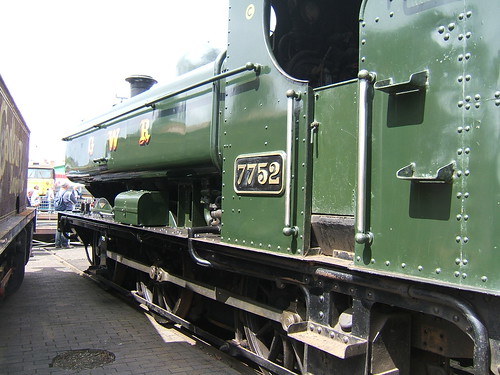
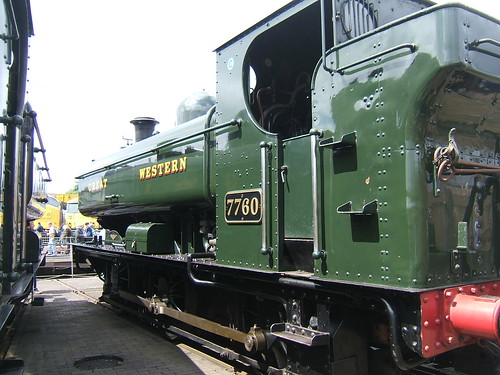
The Great Western didn't build all the 'Panniers' itself and batches were sub-contracted to private builders. For instance, Birmingham Railway Museum's Pannier Tanks 7752 and 7760 (shown below) were both built by North British Locomotive Company Limited in 1930. There's a short article on North British here.

Preserved 'Pannier' 7752 at Tyseley (Photo: Birmingham Railway Museum).

The design survived because of its practicality. Although officially designated as a 'light goods and shunting engine', they were very versatile - my friend John frequently makes fun of me for my off-the-cuff remark once when being interviewed for a railway video that "You can do anything with a Pannier".

There's a detailed history of the '57XX' class on Wikipedia here and in the Great Western Archive pages Introduction and Details of Allocation.

Collett's '54XX'/'64XX'/'74XX' classes

In 1932, 'Pannier Tanks' with 5 ft. 2 in. diameter wheels, 165 p.s.i. boilers and fitted for 'Auto Train' working were introduced, as a replacement for similar elderly locomotives. The '54xx' class had 25 members. A further batch of 40 locomotives, also 'Auto' fitted, were produced with 4 ft. 7.5 in. diameter wheels, forming the '64XX' sub-group. Finally, between 1936 and 1950, 50 locomotives of the '74XX' group were constructed with boilers uprated to 180 p.s.i. but not 'Auto' fitted.

There's further information on the '54XX' class and the sub-classes in Wikipedia here and in the Great Western Archive pages Introduction and Details of Allocation.

6412, 6430 and 6435 have been preserved.

Collett's '1366' class

In 1934, six 'Pannier Tanks' with 3 ft. 8 in. diameter wheels and outside cylinders were built to replace life-expired types for dock and similar shunting.

There's further information on the '1366' class in Wikipedia here and in the Great Western Archive pages Introduction and Details of Allocation.

1369 has been preserved and there is a detailed history of this locomotive here.

Hawksworth's '94XX' class

The story goes that the Chairman of the G.W.R. Sir James Milne (1883-1958) had decided that a more modern design of locomotive was required for bringing empty coaching stock into Paddington to promote the proper corporate image to passengers as they joined their train. Certainly, Collett's '57XX' locomotives then in use, with a large dome and cast chimney appeared to be from an earlier era.

Accordingly, Frederick Hawksworth, the Chief Mechanical Engineer, was tasked with producing a suitable design. Hawksworth used the cylinder design and boiler from Collett's successful 2251 class. Swindon Standard Boiler Number 10 was a tapered, domeless Belpaire boiler pressed to 200 p.s.i. with a sloping grate of 17.4 square feet area.

I love the story but don't know if it's true. Certainly, James Milne was opposed to nationalisation of the railways and, when the G.W.R. was nationalised after World War II, he declined the offer of the chairmanship of the Railway Executive of the British Transport Commission which would run the nationalised railways, instead taking retirement.

Swindon managed to produce the first ten '94XX' locomotives prior to Nationalisation in 1948. In the post The End of an Era I talked about the Nationalisation of the railways in Britain in 1948 and the subsequent building of 999 steam locomotives of various modern designs, intended to help to unify the former 'Big Four' railways into a single unit. However, in what may be seen as a final act of defiance, the Great Western Railway placed an order with private contractors for 200 more of the '94XX' class, leaving British Railways to pick up the bill.

There's more about the '94XX' class in Wikipedia here and in the Great Western Archive Introduction and Details of Allocation.

Hawksworth's '15XX' class

This was a remarkable Hawksworth design to conclude the 'Pannier Tank' story. It adopted some of the '94XX' design and used the same Swindon Standard Boiler Number 10 but featured a short wheelbase, two outside cylinders and Walschaerts motion! Ten were built at Swindon, post-nationalisation, in 1949 and all had a short working life. '1501' is preserved.

There's more about the '15XX' class in Wikipedia here and in the Great Western Archive Introduction and Details of Allocation.

Hawksworth's '16XX' class

Between 1949 and 1955. 70 off of this 'Pannier Tank' were built at Swindon. With 4 ft 1.5 in diameter coupled wheels and height kept to an minimum, they could work on routes with low clearances but their working life was short. One locomotive,'1638', was preserved.

Wikipedia has details here and the Great Western Archive pages has information on Introduction and Details of Allocation.

Saddle Tank '813'

'813' was not actually G.W.R.-built. She was built by Hudswell Clark in 1901 for the Port Talbot Railway and Docks Company. The G.W.R. operated this line for the Port Talbot company from 1908 and finally absorbed the company in 1922. This locomotive served the G.W.R. for some years (acquiring various 'Swindon' features) before finally being sold off in 1934. There's a more detailed history of this interesting survivor on the GWR 813 Preservation Fund website here.

When this locomotive visited The Battlefield Line in 2007, I had a couple of enjoyable days driving her. There's a brief report here. The rather lop-sided headboard 'Greendale Express' visible in the picture below was carried during a 'Postman Pat' weekend. If you know as little about Postman Pat as I do, the Wikipedia article here is a useful primer.

'813' being prepared at Shackerstone on 5th May 2007.

I've worked on six preserved 'Pannier Tanks', listed below:-

7752

I've driven this 'Pannier' many times, on passenger trains, demonstration freight trains and supervising Driving Experience Courses at three locations: Birmingham Railway Museum (as it was then), the Battlefield Line and the Avon Valley Railway. She's always been in green Great Western Railway livery.

7752 displayed on the Turntable at 'Tyseley 100'.


There's a detailed history of this locomotive on the Tyseley Locomotive Works website here.

7760

I've driven this 'Pannier' many times, on passenger trains, demonstration freight trains and supervising Driving Experience Courses at both Birmingham Railway Museum (as it was then) and the Battlefield Line. The locomotive has been in both green Great Western Railway livery and red London Transport livery (as L90).

7760 displayed on the Turntable at 'Tyseley 100'.

There's a detailed history of this locomotive on the Tyseley Locomotive Works website here.

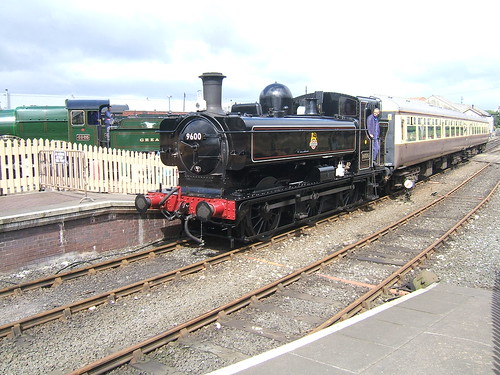
9600

Built 1945 at Swindon in the final form with enlarged cab and larger, rectangular spectacles. I've driven this 'Pannier' a number of times at Birmingham Railway Museum (as it was then), always in British Railways lined black livery .

9600 on a passenger train at 'Tyseley 100'.


There's a detailed history of this locomotive on the Tyseley Locomotive Works website here.

5764

I've worked on this locomotive once, when I was invited fire a round trip on the Severn Valley Railway - I think it was in 2004. I believe she was withdrawn from traffic in 2011 and is currently in store awaiting restoration.


5764 at Bewdley in 2008 (Photo: Peter Broster via Creative Commons).

5786

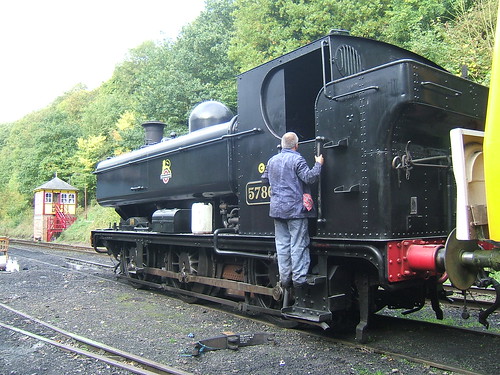
I've enjoyed one day driving this 'Pannier' in October 2010 at the Battlefield Line. I think the unlined black livery with the early totem suits the locomotive (not so sure about the face for 'Day out with Thomas'). This locomotive was preserved by the Worcester Locomotive Society in 1969 and there's more information on the South Devon Railway Association site here.

5786 being prepared for duty at Shackerstone in October 2010.

9466

I've driven this 'Pannier' a number of times, always in green Great Western Railway livery, on passenger trains at the Battlefield Line. green at the Battlefield Line. I think the last time was in 2008. This locomotive was built by R. Stephenson in 1952 as their works number 7617 (so the G.W.R. livery is historically incorrect). This engine is kept in immaculate condition, is fitted with a speedometer, AWS/TPWS and an OTMR (Automatic Warning System, Train Protection and Warning System, On Train Monitoring Recorder) and is approved for running on the National Rail Network.

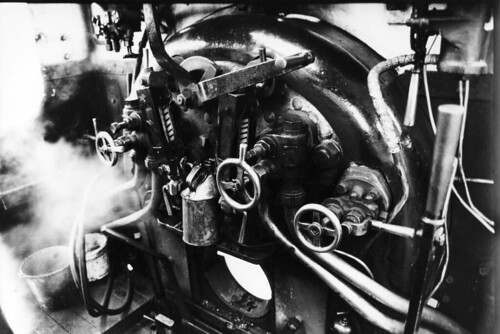
Although they were certainly capable engines, most of the former British Railways enginemen I've spoken to still preferred the earlier Collett '5700' design. One particular problem drivers complained about was that because the design used the '2251' boiler and wider cab, the driver's brake valve ended up too far 'inboard' for the driver to operate it conveniently when leaning out whilst closing up to vehicles. This was fixed with an official brake valve extension link, placing the handle closer to the side of the cab.


Cab view of 9466: The brake valve, with a large copper pipe descending through the floor, is hidden by the regulator handle. A curved link connects the valve to a separate brake lever provided with a turned wooden handle towards the right.

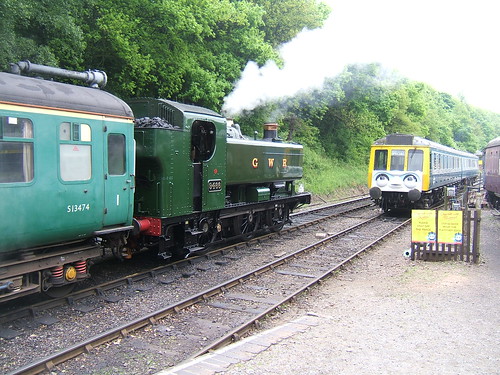
The Battlefield Line, May 2008: '9466' waits to depart from Shackerstone as the DMU (with a face for 'Day out with Thomas') arrives.
There is an album of pictures showing the construction of this locomotive at portrait at Portrait of a Pannier'.

References

[ 1] ‘A Pictorial Record of Great Western Engines’ by J. H. Russell (Oxford Publishing Company Vol. 1 & 2 1975: reprinted as one volume 1978) SBN 0 86093 02 6.

Tuesday, 27 October 2015

The 'Austerity' 0-6-0ST locomotive

'Austerity' Elevation (Industrial Railway Record).

Introduction

In World War II, there was an urgent need for additional shunting engines to deal with the massive volumes of war materiel being produced. To save time, Robert ('Robin') Riddles at the Ministry of Supply chose an existing design - the Hunslet 18-inch industrial - which, with some modifications, was produced in large numbers by Hunslet and other locomotive manufacturers. After the War, many of these locomotives were 'demobbed', finding a new life in collieries and power stations. A total of 75 ended up in LNER stock (classified as 'J94') and a few of these were eventually transferred to Rowsley shed, working on the notorious Cromford and High Peak line. Some new building continued after the War up to 1964 bringing the total build to 485 locomotives.

Hunslet re-acquired some of the surplus locomotives and converted them to the 'Gas Producer' system, based on the work of L. D. Porta in Argentina.

As 'Austerities' were scrapped, around 70 were purchased by preservation groups and, over the years, many of these have re-entered service.

Injector

Two live steam injectors, which force cold water from the saddle tank into the boiler, are provided on 'Austerity' tank locomotives. The Davies and Metcalfe 'Monitor' Live Steam Injector, used on the class, has a good reputation and it's well-worth studying the manufacturer's publication here.

'Austerities' I've driven

The first 'Austerity' I worked on was 68009, on which I took my practical driving examination at Tyseley. We were later re-united at the Battlefield line, by which time she was '8009'.

Next came an 'Austerity' at the North Norfolk Railway. This engine's claim to fame was that she was fitted with a Giesl Ejector, replacing a standard blast pipe and chimney. I believe N.C.B. fitted a number of their 'Austerities' with this feature.

At Peak Rail, 'Duke' was a regular performer. Eventually, this 'Austerity' posed as 68006 (one of the Rowsley 'Austerities').

The boiler backhead of 'Duke' (Photo: Marion Reeves).

'Warrington' was the other 'Austerity' at Peak Rail when I joined. I'd first met this locomotive at Dinting Railway Centre as 'Warrington' with the plain chimney cowling I never liked. She remained 'Warrington' for a time at Peak Rail but, thankfully, a proper cast chimney was eventually substituted. Repainted black and carrying the number 68012, she revived memories of the Cromford and High Peak when running with 68006. Then, she assumed her former military identity as WD150, with copies of the nameplates she carried for a time in military service 'Royal Pioneer'.

WD150 'Royal Pioneer' at Rowsley.

Back at the Battlefield Line, I drove the well-known 'Austerity' from N.C.B. service 'Whiston'.

'Lord Phil' arrived at Peak Rail directly from restoration and required a fair bit of extra work before becoming a reasonably reliable engine.

Peak Rail: 'Lord Phil' at Matlock, ready to haul the service train back to Rowsley.

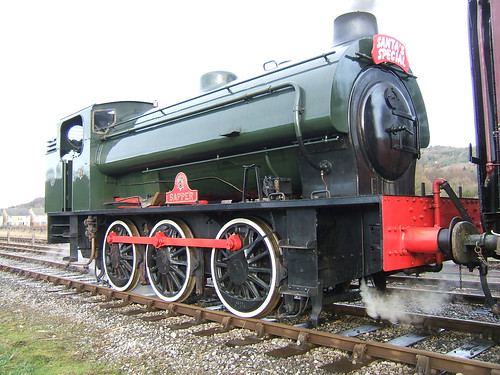
In contrast, WD132 'Sapper' which was at Peak Rail for a time was always a rock-solid performer. It had a 'Kylchap' exhaust combined with the plain chimney cowling I'm not a fan of. 'Sapper' has her own 'Loco Profile' here

'Sapper' operating a 'Santa Special' at Peak Pail.

During Peak Rail's 'Blazing Saddles' event, I got to drive Dean Forest's 'Austerity' 'Wilbert' which I found willing but in need of Tender Loving Care.

'Wilbert' on the rear of a down train at Darley Dale at the Peak Rail 'Blazing Saddles' Event.

Most recently, I drove 'Cumbria' at the Battlefield Line, looking quite handsome but also in need of some mechanical attention.

Battlefield Line Steam Gala, October 2015: 3794 'Cumbria'.

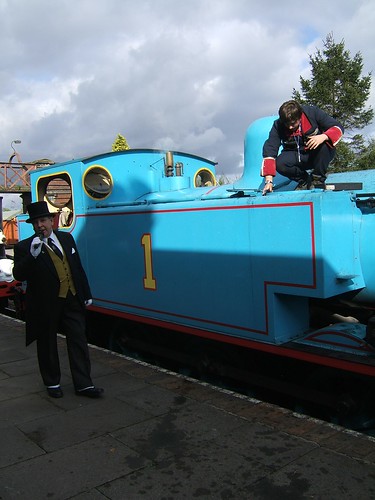
The most unlikely 'Austerity' I've driven is Hunslet 3781, rebuilt by the Mid-Hants Railway as a very convincing 'Thomas'. I drove that that at the Battlefield Line for a 'Thomas' event.


Hunslet 3781, rebuilt as 'Thomas'.

That's a total of 10 'Austerities' I've driven (not counting the 'multiple personalities' some engines adopted at various times).

Related articles on other sites

There's a useful 'Wikipedia' article on 'Austerities' here and a list of preserved examples here.

THE 18in HUNSLETS (article by H. A. Gamble for the Industrial Railway Record)

Austerity 0-6-0st type as modified by L.D.Porta & Hunslet (Article by Martyn Bane).

The 'Austerity Locomotive Owners Association' (A.L.O.A.) has information as part of the Scottish Railway Preservation Society Steam Web Site (select the 'A.L.O.A.' tab).

[A.L.O.A. url updated 23-12-2016, 13-Aug-2017: Injector data added 13-Aug-2017]

Friday, 16 January 2015

Loco-profile 7: 'Sapper' 0-6-0ST

'Sapper' takes an Up train out of Darley Dale. (Photo: Sheila Rayson)

Brief Locomotive History

'Sapper' was built by Hunslet in Leeds in 1944. The Works Number was 3163 and she was very similar to other six-coupled saddletanks built for military service during the Second World War. When 'de-mobbed' this locomotive, and some other members of the class, were acquired by Hunslet. Their aim was to sell-on the locomotives for industrial use. To make the locomotives more attractive to industry (which was, by then, more interested in diesel locomotives or rejecting rail altogether, in favour of road transport). Hunslet converted the locomotives to a Gas Producer Combustion System based on the work of the Argentinian engineer L. D. Porta. There's an excellent article by Martyn Bane on the 'Austerity' class as built and as modified here.

The Hunslet initiative wasn't an unqualified success and, whilst a number of 'Austerity' saddle tanks (both modified and un-modified) have ended up in preservation, I think all the ones actually in use have reverted to a more conventional firebox design and hand firing.

Steam Heating

Of course, as-built the 'Austerity' locomotives were not provided with steam-heating facilities but restored locomotives used for passenger trains on preserved railways have this feature added. In preservation, warming is typically carried out at a steam pressure of about 30 pounds per square inch.
This is only a fraction of boiler pressure so steam from the boiler is admitted to the heating system through a Reducing Valve. It takes a while for steam to work its way through the train so it's usual to open the steam heat cock on the back of the train until steam can be seen escaping, assuring that all the intermediate cocks between carriages are open and the steam heating hoses correctly coupled. This process should be started well in advance of departure to give the coaches a chance to start warming before the passengers board. Once steam heating is started, the fireman needs to account for the extra demand for steam - coal and water will need to be added more frequently.

Handbrake/Steam Brake

'Sapper' is provided with a handbrake and a steam brake. On each wheel, there is a cast-iron brake block which can be pulled against the steel tyre of the wheel through a substantial arrangement of brake rods and cross-members forming the brake rigging. The brakes are applied on all wheels simultaneously either by rotating the handbrake screw using an l-shaped handle in the cab or by the movement of a piston rod connected to the piston in the steam brake cylinder. The steam brake cylinder is mounted under the footplate on the driver's side of the footplate and the supply of steam to the brake cylinder is controlled by a valve in the cab.
Two brackets mounted on the boiler backhead support a transverse shaft which can be rotated by handles at either end. A steam brake valve is supported by the left hand bracket and operated by the rotation of the shaft from either side of the cab. A copper pipe runs from the brake valve to the piston in the steam brake cylinder. Pulling on either steam brake handle applies steam to the brake cylinder: pushing the handle cuts off the steam supply and vents the steam in the brake cylinder to atmosphere, allowing a substantial spring under the front of the locomotive to pull back the brake rigging and release the brakes.

Vacuum Brake

Following a series of dreadful accidents in the 19th century, it became a requirement that all passenger trains be provided with an 'Automatic' brake. There's a little more about brakes in a post called MIC - Brakes.

As-built the 'Austerity' locomotives were not provided with vacuum brakes but restored locomotives used for passenger trains on preserved railways have this feature added. In 'Sapper' a Davis and Metcalfe Type 'M' Ejector including the Driver's Brake Application Valve has been fitted.

Related posts in this blog

Preparation of Locomotive 'Sapper'.


My pictures

'Sapper' Austerity Tank Locomotive.

Wednesday, 13 November 2013

Loco-profile 6: 'Planet' replica

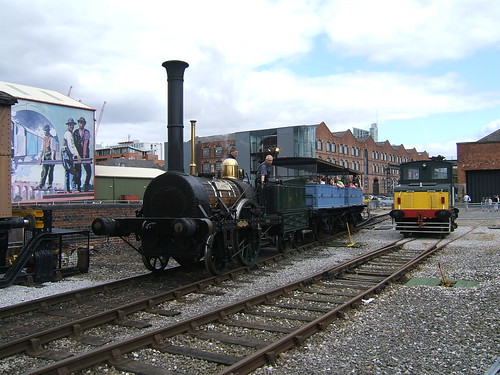
The 1830s saw a remarkable and rapid development of the steam locomotive engine. In 1829, at the Rainhill Trials, 'Rocket' triumphantly proved the feasibility of hauling passenger trains using locomotives. Within a year, Robert Stephenson and Co. had built 'Planet', which offered significant technical advances. Various working replicas of 'Rocket' have been built but 'Planet' was unrepresented until Michael Bailey and the Planet Team, working at Manchester Museum of Science and Industry (now MOSI) designed the 'Planet' replica. On 2nd October 1992 the Museum brought its 'Planet' replica into service. The replica has just completed 21 years of service at the Museum and other railway sites. The articles listed in 'Related posts' below give more information about the genesis of both the original and the replica locomotive.

'Planet' replica (with earlier taller chimney) and replica train.

Related posts in this blog

Early Locomotive Design.
The Planet Replica.
'Planet' at MOSI - The First 21 Years.
'Planet' in Perspective
'Planet Locomotive in Operation.

My Photographs

'Planet'.
Planet Drawings.

Tuesday, 1 January 2013

Loco-profile No. 5: The Russian 'E' class 0-10-0

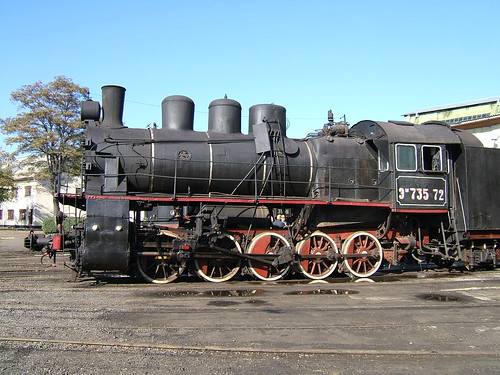
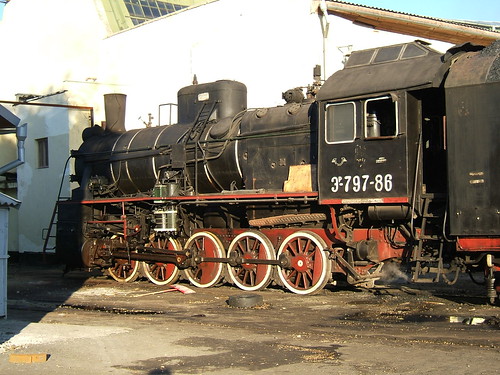
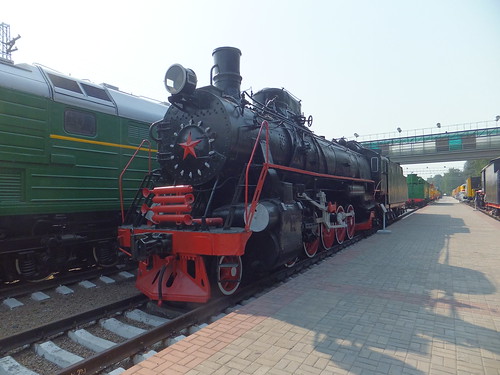
Lugansk works built the first 'E' class 0-10-0 locomotive in 1912 and, including later sub-classes, this became perhaps the most prolific design in the world. Despite numerous initiatives to move on from this design, the 'E' class remained remarkably resilient and I was able to drive two examples of the E' class (the 'Em' and 'Er') in 2005 when I went on a steam driving holiday which is briefly described here.

Em 735-72 at Kolomiya Depot, Ukraine.

Front view of Em 735-72 at Kolomiya Depot.

Note that the complete smokebox front is hinged on the right and, once unbolted, can be swung open for re-tubing and access to the tubeplate. There is a smaller door in the smokebox front used for char removal. This door is hinged on the right and secured by 14 'dogs' or clamps which, when tightened, ensure that the smokebox door is airtight.

Er 797-86 at Kolomiya Depot, Ukraine.

For technical specifications, refer to Reference 1.

References:

Reference 1: 'Soviet Locomotive Types - The Union Legacy' by A J Heywood & I D C Button (Frank Stenvalls Forlag) ISBN 0-9525202-0-6.

Photographs:

Locomotive Profile: Russian 'E' class 0-10-0

Friday, 24 August 2012

Loco-profile 4: Russian 'FD20' class 2-10-2

'FD20' Class 2-10-2 number 588 at Novosibirsk Rolling Stock Museum.

In the early 1930s, the Soviet Union introduced two modern, large locomotive classes. The 'FDp' was a 2-8-4 intended for passenger working with 1850 m.m. diameter coupled wheels whilst the 'FD' was generally similar but arranged as a 2-10-2 with smaller coupled wheels intended for freight duties.

I saw the only surviving 'FDp', number 578, in Ukraine in 2005 when I went with my friend Mike on a steam driving holiday which is briefly described here and with a set of pictures (including the 'FDp') here.

It was to be 2012 and my Trans-Siberian trip before I saw an 'FD20' class, number 588, in the Rolling Stock Museum at Novosibirsk. Pictures of this locomotive are in the set Loco-profile: Russian 'FD20' class 2-10-2.

All the pictures from the Rolling Stock Museum at Novosibirsk are here.

For technical specifications, refer to Reference 1.

References:

Reference 1: 'Soviet Locomotive Types - The Union Legacy' by A J Heywood & I D C Button (Frank Stenvalls Forlag) ISBN 0-9525202-0-6.

Loco-profile 3: Russian 'FDp20' class 2-8-4

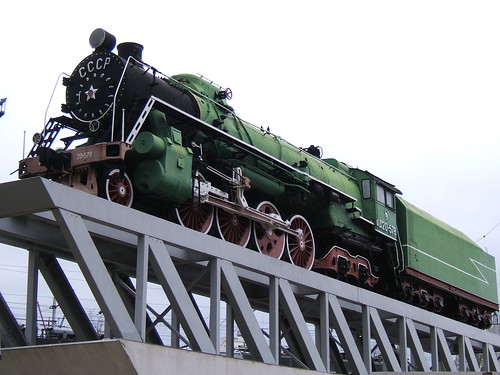
Surviving 'FDp20' class (formerly IS class) plinthed near Kiev main station.

In the early 1930s, the Soviet Union introduced two modern, large locomotive classes. The 'FDp20' was a 2-8-4 intended for passenger working with 1850 m.m. diameter coupled wheels whilst the 'FD' was generally similar but arranged as a 2-10-2 with smaller coupled wheels intended for freight duties.

The passenger class was originally called the 'IS' class (for Iosif Stalin) and the freight class was called 'FD' (for Feliks Dzerzhinski). However, in 1962 (when Stalin became persona non grata the 'IS' class was quietly re-named 'FDp' where the 'p' indicated 'passazhirskii'.

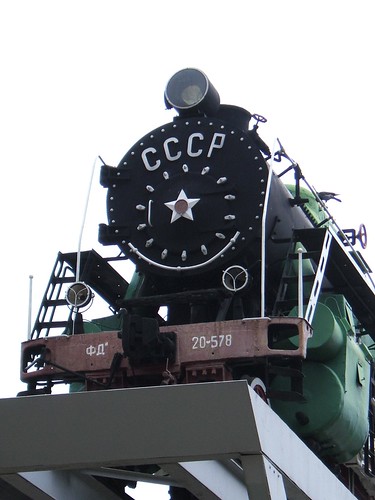
I saw the only surviving 'FDp20', number 578, in Ukraine in 2005 when I went with my friend Mike (now, alas, passed on) on a steam driving holiday which is briefly described here and with a set of pictures (including the two pictures of the 'FDp' in this post) here. The surviving 'FDp20' is displayed on a very elaborate welded steel plinth outside the passenger locomotive repair works near the centre of Kiev in the Ukraine.

Front view of surviving 'FDp20' class. Note that the complete smokebox front is hinged on the left and, once unbolted, can be swung open for re-tubing and access to the tubeplate. There is a smaller door in the smokebox front used for char removal. This door is hinged on the right and secured by 14 'dogs' or clamps which, when tightened, ensure that the smokebox door is airtight.

For technical specifications, refer to Reference 1.

References:

Reference 1: 'Soviet Locomotive Types - The Union Legacy' by A J Heywood & I D C Button (Frank Stenvalls Forlag) ISBN 0-9525202-0-6.

Friday, 17 August 2012

Loco-profile 2: Russian 'YeA' Class

Having been brought up with a multitude of steam locomotive designs in England, it was a surprise when I discovered how few different designs the Soviet Union produced. But those few designs were produced in massive numbers. Because designs were used over a long period, sub-classes did arise as technical improvements were introduced but, in general, having adopted a configuration, they would stick with it.

I was even more surprised to discover that thousands of steam locomotives were, in fact imported into Russia. Having grown up during the Cold War, I found it very odd to learn that America and Canada supplied freight locomotives to Russia. During the First World War, the motive power situation in Russia became critical and Baldwin, Alco and the Canadian Locomotive Company supplied a 2-10-0 for heavy freight. Then, during WWII, Alco and Baldwin supplied over 2,000 locomotives of a very similar design via the USA Transportation Corps as part of Lend-Lease.

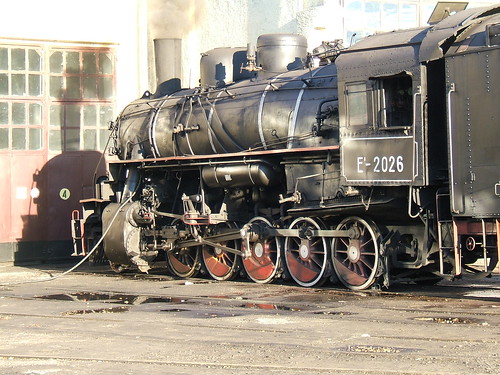
This class became known (in Romanised form) as the 'YeA', where the 'A' stands for 'Amerikanski'. The WWII locomotives had a number of changes compared with the original locomotives including an improved chassis design and changes to the cab, chimney and steam dome. In addition, the railings around the foot-framing, so characteristic of many Russian locomotives, were omitted. There were at least two sub-classes: 'YeM' ('M' for 'Modernised' with an improved piston design) and 'YeMV' with a feed water heater. For technical specifications, refer to Reference 1.

I saw my first 'YeA', number 2027, in Ukraine in 2005 when I went with my friend Mike on a steam driving holiday which is briefly described here and with a set of pictures (including the 'YeA') here. The plan was that we should drive the 'YeA' and the shed staff at Kolomiya had carried out an urgent re-tubing to bring the locomotive back into service. Sadly, following this work, the shed staff couldn't cure a leaking tube problem in time and I only saw the engine in light steam. The shed staff were almost in tears at their inability to complete the work in time.

YeA-2026 in light steam at Kolomiya in 2005.

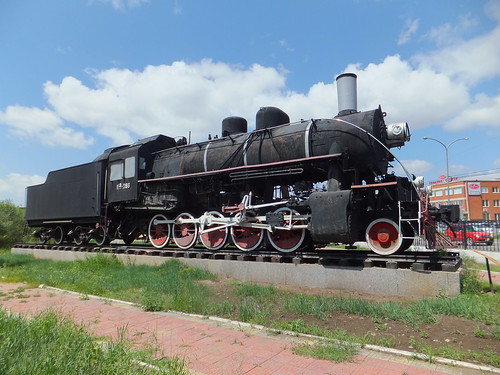
It was to be 2012 and my Trans-Siberian trip before I found another 'YeA', this time 'plinthed' in Ulaan Baatar Train Museum in Mongolia. My pictures of this Museum and its 'YeA' are here.

This Russian 'YeA' Class 2-10-0 in the Ulaan Baatar Train Museum is marked 'YeL-256', perhaps its Mongolian Railway designation.

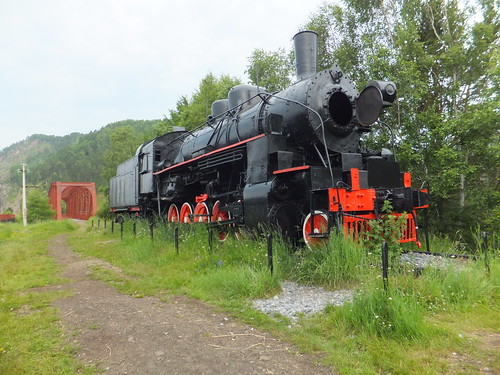
Later in that trip, I found another 'YeA' (without a running number) at Polovina on Lake Baikal. There's a small collection of photographs here.

'Alco' built 'YeA' Class 2-10-0 preserved at Polyvina on Lake Baikal. No running number is carried.

Finally, in the Rolling Stock Museum at Novosibirsk, I found 'YeA' number 3078. Pictures of this locomotive are included in the set here.

'YeA' Class 2-10-0 No. 3078, built by Baldwin in 1944, on display in the Rolling Stock Museum at Novosibirsk.

References:

Reference 1: 'Soviet Locomotive Types - The Union Legacy' by A J Heywood & I D C Button (Frank Stenvalls Forlag) ISBN 0-9525202-0-6.

Friday, 1 January 2010

Loco-profile 1: "Lion"

'Lion' when on display at the Museum of Science & Industry in Manchester

The first locomotive I drove was the 1838 "Lion", star of the Ealing Film 'The Titfield Thunderbolt'. I sometimes say that every other engine since has been a bit of an anticlimax, but that's an exaggeration.

The last steaming of "Lion" was at Birmingham Railway Museum, Tyseley in 1988. She was stored there for some time before moving to Dinting for a while in anticipation of bringing her back to steam. Unfortunately, Liverpool Museums decided that "Lion" will not steam again and she was moved to Dorothea Restorations at Whaley Bridge for cosmetic restoration. I was able to 'drive' "Lion" one last time on a 'rolling road' at Dorothea using air, not steam. At that time, there was no suitable space to display "Lion" in Liverpool so she spent some years on display in the Museum of Science and Industry in Manchester. "Lion" is now stored in Liverpool, in anticipation of static display in the remarkable new museum being completed in Liverpool.

I've written a few posts about "Lion", her history and her supporters club (The Old Locomotive Committee or simply 'OLCO'). To see all these posts, Click here.