skip to main |
skip to sidebar
I'm normally alert to any railways I may encounter in my travels but the significance of the location for a business meeting at Felin Fawr near Bethesda on Tuesday 22nd August 2023 (described in the post here) had failed to register until my friend said "There's an abandoned railway out the back!". After the meeting here wasn't much time to explore, but I made sure of a few pictures to prompt further study later. This post reports what I found.
I knew that the meeting location was near Penrhyn Quarry, which was once the largest slate quarry in the world. But I didn't know that Felin Fawr was the processing site for slate and the building which had hosted my meeting was formerly a Slab Mill producing sawn slate for building purposes. There are useful Wikipedia articles on the slate industry in Wales, the quarry and Felin Fawr Slate Works.

Railway sidings at Felin Fawr in 2023. The meeting was located in the building on the left.
Slate from Penrhyn was used locally from the 16th century but development of the industry in the 1770s was due to Richard Pennant (see 'Notes on the Pennant family' below). Initially, slate was carried in panniers by horse down the mountain to the docks at Port Penrhyn for onward shipment.
Around 1800 the Penrhyn Railroad was constructed, using oval rails fitted at 2 foot and half an inch centre-to-centre, apparently incorporating the somewhat earlier Llandegai Tramway. Haulage was by horses and the most difficult sections were provided with inclined planes operated as a gravity balance cable railway with two tracks. A cable attached to an ascending empty wagon wound around a drum at the top of the incline and attached to a loaded wagon descending means no external power was required. Control was provided by braking on the drum.
In 1878 the operation was transferred to a new, parallel railway using steam locomotive haulage throughout. The inclined planes were eliminated by deviations in the route, increasing route length but easing the grades. Trackwork was conventional and track gauge (measured in the normal way, between inner edges of rails) became 1 foot 10 3/4 inches. In this form, as the Penrhyn Quarry Railway, the system operated until 1962. In 2012, enthusiasts reinstated the trackwork around Felin Fawr which I'd found on my visit. Various galas and operating days were held between 2012 and 2017 when, sadly, the initiative ceased.
Wikipedia has notes on the railways and various cable railways There's an excellent, detailed history of the Penrhyn Quarry Railway in posts by Roger Farnworth here and here.
I also found three interesting articles and photographs by Graham Stephen about the Felin Fawr site. The first clarifies the layout of the Slate Mill. The second shows what remained around 2012 of a waterwheel which powered the mill. The third shows the locomotive shed during the sadly short-lived attempt to restore the railway as a preserved line. The waterwheel was of the suspended pattern, built by De Winton of Caernarfon (who also supplied some of the early steam locomotives for the Penrhyn Quarry Railway). An article by Steve Mills for the Gloucestershire Society for Industrial Archaeology here outlines the advantages of suspension water wheels and rim gearing.

Former Penrhyn Quarry Railway 'Blanche' restored (and heavily modified) at Festiniog Railway (Photo: A.M.Hurrell, CC BY-SA 3.0)
Notes on the Pennant family
Thomas Pennant (died 1522) was the Abbot of Basingwerk Abbey, Holywell. His grandson Gifford Pennant became a successful sugar planter in Jamaica. On his death the profitable sugar plantations, worked by slave labour, passed to Gifford's son Edward Pennant (1672-1736) who further developed the holdings whilst rising in the Jamaican establishment. On Edward's death, the estates passed to his sons John, Samuel and Henry (with care provision for a fourth son). Despite the family wealth, life in Jamaica could be challenging and the three brothers returned to England, leaving the plantations to be administered by agents and entered English society. John Pennant became a successful Liverpool merchant. Liverpool was, of course, the port of entry for Jamaican sugar. Samuel and Henry died without heirs, leaving their estates to John. Through a partnership in the salt trade with Colonel Warburton John became interested in the medieval estate of Penrhyn which was part owned by Colonel Warburton's wife. John, with his second son Richard Pennant (1739-1808), started buying up the remainder of the Penrhyn estate. Richard Pennant's political career started in 1761 when he became the Member of Parliament for Petersfield but, when a vacancy arose in Liverpool in 1767 he was returned unopposed. He married Colonel Warburton's daughter Anne Susanna in 1767.
Upon the death of John Pennant in 1781, the Penrhyn estate effectively became reunited, Richard inheriting part from his father and the balance through his wife. He also became absentee owner of the sugar plantations in Jamaica. In the election of 1780 he lost his seat in the House of Commons and was subsequently created !st Baron Penrhyn in 1783. Because this new creation was an Irish peerage, he was not allowed to sit in the House of Lords but able to stand for the House of Commons, allowing him to regain the Liverpool seat in 1784. Richard spoke in the House of Commons about trade and Liverpool concerns and remained opposed to the abolition of slavery. He was an enthusiastic supporter of projects to develop his Welsh estates and created the massive Penrhyn quarry. Previously, individuals would pay the landowner for the right to extract slate which was brought out by packhorses. Richard created an industry where the landowner took control of extraction and transport, paying employees a wage. He expanded the market for slate by building Port Penrhyn, Bangor, connected to the quarry by horse-drawn railroad.
On Richard's death in 1808, since he had no children, his Baronetcy lapsed and the ownership of the estates passed to his second cousin provided he added 'Pennant' to his name, becoming George Hay Dawkins-Pennant (1764-1840). George married for the first time in 1807 and had two daughters. He continued to develop the Penrhyn estate and received government compensation for the freeing of his slaves when slavery was abolished. In 1833, his elder daughter and co-heiress Juliana Isabella Mary Dawkins-Pennant married a Grenadier Guards officer, Edward Gordon Douglas (1800-1886).
By Royal licence, Edward Gordon Douglas changed his name to Edward Douglas-Pennant, allowing him to inherit the Penrhyn estate from his wife's father, George. In 1866 Edward Douglas-Pennant was raised to the peerage in a second creation of the title Baron Penrhyn, this time as an 'English' peerage. Developments at Penrhyn quarry and the Penrhyn estates continued. By his first wife, Juliana Isabella Mary Dawkins-Pennant, he had two sons and three daughters. During the 1868 general election, 80 quarry workers declined to vote for the Baron's son George who, at that time, was pursuing a political career and were sacked. After the death of his first wife, the 1st Baron re-married and had further children
The 1st Baron died in 1886 and his elder son George Douglas-Pennant (1836-1907) became the 2nd Baron, thereafter concentrating on the running of the various businesses. Penrhyn quarry workers went on strike in 1896, leading to closure of the quarry for 11 months. The 2nd Baron was unrelenting and the strikers resumed work on the same terms. A second strike in 1900 lasted for three years, earning 'The Great Strike of Penrhyn' a special place in the history of the Trades Union Congress. The 2nd Baron was clearly a complex man of strong convictions, hinted at in the biography in the Dictionary of National Biography. After reading about the turbulence of the nineteenth century, I decided not to pursue the Pennant history into the 20th century.
Notes on Penrhyn Castle
Penrhyn Castle was clearly important to the Pennant family and although externally the castle gives the appearance of being ancient, it is not. Between 1822 and 1837, the architect Thomas Hopper (1776-1856) created the imposing appearance. The castle is regarded as his finest work and listed Grade 1. As a National Trust site, it is open to the public and the former Stables houses a railway museum including Penrhyn Quarry Railway artefacts. There's an article about the railway museum on Wikipedia here and there's an entertaining record of the railway museum activities written by one of the former museum volunteers, Keith Jaggers, here. There's lots more about the Jagger's family history and Keith's interest in railways here. Over 2,000 documents from Penrhyn Castle have been archived at Bangor University, providing a valuable insight into transatlantic slave trade and plantation slavery. Dr. Marian Gwyn has researched these areas and there's an interesting article by her outlining the connection between Penrhyn Castle and slavery here.
List of referenced posts on other websites
Slate Industry in Wales (Wikipedia).
Penrhyn Quarry (Wikipedia).
Felin Fawr Slate Works (Wikipedia).
Penrhyn Quarry Railway (Wikipedia).
Cable railway (Wikipedia).
Penrhyn Quarry Roger Farnworth: Penrhyn Quarry Railway (Part 1).
Penrhyn Quarry Roger Farnworth: Penrhyn Quarry Railway (Part 2).
Suspension water wheels and rim gearing
FELIN FAWR WORKS Graham Stephen (GeoTopoi).
FELIN FAWR WATERWHEEL Graham Stephen (GeoTopoi).
FELIN FAWR LOCOMOTIVE SHED Graham Stephen (GeoTopoi).
Richard Pennant, 1st Baron Penrhyn (Wikipedia).
George Hay Dawkins-Pennant (Wikipedia).
Edward Douglas-Pennant, 1st Baron Penrhyn (Wikipedia).
George Douglas-Pennant, 2nd Baron Penrhyn (Wikipedia).
The great Penrhyn quarry strike (TUC).
Dictionary of National Biography, 1912 supplement.
Penrhyn Castle (Wikipedia).
Thomas Hopper (architect of Penrhyn Castle) (Wikipedia).
Penrhyn Castle Railway Museum (Wikipedia).
Penrhyn Castle Railway Museum: Vol 2 (Keith Jaggers).
Keith and Elizabeth Jaggers Family Heritage.
Penrhyn Castle and Slavery (Dr. Marian Gwyn).
My pictures
My pictures at Felin Fawr Cyf (showing the reconstructed trackwork) are here.
When I was young, I found out about the private underground railway operated by the Post Office (as we then called it) to transfer mail between major sorting offices in London. I was fascinated by pictures of rather primitive-looking driverless narrow gauge electric trains.
Brief History
By 1911, worsening congestion on London's roads gave rise to the plan for an underground railway extending around 6.5 miles linking sorting offices at Paddington, Western District, West Central, Mount Pleasant (Clerkenwell), King Edward Building, Liverpool Street/Broad Street stations and Eastern District. A contract to build the railway was given to John Mowlem in 1915 but the shortage of materials and manpower caused suspension of the work in 1915 and the line was not completed until February 1927.
The line was 2-foot gauge, double-track, with reversing loops at both ends of the system and also at principal intermediate stations. In between stations, the two tracks were carried in a 9-foot diameter tunnel with sectional cast-iron lining at a depth of around 70 feet. At station approaches, 7-foot diameter single-line tunnels led to two parallel 25-foot diameter station tunnels at a shallower depth linked by cross-passages with lift access from the sorting office above. At either end of stations, gradients of 1 in 20 decelerated arriving trains and accelerated departing trains (this technique is also used on some of London Underground's lines). In general, each station tunnel accommodated a through line, a platform line and the platform itself, back-to-back with the other platform.
The very long platforms at Mount Pleasant were divided into three by two sets of scissors crossovers, allowing three trains in either direction to be simultaneously dealt with, independently arriving and departing using the through line.
The driverless trains were electric, powered from a central third rail at 440 volts d.c., reduced to 150 volts d.c. in stations (where the line speed limit of 40 m.p.h. was reduced to 7 m.p.h.).
At the west end of Mount Pleasant station, a double-track branch diverged and, climbing through a tunnel and turning through 180 degrees, terminated in the depot and workshop in a large basement area. For safety reasons, there was no third rail within the depot and trains were driven manually from a 'pulpit' via an overhead power system at 150 volts d.c.
In 1987, to celebrate 60 years operation, the railway was re-branded as 'Mail Rail' and the rolling stock was painted red but in 2003, the line was closed and 'mothballed'.
Rolling stock
The original electric rolling stock was 4-wheel long-wheelbase, resulting in excessive rail and flange wear. Between 1930 and 1936 an articulated design by 'Greenbat' (Greenwood and Batley) replaced the original rolling stock. The new locomotives were 4-wheel short wheelbase, with one axle driven and two small carrying wheels. A train comprised two of these locomotives joined back-to back by a chassis without wheels which carried the mail located on a pivot pin and load bearing plate on each locomotive.
An order for 34 replacement units with the same articulated layout was placed with 'Greenbat' in 1980 but, following that firm entering administration, the order was completed by Hunslet.
When the line was 'mothballed', the rolling stock comprised a mixture of 1930 and 1980 stock, with some later modifications.
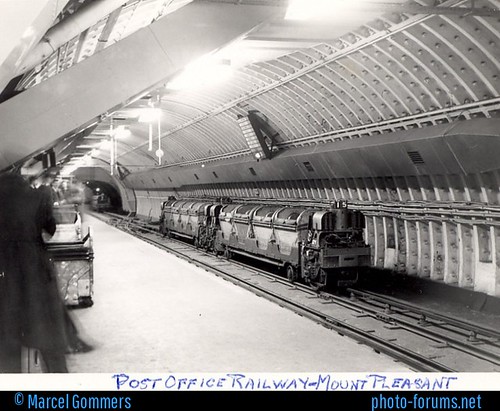
Post Office Railway, Mount Pleasant showing 1930 rolling stock (Photo copyright: Marcel Gommers, via photo-forums.net).
Unofficial visitors
From time-to-time, the closed railway attracted the attentions of unofficial visitors or 'urban explorers' and there are various internet reports on these incursions, for instance, see Urban Ghosts or Beyond the Boundary.
A New Beginning
In 2013 the British Postal Museum announced plans to re-open part of the network as a tourist line and in September 2017 the Postal Museum opened in Phoenix Place with an optional out-and back ride on a section of Mail Rail.
Events of Thursday 30th November 2017
The Postal Museum
On 30th November 2017, I visited the Postal Museum and took the ride on Mail Rail. The main museum was busy, with plenty of adults and children enjoying the interactive exhibits outlining the history of the postal service, telegraphy and the public telephone service. There was a cafe, toilets and the inevitable souvenir shop. It was all well done and the staff were friendly and attentive so I enjoyed my brief visit although personally I prefer more old-fashioned interpretation.
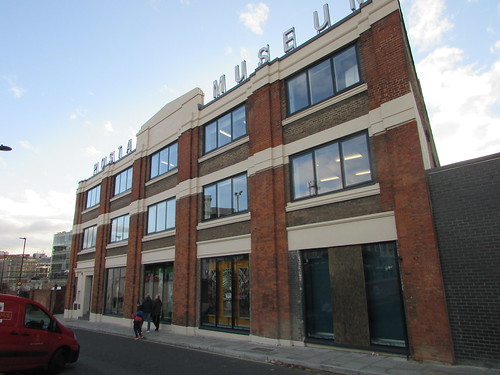
The Postal Museum, Phoenix Place, London:
The Mail Rail Tourist Train
To avoid the possibility of queuing, I'd made a fixed time internet pre-booking to travel on Mail Rail, which has a separate street-level entrance on the opposite side of Phoenix Place leading into another souvenir shop in part of the huge Mount Pleasant Sorting Office.
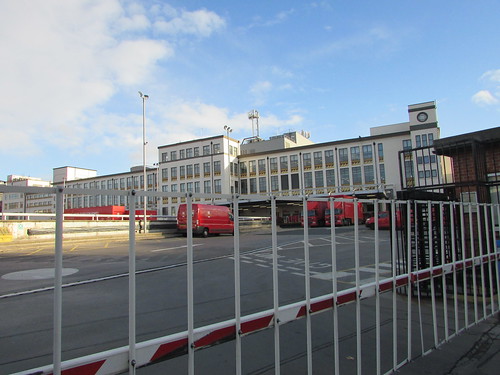
Mount Pleasant Sorting Office, London:
The new tourist railway starts and finishes in the former depot underneath Mount Pleasant Sorting Office, reached by either stairs or a lift from the souvenir shop at street level.
Most of the original trackwork in the depot area has been removed, leaving a waiting area and museum space but many of the original fittings like overhead crane rails and the depot power system have been retained. A new train boarding/alighting platform has been built at the head of the double-track branch which leads to the main railway.
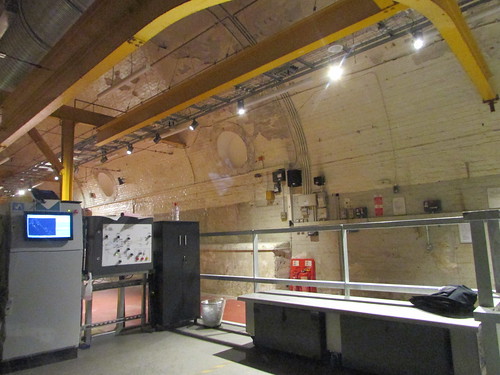
Postal Museum, Mail Rail: View from train boarding/alighting platform, showing control panels on the left and the brick-vaulted construction of the sub-surface former depot area.
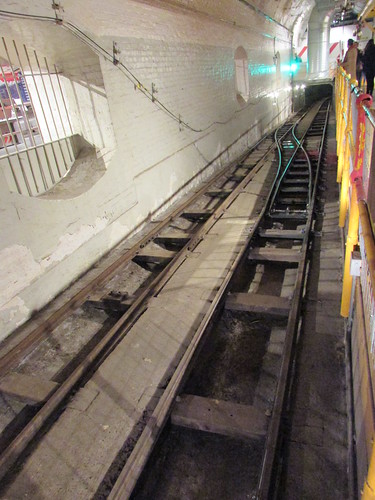
Postal Museum, London: View of double-track branch leaving the train boarding/alighting platform which leads to the main railway.
Two new battery-powered trains have been provided. At the time of my visit, only one was in use. There is a driving cab at each end. Passengers enter individual compartments through side doors and are enclosed by curved, transparent plastic hinging roof sections, creating an effect rather like being in a aircraft cockpit. We boarded the train and staff closed the doors and roofs. After a warning over the public address from the driver not to lean against the doors and roofs (which have interlocks to stop the train), we set off, descending the branch leading to the main line.
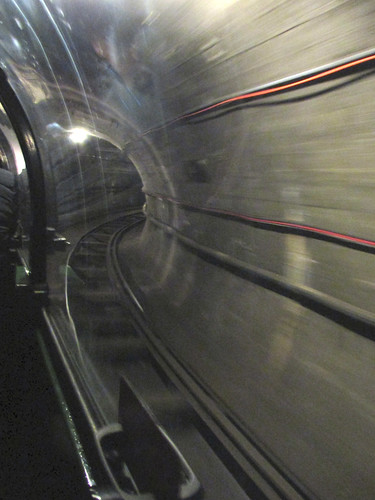
Postal Museum, London: View from the Mail Rail tourist train as it descends from the depot area to join the Eastbound main line.
We stopped in the Eastbound platform at Mount Pleasant and watched an audio visual presentation about the history of the line from the train. As the journey proceeded, we paused a couple more times for another audio visual presentation and a pre-recorded announcement about the layout of the line.
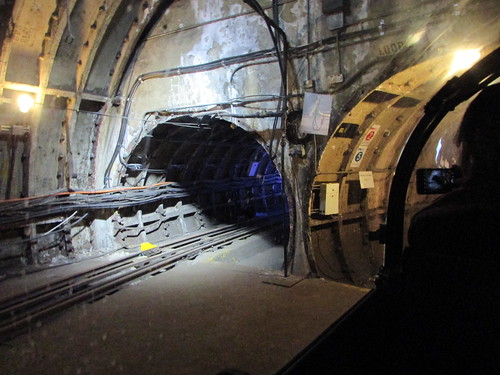
Postal Museum, London: View from Mail Rail tourist train leaving Mount Pleasant.
The train took the reversing loop at the east end of Mount Pleasant station, offereing a brief view of the low level 'graveyard' sidings where old rolling stock is still stored, rejoining the main line now travelling westbound. Having passed through the long, unused westbound platform, we diverged onto the depot branch and finished our journey at the train boarding/alighting platform we'd left about twenty minutes earlier.
The Mail Rail Museum
The remaining exhibits in the depot area illustrated the history of the Post office Railway and the Travelling Post Office service.
The idea of transferring post short distances by rail had been tried as early as 1863 and the Postal Museum has one of the original 4-wheeled vehicles on display. This pneumatic system operated between Euston Station and Eversholt Street 1863-1866 and again in 1873-1874. The vehicles were propelled through a shallow-buried tube by air pressure from a steam-driven fan.
When the Post Office Railway opened in 1927, it had a manually-driven battery electric locomotive for maintenance use. This is on display.
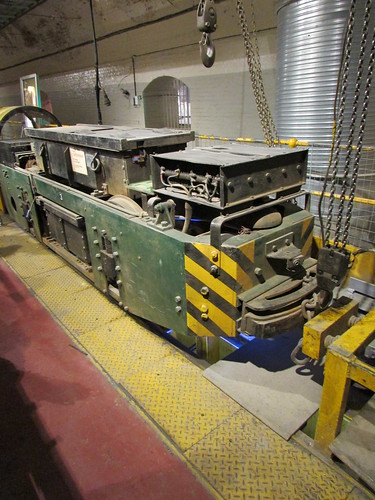
Postal Museum, London: 1927 battery-electric locomotive.
The picture below shows the iconic 1930 articulated train, comprising locomotives joined back-to back by a chassis without wheels which carried the mail.
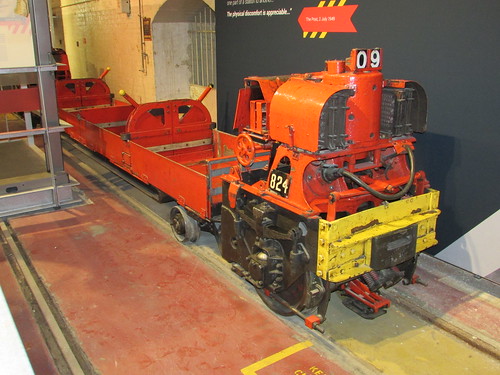
Postal Museum, London: 1930 articulated train.
At the rear of each locomotive, the chassis for mail was attached to a pivot pin with a load bearing plate.
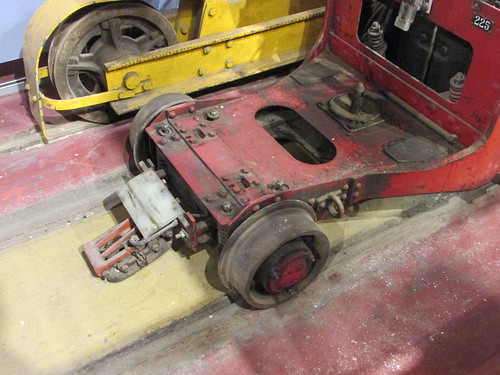
Postal Museum, London: 1930 locomotive, showing method of attaching the chassis carrying mail. Note the electric pick-up 'shoe'.

Postal Museum, London: The original appearance of the 1980 locomotives. Various modifications were applied to some units.
An impressive miniature slide signalling frame which controlled the elaborate layout at Mount Pleasant is on display.
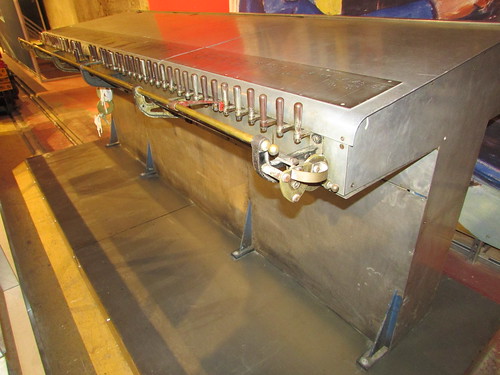
Postal Museum, London: The impressive 55-miniature slide signalling frame which controlled Mount Pleasant.
There was also a mock-up of a section of a Travelling Post Office sorting van (complete with moving floor) with the opportunity to try your hand at sorting on the move and a display of mail exchange apparatus.
Even if you're not a dyed-in-the-wool railway enthusiast, there was plenty of interest at the Postal Museum.
Track diagram
There a track diagram showing the line at the time it was mothballed in 2003 in the 'Quail Track Diagrams':-
'Railway Track Diagrams Book 5: Southern and TfL' Third Edition, published by TRACKmaps (ISBN 978-0-9549866-4-3).
Related posts on other websites
Although the links worked at the time this post was published, changes made by that website's owner may 'break' the link.
The Postal Museum.
London Post Office Railway.
My photograph albums
Where necessary, clicking on an image above will display an 'uncropped' view or, alternately, pictures may be selected, viewed or downloaded, in various sizes, from the albums listed:-
Postal Museum, London.
Events of Saturday, 14th October 2017
Various trips were offered to the guests on Saturday and Doctor Hla Tun had suggested that I take the all-day trip to Mount Popa, home of the 37 Nats (spirits).
I had first visited Mount Popa in 2009, described here. Impressed, I returned in 2011, this time staying at Mount Popa Resort. That visit is described in two posts here and here. Then, in 2015, during a visit to schools in Bagan area, we went to Mount Popa village for lunch and views of Taung Kalat, as described here.
We set off in a small coach, travelling first to Nyaung Oo and then taking the main road towards Mount Popa. After about half an hour, we stopped at the same toddy palm plantation I'd first visited in 2009, but it was clear that they'd scaled-up the tourist facilities since that visit. A good-tempered ox was still demonstrating how peanuts are ground in an oversize pestle and mortar to extract the oil, leaving behind a biscuit-like solid. This is a treat for the ox, apparently, and I was handed a piece to give to the animal which very gently took it from my fingers with obvious relish.
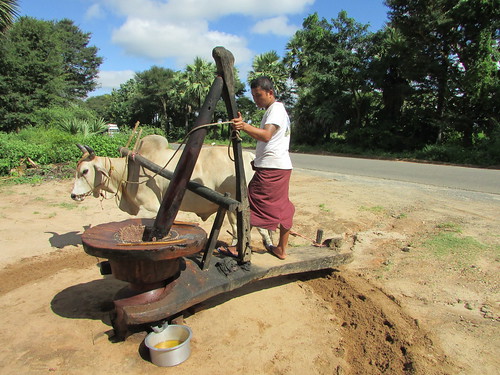 Trip to Mount Popa: Grinding peanuts for oil.
The oil is processed by heating in a large shallow pan (like a wok) whilst continuously stirring. Heat is provided by a simple brick oven fired by bamboo waste and ending in a brick chimney. The oven accommodates a number of pans which are progressively moved towards the chimney as evaporation takes place. Finally, the pan nearest the chimney holds a paste which is carried to a nearby low table to be formed, by hand, into a variety of sweetmeats. Once the pans are moved up, another pan of unprocessed oil can be placed on the oven.
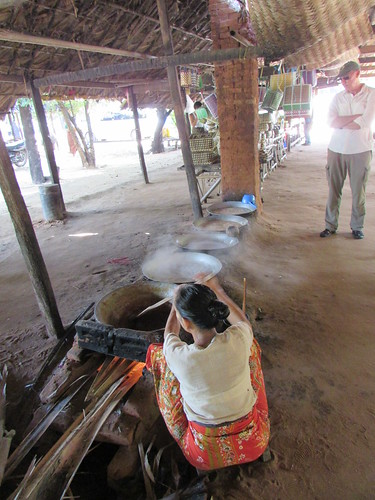
Trip to Mount Popa: Evaporating peanut oil.
Next, a man demonstrated how the toddy palms are climbed once or twice a day, using a simple bamboo ladder lashed to the trunk. A large knife is used to score the tree so that the sap runs into a series of small earthenware pots attached to the tree. On the next visit, the pots containing sap are collected and replaced with empty pots.
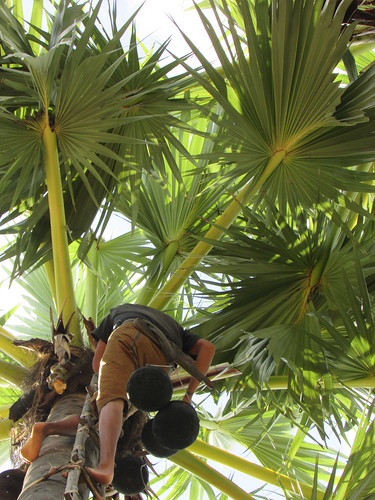
Trip to Mount Popa: Sap collection by exchanging earthenware pots at the top of a toddy palm.
The toddy sap is also taken to the large bamboo shelter where simple stills are used to produce a popular alcoholic drink. The sap is processed by heating in a modified earthenware pot mounted on a simple brick oven fired by bamboo waste and ending in a brick chimney. The oven typically accommodates three pots.
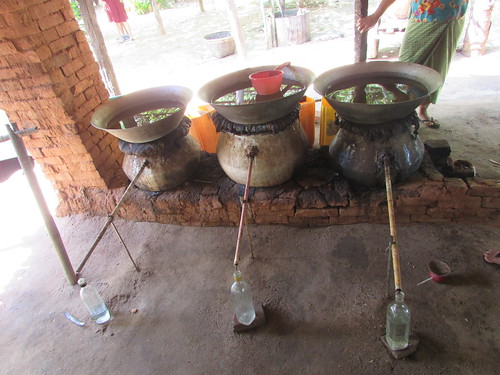
Trip to Mount Popa: Toddy Still.
Each pot is modified by being fitted internally with a metal scoop connected to a long, inclined delivery tube passing through a hole in the side of the pot which is then sealed. The top of the pot is provided with a flexible ring so that, when a large pan of cool water is placed on top of the ring, vapour does not escape.
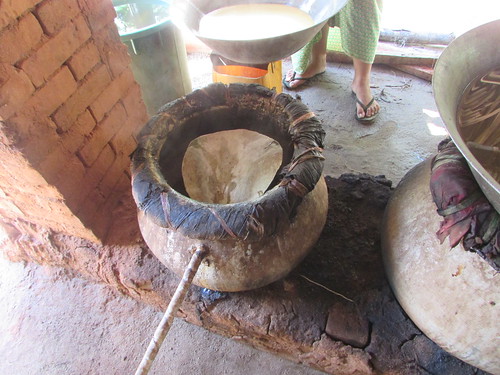
Trip to Mount Popa: Construction of toddy still.
In use, the sap is evaporated by heating but when the vapour strikes the cool underside of the large pan of cool water, the alcohol condenses, droplets fall into the metal scoop and are led away by the inclined tube to a waiting bottle.
All this sweet making and distilling activity requires an army of women fetching and carrying, stirring, firing the ovens, all the time watched by tourists. While we were there, a large coach arrived with a party of tourists from the Australian APT Company, each wearing professional badges showing their first name.
After a fascinating visit, we carried on to Mount Popa, passing through a remote country area where, as I've noted before, many poor and elderly people choose to beg for alms apparently as a way of life, relying upon the Burmese tradition of charitable giving. We parked near the centre of the always-busy town of Mount Popa and walked to the Temple of the Nats, which was oddly quiet when we entered but quickly filled with pilgrims and tourists.
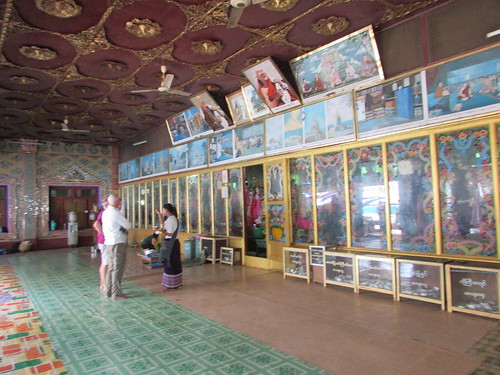
Trip to Mount Popa: The Temple of the Nats.
Images of the 37 Nats are displayed along one long wall of the temple, separated from the main area by a glazed partition which was open for visitors, allowing pilgrims to make donations of money or fresh fruit.
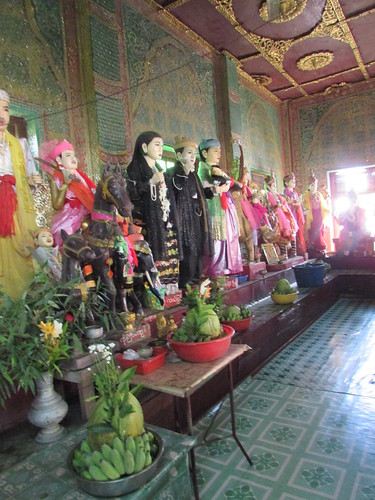
Trip to Mount Popa: Images of the 37 Nats.
The entrance to Taung Kalat, the remarkable series of shrines 777 steps up an improbable-looking rock outcrop populated by hordes of mischievous monkeys was nearby. Having been to the top at least twice, I excused myself as the rest of our party ascended to the summit, instead confining myself to exploring the lower levels occupied by numerous small traders, accompanied by our guide Pyae Pyae. When the party was together again, our coach took the road acending Mount Popa leading to Mount Popa Resort. Pyae Pyae and I started a leisurely lunch on the open air dining deck which offered stunning views of Taung Kalat.
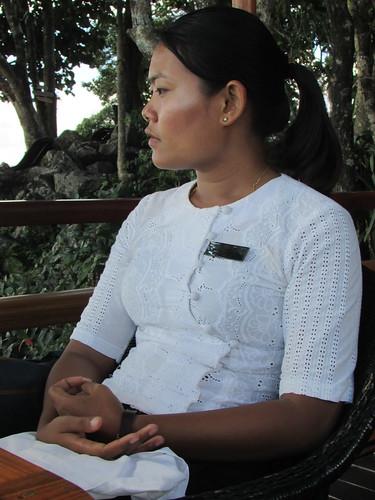
Trip to Mount Popa: Our guide, Pyae Pyae, displaying the natural grace of Myanmar people.
The rest of our party elected to swim in the resort's infinity pool before taking lunch.
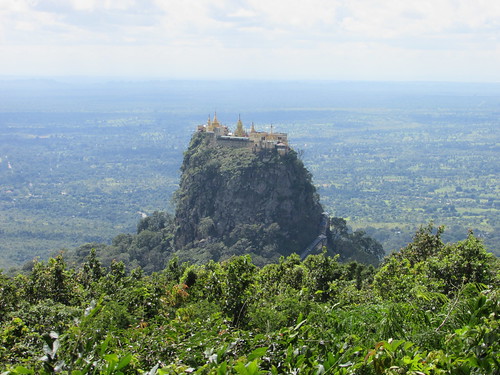
Trip to Mount Popa: Taung Kalat, viewed from Mount Popa Resort.
After lunch, we climbed back into our coach for the return journey. Brian and Shannon had already left 'Road to Mandalay' and were continuing their exploration of Bagan using the Royal Bagan Hotel in Nyaung Oo as their base. So, we dropped them at their hotel before saying "good bye" and returning to Bagan.
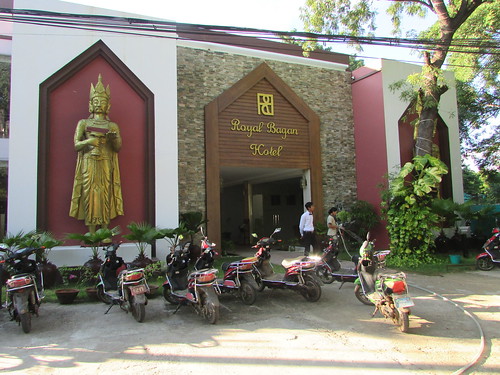
Trip to Mount Popa: Royal Bagan Hotel, Nyaung Oo. Note the waiting 'e-bikes'.
I walked to the Bagan Clinic and, of course, Doctor Hla Tun was still busy with consultations. I was surprised that the open area between a number of the clinic buildings had been provided during the day with a roof of woven plastic netting which I'm sure was appreciated by waiting patients.
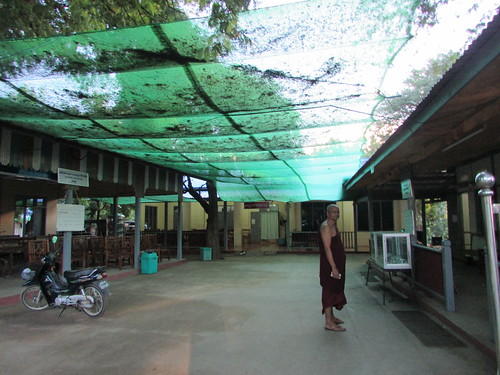
Bagan Medical Clinic Saturday: The Monk beneath the just-installed green netting.
Before I returned to the comfort of 'Road to Mandalay', there was one more experience for me. For some years, I had admired the Irrawaddy Paddle Steamer laid-up at the river bank just below the Clinic and wondered how much of the original machinery survived. Well, Doctor Hla Tun told me that the monk from the Clinic had arranged a visit for me so, armed with my camera, the monk and I descended to the mooring before the light was completely lost. Boarding required negotiation of the long, rather narrow, unsupported gangplank above the brown waters of the Irrawaddy, which task I completed safely but not without some trepidation. Once aboard and seeing that the triple-expansion steam engine and all the associated equipment was intact (if dusty and cobweb bestrewn), I immediately started scurrying up and down companionways with the energy (and lack of grace) of the mountain buffaloes I'd seen in Kachin State lest they should attempt to dissuade me, collecting as many pictures as possible for later study. In due course, there will no doubt be a more technical post on this 1948 Yarrow-built survivor.
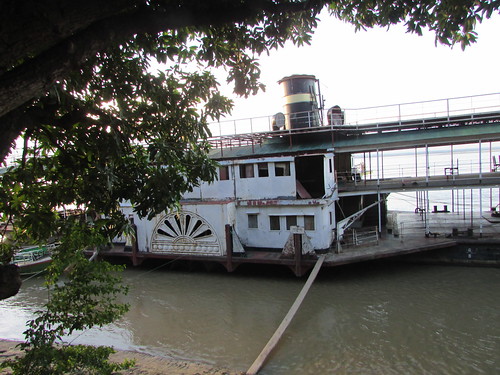
Paddle Steamer 'Minthamee', Bagan 2017: Boarding the Paddle Steamer required negotiation of the long, rather narrow, unsupported gangplank.
Related posts on this website
This is one of a series of posts describing my 12th visit to Myanmar. The post Starting out is the first post in the series.
Clicking on the 'Next report' link displays the post describing the next events. In this way, you may read about the trip in sequence.
Next report.
Alternately, clicking on the 'All my Burma-2017(2) reports' link displays all the posts on this trip in reverse date-of-posting order.
All my Burma-2017(2) reports.
My photograph albums
Where necessary, clicking on an image above will display an 'uncropped' view or, alternately, pictures may be selected, viewed or downloaded, in various sizes, from the albums listed:-
'Road to Mandalay': October 2017.
Trip to Mount Popa.
Paddle Steamer 'Minthamee', Bagan..
In the post Return to Merseyside (Part 3), I described my first, brief exploration around the modern Brunswick Station.
On Saturday, 4th February 2017, I returned to Brunswick Station intending to walk from there along the Riverside Walk to Pierhead.
I had an uneventful journey from Wolverhampton using the London Midland service to Liverpool South Parkway where I changed to a Merseyrail train for the short journey to Brunswick. It had been cold and overcast when I started from home but at Brunwick, there was bright sun and the day remained very pleasant, except for a brief shower in the early afternoon. On my first visit, I'd been able to walk directly from the station to the river by crossing through the Brunswick Business Park but, on Saturday, I was rather surprised to find the Harrison Way gates securely locked. A small sign, which I almost failed to spot, directed me south along Sefton street to reach the Riverside Walk.
This led me past a series of modern, smaller business premises on the left (many car-related) and huge modern warehouses on to my right, the second of which was occupied by TeamSport Go Karting (see their site here).
My detour offered me a view of the unusual entrance to the C.L.C. Dingle tunnel, now used by Merseyrail services to Hunts Cross. The tunnel is approached by a short, deep rock cutting carrying an iron bridge which provides support for the area around Grafton Street.
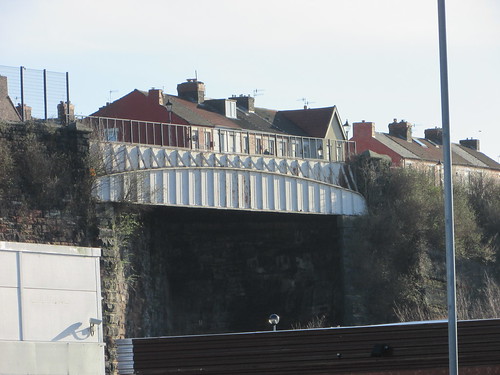
The unusual north portal to Dingle Tunnel on the C.L.C. (now Merseyrail), with the houses on Grafton Street in the background.
Just beyond this tunnel, there is the partially bricked-up entrance to the abandoned Liverpool Overhead tunnel. The sandstone portal remained in excellent condition, with the inscriptions clearly legible - 'L. O. Ry. SOUTHERN EXTENSION | 1896 | ENGINEERS SIR DOUGLAS FOX, J.H. GREATHEAD, S. B. COTTRELL | CHAIRMAN SIR WILLIAM BOWER FORWARD | CONTRACTORS H. M. NOWELL, C. BRADDOCK'.
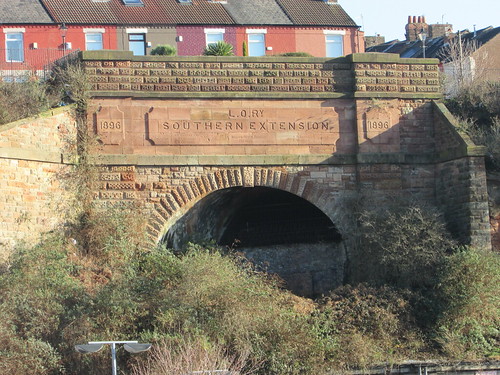
Liverpool area rail: Entrance to abandoned Liverpool Overhead Railway Extension tunnel built 1896.
On my right,I passed the brick-built transit shed which had served the east side of the now-filled-in Harrington Dock. This has been retained and modernised as the South Harrington Building, partly occupied by Royal Mail.
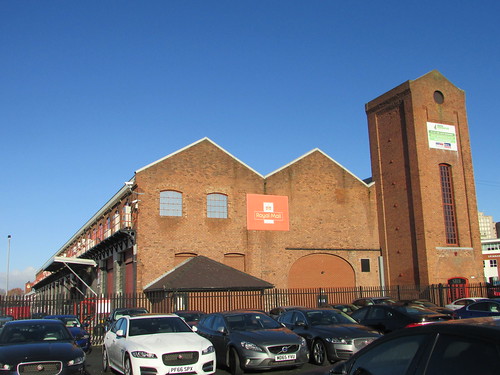
South Harrington Building, showing, on the left, the long elevation which faced the dock.
I turned into the service road and almost missed the small gate giving access to the Riverside Walk next to the filled-in 80-foot wide entrance to Herculaneum Dock. On the other side of the dock entrance I could see Chung Ku Chinese Restaurant. There had been a second 60-foot wide entrance to the south of the restaurant.
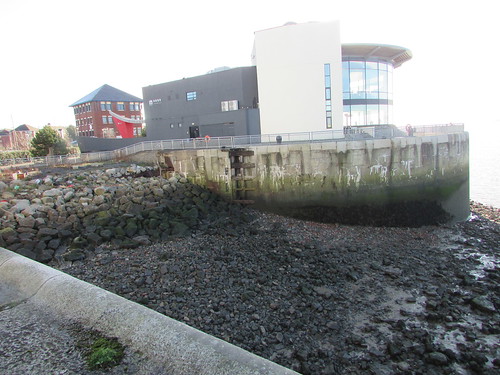
Views around former south docks: Chung Ku Chinese Restaurant and the filled-in entrance to former Herculaneum Dock.
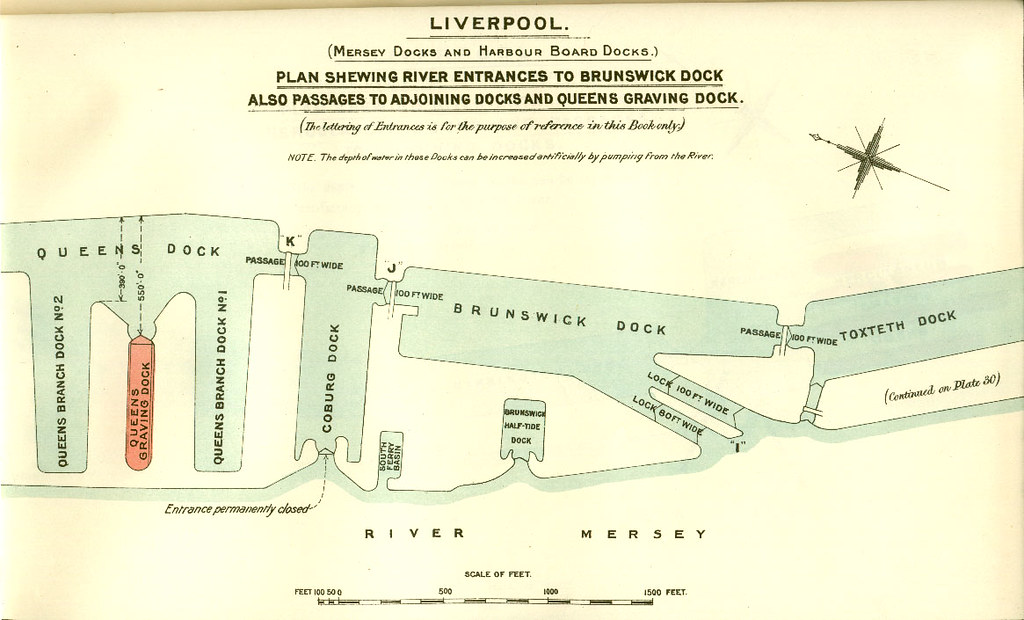
The 1909 plan below shows where I started of my walk, near point 'L' on the plan.
Plan of Toxteth to Herculaneum Docks

Liverpool Docks Admiralty Maps, 1909, Plate 30 (Source: Wikimedia Commons).
Click here for a larger view.
I continued northwards along Riverside Walk, towards Pierhead (heading left on the plan above). There were occasional bicycles, joggers and walkers whose numbers increased as I came nearer to Pierhead. After passing the filled-in Harrington Dock, I had good views of the Tranmere oil handling installations on the Wirral side of the river.
There are two berths for oil tankers. The upstream berth was occupied by the chemical/oil products tanker 'Cenito', owned by LGR di Navigazione Spa and built in China in 2009. The ship's 'vital statistics' are here. The 'SUPER ICE' painted in the hull initially puzzled me - it's because she is classified 'Ice Class 1A Super' which is the highest of the Finnish-Swedish Ice Class ratings, allowing her to operate in difficult ice conditions without icebreaker assistance. Brief research on the internet subsequently showed that her recent ports-of-call included Antwerp and Aruba (in the Caribbean).

'Cenito' berthed at Tranmere.
The other berth at Tranmere was unoccupied (except by a tug), allowing a better view of the loading/unloading facilities.

Loading/unloading berth at Tranmere. The tug 'Switzer Stanlow' (with firefighting equipment) is moored at the berth.
I walked past more modernised transit sheds on my right, flanking the filled-in Toxteth Dock and saw parents with young children going into Yellow Sub, which describes itself as "Liverpool's Premier Play Centre". The only reminder of the lock which once connected Toxteth Dock directly to the river was a capstan, set within modern paving.
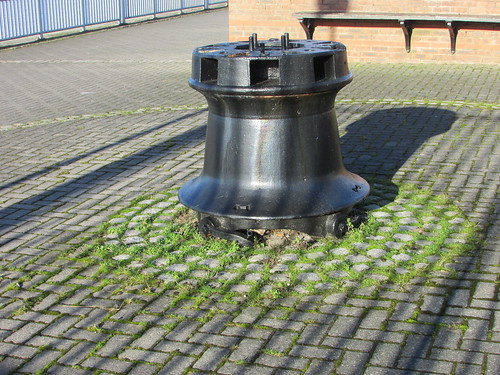
Liverpool - Capstan at former Toxteth Dock.
The 1909 plan below shows the continuation of my walk.
Plan of Queens to Toxteth Docks
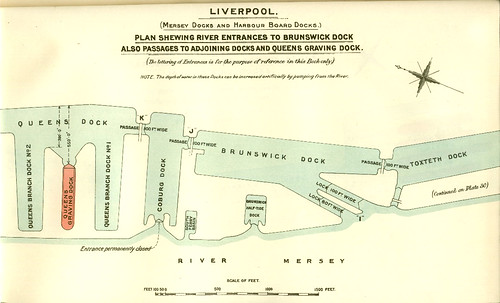
Liverpool Docks Admiralty Maps, 1909, Plate 29 (Source: Wikimedia Commons).
Click here for a larger view.
I then had views of the Cammell Laird shipyard on the Birkenhead side. At a landing stage near the massive shipbuilding hall, two small craft were moored. They were 'Njord Forset' and 'Njord Odin', both 21m multi-purpose crew transfer vessels for the offshore windfarm industry, operated by Njord Offshore Ltd. There is more information on these vessels here.
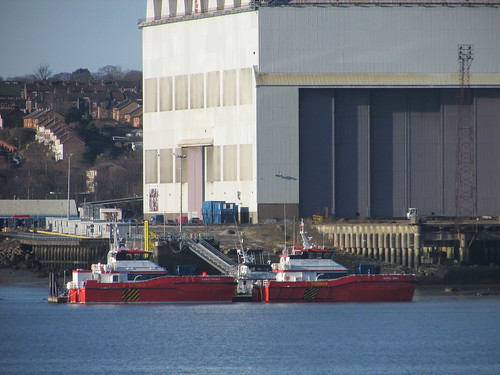
Liverpool: 'Njord Forseti' and 'Njord Odin' moored near the Cammell Laird Shipbuilding Hall.
The locks for Brunswick Dock were the next feature on my walk.
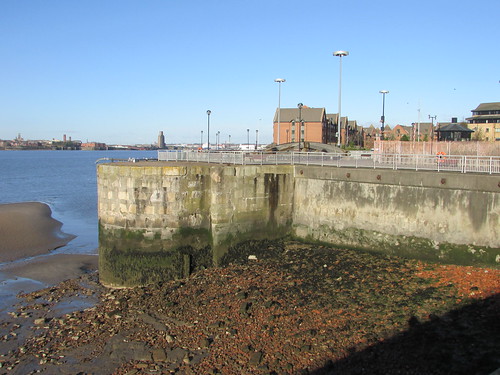
Liverpool: Entrance to Brunswick Dock looking towards housing at Clippers Quay with Birkenhead in the left background.
There were two parallel locks which entered the river diagonally. The larger lock to my right was 100 feet wide but has been filled-in. The second lock, originally 80 feet wide, has been retained and modernised allowing Brunswick Dock and the adjacent Coburg Dock to be used as marinas for pleasure craft.
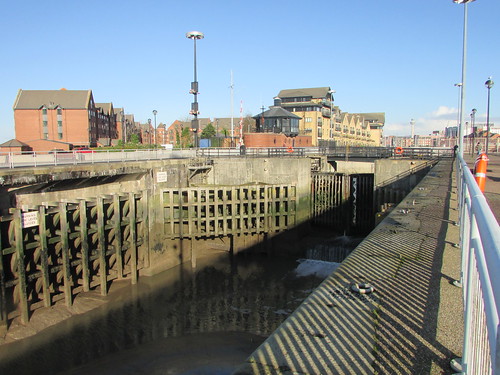
Liverpool: The 80-foot lock chamber at Brunswick Dock, adapted to provide a smaller, working lock for modern pleasure craft.
Whilst most Docks were connected to the river via locks with two sets of lock gates allowing vessels to enter and leave at any state of the tide, the small Brunswick Half-Tide Dock (as hinted by the name) had only one set of wooden lock gates, still in place but not in use.
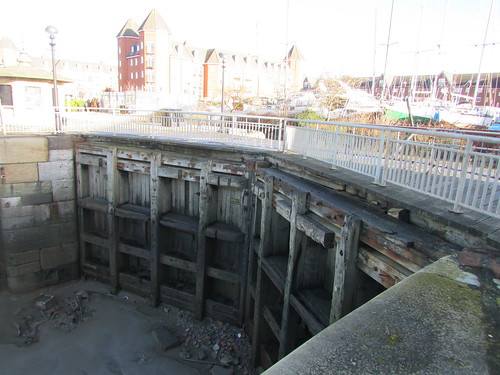
Liverpool: Wooden Lock Gates at Brunswick Half Tide Dock.
The dock itself has been filled and surfaced and now serves as an out-of-the-water storage area for pleasure craft. The remaining walls facing the river, the two Lock-Keeper's Offices and the windlasses to work the gates and sluices give an impression of the meticulous attention to detail of Jesse Hartley, who was the Dock Engineer from 1824 to 1860. There's a little more about this remarkable man in the post Notes on Liverpool and its Docks.
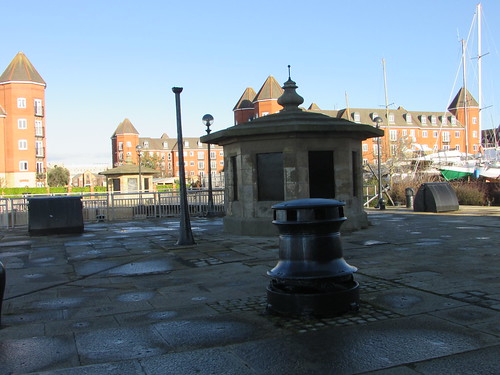
Liverpool: Two Lock-Keeper's Offices at Brunswick Half Tide Dock.
Beyond Brunswick Half Tide Dock, the curved river wall with a set of stone steps gave testimony to the quality and endurance of the works carried out by Jesse Hartley.

Liverpool: Jesse Hartley's stonework near Brunswick Half Tide Dock.
I then came to a small tidal dock - South Ferry Basin. Once the river teemed with ferries linking both sides of the River Mersey, now a single Mersey Ferry operates a triangular route Pierhead - Seacombe - Birkenhead Woodside and the South Ferry Basin is long out of use and silted-up.
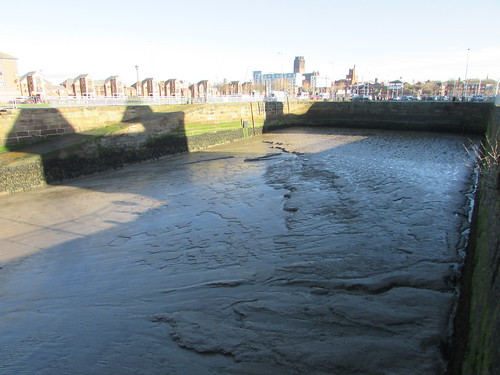
Liverpool: South Ferry Basin.
Coburg Dock came next. Originally, this dock had a single set of gates leading to the river, like Brunswick Half Tide Dock. But the 1909 plan shows this entrance permanently closed because a 100-foot wide passage linked Coburg Dock to Brunswick Dock from where 80-foot wide and 100-foot wide locks offered non-tidal connection to the river. Coburg Dock, still linked to Brunswick Dock, now forms part of Liverpool Marina. A launch area and slipway has been constructed at the river end of the dock.
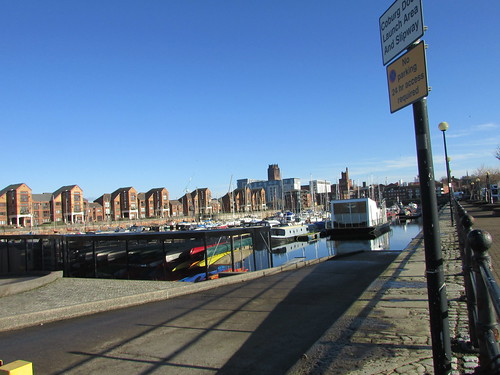
Liverpool: Coburg Dock, showing launch area and slipway.
The footpath was now joined by a road called Kings Parade which has a bus service. I passed the end of Queens Branch Dock No. 1 which has received a new role as the home of Liverpool Watersport Centre (LWC). The Centre is one of the initiatives run by a local charity called Local Solutions, with support from the European Social Fund.

Liverpool: 'wakeboarding' at the Liverpool Watersport Centre in Queens Dock.
Never having heard of 'wakeboarding', I was puzzled by a series of what looked like waterski jumps and two overhead cable systems installed in the end of dock nearest me and. Two young people started performing which clarified the activity. The wakeboard is a short, modified single waterski. The cable system replaces a speedboat. The user attaches to the cable system which drags the performer in one direction before reversing and dragging them back. The user performs a '180 degree' turn at each end of the course and attempts waterski jumps along the course. The System 2.0 Wake Park site here lists 27 'Wake Parks' in the U.K. - the Liverpool Wake Park has a site here and British Water Ski & Wakeboard is the sport's governing body and membership organisation.
The expedition was becoming a little surreal, not helped by the fate of the next dock - Queens Graving Dock. Fashionable apartments called The Keel comprised one block on either side of the flooded dock and two shorter blocks bridge-like across the dock, forming a rectangle. I was now in a thoroughly modern environment passing, in turn, the three modern venues along Kings Parade, Exhibition Centre Liverpool, BT Convention Centre, ECHO Arena. All three are run as an integrated events centre by ACC Liverpool, who have an introductory video with 'drone footage' here. The Exhibition Centre is the most recent addition with a website here. The Pullman Hotel is integrated into this building.
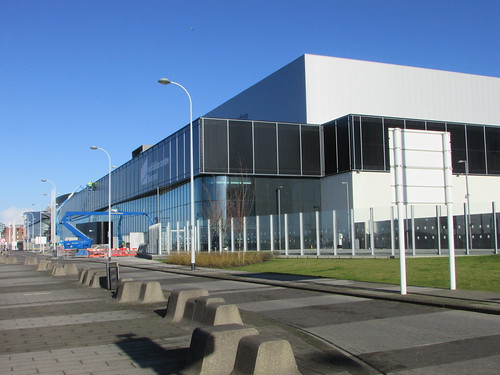
Exhibition Centre Liverpool, Kings Parade.
Then I hurried past the Convention Centre and ECHO Arena towards the Albert Dock and the Waterfront area, concluding my first exploration to Liverpool's former South Docks.
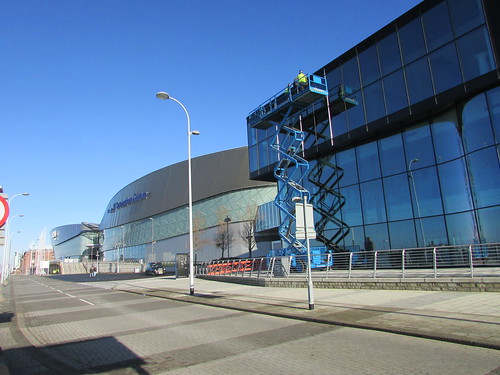
Kings Parade, Liverpool: (L-R) ECHO Arena, BT Convention Centre, Exhibition Centre Liverpool.
Related posts on other sites
Ship AIS (live map showing ships in Liverpool).
Related posts on this site
I've written about Liverpool many times. Most are referenced in the post Liverpool (again).
My Pictures
Where necessary, clicking on an image above will display an 'uncropped' view or, alternately, all the pictures from this and earlier trips may be selected, viewed or downloaded, in various sizes, from the albums listed:-
Liverpool South Docks
Liverpool area rail
Liverpool.
Croydon Airport finally closed in 1959 but, through the efforts of Croydon Airport Society, memories of this significant location in the development of aviation are kept alive. The Main Terminal Building survives as Airport House, now converted into a number of offices for small businesses and the Croydon Airport Visitor Centre.
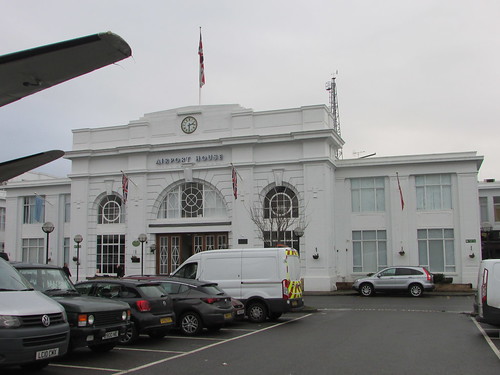
Airport House, Croydon.
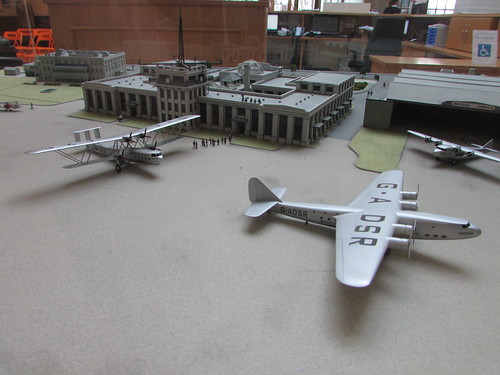
A 1:200 scale model of Croydon Airport in its heyday is displayed in Airport House Reception.
The iconic 'big biplane', the Handley Page H.P.42, handled most international flights in and out of Croydon, until replaced by more modern monoplanes like the Armstrong Whitworth 'Ensign'. In the picture above, an H.P.42 is on the left with an 'Ensign' G-ADSR on the right.
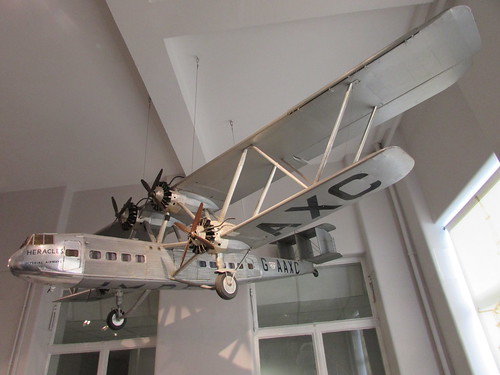
An imposing flying model of H.P.42 'Heracles' (G-AAXC) is displayed in the stairwell of Airport House.
History
The Croydon Airport Society website has a concise, but thorough, history here. Croydon Airport Society have also been involved in the creation of detailed published histories (see Related Books, below).
In 1916, the site was used by the fledgling Royal Flying Corps (later the Royal Air Force) as an aerodrome engaged in the defence of London against German airship attacks. The aerodrome replaced Hounslow Heath in 1920 as London's civilian airport and international passenger services were established. The original facilities were rather primitive so an Act of 1925 authorised the building of a new airport with hard-standing near the terminal although the actual runways remained grass.
The new Administration Building, opened 1928, was built by Wilson Lovatt & Son. This construction firm (based in Wolverhampton, where I grew up) was founded in 1914 and survives, although under threat of 'striking off' by the Companies Registrar. A hotel, the 'Aerodrome Hotel', was built adjacent to the Administration building for the convenience of air travellers.

Croydon Airport: Administration Building Ground Floor Plan
(from the Official Guide, 1928).
Click here for a larger view
On the outbreak of World War II in 1939, the airport reverted to military use. In 1946, the airport was restored to commercial use but Heathrow was designated as London's main airport so Croydon's importance diminished although international services and general aviation flying continued until closure in 1959.
Croydon Airport Visitor Centre
Croydon Airport Society was founded in 1978 and in 2000 opened an award-winning volunteer-led micro museum designed by Haley Sharpe Design (whose head office is in Leicester). The first open day in 2017 was Sunday, 8th January 2017 and my friend Rita (who is a member of the Society) and I decided to visit. Adjacent to Airport House the 'Aerodrome Hotel', now operated by Hallmark, survives and retains its original name (but has acquired an additional storey). The Hotel was hosting a one-day sale of aviation memorabilia, including models, books and photographs, which Rita and I checked out. This is an annual event in January, coinciding with the first Open Day of the year by the Croydon Airport Society.
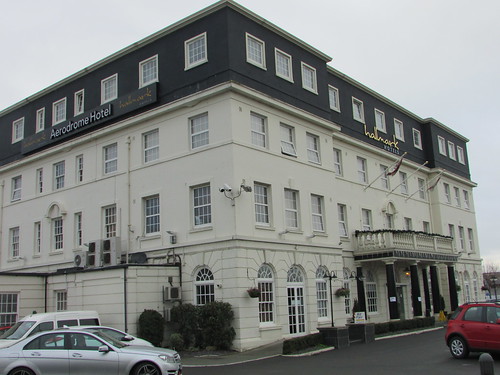
Aerodrome Hotel, Croydon.
Related books
[1] ‘The First Croydon Airport 1915-1928’ (Croydon Airport Society 2001 edition) ISBN 0-9541370-0-0.
[2] ‘Croydon Airport 1928-1939’ by Douglas Cluett, Joanna Nash, Bob Learmonth (London Borough of Sutton Libraries & Arts Services 1980 edition) ISBN 0-9503224-8-2.
[3] ‘Croydon Airport – The Peaceful Years’ by Mike Hooks(2006 reprint) ISBN 0 7524 2758 X (Photographic collection with detailed annotations).
My Pictures
Where necessary, clicking on an image above will display an 'uncropped' view or, alternately, my pictures may be selected, viewed or downloaded, in various sizes, from the album Airport House, Croydon.