skip to main |
skip to sidebar
I'd agreed to attend a business meeting near Bangor on Tuesday 22nd August, 2023. The people we're working with on this project were travelling from the south-west on Monday to be at the meeting and they suggested that we might travel together by car and that they would collect me around 1 p.m. This allowed me to work in the office in the morning, before they arrived at lunchtime.
The weather was good, so there was time for a brief tour of the garden and the Hall before we set-off together. It was agreed that we'd take the 'pretty route', using the A5 through Llangollen. Since this would take us near the commercial woodland at Ty Gwyn, it was further agreed that we'd make a short detour to Ty Gwyn as neither of my friends had previously visited the plantation.
After a pleasant journey, the weather remained mild on arrival at Ty Gwyn and we were able to explore the forest roads on foot.
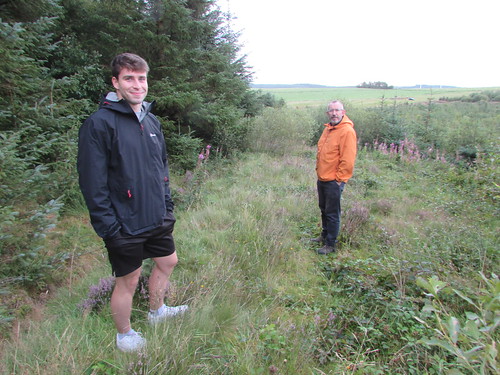
Alex and Steve at Ty Gwyn 2023
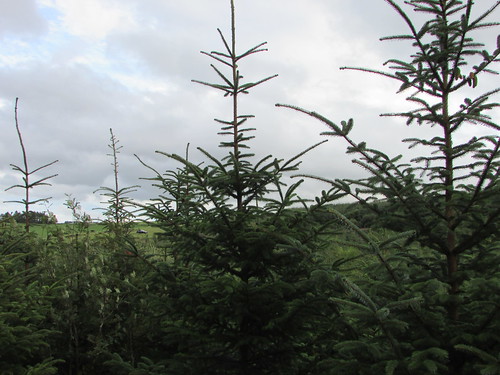
Ty Gwyn 2023: Progress achieved by the sitka spruce which was replanted in 2016.
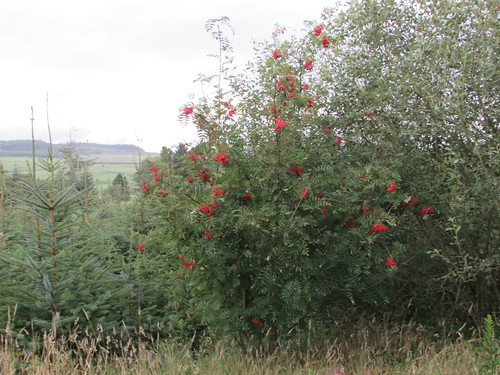
Splendid Rowan berries: Ty Gwyn 2023
Leaving Ty Gwyn, we headed on through the spectacular scenery around Snowdonia as the weather rapidly deteriorated. Having negotiated heavy rain, conditions improved as we approached Bangor at dusk. Overnight accommodation had been arranged at The Management Centre operated by Bangor University. The main university campus at Bangor is at the summit of a hill overlooking the town and the Menai Strait. The Management Centre is a Residential Training, Conference and Events Venue housed in three buildings built in 1910 on the slope below the main campus. After restoration and refurbishment, these three buildings were re-opened with their present role in 2010. My pleasantly-situated room in one residential block gave a view of the main Management Centre building to the left, faced a similar residential block and revealed the Menai Strait looking to the right.

Main Management Centre building, Bangor

View of the Menai Strait from The Management Centre, Bangor
We'd arrived early enough to take dinner in the '1884' restaurant at The Management Centre (1884 was the founding date of Bangor University). Informed that fish had run out (my usual choice), I opted for vegetarian tagliatelle which was very good. After the enjoyable meal with my friends, I was happy to retire to my well-appointed bedroom for a good night's sleep. On Tuesday morning, we took the buffet breakfast at the '1884' before setting off for our meeting.

Bedroom at The Management Centre, Bangor
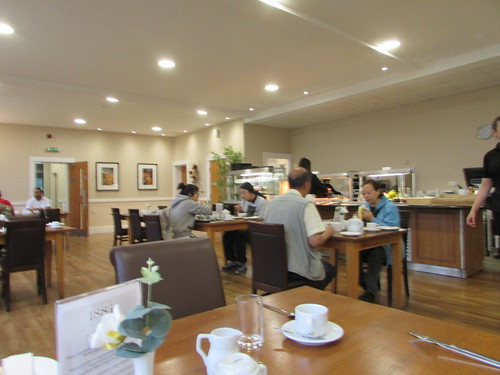
Breakfast at '1884' Restaurant, The Management Centre, Bangor
Since our meeting was scheduled to last all day, we made a brief stop on the way at the large Marks and Spencer's supermarket to select sandwiches, snacks and drinks to sustain us. The meeting was near Bethesda at Felin Fawr Cyf. Here, a series of early industrial buildings have been converted into 'Units' for small business use. Concentrating on the business of the meeting, my antenna failed to alert me to the significance of the location until Steve said "There's an abandoned railway out the back!". When the meeting finished, Steve was hoping to drive back to South Wales, dropping me off on the way so there wasn't much time to explore, but I made sure of a few pictures to prompt further study later. I was puzzled that the truncated trackwork, with a gauge of around two feet, included some modern sleepers, indicating fairly recent (say within 10 years) maintenance. Well, that was a puzzle for the future. I was returned home safely by car after an interesting couple of days and eventually added a post about the Penrhyn Quarry Railway here.

Railway sidings at Felin Fawr
Related posts on other websites
The Management Centre, Bangor.
Related posts on this website
My posts on Brewood Hall are here.
My posts on Ty Gwyn are here.
My pictures
My pictures of Brewood Hall are here.
My pictures of Ty Gwyn are here.
My pictures of The Management Centre are here.
My pictures at Felin Fawr Cyf (showing the reconstructed trackwork) are here.
[Link to Penrhyn Quarry Railway post added 31-Oct-2023]
A visit to the site which is to become the Global Centre of Rail Excellence (GCRE) in South Wales to attend their 'Open Day' involved a Sunday journey to Newport on 11th June 2023, returning the following day after a visit to the extensive GCRE site.
Sunday travel is rarely convenient on the British Railway Network as it's a favourite day for Network Rail to carry out engineering works, frequently substituting Rail Replacement Bus Services for part or all of the route of scheduled trains. I expected to find a Cross Country service via Bristol Parkway but, instead there appeared to be a number of trains running between Nottingham and Newport via Gloucester, with a bus service forward to Cardiff. I pre-booked tickets online.
On Sunday, Dean took me by road to Wolverhampton station in plenty of time to catch my first train to Birmingham New Street. At Birmingham, I made my way to the wide concourse area connecting the different platforms. The station was very busy but I easily located the Passenger Information Screens which showed my train approaching platform 12 on time. After purchasing food for the onward journey, I made my way to the platform which was crammed with passengers. Platform 12 is the highest-numbered platform, sharply-curved on the southern side of the station.
The first station in Birmingham was the 1838 Curzon Street, equipped with a suitably grand building by the London and Birmingham Railway. Although the grade 1 listed building survives, it has been neglected for years. It's to become subsumed into the ridiculous new terminus being built for the unwanted and expensive HS2 railway.
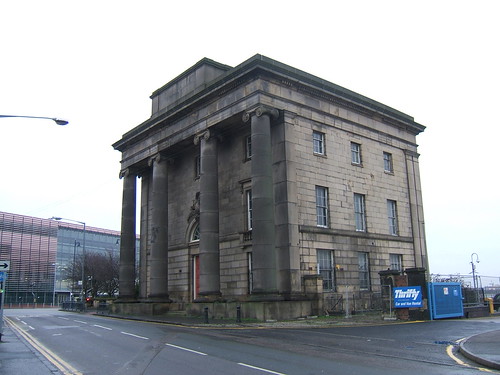
Curzon Street station building in 2007
Curzon Street was relegated to a goods depot when New Street Station was built, one kilometre to the south-west. The rail approaches to New Street were all by tunnel so the cramped station was built in a 'hole in the ground' between the North and South tunnels. The London and North Western Railway managed to get straight platforms but the Midland Railway had to settle for curved platforms which are little changed today. Glazed, arched train shed roofing originally covered the platforms. That on the London and North Western side was lost, I think to bombing in the second world war, so I only remember the utilitarian umbrella roofing which replaced it but I remember the Midland side train shed which survived the war in a dingy and delapidated state. British Railways rebuilt the station by burying the whole area beneath a multi-storey building and its approaches. Even after electrification (and still today) many of the services remained diesel powered, ensuring an unpleasant environment for waiting passengers. Birmingham New Street held my 'Britain's most unpleasant station' award for many years until it was decided to rebuild the station again, creating years of additional confusion for passengers as the work proceeded. Unfortunately, because of the site constraints, few of the fundamental defects could be remedied, although I think platform ventilation is improved. The station now boasts an even larger shopping centre, styling itself 'Grand Central'. Having visited the rather better-known Grand Central in New York, I think the appropriation of the name at New Street is unjustified.

Grand Central, Birmingham New Street: Atrium showing retail outlets at Concourse Level and around the Gallery.
My train, a Class 170 3-car diesel multiple unit, arrived on time and a stream of passengers got off, to be replaced by the hordes waiting on the platform. I gratefully found my reserved seat and tucked myself in the corner. If I'd noticed just how many young people had boarded, I might not have been surprised when, at our first stop at University after just five minutes travel, a large number of passengers abandoned the train. Even after the exodus, the train remained pretty crowded. The next stop was Worcestershire Parkway. This is a recent addition, opened 2020, with a large car park. In addition to the two platforms on the former Midland route to Bristol (now called the 'Cross Country Line'), the station has a third platform on the Oxford and Worcester line which crosses over at this point. The Oxford and Worcester is marketed as the 'Cotswold Line' and is single line between Norton Junction (a little to the west of the new station) for the ten miles to Evesham.
Our next stop was Cheltenham Spa. Because of the Byzantine complexity of the pricing structure for train tickets, 'Split Ticketing' is now commonplace. For instance, it is often cheaper to buy a Birmingham-Cheltenham Spa ticket and a separate Cheltenham Spa-Newport ticket, rather than a combined Birmingham-Newport ticket. Many of the online booking services now incorporate this feature in their pricing automatically, requiring me to print and manage two tickets for the journey from Birmingham to Newport on one train. Leaving Cheltenham Spa, we bowled along happily until Barnwood Junction, where we diverged right onto the northern leg of the triangular junction leading to Gloucester. Once again, there was quite an interchange of passengers before we continued on our way, showing a decent turn of speed in between stops at Lydney, Chepstow and Caldicot.
Just after Caldicot, our route converged with the Great Western Main Line, rising up from the Welsh portal of the 4 mile 628 yard long Severn Junnel. It was clear from the 'Freightliner' Class 66 on a ballast train and the collection of yellow-liveried track machines that the tunnel route was under an Engineering Possession and not available to normal trains that day.

Ballast train and Track machines on the Great Western Main Line just east of Severn Tunnel Junction station viewed from Caldicot line
Continuing west from Severn Tunnel Junction, there are four running lines, paired by direction. The Bishton Flyover re-arranges the order of the lines into paired by use. This was presumably to facilitate freight traffic entering and leaving the massive Llanwern Steelworks site. Steelmaking ceased some years ago and much of the site is being re-developed by St. Modwen. Spain's CAF are assembling Class 197 'Civity' diesel multiple units for Transport for Wales at a thirty million pound new factory here. My train negotiated Maindee East Junction and Maindee West Junction where the Welsh Marches line to Hereford and Shrewsbury makes a triangular junction with the the South Wales Main Line, crossed over the River Usk and quietly came to a stand in platform 1 at Newport. On that day, the service was terminating at Newport, rather than continuing to Cardiff, so passengers for Cardiff were forced to complete their journey by a Rail Replacement bus.

Newport Station Platform 1, after arrival of Class 170 from Nottingham
I was booked into the Mercure Hotel for the night and had arranged that Steve M. would meet me later at the hotel for an evening meal. I toyed with the idea of a taxi for the short distance to the hotel but the weather was fine and I only had a small pull-along case so I decided to continue on foot. My route took me through what I imagine is now called the 'Hospitality Quarter' - pedestrianised streets of colourful bars and restaurants. Judging by the amount of litter I waded through on that Sunday afternoon, the previous night had been a commercial success. The hotel entrance was an unassuming affair in pedestrianised Upper Dock Street opposite Friars Walk Shopping Centre and Leisure Complex. Steps and a ramp led through glass doors to a spartan reception with a reception desk at the far end and lift doors on the left led to the rest of the hotel. Checking-in was quick and friendly and the lift took me to my room on the eighth floor. The room was well-appointed with a decent bed and an excellent en-suite shower, wash basin and W.C. The large window gave a splendid view across the River Usk and the east of the city. Upstream, to the left, the river was crossed by the arched road bridge called Newport Bridge, adjacent to the remains of Newport Castle, with the railway bridge beyond.
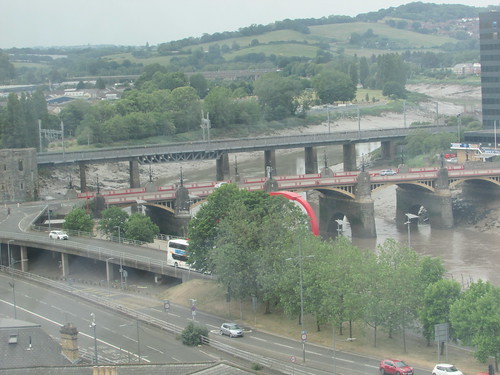
Newport, Wales: View from 8th floor, Mercure Hotel showing railway and road bridges over the Usk
Downstream, I could see the stark, modernist Newport City Footbridge, opened in 2006. This cable-stayed bridge is supported by two tubular steel 'A'-frames 80 metres and 69 metres in length giving the bridge a span of 145 metres. In the foreground, I had a detailed view of the flat roof of Friars Walk, covered with all sorts of heating and ventilating equipment and ducts. I took a leisurely shower and relaxed. My inclination is always to get out and explore an unfamiliar location but, tired from the travelling, I decided to settle for a 'virtual tour' by studying the book 'Newport History Tour' given to me by Steve. In the evening, I enjoyed a good meal in the hotel's restaurant with Steve and his partner before they returned home and I retired as I knew the following day would prove taxing. Steve arranged to return next morning in time for us to both have breakfast at the hotel before setting off for GCRE.
After a good night's sleep, I arose early and decided there was time for a brief exploration before Steve arrived for breakfast. My interest had been piqued by a reference in the 'Newport History Tour' book to Early Power Transformers in Park Square and I judged there was time to walk there and see for myself. It was a fine morning and the city centre was just starting to awake. I was delighted to see contractors scrubbing and washing pavements ready for the new day. I found a disused, preserved transformer near the top of Park Square. I'm used to cast iron cabinets installed on pavements mounting substantial fuses to protect street mains but the cylindrical, decorated pillar I found was a much grander affair. At some point, it had been nicely repainted in blue, with detailing picked out in pale blue and although there was obvious damage, it still looked quite handsome. I believe this relic dates from around 1894 when a power station in Llanarth Street, Newport distributed alternating current at 2,000 volts via rubber insulated cables to a series of these pillars where transformers extracted power at 200 volts a.c. for domestic use.

Newport, Wales: Park Square Transformer
There were tall, hinged doors at low level and smaller doors at high level. One of the larger doors had been opened and rusting on the hinges now prevented it from being closed, resulting in a collection of litter and leaves inside. The original transformer was still in situ, as shown below, but further study is needed to better understand the design.

Excited by what I'd found, I hurried back to the hotel for a sustaining English buffet breakfast with Steve before checking out. Steve and I then set off for the visit to GCRE.
Book references
[1] 'Newport History Tour' by Jan Preece (Amberley Publishing 2019) ISBN: 978 1 4456 9292 0.
Related posts on this website
Lionsmeet 2012 (A live-steam model event at Newport in 2012)
A Trip to South Wales (Part 2) (A visit to Newport in 2014)
Caldicot by Train (Travel on the same route in 2019)
Global Centre for Rail Excellence Open Day (Visit to GCRE)
My pictures
West Midland Railways.
Newport, Wales.
Newport area rail.
[Link to GCRE Visit post added: 9-Dec-2023]
In 2021, the Trade Show 'Railtex' resumed resumed after the interruption caused by the Covid-19 Pandemic (there's a brief report here). The once every two years format continued so it was next staged in May 2023.
On Wednesday 10th May 2023 I attended the show at the National Exhibition Centre near Birmingham, together with one of my friends from Bath who travelled independently by train. We both alighted at Birmingham International station which is a short walk under cover from the Exhibition Centre.
Getting there from Bath
My friend had an interesting journey so I've added a few notes. Bath to Gloucester was by a GWR diesel multiple unit. According to the Railcam.UK 'app' (there's a brief introduction to this 'app' here), this was reporting number 2E53 from Warminster to Great Malvern, making 14 intermediate stops (including Bath), taking just under 2 hours for the whole journey. At Bristol Temple Meads, he was surprised to find 60007 'Sir Nigel Gresley' with its support coach standing on the siding adjacent to platform 3. Afterwards, we found out a little more about this steam working (see 'The Welsh Marches Express' below). On arrival at Gloucester he had a short wait before catching a Cross Country 'Voyager' - the 08:45 from Cardiff, reporting number 1M01, 09:49 Gloucester, due in Birmingham New Street at 10:45 before going forward to Nottingham (due 12:04). The final leg was another Cross Country 'Voyager' - the 09:25 from Manchester, reporting number 1O12 leaving Birmingham New Street at 11:05 and due at Birmingham International just seven minutes later.
Getting there from Wolverhampton
I took the bus from Brewood to Wolverhampton at 09:35 and walked to the railway station. I suppose I have given up expecting to see much progress on the tram extension to the railway station but it was notable that Railway Drive was not teeming with the usual orange-clad workers. In fact, railway drive had been cleared of construction debris and the flangeways of the track were clean. Near the station, the area had been paved over, making it much easier for pedestrians to reach the station buildings, and the double-track tramway now swept right before the lines converged on a headshunt provided with a rather basic platform with awning. A few workmen with plant were still present in the headshunt area. There was no evidence of any overhead electrification so I decided it would be premature to imagine that actual running trams were imminent.
My rail journey was simple as the 09:25 from Manchester was routed via Wolverhampton, due 10:39. Just before the train arrived, the platform was swopped from 2 to 3 (to allow a down train into platform 2) but since platforms 2 and 3 form an island, it was no great inconvenience to passengers. We had a signal stop in New Street North Tunnel for a couple of minutes, waiting for a platform. Passengers waiting to board, including my friend, found that the platform announced previously had suddeenly swopped but my friend and I met up for the short journey to Birminham International.
The Welsh Marches Express
I don't follow main line steam specials but a quick check with the Railcam.UK 'app' showed movement 5Z65 leaving Bishops Lydeard at 05:43 so I presumed the locomotive had been prepared on the West Somerset Railway and made its way with the Support Coach to Bristol.


60007 'Sir Nigel Gresley' and Support Coach at Bristol Temple Meads on 10th May 2023 prior to 'Welsh Marches Express' (Photo: S. Morris): Bristol Area Rail.
My friend found the piece in the 'Shropshire Star' detailing the Paignton-Shrewsbury and return 'Welsh Marches Express'. As 1Z65, this had left Paignton at 05:45, diesel hauled, picking up passengers at various stations to Bristol. With the steam locomotive taking over, 1Z65 was due to leave at 09:14, head north through Filton then joining the Great Western Main Line west at Patchway, through the Severn Tunnel and continuing almost to Newport where the train was to take the eastern leg of the Maindee Triangle to reach the route to Abergavenny and Hereford. The schedule allowed two hours to Hereford, where the train was to pause for 50 minutes (a 'water stop' I assume). Another hour was allowed to reach Shrewsbury, due 13:05.
The 'Shropshire Star' had helpfully added a link to the detailed timings on the RTT 'app' (a similar 'app' to Railcam.UK, also using Open Rail data provided by Network Rail) so I was able to look at how the journey to Shrewsbury turned out. The diesel-hauled train arrived in Bristol just 5 minutes late but by the time 60007 was attached and joining passengers boarded, departure was 15 minutes late. Arrival at the Maindee Triangle was only 7 minutes late but, since the steam special had been booked to pause at Maindee North Junction whilst a conflicting movement cleared, the steam special was 'right time' setting off on the Welsh Marches Line. However, the train had lost 20 minutes by Abergavenny, with no improvement by Hereford. Further time was lost during the stop at Hereford and departure was 41 minutes 'down'. By Craven Arms, the arrears had increased to 50 minutes and arrival at Shrewsbury was at 14:01, 56 minutes late. And, later that day, the return journey would operate! Nobody should imagine running main line steam specials is easy.
The Exhibition
'Railtex' and 'Infrarail' had resumed after the Covid-19 Panemic in 2022 and there's a brief post here on that event.
In 2023, security personnel were again positioned on the broad, covered overhead walkway connecting the railway station to the Exhibition Centre, checking bags and the indications from two metal detector portals. As both my friend and I were pre-registered, admission merely required do-it-yourself scanning of the pre-registration 'QR' code which immediately printed card visitor badge for attachment to a lanyard selected from an adjacent dump bin. A number of ladies in formal suits were on hand to provide assistance, if required.
'Railtex', bills itself as an 'international exhibition of railway equipment, systems and services' and the stands occupied around 3/4 of Hall 3 (which is around 121m x 90m). The term 'Infrarail' seems to have been discontinued. Stands covered the range of topics I expected although a number of familiar names were absent and there were many unfamiliar names, often from Europe. My friend and I spent a few hours touring the stands, taking in one of the presentations in the Conference Zone. As my friend had specific further meetings planned, we split-up and I returned home by train.
We both found the visit useful but there's not the air of excitement which once seemed to permeate these exhibitions (or am I just getting old?). One exhibitor commented that the previous day had been quiet but the day we attended, it was busy without being 'jammed'.
Getting back to Wolverhampton
From a rail and air point of view the National Exhibition Centre has an excellent location. A few minutes walk and you're at a main-line railway station. A few more minutes on the Air-Rail Link and you're at the International Airport. The Air-Rail Link is an automatic, cable-hauled people mover which replaced the original 'Maglev' system. There's a Wikipedia article on the Air-Rail Link here. The location is perhaps not quite so ideal from a road transport view, requiring large numbers of vehicles each with few passengers to have access to and from the location together with parking facilities.
When I got back to Birmingham Unternational station, information displays showed all sorts of trains (most with delays posted), but I couldn't discern a simple answer to the question "which is the best train to get me back to Wolverhampton?". There were lots of passengers around, but I couldn't see any staff. Without much confidence, I selected the 15:08 Holyhead service, off platform 5. I found a TfW class 158 (reporting number 1D15) standing at the platform and joined the few passengers aboard. As departure time neared, quite an influx of passengers boarded and we left, a few minutes late quite well-loaded.
At Birmingham New Street, we stood for a few minutes and, when a 'Pendolino' which had followed us ran in to an adjacent platform, I fully expected it to precede us to Wolverhampton before I realised it was terminating at New Street. I was surprised when a class 66 appeared from the Holliday Street tunnel with a long freight train and sedately made its way through the station and into New Street South Tunnel. Railcam.UK identified this working as 6E11 starting from Appleford at 11:07 routed via Didcot, Swindon, Gloucester, Birmingham and Derby ultimately reaching Milford Junction West, south of York. Further research later showed that Hanson Asphalt have a manufacturing site at Appleford which imports coarse aggregate by rail, so the train was probably 'empties' returning north.
We left Birmingham New Street with just one booked stop at Sandwell and Dudley before Wolverhampton but we were following the Walsall-Woverhampton 'all stations' reporting number 2W36 which slowed our progress, eventually bringing us to a brief standstill at Monmore Green. Once 2W36 had 'tucked himself' into bay platform 5, I expected us to move into the station, but we were held again at the final signal before the station (4271) whilst a 'Pendolino' running as Empty Coaching Stock (ECS) was crossed in front of us from platform 1 to the Up Main towards Birmingham. With platform 1 now available, my train was finally able to proceed into the station.
My local railway pictures
West Midland Railways.
Because of the Covid-19 Pandemic, Trade Shows and Exhibitions were suspended but, following the easing of emergency legislation in July 2021, this type of event was able to resume subject to 'Covid Secure' guidance.
On Thursday 9th September 2021 I attended the last day of the Railtex and Infrarail combined exhibition at the National Exhibition Centre near Birmingham, together with one of my friends from Bath who travelled independently by train.
Getting there
Once again, I took the first bus from Brewood to Wolverhampton at 07:30 and walked to the railway station. For a change, I decided to catch the 'local' to Birmingham New Street. The service currently then continues to Walsall (I described using this circuitous route to Walsall in the post Walsall by Rail). In recent years, platform 5, the bay platform 5 at the south end of the station on the Down side) is used by the terminating 'all stations' Electric Multiple Units along the Stour Valley line but, before electrification and then called 'Down Bay' I think, it wasn't very often used by passenger trains (but I've described catching one Diesel Multiple Unit from this bay during 1962 in the post here). As part of the station redevelopment which accompanied electrification, the end of this bay became a parcels sundries depot, which has now been demolished.

Wolverhampton Station: View from platform 5 showing stop signs, remains of the parcels sundries shed and, in the background, new station in black and orange
There weren't many passengers on the train when I boarded but by departure time at 08:22, the train was reasonably full and at each stop, more people boarded than alighted so we were quite full on arrival at Birmingham New Street. We stopped at Coseley, Tipton, and Dudleyport (all stations I regularly used 60 years ago when making unofficial visits to signal boxes as described in the postVisiting Signalboxes). Stops were then made at Sandwell and Dudley, Smethwick Galton Bridge and Smethwick Rolfe Street. Smethwick Galton Bridge is a relatively recent development, opened in 1995 to provide connections with the 'Jewellery Line'. Over the years, I've occasionally used all six stations between Wolverhampton and Birmingham New Street. Currently, 25 minutes are allowed including stops.
I had expected us to arrive in platform 1 at New Street but discovered it was closed with engineering works on the platform being carried out so we used platform 2. I've complained previously about the confusion that can arise in attempting to change platforms using the stairs or escalators at the 'A' (southern) end of the platforms which seems to involve leaving through the ticket barriers and then coming back in again through another ticket barrier. I was amused to see that signs have now been erected recommending using the 'B' end when changing platforms. With plenty of time in hand, I decided to have another look at the adjacent Grand Central Shopping Centre to see if I liked it any better than on a visit in 2016 described here. I didn't, so I left the station to look at the Midland Metro Tram station in Stephenson Place.
This tram station hadn't been completed at the time of my 2016 visit, but was in use in 2019 when I attended the UKRRIN Annual Conference (described here). However, in September 2021 I was surprised to find the area dug-up again and piles of pre-cast sleepers around. It appeared that the service had been terminated at Bull Street whilst an urgent track relaying along Corporation Street to Stephenson Place was carried out, expected to be completed before Christmas 2021. No explanation was available about the reasons for such major works only five years after completion of build on this section.
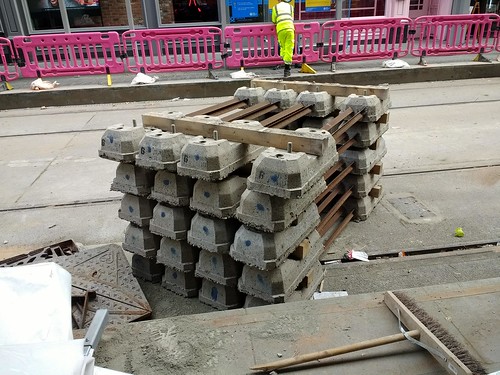
Sleepers in Stephenson Place for track replacement (West Midland Metro)
I walked as far as the Town Hall before returning to the railway station along pedestrianised New Street then through the Arcade past the Macdonald Burlington Hotel. When this was still the Midland Hotel it had a decent, old-fashioned restaurant on the first floor overlooking New Street which I used to enjoy visiting for lunch occasionally. On platform 4, I joined a Cross Country 'Voyager' from Manchester, where I was joined by my friend for the 9-minute journey to Birmingham International station. Birmingham International is another relatively recent development, opened in 1976 to serve both the adjacent airport and the National Exhibition Centre.
The Venue
When I started my own business in 1966, all major trade shows were held in London at Olympia or Earl's Court, which were both showing their age. The National Exhibition Centre (NEC) is one of the better ideas promoted by Birmingham City Council, in my opinion. The idea of a new exhibition location on a 'greenfield' site with good motorway, main-line railway and international air connections appealed to me. The first stage was opened in 1976 and expansion up to 1998 now offers 20 exhibition spaces of various sizes, including the multi-purpose indoor Arena which can be used for exhibitions or entertainment events. 'London-centric'-thinking made establishing the venue rather difficult. For instance, in 2000, the ExCeL exhibition and conference centre opened in London and its foreign owners have continued to develop that competing site. In 2014, Birmingham City Council sold the site which is currently owned by the Blackstone Group.
The Exhibition
'Railtex' and 'Infrarail' are two leading exhibitions in the UK aimed at the railway industry. Following the inability to stage this type of exhibition at all during 2020 because of the Covid-19 Pandemic, the two exhibitions were combined under the banner of the 'UK Rail Hub'in 2021. The event was open 7th-9th September in Halls 11 and 12 of the NEC. 'Railtex' was billed as "the 15th international exhibition of railway equipment, systems and services" and 'Infrarail' as "the 13th international railway infrastructure exhibition".
Arriving at the show during the Age of Covid-19 provided a new experience. On the broad, covered overhead walkway connecting the railway station to the NEC, teams of security checked documentation relating to the Covid-19 status of visitors, who were then asked to wear a self-adhesive wrist-strap to confirm a satisfactory check.
On reaching the exhibition halls, registration was quick - I'd signed-up on-line previously and printed out the confirmation which included what used to be called a 'QR Code' (for quick response) but, with wider utilisation for all sorts of purposes, including railway ticketing, is also called a '2D Barcode'. There's an excellent article about these codes on Wikipedia here. A pleasant lady scanned my confirmation at a special pedestal at the entrance which immediately printed a card label which she attached to a lanyard and I was 'in'.
The show was useful but, perhaps understandably, seemed rather more subdued than previous, similar events I've been to. But I found it good that people were starting to meet face-to-face rather than by the dreaded 'Zoom' or 'Teams' video conferencing.
By mid-afternoon, my friend and I had achieved all we'd hoped and we walked back to Birmingham International station. The northbound train we caught was rather full so we stood in the coach vestibule to Birmingham New Street, where my friend had a change of train. The passengers thinned-out somewhat here so I found a seat to complete my journey back to Wolverhampton.
My local railway pictures
West Midland Railways.
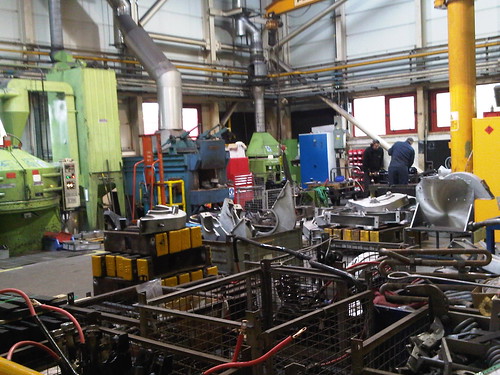
One corner of the Railway Engineering Works at Acton
Crewe, Swindon, Doncaster, Eastleigh, Acton - Acton? Perhaps Acton isn't one of the more famous railway works but London Underground established an important works at Acton. Mass transit sysytems are very intensively used and maintenance of rolling stock and infrastructure to the highest standards is essential.
My interest in Acton Works only started around 1995 when my firm became involved in work for London Underground, as described in the post London Underground and Jan. To be allowed 'behind the scenes' on any railway requires induction, safety training and various examinations matching the roles to be undertaken. An undergound fourth-rail electrified railway has particular risks and London Underground had a well-developed set of in-house training courses based at a Technical Training Centre at Acton Works. So I became a fairly regular visitor to Acton Works as I obtained different certifications and periodic re-certifications in connection with our work supplying Tunnel Telephone equipment, initially for the Jubilee Line Extension project and later for other London Underground lines. During these training visits, I saw glimpses of the work carried out around the sprawling Acton site, a mixture of old, modern and relocatable buildings.
Visits in 2006
During visits to REW Acton in connection with the design and supply of Tunnel Telephone equipment for a new installation at White City (necessitated by major changes to the London Underground depot in connection with the building of Westfield London Shopping Centre), I was able to take pictures of the external Signalling Training Facility that had previously intrigued me. Nearer the original Bollo Lane entrance to the site, a large concrete base provided with a fabric roof mounted an array of full-size working signalling equipment, including signals (colour light and disc shunting), point machines and train stops. On London Underground, points and train stops are electrically controlled but use compressed air to provide power, so the normal features of an air main running alongside the track provided with electro-pneumatic controls were also fitted. This allowing Signalling Technicians to receive training in maintenance of the various types of equipment in use on London Underground in a realistic environment supplementing training given in the adjacent Signal Training School, a large relocatable building provided with examples of various types of control system.

Signal Training facility, Bollo Lane, Acton with a variety of signals and air-operated points. The air main and control cables are along both sides, carried on posts.
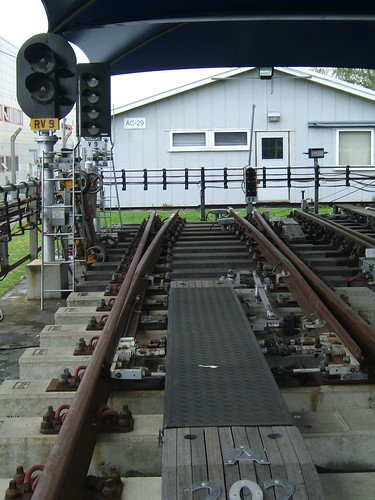
View in opposite direction of Signal Training facility. Left: Colour light signals Right: Turnout. The gabled building in the background is the Signal Training School.
Tour in 2011
During another business visit in March 2011, one of the London Underground staff arranged a fascinating, although brief, tour of part of the works. There wasn't time to get a proper understanding of the variety of work undertaken but I quickly realised the expertise available on the site. Below is a small selection of the things I saw.
Repair and refurbishment of rolling stock equipment forms a vital part of the work. In the reception area of one modern building, a part-sectioned motor wheelset for 1983 tube stock and part-sectioned gearbox for 92 tube stock were displayed.

Motor Wheelset for 1983 tube stock (part sectioned) on display at REW Trains Division, Acton.
In the Traction Motor Section of the works, rows of motors were being processed.

Traction motor section, REW Acton
Nearby, a series of massive jigs were provided for working on the pre-wired underbody control sub-assemblies.

Underbody control sub-assembly, mounted on jig.
Various signalling equipment is maintained at Acton, including heavy items like trainstops and various types of electro-mechanical relays.

Trainstop complete assembly, REW Acton

Shop for re-certifying electro-mechanical signalling relays (REW Acton)
I hadn't realised that surface-mounted cables feeding signalling equipment were normally pre-fabricated in standard lengths including moulded terminations, minimising time-to-exchange when replacement was necessary. I think these cables were bought-in complete but REW Acton also acts as a central stores for London Underground.

Prefabricated multicore cable for signalling showing moulded termination for fast connection to 12 terminal posts (REW Acton)
On an intensive mass transit system, every minute counts and London Underground has always provided clocks on stations to assist passengers and staff. But I was still surprised by the variety of clocks being repaired and regulated in the Clock Section. At the time of my tour, London Underground still had a few mechanical clocks at stations requiring weekly visits for winding!

The Clock Section (REW Acton)
Redundant D78 vehicles
During my 2011 visits, I saw a redundant D78 vehicle leaving the works on a low-loader. At the time, I thought the coach was going for scrap but I discovered afterwards these trains had been bought by Vivarail for conversion into modern, lightweight diesel-electric units for use on heavy-rail infrastructure. I caught up with these former D78 vehicles on a visit in 2018 to Quinton Rail Technology Centre (there's a post on that visit here).

Redundant D78 vehicle leaving REW Acton on low-loader in 2011.
My pictures
Pictures at REW Acton.
Books
There's a book on Acton Works titled ‘Underground Train Overhaul – The Story of Acton Works’ by J. Graeme Bruce/Piers Connor, published by Capital Transport Publishing in 1991 (ISBN 1 85414 134 1).
When I was growing up, telephone services in the United Kingdom were Nationalised and run as part of the General Post Office (GPO). This was logical since the Post Office handled written messages, in the form of letters, in massive numbers. Telephones offered an alternative, faster, method of sending a message. Back then, few homes had the luxury of a telephone but calls could be made from the familiar, red telephone kiosk. Although this gave you the means to communicate with businesses, its use for personal calls was limited since few relatives or friends would possess a telephone. Urgent communication in matters of accident, sickness or death could be expedited as a written message sent as a 'Telegram'. This involved going to a local post office where you could write a brief message on a telegram form and hand it over the counter. On payment of what seemed a lot of money, this would be transmitted by the Post Office to the office nearest your recipient by teleprinter, printed out on a continuous strip which was cut into short lengths and glued (yes, glued) to another telegram form, placed in an envelope and delivered to your recipient's address by a Telegraph Boy (often on a bicycle). Although my experience of using telephone and telegram services was limited, I became fascinated with telephones and telegraph equipment, possibly triggered by a visit I made, when still at school, to a Telephone Exchange. Back then, exchanges were electro-mechanical, rather noisy affairs, using relays, uniselectors and 2-motion selectors. Reed, crossbar and electronic exchanges were still to appear.
But when I started (unofficially) visiting railway signalboxes as described here, I discovered even earlier telecommunications systems (owned and operated by British Rail) still in use. The block system in use for securing the safe passage of trains from signalman to signalman used an arrangement of single-needle telegraph instruments with codes transmitted by single-stroke electric bells (as outlined in the post here). Telephones used were rather primitive, Local Battery affairs in wooden cases.

Local Battery Omnibus Telephone in wooden cabinet with hinging front. Tiltable carbon microphone and cord-mounted receiver stowed on cradle switch, D.C. bell on backboard. Polarised D.C. ringing-out on two buttons.
The GPO were introducing Subscriber Trunk Dialling into the public network (where customers set up their own long-distance calls without the intervention of an Operator), using 'Step-by-Step' Strowger technology. The first Subscriber Trunk Dialling (STD) call in the United Kingdom was made by Her Majesty Queen Elizabeth II on 5th December 1958. There's a brief introduction at Subscriber Trunk Dialling (STD) and a Wikipedia article here.
In 1959, the GPO introduced a 'modern' telephone instrument, still featuring a rotary dial. This formed the basis for what became an extensive range of models - the 700-series. Later members of the 700-series even featured push-button dialling! There's an interesting article on the 700-series instruments on Wikipedia here.
In the post The World of Work I talked about working for Contactor Switchgear (Electronics) Limited. The Sales Director had a number of contacts within British Railways and we bid for a number of telephone-related jobs, without any conspicuous success.
In 1966, I decided to set up in business on my own, as outlined in the post Starting my own business. Getting established proved quite difficult and I was quite happy to accept a variety of work. But an introduction to Gerry Gardner led to sub-contract design and manufacture of specialist telecommunications equipment for emergency services. Following the success of this equipment, we were invited to bid for the supply of selective call telephone equipment by British Rail. Manufacture of the resulting contracts led to a period of expansion and development of similar equipment for use as Electrification Telephone systems for British Rail, as described in the post Electrification Telephone Systems for British Rail. Subsequent schemes were supplied to British Rail and other companies like Westinghouse Brake and Signal.
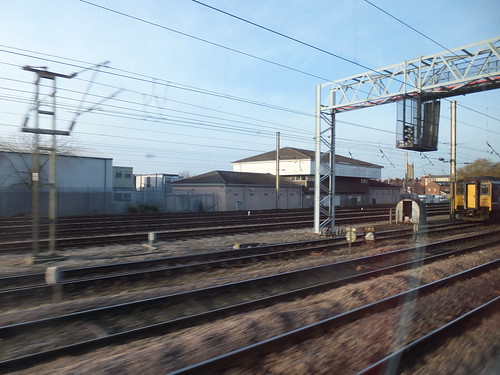
Our equipment was installed in various Power Signal Boxes, including Preston shown in 2013
G.E.C. in Coventry asked us to design and supply telecommunications equipment for a large railway electrification project in Taiwan. Working for the Big Boys mentions some of my experiences and the report here has some recollections from my first visit to Taiwan to assist with commissioning this scheme.
Although we continued to do work in industrial automation (see Visiting Steelworks and Oil & Gas Industry) most work was channeled into telecommunications for railways. British Rail operated a number of large 'Step-by-Step' exchanges to handle internal telephone traffic and they designed their own version of STD (which they called Extension Trunk Dialling) to link these exchanges into one system. We were kept busy maufacturing the racks and relay sets for this scheme.
Two more large projects for G.E.C. followed - one in Brazil, the second in Thailand. These are briefly described in the post Work (part 2). A proposed commissioning visit to Brazil was cancelled at short notice so I didn't get to Brazil until my 'Round the World Two' trip in 2006 (very briefly described here). But I did visit Thailand a number of times during commissioning of that project (the post here outlines the scope, the post here includes a description of a day fault-finding travelling on a railway trolley and the post Thai Railfan Club describes some of the friendships I made).
Standard Telephones and Cables approached us about a complex railway telephone system for use in the Bombay area. We offered to build suitable equipment, but they were keen to manufacture 'in house' so, in the end, we concluded a license agreement. This involved visits to their manufacturing site in South Wales but I was disappointed not to be involved in commissioning the equipment in Bombay - I didn't get to India until 1992 when we commissioned equipment we'd supplied to G.E.C. for a railway telephone system in the Delhi area (see the post My first trip to India).
When we were asked in 1993 to quote G.E.C. for Tunnel Telephone equipment for the Jubilee Line Extension of London Underground, I initially baulked at the idea. None of our existing designs seemed adaptable and, despite the system name, the main function is to provide a high-integrity emergency traction shutdown system. The design challenge appealed to me but I initially assumed the development cost would make our offer uneconomic, as explained in the post Work (part 2). G.E.C. persisted and the supply of Tunnel Telephone equipment became an important, if erratic, source of business but it's so specialised that I tend to think of it as distinct from 'Telecommunications and Jan'. But there is a post called London Underground and Jan.
Related posts on this website
Selecting label 'Work' (or Clicking here) will display all my posts on 'Work' in reverse date-of-posting order. Alternately, Clicking here will display an index list of Titles of posts labelled 'Work' (but this list may not be up-to-date).
[Link URL corrected 26-Nov-2020]
Simple Trolley
The simplest design of trolley comprised a substantial rectangular wooden base supported on two wooden frames running fore-and-aft. These frames carried four inverted U-shaped notches serving as simple bearings for two wheelsets (an axle with two flanged wheels set at the correct gauge for the railway). Usually, no 'underkeeps' were provided on the axle bearings, allowing the trolley to be quickly removed from the track by lifting the wooden base off the wheelsets and then removing the wheelsets clear of the line. Pushed along the track, this was a simple and versatile way of moving track materials to where they were required. When I was an active volunteer at Birmingham Railway Museum (see blog post here), this was still the standard method of moving materials around the site.
In more modern times, a rectangular, horizontal steel frame is carried on four wheels mounted in cast axleguards, replacing the earlier heavy wooden framework.

Steel-framed 4-wheel rail trolley (Battlefield Line, 2020)
Similar simple designs can be found on other railways. The picture below shows a type in use in Burma. The extensions on the side frames provide four 'handles' to assist in manhandling the vehicle on and off the track.

Metre gauge rail trolley used in Burma (MyanmaRailways 2019)
Further development sometimes divided the horizontal frame into two sections, each carrying two wheels. The two sections can be simply locked together to form a four-wheel trolley, with the construction in two sections making transportation to the work site before use easier.
Inspection Trolley
Traditionally, permanent way gangers were responsible for maintaining the line in a specific area which could involve a number of miles of track so man-powered inspection trollies were sometimes provided to facilitate the (usually) daily inspections. The view below shows one Great Western 3-wheel design of inspection trolley. Note the clips on the outrigger to the 'third wheel' which support a specially-shaped key hammer with a long wooden shaft. The thinner end of the hammer head was for knocking back in displaced wooden keys (which held bullhead rail in place in the cast rail chair fixed to the sleeper). Over the years, spring steel keys started to replace wooden keys; 'flat bottom' rail profile (also called Vignoles) came to replace bullhead rail; continuous welded rail (CWR) avoided the disconinuities of fishplated track resulting in permanent way maintenance on modern railways being very different from those far-off days.

3-wheel inspection trolley, as featured in the film 'The Titfield Thunderbolt'
I've written a short post on The Titfield Thunderbolt here which includes a link to my other posts about this well-loved Ealing film and the locomotive which starred in it.
Mentioning a key hammer reminds me of the Tipton Ganger I knew in the late 1950s. He was expected to carry out daily walking inspections of his complex area but decided that shouldering a standard key hammer for hours at a time was too tiring, so he carried out patrols with a fishplate spanner. As the name implies, this is designed for tightening fishplate bolts and is terminated in a long metal shaft to allow sufficient torque to be applied to the bolt. He decided anything a key hammer could do, a fishplate spanner could do, without the weight penalty. Many years later, I became a volunteer at Manchester Museum of Science and Industry (there's a personal history here with a list of my posts) and, when carrying out volunteer Operating Officer duties there which included a daily track inspection, I confirmed the wisdom of the Tipton Ganger's technique!
Pump Trolley
Pump trollies had four wheels and were propelled by working pump handles up and down, often using two or more men.

Publicity shot from 'The Titfield Thunderbolt' showing the 'Pump' trolley used in the film
A 'pump' trolley also featured in the comedy film 'The Great St. Trinian's Train Robbery', made in 1966 on the Longmoor Military Railway. There's an article about this film on Wikipedia here.

'Pump' trolley used in the comedy film 'The Great St. Trinians Train Robbery'
During my visit to the 2019 'Lionsmeet' model event at Bournemouth (described in the post here), I photographed a rather splendid 5-in gauge model of a 'Pump' trolley, actually powered by two small electric motors and remote controlled by radio!

A splendid model of a 'pump' rail trolley, displayed at Lionsmeet 2019, Bournemouth (the control unit to the left is the remote radio controller for the model)

The 'pump' trolley model is powered by two electric motors each driving the adjacent axle via bevel gears (Lionsmeet 2019, Bournemouth)
Powered Trolley
Powered railway trollies could be larger and travel further. In general, petrol engines have been used as the motive power (sometimes production automobile engines) but electric vehicles powered from batteries are also manufactured.
Wickham of Ware built powered rail trollies over a long period. One of their powered trollies featured in 'The Great St. Trinian's Train Robbery'.

During the time I spent as a volunteer at the Manchester Museum of Science and Industry, I had an opportunity to drive one of the Wickham powered vehicles. Fitted with a car engine (Morris, I think), gearbox and foot pedals the experience was like driving a car without a steering wheel.

Wickham Inspection Trolley at Manchester
More modern designs used in the UK tend to omit weather protection, as shown in this picture of a 4-seat powered trolley awaiting restoration at the Battlefield Liine. This type of trolley can often be used to tow a 4-wheel trolley carrying tools and materials.

4-seat powered rail trolley
In 2001, during a visit to Glenbrook Vintage Railway in New Zealand (described here), they had two 3 foot 6 inch gauge motorised inspection trollies on display.


Motorised Inspection Trollies (Glenbrook Vintage Railway, 2001)
Rail Trollies in Thailand
But the experience which always comes to mind happened in 1989 during commissioning of a Train Despatcher Telephone system we'd designed for GEC used on a railway project in Thailand. At the time, overall control of railway trains throughout the country used long-distance telephone circuits carried on open-wires on old-fashioned telegraph poles (There's a brief post here). At various times during the execution of this project, I went out to Thailand to assist and, occasionally when problems arose, I went out in the field to carry out tests or investigate the difficulty. There was one branch line in southern Thailand where unacceptable levels of audible noise were periodically present on the telephone circuits. Normal circuit testing had failed to reveal the intermittent problem and sending a fault team out by road hadn't improved our understanding (the roads were only near to the railway occasionally) so we persuaded the railway to lay on a motorised inspection trolley so that we could drive the whole length of the branch looking for possible external factors to account for the problem.
I joined a couple of G.E.C. engineers and we drove by car to Chachoengsao, as far as I remember, where we found the powered inspection trolley and the railway inspector who was to drive the trolley. There was some delay whilst we waited for a diesel multiple unit to load its passengers and depart ahead of us but at last we set off. Back then, most of the lines were single with authority for trains to proceed given by electric token, but I had a nasty feeling rail trollies were not protected by this system so I felt rather vulnerable in our basic, lightweight trolley (There's a brief introduction to the principles of railway single line working here). I'd also noticed the bamboo flagpole, topped by a small and rather dirty red flag, mounted on our trolley which I assumed was intended to make us more conspicuous should we meet a train. The feeling of insecurity was heightened by the seats being not far above the rails with no enclosing bodywork which made the speed seem much greater. The inspector/driver was in the front left seat, I was in the front right seat, wielding a video camera to record what I could. We were separated by a Briggs and Stratton petrol engine (10 h.p., I think). At that time, I had a lawn mower powered by a similar Briggs and Stratton so I had confidence that we would not get stranded but the engine was raucous and the noise, combined with the heat of the sun which beat down on us remorselessly, made us all quickly tire. I realised that the first part of the journey, as we passed through a number of country stations, was just 'positioning' to reach the junction where the offending branch line diverged.

Typical minor railway station. Note the telegraph pole on the right carrying the Train Despatcher circuits involved in the GEC project (Railways in Thailand: 1989)
After one or two hours of travelling (it seemed much longer), we reached the junction station and started our survey of the branch. We seemed to be passing through a farmed area with tall crops on both sides and the condition of the telegraph poles and open wires was generally good. Nothing suggested a reason for our telephone transmission problems. Suddenly, about halfway along the branch, the farmland gave way to one of the largest high voltage switchyards I've ever seen, right next to the railway and with numerous overhead cables crossing or running parallel to the railway. The induction from this installation was more than enough to account for the problems but people working on the project had been either unaware of its existence or failed to grasp its relevance. Once we'd identified the problem, G.E.C. were subsequently able to mitigate its effects. We completed our survey to the end of the branch but found nothing else untoward. I felt vindicated that our trip had identified the problem but my G.E.C. colleagues, battered by the sun and deafened by engine noise had had enough and phoned for an air-conditioned car to return to Bangkok in comfort.
But on the basis of 'I may never pass this way again', I decided to spend a few more hours returning, as originally planned, on the trolley with the railway inspector/driver. I discovered that my concerns about our safety had not been entirely groundless. Returning along the branch, I found the inspector frequently referring to a page of what looked like a railway timetable. The inspector had very little English and I still have even less Thai, so I couldn't explore my concerns with him but his anxiety level seemed to be increasing. Abruptly, he stopped the trolley on a rural level crossing. We both climbed out and, when he started to slide out the simple lifting beams, I assisted until four wooden handles had been deployed. By then, it was obvious that he intended to manhandle the trolley clear of the track so together we 'walked' the trolley clear of the line. Almost immediately, over the tops of the crops, I saw one of the Hitachi diesel locomotives approaching with a passenger train. Within seconds the train had disappeared and we both set the trolley back on the rails. I realised that he had chosen a level crossing to 'dismount' the trolley since, with the road surface level with the top of the rails, the job was much easier.
We completed the long journey back without further excitement. I made a videotape on that day which I must try to get converted. Later in 1989, the whole project was completed and an 'I&C Seminar' was held at a Bangkok Hotel where G.E.C. outlined what had been achieved to a large group of senior managers from the railway. The seminar is described in the post mentioned above).
There's a postscript to this tale. During my visits to Thailand in connection with the G.E.C. project, I'd met Sanpasiri Viriyasiri, founder of the Thai Railfan Club, who was carrying out an ambitious plan to open a railway museum in an existing warehouse building in Chatuchak Park, Bangkok. In 1990, with the Train Despatcher Project complete, I returned to Bangkok to spend a few days helping to ready this museum for the official opening and that trip is described in the post here. One of the exhibits at that museum (sadly, now closed) was an inspection trolley similar to one described above we used for our survey.

Motorised inspection Trolley similar to the one I travelled on in Thailand pictured at the Bangkok Railway Museum in 1990.
The Rail Trolley Trust
The Rail Trolley Trust is a registered charity formed in 2014 dedicated to the preservation and display of Rail Trollies, petrol, diesel and electric. They've a fascinating website here.
On Thursday, 21st November 2019, I attended the Second UKRRIN Annual Conference which was held at the Birmingham Repertory Theatre. The formidable abbreviation 'UKRRIN' stands for the United Kingdom Rail Research and Innovation Network and their work, in improving collaboration between the rail industry and academia, is described here. It promotes four 'Centres of Excellence' supporting railway innovation in the U.K., targeting Digital Systems, Rolling Stock, Infrastructure and Testing.
UKRRIN works closely with the Rail Safety and Standards Board, a company limited by guarantee set up in 2003 following the collapse of Railtrack in 2002 and the subsequent separation of Railtrack's original remit into intrastructure management (Network Rail) and Safety and Standards (RSSB).
Since UKRRIN's goal is to improve collaboration between the rail industry and academia, it's relevant that UK Research and Innovation (UKRI), with a budget of seven billion pounds Sterling, "works in partnership with universities, research organisations, businesses, charities, and government to create the best possible environment for research and innovation to flourish". It operates through a series of Councils, including Research England which "creates and sustains the conditions for a healthy and dynamic research and knowledge exchange system in English universities". Another area of UK Research and Innovation's work is carried out through Innovate UK. At the time of writing, UKRI are creating a single website to bring together the existing research council, Innovate UK and Research England websites. An example of this collaboration is the Birmingham Centre for Railway Research and Education (BCRRE), headed by Clive Roberts and hosted at Birmingham University where a new building for the Centre of Excellence in Digital Systems is nearing completion. BCRRE works closely with The Rail Alliance, based at Quinton Rail Technology Centre, Long Marston (there's a post in this blog about Long Marston here).
I travelled to the venue by public transport, walking from Birmingham New Street station to Centenary Square where the Birmingham Repertory Theatre is located.
 Centenary Square, with L: Birmingham Repertory Theatre, R: Library of Birmingham (Birmingham, November 2019)
Birmingham Repertory Theatre is housed in a 1971 building. The 1991 theatre extension was demolished to make way for the Library of Birmingham and both buildings are linked by a shared new foyer area. Unique Venues Birmingham is a joint initiative between Birmingham Repertory Theatre and the Library of Birmingham promoting wider use of the facilities.
Registration in the foyer was efficient and a welcoming hot drink was provided in the curved theatre lobby area by Unique Venues Birmingham. I believe around 250 delegates were registered for the event.
The lobby area, and a similar area on the Mezzanine floor above, also served as exhibition space for a number of universities and companies.
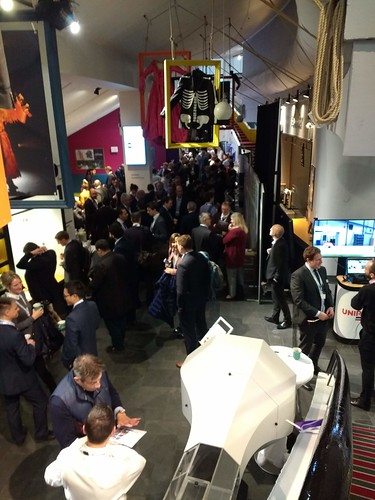
View of the Lobby area (UKRRIN Annual Conference, 21st November 2019)
The conference proceedings were held in the Studio Theatre, a conventional theatre space seating 300 in a tiered auditorium.

The Chairman for the morning session welcomes delegates (UKRRIN Annual Conference, 21st November 2019)
In the first session, there were addresses by Simon Iwnicki from the Centre of Excellence in Rolling Stock at University of Huddersfield, Richard Murray from Teledyne e2v, Clive Roberts from BCRRE, Luisa Moisio from RSSB and Andy Doherty from Network Rail.
A 30-minute refreshment break provided opportunities to study the varied technologies being demonstrated in the exhibition areas in the lobby and mezzanine areas before delegates divided into four 'Breakout Sessions' covering:-
Reliable Assets.
Data-Enabled Railway
Optimised Train Operations.
Low Emission Railway.
One of these was held in the Studio Theatre, the others were in three smaller Suites on the mezzanine level above the shared foyer area. Each one-hour breakout session featured presentations from five different speakers on current initiatives, followed by question and answer sessions moderated by a chairman.

View from Mezzanine Level of the adjacent Library of Birmingham lobby (UKRRIN Annual Conference, 21st November 2019)
A very adequate buffet-style lunch was served both on the lobby level and mezzanine level. On the mezzanine level, it was possible to sit looking out over Centenary Square but there was also plenty of interest in the exhibition stands.
Back in the Studio Theatre, Clive Roberts from BCRRE introduced the afternoon sessions. The first session, titled 'A global perspective: what are we doing to improve UK Rail export performance?', was moderated by Noel Travers of Unipart Rail. There were addresses by David McGorman of Unipart Rail, Julian Stow from University of Huddersfield and Kevin Fry from Balfour Beatty, followed by a question and answer session.
Next, there was an address by the winner of the Young Innovator Award, Mohamed Samra, followed by presentations to the winner and two runners-up.

Clive Roberts and Luisa Moisio presenting an award (UKRRIN Annual Conference, 21st November 2019)
A short refreshment break preceded the final session of the day - a debate titled 'Nurturing Young Talent and encouraging diversity in rail: are we doing enough?'.
I left before the networking drinks reception which closed an absorbing and worthwhile event.
During the day, Clive Roberts announced that RSSB and University of Birmingham will host the 13th World Congress on Railway Research (WCRR) in Birmingham from 6th to 10th June 2022. The website for this event is here.
Relevant websites
UKRRIN (United Kingdom Rail Research and Innovation Network).
RSSB(Rail Safety and Standards Board Limited).
UK Research and Innovation.
Research England.
Innovate UK.
Birmingham Repertory Theatre (Wikipedia).
Library of Birmingham (Wikipedia).
Unique Venues Birmingham.
World Congress on Railway Research 2022.
Related posts on this website
Rail Research UK Association Annual Conference 2017.
Rail Industry Information Day, 2018.
Quinton Rail Technology Centre.
My Pictures
UKRRIN Conference 2019.

