Dr. Hla Tun had managed to arrange for us to visit the Freight Marshalling Yard at Mahlwagon and the Diesel Locomotive Depot also at Mahlwagon Emily accompanied us. We were treated with great friendliness and, of course, I enjoyed myself immensely. A more technical description of our visits (with links to pictures) can be found in the post Mahlwagon Marshalling Yard and Diesel Locomotive Shed, Yangon.
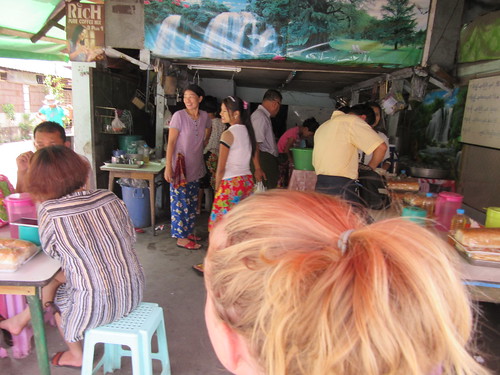
A visit to the main Locomotive Works at Insein had been arranged for the afternoon so, when we left Mahlwagon, the Doctor had to drive across Yangon to Insein. On the way, we stopped for a quick lunch of soft white bread, hot milk and yoghurt at a small roadside cafe which is famous for its milk. Certainly, as we consumed our lunch, they were doing a brisk takeaway business, particularly in milk supplied in plastic bags. There is no standard pasteurisation or sterilisation of milk, so a reliable source of supply is essential. A number of stainless steel churns were standing on the pavement and, as I watched, these presumed 'empties' were loaded into a taxi, a dignified gentleman with a beard climbed into the passenger seat and the taxi drove off, I assumed to obtain more milk.
'Milk Bar', Yangon-style.
After our meal, we continued to the Locomotive Works for our afternoon visit. Once again, we were made very welcome and I had a great time trying to grasp all the activities. There's a more technical description of our visit to Insein (with links to pictures) in the post http://janfordsworld.blogspot.co.uk/2015/05/insein-locomotive-works.html.
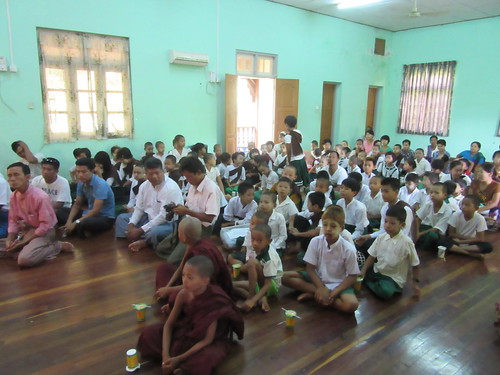
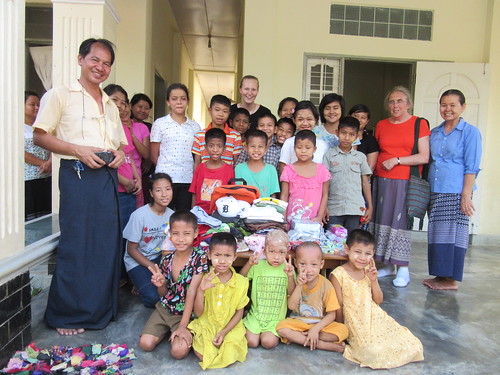
There was one final piece of business. We drove to the Palae Metta Home which has about 20 orphans, boys and girls over a wide age range. It was built by and now operates in honour of the memory of Isabel and Lawrence Barnett and Bob Jennings. For the last three years, running costs have been met by a German charity. Dr. Hla Tun supports the home as possible and we brought clothing and stationery which was gratefully received.
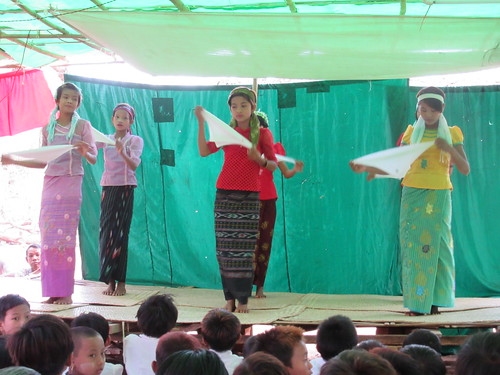
The boys and girls performed a song for us before we left. There's a short video of the song here. After seeing the video, the 'Back Button' will return you to this post.
Smiling faces at the Palae Metta Home.
Events of Thursday, 6th May 2015
On Thursday, I was picked up from the Strand Hotel at 05:15 to go to Mingalardon Airport for my Qatar Airways flight to Doha where I transited to another Qatar Airways flight to Manchester, England. 'Burma-2015' was quite a trip!
My posts
All my posts on this trip to Myanmar can be found here.
My pictures
The following albums (on Flickr) hold pictures relevant to this post:-
I'd been invited to join the team from Pencils for Kids, Inc. distributing backpacks with uniforms/robes and items of stationery at two Nunneries in the Yangon area.
Pencils for Kids, Inc. was founded by Retta Jitner, the current President, in 2007. It operates in Myanmar, Bali and Thailand.
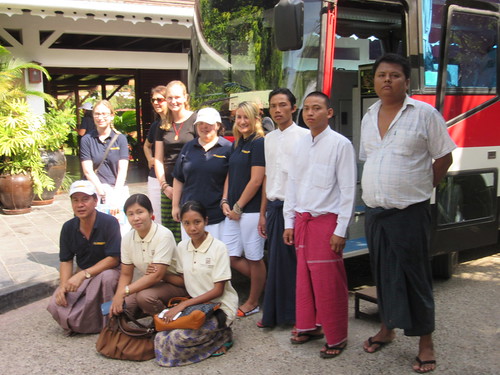
The Doctor, Emily and I met Retta, accompanied by four American ladies from her group, at their hotel the Belmond Governor's Residence. Since they were generally wearing blue polo shirts with the 'Pencils for Kids' logo and white baseball caps also with the 'Pencils for Kids' logo, they looked quite impressive. Doctor Hla Tun was similarly attired but Emily and I were in plain T-shirts with longyi. We travelled in an air conditioned coach with driver, assistant and two local guides. A small pick-up truck with seats followed with the actual items to be distributed.
'Pencils for Kids' team at the Belmond Governor's Residence, Yangon (Retta was taking her own photograph of the group).
Retta at Syriam Nunnery.
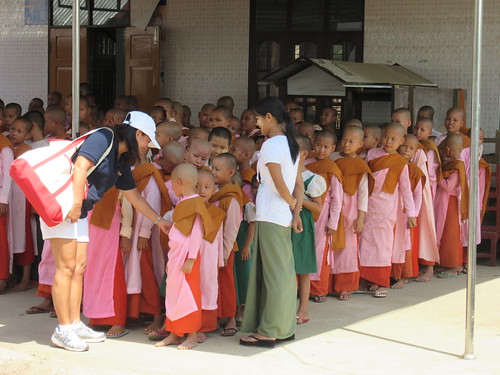
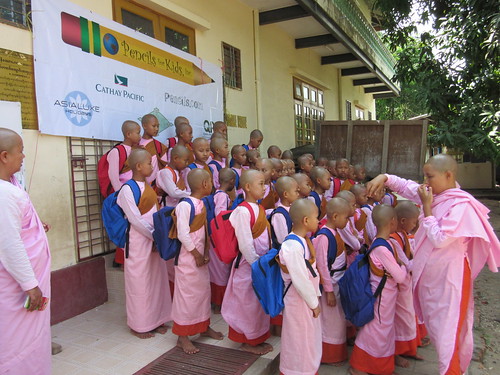
In the morning about 200 sets of backpacks (with 'Pencils for Kids' logo), uniforms/robes and items of stationery were distributed at the Syriam Nunnery.
The 'Group Shot'.
After lunch in a private dining room at a nearby restaurant, we drove a little further out of the city to a smaller Nunnery. The approach road was too narrow for the coach so we travelled the last few hundred yards in the pick-up truck.
The young nuns sang for their visitors.
After the presentations, the 'Group Shot'.
The 'Pencils for Kids' team.
The coach drove us all back to Yangon and we said 'good bye' to our friends from 'Pencils for Kids'.
In the previous post, Yangon (Part 1), I promised to tell you about a rather surreal incident. There I was, unexpectedly enjoying a cab ride on Yangon's 'Circle Line' and taking plenty of photographs. At one of the frequent station stops, a man joined the train and came into the cab. I took him to be some sort of railway inspector because he carefully checked the logbook being assiduously completed by the Secondman (Assistant Driver). We exchanged smiles and he took one or two calls on his mobile phone. Answering another call, he passed the phone to me and said "It's for you". To say I was surprised is an understatement. A man's voice on the phone said that he had some answers to my questions. As we were travelling, I couldn't hear very well and I didn't get his name. I concluded that my mystery caller must have been recruited by my friend Htein Lin to help answer some railway technical questions I'd asked the previous Saturday. It was only that evening that Htein Lin explained to me that he had, indeed, asked his friend Zaw Lin to help and that Zaw Lin is a train driver on the Circle Line. So, I suppose Zaw Lin had been on one of the trains we passed and had recognised me and the railway inspector and decided to make contact. But it was a very odd experience! When we arrived back at Yangon Central Station, I said 'goodbye' to my new friends and walked back to the Strand Hotel, pausing on the way to buy second-hand books in English from a series of street sellers offering books on all sorts of topics.
A shower and a drink at the hotel re-vitalised me, so I set off again on foot, going east along Strand Road before turning north for a few blocks, crossing a number of main roads (Merchant Road, Maha Bandula Road and Anawratha Road) before turning east again on Bogyoke Road.
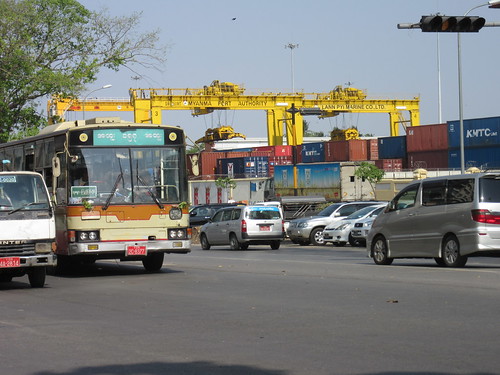
Strand Road, looking towards the docks.
A slightly more aggressive method of crossing roads seemed to be indicated. In Myanmar, vehicles are allowed to turn right against traffic lights so pedestrians wait in vain for an 'all red phase'. Rather, you cross roads one lane at a time, pausing (with traffic passing both in front and behind you) until there's a space between vehicles in the next lane and so on.
The route I was on was one I'd taken a couple of years ago, described in the post Back to Yangon.
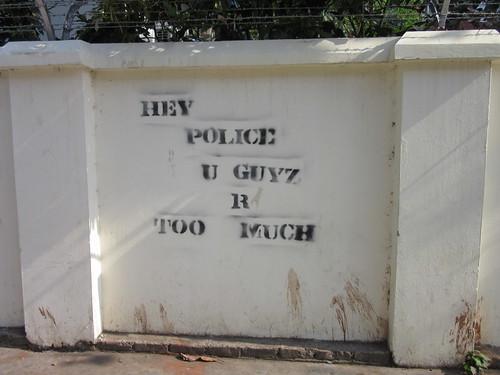
Textspeak meets Irony?
The Yae Kyaw apartment complex being built was a new development since 2013. Health and Safety for the construction workers didn't seem quite as rigorous as back home.
The Yae Kyaw apartment complex under construction.
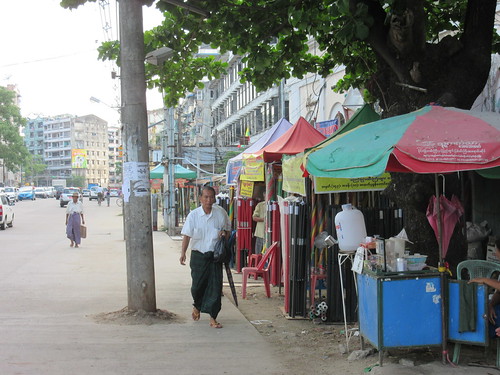
Another new development, less permanent than the Yae Kyaw Complex, was a section of the road which has spawned numerous stalls which all seemed to be offering identical fold-up 'gazebos' and large umbrellas.
Fold-up 'gazebos' and large umbrellas for sale.
Back in 2013, I'd reached Pazundaung railway station (one station east of Yangon Central railway station) and, exhaused, decided to catch a train back. This time, I'd hoped to get beyond Pazundaung, towards Mahlwagon but, by the time I'd reaching Pazundaung station, I was, once again, ready to catch a train back. The kindly station master was worried that I wasn't aware that I was only one station from Yangon Central but, once satisfied, he had his booking clerk issue a ticket costing just 50 Kyats.
Various trains came and went before the one I'd been directed to. I was worried by a group of four ladies sitting on the rails of the anti-clockwise Circle Line, apparently oblivious to the possible approach of a train.
However, before a train arrived on that line, they'd been joined by quite a crowd of passengers.
At last my own train arrived. The train was packed but there was room to stand on the step inside the doorway (many Circle Line coaches are without doors, so it's as well to hold tight to the grab rail. In contrast, the "new" Japanese trains are the height of sophistication, with driver-controlled air operated sliding doors). On arrival at Yangon Central, I indulged in a taxi (yes, a proper 4-wheeled saloon) to return to the Strand Hotel. Once in my comfortable room, I didn't venture out again that evening.
I've deliberately excluded railway technical discussions from this post but I'm sure I'll add a more technical write-up later.
The next day, I'd been invited to join the team from 'Pencils for Kids' distributing backpacks with uniforms/robes and items of stationery at two Nunneries in the Yangon area.
According to the 'welcome' letter from the General Manager of the Strand Hotel, it was built in 1901 by John Darwood (presumably the same family also mentioned in my post Rangoon Tramways) but was subsequently acquired by the Sarkies brothers. Regarded as the "finest hostelry east of Suez" it was said to be patronised by "royalty, nobility and distinguished personages". Certainly, Rudyard Kipling (see my post Kipling's Burma), George Orwell, Somerset Maugham and Noel Coward stayed here.
I had an excellent night's sleep and took breakfast in the Strand Cafe with views of the busy Strand Road. I decided to walk to Yangon Central Station and take a trip on the fascinating 'Circular Railway'. Leaving the hotel, the first change I found within a few yards of the hotel was a covered concrete footbridge which has appeared since my last visit linking the north side of Strand Road (the hotel side) with the road to the Dalla ferry terminal. Many people who work in Yangon actually live in Dalla, the other side of the Yangon River. In 2009 I described a fascinating visit I made to Dalla in the post Ferry to Dalla. Each end of the new footbridge has both steps (for descending pedestrians) and a Schindler escalator for going up. There's a third set of steps leading to the south side of Strand road but these are not provided with an escalator. The bridge offers some new angles for photographs. A number of women were attempting to keep the bridge clean, sweeping up the dust and mopping but with the hordes of pedestrians passing in both directions it was a difficult task.
The new footbridge across Strand Road.
I also noticed that the area in between the old brick transit sheds and the road to the ferry terminal is being developed but as what, I couldn't determine.
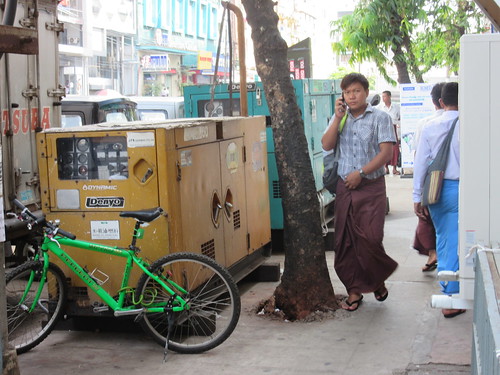
Yangon's electricity supply is still not very secure and the number of commercial premises who find it necessary to provide standby generators has increased over the years. This plant invariably provides another hazard on the already quite difficult pavements. I fondly remember some museum-ready installations with little 'Lister' engines driving a generator via a belt. Today they all seem to be 'packaged' sets of varying size and sophistication, although some of them are rather battered in the way I rather think only the Burmese can achieve.
Standby generators mounted on the pavement in Yangon.
When I reached Yangon Central Station, I went to the 'Circle Line Tourist' booking office on platform 6/7. Once, tourists had to pay with U.S. Dollars but now they accept Kyat. A complete round trip is 1,000 Kyat (around one dollar). The hand-writing of ticket details, using a duplicate book and carbon paper, has stopped - a pre-printed paper ticket is now used which only requires two rubber stamps to validate it. Long-distance tickets are probably still manually produced. My train was to leave from platform 4, so a member of staff conducted me across two lines to the right platform (the platforms are very low so everybody always walks across the lines, although the station does have a footbridge which, with my British upbringing, I usually feel compelled to use). Assuring me that my train would arrive shortly, my guide returned to the ticket office.
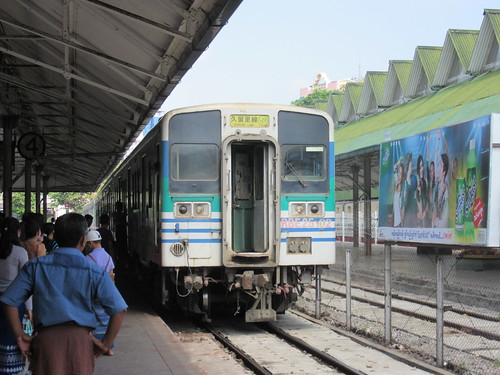
When the train appeared, heading anti-clockwise, I was initially disappointed because it was one of the "new" air-conditioned diesel multiple units from Japan. But these are actually super-annuated units withdrawn from service in Japan, re-furbished and re-bogied for use in Myanmar.
My train arriving in Yangon, still displaying its former Kururi Line markings in English and Japanese.
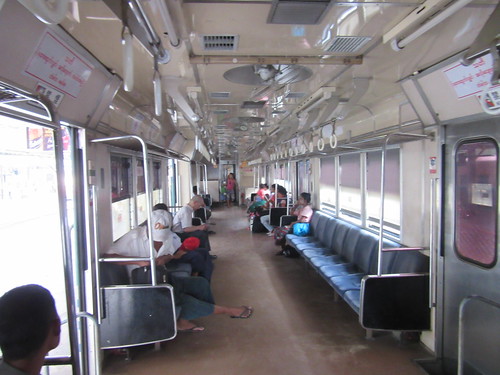
To my surprise, rather than continue anti-clockwise, we set off in a clockwise direction so, to position myself near the front, I had to walk the length of the 5-coach train. Externally, the bodysides have been sold as advertising space so the units look as gharish of some of our English trains. Internally, the original crop of Japanese signage (prohibitions, no doubt) has been re-inforced by Burmese signs. Each coach was provided with a number of oscillating fans, so I wondered if the trains really were "air-conditioned". I was puzzled because about 1 in 3 windows had been opened two or three inches whilst the remaining windows were shut.
The comparatively luxurious accommodation of the 'new' trains.
After about 75 minutes we were about halfway round the Circle Line and the train seemed to be warming up. Train staff came round opening some of the windows fully. They also opened the door to the driving cab and wedged it open with a wooden wheel scotch. Since the gangway door at the front of the cab was already open, when we were moving this produced a good current of air through the train.
I positioned myself near the open cab door for photographic purposes and, seeing my interest, I was invited into the cab and presented with one of the plastic stools to sit on with an excellent view ahead through the open gangway door. I stayed perched on my seat with a broad smile on my face (I must have looked like a sort of garden gnome) until we arrived back at Yangon Central.
Passing another 'new' diesel multiple unit.
There are two short videos showing parts of the journey. The first video shows the train on plain line and can be accessed here. The second video shows the train entering Yangon Central Station after waiting for the signal outside the station and can be accessed here. After watching either video, the 'Back Button' will return you to this post.
There was a rather surreal incident on the journey which I'll describe in the next post.
I know I've yet to tell you about part of the Mon State trip, part of the Putao trip and Saturday in Mandalay. I'll go back and fill in the gaps when I can.
I had a decent breakfast at the Sedona and discussed with the staff the possibility of taking a local train somewhere. But I also needed to be ready to leave for the airport at 3 p.m. and there didn't seem to be a feasible trip. Instead, I decided to have a walk to the station to look around.
I left the hotel about 08:00 and the day was already hotting-up with bright sunshine. I deliberately chose a slow gait along the pavement next to the Royal Palace Moat. Walking gives the chance of spotting things of interest and taking photographs. It took me about 45 minutes to reach the station (it is a fair distance). On the way, I saw that Mandalay City Development Committee are having a new steel-framed building put in on their front lawn. It might be some sort of arena with seating. In various places, I saw new reinforced concrete structures being built, generally up to five stories high although a few are much taller. I found one piece of grafitti with the wish "To be peaceful, Motherland". I'm afraid peaceful co-existence of the various ethnic groups and satisfaction with the pace of political change towards a recognisable full democracy still eludes this marvellous country. I passed red brick Methodist and Anglican churches before turning left onto 78th Street. This important street has three lanes in each direction but usually the lane nearest the kerb is avoided by through traffic and it's usually occupied by pedestrians, who normally keep their back to approaching traffic, motor cycles and bicycles going the wrong way, parked vehicles and tradesmen offering various goods to approaching vehicles.
I arrived safely at the impressive station building and went upstairs to look at the two booking offices. All the signs and most of the timetables were in Burmese. The English timetable I located confirmed what the hotel had said. There were supposed to be bi-lingual Burmese/English electronic displays, but I didn't find one working. I decided to have a good walk around the platforms and then circumnavigate the station using public roads. This provided information not only on Myanma Railways but also on the lives of the people.
I saw one long express train from the south arrive, hauled by 1300 h.p. diesel electric locomotive DF.1342. This class comprises refurbished 'YDM4' locomotives from India. As the train rolled into the platform, a series of men jumped onto the train, one to each door. I assumed they were self-employed porters trying to secure clients before the train had even stopped.
Rejoining 78th Street, I continued south, passing the 'Great Wall Shopping Centre' on the opposite side of the street. Then, I took a side street on the right hoping to reach the west side of the station. The street turned left so as to avoid the railway but lots of pedestrians were simply walking across the tracks as if there were a level crossing at that point so I copied their example and, having crossed the tracks, then turned right so that I was heading north on the street to the west of the station. I was definitely on the 'wrong side of the tracks' and the lifestyles of some of the people explained why Buddhists believe that "life is suffering". Numerous people spoke to me, none in an unfriendly manner and nobody tried to sell me anything. At one place, I saw a petrol-driven air compressor and a sheet of plastic rigged over bamboo poles - bingo, instant tyre repair shop. Nearby, a pile of rubbish dumped in the street was being sorted, presumably for reclamation, by a man and woman squatting beside what appeared to be an 'official' council lorry. A group of children were playing beside an open drain full of cloudy water. I passed a couple of concrete cisterns full of water which I assume is the only water supply available to these 'people of the streets'. Some people were washing clothes whilst others were carrying out there personal ablutions.
By the time I'd watched Kawasaki-built 500 h.p. diesel shunter D.512 perform a few shunting moves at the north end of the station, I'd completed my circumnavigation of the station but I was very tired, having been walking in the sun for two and a half hours. As I walked towards the yard in front of the station where I'd have a choice of hiring various forms of transport back to the hotel, a motor cycle taxi pulled up alongside me and offered his services. I think he expected the brush-off, because he looked quite surprised when I asked for a quote. Lady pillion passengers usually (or perhaps invariably) ride side saddle in Myanmar and I was, as usual, wearing a longyi so I had to decide whether I thought I could balance side saddle. The driver kitted me out with a crash helmet (he was already wearing one) and we set off into the traffic. Well, he took it fairly gently and I thoroughly enjoyed the ride back to the Sedona.
I was able to take it easy for a while before getting ready to be picked up at 15:00 for transfer to the airport for the Air Bagan flight to Yangon with an intermediate stop at Nyaung Oo, which I think they've started to call 'Bagan'.
The flight was on time, my bag appeared promptly at Yangon Domestic Terminal and a driver was waiting holding a sign with my name. As usual, traffic was heavy but, on arrival at the Strand Hotel, I received the usual warm welcome.
All my posts on this trip to Myanmar can be found here.
Back in September 2012, I met a train driver in Myanmar called Htein Lin. That meeting was described in the post By Train to Naba. He and I have corresponded by e-mail since then and on 30th May 2014 I spent the day with Htein Lin, his wife and two daughters, described in the post Mandalay Briefly.
We'd agreed to spend some time together on 1st May 2015 and we met up at the Sedona Hotel. The day was a holiday and also a Full Moon in the month of Kason, making it a very auspicious time for a visit to Mingun, home of the 'Unfinished Pagoda' and other important locations.
My first visit to Mingun was during my first visit to Myanmar in 2008, described in the post Round the World Five - Day 6. I went to Mingun a second time in 2010, described in the post Back to Mandalay.
This time, we went by taxi. Now, Mandalay is on the East Bank of the Ayeyarwaddy but Mingun is on the West Bank, a few miles further north. To cross the river, it's necessary to set off going south to Sagaing to get to the only road bridge in the area. So, it's a fair journey and there seemed to be many people apparently making the same journey. We stopped on the way and the driver was despatched to obtain canned drinks from a shop. Apart from the usual carbonated drinks like Coca Coloa and Sprite, energy drinks in 250 mL cans seem popular. There are a number of brands - Red Bull is widely available but, this time, we had 'Shark' (something to do with the drink having 'bite', I think).
A number of the pagodas we passed were soliciting donations from the passing traffic. A public address system is set up at the roadside and an excited male voice exhorts the traveller to generosity. A number of collectors, often young women, stand at the roadside holding out a metal offering bowl to catch the donations. One pagoda we passed was making ready to distribute a free lunch.
After a number of hold-ups on the narrow roads, we arrived at Mingun and parked near the unfinished pagoda. There's a small shrine inside the single entrance at the front and, having removed footwear, we joined the visitors making an act of worship inside. There's a charge levied by the Conservation Department and some work was apparent. Proper brick steps with a handrail now allow visitors to climb to the top of the Unfinished Pagoda in relative safety but we didn't accept the challenge.
We did closely examine the Mingun bell, along with crowds of excited Burmese. It claims to be the "largest uncracked bell in the world", since Moscow's Tsar Bell, whilst larger, has an 11 ton piece broken off and displayed alongside (I described a visit to the Tsar Bell in the post Inside the Kremlin).
We went into a large elderly persons home maintained by donations. My friend explained that he had been a donor here for some time and we went inside one of the ladies' dormitories briefly. The English are reputed to respond generously to appeals for help but, in Myanmar, it is a natural part of being a Buddhist.
There are a number of art galleries at Mingun but there were also a lot more souvenir stalls than I'd seen on my previous visits, all thronged with Burmese enjoying a day out. We took lunch at a large restaurant with views of the Ayeyarwady River and my friend ordered food for me exactly to my taste (steamed rice and non-spicy vegetables).
Then, we set off back south to Sagaing and its road bridge. Approaching Sagaing, we passed the large Wachet Jivitadana Sangha Hospital, opened in 1984 and, apparently, with American connections. Sagaing has a special place in Burmese Buddhism and there are numerous pagodas, monasteries, nunneries, meditation centres and study centres scattered across the hills. It also has narrow, twisting streets which took some time to negotiate as the traffic was still heavy.
When we reached the main road leading to the bridge, we turned away from the bridge towards nearby Ywa Taung. My friend knew that I'd been keen to find more information about the Diesel Locomotive Workshops at Ywa Taung. We drove to the main entrance knowing that the works was completely closed for the holiday. Having made a photograph, we then went to the home of the Divisional Mechanical Engineer, Khin Maung Htun. He graciously received us and gave me a lot of information about the activities of the workshops, using a Powerpoint Presentation. As soon as I can, I'll write a separate, technical post about the Workshops.
We then crossed the road bridge back to the east bank of the river and drove back to Mandalay after a very enjoyable day out. We had soft drinks in 'Planters Bar' at the Sedona Hotel after which I said 'goodbye' to Htein Lin and his family.
I was not quite finished for the day. My friends in Mandalay, the Ko Hlaing and Ma Khaing Family, came round to the hotel. Their charming young daughter is growing up fast and has an amazing command of English. She and I had a walk around the outside swimming pool and she asked questions about everything we saw. I'd last seen the family a year earlier, as described in Mandalay Briefly.
All my posts on my 2015 trip to Myanmar can be found here.
[Actually first posted 6th May 2015, but timestamp amended to place posts in event order]
In the afternoon, Aung and I travelled together on Air Bagan Flight W9-424 from Putao to Mandalay with an intermediate stop at Myitkyina. At Mandalay, I disembarked whilst Aung stayed on the flight to return to his home in Yangon. The transfer bus at Mandalay was a very second hand Japanese bus. In the large baggage hall, we waiting some minutes before one on the baggage conveyors started up and started spitting out bags intermittently. I stood despondently as the waiting crowd thinned out having found their bags until I was alone and no more bags emerged. Then, a member of staff came sauntering up pushing my bag which, for some reason, had not been through the baggage conveyor. Once they'd collected my baggage tag, I was able to have all my luggage X-rayed and move into the arrivals hall where I'd spotted my waiting driver. He recognised me and said he'd driven me before. He was driving an air-conditioned Toyota 'Alphard' and, for once, I didn't complain about the air conditioning.
Myanmar is changing quite quickly in some respects. The dual carriageway leading away from the airport has sprouted regular posts which I assume will shortly be fitted with lights. At one of the many traffic islands, a huge filling station is under construction. At one point, extensive blocks of what looked like apartments are being built. At the junction with the road to Sagaing, we took the right fork for Mandalay but, in the background, I could see the silhouette of the Sagaing Hills with the triple arches of the new road bridge. As we approached the city, we passed a toll station which relieved us of 500 kyat (about half a U.S. Dollar) after which are area became built up with commercial and industrial premises lining the dual carriageway. As we came nearer, the traffic sloowed, giving me time to notice large new cantilevered structures carrying traffic lights. I noticed the rather mis-named Prince Airport Hotel - it had taken us 30 minutes from the airport to pass the hotel. As we continued, the shops seemed to be more up-market fashion stores and lots of mobile phone stores. Having passed the railway station, we turned right to run parallel to part of the moat around the former royal palace. Very soon, we were pulling into the forecourt of the Sedona Hotel.
Fortunately, I was expected so, within a few minutes, I was in a comfortable room at the front on the 5th floor, with a splendid view along the palace moat to Mandalay Hill in the background. Rooms at the front are noisier, but I think I prefer the front for the commanding views. I'm at the Sedona for two nights, then I fly back to Yangon for the last segment of my trip before returning to England.
I'm afraid there's been too much going on to write up all that's happened but, sooner or later (probably later) I'll try to complete the story and add pictures.
All my posts on this trip to Myanmar can be found here.
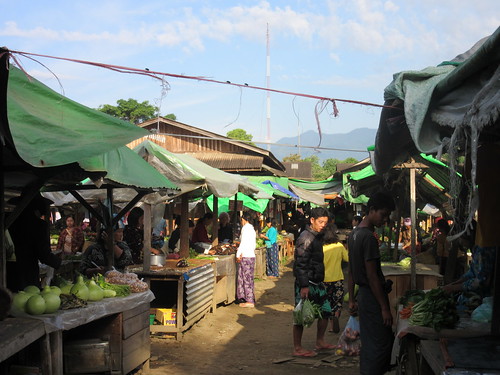
We’d arranged to explore the Market at around 7 o’clock in the morning.
Putao Market.
With appetites whetted by the walk, we returned to Putao Trekking House for breakfast. They’d laid on white toast with butter and preserves followed by a plain omelette for me. They couldn’t resist following that with a pancake and honey. I have to admit, the pancake was very good.
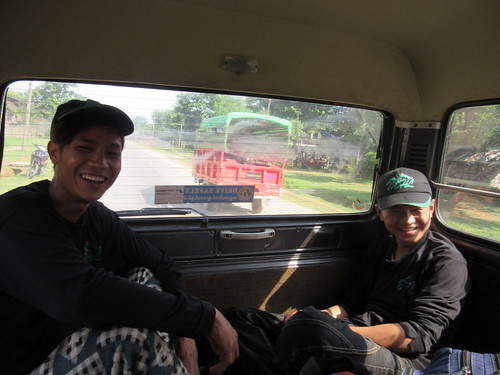
After breakfast, we set off on the main feature of the day – a trek of around ten miles to Namkhan Village. I’d loaded my backpack with clothes and essentials for one night’s stay at a guest house at our destination. We initially set off in the Toyota – Aung, the Local Guide, the driver and two young men who travelled in the luggage space at the back and whose function wasn’t immediately clear.
The two young men who accompanied us to Namkhan.
After a few miles, we stopped at a small village of bamboo houses, picked up our backpacks and began our trek by walking through the village to the pretty, rolling wooded countryside beyond. We crossed a number of narrow pedestrian footbridges made of bamboo but there appeared to be fords adjacent so that motor vehicles could also follow the track. In other places there were wider, rather ramshackle, bridges which presumably could support a light vehicle. It became hotter but I knew that the first ‘leg’ would only be an hour. We arrived at another small village where we joined a tarmac road and continued over the brow of a hill, where a river crossed by a suspension bridge could be seen, with a golden pagoda on the opposite bank gleaming in the bright sun.
The suspension bridge appeared to be of local design. The two orange-painted towers on opposite banks were reinforced concrete and the ends of the suspension cables were anchored to substantial concrete blocks. The actual bridge deck was fabricated from modular ‘Bailey’ bridge parts with the road surface in timber. On either side of the bridge deck there were ‘horizontal catenary cables’, anchored to smaller concrete blocks. These cables were then connected to the bridge deck every few yards by smaller cables. The function was presumably to counter horizontal sway of the deck, but it’s a feature I’d not previously seen (although we crossed a number of similar bridges later in the trip).
As we walked across the bridge, a painful groaning came from the far bank, where one of the ubiquitous Chinese-made heavy lorries was struggling along a track which led from the river bank to the road we were on. When we reached the far bank, the lorry had parked and the driver and his mate were on the ground examining the rear axle. The lorry was loaded (or more probably overloaded) with stone and, from the noises it was making earlier, they were right to be concerned.
Next to the parked lorry was a small tea house where we paused for refreshment. We left our back packs in the restaurant and walked a few hundred yards to the pagoda we’d seen from the top of the hill – Kaung Mu Long. Major reconstruction work was in progress and although it looked new, it’s on a very ancient site. Outside the pagoda was a display of photographs and plans detailing the reconstruction. I was fascinated by all the trades involved in completing the work. The approaches to the pagoda were via steps covered in marble slabs and two smiling women were mixing grouting cement and grouting the gaps between the marble slabs. In various places, men were painting different features in gold, white or coloured paints. The hardest work was being carried out by a group of women working on the river bank below us who were involved in the protection of the river bank against erosion. Large rectangular wire cages called gabions were being filled with round stones carried from the shore manually. I noticed a ‘CAT’ packaged standby generator at the base of the pagoda to power the various electric lights which were still being wired.
I'm afraid there's been too much going on to write up all that's happened but, sooner or later (probably later) I'll try to complete the story and add pictures.
All my posts describing this trip to Myanmar can be found here.
My pictures
The following albums (on Flickr) hold pictures relevant to this post:-
As I suspected, Putao has yet to receive the benefits of the internet. I was told there's one public office in the town where connection is possible, so I had to wait until my arrival in Mandalay to post this report.
On this trip, I visited the northernmost state of the Union of Myanmar, Katchin State, spending four days in and around Putoao. Wikipedia gives a simple introduction to Katchin State here.
Events of Tuesday 28th April 2015
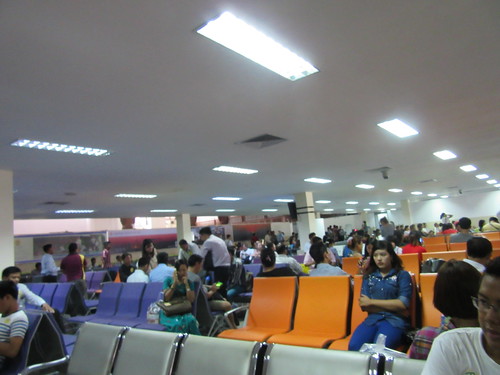
I was picked up from Dr. Hla Tun’s house at around 09:15. In the car was the lady managing director of Sunbird Tours, Tin Htar Oo and my guide for the trip to Putao, Ye Aung Zaw (called simply 'Aung'). We set off into Yangon's heavy traffic. On the way to the airport, we dropped off Tin Htar Oo then carried on and arrived at Mingalardon’s bustling Domestic Terminal around 10:00, in plenty of time for the 11:30 Air Bagan flight to Putao. There’s very little in the way of automation and plenty of consultation of paper lists but our checked-in bags were accepted after weighing on old-fashioned weigh scales and on completion, we were issued with a little stick-on label which all the airlines use. Our Air Bagan labels had been marked in felt-tip pen ‘PBO’ (the ticketing code for Putao). We waited patiently in the departure hall until the public address system announced a one hour delay to our flight so we decided to go upstairs where there’s a reasonable buffet. We each had a leisurely soft drink and then went downstairs again but the information screen didn’t even mention our departure. Things looked more ominous when a couple of Air Bagan people came round with trays holding plastic cups of soft drinks and distributed small lunch boxes containing a cheese sandwich. I was somewhat mollified by the refreshment and then another announcement said that the delay would be one and a half hours – if true, better than I had feared.
The Domestic Departure Hall at Mingalardon Airport, Yangon.
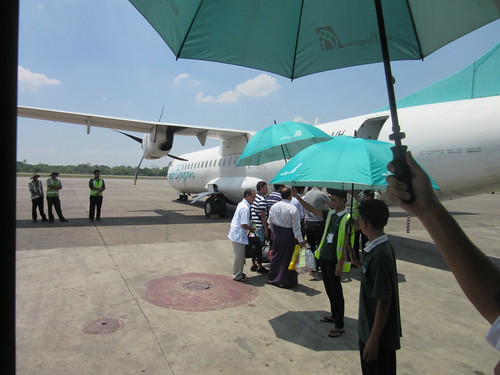
They were telling the truth – a ‘bell-boy’ carrying a board with the flight number circulated the waiting area announcing that the flight was ready for boarding about 90 minutes after we’d originally expected the call. We were loaded into one of the modern, air-conditioned transfer buses (I was rather sorry when they replaced the ancient ‘rattletraps’) and we drove off into the ‘International’ area of the apron, which initially puzzled me. But this was only to turn the bus around, after which we headed to a remote stand in the domestic area where an ATR42-series turbo-prop was waiting. When the doors of the transfer bus opened, I was hit by a wall of heat which took my breath away. Air Bagan were aware of the temperature and had provided a line of ground staff with umbrellas to shade the passengers walking the few yards from the bus to the rear airstairs on the aircraft. When the inevitable hold-up occurred as people found the correct seats, staff held the remaining passengers on the bus until the blockage had cleared.
Umbrellas shaded passengers between the transfer bus and the aircraft, whilst technical ground staff sheltered under the wing.
Soon we were airborne and heading for Mandalay at a cruising level of 19,000 feet. Air Bagan provided a simple but enjoyable lunchbox, a soft drink in a plastic cup and a tea or coffee before we landed at Mandalay on the longest runway in south-east Asia.
Taxiing to a halt at Mandalasy International Airport.
We stayed in our seats whilst a transfer bus took away the 'leavers', returning with the 'joiners' a few minutes later. Before long, we were on our way to our second stop, Myitkyina, the capital of Katchin State. A new terminal building was being built next to the existing modest facilities.
Myitkyina Airport: There appears to be lots of luggage to be loaded for the final leg.
Once landed at Myitkyina, a lot of passengers left us but they were quickly replaced by passengers bound for Putao so we were full again for the last short leg to Putao.
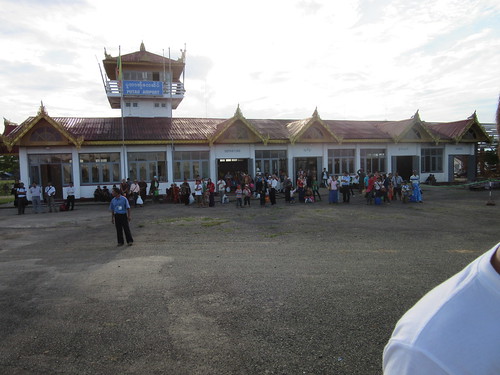
As we approached Putao, mountains appeared on our left as a reminder that we are quite near Nepal but the airfield itself is located on a plateau (elevation 451 metres, I'm told). A crowd of people were standing outside the small terminal building - presumably passengers for the return ‘leg’.
Putao Airport
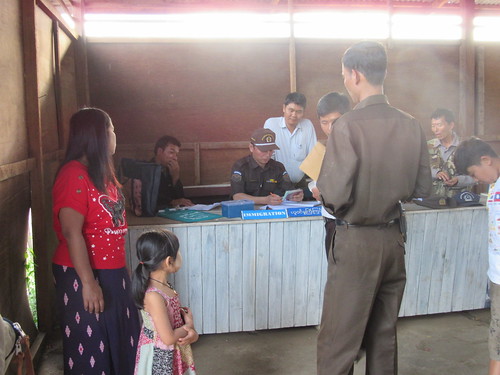
Rather than enter the terminal, we were directed to our left along an unsurfaced track, through a security check and into a large wooden barn with an immigration desk on the left where our local guide and tour leader Ngwa Phu Sar joined us as both my passport and my letter of introduction to Myanmar Immigration were carefully scrutinised.
The Immigration Desk, Putao Airport.
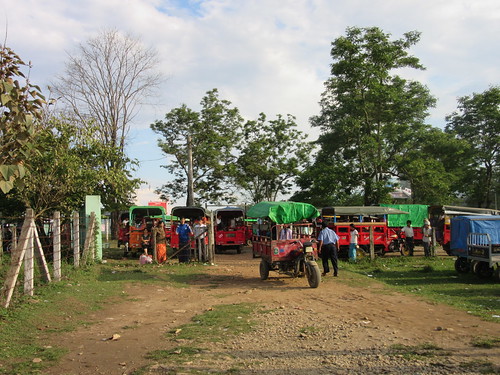
I noticed four basic check-in desks, one for each of the internal airlines serving Putao, and a single set of mechanical baggage scales which all the airlines share. After a few minutes, a group of baggage handlers appeared, struggling to get two loaded baggage trucks across the unsurfaced track. I quickly identified my bag and, after the baggage tag was checked against our receipt, we moved through a simple gate to an area full of three-wheeled bicycle taxis and a single Toyota SUV which was for us.
The public parking area at Putao airport.
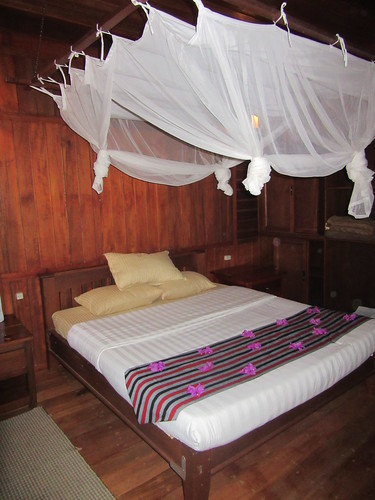
On the road from the airport to Putao itself, we passed a number of quite large wooden family houses then we crossed a couple of large streams on ‘Bailey’ bridges (there's an description of 'Bailey' bridges in Wikipedia here), finally turning left off the road leading to the town centre up a short, steep hill to stop at Putao Trekking House. It appeared that most of the staff were waiting to greet us. Cold towels and a ‘Welcome’ drink of grapefruit juice were provided. The grounds were attractively landscaped with a large main building to our right and a number of ‘cottages’ on our left, each with two ground floor rooms and two rooms on an upper storey. I was impressed by my ground floor room, provided with a large double bed (decorated with fresh flower heads and with a mosquito net above), writing desk and storage facilities. A second tiled room was fitted with a wash handbasin, European-style W.C. and shower.
My comfortable bed at Putao Trekking House.
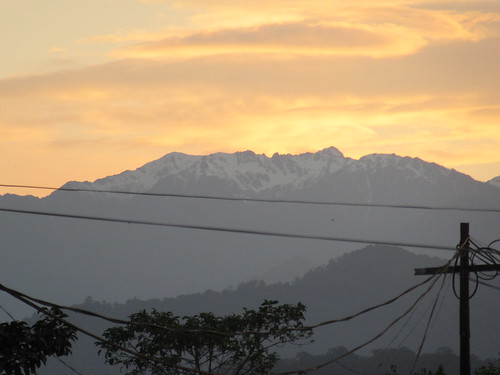
After ‘freshening up’, I accepted the offer of a conducted tour on foot around the town centre with the Tour Leader and Aung. We passed the main open-air market but as it was late afternoon this was closed. We looked at schools, municipal buildings and shops, tea-shops and restaurants. As the sky darkened, I managed an ‘arty’ shot of the distant snow-covered mountains (slightly marred by the overhead electric wires in the foreground).
View of snow-topped mountains at sunset.
We walked back to Putao Trekking House who, at my request, had produced non-spicy food for my dinner, so I was able to enjoy my meal in the spacious restaurant with the Local Guide and Aung. Although I enjoy steamed rice, I can eat less than half of what my companions regarded as adequate. By this time, I was ready for bed. The local electricity supply goes off at about 9 o’clock in the evening (rooms were provided with re-chargeable lamps featuring a rectangular array of light emitting diodes to provide illumination when there's no mains) so I made myself comfortable in the bed and enjoyed an excellent night’s sleep.
In earlier posts on this trip, I described my impressions of the Bagan Medical Clinic over three days (Friday, Saturday, Sunday).
The next day, Monday, the clinic was closed but the Doctor had arranged that, before flying back to Yangon, we would visit two of the schools supported by the RTM Social Contribution in the Bagan area. The two newly-qualified doctors accompanied us but, unfortunately, Emily's travel arrangements meant that she would not be able to see the schools.
Monday 27th April 2015
I took breakfast at my hotel in the open air restaurant, looking out across the river and then checked-out.
View across the Ayeyarwaddy River from the Bagan Thiripyitsaya Sanctuary Resort.
As arranged, I was collected from my hotel at 07:50 and taken to the monastery. The Clinic was strangely quiet on a non-opening day but, as usual, I was offered another breakfast at the monastery. I accepted congee (a rather watery 'rice pudding' flavoured with salt) and then one of Dr. Hla Tun's assistants had brought in a home-made vegetable soup for me to try. It was good.
Unusually, the Head Monk was not present but, as we were finishing breakfast, he appeared and summoned Dr. Hla Tun and I to the monastic school building I'd not been in before. A prize-giving ceremony was already in full-swing and the head monk resumed his elaborately-carved chair at one end of the assembly room, flanked on either side by two monks, each seated on carved chairs. The room was crowded with schoolchildren and their parents.
Prize-giving at the monastic school.
Having completed their examinations, this was the annual prize-giving. I've mentioned before the Myanmar has not succumbed to the "all must have prizes" syndrome which afflicts the United Kingdom. Children are respectful, disciplined and expect to work hard if they are to succeed. Each prizewinner was being presented with a framed, coloured certificate and a gift, the audience would applaud and what appeared to be an 'official photographer' would record the scene. Dr. Hla Tun made one presentation then I was instructed to make the next presentation. The Doctor and I were only there for a few minutes so I couldn't observe too much but I felt privileged to have seen the scene.
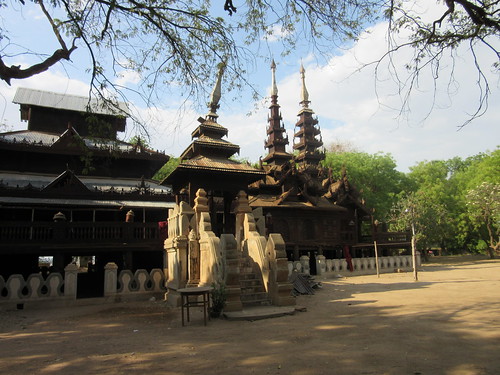
The oldest monastery building is mainly wooden and heavily decorated.
The monastery 'people carrier' was being packed with stationery which we were to distribute that morning. This Toyota vehicle was equipped with a wheelchair lift at the rear and a sign in the front window indicating that we were engaged on monastery-sponsored work. I noticed that, at the the main road toll station leaving Bagan, the road toll was waived. Monks are held in high regard in Myanmar.
We left the monastery and made the short drive to the 'Hotel @ Tharabar Gate' (yes, they use the ampersand, presumably to indicate how with-it they are). Here, we collected the newly-qualified doctor from Myanmar and her parents, together with her Chinese-American doctor friend. Our route then took us past the Ananda Temple onto the dual carriageway which, somewhat improbably, heads across the Bagan Plain, with pagodas all around.
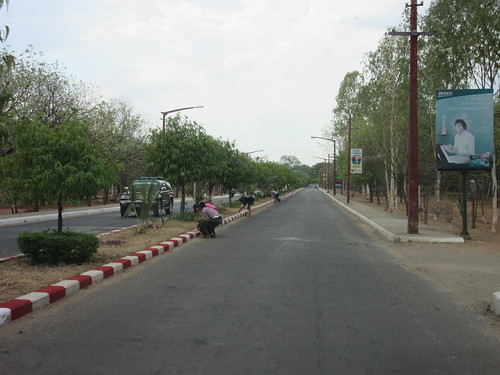
At Nyaung Oo we took the dual carriageway out of town and I noticed 'kerb painters' at work. On dual carriageways, the right-hand kerb (remember, they now drive on the right) is painted white but the left-hand kerb is painted alternately red then white. Groups of male and female workers were quatting in the gutter (ignoring passing traffic) each with a pot of paint and a brush re-painting the kerbs. One group had white paint and, in a couple of hundred yards, the next group would have red paint and so on. When we returned in the afternoon, the work was still being done.
'Kerb painters' at work on the dual-carriageway leaving Nyaung Oo.
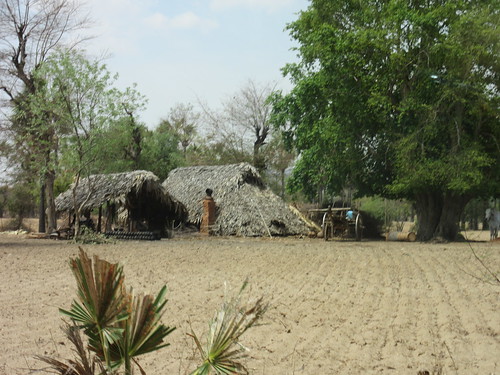
The changes taking place in Myanmar are very visible in this area - various construction projects are in hand: hotels and apartments (I think). Once we'd passed the airport and railway station turns, the road became single carriageway but still with a decent 'tarmac' surface' apart from the section across the currently-dry river bed. We passed a number of filling stations which are either new or still being completed. Eventually we passed into the sandy plain filled with Toddy Palms and, dotted around, the simple bamboo houses equipped with a still for producing the rum-like 'Toddy'.
The short, brick chimney on the simple bamboo house indicates a still.
I wrote a brief description of 'toddy' in a 2009 post here (with a link to a few photographs).
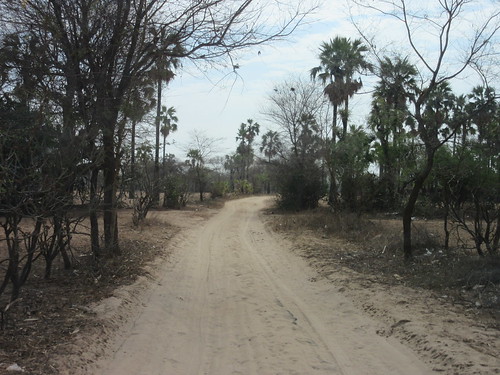
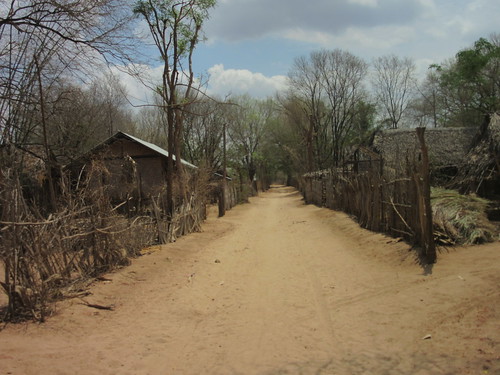
We turned off the tarmac road onto the sandy track which, after around two miles of careful driving, took us to Chauk Kan.
The sandy track to Chauk Kan village.
Chauk Kan
This was my fourth visit to the school here (my last visit is described in Visiting Bagan Schools and that post has links to the earlier visits).
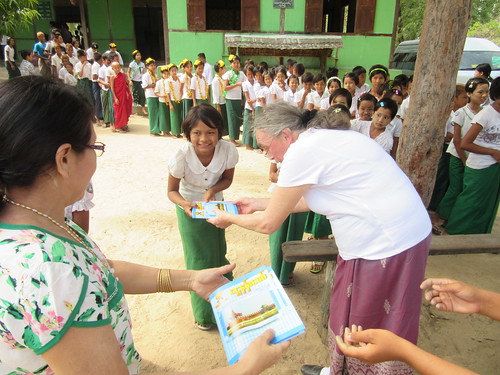
Although the school was currently closed for the summer holiday, the assembly hall was full of excited pupils, anxious to receive their distribution of free stationery.
Excited but well-behaved pupils in the assembly hall.
The headmaster first offered us refreshments, then we joined the pupils in the assembly hall and ten girl dancers entertained us, accompanied by 'pop' music from a sound system. In the meantime, the stationery had been set up out of doors for distribution.
Pupils queuing to receive stationery.
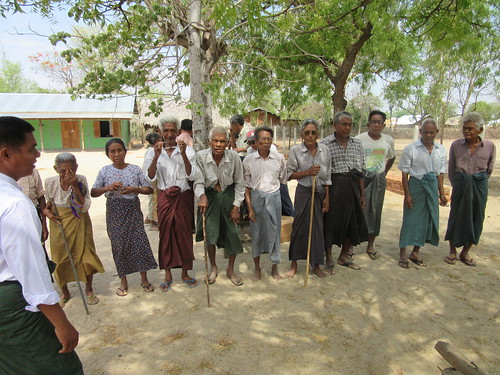
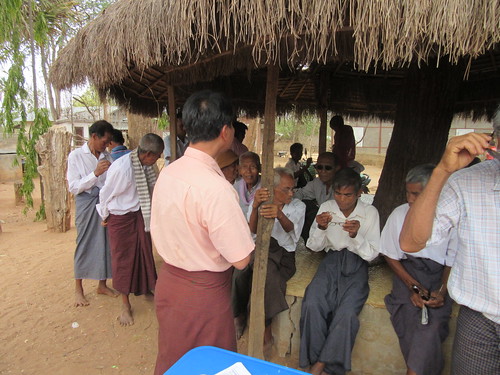
The doctor had also brought a selection of spectacles allowing local elderly people to each select a suitable pair.
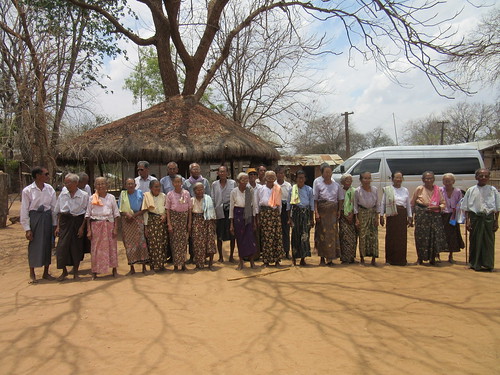
Villagers pose with their new spectacles.
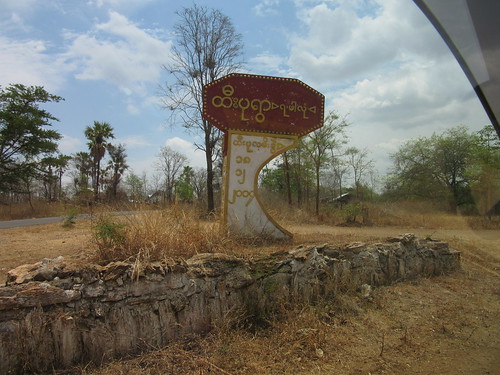
After the visitors had been shown around the school buildings, we returned to our car and retraced our route back to the main road, where we continued to Htee Pu. The village is reached by another long, sandy track which diverges from the tarmac road to Mount Popa at a junction marked by a concrete signpost.
Concrete signpost at the junction with the road to Mount Popa.
Htee Pu
Htee Pu was the first school I visited in the Bagan area, back in 2009. Since then, I've returned in 2010 (when a new, donated school building was opened), 2011 and 2012. In 2013, I visited schools at Nga-Minn-May and Chauk-Kan but time did not permit a visit to Htee Pu. But I visited in 2014 and, as described below, 2015.
Part of Htee Pu village.
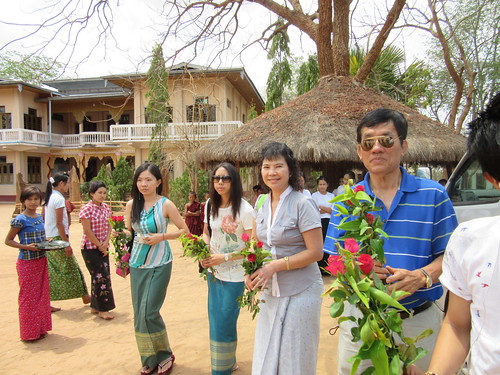
We drove into the monastery compound and parked near the main monastery building. The head monk greeted us and explained that the headmaster was away on a training course since the school was closed for the summer holiday. The visitors were each presented with flowers in welcome.
The Myanmar doctor, her parents and the Chinese-American doctor, presented with flowers.
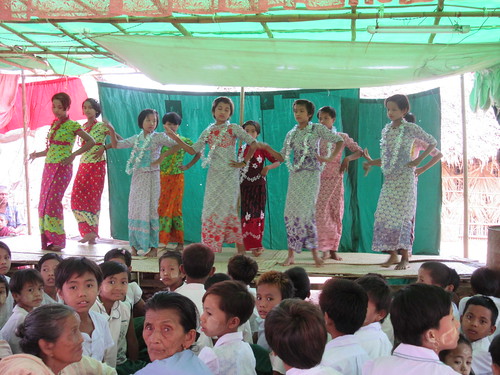
A large, colourful, bamboo-framed temporary shelter had been erected in the monastery compound and, school holidays or not, it was packed with waiting children, a group of lady teachers and villagers. The children were seated on the ground but a number of moulded plastic chairs had been provided for the visitors and some of the elderly villagers. A wooden stage covered with matting had been erected across one end, flanked on either side by serious-looking loudspeakers mounted on oildrums. Our visit was clearly being marked by a concert. Once the visitors were seated, we were treated to a variety of dances by different groups of children.
The audience was torn between watching the dance and their exotic visitors.
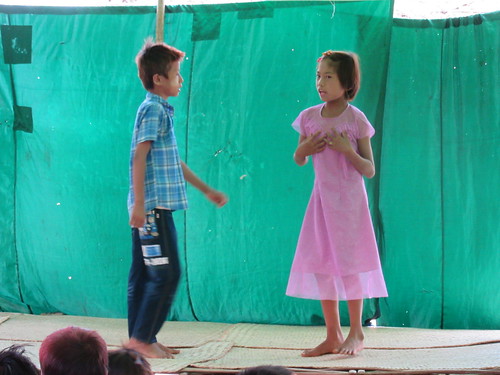
A boy-and-girl dance, with lots of actions.
A dance with handkerchiefs.
Younger children performing.
During the more energetic dances, we worried about the strength of the stage but all was well. Everybody then turned to face the visitors and there were brief speeches from the Head Monk and Dr. Hla Tun during which the visitors were introduced to the audience.
A short video of part of the performance is available here. After seeing the video, the 'Back Button' will return you to this post.
A series of tables was then set up in the compound and the stationery we'd brought was set out. Helped by the lady teachers, each of the visitors distributed the stationery to the children.
Jan distributing stationery to a group of young monks.
As at Chauk Kan, spectacles were available and there was a flurry of activity as the appropriate prescriptions were selected.
Spectacle selection.
The visitors were then taken on a conducted tour of the facilities, after which there was a group photograph of visitors and lady teachers outside the building opened in 2010.
Visitors and teachers outside the building opened in 2010.
The elderly villagers then posed for the cameras with their new spectacles.
Elderly villagers from Htee Pu.
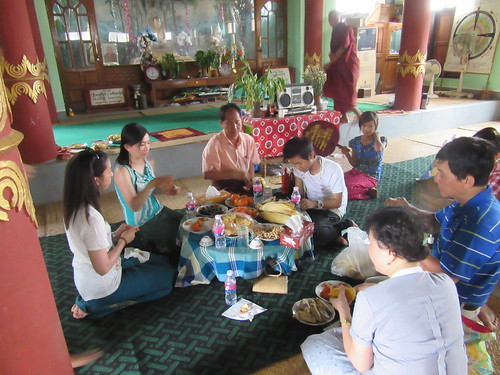
We were then invited to the monastery for for a snack before we left.
A snack in the monastery.
Mount Popa
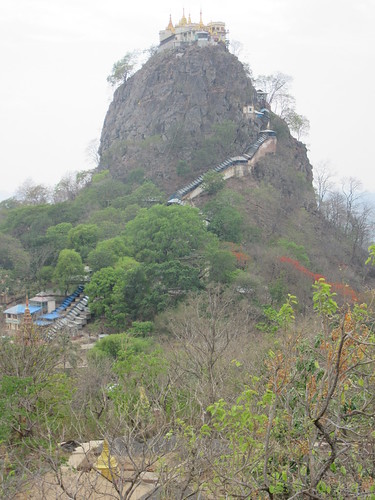
The Doctor decided that there was time to show his visitors the area around Mount Popa. Mount Popa, an extinct volcano, is a special place for the Burmese. Adjacent is the rock pinnacle of Taung Kalat, topped by a number of temples. My first visit was in 2009, described here. I was so impressed, I returned in 2011 and stayed at the Mount Popa Resort. That visit is described here and here.
Arriving at the town, we stopped at what appears to be a privately-developed 'Taung Kalat Viewpoint'. This attraction is still under construction and it was interesting to see the numerous concrete religious statues in various stages of completion. Having taken pictures of the rock pinnacle of Taung Kalat, nobody seemed keen to climb it. Instead, we went to a well-appointed restaurant and took a very pleasant lunch.
Taung Kalat, from the Viewpoint.
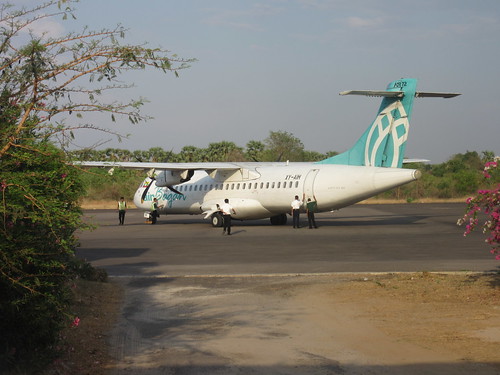
We drove back to Bagan, returning four people to the 'Hotel @ Tharabar Gate' before driving to the Bagan Monastery, collecting our luggage and saying our goodbyes. We were then driven to Bagan Airport to check in for the Air Bagan flight to Yangon. The flight, operated by Air Bagan's hardworking ATR72 (registration XY-AIH) was on time. Back at Yangon, we drove to the Doctor's house where I was to spend a final night.
Air Bagan's ATR72 XY-AIH on arrival at Bagan.
The following morning, the next 'segment' of my trip was to start with a flight to Putao, in the far north of Myanmar.
Jan's blog will be maintained, both in her memory and also as a source of reference material in many areas of interest. New posts will be added, to continue to record the ongoing influence of Jan's work and life.
Jan:
I've been an electronics engineer for over 57 years and I'm interested in travel, history, architecture, the industrial revolution, science, railways and, well, lots of things. I believe in what one of my heroes, Richard Feynman, called "The Pleasure of Finding Things Out".
'Labels to select a blog topic' (below) will select the posts on a particular subject.
The Search Box (with the magnifying glass symbol) in the header will find posts including any particular word or phrase.
'Links to photographs' (below) will take you directly to my photographs on 'Flickr'.
 'Milk Bar', Yangon-style.
 Smiling faces at the Palae Metta Home.