Showing posts with label Tyseley. Show all posts

Saturday, 24 March 2018

Class 08 User Manual

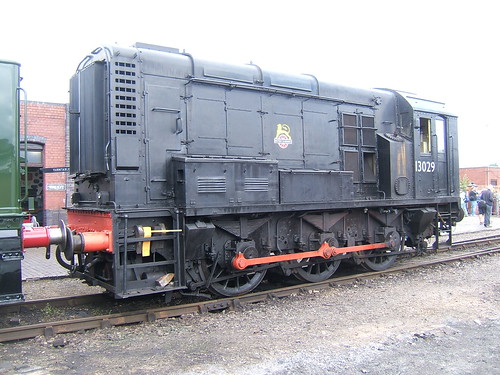
The English Electric 350 h.p. diesel-electric shunter is a rugged, useful locomotive. It became the 'Class 08' with variants classified 10, 11. These notes were specifically prepared back in 2002 for 13029 at Birmingham Railway Museum and details will vary on other locomotives. I have added a link to brief British rail training notes.


English Electric 350 h.p. diesel electric shunter 13029 (later Class 08) at Tyseley Locomotive Works. Around 1990, this was the first diesel I was passed to drive and was very handy for shunting early in the morning when the 'steamers' were still 'brewing-up'.

History

Class: 08/0
Built: BR 1958-1962.
Engine: English Electric 6-cyl 6KT of 400bhp (315kW).
Weight: 49 tonnes.
Brake force: 19 tonnes.
Maximum tractive effort: 35000lb (156kN).
Power/control equipment: English Electric Two EE505 traction motors. Double reduction gear drive.
BR Route availability: 5.
Maximum speed: 15 mph, except certain 20 mph.
Fuel: 668 gallons.

Pre-start checks

Check axlebox dipsticks for oil level and replenish if necessary. Oil coupling rods.

Open battery box on left side of locomotive and close battery switch. Open battery box on rightside of locomotive and close battery switch, additionally visually check the condition of the contacts on starter contactor.

Check main fuel tank gauge. There should be at least 50 gallons, to avoid sediment being drawn from the main tank. Enter cab and ensure handbrake applied. Check service tank fuel gauge. There should be at least 20 gallons, to avoid sediment being drawn into the engine fuel system. As necessary, operate the hand fuel transfer pump to replenish the service tank. Insert master key. Operate the hand pump on the rear wall of the cab for 30 - 45 seconds to pressurise the oil system.

Insert the master key and move to the non-locking 'EO' (Engine Only) position. Further operate the key to the non-locking 'start' position and hold in this position until the engine is firing correctly. Allow the key to return to the 'EO'position and then move it into the 'off' position, in which the battery will be re-charged and the main compressor will start. Wait until the main reservoir pressure (indicated on the duplex brake gauge) has reached 70 psi. Move the straight air brake application valve into the down (applied) position. Full brake pressure should be indicated on the duplex gauge.

The DSD is checked by placing the master direction controller in forward or backward, pressing the foot treadle and moving the driver's application valve for the straight air brake into the up (release) position. On the duplex gauge, the brake needle should fall to zero, indicating brake release. Release the DSD treadle and observe that, after a delay of a few seconds, the brake is automatically applied.

To release the brake after the test, place the driver's valve in the 'brake applied' position, depress the DSD treadle and move the driver's valve back to the release position.

To release the handbrake, partially apply the straight air brake then wind off the brake. Ensure the direction switch is set correctly for the intended movement, lookout to ensure it is safe to move, sound the horn and move to power controller into first notch. Pause at the first notch position and ensure that the motor contactor has energised (audible 'clump' from the control panel), then gently advance the power controller as necessary for the movement, checking the total generator amps as shown on the current meter.

Britsh Rail Mechanical Department, York training notes

These can be viewed, printed or downloaded here.

They comprise 9 pages:-
1. General Layout Diagram 200
2. Cooling Water System Description
3. Cooling Water System Diagram 201
4. Lubrication System Description
5. Lubrication System Diagram 202
6. Fuel System Description
7. Fuel System Diagram 203
8. Air and Vacuum System Description
9. Air and Vacuum System Diagram 204

Sunday, 9 October 2016

Birmingham Railway Museum, Tyseley

I was a 'late starter' in railway preservation, but in 1988 I joined the 'Lion' supporters group, the Old Locomotive Committee (OLCO), following a series of coincidences I've described in the post Lion. It appears that my life is guided by this sort of 'Happy Accident' as I commented in another post here.


'Lion' at Manchester Museum of Science and Industry In 1988, with a much-younger Jan.

'Lion' had been returned to steam to celebrate her 150th Birthday (or, as The Old Locomotive Committee preferred to call it "The Sesquicentenary"), visiting various sites around the country. From Crewe, where I first became involved, she went to the Manchester Museum of Science and Industry, The Science Museum at Wroughton and made two visits to Birmingham Railway Museum, Tyseley. Having become a member of OLCO, I accompanied the venerable locomotive on these public appearances. During the visit to Tyseley, one of the OLCO members let on about my interest in railway signalling. Since the Museum's plans for a new demonstration line incorporating a Great Western signalbox (relocated from Holesmouth Junction) were well advanced, new volunteer members were being actively recruited for the Museum and I was invited - no, instructed - to join. Having had no previous involvement with railway preservation, I thus found suddenly found myself a member of three organisations - OLCO, the Manchester Museum of Science and Industry and Birmingham Railway Museum.

The two visits by 'Lion' to Birmingham Railway Museum after I joined OLCO produced some record crowds at Tyseley. Otherwise, things were much quieter apart from occasional 'Gala' days when two or three large engines would be steamed. Although the site was open to the public regularly at that time, the main activity during the week was restoration and repair of steam locomotives in the workshops. On Sundays, a 2-coach passenger train gave rides on the Demonstration Line using a small steam locomotive. For a time, a 'Terrier' carried out this duty. I'm afraid passenger numbers weren't impressive. The main excitement for operating volunteers was the regular, complicated shunts which were required to position vehicles for the workshops. Initially, I trained as a Passenger Guard and Shunter at the Museum and helped out a bit on the signalling side. Once the signal box was commissioned, I also passed out as a Signalman. The weekend passenger trains, which had previously loaded and unloaded at a wooden platform behind the signal box, moved to one of two new brick platforms, giving a somewhat longer ride.


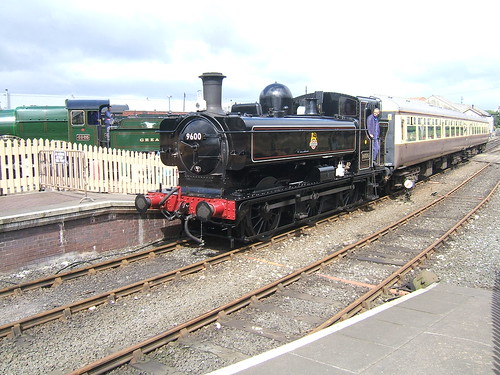
9600 giving rides on the Demonstration Line during the 'Tyseley 100' event.

In an attempt to boost income, Driving Experience Courses were introduced. The original format proved very popular - a safety briefing, sessions about shunting, signalling and, with the benefit of a number of a number of locomotives under restoration to study, the principles of locomotive engineering. Most important, of course, was hands-on firing and driving on both a small tank locomotive and a tender engine, like 'Defiant' or 'Clun Castle'. There was a need for volunteers who could do the presentations on shunting, signalling and locomotive engineering and I happily served in this capacity for a while, before gravitating to Instructor Driver on the 'Little Engines' used on the Driving Experience Courses - engines like 'Henry', 'Cadbury No. 1' or one of the three Tyseley 'Panniers' (there's a description of 'Panniers' illustrating the Tyseley 'Panniers' here). The line used by the small engine was short but that gave trainees plenty of practice in starting, stopping and reversing. Each group of three trainees spent 75 minutes on the footplate, taking it in turns to drive and (if they wished) fire. The Instructor Driver 'single manned' and had to fire, manage the boiler and instruct and supervise the trainees.

But, of course, the highlight of the course was driving a large engine on the 400 yard demonstration line. Initially 'Defiant' or 'Clun Castle' were used and, again, the Instructor Driver 'single manned', looking after three trainees in each 75 minute session.


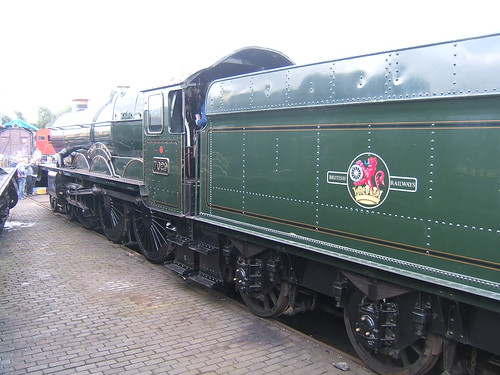
7029 'Clun Castle' running with a 'Churchward' tender.

The initiative met with such an enthusiastic reponse from enthusiasts that, later, a variety of engines offered the driving experience at Tyseley. By that time, I'd been 'passed out' to drive all visiting engines which included 'King Edward I', 'Taw Valley', 'Canadian Pacific' and 'Sir Nigel Gresley'. We thought we were busy with these locomotives on offer (which my friend Tony described as 'tasty engines') until driving courses on 'Flying Scotsman' were introduced.

To deal with the numbers of trainees who wanted a chance to drive this iconic locomotive, the course structure was simplified, omitting the presentations and the small locomotive experience and reducing the time each group of three trainees spent on the locomotive from 75 minutes to 60 minutes. Courses started earlier in the day and continued late into the evening. 12-hour shifts became common and I can remember disposing 'Flying Scotsman' at the end of a late-running shift at midnight, in a snowstorm! There's a short description of 'Flying Scotsman' at Tyseley here. As I write this, 'Flying Scotsman' has recently been returned to steam at a cost (this time) of £4.5 million. Commenting on the excitement this has caused in a post here I said "I think the opportunity for members of the public to actually drive 'Flying Scotsman' is unlikely to recur in the future".

I'll tell you more when I can, including the creation by Birmingham Railway Museum of 'satellite' courses at The Battlefield Line (resulting in my becoming a member of yet another preservation organisation). There's a short history of the Birmingham Railway Museum on Wikipedia here.

I remained a working volunteer at Birmingham Railway Museum for around ten years until Driving Experience courses were discontinued in favour of a regular steam service on the main line between Birmingham and Stratford, the 'Shakespeare Express', which commenced in 1999. Losing the opportunities for footplate work I'd come to enjoy, I decided to concentrate my activities at other sites - The Museum of Science and Industry (as the Manchester museum had become), The Battlefield Line and Peak Rail. However, I had an enjoyable day meeting old friends at Tyseley during the Tyseley 100 event in 2008.

Sunday, 4 January 2015

'Flying Scotsman' at Birmingham Railway Museum

The 'Learn to be a Driver' scheme at Birmingham Railway Museum attracted considerable interest but when the world-famous 4472 'Flying Scotsman' came to the Museum in late 1992, it became the star attraction. It was during this period that I first became intimately acquainted with 'Flying Scotsman', since I was then a volunteer Instructor Driver at the Museum.

The Museum held their Autumn Gala on the weekend of 28th and 29th November 1992, giving an opportunity to see not only 4472 in steam but also 7029 'Defiant' and 6024 'King Edward I'. 46203 'Princess Margaret Rose' also took part but she was away most of the Saturday on a Main Line Railtour. The 1992 Issue 4 edition of 'Lionsheart' published a brief notice of the event in September that year (as did other publications).

At this time, 'Flying Scotsman' was turned out in apple green, numbered 4472, with conventional drafting and the rather tiny single chimney which, surmounting the massive boiler, contributed to the impression of raw power. This was the appearance I liked best.


Flying Scotsman at Steamtown Rasilway Museum (Photo: David Ingham [CC BY-SA 2.0 (http://creativecommons.org/licenses/by-sa/2.0)], via Wikimedia Commons

I don't believe I'd seen the locomotive prior prior to her visit to Birmingham in 1992. I'd certainly seen other 'A3s' at work on the Eastern Region before steam was eliminated but I'd not followed subsequent main line steam railtours (although I did a trip behind the 'Midland Compound' in 1960, described in My First Steam Special) and, at the time, I'd not taken much notice of the work 'Flying Scotsman' had done on steam rail tours.

The locomotive's fame meant that Birmingham Railway Museum was almost overwhelmed by enthusiasts seeking an opportunity to actually drive 4472. Earlier 'Learn to be a Driver' courses had included a technical lecture on locomotives, an introduction to the role of the shunter, a visit to the Museum's working signal box, a period driving a small locomotive and 75 minutes (shared between three trainee drivers) driving a large locomotive. To cater for the demand, the 'Flying Scotsman' experiences were simplified to one hour on 'Flying Scotsman' (shared between three trainee drivers), providing places for 30 or more trainees each day. Only four people at a time were allowed on the footplate so, with three trainees and the Instructor Driver, there was no room for a Fireman and the Instructor Driver had to do the firing and boiler management along with instructing and supervising the trainees. 'Flying Scotsman' and the Museum's staff and volunteers were kept busy until the 1st December 1992, when 'Flying Scotsman' left Birmingham Railway Museum to visit various preserved railways, prior to being 'stopped' with leaking boiler tubes.

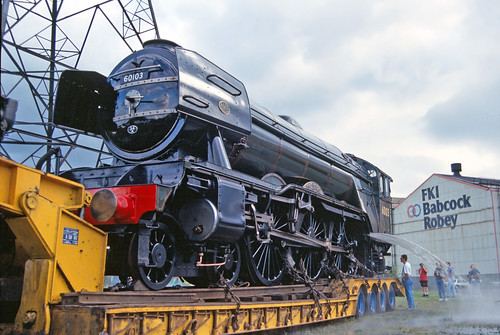
The locomotive was moved to FKI Babcock Robey for repair, emerging on 22nd July 1993 with the British Railways modifications re-applied so the locomotive appeared in British Railways green, numbered 60103, with 'Continental'pattern smoke deflectors, double chimney and dual 'Kylchap' exhaust.

'Flying Scotsman' being prepared to leave FKI Babcock Robey, following a steam test (Photo: John Edkins).

'Flying Scotsman', in its new guise as 60103, returned to Birmingham Railway Museum on 3rd November 1993 for more 'Learn to be a Driver' work. There were still lots of people keen to drive 'Flying Scotsman' and I remember it as a very busy period with courses carrying on well after dark each evening. The locomotive left the Museum on 17th February 1994 but was back at the Museum for more 'Learn to be a Driver' work from 18th November 1994 to 11th January 1995.

I didn't meet up with 'Flying Scotsman' again for over five years, when we were reunited at Peak Rail in 2000. I may not have liked the locomotive's appearance as '60103' but at least it was historically correct. The locomotive which visited Peak Rail combined 'Kylchap' exhaust, double chimney, LNER livery, the running number 4472, no smoke deflectors (at that time) and air brakes. But that's another story.

References

There's a brief history of this iconic locomotive (with references to various other websites and a list of books) in my post 'Flying Scotsman'.

Monday, 30 June 2008

'Tyseley 100'

On the 28th and 29th June 2008 Tyseley Depot celebrated the 100th anniversary of its opening by holding 'Tyseley 100'. The event also raised funds for the charity The Railway Children. The original Great Western locomotive depot is now split into two sites - Tyseley Locomotive Works (a subsidiary of Birmingham Railway Museum Trust) dedicated to railway preservation and the Depot run by London Midland which maintains modern Diesel Multiple Units. The two sites were re-joined for 'Tyseley 100' and I made a brief visit on the Saturday.

I was a working volunteer at Birmingham Railway Museum for a number of years. I was a 'late starter' in railway preservation, but I joined the 'Lion' supporters group, the Old Locomotive Committee in time to accompany the venerable locomotive on a number of her visits around the country, including two which 'Lion' made to Birmingham Railway Museum. During these visits, one of the OLCO members let on about my interest in railway signalling. Since the Museum's plans were well advanced for building a new demonstration line incorporating a Great Western signalbox (relocated from Holesmouth Junction), new recruits were being actively recruited. And so I trained as a Guard and Shunter, helped out a bit on the signalling side and passed out as a Signalman. When Driving Experience Courses proved so popular at the Museum, there was heavy demand for people who could tell the trainees a bit about shunting, signalling and, with the benefit of a number of a number of locomotives under restoration to study, the principles of locomotive engineering. I served in this capacity for a while and then gravitated to Instructor Driver on the 'Little Engines' used on the Driving Experience Courses - locomotives like 'Henry', 'Cadbury No. 1' and occasionally one of the 'Panniers'. After some more experience, I was passed out on the 'Big Engines', initially 'Defiant' or 'Clun Castle' but later we had all sorts of visiting engines.

I haven't been active at Birmingham Railway Museum for a number of years so 'Tyseley 100' provided an irresistible opportunity to renew old acquaintances, both human and mechanical. I was delighted to see so many of the people I used to work with (and a few of the people who'd been on Driving Experience Courses with me) still going strong.

There was an impressive line-up of steam around the turntable, but photographic opportunities were rather limited whilst I was there because of the crush of visitors. 5029 'Nunney Castle' stood next to 5043 'Earl of Mount Edgcumbe' (in primer but looking a lot more presentable than the last time I saw her). 7029 'Clun Castle' (shown in the heading photograph) was alongside 4936 'Kinlet Hall' and 4965 'Rood Ashton Hall' (thought to be 'Albert Hall' for years). The first two of the Tyseley Trio of Panniers (7752, 7760) were side-by-side on the turntable. The third member of the troupe (9600) was was giving rides on the demonstration line. Just for good measure, Pannier 9466 pottered about with a short freight train (More pictures of 9466 at Shackerstone).

A lot of interest was caused by the 'Puffing Billy' replica from Beamish Open Air Museum which was giving rides on the short track parallel to the demonstration line.

All very positive. I was less happy to see 'Kolhapur' on display but not in steam and looking a little careworn - this engine had been a particular favourite of mine. 'Cadbury No. 1' is also awaiting its turn for attention and looks rather sad. It was disappointing to see the 'Bloomer' replica in the works, still awaiting completion. The original intention had been to get this tribute to McConnell's famous 2-2-2 design ready for the 150th celebrations of the opening of the London & Birmingham Railway. I hope she'll be operating in time for 175th anniversary, because I'm not likely to be around for the 200-year celebrations!

Over at the London Midland Depot, a big effort had been made to welcome visitors with a line of portable toilets next to a 2-coach buffet, a number of trade stands, children's entertainments and an impressive collection of preserved diesel and electric traction in the outside yard. I found a couple of tempting new and secondhand railway bookstalls and so, agreeing with Oscar Wilde's dictum that "the only thing to do with temptation is give in to it" (at least in connection with the purchase of books), I staggered away from the site with three loaded carrier bags of books.

An immense amount of work is involved in arranging this type of gala and all those participating are to be congratulated on their efforts.

I travelled back via Birmingham Moor Street, where there was a small 'Railway Fayre' to celebrate 100 years of the North Warwickshire Line. There's a short piece on the history of Birmingham New Street here.

My pictures of 'Tyseley 100'.