skip to main |
skip to sidebar
The Battlefield Line 'Santa Special' trains between Shackerstone and Shenton are of two types, which run alternately - the 'Classic' train with vestibule stock and the 'First Deluxe' train with corridor compartment stock. On the 'Classic' train, Santa's Helpers take groups of passengers, in turn, to see Santa Claus in his Grotto, where the children receive a Christmas present. On the 'First Deluxe' service, families or groups can book a private compartment with a Christmas Hamper of food, drink and Christmas Crackers and are visited by Santa distributing presents.
Events of Saturday 9th December 2017
"Well, that didn't go quite as planned" I commented to Carl just after 9.00 p.m. as I left the railway after a long day. I'd arrived at 6.30 a.m. to drive the Great Western 'Light Prairie' 5542 and Carl had arrived earlier to drive 'Cumbria', the second engine in steam that day. We'd both experienced various difficulties during our shifts but managed to operate the booked service and, hopefully, had helped to make quite a few adults and children happy.
Preparation
I'd last been on 5542 on 22nd October 2017 when we'd had an enjoyable and trouble-free day (although the exhaust did sound a little 'off-beat'). There's a bit about Preparation in my post describing that day On the Footplate. I'm forever banging on about the importance of careful preparation of steam locomotives by both the fireman and driver and it's a recurring theme in my posts labelled 'MIC' in tribute to the Mutual Improvement Classes of the old steam railways which continue, in one form or another, for today's preservation volunteers.
5542 was at the north end of the locomotive shed, over the inspection and disposal pit, with 'Cumbria' 'brewing up' behind her and the resident engine 'Sir Gomer' hidden at the back, out of steam. Tracy was the fireman (we don't indulge in the politically-correct term 'fireperson') and, having done the initial checks, she'd just lit-up but was unhappy with the fire. Apparently, there was general agreement that the particular batch of coal we were working through was dusty, smokey and reluctant to make steam. However, she was confident she'd sort it so I carried on with oiling-round the locomotive. Harry was our cleaner.
The water tanks on a side tank design prevent access from the side under the boiler except at the very front so oiling all the inside motion and axleboxes on the leading and driving axles means 'going underneath' the engine and climbing up. I discuss the various methods of carrying water on tank engines and the resulting problems of access to inside motion in the post Water, water, everywhere.
Unless you're very fit and flexible, 'going underneath' requires the engine to be over an inspection pit. Ideally, the pit should not be as I found it, with various piles of ash remaining from previous disposals and two inches of water at one end which the electric pump had failed to clear. However, I eventually completed 'oiling underneath' and clambered out of the pit.
The smoke from two engines meant that visibility in the shed was very poor and small flakes of coal were falling like snow. Eventually, with aggressive use of the blower, our boiler 'came round' but it certainly wasn't steaming as I'd expect from a Great Western engine. Right at the beginning of the twentieth century, the designer Churchward introduced a range of very carefully-proportioned taper boilers with Belpaire fireboxes. They weren't cheap to build but they gave excellent water circulation producing very free-steaming locomotives.
5524 on the 'Classic' train
The rather cramped track layout at Shackerstone requires careful choreography to manage two trains. We were to take the first departure of the day - the 10.00 a.m. 'Classic' so the Ground Frame was operated to let us come 'off shed'. The 5-coach 'First Deluxe' train was standing in platform 1 and our 5-coach 'Classic' train was in platform 2. The stock in platform 1 had been positioned carefully, just leaving room for us to clear the points so that the Ground Frame could be restored. The signalman, Leon, then 'gave us the road' to move through the crossover onto the running line. With the crossover restored, he then 'cleared' the disc ground signal to allow us onto our train.
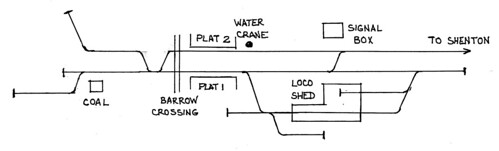
Shackerstone track diagram. North is to the left on this sketch.
Click on diagram for uncropped view.
Once we were 'out of the way', Carl was able to bring 'Cumbria' off-shed. But he had a special task before we started the service. Our self-propelled tamper, which had been 'working in the section' earlier in the week, had decided to expire near 'Airport Bridge' (on the Shackerstone side of Market Bosworth) so 'Cumbria' was despatched to drag the failure back to Shackerstone.
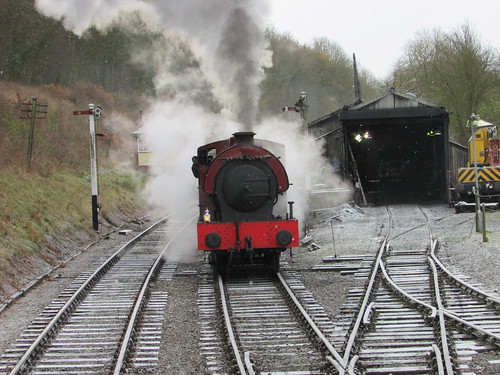
Battlefield Line 'Santa' trains 2017: Carl, driving 'Cumbria', arrives at Shackerstone having rescued the tamper.
Whilst 'Cumbria' was performing the rescue, we had coupled-up and started the steam supply for carriage warming. Our locomotive had a steam brake so, whilst light engine, it's conventional to leave the vacuum hose at one end of the locomotive 'off the stopper' so that the system operates as a 'straight steam' rather than a 'combination' (steam/vacuum) brake. Our Guard asked for vacuum but I noticed that our 'back bag' was still 'off the stopper' so I replaced this before placing the Driver's Combination Brake Application Valve in the 'create' position, so that the vacuum ejector would suck air from the train pipe and release the carriage brakes. Instead of the duplex brake gauge indicating the expected '25 inches' (partial vacuum is measured in 'inches of mercury'), it stubbornly stopped at just a few inches. Assuming that the fault was in the coaching stock, the Guard started to examine the coaches, noting a suggestion from Adrian that the exterior of the coaches had been washed during the week, so it was possible that a 'Butterfly Valve' had been disturbed. There's a brief description of 'Butterfly Valves' in the post MIC - The Working of Trains.
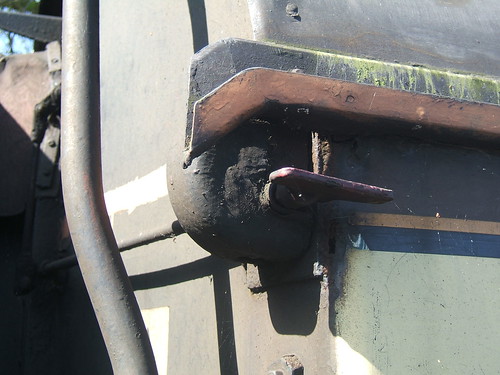
'Butterfly': The indicator for the communication cord on a passenger coach. With the 'flag' horizontal as shown the system is normal.
I didn't find out what our Guard discovered but, after a while, the vacuum came up to the required 25. The Guard should then do a 'Brake Continuity Test' by ensuring that taking the vacuum hose off the 'stopper' at the rear of the train destroyed the vacuum but, in practice, Guards often simply use the 'Setter' (the Guard's Brake Application Valve) in the Guard's compartment.
I'm afraid the Great Western, always prepared to be different, set their vacuum brake 'released' level at '25 inches' whereas every other British railway is content with '21 inches'. I think it was Churchward (before he succeeded William Dean as Chief Mechanical Engineer) working with Armstrong who made this decision. There's sound logic behind their thinking. 'Vacuum' brakes can be described as 'differential pressure' brakes. The bigger the differential between 'released' (a partial vacuum of 25 inches of mercury) and 'full application' (atmospheric pressure), the greater the brake force which can be produced by a brake cylinder of a given size. Looked at another way, more leakage can be tolerated in at system designed to run at '25 inches' before the braking effort available is seriously compromised. There's a little more on the topic in the post MIC - Brakes.
Ideally, the Guard or Driver would also carry out a functional brake test on the train. First, '25 inches' is created in the train pipe which should ensure that all train brakes are off. This vacuum is destroyed and the length of the train is inspected, ensuring that all brake blocks are 'on' (or, in practice, that all brake blocks on the non-platform side of the train are 'on'). If this is satisfactory, vacuum is re-created and the whole train is inspected again to ensure that all brake blocks are now 'off' and clear of the wheel tyres, with the exception of the Guard's coach, where the Guard's Handbrake will keep the brakes applied. The piston in each brake cylinder should be 'up' when the vacuum brake is applied and 'down' when the vacuum brake is released. Similarly, brake blocks should be tight against the wheel tyre when the brake is 'on' and hanging clear when the brake is 'off'. Where necessary, kicking a brake block will show whether it is 'on' or 'off'. I'm afraid I didn't carry out this test and I don't think the Guard did.
It's not unusual for Santa trains to be late away. All seats are normally pre-booked and, although the booking form clearly states "We are not able to hold departure of trains for late arrivals", the commercial department will often allow a few minutes 'grace'. When we finally received the 'Right Away' from the Guard, we made sure the handbrake was fully 'off' and I eased the regulator open. Steam poured from the open cylinder drain cocks but there was no movement. Vacuum was still correct, so I opened the regulator a little further. No movement. Sometimes, even with correct vacuum, some brake blocks on the train may be reluctant to drop clear of the wheel tyre. Rarely, the piston in the steam brake cylinder on the locomotive may 'stick' although, during preparation, cylinder oil is manually fed to the steam pipe leading to the brake cylinder from an oil pot in the cab to prevent this happening. Very rarely, the Guard may forget to release his handbrake (operated from a wheel in the Guard's Compartment). Finally, I opened the regulator even further and there was a small lurch from the engine. After a short pause, the whole train slowly moved. It was obvious that the exhaust beats from the chimney (four 'chuffs' for each revolution of the driving wheels) were uneven. With perfect steam distribution, they should all sound the same. No arrangement of Stephenson Link Motion gives perfect distribution, although Swindon's arrangement as used on the 'Light Prairie' comes close. But 5542 sounded distinctly unhappy.
As the train moved away, I 'linked up' the gear but left the cylinder drain cocks open a little longer because I'd seen that the boiler was rather over-full. The function of the cylinder drain cocks is to 'purge' the steam circuit and cylinders of condensed steam (water) which may collect whilst the engine is stationary. In a locomotive with slide valves, the 'buckle' which imparts the motion to the valve is arranged to allow the valve to move away from the port face which helps to clear any condensate. But the design of piston valves (as used on 5524) means that water can only escape through the drain cocks so 'aggressive' use of drain cocks becomes more important. Since water is incompressible, allowing a piston to squeeze water trapped in a cylinder risks serious damage, such as a broken cylinder cover or cylinder casting. Once I was happy that water had been expelled from the cylinders, I closed the drain cocks.
As we continued slowly up the cutting and passed under Barton Lane Bridge, things seemed a little better but I remained concerned at how 'off-beat' the exhaust sounded. We had been told to stop at Market Bosworth to pick up a staff volunteer. On receiving the 'Right Away' here, 5524 was once again rather reluctant to get under way but we carried on to Shenton and ran round our train. I discovered that the shunting signal controlled by the Guard from the ground frame reading from the run round loop to the single line had failed but the Guard displayed a green flag to authorise the movement. We coupled onto our train and created vacuum ready for the return journey, this time chimney leading. After a wait, the Guard whistled and displayed the green flag and we set off back to Shackerstone.
We arrived back late and were signalled into platform 2 at Shackerstone where I stopped with the leading coach just clear of the barrow crossing, meaning that our locomotive completely blocked the crossing. With the footbridge currently out of use, the barrow crossing is the only way for passengers to get to and from platform 1 so quite a crowd built up at the north end of the platforms waiting for us to uncouple and move forward into the North End sidings, where the bucket loading shovel was waiting to replenish our coal bunker.

Battlefield Line 'Santa' trains 2017: On our return to Shackerstone, we had to uncouple and draw away before passengers could use the barrow crossing.
With a full bunker, we moved back towards the station and stopped at the ground signal (lever 7: a Southern Railway pattern electrically-operated disc without the characteristic external floodlight). Ahead of us, our train was in platform 2 and the 'First Deluxe' train, with 'Cumbria' at the head, was still in platform 1. Once 'Cumbria had departed with the late-running 11.30 train, the ground signal cleared and we cautiously moved over the barrow crossing, ran through platform 1 negotiated the crossover outside the signal box. With the crossover replaced normal, the signalman cleared the "bottom dolly", allowing us to move onto our train and take water. We'd used about half a tank of water since leaving the shed that morning with a full tank. There was then nothing for us to do, except keep our train warmed, until 'Cumbria' returned with the 'First Deluxe' train, so I took a few pictures.
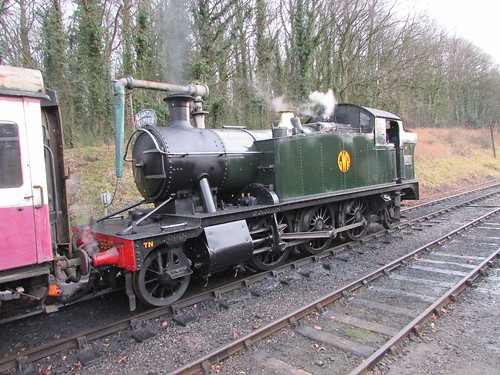
Battlefield Line 'Santa' trains 9-Dec-2017: Late-running 12 noon 'Classic' train ready to leave Shackerstone.
Santa Claus won't be hurried when he's distributing gifts on a train, so we were not surprised that 'Cumbria' returned having lost more time. We were keen to get started but, when we received the Green Flag and I opened the regulator, there was a loud, continuous 'blow' through the chimney but no movement. Having re-checked everything, I tried again, applying more power. The third attempt finally produced a sluggish movement and we slowly left the station, with a very uneven exhaust beat. We kept going but I couldn't be sure of the problem - possibly a broken piston valve ring.
Once again, we'd been asked to stop at Market Bosworth, this time so that train staff could establish how much more time Santa needed for his present distribution. On being given the 'right away' even full pilot valve regulator opening failed to produce movement as it should. The most likely reason was either a dragging brake or a damaged piston valve (or both). I put the reverser into 'Full Forward Gear' (we were bunker leading), opened the regulator and was rewarded by a few inches of movement. With the lever returned to 'Full Back Gear', this time we had movement in the intended direction and I was able to carry on to Shenton where, once again, we ran round our train. This time, we'd used half a tankful of water in just a one-way journey and Tracy was having to fire quite heavily to keep on top of things. I discussed our problem by mobile phone with Shackerstone and it was agreed that Adrian would take a look before we attempted our third and final booked trip that day.
 Tracy firing 5524.
We returned to Shackerstone without incident but had managed to use most of our remaining water, suggesting that a fair amount of steam was going to waste. Shortly after our arrival, 'Cumbria' left with with the second 'First Deluxe' trip that day. With platform 1 now clear, we were able to shunt to the other end of our train and re-fill the water tanks. We were then asked to propel our 5-coach train to the North End No 2 siding where it would remain until the next morning. The line from the platforms to the North Sidings is on a down grade so, after a small push to start the train, it was a case of controlling the speed of the movement with the brake until our shunter, at the far end of the train, signalled us to stop.
When 'Cumbria' arrived back, Adrian appeared and, having made arrangements with the signalman and I'd collected the Single Line Staff, he took us on a test run part way down the line and back light engine. We agreed that, with 'Cumbria' still in steam, it might be prudent to dispose of 5524 and use 'Cumbria' on the last train, the 'Santa Evening Train Special'. Leon in the Signal Box loosed us onto platform 1, so that we could use the Ground Frame to reach the shed. Unfortunately, the train in platform 1 had stopped a little short and, even closed-up to the coaches, we were not clear of the Ground Frame points. 'Cumbria' was no longer attached to the stock so it fell to us to find a shunter, couple-up, create vacuum and, under the control of our shunter, ease the train forward sufficiently to clear the points. With the Guard's handbrake securing the coaches, we uncoupled and moved the engine to the shed. Having made sure that there was plenty of water in the boiler of 5524, Tracy, Harry and I made our way to the station. Carl had watered 'Cumbria' and coupled it to the stock in platform 1. Once I'd relieved him on 'Cumbria', Carl then finished disposal of 5524 for us.
'Cumbria' on the 'Santa Evening Train Special'
In the section 'Notes on driving Cumbria' in the 2016 post Sunday at Shackerstone there's some information about 'Cum
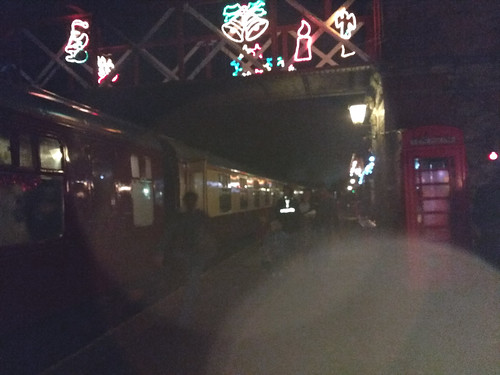
Battlefield Line: Christmas illuminations for the 'Santa' trains 2017.
Our last run was timed to start at 6.15 p.m. and, of course, it was dark (we were just 12 days before the Winter Solstice). The passengers managed to arrive on time and we were only a little late departing. Driving on a traditional British steam railway at night is quite different from driving on roads. There's no powerful headlight and sound cues become more important to the driver to identify his position. Increased light pollution today means that the sky is rarely completely black - nearer tall objects can appear as a dark silhouette against a dark purple horizon, provided that the driver can retain his night vision when, each time the fireman opens the firedoors to feed coal to the fire, there's an intense white or yellow glare from the firehole. There's a little about driving at night on the Battlefield Line in the section titled 'The Specials' in the post 'Operation: Market Bosworth' - On the Footplate. There's a little more in general about railways at night in the post here.
Because Santa was making his way through the train greeting all our visitors, our speed was modest and we were asked to stop at Market Bosworth (where there were more Christmas illuminations on the platform). We were soon on our way again to Shenton, where the series of traditional lamp standards along the platform cast a dim but welcome glow. I eased-up the locomotive to make uncoupling easier but failed to persuade the regulator to close properly. After we were 'un-hooked', I couldn't get the reverser into 'full back gear'- it remained 'steam locked' in mid-gear. This is an irritating habit 'Cumbria' (and other engines) sometimes display which I discussed in the section 'Steam Lock' of the 2017 post Bank Holiday with Steam and Diesel. A bit of brute force (and a lot of not-very-ladylike language) eventually released the lever and we ran round without further delay. We were told to return gently as Santa completed his task but without stopping at Market Bosworth. On the Shackerstone side of Market Bosworth, we received the 'tip' that we could resume normal line speed so, complying with the lower limits through Headley's Crossing and the approach to Shackerstone, we were able to finish up with a little 'romp'.
I was careful to stop correctly in platform 1 at Shackerstone to leave room for 5542 to come 'off-shed' the following morning and we uncoupled. Then we were asked to re-position the 'Classic' train from the North Sidings to platform 2, ready for the morning. I was told we'd a shunter and I asked if the "strings had been pulled". 5542 had put the set in the sidings "blowing 25 inches". Since 'Cumbria' "blows 21 inches" it was essential that all the release cords along the train were pulled before I attempted to Create vacuum. On receipt of the 'move away' hand signal, I attempted to move but 'Cumbria' was slipping badly. Well, the train was on a reverse curve, on a wet rail with an adverse gradient and we were making slow progress so, encouraged by voices from the ground, I persevered for a while but when we stopped again I asked for "better and further particulars" of the string-pulling. It appeared that, in the dark, there had been some confusion and either not all the strings had been 'pulled' or the residual vacuum had not been fully discharged. After more delay, we received the 'move away' hand signal again and, this time, we slowly dragged the 5-coach train into position in platform 2. We then lost no time in uncoupling and moving to shed where we levelled the fire and filled the boiler. I completed the paperwork, made the "Well, that didn't go quite as planned" comment to Carl and went home.
Related posts on this website
Shackerstone Santa Specials.
All my Battlefield Line posts.
On the Footplate.
All my MIC posts.
My photograph albums
Where necessary, clicking on an image above will display an 'uncropped' view or, alternately, pictures may be selected, viewed or downloaded, in various sizes, from the albums listed:-
5542.
Battlefield Line 'Santa' trains 2017.
All my Battlefield Line pictures.
The locomotive 'Ring Haw' first visited Peak Rail for the Santa Specials in 2016. There's a report on that visit here. 'Ring Haw' returned for the 2017 Christmas season and, on 2nd December 2017, I was the driver, with Phil as fireman, on the first day of the popular Santa Specials. For these services, the load had been increased to eight bogie coaches. Operation on the day was top-and-tailing with 'Penyghent' which was specially authorised, as in 2016, to give 'Ring Haw' assistance on certain sections of the route to comply with the owner's load limits.
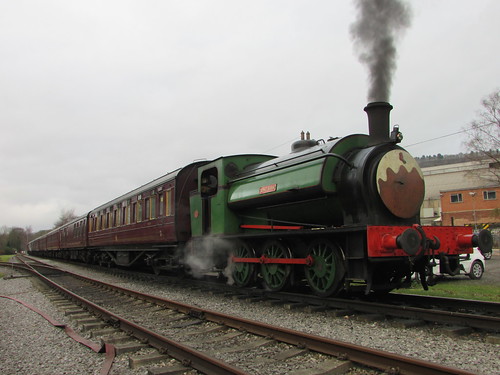
'Ring Haw' at Peak Rail, Christmas 2017.
Matlock Musical Theatre were on the platform at Rowsley to entertain everybody with carols and Christmas songs and entertainers travelled on the train. The highlight, of course, was Santa distributing presents to all the boys and girls on the train. Grown-ups received mulled wine and mince pies.
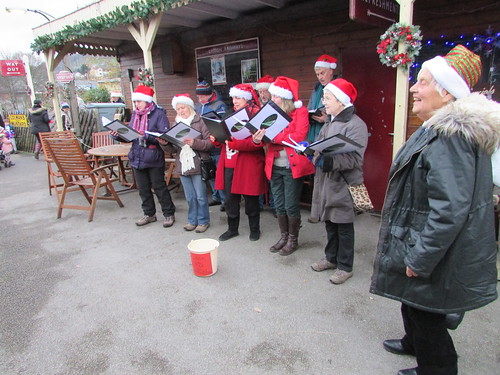
'Ring Haw' at Peak Rail, Christmas 2017: Matlock Musical Theatre were at Rowsley to entertain everybody with carols and Christmas songs.
As expected, 'Ring Haw' performed well and, despite steam heating the 8-coach train throughout the day, proved economical on coal and water.
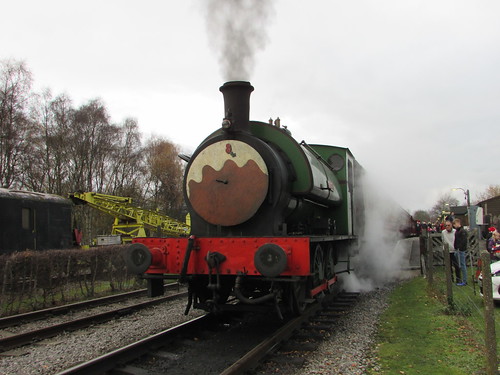
Peak Rail, Christmas 2017: 'Ring Haw' ready for the last departure of the day from Rowsley.
Related posts on other websites
Matlock Musical Theatre
Related posts on this website
Peak Rail Santa Specials ('Ring Haw' in 2016).
All my posts on Peak Rail.
All my posts on Santa Specials.
My photograph albums
Where necessary, clicking on an image above will display an 'uncropped' view or, alternately, pictures may be selected, viewed or downloaded, in various sizes, from the albums listed:-
'Ring Haw' at Peak Rail (2016 plus 2017).
Peak Rail 'Santa' trains, 2017.
All my Peak Rail pictures.
The Battlefield Line 'Santa Special' trains between Shackerstone and Shenton are now of two types, which run alternately. One type, with vestibule stock, is dubbed the 'Classic' train. In this train, Santa's Helpers take groups of passengers, in turn, to see Santa Claus in his Grotto, where the children receive a Christmas present. The second train has corridor compartment stock and forms the 'De Luxe' train. On the 'De Luxe' service, families or groups can book a private compartment provided with a Christmas Hamper containing food, drink and Christmas Crackers. On the 'De Luxe' service, Santa visits each compartment in turn distributing presents.
In December 2016, visiting locomotive 30120 (the preserved Drummond 'T9') worked the 'Classic' train and 'Cumbria' (Hunslet 3794 'Austerity Tank'), hauled the 4-coach 'De Luxe' train. Jan was rostered as the driver of 'Cumbria' on Sunday 11th December and Sunday 18th December.
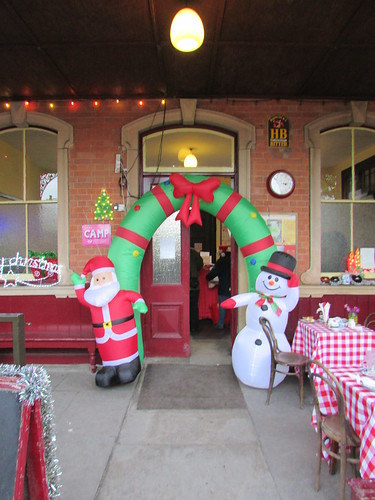 Shackerstone Station had festive decorations.
Events of Sunday 11th December 2016
It was still dark when I arrived at Shackerstone shed but Steve, who was firing 'Cumbria', had just started work and Dave and Carl on the 'T9' had matters well in hand for their earlier departure with the first 'Classic' train of the day. Whilst Steve cleaned the grate and laid the fire, I started oiling-round. By the time I'd finished, 'Cumbria', still warm from the previous day, was just starting to make steam. Once the 'T9' had left the shed, the inspection pit in the shed became available and in due course we moved 'Cumbria' onto the pit so that Steve could clear the ash from the ashpan. I noticed that the rear damper door was reluctant to latch in the 'open' position and Steve had to wedge the damper door open using a spare ashpan rake. Whilst we were over the pit, I completed my examination of the underside of the locomotive. This included checking the six underhung springs, spring hangers and associated fixings, the cylinder drain cocks and operating levers, the brake rigging, steam brake cylinder, handbrake screw and associated linkages, the base of the firebox, the firegrate and foundation ring, the ashpan, in fact generally looking for trouble or what might develop into trouble. Meanwhile, a hose pipe attached to the mains water supply was slowly filling the saddle tank.
As the boiler pressure increased, we moved the locomotive outside the shed and did as much cleaning as time permitted before coming 'off shed' via the ground frame and coupling up to our 4-coach train waiting in platform 1 so that we could start steam heating the train.
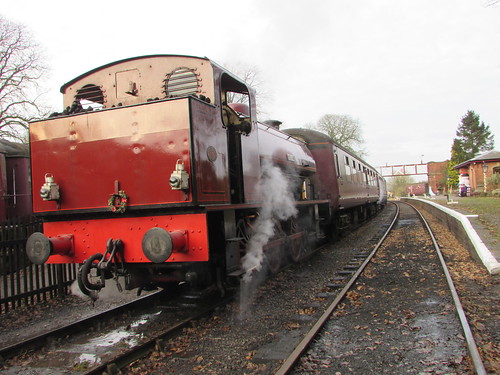
Shackerstone Santa Specials: 'Cumbria' steam heating the stock for the 'De-Luxe' train.
Our first departure was a little delayed (Santa cannot be hurried so the 'Classic' train, hauled by the 'T9', was a little late arriving back at Shackerstone). Once we did set off, it was at a rather pedestrian pace as Santa slowly worked his way from compartment to compartment greeting our young visitors. We stopped at Market Bosworth for a while to let Santa get a little further along the train and then continued, at a similar slow speed, to our terminus at Shenton. Steve and I then ran 'Cumbria' round the train and re-coupled, ready for our return to Shackerstone, this time chimney leading. Santa was still distributing presents so we trundled back to Market Bosworth at the usual slow speed, making us lose more time. However, after waiting at Market Bosworth for a few minutes, Santa had finished seeing all the children and so we were told that we could make our return to Shackerstone at 'Line Speed' (a fairly modest 25 m.p.h. with certain sections at lower speed).
Once we'd brought our train back into platform 1 at Shackerstone, the 'T9' was able to depart with the delayed second 'Classic' train of the day. This left platform 2 free for us the run round our train, stopping to water at the water column. That was when the plan unravelled. Steve man-handled the water 'bag' into the tank filler and I opened the water valve (a big, horizontal wheel which for some reason is turned clockwise to allow water to flow, unlike most water taps). At first, water started to flow but Steve quickly realised that the volume was reducing to a trickle. He climbed down to the ground and went to investigate the problem.
Locomotive Water Supplies
In addition to needing fuel to generate heat, steam locomotives require copious supplies of water which is boiled, used to push a piston down a cylinder to produce motion and then (unless we're talking about compound or condensing designs) immediately discharged as exhaust steam. I discussed carrying water on locomotives in the post Water, water, everywhere. So the first thing locomotives run out of is usually water (followed by either fuel or a sufficiently energetic fireman to continue working). A hose connected to a mains water supply may suffice on shed whilst an engine is being brought into steam but, once on the road, the locomotive needs to be replenished in a matter of minutes so normally large, elevated tanks are required at strategic locations along the railway which can be refilled from a more modest water main over a period of time and rapidly discharged by gravity through a large capacity pipe into the locomotive's water tank. Various sizes and arrangements for the elevated tanks could be found in the steam era.
A common British arrangement was to mount the tank on a brick structure. The picture below shows a fairly grand preserved example adjacent to Huddersfield Station (for a little more about this splendid survivor, see the post Day Trip to Shipley).
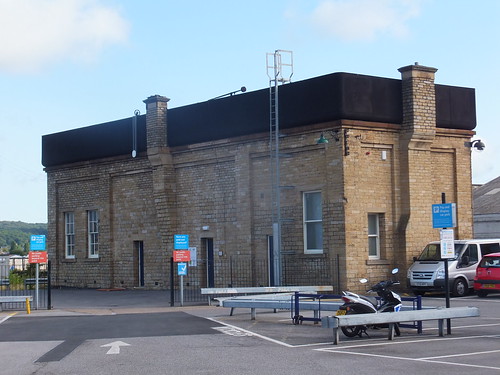
Railway water tower at Huddersfield Station.
Alternately, the tank could be supported on a metal framework.
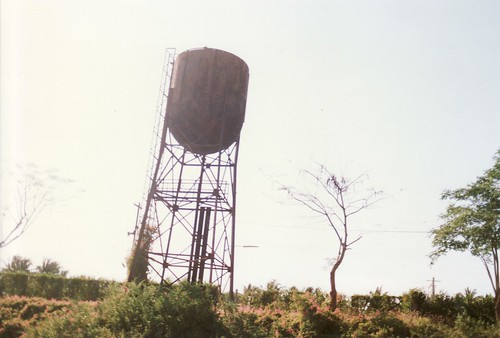
A large railway water tower in Thailand.
In the Parachute Tank design, a round metal tank was balanced on top of a cast column at the point of use but, more commonly, the water column (or water crane) at the trackside would be fed by a high-capacity pipe from a remote tank. When I was young, I used to watch locomotives taking water at Wolverhampton High Level Station and the LNWR pattern water column in use there is described in the section 'Water Column' in post Wolverhampton High Level Remembered.
Arrangements at Shackerstone
There are two, interconnected tanks, elevated by being positioned at the top of the bank adjacent to the railway. These are normally filled under the control of a float valve from the available public water supply and a high capacity pipe feeds water to the water crane at the end of platform 2.
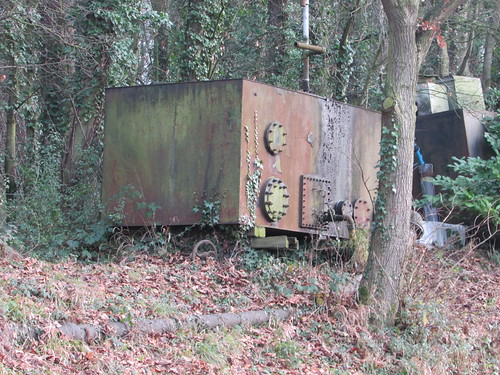 Shackerstone: The tanks for the locomotive water supply on the bank adjacent to platform 2.

Shackerstone: The Water Crane at the end of platform 2.
The Problem
Steve quickly diagnosed the problem. Because of a fault on the float valve, the stop valve in the incoming water supply had been shut to prevent possible overflow but had not been re-opened, allowing the tank to empty itself. Opening the stop valve allowed water to start flowing into the tank but it would be some hours before a proper supply was available. The platform tracks at Shackerstone are provided with hoses connected to the mains for refilling the lavatory tanks on the passenger coaches and we experimented with taking water from here, but it was clear that we would not have taken sufficient water in time to work our next booked 'De-Luxe' service ('Cumbria' uses rather a lot of water, especially when carriage warming is required).
The Solution
The 'T9', on its way back from Shenton after its second trip with the 'Classic' train, had sufficient water for another trip (it's paired with an 8-wheel 'Watercart' tender) so it was decided to 'swop' the engines, with the 'T9' taking the second 'De-Luxe' train, giving 'Cumbria' another hour or so to finish watering from the mains supply before taking the last 'Classic' train.
The returning 'Classic' train was stopped just short of the signal box and the 'T9' uncoupled and moved forward, light engine, to couple onto the 'De-Luxe' train in platform 1. As soon as the 'T9' had cleared the crossover, we moved towards the coaches of the 'Classic' service, coupled on, and brought the train into platform 2 so that the passengers could disembark. If any of the passengers noticed that they'd left Shenton with one engine and arrived at Shackerstone with a different engine, they made no comment!
Once the 'T9' had departed with the 'De-Luxe' train, we were able to run round the coaches of the 'Classic' train and provide steam heat whilst we continued to slowly replenish our saddle tank. By the time the 'T9' returned, it was becoming dark so Steve had lit our engine lamps. We also had a full tank of water. Once we had the 'Right Away' from the Guard, we set off in the gathering gloom at the accustomed gentle pace for 'Santa' trains. On arrival at Shenton, we cautiously ran round the train - everything becomes harder in the dark - and waited for the 'tip' from the Guard.
We were told that Santa had completed his present distribution, so we could return at 'Line Speed', although a stop at Market Bosworth was required to allow some people off the train, so we had an enjoyable trip back to Shackerstone and, approaching the signal box found the 'Bottom Dolly' disc signal 'off' for platform 2, as expected. The 'T9' had run round the 'De-Luxe' stock to the Shenton end of the train. We uncoupled from the 'Classic' train and, by the time we'd moved the engine down to the 'North End', the 'T9' had drawn the 'De-Luxe' stock 'Up the Cutting', leaving platform 1 clear for us to pass through the platform to the Ground Frame and go 'on shed'. We 'tied-down' 'Cumbria' well inside the shed and completed our disposal. Meanwhile, the 'T9' pushed the 'De-Luxe' stock back into platform 1, uncoupled and followed us onto shed. Well, we were about 30 minutes late finishing the 'Santa' trains but, considering the difficulties, we thought that not a bad result. There were certainly lots of pleased passengers during the day.
Events of Sunday 18th December 2016
It was still dark when I arrived, a little before 7.00 a.m. John B. and Sam B. had arrived and were preparing the 'T9'. The good news was that, during the previous week Steve had repaired the faulty float valve on the locomotive water supply which had caused problems during my previous 'turn'. The bad news was that there was no fireman for 'Cumbria' and that I was on my own. It appeared that, unless I set to and tackled both fireman's and driver's duties (at least temporarily), a number of disappointed visitors were guaranteed. I couldn't find a firing shovel (not a good start) but I borrowed the 'spare' shovel off the 'T9'. I couldn't find wood for lighting-up. Sam said he'd had a similar problem but showed me a rather damp wooden panel which he'd been breaking up to use on the 'T9' and he helped me break up a bit more of the panel.
Lighting-up
Before lighting-up, the safety of the boiler must be assessed. The two gauge glasses had been, correctly, left isolated overnight so I 'opened' them, 'blew-down' (actually 'drained-down' since there was no pressure left in the boiler) and satisfied myself, by comparison of the levels in the glasses, that there was adequate water in the boiler. Then, I checked around the boiler for leaks. Mudholes, washout plugs, stays, rivets, foundation ring, boiler tubes and fusible plug should all be examined. The firegrate still had the now-cold ash and clinker from the previous day's fire so, armed with a suitable fireiron (a substantial 'straight dart' about five feet in length), I slid the end of the dart forwards and backwards along the firebars to encourage the remains to drop through the air spaces into the ashpan. This is a fairly energetic process which, of course, produces clouds of dust. Any large clinker has to be extracted with the clinker shovel ('paddle') through the firehole door but, being short of time, I managed to avoid this by 'bashing' larger pieces with the dart to break them up. The cleaner the firegrate before setting a new fire, the less likely are subsequent steaming problems but, in the circumstances, I settled for a result a little short of the proverbial "clean enough to eat your dinner off".
There are nearly as many methods of steam-raising as there are fireman. I adopted a method that's worked well on a wide range of locomotives. First, I shovelled a thin bed of coal across most of the firegate. I selected a fairly thin stick of wood from my meagre supply, wrapped it in a oil-soaked rag and lit the rag from a match. I carefully dropped the burning stick onto the grate and added more wood, attempting to form a "Scout's Campfire" shape so that each piece of wood could be exposed to the heat but also have plenty of air around it. I added a little oil to encourage the damp wood to burn and was gratified to see a reasonable wood fire result. Next, I tossed some small pieces of coal onto the wood so that the coal would be warmed. Worried that the wood would expire before the coal caught alight, I returned to the remains of the damp wooden panel and broke up a little more wood which I added to the fire with more selected pieces of coal. I then applied the "Ten Minute Rule" - open the dampers, close the firedoors and do something else for ten minutes. Well, I'd plenty of other things to do with an engine to examine and oil. After ten minutes, the fire had 'caught' better than I dared hope, so I applied a light firing of coal, making sure that there was coal around the edges of the burning mass to encourage the fire to spread across the firegrate and then left it for another ten minutes. Some fireman tend to 'black-out' the fire and leave it for half-an-hour or more, later spreading the fire around the grate with a fireiron but I've found that following the "Ten Minute Rule" will warm an engine faster but gently and (except on very large firegrates) avoids the need to use a fireiron to spread the fire altogether. An engine is immobile until it's producing steam and, with around half a ton of water in the boiler of an 'Austerity', it takes time and a decent fire to bring it to the boil, even when the water is warm from the previous day.
Of course, being on my own there was a lot of climbing up and down involved - hose into the tank to take water, work progressively around the engine applying oil, return periodically to the footplate to fire. By the time the 'T9' moved off shed, 'Cumbria' was starting to make steam so I could consider moving onto the pit to empty the ashpan. Getting an engine to move is always the lesser problem - getting it to stop is the main safety consideration and when single-manning the risks are increased. With around 30 p.s.i. on the clock, I gingerly moved the engine onto the pit without incident. I clambered underneath 'Cumbria' with two ashpan rakes - one to rake out the ash, one to wedge the front ashpan door open. Perhaps unwisely, I decided to leave the hose feeding the locomotive's water tank, as I was anxious to start out with a full tank, and so I raked out the ashpan 'dry'. I eventually emerged from the pit, after shifting a fair amount of ash from the two ashpans, spluttering from the dust and white like a snowman. Simon P. chose this moment to appear and comment "You should be coming off shed now to steam heat the train". My rather terse response encouraged him to assist by checking the saddle tank water level (I decided we'd enough), operate the Ground Frame and, after I'd moved the engine onto the four coach 'De-Luxe' train, couple up.
In the section Related posts on this site below, various posts on steam-raising and preparation are linked.
The First 'De-Luxe' service
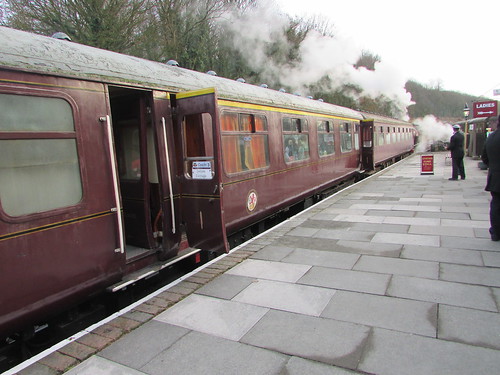
Shackerstone Santa Specials: 'Cumbria' (shrouded in steam) waiting to take the 'De-Luxe' train.
After my unexpected exertions getting 'Cumbria' ready, I was content to look after the engine whilst warming the train, maintaining the fire and keeping the boiler topped-up. But we would need a fireman if we were to take the 'De-Luxe' train down the line. Management decided that, when the 'T9' returned, Sam (who was firing the 'T9') would have to immediately swop onto 'Cumbria' and fire that trip. So that's what happened. We made a leisurely progress to Shenton, pausing a Market Bosworth, as 'Santa' made his way through the train. Sam and I ran round the train and were told that the return to Shackerstone could be made at normal speed, so we enjoyed a slightly more spirited run back. Sam then swopped back onto the 'T9' for another run to Shenton with the 'Classic' train.
The Second 'De-Luxe' service
Again, I was happy to 'baby-sit' the engine before our second journey to Shenton, expecting that Sam would have to swop engines again. But, having completed other duties, Martin S. appeared, saying the he would fire the second trip. As Santa dealt with his excited young visitors, we made our sedate way from Shackerstone to Shenton and ran round, ready for the return.

Shackerstone Santa Specials: View from footplate of 'Cumbria' looking back along the train between Market Bosworth and Shenton.
As it became dark, we were able to return to Shackerstone at normal speed because Santa had completed his rounds. As usual, we ran into platform 1, uncoupled and waited for the 'T9' to leave with the last train of the day. Whilst we waited, our passengers streamed past on their way to the car park - everybody seemed in good spirits.
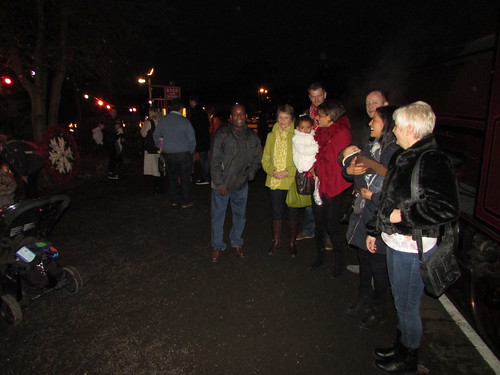
Shackerstone Santa Specials: Platform 1 North End. A group of happy passengers photographed with 'Cumbria' in the background.
After the 'T9' had left we were able to run round the train. Martin said that I could propel the empty stock to the North End, to stable overnight, and that he would act as Shunter. He released the Guard's handbrake and gave me handsignals with a 'Bardic' battery handlamp from the far end of the train. I eased the train forward very gently. In the dark, the driver is reliant on the Shunter's signals (although, noting the position of the locomotive, I could work out roughly where the other end of the stock would be). When the white "come towards" handsignal changed to steady red, I stopped the movement and waited for Martin to re-apply the Guard's Handbrake and walk back to uncouple 'Cumbria' from the coaches.
Then we were able to return, via Platform 1 and the Ground Frame, to the shed where we stabled well inside so that the 'T9' could come in after us and we completed our disposal.
Related posts on this site
Driving Turn at Peak Rail - Part One: Preparation
Preparation of Locomotive 'Sapper'
(Both of the above describe the preparation of locomotives similar to 'Cumbria' at another railway).
MIC - Firing Steam Locomotives (1).
The 'Austerity' 0-6-0ST locomotive.
There are a number of other posts about footplate work on 'Cumbria' on the Battlefield Line:-
'Santa Specials' at The Battlefield Line - Christmas 2015.
The Battlefield Line Steam Gala.
Sunday at Shackerstone.
'Operation: Market Bosworth' - On the Footplate.
Related posts on other sites
Sam Brandist has his own blog and has posted an interesting account of his day on the 'T9' (and helping me with 'Cumbria') on Sunday, 11th December. You can find his report here.
My Pictures
Shackerstone Santa Specials.
Peak Rail Santa Specials operate from Rowsley, where all passengers board and alight, to Matlock Town. 'Technical' stops are made at Darley Dale in both directions. In 2016 trains were operated 'top-and-tail' by visiting locomotive 'Ring Haw' (0-6-0ST Hunslet 1982 of 1940) at the south end of the train and either resident Class 31 or Class 44 diesel-electric at the north end. Jan was rostered as the driver of 'Ring Haw' on Tuesday 20th December and Thursday 22nd December.
Events of Tuesday 20th December 2016
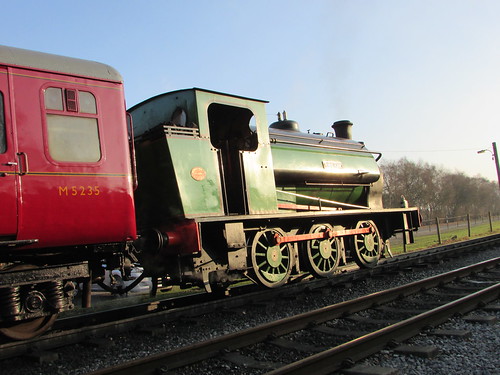
'Ring Haw', highlighted by the afternoon sun, ready to start the last train of the day from Rowsley on 20th December 2016.
I was rostered with Keiron R. as fireman, working with 'Penyghent' at the north end. The load was six passenger coaches plus a 'BG' luggage van to store the presents which Santa Claus would distribute to the visiting children. 'Ring Haw' rather appealed to me. It is a '14-inch Hunslet', less powerful than the 'Austerity' 0-6-0ST locomotives (which were based on the '16-inch Hunslet'). It served at the Nassington Iron Ore Mine near Peterborough until withdrawal in 1970. It is now based at the North Norfolk Railway and the owners limit its use to the equivalent of a 4-coach load so 'diesel banking' was specified on parts of the Peak Rail route. Following clearance by the Railway Inspectorate, it was also specified that the diesel locomotive would create the vacuum brake even when 'Ring Haw' was working the train, so the vacuum ejector in the cab of 'Ring Haw' was simply used the driver's brake application valve.
Whilst 'oiling round' I had plenty of time to notice the similarities with the 'Austerity' tank locomotives - two inside cylinders with slide valves operated by 'Stephenson' Link Motion.
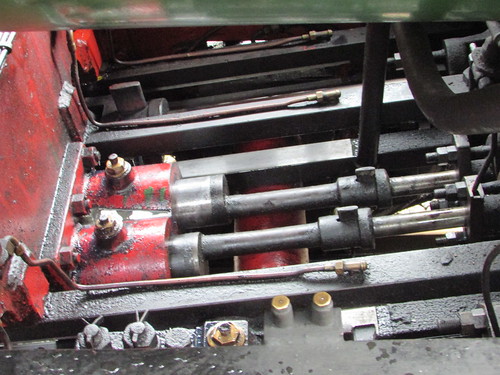
'Ring Haw' at Peak Rail: View from right-hand foot framing, showing slide bars and valve rods.
As far as lubrication is concerned, a number of conventional oil cups with trimmings and oil holes have been retained but a large mechanical lubricator is now fitted to 'Ring Haw' serving not only the cylinders and the regulator in the dome but also the axleboxes, slide bars, piston and valve glands via copper pipes fitted with the appropriate non-return valves. Oil with an SAE of 680 is used in the mechanical lubricator.

'Ring Haw' at Peak Rail: Mechanical lubricator mounted on the left-hand foot-framing.
Unusually, the axlebox hornguides are grease lubricated from a separate system fed from grease nipples mounted along the top of the main frames.
The saddle tank is pierced by the dome which accommodates the regulator. Externally, the dome mounts two Ross 'Pop' safety valves side-by-side together with a high-toned whistle. The saddle tank does not extend over the smoke box.
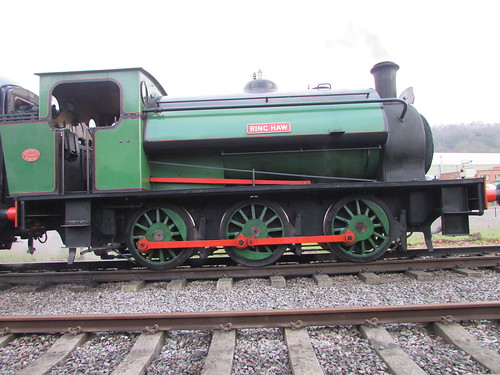 'Ring Haw' at Peak Rail
The cab layout is typical of industrial locomotives - right hand drive with a two-handled regulator, steam brake valve capable of being operated from linked handles on either side of the cab, two gauge glasses and two Davies and Metcalfe backhead injectors. The Davies and Metcalfe vacuum ejector and the steam heating shut-off cock with automatic pressure regulator are, of course, features added in preservation.
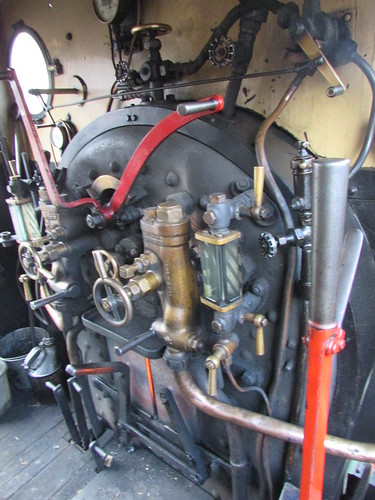
'Ring Haw' at Peak Rail: View of boiler backhead viewed from driver's side of cab.
'Ring Haw' steamed well and was economical on coal and water. Keiron and I had an enjoyable day carrying out four round trips to Matlock Town as we helped to provide the proper 'Santa Special' experience which relies on the work of a large number of volunteers.
Events of Thursday 22nd December 2016
Once again I was rostered with Keiron R. as fireman, working with 'Penyghent' at the north end and the same 7-coach load as on the Tuesday, carrying out four round trips to Matlock Town. 'Ring Haw' gave us no concerns during the day.
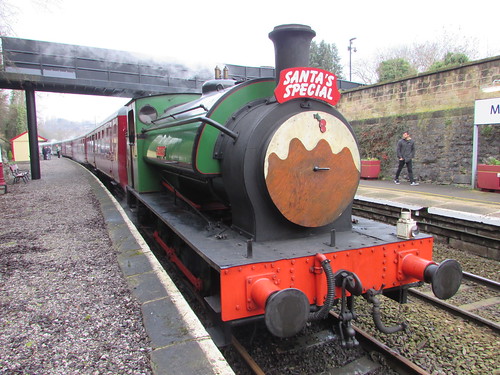 'Ring Haw' at Matlock Town, with 'Christmas Pudding' headboard, ready to be pulled back to Rowsley.
As on the previous Tuesday, we lit the engine lamps for the last round trip as it was already becoming dark (the Winter Solstice had been on Wednesday, 21st December, giving less than 8 hours of daylight). At the end of traffic, 'Penyghent' uncoupled from the train and headed smartly up the loop until clear of the crossover to the Headshunt (which I prefer to call the 'Third Line'). Meanwhile, Keiron uncoupled 'Ring Haw' from the train and, in possession of the Single Line Token, we headed towards Matlock until clear of the South Ground Frame so that Keiron could turn me into the loop. Once clear of the points, I gave three short whistles to Keiron (the old British Railways whistle code for "Clear of All Running Lines") and, once Keiron had rejoined the engine, we followed 'Penyghent' to the North End.
I stopped clear of the road crossing until 'Penyghent' passed us, heading for Shed Road 2 then I followed suit and we also stabled on Road 2. Whilst we went about disposal duties, Harvey C. used the Bucket Loader to refill the bunker ready for the following days service. Then it was complete the paperwork, sign off and return home.
My Pictures
'Ring Haw' at Peak Rail.
In an earlier post here, I described my driving turn on Saturday 19th December 2015. I was back on the following Wednesday, described below.
The '2251' Class
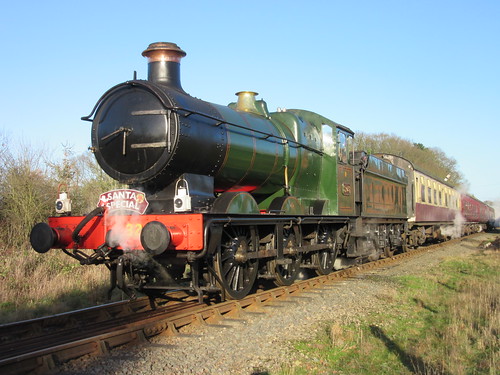 Battlefield Line 'Santa' Trains 2015: '3205' pauses at Market Bosworth before continuing to Shenton.
This class was introduced by Charles Collett in 1930 as a replacement for the much-loved and long-lived 'Dean Goods' and Armstrong 0-6-0 tender locomotives. The 'Dean Goods' was introduced by William Dean in 1883 and by 1899 260 off had been completed.
The Collett locomotive proved versatile, handling goods, short-distance main line and stopping passenger trains. The design had two inside cylinders, each 17.5 inches diameter by 24 inch stroke, fed from slide valves controlled by Stephenson Link Motion. With 5 foot 2 inch diameter coupled wheels, tractive effort was 20,155 pounds. Whilst the 'Dean Goods' had no route restrictions, the heavier axle load of the '2251' (a little over 15 tons) gave them a 'Yellow' route colour. Swindon Standard Boiler Number 10 was produced for the class - a tapered, Belpaire boiler pressed to 200 p.s.i. with superheating and a sloping grate of 17.4 square feet area. Subsequently, the Number 10 Boiler was used by Collett's successor, Frederick Hawksworth in the '9400' 'Pannier' and the '1500' outside-cylindered 'Pannier' locomotives.
In the design of the '2251', Collett followed the standards introduced by Churchward so construction and driving controls are largely similar to other Great Western engines. The '2251' has a screw reverser, rather than a lever reverser. Like most of the Great Western tank engines, the locomotive is fitted with a steam brake, combination brake valve, vacuum ejector and vacuum pump. When shunting light engine using just the steam brake, the driver has to first ensure that the vacuum brake on the standard tender is released.
Events of Wednesday 23rd December 2015
Wednesday's 'Santa' timetable called for fewer services than on my turn the previous Saturday: '3205', the 'Collett Goods', was booked to make two trips to Shenton (leaving Shackerstone at 11 a.m. and 3 p.m.) whilst 'Cumbria' was diagrammed to make one trip (at 1 p.m.).
Adrian L. was the other driver and he generously suggested I took '3205' knowing I'd not previously driven the class, assuring me "You'll like it" (Of course, he was right. I was once asked 'What's your favourite engine?' An old engineman present commented 'Anything they'll let her drive!').
Dave H. was once again marked as fireman with Jamie as Trainee. Since Jamie was very close to passing out as a Fireman, Dave let him perform most of the firing. Whilst Dave and Jamie lit the fire, I went round the engine examining, oiling and familiarising myself with the layout.
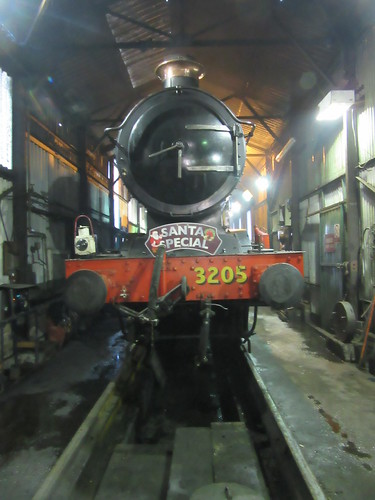
'3205' being prepared inside the shed at Shackerstone.
I found one cork missing from an Expansion Link, which we replaced from a small stock in the toolbox on the tender, otherwise everything seemed to be in order. Having been used the previous day, the engine came into steam fairly quickly.
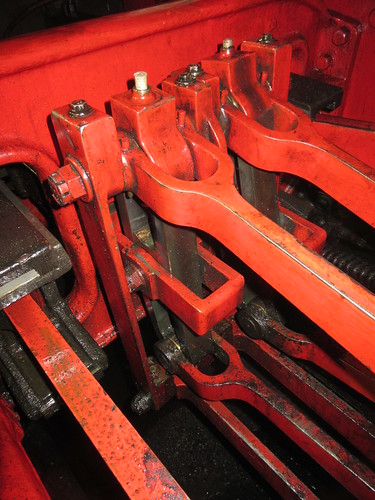
View looking forwards on the left side of engine. Motion Plate (top) L-R: Rear of slide bars and LH Connecting Rod, LH Lifting Links and Expansion Link (showing attachment of Valve Rod to Die Block), RH Lifting Links and Expansion Link. Forward Eccentric Rods connect to top of Expansion Link, Back Eccentric Rods connect to bottom of Expansion Link.
The Great Western, like most railways, made their tenders interchangeable, so '3205' was actually running with the tender from previous-visitor to Shackerstone '3803' which I'd last seen in black livery. There are a number of posts on '3803', such as Easter Saturday at the Battlefield Line. The tender tank had been filled using the water hose in the shed and the water gauge on the tender indicated that we had the full 3,000 Gallons (although being float-operated such gauges are not always truthful). With only two round trips, we didn't need to trouble the water column on platform 2 during the day.
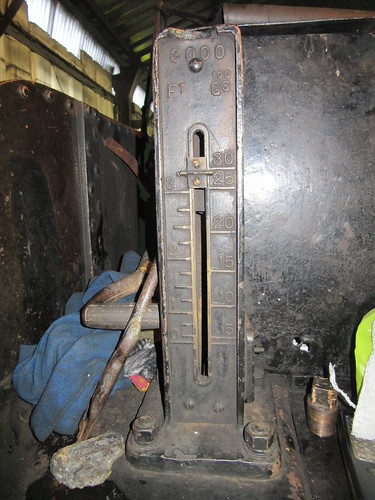
Float-operated water gauge on tender, marked in Feet and Gallons.
We came off-shed, moved across to our train in platform 2, coupled on and commenced steam heating. On the Fireman's side of the cab, a Carriage Warming Isolating Cock is connected to the steam manifold, receiving full boiler pressure. This feeds a Mason's Reducing Valve, allowing the steam pressure fed to the train to be regulated.
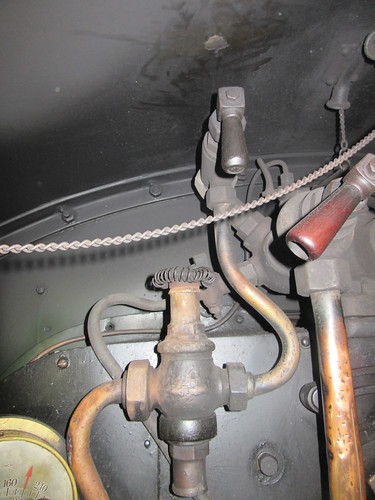
Wooden-handled steam isolating cock for Carriage Warming (top), feeds a Mason's Reducing Valve (bottom) for regulating the pressure.
A Bourdon Gauge (similar to the Boiler Pressure Gauge) indicates the carriage warming pressure being fed to the train. The engraved brass dial on G.W.R. carriage warming pressure gauges lists the pressure to be used according to length of the train.
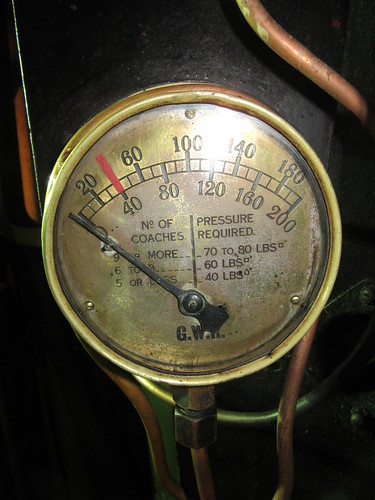
Carriage Warming Pressure Gauge showing pressure to be used according to length of train.
As expected, departure was a little late, waiting for passengers. On receipt of the Guard's 'right away', I checked the signals, whistled and, with the screw reverser set to full forward gear (about 75% cut-off indicated) and the cylinder drain cocks open, eased the regulator open. After a few yards, I closed the drain cocks. We collected the Single Line Staff from the signalman and made our way up the bank, observing the 10 m.p.h. speed limit. By this time, I'd wound the reverser back to around 35% cut-off, at which the engine appeared quite happy. Once clear of the speed restriction, I only allowed speed to rise a little as Santa trains are always leisurely as groups of passengers are led through the train to visit Santa.
Once we were on the downgrade to Market Bosworth, I was able to shut off steam. I banged the regulator shut, to make sure it had closed, and then gently moved the regulator handle open far enough for curved link lifted by the regulator handle to open the Jockey Valve so that the Sight Feed Lubricator would continue to feed oil to the moving pistons and valves. I also wound the reverser to full forward gear - the 'Drift' position which suits most locomotives fitted with Stephenson Link Motion. A little braking as we approached the platform at Market Bosworth reduced our speed then I used a little steam to ease the whole train into the platform before stopping. The fireman wound the tender handbrake on as we were likely to stand a little while. We took the opportunity to take a few photographs.
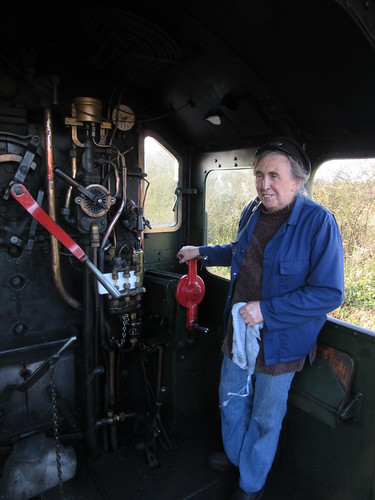
Dave took this picture of Jan as we waited at Market Bosworth.
When we received the 'right away', starting away was generally similar to leaving Shackerstone - there's a 5 m.p.h. slack over the foot crossing until past the out-of-use signal box then a further slack of 5 m.p.h. over the underbridge near the siding. Once clear of this slack, I used a little more steam to climb the bank, again with about 35% cut-off but running at a very modest speed.
I was able to 'drift' on the downgrade to Shenton, bring our speed down with gentle braking on the approach and a little steam to bring the train into the station. With vacuum destroyed, I 'eased-up' onto the train to make uncoupling easier then made the locomotive safe for 'going between' to uncouple - tender handbrake hard on, regulator fully shut, reverser in mid-gear, cylinder drain cocks open. After uncoupling and with one lamp on the buffer beam at each end, we ran around the train and coupled on again, setting the lamps to 'Express' (one over each buffer on the tender).
Soon we were making our leisurely progress back to Market Bosworth, tender first. It can be unpleasant running tender first with the wind and when it rains - well! There was a canvas storm sheet available which can be rigged between the cab roof and two supports at the front of the tender but it was not needed as we were lucky with the weather. Once again, we stood for some minutes in Market Bosworth, so I took the picture below.
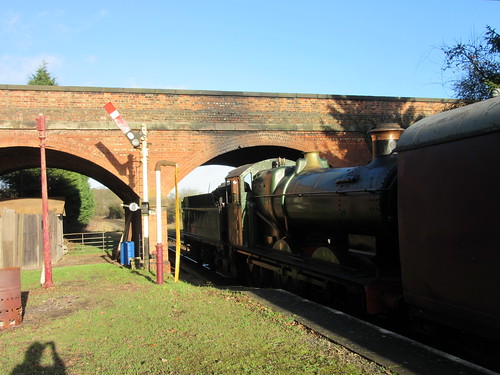 Battlefield Line 'Santa' Trains 2015: '3205' waits for the 'right away' from Market Bosworth.
When we arrived back at Shackerstone (unfortunately stopping a little short because of a problem releasing the train brakes after an application), 'Cumbria' was ready to leave with the 'De Luxe' service. Once all our passengers had disembarked, I positioned the train correctly and we ran round, ready for the 3 p.m. departure.
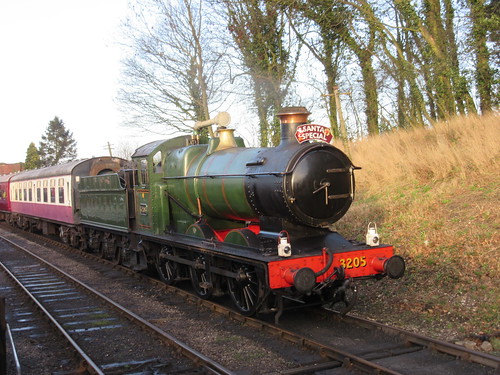 '3205' ready to take the 3.00 p.m. from Shackerstone on 23rd December 2015.
The 3.00 p.m. train was a little late away and we made the usual unhurried progress to Shenton, pausing at Market Bosworth for a while. By the time we had run round, it was dusk, so we made sure the loco lamps were lit (there's a short article on traditional lamps MIC - Lamps). Once again, we were held at Market Bosworth in the gathering gloom but this time the Guard, before issuing the 'right away' using a handlamp, gave us the instruction "Go for it!". Of course, '3205' worked the train up to line speed without effort and, all too soon, we were approaching Shackerstone and looking out for the Outer Home signal.
Although the signals at Shackerstone are semaphore and were originally lit by paraffin (there's an article about semaphore signals at night here), they have been adapted and are now electrically lit. The signalman had "given us the road" so we gingerly descended the bank, surrendered the Single Line Staff and stopped in platform 2 (this time in the right place). We quickly uncoupled and dropped forward clear of the points to await our path to the shed, which was blocked by the 'De Luxe' train stock. The picture below gives an idea of how dark it had become. You can just see the right hand side of '3205', ahead of us the last coach of the 'De Luxe' train and on the right the passengers off our train, streaming past to the car park.
Adrian had already disposed of 'Cumbria' in the shed but, in its place, he'd attached a diesel shunter which performed the final shunt I'd carried out using 'Cumbria' on Saturday 19th December 2015. Once the coaches had been drawn up towards the single line, we were able to make our way through platform 1 to the 'Dock' ground frame and into the shed. We quickly disposed, I completed the necessary paperwork and thanked Dave and Jamie for a splendid day.

Not yet 5.00 p.m. but already dark: View from the footplate of '3205' (left) as we wait for the empty stock ahead of us to be drawn clear so that we can reach the shed. Happy passengers (right) stream past to the car park.
You can find all my posts on 'Santa Special' trains here.
My pictures of Battlefield Line 'Santas' in 2015
Battlefield Line 'Santa' Trains 2015.
The Battlefield Line now operates two 'Santa' trains, alternately, on its line from Shackerstone to Shenton. One, with vestibule stock, is dubbed the 'Classic' train. In this train, Santa's Helpers take groups of passengers, in turn, to see Santa Claus in his Grotto, where the children receive an early Christmas present. The second train has corridor compartment stock and forms the 'De Luxe' train. On the De Luxe service, families or groups can book a private compartment provided with refreshments and Christmas Crackers and Santa makes a 'house call' at each compartment, distributing presents.
In December 2015, visiting locomotive 3205 (the 'Collett Goods') worked the 5-coach 'Classic' train and another visitor, 'Cumbria' (Hunslet 3794 'Austerity Tank'), hauled the 4-coach 'De Luxe' train. I'd first seen both engines at the The Battlefield Line Steam Gala in October 2015.
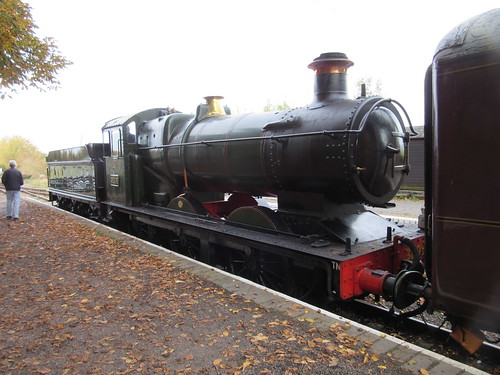 3205 Collett Goods at the Battlefield Line Steam Gala, October 2015
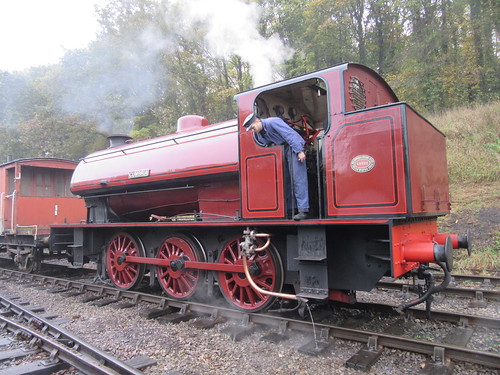 Hunslet 3794 'Cumbria' at the Battlefield Line Steam Gala, October 2015
Events of Saturday 19th December 2015
I had been rostered to drive 'Cumbria'. For whatever reason, there was no fireman for 'Cumbria' although our trainee, James, was well-on with steam raising, under the watchful eye of Dave H. who was actually booked as Fireman on the 'Collett Goods'. The day was only saved by Dave agreeing to be fireman on both locomotives, since there was also a trainee fireman on the 'Collett Goods' to assist. Whilst trainee firemen can carry out most of the tasks, and are allowed to work under the supervision of the driver in 'station limits', once a locomotive leaves Shackerstone, there must be a registered fireman on the footplate.
The 'Collett Goods' was booked to make three trips to Shenton (leaving Shackerstone at 10 a.m., 1 p.m. and 4 p.m.) whilst 'Cumbria' was diagrammed to take two trips (at half past eleven and half past two). All trains were 'Sold Out'.
We came off shed with 'Cumbria' in good time to allow us to steam heat the 'De Luxe' train standing in platform 1. The day was overcast with intermittent rain. The 'Collett Goods' moved across to the head of the 'Classic' train in platform 2 shortly before departure time at 10:00. The 'Classic' train coaches have Electric Train Heating so can be warmed from an electric 'Shore Supply' before the locomotive arrives although, once coupled, the 'Collett Goods' provided conventional steam heating. The 10 o'clock departure left about ten minutes late, waiting for tardy passengers. We continued to warm our train whilst the other train travelled to Shenton and back and all the young people on that train had had a chance to meet Santa.
I think our first departure was about ten minutes late and we made very leisurely progress down the line to Market Bosworth. With a full train, Santa has his work cut out to see everybody so we stood for a while before carrying on to Shenton.
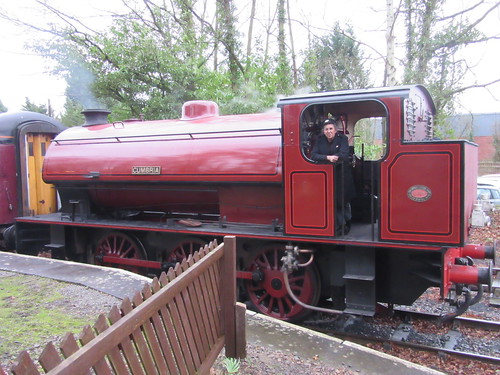 Jan relaxes on the footplate as 'Cumbria' pauses at Market Bosworth en route to Shenton with the 11:30 from Shackerstone.
We made similarly pedestrian progress to Shenton. Then we had a flurry of activity as we uncoupled, ran round and "hooked on" again for the return, this time chimney leading. When we finally arrived back in platform 1 at Shackerstone, the one o'clock 'Classic' service was able to leave, but there was, once again, a slight delay as late-arriving passengers were rounded up. Once that train had left, we were able to run round our train, pausing at the water column at the south end of platform 2 to replenish our saddle tank. Once re-coupled, it was back to keeping the train warm ready for the 2.30 p.m. train.
Our second trip down the line was similarly uneventful (and slow). The day had remained overcast and, only three days before the Winter Equinox, we lit our paraffin headlamp before returning from Shenton. Of course, in the days of steam, the headlamp was principally a means of indicating to signalmen the type of train approaching. It's only modern high-intensity lights, now mandatory on Network Rail lines, that offer the driver any improved visibility ahead and that effect is limited.
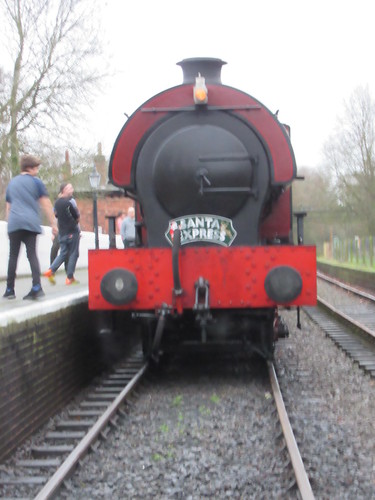
'Cumbria' (with headlamp lit) ready to return from Shenton.
We stood for some time at Market Bosworth, giving me a chance to take a picture of James on the footplate of 'Cumbria'. I also managed a shot of Santa himself making his way from compartment to compartment.
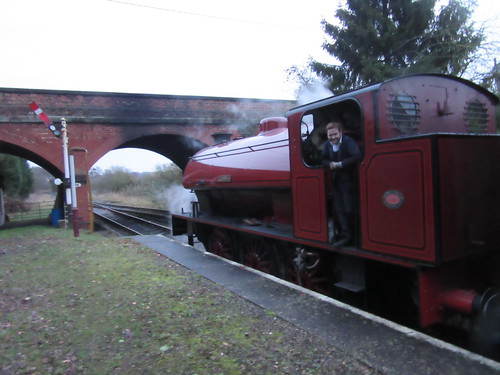 James smiles for the camera at Market Bosworth on our second return trip to Shackerstone.
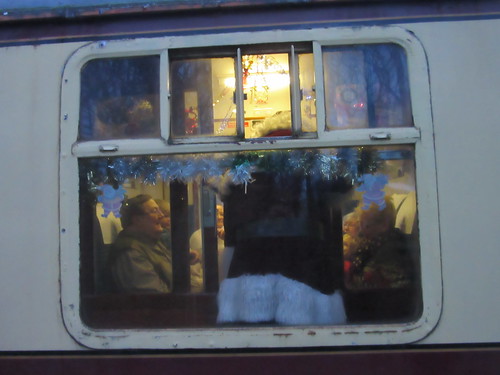 View from the platform at Market Bosworth as Santa visits each compartment of the 'De Luxe' train in turn.
Eventually, we arrived back at Shackerstone, with a lot of happy passengers. A little later, the 'Collett Goods' left with the 4.00 p.m. departure - the last train of the day. My initial hopes that we might then put our engine to bed were dashed. With our 4-coach train blocking platform 1, there was no 'release road' to allow the 'Collett Goods' onto shed on his return and, in the absence of a suitable diesel shunting locomotive, and so we ran round our train and re-coupled. We remained there until the last train returned to platform 2. Our Guard also agreed to stay, to act as Shunter riding in the end of the stock. Once the last train had arrived, Leon, the signalman, "gave us the road", including permission to pass the Starting Signal (nowadays usually called the 'Section Signal') at danger sufficiently to get our 4-coach clear of the crossover and the two-disc ground signal which protects the crossover. The top disc 12 reads to platform 1, bottom disc 3 reads to platform 2. Signals by handlamp from both the Guard and Signalman let us know when we were 'clear'. The 'Collett Goods' wasted no time in uncoupling and, as soon as we'd drawn our train clear of platform 1, shunting into the shed.
The crossover road was reversed again and disc 12 cleared. The Guard, keeping lookout from what was now the leading vehicle, continuously gave lamp signals and I cautiously propelled the train back into platform 1. The Guard applied his handbrake, I 'squeezed up' to make sure the coupling was slack then James uncoupled. We followed the 'Collett Goods' into the shed and completed disposal of our engine.
More
I was back at the Battlefield Line on 'Santa' trains on Wednesday 23rd December 2015, driving '3205', as described here.
You can find all my posts on 'Santa Special' trains at the Battlefield Line and Peak Rail here.
My pictures
Battlefield Line 'Santa' Trains 2015
In an earlier post here, I described the service on 6th December 2015. I was there again on Sunday, 20th December 2015, this time with Phil M. as fireman. Having prepared 'Lord Phil', we moved across to Rowsley platform road and coupled onto the south end of the 7-coach train, giving us over an hour to perform 'carriage warming'.
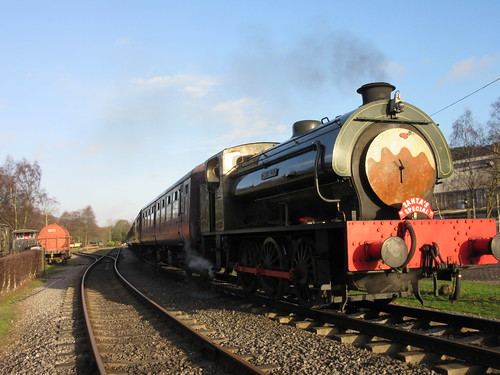 Steam heating the stock prior to the first departure from Rowsley.
This time, the 'Class 31' had been left in the shed overnight but it came across and coupled up to the north end of the train to 'top and tail' in time for the first departure, which was a little delayed waiting for missing passengers.
We were still enjoying mild weather for December and the sun shone for most of the day but there was a wind which rather chilled the driver's side of the cab.
All tickets on the 'Santas' are pre-booked and we were told that all four trains were 'Sold Out'. In addition, Sunday Lunch was being served in the Palatine Set and, again, all seats were booked.
Of course, Santa Claus was there to welcome his young visitors, together with a reindeer, a cow and Peppa Pig.
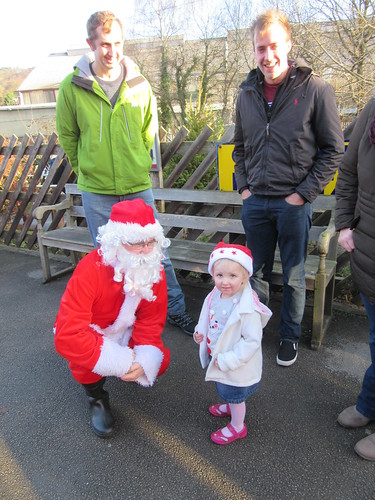
Santa greets a young visitor.
Once again a choir from Matlock Musical Theatre sang Christmas Carols on the platform at Rowsley as passengers boarded the train. Initially, there were six singers but other members strengthened the group later.
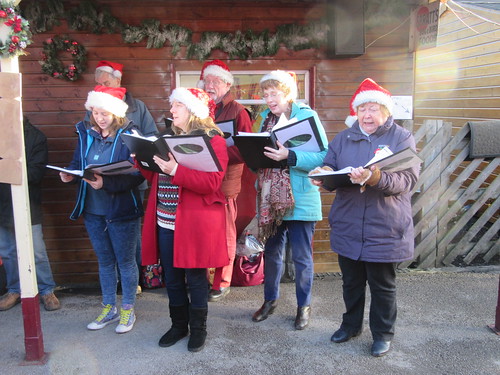 Carol Singers from Matlock Musical Theatre.
Phil drove the first trip while I fired. I seem to be loosing strength in my arms so that even firing the small grate on an 'Austerity' is getting harder. On the right-hand drive 'Austerity', the fireman should work from the left of the footplate, preferably using his right arm to push the shovel blade, leaving the left hand to support the shaft of the shovel. Unfortunately, I'm naturally left handed but on the small footplate of an 'Austerity' there's not enough room to fire from the 'wrong' side. Originally, most locomotives were right hand drive. The Great Western Railway remained right hand drive to the end, as did many countries which adopted right-hand running on double track. But in Britain, we've always used left-hand running on double track so the sighting of signals is easier if the driver is on the left and more modern locomotives tended to be left-hand drive. Since both left-hand and right-hand locomotives were in use (even within the same class sometimes), it was advantageous for fireman to be able to fire from either side - indeed, some driver's insisted that fireman stayed on their own side of the cab.
A few years ago the consummate railway professional Dick Hardy wrote to me about a day he'd spent firing 'Port Line' on a main line steam special, saying he found the firebox about a foot longer than he remembered from when he was younger. I know exactly what he meant.
I drove the three remaining trips and we worked through the day without incident which, of course, you always aim to do.
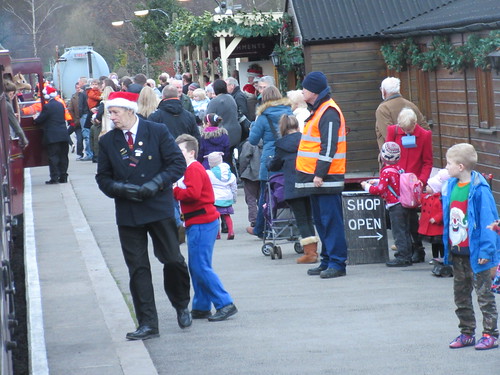 Rowsley Station.
I don't think any of our departures from Rowsley were on time and the various speed restrictions don't give much scope for making up time 'on the road' but we made sure we didn't lose further minutes. There's a short video clip showing our final approach to Matlock Town, passing the Sainsbury's car park here. After watching the clip, the Back Button will return you to this blog.
On the final return from Matlock Town, Phil made sure our red tail lamp was lit. When we stopped at Darley Dale, the illuminated Christmas decorations showed up well.
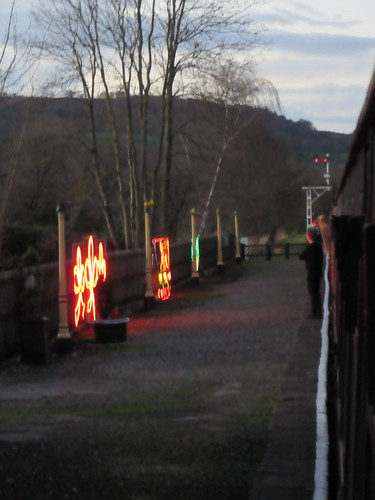
The last Down train at Darley Dale, showing the illuminated decorations.
To be able to check the gauges in the gathering gloom, Phil had donned his head-mounted 'miner's lamp'.
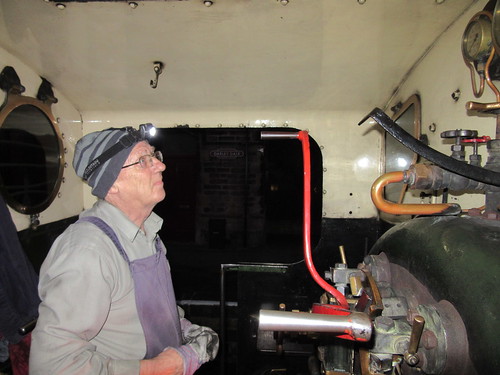 Flash photography shows Phil (with 'miner's lamp' ) checking the gauges.
On arrival at Rowsley, we received the single line token from the station staff so that we could uncouple from the train and make our way, via the South End ground frame, to the loop and third line. At the North end, we then passed the token back to the diesel crew, allowing them to release the North End ground frame so that the 'Class 31' could make its way to the shed. We took 'Lord Phil' to the siding outside the shed, so that Chris could coal our bunker using the Bucket Loader. We then made our way to No. 1 road where we disposed and left 'Lord Phil' over the outside pit.
My pictures
Peak Rail 'Santa' Trains - 2015.
Bookings for Peak Rail's 'Santa Trains' in December 2015 have been very satisfactory.
Sunday, 6th December 2015
On the second day of the Santa service I was booked to drive, with Mike S. as fireman. Having prepared 'Lord Phil' and topped-up the bunker with coal, we coupled onto the south end of the 7-coach train ready to 'top and tail' with the 'Class 31' diesel-electric which had been left coupled at the north end overnight. We were nice and early so, before the first departure at 10:45, we had over an hour to perform 'carriage warming', supplying steam at 30 p.s.i. via the Reducing Valve to the heating system on each of the coaches. The weather was fairly mild for December and, although we had intermittent rain during the day, it was reasonably pleasant.
Rowsley Station had been decorated for Christmas and looked quite inviting. All tickets on the 'Santas' are pre-booked and volunteer helpers are always in demand to deal with the large number of passengers. Santa had a number of Elves and other helpers in attendance to assist in distributing presents to the children whilst the grown-ups enjoy mulled wine and a mince pie during the journey to Matlock Town and back.
As the passengers arrived, there was quite a pleasant atmosphere of anticipation, particularly when Santa patrolled the platform greeting the boys and girls together with professional entertainers who juggled, did magic and clowned. There was also a reindeer and a bear.
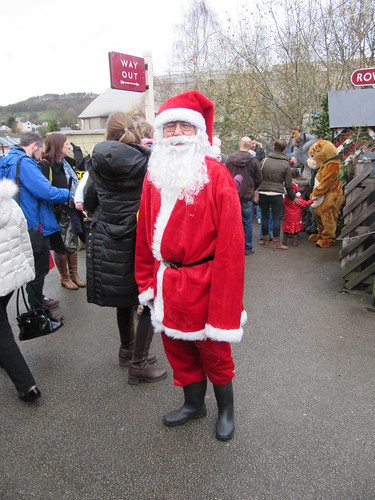
Santa poses for the camera before resuming greeting the visitors. The reindeer and bear are in the background.
In addition, a choir sang Christmas Carols on the platform at Rowsley as passengers boarded the train.
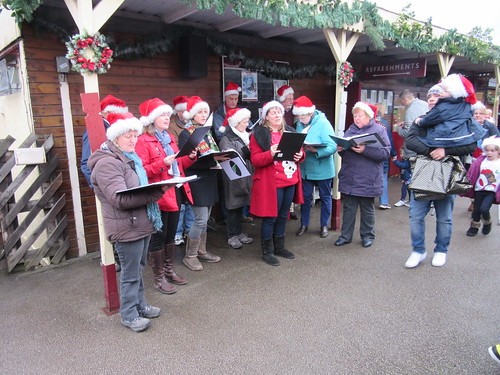 The choir perform in front of the decorated station buildings at Rowsley.
The two coaches marshalled next to the steam locomotive at the south end form the 'Palatine Set' comprising one full restaurant car and a restaurant/bar/kitchen car. The 'Palatine Set' was thronged with staff preparing to serve Christmas Lunch to the diners on the second departure from Rowsley at 12:18.
Santa trains are often a little late departing because of booked passengers arriving late but, as far as possible, the timetable is adhered to. With the number of speed restrictions on the route, it's difficult to make up time.
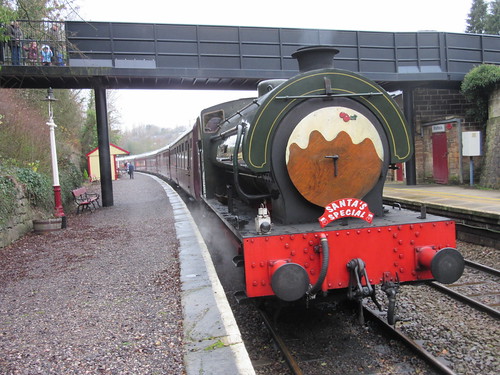 'Lord Phil' on arrival at Matlock Town, with 'Christmas Pudding' smokebox decoration and 'Santa's Special' headboard. It is displaying a tail lamp, ready for the return journey.
The 'Class 31' hauled the train back to Rowsley where Mike and I replenished the saddle tank. The water consumption is increased, of course, when supplying steam to heat the train. With the diners and booked passengers aboard, we set off on our second round trip. This was completed without incident, with Mike using the classic "little and often" method of firing. We didn't need to top-up with water this time.
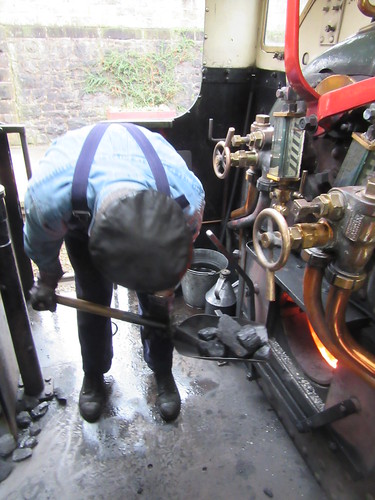
Mike using the classic "little and often" method of firing.
The train was very busy on the two round trips in the afternoon during which parties of adults arrived by, I think, at least four large motor coaches. After the third round trip, we filled the saddle tank, this time with me perched on top of the engine, allowing me to take a couple of pictures from my elevated position.
 A view of Rowsley whilst taking water. On the far left, the maroon exhibition coach is visible, stabled on the turntable siding.
On the last trip to Matlock, it was starting to grow dark so we lit the locomotive paraffin lamps, displaying a white near the chimney on the way there, changing to a red tail lamp on the buffer beam for the journey back. There's a little piece about lamps here.
 'Lord Phil' at Matlock Town, displaying a lit tail lamp.
The 'Class 31' took us back to Rowsley for the last time, pausing briefly in the Down platform at Darley Dale. Now it was properly dark, the illuminated Christmas decorations on both platforms showed up well, encouraging a number of passengers to take photographs of the displays.
On arrival, we were given the single line token, allowing us to uncouple from the train and make our way, via the loop and third line, to the North end where we surrendered the token to the diesel crew, so that they could stable their locomotive in the shed on No. 1 road. Meanwhile, we took 'Lord Phil' to the siding outside the shed, so that Chris could coal our bunker using the Bucket Loader. We then made our way back to the North end and attached the exhibition coach from the turntable siding. With Jacob acting as guard, we propelled the coach over the third line back onto the loop. We then drew the coach along the loop, stopping where instructed adjacent to the main train. With the coach 'tied down' and uncoupled, it was now our turn to make our way to No. 1 road where we carried out the disposal procedures and stabled 'Lord Phil' over the outside pit.
Go to 'Santa Specials' at Peak Rail - Christmas 2015 (part 2)
My pictures
Peak Rail 'Santa' Trains - 2015.

