Showing posts with label Peak Rail. Show all posts

Wednesday, 1 January 2020

Santa Specials at Peak Rail 2019

In December 2019 Santa Specials at Peak Rail continued the well-established format of a top-and-tailed service between Rowsley and Matlock Town, stopping at Darley Dale for operational purposes.

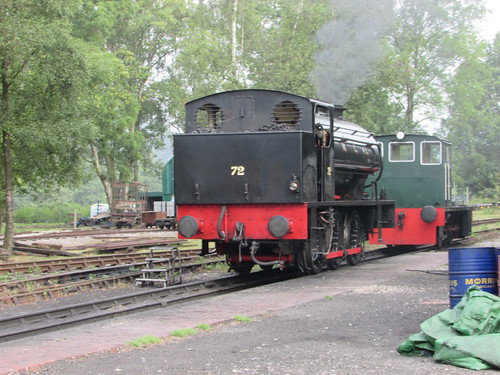
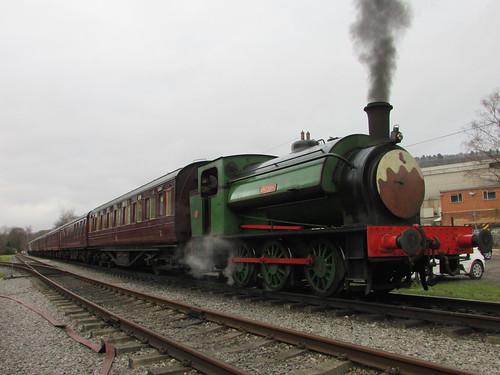
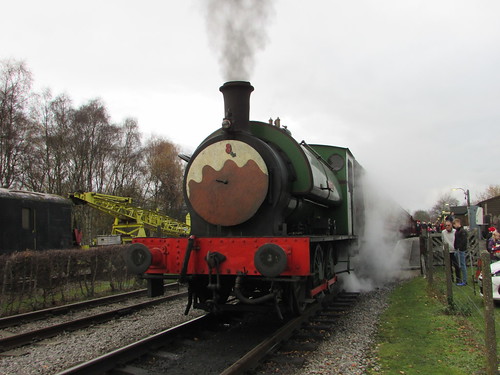
Once again, 'Austerity' 0-6-0T saddle tank No. 72, facing south, was to be coupled at the south (Matlock) end of the train with diesel-electric stalwart 'Penyghent' marshalled at the north end. For the first time, an 8-coach train was in use. Previously, passenger trains were formed of up to 7-coaches (5 coaches plus kitchen/dining car and the beautiful restored LMS coach 7828 forming the 'Palatine Dining Set'). In 2019, an additional Brake Composite Corridor coach (code 'BCK' number 21268) was added which was air-braked but also 'through piped' for vacuum.

It's acceptable to include a coach without working brakes in a passenger train provided it is 'sandwiched' between vehicles with operative brakes so that, in the event of such a train becoming divided, both parts of the train will be automatically stopped. Of course, when the Guard informs the driver of the load, he should remind the driver of the unbraked vehicle. The 'Special Trains Notice' issued by the Operating Department covering the Santa Special Trains also gave special authorisation for 'Penyghent' to provide assistance to Up Trains in case of problematic railhead conditions.

I was rostered driver on Sunday 22nd December 2019 with Phil M. as fireman and R. Newman as cleaner.

In 2019 been the United Kingdom had suffered a particularly wet November and December with flooding in many areas, including the Derwent Valley, through part of which Peak Rail runs. I knew that extreme river levels had caused some damage to railway bridge 35, just north of Matlock Riverside station and a 5 m.p.h. speed restriction had been imposed, together with weekly bridge inspections.

The 22nd of December was the Winter Solstice - the shortest day of the year so I was not surprised that it was still very dark when I arrived at Rowsley shed at about 06:45. On my journey from home to Rowsley, we'd passed through fairly heavy rain so I was relieved that it was dry at Rowsley. It rained a bit later in the day but it wasn't bad and the temperature wasn't too low. Phil and the cleaner had matters well in hand with the fire so I concentrated on oiling-round and daily exam.

The 0-6-0ST 'Austerities are powerful and reliable locomotives but I have been known on occasion to call them, rather unkindly, 'boring'. However, on this winter morning I was very appreciative of the relative simplicity of oiling an 'Austerity' as compared with Great Western 'light Prairie' 5542 and 'modified Hall' 6989 I'd been on recently at the Battlefield Line. But there's still a fair bit of 'squirming around' to get at the inside motion.

Once we were ready, we decided to go across to our 8-coach train nice and early to start carriage warming. Of course, we had an ulterior motive: on the platform we could enjoy the facilities of Rowsley Station Buffet so tea and a breakfast bap made us ready for the rest of the day.

The Special Timetable called four round trips to Matlock Town leaving Rowsley at 10:30, 12:05, 13:40 and 15:15 with our 8-coach train (plus the trailing load of 'Pehyghent'). 'Santa Specials' are often late departing from Rowsley, as late-arriving booked passengers are usually given a little leeway and it was about 10:45 when we set off.

The railhead was quite damp and there was plenty of drifting steam from the cylinder drain cocks condensing in front of us but, as I hoped, No. 72 moved away without a trace of slip. With no carrying wheels, the whole of the 48 ton weight of the locomotive is adhesive and the generous size of the cylinders (18 inches diameter with a 26 inch stroke) combined with relatively small wheels (4 foot 3 inches diameter) produces a tractive effort of 23,870 pounds (at 85% boiler pressure). The 'Austerity' was designed to shift freight trains well above 1,000 tons - it just isn't very quick about it - so assistance from 'Penyghent' was not required.


Phil was ably assisted by a 'Christmas Elf' (Santa Specials at Peak Rail 2019)

We completed our first run to Matlock Town without incident, crossing Bridge 35 gently at 5 m.p.h. The damage to the bridge was not visible from above but I was told that uprooted trees carried downstream in the floods had struck the bridge piers and displaced some steel supporting brackets. Some tree branches were still deposited on the river bank normally well above water level, together with a number of large hay bales transferred by the floods from a field somewhere upstream.


Crossing Bridge 35: Two large hay bales, wrapped in black polythene, are visible on the river bank near the centre of the picture (Santa Specials at Peak Rail 2019)

We stood in Matlock Town for a while whilst Santa proceeded through the train with his helpers, distributing presents then 'Penyghent' hauled the train back to Rowsley, with the 'Austerity' trailing behind as 'Tail-end Charlie'. Back at Rowsley, we took the opportunity of replenishing the saddle tank with water.


Phil at the 'Brown Tank Wagon' at Rowsley as we take water using a portable pump and fire hoses. Note the 'DOGFISH' hopper ballast wagons on the siding.(Santa Specials at Peak Rail 2019)

In addition to passengers joining the train to meet Santa, the 12:05 boarded diners for Christmas lunch.


A winter Sun illuminates Rowsley as diners join the train for Christmas lunch (Santa Specials at Peak Rail 2019)

As the train left Rowsley, we could seen that the top end of the large car park was now quite full.


By noon, the top end of the car park had filled-up (Santa Specials at Peak Rail 2019)

Our platform at Matlock Town was unusually quiet because, on Santa Specials, passengers only join or leave the train at Rowsley.


Matlock Town (Santa Specials at Peak Rail 2019)

Once again, 'Penyghent' hauled our long train back to Rowsley.


'Penyghent' shown entering the loop at Matlock Riverside as it returns our long train to Rowsley (Santa Specials at Peak Rail 2019)

As we waited at Darley Dale to give Santa a chance to finish his present distribution, I took a couple of pictures.


View from Down platform at Darley Dale, looking north, as we return to Rowsley (Santa Specials at Peak Rail 2019)


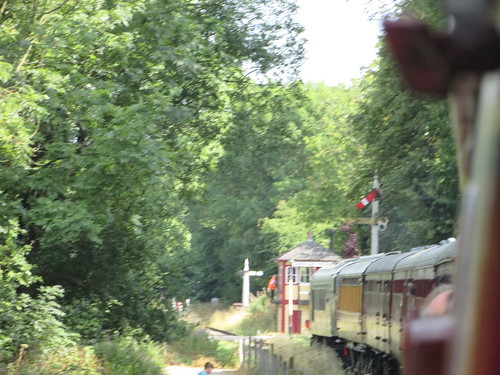
View from Down platform at Darley Dale, looking south showing crossing gates and signal box, as we return to Rowsley (Santa Specials at Peak Rail 2019)

By the time we arrived back at Rowsley, the train was well-warmed and we were able to discontinue steam heating.


Disembarking happy passengers at Rowsley (Santa Specials at Peak Rail 2019)

We were able to invite Newman family members to view the footplate before they received a special greeting from Santa himself.

Newman family members chatting to Santa alongside our engine (Santa Specials at Peak Rail 2019)

As it grew dusk, we made our fourth round trip to Matlock Town then, leaving the coaching stock in the platform at Rowsley, we moved light engine to the shed and disposal after a successful and enjoyable day.

Related posts on this website

The 'Austerity' 0-6-0ST locomotive.
Peak Rail 2019.
All my Peak Rail posts.

My photograph albums

Where necessary, clicking on an image above will display an 'uncropped' view or, alternately, pictures may be selected, viewed or downloaded, in various sizes, from the albums listed:-
Peak Rail Santa Trains 2019.
No. 72 Austerity Tank.
'Penyghent'.
Restored coach 7828.
All my Peak Rail pictures.

Wednesday, 31 July 2019

Peak Rail 2019

Although Peak Rail ran a reduced service in February and March 2019, my first driving turn at Peak Rail in 2019 was Sunday, 7th April. I also describe a turn on Easter Saturday. The year then continued following a similar pattern.

Sunday, 7th April 2019


No. 72 on an 'Up' train pauses at Darley Dale on 25th March 2018.

The popular 'Austerity' 0-6-0 saddle tank No.72 which had worked the services during 2018, usually top-and-tailed with a main-line diesel (D8 'Penyghent'), had been retained as the steam motive power in 2019. In the morning, Mike S. was fireman with C. Ward taking over in the afternoon. Colin D. was cleaner all day and it was a merry footplate.

In the morning, Mike and I came off-shed at 08:30, in order to collect our driving experience candidate from Rowsley Station at 08:45, giving him two hours on the footplate. This time was divided between familiarisation with the locomotive and its controls, driving between Rowsley and the Up Home signal at Church Lane, operating Rowsley South Ground Frame to allow shunting movements to the loading dock at the north end of Rowsley Yard (where our driver was met by his wife and two children) and a little practice firing.

Apart from the 'pole' reverser, which was unreasonably stiff to move following maintenance work, the engine performed well.

Easter Saturday, 20th April 2019

Once again, No. 72 was the motive power. Robin S. was fireman all day. He'd stayed 'on site' overnight and booked on very early (04:15) so we were ready to come off shed nice and early and we sat in the platform at Rowsley, waiting for our driving experience candidate who enjoyed a 1-hour experience course, followed by a footplate ride on the first service train to Matlock Town.

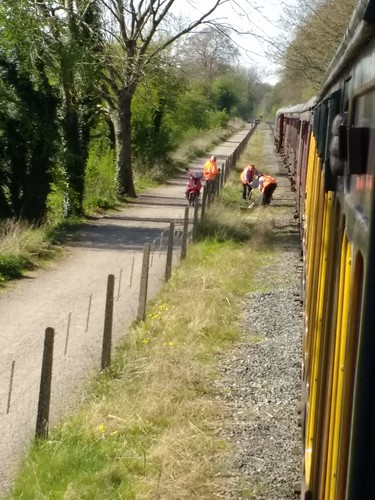
The weather was bright and warm and we had plenty of passengers on all the trains. When we arrived back at Rowsley after the fourth round trip, we were informed that we'd started a small lineside fire. On that return trip (when we were being 'towed' by 'Penyghent') I'd seen a couple of people standing on the public footpath adjacent to the line, apparently looking at the track, but I'd spotted nothing untoward. Keen to ensure that any embers were fully extinguished, the Guard recruited help, loaded at least two five gallon drums of water into the Guard's compartment and we arranged to stop at the incident on our last trip to Matlock to ensure the fire was out. We stopped as planned and the Guard made a thorough job of dousing the area with water before completing the trip. Only a tiny burnt area was apparent and I joked to the Guard that he could have spit on on it to make it safe but, in very dry weather, lineside fires can be very serious and preserved railways may ban the use of steam locomotives during high-risk conditions. I described another lineside fire on the Battlefield Line in the post here.


Peak Rail 2019: A small lineside fire.

Related Posts on this Website

The 'Austerity' 0-6-0ST locomotive.

My pictures

Where necessary, clicking on an image above will display an 'uncropped' view or, alternately, pictures may be selected, viewed or downloaded, in various sizes. Within each album, photographs are normally arranged by date taken.

No. 72 - Austerity Tank.
Peak Rail 2019.
All my Peak Rail Albums.

Tuesday, 23 July 2019

Buxton by Rail

On the 18th April 2019, I made a journey by train to Dove Holes for a meeting. After the meeting, I continued to Buxton then, after a quick walk around the town, made the journey back home. I was surprised to find it was as long ago as 18th November 2013 when I'd previously visited Dove Holes by train and that journey is described in the post here.

I decided to travel to the Buxton branch via Crewe, involving a change at Crewe. The view below shows platform 5 looking north as I waited for the Euston-Piccadilly Virgin service. Down Manchester trains from London normally cross to platform 5 at Crewe South Junction so as to avoid conflicts with other routes at Crewe North Junction as they depart on the Manchester line.


Crewe: View from platform 5 looking north (Buxton by rail).

At Stockport, I changed again, catching the usual superannuated 'Northern Rail' diesel multiple unit from platform 0 which noisily ground its way up the hills to Dove Holes.


Stockport platform 0 looking south, showing 'OFF' and 'RA' indicators for Stockport No. 1 signal box signal 23 (Buxton by rail).


Dove Holes, looking north towards Stockport (Buxton by rail).

These were the published timings of the trains I used:-

Wolverhampton-Dove Holes-Buxton Arrive Depart
Wolverhampton 09:20
Crewe 09:55 10:12
Stockport 10:36 11:02
Dove Holes 11:41 13:41
Buxton 13:49

Not knowing how long my meeting would last, going on from Dove Holes to Buxton was only an aspiration. Trains stop at Dove Holes every two hours but I was lucky and, following my meeting, managed to get the 13:41 to Buxton.


Dove Holes, waiting for the 13:41 to Buxton: Looking north towards Stockport, as the 13:40 departs for Manchester (Buxton by rail).

Buxton was always special from the railway point of view, not least for the two parallel stone-built terminal stations, one Midland Railway the other London and North Western Railway with twin train sheds provided with imposing gable end walls featuring massive fan windows. Each railway provided its own extensive freight and locomotive facilities and complex junctions joined the various routes. Gary Dixon has shared this early track plan:-


Old Track Plan of Buxton (Shared by Gary Dixon)
Click here for larger size


When I was young, the railways at Buxton were still impressive but are now a pale shadow of what once was there. Sadly, the Midland station has been closed, demolished and the land redeveloped. Peak Rail was set up with the aspiration of re-instating the Midland route to Buxton as a tourist line and preservation activities were originally conducted from part of the old Midland station yard. Before I became a member at Peak Rail, I remember the 'steam shuttle' operating on a short demonstration line at Buxton.


Peak Rail 'steam shuttle' at Buxton

But, stymied by the removal of the original bridge over the road just outside the station it was decided that Peak Rail activities would be transferred to the Matlock end of the route. I've been a driver at Peak Rail for some years now and there are a number of posts in this blog with the label Peak Rail.

So, after my short journey from Dove Holes, my train arrived at the remaining, former L&NWR station, now shorn of its overall roof but retaining the magnificent gable end wall and fan window, with the name of the original owning company incised in the stonework.


The LNWR station building at Buxton which originally faced a similar Midland building (Buxton by rail).


7mm/ft scale model of the now-demolished Midland station, on display in the remaining (LNWR) station.

Buxton is full of impressive stone-built edifices befitting its history as a popular Spa Town. I went as far as the elegant Buxton Crescent, currently undergoing major restoration work.


Buxton Crescent under restoration. The building on the left is the pump room (Buxton by rail).

The Pump Room now doubles as a tourist information bureau.


The Pump Room, Buxton (Buxton by rail).

I would have liked to spent longer in Buxton but my walking is not brilliant and I decided to walk back to the station and travel back to Stockport on the 14:34 from Buxton.


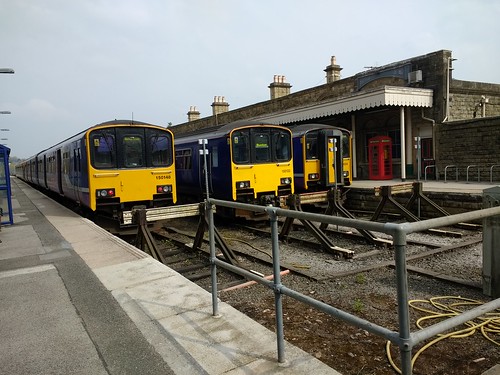
Buxton Station looking quite important with three DMU side-by-side (Buxton by rail).

Network Rail were in the final stages of completing an extension to sidings on a disused council trip to allow DB Cargo and Freightliner to increase the length of stone trains working through Buxton from 18 to 26 wagons, giving 2,500 tonnes trains. I believe the sidings were brought into use shortly after my visit.


Almost-complete siding extension at Buxton (Buxton by Rail)


Another view of the siding extension works at Buxton (Buxton by Rail)

At Stockport, I changed trains, taking a Cross Country 'Voyager' via Stoke back to Wolverhampton. As is often the case, the train was packed with commuters mainly travelling from Manchester as far as Macclesfield but, luckily, I managed to secure a seat at Stockport. But it's rarely a very pleasant passenger experience on the overcrowded trains which Train Operating Companies love to run.

These were the published timings of the trains I used on my return journey:-

Buxton-Wolverhapton Arrive Depart
Buxton 14:34
Stockport 15:20 15:36
Wolverhampton 16:39

References

You can find detailed signal box diagrams for the routes I used as they were back in steam days in the excellent series of publications from the Signalling Record Society 'British Railways Layout Plans of the 1950's'.

If you want to see what remains of the routes today, refer to 'Railway Track Diagrams Book 4: Midlands & North West', Second Edition (or preferably later), published by Trackmaps.

Related Posts on this Website

The following post describes a trip on the Buxton Branch as far as Dove Holes in 2013:-
The Buxton Branch

My pictures

I'm sorry, taking pictures in a modern train often gives poor results. Where necessary, clicking on an image above will display an 'uncropped' view or, alternately, pictures may be selected, viewed or downloaded, in various sizes, from the albums below:-
Buxton by Rail

Pictures from this album have been divided and added to various albums each covering a roughly-defined geographical area. Within each of these albums, photographs are normally arranged by date taken. Thus, by searching through the appropriate album, you can find changes through time. My trip to Buxton added pictures to a number of albums as I moved through various areas.

Railway pictures:
West Midland Railways (Wolverhampton).
Stafford Area rail.
Crewe Area rail.
Buxton Branch (Trips in 2013 and 2019).
Manchester Area Rail.


Buxton Town:
Buxton.

Wednesday, 2 January 2019

Santa Specials at Peak Rail 2018

Santa Specials at Peak Rail in December 2018 followed the established format of a top-and-tailed service between Rowsley and Matlock Town, stopping at Darley Dale for operational purposes.

The previous Christmas, in December 2017, we had used saddle tank 'Ring Haw' (there's a post here with a link to pictures) but in 2018 we used the popular 'Austerity' 0-6-0T saddle tank No. 72 which has operated the services throughout 2018. Diesel-electric stalwart 'Penyghent' was used as the second locomotive in both years, marshalled at the north end of the train.

A persistent seasonal infection meant that I had to cancel a 'Santa Special' turn earlier in December but I carried out my turn on Wednesday, 19th December with Harvey C. as fireman. Fortunately, the weather was fairly kind.


Peak Rail Santa Trains 2018: Santa on the platform at Rowsley ready to greet arriving passengers.

We ran four round trips leaving Rowsley at 10:45, 12:18, 13:51 and 15:24 with a seven coach train (plus the trailing load of 'Pehyghent).


Peak Rail Santa Trains 2018 No. 72 being watered at Rowsley.


Peak Rail Santa Trains 2018: No. 72 (with Christmas wreath on smokebox) pauses at Darley Dale.

The final train was particularly interesting as we conveyed a Mayoral Party with their guests.


Peak Rail Santa Trains 2018: Mayoral Party about to board.

My photograph albums

Where necessary, clicking on an image above will display an 'uncropped' view or, alternately, pictures may be selected, viewed or downloaded, in various sizes, from the albums listed:-
Peak Rail Santa Trains 2018.
All my Peak Rail pictures.

Saturday, 1 September 2018

Peak Rail 1940s Weekend 2018

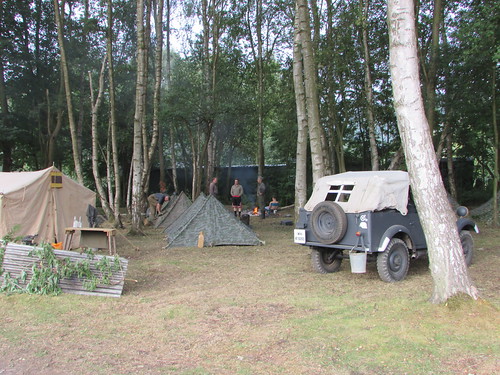
The '1940s Weekends' are popular features at many preserved railways and it is an important weekend at Peak Rail. Directly opposite the station platform at Rowsley is a large wooded area which is used on each day for a dramatic battle re-enactment which can be watched in safety by visitors from the station platform once the service train has been despatched to Matlock.

The Event on Sunday, 5th August 2018

2018 had enjoyed a long, hot summer and the 5th August was no exception. I was rostered as steam driver with Dave P. as fireman and Colin D. as cleaner on the second day of the two-day event. As I walked to the Locomotive Shed to sign-on it was still quiet. Our 7-coach train was waiting in the platform and a large, white marquee has been erected adjacent to the north end of the platform for the wartime entertainments.


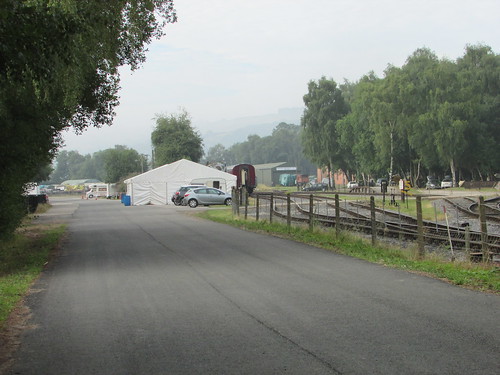
Peak Rail 1940s Weekend 2018: Looking south towards Rowsley Station on my arrival.

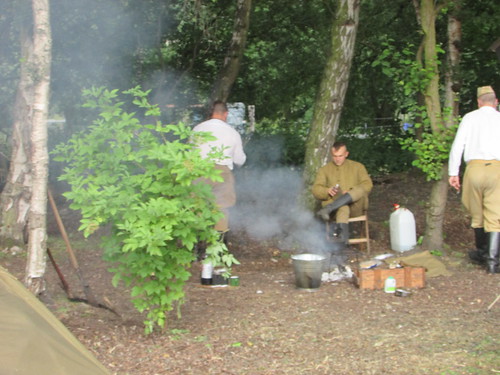
As usual, the wooded area opposite the station had become a series of military encampments and the re-enactors were starting to emerge from their tented accommodation and prepare breakfast over a number of campfires.


Peak Rail 1940s Weekend 2018: Breakfast in camp.

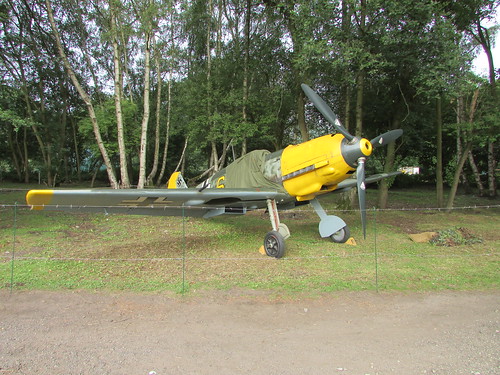
As well as the encampments and a number of replica military vehicles, there was an imposing replica Messerschmitt Bf109e (which, I later learned, incorporated some parts of a genuine wartime aircraft).


Peak Rail 1940s Weekend 2018: The German Camp.


Peak Rail 1940s Weekend 2018: Messerschmitt Bf109e.

Unusually, our locomotive (Austerity tank No. 72) had been turned to face north and we were to work at the north end of the train, top and tailing with 'Penyghent' at the south end. This seems to be the practice for the '1940s Weekend' and I presume it's to avoid the continuous rumble of a large diesel engine standing right outside the marquee when the performers are singing and dancing. It makes a nice change to be 'the other way round' (as long as the driver can remember the 'stop marks' for bringing the train to a stand at Darley Dale and Rowsley).


Peak Rail 1940s Weekend 2018: No. 72 'brewing-up' on the outside pit.

Dave and Colin had the engine warming-up nicely, so I was able to concentrate on oiling-round and carrying out the daily exam. Later, the crew arrived to prepare 'Penyghent'. Both locomotives moved across to the station and coupled onto the 7-coach train. Of course, on the journey to Matlock, No. 72 was "tail-end Charlie" so we'd have little to do. Departures are often a bit late, waiting for booked parties to arrive but I think our first train was close to 'right time'. 'Penyghent' made the booked stop at Darley Dale and then continued to Matlock Town.


Peak Rail 1940s Weekend 2018: Darley Dale Up Platform.

At Matlock Town, 'Penyghent' surrendered the token to us for the return journey when we would have a chance to do some work. The Guard had given us the load as 385 tons nett - 7 coaches plus Penyghent trying not to do anything unless requested. Gross weight is obtained by adding in the weight of the passengers, around one ton for every 15 passengers. I talked about train weights and gradients in a post about the '1940s Weekend' in 2013 here and I copy below the gradient diagram from that post.

Gradient Diagram Ambergate - Bakewell

The initial run from Matlock Town to passing Matlock Riverside is a downgrade at around 1 in 170 which tends to build up speed with very little steam required. We still have a 5 m.p.h. restriction through the loop at Matlock Riverside, so some braking may be required to comply. Once over the River Derwent bridge, the gradient is against you at about 1 in 400 most of the way to Rowsley. Even with 400 tons on the drawbar, that's not much of a challenge for an Austerity tank at the line speeds allowed and 'first valve' on the regulator will normally suffice. The hardest part is probably stopping gently at Rowsley without overshooting the 'mark' so that water can be taken from the rank wagon at the end of the platform.

There was wartime music coming from the marquee, being enjoyed by a crowd of visitors, many in uniform or period clothing. In addition to soft drinks and light refreshments, there was a licensed bar. Hot food and drink was also available at the cafe on the platform.


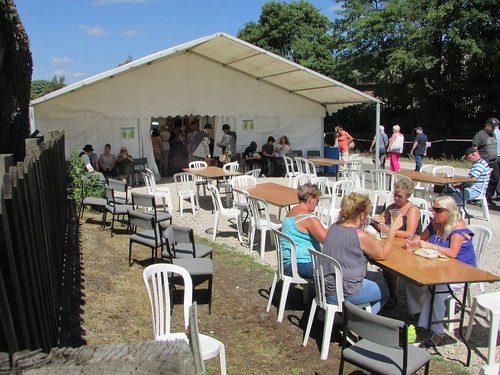
Peak Rail 1940s Weekend 2018: The marquee and outside seating area.

Lots of cars were entering the site and the large car park by the station was rapidly filling up, keeping the marshals helping with parking busy. We made our second round trip, returning to Rowsley to find even more people. At one point, I could see three National Holidays coaches dropping their passengers, turning and parking.


Peak Rail 1940s Weekend 2018: 'Penyghent' sets off from Rowsley with the third service.

By the time we returned on the third round trip, we were quite warm. I usually sport a 'tin helmet' to give a sense of period but it was quite uncomfortable in the warm weather. Dave relaxed on the platform for a while before the fourth departure.


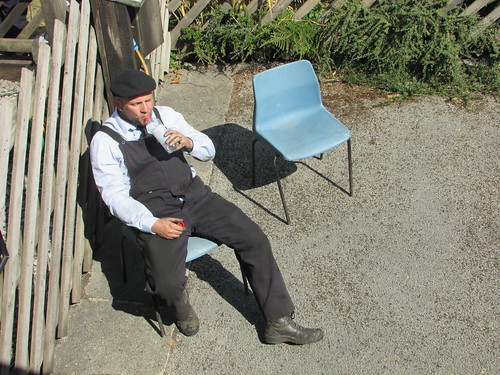
Peak Rail 1940s Weekend 2018: Dave takes hydration prior to the fourth departure.

By the time we left, the platform was packed with visitors, not travelling this time but trying to secure good positions for watching the battle re-enactment which would commence a little later. Well, I can't tell you what happened this year but from previous experience, I know the carefully-constructed displays are well choreographed and usually exciting, with plenty of pyrotechnics.


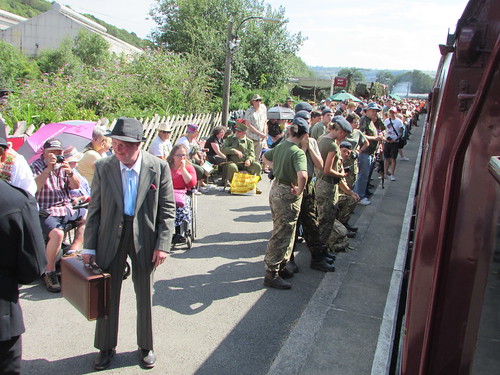
Peak Rail 1940s Weekend 2018: Visitors waiting for the battle re-enactment to commence

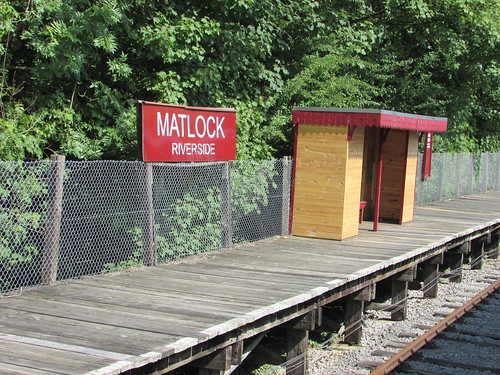
Until our line was extended to Matlock Town, our terminus was Matlock Riverside, now rarely used. The vandalised platform shelter has been replaced but not repainted.


Peak Rail 1940s Weekend 2018: Matlock Riverside. The vandalised shelter has been rebuilt but not repainted.

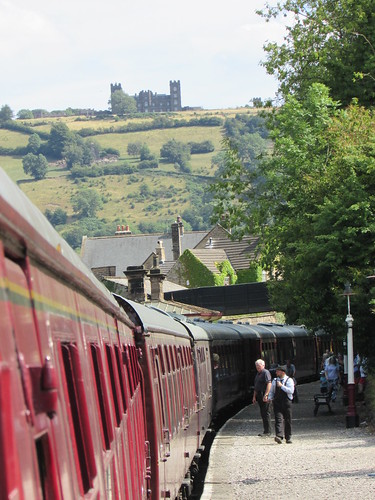
At Matlock Town, Dave collected the token from Gordon, ready for our departure. On the skyline, Riber Castle still dominates the view. It was built as a family home by a successful industrialist in 1862 but, more recently, has had a chequered history. I think the latest initiative is conversion to flats but I'm not sure of the current status. There's a Wikipedia article here.


Peak Rail 1940s Weekend 2018: Dave collects the token from Gordon prior our departure to Rowsley.

We made another uneventful trip to Rowsley where the mock battle had finished and many visitors were starting to leave. Just one final round trip remained. At Church Lane, I watched the signalman preparing to collect the Rowsley-Church Lane single line token. Church Lane to Darley Dale is now double track with Absolute Block signalling so no token is required but leaving Darley Dale a token is required for the single line section from Darley Dale to Matlock Town.


Peak Rail 1940s Weekend 2018: 'Penyghent' approaching Church Lane Crossing box. The signalman is on the landing, ready to receive the Rowsley-Church Lane token.

Back at Rowsley, many of the re-enactors were packing up to leave. I hope they had an enjoyable weekend: as we disposed No. 72, Dave, Colin and I certainly agreed we'd had a good day.

The Event in previous years

Peak Rail first ran this event in 2006 and it's proved very popular.

Peak Rail 1940s Weekend, 2017 (article with link to pictures).
Peak Rail 1940s Weekend, 2016 (article with link to pictures).
Peak Rail 1940s Weekend, 2015 (article with link to pictures).
2014 event (pictures only).
2013 event (article with link to pictures).
2012 event (article with link to pictures).
2009 event (article with link to pictures).
2008 event (article with link to pictures).
2007 event (pictures only).
2006 event (pictures only).

To see all my posts about Peak Rail, select Label 'Peak Rail' or click here.

My pictures

Where necessary, clicking on an image above will display an 'uncropped' view or, alternately, pictures from may be selected, viewed or downloaded, in various sizes, from the albums listed:-

Peak Rail 1940s Weekend 2018.
No. 72 - Austerity Tank.
All my Peak Rail albums.

Friday, 8 December 2017

Santa Specials at Peak Rail, 2017

The locomotive 'Ring Haw' first visited Peak Rail for the Santa Specials in 2016. There's a report on that visit here. 'Ring Haw' returned for the 2017 Christmas season and, on 2nd December 2017, I was the driver, with Phil as fireman, on the first day of the popular Santa Specials. For these services, the load had been increased to eight bogie coaches. Operation on the day was top-and-tailing with 'Penyghent' which was specially authorised, as in 2016, to give 'Ring Haw' assistance on certain sections of the route to comply with the owner's load limits.


'Ring Haw' at Peak Rail, Christmas 2017.

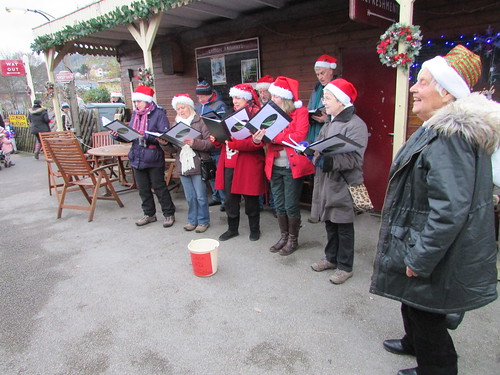
Matlock Musical Theatre were on the platform at Rowsley to entertain everybody with carols and Christmas songs and entertainers travelled on the train. The highlight, of course, was Santa distributing presents to all the boys and girls on the train. Grown-ups received mulled wine and mince pies.


'Ring Haw' at Peak Rail, Christmas 2017: Matlock Musical Theatre were at Rowsley to entertain everybody with carols and Christmas songs.

As expected, 'Ring Haw' performed well and, despite steam heating the 8-coach train throughout the day, proved economical on coal and water.


Peak Rail, Christmas 2017: 'Ring Haw' ready for the last departure of the day from Rowsley.

Related posts on other websites

Matlock Musical Theatre

Related posts on this website

Peak Rail Santa Specials ('Ring Haw' in 2016).
All my posts on Peak Rail.
All my posts on Santa Specials.

My photograph albums

Where necessary, clicking on an image above will display an 'uncropped' view or, alternately, pictures may be selected, viewed or downloaded, in various sizes, from the albums listed:-
'Ring Haw' at Peak Rail (2016 plus 2017).
Peak Rail 'Santa' trains, 2017.
All my Peak Rail pictures.

Tuesday, 5 December 2017

On the Footplate

Before I left on my Myanmar trip at the end of September 2017 (that trip is described in a series of posts, the first of which is here), I'd offered some dates for the end of October and November to both the Battlefield Line and Peak Rail. I discovered that the Battlefield Line had covered all the October 'turns' and was not running steam in November in preparation for the intensive 'Santa Special' season in December. Peak Rail rostered me for the 11th November after which they, too, had a short break to get ready for the 'Santa Specials'.

The Battlefield Line: 22nd October 2017

Although I'd not been rostered on the Battlefield Line during October, on Friday 20th October, I received an urgent text telling me that Shackerstone had 'lost' the crew for both Saturday 21st and Sunday 22nd October. I offered to do either day and was asked to cover Sunday which (like Saturday) had a 'Gold' Footplate Experience prior to the public service. There's a description of the format of the 'Gold' Footplate Experience in an earlier post here (when we were using 'Austerity' tank locomotive 'Cumbria'). Jamie had offered to fire on the Sunday so I knew we'd have an enjoyable day. Our engine was Great Western 'Light Prairie' 5542.

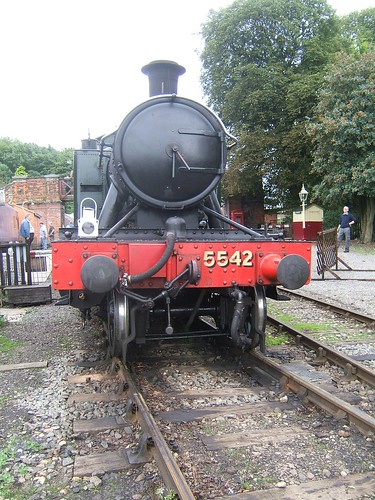
It had been some years since I'd driven 'Light Prairie' 5542 - there's a very short post here.


5542 running round its train at Shackerstone during the visit in 2010.

5542 Layout of Valve Gear

All the 2-cylinder Great Western designs (until Hawksworth produced his remarkable Pannier tanks with Walschaert's motion for shifting empty stock in and out of Paddington) featured Stephenson Link motion with four eccentrics mounted on the driving axle between the frames to provide the necessary valve events. Where outside cylinders and valves were required, the movement of the dieblocks was transmitted from inside the frames to outside via the intermediate valve rods, rocking shafts and finally via the valve rods to the valve spindles, as shown in the diagram below.

Click here for a larger view.

The diagram above is drawn as for a larger, tender engine. In the 'Light Prairie', the intermediate valve rods are shorter and set at a steeper angle so as to connect to the inner valve arm attached to the rocking shaft mounted on the framing. The outer valve arm then drives the valve rod connected to the valve spindle.


5542: Link motion for right-hand cylinder.

The set of pictures of 5542 here has a number of pictures of the valve gear illustrating how the layout in the diagram above is implemented in practice.

5542 Sight Feed Lubricator

The sight feed lubricator is mounted in the cab on the boiler backhead, in front of the driver. Moving parts in contact with superheated steam (such as the valves, pistons and regulator valve) require lubrication with a special, compound mineral oil, formulated to retain its properties at high temperature. Sight feed (or hydrostatic) lubricators are often used for this purpose and Swindon developed a range of suitable lubricators. Through training and the issue of circulars, Swindon ensured that drivers understood the method of operation and the importance of the Sight Feed Lubricator. A copy of Great Western Circular 5801 issued in November 1937 by C.B. Collett can be accessed (and downloaded) here.


5542: Boiler backhead.

5542 preparation

Whilst Jamie raised steam, I set about reminding myself of all the oiling points as I carried out the daily examination and oiling. The most obvious change since 2010 was that the 'shaded' tankside lettering 'G W R' had been changed for the GWR Roundel which was used between 1934 and 1942 (see 'GWR Roundel' link below). There were changes to the mechanical arrangements for remote control of the regulator used when working 'push-pull' or 'Auto' trains. I discovered that the locomotive had acquired a Stone's electric generator since I last saw her - certainly not a Swindon feature - but not yet in use. I talk about electric generators on steam locomotives in the post Electrical Systems on Steam Locomotives. And the locomotive certainly has a hopper ashpan now.

Having started with oiling the 'easy bits' accessible from ground level alongside the engine (principally crankpins, big ends, little ends and crossheads), I moved into the pit underneath the locomotive and clambered up, perching on a mixture of brake rigging and axles, as I dealt with the Stephenson link motion and axleboxes. Then it was onto the framing at the front of the engine to deal with the vacuum pump oil pot, rocking shafts and a few more oiling points. In the cab, I topped-up the two oil boxes which serve the trailing coupled wheels.

We were kept pretty busy all day, so I didn't manage to take any pictures, but I've included pictures from an earlier visit by the locomotive in 2010.

Peak Rail: 11th November 2017


Locomotive 'Jennifer' at Matlock Town earlier in 2017.

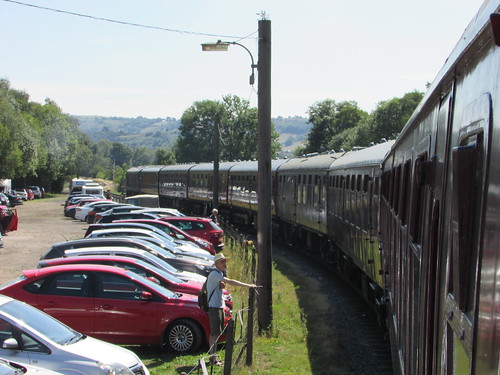
I discovered that this was to be the final weekend for 'Jennifer' at Peak Rail. Although the locomotive engineering department had failed to cure the oscillation in the drawgear which had created some problems for passengers (and crews), she was a 'solid steamer' and strong so I viewed her return to Llangollen with some regret. She was facing 'downhill' so we operated the service coupled to the south end of the train, 'top and tailed' with the diesel electric.

Operating on a Saturday, we saw East Midlands Trains Diesel multiple units at Matlock Town two or three times in the day.


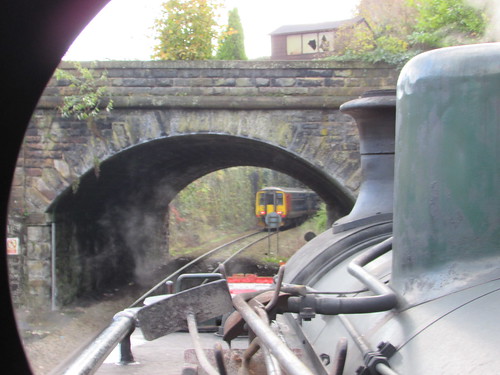
Peak Rail 11th November 2017: View from the footplate of 'Jennifer' on arrival at Matlock Town as an East Midland Trains Class 156 departs.

Related posts on other websites

Although the links below worked at the time this post was published, be warned that changes by a website's owner may 'break' the links.

GWR Roundel.
Locomotive 5542 Limited.

Related posts on this website

All my Battlefield Line posts.
All my MIC posts.
All my Peak Rail posts.

My photograph albums

Where necessary, clicking on an image above will display an 'uncropped' view or, alternately, pictures may be selected, viewed or downloaded, in various sizes, from the albums listed:-

5542 at Shackerstone.
All my Battlefield Line pictures.
'Jennifer'.
Peak Rail 2017.
All my Peak pictures.