skip to main |
skip to sidebar
Spring 2023 started on 20th March. Although we'd had some snow during the winter, we escaped bad snows where I am. But it had been cold by U.K. standards, made more painful by staggering recent increases in energy costs, so I was cheered by the prospect of better weather. The local birdsong also became more optimistic, encouraging me to make the first 'pilgrimage' of the year by train on the 24th March. I chose to visit Liverpool and the Wirral (a favourite destimation) and booked a First Class return ticket online.
In the past, I've often used the West Midland service which requires no changes and gives the shortest overall journey time although it makes a number of stops. But I decided to see how I fared with Avanti who have been getting heavily criticised for poor service and large numbers of cancellations at short notice. In general, I believe these criticisms are justified (as are the wider complaints about our expensive, pathetic railway services) but, on 24th March, all my Avanti trains were on time and provided a decent service.
The plan was to catch a Euston to Glasgow via Birmingham 'Pendolino' service as far as Crewe, waiting there for a Euston to Liverpool via the Trent Valley Line 'Pendolino' train. The first train arrived on time and I quickly found my reserved seat in coach J at the rear. With major engineering works around Carstairs, I discovered that the train would be terminating at Preston where onwards passengers would probably be decanted onto a Transpennine service to continue their journey north. During my half hour non-stop journey to Crewe (depart Wolverhampton 08:32, due Crewe 09:07) I was the only passenger in the coach so the friendly catering staff had time to serve a reasonable cooked English Breakfast with white toast, butter and jam, together with a mug of tea and a glass of orange juice. I was intrigued by the rather small oval plates but the food was good and at least the crockery was glazed pottery not plastic and the cutlery steel so I forgave the relative lack of refinement and alighted at Crewe platform 11, right time, in a good mood.

Merseyside in March: Breakfast on Avanti 'Pendolino' Wolverhampton-Crewe
I'd about 20 minutes to wait for my connection, also from platform 11 but before that was due, a single unit DMU from Chester arrived in platform 11 from the north, discharged its passengers, re-loaded and scuttled off back to Chester. Although Crewe station is now a shadow of its former days, I still enjoy looking at what remains. There's a short post about a visit I made in the 1950s here. Although the station buildings have been repeatedly modified over the years, some of the grandeur of the LNWR expansion of the station in 1907 remains, particularly in what's left of the overall roof. The post here talks about the station buildings. On time, my connecting service came snaking in through Crewe South Junction and I boarded coach J at the rear of the 'Pendolino'. This train, reporting number 1F12, had left Euston at 07:43 and on leaving Crewe at 09:26 had one stop at Runcorn with a scheduled arrival at Liverpool Lime Street at 10:04.

Merseyside in March: Liverpool-bound 'Pendolino' on Avanti service 1F12 arriving at Crewe platform 11.
Catering was once again promptly offered and I accepted white toast and an orange juice as we sped along the familiar route to make a 'right time' arrival at Liverpool, where the weather was dry with patchy sun. Disembarking, I paused to record another view of the elegant train sheds and then some details of a conveniently located 3-aspect colour light signal supplied by Unipart Dorman before purchasing an All Areas 'Saveaway' day ticket which would give me flexibility to change my plans during the day.

Merseyside in March: Train Sheds at Lime Street viewed from platform 9.
I made my way to the underground Merseyrail station, unsure of my initial destination. With four trains an hour currently to New Brighton, West Kirby and Chester, plus two trains an hour to Ellesmere Port, I knew I should have less than five minutes to wait for a train. The first train was for New Brighton and I was tempted to stay on it all the way but uncertainty over the weather made me alight at James Street with the aim of taking a Mersey Ferry Trip before the possible deterioration of the weather. At street level, the sun was encouraging but there was quite a breeze coming from the river. Guessing that the next ferry would still be at 11 o'clock, I decided that I'd time to call in at the Museum of Liverpool to check on the preserved locomotive 'Lion' before continuing to Pierhead. Well, the exhibit was safe, if a little dusty, but I was pleased to see that the associated audio-visual screens which had been out of order on my last visit were working again. There's a short post about the audio-visual systems as originally installed here.
A short walk took me from the Museum to the ferry booking office. I knew that Seacombe landing stage had re-opened after a recent lengthy refurbishment. There's a brief mention of this work in the post about my trip in August 2021 here. But I hadn't realised that Birkenhead Woodside landing stage had now closed for two years whilst it, too, was refurbished. In the past, I have used the ferry to Seacombe and walked to New Brighton (in 2016) or the reverse (in 2019). But walking seemed ambitious and bus did not appeal so I booked a round trip 'River Explorer' which involved a modest extra payment. I boarded the waiting 'Snowdrop' (still in its 'dazzle' livery which I hate) and took up my customary position on the outside upper deck towards the bow. With the tide coming in, we were moored facing the sea. A combination of wind and tide made the water surge between the landing stage and the hull, giving the ferry an unpredictable motion which fortunately subsided once we were under way.

Merseyside in March: View from 'Snowdrop' at Pierhead looking downstream. Bunkering vessel 'Mersey Endurance' at Cruise Terminal on the right.
As the electronic chimes of the Liver Building clock struck eleven, the usual group of late passengers rushed to board and we cast off. The ferry initially headed downstream while the recorded commentary described some of the notable features of Liverpool North Docks, then we turned across channel and headed for Seacombe Landing Stage, finally turning to approach facing downstream.
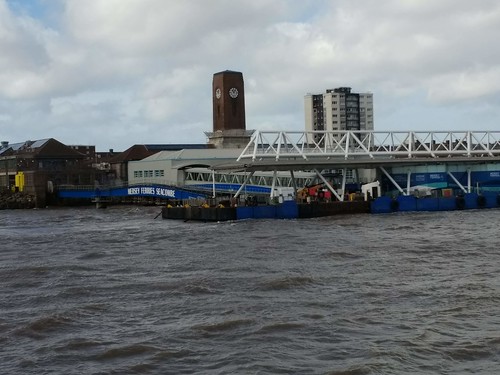
Merseyside in March: View from 'Snowdrop' approaching the re-opened Seacombe Landing Stage, showing one of the new linkspans connecting the pontoon to the land.
We moored and the new powered gangway was lowered to let passengers off and on. I've always been amazed that the previous counterbalanced, manually operated gangways (usually requiring quite strenuous attention) have survived so long.

Merseyside in March: View from 'Snowdrop' berthed at the refurbished Seacombe Landing Stage. Note the new, hydraulic gangways.
The original method of positioning the pontoon with multiple anchor chains at each end has been retained. The lively sea in the picture below suggests the skill needed by the ferry skippers dock repeatedly without incident.

Merseyside in March: View from 'Snowdrop' at the re-opened Seacombe Landing Stage, showing pontoon anchor chains.
'Snowdrop' moved away from the landing stage and performed a 180 degree turn to starboard to continue upstream. We passed the entrance to the Great Float and Birkenhead Docks and the unoccupied Twelve Quays landing stage, used principally by Stena 'Ro-Ro' vehicle and passenger ferries to Belfast. It was a new experience to continue past Birkenhead Woodside landing stage without stopping. The only river traffic we saw was a tug heading downstream near the Liverpool shore and a dredger. Dredgers, of various types, are a permanent feature. The action of the tide and river flow continually shifts massive amounts of sand and keeping marked channels to adequate depths means dredgers are always required.

Merseyside in March: View from 'Snowdrop' heading upriver in choppy conditions with the Liverpool Shore and Anglican Cathedral in background. Note tug going down river and dredger.
On the Birkenhead shore to starboard (our right) we then passed the Cammell Laird shipyard with its large Wet Basin and Dry Docks used for ship repair work. The picture below gives an idea of the layout.

Aerial view of Cammell Laird shipyard: River Mersey top left, Wet Basin top right, various dry docks in the centre (Photo: Cammell Laird Ltd)
One of the Royal Fleet Auxiliary 'Tide' class tankers, 'Tiderace' A137 was dry docked.

Merseyside in March: View from 'Snowdrop' of Cammell Laird docks showing Royal Fleet Auxiliary Tanker 'Tiderace' dry-docked.
'Ben My Chree' was in an adjacent dry dock. She is a 'Ro-Ro' vehicle and passenger ferry built 1998 (125m long, 40m beam) operated by Isle of Man Steam Packet Company, normally on the Heysham - Douglas route. The Company refer to her as a 'Ro-PAX' and cite her as a reliable performer.

Merseyside in March: View from 'Snowdrop' of Cammell Laird docks with 'Topaz Tangaroa' multi-purpose offshore vessel (background) and 'Ben My Chree' Ro-PAX ferry (foreground).
As 'Snowdrop' continued upstream, I had a better view of 'Topaz Tangaroa' in the Wet Basin. Her whole foredeck is enclosed to provide accommodation for 82 crew and blended into the bridge giving her a bullet-like appearance, somewhat diminisheded by the helicopter deck mounted above on columns. The rear of the ship is a flat workdeck, dominated by a massive side-mounted crane. Length is 98m, breadth is 20m. She was built in 2019 by Vard in Norway as a multi-purpose offshore vessel for Topaz Energy and Marine in Dubai. Registered in the Marshall Islands, she is operated by P&O Offshore Logistics, based in Dubai. There's brief information here.

Merseyside in March: View from 'Snowdrop' of Cammell Laird docks with 'Irish Sea Pioneer' drill ship (visible left) and 'Topaz Tangaroa' multi-purpose offshore vessel (centre).
But the award for the oddest-looking vessel went to 'Irish Sea Pioneer', also in the Wet Basin. Built in 1996 by Bollinger in the USA for Halliburton-BHP and 55m (or perhaps 47m) long with 24m beam, she's a type of Offshore Support Vessel variously termed a 'drillship', a 'giant liftboat' or a 'four legged jack-up boat'. There's a fascinating article here and more than you need to know about designing such a vessel in a Conference Paper here.

Merseyside in March: View from 'Snowdrop' of Cammell Laird docks with 'Irish Sea Pioneer' drill ship (left) and Topaz Tangaroa' multi-purpose offshore vessel (right).
Leaving Cammell Laird astern, we approached Tranmere Oil Terminal with its oil storage tanks one of which, I noticed, has acquired a partial geodesic-domed roof. As we turned across river towards the Liverpool shore, there were two oil tanker berthed at Tranmere, each attended by a tug. I assumed the tugs were there as fire precautions because all modern tugs have powerfull water pumps and and water monitors for firefighting. I was unable to identify any of the vessels visually. I've explained in the post Watching The Ships Go By how ships with Automatic Identification System (AIS) operating can be identified and tracked. The whole of the river area 'Snowdrop' had cruised can be displayed in real time here.

Merseyside in March: View from 'Snowdrop' of Tranmere Oil Terminal showing two unidentified, berthed oil tankers, each attended by a tug.
Now heading downstream, 'Snowdrop' passed the re-development of the former South Docks, the remarkable preserved area of Albert Dock, the offensive modern architecture of the Museum of Liverpool and berthed back at Pierhead in the shadow of the Three Graces as the iconic Custom House, Cunard Building and Liver Building are known. UNESCO awarded Liverpool World Heritage Status in 2004 for the “outstanding universal value” of its waterfront but this accolade was lost in 2021 because of “irreversible loss” to the historical value of its Victorian docks caused by insensitive redevelopment which continues with the construction of a new football stadium for Everton Football Club at the former Bramley-Moore Dock. I left the ferry after an interesting cruise, passing the long queue of passengers waiting on the landing stage to board the 12 noon cuise.
I walked back to James Street Merseyrail station, intending to catch a train to New Brighton. That didn't prove quite as straightforward as I hoped. The first train to arrive was for Chester, so I remained on the platform, looking at the artwork applied to the original patterned tiling on the normally-unused platform 2. I'm afraid I preferred the original, tiled decorations.

Merseyside in March: View of Merseyrail James Street station showing artwork on the normally-unused platform 2, looking towards Birkenhead.
The next arrival was for New Brighton train so I boarded. Like the Chester train, it was a Class 507, a 40-year old veteran, not one of the new Stadler Swiss-built Class 777 currently being introduced. We made the usual rather noisy progress under the river via the Mersey Tunnel and stopped at Birkenhead Hamilton Square. After a flurry of passenger activity, we set off, taking the flyunder to reach New Brighton/West Kirby line. We stopped at Conway Park, an unattractive, modern sub-surface construction in a deep 'station box', open to the sky. The doors opened. A few passengers alighted and boarded. The doors closed. Then nothing. Squinting through the window, I could just see reflected light from the colour light signal at the end of the platform. It was red. After a few minutes, the lady driver announced over the public address a delay because the traction current had been disconnected. No comment about reason (usually a fault or an accident) or likely delay so we all waited in silence. After a few more minutes, another announcement invited us to continue our journey by other means, if we wished and the doors were released. Nobody moved at first, then a trickle of passengers left the train which turned, lemming-like into a flood which I joined, pausing only for a picture of the stranded train and to note a poster saying that the Kirkby Line was the first to be operating Class 777 trains. I just managed to join an already-crammed lift to the surface.
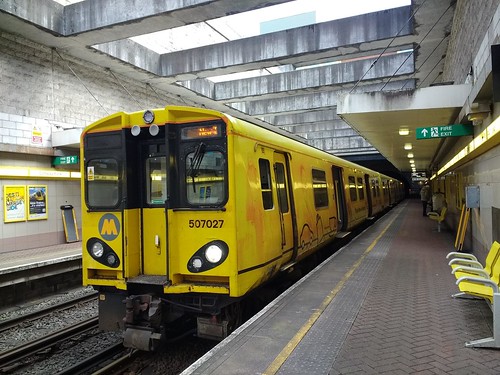
Merseyside in March: View of Merseyrail Conway Park station from platform, with my train stranded by an unexpected traction current interruption.
I started to form a plan to walk back to Hamilton Square station, where I hoped trains to other destinations would still be running. The local area map in the booking hall didn't give me a clear idea of the roads I needed to get to Hamilton Square and even Google Maps on my mobile phone had trouble giving me details, but after a while, I decided on a route to take. The Conway Park station is next to a roundabout on Europa Boulevard, a dual carriageway with a broad central reservation of well-established trees. The area is partially redeveloped but with little traffic. I followed the dual carriageway north to a rather abrupt T-junction with Price Street. Turning right, I came to a railway bridge over what had been two parallel, double-line railways, long disused. I realised this would have been the goods lines to Birkenhead Docks which formerly diverged from the main Chester - Birkenhead Woodside L.M.S. & G.W.R. joint line at Blackpool Street signal box. An earlier post here gives a little background on the railways around Birkenhead. I decided a photograph of the location would be useful and, whilst framing the shot, stumbled on an uneven pavement and crashed to the floor, falling painfully on my left arm. A concerned lady came over to see if I needed help but nothing appeared broken (although everything hurt). I dragged myself upright and assured the lady I would be fine, making sure I had taken the picture.

Long-disused Goods Lines to Birkenhead Docks at Price Street, Birkenhead.
I slowly continuing along Price Street to Hamilton Square itself where I rested on one of the seats in the gardens before continuing to nearby Hamilton Square station.

Hamilton Square Gardens, Birkenhead (Return to New Brighton)
I caught a train back toward Liverpool with thoughts of changing to the Northern Line and visiting Kirkdale (where the depot servicing the Kirkby Line is located) but when the public address announced that, after traversing the Liverpool Loop, the train was for New Brighton, I decided that I was happy to just stay on the train and be taken to my original destination. I felt a sense of deja vu, as my train left James Street, made a brief stop at Hamilton Square Station and arrived at Conway Park. This time, after a normal delay, we carried and called at Birkenhead Park.
On the way to the next station, Birkenhead North (where the New Brighton line diverges from the West Kirby line), my hope that I'd soon be in New Brighton was dashed by a announcement from the lady driver that the service would terminate at Birkenhead North. She explained that extreme late running caused by the earlier traction current disconnection meant that, in an attempt to get back to schedule, the train would return to Liverpool. At Birkenhead North, platform 3 filled with disappointed passengers decanted from my train. I noticed a loaded train in platform 1, which I assumed was about to leave for Liverpool but, after a couple of minutes, these passengers got off and used the overbridge to get to platform 3 and joined the train I'd just abandoned. I'd not previously noticed the trailing crossover and position light ground signal on the main line at the Liverpool end of platform 3. The ground signal came 'off' and my train set off through the reversed crossover to reach the correct line and scuttled off back to Liverpool. The passenger information screen (an orange scrolling LED display capable of detailing the next three departures) displayed some rather unlikely timings for a while but eventually settled down to show the next train for West Kirby with the second train for New Brighton. The West Kirby train arrived and departed and, eventually, the promised New Brighton arrived, allowing the waiting passengers to pile aboard for the ten minute journey to New Brighton, stopping at Wallasey Village the Wallasey Grove Road.
So, despite the delays and my fall, I made it to New Brighton. I turned left on leaving the station and made my way north down Atherton Street towards the Marine Promenade. Liverpool Businessman James Atherton (1770-1836) is credited with developing the North Wirral and New Brighton.

Looking north down Atherton Street from the station (Return to New Brighton)

James Atherton (Williamson Art Gallery and Museum)
I explored along the main road parallel to the promenade, King's Parade, as far as RNLI's New Brighton Lifeboat station but decided not to navigate the car parks and modern retail and hospitality developments to reach the sea wall itself, thinking I'd probably had enough excitement for one day and that I should focus on getting home. It was quite a stiff climb back up Atherton Street to the station and, when the train arrived, I was quite content to flop on board and wait for departure. The journey back to Liverpool Lime Street Low Level was without incident then escalators and walking took me to the main line concourse where I could select my return train.
At 15:33 there was a direct Birmingham service (a Class 350 'Desiro' reporting number 1G59) but I decided to see what the catering was like on Avanti's London service at 15:43 (reporting number 1A58) which meant at least a change at Crewe. The inbound Avanti 'Pendolino' arrived in platform 9, discharged its passengers and departing passengers immediately started to board so I trekked almost the length of the train to reach First Class. I was surprised at how many passengers had already boarded but I found a suitable table and almost immediately the attendant appeared although we were not due to leave for over ten minutes. I explained that I was only going to Crewe with them and studied the menu, ordering an orange juice and a Mushroom and Cheese Croque with Bechamel Sauce which I'd not tried before. The jolly attendant said he'd get the toasted sandwich started, to make sure I had plenty of time to enjoy it. In fact, the hot food and cold drink arrived before we set off up the 1 in 93 bank to Edge Hill and were excellent, ensuring a relaxing journey to Crewe. I monitored the journey on my mobile phone using the Railcam.UK 'app' (there's a brief introduction to this 'app' here). My express only stopped at Runcorn before Crewe whereas 1G59 which had left Liverpool just ten minutes ahead of us made stops at Liverpool South Parkway, Runcorn, Acton Bridge, Hartford and Winsford before Crewe.
Although the Working Timetable suggested that my train would not be 'baulked' by the preceding Class 350, watching the live display on Railcam.UK suggested that we were catching up and we were actually brought to a stand briefly before Winsford. The rest of the journey to Crewe was a bit subdued and we stopped again at signal 0144 outside Crewe. After a couple of minutes, the signal cleared and, as we moved away, I caught a glimpse of a Class 66 with a train of yellow-painted, loaded bogie stone wagons moving from the Up Slow to the Up Liverpool Independent and descending the gradient to enter the tunnel under Crewe North Junction before emerging in a cutting on the Down side of the station. In steam days, this cutting was always referred to as "The Muckhole" by the army of trainspotters always to be found around the footbridge used by enginemen between the station and Crewe North Shed. Railcam.UK identified the Stone train as 6K06, Shap to Basford Hall. As we stopped in platform 5, the train which had slowed our approach to Crewe, 1G59, was still in adjacent platform 6, awaiting the 'right away'.
I left the Avanti train (1A58 was next stop Milton Keynes then Euston) to look for a service stopping at Stafford and discovered another Avanti London service due in platform 1 in a few minutes with a Stafford call. The train arrived and, with only a 20 minute dash to Stafford, I was happy to join the Quiet Coach at the rear with just one other passenger.
At Stafford, I left the station and took a taxi home, very tired but pleased with the trip.
Previous similar Liverpool trips/strong>
Trip on 1st April 2022
Trip on 9th January 2016
My pictures from this trip
Merseyside in March
My first visit to Liverpool was over seventy years ago and my early experiences are described in the posts Liverpool (2008) and Liverpool (again) (2014). Since then, I've continued to publish posts about the area, grouped as Merseyside.
I only recently discovered the website Historic Liverpool) with old maps and a blog run by Martin Greaney and Sue Greaney. They offer framed maps and Martin's book 'Liverpool: A Landscape History'. In the blog, there's a post 'Postcards from Edwardian Liverpool' and two of these particularly interested me.

Liverpool: Edwardian postcard view of Princes Dock, looking north, showing in the foreground the pump house where 'Lion' was used to empty the Princes Graving Dock seen immediately behind the pumphouse (Photo: 'Historic Liverpool')

Liverpool: Edwardian postcard view of Princes Dock, looking north, showing 4-funnel liner at the Landing Stage and New Brighton Tower in the background (Photo: 'Historic Liverpool')
Apart from the general interest of any old photographs, I found three features of special note.
Princes Graving Dock Pumping House
The first postcard shows the Graving Dock emptied and with a cargo vessel receiving attention. In the foreground, the pumping house where 'Lion' was used to drive the chain pump used to empty the Graving Dock is visible. The details are not too clear but, by reference to the 1873 drawing below, the elaborate chimney associated with the Pumping House is definitely visible.

Liverpool: Drawing of Princes Graving Dock Pumping House circa 1873 (National Museums & Galleries on Merseyside)
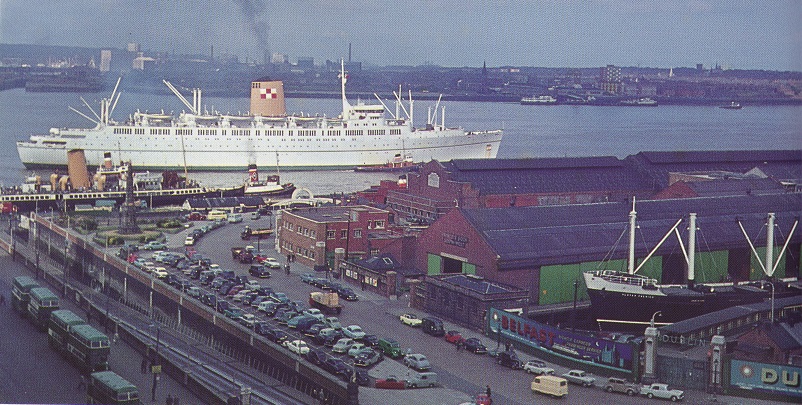
It's assumed that, following electrification of the Graving Dock pumping in the 1920s and donation of 'Lion' to the Liverpool Engineering Society, this chimney was demolished. Certainly, it's gone in the 1961 colour image I included in the post 'Lion' Locomotive - the Lost Years, copied below.
Liverpool Pierhead in 1961 with the 'Empress of Britain' dominating the scene. Of interest to rail enthusiasts is the rare view of the Pumphouse (to the left of the 'Belfast' hoarding) from where the locomotive 'Lion' was rescued (Photo: N.P.B. collection from 'Reflections on a River').
Click for larger view.
In 1992, National Museums & Galleries on Merseyside documented the remaining Pumping House in drawings and photographs prior to demolition. This information was published in 'Lionsheart', the newsletter of the Old Locomotive Committee (No. 29 April 1993, No. 31 Sep 1993 and No. 61 June 2005) and some of which is reproduced here. All issues of 'Lionsheart' are available online to Old Locomotive Committee members via the OLCO website here, which also includes membership application details.
Four funnel liner
The second postcard shows a four funnel steamship moored at Liverpool Landing Stage. I was intrigued about the identity of this ship and was surprised to discover that only 14 liners were ever built with 4 funnels.
Kaiser Wilhelm der Grosse (launched 1897, scuttled 1914)
Deutschland (launched 1900, scrapped 1925)
Kronprinz Wilhelm (launched 1901, scrapped 1923)
Kaiser Wilhelm II (launched 1902, siezed by USA 1917 finally scrapped 1940)
Lusitania (launched 1906, torpedoed 1915)
Mauritania (launched 1906, scrapped 1935)
Kronprinzessin Cecilie (launched 1906, siezed by USA 1917 finally scrapped 1940)
France (launched 1910, scrapped 1935)
Olympic (launched 1910, scrapped 1935-1937)
Titanic (launched 1911, sank 1912)
Aquitania (launched 1913, scrapped 1950)
Britannic (launched 1914, mined 1916)
Arundel Castle (launched 1919, scrapped 1959)
Windsor Castle (launched 1921, torpedoed 1943)
The above and much more can be found on the Maritime Quest website here which has a marvellous collection of historic photographs.
This was the period when transatlantic companies vied to provide enhanced facilities to their First Class clientele. Of course, it wasn't just the rich and famous who travelled on these luxurious leviathans. Liverpool was the port of departure for many emigrants seeking a better life in the United States, usually travelling more modestly in 'Steerage' as Third Class was often called.
New Brighton Tower
In both the aboce postcards, New Brighton Tower is visible in the distance on the other side of the river. This tower, outlined in a Wikipedia article here had a fairly short existence (1898-1921), defining the possible range for the date of the two original photographs.
Following the success of Blackpool Tower, opened in 1894, New Brighton acquired its own tower in 1898. The tower itself (like Blackpool) surmounted an impressive brick-built ballroom. The tower was closed during World War I during which maintenance stopped and, after the war, it was decided to demolish the tower and sell the low carbon steel used in its construction for scrap. The Tower Ballroom remained in use until destroyed by fire in 1969.

New Brighton Tower (Photo: Historic England Archive)
Related posts on other websites
Lion & The Old Locomotive Committee (OLCO website)
Four Funnel Liners (Maritime Quest)
New Brighton Tower (Wikipedia)
Related Pumping House posts on this website
'Lion' and the Pumphouse
'Lion' Locomotive - the Lost Years
To find all my posts about the Old Locomotive Committee and the locomotive 'Lion', click here or select 'OLCO' under 'Labels to select a blog topic'.
To find all my posts on Liverpool, The Wirral and Merseyside, click here.
In early 2022, the United Kingdom was attempting to 'Live with Covid'. Pandemic restrictions imposed by law had been largely removed, although differing attitudes to social mixing existed amongst the population, according to their experiences over the previous two years. I decided to have a day out by rail. Since I was a child, Liverpool and New Brighton has been a favoured destination. My most recent visit had been in August 2021 (described here).
Events of Friday, 1st April 2022
March straddles the end of winter and the beginning of spring in the U.K. and the old adage has it that the month 'Comes in like a Lion, goes out like a Lamb'. But that didn't seem to work in 2022 when we experienced unusually balmy weather in the middle of the month which turned bitterly cold with snow in places at the end of the month. The last day of March struggled to raise the temperature much above freezing where I live, despite weak sunshine, and we experienced a number of snow showers. None-the-less, I determined to make a day trip to New Brighton the following day, despite the possible weather conditions. I booked a First Class railway ticket on-line, partly because the early booking offered useful discount compared with booking at the station, partly to discourage me from changing my mind and cancelling the trip.
It was a cold, frosty but dry morning on 1st April. With some reluctance, I arose early and caught the first bus from Brewood to Wolverhampton at 07:30. This gave me plenty of time to walk to the railway station where the huge, new building on platform 1 appalled me yet again before I made my way over the older of the two footbridges to platform 2 to wait for the 08:21 to Liverpool Lime Street.
I believe passenger figures nationwide are still only around 60 or 70 per cent of pre-pandemic levels so I was fairly surprised at the numbers waiting to board the train, formed of two 4-car Class 350 'Desiro' Electric Multiple Units (EMU). I made myself comfortable in the First Class section and we made an on-time journey to Liverpool.
To my delight, on arrival, sunlight was flooding in through the impressive train shed roof at Liverpool Lime Street so, as usual, I purchased a 1-day All Zones 'Saveaway' ticket from the booking office on the main concourse. Although Railcards are not valid for this ticket, at £5.65 for virtually unlimited travel by bus, train and Mersey Ferry within Merseyside, this is an attractive choice.

Liverpool Area Rail: Lime Street station Main Concourse in 2017
Armed with this ticket, I went down the escalator to the pedestrian passage leading under busy Lime Street to access the deep-level single Merseyrail platform situated on the Liverpool Loop via another escalator. I'd decided not to visit Liverpool Museum first, but to head straight to New Brighton. Services are still provided by elderly Class 507 and 508, built by British Rail Engineering Limited (BREL) at York, since refurbished but overdue to be replaced by Statler Class 777. For more information on all these electric trains, see 'Related posts on other websites' below. On previous journeys through Crewe and on my way to Liverpool that morning, I'd seen Class 777 at Crewe Traincare Depot but I've not yet seen these units in the Liverpool area, where test running with 'ghost trains' is supposed to be happening prior to introduction on public services later in 2022.

New Class 777 at Crewe Traincare Depot (Return to New Brighton)
I boarded the first train to arrive, a careworn but game Class 507/508 heading for West Kirby. I pondered whether to stay on this service to West Kirby but as we made our way under the River Mersey through the remarkable tunnel first opened in 1886 (described in a post here), I decided to alight at Birkenhead Park and wait for the next New Brighton Train.
Birkenhead Park now has just one island platform but was originally the interchange between the Mersey Railway and the Wirral Railway and must have once been a frantic place with trains from both directions terminating and steam locomotives running round. The LMS electrification of the Wirral Lines in the 1930s ended this activity and allowed trains to run through to Liverpool. I walked up the long, stepped ramp to the street to check out the undistinguished modern station building but decided not to walk to the famous park (which claims to be the first publicly-funded park in the world) giving the station its name but instead returned to the platform for the New Brighton Service and a speedy (if noisy) journey to my destination.
I always admire the simple, airy design of the booking hall at New Brighton station, but I'd not seen the piratical character swinging from the roof before, whose significance, other than to reinforce the maritime credentials of the location, eludes me.

Piratical figure hanging from the roof at New Brighton station (Return to New Brighton)
Immediately outside the station, the promenade is visible, about 400 yards away, looking north down Atherton street.
Looking north down Atherton Street from the station (Return to New Brighton)
I normally prefer to take the longer route east down Victoria Road, passing one of New Brighton's examples of modern public art (a series of mermaids). Bewilderingly, the figure near the staion is extensively tattooed and titled 'The Inked Siren of Black Rock'. The road leads past St. James Church (1856, Gothic Revival style by George Gilbert Scott) and Wallasey Post Office.
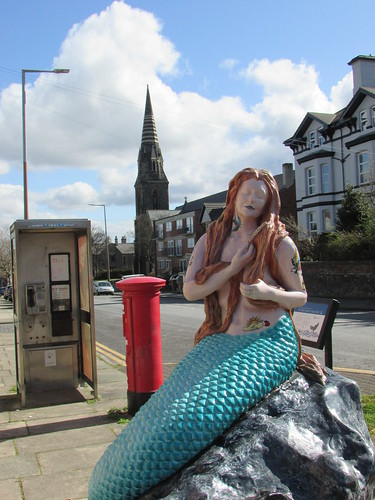
The Inked Siren of Black Rock (Return to New Brighton)
On my previous visit in August 2021, I saw my first knitted 'postbox topper' at Wallasey Post Office: I discovered it now showed a topical Easter theme.

Easter-themed 'postbox topper' at Wallasey Post Office (Return to New Brighton)
I continued on Victoria Parade to the promenade where it was near high tide but I still couldn't resist spending a few minutes on the small patch of golden sand remaining.

New Brighton Beach: Fort Perch Rock, Lighthouse and Seatruck Ro-Ro ferry departing for Dublin (Return to New Brighton)
This part of the beach provides views across the estuary of the River Mersey to Seaforth Docks just 1 mile away and the Liverpool 2 Deepwater Port where container ship MSC MANDY was berthed. Built in 1993 and Panama-flagged, this ship is 237m long and 32m wide with a DWT of 48,852. Afterwards, I learned she'd arrived late the previous evening and after a 2-day stay left for Portugal, Spain and Montreal.

MSC MANDY berthed at Liverpool 2 (Return to New Brighton)
Fort Perch Rock is still closed but a banner promises 'The Ultimate Live Action Escape Room Experience' once the website at 'escapethefort.com' is open. I made my way onto the north-facing beach to admire the lighthouse and then take in the less-admirable appearance of the Burbo Bank Offshore Wind Farm to the west. I still haven't identified the intriguing maintenance vessel in amongst the wind turbines.

New Brighton Lighthouse, decommissioned 1973 (Return to New Brighton)

Burbo Bank Offshore Wind Farm showing maintenance vessel with jack-up legs and crane (Return to New Brighton)
The pleasant weather had encouraged lots of people to take a stroll but the between-the-wars block of cafes and amusement arcades facing the Marine Lake remained firmly shuttered.

"... the between-the-wars block of cafes and amusement arcades facing the Marine Lake remained firmly shuttered." (Return to New Brighton)
I walked back to the station, pausing for an enjoyable English breakfast at the Smuggler's Cave cafe I'd used on my last visit. The timetable was showing four departures every hour to Liverpool but the next was shown as cancelled so, whilst waiting, I studied, with approval, the building repairs which have been completed.
The 3-car electric arrived and discharged quite a few passengers. By the time we left, there was a fair passenger loading and we returned, stopping at all stations, losing and gaining passengers at each stop. I got off at Birkenead Hamilton Square and took an electric lift to the surface. Originally, the lifts were hydraulically worked and the impressive tower housed the hydraulic accumulator.

Hamilton Square station, Birkenhead, viewed from Hamilton Square (Return to New Brighton)
Checking the time of the next ferry to Liverpool, I decided I'd time to first briefly re-visit nearby Hamilton Square which lends its name to the railway station.
The 63 elegant late-Georgian houses erected between 1825 and 1844 were designed by James Gillespie Graham and all are now listed Grade I. Even the parked cars, wheelie bins, rooftop television aerials and a myriad satellite dishes fail to destroy the impact of these well-proportioned buildings. The serried ranks of chimney pots atop the roof serve as a reminder of just how labour-intensive such dwellings were in the age of heating by coal fires, necessitating armies of servants.

Hamilton Square, Birkenhead (Return to New Brighton)
Satisfied with my short visit to Hamilton Square, I walked towards Woodside Ferry Terminal, passing Shore Road Pumping Station. This impressive building was built by James Brunlees and Charles Fox around 1886 to house two large Grasshopper Beam engine pumps supplied by Andrew Barclay needed to remove water from the Mersey Railway Tunnel. Following the installation of electric pumps in 1959, one of the original pumps was restored and, known as the 'Giant Grasshopper' the building was opened to the public as a museum. I was fortunate enough to visit once years ago and, despite being the only visitor, the attendant operated the pump mechanism for me (using compressed air rather than steam). Sadly, by 2014 public opening of the museum had ceased.

Shore Road Pumping Station, Birkenhead (Return to New Brighton)
I discovered that a number of wooden sheds had appeared adjacent to the Ferry Terminal at Birkenhead Woodside forming a retail initiative called 'Woodside Food & Market' and 'Woodside Makers Bakers & Creators Market'. It was closed on my visit but I believe opened over Easter (and, sorry, I think the organisers, Woodside Ferry Village, call the sheds 'chalets').

'Woodside Food & Market' and 'Woodside Makers Bakers & Creators Market' adjacent to the Ferry Terminal at Birkenhead Woodside (Return to New Brighton)
After a few minutes, the ferry 'Snowdrop' appeared, heading upstream towards the landing stage. Seacombe terminal remained closed so the ferry had come directly from Pier Head, taking a downstream loop so that passengers had had a view of some of the riverside features during the journey.

'Snowdrop' arriving at Birkenhead Woodside Landing Stage (Return to New Brighton)
On the ebb tide, the ferry came directly alongside (starboard side to the landing stage) and passengers quickly disembarked. Once on board, I took up my usual position on the upper foredeck ready to study the departure.

'Snowdrop' at Birkenhead Woodside Landing Stage (Return to New Brighton)
On the return journey, the ferry makes an upstream loop, whilst the pre-recorded commentary describes the riverside features. As we passed Monk's Ferry, I decided I really must plan a visit to the remains of Birkenhead Priory and St. Mary's Church. There's a detailed website here.

Monks' Ferry, Birkenhead with St. Mary's Church in background (Return to New Brighton)
There was the usual cluster of Royal Navy vessels at the Cammell Laird shipyard. In the Wet Dock, Replenishment Tanker A136 'Tidespring' was back. I'd seen it there on a 2019 visit (report here). Also in the Wet Dock was Type 45 Destroyer D33 'HMS Dauntess'. A second, unidentified Type 45 was in dry dock.

L-R: D33, A136, unidentified Type 45 at Cammell Laird, Birkenhead (Return to New Brighton)
The ferry continued past Tranmere, where EVA MAERSK was moored, with the usual attendant tug. Afterwards, I found that EVA MAERSK, a crude oil tanker, was built in 2017, registered in Denmark, 274m long, 50m beam. She'd arrived a couple of days before from Ingleside, Texas and departed later the day I saw her for Scapa Flow.

EVA MAERSK at Tranmere (Return to New Brighton)
The ferry then made a wide turn to port so as to cross to the Liverpool side of the river. A chill wind then hit the exposed deck and, within a minute or two, I was the only passenger left outside. Our turn offered a view of Seacombe Landing Stage with the new linkspan bridges fitted. Afterwards, I found pictures of the installation taking place in October 2021 in the 'Wirral Globe'. The heavy lift was carried out by Liverpool's resident floating crane, LARA 1 (mentioned in my earlier report here).

Seacombe Landing Stage, still closed but showing the new linkspan bridges installed in October 2021 (Return to New Brighton)
Tug/Fire Fighting Ship SVITZER AMAZONAS, going upriver, crossed behind us and I managed a reasonable picture. The Peel Ports website offered fairly comprehensive technical data here.

Tug SVITZER AMAZONAS, going upriver (Return to New Brighton)
Approaching the landing stage at Pier Head, I was surprised to see another naval vessel moored at the Liverpool Cruise Terminal. Although oddly anonymous and without flags, it still carried the identity A386 so, afterwards, it was a simple task to identify the vessel as the former Royal Fleet Auxiliary dry stores ship 'Fort Austin', decommissioned with sister ship 'Fort Rosalie' in 2021 and sold to the Egyptian Navy. I'd seen 'Fort Austin' in the Cammell Laird shipyard back in 2016 (see report here) and, previously in 2014, found 'Fort Rosalie' in the West Float at Birkenhead (see report here).

Former former Royal Fleet Auxiliary dry stores ship A386 'Fort Austin' at Liverpool Cruise Terminal, decommissioned and sold to Egypt (Return to New Brighton)
Because the tide was still ebbing, the ferry first went downstream of the landing stage and then turned to starboard so as to put the port side of the vessel against the landing stage. As we moored, I took (another) picture of the iconic Liver Building and noted that, once again, there seems to be a problem with the clock.

The Liver Building, Pierhead, Liverpool, with clockface facing river showing wrong time (Return to New Brighton)
Passing the statue of the 'Fab Four', I finally took my own picture showing the compulsion people seem to have to be photographed with the rather oversized figures of the Beatles.

Photograph with the Beatles, Pier Head, Liverpool (Return to New Brighton)
I made a quick visit to Liverpool Museum to check on the locomotive 'Lion' in the Great Port Gallery (discovering that not all the audio-visual presentations were working).

The Footplate of 'Lion' in the Museum of Liverpool (Return to New Brighton)
It was only a little after two o'clock and I pondered what to do next but, noting that my energy levels were falling rapidly, I decided that the sensible course would be to go to Lime Street and catch the 15:05 West Midland Trains back to Wolverhampton. It didn't take as long as I allowed to walk to James Street Merseyrail station, descend to the platforms by lift, catch the electric train to Liverpool Lime Street Low Level and take the escalators to the main station so I was back on the main concourse for about half past two with a while to wait for the planned 15:05 departure. The arrival of an Avanti 'Pendolino' prompted me to check its departure time (14:47) and stops (Runcorn, Crewe, Stafford). The second member of platform staff I asked confirmed my ticket was valid on Avanti (the first, although dealing with passenger enquiries didn't know) so I plodded down the platform towards the remote First Class section. I discovered Avanti now have a section of Standard Premium seating and, with legs aching, I decided that would do.

Avanti West Coast Standard Premium seating (Return to New Brighton)>
The journey to Stafford was comfortable and uneventful. I finally managed a reasonable picture of the now-decommissioned Fiddler's Ferry Power Station which could produce a staggering 1,989 MW of power from its four 500 MW alternators. Don't start me on the national self-harm caused by deliberately destroying proven plant like this before robust replacement solutions are in place.

Fiddler's Ferry decommissioned power station viewed from train approaching Runcorn
Apart from some expected wind chill on part of my ferry crossing, the weather had been grand but we arrived at Stafford on time in a heavy sleet storm. My intention had been to change at Stafford for a Wolverhampton train but I suddenly felt very cold so decided I'd take a taxi home. But it was not to be - there were no taxis - so I doubled-back into the station and located the platform for a Wolverhampton train in just a few minutes. At least there was no sleet on arrival at Wolverhampton and I gratefully climbed into a taxi for home having had a most enjoyable day.
Related posts on other websites
Class 507 (Wikipedia)
Class 508 (Wikipedia)
Class 777 (Wikipedia)
Birkenhead Priory
Svitzer Amazonas data.
Related posts on this website
A day trip to Liverpool (2021)
On foot around Liverpool Docks (2) (2014)
Merseyside in December (2016)
Birkenhead and New Brighton by train (Part 2)
To see all my Merseyside posts Click here or select label 'Merseyside'.
My pictures
Liverpool area rail Earlier pictures
Merseyrail Earlier pictures
Return to New BrightonPictures on this trip
Depending on the display device, the right hand edge of pictures may not display. To see an uncropped image, click on the picture. Alternately, you can find the image by following the 'My pictures' links and display or download the image in various resolutions.