skip to main |
skip to sidebar
Background
The development of railways in what was to become, for a time, the Soviet Union, started in the days of the Russian Empire of the Tsars, using steam traction.
The first reference to electric traction I've found was a short tram line in Kiev, opened in 1892. But, as early as 1926, following the turmoil of the Russian Revolution, Electric Multiple Units were operating in Azerbaijan from Baku to Sabunchi (around 11 km route length).
Between 1928 and 1932, General Electric locomotives were introduced on the Kashuri-Zestafoni and Suram Pass lines (around 66 km route length west of Gori towards Black Sea) of the Zakavkazskaya Railway and then on the Mineral'nye Vody-Kislovdsk line in Caucasus (around 56 km route length on Murmansk Line).
In 1934, PB21-01 (named to honour the Politburo) and operating at 3kV d.c., built at Kolomna Works, gave satisfactory performance between Tbilisi and Khasari.
The OR22-01 was introduced in 1938. This Co-Co design operated from 20 kV a.c. and used Mercury Arc Rectifiers to rectify power to the motors.
By 1941, 1,870 route km had been electrified.
After World War II, the Soviet Union designed a series of 1-section and 2-section 3 kV d.c locomotives but, in 1957, 25kV a.c. was chosen for all new work. By 1991, the Western Lines, the Caucasus and Trans-Siberian had been electrified, using various methods.
The first post-World War II design for freight work was the 'T8' (for Tbilisi 8-axle), a 2-section 3 kV d.c locomotive which also appeared as a 1-section design. The 1-section had a cab each end: the 2-section had one cab in each section. The class name was changed to commemorate Vladimir Lenin, and each driving end carries his initials in Cyrillic characters which look rather like 'Bn' since his name in Russian is 'Влади́мир Ленин'. In Roman letters, the family is known as 'VL' and successive classes are VL8 (introduced 1953), VL10 (introduced 1961) and VL11 (introduced 1975). Some units no longer carry the 'VL' prefix.
VL8
According to the list on the 'Railfan Europe' site here, the VL8 (introduced in 1953) is almost extinct, although I photographed VL8-310 in Azerbaijan.

Azerbaijan Railways: VL8-310 2-section Bo-Bo 3 kV d.c.
VL10
In 1961, the first VL10 was produced in Tbilisi followed by 17 more. From 1967 to 1977, large numbers were series-built at both Tbilisi and, from 1969 to 1976, Novocherkassk, totalling 1,902 units. I believe the class is referred to as 'Chervonets', an informal name for a 10 rouble coin.
Brief data
2-section Bo-Bo.
Wheel diameter 1250 mm.
Each section Power(a) 2680 kW (b) 2300 kW.
Each section Tractive Effort (a) 307 kN (b) 195 kN @ 48.7 km/h (c) 159 kN @ 51.2 km/h Max 100 km/h.
Each section has 4 off 670 kW, series wound, nose suspended, axle hung d.c. traction motors (Tbilisi TL-2K1), with a gear ratio of 3.83:1.
Regenerative braking is provided.
Each section is 16420mm long and weighs 92t, giving an axle load of 23t.

Armenia Railways: The Russian-design 3 kV d.c. 2-section locomotive VL10-825 which hauled the 'Golden Eagle' from Yerevan.
In 1975 a higher-power sub-class was introduced called VL10u ('u' for 'usilennyi', meaning strengthened), with a higher power.
Standardisation meant that many parts, including bogies and series production bodies were common with VL 80K class (a similar 2-section Bo-Bo arranged for 25 kV a.c. operation introduced in 1963).
In 1974-75, three ballasted units were prototypes for the VL10U class.
In 1984-5 the VL10N class was introduced for industrial use with rheostatic rather than regenerative braking.
VL11
VL11, introduced 1975, is a development allowing extra ('booster') sections to be added for higher power.

Tbilisi Station, Georgian Railway: 11-747A on northbound train
VL11m, a modernised version of the VL11, followed in 1987.

Azerbaijan Railways: VL11m 341 waiting with a westbound train west of Hajiqabul. Both pantographs lowered and crew relaxing.

Qobustan Station: Azerbaijan Railways: VL11 M6-509 on the platform line. This is a modernised version (built from 1987) of the adaptable multi-section Bo-Bo VL11 (built from 1976) which was developed from the earlier VL10. The Cyrillic 'b' after the running number indicates cab 'b' (14:25)
The collapse of the Soviet Union 1992 must have been an incredible upheaval for the railways. A huge, previously-integrated railway system was devolved into numerous separate railways and existing rolling stock was divided up according to prior use. Whereas previously the manufacture of traction units and rolling stock had been state-directed, efforts became fragmented.
Book Reference
[1] 'Soviet Locomotive Types - The Union Legacy' by A J Heywood & I D C Button (Frank Stenvalls Forlag) ISBN 0-9525202-0-6.
[2] 'Lokomotivy otechestvennykh zheleznykh dorog (Railroad Locomotives of our Native Land) 1845-1955' by Vitaly A Rakov (Transport Moskva, 1955 in Russian Cyrillic) ISBN 9785277008218.
Related posts on other websites
Elmavalmshenebeli (Georgian loco builder).
Railfan Europe: RZD dc electric locomotives.
VL10 (Wikipedia).
Related posts on this website
Numbering of Russian Locomotives and Rolling Stock.
Russian Railways.
Railway Workshops in Kiev (2005 visit).
Trans-Siberian (17 posts describing a journey from Ulan Bataar to Moscow).
Caspian Odyssey (11 posts describing a journey from Yerevan to Baku).
My Pictures
Ukraine Modern Image (Electric & Diesel).
Kiev Locomotive Works (Passenger) (Electric).
Kiev Locomotive Works (Freight) Electric & Diesel.
Russian Railways (2011 canal/river trip).
Railways in Armenia (2018).
Georgian Railway (2018).
Tbilisi Station, Georgian Railway (2018).
Azerbaijan Railways (2018).
Locomotive Profile: VL10 and similar locomotives.
Russian Railways - The Trans-Siberian Railway (2012: 21 albums).
In Part 4 I described my third day on the footplate at Kolomiya in Ukraine on 26th October 2005, when Er797-86 and Em735-72 double headed our train to Vorokhta and back.
On Thursday 27th October 2005, the format of the day was similar but this time the run was terminated at Mikulichin.
Into the Mountains again
As before, Er797-86 was leading from Kolomiya with Em735-72 tender first. This time, our train comprised a bogie hopper wagon, a bogie flat wagon and one of the two green coaches Su251-86 had brought from Chernivtsi. The trip the previous day had given us a little 'route knowledge' and were able to start to anticipate.
We made our way through Delyatin and Yaremcha and continued our climb as far as Mikulichin.
 Yaremcha station building.
 View ahead from Em 735-72 leaving Yaremcha.
I commented about the poor quality of coal in Part 4. As time went on, the situation got worse as all the loose coal became used. We spent some time in the tender with shovels breaking-up the concrete-like contects, trying to release coal which stood a chance of burning. I never really got used to the firing shovels in use. Rather than the 'T' handle of English shovels, where you can use the palm of your hand to either drive the shovel blade into the coal stack or propel a shovelful to the front of the firebox, the Ukraine shovels had a long, straight handle which I found difficult to use.
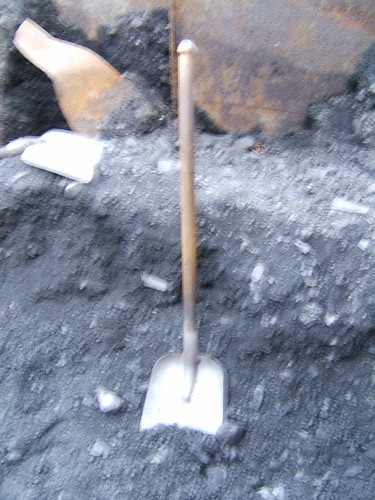
Typical firing shovel.
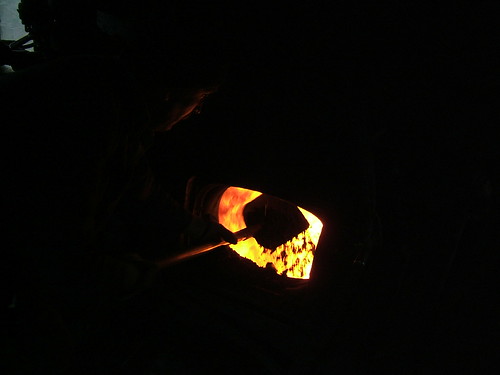 Em 735-72 being fired.
On arrival at Mikulichin, we ran the engines round the train ready for the return journey. There was time for me to take more pictures around the station and our train before we set off back to Kolomiya.
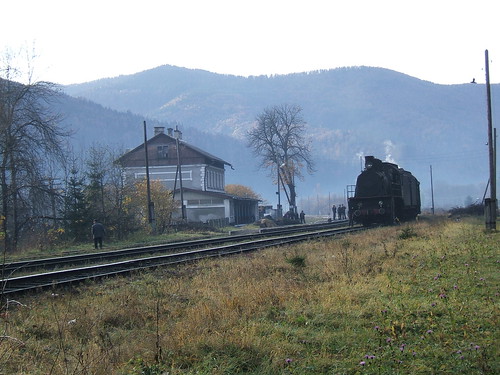 Our train at Mikulichin, ready to return to Kolomiya
On the return journey, the group with Mike and I was once again on the lead engine, Em 735-72, taking it in turns to drive.
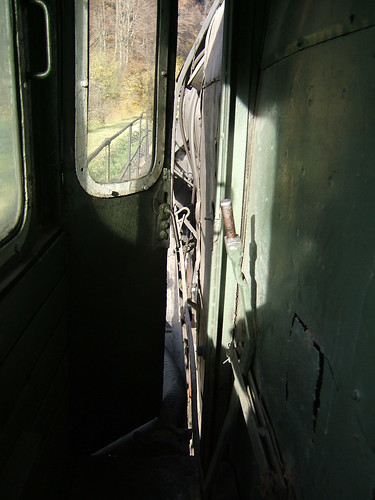
Em 735-72: Fireman's view ahead. The door giving access to the foot-framing is partly open.
At Yaremcha, we passed a 2M62-class diesel electric with a single coach, which I thought might be a dormitory coach for track workers. At one point, when I was driving, we passed a group of track workers, standing clear. We solemnly saluted one another and it reminded me that the unspoken comradeship between railwaymen is not peculiar to the English.
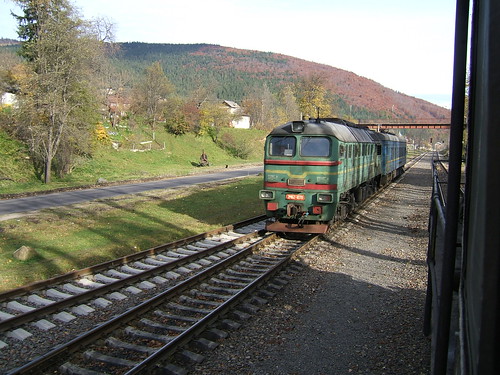 Passing 2M62-1070 with a single coach near Yaremcha.
This was the fourth day that steam trains had been seen on the Rakhov line and I had started to notice how many people in the lineside properties were outside as we passed, watching the train go by, just as in England when steam specials appear on the main line.
I was driving as we approached the junction at Kolomiya where the line from Ivano Francovsk converged on our left. I looked out for our colour light signal which was showing 'off' but with a 'Green Bar' lit. I realised that we were being crossed into the 'loop' platform and shut off in plenty of time. We clattered over the points leading to the 'loop' and drifted along the platform, with only light braking needed to stop where the Ukrainian driver indicated.
And so our steam driving experience in Ukraine had come to an end. Not all of the arrangements had worked out during the week but I still found it a wonderful experience. We sadly said our "goodbyes" to our Ukranian railway friends, checked out of our hotel and were taken by coach back to Ivano Francovsk. We had a short time to look around the town before entering the railway station to catch our overnight train to Kiev. This time, my booking arrangements worked and I had a 4-berth compartment to myself.
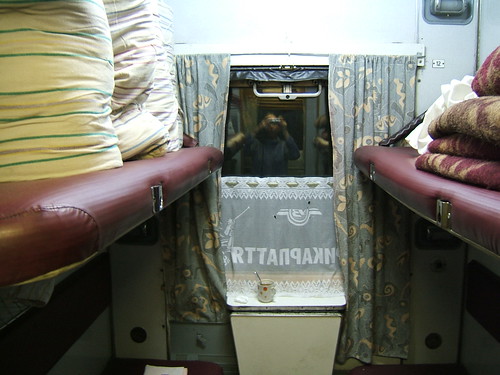 My 4-berth compartment on the Kiev train.
On arrival in Kiev, we were to visit two railway repair works (described here) and spend a night in a hotel before flying home.
Russian Railway background
At the time of my visit to Ukraine in 2005, I was almost completely ignorant about Russian Railway practice. The book 'Soviet Locomotive Types - The Union Legacy' (reference [1] below) is an invaluable primer on Russian steam, diesel and electric traction. Later, in 2011, a river cruise from Moscow to St. Petersburg (described in a series of posts here) gave me tantalising glimpses of railways in Russia itself. Then, in 2011, I travelled by the 'Golden Eagle' private train from Ulaan Baatar in Mongolia to Moscow (described in a series of posts here), finding out a little more about Russia's remarkable railway heritage.
Book References
[1] 'Soviet Locomotive Types - The Union Legacy' by A J Heywood & I D C Button (Frank Stenvalls Forlag) ISBN 0-9525202-0-6.
My pictures
The railways:
Ukraine Steam.
Ukraine Modern Image.
The country:
Ukraine.
In Part 3 I described my second day on the footplate at Kolomiya in Ukraine, on locomotive Su251-86.
On Wednesday 26th October 2005, my friend Mike and I made our first excursion onto the single line from Kolomiya to Rakhov. We found out how our hosts had dealt with the problems of 24th October when Er797-86 had got into trouble, short of steam, on the Rakhov line (mentioned in Part 2). The solution adopted was to subsequently double-head the train, with Er797-86 coupled tender to tender with Em735-72. Er 797-86 (chimney leading) would haul the train out from Kolomiya with Em 735-72 (tender first) assisting as required. After running round both engines coupled together at the far end, Em 735-72 (now chimney leading) would return the train to Kolomiya with assistance from Er 797-86.
'E' class background
The 'E' class 0-10-0 had been introduced in 1912 as a development from the earlier 'O' series 0-8-0. Russian-built 'E' class were supplemented in the early 1920s by imported 'E' class from Germany and Sweden. The 'Eu' class was a Russian redesign built in large numbers from 1926 until the 'Em' was introduced in 1931. Modifications to the 'Em' design produced the 'Er' class, more powerful and economical than the 'Em'. This class was built between 1935 and 1957. Altogether over 11,000 of the various types were built. There's a little more information on the class here.
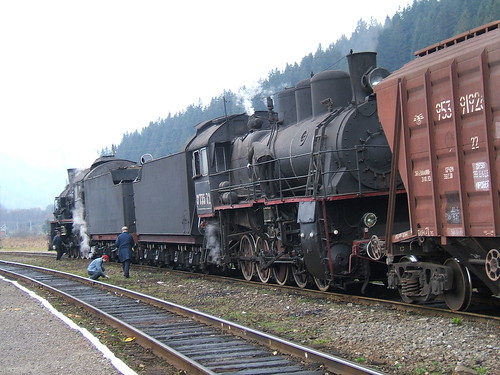 Er 797-86/Em 735-72 stand at Mikulichin.
A journey into the Carpathian Mountains
Although the organisers had initially hoped that we could travel to Rakhov, in fact we were only allowed as far as Vorokhta (about 90 km from Kolomiya).
On the first leg of the journey out, Mike and I were allocated to Em 735-72, which we'd been on for our first day's driving (described in Part 2). We departed from Kolomiya heading west with a train comprising bogie hopper, bogie open and bogie flat wagons. About 47 km from Kolomiya, we arrived at the junction station at Delyatin, where a direct line from Ivano Francovsk converges. Delyatin had a most impressive station building but only the very narrow, low platforms common at smaller stations.
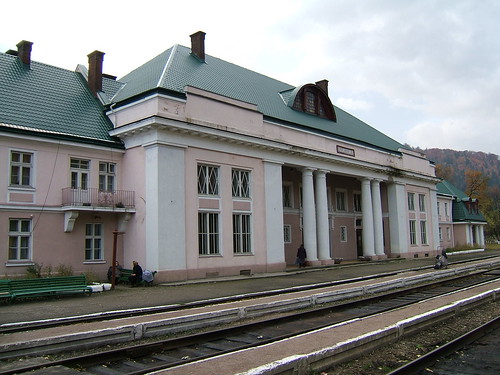 The impressive station building (and narrow, low platforms) at Delyatin.
A handful of passengers were waiting and our train stood at Delyatin for about half an hour until a diesel multiple unit travelling in the opposite direction cleared the line ahead.
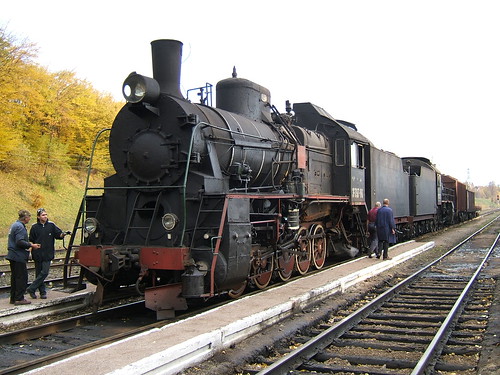 Er 797-86/Em 735-72 pause at Delyatin.
As we continued, the scenery became far more rugged as we headed into the forest-covered mountains. The picture below shows the view ahead of the train, looking from the footplate through the aperture in the tender cab (Em 735-72 was travelling tender first).
 View ahead from Em 735-72.
The above picture also gives a clue regarding the steaming problems. The coal in the tender was very small pieces - slack. Worse, the dust which accompanies slack had been lying in the tender, exposed to the rain, for goodness knows how long, turning the dust to mud which had then dried like cement. We'd not had major problems on our trip to Stefaneshty or with the Su251-86 on the fairly level route to Chernivtsi, but the route to Rakhov was clearly more demanding. In addition, the amount of ash we'd seen dumped by Em 735-72 at Stefaneshty and by the Su251-86 at Chernivtsi suggested that it wasn't a high grade coal to start with. A good coal for locomotives should have a high calorific value, low content of incombustible ash and low content of harmful elements like sulphur which can produce an 'acid rain' attacking the boiler tubes.
8 km beyond Delyatin, we passed through Yaremcha which is an important tourist centre, with a modernised station. The year following my visit, the Romanised spelling of the name was changed to 'Yaremche' (see Wikipedia here). After a further 10 km, we stopped at Mikulichin, where we had to wait for a 'path'. Mikulichin was as pretty a village as the website here suggests and we spent some time exploring the minor road through the village before returning to the fairly isolated station.
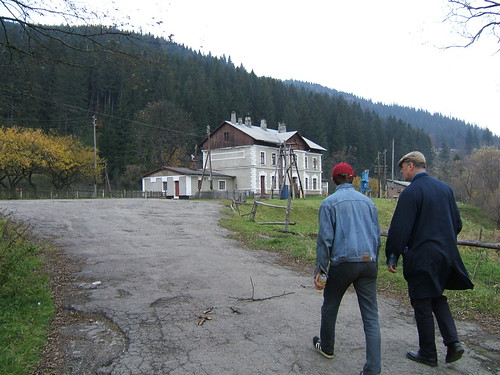 Station approach, Mikulichin.
Back at the station, the friendly lady stationmaster allowed me to study the signalling and telecommunications facilities. I'll describe what I was able to glean in a later post. After a wait of around two hours at Mikulichin, we finally had our 'path' to enable us to set off on the remaining 16 km to Vorokhta. For this leg, the eight trainees had swopped engines, so Mike and I were now on the leading engine, Er 797-86, again taking it in turns to drive.
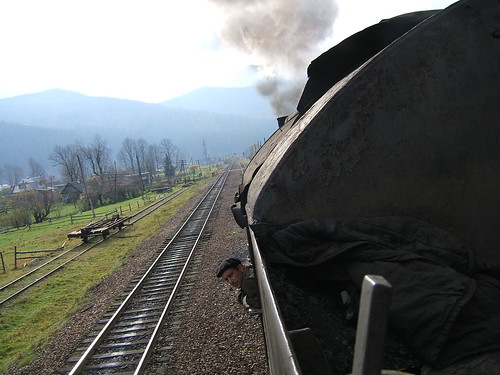 Er 797-86 leaving Mikulichin.
Approaching Vorokhta, we passed over a fairly notable modern viaduct. There were sentry boxes at each end, presumably from the Soviet era, but they appeared to be no longer in use.
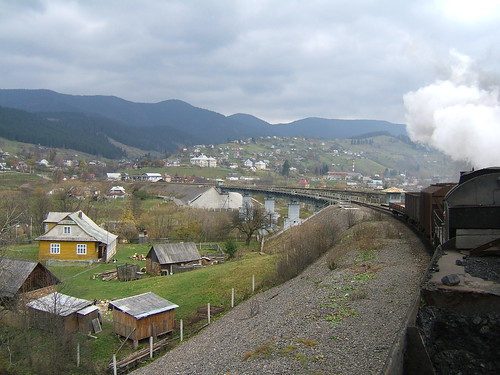 View from Er 797-86: looking back, approaching Vorokhta.
At Vorokhta, the two locomotives were detached from our train and, coupled together, run round our three wagons ready for the return journey. There was then a 'photocall' as everyone (bar the photographer) posed in front of Em 735-72 as pictures were taken with various cameras.
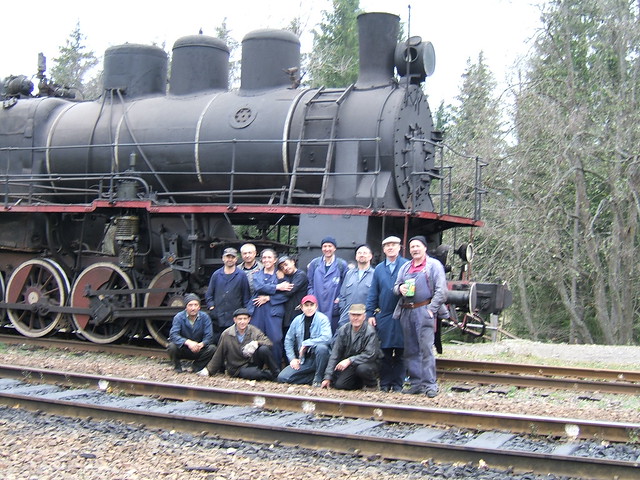 Em 735-72 and the entire cast pose for photographs.
The Ukrainian crews then invited us to lunch on the footplate of Er 797-86. A wooden table appeared from somewhere and lots of typical Ukrainian food was handed round. It was a very jolly interlude.
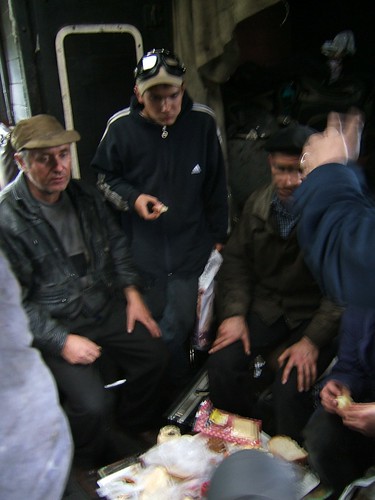
Er 797-86: Lunch on the footplate at Vorokhta.
We set off on our trip back to Kolomiya having swopped round again so that Mike and I were once again on Er 797-86. The picture below gives a good idea of the attractive area we were passing through. The train is about to pass over one of the many ungated road crossings. Notice the open wire pole route for telephones.
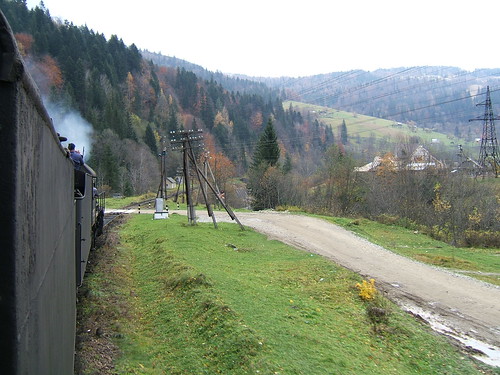 View from Er 797-86 returning from Vorokhta.
I'm afraid I'm unclear exactly which bits of the line I drove personally, but I do remember driving through the tunnel on this line. I usually drive with the sliding side window of the cab (which the Russian locomotives also have) open. Approaching the tunnel, I deemed it wise to slide it shut. The tunnel wasn't a 'tight fit' so conditions weren't bad but there was plenty of steam swirling around the cab. We were on the leading engine, of course, so I don't know whether matters were less comfortable on Er 797-86 behind us!
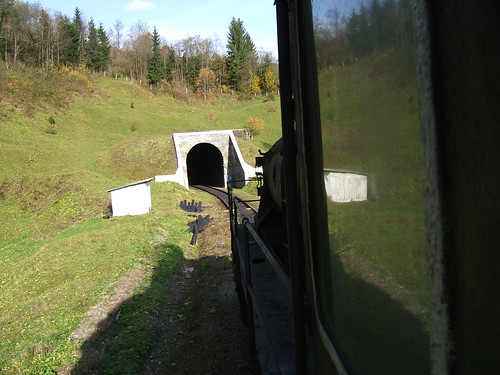 Fireman's view of the tunnel from the cab of Em 735-72 en route to Kolomiya.
The last pictures I took on that day were at Yaremcha. By the time we arrived back at Kolomiya, we'd had an interesting but tiring day. The following day would be our last driving day, and that's described here.
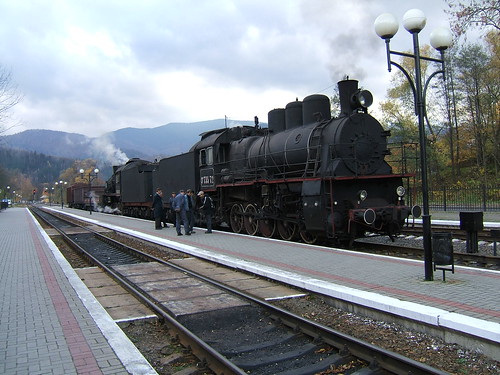 Er 797-86/Em 735-72 at Yaremcha.
Russian Railway background
At the time of my visit to Ukraine in 2005, I was almost completely ignorant about Russian Railway practice. The book 'Soviet Locomotive Types - The Union Legacy' (reference [1] below) is an invaluable primer on Russian steam, diesel and electric traction. In 2011, a river cruise from Moscow to St. Petersburg (described in a series of posts here) gave me tantalising glimpses of railways in Russia. Then, in 2011, I travelled by the 'Golden Eagle' private train from Ulaan Baatar to Moscow (described in a series of posts here).
Book References
[1] 'Soviet Locomotive Types - The Union Legacy' by A J Heywood & I D C Button (Frank Stenvalls Forlag) ISBN 0-9525202-0-6.
Photographs
The railways:
Ukraine Steam.
The country:
Ukraine.
In Part 2 I described my first day on the footplate at Kolomiya in Ukraine, on locomotive Em 735-72.
On Tuesday 25th October 2005, my friend Mike and I were allocated to the Su251-86 which, with a coach and two bogie wagons, was to head south-east to Chernivtsi, about 75 km distant. As I mentioned in Part 1, Su 251-86 is normally based at Chernivtsi and the Ukranian crew were also stationed at Chernivtsi.
Su class background
This locomotive was probably the most 'English' looking of the steam locomotives we saw, although it retains plenty of 'Russian' features. The design was derived from Sormovo Works 'S' class of 1910 via the 1915 'Sv' class from Kolomna Works, re-designed by Kolomna Works in 1925 as the 'Su' class. It became the standard passenger engine for long-distance and suburban work in Russia and over 2,500 were built in four different variants. It was 6-coupled with carrying wheels fore and aft to produce a 2-6-2 (Whyte's) wheel arrangement (although the Russians invariably counted axles, calling it a 1-3-1). With an axle load just over 18 tons, it had good route availability.
The coupled wheels were 1850mm (6'1") diameter. The Russians didn't go in for the small variations of wheel diameter between classes which rather afflicted British designers and the later FDp20 (first built 1932) and P36 (first built 1950) retained the same wheel diameter.
Although elsewhere the vogue was for 4-wheel leading bogies on fast passenger locomotives, for some reason, Russian designers were never keen on the idea and used a 2-wheel leading truck until the 'P36' design of 1950.
English locomotive designers indulged in all sorts of fancy profiles for their chimneys - J. G. Robinson said "The chimney is to a locomotive like a hat to a man - the finishing touch" but the utilitarian designers further east were usually content with a simple tapered 'stovepipe'.
The boiler appears to have two domes but the rear one is a 'Sand Dome' to hold dry sand for application to the rails to improve traction.
A substantial cab is provided, lined with wooden panelling. A prominent feature is a glazed 'skylight' on the cab roof. Access to the cab from the ground is via proper inclined 'stairs' provided with handrails (a distinct improvement on the meagre vertical steps of British designs). The front wall of the cab has doors either side to give access to the footframing and. in common with most Russian steam locomotives, substantial railings are provided around the outside edge of the foot-framing (rather than a single handrail fixed to the boiler, as in British practice).
The class were originally designed for a maximum speed of 115 km/h but the preserved locomotive had been given a much lower limit (40 km/h, I think).
 Su 251-86 at Kolomiya Depot.
The Su class, like the majority of Russian designs, has two outside cylinders (575mm by 700mm) with piston valves driven by Walschaerts Valve Gear.
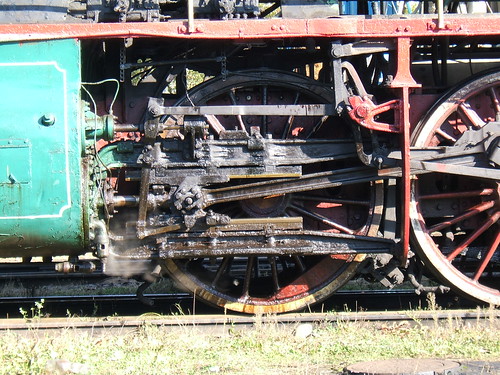 Su 251-86: Left hand motion detail.

My friend Mike tries out the driver's seat. Russian railways adopt right-hand running on double track, with signals set on the right and locomotives are right hand drive.
The picture below shows the boiler backhead. The general appearance of disrepair was a little worrying but the locomotive operated as required the week that we were there.
The 'skylight' in the roof is visible at the top of the picture. There is a Steam Manifold mounted on top of the firebox, provided with a number of red T-handled shut-off cocks. The two large copper pipes at either end of the Manifold supply steam to the two backhead-mounted injectors.
The gland for the regulator rod is in the normal position, on the centre line of the boiler, near the top of the green-painted cladding. However, rather than attaching the regulator handle directly to the regulator rod, a link connects the rod to a short regulator handle mounted lower down and to the right, so as to be more accessible to the driver. The regulator handle works in a notched quadrant and a catch on the regulator handle allows it to be latched in the desired position. There is one gauge glass, mounted to the left of the regulator gland. As a back-up, there are three 'Try-cocks' to the right of the regulator gland. The dual, sliding firedoors are near the bottom of the picture. Each heavy, cast firedoor is suspended on two greased wheels running on the track above the firehole.
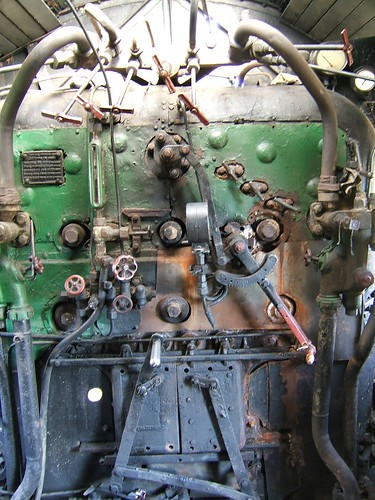
Su 251-86: Detail of boiler backhead.
All the locomotives we saw in Ukraine, including the Su 251-86, had large, 8-wheel tenders carried on two bogies, with a fairly simple 'tender cab' at the front, matching the locomotive cab. On the tender sidesheeting, next to the cab and just above the tender underframe, the darker rectangle is the door to a compartment for storing oil bottles and oil feeders.
 Su 251-86 at Kolomiya Depot, showing the bogie tender.
On the road
Despite the engine's battered appearance, the Chernivtsi crew were clearly proud of it, and I quickly grew to like it. We set off on the single line to Chernivtsi, taking it in turns to drive and assist the fireman. We stopped at an intermediate station and the crew took the opportunity to apply more oil.
 Su 251-86: My friend Mike oiling the leading truck en route to Chernivtsi under the watchful eye of the Ukranian driver. The oil feeder in use is much larger than that typically used in Britain.
As we approached our destination, it became clear that Chernivtsi was a fairly major city - I think the population was around 240,000 at the time. There is a Wikipedia article here. On arrival at Chernivtsi, we were routed into one of a number of sidings leaving the platforms and the impressive station building on our right.
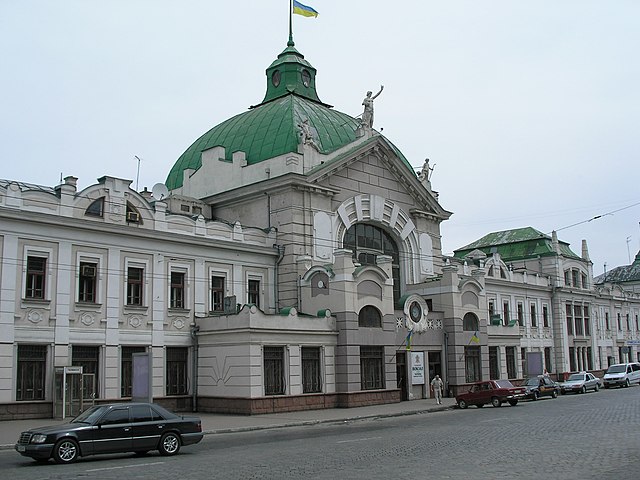
 Chernivtsi Railway Station (built 1909) viewed from the road (Photo: Creative Commons Attribution: DDima).
I think we were offered the opportunity to explore the town but Mike and I preferred to stay with the engine. Having uncoupled our short train and left it in the sidings, the engine was signalled to carry on ahead to reach the motive power depot. After about one kilometre, the single-track main line curved away on our right and a few hundred metres further took us to a complex of sidings and the motive power depot.
Chernivtsi Motive Power Depot
Our locomotive was 'parked-up' in the sidings of what is now a diesel depot and we were allowed to wander around the depot (I think the Ukranian crew were taking their lunch break). A turntable served a roundhouse, built of reinforced concrete with brick infill. The capacity of the shed had been reduced by replacing some of the access doors with solid walls. Repairs had been carried out to the remaining wooden access doors on each road leading into the shed. A class TGK2 diesel-hydraulic shunter number 6009 and a smart-looking ChME3 (but with at least one wheelset missing) stood outside the roundhouse.
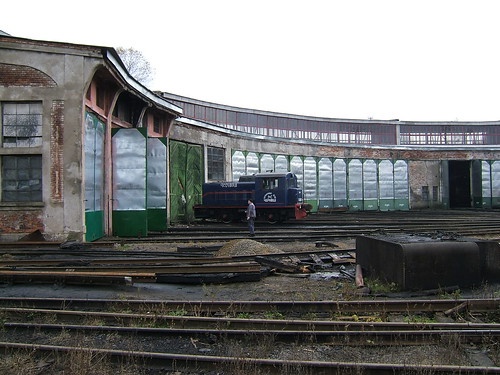 My friend Mike examines the repairs to the wooden doors of the roundhouse at Chernivtsi.
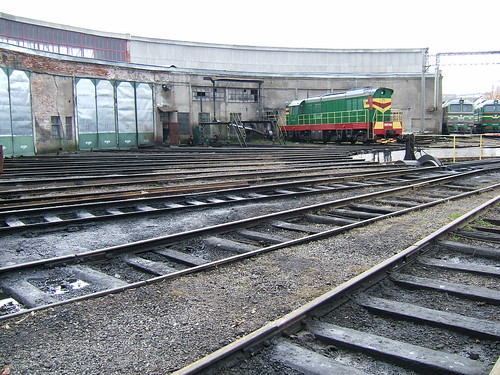 A smart-looking ChME3 (but with at least one wheelset missing) standing outside the roundhouse at Chernivtsi.
We were drawn to two of the massive class 'L' 2-10-0 freight locomotives, L 3535 and L 5141, standing in the open. Starting in 1945, over 4,000 of these popular freight locomotives were built. I'm afraid close inspection found these impressive machines in the same battered state of all the locomotives we'd seen in Ukraine, although not quite as care-worn as nearby 'Er' class 799-82.
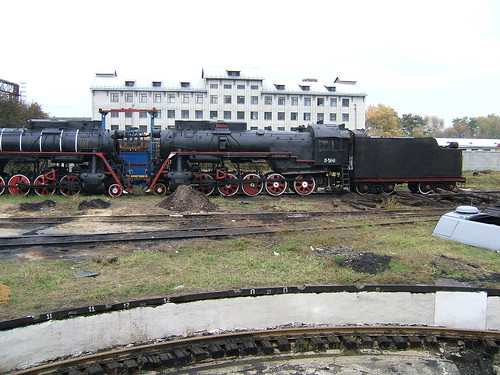 'L' class 2-10-0 numbers 3535 (left) and 5141 (right) in store at Chernivtsi.
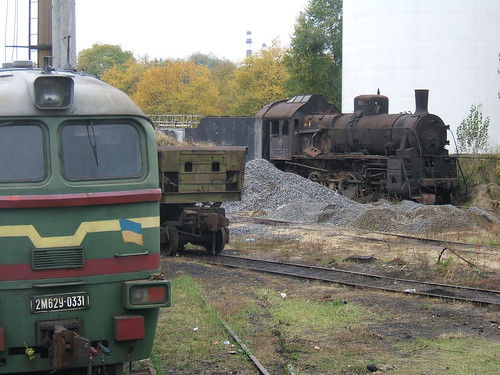 L: 2M62U-0331, R: (in battered condition) 'Er' class 799-82 at Chernivtsi.
This trip to Ukraine was the first time I'd seen the Russian pattern of Sanding Tower shown in the picture below. Much later, in 2012, I found even more impressive installations at Ilanskaya (described here).
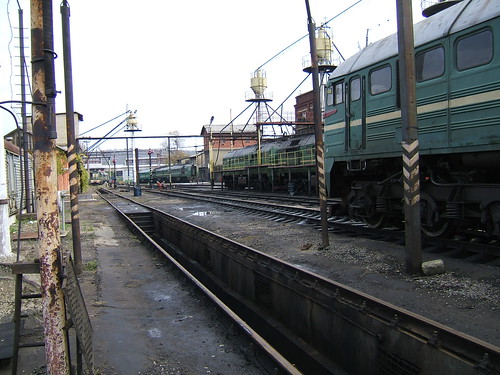 The Diesel Preparation Sidings at Chernivtsi with a number of Sanding Towers visible.
In addition to the roundhouse, we found what appeared to be workshops served by a number of parallel roads at one end and a lightweight traverser at the other end. It was possibly a wagon workshop but we didn't find any activity around the building.
Near the workshops, we found a narrow gauge 0-8-0 in store. It appeared to be 159-495, 750 m.m. gauge, formerly at Dnepropetrovsk Childrens' Railway in the Ukraine. The Russian 'Gr' class is similar.
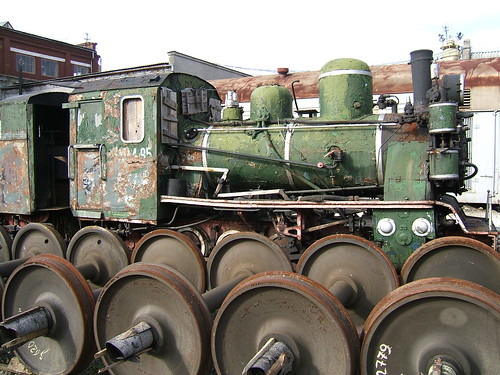 Narrow gauge 0-8-0 159-495 at Chernivtsi.
The Ukranian crew had turned the locomotive on the turntable for the trip back to Kolomiya and decided to take more coal, so a rail-mounted mobile diesel crane with a grab was summoned and used to 'borrow' coal from the tender of L3535 and transfer it to the tender of Su 251-86!
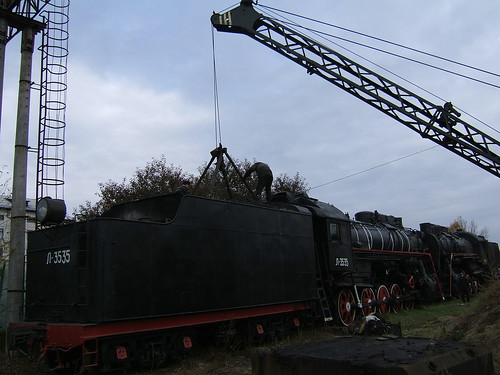 Coaling Su 251-86.
There was clearly some concern about the effectiveness of the steam turbine generator (mounted on top of the firebox) which is used to power the headlamps and other lamps, including cab lighting. A fitter was summoned and he clambered on top of the firebox and made some adjustments. He could be quite clearly heard repeating "Kaput!" but I think we had electricity on the way home.
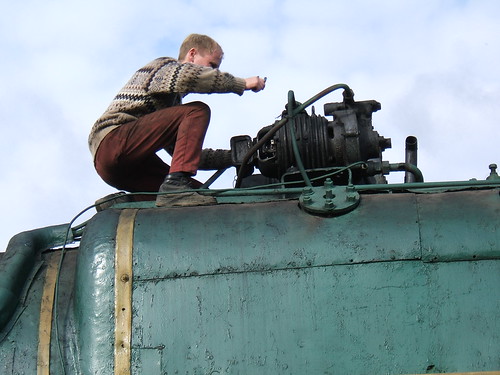 A fitter at Chernivtsi attempts repairs to the steam turbine generator.
The Ukranian crew also emptied char from the smokebox. The complete flat smokebox front is hinged on the left (looking from the front) and, once unbolted, can be swung open for re-tubing and access to the tubeplate. Regular access for char removal is via a smaller dished door, hinged on the right and secured by a number of 'dogs' or clamps which, when tightened, ensure that the smokebox door is airtight. After the char was removed, I closed the door and tightened the 'dogs', using a side spanner.
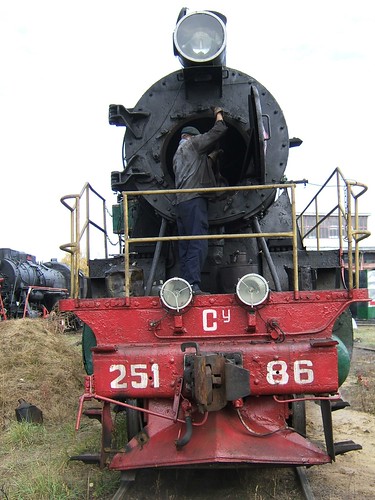
Removing smokebox char.
The final jobs before our return trip to Kolomiya were to empty the hopper ashpans and oil round.
 Su 251-86 with the hopper ashpan doors open. Note the metal scotch placed under the trailing wheel.
The Journey Home
It was starting to get dark as we set off, at a leisurely pace, back to Kolomiya. I vividly remember driving on this trip with the hypnotic 'clink - clonk' from the motion as we sauntered along through the darkness. For some reason, the beat made me start quietly singing 'The Rhythm of Life' - one of the songs performed by Sammy Davis Junior in the film 'Sweet Charity'. Even with our electric headlight, there wasn't much to see. Every so often, we passed over level crossings, often without barriers, but inevitably with a wooden lamp post carrying a single fluorescent tube throwing pale illumination onto the crossing itself. All too soon, we were back in Kolomiya after an interesting but tiring day. We were happy to leave the Ukraniam crew to complete disposal and we wearily returned to our hotel.
The next day, Mike and I were to drive on the Rakhov line. That's described in Driving Steam in Ukraine (Part 4).
Russian Railway background
At the time of my visit in 2005, I was almost completely ignorant about Russian Railway practice. The book 'Soviet Locomotive Types - The Union Legacy' (reference [1] below) is an invaluable primer on Russian steam, diesel and electric traction. In 2011, a river cruise from Moscow to St. Petersburg (described in a series of posts here) gave me tantalising glimpses of railways in Russia. Then, in 2011, I travelled by the 'Golden Eagle' private train from Ulaan Baatar to Moscow (described in a series of posts here).
Book References
[1] 'Soviet Locomotive Types - The Union Legacy' by A J Heywood & I D C Button (Frank Stenvalls Forlag) ISBN 0-9525202-0-6.
Photographs:
Ukraine Steam.
Chernovtsy Motive Power Depot, Ukraine.
In Part 1 I described my journey to Kolomiya in Ukraine on a trip to drive Russian-built steam locomotives.
On Monday 24th October 2005, our footplate experience commenced. The fitters were still working on the leaking tubes on YeA2026 so we had three steam locomotives available. The twelve people on the course were divided into three groups of four to travel on different engines on different routes. The two Engineer's coaches which Su251-86 had arrived with were allocated to two of the trains to provide accommodation.
One group were allocated to Er797-86 which, with bogie wagons as a load, was heading south-west on the Rakhov line.
The second group were allocated to Su251-86 which, with a similar load, was heading south-east for Chernivtsi.
My friend Mike and I, with two others, were with Em735-72, with one of the coaches and two bogie wagons which would head north-east to Stefaneshty.
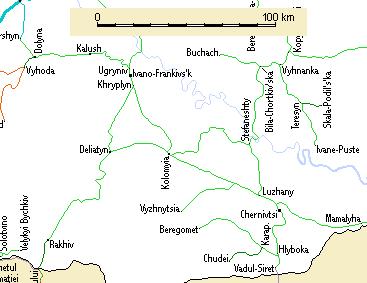
Railways around Kolomiya.
Of course, each locomotive was under the control of a Ukrainian Driver and Fireman. Since few railwaymen in Ukraine have much English, the problem of communication had been addressed by Dzherelo SPK by providing a bilingual college student on each locomotive to act as an interpreter. The idea was that two of each group would be Trainee Driver and Fireman for a time before swopping roles. The two Engineer's coaches which Su251-86 had arrived with were allocated to two of the trains to provide accommodation for the other two trainees who would exchange with the pair on the footplate at a suitable stopping point.
After the first day, I think the whole group stayed on the footplate and swopped round as necessary. The Russian loading gauge is particularly generous and the cabs were large so this presented no problem. I was reminded of my first time on the footplate of a Broad Gauge steam locomotive in India in 1992 (described here), when I commented at the time that the cab was big enough "to hold a party".
 Em 735-72 in the sidings ready to leave Kolomiya.
We set off, passed the roundhouse and the diesel shed, taking the left of two single lines, with the line to Chernivtsi on our right. The map above shows how sinuous the line to Stefaneshty is, as it winds through rolling hills. The line is something of a switchback too so, having set the regulator and cut-off to the Ukraine Driver's instructions, speed would fall a little on the uphill sections, then pick-up again on the downgrades. I was driving at this point and, although the locomotive might have been a rather battered survivor, I had the confidence that it would just keep clomping along for ever. And, of course, I would have stayed in the right-hand driver's seat for ever but we had three other trainees to share with. All too soon, we were arriving at Stefaneshty. The single line from Luzhany (on the direct line from Kolomiya to Chernivtsi) converged on our right and we were routed into the rightmost loop line, where we stopped opposite the station building. With our winding route from Kolomiya, we must have travelled around 80 km.
 Em 735-72 on arrival at Stefaneshty.
The Ukrainian Fireman immediately set-to emptying ash from the ashpan, whilst his driver oiled round the motion again. I don't know whether the ashpan had been emptied the previous evening, but there was certainly plenty of ash dumped between the rails at Stefaneshty. The fireman detached the locomotive from its train (one air brake hose to disconnect, then pull the release lever to open the knuckle on the massive Russian-pattern automatic coupler) and the Ukrainian Driver ran the locomotive around its train.
 Em 735-72: Oiling round and Ashing-out at Stefaneshty.
We set off in the opposite direction, this time with Em 735-72 running tender-first. At the south end of Stefaneshty, we were routed onto the left-hand single line to Luzhany, leaving the line we'd travelled earlier on our right. A journey of about 35 km took us to the junction at Luzhany where, once again, Em 735-72 was run around its train. The engine was now chimney-leading again, for the last leg of about 60 km back to Kolomiya. I know that Mike and I travelled in the coach for at least part of this journey, because I was able to take a picture of the standard Russian Autocoupler.
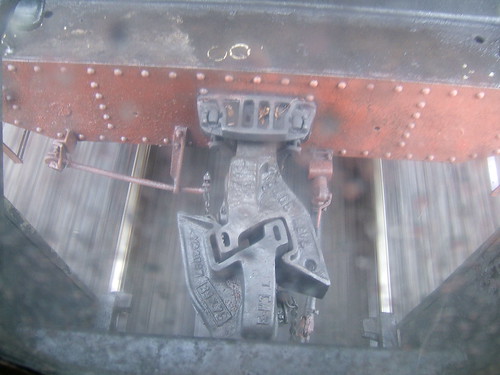 Em 735-72 at speed in the rain, showing Russian pattern autocoupler between tender & coach. The release lever to open the knuckle on the coupler is on the left and the air brake hose (with two red-painted 'palm' couplings between the vehicles) is just to the right of the Automatic Coupler.
We arrived back at Kolomiya safely, as did Su251-86 returning from Chernivtsi. But we learnt that Er797-86 had got into trouble on the Rakhov line, short of steam, causing some disruption to the public trains and resulting in a late arrival back in Kolomiya. Further disappointing news was that, since YeA 2026 had failed another steam test, there was insufficient time to cool the boiler down, carry out remedial work, light it up again and carry out a further steam test before the end of our visit. With great regret, YeA 2026 was 'scratched'.
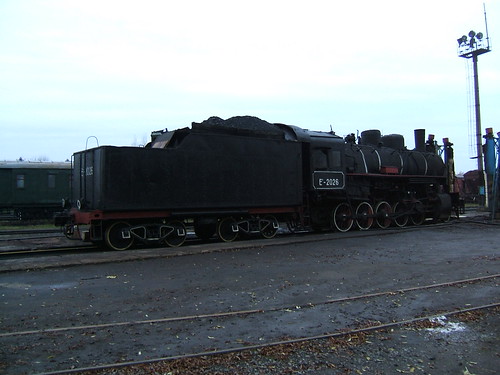 YeA 2026 left to cool-down after failing the steam test.
We returned to our hotel for an evening meal and bed, because we had another early start the following day when we'd do it again.
Continued in Driving Steam in Ukraine (Part 3).
Russian Railway background
At the time of my visit to Ukraine in 2005, I was almost completely ignorant about Russian Railway practice. The book 'Soviet Locomotive Types - The Union Legacy' (reference [1] below) is an invaluable primer on Russian steam, diesel and electric traction. In 2011, a river cruise from Moscow to St. Petersburg (described in a series of posts here) gave me tantalising glimpses of railways in Russia. Then, in 2011, I travelled by the 'Golden Eagle' private train from Ulaan Baatar to Moscow (described in a series of posts here).
Book References
[1] 'Soviet Locomotive Types - The Union Legacy' by A J Heywood & I D C Button (Frank Stenvalls Forlag) ISBN 0-9525202-0-6.
My Pictures
Ukraine Steam.
Background
In the earlier post Ukraine 2005 I briefly described my trip to Ukraine to drive Russian-built steam locomotives. After a long interval, I'll take up the story.
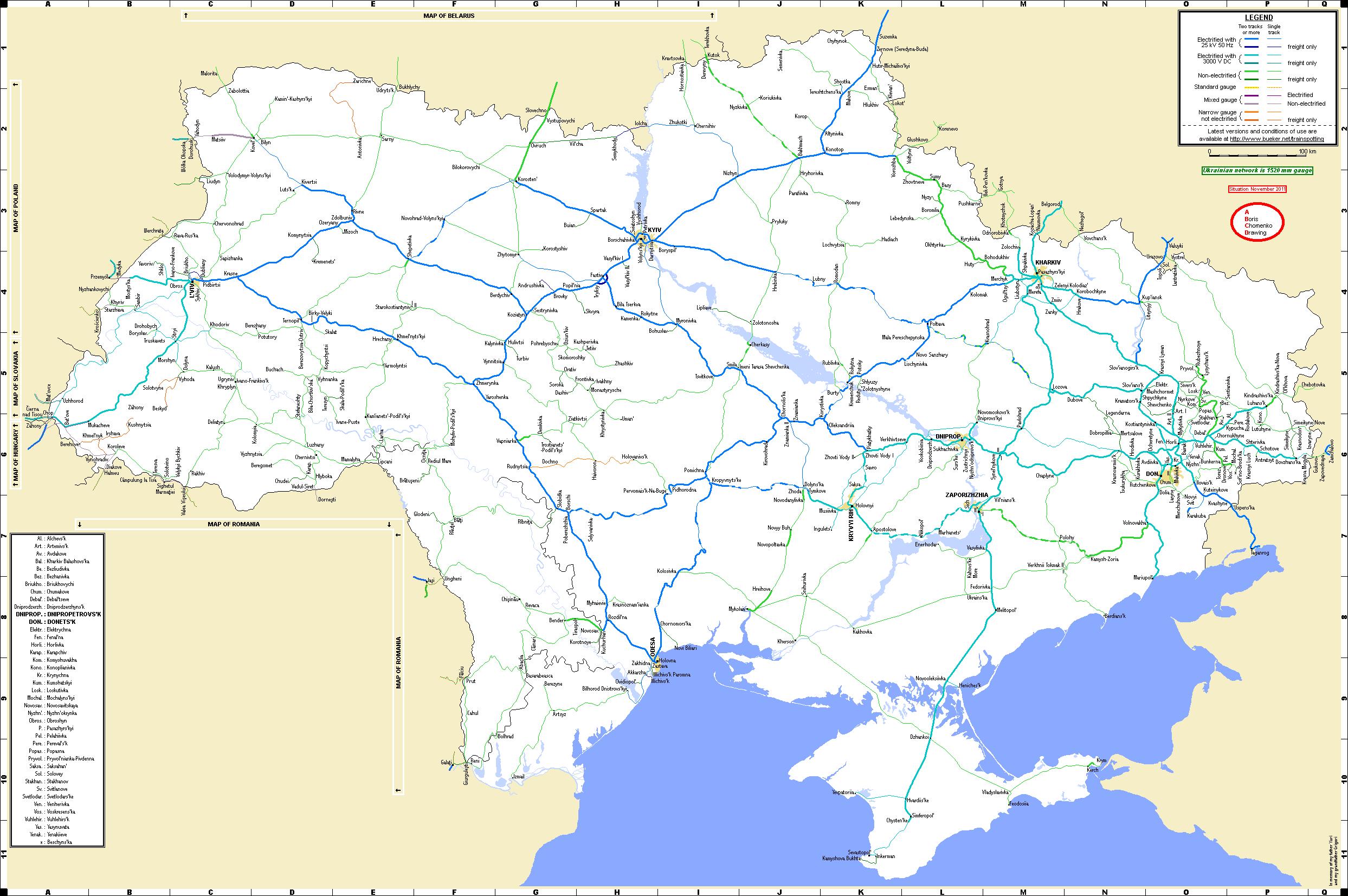
Ukraine has an extensive railway system to the Russian gauge of 5 feet and, although Ukraine has been a sovereign state since 1991, the railway infrastructure and rolling stock was principally provided by Russia during the Soviet era.
Click here for a railway map of Ukraine.
The visit was arranged by East Europe Railtours Limited in the U.K. and Dzherelo SPK in Ukraine. On 22nd October 2005, we arrived by air in Kiev, the capital of Ukraine, and met up with the other members of the group. In total, there were twelve of us. We travelled overnight by train on the overhead electrified line west to L'viv (Lvov in Russian) which is fairly near the Polish border. After changing engines, we continued south to Ivano Francovsk on the non-electrified line, arriving in the morning.
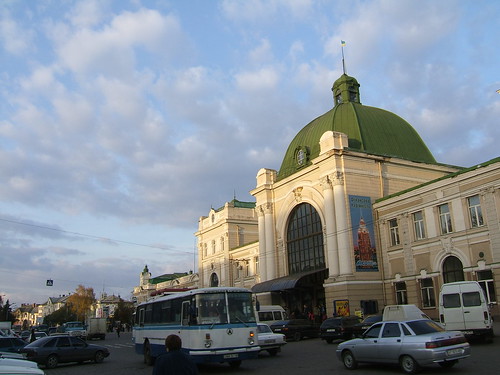 The station buildings at Ivano-Frankovsk viewed from the road side.
From Ivano Francovsk, a coach took us further south to Kolomiya and the Hotel Pysanka which would be the base for our engine driving activities. 'Pysanka' is the word for the decorated eggs typical of the area. Just outside the hotel was the Pysanka Museum ('Egg Museum') displaying a range of decorated eggs. The central building of the museum was egg-shaped, so this provided a useful landmark when exploring the town.
 The group outside the hotel in Kolomiya.
Railways around Kolomiya
Kolomiya is an important railway junction. The railway from Ivano Francovsk to Chernivtsi passes through Kolomiya and two branches radiate. The branch to the south-west passes through some beautiful country in the Carpathians to Rakhov, and then over the border into Romania. The other branch heads broadly north-east to Stefaneshty.
Railways around Kolomiya.
Kolomiya Steam Shed
Having checked-in at our hotel, we were taken to the steam shed for a briefing and the opportunity to look at the locomotives. The motive power depot at Kolomiya had a roundhouse with steam locomotives. Nearby, there was a straight shed (which we didn't visit) for diesel locomotives.
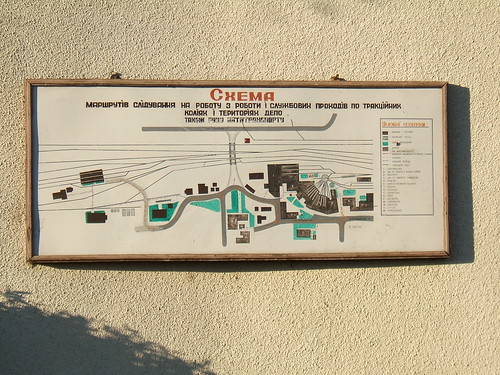 Plan of the motive power depot displayed at Kolomiya depot.
The following steam locomotives were 'on shed':-
Em 735-72
Er 797-86
Yea 2026
b 2137
The 'Em' and 'Er' were sub-classes of the ubiquitous 0-10-0 freight locomotives which were produced in large numbers. There's a brief profile here.
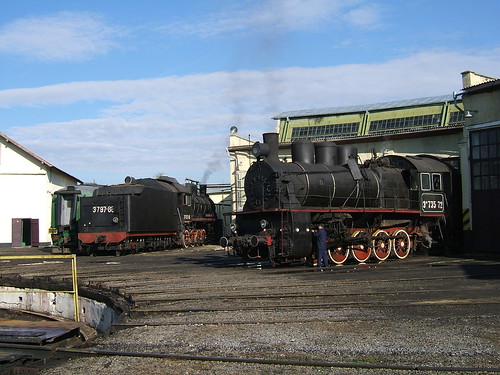 Er 797-86/Em 735-72 at Kolomiya depot.
The 'Yea' was an American design imported in both the First and Second World Wars. There's a brief profile of this class here. We found Yea 2026 inside the shed at Kolomiya, with smokebox door open, as the fitters were still completing the replacement of leaking smoke tubes.
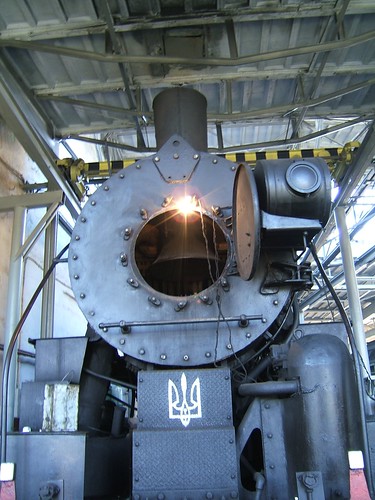
Yea 2026 inside the shed at Kolomiya, with smokebox door open.
The 'b' class was a four-coupled side tank but this was not steamed during our stay. I think the '1885' on the side tank commemorates the year the first railway opened at Kolomiya.
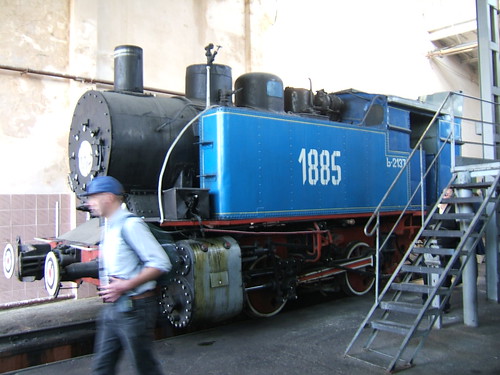 B 2137 inside the shed at Kolomiya.
Leter in the day, an 'Su' class (Su 251-86) arrived light engine under its own power from her home depot, Chernivtsi, to add to the 'stud'. She brought two rather battered Engineer's Coaches.
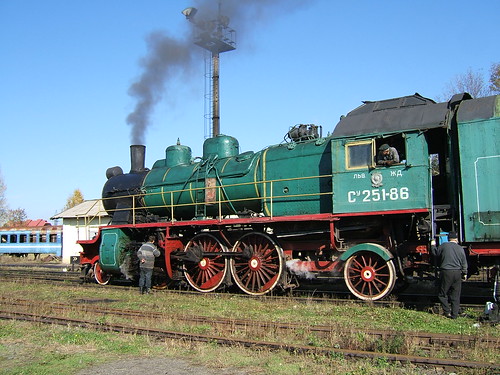 Su 251-86 on arrival at Kolomiya from Chernivtsi.
We spent most of the day around the shed studying the locomotives and looking at the activity around the station, with diesel traction like the 2M62 (a 2-section Co-Co) on freight trains and 4-car Diesel Multiple Units like the D1 on passenger trains.
 2M62-0888 with a freight at Kolomiya.
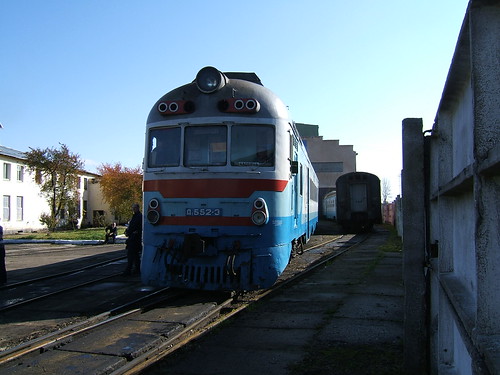 Diesel Multiple Unit D1-552-3 stabled near the Roundhouse at Kolomiya.
The following day the driving commenced, as described in Driving Steam in Ukraine (Part 2).
Russian Railway background
At the time of my visit in 2005, I was almost completely ignorant about Russian Railway practice. The book 'Soviet Locomotive Types - The Union Legacy' (reference [1] below) is an invaluable primer on Russian steam, diesel and electric traction. In 2011, a river cruise from Moscow to St. Petersburg (described in a series of posts here) gave me tantalising glimpses of railways in Russia. Then, in 2011, I travelled by the 'Golden Eagle' private train from Ulaan Baatar to Moscow (described in a series of posts here).
Book References
[1] 'Soviet Locomotive Types - The Union Legacy' by A J Heywood & I D C Button (Frank Stenvalls Forlag) ISBN 0-9525202-0-6.
My pictures
Ukraine Steam.
Ukraine Modern Image.