skip to main |
skip to sidebar
Doctor Hla Tun had arranged an official visit to view the signalling arrangements at Bago on 9th May 2018 and this post adds some technical comments to the post A trip to Bago which describes that visit.
Bago is an important station on the double-track route from Yangon via Naypyitaw to Mandalay. It is also the junction for the single line to the south of Myanmar. Originally, this single line line terminated at Mottama but, with the opening of the Thanlwin Bridge, there is now a continuous railway to Mawlamyine and beyond.
At Bago there are two fully-interlocked mechanical signal cabins, one at each end of the station (South Cabin at Yangon end, North Cabin at Mandalay end) and a number of parallel loops through the station. I had previously seen a similar arrangement in use at Kyee Myin Daing (see the report of my visit to Kyee Myin Daing on 10th May 2017 here.
The Doctor and I arrived at Bago station at 1.00 p.m. and were ushered into the spacious meeting room. After introductions to Yin Min Oo, the Assistant Divisional Manager, the Signal Officer and two others who would accompany us on our tour, one of whom was an English speaker, we set off on our tour.
On the platform, we passed a particularly battered specimen of an Arrivals and Departures board. This board helps passengers find their correct coach, by showing the make-up of major passenger trains. Each coach is represented by a disc with vehicle details inscribed. The appropriate discs are hung on a horizontal series of small hooks so that the composition of each train is readily visible. Three trains are shown - I assume the apparent gaps in the train formation indicated are because of broken or missing hooks.
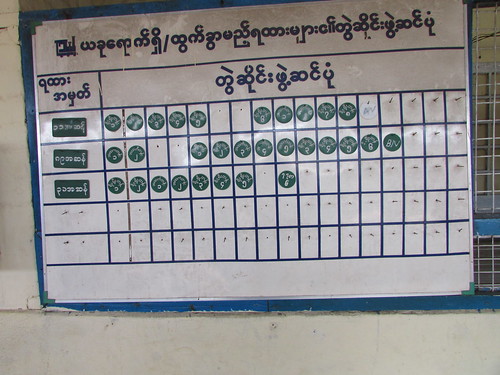
A particularly battered Arrivals and Departures board at Bago
Station Master's Office
The office which directs and authorises traffic movements in the Bago area they referred to as the 'Station Master's Office'. I think Myanma Railways may also use the term 'Sub-Control' for the more important locations.

Bago track diagram in Stationmaster's Office
Click for larger image
The Sub-controller (as I will provisionally call him) updates the train register book and writes out and issues the paper 'Line Clear' forms authorising train movements. The Sub-controller also has a radio, which links him with the Control Office in Yangon, and an impressive array of desk telephones. There's a hand-cranked magneto telephone which I think communicates with the Bago Signal Cabins and five auto telephones whose function I didn't discover.

The 'Sub-controller' in the Station Master's Office at Bago
At the 'Sub-controller' desks at Bago, there are two elderly items of electrical signalling equipment similar to those I'd seen on an official visit to Kyee Myin Daing in 2017 (described here). I assumed that, as at Kyee Myin Daing, they are used to instruct the two local signal boxes regarding the route through the station area to be taken by trains. There's also a third, similar instrument which I think is not in use.

Route Indicating Signalling Equipment, Bago (The Railway at Bago, 9th May 2018)
Each instrument is housed in a substantial, cast housing rather similar to some designs of electric token instrument, with the cast cover secured with a padlock. All indications and controls are on the front face. There are two 2-position galvanometers towards the top; one a lower-quadrant semaphore stop signal indicator, the other displaying text in a slot (ON/OFF, as far as I can determine). Below this is a window showing part of a rotating disc revealing different numbers, according to the angular position of the disc which is controlled by turning a commutator knob below the window. I've found displays of 'N', '1' and '3' so I assume this is how the desired road is selected. Near the bottom of the front is a substantial pull-out slide (rather similar to that on certain electric tablet machines). To the left of the slide, is a push-button (possibly to reset for the next route).
These instruments are connected electrically to the appropriate signal cabin, where the required route is visually indicated.
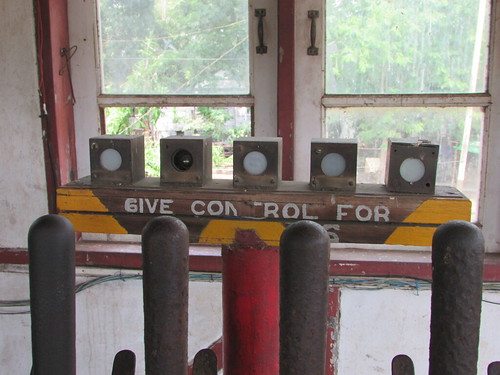
These 'GIVE CONTROL FOR' filamentary indicators in the signal cabin show the required route (The Railway at Bago, 9th May 2018).
Time didn't allow me to get to the bottom of this tantalising puzzle, so I'm afraid I still have only a hazy understanding of the set-up as our hosts were anxious to move on to the signal cabin at the Mandalay end of the station, Bago North.
I was keen to see the mechanical signalling at Bago at close quarters as it's to be abolished and all the delightful semaphore signals removed as part of the railway modernisation. My interest had been whetted travelling through Bago by train on 8th September 2012 during an uncomfortable journey from Yangon to Kyaikto, described in two posts here and here. Three days later, I returned to Yangon by road, stopping at Bago to add more photographs of the railway.
As we walked across the multiple tracks from the main platform to reach Bago North Signal Cabin, I kept stopping to take pictures of items of signalling equipment, including an example of one of the rather elegant ground disc signals.

One of the rather simple yet elegant ground disc signals at Bago (The Railway at Bago, 9th May 2018)
Bago North Signal Cabin
We entered the mechanical signal cabin of Bago North where, on the operating floor, two signalmen were on duty.

Bago North Cabin, overall view (The Railway at Bago, 9th May 2018)

Track Diagram, Bago North Cabin (The Railway at Bago, 9th May 2018)
Click for larger version
I photographed everything in sight for later study and the young signalman set up a route to demonstrate the operation of the levers (but I didn't ask to try myself). I asked to see the locking room and, again, took a number of photographs.
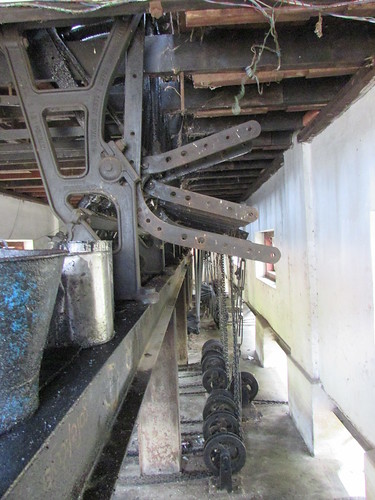
Bago North Signal Cabin: General view of locking room (The Railway at Bago, 9th May 2018)

Bago North Signal Cabin: Locking room, showing drive from levers to inclined locking tray (The Railway at Bago, 9th May 2018)

Bago North Signal Cabin: Locking room, showing detail of inclined locking tray (The Railway at Bago, 9th May 2018)
For more information on the control of trains in Myanmar, see the post here Alternately, there's an index of all my Myanma Railways posts (which may not always be up-to-date) here.
Bago Locomotive Depot
On 6th May 2015, I'd made a visit to Insein Locomotive Works in Yangon (described here) and was excited to find them restoring a couple of steam locomotives with the intention of using them to operate tourist trains. That didn't happen but the German travel firm FarRail Tours stepped in to support the costs and use the locomotives for photographic charters. I took a few pictures of the restoration work in progress which you can find here.
I knew from following the interesting FarRail Trip Reports that the three serviceable steam locomotives were normally kept in the shed at Bago. During the 2018 Bago visit being described, our hosts offered a visit to the locomotive shed so, of course, I quickly agreed. Any loco depot is full of interest and I quickly took a few pictures showing the office block with the sign for the Loco Ispector's Office (in English and Myanmar languages), a couple of Japanese 'RBE' diesel railcars, a single-ended Very Lightweight Diesel Railcar carrying the running number LRBE66, locomotive DF1205 (a 1200 h.p. Bo-Bo-Bo diesel electric but with single cab and very worn paint finish). There was a 'graveyard' of dismantled steam locomotives including a number of main frames with cylinders attached, a bogie, coupled wheelsets in two sizes and I don't know what else was hidden in the undergrowth.
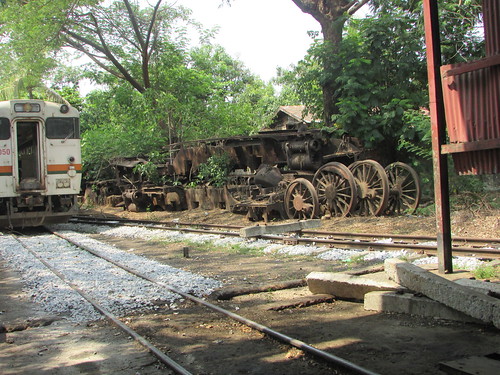
Japanese diesel railcar and 'graveyard' of dismantled steam locomotives (The Railway at Bago, 9th May 2018)
The original massive water tower survives. There are also three modern elevated, rectangular tanks. I think the left one is water - the others may be diesel fuel which I didn't confirm but they are ajjacent to three 3,500 gallon cylindrical fuel tanks, silver-painted and mounted horizontally. Nearby are two of the original inspection pits and a water column supplied by J. Blakeborough and Sons, Brighouse in 1904.

DF1205, original water tower, storage tanks, inspection pits and water column (The Railway at Bago, 9th May 2018)
I'd previously tracked down various non-operational examples of steam in Burma at various locations (there's a post here) but this was my first sighting of engines still steamable so I clambered onto the footplate of each of the three locomotives in turn, grabbing as many pictures as I could before our hosts became too restless.
The three locomotives are from two classes produced after World War II to allow Burma Railways to recover from severe war damage (at different stages during the war, Burma was bombed by both the the U.K. and Japan). Vulcan Foundry at Newton-le-Willows was involved in the building of these classes. There's a splendid website chronicling the history of Vulcan Foundry here.
One 'YB' class 4-6-2 for passenger service is preserved and two 'YD' class 2-8-2 mixed traffic locomotives. All three are oil-fired although, when withdrawn, some examples of these classes remained coal-fired.
The solitary 'Pacific' type, 'YB629' was standing outside the north end of the shed, coupled head-to-head onto 2-8-2 'YD964' which was the engine I'd identified under heavy repair at Insein back in 2015. At Bago, 'YD964' was standing over the Wheel Drop with the motion partly taken-down, presumably in need of running repairs. The second 2-8-2 was standing outside the south end of the shed. My pictures of these three survivors are in the album here, and I apologise for the poor quality of some of them in my haste to record as much as possible.

'YB629' 4-6-2 outside Bago Shed (The Railway at Bago, 9th May 2018)
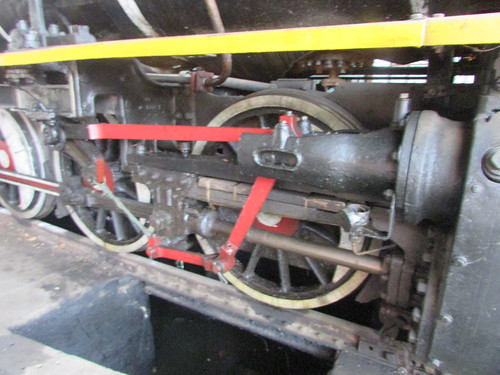
YD 964': View of driver's side showing partly-dismantled motion. Wood between the slidebars prevents the crosshead from moving. The locomotive is standing over the Wheel Drop (The Railway at Bago, 9th May 2018)

'YD967' 2-8-2 at Bago: For once, Jan looks quite happy (The Railway at Bago, 9th May 2018)
Bago to Yangon by Train
When our hosts managed to prise me away from the steam locomotives, I was all set for a visit to Bago South cabin but they said there was not enough time, so we made our way back to the station, this time using a public footbridge. However, they did suggest that I might like to return to Yangon by train, a suggestion I readily accepted. Train 32 from Naypyitaw (from where it departed at 08:00) was due to arrive, they said, at 15:00. They also suggested that my photographic opportunities might be better in an Ordinary Class coach, where all the windows were sure to be fully open, rather than an Upper Class coach. I agreed with their reasoning and a ticket was issued. Then they said the train was 15 minutes late and it actually arrived about 15:20. According to the rail travel website 'The Man in Seat 61' here, the train was not due in until 15:20 and was due to depart at 15:23, arriving Yangon at 17:00. Well, we left about 15:23 and cracked along at what, for a Burmese train, was a a very good speed. We made just one stop and arrived at Yangon Central Station at 17:00. The journey is described in some detail in the post Bago - Yangon by train.
Related posts on this website
This is one of a series of posts describing Myanma Railways.
Selecting label 'Myanma-Railways' or clicking here displays all the posts with this label in reverse date-of-posting order.
Alternately, there is an Index here (but it may not be always quite up-to-date).
My pictures
Where necessary, clicking on an image above will display an 'uncropped' view or, alternately, pictures may be selected, viewed or downloaded, in various sizes, from the albums below:-
Bago Station (earlier pictures).
The Railway at Bago, 9th May 2018.
Bago to Yangon by Train, 9th May 2018.
All my Myanma Railways pictures.
Thursday, 10th May 2018
This was my last day in Yangon. I had breakfast, finished packing and said farewell to everybody in Doctor Hla Tun's household. I was sad to be leaving. The Doctor ran me to the Belmond Governor's Residence hotel for a meeting with Eddie Teh, Belmond's General Manager in Myanmar, about the activities of the Belmond Myanmar Foundation in Myanmar.
Early Friday morning I was booked to fly to Bangkok on flight PG706 at the rather inconvenient time of 05:50, requiring a check-in at 03:50. Eddie kindly suggested that I stay at the Belmond Governor's Residence in the meantime, allowing me to upload some pictures to the internet. This has the advantage that, rather than worry about my departure, Doctor Hla Tun could concentrate on his own flight Friday morning to Bagan, where he would no doubt face another gruelling weekend of consultations at Bagan Medical Clinic.
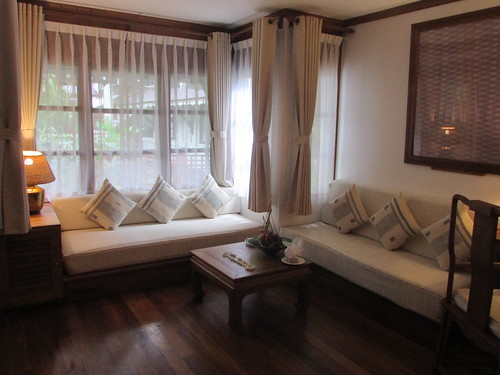
Belmond Governor's Residence.
Related posts on this website
This is one of a series of posts describing my 13th visit to Myanmar. The post Travelling again is the first post in the series and then, by clicking on the 'Next report' links you may read about the trip in sequence.
Alternately, clicking on the 'All my Burma-2018 reports' link displays all the posts on this trip in reverse date-of-posting order.
All my Burma-2018 reports.
This is the last report on my Myanmar trip but from Bangkok, I flew to Kathmandu for a few days in Nepal. The first report on the Nepal trip is here.
Alternately, clicking on the 'All my Nepal reports' link displays all the posts on this trip in reverse date-of-posting order.
All my Nepal reports.
My pictures
The Governor's Residence Hotel, Yangon
All my general pictures on this amazing trip to Myanmar can be found in the collection Burma 2018.
['My pictures' links and picture added 7-Aug-2018]
Wednesday, 9th May 2018
The Doctor had made arrangements for an official visit to Bago station and he drove me there and accompanied me on tour. We left at about 11.20 a.m. and spent the next 45 minutes struggling through Yangon's horrendous traffic. Once clear of the worst of the traffic, we made better time on the road to Bago, a dual carriageway with three lanes in each direction. There wasn't much proper countryside visible - 'strip' development continued to Bago.
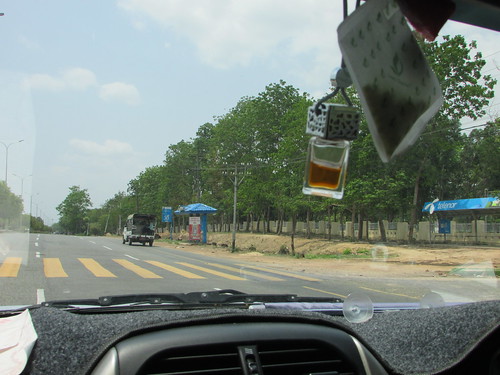
The road from Yangon to Bago, near Bago, 9th May 2018.
The Doctor and I arrived at Bago station at 1.00 p.m. and were ushered into the Station Master's spacious meeting room.
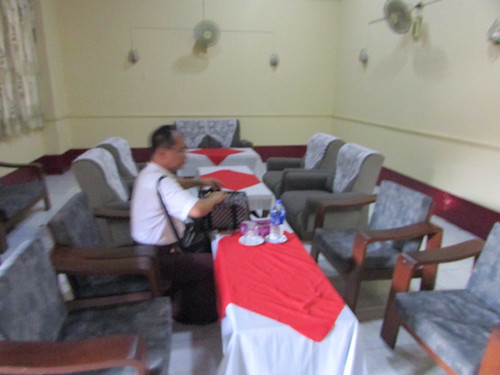
The Railway at Bago, 9th May 2018: The Station Master's spacious meeting room.
After introductions to the people who would accompany us on our tour, including an English speaker, we set off to check out the area. We started at the Station Master's Office, where one man directs all train movements in the area. Then we crossed various tracks to reach the North signal cabin. Our hosts were fascinated with my attention to detail, as I delightedly photographed trackside equipment from a former era.
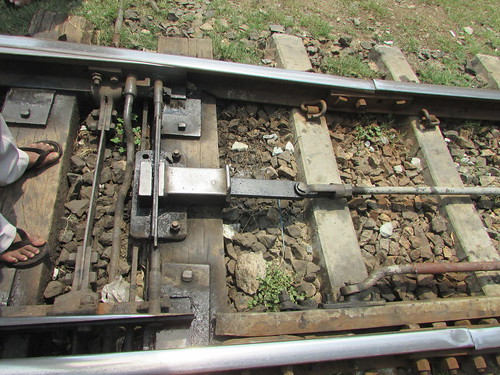
The Railway at Bago, 9th May 2018: Facing point lock and Locking Bar.
We entered the mechanical signal cabin of Bago North where, on the operating floor, two signalmen were on duty. I photographed everything in sight for later study and the young signalman set up a route to demonstrate the operation of the levers (but I didn't ask to try myself).
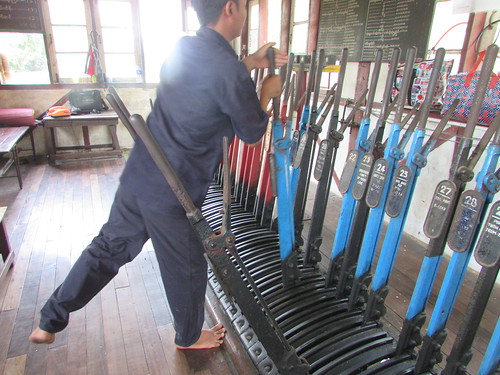
The Railway at Bago, 9th May 2018: The young signalman set up a route.
I asked to see the locking room and, again, took a number of photographs.
To my delight, they offered to show me to locomotive shed, where I knew they kept three steam locomotives sometimes used by the German travel firm FarRail Tours (www.farrail.com) for photographic charters. Their Trip Reports are full of interesting information and pictures. I climbed onto the footplate of each locomotive in turn, grabbing as many pictures as I could.
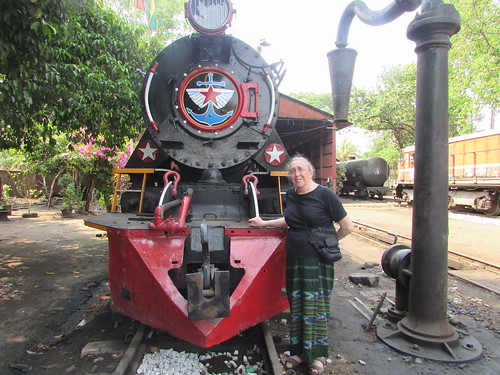
The Railway at Bago, 9th May 2018: For once, Jan looks quite happy.
With temperatures in the high 30s Celsius, I was fairly tired when I'd finished but still disappointed when they said there wasn't time to visit Bago South signal cabin.
This was because it had been suggested that I might like to return to Yangon by train, a suggestion I readily accepted. Train 32 from Naypyitaw (from where it departed at 08:00) was due to arrive, they said, at 15:00. They also suggested that my photographic opportunities might be better in an Ordinary Class coach, where all the windows were sure to be fully open, rather than an Upper Class coach. I agreed with their reasoning and a ticket was issued. Then they said the train was 15 minutes late and it actually arrived about 15:20.
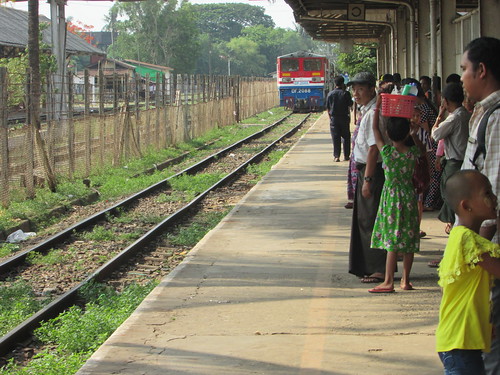
The Railway at Bago, 9th May 2018: Train 32 from Naypyitaw arriving at Bago.
According to the rail travel website 'The Man in Seat 61' here, the train was not due in until 15:20 and was due to depart at 15:23, arriving Yangon at 17:00. Well, we left about 15:23 and cracked along at what, for a Burmese train, was a a very good speed. We made just one stop and arrived at Yangon Central Station at 17:00.
The Doctor made the journey back in his car and met me at Yangon Central Station. Then we picked up the Doctor's wife and daughter and drove back to the Doctor's home.
I’ll defer the technical railway stuff to a later post.
Related posts on this website
This is one of a series of posts describing my 13th visit to Myanmar.
The post Travelling again is the first post in the series.
Clicking on the 'Next report' link will show the post describing the next events. In this way, you may read about the trip in sequence.
Next report
Alternately, clicking on the 'All my Burma-2018 reports' link displays all the posts on this trip in reverse date-of-posting order.
All my Burma-2018 reports.
My pictures
Where necessary, clicking on an image above will display an 'uncropped' view or, alternately, pictures may be selected, viewed or downloaded, in various sizes, from the albums below:-
Yangon around and about.
Bago Station (earlier pictures).
The Railway at Bago, 9th May 2018.
Bago to Yangon by Train, 9th May 2018.
All my general pictures on this trip to Myanmar can be found at Burma 2018.
['My pictures' links and pictures added 6-Aug-2018]
Tuesday, 8th May 2018
Last night, the Doctor and I returned to his Yangon home for the first time since leaving on Friday 27th April. In that time, the Doctor has carried out two full weekends of consultations at Bagan Medical Clinic and, in between those weekends, we made a fascinating side trip to Chin State led by the Monk from the Clinic and accompanied by the Doctor's wife. After the second weekend at the Clinic, we made food donations at two Orphanages in Pyin Oo Lwin and made a journey by train over the famous Gokteik Viaduct before flying back to Yangon from Mandalay.
I slept very well on Monday night and was told that Tuesday was to be a rest day for me. After breakfast, I settled down in my room to work on the internet, dealing with e-mails and updating this blog.
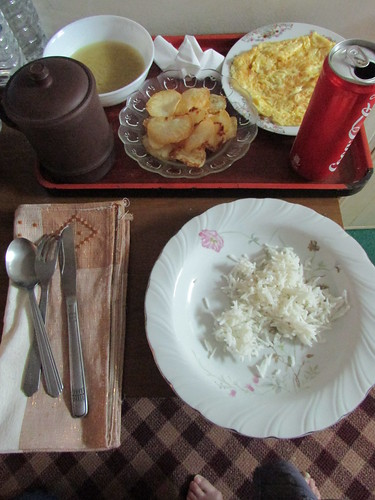
A splendid meal, tailored to my rather conservative tastes, at the Doctor's house in Yangon.
I've enjoyed many great experiences visiting different parts of the world (for more details, see the post Jan Ford's Travels) but I think that this trip has surpassed any previous travelling I've done. The emotion of being immersed in all this activity is almost overwhelming. I've met some lovely, welcoming people.
Tomorrow, the Doctor and I go on a railway visit (surprise, surprise) then on Thursday I've a meeting with Eddie Teh, Belmond's General Manager in Myanmar.
Then, my extraordinary trip to Myanmar will be over and early Friday morning I'm booked to fly out of Yangon's Mingalardon airport.
Related posts on this website
This is one of a series of posts describing my 13th visit to Myanmar. The post Travelling again is the first post in the series.
Clicking on the 'Next report' link displays the post describing the next events. In this way, you may read about the trip in sequence.
Next report
Alternately, clicking on the 'All my Burma-2018 reports' link displays all the posts on this trip in reverse date-of-posting order.
All my Burma-2018 reports
My pictures
Where necessary, clicking on the image above will display an 'uncropped' view or, alternately, pictures may be selected, viewed or downloaded, in various sizes, from the albums below:-
Yangon around and about.
All my pictures on this trip to Myanmar can be found at Burma 2018.
['My pictures' links and picture added 6-Aug-2018]
This post adds some technical comments to the post Gokteik Viaduct
We arrived at Pyin Oo Lwin station a little before 08:00 and went to the booking office for our pre-arranged tickets from Pyin Oo Lwin to Nawngpeng. Handwritten tickets for Upper Class with seat reservations were prepared with due ceremony and my passport number was included in the ticket information.
In the booking hall there was a black notice board with details of the two departures and with that day's notes added in chalk in English. Our train number 131 was shown as an Up train. In the past, it took me a while to realise that UP and DOWN on the Mandalay-Yangon line refer to trains to and from Mandalay, respectively. Thus, I'd expected the train we were about to board to be a Down train but, apparently, it's not so.
To help passengers find their correct coach, at principal stations there is an Arrivals and Departures board showing the make-up of passenger trains. Each coach is represented by a disc with vehicle details inscribed. The appropriate discs are hung on a horizontal series of small hooks so that the composition of each train is readily visible.
The discs representing our train number 131, left to right, were marked Guard, Parcels, Upper 2, Ordinary 3, Ordinary 2, Upper 1, Ordinary 1, Locomotive.
Train number 132 was similarly represented.
Our train number 131 was already in the platform with Bo-Bo-Bo DF.2080 in red and blue livery (built in China by Dalian Locomotive and Rolling Stock) on the front of 3 air braked carriages (2 Ordinary Class and 1 Upper Class) with a bogie parcels van (type GBHV) and a bogie Guard's/Parcels van (type VBHV) on the rear. The locomotive and all vehicles were air braked and fitted with automatic couplers. The Doctor said his friend had told him that the load limit from Mandalay to Pyin Oo Lwin is 180 tons but that, beyond Pyin Oo Lwin, the limit is increased to 240 tons.
Another Bo-Bo-Bo, DF.1629 in brown and cream livery, was propelling two flat cars used as shunters' wagons towards the rear of our train, number 131.The flat cars were modern, air braked with a wheel to operate a handbrake. Both cars had locating dowels at each corner for carrying a standard shipping container. The one flat car, R.9.2021 had two additional dowels perhaps for carrying half-length containers and the maker's plate 'TITAGARH WAGONS LIMITED 2013'. The Titagarh Group (website here) is a heavy engineering company based in India but now developing an export market.
It was clear that DF.1629 was going to remove the two goods wagons from the rear of train number 131, with a view to strengthening the passenger accommodation. But it took three attempts before the coupling between the leading shunters' wagon and the rear coach mated correctly.
Whilst the additional coaches were being fetched, we'd visited the Stationmaster's Office so that I could photograph the track diagram. The 'wye' at the bottom of the diagram serves the loco shed which I understand is still in use.
Approaching a Block Station like Pyin Oo Win in either direction, the first indication a driver receives is a white, rectangular warning board, set half a mile before the distant signal. All distant signals are fixed and come in a wide variety of designs. Next comes the 'Outer' or 'Home' stop signal. This is operated by the pointsman at the entrance to the station where a green flag indicates that the points have been set and clipped for the train to enter the station. Before leaving the station, the driver must be in possession of a paper Line Clear form for the Block Section ahead and must have a green flag from the pointsman to indicates that the points have been set and clipped for the train to leave the station. Finally, the train passes a 'Limit of Shunt' board. This is a white square with a smaller red square in the middle.
The station is not interlocked in the sense of having a lever frame but four Trapped Key Locking Boxes were mounted on the wall near the door. The Locking Boxes for roads 3, 4 and 5 had their keys but the unmarked box had no key, presumably because of the shunt in progress. I took pictures of the Stationmaster on the radio, the book of paper Line Clear forms authorising train movements and the Train Register book.
For more information on the control of trains in Myanmar, see the post here and for information about the control of points and interlocking see the post here. Alternately, there's an index of all my Myanma Railways posts (which may not always be up-to-date) here.
Back on the platform I watched DF.1629 propelling two Upper Class carriages and the two goods wagons onto the train and, to my surprise, the re-inforced train departed at 08:22 as scheduled.
The ruling gradient appeared to be downhill and we we travelling faster that I previously recalled. We came to a brief stand at the approach to a station and, once the points were set away from a sand drag, the upper quadrant signal cleared and we entered the platform. We carried on, making brief intermediate stops, to Hsam Ma Hse. This had the normal passing loop plus a third line on which DF.2063 (red and blue livery) waited with a ballast train, adjacent to a yard with numerous large piles of ballast. There was a belt-type elevator which apparently was used to load the ballast wagons.
Our next stop was at Nawnghkio, a more important station, where we stood for a few minutes loading and unloading freight.
Five or six kilometres beyond Nawnghkio, we started getting views of the famous viaduct. What struck me was how much higher than the bridge we were and I wondered how we'd lose height. Well, we did it by twisting and turning down the mountain side, around tight curves and descending through rock cuttings. Finally, we headed away at right angles with the bridge on our right. Below us, there was a parallel line at lower level with the semaphore Outer signal for Gokteik. We traversed the expected 'dumbell' loop now heading back towards the bridge now on our left and stopped at the small isolated station of Gokteik. The line curved left to lead us onto the viaduct which we traversed slowly (there's a 5 m.p.h. limit displayed). This monumental structure, set in impenetrable jungle, gives feelings of awe that are hard to convey.
at the entry to the station where hand operated
Immediately after the viaduct, there are two tunnels. The second was certainly brick-lined, I'm not sure about the first. The locomotive was now working hard as we climbed away from the bridge, so I was not surprised when we passed a sand drag (trailing to us) protected by stop signals. Soon, we arrived in Nawngpeng, where we disembarked. I made it a 'right time' arrival. However, the train did not, as suggested by the travel website ‘The Man in Seat 61’ here wait for train 132 to arrive and leave at 12:25 but set off for Lashio a few minutes after noon.
Station distances from Wikipedia
Pyin U Lwin 422 1/2
Pwe Kaul 427 3/4
Wet Wun 433 1/2
Sin Lan Su 438 1/4
Hsam Ma Hse 444
Nawnghkio 456
Gokteik 463 Gokteik Viaduct
Nawngpeng 472 1/4
The complete list is here.
Information from 'The Man in Seat 61'
There is one passenger train daily each way over the Gokteik Viaduct. Upper and Ordinary Class seats are provided.
Mandalay to Pyin Oo Lwin is 67 km (42 miles).
Mandalay to Hsipaw is 206km (129 miles).
Mandalay to Lashio is 280 km (175 miles).
Train number 131: Mandalay > Pyin Oo Lwin > Lashio
| Station |
Arrive |
Depart |
| Mandalay |
|
04:00 |
| Pyin Oo Lwin (Maymyo) |
07:52 |
08:22 |
| Gokteik |
11:03 |
11:08 |
| Nawngpeng |
11:58 |
12:25 |
| Kyaukme |
13:19 |
13:39 |
| Hsipaw (Thibaw) |
14:55 |
15:15 |
| Lashio |
19:35 |
|
Train number 132: Lashio > Pyin Oo Lwin > Mandalay
| Station |
Arrive |
Depart |
| Lashio |
|
05:00 |
| Hsipaw (Thibaw) |
09:25 |
09:40 |
| Kyaukme |
11:05 |
11:25 |
| Nawngpeng |
12:22 |
12:30 |
| Gokteik |
13:23 |
13:25 |
| Pyin Oo Lwin (Maymyo) |
16:05 |
17:40 |
| Mandalay |
22:40 |
|
For all the information on train travel in Burma on this website, click here.
My pictures
Where necessary, clicking on an image above will display an 'uncropped' view or, alternately, pictures from may be selected, viewed or downloaded, in various sizes, from the albums below:-
By train over Gokteik Viaduct 7th May 2018.
All my pictures on this trip to Myanmar can be found at Burma 2018.
['My pictures' link added 4-Aug-2018]
Did I mention my interest in railways? All my posts on the railways of Myanmar can be found here. When I first told the Doctor that I wanted to travel on the train over the famous Goktiek Viaduct, he insisted on making arrangements for me. As things worked out, he was also able to accompany me on the train.
Monday, 7th May 2018
I took breakfast in the Dining Hall on the 5th floor of Hotel Maymyo then checked out ready to be picked up by the Doctor at 7.40 a.m. to catch the train from Pyin Oo Lwin station across the Gokteik Viaduct.
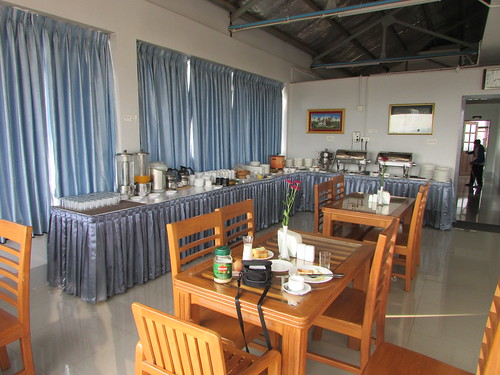
Breakfast at Hotel Maymyo, Pyin Oo Lwin, 7th May 2018
The Gokteik Viaduct, opened 1900, is a steel trestle bridge on the railway line from Mandalay to Lashio almost 700 metres long which carries a single track at a height of over 300 metres above the ground. There's a Wikipedia article here.
The height and length of the viaduct make it a ‘must see’ for many tourists and the travel website ‘The Man in Seat 61’ has more information here.
Train 131 from Mandalay to Lashio was scheduled to leave Pyin Oo Lwin at 08:22, pass over the Gokteik Viaduct and arrive at Nawngpeng at 11:58. It was arranged that our car would go ahead by road to Nawngpeng using the Oriental Highway, pick up the Doctor and the writer on arrival by train then drive us via Pyin Oo Lwin to Mandalay Airport. The Doctor had booked tickets for us to Yangon on separate flights to keep the cost down.
Well, all the arrangements worked well and the viaduct is certainly impressive. There were a number of European travellers on the train who also seemed to enjoy the experience and many photographs were taken. You’ll probably be relieved to learn that I’m deferring the technical railway stuff to a later post (but you can find it at Gokteik Viaduct Notes then use the 'back button' to return here).
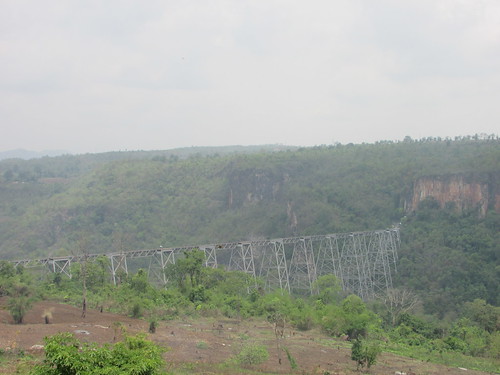
By train over Gokteik Viaduct 7th May 2018
The car collected us at Nawngpeng as planned and we set off on the Oriental Highway towards Pyin Oo Lwin. The amount of lorry traffic was astonishing, mainly 8-wheel fixed wheelbase and 10- and 12-wheel articulated rigs. Via a series of spectacular zig-zags, the road descended into the valley then, using a similar technique, climbed up the opposite side of the valley.
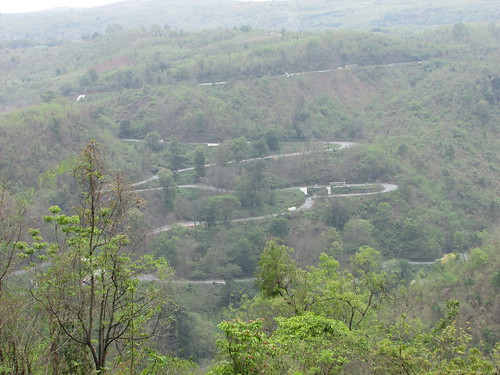
Nawngpeng - Mandalay Airport by road 7th May 2018: View of zig-zag road from opposite side of valley.
As I’ve previously reported, Myanmar drives on the right (despite the fact that many vehicles, like the Toyota Crown I was travelling in, have the driver on the right). However, the bigger lorries need space to turn so, even if they should be driving on the inside of a hairpin bend, they simply take the wrong side of the road so as to be on the outside of the hairpin. Drivers of smaller vehicles travelling in the opposite direction, with admirable pragmatism, simply also adopt the wrong side of the road until they’re clear of the offending lorries and so the traffic keeps moving (though it looks frightening).
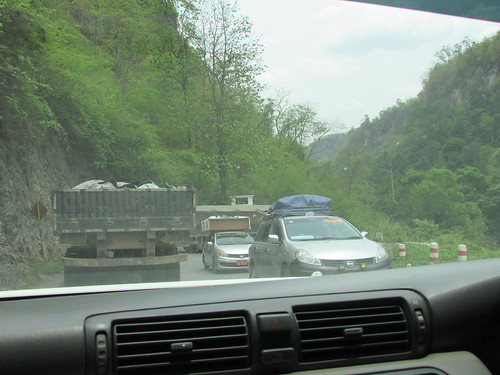
Nawngpeng - Mandalay Airport by road 7th May 2018: On the hairpins, traffic informally adopts the wrong side of the road to allow lorries space to turn.
Having reached a plateau, our route continued on easier gradients. We stopped at a large, obviously popular, tea-shop. The floor was littered with empty water bottles and debris from a busy morning but I was amazed when the place setting for each diner (plate, bowl, tea cup and cutlery) arrived packed in a plastic bag and looked clean. Fearing my foreigner’s delicate digestion, the Doctor often washes cups or cutlery again before letting me use them but on this occasion there was no need.
We carried on to Pyin Oo Lwin where the Doctor and I enjoyed a cup of heated milk (a sort of informal Pasteurisation) at a roadside shop.
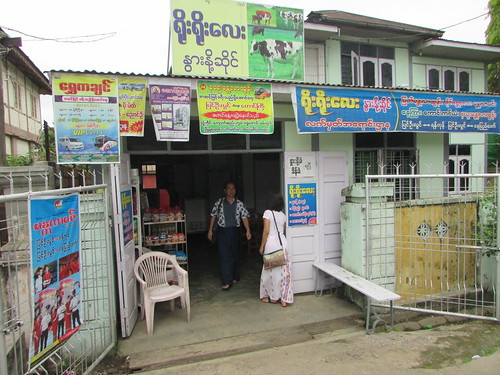
The roadside shop in Pyin Oo Lwin where we drank heated milk.
As we left Pyin Oo Lwin, the Doctor made some purchases at a group of roadside stalls (Pyin Oo Lwin is famous for strawberries).
Although parts of the road descending to the plain were already dual-carriageway the last time I was on it, massive road improvement has occurred since. This construction project is ongoing - as we came nearer to Mandalay, the Oriental Highway became one vast construction site with traffic in both directions rushing across a dusty, unsealed surface with no markings or verges and poor visibility from the clouds of dust. The speeding vehicles were sharing the space with dozens of excavators, graders, road rollers and tipper lorries all oblivious to the traffic and operating within inches of the passing cars, pick-ups lorries and tankers. It was an amazing, anarchic scene. There were also a number of rather alien-looking tracked vehicles, each attached by an umbilical cord to a large, wheeled packaged unit. I assumed that they were pneumatic rock drills.
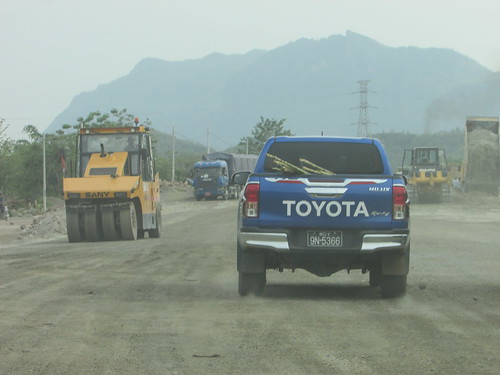
Road improvements in progress on the Oriental Highway.
At last, we returned to the relative discipline of a dual carriageway, paid at a couple of toll stations, passed through Myitnge and took the road to Mandalay Airport.
The Doctor had little time to catch his flight to Yangon and dashed off to check-in, encumbered with various shopping carriers of his purchases. I said farewell to our driver and the young lady from Belmond as they set off on the long drive back to Bagan. I then had a couple of hours before my own flight to Yangon. A little after 9.00 p.m., I arrived at Mingalardon Airport to find the Doctor and his wife waiting for me. We returned to the Doctor's house by taxi and, tired but thrilled by our various explorations, I slept well with the promise that the following day was a day of rest for me. For once, I was disinclined to argue.
Related posts on this website
This is one of a series of posts describing my 13th visit to Myanmar.
The post Travelling again is the first post in the series.
Clicking on the 'Next report' link will show the post describing the next events. In this way, you may read about the trip in sequence.
Next report
Alternately, clicking on the 'All my Burma-2018 reports' link displays all the posts on this trip in reverse date-of-posting order.
All my Burma-2018 reports
My pictures
Where necessary, clicking on an image above will display an 'uncropped' view or, alternately, pictures from may be selected, viewed or downloaded, in various sizes, from the albums below:-
Hotel Maymyo, Pyin Oo Lwin, 7th May 2018.
By train over Gokteik Viaduct 7th May 2018.
Nawngpeng - Mandalay Airport by road 7th May 2018.
All my pictures on this trip to Myanmar can be found at Burma 2018.
['My pictures' links added 4-Aug-2018: Pictures embedded 23-Aug-2018]
Sunday, 6th May 2018
Support for orphanages in Myanmar is described in a number of posts, covering schools and orphanages, labelled 'Education'. You can display them all by clicking here.
Doe Pin orphanage is situated on the Mandalay - Pyin Oo Lwin road, just before you reach Pyin Oo Lwin. I think my last visit was in 2011 (described here).
Our visit to Doe Pin in 2018 was to make the formal presentation of a gift from a Swiss charity, Enfants d'Ailleurs Foundation, arranged by Doctor Hla Tun through Belmond 'Road to Mandalay'. This donation, valued at 2,000,000 Kyat, comprised Rice, Cooking Oil, Gram Pea (a type of chickpea), Onions and Potatoes. When we entered the assembly hall, the purchased food was laid out impressively.
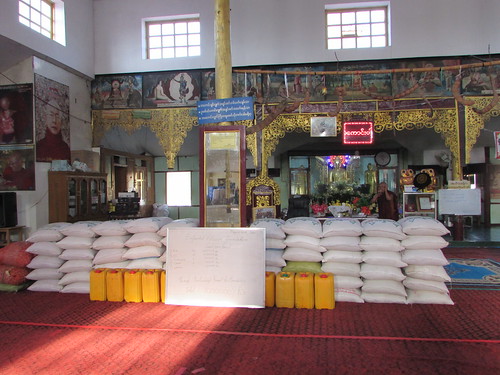
Doe Pin 6th May 2018: The donation of Rice, Cooking Oil, Gram Pea (a type of chickpea), Onions and Potatoes.
The Abbot was informed of our arrival and he appeared, as ebullient and friendly as I remembered him from previous visits. Although there are around 600 boy orphans here, a much smaller number were present for our visit with the balance due to return before the start of the new academic year. Children from 18 different ethnic groups are included in the total. The Abbot summoned the children present, the formal donation was made and lots of photographs were taken to record the event. The younger children sang for us.
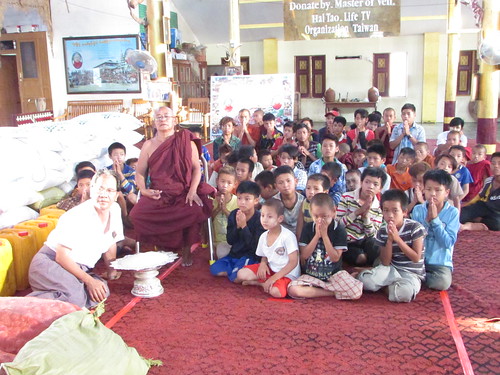
Doe Pin 6th May 2018: Dr. Hla Tun, the Abbott and a small group of orphans.
We then drove through the town to reach the Shewe Sin Minn Orphanage for Girls. I think my first visit was in 2011 (described here) but I have made visits since. As at Doe Pin, our aim was to make the formal presentation of a gift from a Swiss charity, Enfants d'Ailleurs Foundation, arranged by Doctor Hla Tun through Belmond 'Road to Mandalay'. This donation, also valued at 2,000,000 Kyat, comprised Rice, Cooking Oil, and artificial meat balls. The open area in front of the buildings was crowded by hundreds of young nuns and orphans.
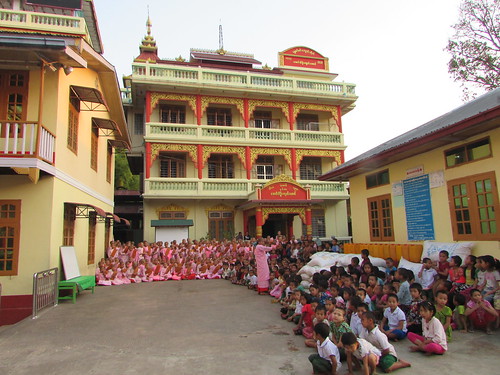
Shwe Sin Minn Orphanage, 6th May 2018
All told, there are about 600 girls here from four different ethnic groups although not all were present for our visit. I was astounded at the changes in the buildings which had been embellished with typical religious features and re-painted. More new construction was in progress. The orphanage was founded and run by two sisters. The younger one, who is headmistress welcomed us and accepted the donation. The elder sister, who is head nun, appeared briefly. Once again, the purchased food was on display and the formal donation took place with the usual recording of the scene photographically. All the girls then sang for us.
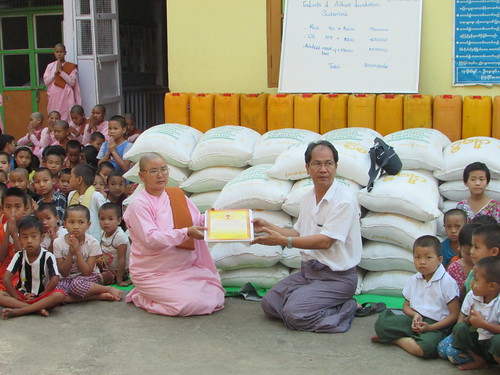
Shwe Sin Minn 6th May 2018: The formal donation of food.
We made a brief visit to Pyin Oo Lwin Hospital, visiting two young Hare Lip patients whose surgery had been paid for by 'Road to Mandalay' guests.
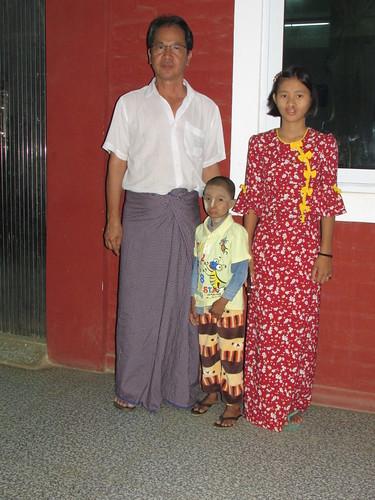
Dr. Hla Tun with Hare Lip patients at Pyin Oo Lwin Hospital 6th May 2018
The Doctor had arranged a visit to the nearby Yadanar Mun Aung monastery. This is a large teaching monastery housed in a number of buildings within the monastery compound. We were given an audience with the abbott, who invited me to overnight in the guesthouse forming part of the monastery but the Doctor declined on my behalf as he had already made arrangements for me to stay in a hotel.
After we left the monastery, I was taken to the Hotel Maymyo. This was a modern, comfortable hotel aiming to encourage tourists. The only problem was that my room was on the 3rd floor (that's 'American' 3rd which the British usually call 'second floor'), the 'Dining Hall' for breakfast was on the 5th floor and there was no lift. I'm a bit slow on stairs these days but it was a minor inconvenience.
Although the hotel served breakfast, it did not provide other meals so I went by car with the others to a tea-shop for dinner. Then they dropped me back at the hotel (they were not staying at the hotel) and I was delighted to find that the hotel had a very usable Wi-Fi.
Related posts on this website
This is one of a series of posts describing my 13th visit to Myanmar.
The post Travelling again is the first post in the series.
Clicking on the 'Next report' link will show the post describing the next events. In this way, you may read about the trip in sequence.
Next report
Alternately, clicking on the 'All my Burma-2018 reports' link displays all the posts on this trip in reverse date-of-posting order.
All my Burma-2018 reports
My pictures
Where necessary, clicking on an image above will display an 'uncropped' view or, alternately, pictures from may be selected, viewed or downloaded, in various sizes, from the albums below:-
Doe Pin 6th May 2018.
Shwe Sin Minn 6th May 2018.
Hare lip patients at Pyin Oo Lwin Hospital.
Hotel Maymyo, Pyin Oo Lwin, 7th May 2018.
All my pictures on this trip to Myanmar can be found at Burma 2018.
['My pictures' links added 4-Aug-2018]
Sunday, 6th May 2018
By continuing to see patients on Saturday night until one o'clock in the morning, Doctor Hla Tun was left with around twelve patients still to see on Sunday morning. He started his consultations a little after 7.00 a.m. in the hope of being finished before noon but each patient always receives all the time they need and, with some complex cases, it was after 2 p.m. before we were ready to leave, with over 600 patients having been seen that weekend.
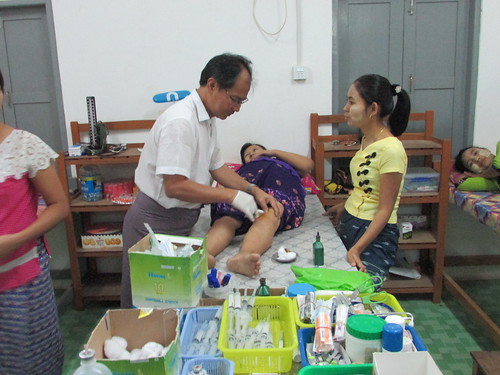
Bagan Clinic 6th May 2018: Doctor Hla Tun at work.
As always, I was sad to be leaving my friends at the Clinic which was now much quieter as patients started their often arduous journeys home.
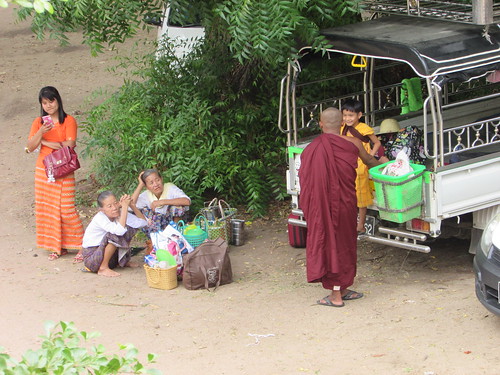
Bagan Clinic 6th May 2018: A group of patients preparing to travel home.
By Sunday afternoon, a number of the retail stall holders had also packed up and left.
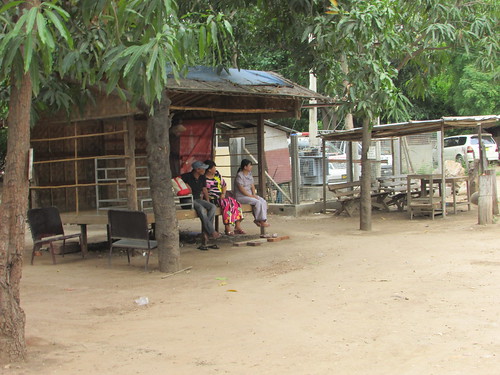
Bagan Clinic 6th May 2018: By Sunday afternoon, a number of the retail stall holders had packed-up and left.
At the Doctor's insistence, I'd been given lunch (yes, congee and a plain omelette with a can of Coca Cola). To prepare me for the journey, they also gave me soup and fresh fruit. The Doctor himself intended to skip lunch but the staff made sure he took something from the wide range of dishes available which he consumed whilst standing.
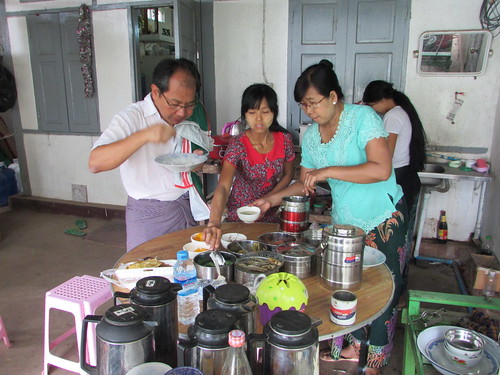
The Doctor takes a hasty lunch.
The Doctor and I were to travel in a monastery saloon car with a different driver who was familiar with the Mandalay area. An attractive young lady who works for Belmond with good English was to accompany us on our trip.
We left Bagan Medical Clinic and drove across the Plain of Bagan with its numerous pagodas which I always find magical.
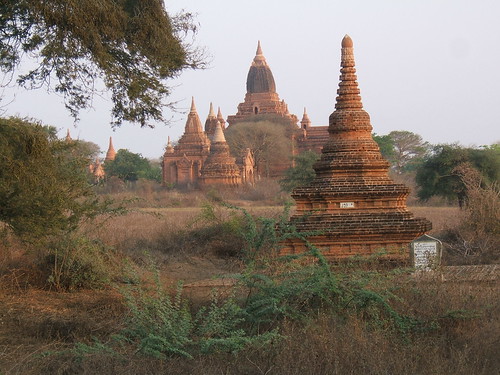
Bagan Pagodas.
At Nyaung Oo we headed north on a good road I'd not travelled before towards Mandalay. We passed a deteriorating concrete bridge over a watercourse which was shared by a single line railway. Small toll stations were provided on either side of the bridge.
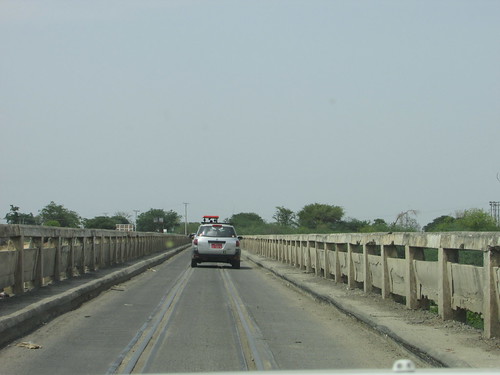
Bagan to Pyin Oo Lwin 6th May 2018: Deteriorating concrete bridge shared by a single line railway.
In the substantial city of Myingyan, the broad main road had the concrete poles for power distribution running down the middle, with the usual untidy festoon of cables to buildings on both sides of the road and various types of street lighting fittings strapped to the poles.
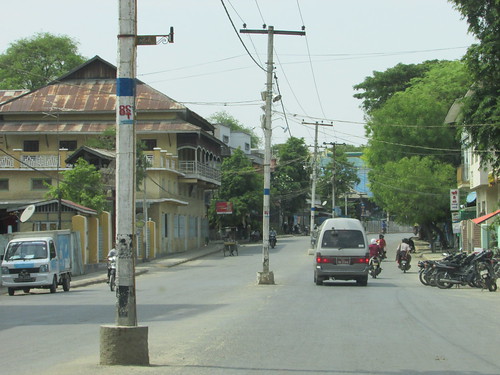
Bagan to Pyin Oo Lwin 6th May 2018: Myingyan.
The road turned east and intersected the Yangon - Mandalay Expressway which we joined, heading north towards Mandalay. At the toll station near Mandalay International Airport, we turned off towards Paliek and Myitnge. After about three hours travelling, we stopped briefly for sweet tea at a tea-shop near Myitnge then by-passed Mandalay itself to take the road to Pyin Oo Lwin.
The changes here since my last road trip to Pyin Oo Lwin were remarkable. The road, the 'Oriental Highway', is operated by a private company and massive road works are in progress at the Mandalay end of the route. Beyond Pyin Oo Lwin the road continues through Lashio to an important border crossing into China so the route carries immense amounts of heavy lorries. From the plains at Mandalay, the road climbs 3,500 feet to Pyin Oo Lwin so we were frequently passing crawling heavy lorries.
Pyin Oo Lwin was chosen by the Britsh at their 'Hill Station' (the term is still used in Myanmar) and called Maymyo, 'May's town' after a British colonel of that name. This gave the British somewhere to escape the heat of the plains in summer and older parts of the town still have the atmosphere of England, although modern rather nondescript development is less attractive, swelling the population to around 255,000. There's a Wikipedia article on the town here.
Related posts on this website
This is one of a series of posts describing my 13th visit to Myanmar.
The post Travelling again is the first post in the series.
Clicking on the 'Next report' link will show the post describing the next events. In this way, you may read about the trip in sequence.
Next report
Alternately, clicking on the 'All my Burma-2018 reports' link displays all the posts on this trip in reverse date-of-posting order.
All my Burma-2018 reports
My pictures
Where necessary, clicking on an image above will display an 'uncropped' view or, alternately, pictures from may be selected, viewed or downloaded, in various sizes, from the albums below:-
Bagan Medical Clinic 2nd weekend
Bagan to Pyin Oo Lwin 6th May 2018
All my pictures on this trip to Myanmar can be found at Burma 2018.
[Patient numbers and 'Next' link added 8-May-2018: Edits, pictures linked, pictures inserted 26-Jun-2018]
Saturday, 5th May 2018
Having slept well, I ventured outside just before seven, I immediately came across the Abbott, showing a Myanmar lady and her 20-year old daughter around the Clinic. The daughter spoke English, so we chatted for a minute or two.
It had been agreed that I would go to Htee Pu and make a distribution of stationery. The Doctor had ensured that the stationery was available at the Clinic so the monastery car was loaded and the driver and I set off at 8.00 a.m. on the familiar route to Htee Pu. The last couple of miles to Htee Pu village used to be a nightmare over an undulating earth road but, on my last visit, road improvements were in progress and we found that, now the work was completed, access to Htee Pu is much improved, although the last section through the village to the monastery and school remains a rutted, earth road.
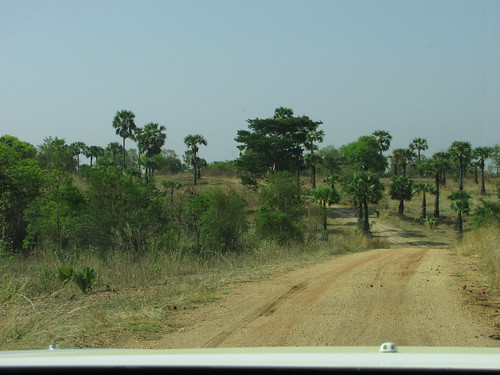
Visit to Htee Pu 5th May 2018: The improved road from the main road to the village.
We were greeted by the abbot and three lady teachers. Three tables were set up in the shade of a large tree in the dirt playground and we unpacked the bulk supplies of exercise books, pencils and plastic rulers and assembled over 100 ‘kits’ comprising 5 good-quality ruled exercise books, three pencils each with a eraser tip, and a plastic ruler. I noted, with approval, that all the packaging materials were being carefully collected in a black plastic bag and a woven basket. Htee Pu school tries to inculcate a responsible attitude to litter in its pupils. In general, Myanmar people are some of the friendliest in the world but it has to be said that they are also some of the worst offenders in thoughtlessly tossing litter aside.
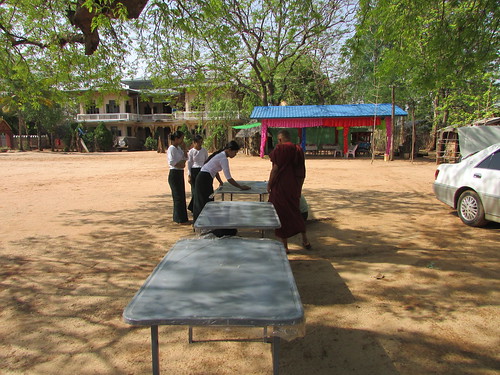
Visit to Htee Pu 5th May 2018: Three tables were set up in the shade of a large tree. The monastery building can be seen in the background.
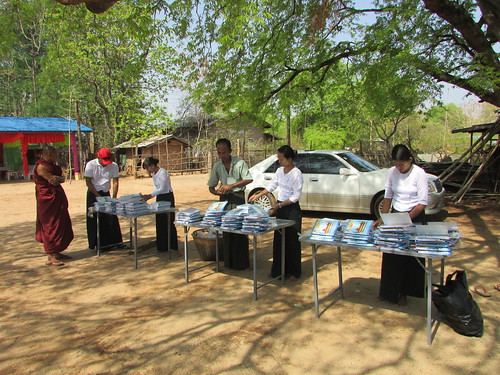
Visit to Htee Pu 5th May 2018: Exercise books, pencils and plastic rulers were assembled into over 100 ‘kits.’
There was no sign of any children. It was hard to believe that over 100 excited children were waiting noiselessly in the adjacent assembly hall.
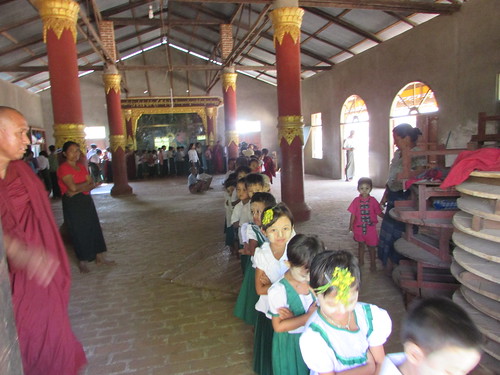
Visit to Htee Pu 5th May 2018: The Assembly Hall where the children were quietly waiting.
Once the stationery 'kits' were ready, the teachers brought out the children in single file, youngest first. Because of the good organisation, it didn't take long to present the distribution.
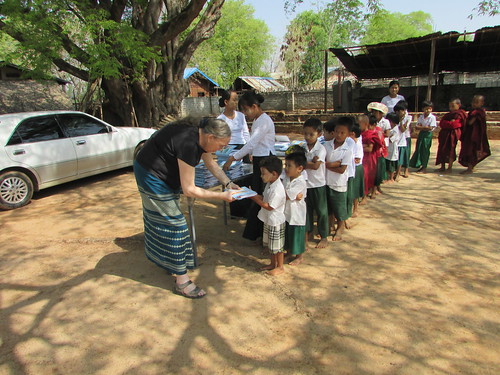


Distribution complete, the children quickly disappeared (this visit took place during their summer school holiday) and the abbott, teachers and I sat for a while in a decorated pavilion where refreshments had been provided.
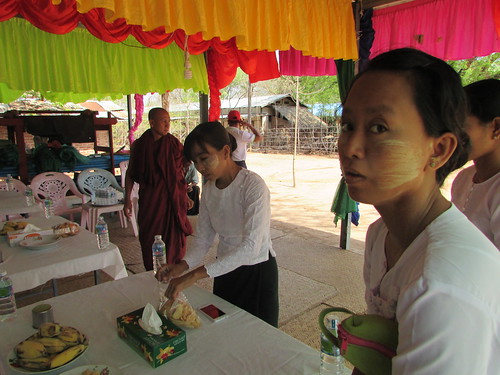
Visit to Htee Pu 5th May 2018: Refreshments in the Pavilion.
Afterwards, the abbott took me to check the various classrooms which had been provided as part of the ‘Road to Mandalay’ Social Contribution. I'd attended the opening ceremony, back in 2010, of one of these buildings (there's a description of that opening here).
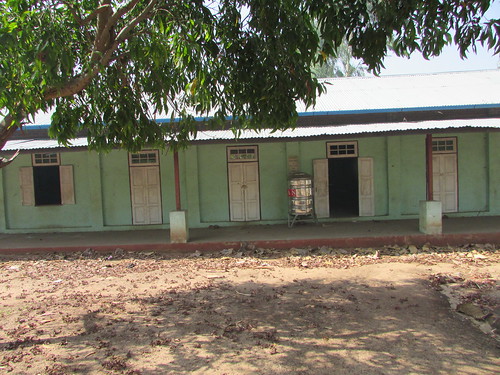
Visit to Htee Pu 5th May 2018: Current view of the building opened in 2010.
Finally, we said 'good-bye' to our friendly hosts and the driver and I returned to Bagan Medical Clinic. As usual, the main road back to Nyaung Oo had road works in progress. I think major repairs are required each year following the season of heavy rain but there is also a serious attempt to generally improve the road infrastructure in Myanmar.
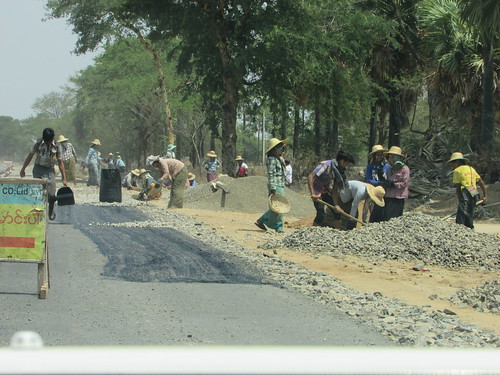
Visit to Htee Pu 5th May 2018: Roadbuilding on the Nyaung Oo-Mount Popa road.
Safely back in Bagan, I spent the rest of the day either trying to write text files ready to upload to the internet once I had a connection, backing up photographs or observing in Doctor Hla Tun’s consulting room. Once again, I retired well before the Doctor.
Related posts on this website
This is one of a series of posts describing my 13th visit to Myanmar.
The post Travelling again is the first post in the series.
Clicking on the 'Next report' link will show the post describing the next events. In this way, you may read about the trip in sequence.
Next report
Alternately, clicking on the 'All my Burma-2018 reports' link displays all the posts on this trip in reverse date-of-posting order.
All my Burma-2018 reports
My pictures
Bagan Medical Clinic 2nd weekend
Visit to Htee Pu 5th May 2018
All my pictures on this trip to Myanmar can be found at Burma 2018.
[Pictures linked, minor edits and pictures embedded 22-Jun-2018]

