Showing posts with label Flying. Show all posts

Thursday, 17 September 2020

Aerobatic Experience

I love flying. Although I've enjoyed a few flying lessons over the years, I decided that it would be too expensive and take more commitment than I was prepared to give to learn to fly an aircraft. But I'm always happy to be taken aloft by a qualified pilot. Only once, though, have I had an aerobatic flight. My friend Jack Upchurch, sadly now passed on, was a passionate aerobatic pilot of competition standard, flying a Stampe bi-plane or a tiny 'Turbulent' monoplane. Some years ago, I accompanied Jack and his wife Rita to Headcorn airfield where the aircraft he flew were based. There was a flying 'slot' available on the Stampe, registration G-AWEF, and Jack invited me to accompany him on a short, local flight. Up close, the Stampe looked very small and fragile. It's a two-seat aircraft: the pilot is at the rear and the passenger (or trainee) in front, each in their own small cockpit.


Jack and Jan chatting before the flight (Photo: Rita Upchurch)

As instructed, I stepped carefully onto the lower wing and levered myself into the front seat.
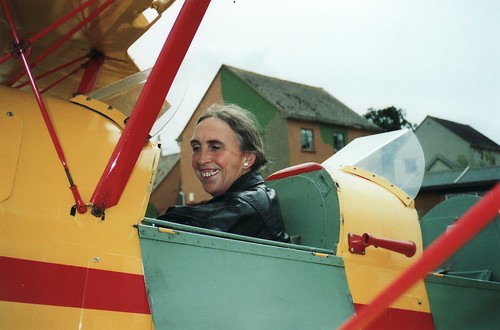

Jan in the front seat before the flight (Photo: Rita Upchurch)

Jack followed into the pilot's seat, wearing flying overalls and World War II leather flying helmet incorporating earphones and facemask with microphone, with the cable held in his mouth, presumably to prevent it from becoming trapped as he sat in the restricted space.

Jack boarding the cockpit (with headset lead held in his mouth) before the flight (Photo: Rita Upchurch)

The gentleman serving as ground crew arrived with the 5-point safety harness, trussed me into position and supplied me with a modern version of the flying helmet with miniature earphones and a boom microphone.


Ground crew arranging Jan's harness and headset before the flight (Photo: Rita Upchurch)

Once the headsets were plugged into their jacks, there was two-way speech between Jack and I.


Jack and Jan before the flight (Photo: Rita Upchurch)

The Stampe has open cockpits, with a small windscreen in front of each to give some protection from the airflow. The ground crew carried out the final checks before closing the hinged access flaps on each side of the cockpit which had been lowered to allow access on the ground. When raised and latched, they offer some protection from the airflow.


Ground crew carrying out final checks before the flight (Photo: Rita Upchurch)

Checks complete, the De Haviland Gipsy Major 10 engine was started and Jack taxied the aircraft to the grass runway 10/28. The take off run was a little bumpy on grass but what impressed me, more used to larger jet aircraft, was how quickly the aircraft seemed to float off the ground without effort. As Jack climbed away from the runway, I was expecting a sightseeing trip. When one wing dipped to point to the ground, it seemed a good way to admire the countryside - the view ahead in level flight didn't show much of the ground. But, with increasing horror, I realised that Jack was continuing the roll so that my harness suddenly tightened as the seat, unaided by gravity, failed to support me as we flew inverted. I experienced terror as I realised that the five straps of my harness were all that prevented me from plunging to earth. Jack rolled the aircraft right way up and immediately started a steep climb which again involved being inverted at the top of the loop.

After the flight, I discovered that Jack was executing a standard series of what he called 'simple' aerobatic manoeuvres, accurately timed and positioned in a three-dimensional 'box'. But at the time, the assault on my senses was almost overwhelming and I started to feel sick. I think it was only the humiliating thought of actually throwing-up in the aircraft (no sick bags were provided) which allowed me to control the urge. I considered using the intercom to ask Jack to stop but my curious thought was 'if he stops now, I'll never have the confidence to attempt it again, so I'd better keep quiet'. On the rare occasions Jack spoke to me on the intercom, I somehow managed to reply in a fairly normal voice, suppressing my feeling of panic. I have no clear recollection of the various manoeuvres Jack executed but new (and unwelcome) sensations kept occuring as we moved through the programme. I remember at one point Jack saying "There's Leeds Castle" (about six miles from Headcorn) and dropping a wing to give a better view. I don't think the manoeuvres lasted long before we entered a period of 'staight and level' flight. At first, I was very relieved but I soon started to think how boring it was, compared with the preceding excitement which had so terrified me. We were soon back at Headcorn and made a gentle landing.


Pilot's view on approach to Runway 28 at Headcorn (from Headcorn Aerodrome website)

When the engine stopped, I felt completely disorientated. Getting into the aircraft hadn't been easy but getting out almost defeated me. Once I was finally back on the grass, my sense of balance had almost deserted me and for some minutes I staggered about as if inebriated. My deception on the intercom had been convincing and Jack said he had no idea of the terrors I had experienced. After a few more minutes, I felt completely recovered and found myself saying "When can we go again?". Jack checked on the bookings for the rest of the day, but there was no availability and, to date, that remains my only aerobatic flight.


Map of Headcorn Aerodrome, ICAO designator EGKH (from Headcorn Aerodrome website)

The Stampe SV.4 Aircraft

The Stampe SV.4 was a Belgian design in 1933 by George Ivanov for Stampe et Vertongen of Antwerp as a tourer and trainer. 35 aircraft were built before closure prior to World War II. Post-war, successors Stampe et Renard built a further 65 plus 940 built under license by SNCAN in France and an Algerian firm. There's a Wikipedia article on Stampe here

The aircraft I flew in is a post-war model SV.4C

Engines used on Stampe aircraft

The Stampe SV.4 uses a 4-cylinder, air-cooled in-line inverted aero engine. For aircraft use, the engine crankshaft must be high enough off the ground to give the propellor clearance under all conditions. In a inverted engine, the cylinders are placed underneath the crankshaft, allowing the pilot an unobstructed view ahead. Renault engines were commonly used but the De Haviland Gipsy Major was also used.

I believe the aircraft I flew in is equipped with Gipsy Magor 10 Mark I.There's an article on the Gipsy Major engine here.

Pictures
.

Sunday, 27 January 2019

Air Traffic Control

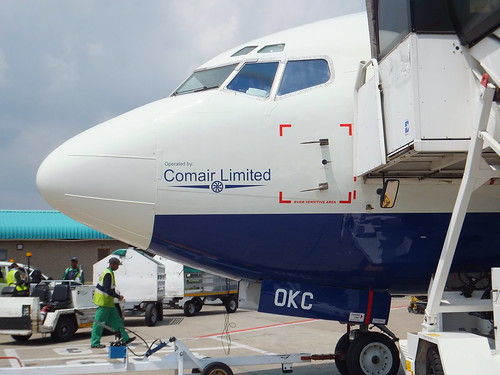
Comair 737 ZS-OKC on the ground at O. R. Tambo International Airport.

On my Safari Trip in February 2012 (described here, Boeing 737 ZS-OKC operated by Comair took me from O. R. Tambo to Livingstone. Whilst waiting to board, I noticed, marked in red on the side of the fuselage, the 'RVSM Sensitive Area'. I didn't know what 'RVSM' meant but it was not until I returned to the U.K. that I had an opportunity to research its significance (and it was almost another seven years before I wrote about it).

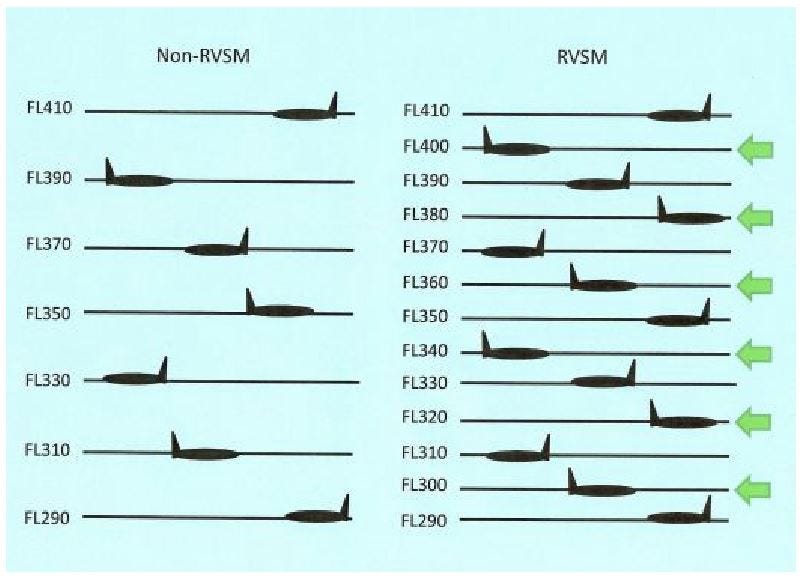
Although more modern techniques now exist, the basic method for determining an aircraft's altitude is by measuring barometric pressure with a 'pressure altimeter'. Increasing air traffic led to the introduction of a world-wide system of 'airways' with flying altitudes assigned to each aircraft to ensure safe vertical separation. Errors in measurement on the aircraft obviously potentially erode this separation. Continued growth in air traffic has led to improvements in pressure altimeters justifying an initial vertical separation of 2,000 feet between aircraft flying above Flight Level 290 ('Two,Nine,Zero') being reduced to 1,000 feet (as was already applied up to Flight Level 290). Of course, this requires suitably-tested equipment and the 'RVSM Sensitive Area' is kept pristine so that the air pressure sensed by the 'Pitot Tubes' feeding the pressure altimeter is not affected by turbulence.

Wikipedia has an article about this at Reduced vertical separation minima

. The diagram below illustrating Non-RVSM and RVSM Flight Levels is from CSSI Inc:-


Non-RVSM and RVSM Flight Levels between FL290 and FL410.

CSSI Inc. also produced this sketch illustrating the effect of different errors on the altitude indicated to the pilot:-


Difference between Assigned and Actual Altitude.

There's more about altimeter setting on the excellent 'Skybrary' site here.

Of course, RVSM is just one feature of the amazing and complex Air Traffic Control system that world trade is dependent on.

Monday, 23 January 2017

Croydon Airport

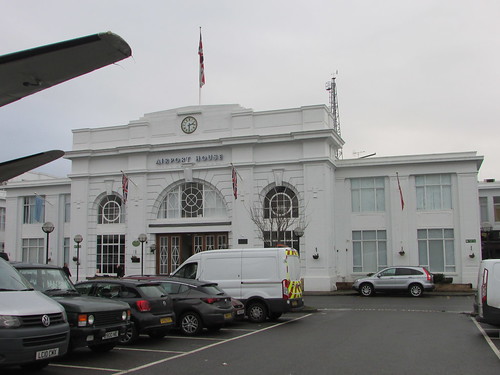
Croydon Airport finally closed in 1959 but, through the efforts of Croydon Airport Society, memories of this significant location in the development of aviation are kept alive. The Main Terminal Building survives as Airport House, now converted into a number of offices for small businesses and the Croydon Airport Visitor Centre.


Airport House, Croydon.


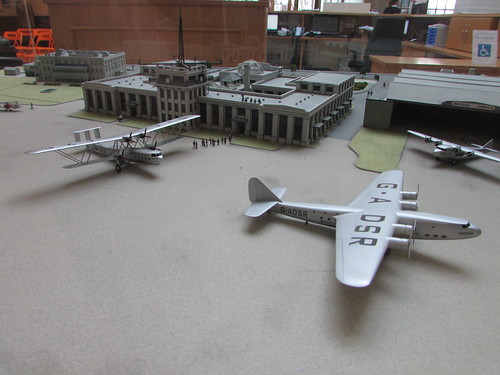
A 1:200 scale model of Croydon Airport in its heyday is displayed in Airport House Reception.

The iconic 'big biplane', the Handley Page H.P.42, handled most international flights in and out of Croydon, until replaced by more modern monoplanes like the Armstrong Whitworth 'Ensign'. In the picture above, an H.P.42 is on the left with an 'Ensign' G-ADSR on the right.


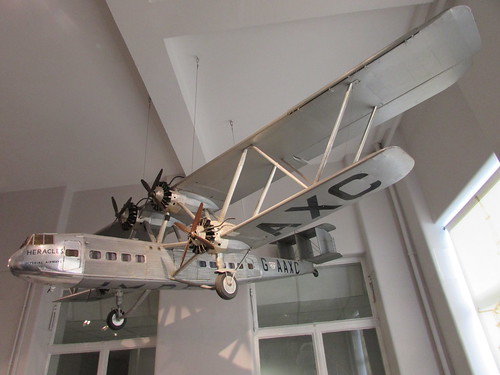
An imposing flying model of H.P.42 'Heracles' (G-AAXC) is displayed in the stairwell of Airport House.

History

The Croydon Airport Society website has a concise, but thorough, history here. Croydon Airport Society have also been involved in the creation of detailed published histories (see Related Books, below).

In 1916, the site was used by the fledgling Royal Flying Corps (later the Royal Air Force) as an aerodrome engaged in the defence of London against German airship attacks. The aerodrome replaced Hounslow Heath in 1920 as London's civilian airport and international passenger services were established. The original facilities were rather primitive so an Act of 1925 authorised the building of a new airport with hard-standing near the terminal although the actual runways remained grass.

The new Administration Building, opened 1928, was built by Wilson Lovatt & Son. This construction firm (based in Wolverhampton, where I grew up) was founded in 1914 and survives, although under threat of 'striking off' by the Companies Registrar. A hotel, the 'Aerodrome Hotel', was built adjacent to the Administration building for the convenience of air travellers.


Croydon Airport: Administration Building Ground Floor Plan
(from the Official Guide, 1928).
Click here for a larger view


On the outbreak of World War II in 1939, the airport reverted to military use. In 1946, the airport was restored to commercial use but Heathrow was designated as London's main airport so Croydon's importance diminished although international services and general aviation flying continued until closure in 1959.

Croydon Airport Visitor Centre

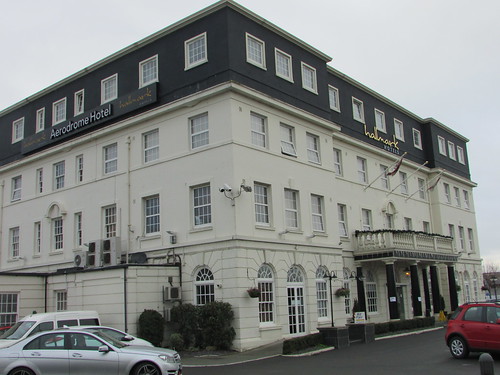
Croydon Airport Society was founded in 1978 and in 2000 opened an award-winning volunteer-led micro museum designed by Haley Sharpe Design (whose head office is in Leicester). The first open day in 2017 was Sunday, 8th January 2017 and my friend Rita (who is a member of the Society) and I decided to visit. Adjacent to Airport House the 'Aerodrome Hotel', now operated by Hallmark, survives and retains its original name (but has acquired an additional storey). The Hotel was hosting a one-day sale of aviation memorabilia, including models, books and photographs, which Rita and I checked out. This is an annual event in January, coinciding with the first Open Day of the year by the Croydon Airport Society.


Aerodrome Hotel, Croydon.

Related books

[1] ‘The First Croydon Airport 1915-1928’ (Croydon Airport Society 2001 edition) ISBN 0-9541370-0-0.
[2] ‘Croydon Airport 1928-1939’ by Douglas Cluett, Joanna Nash, Bob Learmonth (London Borough of Sutton Libraries & Arts Services 1980 edition) ISBN 0-9503224-8-2.
[3] ‘Croydon Airport – The Peaceful Years’ by Mike Hooks(2006 reprint) ISBN 0 7524 2758 X (Photographic collection with detailed annotations).

My Pictures

Where necessary, clicking on an image above will display an 'uncropped' view or, alternately, my pictures may be selected, viewed or downloaded, in various sizes, from the album Airport House, Croydon.

Wednesday, 3 February 2016

Flight Simulator

Click on any image below for an 'uncropped' view.

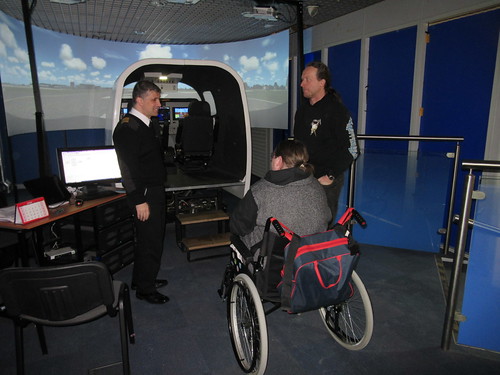
Dean had been given a birthday present piloting a flight simulator and I accompanied Ann and Dean to Birmingham Airport where SoftekSim had a 'shop' in the arrivals hall fitted with a simulator for a Beechcraft 'King Air' turbo-prop aircraft. I say "had" because, sadly, this facility closed at the end of January 2016 and it's not yet clear whether it will re-open.

Flight Simulator: L-R: The Instructor, Ann and Dean.

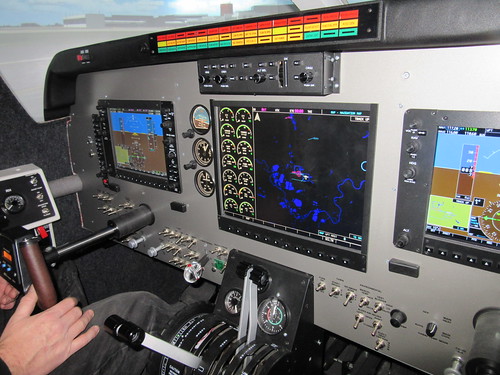
I was surprised to discover that the simulator was built in Latvia by SoftekSim, who are based in Riga. Although I've been a passenger in a few Beechcraft aircraft, I've not been in the upmarket King Air which the simulator represented. This was a "glass cockpit" aircraft so all the basic flying instruments were on duplicate screens in front of the Pilot (left-hand seat) and Co-pilot (right-hand seat). A larger screen in the centre displayed map information together with a host of gauges. Together with all the flying and engine controls, a host of switches and alarm annunciators, it was all pretty impressive. A large, wrap-around display outside the cockpit showed the outside world and, we soon discovered, there was realistic sound and jacks provided the appropriate motion effects.

Flight Simulator.

Dean took the left-hand seat and I squeezed into the right-hand seat, just for the ride.

The first task was to fly from London Heathrow to London City Airport in good weather. The map display and the wrap-around display showed that we were just clear of the eastern threshold of the northern runway at Heathrow, so we were going to take off to the west on runway 'Two-Seven Right'. The instructor ran briefly through some start-up checks and then had Dean start the turbo-props, producing a reassuring roar from the sound system. Power was increased and Dean taxied out, turning left (using the rudder pedals to steer on the ground) onto the runway centreline. Set take-off flap and more power, then the take-off roll commenced. The instructor prompted 'Rotate' as we achieved take-off speed and the aircraft started to climb. The instructor called for a left-hand climbing turn and, at a safe height, take-off flap setting was retracted, power was reduced and we settled into level flight heading east towards our destination.

Then, suddenly, we were nose-down, plummetting towards the ground, with the wrap-around display showing the buildings getting larger and larger! "Not your fault" shouted the instructor, hitting the main reset. As we all laughed with relief the instructor explained that they were experiencing an occasional software fault on the simulator and we'd been unlucky. This, he said, was the reason the Birmingham Airport facility was being closed, whilst the software problem was addressed in Latvia. The simulator used three computers running 'Windows' so it took a little while to re-boot.

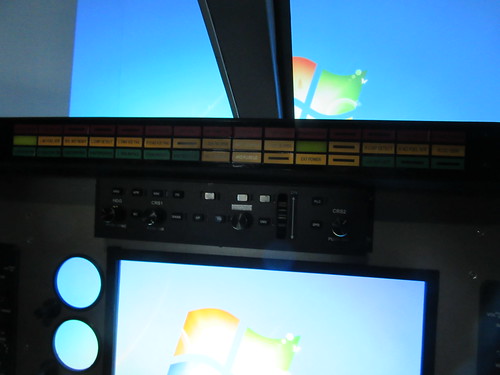
Flight Simulator: The familiar 'Windows' screen appears in the cockpit and 'outside' as the system restarts.

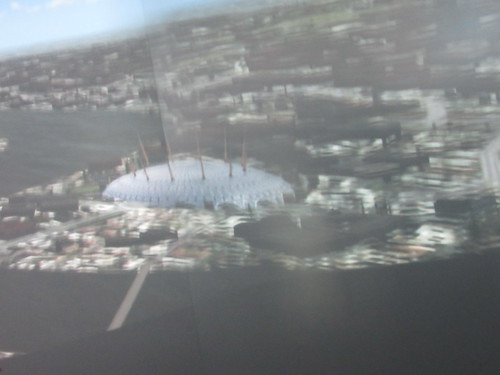
The instructor was able to position the flight at the point where the problem occurred and Dean was able to continue to 'fly' the aircraft. Overflying Canary Wharf, I had a good view of the 'O2' from my side.

View of the 'O2' as we approached London City airport.

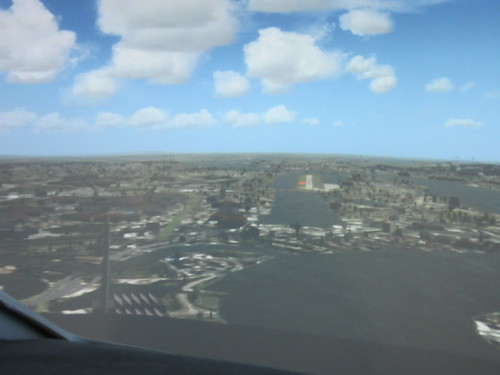
Flight Simulator: Approaching London City Airport. The 'grey' areas are water.

Dean safely 'let down' on the runway but had a bit of trouble steering on the ground (the 'yoke' controlling the ailerons are ineffective on the ground - only the rudder pedals work. We veered onto the grass and I was sure we we going to get a 'dunking' in the adjacent dock but Dean managed to stop just before we hit the chain link fence at the boundary. The instructor seemed quite impressed commenting "Any thing you walk away from is a 'perfect landing'".

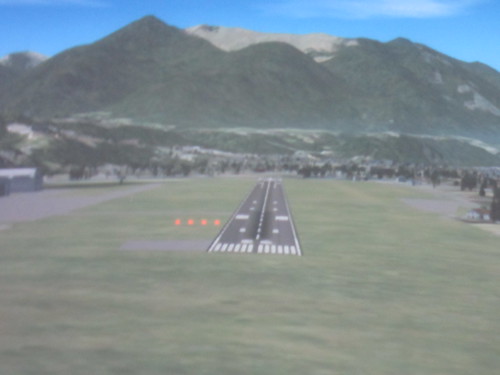
There was time for Dean to make a second landing. This time, the instructor positioned the aircraft cruising up the valley between the mountains on the approach to Innsbruck International Airport in Tyrol, western Austria.

Flight Simulator: The mountains around Innsbruck, Tyrol, western Austria.

This time, Dean was able to land and brake in a straight line, impressing everybody. I'm sure Dean would have happily done it all again, but the next customers were already waiting for their 'slot'.

Flight Simulator: Coming in to land at Innsbruck airport.

Despite the 'hiccup' with the computers, Ann, Dean and I were very taken with the set-up and hope that SoftekSim will be able to resume operations in the future.

My pictures

Flight Simulator.

Friday, 4 October 2013

Aerial Photography showing Brewood Hall

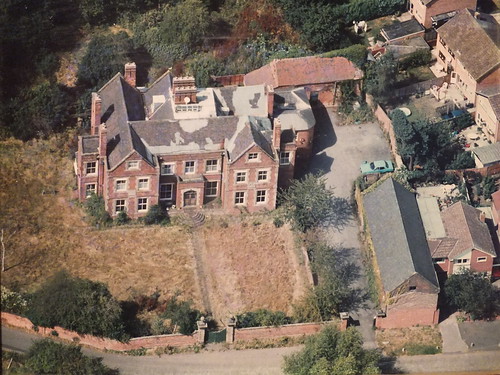
In the 1970s, I took a few aerial photographs of Brewood Hall myself, but they have currently gone missing. They were taken as we returned from the Isle of Man in a twin-engined Piper 'Aztec'. Our route to Birmingham took us just to the south of Brewood Village. The camera was a 'Halina' 35 m.m. camera and with only a standard lens, there was not a lot of detail.

The first three pictures below were taken over a period of years by firms who overfly a likely area taking photographs 'on spec' and then send a salesman door-to-door trying to sell framed prints.

This picture must date from the 1970s, when the path to the front gate was flanked with flower beds. The road at the front of the property, Sparrow's End Lane, was narrow and 'hugged' the outside of the front wall. This is a photograph of a print which has rather faded.

Lack of funds in the 1980s led to ugly temporary roof repairs. The garden is unkempt, too. This is a photograph of a print.

The aerial photography must have been taken around 2008. This is a photograph of the print the firm supplied. I complained about the poor colour balance of the print, but I've not tried to correct it. By this time, there had been significant expenditure on the main building and the small barn had been restored. Sparrow's End Lane had been re-aligned and widened to serve a new housing development, so there is now a 'wedge' of grass between the front wall and the road.

This year, I had an e-mail from Aerial Impressions, who originate in Australia. The e-mail was inviting commissions to take photographs on a forthcoming planned photographic mission in my area. I decided to place an order with them and we exchanged maps showing exactly the extent of the property to be covered. I received an acknowledgment confirming that, subject to weather, photography in my area would start within a few days.

I'd almost forgotten my order when, some days later, I heard an aircraft overhead. That's not so unusual - we get quite a few light aircraft over-flying. We also get helicopters - the police and the Air Ambulance are regulars. We also get a number of military flights - Boeing 'Chinook' twin-rotor helicopters and 'Hercules' four-engine transports are commonplace. A few years ago, low-flying jet fighter aircraft were frequent fairly terrifying visitors, but that seems to have virtually ceased. The aircraft I could hear appeared to be manoeuvring so I thought "I wonder if that's the aerial survey?", grabbed my camera and went outside.

The high wing monoplane certainly appeared to be circling the property, so I attempted a picture. It always amuses me to take pictures of photographers at work, but I'd never attempted a picture of an aerial survey before. Well, the result is pretty poor - the target was too quick for me!

My feeble attempt to capture the survey aircraft.


An enlargement of part of the above photograph
perhaps makes the aircraft more obvious.


A week or so later, I received a disc from Aerial Impressions with around 50 high-resolution shots they'd taken. I was very pleased with the result and there was confirmation that it really was the survey aircraft I'd attempted to photograph because I was clearly visible on the lawn to the left of the Hall in around half of their pictures.

Brewood Hall in 2013. Jan is on the lawn to the left of the Hall.

There is a set of pictures Brewood from the Air which shows the village of Brewood and Brewood Hall. The Aerial Impressions pictures can be viewed in their full 21 Megapixel resolution.

Sunday, 23 August 2009

Up, Up and Away

The Jet Airways Boeing 777-300ER at Heathrow, just prior to boarding

Once again, I'm off to the Far East. As I write, it's 08:15 on a Sunday morning and I'm in the American Airlines lounge at Heathrow, Terminal 3. I'm actually flying Jet Airways (an Indian airline) to Mumbai then, by a connecting flight, on to Bangkok. Because we 'lose time' flying east, it'll be Monday morning by the time I get to Bangkok.

I had an uneventful journey from home with Alan (that's the way I like it) and although Heathrow is busy, check in and security didn't take too long. Security is still thorough but, this morning at least, the staff are polite and I even got some smiles.

All-in-all, I'm quite relaxed and I'll keep you posted on my experiences as and when possible.

Monday, 22 June 2009

Flying

I've already described my first flight which gave me the taste for flying and since then I've flown in a variety of aircraft.

That first flight was a private charter by one of my customers and later I was able to charter an aircraft myself. This is how it came about...

Having set up as an electronics consultant, I was trying (with no great success) to establish the business. One day, I received a call from a senior electrical engineer at a large company involved in building new plant for British Steel (yes, in those far-off days, we had a British-owned steelmaking industry). I'd worked with him before and he thought I might be able to help with a problem. It seems that another company had designed special electronics for bulk materials handling equipment which was failing to give satisfaction on site. The client, British Steel, was not amused and was demanding urgent action. I was invited to go up to the site in the North East of England and see what could be done. At the time, I didn't relish trying to put someone else's mistakes right (it was tough enough trying to rectify my own mistakes) and I said that I was too busy to travel to the wilds of the North East. But the engineer persisted and I was amazed to find myself saying "Oh, alright, I'll go and have a look, but you'll have to charter a light aircraft to take me there and back". I imagined that would be the end of the matter but, instead, I was told, yes, they'd pay for the charter provided I arranged it, as they had no experience in chartering. It seemed the wrong moment to confess that I'd never chartered, either. I was more confident that I could arrange a charter than that I could fix the problem when I got there.

I arranged a twin-engined Piper 'Aztec' and pilot out of Birmingham to a small airport a taxi-ride away from the steelworks. In the meantime, we collected as much information as we could about the problems that were occurring and designed a small control module to replace the key element of the existing system. Although we had to make a number of assumptions in designing our control module, I hoped that our replacement would at least furnish an indication of the way to go.

I can remember very little of the flight, except waiting in the old, cramped terminal at Elmdon before departure, along with passengers for the various commercial departures (this was in the days before there was a separate 'General Aviation' terminal for private flights). The other passengers were scurrying hither and thither in reponse to inaudible public address annonuncements but when my pilot arrived, I was politely asked "Are you ready to leave?" and the two of us went out onto the apron and made our way to the waiting aircraft. I liked the idea of sitting 'up front' in the right hand seat and wearing headphones ('cans') both to facilitate conversation with the pilot and to follow the Air Traffic Procedures. Basically, I was hooked on aviation!

And what about when I arrived at the steelworks on that charter trip? I'm glad to report that our hastily-constructed control module performed better than I'd dared hope and we subsequently did quite a bit of work at various steelworks supplying materials handling equipment of our design. I managed to charter small aircraft a few more times as well but that's another story.

Monday, 29 January 2007

My First Flight

In the 1960s, we'd been designing digital selective call equipment for use in Private Mobile Radio equipment. Our client, Gerry Gardner, was a wonderful character with his own firm in Canterbury. He was bidding on a large contract for Lancashire Constabulary and he'd decided to charter a light aircraft to take him up North for a meeting. I was never sure whether it was a desire to avoid the long car journey, impress the Client or a bit of both. I was pleased, because he offered to land at the small airfield at Wolverhampton en route to pick me up.

Light aircraft can fly under two regimes: Visual Flight Rules (VFR) or Instrument Flight Rules (IFR). The aircraft Gerry had chartered was only equipped for VFR, so the flight could only go ahead if the weather conditions met the 'Minima', the worst case conditions under which VFR flight is allowed. On the appointed day, the forecast for the en-route weather was poor, so plans were deferred to the following day. The weather was even worse that day, resulting in plans being re-arranged for the following Monday. Originally, we'd intended to fly to the airfield near Preston used for test flying of military aircraft, but it was not available on the Monday, for some reason, so the destination was altered to Squires Gate, Blackpool.

On Monday, I confirmed by telephone that the flight would take place, then made my way to the local airfield, Pendeford. Aircraft maintenance work was going on in the hangar, but I was concerned to be told "The 'field's not open on Mondays, 'cos there's no ATCO on duty". With no Air Traffic Control Officer, there was nobody to answer the radio or pass the local conditions to an incoming aircraft. Not feeling very optimistic, I decided to hang around and see what happened. On schedule, an aircraft could be heard approaching from the South. The aircraft made a complete circuit at low level and then landed on the grass runway. When it taxied to a stop, I approached the aircraft, a single-engined Beech with the distinctive Beech V-tail, and was relieved to see my customer sitting next to the pilot.

I was soon installed in the seat at the back of the small cabin and we took off and headed North. The pilot explained that, when he got no response on the radio, he did a low level circuit to physically check that it was safe to land and then 'let down'. I was astonished at the informality, but delighted I'd not missed my flight. I was so fascinated with the aerial views of the landscape, I didn't even think about being frightened. I was amazed at just how much detail on the ground could be made out - a cross between a highly-detailed model and an Ordnance Survey map. Nowadays, people are more used to aerial views and we have access to tools like Google Earth but to me, back in the 1960s, the flight was a stunning experience.

Well, we arrived safely, travelled the last few miles by road to the meeting and made our presentation but by the time we returned to Squires Gate, the sky had darkened and a storm threatened. The pilot said conditions were still acceptable, provided we took off without delay. As we taxied, the small aircraft was buffeted by the wind and then the lightning started! In our exposed position each lightning strike was clearly visible and accompanied by a loud 'crack' from the radio on the cabin loudspeaker. We couldn't hear the actual thunder for the noise of the engine at 'take-off revs' as we bounced down the runway and took off.

After a few minutes, we'd passed out of the storm and continued South in pleasant evening conditions. However, low cloud made it hard for the pilot to pick out landmarks and I was not sure whether he was joking when he said he was not exactly sure where we were. Looking down, I could easily recognise the town of Stafford and the railway line running through it. I pointed this out and added "If you follow that railway line branching to the right, it will lead you to Wolverhampton". So that's what we did. Once we got in the vicinity of Wolverhampton, the pilot spotted the airfield and was able to land safely, drop me off, then take off to complete his journey South. Despite the "alarums and excursions" of the day, I was thoroughly taken with the business of flying and I've since taken every opportunity to fly in aircraft, large and small.

And the contract? Yes, we got it, giving rise to lots more experiences.