skip to main |
skip to sidebar
I was rostered as DMU (Diesel Multiple Unit) driver at the Battlefield Line on Saturday, 2nd October 2021.
The 'set' comprised the Driving Motor car at the north end coupled to the Single Unit ('Bubble Car') at the south end: the customary arrangement at present. There's a second Driving Motor Car which is currently receiving attention in Shackerstone M.P.D. before being reunited with its 'other half' to form a 2-car unit. The set normally has four 150 h.p. in use, one to each bogie but one engine on the Single Unit has been using excessive engine oil for a while and the Owner recently decided to isolate that engine and run with three engines until a replacement engine could be fitted.
The thoughtful design of the 'Modernisation Series' DMUs makes it easy for a driver to safely isolate an engine which has failed in traffic, allowing the unit to 'limp home' with reduced power and this had already been done. Firstly, the Final Drive had been isolated using the hook-ended, long-handled tool stowed in the guards compartment.

Guard's compartment in 55005: The long, thin rod with a handle at the top stowed vertically in between the red-painted Brake Setter and the Guard's seat is the 'Toasting Fork' to isolate the final drive.
The 'toasting fork' allows the driver to reach over the top of the bogie, grasp the isolating switch with the hooked end and twist the switch to the 'isolated' position.
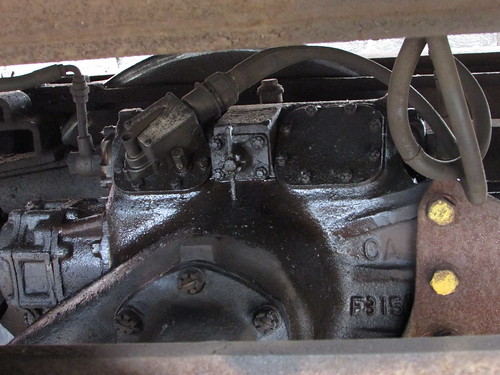
The vertical bar is the Final Drive Isolating Switch in the 'engaged' position. When horizontal, the drive is 'isolated'.
Secondly, a carriage key had been used to electrically isolate the engine, using the isolating switch on the underframe near the engine.
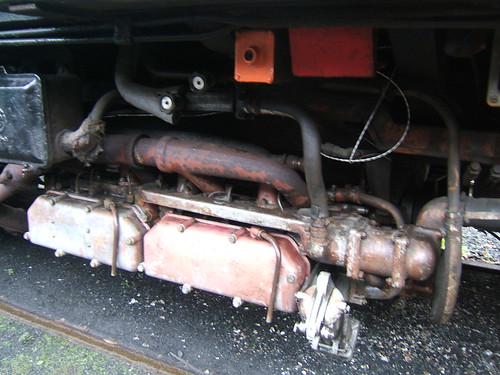
'Flat 6' DMU engine. The orange-painted square box mounted on the underframe above the engine is the switch (operated by a carriage key) to electrically isolate the engine.
It didn't take long to check oil and fuel levels, make sure auxiliary drive belts were intact and look for anything not quite right, then each engine was electrically started from the ground. Two out of three started: one refused to turn over and just made an 'Ug' sound. I started thinking about finding the battery charger and setting it up to get more life into the battery but decided to make one more attempt and this time the engine turned over sluggishly but enough to fire and we were away.
Stephen W. was booked Guard and he arrived nice and early. The day started dull and rather cold so we anticipated poor passenger numbers but when we moved the train from the DMU siding where preparation is carried out into the platform, there were quite a few passengers already waiting. We set off a few minutes late and, for a time, the weather deteriorated with intermittent heavy rain, requiring the use of the air-operated windscreen wiper. Market Bosworth had been closed to passengers during the limited operations as Covid restrictions were eased but we were scheduled to resume the intermediate stop. Whilst waiting for the Guard and Market Bosworth Station Staff to conclude station duties, I took a picture of the passenger compartment behind the driving cab.

Battlefield Line 2021: DMU on 2-Oct-2021 at Market Bosworth on the first northbound service.
We carried on to Shenton with improving weather. In fact, later in the day there was quite a pleasant sun. The dull start to the day made me anticipate poor passenger numbers but quite a few passengers turned up for each service which made the whole day very worthwhile. But I'm sure the passengers were relieved that the carriage heating was working! There are two underframe-mounted heater units on each coach. Diesel fuel (electrically ignited) is burned in a cylindrical combustion chamber and electric fans blow warmed air through ducts into the coach. The heaters are controlled from a simple panel in the Driver's cab and a switch allows fan-only operation in summer. Safety circuits are provided to ensure correct operation. The principle is similar to some warm-air portable heaters used in industry.
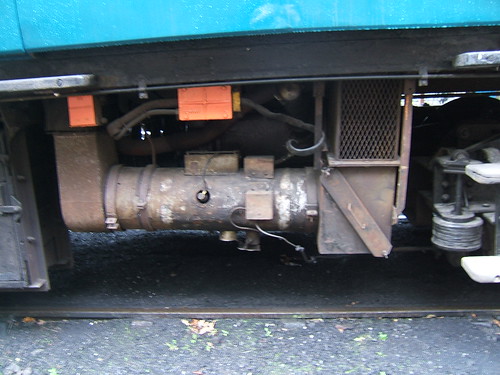 One of the two underframe-mounted heater units on each coach.
Stopping at Market Bosworth on the return trip, we picked up a large family group celebrating the birthday of one of the group. They were all staying at the Bosworth Hall Hotel in Market Bosworth and they'd decided to have a round trip on the train. The jolly crowd left us at Market Bosworth on our second north bound journey.

Battlefield Line 2021: DMU on 2-Oct-2021 showing a birthday party alighting at Market Bosworth from the second northbound service.
Our Guard had recently been passed-out to drive the DMU but had not yet had a rostered driving turn so we agreed to 'swop roles' for the third round trip so that Stephen could drive whilst Jan carried out the guard's duties.

Battlefield Line 2021: DMU on 2-Oct-2021 showing Jan completing the Guard's Journal on the third round trip.
I was back in the cab for the final round trip to Shenton then the unit was stabled in the DMU siding, final inspection made and paperwork completed after an enjoyable shift.
Related posts in this blog
All my Battlefield Line posts.
All my DMU posts.
My pictures
Battlefield Line 2021.
All my Battlefield Line pictures.
As I outlined in the post Operations at the Battlefield Line in 2020, the year has unfolded like no other, due to the Coronavirus pandemic. With special health precautions in place, the Battlefield Line recommenced operations in August using a mixture of diesel railcar, steam-hauled and diesel-hauled services. Against a background of frequently-changing national and local guidance and legislation, passenger numbers have been unpredictable and fewer steam services have been operated.
After the steam and diesel multiple unit turns described in the post linked above, I was next rostered on Sunday, 11th October 2020. In a normal season, a Sunday service would have been steam-hauled but, because of uncertainty over demand, the 2-car Diesel Multiple Unit (DMU) had been rostered. On a steam day, I would have arrived around four hours before the time of the first departure but, with the simpler preparation demanded by the DMU, I allowed what I expected to be a generous 90 minutes.
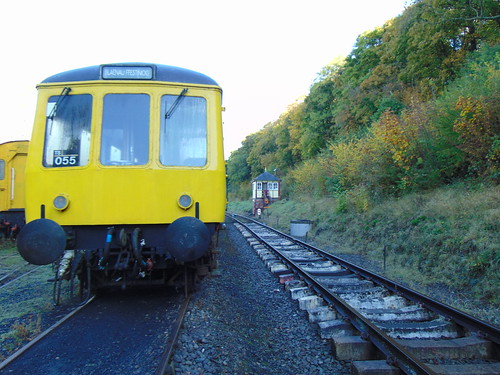
It was a cool morning with a little drizzle when I arrived, locating the DMU stabled in its usual spot in the long siding called the DMU Siding adjacent to the running line. I smiled to see the destination blind at the north end of the unit had been set to 'BARMOUTH' by the previous driver. The range of destinations offered by the roller blind was 'inherited' from the previous owner, British Rail, and represents places served by the last depot, Tyseley (although some additions have been added to cover Battlefield Line stations).

The 2-car DMU stabled, as normal, in the DMU Siding at Shackerstone: A Day on the DMU (Photo: D. Mould)
All doors on carriages of this era, both passenger and staff access doors, are locked when not in use, using a standard tapered square section key. I entered the carriage at the northern end of the set (51131, half of a 2-car unit) via the Guard's compartment, using a British Rail standard multi-purpose 'T'-handled carriage key.

British Rail standard multi-purpose 'T'-handled carriage key
The driver's two control handles for the unit are stored in the Guard's compartment when the DMU is stabled and, during traffic, are inserted in whichever cab is leading. The control handles comprise the chrome-plated Brake Handle and the brass Select Direction key (invariably called the 'spoon'). To enable the electrical control circuits, each driver also carries a personal Master Key. Having collected the two control handles, I walked through the passenger compartment to reach the driving cab. Checking the inspection sheets, I found that the DMU had been used the previous day, with Carl driving. The only defect shown was a non-working secondman's windscreen wiper which I'd previously noted. The air-operated wipers on these units are rather temperamental. I partially filled-in a new inspection sheet before returning to the ground. I carried out the normal inspections by making a circuit of the DMU, noticing that the destination blind at the southern end had been set to 'BLAENAU FFESTINIOG'. Two of the four 150 h.p. engines required a top-up of engine oil.

Jan carrying out the daily inspection: A Day on the DMU (Photo: D. Mould)
Having closed both battery isolator switches and inserted my master key in the cab, I first attempted to start the engines on 51131. Despite the DMU having been used the previous day (deputising for the Class 33 diesel electric), I found that there was insufficient charge in the battery to crank either engine. So, the battery charger had to be retrieved from the Guard's compartment in 55005, together with the long mains lead to reach from the DMU to the nearest power socket. The 24 volt output from the charger was connected to the charging point on the underframe of 51131 using a heavy-duty low-voltage connector.
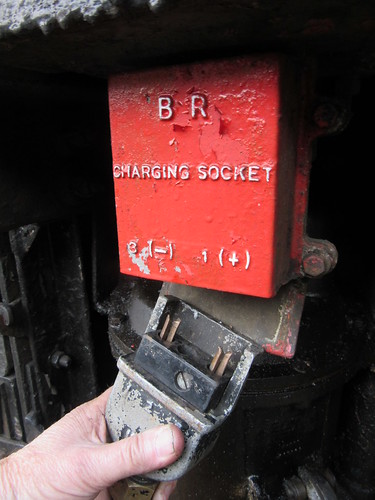
DMU at Shackerstone: Battery charging socket
To my relief, a little over 30 minutes connected to the charger allowed me to start both engines on 51131. Fortunately, the battery on the 'Bubble Car' was able to start its engines without the need for re-charge. With the charger and mains lead re-stowed on 55005, I updated the inspection sheet whilst waiting for the engine-driven compressors to generate sufficient control air to allow Electro Pneumatic (E.P.) control of the engine throttle settings and the Final Drives which select direction of travel and connect the gearbox outputs to the wheels. Once I was ready, a short 'pop' on the horn alerted the signalman, who immediately pulled 'off' the ground disc signal which allowed me to leave the DMU siding and gently drift down to platform 1 at Shackerstone. I was surprised at the reasonable crowd of passengers awaiting the train's arrival.
To meet Coronavirus regulations, a volunteer was on duty at the station entrance to 'Meet and Greet' visitors, briefing them on the arrangements in force and collecting contact details (a requirement to support infection tracing, when required). Tickets were being sold from the traditional booking office window. The Guard, supported by the Travelling Ticket Inspector (TTI) and a volunteer periodically sanitising features like coach door handles quickly prepared the train for boarding and the 11:00 departure left only about four minutes late. After the slight 'hiccup' starting the engines, the DMU ran flawlessly for the rest of the day.
Because of Coronavirus, the intermediate station stop at Market Bosworth has been temporarily suspended. As we made our way to Shenton, the sun came out and remained out for most of the day, producing pleasant, mild conditions. To my amazement, Shenton car park was full on our arrival and stayed full all day. The pottery and glassworks were open and the Covid-adapted buffet at Shenton was kept busy all day providing takeaway refreshments to visitors via an opened sash window facing the platform. The various station seats on the platform had been supplemented by picnic tables, providing plenty of socially-distanced seating. Quite a holiday atmoshere prevailed.

Visitors enjoying the Autumn sun at Shenton: A Day on the DMU (Photos: D. Mould)
At 11:35, the DMU returned to Shackerstone. The picture below shows the view approaching the signal box. 'Single manned' vehicles have a Driver Surveillance Device (DSD), more commonly called the 'deadman's handle' to stop the train in the event of driver incapacitation. Alone in the cab, surrendering the train staff to the signalman on arrival involves carefully setting the approach speed (5 m.p.h. on the immediate approach to the signalbox, then 5 m.p.h. through the crossover to platform 1). Then, the train is allowed to coast, the deadman's handle (part of the throttle control) is released and the driver carries the staff across to the right hand window, near to the signalman on the 'token landing'. Just by this window is an 'Override' pushbutton. Pressing and holding this prevents the brakes from being applied. Keeping one finger on the override, the driver leans out and hands the staff to the signalman. The driver can then cross back to the driving seat and operate the deadman's control, again preventing the brakes from being applied. Only a few seconds elapse between releasing the deadman's (or the override) and automatic brake application so the aim is to appear unhurried and nonchalant whilst avoiding automatic braking as the driver crosses the cab, excessive speed into the crossover or the train just 'stalling' with the brakes released because of the extra friction when passing through the tight reverse curve of the crossover.

View from DMU approaching Shackerstone. The upper disc of the 2-disc ground signal is 'off', for the DMU to arrive in platform 1: A Day on the DMU (Photo: D. Mould)
The Victorian Tea Rooms on the platform at Shackerstone were also providing a limited takeaway menu. The various station seats on the platform were supplemented by small round, cast iron tables and picnic tables. In addition, the attractive design of the station building (originally shared by other stations on the Ashby and Nuneaton Joint Railway) features a pleasant covered but open-sided verandah which is also furnished with seats and small tables, offering plenty of socially-distanced seating. Johnathon was kept quite busy all day running the tea room.
Passenger numbers on the 12:30 and 14:00 departure from Shackerstone were good and the sun continued to shine.
Before the last departure of the day from Shackerstone (at 15:30), I took the opportunity to visit Chris and Jo who run the shop on platform 2. The layout of this shop, too, has been re-arranged and a large screen provided on the counter to meet Coronavirus regulations.

Platform 2 at Shackerstone, with the shop on the right (Photo: D. Mould)
The final departure from Shackerstone wasn't very busy. It was only after our arrival at Shenton that the Guard learned that a booked party of 25 had arrived by coach at Shackerstone after the 15:30 departure had left. We delayed the return from Shenton a few minutes while the coach drove from Shackerstone to Shenton so that we could at least give the party a 1-way ride back to Shackerstone.
There was one final incident in the day as we approached Shackerstone. The Down Outer Home signal is a rather nice lattice post upper quadrant signal, mechanically operated by wire. When 'on' the arm should stand at '9 o'clock' clockface: when 'off' it should be raised 45 degrees ('10.30' clockface). As I approached, I could see that the arm was at '2 o'clock' which can occur if the arm stop is defective, the wire is tight and the signalman is energetic. This counts as a 'signal imperfectly displayed' and the Rule Book says it should be treated as a 'stop'. So I stopped. There's no working Signal Post Telephone at this location so the Guard and I independently tried to call the signalman by mobile phone. The Guard got through first and we obtained authority to pass the signal and complete our final run. By the time the passengers had got off, doors been locked and I'd moved the DMU into the DMU Siding for stabling, the Signalman had walked up to the errant signal, climbed the post, put the signal arm back to 'stop' and returned to his box. The final picture below shows a fairly quiet Shackerstone station.

Shackerstone station: A Day on the DMU (Photos: D. Mould)
Other DMU Posts on this website
To view all my posts on the DMU at the Battlefield Line click here, which displays them in reverse date of posting order.
Pictures
A Day on the DMU
On Saturday 2nd November 2019, the Battlefield line celebrated Bonfire Night with a Bonfire and Firework display at Market Bosworth Station. The railway's website here enthused on its events page:-
Gigantic bonfire and spectacular firework display
Catch the train from Shackerstone at 6:00pm or 6:50pm and ride to Market Bosworth Station
Train returns from Market Bosworth at 8:15pm.
Refreshments available at Market Bosworth Goods Shed
Parking spaces are limited at Market Bosworth, so it is advised to catch one of the trains from Shackerstone Station
The plan for the evening services to and from Market Bosworth was that 'Light Prairie' 5542 would be chimney-leading at the south end, coupled to three coaches of the normal 4-coach 'set', omitting the 'BG' guard's full brake with the 2-car Diesel Multiple Unit (DMU) completing the consist at the north end. The DMU currently comprises the single-unit 'Bubble Car' attached to the Driving Motor car of the 2-car set whilst the Driving Trailer of the 2-car set undergoes body repairs in the shed. All the bonfire trains were to operate from Platform 1 at Shackerstone. 5542 would haul the 6.00 p.m. to Market Bosworth and, after unloading, the DMU would take the empty stock back to Shackerstone, to form the 6.50 p.m. service to Market Bosworth. After the firework display, the DMU was to lead the return train back to Shackerstone, with 5542 authorised to provide assistance if necessary.
I've described Steam/DMU 'Shuttle' operation at the Battlefield Line in the post here. At the 50th Anniversary Gala, just a couple of weeks prior to the Bonfire and Firework Night, I'd been involved in the operation of the Steam/DMU 'Shuttles' (both as steam and DMU driver) as described here. Adrian L. and Ritchie M. were already rostered on 'Light Prairie' 5542 for the evening trains but, with three bogie coaches added for the Bonfire and Firework Night, it offered a new experience so, when the railway asked for a DMU driver, I volunteered.
The plans underwent a number of changes before we actually worked the trains. The principal change, at around 5.00 p.m. on Saturday, was to operate with the full 4-coach service train which, from the south end, was marshalled passenger coach, buffet coach, passenger coach and guard's full brake (BG). Because the platform lengths are tight for even a 5-coach train this implied placing the passenger set at the north end of the train and allowing the BG to stand outside the platform, with 5542 marshalled at the north end and hauling the trains bunker-first towards Shackerstone. With only 3 passenger coaches alongside the platform, that left just about enough room to accommodate the 2-car DMU alongside the platform at the south end.
By 5.00 p.m. I'd done the Daily Exam on the DMU (much simpler than on a steam locomotive), started all four engines, obtained sufficient control air pressure and checked that the final drive controls, vacuum braking system and Driver's Supervisory Device (DSD, the posh name for the Deadman's Handle) were all operative from both the south end and north end cabs. So I was ready to roll, but I had to wait in the DMU siding until 5542 came off shed, by which time it was already fully dark. The heavy rain earlier in the day had abated but not really stopped. 5542 left the shed, trundled through the empty platform 1 to the north end and coupled onto the north end of the stock in platform 2. 5542 then propelled the four coaches southwards, past the signal box and 'up the cutting' until clear of the crossover. Once the signalman had reversed the crossover and cleared the ground signal, 5542 drew the train into platform 1, with most of the BG overhanging the platform. Then the 'dummy' (ground disc signal) on the DMU siding came 'off' and I drifted down to the south end of the 4-coaches in platform 1 and gently 'buffered-up'. The whole of the Driving Motor car was alongside the platform but only part of the 'Bubble Car', so we had to make sure that passengers used only the available doors. The 6.00 p.m. service wasn't full so we didn't need to load the 'Bubble Car'.

Platform 1 at Shackerstone Station, showing 'Special' including (in background) the 2-car DMU (Battlefield Line Bonfire and Firework display)
Railway Operations at Night
I've discussed driving steam trains at night in the post The Railway at Night and there's a bit more in the post 'Operation: Market Bosworth - On the Footplate' describing the running of 'specials' in the dark.
The semaphore signals at Shackerstone were originally lit by paraffin lamps, as described in the post Part 4 - Semaphore Signal Aspects by Night (one of an occasional series on Railway Signalling in Britain in this blog). Some years ago, I remember climbing the Shackerstone Down Home signal (number 2) to replace the paraffin lamp. Since then, the signals at Shackerstone have been 'electrified', with filamentary lamps replacing the paraffin lamps. Unfortunately, a couple of these lamps were 'out', requiring extra vigilance.
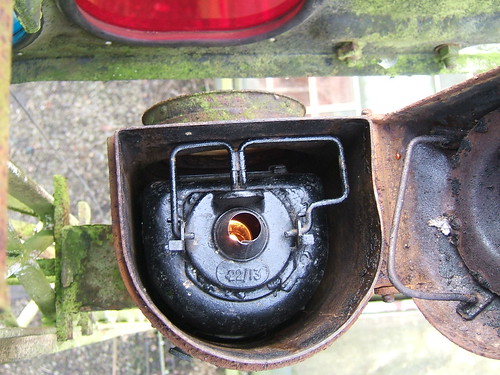
View from above showing the parffin lamp housing fitted to an upper quadrant lattice post signal, with the lamp housing open to show the lighted signal lamp inside. At the top of the picture can be seen the filter glasses producing the appropriate signal aspect.
But the design of the cab of a DMU compounds the problems of keeping a good lookout ahead. The 'Modernisation' DMU featured glazed panels between the cab and the the passenger compartment. At night, the light from the illuminated passenger compartment destroys the driver's night vision unless the blinds fitted to the glazed panels are lowered. Although the forward visibility for passengers is attractive during the day, later designs of DMU have replaced the vision panels with a solid bulkhead.
In addition, the driver views the line through generously-proportioned front windows. Glazing will produce reflections from any stray light which can be distracting. During rain, the air-operated windscreen wiper will clear a limited area which may retain smears (depending on the condition of the wiper blade) and rain on the 'unwiped' area can produce visual distortion or scatter stray light. On a steam locomotive, leaning out of the cab will normally offer the best forward vision but on this type of DMU, the need to keep the Deadman's Handle operated limits the driver's ability to lean out.
As built, 'Modernisation' DMU show just show two white marker lights ahead but these are intended to warn people trackside, not to act as headlights improving the driver's visibility. British Rail did retro-fit an additional higher-intensity headlamp to some units but this was still primarily to warn people trackside although, as increasing use was made of reflective signage (for instance, for indicating speed limits), this headlamp also improved the driver's ability to locate such signs. Unfortunately, the leading cab from which I was driving was not one fitted with a higher-intensity headlamp.
There are various indicator lamps in the cab which can also be distracting at night. Set vertically to the left of the driving position is a panel of filamentary indicator lamps indicating engine status. For each power car in the formation (up to a maximum of six power cars) there are two 'engine running' lamps and one 'oil and axle' lamp. So for the 'Bubble Car' plus Driving Motor car combination, 6 out of the 18 lamps were lit. At least, the lenses of these lamps were blue glass, so the effect wasn't too bad. More troublesome were the two repeater lamps which confirmed that the marker lights were lit, mounted in front of the driver on the horizontal panel. I reduced the unhelpful glare by placing a piece of rag over the repeater lamps.
The 6.0 p.m. to Market Bosworth
A little late, I received the 'Right Away' from the Guard, exchanged whistles with the 'Prairie' at the rear and, with the rear locomotive 'making the brake' I carefully applied power to start our 6-coach train. With four 150 h.p. underfloor engines under my control only slight assistance was needed from the steam engine. First task was to confirm that signal 14 was 'off' (the signal lamp had failed), then comply with the 5 m.p.h. speed restriction through the crossover by the signal box. Next, I had to lean out (keeping one hand on the Deadman's Handle) to collect the Single line Staff, before confirming that the Advanced Starter (signal 15) was off. Once I judged that the whole of the train was clear of the 5 m.p.h. restriction I allowed the speed to rise to 10 m.p.h. Beyond Barton Lane Bridge, with some help from 5542 at the back, speed was worked up to the Line Speed of 25 m.p.h., before I sounded the horn for first Headley's Crossing and then the Public Footpath Crossing. Just before Carlton Bridge, I started an initial brake application of 15 in/Hg. This was intentionally early, as I was not sure what the braking characteristics of our unusual train would be, but I had no difficulty reducing the speed to 15 m.p.h. for the 'slack' past the Sewage Works, after which I re-applied power until Airport Bridge, where I started a brake application for the 15 m.p.h. restriction through the wooded area. We were now on the approach to Market Bosworth station, with glimpses of the platform lighting visible through the arches of Station Road bridge. Speed was reduced to 10 m.p.h. and the horn sounded before we ran along the platform. I deliberately overran the platform by around half the length of the leading coach, to ensure that the last passenger-carrying coach was in the platform.
Once all the passengers had left the train and I'd given the Single Line Staff to the crew on 5542, we set off back to Shackerstone to collect more passengers. On this trip, I just had to make sure that I kept the Deadman's Handle operated, the final drives set to 'Reverse' (My cab had become the trailing cab) with the engines idling in 4th Gear (the gear allowing 'free-wheeling').
The 6.50 p.m. to Market Bosworth
We boarded a second set of passengers at Shackerstone for the 6.50 p.m. departure. It was still raining when we set off. Either because of the rain or because 5542 was providing less assistance at one point I had wheel-slip on the DMU, quickly cured by reducing the engine speed slightly. Otherwise, the journey to Market Bosworth was uneventful.
Bonfire and Firework Display
The train crews were able to join the stream of passengers making their way across to the bonfire site, adjacent to the goods shed. I paused to speak to my friends in the attractive refreshment room on the platform.

Refreshment Room, Market Bosworth Station (Battlefield Line Bonfire and Firework display)
It continued to rain as we made our way over the foot crossing leading to the Goods Shed, but everybody seemed in good spirits.

Foot Crossing, Market Bosworth Station by night. Note crossing lighting (Battlefield Line Bonfire and Firework display)
Refrshments were also available both inside and just outside the Goods Shed. Tables and chairs were set up inside the Goods Shed for those waiting for the display to start before braving the weather.

Goods Shed, Market Bosworth Station (Battlefield Line Bonfire and Firework display)
But I found that most people were already outside, admiring the huge bonfire which was sending orange flames high into the sky. When the display started, we were joined by the people from the Goods Shed. I was impressed by the professionalism of the display, with rocket quickly following rocket in a dazzling display of contrasting colours. I'm afraid my picture below doesn't do justice to the impact of the fireworks.

Warmed by the large bonfire, the crowds watch the spectacular firework display, with a reflection of the firework just launched in a large puddle in the foreground (Battlefield Line Bonfire and Firework display)
Return to Shackerstone
As soon as the display finished, I made my way back to the train and made the DMU ready for the return journey. Only one train operated back to Shackerstone and I think we boarded over 200 passengers. I kept a good lookout for any 'stragglers' wanting to catch the train but, once everyone was aboard, we set off with 5542 doing most of the work and the DMU giving some assistance in accelerating the train up to line speed.

At the end of the firework display, over 200 passengers returned to Shackerstone in the 6-coach train (Battlefield Line Bonfire and Firework display)
On arrival at Shackerstone, I 'changed ends' and 'squeezed up' to slacken the coupling before Adrian L. kindly uncoupled. I 'changed ends' again to drive the DMU into the DMU siding for stabling. As I was shutting-down and locking-up, 5542 propelled the 4-coach service train 'up the cutting' before drawing it into platform 2 ready for its next use. Then 5542 scuttled to the shed for disposal.
An interesting evening.
Related posts on this website
Operation of Steam/Diesel Multiple Unit Services at the Battlefield Line.
Shackerstone Railway Society 50th Anniversary Steam Gala.
Railway Signalling in Britain: Part 4 - Semaphore Signal Aspects by Night
Diesel Multiple Units (Index)
My Pictures
Battlefield Line Bonfire and Firework display.

Jan on 5542 on Friday 19th October 2019: 50th Anniversary Gala at the Battlefield Line (Photo: 'Pip')
The Society
In 1969 the Shackerstone Railway Society was set up by a group of enthusiasts. Early passenger operations took place on the single-line between Shackerstone and Market Bosworth which had been left in place by British Rail (the line had originally been double-track). In 1992, the single-line was extended to Shenton, along the original double-track trackbed. The railway is now marketed as 'The Battlefield Line' since the present southern terminus at Shenton Station is adjacent to the traditional (if historically inaccurate) site of the Battle of Bosworth.
The 2019 Steam Gala
In 2019 the Shackerstone Railway Society celebrated 50 years since its founding. I've only been a member for about half of that time. To mark the 50th Anniversary, the Society organised a Steam Gala on the 19th, 20th and 21st October 2019. Three steam locomotives were in use for the Gala - 'Light Prairie' 5542 which had been resident during the summer, 7820 'Dinmore Manor' on a very short visit and newly-restored 6989 'Wightwick Hall' which should remain until Christmas. In addition, full use was made of the resident preserved Diesel Multiple Units (DMU), currently operating as the single-unit 'Bubble Car' (55005) attached to the Driving Motor Brake car of the 2-car set (51321) whilst the other half of the 2-car set (51131) undergoes body repairs in the shed.
The arrival of 'Dinmore Manor'
Just prior to the Gala, on Wednesday October 9th, I happened to be the driver on the DMU for the normal Midweek Railcar Service and saw the arrival, by road, of locomotive 'Dinmore Manor' (less tender), courtesy of specialist hauliers Reid Freight Services.

7820 'Dinmore Manor' arriving at Shackerstone for the 50th Anniversary Steam Gala (Battlefield Line 2019).
Background
During the 2018 Steam Gala, 'Staff and Ticket' working was introduced between Shackerstone and Market Bosworth. There's a brief description of 'Staff and Ticket' working in the (Part 1) post below. In 2018, 'Staff and Ticket' working allowed a push-pull 'auto' train terminating at Market Bosworth to leave Shackerstone once the earlier service train to Shenton had passed Market Bosworth. The push-pull would then scuttle back to Shackerstone whilst the service train was returning from Shenton as far as the Stop Board approaching Market Bosworth. Once the push-pull had arrived back at Shackerstone, the service train could be allowed to pass the Stop Board at Market Bosworth and continue to Shackerstone. There's a description of how this worked out in my posts on the 2018 event:-
Battlefield Line Steam Gala 2018 (Part 1)
Battlefield Line Steam Gala 2018 (Part 2)
The Anniversary Gala Steam/DMU 'Shuttles'
For the Anniversary Gala in 2019 we didn't have an 'Auto' coach but we did have a DMU. It's possible to 'top and tail' with a DMU coupled to a steam locomotive where the steam locomotive does the driving in one direction and the DMU in the other. I've described this method of working in the post Operation of Steam/Diesel Multiple Unit Services at the Battlefield Line. The Anniversary Gala timetable called for a regular Steam/DMU 'Shuttle' between Shackerstone and Market Bosworth, using Great Western 'Light Prairie' 5542, but using a different sequence of movements from the 2018 Gala.
Turnback Siding at Market Bosworth
During 2018, work had started on building a new passing loop at Market Bosworth which, when completed, will allow proper two-train working.
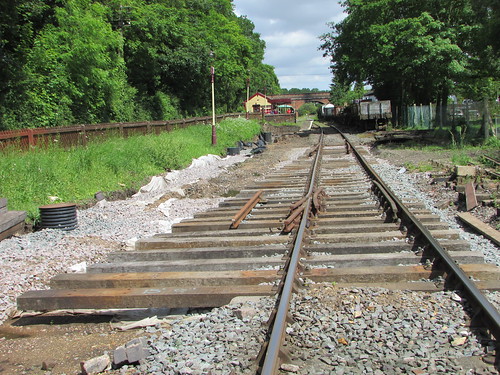
Market Bosworth in 2018: View from foot crossing looking north towards Shackerstone showing work in progress on the new passing loop.
By the time of the 2019 Gala, work on the new loop had proceeded sufficiently to provide a 'turnback siding' which could be used to 'recess' a Steam/DMU 'Shuttle'.

Market Bosworth in 2019: View from foot crossing looking south towards Shenton with the 'Prairie'/DMU Shuttle stabled in the Turnback Siding (50th Anniversary Gala at the Battlefield Line)
Since the point machines to operate the connections to the 'turnback siding' had not yet been installed, during the Anniversary Gala the points had to be manually operated locally before being clipped and locked in both the normal and reverse positions.

Detail of Clipped Trap Points on the Turnback Siding showing Left: point clip secured by a lock. The key for the lock is attached to the single line staff for the Shackerstone-Market Bosworth section; Centre: dual point stretcher bars; Right: extended point timbers to carry a point machine. (50th Anniversary Gala at the Battlefield Line)
Format of Services during the Anniversary Gala
In general, each service train to Shenton, hauled by one of the tender engines, left Platform 2 at Shackerstone and, once clear of Market Bosworth, the 'Shuttle' left Platform 1 at Shackerstone and followed to Market Bosworth, where it unloaded its passengers in the platform and then carefully moved through the new crossover into the 'turnback siding'. It was then 'shut in' until the service train returned from Shenton, after which it was 'turned out' to pick up passengers from Market Bosworth station. When the service train had arrived at Shackerstone and 'cleared' the Single Line Section, the 'Shuttle' was allowed to return to Shackerstone. This format required the use of 'Staff and Ticket' working referred to in 'Background' above.
Operations at Shackerstone
In the post Santa Specials at the Battlefield Line 2017 I commented "The rather cramped track layout at Shackerstone requires careful choreography to manage two trains".
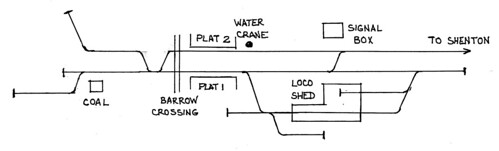
Shackerstone track diagram. North is to the left on this sketch.
Each time the service train arrived back at Shackerstone, the tender engine uncoupled and moved to the north end to wait whilst the other tender engine shunted to the head of the train, ready for the next Shenton departure. Thus, the motive power on the Shenton train alternated between 'Dinmore Manor' and 'Whitwick Hall'. Once this shunt was complete, the Steam/DMU 'Shuttle' could be allowed back into Platform 1.

An atmospheric black-and-white shot, showing 'Dinmore Manor arriving back at Shackerstone, with 'Whitwick Hall' ready to come 'off-shed' to take the next departure for Shenton at the 50th Anniversary Gala (Photo: 'Pip')
Friday 19th October
I was rostered to drive 5542 on the first day of the Gala, Friday 19th October. On my arrival, the fireman and cleaner had already lit-up. I was a bit worried by the large fire they'd 'set' since we were only going as far as Market Bosworth with a featherweight train (the 2-car DMU) and would be doing a lot of standing around. I'm afraid the engine had started to blow-off fiercely before we had even moved out of the shed, to the annoyance of the crews preparing the two tender engines. 5542 continued to blow off, almost continuously, for the next hour or so.
We'd not been able to fill the side tanks at Shackerstone but I judged that we carried enough water to do one or perhaps two round trips to Market Bosworth, so we completed our first round trip to Market Bosworth successfully (apart from the irritation of the discharging safety valves). There's a fire hose connection at the south end of platform 1 and we found that this would deliver around 300 gallons in about 15 minutes. Since the trip to Market Bosworth had used about 300 gallons, I was reassured that, if necessary, we could keep going without visiting the water column on platform 2. Water supplies are always uppermost in the mind of steam locomotive footplate crews. I talked about this in the section 'Locomotive Water Supplies' of the post here and described the various methods of storing water on engines here.

5542 and 2-car DMU 'recessed' in the 'turnback siding' at Market Bosworth (50th Anniversary Gala at the Battlefield Line)

Dinmore Manor' running tender first approaches Market Bosworth with a Down train, having been 'called by' the Stop Board (far left) with a Yellow Flag from the Person In Charge. The 'Prairie'/DMU Shuttle in the Turnback Siding waits for the road back to Shackerstone (50th Anniversary Gala at the Battlefield Line)

Market Bosworth station with all eyes on the approaching Down train, which has been 'called by' the Stop Board with a Yellow Flag by the Person In Charge, seen holding the now-furled flag (50th Anniversary Gala at the Battlefield Line)
Then, on our second trip to Market Bosworth, the boiler pressure collapsed so dramatically that I had to 'nurse' the train for the last mile to Market Bosworth, with the brakes starting to drag. The fireman's attempts to remedy the situation whilst we unloaded the passengers were not successful and, when we received the 'tip' to move into the 'turnback siding', there was insufficient boiler pressure for the ejector to release the vacuum brakes. A rather grumpy driver picked up the shovel and set about improving matters so as to allow us to move clear of the single line before the service train returned from Shenton. I'm glad to report that the fireman kept the boiler in a satisfactory condition thereafter.
Once back at Shackerstone, we used the fire hose to replenish our water tanks but, later in the day, we shunted our whole train (steam locomotive plus DMU) across to platform 2 to fill the tanks from the water column. Overall, a very enjoyable day.
Sunday 21st October
Although I'd been rostered for the Sunday, a change in the roster meant I became 'spare'. I had a couple of round trips riding on the footplate of 'Dinmore Manor', ostensibly mentoring a very promising young fireman, then later in the day, I did a bit of DMU driving on the Steam/DMU 'Shuttle'. This was an interesting contrast with driving 'the other end' on Friday. Otherwise, I was able to actually chat with some of our volunteers and look at the 'Other attractions'.
Other attractions
Refreshments were available in the Victorian Tea Room at Shackerstone, the station buffet at Market Bosworth, the goods shed buffet at Market Bosworth, the station buffet at Shenton and in the Buffet Car on the service train.
Gifts and souvenirs were offered by the Station Fund Stall and the Platform 2 shop at Shackerstone, where the Museum was also open and there were displays charting the history of the line since preservation in the booking hall.


Part of the photographic display in the booking hall at Shackerstone for the 50th Anniversary (Battlefield Line 2019).
The Goods Shed at Market Bosworth had further attractions: the LMS 'Patriot' Project had a sales stall and
the Gauge 1 Society displayed their layout featuring live-steam radio-controlled models.

The Gauge 1 Society displayed their layout in the Goods Shed at Market Bosworth (50th Anniversary Gala at the Battlefield Line)

The Gauge 1 Society displayed their layout in the Goods Shed at Market Bosworth, including this 'Bury' L&B 0-4-0 featuring 3D printed parts (50th Anniversary Gala at the Battlefield Line)
Other posts on this website about the Battlefield Line
To see all my posts about the Battlefield Line, select Label 'Battlefield Line' or click here.
To see all posts with Mutual Improvement Class content, select label 'MIC'or click here or look at the index at Mutual Improvement Classes (2).
My photograph albums
Where necessary, clicking on an image above will display an 'uncropped' view.
50th Anniversary Gala at the Battlefield Line
To see all my Battlefield Line pictures, click here.
Related posts on other websites
5542 'Light Prairie'.
7820 'Dinmore Manor' Locomotive Limited.
6989 'Wightwick Hall'.
Other posts on this website about the Battlefield Line
To see all my posts about the Battlefield Line, select Label 'Battlefield Line' or click here.
To see all posts with Mutual Improvement Class content, select label 'MIC'or click here or look at the index at Mutual Improvement Classes (2).
My photograph albums
Where necessary, clicking on an image above will display an 'uncropped' view or, alternately, pictures may be selected, viewed or downloaded, in various sizes, from the album listed:-
50th Anniversary Gala at the Battlefield Line
To see all my Battlefield Line pictures, click here.
The Battlefield Line is home to two preserved British Railways 'Modernisation' Diesel Multiple Units (DMU) - a 2-car set and a single-unit 'Bubble Car'. At different times, these have operated in various 1- 2- or 3-car formations. You can find all my DMU posts here or by selecting 'DMU' from the list in 'Labels to select a blog topic'.
It's possible to 'top and tail' with a DMU and a steam locomotive where the steam locomotive does the driving in one direction and the DMU does the other and this post reviews times when that's happened.
'Thomas' events
As part of 'Thomas' events, we often ran 'Thomas' coupled to a DMU (posing as 'Daisy' and carrying a 'face' headboard): for instance:-
Day out with Thomas: 2009
Happy Birthday Thomas! (part 2)
The Steam/DMU 'Shuttle' was issued with the Shenton staff at Shackerstone and ran down the single line whilst the engine off the service train was running round and watering. The 'Shuttle' only went as far as Headley's Crossing (just over a mile from Shackerstone) before returning. On arrival back at Shackerstone, the next service train could leave for Shenton. This is how we worked the Steam/DMU 'Shuttles' during 'Thomas' events:-
'Thomas' was vacuum-braked for working passenger trains and the 'Modernisation' DMU were also fitted with vacuum brakes, so it was possible to work 'Thomas' coupled to the DMU with braking controlled from whichever was the leading vehicle. The DMU were designed for intensive stopping services with frequent station stops, so they were provided with a special 'high speed' vacuum brake where a second pipe runs down the train to enable vacuum to be re-created quickly, even when a number of units are being worked in multiple. When coupling the DMU to 'Thomas', the shunter had to remember that the vacuum hose on the DMU with the red-painted coupling was the vacuum brake which had to be coupled to 'Thomas'. The other (blue) coupling remained on the stopper. It wasn't actually possible to connect them the wrong way round because, although the hose couplings look similar one is 'Left-hand' and the other 'right-hand'.
With the DMU leading, the driver on 'Thomas' shut off the steam supply to the vacuum ejector and placed the brake application valve in the 'Running' or 'Lap' position so that the DMU driver had control of the brakes. The DMU was driven normally, with the vacuum created by the DMU's exhausters, and 'Thomas' was just 'tail traffic'.
On arrival at Headley's Crossing, the DMU driver usually shut down the cab and moved to the other end of the train. The cab next to 'Thomas' was opened up and the vacuum brake application valve was placed in the 'Lap' position. The DMU driver also needed to operate the 'Deadmans' device (and keep it operated throughout the journey), otherwise 'Thomas'was unable to create vacuum using the locomotive ejector. The DMU final drive was set for the direction of travel and 4th gear selected (4th gear has a 'freewheel' arrangement) with the engines left idling. 'Thomas' was then able to haul the DMU back to Shackerstone as if it were hauling normal coaches. It was possible for the DMU driver to remain in the cab remote from 'Thomas' throughout but I always preferred to 'change ends' to facilitate communication with the steam locomotive.
 Jan (this time on 'Thomas') collects the Single Line Staff as Daisy pulls a 'Shuttle' out of Shackerstone back in 2010. Since then, the rules have changed: the staff is now carried by the leading locomotive (photo: Sam Brandist)
'Ivor' events
We adopted a similar operating arrangement during visits from Ivor the engine. My reports are listed below:-
Ivor the Engine
Ivor the Engine: 2008
Ivor: The best laid plans...

'Ivor' with 'half a DMU' taking water in platform 1 at Shackerstone during a 2008 visit.
Operation of GWR Steam/DMU 'Shuttles' during the 2019 Gala
The 2019 Gala timetable called for a frequent Steam/DMU 'Shuttle' between Shackerstone and Market Bosworth, using Great Western 'Light Prairie' 5542. The method of operation has to be revised somewhat when the steam locomotive is a Great Western design. The Great Western were never afraid to be different and this is the case with the their locomotive vacuum brake systems. Whereas other railways were content to operate with a partial vacuum of 21 inches of Mercury (in/Hg), the Great Western decided to use 25 inches of Mercury. This offers a more powerful brake better able to tolerate minor leakage. For a brief introduction to the vacuum brake, see the post MIC - Brakes.
With 5542 leading, the locomotive creates the brake using its ejector at 25 in/Hg. Although the exhausters on the DMU will only create 21 in/Hg, this does not prevent the locomotive creating a higher vacuum in the train pipe and the vacuum brakes work normally.
When the direction of travel is reversed and the DMU is leading, the DMU would normally 'create the brake'. But with the DMU creating 21 in/Hg in the Train Pipe (and below the piston in the brake cylinders) whilst there is still 25 in/Hg above the piston in the brake cylinders (created when the steam locomotive was leading), the brakes will not fully release. This problem occurs with locomotive-hauled stock when a locomotive creating 21 in/Hg takes over a train previously hauled by a Great Western engine, where the solution is to release the brakes by 'pulling the strings' (as described in the post MIC - Brakes).
There's a further problem with the GWR Steam/DMU combination. Great Western locomotives have a crosshead-driven vacuum pump which, at moderate speeds, will maintain 25 in/Hg in the train pipe even with the locomotive ejector shut-off. So, even if 'pulling the strings' has allowed the train to move away with the DMU's exhausters creating 21 in/Hg, at moderate speeds the locomotive's vacuum pump will create a higher vacuum both above and below the piston in the brake cylinders. This is no problem until the driver of the DMU makes a brake application, for instance, to comply with a speed restriction. After passing through the restriction, releasing the brake will create 21 in/Hg in the Train Pipe (and below the piston in the brake cylinders) whilst there is still 25 in/Hg above the piston in the brake cylinders (previously created by the steam locomotive vacuum pump) and the brakes will not fully release. At reduced speeds, the vacuum pump may not 'boost' the train pipe above 21 in/Hg and the brakes may 'drag'.
The solution adopted was to let the steam locomotive create the vacuum in both directions of travel and operate at 25 in/Hg, which worked well. Where a train is worked by two locomotives (either double-headed or 'top and tail') it's normal for only the leading engine to 'make the brake' but, in case of difficulty in maintaining adequate vacuum, the enginemen may agree to a modified arrangement.
For the Gala in 2018, a push-pull 'auto' train between Shackerstone and Market Bosworth had been operated with two single line sections (Shackerstone - Market Bosworth and Market Bosworth - Shenton), together with 'Staff and Ticket Working'. This is described in the post Battlefield Line Steam Gala 2018 (Part 1).
By the time of the 2019 Gala, work on the new passing loop at Market Bosworth had proceeded sufficiently to provide a 'turnback siding' which could be used to 'recess' a Steam/DMU 'Shuttle'. Since the point machines to operate the connections to the siding had not been commissioned, the points had to be manually operated from the ground before being clipped and locked in both the normal and reverse positions.
5542 and 2-car DMU 'recessed' in the 'turnback siding' at Market Bosworth (50th Anniversary Gala at the Battlefield Line)
Other posts on this website about the Battlefield Line
To see all my posts about the Battlefield Line, select Label 'Battlefield Line' or click here.
To see all posts with Mutual Improvement Class content, select label 'MIC'or click here or look at the index at Mutual Improvement Classes (2).
My photograph albums
Where necessary, clicking on an image above will display an 'uncropped' view.
To see all my Battlefield Line pictures, click here.
The year started with the Last Train Monmouth-Chepstow Re-enactment on 1st January 2019. I wasn't on the footplate that day, but attended the well-patronised event which is described here.

Last Train Monmouth-Chepstow Re-enactment.
Since the re-enactment, I've carried out driving turns at the Battlefield Line fairly frequently in 2019, using both steam and Diesel Multiple Units.
Before 'Pannier' 6430 left the railway, I had two days on the engine - Saturday, 16th February 2019 and Wednesday 20th February (described here).

Pannier Tank 6430: Being prepared at Shackerstone.
Once popular 'Light Prairie' 5542 returned to Shackerstone, that has provided the season's steam motive power. My turns on 31st March (Mothering Sunday), 22nd April (Bank Holiday Monday) and Sunday 28th April are described in the post here but further turns on Saturday 25th May, Sunday 2nd June, Sunday 16th June (Fathers' Day), Sunday 30th June and Sunday 21st July haven't produced separate reports.

5224 at the Battlefield Line.
Saturday 3rd August 2019
After driving the service trains during the day, I made two round trips to Shenton with the Fish and Chip Special. That day is described here.

The Driver's View (Battlefield Line: 3-Aug-2019)
Saturday 10th August 2019
Just a week after the Fish and Chip special, I was back on 5542, with Jamie as fireman. We both enjoyed the day.
Bank Holiday Monday 26 Aug 2019
The Bank Holiday weekend, which was also the Battlefield Line's Family Fun Weekend, proved very hot. I was rostered on Monday and and Sunday's driver had warned me to beware heat exhaustion. At short notice, Adrian was drafted in to fire and he was happy to fire all day. Before leaving the shed, oiling underneath was particularly difficult because of the amount of ash in the pit but once preparation was done I was a lot happier. It was hot when we were standing but, in motion, the moving air made things much better. Towards the end of the day we had some injector problems as the injector bodies warmed-up but we kept them going by running water through them them for a few seconds before opening the injector steam cock. We had a good day, with plenty of passengers.
Wednesday 28 Aug 2019
Two days later, I was back at the railway driving the midweek diesel railcar service.

DMU at Shackerstone MPD, seen during Daily Exam on 28th August 2019.
Sunday 8th September 2019
Another turn on 5542 with Stephen W. firing. My friend Mike S. from Peak Rail visited and fired a couple of round trips. The picture below shows the driver's view into the pit during oiling round when perched on the leading coupled axle.

Shackerstone, 2019: The joys of loco preparation.
Wednesday 11th September 2019
Three days later, I was back at the railway driving another midweek diesel railcar service.
Sunday 22nd Sep 2019
I'd been booked to drive 5542 on 22nd September but the previous day, 5542 had failed. A driver for the substitute DMU on the 22nd had already been found so I was not required.
Sunday 6th October 2019
It took a few days for the engineering staff to identify and rectify the fault on 5542. The problem which had eluded us for a while was found to be a leaking superheater element which finally revealed itself as the leak became aggravated. Following replacement of the superheater element the locomotive had performed had well on Saturday 5th October following repair so I was looking forward my shift on 5542 the next day. Unfortunately the "powers that be" didn't manage to find a fireman or let me know so I started lighting up, thinking the fireman was late. I couldn't raise anybody by phone so eventually I abandoned preparation of 5542 and instead prepared the diesel railcar as a substitute. We ran to the timetable without difficulty, of course, but I spent a fair while apologising to disappointed passengers.

Diesel substitution on Sunday, October 6th (Battlefield Line 2019)
Diesel Multiple Unit Operations
In addition to deputising for steam services on occasion, midweek services are normally scheduled to be operated by a diesel railcar. At present, that usually means half of a 2-car set coupled to a 1-car ('Bubble Car') whilst the other half of the 2-car set receives extensive 'Tender Loving Care' in the shed. This year, I've been rostered for midweek services on the following dates:-
Thursday 30th May, Wednesday 3rd July, Thursday 18th July, Wednesday 28th August, Wednesday 11th September, Wednesday 9th October.
Although I've not added new DMU posts recently, you can find a list of earlier posts (with links) here.
50th Anniversary Steam Gala is coming...
In 2019 the Shackerstone Railway Society is celebrating 50 years since its founding. I've only been a member for around half of that time. To celebrate that event, the Society is organising a Steam Gala on the 19th, 20th and 21st October. In the booking hall at Shackerstone station, there's a photographic display charting the history of the line since preservation.
Part of the photographic display in the booking hall at Shackerstone for the 50th Anniversary (Battlefield Line 2019).
On Wednesday October 9th, the locomotive 7820 'Dinmore Manor' (less tender) arrived by specialist hauliers Reid Freight Services to take part in the Steam Gala.
7820 'Dinmore Manor' arriving at Shackerstone for the 50th Anniversary Steam Gala (Battlefield Line 2019).
Related posts on this website about 5542
Preparing 5542 (part 1).
Preparing 5542 (part 2)
There are also a number of other posts with technical content about working on 5542:-
GWR 'Light Prairie' 5542 (22-Aug-2010)
On the Footplate (5-Dec-2017)
Santa Specials at the Battlefield Line 2017 (19-Dec-2017)
5542 at the Battlefield Line (28-Aug-2018)
Battlefield Line 'Family Fun Weekend' (3-Sep-2018)
5542 at the Battlefield Line in 2019 (30-Jul-2019)
Fish and Chip Special (4-Aug-2019)
Other posts on this website about the Battlefield Line in 2019
Last Train Monmouth-Chepstow Re-enactment (1-Jan-2019).
'Pannier' 6430 at the Battlefield Line (16-Feb-2019, 20-Feb-2019)
To see all my posts about the Battlefield Line, select Label 'Battlefield Line' or click here.
To see all posts with Mutual Improvement Class content, select label 'MIC'or click here or look at the index at Mutual Improvement Classes (2).
My photograph albums
Where necessary, clicking on an image above will display an 'uncropped' view or, alternately, pictures may be selected, viewed or downloaded, in various sizes, from the album listed:-
6430 GWR Pannier Tank
5542 GWR Locomotive
Battlefield Line 2019
Even casual perusal of this blog is likely to reveal my enthusiasm for driving steam locomotives, latterly at a couple of preserved railways in the United Kingdom. At the Battlefield Line, I also drive the Diesel Multiple Units (DMU) owned by Ritchie Marcus and there's a steadily-increasing number of posts describing this (you can find them all here or by selecting 'DMU' from the list in 'Labels to select a blog topic').
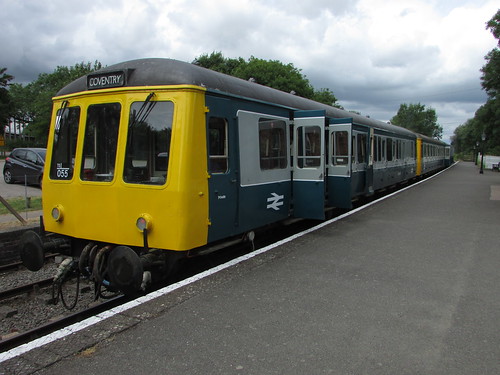
DMU Days at the Battlefield Line: After taking the school party to Shenton on 4th July 2017, the 1-car coupled to the 2-car set wait at Shenton prior to the return to Shackerstone.
In the summer of 2018, these diesel railcars provide the 'Midweek Services' on Tuesdays, Wednesdays and Thursdays so I seem to be getting regular DMU driving turns. I've always enjoyed driving the 'British Railways Modernisation' DMUs, which I remember from my own childhood when they were first introduced but the afflictions of increasing age make a 'diesel day' increasingly attractive for a number of reasons.
Firstly, preparation time is much reduced, compared with steam. 'Checking levels', as on a car, is required but the laborious 'oiling round' is avoided. Whilst a visual examination around the underframe is essential, once the engines are started, also from ground level, the driver can return to the cab whilst the compressors establish sufficient control air pressure to allow movement.
Secondly, driving is carried out whilst seated. Whilst I don't find the seat design particularly good (and manoeuvring around it is tight), it represents luxury compared with most steam locomotives which either make no provision for sitting or offer a rather mean wooden tip-up seat. Gresley is renowned for fitting a padded leather bucket seat on some of his steam locomotives. On most designs, many drivers (the writer included) preferred to remain standing to make the most of the poor forward vision offered by the cab design.
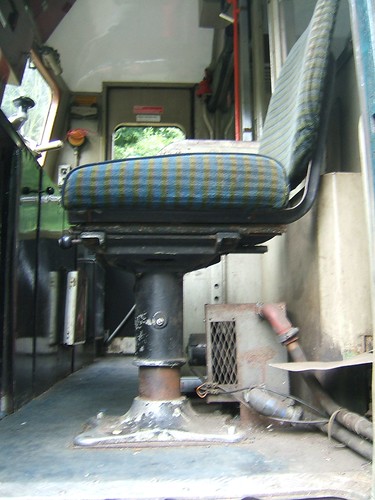
Detail of the driver's adjustable seat.
I often say '90% of a driver's attention should be focussed on the line ahead'. We can debate the exact percentage but keeping a good lookout is vitally important. The windows across the full width of the DMU cab give a panoramic view down the line very welcome to steam drivers brought up on leaning out of the cab to get reasonable sightlines around the front of the boiler. Provided the blinds at the rear of the DMU cab are raised, the passengers, too, can enjoy the view of the route ahead. The blinds were provided, of course, for use at night when the lights in the passenger compartment would otherwise damage the driver's night vision. More modern designs of diesel railcar reverted to solid walls between passengers and cab.
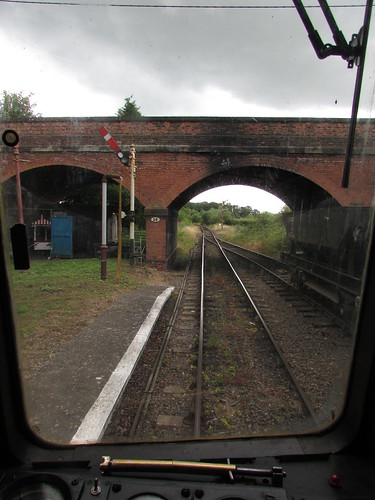
DMU Days at the Battlefield Line: Driver's view leaving Market Bosworth for Shackerstone.
On a steam-hauled train, to give the driver any chance of watching the line ahead, it's a requirement that the locomotive is a the front of the train (except where special arrangements are made called 'push-pull' or 'auto' trains). This means that, at each and of the line, there's a period of furious activity where the locomotive is uncoupled from the coaches, shunted to the other end of the train and re-coupled. On DMU, a driving cab is provided at each end of the train so that, at the end of the line, it's only necessary for the driver to 'close' what had been the leading cab, move to the other end of the train and 'open' what had been the 'back cab' so as to become the leading cab. The business of 'closing' and 'opening' cabs involves the transfer of an electrical master key and removable handles to control the final drive and braking systems.
Although the supply of coal carried by a steam locomotive is normally arranged to suffice for a whole day, the water supply (which is boiled to produce steam, used to impel a piston up and down a cylinder producing useful work and then discharged as exhaust steam from the chimney) often requires replenishment a number of times a day. By contrast, a DMU may be able to run for a number of days before the diesel fuel tanks require topping-up and water (used to cool the diesel engines, as in a car) is recirculated.
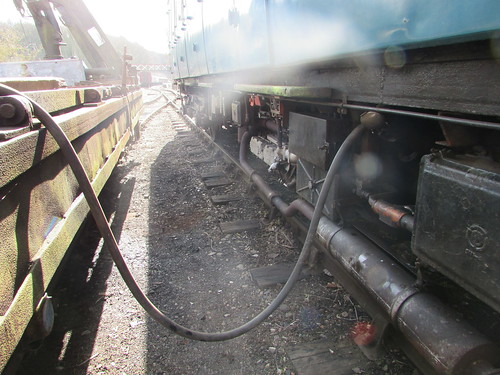 Refuelling the DMU at Shackerstone.
On a DMU, the driving controls, instruments and indications are laid out on the desk in front of the driver in a reasonably ergonomic manner unheard of on steam locomotives although Riddles, in designing the British Railways 'Standard' steam locomotives, attempted a convenient layout.
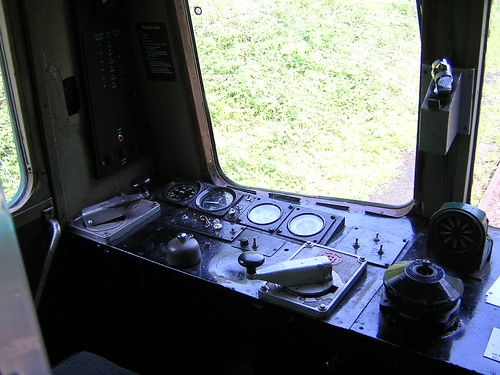
The driving controls, instruments and indications are neatly laid out on the desk in front of the driver.
Drivers also appreciated the 'power on demand' nature of the DMU. With steam traction, the power available to work the train depended upon many factors including time since last 'shopping', time since last boiler washout, quality of coal and, not least, attitude and competence of the fireman. In contrast, a DMU normally works as intended or doesn't work at all. That's a bit of a simplification but, in general, when a diesel driver opens the throttle, the power will flow, giving the driver a feeling of confidence that the job will go well.
But perhaps the best feature of working on a DMU is the opportunity to meet passengers. Many passengers seek out a seat in the leading coach where they can see the line ahead and watch the driver at work. In stations, passengers (men, ladies and children) can often be seen studying the cab and may ask questions. When working on steam, although we always try to acknowledge anyone nearby, the workload involved hinted at above means that a protracted chat is rarely possible. In contrast, when working on a DMU there are better opportunities for passengers to take photographs of the driver's 'office' or to answer questions (admittedly at the risk of boring them to tears - 'too much information'). I never cease to be amazed at the interesting backgrounds and experiences of our visitors. And, at the end of the day, I'm not quite as shattered (or dirty) as after a steam 'turn'.
 One of the two underframe-mounted heater units on each coach.


