Showing posts with label CH1. Show all posts

Wednesday, 25 November 2020

China (part 2)

Introduction

In 2002, I made my first visit to China. I'd not heard of 'blogging' then (there's an interesting history of blogging in Ryan Robinson's blog here) so it was not until 2007 that I started to describe this trip in the post China. At that time, I was still using a 35mm roll-film Canon 'EOS' camera so I was quite sparing in taking photographs and those I did take didn't get scanned and made available on the internet for years.

The 2007 post covers Beijing area (Tiananmen Square, the Forbidden Palace, solo tour of the city and its subway, next day Ming Tombs, Chinese Hospital, Cloisonne factory, the Great Wall), flying to Xian (City Wall, Buddhist Monastery, Big Wild Goose Pagoda, next day Terracotta Army, Flying to Chongqing (board Yangtse cruise ship 'Pinghu', next day start our journey dowmnstream). Then, the description stops with the cheerful comment "I hope to tell you more later". I didn't return to the topic until I talked about an incident in Beijing right at the end of the trip in the post here. That finally induced me to finish describing my introduction to China but with few pictures to prompt the memory and any contemporaneous notes lost long ago, it will be a little sketchy.

The Yangtse River

The Yangtse cruise proved a good choice as it enabled me to see some of the contrasts China offers, start to understand the importance of the river as an ancient highway and appreciate the breathtaking scope of some of the projects being undertaken in China as it asserts its place in the modern world.


Chongqing-Yichang Yangtse River Cruise (Map: China Discovery)

As described here I'd boarded 'Pinghu' in the dark one evening and the following morning we set off downstream with the weather misty and occasionally rainy. I think Fengdu Ghost City on the northern bank was our first stop, where I gathered contrasting impressions of an ancient temple on high ground and a modern town being demolished virtually by hand prior to inundation. As we continued downstream, there were demonstrations of Chinese arts and crafts on board.
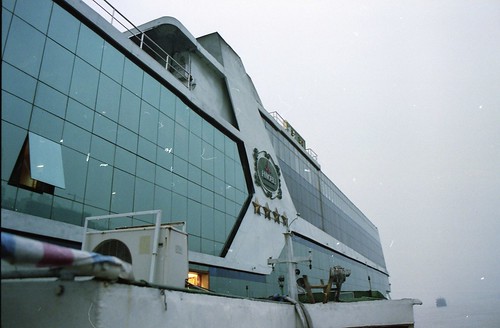

My cruise ship 'Pinghu', viewed from tender taking us ashore.


My cruise ship 'Pinghu', moored midstream in the Yangtse viewed from tender taking us ashore. Note the modern hilltop town top right of the picture.


My cabin aboard 'Pinghu' (Yangtse River Cruise)

Our next visit was to Baidicheng (which means white emperor city), an ancient hilltop fortress and temple complex offering views downstream towards the first of the Three Gorges we would pass through on our cruise - the Qutang Gorge. We had to climb a long, steep path to reach the site and I was rather tempted by the offers of transport to the top by groups of porters using home-made 'sedan chairs' comprising a sort of deck-chair with a simple roof fixed to a stout carrying beam. Resisting temptation, I made it both ways under my own power.


The steep path from the landing place to Baidicheng (Yangtse River Cruise)

I enjoyed wandering around the temple site which commanded good views of the Yangtse River and the Qutang Gorge we would cruise next. I've included a picture of Jan with a carved female guardian lion (Jan is on the left)


Jan and carved female guardian lion at Baidicheng (Yangtse River Cruise)
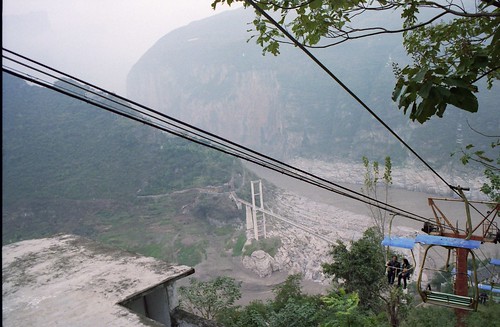

View of chair lift, suspension bridge and Qutang Gorge at Baidicheng in 2002 (Yangtse River Cruise)

The weather didn't improve as we made our way downstream. It was certainly 'atmospheric' but a bit damp. We passed through the Wu Gorge and went ashore for an excursion on a much smaller boat on a 60 km long tributary of the Yangtse called the Shennong Stream. It's an area of great beauty which I'm afraid we didn't see at its best. The rain sluiced down remorselessly so I didn't risk taking a camera but you can read a modern description of the area here, which talks about 'sampan drifting' in an unpowered, wooden-hulled double-ended craft (sometimes called a 'pod boat' because of its shape). We boarded one of these boats, with two helmsmen, one each end, each provided with a large oar principally used for steering. Of course, initially we were heading against the current so motive power was provided by a line of men scrambling along the bank ahead of us, man-hauling on a substantial rope attached to our vessel. The weather conditions made it difficult for the men to keep their balance and I witnessed a number of near-accidents. To add to the incongruity of the scene, all the haulers had donned plastic ponchos to keep out the worst of the weather. When the helmsmen decided we'd gone far enough, one of the shore party scrambled aboard the boat, bringing the haulage rope with him, leaving the rest of the men to make their way back to the loading point and, presumably, do it all again. Even in the rain and with impaired visibility, it was very pleasant to be silently drifting with the current back to our boarding point and it seemed a different world from the commercial bustle of the Yangtse with its procession of cargo ships and passenger ferries in both directions, occasionally punctuated by the loud exhaust of the hydrofoil ferries. Once safely back aboard 'Pinghu' and with the opportunity to dry-out, our journey continued into the third gorge - Xiling Gorge.

Despite the generally indifferent weather, I spent a fair bit of time outside on the upper deck, trying to absorb the majesty of the deep gorges and trying (but failing) to imagine the changes completion of the Three Gorges would bring, with the river level raised three hundred feet.


Signs on riverbank indicating planned rise in water level. The upper sign indicates 175m above sea level - the planned river level after completion of the Three Gorges Dam (Yangtse River Cruise)


Passing through the Three Gorges of the Yangtse River before inundation (Yangtse River Cruise)

The picture above also shows the mast on 'Pinghu' and the 'christmas tree' effect created by the various branches carrying navigation lights. After dark, I spent some time on the outside upper deck, fascinated by the amount of river traffic still moving, with the different displays of navigation lights indicating each ship's status - anchored, under way, towing.

I was disappointed by the actual Three Gorges Dam site. Although there was plenty of earthmoving going on, I'd failed to fully appreciate that we were passing what would become the base of the dam and that the impressive appearance of a large dam would only appear later. Our cruise terminated at Yichang where a large number of ferries were moored.


Ferry moorings at Yichang (Yangtse River Cruise)

I met up with a local guide who took me by car to the Chinese Sturgeon Museum set up in 1982 which is attempting preservation of this endangered species. There were interesting displays but I found the large, tiled pools housing live Chinese Sturgeon rather depressing, I'm afraid. There's a Wikipedia article here.


Chinese Sturgeon Museum, Yichang (Yangtse River Cruise)

Next, we visited Yichang Museum where there was a very well-displayed exhibition of artefacts from the area, many uncovered during the massive civil works involved in relocating towns along the Three Gorges at a higher level. Finally, I was taken to the Gezhouba Dam with its Navigation Locks allowing ships up to 10,000 tons to by-pass the dam. This project, started in 1970, was completed in 1988 and the 47 metre high dam has a generating capacity of 2.71GW. The scale of the ship locks is impressive but I was particularly taken by the almost continuous stream of pedestrians slowly making their way across the river, in both directions, using the walkways built along the top of the lock gates.


Gezouba: Navigation Lock Gate (Yangtse River Cruise)

My guide then took me to Yichang airport for my internal flight back to Beijing. Back in Beijing, I was returned to the same hotel I'd used on my arrival in Beijing to prepare for my final flight home. It was on a walk in Beijing before my transfer to the international airport that I had the unfortunate brush with the local police described here. Despite that hiccup, it had been a wonderful trip and I'm pleased that I got to see the Three Gorges before the dam was completed.

Related material on other websites

China's Mighty River (1930s article from 'Shipping Wonders of the World).
Yangtse River (Facts and Details site)
Chinese Sturgeon (Wikipedia)

My pictures of the 2002 trip

Beijing, China
Xian, China
Yangtse River, China

Wednesday, 3 January 2007

China

Back in 2002, when I read about the Three Gorges Project in China and how the completion of the hydro-electric project would permanently alter the appearance of the famous Three Gorges (raising the water level some 300 feet), I determined to see the area for myself before the flooding commenced.

I flew to Beijing (Peking) and was amazed at the huge modern airport. My guide took me to an equally modern American-style hotel in the centre of the city. Later, my guide took me to Tiananmen Square, crowded with tourists from every part of the huge country which is China but with very few Westerners. Despite the historic associations, I found it unthreatening. The huge parliament building lies on one side of the massive square, but the natural focus is the massive outer walls and gatehouse of the Forbidden City, carrying a large painting of Chairman Mao.

Along with hordes of tourists, we entered the Forbidden City, on payment of a few Yuan. For centuries only the highest castes of Chinese had been allowed into this palace (hence the name) and, when the Communsts took over, they lost no time in throwing it open to the people in a highly symbolic act. China has been criticised for its former poor standards of conservation and, it has to be said, some parts of this incredible city are rather down at heel. But there is a lot of work in progress and it appears to be of high qualty. The city is arranged as a series of concentric walls with hundreds of guest houses and palaces, becoming more important as you reach the centre of the city where only those closest to the Emperor were allowed. The overall effect is mind-boggling. One jarring note as we were fairly near the centre of the Forbidden City was a building attracting queues of people. "Starbucks!" said the guide proudly and he seemed quite disappointed that I had no desire to visit this particular building.

On an evening walking tour on my own of the brightly-lit city, I found modern shops representing all the Western designers and it was hard to believe that you were not in Europe. But I managed to work out how the Subway works and I went further afield where the lights were not so bright and the department stores more modest. I saw very few Europeans but I did not feel uncomfortable. Of course, I had some technical interest in how the Subway was built and operated. At the front of the train, it was possible to get a restricted view into the driving cab and along the track ahead. The trains are Driver Only Operation and the drivers follow the Japanese practice of pointing at each signal as they approach it and declaiming out loud the aspect displayed. I also visited the huge main line station which, even late at night was thronged with people. Eventually, I returned safely to my hotel to prepare for the organised private tour the following day.

First, we went to the Ming Tombs, out in the country, where successive emperors were buried. The scale of the place is impressive, particularly the underground tomb chambers. There were plenty of tourists, both Chinese and overseas visitors. Next, a visit to a Chinese 'hospital'. Coachloads of tourists were arriving for a brief consultation with a Chinese doctor, resulting in the prescribing of various herbal remedies on sale in the adjacent dispensary. Diagnosis is principally by the taking of the pulse on both wrists simultaneously, together with a careful assessment of the patient's appearance. The male doctor only spoke Chinese but a 'nurse' was on hand to translate the doctor's comments. The Chinese idea of 'chi' flowing through 'meridians' in the body is contrary to Western medicine, but the effectiveness of some Chinese techniques is slowly being accepted in the West. We then moved on to a factory where Cloisonne work was being produced. It's a fascinating and very labour-intensive process and I was happy to make some small purchases before being whisked away to see the Great Wall of China, where we arrived late afternoon.

All the pictures I'd seen of the Wall didn't prepare me for the sheer scale of the construction, as it snaked away into the distance following the contours of the exceptionally hilly terrain. In many places, the Wall has been lost or is in a poor state of repair but here, North of Beijing, a lot of work has been carried out and this is the section of the Wall that the majority of tourists see. I would have been content to have spent a lot longer walking the Wall: most tourists are happy to walk a few hundred yards and return so it's fairly easy to get to quieter spots where you can readily imagine the patrols charged with guarding the empire, so many centuries ago.

I took an internal flight to the city of Xian (pronounced 'see-ann'), which is a major modern city with an ancient core still surrounded by a massive brick-built wall. After studying the walls, which have survived remarkably well, we travelled through the noisy, bustling city to the quiet of a Bhuddist monastery. Helped by the number of visitors, they have been able to fund a new temple, built in the traditional style. The other attraction is the medieval Big Wild Goose Pagoda which you can ascend, on payment of a modest fee. From the top level, there is a marvellous panorama of the city.

I spent one night in a very pleasant Western-style hotel in the suburbs, before moving on to view the Terracotta Army. The Emperor Qin ('chin') prepared a huge mausoleum for himself during his lifetime, with thousands of clay soldiers, life size, to guard his remains. This prototype strong man of China was so reviled that his body lay undisturbed for only a few years before the whole complex was sacked and burnt. The extent of the works were forgotten until a few years ago, when three farmers digging a well started to uncover fragments of the soldiers. There are already three different museum buildings covering the excavations so far. The largest is built like an aircraft hanger, filled with excavated trenches containing rank after rank of clay soldiers. Each soldier's head was individually modelled and, originally, painted. Most of the figures currently on display have a brownish, clay appearance. It is a truly amazing site. My visit was out of season and I was able to get around the museums quite easily. But, be warned, I'm told it can be a real scrum at the height of the season. The international airport at Xian was built specifically so that China could exploit the tourist potential of the Terracotta Army. I also visited a factory in Xian where they produce wonderful furniture and, in various scales, models of the terracotta warriors using the local clay. I was so impressed, I arranged for the firm to ship back a full-size kneeling archer and full-size senior officer. These replicas invariably attract a lot of interest when people visit me.

Then on again, by another internal flight to the city of Chungking, where I arrived late at night. I think Chungking is currently the largest city in the world, as people leave the poverty of the countryside to try to achieve a better standard of living in the city. China's remarkable growth rates are being fuelled by this flight from agriculture but life in manufacturing is very tough, by Western standards.

We drove through the city to the banks of the Yangtse River, where I was to join a cruise ship for a trip through the Three Gorges. There's a series of concrete steps leading down to the water's edge, difficult to negotiate in the dark when you're tired. Worse was the very insubstantial-looking duckboards stretching right out into the river, ending at the brightly-lit cruise ship. Members of the crew were positioned on the duckboards every so often, holding rather ineffective electric torches by way of encouragement. At least my luggage was brought out for me. The ship, the 'Pinghu' was modern and spacious and within a few minutes I was able to collapse in my very decent cabin, re-united with my luggage.

Next morning, we bade farewell to Chungking and slipped our moorings to cruise downstream to the Three Gorges. It was raining and a heavy mist lay over everything, but I braved to upper deck to see what could be seen. The rain continued for quite a bit of the journey - it was certainly atmospheric, even if perhaps I didn't see the Three Gorges at their best. I hadn't realised that the Yangtze is such a vital communications artery in this part of China. The river traffic was amazing with large and small vessels of all descriptions. There is a wide variety of passenger ferries and quite large cargo vessels. The oddest and fastest vessels are perhaps the hydrofoil ferries, which appear to follow the Russian design, looking more like an aircraft with the 'fuselage' set in a sit-up-and-beg attitude on the hydroplanes. These noisy craft overtake everything on the river, throwing up a huge plume of spray at the stern. Quite a lot of coal is loaded into barges for river transport - the working practices would shock a European Heath and Safety Inspector. All sorts of towns are visible, mainly of modern construction. Once the dam is in service, the river level will rise to inundate most of the adjacent land, so newer towns have been built on higher land. I got a better look at this when we tied up for a shore visit.

We left the ship by the usual duckboards leading to the shore and were taken by bus to an ancient temple on high ground. Looking down towards the river, we could see a moonscape, where the old town was being demolished, a bleak vista of great lumps of broken cement, all covered in dust. When we returned to river level, I walked in the old town where hundreds of workmen were engaged in the demolition work. Although there were a few machines involved in the work, most of the demolition was being done by hand. I saw men precariously balanced on the remaining parts of the building under attack, flailing at the structure with large hammers. The rubble and reclained material is loaded onto large lorries, often by hand, and carried away in a swirl of concrete dust. After a day working in these conditions, the men eat and sleep in home-made tents dotted around the site. This was just one town - this pattern is being repeated all along the length of river affected by the dam project. The scale of the project is enormous.

Let's break off there, cruising down part of the Yangtze, longest river in Asia, third longest in the world. The rest of the trip was described (but not until 2020!) in the post China (part 2).

My pictures of the 2002 trip

Beijing, China
Xian, China
Yangtse River, China

[Link to part 2 added, pictures linked 26-Nov-2020]