Thursday, 17 September 2020

Locomotive Profile: Great Western '4575' Class

The influence of George Jackson Churchward (1857-1933) on the history of the Great Western Railway (GWR) was immense. Churchward was assistant to the revered William Dean (1840-1905), Chief Locomotive Engineer of the GWR, for a number of years and in that time he had started to formulate his own policies for equipping the GWR with the finest motive power possible, based on a few standard classes using scientific design principles. When Dean retired in 1902, Churchward became Chief Mechanical Engineer of the GWR, serving in that role until 1922. In a flurry of activity after he took over, Churchward laid down the template for locomotive design which served the GWR until the end of steam locomotive design in the UK.

In 1903, 4-6-0 locomotive number 98 emerged from Swindon works representing the first of his standard designs. It featured two outside cylinders with 10-inch piston valves and represented a maturing of ideas incorporated in 4-6-0 number 100 built the previous year. Two other prototypes for standard designs emerged in 1903, again with two outside cylinders and piston valves - a freight 2-8-0 locomotive number 97 which was the forerunner of the famous '28XX' class and a large-wheeled 2-6-2 tank number 99. Significantly, in a triumph of the foundrymans' art, in all three designs, one cylinder, its valve chest, associated internal passages and half the saddle to support a 'drumhead' smokebox were combined in a single casting. In each case, two castings bolted together on the centreline of the locomotive formed the complete 2-cylinder 'engine'.

Churchward had a cautious approach and these prototypes were intended to run for a couple of years to prove the soundness of the design before further orders were placed but motive power needs meant that a small-wheel version of the 2-6-2 tank, number 115, appeared in 1904 and its success in the West Country and Wales led to ten further locomotives (numbered 3101-3110) being built in Wolverhampton works in 1905-1906. Number 115 was eventually renumbered 4400 and the ten later locomotives 4401-4410.

Further experience suggested an increase in driving wheel diameter would be helpful and twenty more 'Light Prairies' were built at Wolverhampton with 4 feet 7½ inch diameter wheels, with more to follow built at Swindon. Various modifications were introduced to these popular engines - top feed, an extended smokebox, superheaters with boiler pressure raised from 180 p.s.i. to 200 p.s.i. and an extended coal bunker bringing the weight up to around 56 tons 13 cwt. Cylinders were 16½ x 24 inch. 

Preserved locomotive 5542 of the '4575' class has proved popular with both visitors and crews on her various lisits to the Battlefield Line. The Wikipedia article on this locomotive says:-
In 1904 G J. Churchward introduced the 2-6-2T locomotive No 115 that was to be the forerunner of the 45xx class locomotives. The prototype, built at Swindon, very quickly proved most useful, and a further 10 examples were soon constructed at Wolverhampton locomotive works. The new locos sported copper topped chimneys and were originally numbered in the 31xx series but were re-numbered as the 44xx class. They were well equipped for use on the steep and twisting Great Western branch lines, particularly in and around the West Country. They were noted for excellent acceleration but with 4ft 1½in wheels their speed was restricted. Various modifications were soon introduced amongst other things, increased coal capacity, superheated boilers with increased pressure, at that time 180 p.s.i, and greater cylinder capacity.

Locomotive 5526 (also a member of the '4575' class) has proved equally popular on her visits to the Battlefield Line. 

References

[ 1] ‘A Pictorial Record of Great Western Engines’ by J. H. Russell (Oxford Publishing Company Vol. 1 & 2 1975: reprinted as one volume 1978) SBN 0 86093 02 6.
[ 2] ‘Great Western Steam’ by W. A. Tuplin (George Allen and Unwin 1958).

Related posts on other websites

GWR 4575 Class (Wikipedia)
GWR 4575 Class 5542 (Wikipedia)

Related posts on this website

The following posts talk about members of the '4575' class:-

'Cold Turkey Gala' at the Battlefield Line (5526 & 5542)
Preparing 5542 (part 2) 
3 Sep 2018
5542 at the Battlefield Line 28 Aug 2018
More Fish and Chips 15 Jul 2018
Santa Specials at the Battlefield Line 2017 19 Dec 2017
On the Footplate 5 Dec 2017
GWR 'Light Prairie' 5542 22 Aug 2010

My photograph albums

Where necessary, clicking on an image above will display an 'uncropped' view or, alternately, pictures may be selected, viewed or downloaded, in various sizes, from the albums listed:-

5526 GWR Locomotive
5542 GWR Locomotive
5521 GWR Locomotive
5553 G.W.R. Locomotive
4588 G.W.R. Locomotive


Aerobatic Experience

I love flying. Although I've enjoyed a few flying lessons over the years, I decided that it would be too expensive and take more commitment than I was prepared to give to learn to fly an aircraft. But I'm always happy to be taken aloft by a qualified pilot. Only once, though, have I had an aerobatic flight. My friend Jack Upchurch, sadly now passed on, was a passionate aerobatic pilot of competition standard, flying a Stampe bi-plane or a tiny 'Turbulent' monoplane. Some years ago, I accompanied Jack and his wife Rita to Headcorn airfield where the aircraft he flew were based. There was a flying 'slot' available on the Stampe, registration G-AWEF, and Jack invited me to accompany him on a short, local flight. Up close, the Stampe looked very small and fragile. It's a two-seat aircraft: the pilot is at the rear and the passenger (or trainee) in front, each in their own small cockpit.


Jack and Jan chatting before the flight (Photo: Rita Upchurch)

As instructed, I stepped carefully onto the lower wing and levered myself into the front seat.


Jan in the front seat before the flight (Photo: Rita Upchurch)

Jack followed into the pilot's seat, wearing flying overalls and World War II leather flying helmet incorporating earphones and facemask with microphone, with the cable held in his mouth, presumably to prevent it from becoming trapped as he sat in the restricted space.

Jack boarding the cockpit (with headset lead held in his mouth) before the flight (Photo: Rita Upchurch)

The gentleman serving as ground crew arrived with the 5-point safety harness, trussed me into position and supplied me with a modern version of the flying helmet with miniature earphones and a boom microphone.


Ground crew arranging Jan's harness and headset before the flight (Photo: Rita Upchurch)

Once the headsets were plugged into their jacks, there was two-way speech between Jack and I.


Jack and Jan before the flight (Photo: Rita Upchurch)

The Stampe has open cockpits, with a small windscreen in front of each to give some protection from the airflow. The ground crew carried out the final checks before closing the hinged access flaps on each side of the cockpit which had been lowered to allow access on the ground. When raised and latched, they offer some protection from the airflow.


Ground crew carrying out final checks before the flight (Photo: Rita Upchurch)

Checks complete, the De Haviland Gipsy Major 10 engine was started and Jack taxied the aircraft to the grass runway 10/28. The take off run was a little bumpy on grass but what impressed me, more used to larger jet aircraft, was how quickly the aircraft seemed to float off the ground without effort. As Jack climbed away from the runway, I was expecting a sightseeing trip. When one wing dipped to point to the ground, it seemed a good way to admire the countryside - the view ahead in level flight didn't show much of the ground. But, with increasing horror, I realised that Jack was continuing the roll so that my harness suddenly tightened as the seat, unaided by gravity, failed to support me as we flew inverted. I experienced terror as I realised that the five straps of my harness were all that prevented me from plunging to earth. Jack rolled the aircraft right way up and immediately started a steep climb which again involved being inverted at the top of the loop.

After the flight, I discovered that Jack was executing a standard series of what he called 'simple' aerobatic manoeuvres, accurately timed and positioned in a three-dimensional 'box'. But at the time, the assault on my senses was almost overwhelming and I started to feel sick. I think it was only the humiliating thought of actually throwing-up in the aircraft (no sick bags were provided) which allowed me to control the urge. I considered using the intercom to ask Jack to stop but my curious thought was 'if he stops now, I'll never have the confidence to attempt it again, so I'd better keep quiet'. On the rare occasions Jack spoke to me on the intercom, I somehow managed to reply in a fairly normal voice, suppressing my feeling of panic. I have no clear recollection of the various manoeuvres Jack executed but new (and unwelcome) sensations kept occuring as we moved through the programme. I remember at one point Jack saying "There's Leeds Castle" (about six miles from Headcorn) and dropping a wing to give a better view. I don't think the manoeuvres lasted long before we entered a period of 'staight and level' flight. At first, I was very relieved but I soon started to think how boring it was, compared with the preceding excitement which had so terrified me. We were soon back at Headcorn and made a gentle landing.


Pilot's view on approach to Runway 28 at Headcorn (from Headcorn Aerodrome website)

When the engine stopped, I felt completely disorientated. Getting into the aircraft hadn't been easy but getting out almost defeated me. Once I was finally back on the grass, my sense of balance had almost deserted me and for some minutes I staggered about as if inebriated. My deception on the intercom had been convincing and Jack said he had no idea of the terrors I had experienced. After a few more minutes, I felt completely recovered and found myself saying "When can we go again?". Jack checked on the bookings for the rest of the day, but there was no availability and, to date, that remains my only aerobatic flight.


Map of Headcorn Aerodrome, ICAO designator EGKH (from Headcorn Aerodrome website)

The Stampe SV.4 Aircraft

The Stampe SV.4 was a Belgian design in 1933 by George Ivanov for Stampe et Vertongen of Antwerp as a tourer and trainer. 35 aircraft were built before closure prior to World War II. Post-war, successors Stampe et Renard built a further 65 plus 940 built under license by SNCAN in France and an Algerian firm. There's a Wikipedia article on Stampe here

The aircraft I flew in is a post-war model SV.4C

Engines used on Stampe aircraft

The Stampe SV.4 uses a 4-cylinder, air-cooled in-line inverted aero engine. For aircraft use, the engine crankshaft must be high enough off the ground to give the propellor clearance under all conditions. In a inverted engine, the cylinders are placed underneath the crankshaft, allowing the pilot an unobstructed view ahead. Renault engines were commonly used but the De Haviland Gipsy Major was also used.

I believe the aircraft I flew in is equipped with Gipsy Magor 10 Mark I.There's an article on the Gipsy Major engine here.

Pictures
.

Sunday, 13 September 2020

Operations at the Battlefield Line in 2020

Following The Cold Turkey Gala on the 4th/5th January 2020, there was a planned closure of the line until Easter, allowing significant permanent way work to be undertaken, including the replacement of 17 crossing timbers on the facing point at the entrance to Shenton Station.


Shenton Station: Re-timbering of facing points almost complete (Photo: Adrian Lock)

However, in early 2020, the Coronavirus Pandemic spread throughout the world and Governments closed down many normal activities in an attempt to control the spread of the virus. In the United Kingdom, the national railway network continued operations with Social Distancing Measures in place to allow essential travel, but heritage, tourist and museum railways (standard gauge, narrow gauge and miniature) were initially forced to suspend operations.

After a number of months of 'lockdown' the UK Government partially eased the restrictions and, by July 2020, 48 of these minor railways were reported by 'The Railway Magazine' as having re-opened to the public, with 'Covid Secure' precautions in place. At least 29 more lines, including the Battlefield line, planned to re-open during August.

As part of the preparations for re-opening the Battlefield Line there were two non-public days of operation, allowing re-certifications of drivers. On Saturday 19th July 2020, the diesel railcar operated a non-public service to allow re-certification of drivers on the DMU Roster. Then, on Sunday 26th July, 'Light Prairie' 5526 operated a non-public service to allow re-certification of drivers on the steam roster.

The Battlefield resumed operations with a public 2-car diesel railcar service on 1st and 2nd August 2020.


The following weekend (8th and 9th August) a Class 33 main-line diesel electric locomotive (33201) operated a public service. Finally, the first public steam service of the Covid-19 era was on Saturday 15th August when 5526 made a welcome appearance with Adrian A. driving. The following day, I was 5526's driver, ably supported by Stephen W. as fireman.

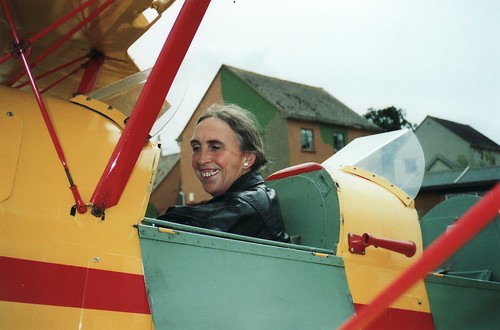
Jan, pleased to be back on the footplate at the Battlefield Line, 16-Aug-2020 (Photo: D. Mould)

Three days later on Wednesday 19th August, I was back at the railway to operate four round trips using the 2-car diesel railcar. At the end of the public services, with Ritchie M. acting as shunter, we used the DMU to move the wagons forming the demonstration freight train from the DMU siding to the running line before stabling the DMU on the DMU siding. The freight wagons were to be used the following day by Adrian L. for a photographic charter using 5526.


2-car DMU pictured at Shackerstone in 2019

Operations at Shackerstone have continued into September using 33201, 5526 and the 2-car DMU but the impact on revenues and frequently-changed public safety law and guidelines has presented serious challenges to all businesses.

Pictures

Battlefield Line 2020

[Pictures updated 2-Oct-2020]

Friday, 26 June 2020

Infrastructure Problems (3)

This post is one of what appears to be becoming a series about infrastructure and 'the built environment' in the United Kingdom. The first, Infrastructure Problems, discussed how services are distributed in this country, touching on some of the problems which can arise.  The second post, Infrastructure Problems (2), rambled on about road repairs and potholes before returning to the theme of water leaks and other failures.

This updare talks about a (fortunately fairly minor) water leak, before turning to temporary traffic lights.

Another Water Leak

In May 2020, I found a water authority surveyor already at the site of a leaking buried water main in Sandy Lane. Having already marked the offending area with blue spray paint, he was using his mobile telephone to summon a repair team.  A neat gash, a few inches long, had appeared in the road surface and water was bubbling out and running downhill. It wasn't a very impressive leak, but I took a couple of pictures. 


Water main problems (Brewood Village)

The picture immediately above also shows a Fire Hydrant connection. Raising the hinged lid of the cast box at the bottom of the picture gives access to the water main for use by the water authority and firefighters. The rather battered, yellow-painted concrete stump adjacent carries a cast plate with a large 'H' (for hydrant) and a cast figure which I think reads '3' indicating a 3-inch diameter main. 

Nowadays, Fire and Rescue Services makes extensive use of computerisation and the picture below shows the type of map available in the cab of fire appliances to facilitate locating nearby Hydrants. I took this picture when the local fire appliance was on display during the Brewood Garden Party in 2019 (there's a post about the Garden Party here with a link to pictures of the fire appliance). The hydrant shown in the picture above can just be seen on the left of the map view below as a yellow square with an 'H'. There's also '75' (sideways) which I presume means that the fire service have metricated the '3 inches' to millimetres. 

Staffordshire Fire and Rescue Service makes extensive use of computerisation. This view shows the 'Sat-Nav' function available on the display in the vehicle cab.

Temporary Traffic Control

In the first post in this series, I talked about the use of temporary traffic lights for traffic control when the carriageway is obstructed by excavations or similar. The design of this equipment has changed drastically over the years. 

When I was young, filamentary lamps in the signal head normally required a portable generator to provide sufficient electrical power and the control of the sequencing was purely determined by timers. Cables had to be connected between the traffic signals, allowing light sequences to be controlled.

In more modern equipment, the use of high efficiency Light Emitting Diode (LED) lamps have reduced power demand sufficiently to make rechargeable batteries a viable power source. Additionally, microwave detectors incorporated into the signal heads directed towards oncoming traffic allowing detection of waiting vehicles and dynamic adjustment of light changes to suit actual traffic flows. Finally, interconnected cables are eliminated by the use of a radio data link between traffic signals.

The simple example illustrated below shows one of two traffic signals deployed in Sandy Lane in 2018 during excavations to connect two new houses to buried gas, electricity, water and drainage services. The first picture shows the rear of the traffic signal at the upper end of the narrowed carriageway. Batteries in the base unit power the unit and the electronic controller is in the control box mounted on the mast supporting the signal head. It shows a TR 2502A-AP16 made by Pike Signals and on hire from A-Star Traffic Management,

Temporary Traffic Signal during connection of services to New Houses in Sandy Lane.

Control Box showing indications on electronic controller

This is a very simple example - the Pike Signals website illustrates their 'Evo' range suitable for temporary multiple road junctions incorporating pedestrian crossings. 

Pictures around Brewood Village

The following album includes some examples of local services infrastructure. 
Pictures may be viewed in various sizes or downloaded for non-commercial use.

Wednesday, 24 June 2020

Power Signal Box, Togyaunggalay

Events on Sunday 5th May 2019, Yangon area 

In the post Return to Burma, I mentioned a visit to Togyaunggalay (Romanisation of Myanmar words can be a bit variable and there are various English spellings of the placename). My friend Doctor Hla Tun had arranged a visit to the elderly power signal box at Togyaunggalay station on the day I arrived in Myanmar. Earlier that day we'd visited the recently-commissioned Railway Operation Control Center in Yangon (described in a post here) after which the Doctor drove us through Yangon's heavy traffic to the junction station at Togyaunggalay.

The railway network around Yangon is shown below. Togyaunggalay station is situated on the double track main line from Yangon through Bago to Mandalay. A junction just north of the station connects the single line serving Dagon University. A junction south of the station leads to the single line to Thilawa.

Railways around Yangon (displayed on Togyaunggalay station)

In 2018, after visiting the railway at Bago, I'd travelled through Togyaunggalay by train (there's a description of that trip here) so I was pleased to have the opportunity to confirm the signalling arrangements. 

On our arrival in 2019, we reported to the Station Master and were conducted along the main platform to the concrete signal box and climbed the steps to the operating floor. The loud noise emanating from the ground floor equipment room indicated that the incoming overhead 3-phase electricity supply was absent and that the system was being run by the standby generator. The first floor equipment room was locked, so I couldn't study the relay interlocking equipment but continued to the second floor where we were welcomed by the signalman.

 Togyaunggalay signal box on 9th May 2018: Note radio antenna on left and incoming overhead 3-phase electricity supply terminated on frame on the right (Bago - Yangon by train).

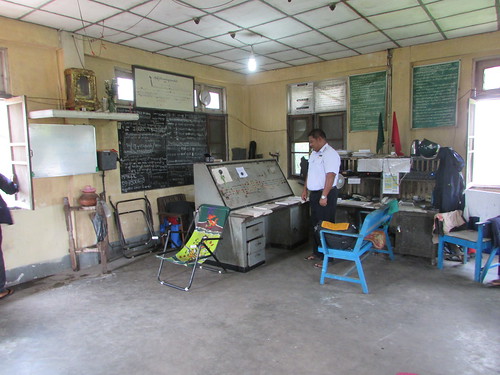
The railway signalling console was of the 'NX' pattern (there's a very brief explanation of this type of control in the section 'NX' pushbuttons of the post here) and used 'Mosaic' construction.The signalling console looked rather small, situated near one corner of the room. A desk just to the right was furnished with red and green flags, a number of telephones, two VHF radiotelephones for train control and a power amplifier and microphone for making announcements to waiting passengers. The windows overlooking the tracks behind the signalling console had been largely blocked by a large blackboard covered in what appeared to be useful telephone numbers. Above the blackboard was the usual framed drawing of the track layout and a clock. To the left, on a small shelf, was the customary Buddhist shrine.

Togyaunggalay: The operating floor of the signal
cabin, showing the Korean 'NX' signalling panel

A Mosaic Diagram, as the name implies, assembles a series of small 'tiles' into a frame. Each 'tile' has part of the signalling diagram on its face, together with the associated control switches and lamp indications. Each 'tile' can be individually removed for maintenance.

Mosaic Diagram Togyaunggalay - centre (Myanma Railways 2019)

I assumed that the siting of the blackboard was at least partly so that the lamp indications on the console were easier to see in bright sunlight, but nonetheless, I found some of them hard to interpret (or missing). They explained that spares, particularly the filament lamps used for indications, had become hard or impossible to source. They'd been forced to modify the circuits (in places using two lamps in series) but admitted that the result was not altogether satisfactory. Despite this, the signalman was carrying out his crucial tasks with the usual studied calm typical of signalmen everywhere.

Mosaic Diagram Togyaunggalay - detail (Myanma Railways 2019)

The flat desk area in front of the inclined control panel held two train register books and two books of paper Line Clear forms. 

Togyaunggalay Power Signal Box: Signalman completing Paper Line Clear Form

The Train Register Books serve a similar function to those used in the United Kingdom (described in a post here) although in Myanmar movements are separated into two books, one for 'Up' trains, one for 'Down'. Because of the importance of these logbooks, pages are individually numbered.

Train Register Book (Down Trains) Togyaunggalay

The British introduced railways into Burma (as Myanmar was then called) so signalling originally followed British practice, with reliance on telegraphy, telephony and special signalling equipment (like electric tablet systems for single lines). This relied on an open wire system using telegraph poles supporting cross-arms carrying porcelain insulators to which copper wires were attached. Remnants of this system can be seen throughout the country (invariably using an old length of rail as the 'pole') but, as far as I can determine, they have all fallen into disuse. Voice communication across the railway now uses VHF radiotelephones, allowing signalmen or stationmasters to authorise train movements from one 'block station' to the next. The permission is given to drivers in the form of a 'Paper Line Clear Form', shown in the picture below. Because of the vital nature of these forms, they are individually numbered, completed with some care and authorised with a rubber stamp.

Book of paper Line Clear forms: Togyaunggalay (MyanmaRailways 2019)

The pictures below show a local train from Yangon to Dagon University. In the first picture, the train has just arrived. The freight train seen waiting on the left was unusual in having a number of men travelling in open bogie wagons type SMBV, perched on piles of rock. The Doctor explained that the 'rock' was extremely valuable jade and the men were security.

The second picture shows the signalman's assistant or 'runner' delivering the Paper Line Clear Form to the driver of the passenger train, authorising travel on the branch to Dagon University.

A freight waits for the signal (L) as a local Yangon-Dagon University arrives (R)

The signal box 'runner' delivers the paper Line Clear form to the driver

At the end of a fascinating tour, I made sure I checked out the throbbing standby generator on the ground floor - a substantial Daewoo packaged diesel alternator. Its claim to being 'sound proof' was a little undermined by the need to leave all the access doors open to prevent overheating (the outside air temperature was around 40 degrees Celsius that day).

Standby Generator Togyaunggalay (Myanma Railways 2019)

They explained that, even with the access doors open, the water-cooled diesel engine required periodic replenishment of water. Illustrating this point, as we left, a railwayman had just pushed a small platelayer's trolley along the platform line outside to the signal box, loaded with a plastic dustbin and a large plastic tub, both filled with water!

Cooling water for the Standby Generator at Togyaunggalay (MyanmaRailways 2019)

A most interesting day. I'd visited both the Railway Operation Control Center in Yangon and Togyaunggalay power signal box on the day I'd arrived in Myanmar and, later in the trip, I was to tour 'Mandalay Tower', the power signal box controlling Mandalay area.

My pictures

All my railway pictures around Yangon during my visit to Myanmar in 2019 are in the album below. Pictures may be viewed in various sizes or downloaded for non-commercial use.

Sunday, 21 June 2020

Infrastructure Problems (2)

The road which passes the side of my garden, Sandy Lane, carries a formidable volume and variety of traffic so road 'patching' of potholes by the Council's contractor is frequent. I mentioned potholes in an earlier post called Infrastructure Problems, showing a typical example in Sandy Lane.

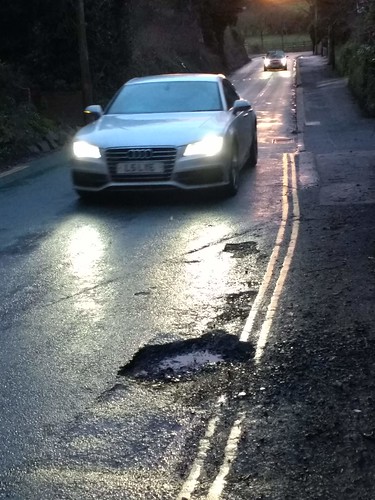
Pothole in Sandy Lane, Brewood in February 2019 

'Patching' is rather temporary. Over a few years, the area of road surface shown above has suffered  a number of separate potholes and the picture below (apologies for the poor quality) reveals at least five separate, overlapping attempts at making good in this small areas.

Overlapping pothole patching in Sandy Lane in November 2019

The long-term remedy is taking off the old tarmac and relaying, in a process called 're-surfacing'. Back in November 2012, a serious attempt was made at improving the junction between Sandy Lane and its continuation called The Pavement. I was quite impressed by the massive Cold Milling Machine used in this process, which I described in the post here. The surface on this section of road has lasted quite well but I soon noticed that they didn't manage to get the camber quite right to shed rain water. A recent picture (
which I took following failure of a water main) illustrates the effect.

Water in the left gutter from a burst main further up in Sandy Lane gets diverted by the camber to the right and then back to the left (Brewood Village)

To assist in shedding rain water, road surfaces are supposed to be cambered from side to side so as to direct surface water to the nearest gutter. At frequent intervals, this water should be directed underground into a surface water sewer pipe. Water enters the sewer via a series of gullies each provided with a hinged drain cover 
at road level, usually made of cast iron or cast steel.

This cover has a series of slots to admit water which passes into the sewer pipe via a U-trap, a larger version of the trap fitted under domestic sinks. The idea is to prevent solid material from being swept into the sewer but instead being retained in a chamber in the gulley, below the level of outflow to the sewer pipe. This should avoid blockages in the sewer pipe but over time sediment builds up, necessitating periodic removal before the gulley becomes blocked.

This is achieved by a sort of 'wet-n-dry' vacuum cleaner called a Gulley Emptying Vehicle. These vehicles usually also provide road-sweeping facilities, using contra-rotating brushes to remove debris and mud from the gutter and road surface.

A modern Gully-Emptying Vehicle parked in Sparrows End Lane in 2016 

Unfortunately, during the period of Government Austerity the United Kingdom has endured since 2008, gulley emptying seems to be low priority around here and many gullies have become blocked and ineffective.

In the post Infrastructure Problems, I outlined how mains water is normally a buried service. Until isolated or repaired, bursts or leaks on this network can result in the discharge of large volumes of water which either enter the surface water sewer via the gullies or generally saturate the surrounding earth. 

One example occurred, again in Sandy Lane, in 2013. A leaking buried water main announced itself by water flowing across the pavement and into the gutter. For some unknown reason (perhaps because it appeared to be a relatively minor leak) the water authority chose to defer repairs.

Sandy Lane. Water still leaking in October 2013.

It was October when the electricity suddenly failed. A quick look outside revealed that most (not all) of the village was in darkness so I didn't bother to check the house fuseboards. Power failure was not unknown at the time as the village has various overhead transmission lines which were prone to occasional failure, particularly during thunderstorms or bad weather. I can't remember how long it was before supply was restored but the electricity authority must have arranged some temporary 'workaround', because it was some days before permanent repairs were effected and the likely cause was revealed.

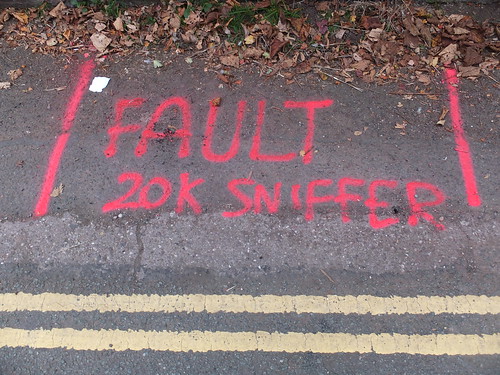
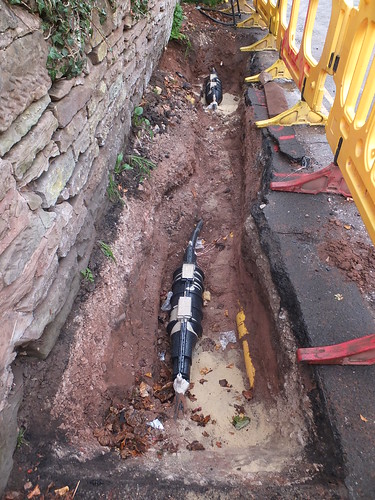
I found that they had located a cable fault underneath the road surface of Sandy Lane, a little downhill from the long-standing water leak and emblazoned the position with red spraypaint. A few days later the water leak was repaired and the electricity authority had dug a trench to locate the cable problem, which appeared to be the remains of a straight cable joint, blown apart and blackened. The conclusion seemed irresistible that the continuous saturation by water from the unrepaired leak has caused the elderly joint to fail. 

 The electricity fault has been located in October 2013. 

The repair to be cable was effected out the damaged cable joint and the cable on either side for a short distance and splicing in a length of new cable using two modern epoxy-filled joints.

The damaged section of electricity cable has been cut out
and a new section 'spliced in' between two modern epoxy-filled joints.

Just some of the pitfalls of living in a modern society! 

Pictures around Brewood Village 

The following album includes some examples of local services infrastructure:-
Brewood Village


Tuesday, 16 June 2020

Titfield Thunderbolt Film Posters

Some months ago when I was browsing on Abebooks (my first choice for books, particularly second-hand railway books) I came across BENITO ORIGINAL MOVIE POSTER based in Spain who were offering an original English poster for the 'Titfield Thunderbolt' film, showing the theft of the '14XX' by Dan and Mr. Valentine.


I'm afraid it would have set you back over £800 plus shipping but the Spanish poster for the film below was available at under £300.


You will note that, for Spanish-speaking audiences, the film had been re-titled 'LOS APUROS DE UN PEQUEÑO TREN' which, apparently, means 'The Troubles of a Small Train'.

I also found another poster for the film which used a mirror-image of the '14XX' artwork above but with the Spanish title.

Intrigued, I also found a poster on offer from CineMateriel for the French re-release. I discovered that 'Tortillard' is a term for a train, particularly a slow or roundabout local train, which I found rather charming.


Until I spotted the '14XX' poster above on the internet, I only remember having previously seen the Edward Bawden film poster, which I mentioned in my post The Titfield Thunderbolt and is repeated below, but a little more exploration showed that there are quite a few other film posters and artwork for DVD releases around. 

The Legend of the Titfield Thunderbolt lives on!

Wednesday, 27 May 2020

Brewood Village Road Re-surfacing

The road which passes the side of my garden, Sandy Lane, carries a formidable volume and variety of traffic so road 'patching' by the Council's contractor is frequent.

In November 2012, the junction between Sandy Lane and its continuation (The Pavement) was properly 're-surfaced', actually taking off the old tarmac and relaying. I was quite impressed by the massive Cold Milling Machine used in this process, which I described in the post here. The surface on this section of road has lasted quite well.

In May 2020, temporary road signs indicated that road works were to be carried out and on the afternoon of Monday, 18th May 19th May, there was activity in the afternoon as 'surface dressing' was carried out on Sandy Lane, from a starting-point beyond the junction re-surfaced in 2012 (which was left untouched) up to the village square. 'Surface dressing' is claimed to be a cost-effective way of restoring the road surface, sealing it and improving skid resistance. If you are interested, I found an interesting video by Dumfries and Galloway Council here which shows the whole process (including an ingenious method of confirming that the specified thickness of bitumen had been applied).

I viewed some of the proceedings from my garden and took a few pictures. There were a number of large vehicles, all painted canary yellow and carrying the logo 'RMS' in red, together with a number of workers, all wearing orange overalls with white 'hard hats'.


L-R: Chipping spreader, 8-wheel lorry with road chippings, road roller (Brewood Village: Road re-surfacing)

The contractors were Road Maintenance Services Limited, apparently in partnership with Staffordshire County Council and Amey. Road Maintenance Services Limited were set-up in 1947 by the Barlow family and remain family-owned. Their website is here and they claim to be 'innovators in surface treatments'. They are members of The Road Surface Treatments Association (RSTA), which was set up in 2008 and has its own website here.

A large, articulated tanker was marked as carrying 'Bitumen Emulsion'. This had a platform at the back for an operator to control machinery clearly provided to apply bitumen to the road being treated. A little internet research revealed that the manufacturers were a French company called Acmar, founded in 1946. Their English website is here and this type of vehicle is usually called a Bitumen Sprayer.


Articulated Bitumen Sprayer made by Acmar, showing adjustable spray bars and operator's platform (Brewood Village: Road re-surfacing)

There were two unfamiliar-looking four-wheeled rubber-tyred vehicles whose function seemed fairly clear. Chippings in a low-level hopper at the rear of the vehicle were transferred via an inclined conveyor to a second, smaller hopper behind the driving cab. The second hopper was then provided with a discharge mechanism to drop chippings onto the hot bitumen applied to the road surface by a Bitumen Sprayer. Following a bit more internet research later, I discovered the vehicles were called Chipping Spreaders. They were made by The Phoenix Engineering Co Ltd in Chard (website here). The machines appeared to be model MK7, now superceded by similar, later models but still available second hand. This company was originally formed in 1891 by a group of Londoners who acquired the Phoenix Iron Foundry which had traded since 1839. In 1891 Thomas John Jennings was company secretary and his descendants still manage the company.


Phoenix MK7 Chipping Spreader (Brewood Village: Road re-surfacing)

A little more research showed that what I call a 'road roller' was, more correctly, a 'VM75 Single Drum Soil Compactor' from the JCB 'Vibromax' range. Although the VM75 isn't manufactured now, there still seems to be a healthy second-hand market. One end of the machine is supported on the familiar wide drum but the other end is supported on two large, rubber-tyred wheels.


JCB VM75 Single Drum Soil Compactor (Brewood Village: Road re-surfacing)

By the time I observed the proceedings from my garden, they had already re-surfaced the downhill side of the road, so I watched as they treated the uphill side. First, the Bitumen Sprayer drove slowly uphill, laying down a ribbon of hot bitumen alongside the completed downhill strip.


Bitumen Sprayer at work (Brewood Village: Road re-surfacing)

One of the Chipping Spreaders lined up and one of the 8-wheel lorries was backed up to the rear of the Chipping spreader and coupled to it, allowing the low-level hopper on the Chipping Spreader to be continuously replenished from the lorry. The odd-looking combination then carefully followed the Bitumen Sprayer, laying down an even layer of small, grey chippings.


Chipping Spreader about to follow the Bitumen Sprayer (Brewood Village: Road re-surfacing)

The second Chipping Spreader appeared and waited as the second 8-wheel lorry of chippings was handsignalled to reverse up to the Chipping Spreader, after which these two vehicles slowly followed the first two.


Second lorry handsignalled towards the second Chipping Spreader (Brewood Village: Road re-surfacing)

Finally, the 'VM75' Road Roller slowly followed the other vehicles. I didn't stop to watch it performing but I'd found the whole operation very interesting.

My Pictures

Brewood Village: Road re-surfacing

Wednesday, 20 May 2020

Train Movements at Euston (2)

At the time of writing, the world is suffering from the serious, new respiratory disease Covid-19 and the U.K. is currently in 'Lockdown'. Only essential travel is permitted, resulting in train passenger numbers collapsing and revised timetables.

In the post Train Movements at Euston, I documented a few evening departures on 16th April 2020.

I've documented more incomplete fragments of arrivals and departures during the restricted Covid-19 timetable below.

I'm sorry the information is fragmentary. This is partly due to the internet becoming notoriously unreliable in these strange times, despite having a 'fibre to the cabinet' feed which on a good day produces at least 40 MBPS. With most people at home during 'Lockdown', at present internet speed is sometimes as poor as 0.2 MBPS with a 'ping' of 2 seconds, or it even becomes totally unresponsive.

Note 'VT' is the TOC code for Avanti, 'LM' is the TOC code for West Midland Trains.

Evening movements on 15th May 2020

Plat Nbr Dep Destination Nbr Arr From TOC
1 1F27 19:44 Liverpool 1M14 18:48 Crewe VT
2 1P06 19:18 Preston 1M13 17:58 Crewe VT
3 9G42 19:28 Wolverhampton 1B24 18:55 Wolverhampton VT
4 1B22 17:54 Wolverhampton
5 5D91
6 1H05 19:08 Manchester 1A52 18:19 Liverpool VT
7 1H07 Manchester 1A54 18:41 Manchester VT
9 2D46 19:15 Watford
.... Later ....
1 9G47 21:28 Wolverhampton 1M15 19:57 Crewe VT
3 9G45 20:44 Wolverhampton 1A59 19:49 Manchester VT

Lunchtime movements on 16th May 2020

Plat Nbr Dep Destination Nbr Arr From TOC
1 1H11 13:08 Manchester 1A02 10:54 Manchester VT
2 1H08 12:08 Manchester 1A05 11:43 Liverpool VT
3 1F15 12:51 Liverpool 1A06 11:59 Preston VT
4 1S63 12:12 Crewe 5S63 11:49 Wembley CS VT
5 9G50 12:31 Wolverhampton 1B04 11:28 Wolverhampton VT

Engineer's Trains on 16th May 2020

In the evening, three engineer's trains from Bescot arrived. The first was 6G50, a train of bogie ballast hoppers top-and-tailed by a pair of GB Railfreight Class 66. This continued to Euston before re-appearing on the Down Fast and slowly making its way to the work site which, as far as I could determine, was north of Primrose Hill Tunnels. Later, 7G52 arrived. This was hauled by another GB Railfreight Class 66. As it slowly passed the Railcam UK camera at Camden, also heading towards Euston, I could see it was an assortment of engineering materials with a number of bogie open wagons at the rear. I didn't follow matters but on Sunday morning these trains, together with Colas Yellow plant vehicle and 6G51 which appeared to be another ballast train were all showing up in describer berths apparently north of Primrose Hill Tunnels, surrounded by more berths displaying '****' in red, probably as a signalman's reminder of the work in progress.

Morning movements on 20th May 2020

At the time I wrote this, the Government were encouraging our railway system to increase services to help get the country back to work so just after 08:30 on Wednesday, 20th May 2020 I made another quick 'snapshot' of long-distance trains at Euston

Plat Nbr Dep Destination Nbr Arr From TOC
1 1R04 W'ton 05:45 VT
2 1H15 09:20 Manchester 1R12 11:43 W'ton 06:45 VT
3 1H63 09:40 Manchester 1R06 W'ton 06:04 VT
4 5H12 0741 Wembley CS VT
5 9P54 08:43 Preston 1R07 08:10 Lancaster VT
6 1F13 09:07 Liverpool 1R08 08:20 Manchester VT
7 1U27 08:46 Crewe 1U00 08:06 Crewe LM
8 1Y32 19:32 Birmingham LM
9 Local
10 Local
11 Local
12 5R11 09:12 Wembley CS 1R11 08:39/td> Liverpool VT
13 1Y08 08:13 Northampton LM
14 1S48 09:10 Glasgow 1R10 08:23 Manchester VT
15 0M16 Off sleeper?
16 1Y09 09:13 Birmingham 2B14 07:39 Bletchley lm


Wednesday, 13 May 2020

The Mersey Railway: Historical Notes

In the post Early Days of the Mersey Railway I outlined the construction of the tunnel and, in 1886, the opening of the line using steam traction.

Initially, there was only one station on the Liverpool side of the river, underground at James Street, accessed from street level by three large hydraulic lifts. From here, the railway line descended on a gradient of 1 in 27 under the river before climbing at a gradient of 1 in 30 to Birkenhead Hamilton Square station. Like James Street, this station was underground, accessed from street level by three large hydraulic lifts. The line continued south in a tunnel to the railway's headquarters at Birkenhead Central which was located in a cutting with retaining walls. The line extended south in cutting and tunnel to the final, sub-surface station at Green Lane.

At Shore Road, Birkenhead and Mann Island, Liverpool huge, steam-powered pumps were provided to keep the tunnel free of water.

At the time of the railway's opening, extensions to the line were already in hand. In 1888, the first to open was a branch in a tunnel from Birkenhead Hamilton Square to Birkenhead Park, to make an end-on connection with the relocated terminus of what became the Wirral Railway. This allowed through-running of Mersey Railway trains to and from locations on the Wirral, although locomotives were exchanged at Birkenhead Park. The extension from Green Park via cutting and tunnel to the surface station Rock Ferry and, on the Liverpool side, from James Street by tunnel (on a gradient varying between 1 in 31 and 1 in 34) to an underground station below the Liverpool Central station of the Cheshire Lines Committee were both opened in 1891.

Beyer Peacock supplied eight 0-6-4 and ten 2-6-2 condensing tank locomotives to operate the line.


Beyer Peacock 0-6-4 condensing tank for Mersey Railway (The Engineer)


Beyer Peacock 2-6-2 condensing tank for Mersey Railway (Railway Archive)

The condensing feature was used when travelling in tunnels. On arrival at Liverpool Central, a second locomotive was attached to the rear to form the departing train whilst the incoming engine uncoupled, 'dumped' the heated tank water, refilled with cold (conventional boiler feed injectors fail to operate reliably with hot water) and prepared to take out the next arrival.

Trains comprised eight 4-wheel passenger and one 4-wheel brake coach, each 27 feet in length.

With the extensions to the line in place, the railway offered good connections and a faster crossing than the ferries but using steam operation, conditions in the tunnels were foul, despite the massive fans provided, and revenue decreased, forcing the railway to continue operations in receivership.

Salvation came in 1903 in the form of an American, George Westinghouse, who was able to propose conversion to electric traction, using a fourth rail system operating at 650 volts d.c. Power was provided by three 1,650 h.p. generators driven by steam located in the pumping station at Shore Road, Birkenhead. Two, smaller 300 h.p. generators were also provided for lighting and other purposes.

Spacious bogie coaches to American design formed the replacement electric trains and these became popular with passengers, although no heating was provided. Air brakes were fitted but without compressors on the train, so periodically crews had to re-charge the train air receivers from an 'air main' at stations. All through-running at Birkenhead Park ceased.

At the railway 'Grouping', the Mersey Railway remained independent but the Wirral Railway became part of the L.M.S. empire. The Mersey Railway continued its role unchanged until 1938 when the L.M.S. electrified the Wirral lines (using the third-rail system). Running rights for the new L.M.S. electric multiple unit trains to operate to Liverpool Central and for the Mersey Railway electrics to serve the Wirral were established. The elderly Mersey Railway electrics required refurbishment to serve this extended role. Facilities to change between third-rail and fourth-rail current collection were provided, together with heaters and on-board electric compressors for the brake system.

Railway Nationalisation in 1948 finally brought an end to the Mersey Railway's independence and it became part of British Railways London Midland Region. But, repainted and renumbered, the Mersey Railway's electric trains carried on until 1956 when LMS-design electric multiple units started to replace the elderly vehicles. The last was withdrawn in 1957.

In 1977, the ambitious 'Liverpool Loop' scheme was opened by British Rail. This extended the line beyond Liverpool Central station so as to serve Liverpool Lime Street station by a reversing loop.

In recent years, I've looked at stations on the original Mersey Railway as part of a study of the modern Merseyrail system and there are notes below on three of those stations.

Birkenhead Central

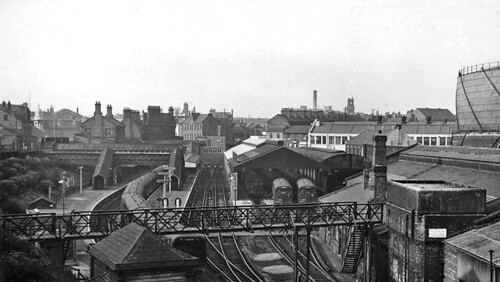
The railway's headquarters at Birkenhead Central were fitted into a cramped location below ground level bounded by a cutting on one side and retaining walls abutting the gas works on the other. The station provided two through platforms, a south-facing bay, the 3-road steam locomotive shed and a carriage shed, as shown on the fragment of the 1912 Ordnance Survey map below. The right hand edge of the map shows the LNWR/GWR joint line which ran from Birkenhead (Woodside) to Chester (General). The large Engine Shed in the lower half is actually two engine sheds side-by-side for the LNWR and GWR.


Birkenhead Central station 1912: Birkenhead 25 inches to 1 mile map (National Library of Scotland)


The modern satellite view below shows what has survived. The platforms and station buildings are still there but the bay platform has become a siding. The carriage shed has been re-roofed and, in a different form, extended. The Mersey Railway steam locomotive shed has gone, as has the adjacent gas works (although some of my pictures from 2014 reveal abandoned steelwork which formed part of one of the access stairs to a rolling lift gasholder which I believe replaced the column-supported designs shown on the 1912 map). The large LNWR/GWR locomotive shed has gone and the area is overgrown.

Birkenhead Central station: satellite view (Google Maps)

Below, a few illustrations of Birkenhead Central over the years.


Birkenhead central in steam days, drawn by T. Raffles Davison (Mersey Railway)


Birkenhead Central, 1961 (Photo: Ben Brooksbank CC BY-SA2.0)


Merseyrail: Birkenhead Central in 2014, showing former carriage sidings.

Green Lane

The railway is below street level with a tunnel to the north leading towards Birkenhead Central and a short tunnel to the south, leading towards Rock Ferry. There are two platforms, set in a rectangular excavation with the retaining walls beautifully-executed stonework. A series of plate girders span the station and the spaces between these girders are partially infilled by brick arcading but only above the southbound track, giving the station a rather 'lopsided' appearance. I presume this was to support trackwork leading to the LNWR/GWR steam locomotive sheds serving the joint Line from Chester to Birkenhead Woodside which ran slightly to one side of Green Lane above ground level. Quite generous station buildings were provided at street level.

Birkenhead Green Lane station 1912: Birkenhead 25 inches to 1 mile map(National Library of Scotland)

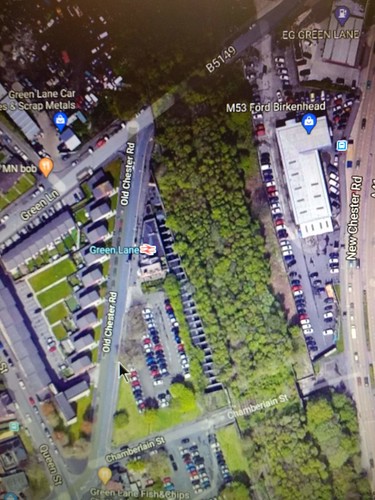
The modern satellite view below shows that the railway is little changed. The multiple plate girders bridging the station are clearly visible. The whole of the area where the joint line once ran is abandoned andvery overgrown with vegetation. The station buildings with their wedge-shaped plan remain.


Green Lane station: satellite view (Google Maps)

Below, pictures illustrating changes at Green Lane over the years.


Green Lane station in steam days, looking north, drawn by T. Raffles Davison (Mersey Railway)


Green Lane station, Merseyrail in 2020, looking south, showing stonework, overhead plate girders, partially infilled by brick arcading, and short tunnel towards Rock Ferry.

Rock Ferry

The 1891 southwards extension of the Mersey Railway to the surface station at Rock Ferry offered platform-to-platform interchange with the through platforms on the LNWR/GWR Joint Line which ran from Birkenhead (Woodside) to Chester (General). Mersey Railway trains ran to two terminal platforms provided with a middle engine release siding. North of Rock Ferry Station, at Union Street, connections were provided between the Mersey Railway and the Joint Line but I believe these were originally not much used.


Rockferry station 1912: Birkenhead 25 inches to 1 mile map (National Library of Scotland)

The modern satellite view below shows the major changes to the railway. The two terminal platforms of the Mersey Railway survive but the engine release road is now removed. The four tracks of the Joint Line have gone, but the Mersey Railway route has been slewed to occupy the trackbed of the Western pair of Joint Lines. The trackbed of the Eastern pair of joint lines was retained for a time to provide connections to the Birkenhead Docks railway system, but these are out of use. The island platform serving one terminal platform and the northbound through platform is re-roofed but not much changed. The southbound through platform is modernised and the associated access footbridge is new.

Rockferry station: satellite view (Google Maps)


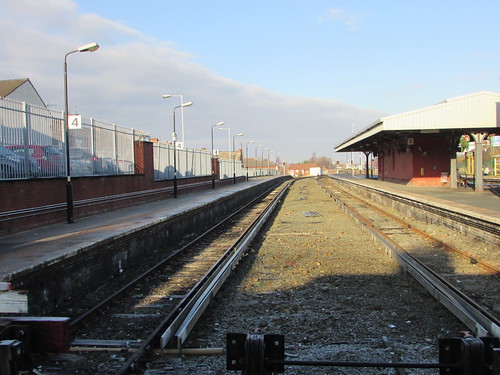
Rock Ferry station in 2016 - terminal platforms 4 and 3, looking north. There was originally a 'middle siding'.


Rock Ferry station in 2016, view looking north from footbridge.

Thomas Raffles Davison

The pencil sketches of Birkenhead North and Green Lane above are the work of Thomas Raffles Davison (1853-1937), a prolific architectural illustrator, journalist, editor and occasional architect. There's a Wikipedia article about him here.

Books

[1] ‘The Line Beneath The Liners: A hundred years of Mersey Railway sights and sounds’ by John W. Gahan, published by Countyvise (ISBN 0 907768 40 7 and Avon AngliA Publications (0 905466 57 8).
[2] ‘Chester to Birkenhead including the Helsby Branch’ by Vic Mitchell and Keith Smith (Middleton Press 2012) ISBN 978 1 908174 21 5.

Posts on this website referring to Merseyrail

Early Days of the Mersey Railway 8-Oct-2013.
Day Trip to Liverpool 24-May-2010.
By rail to Liverpool (Part 2) 24-Mar-2014.
Birkenhead and New Brighton by train (Part 1) 19-Feb-2014.
Birkenhead and New Brighton by train (Part 3) 24-Feb-2014.
Railways around Birkenhead 28-Feb-2014.
More Merseyrail 21-Oct-2014.
Return to Liverpool 19-Mar-2020.

Quite a few of my posts relate to Merseyside. Your can display all these posts, in reverse date-of-posting order, by selecting Label 'Merseyside' or click here).

My pictures on the Merseyrail network

Where necessary, clicking on an image above will display an 'uncropped' view or, alternately, pictures may be selected, viewed or downloaded, in various sizes, from the albums below:-

Albums showing stations discussed in this post:-
Birkenhead Central Station
Green Lane
Rock Ferry

Merseyrail.
Profile - 'Cecil Raikes' (The locomotive).