skip to main |
skip to sidebar
Each year, The Old Locomotive Committee (OLCO) has an event, called 'Lionsmeet', for live steam models of the 'Lion' locomotive and similar models of designs up to around 1850. In 2019, the event was held on Saturday, 17th August at the Littledown Park track of the Bournemouth & District Society of Model Engineers (B&DSME).
B&DSME has a long history during which it has operated on a number of sites as outlined on their website here. The Society was founded in 1924, as shown below.
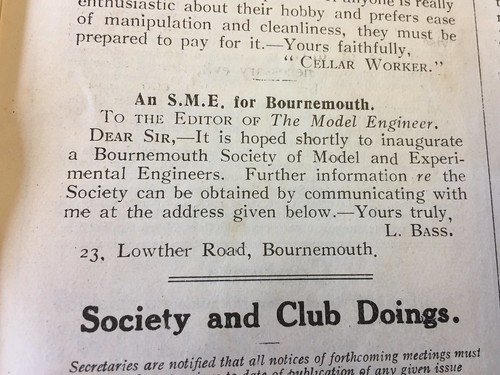
Letter published in the Model Engineer & Electrician magazine on the 13th March 1924 announcing the inauguration of the Bournemouth society(Photo: B&DSME).
The present Littledown Park track was opened in 2004 in a popular Bournemouth park which incorporates a leisure centre. The part is described on Bournemouth Council's website here. The park features an attractive lake area, home to numerous ducks and a rather tame heron.
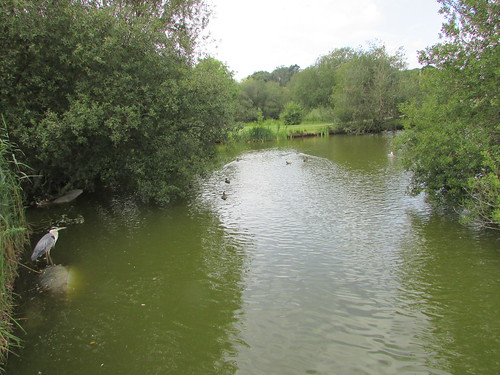
Lionsmeet 2019: Littledown Park features an attractive lake area with ducks and a rather tame heron.
The weather during the previous few days had been very wet in most of England but improved on the day of 'Lionsmeet', which proved dry and warm. On my arrival at the B&DSME Clubhouse, I was welcomed by host club members and my friends from OLCO. I was rapidly furnished with a cup of tea and, throughout the day, the host club were very solicitous regarding the welfare of their visitors.
Initially, the activity was centred around the multiple, elevated steaming bays outside the clubhouse as various 'Lion' models were steamed.
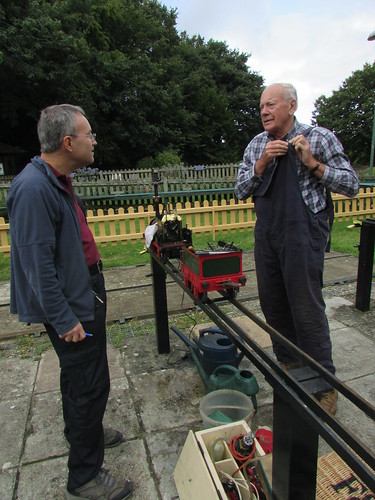
Lionsmeet 2019 Bournemouth: Andrew Neish and Adrian Banks chat as 'Thunderbolt' "brews up".

Lionsmeet 2019 Bournemouth: View of the Steaming Bays and traverser tracks.
An elevated traverser transfers locomotives between the steaming bays and a spur line leading to the running line. There is also a siding alongside the clubhouse to facilitate moving larger locomotives between road vehicles and the steaming bays. The traverser also serves two single road, covered carriage sheds which are almost invisible, situated close to the park boundary and hidden by bushes.

Lionsmeet 2019 Bournemouth: View of traverser and entrance to second carriage shed.
The traverser also gives access to a turntable. Although running on the main line is normally in a clockwise direction, I was told that periodically anti-clockwise running is adopted, to even out flange wear.

Lionsmeet 2019 Bournemouth: View of the Turntable. The carriages are standing on the spur line from the traverser to the running line.
The 1760 feet long continuous running line is situated in a pleasant wooded area close to the park boundary, and has a conventional 'dog bone' shape with two long, parallel sections joined at each end by 57 feet radius return loops. A station, named Bankside, is provided on the return loop near the clubhouse for loading and unloading passengers.

Lionsmeet 2019: View showing part of return loop at clubhouse end of line, the two parallel straight sections through the trees and the park boundary in the background.
The running line is supported on pre-cast concrete beams each 4 metres long, using just four different types (straight, curved with cant, left-hand transition, right-hand transition). The 4-rail multi-gauge track caters for 3½", 5" and 7¼" gauges. The track was pre-assembled into 3 metre long panels using 1kg/m steel flat-bottom rail profile, mounted on jig-drilled sleepers sawn from recycled plastic plank. The 'About' tab of the B&DSME website here has a lot more information about the track and its construction.
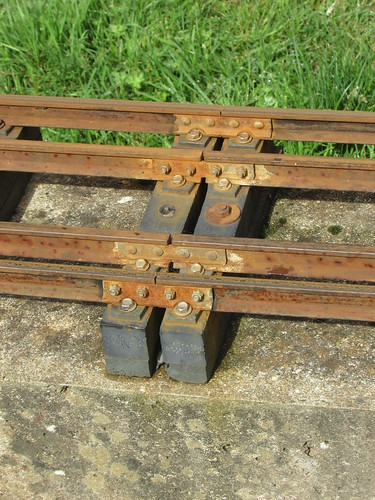
Lionsmeet 2019 Bournemouth: View of rail joints on the multi-gauge track.
A J Reynolds' 'Lion' was the first locomotive ready for running but John Dalton with his 7¼" gauge model and Adrian Banks with 'Thunderbolt' followed. Later, Nigel Way from the host club joined them, driving the 'Lion' owned by John Biss.
Once the traverser has transferred locomotives from the steaming bays to the spur line leading to the running line, a combination of hinging section on the spur and 'Bendy Beam' on the running line allow locomotives onto the main line. The 'Bendy Beam' is described on the B&DSME website here.
When electrical detection proves that the hinging sections and 'Bendy Beam' are correctly set for movements on the running line, the solenoid-operated lower-quadrant semaphore 'stop' signal facing Bankside station platform is automatically placed 'off'. Trains approaching Bankside station in a clockwise direction receive an advance warning from a distant signal. When the railway is not running, the signals are unplugged and stored in the wooden station building at Bankside. I was told that the signals can be installed in alternative locations when anti-clockwise running is adopted.

Lionsmeet 2019, Bournemouth: View looking north from station showing (L-R) spur line from steaming bay traverser, running line, holding siding.
The picture below shows Adrian Banks moving 'Thunderbolt' onto the running line.
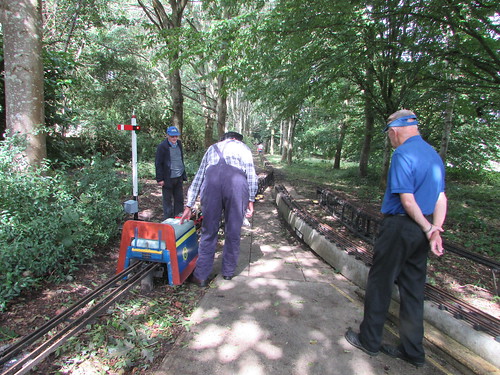
Lionsmeet 2019 Bournemouth: Adrian Banks with 'Thunderbolt' moving from the spur line to the main line.
Once 'Thunderbolt' was on the running line, a member of the host club restored the hinged section and 'Bendy Beam' to allow continuous running to resume.

Lionsmeet 2019 Bournemouth: With Adrian Banks and 'Thunderbolt' on the main line, the 'Bendy Beam' is restored for main line running.
There was no competition running, so participants could exercise their steeds or chat with the members of the host club or OLCO during a relaxed day.

Lionsmeet 2019 Bournemouth: A J Reynolds was early onto the track with his 'Lion'.

Lionsmeet 2019 Bournemouth: John Dalton approaches the station with his 7¼" 'Lion'. Note the 'clear' distant signal.

Lionsmeet 2019, Bournemouth: Nigel Way, A J Reynolds and John Dalton lined-up at Bankside station with their models. Mains water with a portable bowser and buckets of coal are available here.
A splendid buffet luncheon was unveiled in the clubroom - a rather magnificent affair equipped with First Class seating obtained during the re-fit of railway coaches. Appropriately, the large colour display screen on the end wall was showing 'The Titfield Thunderbolt' on repeat.

Lionsmeet 2019: The clubroom, with ex-railway First Class seating.
The afternoon was particularly relaxing as the weather remained warm, presenting a good opportunity to study the interesting range of static exhibits on display.

Lionsmeet 2019: Bankside station on a warm afternoon.

Lionsmeet 2019, Bournemouth: (L-R) John Dalton, Andrew Neish and Peter Burton, B&DSME Chairman.

Lionsmeet 2019 Bournemouth: Harrye Frowen's 7¼"'Lion' was displayed by John Hawley.
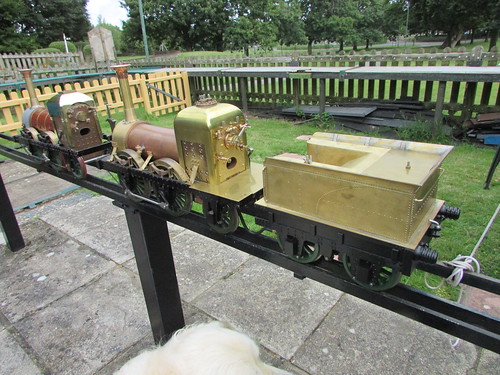
Lionsmeet 2019 Bournemouth: Two 'Lions' under construction.
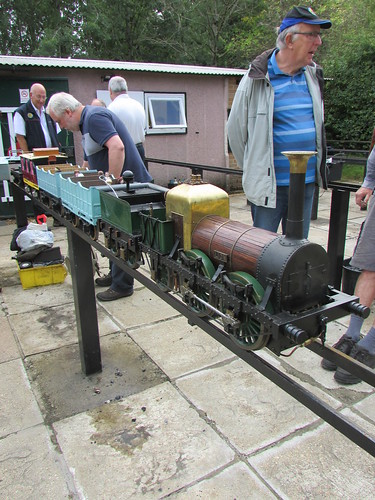
Lionsmeet 2019 Bournemouth: John Biss's 'Lion' and train.
Other models by John Biss were also on show, including a rail-mounted hand-operated crane and an intriguing Pump-type Maintenance Trolley which is battery powerd and radio controlled!
Also on display was a completed model of 'Canterbury Lamb' and a rolling chassis I didn't identify for either a 2-2-0 or 0-2-2, together with a partial kit of parts for a 'Lion' offered for sale.
On an elevated storage siding in the clubhouse, I found another battery powered model called 'Sheddon Wheals' with a steam-outline superstructure painted blue and strangely reminiscent of a famous steam locomotive. There was also a nicely-executed six-coupled diesel outline locomotive named 'Littledown Castle' which I understand is petrol-engined. These last two locomotives exit the clubhouse via an opening hatch in the wall. When a bridging piece of track is correctly in place connecting the elevated storage siding to a nearby steaming bay outside, a 'moveable scotch' is automatically lowered to allow the locomotives to safely leave the storage siding.
There's also an out-and-back 16mm narrow-gauge garden railway on elevated baseboards, but it was not in use during 'Lionsmeet' and was protected by locked security covers.
All the above are illustrated in my album of pictures of Lionsmeet 2019 here.
It had been a most enjoyable day and John Brandrick, the OLCO Chairman, made a short address thanking the host club for their hospitality, enthusiastically endorsed by the OLCO members.

Lionsmeet 2019: Bournemouth: John Brandrick, OLCO Chairman, (with Dan) thanks B&DSME for hosting 'Lionsmeet' 2019.
Related posts on this website
All my posts about the Old Locomotive Committee can be found here. Most posts include links to my related pictures.
My pictures
Where necessary, clicking on an image above will display an 'uncropped' view or, alternately, pictures from may be selected, viewed or downloaded, in various sizes, from the albums listed:-
Lionsmeet 2019.
All my 'OLCO' picture albums.
Events of Monday, 20th May 2019
After an enjoyable visit to Mandalay Railway Station in the morning (described here), we moved on to the serious business of the day, taking the much-improved Oriental Highway from Mandalay which climbs into the hills at Pyin Oo Lwin where Doctor Hla Tun was to make food donations at two orphanages. There are many posts in this blog regarding educational charitable work in Myanmar initiated by the 'Road to Mandalay Social Contribution'. You can find them all here or by selecting search label 'Education'.
In Pyin Oo Lwin, there is an orphanage for boys at Doe Pin and one for girls at Shwe Sin Minn. Both are supported on a regular basis by a Swiss charity, Enfants d'Ailleurs Foundation. The foundation remits funds to the Belmond Myanmar Foundation in London which releases them to Doctor Hla Tun who acts as a 'trusted intermediary' organising the actual food donations, normally two each year, to both orphanages. The Doctor arranges the formal handover, receiving the donation certificates issued by the orphanages on behalf of the donor organisation and providing photographs of the event.
My first visit to Doe Pin was in 2009 and I've been back from time to time ('Related posts' below lists posts describing these visits). The Abbott greeted us warmly, offering refreshments and Doctor Hla Tun checked the donated foodstuff laid out ready, checking the list of food and its cost recorded on a 'white board'.

Doe Pin Orphanage 20-May-2019, with the foodstuffs donated by Enfants d'Ailleurs Foundation on the left and listed on the 'white board'.
The Abbott issued the donation certificate to the Doctor and a number of photographs of the handover were made.
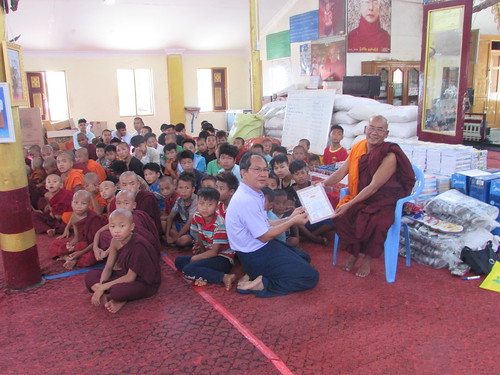
Doe Pin Orphanage 20-May-2019: Doctor Hla Tun receives the donation certificate issued by the orphanage, watched by a group of orphans.
The Abbott then made a short address and, after some general conversation, we said 'good bye' and returned to our car.
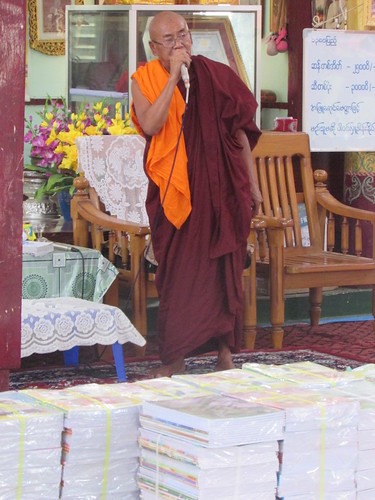
Doe Pin Orphanage 20-May-2019: The Abbott makes a short address.
We drove through the town of Pyin Oo Lwin to Shwe Sin Minn orphanage founded by two sisters in 1999. My first visit was in 2011 when building work was in progress to expand the accommodation. I returned in 2013 to find another extension being constructed ('Related posts' below lists posts describing these visits). Arriving in 2019, I found another major new building under construction.

Shwe Sin Minn orphanage, Mandalay, 2019: New building under construction, given by a Taiwanese donor.
The food donated by Enfants d'Ailleurs Foundation was already laid out at the rear of the assembly hall, with the orphans sitting on the floor in the remaining space.

Shwe Sin Minn orphanage, Mandalay, 2019: Orphans gathered in front of donated sacks of rice. The 'white board' in the background lists the donated foodstuff.
The Head Nun presented the donation certificate confirming the foodstuffs received to Doctor Hla Tun.

Shwe Sin Minn orphanage, Mandalay, 2019: Doctor Hla Tun receives the donation certificate issued by the orphanage from the Head Nun.
The Head Nun then invited Doctor Hla Tun to make a short address to the assembled children.

Shwe Sin Minn orphanage, Mandalay, 2019: Doctor Hla Tun made a short address to the assembled orphans, watched by the head nun.
Finally, all the orphans moved outside for a group photograph.

Shwe Sin Minn orphanage, Mandalay, 2019: Orphans pose for a group photograph.
Having completed the formal donations at the two orphanages, we set off by car to return to Mandalay, stopping on the outskirts of Pyin Oo Lwin at a long line of roadside vendors. The area is well-known for strawberries, other fruit and various local wines. Doctor Hla Tun made some purchases to take back to his home in Yangon on the following day then we continued on the Oriental Highway to Mandalay, slowly making our way through the heavy traffic of the city to my hotel. Doctor Hla Tun had made his own arrangements for accommodation that night but insisted that the following morning we would travel to Mandalay Airport together where he would take a flight to Yangon and I would start my long journey home via Bangkok.
My friend Ko Hlaing and his young daughter Sandy had arranged to visit me at the Hilton Hotel in the evening. They didn't want a meal so we just went to my room for a chat and ordered soft drinks. Both speak good English making things easier for me and I really enjoyed spending a little time with them both since it had been around 18 months I'd seen them (that visit is described here).

Mandalay, 2019: Ko Hlaing and his daughter Sandy.
The visit concluded with Sandy and I going for a walk around the outdoor swimming pool. Although it was dark, the swimming pool area was well-lit, producing some dramatic lighting effects. There was time for one group picture in Reception before we finally said our 'good byes'.

Mandalay, 2019: Ko Hlaing, Sandy and Jan.
Related posts on this website
This is one of a series of posts describing my 14th visit to Myanmar. The post Return to Burma is the first post in the series.
Clicking on the 'Next report' link displays the post describing the next events. In this way, you may read about the trip in sequence.
Next report
Alternately, clicking on the 'All my Burma 2019 reports' link displays all the posts on this trip in reverse date-of-posting order.
All my Burma 2019 reports.
You can find all the posts about education support here or by selecting search label 'Education'.
The following posts include references to Doe Pin or Shwe Sin Minn:-
Visit to an Orphanage, Myanmar (Doe Pin) 2009
Three Orphanages 2011
Three Orphanages Revisited 2012
Support for Orphanages in Myanmar 2013
Maymyo 2013
News from Burma - Educational Support 2014
Two Orphanages and a Monastery 2018
My pictures
My pictures showing this part of the trip are in the albums:-
Hilton Hotel, Mandalay.
Burma 2019.
Doe Pin Orphanage 20-May-2019.
Shwe Sin Minn Orphanage 20-May-2019.
All my general pictures on this trip are in the collection of albums also called Burma 2019
[Link to 'Next report' added 5-Nov-2020]
I briefly described oiling 5542 in the earlier post On the Footplate but decided to go into a bit more detail so in the post Preparing 5542 (part 1) I started to describe the preparation of the locomotive. This article, Part 2, concludes the description.
Layout of Locomotive
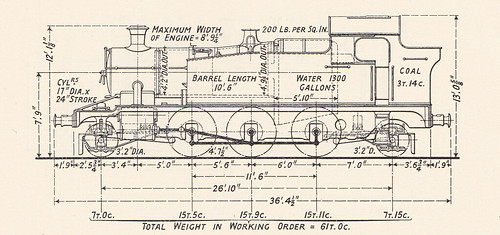
"4575" Class (Railway Publishing Co. Ltd. 1938)
Click for larger view.
In Part 1, I described oiling the motion accessible from outside of the engine at ground level. Attending to the inside motion requires the locomotive to be over an inspection pit giving access underneath the engine and allowing climbing up underneath the boiler between the frames. It doesn't matter what order oiling points are attended to but some sort of routine is necessary to ensure none are overlooked. Before disappearing into the pit, a suitable oil feeder, oil bottle of Motion Oil to allow replenishment of the feeder and the vital 'wiper' (a rag to remove any surplus oil) should be positioned in the pit or alongside the engine within reach of somebody working in the pit. This avoids having to either climb out of the pit part way through oiling to obtain supplies or shouting to your mate for assistance.
5542 has a pony truck at each end and, as you enter the pit, the oil fillers for the underkeeps on the pony truck axleboxes at that end face you as a reminder to check levels and periodically use a siphon to remove any water (which sinks to the bottom of the axlebox, being denser than the oil).

5542: Trailing truck, RH axlebox.
Most locomotives have an extensive system of rods and transverse shafts a few inches above rail level to allow all the brake shoes to be operated from a single power brake cylinder. In 5542 it's a steam brake cylinder mounted under the cab. Other British designs may use one (or two) vacuum brake cylinders and, particularly on steam locomotives used overseas, the power brake cylinder may be operated from pressurised air. Then, depending upon the design, there are additional obstructions from the suspension and various pipes. The chassis for the pony trucks on 5542 have to be ducked under, whichever end you approach from. Since 5542 also has mechanical linkages for remote control of the regulator when working 'Push-pull' or 'Auto' trains, there are also additional shafts and bell cranks to be avoided.
When moving around in the pit, it's necessary to bend down to avoid a nasty crack from contact with all this old iron. Traditionally, enginemen wore flat caps or the 'greasetop' hat during preparation, neither of which offers much protection against impacts to the head. A complication at Shackerstone is that the pit is not as deep as most pits, so a particularly hunched-up pose is required.
This rather-ape-like stance puts you at about the right level for attending to the underkeeps of the six coupled wheels which are provided with a short 'elbow' closed with a cork allowing any water to be removed with a siphon.
The next problem is to decide where to climb up into the space underneath the boiler not occupied by the inside motion or the various 'additional obstructions', to allow oil to be applied to the numerous oiling points. Depending upon stature and fitness, different people may adopt different solutions. I generally clamber up first ahead of the trailing coupled axle and then to the rear of the leading coupled axle.
A wooden stool with a single step is dragged into position in the pit ahead of the trailing coupled axle. This task is often harder than it sounds as the preparation pit is also used for disposal, so there is usually a pile of ash just where you'd like to set the stool. Feeder and oil bottle are then placed where they can be reached after you've ascended. Climbing onto the stool then puts the trailing coupled axle at about waist height so I then hoist myself up so as to sit on the axle, facing the driving axle with its four eccentrics. Leaning forward, I can first top-up the four eccentrics and then, reaching up left and right, attend to the four-feed oilboxes mounted on the inside of the main frames. The four tail trimmings in each oilbox feed a driving axlebox, via flexible hoses (2 for hornguides, 2 for axlebox) which allow for the up-and-down motion of the axlebox in the hornguides.

5542: Driving axle showing RH eccentrics.

5542: Four-feed oilbox mounted on the inside of the right main frame for Right Driving Wheel.
Having completed this part of the oiling, it's time to climb down into the pit and re-position the wooden stool, feeder and oil bottle to allow me to climb up again to sit this time on the leading coupled axle, facing rearwards, allowing the rest of the Link Motion to be oiled. Following Churchward's example, Collett provided comprehensive arrangements for keeping the Link Motion lubricated. There's a fair bit of stretching (and grunting) to reach all the corks and top-up the oil reservoirs. Then, reaching left and right, the two four-feed oilboxes mounted on the inside of the main frames which serve the leading coupled axleboxes are dealt with. The four tail trimmings in each oilbox feed a coupled axlebox, via flexible hoses
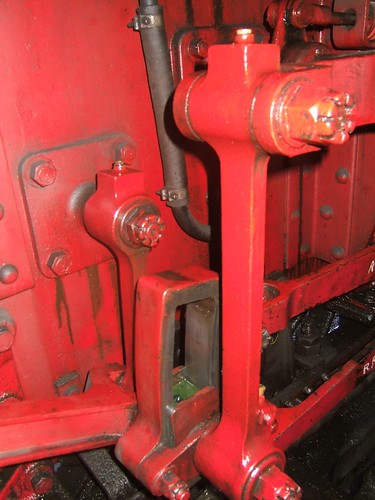
5542: Link motion for right-hand cylinder.
 5542: Four-feed oilbox mounted on the inside of the right main frame for Right Leading Coupled Wheel.
The last oiling points here are on the inner arms of the LH and RH Rocking Shafts, reached by twisting round.

5542: Upper end of RH Intermediate Valve Rod, showing connection to inner arm of Rocking Shaft.
With the rather unpleasant 'inside' examination and oiling complete, it's time to exit the pit and climb up onto the framing at the front of the engine to deal with two rocking shaft oil pots, two additional oil pots and the vacuum pump oil reservoir on the right side of the engine. The vacuum pump reservoir generally uses a steam oil and paraffin mix. On the left side of the engine there is no vacuum pump oil pot but there are two oil pots for the rocking shaft plus one additional oil pot. In Part 1, in looking at the outside motion, we'd already seen that the oiling points differ on the two sides of the engine because of the design of the slide bars and crossheads. Just below the bottom of the smokebox door, on the boiler centreline, there's a single footstep to assist the crew in reaching up to place a lamp on the top lamp iron when required. This position is always referred to as the 'chimney' but, of course, the lamp iron is actually fixed to the smokebox. Almost hidden underneath this footstep is another oil box requiring attention.

5542: View of framing on right-hand side of boiler, ahead of side-tank.
In Part 1, the Sight Feed Lubricator using steam oil is described by reference to an earlier post '5542 at the Battlefield Line'. There are also two 4-way oil boxes, in the cab fixed to the inside of the left and right side tanks at high level. The four tail trimmings in each oilbox feed a the left and right coupled wheel axleboxes via copper pipes (2 for hornguides, 2 for axlebox).

5542: 4-feed oil box mounted on the left of the cab (actually on the side tank) feeding the left trailing coupled wheel. A second, similar oil box is mounted at a lower level.
Finally, there's a low level oilbox only on the fireman's side of the cab.

5542: 4-feed oil box mounted on the left of the cab (actually on the side tank) mounted at a low level. The round 'hatch' on the left of the picture provides access to the sidetank.
Related posts on this website
Preparing 5542 (part 1).
There are also a number of other posts with technical content about working on 5542:-
GWR 'Light Prairie' 5542 (22-Aug-2010)
On the Footplate (5-Dec-2017)
Santa Specials at the Battlefield Line 2017 (19-Dec-2017)
5542 at the Battlefield Line (28-Aug-2018)
Battlefield Line 'Family Fun Weekend' (3-Sep-2018)
5542 at the Battlefield Line in 2019 (30-Jul-2019)
To see all my posts about the Battlefield Line, select Label 'Battlefield Line' or click here.
To see all posts with Mutual Improvement Class content, select label 'MIC'or click here or look at the index at Mutual Improvement Classes (2).
My photograph albums
Where necessary, clicking on an image above will display an 'uncropped' view or, alternately, pictures may be selected, viewed or downloaded, in various sizes, from the album listed:-
5542 GWR Locomotive
Some years ago, when I started my travels overseas, I was frequently horrified with the risk of 'trips, slips or falls' to which pedestrians were exposed. At the time, I considered that the United Kingdom handled these risks better. After the world-wide economic problems of 2008, my country entered a period of 'austerity' and funding for repairs to roads and pavements came under pressure. Despite continued emphasis on 'Health and Safety', I feel that my country has elevated itself to a position amongst the world leaders in terms of unrectified hazards to road users.
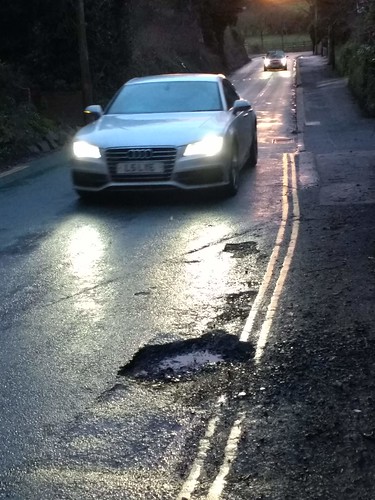
Pothole in Sandy Lane, Brewood
Part of the reason for these problems in the U.K. is the common practice of distributing services underground. Mains water, Gas, Electricity and Telecommunications, together with Drains for Surface Water and Foul Water (sewage) are typically buried in the ground, usually underneath the surface of a road. This is fine until repairs or alterations to any of the services are required, necessitating removing the road surface and digging-up the sub-soil until the required service is exposed. The obstruction of the carriageway creates traffic management problems, often addressed by traffic control using temporary traffic lights. The presence of the excavation, often a couple of metres in depth, also presents a danger to pedestrians, often dealt with by some form of temporary fencing. Requirements for signage to alert both pedestrians and vehicles to the temporary works further complicate matters.

Brewood Village: Temporary traffic lights and signage during connection of buried services to a house extension in Sandy Lane.
In the United Kingdom, I think mains water and drains are invariably buried. The same applies to domestic mains gas supplies but I was interested to discover (on my trip Caspian Odyssey) that in Armenia and neighbouring Georgia, gas is distributed above ground because volcanic activity can cause sufficient ground movement to damage buried pipework. In these countries, this seemed to result in an unsightly and sometimes rather'Heath-Robinson' arrangement of pipes, elbows and supporting brackets.
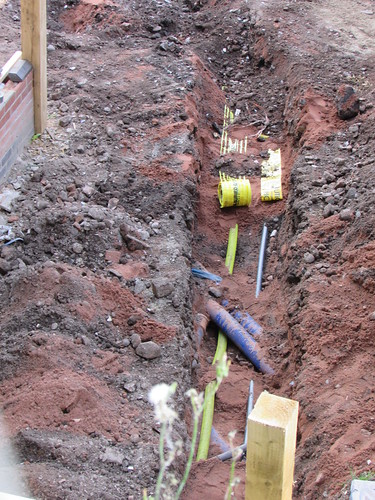
Brewood Village: Directly-buried underground services during connection to new houses in Sandy Lane. Note the printed identification tapes laid on top of the gas main (left) and water main (right).
Both electricity and telecommunications cables are sometimes carried above ground.

An underground multi-pair telecommmunications cable feeds a telegraph pole from where subscribers are connected by overhead 'drop-wires'.
Indeed, when telephones started to proliferate, they were initially invariably fed by two (less commonly, one) bare copper wires carried on ceramic insulators on the cross arms of 'telegraph poles'. In a built-up area, the number of circuits was visually intrusive but at least readily accessible for maintenance (if you had a head for heights).
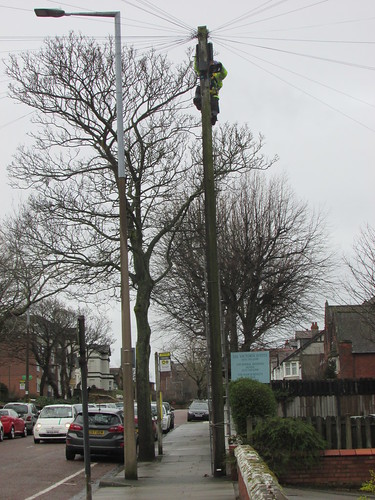
'Openreach' Lineman working on a British Telecom Distribution Pole in Victoria Road, New Brighton.
As the idea of generating mains electricity in one place and distributing it to consumers over a wider area grew, it was logical to copy the transmission methods used for telephones by using copper wires carried on porcelain insulators on wooden poles.
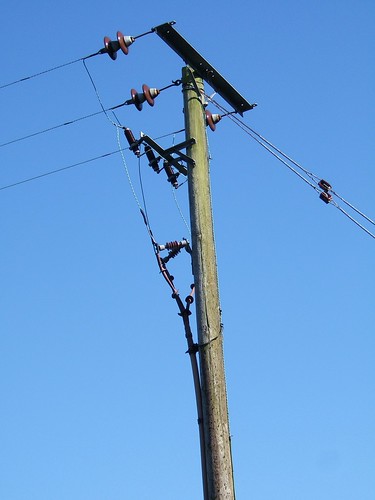
Three-phase 'Delta' connected overhead electricity transmission line on wooden pole, showing connection to multi-core insulated cable leading to a transformer at ground level. The pole is stayed by two stranded galvanised steel guy wires, each incorporating an 'egg' insulator.
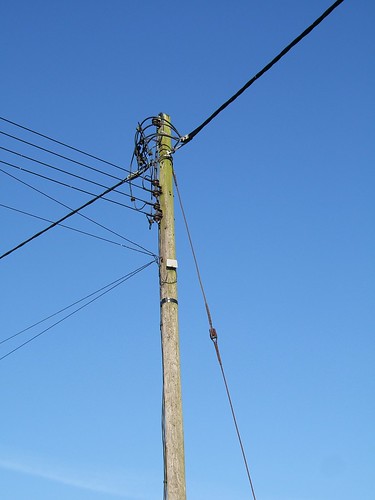
A 3-phase electricity supply being distributed by four insulated cables twisted together, carried overhead on wooden poles. A teed connection to a consumer is carried on four separate, parallel wires. Overhead 'drop-wires' for telephones are fed from an underground cable via a plastic terminal box. Note the 'Egg' insulator in the stranded galvanised steel guy wire.
As technology developed better electrical insulating techniques, it became possible to manufacture electrical cables where one tough, impervious sheath embraced a number of separate electrical conductors. For telephony, there might be many thin conductors capable of carrying a number of separate circuits. For power transmission, a small number of thick conductors were common. These cables could then be buried, removing the need for a series of poles to support the service.
Particularly for distributing telephone circuits in a built-up area, a large number of circuits would leave the exchange but then split to serve different groups of suppliers. This could conveniently be done by bringing the exchange cable into an accessible underground chamber where other cables could be interconnected, usually via an above-ground terminal cabinet allowing changes to the circuits provided and a convenient location for testing when faults occurred.
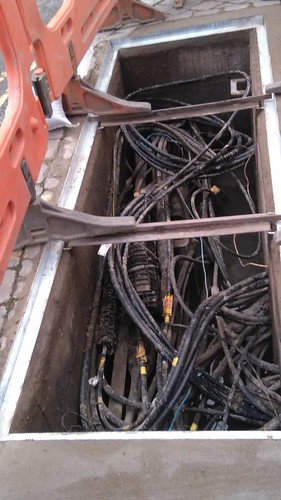
Termination chamber, Market Place, Brewood (during replacement of lid frame).
Power distribution often used inaccessible, buried joints to 'tee' power to individual users. In the 1950s, the Victorian house I was living in was finally connected to mains electricity (we'd previously only had mains water and gas). I was fascinated as the pavement was dug-up, the electric cable passing the house - the 'street main'- was located and the lead outer sheath removed to expose the individual three live phases, the neutral and (I think) the protective earth, each with its own electrical insulation. With what seemed to me very inadequate protective clothing and a few rubber mats to line the excavation, the jointer calmly attached the spur cable which would feed the house to one of the three phases, the neutral and the protective earth. Each joint was very carefully made and soldered for reliability. I presume some insulation was applied but I can't remember details. The remainder of the process involved making-good the sheath of the main cable and sealing the new spur cable so as to prevent the ingress of moisture. The joint closure was two pre-formed sheets of lead about two feet long, one fitted under the new joint, one on top so as to embrace the main cable, fitting snugly around the street main at each end of the joint and around the new spur cable. The two halves of the joint closure were held tightly together by bending over interlocking tabs at the edge of each sheet of lead before carefully heating the lead with a blowlamp and 'wiping' it with moleskin until a continuous, waterproof lead sheath had been created along the 'street main' and new spur cable.
Pictures around Brewood Village
The following album includes some examples of local services infrastructure:-
Brewood Village
Although Peak Rail ran a reduced service in February and March 2019, my first driving turn at Peak Rail in 2019 was Sunday, 7th April. I also describe a turn on Easter Saturday. The year then continued following a similar pattern.
Sunday, 7th April 2019

No. 72 on an 'Up' train pauses at Darley Dale on 25th March 2018.
The popular 'Austerity' 0-6-0 saddle tank No.72 which had worked the services during 2018, usually top-and-tailed with a main-line diesel (D8 'Penyghent'), had been retained as the steam motive power in 2019. In the morning, Mike S. was fireman with C. Ward taking over in the afternoon. Colin D. was cleaner all day and it was a merry footplate.
In the morning, Mike and I came off-shed at 08:30, in order to collect our driving experience candidate from Rowsley Station at 08:45, giving him two hours on the footplate. This time was divided between familiarisation with the locomotive and its controls, driving between Rowsley and the Up Home signal at Church Lane, operating Rowsley South Ground Frame to allow shunting movements to the loading dock at the north end of Rowsley Yard (where our driver was met by his wife and two children) and a little practice firing.
Apart from the 'pole' reverser, which was unreasonably stiff to move following maintenance work, the engine performed well.
Easter Saturday, 20th April 2019
Once again, No. 72 was the motive power. Robin S. was fireman all day. He'd stayed 'on site' overnight and booked on very early (04:15) so we were ready to come off shed nice and early and we sat in the platform at Rowsley, waiting for our driving experience candidate who enjoyed a 1-hour experience course, followed by a footplate ride on the first service train to Matlock Town.
The weather was bright and warm and we had plenty of passengers on all the trains. When we arrived back at Rowsley after the fourth round trip, we were informed that we'd started a small lineside fire. On that return trip (when we were being 'towed' by 'Penyghent') I'd seen a couple of people standing on the public footpath adjacent to the line, apparently looking at the track, but I'd spotted nothing untoward. Keen to ensure that any embers were fully extinguished, the Guard recruited help, loaded at least two five gallon drums of water into the Guard's compartment and we arranged to stop at the incident on our last trip to Matlock to ensure the fire was out. We stopped as planned and the Guard made a thorough job of dousing the area with water before completing the trip. Only a tiny burnt area was apparent and I joked to the Guard that he could have spit on on it to make it safe but, in very dry weather, lineside fires can be very serious and preserved railways may ban the use of steam locomotives during high-risk conditions. I described another lineside fire on the Battlefield Line in the post here.
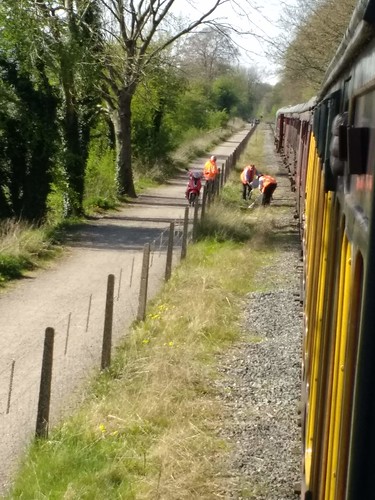
Peak Rail 2019: A small lineside fire.
Related Posts on this Website
The 'Austerity' 0-6-0ST locomotive.
My pictures
Where necessary, clicking on an image above will display an 'uncropped' view or, alternately, pictures may be selected, viewed or downloaded, in various sizes. Within each album, photographs are normally arranged by date taken.
No. 72 - Austerity Tank.
Peak Rail 2019.
All my Peak Rail Albums.
On previous visits to the Battlefield Line, 'Light Prairie' 5542 has always been a popular and reliable performer. She was welcomed back again in March 2019 and below are brief notes on a few 'turns' I had.
The timetable
The timings for the 2019 weekend 'Green Timetable' of five return workings between Shackerstone-Market Bosworth-Shenton were as follows:-
| Shackerstone Dep |
11:00 |
12:15 |
13:45 |
15:00 |
16:15 |
| Market Bosworth Arr |
- |
- |
- |
- |
- |
| Market Bosworth Dep |
11:12 |
12:27 |
13:57 |
15:12 |
16:27 |
| Shenton Arr |
11:20 |
12:35 |
14:05 |
15:20 |
16:35 |
| Shenton Dep |
11:35 |
12:50 |
14:20 |
15:35 |
16:50 |
| Market Bosworth Arr |
- |
- |
- |
- |
- |
| Market Bosworth Dep |
11:45 |
13:00 |
14:30 |
15:45 |
17:00 |
| Shackerstone Arr |
11:55 |
13:10 |
14:40 |
15:55 |
17:10 |
Because of a major programme of track laying in progress at Market Bosworth, to create a passing loop, the pedestrian level crossing at the Shenton end of the Market Bosworth station was closed at the beginning of the season. Since this was the only public access to the single platform, 'early season' trains were temporarily not calling at Market Bosworth. Once the main line turnout had been completed, the pedestrian level crossing was reinstated and, later in the year, trains resumed the intermediate stop at Market Bosworth. The timetable does not specify arrival times at Market Bosworth in either direction but crews attempt to arrive around 2 minutes before booked departure, to allow a reasonable time for passengers to leave and join the train.
Mothering Sunday: 31st March 2019
I was driver on 5542's second day in traffic during the 2019 season on Sunday, 31st March (Mothering Sunday) when she carried out five round trips from Shackerstone to Shenton, two of which were special Mothering Sunday Afternoon Cream Tea trains. The married couple of Rod and Tracy Tye shared the firing duties.
Although Market Bosworth station was closed in March 2019, as explained above, we made a couple of Special Stops there at the request of the Guard for commercial purposes.
We had an enjoyable day without problems.

"Mother's Day" Afternoon Cream Tea at the Battlefield Line (Photo: Graeme Watkins).

5542, with Jan driving, passing Permanent Way gang at Market Bosworth on 31st March 2019 (Photo: Adrian Lock).
Easter Bank Holiday Monday: 22nd April 2019
I was back on 5542 with Ritchie Marcus firing, carrying out the Green Timetable shown above. The weather was kind, there were plenty of passengers and a holiday atmosphere prevailed. The engine seemed to enter into the spirit and steamed "like a witch".

5224 at the Battlefield Line: Ritchie on the footplate
I did a little firing myself that day and was pleased with the results using the technique of "getting a good back" on the sloping grate. Welsh coal is very friable (allegedly why the Great Western had no automated coaling plants) so there was plenty of dust blowing around, even with liberal use of the 'slacker' (coal watering pipe) but otherwise there were no problems and Ritchie and I agreed we'd had a good, although tiring, day.

5224 at the Battlefield Line: Back in the shed after a good day.
A Difficult Day
Not all 'turns' are text-book. On Sunday, 28th April I had a rather trying day which eventually became good but was particularly exhausting. The problems started as soon as I signed-on at 05:45: There was no fireman. I had not been advised who was rostered to fire so I decided to start lighting-up myself. At 06:30 a rather shame-faced fireman arrived saying he'd overslept the alarm. Although I knew him, I'd not worked with him on the footplate before but he seemed confident so I left him to finish lighting-up, stressing how little time we had because of the Gold Footplate Experience. With the fireman was a cleaner I'd not met before said he'd oiled 5542 a number of times before so I let him oil 'outside' while I went into the pit to oil 'inside'. I emerged from the pit around 07:30 plastered with ash and oil. To add to my woes, the electric pump in the pit couldn't be induced to work so I'd ended up splashing around in a few inches of oily, ashy water at the cab end of the pit but, fortunately, my boots remained fairly waterproof.
Returning to the footplate to see how matters were progressing, I was greeted by a nice little fire in the front of the box which would probably have steamed quite well in two or three hours but I pointed out we didn't have that long. Accompanied by the fireman and cleaner, I found more wood and started to spread the little fire with a fire-iron until the whole grate was covered with a better coal and wood fire. However, it had been cold in the night and there wasn't much heat left in the boiler so I wasn't very optimistic and went to warn Mark H. that we'd be late off-shed, to be told that our driving experience trainee and his family were already touring the Museum.
I returned to the shed to coax the fire and, to my surprise, we'd managed 20 pounds by nine o'clock. By the time I'd given our driving experience trainee a walk round the engine, we'd made about 60 pounds so I took the engine off-shed. It was about 09:10 when we carefully left light engine but I was still worried that pressure wasn't building as I expected (it wouldn't rise above 160 pounds) and the fireman seemed unsure how to proceed. I knew the grate was clean when we started and I'd warned him not to get the front of the fire too thick - that had seemed to promote clinker on the sloping grate of this engine in the past. The coal seemed the same as earlier in the year (Ffos-y-Fran opencast) although there did seem a particularly high proportion of slack in the bunker. However, no arrangements had apparently been made for re-coaling and the fireman remained confident so we pressed on. Light engine, of course, 160 pounds was no problem.
In the cutting between Market Bosworth and Shenton we found a fairly large tree across the track (it had been a rough, windy night). We stopped and tried to pull it clear. It was multi-stemmed and some of the smaller branches came away but the main root, about six inches diameter, was still firmly attached. We managed to bend the branches forward , slide the engine past and continue to Shenton. On the return, we tried again to remove the tree but decided we'd need a hand saw to cut the trunk so we bent the branches the other way and slid past again.
We stopped at Shackerstone box to report to the signalman and he lent us a small saw. To be on the safe side, we decided we'd take water before coupling onto the train. A number of members of our driving experience trainee's family were to travel on the round trip driven by the trainee. Whilst the fireman and cleaner took water, I 'fettled the fire' and managed to get the valves lifting but as soon as we started away the pressure collapsed again, despite my guidance to the fireman. Fireman need to anticipate and not relax as soon as the boiler pressure starts to increase. The amount of slack in the bunker didn't help. Although it burns, if you put too much in one place, it acts like sand and I could see that the back of the fire was tending to become a black 'tump' not steaming properly, even after a the fireman gave it a 'stir' with the fire iron.
We stopped at the fallen tree and the fireman and our driving experience trainee used the saw to cut the tree root and drag the remains clear. I decided to stay on the engine and coax the fire to a better state. Whilst running round the coaches at Shenton, I again did what I could with the fire but although I could get it blowing off and fill the boiler whilst at a stand, on the road the pressure still tended to drop to around 160.
However, we got back safely to Shackerstone and I was asked to present the certificate to our driving experience trainee, who had performed very well.

Jan presents the certificate after a Gold Experience (Photo: Mark Heseltine).
We ran round and watered (I fettled the fire) then backed onto the train (more fettling) and we set off with the 11:00 departure rather late, having agreed with Mark's suggestion to follow the late-running 11:00 service by the 13:45 departure, cancelling the 12:15 advertised round trip altogether. I was a lot happier with the state of the fire as we set off with the delayed 11:00 but the fireman still wasn't reacting quickly enough and we lost pressure 'on the road'. At Shenton, I had another go at the fire. The fireman said he was experienced with 'Panniers' 6412 and 6430 which we'd used on the 2018 'Santa Specials' (there's a brief report on the 'Santa Trains' here) but said he couldn't figure out 5542. Well, I was a bit puzzled with our problems, too. The amount of slack in the coal certainly didn't help and the fireman had to go 'bunker diving' quite frequently to sort out more lumps. Although the fireman was willing and keen as mustard, his relative inexperience meant that on the return journey, between Market Bosworth and Shackerstone, I realised that we were going to have to 'stop for a blow-up'. We came to a stand near Carlton Bridge with the brakes dragging. After less than ten minutes, we carried on and arrived safely at Shackerstone, ran round and watered, ready for the 13:45. Whilst the fireman and cleaner had a quick lunch, I stayed on the engine trying to get the fire 'right'. There was very little clinkering, just black slow-to-burn areas.
We set off with the 13:45 and things definitely seemed better. Although pressure came down, it didn't continue to collapse and the fireman seemed to 'get it' and fired more promptly. At last, pressure recovered in the station stops and when the valves lifted, it encouraged both of us. I reduced my physical interventions in firing as the fireman seemed to be getting better at judging the necessary firing rate. When the engine was working, the fire was now white-hot. The cleaner did all the uncoupling and coupling, allowing the fireman to concentrate on finding more lumps and managing the boiler.
I was glad we'd 'dropped' the 12:15 round trip, because by the time we set off on the 15:00 departure we were already fairly tired . The engine continued to steam as you'd expect from a 'Swindon' engine but, despite regularly sweeping the footplate and using the 'slacker', the wind was whisking clouds of coal dust around. But we were all relieved that we'd finally got a 'good steamer'. We got back to Shackerstone within a few minutes of 'right time' and ran round, taking water for the last time.
I was rather worried as to just how empty the bunker had become and most of what remained was slack. The fireman remained optimistic and the last trip to Shenton was done in fine style with the safety valve starting to 'sizzle' each time the regulator was closed. On the way back, the fireman realised that the fuel situation meant that he could no longer recover the pressure as it started to fall. I came back in a leisurely fashion, one eye fixed on the boiler pressure gauge and I noticed that, this time, the fireman was paying careful attention to the gauge too. Of course, my main concern was keeping the vacuum brakes released and our final arrival in Shackerstone with almost 140 pounds on the clock was a great relief. We'd half a glass of water remaining so I was sure we'd be alright. We raked through the fire outside the shed, pushing good fire towards the tubeplate. There was very little clinker. We stabled inside the shed and had no problems filling the boiler well above the top nut. We all agreed it had been a good day but, oh, it was hard work.
"4575" Class (Railway Publishing Co. Ltd. 1938).
Related Posts on this Website
GWR 'Light Prairie' 5542 (22-Aug-2010).
On the Footplate (5-Dec-2017).
Preparing 5542 (part 1) (14-Sep-2018).
5542 at the Battlefield Line(28-Aug-2018).
Battlefield Line 'Family Fun Weekend' (3-Sep-2018).
Battlefield Line Steam Gala 2018 (Part 2) (4-Jan-2019).
My pictures
Where necessary, clicking on an image above will display an 'uncropped' view or, alternately, pictures may be selected, viewed or downloaded, in various sizes, from the albums below:-
5542 GWR Locomotive.
Battlefield Line 2019.

