Monday, 23 September 2019

East Croydon to London Bridge

Journey on Thursday, 28th March 2019

I've been a reasonably frequent traveller between East Croydon and London on various visits. Normally, the service from East Croydon to Victoria with a single stop at Clapham Junction is the most convenient, using the line originally built by the London Brighton and South Coast Railway (LBSCR). But Victoria was not the first LBSCR terminus in London - that was Tooley Street, later called London Bridge. So I sometimes use the fast service from East Croydon to London Bridge along the 4-track route through Norwood Junction.

Travelling up to London from Croydon on 28th March for a meeting near London Bridge, I arrived at East Croydon in time to watch a fast train to London Bridge departing. I decided I'd still plenty of time to get to my meeting so when the next train to London Bridge, a stopping train via North Dulwich, arrived I decided to board it. The map below shows the normal route to London Bridge and the route my stopping train took. The development of the railway network in south London is quite hard to follow. To see the whole of this pre-grouping map and extracts of some areas, follow the links from my post Pre-grouping Railway Map.


Detail from pre-grouping railway map showing LBSCR main line via Norwood Junction (thin green) and route via North Dulwich (thick green). The original map was published by W & A K Johnston under the title 'Railway Map of England and Wales 11th Edition'.

I'd only previously travelled on parts of the route the train would take. The whole route belonged to the London, Brighton and South Coast Railway in pre-grouping days, but the South Eastern and Chatham Railway was 'implicated' around Tulse Hill, Peckham Rye and, of course, on the last 1.5 miles to London Bridge.

We left East Croydon on the Slow line and at Windmill Bridge Junction took the flyover which took us over the Brighton Fast lines to our first stop at Selhurst. From here the route is 4-track, paired by use, to Victoria. Travelling on the Up Slow my train made station stops at Selhurst, Thornton Heath and Norbury.


Norbury: View from train on Up Slow showing Banner Repeater TVC672 on platform (South Croydon to Wolverhampton by rail)

After the Streatham Common stop, my train diverged to the right from the Victoria Lines onto the Streatham Spur, then joining the line from Mitcham Junction.


Streatham Common Spur: View from train heading for Streatham showing Victoria lines and, in background, bridge carrying Mitcham Line over the Victoria Lines (South Croydon to Wolverhampton by rail)

We stopped at Streatham, passed through Streatham Tunnel and Leigham Tunnel and then, approaching Tulse Hill, were joined on our left by the line from Streatham Common and on our right by the line from Wandsworth Common before stopping at platform 3 of the four-platform Tulse Hill station.
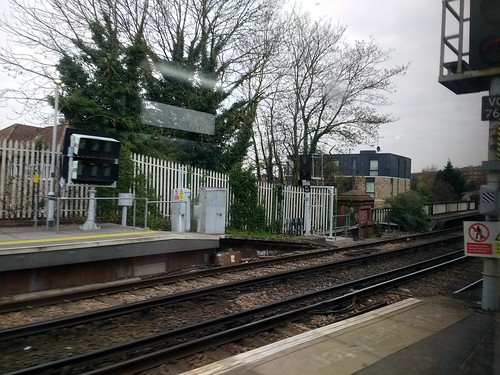

Tulse Hill: View from train in platform 3 showing signals VC760 and VC762. Note expansion joint in running rail and traction current bonding (South Croydon to Wolverhampton by rail)

Leaving Tulse Hill, the route to Herne Hill (used by some 'Thameslink' services) diverged to our left before we entered the 331 yard long Knight's Hill Tunnel, then making stops at North Dulwich and East Dulwich.


North Dulwich: View from train showing platform 1 (South Croydon to Wolverhampton by rail)

At Peckham Rye Junction, we merged with the line from Victoria via Clapham High Street and continued over the arches to platform 2 at Peckham Rye on the South London Line.


Peckham Rye: View from train approaching station 'over the arches' showing 4-aspect automatic signal VS443 (South Croydon to Wolverhampton by rail)


Peckham Rye: View of platforms 3 and 4 and rear of signal VS444 (South Croydon to Wolverhampton by rail)

After our stop at Queens Road Peckham, Old Kent Road Junction allows London Overground services to diverge right and join the East London Line at Silwood Junction but my train continued to a brief stop at South Bermondsey before joining the remarkable expanse of lines for the final mile and a half to London Bridge. Still following the original alignment of the London and Greenwich Railway across a series of viaducts but now expanded in width to carry no less than eleven running lines, the area received major modernisation during the Thameslink Project which also completely rebuilt London Bridge station.
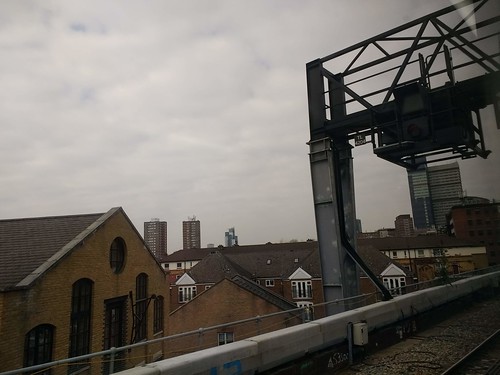

Approaching London Bridge on Up showing signal TL4204 on 11 Reversible at Brunswick Court Junction (South Croydon to Wolverhampton by rail)


Approaching London Bridge on Up showing former Area Signalling Centre (South Croydon to Wolverhampton by rail)

There's a brief mention of the pioneer London and Greenwich Railway here and the later period on the L.B.S.C.R. at London Bridge is outlined in Origins of the Southern Railway: Part 2: L.B.S.C.R..


London Bridge Station: View from Platform 12 looking South-East after my arrival. Route set for departure from platform 13 to track 9.


London Bridge Station: Concourse near entrance to Platform 12 showing departure display.

After my London meeting, I returned to Wolverhampton from London Euston. There are a number of pictures in the collection South Croydon to Wolverhampton by rail taken on that journey.

Related articles on this web site

Notes on Some Early Railways in England.
Origins of the Southern Railway: Part 2: L.B.S.C.R.

My pictures

Where necessary, clicking on an image above will display an 'uncropped' view or, alternately, pictures may be selected, viewed or downloaded, in various sizes, from the albums below. Apologies for the poor quality of pictures taken from trains.

South Croydon to Wolverhampton by rail
East Croydon Area Rail.
South London Railways.
London Bridge Station.

Saturday, 7 September 2019

Bournemouth by Train

On Saturday, 17th August 2019, I travelled by train from Wolverhampton to Bournemouth to attend the 'Lionsmeet 2019' event. The timings of the outward trains I used were:-

Wolverhampton-Bournemouth Arrive Depart
Wolverhampton 06:02
Birmingham New Street 06:19 06:33
Winchester 08:58 09:05
Bournemouth 10:00

The first 'leg' to Birmingham was by a 2-coach Diesel Multiple Unit operated by Transport for Wales, reporting number 1G28. At Birmingham New Street, the train stopped at the south end of the platform (before continuing to Birmingham International) so I had a fair walk to the escalators towards the north end of the platform which allowed me to cross to platform 9 (without the 'faff' of using the ticket barriers).

There was a Cross Country 'Voyager' displaying the destination as 'Manchester' in the north end of platform 9. As I watched, another 'Voyager', comprising two 'sets', slowly arrived in platform 9 from the south - clearly an empty stock working from the Bombardier Depot at Central Rivers (near Burton-upon-Trent). The new arrival stopped a few yards short of the Manchester train, following handsignals from a driver waiting on the platform who was presumably about to take over one of the trains. After a short delay, the new arrival eased forward a few feet and I realised that it had been uncoupled from the rearmost set. So there were now three departures in platform 9, one behind the other, bound for Manchester, Painton and Southampton.

I boarded the Southampton service, reporting number 1O80, and we left on time, turning right at Proof House Junction to reach St. Andrews Junction where we first joined the former Midland Railway Camp Hill line before diverging left at Bordesley Junction to next join the former Great Western route to London Paddington.

Our first calling point was Leamington Spa, where the original layout of two main lines flanked by platform loops remains although the station is much changed from steam days. Immediately south of the station, only parts of the viaduct remain which formerly brought the L&NWR line to a second station Leamington (Milverton). The comprehensive WarwickshireRailways.com site has more information about the history of both stations - the GWR station is described here, the L&NWR station here.

Further south, Fenny Compton is the junction for the MOD Depot at Kineton. There's an excellent history of Kineton MOD and its railways in Roger Farnworth's blog here. At Fenny Compton, there are goods loops in both directions and a Freightliner train was waiting in the Down Loop. During the journey, I was using Railcam.UK intermittently on my mobile phone, so I quickly identified the freight as 4M62 from Southampton to Lawley Street. There's an introduction to using Railcam.UK in my post here.

My train was 'right time' for its next stop at Banbury, then we passed under the flyover at Aynho Junction where the Princes Risborough Line diverges. The 'cut-off' through Princes Risborough gave the Great Western a faster route from Birmingham to London Paddington than the original route through Oxford and Didcot but, following British Rail's decision to electrify the former L&NWR, the route became less important. The line from Aynho Junction to Princes Risborough was singled and a number of intermediate stations lost their through main lines, retaining what had been platform loops. This, of course, was in the name of reducing ongoing maintenance costs but, with passenger traffic increases generated by the innovative Train Operating Company Chiltern Trains and their services between Birmingham and London Marylebone, the line from Aynho to Princes Risborough has been restored to double track.

Oxford station appeared completely modernised with comprehensive signalling and track improvements including high-speed turnouts. We arrived at 07:40 and left, on time, at 07:42. Railcam.UK showed me that we were being followed by 4O18, a Lawley Street to Southampton Freightliner train. At Didcot we used the Didcot avoiding line, catching brief views of the Great Western Society's facilities and numerous steam locomotives before joining the now-electrified Up Relief line of the Great Western Main Line which took us to our next stop at Reading.

The modernisation in the Reading area was even more spectacular that at Oxford (but I believe did cost around 400 million pounds!). We ducked under the 'new' flyover carrying the Up and Down Main lines which was opened, I think, in 2015 and stopped in the west end of platform 7. My train would reverse here, so as to reach the line to Basingstoke. The container train following us would have no need to enter the station at all. Passing under the flyover to gain the Reading West Curve, it would join the Basingstoke line at Oxford Road Junction without hampering traffic on the Main lines at all. We arrived at 08:05 and were not due out until 08:22, giving me time to tale a few pictures of the station. It's impressive from an engineering point of view but, for me, bereft of any aesthetic appeal. There's more information about the station on Wikipedia here.


Bournemouth by Train: Reading, view from overbridge looking west showing the amazing tangle of Overhead Line Equipment and a Class 800 approaching.


Bournemouth by Train: Reading, view of platform 7 looking west, showing my 'Voyager' waiting to leave with the Southampton service.

Departure was on time and my train headed south for about fifteen miles so as to join the main line from Waterloo just east of Basingstoke station.

The line we had joined opened in 1840 as the London and Southampton Railway, only ten years after the opening of the pioneering Liverpool and Manchester Railway. When the London and Southampton Railway opened a branch from Eastleigh to Gosport, creating the first railway to serve Portsmouth via a ferry across Portsmouth Harbour, it tactfully changed its name to the London and South Western Railway, since Portsmouth regarded Southampton as rather an 'upstart'.

The main line through Basingstoke has four tracks, paired by direction (Down Slow, Down Fast, Up Fast, Up Slow). This arrangement had applied from Wimbledon, with intermediate stations provided only with flanking platforms on the slow lines but Basingstoke has platforms on all four lines. The station buildings are elderly but attractive of red brick construction with extensive canopies over the platforms.


Bournemouth by Train: Basingstoke Station Buildings.

We arrived at Basingstoke at 08:39 (1 minute early), leaving at 08:44 and accelerating towards Worting Junction where the direct line to Salisbury diverged to our right. This line had opened in the 1850s and ultimately led to Exeter and Plymouth, inciting fierce rivalry with the Great Western Railway for traffic, best known for the competition for the 'Ocean Mails' traffic from Plymouth. At Worting Junction, crossovers allow the traffic to 'sort itself out' and then what were the Fast Lines become the Up and Down Exeter and what had been the Slow Lines become the Up and Down Southampton. Battledown Flyover, opened in 1897, allows Up Southampton trains to avoid conflicts with trains on the Exeter line, as clarified in the Wikipedia article here.


Bournemouth by Train: Battledown Flyover, viewed from down Southampton train.

When booking my ticket on the internet, the recommendation was to change at Winchester so I had a few minutes to take pictures of the simple layout: just two platforms flanking the main lines.


Bournemouth by Train: Winchester platform 2, looking towards Eastleigh, with 'Voyager' departing for Southampton.

On the Down side to the north of the station, there is a single refuge siding, called the Baltic Siding, apparently usable by trains in either direction.


Bournemouth by Train: View from Winchester platform 2, looking towards London, showing overbridge and signals EH144 and EH252 for Up direction movements. The turnout to the right is for the Baltic Siding.

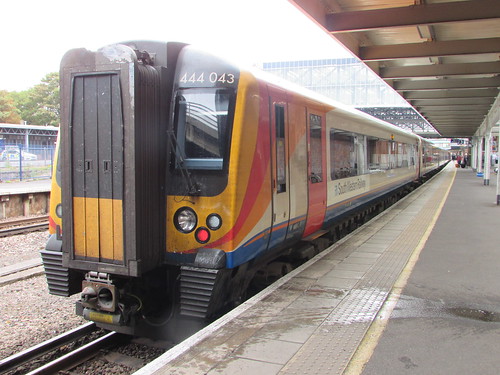
Whilst I waited, an Up container train rattled through from Southampton but I didn't identify the destination. My connection arrived on time; a Class 444 EMU formed from two 5-car units, reporting number 1W57, which had left London Waterloo at 08:05 and taken just one hour for the 66 miles. We reeled off the seven miles to Eastleigh, passing the extensive yards at speed on the Down Fast before braking for our stop at Southampton Airport. Soon on our way again, we passed the 4-platform junction at St. Denys, where the line from Fareham converges and had views on the left of the River Itchen which sinuously makes its way to the sea.

Bournemouth by Train: View of River Itchen approaching Southampton.
From St. Denys there are four running lines, paired by direction past the modern Northam Traincare Depot on our left. At Northam Junction the line to Southampton Eastern Docks, now single, continues ahead. The branch is just over a mile long so there were no views of the 'Old Dock', although St. Mary's Stadium, home of Southampton's Premier League Football Club - the "Saints" was very apparent.

Beyond Northam Junction, the double track main line executes an almost 90-degree turn to the right before entering Southampton Central station via a tunnel 528 yards long. I found the present reinforced concrete 4-platform station dating from the 1930s and refurbished in 2011 unappealing, I'm afraid. There were aspirations to build a completely new 10-platform station but I don't know how that's progressing.

West of the station there are four running lines flanked by two loops. The six lines are 'grouped by direction' but, unusually, in the order Down Loop, Down Fast, Down Slow, Up Slow, Up Fast, Up Loop. This seems to be because the next station, Millbrook, just under a mile from Southampton Central has only one island platform placed between what have become the present Slow lines. Re-signalling has transformed the area since my early visits, during which the four Loop and Fast sines have been arranged for reversible working. As I passed, I could see that signalling alterations were continuing in the area - there were a number of uncommissioned new colour light signals with the signal heads shrouded in a custom-made bag carrying the white cross symbol indicating uncommissioned equipment. Speed was quite low through this area.

I didn't really see Millbrook Freightliner Terminal on the north side of the line, because my attention was focused on the tantalising views across the fence on the south side as we passed first the Western Docks and then the more modern container berths operated by DP World.

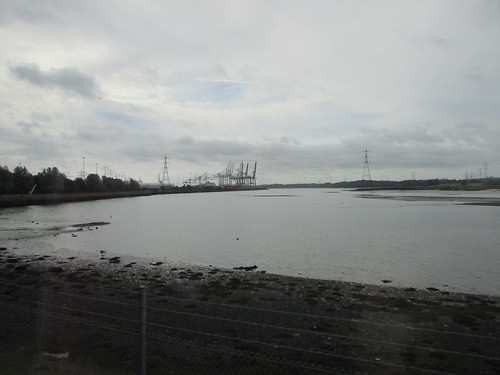
I knew that Southampton had a berth large enough to handle the super-size 'Post-Panamax' container ships and I took the picture below not sure whether the vessel was a 'Post Panamax' design - from a few hundred yards away on the train, it was hard to determine the size. A little research back home confirmed the vessel was the 'Post-Panamax' vessel 'MOL TRIUMPH' with a capacity of over 20,000 twenty-foot containers or equivalent!


Bournemouth by Train: View of DP World berth DP5 at Southampton after passing Millbrook station. The ship is MOL TRIUMPH.

We passed Maritime Freightliner Terminal, next to container berths DP1 to DP4 and then under the long concrete bridge carrying road traffic to the container berths. A couple of 'Freightliner' locomotives stood in the sidings near the repair shop where freightliner wagons are serviced.


Bournemouth by Train: View of DP World container cranes at berths DP1 to 4 at Southampton with Freightliner container crane in foreground.


Bournemouth by Train: View of DP World container cranes at berths DP1 to 4 at Southampton, Freightliner locomotives and bridge carrying First Avenue to Dock Gate 20 on left, Freightliner repair shop on right.

As we crossed the River Test on the Totton Causeway, there were final views of Southampton docks before we headed towards the New Forest and our next stop at Brockenhurst.


Bournemouth by Train: River Test with DP World container terminals in the distance.

At Brockenhurst, a Class 450 EMU forming the shuttle service to Lymington was waiting on the opposite face of the Down island platform. Railcam.UK informed me that the reporting number of the Lymington train was 1J15. Some years ago I used the Brockenhurst - Lymington Pier service when slam-door stock was still in use. I think the 'diagram' then involved seven round trips on the line. There's an article about the branch on Wikipedia here.

The final 15 miles to Bournemouth took us just 21 minutes, including three brief stops - at New Milton, Christchurch and Pokesdown, giving us a 'right time' arrival. The leading driving cab of my train had stopped near a pillar supporting the umbrella roof and I'd noticed the bucket of water with two mops leaning on the pillar. But I'd not realised the intention until the driver left the cab and used one of the mops to liberally douse the front cab window with water. The wet patch on the platform testified to the technique being common practice. I concluded that the built-in window washing feature on these EMU is not as effective as it might be.


Bournemouth: Class 444 which I'd caught at Winchester about to head to Weymouth.

Platform announcements indicated that the two sets divided at Bournemouth, the front set continuing to Weymouth, the rear set terminating, I think. Although the two cental roads between the Up and Down platforms have been elimited, Bournemouth is still laid out to facilitate trains being divided or joined. There are two middle sidings between the Down and Up lines just west of the train shed, provided with a servicing platform and lighting and these see regular use. The Down platform (number 3) extends west outside the train shed for some distance, forming the now-disused platform 4.


Bournemouth: View from footbridge looking west with platform 3 and disused platform 4 beyond. The concrete road bridge carries dual-carriageway Wessex Way.

The real joy for me was the train shed itself which had become very shabby but, following extensive refurbishment in 2000 with brickwork and stonework cleaned, roof trusses repainted, roof reglazed and replacement of the glazed end screens, natural light floods onto the platforms. Wikipedia has an article on Bournemouth station here.


Bournemouth: View looking towards London from footbridge showing station buildings on platform 2 and Train Shed roof.


Bournemouth: View looking towards London on platform 3 showing station buildings and Train Shed roof.


Bournemouth Station: View from approach road on south side.

However, I only spared a few minutes taking pictures before boarding a taxi to Littledown Park to attend the 2019 'Lionsmeet' (described here).

Book References

[1] 'Regional History of the Railways of Great Britain: Vol. 11, Thames and Severn' by Rex Christiansen (ISBN: 0715380044).
[2] 'The London & South Western Railway' O.S. Nock, published by Ian Allen.
[3] 'The South Western Railway' by Hamilton Ellis, published 1956 by George Allen and Unwin.
[4] 'History of the Southern Railway' by C. F. Dendy Marshall, revised by R. W. Kidner reprinted 1982 by Ian Allen (ISBN 0 7110 0059 X).
[5] 'Southampton's Railways' by Bert Moody, Waterfront Publications (ISBN 0 946184 63 1).


Related articles on other sites

London and South Western Railway (Wikipedia).
Lymington branch line (Wikipedia).
Bournemouth railway station (Wikipedia).

Related articles on this site

Origins of the Southern Railway: Part 1 - L.S.W.R. 17-Nov-2015
Lionsmeet 2019.
Watching The Trains Go By.

My pictures

Where necessary, clicking on an image above will display an 'uncropped' view or, alternately, pictures may be selected, viewed or downloaded, in various sizes, from the albums below:-
West Midland Railways (pictures on earlier journeys).
Bournemouth by Train.


Apologies for the poor quality of pictures taken on board modern trains.

Sunday, 25 August 2019

Lionsmeet 2019

Each year, The Old Locomotive Committee (OLCO) has an event, called 'Lionsmeet', for live steam models of the 'Lion' locomotive and similar models of designs up to around 1850. In 2019, the event was held on Saturday, 17th August at the Littledown Park track of the Bournemouth & District Society of Model Engineers (B&DSME).

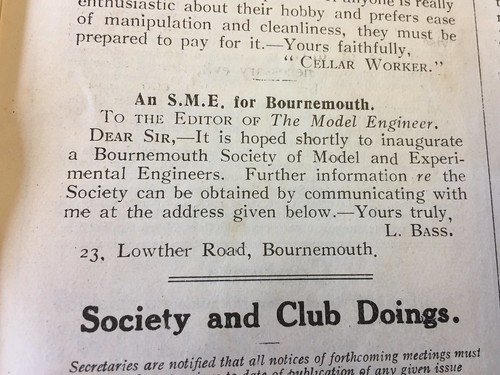
B&DSME has a long history during which it has operated on a number of sites as outlined on their website here. The Society was founded in 1924, as shown below.


Letter published in the Model Engineer & Electrician magazine on the 13th March 1924 announcing the inauguration of the Bournemouth society(Photo: B&DSME).

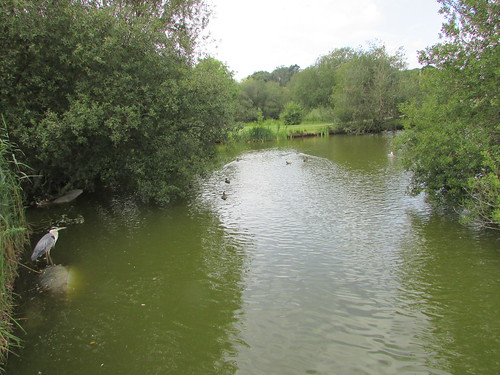
The present Littledown Park track was opened in 2004 in a popular Bournemouth park which incorporates a leisure centre. The part is described on Bournemouth Council's website here. The park features an attractive lake area, home to numerous ducks and a rather tame heron.


Lionsmeet 2019: Littledown Park features an attractive lake area with ducks and a rather tame heron.

The weather during the previous few days had been very wet in most of England but improved on the day of 'Lionsmeet', which proved dry and warm. On my arrival at the B&DSME Clubhouse, I was welcomed by host club members and my friends from OLCO. I was rapidly furnished with a cup of tea and, throughout the day, the host club were very solicitous regarding the welfare of their visitors.

Initially, the activity was centred around the multiple, elevated steaming bays outside the clubhouse as various 'Lion' models were steamed.


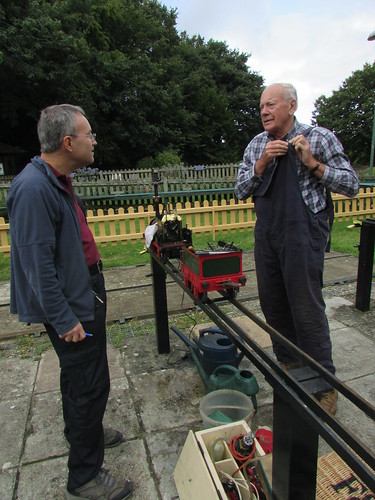
Lionsmeet 2019 Bournemouth: Andrew Neish and Adrian Banks chat as 'Thunderbolt' "brews up".


Lionsmeet 2019 Bournemouth: View of the Steaming Bays and traverser tracks.

An elevated traverser transfers locomotives between the steaming bays and a spur line leading to the running line. There is also a siding alongside the clubhouse to facilitate moving larger locomotives between road vehicles and the steaming bays. The traverser also serves two single road, covered carriage sheds which are almost invisible, situated close to the park boundary and hidden by bushes.


Lionsmeet 2019 Bournemouth: View of traverser and entrance to second carriage shed.

The traverser also gives access to a turntable. Although running on the main line is normally in a clockwise direction, I was told that periodically anti-clockwise running is adopted, to even out flange wear.


Lionsmeet 2019 Bournemouth: View of the Turntable. The carriages are standing on the spur line from the traverser to the running line.

The 1760 feet long continuous running line is situated in a pleasant wooded area close to the park boundary, and has a conventional 'dog bone' shape with two long, parallel sections joined at each end by 57 feet radius return loops. A station, named Bankside, is provided on the return loop near the clubhouse for loading and unloading passengers.


Lionsmeet 2019: View showing part of return loop at clubhouse end of line, the two parallel straight sections through the trees and the park boundary in the background.

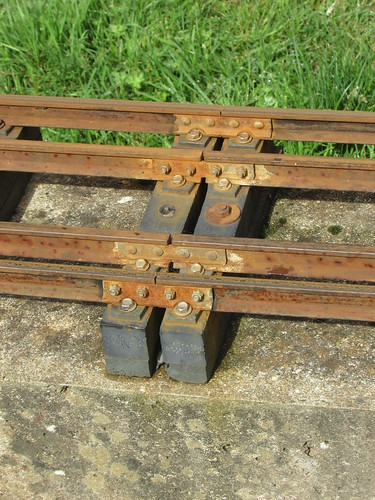
The running line is supported on pre-cast concrete beams each 4 metres long, using just four different types (straight, curved with cant, left-hand transition, right-hand transition). The 4-rail multi-gauge track caters for 3½", 5" and 7¼" gauges. The track was pre-assembled into 3 metre long panels using 1kg/m steel flat-bottom rail profile, mounted on jig-drilled sleepers sawn from recycled plastic plank. The 'About' tab of the B&DSME website here has a lot more information about the track and its construction.


Lionsmeet 2019 Bournemouth: View of rail joints on the multi-gauge track.

A J Reynolds' 'Lion' was the first locomotive ready for running but John Dalton with his 7¼" gauge model and Adrian Banks with 'Thunderbolt' followed. Later, Nigel Way from the host club joined them, driving the 'Lion' owned by John Biss.

Once the traverser has transferred locomotives from the steaming bays to the spur line leading to the running line, a combination of hinging section on the spur and 'Bendy Beam' on the running line allow locomotives onto the main line. The 'Bendy Beam' is described on the B&DSME website here.

When electrical detection proves that the hinging sections and 'Bendy Beam' are correctly set for movements on the running line, the solenoid-operated lower-quadrant semaphore 'stop' signal facing Bankside station platform is automatically placed 'off'. Trains approaching Bankside station in a clockwise direction receive an advance warning from a distant signal. When the railway is not running, the signals are unplugged and stored in the wooden station building at Bankside. I was told that the signals can be installed in alternative locations when anti-clockwise running is adopted.


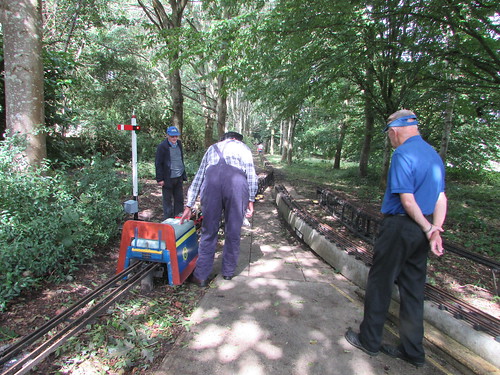
Lionsmeet 2019, Bournemouth: View looking north from station showing (L-R) spur line from steaming bay traverser, running line, holding siding.

The picture below shows Adrian Banks moving 'Thunderbolt' onto the running line.


Lionsmeet 2019 Bournemouth: Adrian Banks with 'Thunderbolt' moving from the spur line to the main line.

Once 'Thunderbolt' was on the running line, a member of the host club restored the hinged section and 'Bendy Beam' to allow continuous running to resume.


Lionsmeet 2019 Bournemouth: With Adrian Banks and 'Thunderbolt' on the main line, the 'Bendy Beam' is restored for main line running.

There was no competition running, so participants could exercise their steeds or chat with the members of the host club or OLCO during a relaxed day.


Lionsmeet 2019 Bournemouth: A J Reynolds was early onto the track with his 'Lion'.


Lionsmeet 2019 Bournemouth: John Dalton approaches the station with his 7¼" 'Lion'. Note the 'clear' distant signal.


Lionsmeet 2019, Bournemouth: Nigel Way, A J Reynolds and John Dalton lined-up at Bankside station with their models. Mains water with a portable bowser and buckets of coal are available here.

A splendid buffet luncheon was unveiled in the clubroom - a rather magnificent affair equipped with First Class seating obtained during the re-fit of railway coaches. Appropriately, the large colour display screen on the end wall was showing 'The Titfield Thunderbolt' on repeat.


Lionsmeet 2019: The clubroom, with ex-railway First Class seating.

The afternoon was particularly relaxing as the weather remained warm, presenting a good opportunity to study the interesting range of static exhibits on display.


Lionsmeet 2019: Bankside station on a warm afternoon.


Lionsmeet 2019, Bournemouth: (L-R) John Dalton, Andrew Neish and Peter Burton, B&DSME Chairman.


Lionsmeet 2019 Bournemouth: Harrye Frowen's 7¼"'Lion' was displayed by John Hawley.


Lionsmeet 2019 Bournemouth: Two 'Lions' under construction.


Lionsmeet 2019 Bournemouth: John Biss's 'Lion' and train.

Other models by John Biss were also on show, including a rail-mounted hand-operated crane and an intriguing Pump-type Maintenance Trolley which is battery powerd and radio controlled!

Also on display was a completed model of 'Canterbury Lamb' and a rolling chassis I didn't identify for either a 2-2-0 or 0-2-2, together with a partial kit of parts for a 'Lion' offered for sale.

On an elevated storage siding in the clubhouse, I found another battery powered model called 'Sheddon Wheals' with a steam-outline superstructure painted blue and strangely reminiscent of a famous steam locomotive. There was also a nicely-executed six-coupled diesel outline locomotive named 'Littledown Castle' which I understand is petrol-engined. These last two locomotives exit the clubhouse via an opening hatch in the wall. When a bridging piece of track is correctly in place connecting the elevated storage siding to a nearby steaming bay outside, a 'moveable scotch' is automatically lowered to allow the locomotives to safely leave the storage siding.

There's also an out-and-back 16mm narrow-gauge garden railway on elevated baseboards, but it was not in use during 'Lionsmeet' and was protected by locked security covers.

All the above are illustrated in my album of pictures of Lionsmeet 2019 here.

It had been a most enjoyable day and John Brandrick, the OLCO Chairman, made a short address thanking the host club for their hospitality, enthusiastically endorsed by the OLCO members.


Lionsmeet 2019: Bournemouth: John Brandrick, OLCO Chairman, (with Dan) thanks B&DSME for hosting 'Lionsmeet' 2019.

Related posts on this website

All my posts about the Old Locomotive Committee can be found here. Most posts include links to my related pictures.

My pictures

Where necessary, clicking on an image above will display an 'uncropped' view or, alternately, pictures from may be selected, viewed or downloaded, in various sizes, from the albums listed:-

Lionsmeet 2019.
All my 'OLCO' picture albums.

Thursday, 8 August 2019

Two Orphanages

Events of Monday, 20th May 2019

After an enjoyable visit to Mandalay Railway Station in the morning (described here), we moved on to the serious business of the day, taking the much-improved Oriental Highway from Mandalay which climbs into the hills at Pyin Oo Lwin where Doctor Hla Tun was to make food donations at two orphanages. There are many posts in this blog regarding educational charitable work in Myanmar initiated by the 'Road to Mandalay Social Contribution'. You can find them all here or by selecting search label 'Education'.

In Pyin Oo Lwin, there is an orphanage for boys at Doe Pin and one for girls at Shwe Sin Minn. Both are supported on a regular basis by a Swiss charity, Enfants d'Ailleurs Foundation. The foundation remits funds to the Belmond Myanmar Foundation in London which releases them to Doctor Hla Tun who acts as a 'trusted intermediary' organising the actual food donations, normally two each year, to both orphanages. The Doctor arranges the formal handover, receiving the donation certificates issued by the orphanages on behalf of the donor organisation and providing photographs of the event.

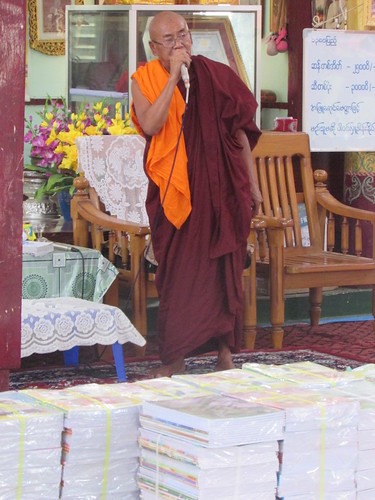
My first visit to Doe Pin was in 2009 and I've been back from time to time ('Related posts' below lists posts describing these visits). The Abbott greeted us warmly, offering refreshments and Doctor Hla Tun checked the donated foodstuff laid out ready, checking the list of food and its cost recorded on a 'white board'.


Doe Pin Orphanage 20-May-2019, with the foodstuffs donated by Enfants d'Ailleurs Foundation on the left and listed on the 'white board'.

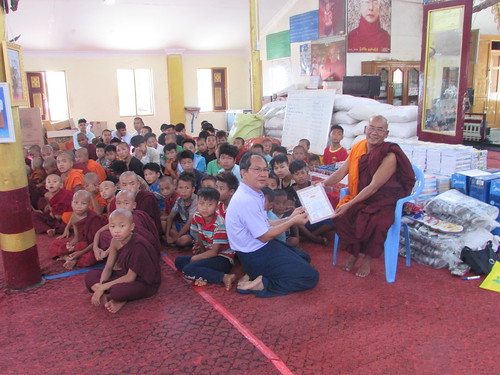
The Abbott issued the donation certificate to the Doctor and a number of photographs of the handover were made.


Doe Pin Orphanage 20-May-2019: Doctor Hla Tun receives the donation certificate issued by the orphanage, watched by a group of orphans.

The Abbott then made a short address and, after some general conversation, we said 'good bye' and returned to our car.


Doe Pin Orphanage 20-May-2019: The Abbott makes a short address.

We drove through the town of Pyin Oo Lwin to Shwe Sin Minn orphanage founded by two sisters in 1999. My first visit was in 2011 when building work was in progress to expand the accommodation. I returned in 2013 to find another extension being constructed ('Related posts' below lists posts describing these visits). Arriving in 2019, I found another major new building under construction.


Shwe Sin Minn orphanage, Mandalay, 2019: New building under construction, given by a Taiwanese donor.

The food donated by Enfants d'Ailleurs Foundation was already laid out at the rear of the assembly hall, with the orphans sitting on the floor in the remaining space.


Shwe Sin Minn orphanage, Mandalay, 2019: Orphans gathered in front of donated sacks of rice. The 'white board' in the background lists the donated foodstuff.

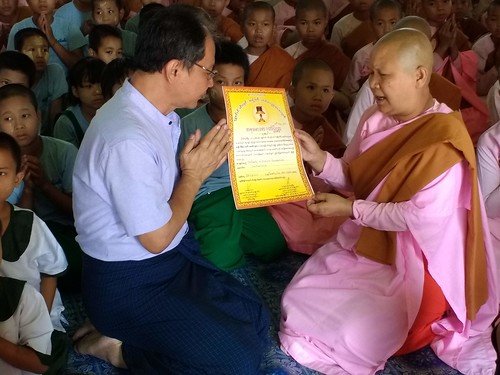
The Head Nun presented the donation certificate confirming the foodstuffs received to Doctor Hla Tun.


Shwe Sin Minn orphanage, Mandalay, 2019: Doctor Hla Tun receives the donation certificate issued by the orphanage from the Head Nun.

The Head Nun then invited Doctor Hla Tun to make a short address to the assembled children.


Shwe Sin Minn orphanage, Mandalay, 2019: Doctor Hla Tun made a short address to the assembled orphans, watched by the head nun.

Finally, all the orphans moved outside for a group photograph.


Shwe Sin Minn orphanage, Mandalay, 2019: Orphans pose for a group photograph.

Having completed the formal donations at the two orphanages, we set off by car to return to Mandalay, stopping on the outskirts of Pyin Oo Lwin at a long line of roadside vendors. The area is well-known for strawberries, other fruit and various local wines. Doctor Hla Tun made some purchases to take back to his home in Yangon on the following day then we continued on the Oriental Highway to Mandalay, slowly making our way through the heavy traffic of the city to my hotel. Doctor Hla Tun had made his own arrangements for accommodation that night but insisted that the following morning we would travel to Mandalay Airport together where he would take a flight to Yangon and I would start my long journey home via Bangkok.

My friend Ko Hlaing and his young daughter Sandy had arranged to visit me at the Hilton Hotel in the evening. They didn't want a meal so we just went to my room for a chat and ordered soft drinks. Both speak good English making things easier for me and I really enjoyed spending a little time with them both since it had been around 18 months I'd seen them (that visit is described here).


Mandalay, 2019: Ko Hlaing and his daughter Sandy.

The visit concluded with Sandy and I going for a walk around the outdoor swimming pool. Although it was dark, the swimming pool area was well-lit, producing some dramatic lighting effects. There was time for one group picture in Reception before we finally said our 'good byes'.


Mandalay, 2019: Ko Hlaing, Sandy and Jan.

Related posts on this website

This is one of a series of posts describing my 14th visit to Myanmar. The post Return to Burma is the first post in the series.
Clicking on the 'Next report' link displays the post describing the next events. In this way, you may read about the trip in sequence.
Next report
Alternately, clicking on the 'All my Burma 2019 reports' link displays all the posts on this trip in reverse date-of-posting order.
All my Burma 2019 reports.

You can find all the posts about education support here or by selecting search label 'Education'.

The following posts include references to Doe Pin or Shwe Sin Minn:-
Visit to an Orphanage, Myanmar (Doe Pin) 2009
Three Orphanages 2011
Three Orphanages Revisited 2012
Support for Orphanages in Myanmar 2013
Maymyo 2013
News from Burma - Educational Support 2014
Two Orphanages and a Monastery 2018


My pictures

My pictures showing this part of the trip are in the albums:-
Hilton Hotel, Mandalay.
Burma 2019.
Doe Pin Orphanage 20-May-2019.
Shwe Sin Minn Orphanage 20-May-2019.

All my general pictures on this trip are in the collection of albums also called Burma 2019

[Link to 'Next report' added 5-Nov-2020]