Tuesday, 23 July 2019

Buxton by Rail

On the 18th April 2019, I made a journey by train to Dove Holes for a meeting. After the meeting, I continued to Buxton then, after a quick walk around the town, made the journey back home. I was surprised to find it was as long ago as 18th November 2013 when I'd previously visited Dove Holes by train and that journey is described in the post here.

I decided to travel to the Buxton branch via Crewe, involving a change at Crewe. The view below shows platform 5 looking north as I waited for the Euston-Piccadilly Virgin service. Down Manchester trains from London normally cross to platform 5 at Crewe South Junction so as to avoid conflicts with other routes at Crewe North Junction as they depart on the Manchester line.


Crewe: View from platform 5 looking north (Buxton by rail).

At Stockport, I changed again, catching the usual superannuated 'Northern Rail' diesel multiple unit from platform 0 which noisily ground its way up the hills to Dove Holes.


Stockport platform 0 looking south, showing 'OFF' and 'RA' indicators for Stockport No. 1 signal box signal 23 (Buxton by rail).


Dove Holes, looking north towards Stockport (Buxton by rail).

These were the published timings of the trains I used:-

Wolverhampton-Dove Holes-Buxton Arrive Depart
Wolverhampton 09:20
Crewe 09:55 10:12
Stockport 10:36 11:02
Dove Holes 11:41 13:41
Buxton 13:49

Not knowing how long my meeting would last, going on from Dove Holes to Buxton was only an aspiration. Trains stop at Dove Holes every two hours but I was lucky and, following my meeting, managed to get the 13:41 to Buxton.


Dove Holes, waiting for the 13:41 to Buxton: Looking north towards Stockport, as the 13:40 departs for Manchester (Buxton by rail).

Buxton was always special from the railway point of view, not least for the two parallel stone-built terminal stations, one Midland Railway the other London and North Western Railway with twin train sheds provided with imposing gable end walls featuring massive fan windows. Each railway provided its own extensive freight and locomotive facilities and complex junctions joined the various routes. Gary Dixon has shared this early track plan:-


Old Track Plan of Buxton (Shared by Gary Dixon)
Click here for larger size


When I was young, the railways at Buxton were still impressive but are now a pale shadow of what once was there. Sadly, the Midland station has been closed, demolished and the land redeveloped. Peak Rail was set up with the aspiration of re-instating the Midland route to Buxton as a tourist line and preservation activities were originally conducted from part of the old Midland station yard. Before I became a member at Peak Rail, I remember the 'steam shuttle' operating on a short demonstration line at Buxton.


Peak Rail 'steam shuttle' at Buxton

But, stymied by the removal of the original bridge over the road just outside the station it was decided that Peak Rail activities would be transferred to the Matlock end of the route. I've been a driver at Peak Rail for some years now and there are a number of posts in this blog with the label Peak Rail.

So, after my short journey from Dove Holes, my train arrived at the remaining, former L&NWR station, now shorn of its overall roof but retaining the magnificent gable end wall and fan window, with the name of the original owning company incised in the stonework.


The LNWR station building at Buxton which originally faced a similar Midland building (Buxton by rail).


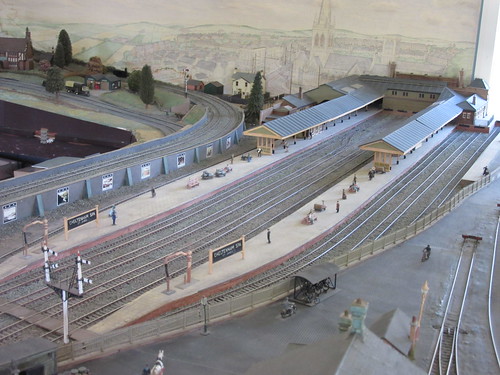
7mm/ft scale model of the now-demolished Midland station, on display in the remaining (LNWR) station.

Buxton is full of impressive stone-built edifices befitting its history as a popular Spa Town. I went as far as the elegant Buxton Crescent, currently undergoing major restoration work.


Buxton Crescent under restoration. The building on the left is the pump room (Buxton by rail).

The Pump Room now doubles as a tourist information bureau.


The Pump Room, Buxton (Buxton by rail).

I would have liked to spent longer in Buxton but my walking is not brilliant and I decided to walk back to the station and travel back to Stockport on the 14:34 from Buxton.
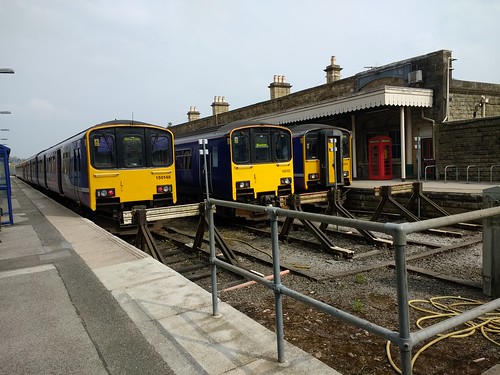

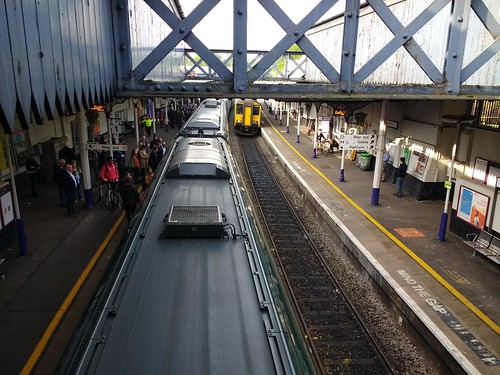
Buxton Station looking quite important with three DMU side-by-side (Buxton by rail).

Network Rail were in the final stages of completing an extension to sidings on a disused council trip to allow DB Cargo and Freightliner to increase the length of stone trains working through Buxton from 18 to 26 wagons, giving 2,500 tonnes trains. I believe the sidings were brought into use shortly after my visit.


Almost-complete siding extension at Buxton (Buxton by Rail)


Another view of the siding extension works at Buxton (Buxton by Rail)

At Stockport, I changed trains, taking a Cross Country 'Voyager' via Stoke back to Wolverhampton. As is often the case, the train was packed with commuters mainly travelling from Manchester as far as Macclesfield but, luckily, I managed to secure a seat at Stockport. But it's rarely a very pleasant passenger experience on the overcrowded trains which Train Operating Companies love to run.

These were the published timings of the trains I used on my return journey:-

Buxton-Wolverhapton Arrive Depart
Buxton 14:34
Stockport 15:20 15:36
Wolverhampton 16:39

References

You can find detailed signal box diagrams for the routes I used as they were back in steam days in the excellent series of publications from the Signalling Record Society 'British Railways Layout Plans of the 1950's'.

If you want to see what remains of the routes today, refer to 'Railway Track Diagrams Book 4: Midlands & North West', Second Edition (or preferably later), published by Trackmaps.

Related Posts on this Website

The following post describes a trip on the Buxton Branch as far as Dove Holes in 2013:-
The Buxton Branch

My pictures

I'm sorry, taking pictures in a modern train often gives poor results. Where necessary, clicking on an image above will display an 'uncropped' view or, alternately, pictures may be selected, viewed or downloaded, in various sizes, from the albums below:-
Buxton by Rail

Pictures from this album have been divided and added to various albums each covering a roughly-defined geographical area. Within each of these albums, photographs are normally arranged by date taken. Thus, by searching through the appropriate album, you can find changes through time. My trip to Buxton added pictures to a number of albums as I moved through various areas.

Railway pictures:
West Midland Railways (Wolverhampton).
Stafford Area rail.
Crewe Area rail.
Buxton Branch (Trips in 2013 and 2019).
Manchester Area Rail.


Buxton Town:
Buxton.

Monday, 22 July 2019

On to Mandalay

Sunday, 19th May 2019

I had decided to visit Mandalay at the end of my trip so that I could see friends in that city. I'd originally intended to make my own arrangements but, in the end, I merely arranged a hotel and my flights and Doctor Hla Tun took care of everything else. The Doctor estimated that he would have completed his consultations by noon on Sunday, so the monastery car and driver was arranged for that time to take the Doctor and I from Bagan to Mandalay. During the morning, I was able to continue to study the workings of the Clinic.

Individual patient treatment booklets are issued on registration at the clinic for the first time. These booklets comprise a number of plain, folded sheets stapled into a thicker, simply-printed cover. Each booklet is meticulously updated by the Doctor on the first and any subsequent visits in manuscript. Any associated test results (for instance blood tests, ECG) are usually stapled to this booklet which is retained by the patient.


Doctor Hla Tun updating a Patient Record Booklet.

The overall Clinic Records detailing patient registrations are also hand-written in ruled, bound books. The Clinic Accounts, including payments made by patients towards the cost of medication, comprise a series of plain ruled, stapled or bound books which are also completed in manuscript. The Clinic has a number of clear-sided donation boxes, similar to those seen at sites of religious pilgrimage (charitable giving is a fundamental part of Buddhist belief) and proceeds from these are also recorded in the Clinic Accounts. To keep figures aligned in each of the account books, vertical columns are manually added to each page in pencil.


Bagan Medical Clinic, May 2019: Two donation boxes outside the original clinic building.

Hla Win Ko showed me a 'PC' tower computer at the Clinic which he has programmed to produce various dosage labels for issue with medication dispensed to patients. Labels are produced in sheets of A4 size each containing multiple labels which are then cut to produce individual labels.


Around Bagan Clinic 2019: Sheet of medicine dosage labels, printed at the Clinic.

The design of the patient treatment booklet, the Clinic Accounting Books and the method of production of medicine labels have all been chosen so as to minimise the overhead costs in operating the clinic.

I also sat-in with Doctor Hla Tun to observe some of the treatments. Concepts of personal privacy are rather different in Myanmar so observing and even taking photographs during medical treatments, providing modesty is maintained, is acceptable. Patients are both old and young and represent many different ethnic groups but all have a natural dignity which is very impressive.


Around Bagan Clinic 2019: A patient in Doctor Hla Tun's consulting room awaits treatment.


Around Bagan Clinic 2019: A patient receiving pain-control injections from Doctor Hla Tun.

Inevitably, it was somewhat after twelve noon when the Doctor finished his last treatment. The Doctor, somewhat reluctantly, stopped for a light lunch after bullying from his Staff (and me) before we set of on the road journey to Mandalay which would take at least three and a half hours. We took the road through Myingyan we'd used the previous year when we travelled by road from Bagan to Pyin Oo Lwin (described in the post here).

Once again, I was fascinated as we passed over the crumbling concrete bridge over a broad, dry creek which incorporates a single-line metre gauge railway. Wind-blown sand covering the bridge deck increased the appearance of dereliction but both the road and the railway track are in regular use. I've only seen the creek dry but, in the rainy season, significant flood water must be channeled towards the Ayeyarwaddy River. A few yards away from the bridge, a parallel second road bridge was being constructed.


Bagan - Mandalay

Our route to Mandalay took us through Myitnge, where my friend Htein Lin lives. Myitnge is a 'railway town' where the British built the Carriage and Wagon workshops. The original workshops have been joined by a large, modern Chinese-built railway carriage building plant. The post Around Mandalay describes a day I spent with Htein Lin and his family when I visited both the original Wagon and Coach workshops and the new Chinese plant. I understand that the new Chinese plant, having produced an initial batch of air-suspension coaches, is currently 'mothballed' due to budgetary constraints.

Doctor Hla Tun arranged a rendezvous in Myitnge by mobile telephone with Htein Lin, who was waiting for us on his motor cycle. He then conducted us to a large restaurant where we met his wife and daughter. After taking photographs, we went to a private room for refreshments and conversation.


Bagan - Mandalay: Htein Lin, his wife and daughter with Jan at Myitnge.

My friend has opened a clothing shop in Myitnge which is proving successful and the family were keen that I should see it, so we climbed back into the car and Htein Lin conducted us there on his motor-cycle. Before I said 'good-bye' to the family, they generously presented me with a tee-shirt.


Bagan - Mandalay: Htein Lin and family at their shop in Myitnge with Jan.

We then finished the journey to Mandalay and I was taken to my hotel for two nights, the Hilton. This was formerly the Sedona Hotel and I've stayed there a number of times in the past but it has changed hands and been completely refurbished.

Hilton Hotel, Mandalay: View from my room with Mandalay Hill in background, Mandalay Palace and Moat and hotel's porte cochere on right.

Since the events often called the 'Rohingya Crisis', tourism from North America and Europe to Myanmar has sharply fallen. But I was surprised to discover that large numbers of visitors are now arriving from China and the Hilton Hotel seemed to be catering for many of them. After the rather packed programme of the previous weeks, I was content to relax in my spacious room on Sunday evening, watching dusk descend over the city and using the hotel's fast Wi-Fi to upload photographs to 'Flickr'.

Related posts on this website

This is one of a series of posts describing my 14th visit to Myanmar. The post Return to Burma is the first post in the series.
Clicking on the 'Next report' link displays the post describing the next events. In this way, you may read about the trip in sequence.
Next report
Alternately, clicking on the 'All my Burma 2019 reports' link displays all the posts on this trip in reverse date-of-posting order.
All my Burma 2019 reports.

My pictures

My pictures including this part of the trip are in the albums:-
Burma 2019.
Hilton Hotel, Mandalay.


All my pictures on this trip are in the collection of albums also called Burma 2019

Tuesday, 9 July 2019

Caldicot by Train

On Wednesday, the 1st May 2019, I made a journey by train to Caldicot for a meeting. The timings of the outward trains I used were:-

Wolverhampton-Cheltenham-Caldicot Arrive Depart
Wolverhampton 07:16
Cheltenham 08:24 08:46
Caldicot 10:36 11:02

My journey started at Wolverhampton, joining a Cross Country service from Manchester to Bristol, reporting number 1V43, as far as Cheltenham. The 'Voyager' was crowded but made good time to Birmingham and continued on the Camp Hill line until the approach to Kings Norton where we had to wait for a Class 323 to cross in front of us from the Bournville Line to the slow line to Bromsgrove.


Kings Norton Station with foliage on disused island platform obscuring an EMU heading for New Street (Caldicot by train).

We had no booked stops and were soon descending the famous Lickey Incline at speed. Suburban 25 kV a.c. electrification now extends as far as Bromsgrove and it still seems strange to me to see Overhead Line Equipment on this stretch. Even odder is the new multi-platform Bromsgrove Station, so different from the previous modest facilities.


Bromsgrove Station, expanded and rebuilt (Caldicot by train).

Just over an hour after leaving Wolverhampton, we slowed on the approach to Cheltenham Spa station. Looking left, I was surprised to see a GWR (that's the modern 'GWR' title adopted by FirstGroup plc) 'bi-mode' Class 800 in green livery waiting on the adjacent line. I left the 'Voyager' and made my way to the footbridge to take in the layout of the two-platform station set in a cutting on a gentle curve. By that time, my 'Voyager' had left and the Class 800 had moved into platform 1, to form the next London service. I didn't take much notice of the Diesel Multiple Unit arriving in platform 2 but afterwards I realised that this was the terminating Transport for Wales service from Maesteg which would form my connection to Caldicot. The line I'd seen the Class 800 waiting on is now a 'turnback siding', and is frequent use bu both GWR and Transport for Wales services.


Cheltenham Spa Station view from footbridge looking towards Bristol, showing GWR 'bi-mode' Class 800 in platform 1 and DMU from Maesteg arriving in platform 2 (Caldicot by train).

I exited through the automatic barriers on the Queen's Road side to briefly explore. The station road approach is at the level of the footbridge so the neat, stuccoed buildings are not particularly impressive.


Cheltenham Spa station building, facing Queen's Road (Caldicot by train).

Cheltenham formerly boasted a number of stations. Perhaps best-known (and most conveniently-located) was the long-gone G.W.R. terminus Cheltenham Spa St. James, starting point of the famous 'Cheltenham Flyer' express. I don't believe I ever visited this station but I remember the road bridge and junctions adjacent to the surviving station which was then called Cheltenham Spa Lansdown. The Queen's Road Bridge is still in use, now carrying the road over an urban cycle track. At 'Lionsmeet 2015', I saw a splendid 4 m.m. scale model of Cheltenham Spa St. James built by the Guildford Model Engineering Society and mentioned in my report here.

A view of part of the 4mm scale layout of Cheltenham Spa St. James.

After my brief excursion outside the station, I caught reporting number 2L49 (Transport for Wales service from Cheltenham to Maesteg) and alighted at Caldicot. It's a leisurely journey, stopping frequently, but not without interest. The first stop is at Gloucester which for a long time had separate Midland and Great Western stations. Closure of the Midland station and its connections meant that Birmingham-Bristol trains then needed to use the triangle from the main line in order to call at the former Great Western station and then change direction. For some years, I remember most Cross Country 'Voyagers' making this detour but changes to the timetable mean that it now may be necessary to change to reach Gloucester. Because of its importance, Gloucester was equipped with a Western Region style power signal box which remains in use.


Gloucester Power Signal Box (Caldicot by train).

Leaving Gloucester, there were good views of the medieval cathedral before the line crossed the River Severn near Over, later turning south west to run close to the broadening River Severn at Newnham.


Gloucester Cathedral (Caldicot by train).


The River Severn near Newnham (Caldicot by train).

Caldicot station is less than 1 kilomtre east of the better-known Severn Tunnel Junction. The double-track route from the Tunnel runs in a cutting just north of Caldicot station and in the picture below, you can just make out, in the distance, the Overhead Line structures on the parallel tunnel route.


Caldicot Station, looking towards Newport (Caldicot by train).

I don't believe I'd visited Caldicot before - it's an interesting, rather modern small town. The two halves of my meeting were divided by a visit to a cafe within walking distance which furnished a very enjoyable all-day breakfast. When the meeting finished, I was driven to Caldicot station to make sure I didn't miss the return service.

The return timings were:-
Caldicot-Cheltenham-Wolverhampton Arrive Depart
Caldicot 15:42
Cheltenham 16:31 16:41
Wolverhampton 17:48


The return train was reporting number 2G52 which had left Maesteg at 14:15. After off-loading its passengers, the empty stock went through the facing crossover on the main lines and entered the 'turnback siding', under the control of Gloucester signal G45, a 3-aspect colour light with a line-of-lights route indicator reading to the Up Goods Loop when lit. The movement to the turnback siding was authorised by a subsidiary aspect of two diagonal white lights and an illuminated 'S'.


Cheltenham Spa: View from platform 2 showing signal G45 displaying a subsidiary proceed and 'S' allowing the stock from my arrival to cross to the Turnback Siding (Caldicot by train).


Cheltenham Spa Station: View of platform 1 from platform 2 (Caldicot by train).

After a down Cross Country Voyager had paused briefly at platform 1 and noisily deported, the Transport for Wales stock emerged from the turnback siding to form train reporting number 2L65, booked to leave at 16:46 and due in Maesteg at 19:08. Whilst 2L65 was boarding passengers, my own up train, another Cross-Country 'Voyager' arrived in platform 2. I managed to find a seat in the heavily-loaded train so the journey back to Wolverhampton was not too bad, then a taxi returned me home.

Related Posts on other Websites

Cheltenham (Wikipedia). Population around 117,000
Gloucester (Wikipedia). Population around 129,000
Caldicot (Wikipedia). Population around 11,000


Book References

[1] 'Regional History of the Railways of Great Britain: Vol. 11, Thames and Severn' by Rex Christiansen (ISBN: 0715380044)

My pictures

I'm sorry, taking pictures in a modern train often gives poor results. Where necessary, clicking on an image above will display an 'uncropped' view or, alternately, pictures may be selected, viewed or downloaded, in various sizes, from the albums below:-
Caldicot by Train

Gradient Diagrams.

Friday, 28 June 2019

A Second Weekend at Bagan Medical Clinic (part 2)

Saturday, 18th May 2019

Like the previous day, I spent Saturday observing the activities of the Bagan Medical Clinic but there was also the excitement of a morning trip by car to make a stationery distribution at Htee Pu school, and a visit to a famous Mountain Pagoda, Tuyin Taung, on the way back.

The school at Htee Pu is in a fairly remote village in the Mount Popa area which Doctor Hla Tun and the Road to Mandalay Social Contribution have supported for a number of year. This assistance includes new school rooms, toilet facilities together with donations for school uniforms, stationery and teaching support. I'd first visited Htee Pu in 2009 (that report is here) and been impressed with the local Abbott's drive in trying to improve the lives of local people and I've subsequently been back a number of times:-

Opening of New School Building at Htee Pu (Saturday, 4th September 2010)
Mount Popa to Bagan (Saturday, 29th October 2011)
Htee Pu School Visit (Saturday, September 22nd 2012)
Visiting Bagan Schools (Monday, 28th April 2014)
Visit to Bagan Schools, 2015 (Monday, 27th April 2015)
Bagan (Day 4) (Monday, 2nd May 2016)
Visiting Schools in the Bagan Area (Monday, 1st May 2017)
A second weekend at Bagan Medical Clinic (2) (Saturday, 5th May 2018)

Initially, Doctor Hla Tun had intended to accompany me to Htee Pu for the distribution described below but, on reviewing the numbers of waiting patients, he decided he'd continue with consultations and send me with the monastery car and driver to Htee Pu. The stationery to be distributed to the pupils was loaded into the car and the driver and I set off on the familiar route at about 8.00 a.m. The final two miles to the village is still over an unsurfaced road but, as I've commented in previous posts about Htee Pu, improvements have been carried out, including a bridge over a section which formerly frequently flooded in the rainy season. The village is now more accessible.


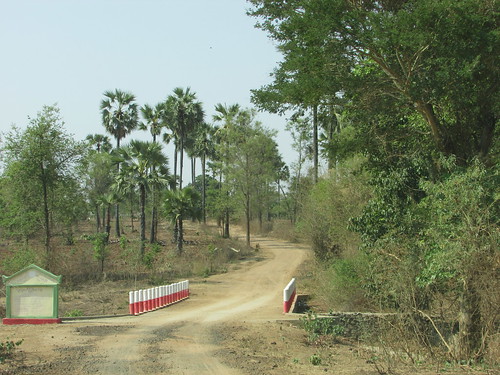
Distribution at Htee Pu, May 2019: The new bridge on the road to Htee Pu.

In the village itself, I noticed new concrete poles with electric lighting. Electrification remains an important ongoing project in Myanmar. On my early visits to Htee Pu, I'd seen locally-installed wooden poles each supporting two electric conductors simply notched into a wooden cross arm with periodic dangling lamps. All this was powered by a small diesel engine driving an electric generator at the monastery. Because of the cost of diesel fuel, hours of operation were very limited. Numerous electrification projects are slowly improving the picture but the mains electricity supply in Myanmar remains notoriously unreliable compared with what I can expect in England.


Distribution at Htee Pu, May 2019: Htee Pu Village, showing new concrete poles with electric lighting.

On my visit in 2017, I'd admired a new open-sided pavilion erected in the school yard in front of the monastery. As we arrived in 2019, I was surprised to see that this pavilion had been joined by a second, much larger pavilion, with a framework of blue-painted tubes supporting a banana-leaf roof. The new pavilion was large enough for a 'top table' with refreshments, space for all the children to sit in the shade on woven mats and even room for our car to be parked in the shade!


Distribution at Htee Pu, May 2019: The 'top table' with local dignitaries and waiting pupils enjoy the new pavilion.


Distribution at Htee Pu, May 2019: The Headmistress and pupils enjoying the new pavilion.

The stationery was unloaded from the monastery car and the monastery driver supervised the teachers as they made up the 'kits' of stationery to be presented to each pupil. Since it was not a School day, I knew that only some of the pupils would be able to attend but we try to leave spare materials for teachers to distribute afterwards. The children waited quietly seated on the mats under the pavilion until preparations were complete and then teachers formed up the pupils, class by class, to receive the stationery. With teachers supervising the line of waiting students and another teacher passing each 'kit' to me, it only took a few (rather frantic) minutes to complete the distribution.


Stationery Distribution at Htee Pu, May 2019.

The discipline of students in Myanmar is always impressive but their individuality is also notable, like young people anywhere. Some will confidently say "Thank you" in English, others, prompted by teachers, will mutter an approximation, whilst a third group remain over-awed at having to approach a stranger. I do my best to appear friendly and unthreatening, usually keeping up a continuous patter in English which is intended to be soothing.

I was then expected to make a short address to the pupils in English, which was translated by a local businessman, with the Headmistress and the Abbott carefully watching. Once again, I relied on the "Never give Up" theme. There was then a presentation of packets of tamarind and sugar lozenges made at the businessman's local factory - delicious.


Jan addresses the pupils at Htee Pu, May 2019

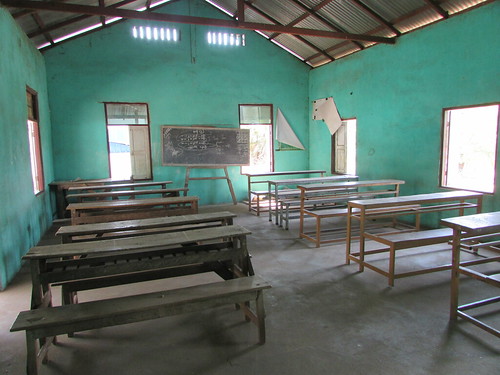
A short walk around the school compound followed, with a number of new toilets pointed out and concluding with an inspection of the classrooms donated in 2010 (report here).


Distribution at Htee Pu, May 2019: View of classrooms donated in 2010.

Finally, we took pictures with the teaching staff and a 'group shot' in the pavilion.


Distribution at Htee Pu, May 2019: Jan and the Teaching Staff.


Distribution at Htee Pu, May 2019: The 'group shot'.

After a brief pause for refreshments, I said 'good bye' and left the good people of Htee Pu, who have made quite an impression on me during my various visits.

Before we'd left the Clinic, the Doctor had suggested that, after the distribution, I might enjoy a side trip to Mount Popa or elsewhere. Mount Popa is a fascinating and historic area which I'm always happy to re-visit but we agreed that a trip to a famous mountain pagoda called Tuyin Taung which I'd not visited might be more appropriate.

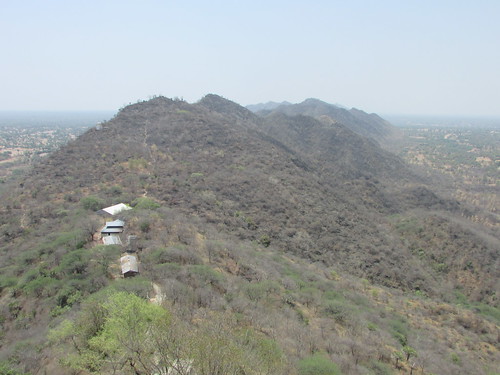
Each time I'd travelled on the road between Nyaung Oo and the direction on Mount Popa, I'd been aware of a long mountain range which thrusts itself from the plain parallel to the main road. Particularly noticeable is one gilded pagoda which crowns the high ground, sentry-like, near the Nyaung Oo end of the range. Now, I was to visit this important shrine. Not far short of Nyaung Oo, the car made a left turn to head across the plain to the base of the mountain, followed by a long zig-zag ascent of the mountain finishing in a busy car park a little way below the summit. The popularity of the site was obvious from the number of pilgrims, as far as I could tell all Myanmar people. My driver indicated the daunting flight of concrete steps leading to the unseen pagoda at the summit and said he would look after the car. I slowly hauled myself upwards, clinging to the stainless steel tubular handrail often found in such location as crowds of cheerful pilgrims passed me in both directions. The hot sun bore down and my progress was slow but at last I came to a complex of pavilions with a final broad set of steps on the left leading to the pagoda platform.


Burma 2019: Broad steps leading to the pagoda platform at Tuyin Taung.

The views in all directions from the pagoda platform showed the extent of the Bagan Plain, with the Ayeyarwaddy River glistening in the distance as it arced from my north to my west.


Burma 2019: View from Mountain Pagoda across the Bagan Plain.


Burma 2019: View from Mountain Pagoda, with the Ayeyarwaddy River in the distance.

Looking south-east, the mountain range continued but it was clear that Tuyin Taung Pagoda was on the highest part of the outcrop.


Burma 2019: View looking south-east from Tuyin Taung Pagoda.

The sun had made me a little giddy so, slowly and carefully, I started my descent of the steep steps to the car park. Seeing my caution, two smiling middle-aged Myanmar lady pilgrims formed up on either side of me, took each arm in a firm grip and made sure I reached the car park safely. It's these small acts of kindness that make Myanmar such a special place for me. My car and driver was waiting so I was back at the Bagan Medical Clinic in less than 30 minutes.

Related posts on this website

This is one of a series of posts describing my 14th visit to Myanmar. The post Return to Burma is the first post in the series.
Clicking on the 'Next report' link displays the post describing the next events. In this way, you may read about the trip in sequence.
Next report.
Alternately, clicking on the 'All my Burma 2019 reports' link displays all the posts on this trip in reverse date-of-posting order.
All my Burma 2019 reports.

My pictures

My pictures including this part of the trip are in the albums:-
Burma 2019. Distribution at Htee Pu, May 2019.
Burma 2019: Tuyin Taung Mountain Pagoda.

All my pictures on this trip are in the collection of albums also called Burma 2019

[01-Jul-2019 Visit to Tuyin Taung added]

Saturday, 18 May 2019

A Second Weekend at Bagan Medical Clinic (part 1)

Friday, 17th May 2019

Friday was a day around the Bagan Clinic, although I did travel as far as Nyaung Oo Airport by car.

I was out and about the clinic about 7.00 a.m., taking photographs. The Clinic staff provided me with a fried egg, congee and a can of Coca Cola in the Staff area of the original clinic building while the satellite television was showing “Nim’s Island”. The sound was turned down and the subtitles were in Myanmar language but I was surprised to find the plot was fairly obvious, although I’d never seen the film. However, to protect cultural sensibilities, from time-to-time a small area of the screen would be deliberately ‘de-focussed’. On various programmes, I found this technique applied to smoking, drinking alcohol and too much female cleavage. Confusingly, on other channels, extreme violence, lesbianism and three-in-a-bed activities seemed acceptable (even at eight in the morning).

Doctor Hla Tun took his breakfast and started his ‘list’ by treating a number of monks. Doctor Hla Tun’s mother also had her breakfast, prior to flying back to Yangon. Hla Win Ko interrupted his work in the Dispensary to drive her to Nyaung Oo Airport and I went with them. We stopped near the airport so that she could buy some mangoes from a roadside vendor.


Buying mangoes at a roadside vendor in Nyaung Oo, en route to the airport.

This (plus various prior purchases) made her baggage overweight and at first I feared that the stern-faced man in charge of KBZ Airline check-in was going to levy an excess charge. But eventually it was all smiles, the pieces were labelled ‘Fragile’ and passed through.


Check-in at Nyaung Oo.

Hla Win Ko had another task before we returned to the Clinic. Medications are often shipped using an 'express parcel' service and he intended to collect two parcels of medication expected for Bagan Medical Clinic from a Freight Forwarder in Nyaung Oo. The parcels depot was a dusty, fenced yard with a couple of large trees, around which a number of cartons were arranged. A man relaxed under one tree with various handwritten records.


Freight Forwarder's Yard in Nyaung Oo.

The man searched through his records and concluded that one parcel for the Clinic was there – the second was yet to arrive. So the one parcel was signed for and loaded into the car.


Collecting medication at the Freight Forwarder's Yard in Nyaung Oo.

Knowing my fascination with the ancient pagodas spread across the Bagan plain, Hla Win Ko asked if I'd like to stop to look at pagodas during the short journey back to the Clinic. We selected a group of minor restored pagodas without visitors allowing me to explore alone. It was not yet 10.30 a.m. but the temperature was in the mid thirties.


Pagodas of the Bagan Plain.

We were back at the Clinic in time for me to participate in the distribution of the Free Lunch to patients and their companions.

I spent the rest of the day either sitting in on Doctor Hla Tun's consultations or wandering around the site watching the various activities. I still find it hard to believe how the site has expanded since the opening of the original, modest Clinic in 2011 (described in the post here).

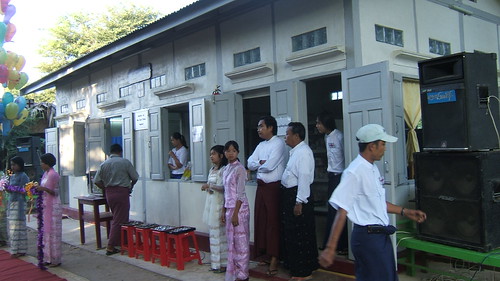
The original Clinic in 2011, just before the Opening Ceremony.


Bagan Medical Clinic, May 2019: The original Clinic building is now just one of a complex of buildings.

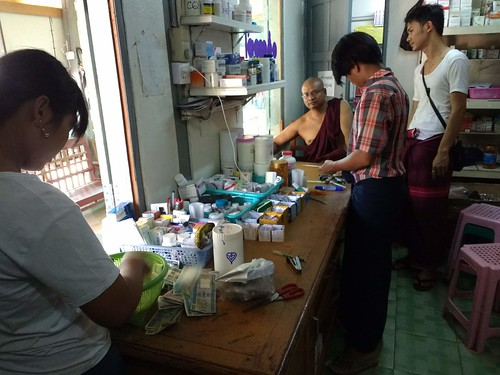
Once the Clinic was opened in 2011, local and overseas donors could see the work being done and they were encouraged to contribute towards supporting and expanding the Clinic. However, the Reception and Dispensary area of the original building remains the 'nerve centre' of the whole complex. On arrival, it's where patients register to be seen by a Doctor and, after consultation and treatment, it's where patients collect any prescribed medication.


The Reception/Dispensary Area at Bagan Medical Clinic 2019

Related posts on this website

This is one of a series of posts describing my 14th visit to Myanmar. The post Return to Burma is the first post in the series.
Clicking on the 'Next report' link displays the post describing the next events. In this way, you may read about the trip in sequence.
Next report.
Alternately, clicking on the 'All my Burma 2019 reports' link displays all the posts on this trip in reverse date-of-posting order.
All my Burma 2019 reports.

My pictures

My pictures including this part of the trip are in the album Burma 2019.

All my pictures on this trip are in the collection of albums also called Burma 2019 (apart from 'specialist' railway pictures: confusing, eh?).

[Text added, pictures added 21/24-Jun-2019]