skip to main |
skip to sidebar
Events of Friday 12th May 2017
I was up around 7.00 a.m. and accompanied my host, Keith Watson, on his walk to exercise his dog, Sasha, on nearby parkland. On our return, we had breakfast before getting ready to drive to see Birgit, a friend of Keith's for many years. On the way, we passed Bull Creek Station on Perth's excellent electrified suburban railway network. On previous visits, I've made use of this netwok.
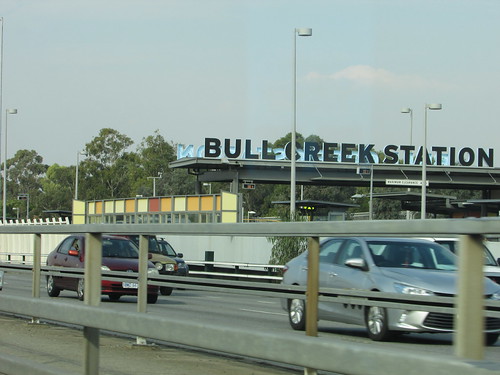
Railways around Perth: Bull Creek Station, Perth, Western Australia.
Sasha came with us in the car and played happily with Birgit's Manchester Terrier, Pepper.
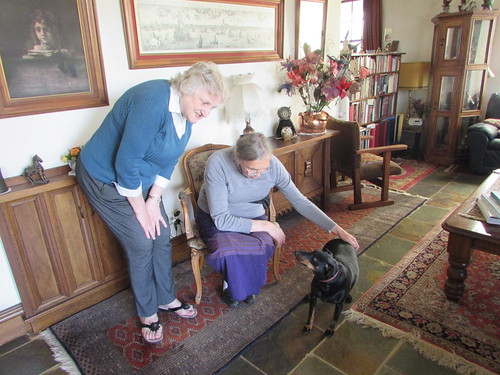
Perth: Birgit, Jan and Pepper.
After a pleasant visit, we returned to Keith's home. After some catching-up, Keith and I drove to a nearby 'Subway' where we purchased a filled baguette which we took home to consume. Later I attempted to connect my laptop to Keith's Wi-Fi, initially without success, but a call to Keith's computer man quickly resolved the problem and I was able to check my e-mails and post brief reports to my blog.
All the travelling had left me quite tired, so I didn't do much for the rest of the day. I was quite impressed by the television news coverage on SBS (the Special Broadcasting Service which is part of ABC - the Australian Broadcasting Commission), less so by the Eurovision Song Contest coverage from Ukraine.
I retired early and slept very well.
Related Posts on this Website
Next Post describing this trip.
All Burma-2017 Trip posts.
All Australia-2017 posts.
My Pictures
Pictures from earlier visits to Perth.
Perth: Around and About (2017).
[Text amended, pictures added 6-Sep-2017]
Events of Thursday 11th May 2017
That's Perth, Western Australia, not the one in Scotland.
I managed to pack, have breakfast and be ready for Doctor Hla Tun to take me to the airport. The Doctor's daughter and wife were with us in the car. The Doctor's daughter has just started medical studies at the college in Yangon so we dropped her at the campus before continuing to Mingalardon Airport Terminal 2. I said "Goodbye" to the Doctor and his wife helped me with my luggage to the right Check-in queue where we also said "Goodbye", as she had to open her Gift Shop in Terminal 2.
My travel agents, Wexas, had recommended flying by Jet Star to Singapore then Business Class by Quantas from Singapore to Perth. Both flights, confusingly were 'code share' with Emirates.
Waiting at the Gate, I had a good view of the Ground Crew preparing for the inbound flight, the aircraft arriving, unloading passengers and freight, refuelling and loading freight before I took my own seat on the aircraft. There's an album of pictures of these activities called Jetstar at Mingalardon.
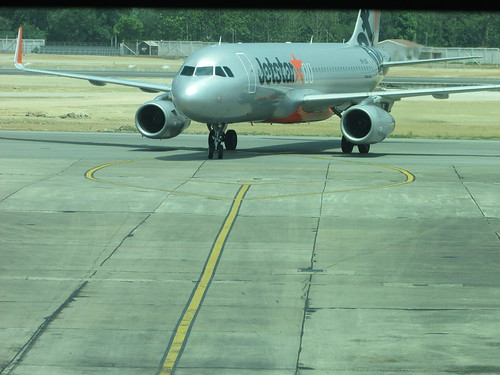
Jetstar at Mingalardon: The arriving A320 aircraft turns off the taxiway.
The Jet Star flight was all-economy (an A320 with 3+3 seating) and they charge for all food and drink separately. But, apparently, my name appeared on a special list and I received a free meal, a wash bag and the use of a blanket which proudly claimed it was made from '19 recycled plastic bottles'.
We arrived on time at Singapore's huge Changi Airport. Massive expansion work was being carried out in the terminal area and six tower cranes at work (painted in red and white stripes) dominated the biew as we taxied to our Gate.
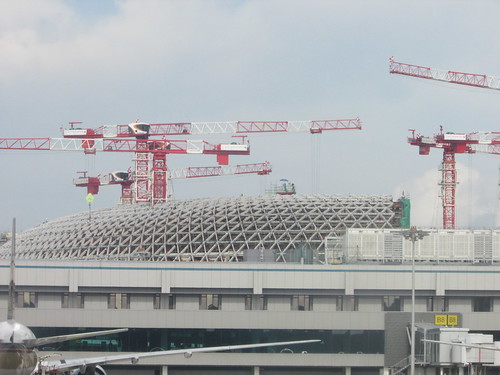
Changi Airport (2017): Six tower cranes working on expansion of the terminal.
The Transfer Desk issued my boarding card for my onward flight to Perth and I had a little over one and a half hours in the comfort of the excellent Quantas Lounge with time for a Coca Cola, Cheese Plate and internet fast enough to load a few pictures from Bagan.
The aircraft on the Perth leg was a Boeing 737. Despite the winglets to improve economy, the narrow body gives this iconic design a rather old-fashioned appearance.
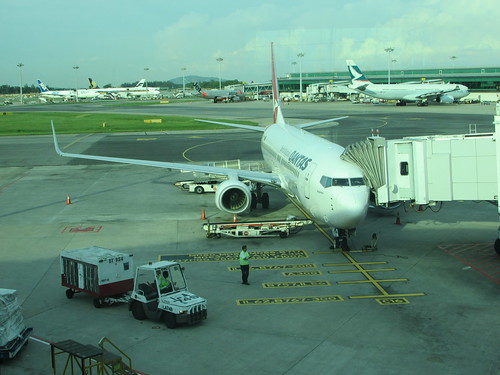
Changi Airport (2017): The 737 aircraft which would take me onward to Perth.
We taxied to the runway and, after one arrival and one departure had preceded us, we took off for the four and a half hour flight to Perth.
After a good flight, we landed a few minutes early at Perth. Immigration, Luggage Reclaim and Customs were completed promptly and the driver for my booked car was waiting in the arrival hall. Within a few minutes, we were on the way to my friend's house, arriving about twenty past midnight. After a joyful re-union with my friend Keith, his wife Fhines and, of course, Sasha the dog, I retired for the night.
Related Posts on this Website
Next Post Describing the Australian part of this trip.
All Burma-2017 Trip posts.
All Australia-2017 posts.
My Pictures
Yangon Airport (2010 and later).
Jetstar at Mingalardon.
Yangon -Singapore by air.
Singapore (Changi) Airport (2015 and later).
[Links to pictures added 16-Aug-2017: Text amended, pictures added 6-Sep-2017]
Events of Wednesday 10th May 2017
Since my first visit to Yangon in 2008, the intensive railway working around the Circle Line has fascinated me. There's an earlier post Yangon Area Railways which gives an overview.
My friend Doctor Hla Tun had managed (after some difficulty) to arrange official permission for us to visit signal cabins on the Circle Line before modernisation by the Japanese wipes them away. So the day was spent dashing from site to site in the Doctor's car and trying to understand the equipment and systems currently in use by inspection, by taking photographs for later study and by quizzing the local staff, with the Doctor as interpreter. We were warmly welcomed every where we visited and I had a wonderful day but, of course, ended up totally exhausted.
We first went to Khyee Myin Daing station I'd visited previously. There's an earlier post here. On the 'official' visit in 2017, I discovered signalling equipment in the Stationmaster's Office (of a pattern I'd not come across previously) which is used to instruct the two local signal boxes regarding the route through the station area to be taken by trains.
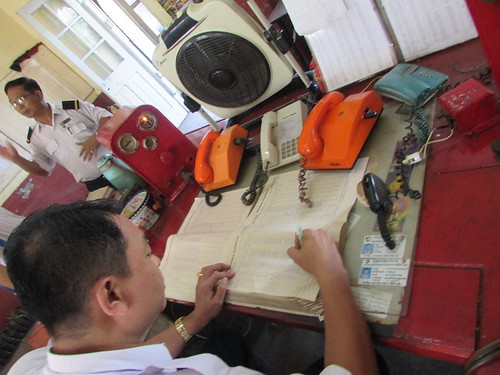
Kyee Myin Daing Station Master's Office, with the Station Master in the background. The red box on the left communicates the required route to the South Signal Cabin. There is a similar box to the North Signal Cabin. Note the grey auto telephone and two orange magneto telephones and two train register books.
Then we visited Kyee Myin Daing South Signal Box which I'd photographed a year earlier. This time, I was allowed to make three lever movements. I was very surprised when I learned, a few days later, that the stationmaster's photograph of the writer operating the frame had appeared in the newspaper Myanma Alinn Daily News on May 12.

Jan operating the lever frame at Khyee Myin Daing South Signal Cabin.
We then moved to Khyee Myin Daing North Signal Cabin for more pictures. The 'South' and 'North' cabins are the only 'mechanical' cabins in the Yangon area.
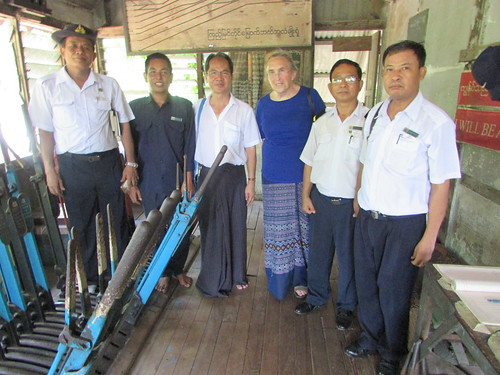
Kyee Myin Daing North Signal Cabin: The Group Shot.
On earlier visits to Insein, I'd identified the 'power' signal cabin but failed to identify the likely equipment supplier, so I was keen to inspect this installation. There's an earlier post here. On the 'official' visit in 2017, I discovered that the push-button control panel was a 'modified NX' pattern made in Korea. I was unable to inspect the relay room as the technician with the key was away at the time.
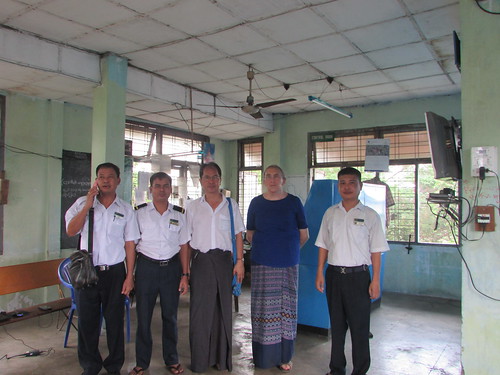
Insein Signal Cabin: The Group Shot. The blue signalling control console is in the background.
During a previous visit to Myanmar, I'd found a small push-button signalling panel at Da Nyn Gone which I believed had been built locally by Myanma Railways. There's a post here.
Based on this discovery, it appeared likely that the small installations at Mingalardon and Paywet Seik Kone were controlled from similar locally-built panels. The 'official' visit in 2017 allowed me to inspect both Mingalardon and Paywet Seik Kone stations and confirm that locally-manufactured push-button panels are in use.

Pa Ywet Seit Gone: Taking tea in the Station Master's Office.
I was also able to take pictures of the relay interlocking at the two sites and determine that rather elderly Westinghouse relays are in use.
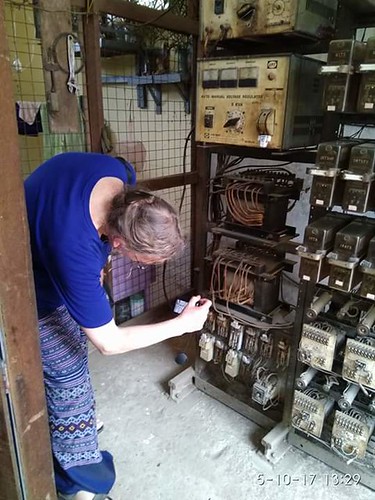
Jan examining Mingalardon signalling equipment (Photo: Myanma Railways)
I believe Pazundaung and Mahlwagone probably have similar installations constructed in Myanmar but there was insufficient time to establish this positively.
In the above, I've used the 'Anglicised' spelling which the railway seems to use, although rendering Myanmar names in 'English' is always a rather variable affair. I took lots of technical pictures, plus a few 'group shots' with the station masters and staff at some of the places we visited. These pictures have now been uploaded to 'Flickr' and the various new albums are listed below. It will take time to absorb what I saw and, in due course, further technical reports will surely appear.
I spent a quiet evening at Doctor Hla Tun's home. Sadly, I had come to the end of my visit to Myanmar and the following morning I was to travel to Australia to visit some of my friends there.
Related Posts on this Website
Next Post describing this trip.
All Burma-2017 Trip posts.
My Pictures
Kyee Myin Daing Station Master's Office.
Kyee Myin Daing South Signal Cabin (2017).
Kyee Myin Daing North Signal Cabin.
Insein Signal Cabin.
Mingalardon Signalling.
Pa Ywet Seit Gone Signalling.
[Text amended, links to pictures added 22-May-2017: Text amended, pictures added 5-Sep-2017]
Events of Tuesday 9th May 2017
I'd arranged with my guide, Ms. Thandar Oo, that I would take a trip around the lake by boat so, at 7.00 a.m., I breakfasted in the capacious restaurant at Villa Inle Resort and Spa and by 8.30 a.m. I'd checked out. Thandar Oo was waiting, this time with one of the elegant 15-metre Inle Boats.
With my luggage on board and sheeted over, we set of along the narrow canal between the hotel and Inle Lake, with the tomato 'fields' on both sides. The 'fields' are actually long and narrow floating strips of organic material laid side-by-side and each pinned to the lakebed with long bamboo poles. We passed local people at work tending the crop.
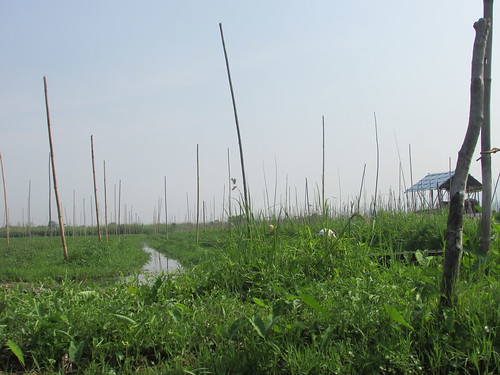
Around Inle Lake: Tomato growing.
In some places, zucchini were grown, under the same sort of bamboo frames I'd seen during our train journey from Kalaw to Nyaung Shwe.
Once we entered the broad expanse of the Lake, there were numerous Inle boats, similar to our own, noisily heading in all directions. Usually, the motive power is a manual-start, Chinese-made diesel developing 25 horse power costing 500 U.S.dollars new and perhaps 300 U.S. Dollars second-hand. Later in the day I spotted a few Inle boats powered by an automotive engine which was probably more powerful. It was certainly quieter! Some of the smaller boats on the water were of the well-known 'longtail' design and yet others were not motorised at all.
Harvesting Weed
Inle Lake is quite shallow and water weed grows freely. One of the more arduous tasks is collecting water weed from boats, using a long pole to repeatedly lift massive clumps of weed into the boat until it almost sinks. The weed is then dried and used as fertiliser for the tomatoes.

Around Inle Lake: Collecting water weed as fertiliser.
Inle Lake Villages
I was told that there are seventeen distinct villages distributed around the lake, with a total population of around 56,000, plus a further 40,000 people at Nyaung Shwe which serves as the administrative centre of the area.
A broad canal led us to a large village of substantial houses on stilts, raised high above the water. Although some designs recurred frequently, each building reflected the owner's tastes in decor. Some houses were completely made of bamboo but most partially adopted more modern building techniques.
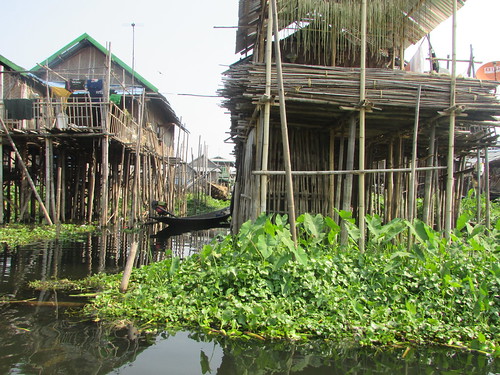
Around Inle Lake: Traditional, bamboo stilt houses.
Piped water (via blue HDPE pipes) and electricity (via a most curious distribution system featuring wooden pylons along all the main canals) were commonplace.
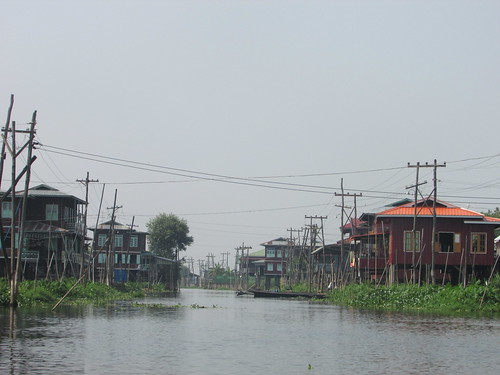
Around Inle Lake: Typical village with its curious electrical distribution system.
The village included a long, open shed housing one of the equally-long man-powered racing boats which compete during the Pagoda Festival. Narrower canals, with a number of footbridges, led us to the rickety wooden landing stage of a family-run silversmith's workshop.
Silversmith's Workshop
Silver ore is reduced to pure metal in a small, clay crucible. This requires a temperature of 800 degrees Celsius produced in a small forge using bellows to supply extra air. The molten silver is cast into a small ingot using a simple mould and, after cooling in cold water, the ingot can be beaten to the required thickness or turned into silver wire using a small 'mangle'. The hard fruit of the Star Anise plant, if warmed for one minute can be grated to give an effective 'soap' for silver cleaning, for clothes washing without fading dyes or as a shampoo. There was a large showroom with an amazing range of silver jewellery. The delicacy of some of the items was astonishing.
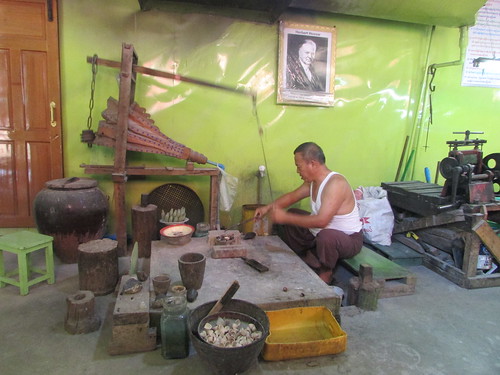
Inle Lake Silversmith: General view of silver smelting workshop.
Boat-building yard
Our next visit was to a boat-building yard. Two 15-metre long hulls of the standard Inle design were virtually complete and I was staggered by the craftsmanship. Only teak wood is used and, when we arrived at the landing stage, two men were starting to turn one two-inch thick teak plank into two one-inch thick planks by sawing. One man stood on a raised sawing platform made of bamboo, one man stood on the ground and between them a massive saw was being worked vertically up and down.

Inle Lake Boat Builder and Cheroot Factory: Sawing a teak plank.
Each of the many frame members required was made from three pieces - left, keel, and right.The keel itself is normally made from three planks to give a slightly convex shape, requiring keel frame members to be curved at the bottom. Keel frame members were being shaped, with considerable accuracy, by another man sitting on the ground merely using an axe.
The structure of the hull had been assembled using wooden dowels, but I didn't identify the wood. Metal woodscrews were used for some features, like attaching the planks forming the top of the gunwhales.
All seams, dowels and screwheads had been caulked using teak sawdust and resin mixed in a simple stone mortar with a pestle to give a dark-coloured paste. Boats built in this traditional way have a long life of tens of years given some maintenance. The purchase cost of 2,500 U.S. Dollars seemed very reasonable to me given the skill and man-hours involved in the construction.

Inle Lake Boat Builder and Cheroot Factory: Completed hull.
Cheroot Factory
Immediately behind the boat-building yatd was a cheroot-making factory. Home-made cheroots can be huge, fat affairs but the commercially-made cheroot is more like the small cigars marketed as 'cigarillo'. Seated on the floor of the factory, a number of women, paid by 'piecework' were deftly assembling the product. According to a sign in English for the benefit of the many tourists around Inle Lake, the ingredients are:-
Cheroot Leaf
Tobacco
Honey
Tamarind
Brown Sugar
Rice Wine
Banana Fruit
Star Anise
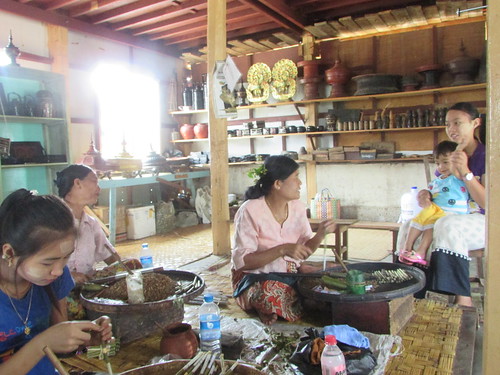
Inle Lake Cheroot Factory.
Alodawpauk Pagoda
A boat ride of less than 200 yards took us to one of the landing stages of the important Alodawpauk Pagoda. This was busy with tourists, many apparently from Mynmar. I was told it's an 11th century pagoda which, because of its importance, was restored by the military government in the 1980s. Ongoing development is paid for by private and business donors, some in Thailand.
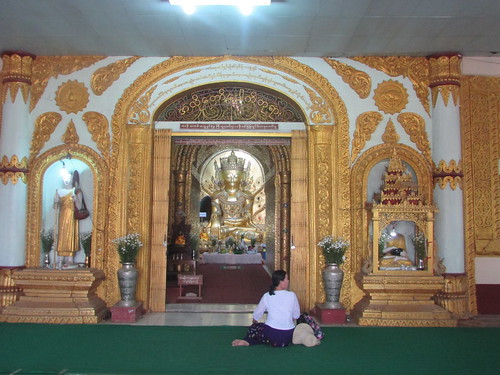
Alodawpauk Pagoda, Inle: One of the four main Buddha images.
Blacksmith's Factory
After a brief visit to a bamboo handicrafts showroom where modern products for tourists seemed to predominate, we moved on to a blacksmith's workshop. As the boat docked at the usual rickety landing stage, I was sure I recognised it and, indeed, it was the same blacksmith's I'd visited in 2008. That first visit is described in another post called 'Around Lake Inle' which you can find here. Work was being carried on exactly as I'd witnessed the first time, but the personnel had changed.
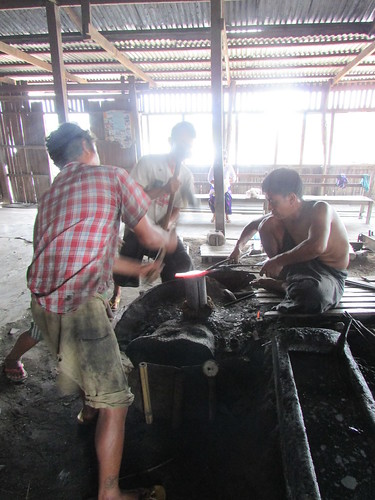
Inle Lake Blacksmith.
After the blade forging process, sharpening was being carried out by two men, one using a sort of spokeshave to scrape away excess metal, the other using an assortment of metal files to produce the cutting edge. Both men used simple jigs to hold the workpiece but the man with the files also used one foot, like a third hand, to hold the item in the jig.
Impressed with the skills, I determined to purchase a souvenir. I came away with a pair of scissors which I intended to display at home but they proved so sharp they're in daily use in my kitchen.
Lunch
After visiting the blacksmith's workshop, a short boat ride took us to the huge, clean 'Golden Kite Restaurant' built, like the rest of the village, on numerous wooden piles but here the landing stage was, unusually, in good repair. The restaurant was located at the intersection of two major canals so it was rather noisy but we nonetheless enjoyed lunch there.
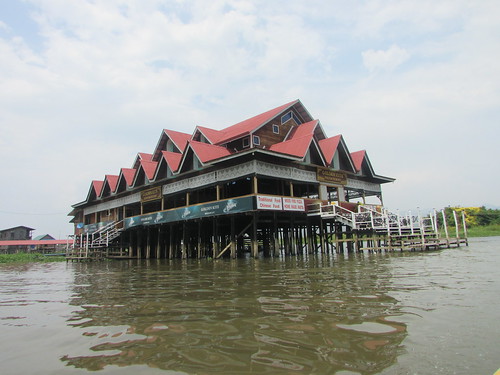 The 'Golden Kite Restaurant'.
Return to Nyaung Shwe
Back in our boat, it was time to head back north to Nyaung Shwe. This took about 45 minutes, very pleasant but noisy.
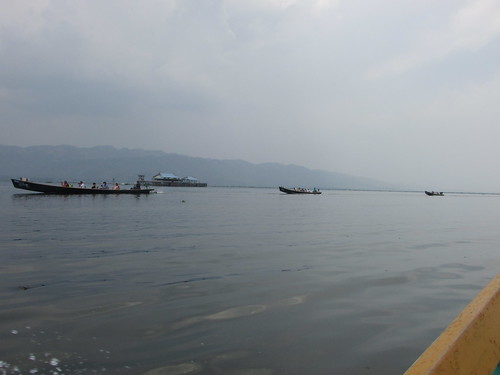
Return to Nyaung Shwe: Speeding north, passing three similar boats heading south.
On arrival at Nyaung Shwe, our driver was waiting to meet us and my luggage was soon transferred to the car. We set of towards Heho for me to catch the afternoon Air KBZ flight back to Yangon. At Shwe Naung, we turned left towards Heho.
Paper making
"We're a little early", Thandar Oo said, telling the driver to stop at a small paper handicrafts workshop up in the hills. We watched two women making sheets of paper from the bark of the Mulberry tree. I'd seen a similar process, but using different plant material, in Bhutan and that's described here. In Myanmar, the mulberry bark is softened with hot water and then pounded with hammers until it becomes a paste which, mixed with water, can be poured onto a muslin-covered wooden frame in a cistern of water. Then, if desired, decoration can be added, creating patterns with leaves and petals before the frame is gently lifted from the water and allowed to drain, leaving a layer of cellulose material which, when dried in the sun, will become paper. A wide selection of products made from this paper were on display.
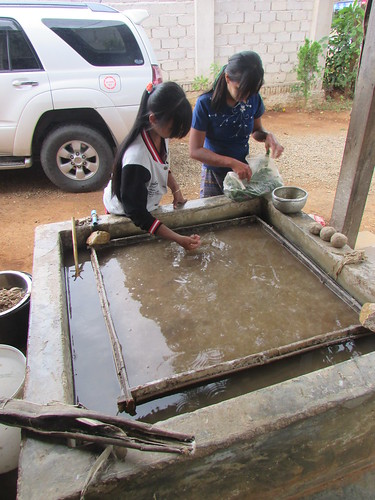
Nyaung Shwe - Heho: Paper handicraft workshop - decorating the paper with leaves and petals.
Heho Railway Station
We set off again, still early, so I proposed a visit to Heho station. I was able to take a number of photographs and, using Thandar Oo as an interpreter, clarify various technical points with the friendly young stationmaster.
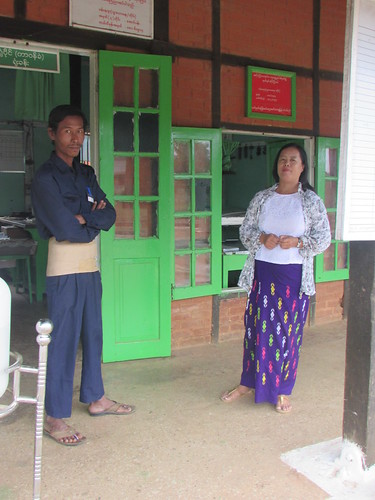
Heho Station: Left - the Stationmaster, right - my Guide Thandar Oo.
Return to Yangon
Heho airport was only a few minutes away and on arrival it was time to say "Goodbye" to my driver and guide. Since it was 'low season', I was surprised at how many tourists were waiting to travel - Japanese, German and various English-speaking travellers. The Air KBZ flight was on time into Yangon where two transfer buses took us to the new Domestic terminal. Doctor Hla Tun was waiting to pick me up, as I was again staying at his home.
Related Posts on this Website
Next Report describing this trip.
All Burma-2017 Trip posts.
My Pictures
Around Inle Lake (2017).
Inle Lake Silversmith.
Inle Lake Boat Builder and Cheroot Factory.
Alodawpauk Pagoda, Inle.
Inle Lake Blacksmith (2017).
Naung Shwe - Heho by road.
Heho Station.
[Links to pictures added 16-Aug-2017: Text amended, pictures added 4-Sep-2017]
Events of Monday 8th May 2017
My hotel, Villa Inle Resort and Spa was very comfortable and peaceful, so I awoke refreshed although during the night there had been a violent thunderstorm followed by torrential rain. Monday was planned for a visit to Kakku: an important Buddhist site with over 2,000 pagodas.
My first visit to Inle Lake in 2008 (part of the 'Far East Two' trip, described here) had included a trip to Kakku during which there was heavy rain whilst I was touring the pagodas. That earlier trip is described here.
This time, I was picked up by car from my hotel. As I've noted already, there are road improvements in many areas and the Pa-O area of Southern Shan State where Inle Lake located is no exception. I was told we could now drive on a new road from Maing Tauk Village (the location of the hotel) cross country to Kakku, with a considerable saving in time. Previously it was necessary to go via Nyaung Shwe (where I'd boarded the boat to the hotel the previous afternoon) and Taung Gyi to reach Kakku.
We set off about 8.45 a.m. and headed south, close to the eastern side of Lake Inle. Tourism has brought ribbon development which extends ever-further. The Government have designated a 'Hotel Zone' to control this development. Feeder roads, complete with lighting, are in place and large, new hotels are open or being built. I noticed the 'Hotel Zone Jetty' under construction.

Inle Garden Hotel in the Hotel Zone.
Our route then took us through the mountains on a road not long opened, presumably to help open up the fairly remote area we were in. A rural, agrarian way of life was the norm and the majority of the people showed their Pa-O origins with either a turban for the men or an orange plaid headscarf for the women, who favoured dark-coloured clothing or the traditional black tunic and trousers.
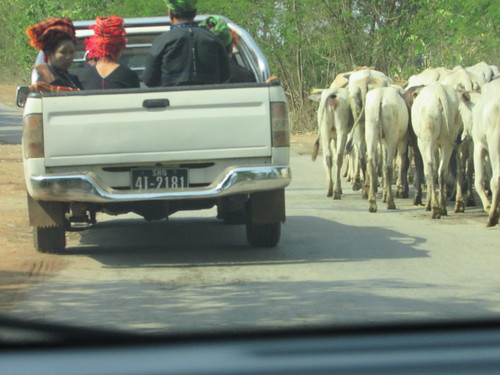
Kakku by road (2017): Following a pick-up with traditionally-dressed Pa-O people as they pass a herd of cows.
Sooner than I expected, we were at Kakku and the remarkable sight of (I'm told) 2,478 pagodas huddled together on a compact, vaguely rectangular site around 300 metres by 150 metres set on a gentle hillside. As a foreigner, an admission payment was made for me.
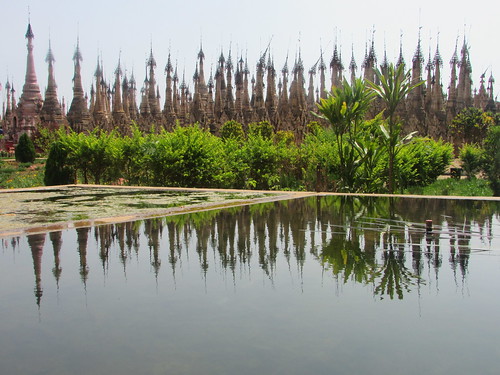
The Pagodas of Kakku.
Thandar Oo said that a party of donors from Yangon were dedicating a number of donated 'hti' that morning. The 'hti' or umbrella is the metallic decoration carried at the top of the 'spire' of a Myanmar-style pagoda (different ethnic groups favour different styles, I understand). Music was coming from the site and the dedication was in progress. Scaffolding had been erected over a row of perhaps eight similar-sized pagodas. The scaffolding was a mixture of conventional steel scaffoldong, push-together metal access towers and bamboo poles, tied together with a heavy-duty twine. One bamboo deck had been laid across the scaffolding about eighteen feet above the ground and a second about twenty four feet above the ground. About twenty four men were distributed across the two decks, presumably the donors or donors' representative. The upper deck of the scaffolding was about level with the position where the 'hti' would be carried.
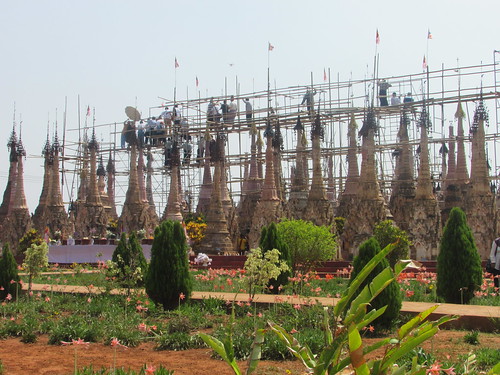
Kakku: Dedication of donated 'hti'.
I couldn't see the ceremony itself but later the men all returned to ground safely. Immediately, a group of scaffolders started to dismantle the temporary structure.

Kakku: The temporary scaffolding for the dedication ceremony can be seen on the left, topped with a number of Buddhist flags.
A combination of bad storms and last year's earthquake has damaged pagodas throughout Myanmar. The 'hti' can easily be displaced and many at Kakku were sitting at a crazy angle. The delicate, tapering pinnacle or 'spire' of brick, sometimes with stucco applied, is the next area to crumble. Damage elsewhere in the structure is usually limited to cracks developing or small areas of brickwork or stucco detaching.

Kakku: An elaborately-decorated pagoda with a displaced 'hti'.
Restoration work is always going on, but this is usually at the behest of donors and to the despair of archaeologists who often consider the historical record 'corrupted' by the new work.
Pagoda builders and those carrying out repairs seem to use bamboo scaffolding exclusively, embracing the pagoda being worked on in a 'cocoon' of scaffolding and we saw examples on our visit to Kakku.
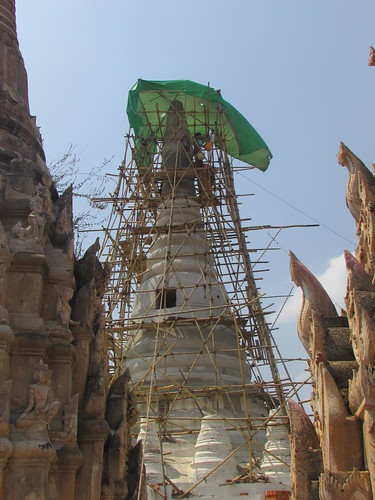
Kakku: Restoration work in progress on a pagoda.
The railway station at Kakku didn't detain us long. It is a one-platform halt on the single line from Taung Gyi to Nansen and Mong Nai. Although it has a simple station building, we found it boarded-up and semi-derelict. There is one train to Taung Gyi at 06:00 daily, arriving three hours later. The return from Taung Gyi is due to arrive in Kakku at 16:00. Ordinary Class Single Fare is 200 Kyats.

Kakku Station: With my guide and driver.
The restaurant just opposite the pagoda site with a timber framed roof which I used back in 2008 was badly damaged in storms. It has been replaced with a huge steel-framed affair, very well-appointed and clean so we were able to enjoy lunch there.
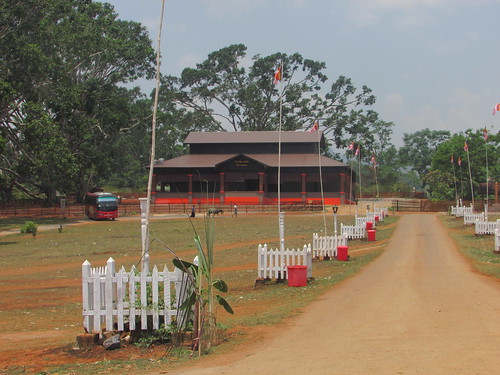
Kakku: Hlaing Konn Pa-O National Restaurant.
After lunch, we set off on the return journey through the mountains using the new road. Back at Villa Inle, I was able to enjoy the warm afternoon in the comfort of my own villa.
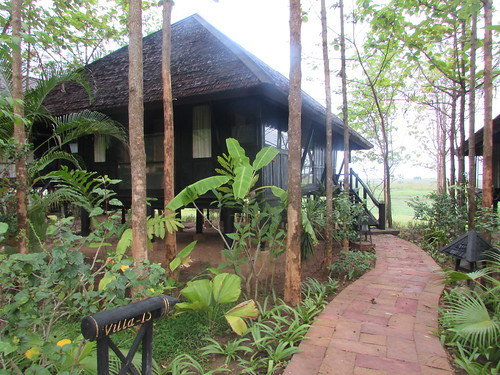
Villa Inle Resort and Spa: My Villa.
Tomorrow morning we plan to explore Inle Lake a little then, in the afternoon, I catch a flight from Heho back to Yangon.
Related Posts on this Website
Next Post describing this trip.
All Burma-2017 Trip posts.
My Pictures
Where necessary, clicking on an image above will display an 'uncropped' view or, alternately, pictures from may be selected, viewed or downloaded, in various sizes, from the albums listed:-
Kakku by road (2017).
Kakku, Shan State, Myanmar (2008: my earlier pictures).
Villa Inle Resort and Spa.
[Links to pictures added 16-Aug-2017: Text amended, pictures added4-Sep-2017]
Events of Sunday 7th May 2017
I slept well at Hotel Kalaw Hill Lodge, took an early breakfast and then, as the day before, had to borrow their tiny battery-powered modem before I could attach to the internet. I was not being picked up until noon but, rather than relaxing, I used the morning to produce a review of the previous days events.
The reason for the late start? I'd determined to make another journey by train. In 2016, I'd travelled from Thazi to Kalaw by train, as described here. This time, I'd arranged to start the journey at Kalaw and travel to Shwe Nyaung, about a three and a half hour journey (by car, we would have covered the distance in less than half the time).
We drove to the station and waited for the train which, not unusually, was late.
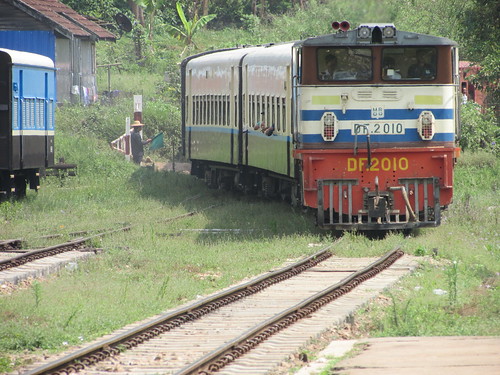
Rather late, my train arrives at Kalaw.
Thandar Oo travelled with me on the journey and our car and driver went on ahead with the luggage. I took lots of pictures of railways, the scenery and people. Our first stop was at Aung Ban, which I'd visited four days previously by car, on our way from Heho Airport to Loikaw. Our general heading continued East-North-East but to maintain reasonable gradients for the steam locomotives for which the line was designed in the 1920s, we twisted and turned as we made our way through the hills. Eventually, we passed close to the end of Runway 36 at Heho airport and stopped at Heho Station at an elevation of 3858 feet above sea level (about four hundred feet lower than Kalaw Station).
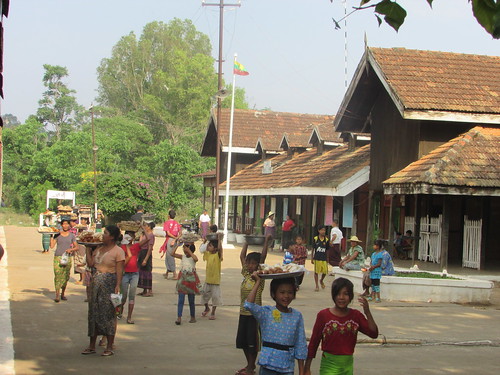
Heho Station.
Numerous vendors walked along the platform looking for customers on the train for their various foodstuffs. Thandar Oo purchased potatoes from an elderly woman.
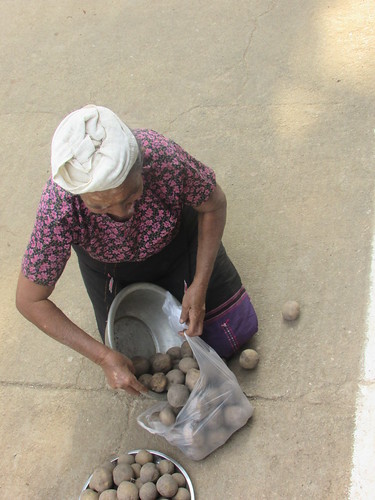
Kalaw - Shwe Naung by train: Buying potatoes at Heho Station.
We then came to my reason for choosing this journey: to lose height rapidly, the railway takes a descending single spiral and crosses under the high level line at the Ba Wa Sam Sa Ra Bridge.
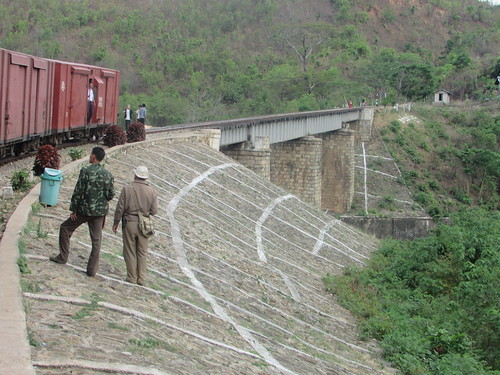
Kalaw - Shwe Naung by train: View looking back, immediately after passing over the Ba Wa Sam Sa Ra Bridge at high level.
With plenty of braking to control our speed, the train then descended the spiral and passed under the bridge we'd crossed over around three minutes earlier.
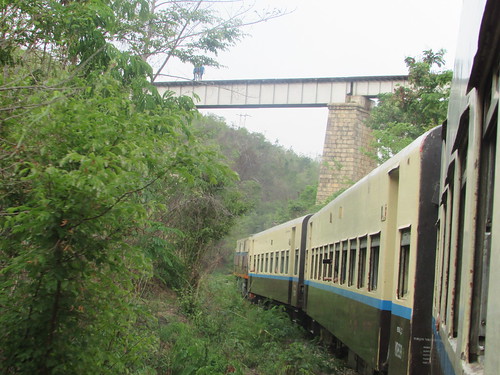
Kalaw - Shwe Naung by train: View looking ahead, immediately before passing under the Ba Wa Sam Sa Ra Bridge at low level.
Around half an hour later, we arrived at Shwe Nyaung station. At some point, there will no doubt be a more technical commentary for those interested in railways.
I was quite tired after the train journey but our car was waiting so we set off for Nyaung Shwe (yes, same words, opposite order). The developments to encourage tourism in the almost nine years since I last visited the area were quite noticeable. At Nyaung Shwe, Thandar Oo and I boarded a boat with my luggage (which was covered in a waterproof sheet to protect it from spray) to take us to my hotel - the Villa Inle Resort and Spa. Then I realised that the boats I'd admired at Phe Khong the previous day were actually the 'standard' design used around Inle Lake.
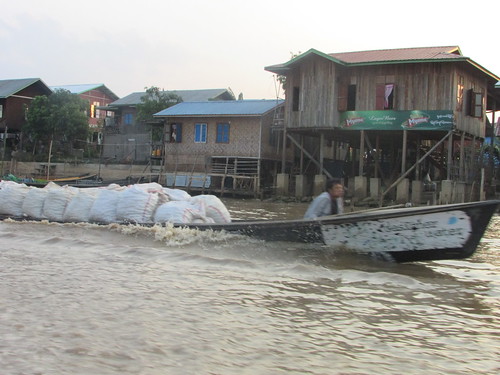
To Villa Inle Resort by boat: View passing a heavily-loaded cargo boat.
The boat must have taken about 30 minutes to reach my destination as the sun set in the west and the heat of the day abated. My arrival at Inle Lake almost 8 years ago is described here and you can find all my posts on that trip to the Far East here.
My personal, large, wooden villa at the Villa Inle Resort and Spa this time was very luxurious and I'd have happily stayed longer than the two nights arranged.
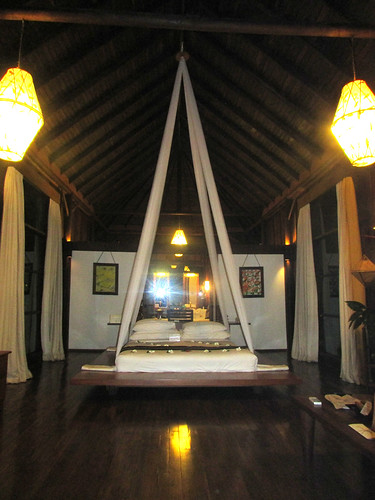
My accommodation at Villa Inle Resort and Spa
Related Posts on this Website
Next Post describing this trip.
All Burma-2017 Trip posts.
My Pictures
Where necessary, clicking on an image above will display an 'uncropped' view or, alternately, pictures from may be selected, viewed or downloaded, in various sizes, from the albums listed:-
Kalaw Hill Lodge.
Around Kalaw (pictures from 2016 and 2017).
Kalaw - Shwe Naung by train.
Shwe Naung to Villa Inle Resort by car and boat.
Villa Inle Resort and Spa.
[Links to pictures added 17-Aug-2017: Text amended and pictures added 2-Sep-2017]
Events of Saturday 6th May 2017
I was really sorry to leave the Loikaw Lodge. It's new, only open about eight months but the lady owner, Swe Yi Myat, has incorporated all the features that have impressed her in her own travels and, for me, the result was perfect. Everybody was keen to make me comfortable, everything worked and the views over the small lake made a peaceful environment, although the hotel is conveniently situated in a residential area of Loikaw.
My guide Thandar Oo and the driver collected me at 8.30 a.m. and we set off along Route 54, retracing our arrival route From Heho. As we left the city, I spotted the small commercial airport, followed by major construction work which appeared to be a serious extension to the runway.
We passed a Christian church. I couldn't tell whether Catholic or Baptist (both are active in Myanmar) but it had two white towers, each topped by a short blue spire, so Catholic is more likely.
Once out of the city, we crossed a plain with rice fields on both sides, followed by a concrete river bridge. The river is presumably the water source to irrigate the healthy, green rice fields where a number of farmers could be seen working. An earlier, steel truss road bridge stood alongside the concrete bridge.
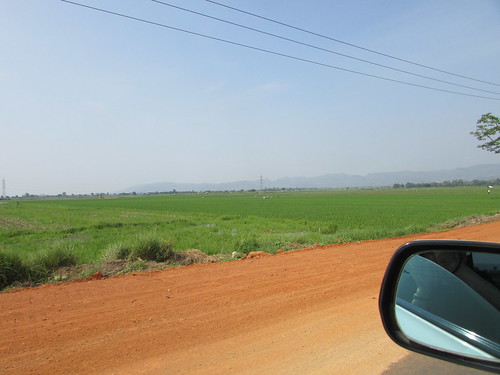
Rice-growing near Loikaw.
We passed an area of Government-owned teak trees, still quite young. Each tree had a white ring painted on the trunk, to indicate that unauthorised felling was likely to result in incarceration for the miscreant.
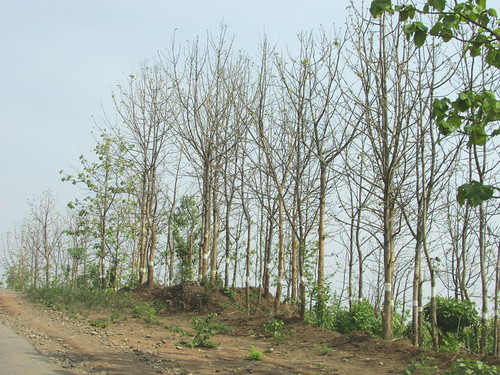
Government-owned young teak trees.
.
A massive, ragged outcrop of rock had attracted the building of a host of gold-painted pagodas and the rock itself was painted white resulting in quite an impressive effect, although not on the scale of Taung Kwe Zedi in Loikaw.

A rock outcrop Buddhist shrine.
On our left, a tall, steep-sided mountain was topped with a white and gold pagoda but lower down the rock face, a Christian cross had been painted, as it appeared to me, defiantly.
Shortly after, entering Phe Khong town, we passed a large building, perhaps a school, with Catholic embellishments. Here, the unfenced single-line railway line from Loikaw had come very close to the road so each building on that side was isolated from the main road by the railway track and had built its own, rather informal, level crossing to reach the main road. The railway then ducked out of site as we passed through the main part of the town which included another church, this time with a single tower and spire surmounted by a large cross.
The railway then re-appeared on our left and, hidden in the trees, was a small station. We stopped so that I could make a photographic record.

Phe Khong station (road side).
The facilities were very modest - a simple station building, single platform and passing loop. Thandar Oo noted the ticket prices displayed in the deserted ticket hall:-
To the new capital, Nay Pyi Taw:
2,500 Kyats Ordinary Class, 3,350 Kyats Upper Class.
To Kalaw (our destination that day):
1,200 Kyats Ordinary Class, 1,600 Kyats Upper Class.
But road and rail were not the only transport options at Phe Khong. At its southern extremity, Inle Lake discharges into a system of lakes and rivers which extends to Loikaw. Small boats provide passenger and freight facilities between Inle and Loikaw and Phe Khong is one of the intermediate calling points. So, after I'd finished my examination of the railway station, we drove to Phe Koung Jetty.
'Jetty' was rather overstating the infrastructure - there's a beach and the elegant wooden boats get as close as they can to dry land. I did see a decrepit-looking short wooden walkway which is perhaps intended for passengers but the activity in the short time we were there was all freight-related.
First, one of the basic but effective small Chinese-built lorries arrived. These improbable-looking machines are everywhere - four-wheeled and articulated with a noisy diesel engine on the front unitt whilst the load is carried on two rear wheels in a simple, tiny lorry body. The driver perches on a padded shelf attached to the front of the lorry body, wrestling the steering wheel on the front unit. I say 'wrestling' because the direction of these vehicles always seems rather uncertain but they are ubiquitous and carry out prodigious haulage feats. I'm told they're called "Chinese Buffalo" which seems appropriate.
The driver of this interesting vehicle turned it around and unhesitatingly backed into the lake, with an assistant sitting on each rudimentary mudguard over the rear wheels, until he reached a waiting boat lying broadside-on to the beach. Everybody involved then started to transfer a load of building bricks from the lorry to the boat.
Another "Chinese Buffalo" arrived and made a different manoeuvre, driving forwards into the water parallel to the shoreline, then attempting to reverse to reach a another boat lying perpendicular to the shoreline, partially-beached.
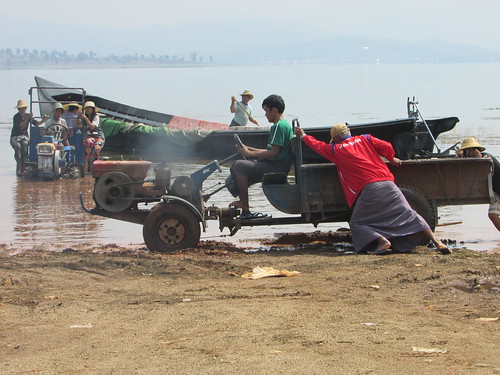
Phe Khong Jetty: One lorry, deep in the water has positioned by a waiting boat whilst a second lorry struggles in the wet sand to get near a second boat.
This positioning was achieved only after a lot of heaving from the driver's two assistants. A large sheet of tough, woven polypropylene had been laid across the hull of the beached boat and the men started shovelling gravel from the lorry onto the sheet.
The third vehicle to appear was a motor tricycle. These vehicles can be seen all over Myanmar, acting as taxis or freight hauliers. But I was surprised to see the driver reverse his machine into the water until it covered the rear axle. He then called to a boatman some yards away who poled his craft across to the motor tricycle and, once lined up, a variety of goods were moved from the motor tricycle to the boat.
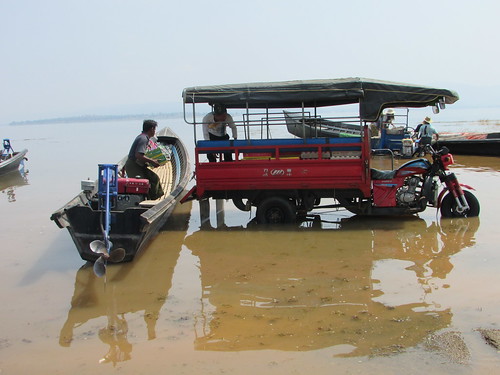
Phe Khong Jetty: A motor tricycle transfers goods to another boat.
The many motor boats I could see appeared to be of the same general pattern, wooden framed and clad with thick, flush planking, perhaps 25 feet long and 8 foot beam across the gunwhales at the widest point fitted with simple, low decking near the keel. The hull shape was elegant and suggested speed.
Whereas many of the smaller motor boats I've seen in the Far East have been of the 'long-tail' pattern, these motor boats had a fixed diesel engine driving a propeller shaft which passed through the transom to a universal joint driving the propeller itself through a secondary shaft. This allowed a lever mechanism incorporating a tiller to steer the boat and lift the propeller out of the water when required. Seen on the water, these craft seemed to have a fair turn of speed.
We then walked to the nearby market. It was a large market, well provided with permanent, lock-up stalls. Although only partly in use during our visit, there was still the usual bewildering variety of food and dry goods on offer.
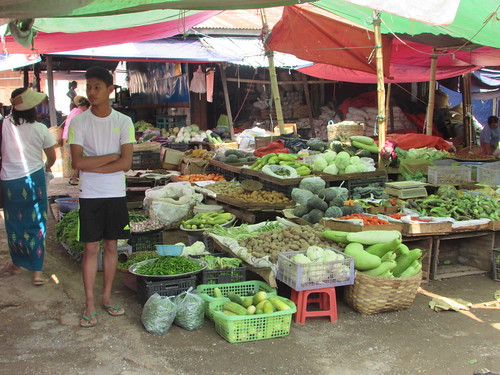
Phe Khong Market.
Our car continued north through the rugged mountain scenery of Pa-O territory which I found most appealing. We made another stop at Pin Kun Village, with a typical Pa-O market still in progress where the Pa-O come to sell their produce and purchase necessities.
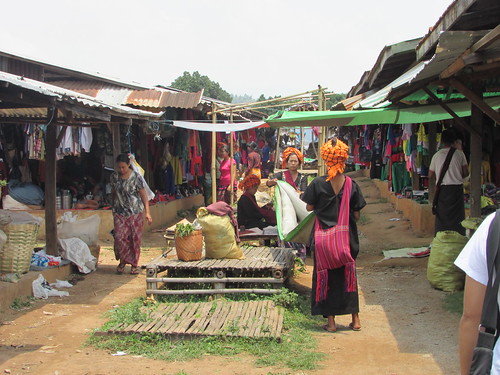
Pin Khun Market: Note the traditionally-dressed Pa-O women in black, with orange 'turbans'.
Thandar Oo had presented me with a Kayah longyi which needed tapes fitting (for the fuller European figure). She commissioned a girl at a tailoring stall equipped with two Chinese-made treadle sewing machines to do the work but, before the work was completed, ended up demonstrating her abilities as a seamstress herself.
As we returned to our car, I watched a lorry from a more remote village getting ready to leave with a group of Pa-O people.
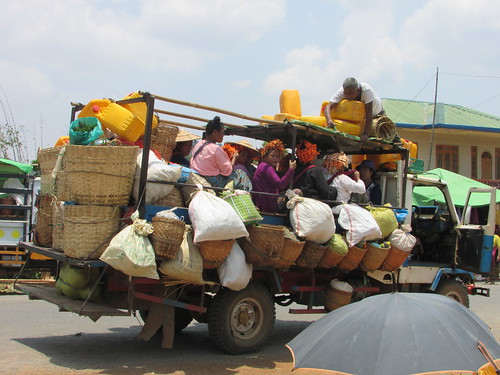
Pin Khun Market: Transactions completed, a well-loaded lorry prepares to return Pa-O people to their village.
We continued towards Kalaw and, about 20 minutes later, passed through another village where the railway ran down the side of the street.
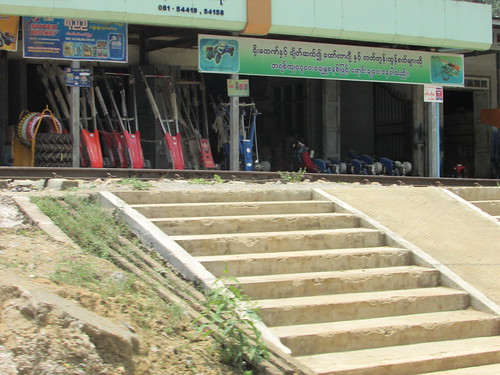
Loikaw - Aung Ban railway track passing in front of a row of shops. Although broad concrete steps are provided here from the main road, pedestrians then have to step over the rails!
When we came to the junction with the road to Heho, we turned towards Kalaw, pausing at the railway station to re-check the timing for our proposed railway journey the following day.
Finally, it was on to the comfort of the Kalaw Hill Hotel for one night.
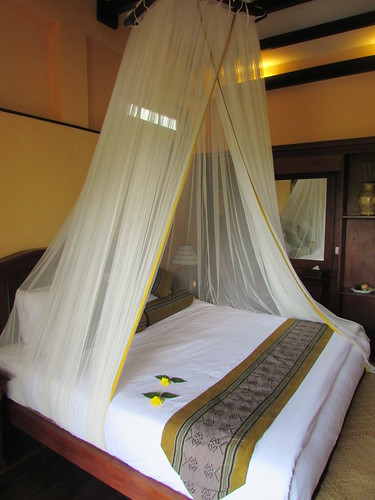
Kalaw Hill Lodge Hotel.
I'd first stayed there just over a year earlier. That first visit is described in the post By train to Kalaw with a link to the following post and to the pictures of that first visit.
Related Posts on this Website
Next Post describing this trip.
All Burma-2017 Trip posts.
My Pictures
Where necessary, clicking on an image above will display an 'uncropped' view or, alternately, pictures from may be selected, viewed or downloaded, in various sizes, from the album listed:-
Loikaw Lodge.
Aung Ban - Loikaw by road.
Aung Ban to Loikaw railway.
Phe Khong Jetty.
Phe Khong Market.
Pin Kun Market.
Kalaw Hill Lodge.
[Links to pictures added 24-May-2017: Pictures added, minor text changes 2-Sep-2017]

