skip to main |
skip to sidebar
Events of Tuesday, 3rd May 2016
I had breakfast at the Aye Yar Resort and checked-out at 8.00 a.m. The monastery car picked me up with the usual driver, together with one of my other young friens from Clinic. We drove via the Anawratha Road to a pagoda famous for its wall paintings, Gu-Byauk-gyi, I think. Although the souvenir sellers were starting to set up their wares, it was still quiet. My friend said most guides take their clients to Nyaung Oo market first and that it would become busy later. We continued to Nyaung Oo and took the familiar road out of town, past the airport turn, then the railway station turn. I think Nyaung Oo is unique in having an airport nearer the town than the railway station. We carried on along the main road we’d used the day before, through Taung Zin.
The crumpled caldera of volcanic Mount Popa was visible through the haze on the left. Our route started to rise out of the plain so that we were travelling through wooded mountains. The area appeared to be the source of rock, with large piles of graded sizes which I assumed were for roadbuilding. There were also two new electricity transmission routes, one low voltage, one medium voltage, being erected. We passed a number of areas where minor improvemnts were being carried out to the road. As is usual, most of the labourers were women. Barrels of tar were being prepared for use by having a fire set under them but I also spotted a couple of ancient, wheeled tar boilers. We passed through a series of fairly small one-street villages, with a variety of stalls on both sides of the road and, of course, a profusion of tea shops.
We then entered a fairly major town with proper shops, rather than stalls, and a couple of impressive-looking modern bank buildings. There were at least two sets of modern traffic lights with countdown-timers. Providing the contrast at which Myanmar excels, there were also oxen grazing on the patches of sparse grass. As we threaded our way onto our road, I noted not just the number of teashops but also their large size.
We passed through another area of farmed land populated by pairs of oxen ploughing or hauling carts before we entered another fairly large town, Meiktila with its lake. We parked near the bridge which takes the road across an arm of the lake. I walked along a rather rickety bridge thrust into the lake leading to a very small pagoda.
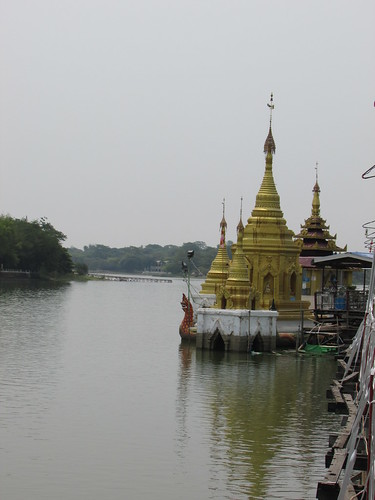
Meiktila Lake Pagoda.
The lake water was clear and lots of fish, carp I think, could be seen. Walking back to the car, I spotted a wooden pumphouse extracting water from the lake. As we drove over the road bridge, we passed a huge, gilded ‘concrete barge’ with a bird's head at the edge of the lake, apparently another temple.
On our way out of town, we passed a massive, walled factory with a least 20 large sheds. A sign in English as well as Burmese revealed that this was Meiktila textile works.
Before long, we were running into Thazi, with one main road running through and a network of generally unmetalled side-streets. We easily located the Moon Light Guest House and I was made very welcome by the proprietors.
My friends who had delivered me safely to Thazi agreed to act as interpreters at the Diesel Locomotive Depot, where I had been given two Inspectors names as contacts. Unfortunately, they were both absent that day, but I was allowed to take a few pictures before we left. Having returned me to my hotel, my friends declined hospitality and set off back to Bagan.
Although it was rather hot, I decided to go for a walk along the main road to see a little more of the town, which I believe has a population of around 30,000. I passed a rather smart modern fire station with four appliances near the Police Station for Thazi Township. Both KBZ Bank and CB Bank had impressive modern buildings. Having got used to seeing pairs of oxen doing the ploughing and pulling, I was surprised to see two modern farm tractors pass along the main road. I found it reassuring, somehow, that most of the 'taxis' were horse-drawn 2-wheeled 'hackney cabs'. After exploring the main road, I took the side road leading to the station to make a photographic survey. By the time I was back at the Guest House, I was thoroughly exhausted but a cold drink followed by a nap restored me sufficiently to prepare this report.
Then I broke off for an evening meal, which was prepared exactly to my preferences and was excellent.
Related posts
There's a report on my visit to Thazi Locomotive Depot and Station here.
Next post describing this trip.
All my posts on this trip can be found here.
My pictures
There are a few pictures of this trip here.
Pictures at Meiktila Lake are here.
More pictures will be posted as soon as possible.
Events of Sunday, 1st May 2016
On Sunday, I walked to the Clinic just after 8.00 a.m. The Doctor had already started work and he hold me that there had been 60 registrations at that time.
I'll describe my morning observing Dr. Hla Tun's consultations in a separate post.
A startling storm
There was a vicious thunderstorm around lunchtime and the electricity went off. The rain was very heavy for a while. The Clinic have some sort of standby generator (I didn't discover details) but they didn't use it - they just carried on using battery lighting until power was restored, after around an hour. The temperature was much more comfortable after the rain, most of which dried up quickly. I took the opportunity to leave the clinic and walk to the hotel with a view to exploring on foot. But the temperature was rapidly rising again, so when a middle-aged guy on a motor cycle offered a boat ride, I entered into negotiations.
A relaxing cruise on the Ayeyarwaddy
Briefly, we made a deal and I had a splendid cruise lasting one hour on his longtail boat with a roof which could have carried a couple of dozen tourists rather than one. We went up river almost to the Swezigon Pagoda before returning to the shore close to my hotel (I say 'shore' because there's no actual jetty but if you're lucky - I was - you keep your feet dry. It was late afternoon when we returned - a good time to watch the activities of the local people, many carrying out ablutions and clothes washing.
Related posts
Next post describing this trip.
All my posts on this trip can be found here.
My pictures
There are a few pictures of this trip here.
More pictures will be posted as soon as possible.
Disclaimer
Judged by Western standards, my reporting at the Clinic may seem intrusive, with access to the Doctor's Consulting Room during diagnosis and procedures and with photographs made freely available. But ideas of personal privacy have not developed in the same way in Burma and Dr. Hla Tun believes that those interested in the work should understand the problems of medical care in Myanmar, in general so different from the Western world.
In my observations, I try to better understand the working of Myanmar Society, developed over centuries, and give others a small insight into the lives of these admirable people who moved me to try to make some small attempt at offering support. Misinterpretations of what I see may occur and are, of course, my responsibility.
General
Myanmar is a large country with, by Western standards, relatively poor internal communications (although the growth of internal air transport over the last few years has been impressive). Although the Bagan Clinic was conceived as a local clinic, the reputation it has earned means that it now attracts patients from a wide area, despite the problems of travelling long distances.This also introduces problems of language, because people from Myanmar are highly diverse, as discussed in 'Ethnic groups in Myanmar' below.
The Clinic now charges a flat fee of 10,000 Kyat (around 10 U.S. Dollars) for a consulation but this is frequently waived because of the widespread poverty of patients. The fee includes all medication supplied and, where required, blood tests and E.C.G. carried out by the Clinic's laboratory.
Patient Notes
As is customary in Myanmar, patient notes are entered in a specially-produced notebook with the clinic details printed on the cover and the patient's name and address written in spaces provided for the purpose. These notebooks become the patient's property and are taken away by the patient, with any relevant test results or E.C.G. printouts tucked inside. It's fairly common for patients to bring similar patient notes issued by other clinics consulted previously. Orthopaedic patients often bring X-rays taken at other clinics. All of this patient history will be carefully studied by the Doctor during the consultation.
Medication
Details of medicines prescribed are entered in the patient notes. Some drugs are taken from a stock in Doctor Hla Tun's consulting room but, more generally, the patient will take their notes to the Dispensary which forms part of the original clinic building where the prescribed medication will be issued.
Doctor Hla Tun's consulting room
There is little privacy in the Doctor's consulting room - it is more like a general ward. Three examination couches are permanently occupied and the Doctor moves between them. If he prescribes various injections, these are generally administered by his two female assistants and, in the meantime, the Doctor will move to the next patient or update patient notes. In addition, mothers with young children are frequently seated adjacent to the Doctor's desk, making a fourth patient, and patients with just-completed tests will also wait at the Doctor's desk for him to review the results. Many patients also have a friend or relative with them in the consulting room so, together with Clinic staff frequently entering with information or questions for the Doctor, it can be quite crowded at times. Somehow, Doctor Hla Tun keeps track of all this activity, radiating quiet confidence.
Individual stories
On Saturday, there was a party of 9 patients from Shan State. They spoke a different dialect so the Doctor needed to use somebody with knowledge of standard Myanmar language and Shan dialect as an interpreter. The group had set-off by road in a hired pick-up at 6.00 p.m. Friday and arrived at the Clinic compound at 3.00 a.m. Saturday morning. The Driver of the pick-up charged each of them the equivalent of 35 U.S. Dollars.
One of these Shan patients was a large man from the Shan Hills with poor mobility following a stroke. It required two strong young men to help him to the examination couch whereas before he would regularly walk 14 miles to the nearest town. The Doctor aspirated fluid from the knee joints and gave a number of injections for pain relief. He also suggested a number of exercises to help strengthen weakened muscles.
I'll outline some other cases later.
Ethnic groups in Myanmar
The Myanmar Government recognises 135 distinct ethnic groups of which the major groupings are:-
Bamar
Chin
Kachin
Kayin
Kayar
Mon
Rakhine
Shan
For more information, refer to the Wikipedia Article.
Related posts
All my posts on this trip can be found here.
My pictures
There are a few pictures of this trip here.
More pictures will be posted as soon as possible.
Events of Saturday, 30th April 2016
I was booked into the Aye Yar River View Resort for our four days in Bagan. For me, this location has two particular attractions. Firstly, the 'River View Rooms' are literally that. They are built on the east bank of the Ayeyarwaddy River (but at a higher level) with only a narrow strip, a hedge and asandy track between the base of the hotel building and the river with a variety of moored boats visible. It can be noisy at times - most of the smaller 'longtail' boats are propelled by raucous Chinese-built single-cylinder diesel engines which kick up quite a racket and the powerful tug-boats which power the barge traffic have large, loud marine diesels. But if, like me, you're an incurable romantic, it gives a connection with "The beating Heart of Burma" and, I noticed this time, the hotel provides disposable ear plugs. The second attraction is that the hotel is within walking distance of the Bagan Medical Clinic via a network of dusty, unsealed roads quite busy with pedestrian and motor cycle traffic. The walk takes ten or twenty minutes, depending how fast you walk and how impervious to sun you are (I'm not very good on either count any longer). However, Doctor Hla Tun usually insists on my using the monastery car for the commute.
The car picked me up, as arranged, at 8.30 a.m. and by the time I arrived at the Clinic, Doctor Hla Tun had already started consulations. The Clinic was noticeably busier than the previous day and I think the total patient registrations for the day exceeded 200.
Doctor Hla Tun introduced me to the lady opthalmologist who now conducts eye tests at the Clinic on a every other Saturday and I was able to watch her at work. Later I discovered that in the week, she works in Chaulk Hospital.
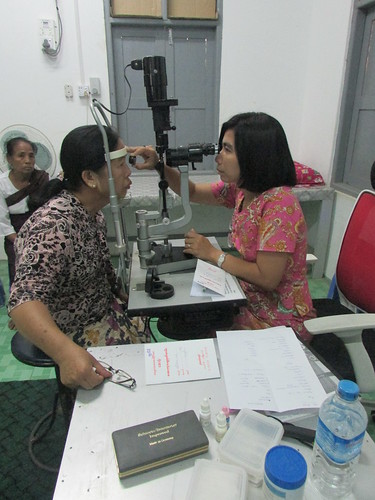
The lady Opthalmologist at Bagan Medical Clinic.
I'll describe my morning observing Dr. Hla Tun's consultations in a separate post.
Doctor Hla Tun asked if I had visited the famous monastery at Salay (sometimes transliterated as 'Sale'). As I had not, he arranged what turned out to be a fascinating trip for the afternoon. We set off in the monastery car with the young monk in the front passenger seat and the lady opthamologist and I in the rear.
We left Bagan heading south, passing first through the village of Myinkaba and then through a rather modern area called 'New Bagan'. We kept going firstly through the familiar landscape of the Bagan Plain but then becoming very undulating and, to my surprise, I spotted a number of four-legged steel oil derricks dotted around.
Chaulk Oilfield
I knew that Burma was an early producer of mineral oils but I had no idea that the Chaulk Oilfield (the name is sometimes transliterated with an 'l', sometimes without)was on our route, still less that it still produced useful amounts of oil.
The first derricks we saw were exactly as you see in old pictures but later we encountered a much simpler design which appeared to comprise a tripod of three wooden poles with simple wooden horizontal bracing. Where derricks were close to the road, I saw traditional 'nodding donkey' oil well pumps lazily extracting 'black gold' from the bore hole and delivering the oil through a flexible pipe to some unseen collection point. A network of overhead electric distribution systems, some appearing quite elderly, criss-crossed the skyline, carrying power to the numerous electric well pumps. I saw a reference to Well number 1118! Myanmar Oil and Gas Enterprise (MOGE) lists the Chauk Oilfield as having been discovered in 1902 and still producing. There's an MOGE slideshow here and a Wikipedia article here
Near Chaulk town I saw a large farm of oil storage tanks and, further south, a single pipeline apparently lying on the ground ran parallel to the road. After a few miles, we came to an industrial complex which I assumed (principally from a series of 'flare stacks') was an elderly and relatively small-scale oil refinery.
Salay
The town of Salay is famous for its 'Yoke-Sone-Kyaung' monastery with its spectacular woodcarvings now in the care of the Department of Archaeology & National Museum. Built entirely of wood, and crammed with various artefacts, I found it a fascinating place. As I explored the gloomy rooms, thunder and lightning was followed by torrential tropical rain, sending the attendants scurrying to close the top-hinged 'doors' which formed the sides of the building. The storm was short-lived and it was dry as I returned to the monastery car.
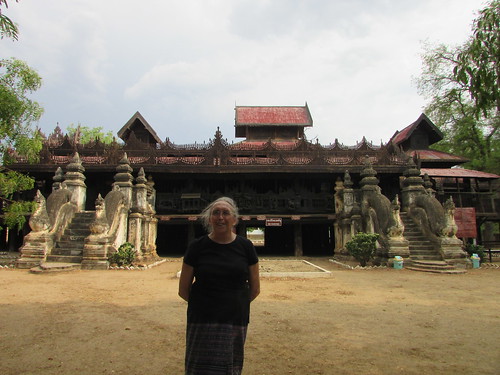 Jan at Salay Monastery.
Sarkjouhla Pagoda
We then drove a few miles to the venerated temple of Sarkjouhla, dating back to 1191 A.D. Having explored the various elements of the complex, we headed back north.
Back to Bagan
We dropped the Opthalmolgist at her home in Chaulk before completing the journey back to Bagan Medical Clinic. Tired by the journey, it wasn't long before I accepted the offer of a car to my hotel. Doctor Hla Tun and his staff were working until midnight to finish treating the patients that day.
Related posts
Next post in this series.
All my posts on this trip can be found here.
My pictures
There are a few pictures of this trip here.
More pictures will be posted as soon as possible.
Introduction
I first visited Bagan in 2008, as just one destination on the trip Round the World Five.
The dusty Plain of Bagan has the remains of 2,000 pagodas, many over 1,000 years old. In the heyday of the city there were reputedly over 20,000 pagodas. The area never fails to impress even the most cynical. Ruination does not deter the local people from veneration of the sites and modern donors achieve Merit by 'restoring' the structures, using techniques which appall archaeolgists.
In the Afterword post to 'Round the World Five' I wrote "I was impressed with the charitable initiatives that the 'Road to Mandalay' ship is involved in covering education and medicine ... Kipling wrote "Burma is different from anywhere you have ever seen" and in his poem 'Road to Mandalay' he describes how the country draws you back. He was right - I intend to return to Myanmar". An accurate forecast, but I didn't realise how important a place of 'pilgrimage' the country would become to me - this is my tenth visit. Following later visits, I made contributions to various school projects (for instance, see the post about the opening of a new school building at Htee Pu here. Incidentally, 'Htee Pu' is rendered as 'Ti Pu' in early posts - the Romanisation of Burmese words is a very variable feast which leads to endless confusion.
The Doctor and the Abbot of Bagan Monastery had the ambition to build a small medical clinic at Bagan to serve the local population and, later, I also joined in this project. The opening ceremony in 2011 is described here but the growth in demand since has exceeded all expectations. There are a number of posts chronicling this growth here.
Events of Friday, 29th April 2016
Dr. Hla Tun is the Chief medical Officer of the Bagan Medical Centre, so is normally there on the clinic opening days of Friday, Saturday and Sunday each week. Since he was in Yangon on the previous day, this involved an early start so as to catch the 6.00 a.m. flight from Yangon to Nyaung Oo (Bagan), where the Monastery Car transferred him to the Clinic.
 Yangon Airport - 6.00 a.m.
An already-exhausted Jan accompanied him. We arrived at the Clinic around 8.00 a.m. and were soon met by the elderly, smiling Abbott who (like everyone else in Myanmar) always presses food upon me. We share not one word of each others language but seem to communicate well enough (with occasional outside help). I have great respect for this community leader who always seems concerned for the welfare of the local people.
After breakfast (I enjoyed a special rice congee but declined the chicken and fish), one of the Monks who has been involved with the daily running of the Clinic since its opening then showed the Doctor and I the building work in progress on the fourth, and largest, clinic building.
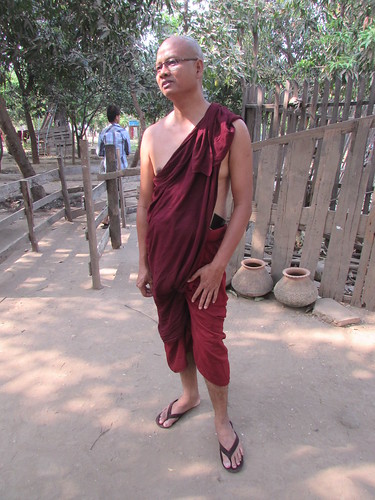
This young monk has been involved with the Clinic since its opening.
The latest building is of reinforced concrete construction provided with two floors and a flat roof accessible by stairs around which the builders were installing balustrading. The necessary sacks of cement were being carried up to the roof level balanced on the heads of three lady labourers who were also mixing the cement using long-handled shovels.
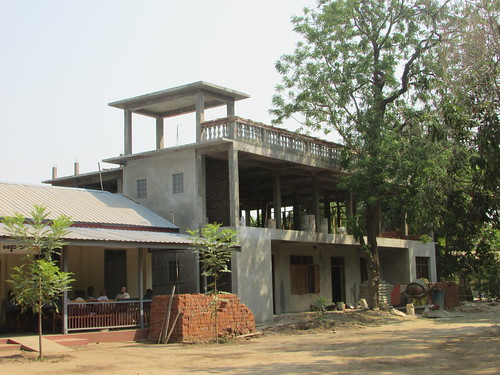 The 2-storey Clinic Building under construction at Bagan Medical Clinic.
It was a quiet day - only 80 patients had registered when Doctor Hla Tun started seeing patients at 9.00 a.m. Three other Doctors were also on duty - two young Doctors from Yangon on a Stanford programme who form part of a rota system and one regular, locally-based doctor. Howevever, by the time Doctor Hla Tun stopped for lunch at 2.00 p.m., the total number of patients has risen to 130, ensuring the customary late finish for Doctor Hla Tun who carries out all the more complicated procedures and diagnoses. I've described my observations in Dr. Hla Tun's consultation room in a separate post The Work of Bagan Medical Centre.
In the afternoon the Doctor had arranged the monastery car to take me to visit the Jetawun Monastic Education Center (their spelling) in Nyaung Oo.
Jetawun Monastic Education Centre
I'd known of this monastic school for some time, but this was my first visit. My friends at the Royal Burma Society in Great Britain have provided donations to the school and they suggested that I should try to visit during this trip
Because my visit coincided with the summer school holiday period in Myanmar, the school was not open but the monk who runs the school, Baddanta Ar Deik Sa, received me and showed me some of the extensive facilities.
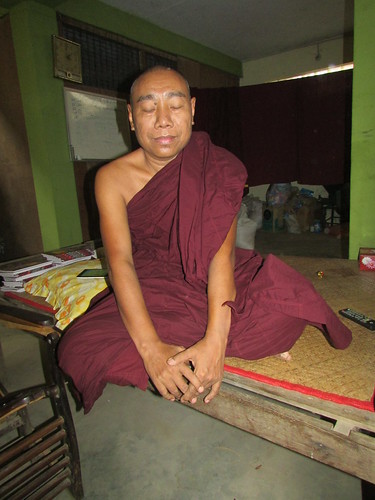
Baddanta Ar Delk Sa of the Jetawun Monastic Education Center, Nyaung Oo.
The Education Center was founded in 2006 and the growth in student numbers since then is notable:-
| Academic Year |
Number of Students |
| 2006-2007 |
46 |
| 2007-2008 |
120 |
| 2008-2009 |
203 |
| 2009-2010 |
270 |
| 2010-2011 |
330 |
| 2011-2012 |
370 |
| 2012-2013 |
375 |
| 2013-2014 |
380 |
| 2014-2015 |
376 |
| 2015-2016 |
380 |
Related posts
Next post in this series.
All my posts on this trip can be found here.
My pictures
Bagan Medical Clinic (day 1).
Bagan Medical Clinic: Construction of 2-storey Building.
Jetawun Monastic Education Center.
Thursday, 28th April 2016
Just a quick note to confirm I'm safely back in Yangon after an amazing six days touring a few of the Mergui Archipelago's 800 islands in the sailing vessel 'Meta IV' with six other passengers and four crew.
Length: 23.75 m
Breadth: 5.7 m
Draught: 2.85 m
Net tonnage: 35
Gross tonnage: 58
Fitted with a 195 kW Cummins diesel and single, reversible screw.
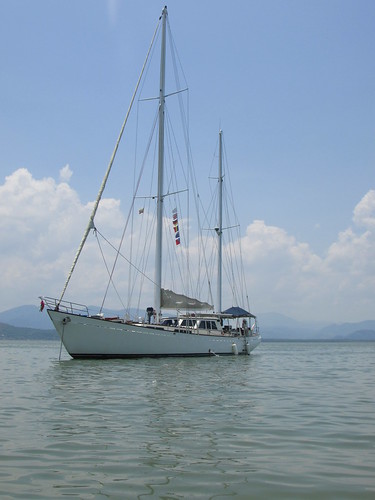
My home for six days - 'Meta IV'.
We sailed from Kawthaung on Saturday, 23rd April and anchored the first night off Ba Wel Island (along with a number of commercial fishing vessels).
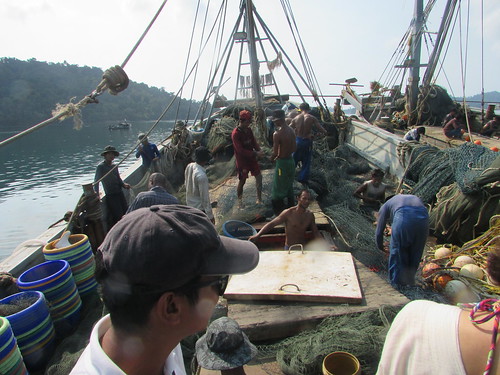 On board a moored fishing vessel at Ba Wel Island, Mergui Archipelago.
On Sunday, 24th April we visited the village on Nyaung Wee Island, went ashore at a small island (115) and anchored for the night off Nyaung Wee Island.
On Monday, 25th April we made visits to Lampi South River with its rich mangrove forests, small island (60) and anchored off Ko Phaar Island.
On Tuesday, 26th April we visited Kyunn Philar East, where we replenished the two fresh water tanks, anchoring off Kyunn Philar East.
On Wednesday, 27th April we visited Oh Way Island before anchoring off Ba Wel Island for our last night at sea.
Finally, on Thursday, 28th April, 'Meta IV' returned to Kawthaung.
Another early start tomorrow, as I fly north with the Doctor to Bagan. Whilst there, I hope I can write a little more.
Related posts
Next post describing this trip.
All my posts on this trip can be found here.
My pictures
There are some pictures around Kawthaung here.
Pictures leaving Kawthaung and sailing to Ba Wel Island on Saturday 23rd April are here.
There are a few pictures of the early part of this trip here.
More pictures will be posted as soon as possible.
[Links to pictures added 7-May-2016]
In the article Rangoon Tramways, I posted a brief introduction to the electric tram system which once served Rangoon.
Electric trams are once again running in Rangoon, now called Yangon, and on Thursday, 21st April 2016 I made my first trip on the new system. The line runs along Strand Road from War Dan (to the West, where the Depot is located) with stops at Maw Tin, Sint Ohe Dan, Pagoda Road, Pan So Dan, Bo Ta Htaung, terminating at Lansdown.
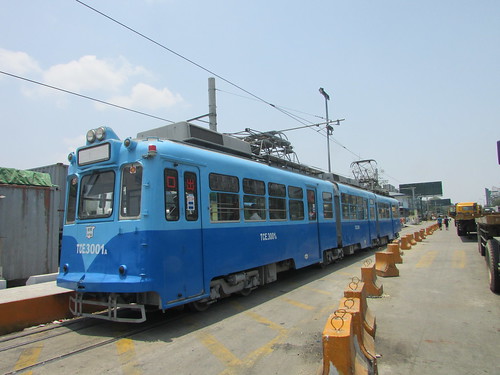
Tram TCE 3001 at the Lansdown (Eastern) terminus).
A modern overhead conductor system has been provided, apparently fed from a single sub-station at War Dan. An insulated feeder carried on the concrete supports allows the bare conductor to be parallel-fed at intervals.
The tramway is standard gauge, running on a single dual-gauge track which it shares with the metre-gauge line serving the goods depots along Strand Road. There are a few interesting dual gauge turnouts.
I took lots of pictures which you can find here. I'll add information on the rolling stockas soon as possible.
[Post time revised to place in sequence 1-May-2016: Link to pictures added 7-May-2016]
Events of Wednesday, 20th April 2016
In earlier posts, I've described three hectic days in Mon State. At the end of the third day, we took the overnight bus back to Yangon, where I again stayed at the Doctor's house.
Events of Thursday, 21st April 2016
The Doctor prescribed a day of recovery for me (it has been awfully hot) and, for once, I was happy to comply. But I did manage to try out Yangon's new electric tram - there's a brief report here.
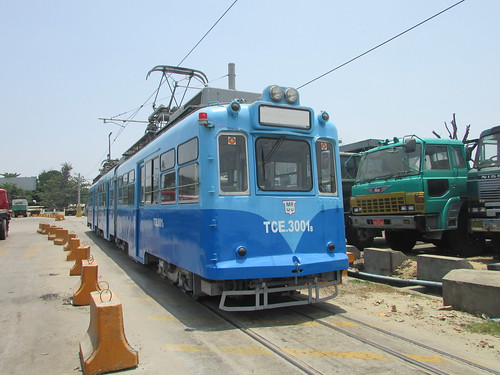 Tram TCE 3001 at the Lansdown (Eastern) terminus).
Events of Friday, 22nd April 2016
Early on Friday, Doctor Hla Tun left early to fly to Bagan Medical Clinic for the usual three days of consultations. On this occasion, I did not accompany him as the following day, I had arranged to spend a few days on a sailing boat. However, we had discovered that Aung Ko Latt (from Ko Dut in Mon State) had travelled to Yangon, so the Doctor had arranged for him to meet me.
Aung and I made a clockwise trip on the Circle Line together. No doubt a technical review will appear at some stage - The technical review can be found here.

The second-hand, Japanese-built Diesel Multiple Unit on which Aung and I made our Circle Line Trip.
On the way back to the Doctor's house, we made a stop at the Taw Winn Shopping Centre so that I could indulge my taste for reprinted old books about Burma written by the English.
I said 'good-bye' to Aung and prepared for another early start the following day, Saturday, 23rd April, when I was to fly south to Kawthaung to see a little of the far south of Burma.
Related posts
Next post describing this trip.
All my posts on this trip can be found here.
My pictures
Pictures of Yangon's new tram system are here.
Pictures of my trip on the Circle Line with Aung are here.
All my pictures on this trip are here.
[Link to Circle Line Pictures added 7-May-2016: Link to tram pictures added 11-May-2016: Link to technical review added 29-May-2016]
Events of Wednesday, 20th April 2016
Once again, we were up early and, having said goodbye to some of the young Ko Dut D.I.C. staff, we drove into the village with the D.I.C. manager for breakfast featuring rice noodles at a small lean-to roadside restaurant built outside the front wall of the owner's house. In the front yard of the house, a young girl was producing fresh noodles by squeezing the hot, cooked rice paste through a perforated plate, using a large set of 'pliers'. The Burmese value reliable, fresh sources of food. Fortified by breakfast, we said our final "good byes", left Ko Dut and headed back north. The Doctor had allowed time for us to visit the important pagoda built in the sea at Khaikhami Yele Paya since Myint and Mi Mi had not previously visited. I was once again reminded of my good fortune in having much better opportunities to see the country than most Burmese, since it was my fourth visit (I'd visited before in 2012 as described here and with Dr. Hla Tun in 2014 (as described in Last day in Mon State) and in 2015 (Visit to Mon State, Myanmar (Part 4). Although, as a non-Buddhist, it does not have the same resonance for me as for the many pilgrims I saw there, I never tire of being at this very special place.
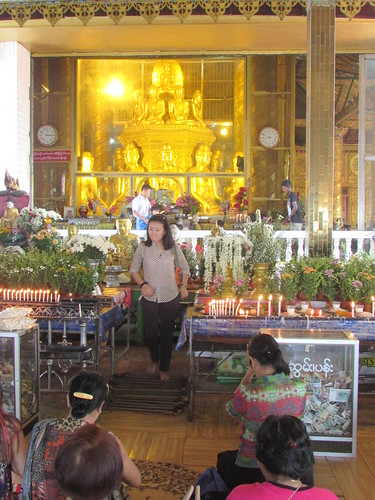
Mi Mi at Khaikhami Yele Paya.
We then continued north to Mawlamyine and the Drop In Centre at Hlaing, situated in a crowded and poor area just outside the centre of Mawlamyine. A number of collapsible shelters had been erected outside the D.I.C. building and over 300 children were seated under these shelters, waiting for us (there are over 400 children 'on the books' but there are various reasons why they are rarely all present at one time).
The 'Sky Net' television news team (cameraman and female presenter) were there and I was asked to do a short piece to camera in English. I doubt if it was used. But they then conducted an interview of over 5 minutes with Dr. Hla Tun and a similar interview with the Centre Manager.
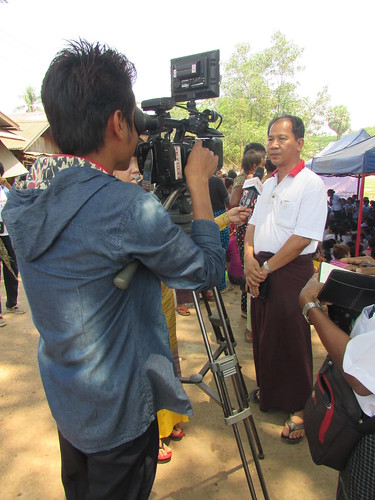
We know that these interviews were transmitted because, back in Yangon and by chance, we saw the latter part of the programme they'd made on national television.
At Hlaing, I also saw two newspaper journalists making copious notes and taking photographs. All the school uniforms and stationery had been put ready in the new school bags, year-by-year and separately for boys and girls. There were plenty of helpers to organise everything, so I found myself handing out the bags at high speed, wittering away in English, in the hope that it helped relax the children, some of whom were clearly over-awed by the occasion. The Doctor carried out the last 20 or so distributions as, by that time, I was perspiring freely.
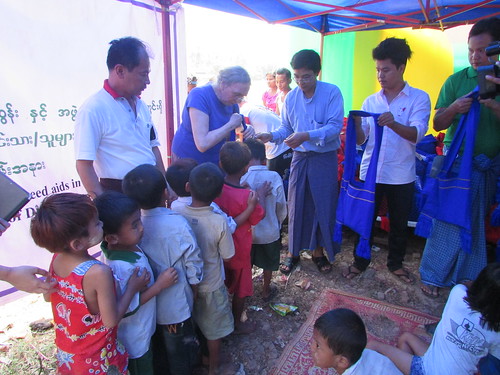 Jan helping with the distribution at Hlaing D.I.C.
The children changed into their uniforms inside the D.I.C., some of the younger ones with help from the staff, and then, back outside under the shelters, the Doctor made a speech of encouragement. Some of the shelters were removed to make it easier to made a 'Group Shot' before the children left.
Hlaing D.I.C. - The 'Group Shot'.
Back inside the D.I.C., the Doctor made some specific financial awards to support deserving children and a number of the D.I.C. volunteers. There are so many stories of dedication and determination. We were moved by the story of one young woman with excellent language skills who had given up her full-time job with 'Care' and now undertakes part-time work so that she can look after eleven orphans.
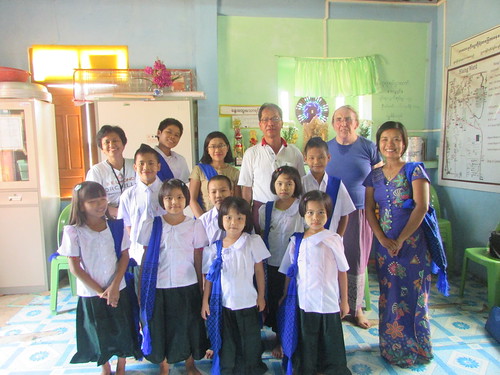 The young woman on the right now looks after 11 orphans in Mawlamyine.
After lunch at a cafe in Mawlamyine, we had one more distribution at the smaller centre of 'Future Generation', also in Hlaing.
Then it was back to the Care Centre in Malamyine we'd stopped at (briefly, on our first arrival) where there was time to 'shower' (Burmese-style) before another meal in Mawlamyine. Since it was a bit of a walk, I was offered a lift on a motor-cycle (pillion, side=-saddle) which included the southern end of Strand Road I'd not seen before. After the meal, I managed to walk to the Care Centre where the car took The Doctor, Myint, Mi Mi and the writer to the Bus Station so that we could catch the 8.30 p.m. bus back to Yangon.
Related posts
Next post describing this trip.
All my posts on this trip can be found here.
My pictures
Burma-2016.
More pictures will be posted as soon as possible.
[Post date amended to place in sequence: 1-May-2016]
Events of Tuesday, 19th April 2016
I was a little restored by morning but I knew it would be a tiring day making presentations to the children attending Ko Dut DIC. Children were supposed to arrive at 8.00 a.m. but by 6.30 a.m. we could hear the excited chatter of early arrivals.Once we let the children in, the ground floor was soon crowded and the Doctor and I started distributing snacks, a school bag, exercise books, pencils, a short plastic ruler and pens, together with new school uniforms for the coming year.
The event, to which the children always look forward, was made extra special by a visit from the fairly young head monk from the local Buddhist monastery. He made a short speech of encouragement to the children and, after chatting with me in excellent English, left to carry out other appointments.
Presently, we all moved outside for the now traditional 'Group Shot' before the children returned to their homes using a variety of means (pedal bicycle, motor cycle driven by adult, motor rickshaw, pick-up or walking), all proudly carrying the items they'd received.
 Ko Dut D.I.C. - The Group Shot.
The Doctor then had a meeting with the mainly female teachers and volunteers who run Ko Dut DIC.
We then drove to the smaller DIC at Lamine and repeated the performance. It might have been smaller, but our welcome was no less rousing and, as is customary, drinks, fruit and snacks were provided for the visitors. In addition to the distribution of school-related items, the Doctor made specific cash disbursements to alleviate hardship. It's sobering to note that a qualified teacher with up to 50 students may receive a salary of only 15 U.S. Dollars a month.
We drove to our last distribution of the day at another small DIC in the area. The benefits to these fairly remote country communities of the Drop In Centres should not be underestimated.
With the official business of the day complete, we drove to a large pagoda which Myint and Mi Mi had not previously visited. I'd visited the previous year so I could note progress, particularly on the large reclining Buddha image. I'm very conscious that I enjoy much better opportunities to travel around Myanmar that most local people.
Ko Dut is only a short drive from West-facing beach so another recent tradition is the celebratory evening meal on the beach to say "Thank You" to the dedicated staff and volunteers after admiring the sunset. Since the tide was out, it was possible to take motor cycles across the beach to a small monastery. Myint and Mi Mi were taken on one machine and Aung Ko Latt took me as pillion passenger on another. As I was wearing a traditional longyi, this involved riding 'side saddle', which I find great fun.
Finally, we all returned to Ko Dut in a good-natured convoy of a car and about ten Honda 'Wave' motor cycles. Once again, it was a night on the floor with another early start the following day.
Related posts
Next post describing this trip.
All my posts on this trip can be found here.
My pictures
Burma-2016.
More pictures will be posted as soon as possible.
On Sunday 17th April 2016 I wrote "I may be out of touch for a time whilst travelling in Mon State, Myanmar, but despatches will resume as soon as possible". Well, I had a wonderful (if exhausting) three days in Mon State with Doctor Hla Tun, Myint and Mi Mi visiting initiatives of the Orphans and Vulnerable Children (OVC) Project.
Background
This was my fourth visit to Mon State and my third visit looking at OVC initiatives. The first, purely sightseeing, visit was part of my trip to Myanmar in 2012. You can find all in posts on this trip here. Then, in 2014, I accompanied Doctor HlaTun on his annual tour of inspection of projects which he part supports. My posts on this trip are here. I returned with the Doctor in 2015, as described in my posts here.
Travelling to Mon State
>On Sunday 17th April 2016, Doctor Hla Tun, Myint, Mi Mi and the writer left Yangon after 9.30 p.m. on one of the many 'Overnight Coaches' widely used to travel around the country.
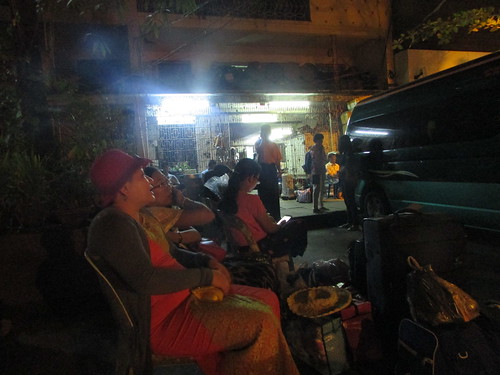 Waiting for the bus outside the travel office in Yangon.
The reclining seats on the bus were in rows of 2 on left of gangway, 1 on right, pre-allocated. I discovered that, in almost every case, the latch on the seat back was defective so that seats were permanently reclined.
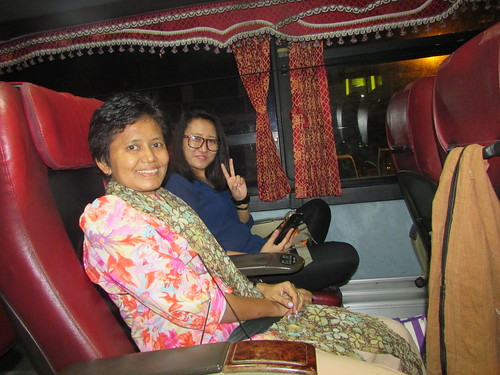 Myint and Mi Mi before we leave Yangon.
I had been puzzled by the tiny plastic moulded chairs carried on the bus. Once people were seated in the reclining seats, additional passengers were accommodated in the gangway on the small chairs.
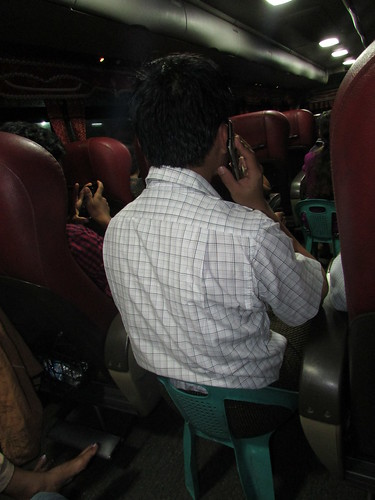
Seating 2 + 1 + plastic seat in gangway.
Events of Monday, 18th April 2016
On arrival at Mawlamyine Bus Terminal, we were met by a car and driver which took us to the 'CARE' charity administrative offices where it had been arranged we could wash and briefly relax before setting off again by car to travel further south. I'm afraid it was 'brief' as it was around 5.00 a.m. when we arrived and the Doctor wanted to set off at about 6.00 a.m.!
Once on the road, the Doctor made a stop at a typical tea house for a snack with the sweet, milky tea the Burmese (and I) enjoy. Then, we stopped at the Win Sein Taw Ya Pagoda, housing the World's Largest Reclining Buddha. It was my fourth visit, but I believe the first for Myint and Mi Mi. Shortly after my third visit a year ago, the elderly monk responsible for the project passed away and there is now a hall of remembrance in his honour. Further building work was also apparent on both the original and second reclining Buddha figures.
By about 8.00 a.m. we had reached Kot Kha Pon - the first of the Drop In Centres ('DIC') we were to visit. Quite a few of the children who attend the centre were unable to be present on that date so distribution of school-related gifts was fairly quickly completed, the balance being left with the staff.
Our next visit was to Ka Mar Wet DIC, Where, as usual, we were made very welcome. After the presentations, the traditional group photographs were taken outside the DIC, with the children wearing their new, just received, uniforms.
To reach Ko Dut, where we would spend the night, our route took us through Thanbyuzayat on the main road. This was the location where the Death Railway, built by prisoners of the Japanese in 1942-1943, joined the Burmese main railway line south from Mawlamyine. For some time, one of the Japanese steam locomotives which was used on the Death Railway has been 'plinthed' at this location but what I'd not seen before was a modern museum building labelled 'THE DEATH RAILWAY MUSEUM' which opened earlier in 2016 and was packed with visitors. The Doctor purchased admission tickets (the 'Foreigner' pays an enhanced rate) and we looked around. The centre piece of the ground floor was a large 'trompe d'oeil' painting extending across the floor which attempted (fairly successfully) to give the impression of standing on a wooden trestle trestle bridge on the line. I was disappointed that lots of visitors were taking the opportunity to take that elusive "This is me standing on the Death Railway" picture. The other display material was, I thought, rather thin but appeared better researched. I left the museum with mixed feelings. I believe we must confront the evil in our past but I wasn't convinced that a 'Disneyworld' approach was appropriate. Afterwards, I found I piece from the 'Daily Telegraph' at here which appeared to share my reaction.
We stopped to visit the large pagoda on our route to Ko Dut and also looked at the Mon Ethnic School, where further building work was in hand. The new building replaced the now-abandoned wooden temporary
shelter, now suffering termite attack. More startling, immediately behind the temporary shelter, a tall, shining triangular-section cellular radio transmission tower has appeared, complete with equipment cabinets and a large, sloping framework to support solar panels.
We were invited for an evening meal at the home of the manager of Ko Dut DIC. By this time, I was very tired so, on arrival at the DIC itself (where Myint, Mi Mi and I were to sleep on the naturally-ventilated upper floor) I was just keen to set up the thin sleeping mats and the mosquito nets and collapse.
Related posts
Next post describing this trip.
All my posts on this trip can be found here.
My pictures
Travelling to and from Mon State.
Win Sein Taw Ya Pagoda.
there are other pictures at Burma-2016. More pictures will be posted as soon as possible.
[Additional material added 21-Apr-2016: Link to pictures added 7-May-2016: Pictures and notes added 29-May-2016]
"Would you like to go with my wife and I to the Shwedagon on Sunday morning?" asked the Doctor "We will leave at 4.00 a.m." The Shwedagon is, I'm sure, the most revered religious site in Burma and the chance to visit on an Auspicious Date (New Year's Day) was very attractive, even if it meant a rather early start.
History
Wikipedia gives a brief outline of the Shwedagon here. Historians believe it is no more than 1,500 years old but legend has its origins over 2,600 years ago. You can find quite a lot on the internet - I liked a copy of an English report from 1586 on the 'Sacred Sites' website here.
Events of Sunday, 17th April 2016
We made the brief trip from the Doctor's home to the Shwedagon by car, suffering a traffic jam in the last few hundred yards. Can you imagine - a traffic jam leading to a place of worship at ten past four in the morning? It was still completely dark but the whole area was brightly lit by electric lights. On foot, we passed between two large ceremonial lion statues - Chinthe - and climbed Singuttara Hill by one of four sets of covered steps leading to the elevated pagoda platform. Already, there were thousands of pilgrims kneeling in worship or simply promenading between the different features and there was a great sense of peace and goodwill. I was, once again, impressed by the sheer power of the ideas embodied in Buddhism to inspire the actions of its followers.
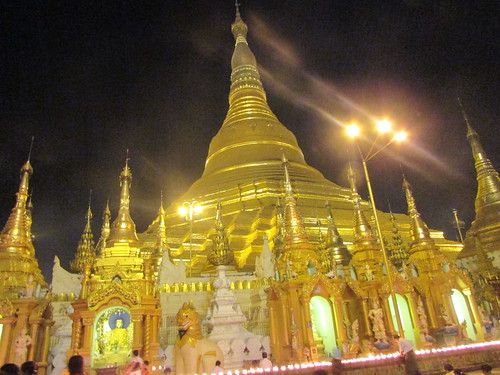 The Shwedagon on New Year's morning.
The central golden Shwedagon Pagoda, rising 325 feet above the platform and floodlit, dominated the view but there were also lesser pagodas and, I would estimate, at least fifty Prayer Halls, each with multiple Buddha images. The broad marble platform linking all these constructions was thankfully cool to my bare feet - I'd found an earlier visit in 2008 on a hot afternoon quite painful! That earlier visit was part of 'Round the World 5' and there are some pictures of the Shwedagon I took on that trip here.
On a visit to the Shwedagon, it's easy to see why the site is so evocative to the Burmese. When the military regime decided to build a new capital city at Napyidaw, they equipped it with a copy of the Shwedagon called the Uppatasanti Pagoda. I visited this 'pretender' in 2013 and was, despite my low expectations, quite impressed. Although the design was based on the revered Shwedagon in Yangon, as I commented in my post An Evening in Napyidaw "at least this young Pagoda has the good grace to be a few inches shorter".
After an inspiring early morning visit, I was given breakfast at the Doctor's home before leaving by car to the nearby lake, as on the previous day. This time, I sat on one of the concrete seats overlooking the lake whilst the Doctor and his wife did their accustomed out-and-back walk. Then, we drove to the covered market, still not fully open but with plenty of shoppers.
As we drove back to the Doctor's home, I noticed that a number of the Water Stations had been at least partially dismantled - the Water Festival was over for another year. Although it was only about 7.30 a.m., I could hardly keep awake but a couple of hours sleep refreshed me.
Tonight, we will take the overnight bus to Mawlamyine in Mon State to visit various Orphans and Vulnerable Children initiatives. I made this journey by bus in 2014, as described in the post By Bus to Mawlamyine, with links to subsequent posts. We repeated the journey in 2015, this time travelling by car, as described in the post here with links to later posts. Unfortunately, that trip was ultimately ill-starred as the car was seriously damaged in a Road Traffic Accident on the way back but, thankfully, without anyone being injured.
Related posts
Next post describing this trip.
All my posts on this trip can be found here.
My pictures
New Year's Morning at the Shwedagon
There are also some pictures at Burma-2016. More pictures will be posted as soon as possible.
[Link to pictures added 7-May-2016]
Events of Saturday, 16th April 2016
The Doctor invited me to join him and his wife on an early morning constitutional. We left, by car, just before 6.00 a.m. and drove to a nearby lake where we found lots of people, many middle-aged couples, walking or otherwise exercising along the path bordering the water. After an out-and-back walk of about 30 minutes, we drove to the market. This was not fully open but the stalls that were trading seemed to be doing excellent business. At one stall, in the short time it took for the Doctor to complete his purchase, two assistants clashed three times trying to simultaneously use the single, rather battered scales to check the weight! I did notice that the scales used proper cast weights presumably in the traditional Burmese units of ‘Vliss’, rather than (as I have seen in many places) dry batteries.
After breakfast at the Doctor’s home, the Doctor drove to his wife to Yangon International Airport, where they have a shop. The development of the airport terminal since my first visit in 2008 is remarkable. New Domestic and International Terminals are currently under construction.
The traffic was very heavy and the lines of pick-up trucks trying to get to the major Water Stations seemed completely jammed so the Doctor returned via a different route, stopping for dairy products at the ‘Milk Bar’ we’d visited the year before (described in the post Yangon (Part 4)).
The Doctor had decided to show me one final, very special and popular Water Station. The road in front of City Hall had been blocked by an elaborate stage comprising the usual row of hose-wielding water-throwers set below a large performance area flanked by two large colour screens. There was room for a single line of vehicles to pass in front of the hoses with crowds of onlookers opposite forming an audience for the performers. Two ‘Sky’ Electronic News Gathering vehicles with satellite dishes were nearby, suggesting that at least part of the event was being broadcast. Certainly, the two large screens were showing a ‘mixed’ output from a number of cameras.
To ensure that the onlookers entered into the spirit of the festivity, a series of hoses on tall posts were watering the crowds. In addition, two manually-operated high-capacity ‘monitors’ set on either side of the crowd were continuously ‘raking’ the onlookers with water. A number of onlookers had taken the precaution of equipping themselves with umbrellas but I’m not sure that this was terribly effective. Certainly, I became quite wet.
We returned to the Doctor’s home along part of Strand Road, where I had my first sight of the modern overhead catenary installed for the recently-introduced trams. I didn’t see a tram, though.
Related posts
Next post on this trip.
All my posts on this trip can be found here.
My pictures
Burma-2016.
More pictures will be posted as soon as possible.
Events of Friday, 15th April 2016
The Doctor said that we would visit a pagoda on an island to the south of Yangon. The Doctor, his wife and I set off by car about 7.15 a.m. It took us around an hour to reach Kyauktan, a small town bordering a fast-flowing, muddy river. The small island we could see was completely occupied by the Kyaik Hmaw Won Yele Pagoda and a fleet of gaily-painted elegant wooden ferries was transferring pilgrims from the mainland to the Pagoda.
We discovered that, as a Foreigner, I was only allowed to travel on one of the ‘big boats’, so we had to wait a few minutes for one of these to become available. It featured a roof, plastic moulded seats to sit on and even lifejackets (but lacked the aesthetic appeal of the smaller ferries). It’s often the case in Burma that Foreigners have to pay a premium. Knowing how poor many Burmese are, it’s a cost I don’t resent (and they did provide a lifejacket!).
I’m not a Buddhist, but the devotions of Burmese Buddhists never fail to impress me. We walked around the various temples and I noted the inscribed stone with the Exhortation Verses:-
VERSE 1
Forbearing patience is the highest moral practice.
“Nibbana is supreme” say the Buddhas.
A bhikkhu does not harm others.
One who harms others is not a bhikkhu.
VERSE 2
Not to do evil
To cultivate merit
To purify one’s mind
This is the teaching of the Buddhas.
There was a third rule inscribed but the text was obscured by a display of flowers.
Near the water’s edge, a vendor was selling fish food balls to throw to the fish – carp, I imagine, from the violent thrashing of the water but the water was too muddy to see the fish clearly.
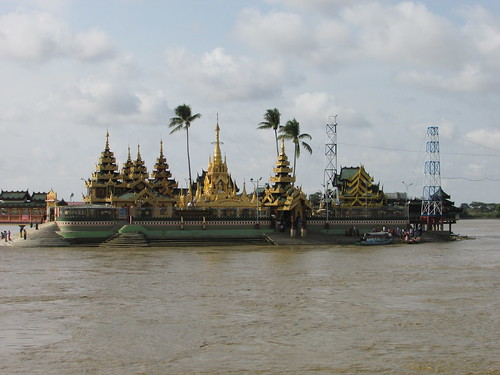 Kyaik Hmaw Won Yele Pagoda.
We returned to the mainland using the same ‘big boat’ which took us to the island and explored the open market, where the Doctor and his wife made a few purchases. Then it was back to the car and we retraced our outwards route from Yangon. On the outward journey, the roads had been much quieter and the Water Stations had not been throwing water – I gathered that 9.00 a.m. was the usual starting time. But I’d been amused that, even as early as 8.00 a.m., most of the sound systems had already ‘turned it up to 11’ (a reference to ‘This is Spinal Tap’ for the cogniscenti). On the way back, there was heavy traffic principally heading towards Kyauktan with lots of pick-up trucks loaded with happy (and already wet) revellers.
Out in the country, we made a brief stop where the Doctor spoke to a friend who has a business selling bamboo. The versatility of bamboo as a building material is perhaps not fully appreciated in countries which do not produce ‘construction grade’ bamboo. Certainly, all the buildings where we stopped were bamboo-built.
Our next stop was at the Kyaik Khauk Pagoda, Thanlyin where the main pagoda is on a hilltop location, surrounded by extensive monastic buildings. The hilltop was reached by a number of sets of covered steps, in the traditional arrangement I’d seen in many places. Although I made the ascent, I’m slower than I used to be (on my recent trip to Cape Point in Cape Town my right knee suddenly started to aggravate me).
Because of the holiday period, the pagoda was packed, with many groups dressed in the white top and plain brown longyi of the pilgrim. They were likely to spend the whole day at the pagoda and, since a pilgrim’s lunch is traditionally taken before noon, there was a lot of eating going on.
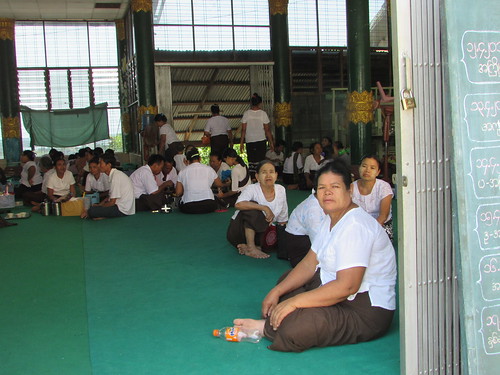 Pilgrims taking lunch in one of the Prayer Halls.
Over the loudspeaker system, a monk with a particularly mellifluous voice was intoning sacred texts.
The elevated position of the pagoda gave wonderful views in all directions. The skyline of Yangon city is changing as numerous tall buildings, at one time prohibited, are erected.
The new port of Thilawe, with a couple of large cargo ships, was visible. Burma has now taken its place on the cruise liner itinerary, with the ships docking at Thilawe and passengers being bussed into Yangon for a ‘whistle-stop’ tour.
I’d already noticed a separate lift giving access to the hilltop. This was also a feature I’d seen at other important sites (like the Shwedagon and Mandalay Hill) and the Doctor and his wife, concerned for my well-being, suggested we used the lift to descend. However, previous experience meant that I was unsurprised that the lift did not appear to be in general use. I’d spotted the rolled-up red carpet waiting for important visitors and the ‘VIP Lounge’ near the lift, but where’s the Merit in that? I was quite happy to descend (albeit slowly) using the covered steps.
We carried on back to Yangon. The area around the National Stadium in Yangon was very busy and the sound of modern dance music was overpowering. I wondered what event was in progress and the Doctor offered to show me. Apparently, the New Year practices in Rakhine State vary from those generally observed and so, I suspect to raise the profile of the Rakhine people, a water-throwing event had been organised on part of the National Stadium site. It was noisy, it was wet and everybody seemed to be having a great time. There were lines of water-throwing stations and a covered walkway to facilitate seeing it all. However, the roof of the covered walkway had been connected to the water supply and a series of rotating nozzles, like upside-down lawn sprinklers, generously sprayed the pedestrians beneath. There was a wide range of cafes and food stalls and a remarkable number of traders selling all sorts of goods.
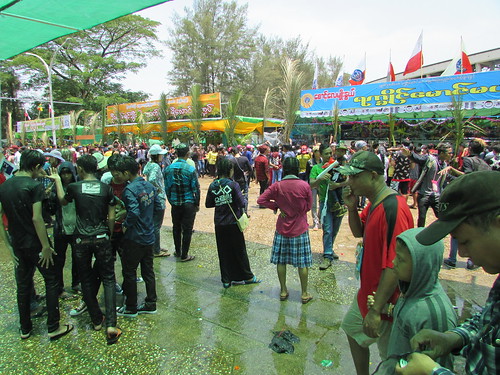 Thingyan - Rakhine Style.
The remainder of our trip back to the Doctor’s home was, of course, punctuated by the car being liberally sprayed with water at the Water Stations we passed but, with the car windows closed, we completed our journey without further soaking.
Related posts
Next post on this trip.
All my posts on this trip can be found here.
My pictures
Kyaik Hmaw Won Yele Pagoda.
Kyaik Khauk Pagoda.
Thingyan - Rakhine Style.
All my pictures on this trip are in the collection Burma, 2016.
[Links to pictures added 7-May-2016]
Introduction
A number of Asian countries celebrate the New Year with Water Festivals, where the throwing of water symbolises the washing-away of past sins. In Thailand and Laos, the festival is called 'Songkran' but in Myanmar it's 'Thingyan', described on Wikipedia here.
Getting wet on 14th April 2016
As described in the first post in this series Return to Rangoon, I arrived in Yangon early morning on the 1th April and my host, the Doctor, took me to see the temporary 'water throwing stations' erected in connection with the New Year -Thingyan. These exist in a wide variety of forms.
Within Yangon area, the simplest comprise one or more plastic waters barrels or, alternately, oil drums with the end cut off filled with water. The ‘water throwers’ are each equipped with a plastic bucket, a plastic bowl or a (usually battered) aluminium bowl. As the target, pedestrian or vehicle, approaches the bowl is ‘charged’ with water from the barrel allowing the target to be ‘baptised’ with water. There seemed to be an infinite variety of techniques, from the genteel splashing only a few drops of water to more aggressive but still good-natured producing a good soaking. I was reminded of the difference between the symbolic baptism of much of the Christian church and the total immersion practised by Baptists. Even the water barrel was not essential. In a few places I saw a rectangular frame made out of lengths of substantial bamboo lashed together with plastic rope and lined with heavy-duty polythene sheet to form a reservoir.
I quickly realised, as we drove across the city, that this type of ‘water throwing station’ could be made mobile, by loading it in the back of a standard pick-up truck, accompanied by an improbable number of water-throwers. To slightly lessen the chances of water-throwers falling off the crowded vehicle, most trucks had been fitted temporarily with a simple frame of four lengths of thick bamboo lashed together and wedged into the load space to raise the height of the sides. In fact, as we slowly negotiated the crowded streets it sometimes seemed as if every other vehicle was a ‘water throwing station’.
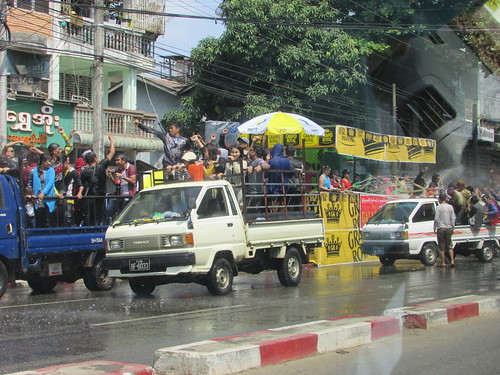 Thingyan (Yangon, 2016).
Although the water-throwers varied – some trucks had a mix of age and gender - most were male teenagers in a ‘uniform’ of dark clothing, usually with a black baseball cap worn backwards and testing the truck suspension to destruction by dancing to some form of ‘ghetto blaster’.
Although the roadside ‘water throwing stations’ were sometimes silent, when sound systems were fitted they could be less inhibited than on vehicles and many locations featured a wall of loudspeakers producing an exceptionally loud modern dance beat.
Even simple roadside water throwing stations were often provided with shelters – the inevitable bamboo lashed together with a plastic roof tied-on. These constructions were often embellished with palm fronds. Increasing sophistication appeared to be linked to commercial sponsorship –larger stores had their own water throwing stations, sometimes with uniformed staff. A ready supply of mains water encouraged the use of hoses, rather than water bowls. Temporary plastic plumbing at the side of the road produced a ‘fire-main’ to which perhaps ten or twenty lengths of garden hose could be attached, each manned by a separate water-thrower.
The pick-up trucks appeared to queue-up at roadside water-throwing stations for their turn to ‘duel’ the fixed water throwers.
The Doctor parked a few hundred yards from the main water-throwing stations in Pyay Road and we joined the throng of pedestrians. We had to ‘run the gauntlet’ of a number of smaller water-throwing stations to reach the main road so, needless to say, I ended up wringing wet from head to foot (I saw very few Europeans so I imagine an elderly white woman presented an irresistible target). My conclusion is that a well-aimed bucket of water is a match for a number of poorly-directed hoses. The temperature was 42 or 43 degrees Celsius so I expected to start drying out but when we eventually arrived back at the Doctor’s house I was still encased in a mass of sodden clothing.
The main road represented a further escalation in scale as the closely-packed water-throwing stations were sponsored by some of the major companies in Myanmar and it appeared that no expense had been spared. Each station was built in the manner of a ’stage’ at an outdoor music festival, constructed from standard scaffolding providing multiple levels and topped with a proscenium arch equipped with modern computer-controlled lighting. The lower level invariably featured a battery of perhaps 50 hoses, manned by enthusiastic water-throwers who, I was informed, had paid 125 American dollars for a 5-day ticket. A few of the hoses had extra capacity and were more like fire hoses. Of course, all the water discharged had to find its way into the street drains, leaving the road awash to a depth of a few inches.
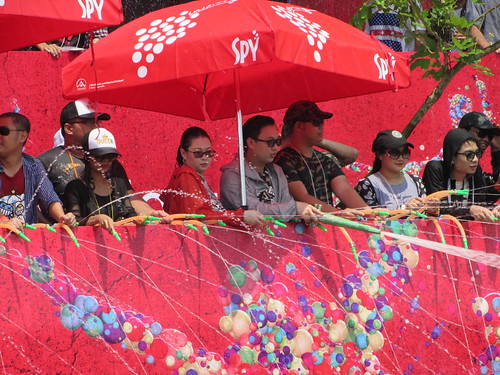 One of the major commercially-sponsored water-throwing stations in Yangon.
Each stage had its own live performers, blasting away at a high decibel level, apparently oblivious to the adjacent stages, delighting the mainly young (and wet) crowd dancing in the street. This was not a side of Burma I had seen before! There were plenty of police in attendance but they seemed to be keeping a watching brief. The opposite side of the road was lined with food and sales stalls (sales of waterproof pouches for a mobile phone to hang round the neck seemed particularly strong). Beyond the vendors, an embankment rose up to Inya Lake, finally revealing where all this water was coming from. I spotted a whole series of high capacity plastic pipes snaking down the embankment from the lake and disappearing under the road which presumably provided the source of the water-driven mayhem.
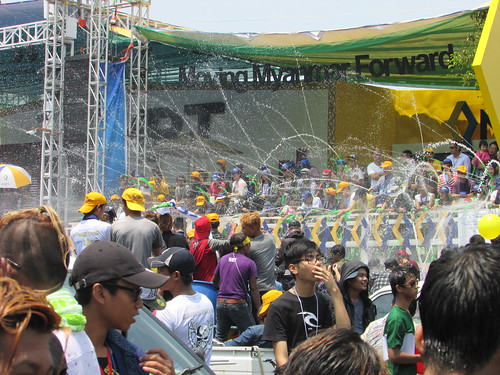 The MPT-sponsored water-throwing station.
I barely noticed the additional dousing as we walked back to the car. Back at the Doctor’s home, I had a shower, changed and was happy to comply with Doctor’s recommendation that I relax (or at least limit myself to computer work) for the rest of the day.
Related posts
Next post on this trip.
All my posts on this trip can be found here.
My pictures
There's an album of pictures showing Thingyan in Yangon here.
All my pictures on this trip are in the collection Burma, 2016.
[Picture references amended 10-May-2016, 26-May-2016]
Introduction
Little did I realise, on my first visit to Burma in 2008 described in a few posts forming part of my record of the trip Round the World 5 that the country and its wonderful people would steal my heart. My trip in 2016 which I start to describe here is my tenth trip to this exotic and remarkable land.
For many people, the attraction of the country is still best encapsulated in the gnomic phrase written by Rudyard Kipling, which he attributes to Rangoon’s revered Golden Temple, the Shwedagon – "This is Burma and it will be quite unlike any land you know about". In Kipling’s day, Burma was part of British India and, whilst Kipling reported extensively on the British military actions in Burma during his employment by a newspaper in India, he only spent three days in Burma, as he travelled back to England to pursue his writing career. So my own time ‘in territory’ far exceeds Kipling’s but I bow to Kipling’s ability to capture the essence of the place. There's a short description of Kipling's Burma here.
A later British writer, George Orwell, served in Burma and his experiences are incorporated in his writing. Although he captures the snobbery and class divisions of the British abroad, I’m not alone in thinking it’s not equal to his more famous political works. I've visited the house in Katha which was formerly home to George Orwell twice - described here and here.
Leaving England
On my trip to Burma in 2015 I'd enjoyed my flights with Qatar Airways and used them again in 2016. This time, I left from Birmingham Airport on Wednesday, 13th April 2016 aboard flight QR36 to Doha. This was operated by a Boeing B787-8 'Dreamliner' which provided a very comfortable flight.
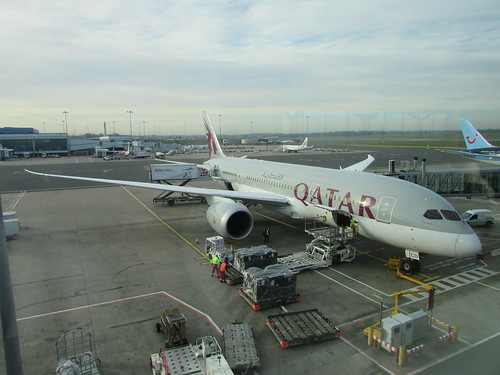 Boeing B787-8 at Birmingham Airport.
Transit in Doha
Hamad International Airport in Doha has a huge, well-appointed business lounge so the wait for my onwards flight QR918 to Yangon (formerly Rangoon) passed pleasantly enough, although I was very tired. An A320 Airbus worked this flight: everything worked and the cabin crew were excellent.
Arriving in Yangon
We made a 'right time' arrival at Yangon on Thursday, 14th April 2016, immigration was fast and my checked bag appeared promptly, so I was through customs and being met by my host, Doctor Hla Tun and his charming wife, at 06:25 a.m.
On the way to the Doctor's home, we went to a street market for fresh produce and sat at a 'kerbside diner' for delicious rice pancakes cooked as we watched. At the Doctor's home, I had a shower, a couple of hours rest and then changed ready for our morning visit to the Water Festival activities.
Related posts
Next post on this trip.
All my posts on this trip can be found here.
My pictures
There's an album of pictures of Birmingham Airport, including my departure on 13-Apr-2016, here.
All my pictures on this trip are in the collection Burma, 2016.
[Picture references amended 10-May-2016]
My first driving turn at the Battlefield Line in 2016 was on Sunday, 3rd April when Dave H. and I ran five service trains to Shenton with 'Cumbria'.
'Cumbria' is a six-coupled 'Austerity' saddle tank locomotive (Hunslet 3794/1953) owned by the Furness Railway Trust. There's a short history of the locomotive here and my article The 'Austerity' 0-6-0ST locomotive has more background on this locomotive class.
I first drove this engine during the Steam Gala in 2015 (described here) and I had another turn during the 'Santa Specials' (described here). But running a full 'Green Timetable' service is considerably more demanding and, at the end of traffic whilst Dave and I agreed we'd had a good day, we were also pretty exhausted.
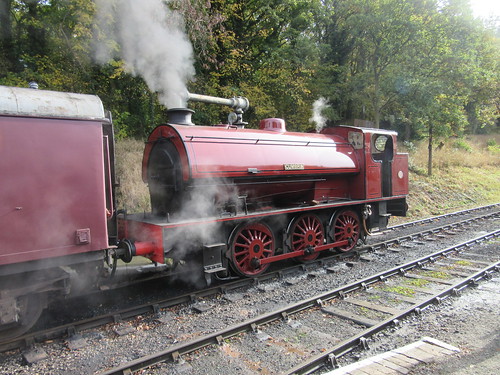 Battlefield Line Steam Gala, October 2015: 3794 'Cumbria', in its handsome lined-out 'Furness Indian Red' livery.
I signed on at seven o'clock (first departure was scheduled for 11:15) and was relieved to find 'Cumbria' already lit-up by Adrian L. I discovered that Dave H. was 'marked' as fireman but that he'd arranged a later start with Adrian agreeing to provide 'cover' until he arrived. Adrian and I spent a companiable couple of hours preparing the locomotive until Dave arrived.
We were using 'Welsh' coal which is, once again, available. The fearsome reputation of the Great Western Railway locomotives designed by Churchward was originally ascribed to the excellent steam-raising properties of the 'Welsh' coal normally used by that railway. But the locomotive exchanges of 1925 between the LNER and the GWR (touched on in my article 'Flying Scotsman') confirmed that the performance had more to do with sensible design proportions in boilers and cylinders, the use of 'long-lap, long travel' valves and good training of locomen, for the Great Western locomotives proved superior even when using the 'Yorkshire Hard' coal favoured by the L.N.E.R. But I was soon reminded of the one drawback of 'Welsh' - it's a rather soft coal prone to produce a lot of dust, suggesting the need for liberal use of the Coal Watering Pipe (an additional connection to the fireman's side injector with a cock allowing a jet of hot water to be directed around the footplate and bunker as required via a wire-reinforced flexible hose terminated in a nozzle, variously called, in different parts of the country, 'Pep Pipe', 'Slacking Pipe' or 'Degger'). Sadly, 'Cumbria' is not provided with a coal watering pipe so we were in for a dusty shift. Incidentally, whilst the LMS, LNER and SR installed automated coaling plants at their major depots, the GWR retained manual coaling using large rail-mounted 'tubs' to the end - supposedly because of the friability of 'Welsh' coal, rather than parsimony.
'Welsh' coal requires a modified firing technique. It takes a fair while to 'get going' but will then continue to give out high heat long after other coals have turned to ash. The new supply of 'Welsh' was smaller than the lumps I remember from over twenty years ago when I regularly fired 'Clun Castle' and 'Defiant' at Birmingham Railway Museum on driving experience courses and, as each lump absorbed heat from the firebed, it would swell and open resembling a glowing cauliflower head, creating steam for a long time. We didn't get this effect with the smaller lumps supplied on 'Cumbria' but the fuel did take its time and require plenty of air to produce steam (then it didn't want to stop!). The engine had been lit up in the shed so, as soon a we had about 20 p.s.i. of boiler pressure, I gingerly moved the locomotive outside the shed, in the hope of improving the drafting.
By 10:45, we had sufficient boiler pressure to ensure an effective steam brake, allowing us to move onto our 4-coach train waiting in platform 2, pausing on the way to fill the saddle tank at the water crane. This was a fairly time-consuming operation, since the pivoted arm of the crane carried a flexible plastic hose (this would have originally been riveted leather and always called 'the bag' by railwaymen) long enough to accommodate differing locomotive fillers, leaving it rather too long for the saddle tank of 'Cumbria'. Care was needed to dispose of the extra length of hose inside the saddle tank so that it didn't 'double up' when the water supply was turned on, impeding water flow.
Unfortunately we had to take water each time we ran round our train at Shackerstone during the day, ensuring that there was no time for a 'breather' throughout the shift. I didn't manage any photography, either.
The 'Green Timetable' is as below:-
| Shackerstone Dep |
11.15 |
12.30 |
13.45 |
15.00 |
16.15 |
| Market Bosworth Dep |
11.27 |
12.42 |
13.57 |
15.12 |
16.27 |
| Shenton Arr |
11.35 |
12.50 |
14.05 |
15.20 |
16.35 |
| Shenton Dep |
11.50 |
13.05 |
14.20 |
15.35 |
16.50 |
| Market Bosworth Dep |
12.00 |
13.15 |
14.30 |
15.45 |
17.00 |
| Shackerstone Arr |
12.10 |
13.25 |
14.40 |
15.55 |
17.10 |
As is often the case, even the first departure of the day was late, waiting for passengers. Thereafter, it was a struggle to keep to time because of the various speed restrictions on the line. Despite smart running round our train at each end of the line, the time required to take water meant that we lost further time, ending up at the end of the day around 20 minutes "down".
Notes on driving 'Cumbria'
When starting, any locomotive should be worked, at least briefly, in full gear, to maximise starting torque and start away smoothly. 'Full gear' can mean anything from 60-odd per cent cut-off to 80-odd per cent cut-off, depending upon the design. Once moving, I tend to 'link-up' (cutting off steam earlier in the piston's travel) quite quickly - with our four-coach train, 'Cumbria' was moving less than 200 tons total, yet the original design specified the ability to start 1,100 tons on the level, so an extended period of full gear was hardly warranted. Full-gear operation seeks to get lots of steam into the cylinders to generate power but, at the end of the piston stroke, that same steam has to be exhausted through the blast pipe and chimney and this can have the effect of 'choking' the locomotive, limiting acceleration.
But, of course, it's not that simple. The driver must consider various details of the design of the locomotive:-
First consideration, the Steam Valve: Originally, all locomotives used ordinary slide valves where the steam valve is held tightly against the port face by the pressure of steam in the valve chest. As locomotives became more powerful, valves became larger and, because the steam valves were 'unbalanced', significant power was absorbed in simply dragging the valve up and down across the port face and it became harder for the driver to adjust the cut-off when under steam.
Some of the 'Pannier' class locomotives of the Great Western railway were notorious for difficulties in adjusting cut-off, unless the regulator was first closed, the cut-off altered and then steam was re-applied. There was a possible disadvantage with this technique in that, with the regulator closed, any unburnt particles emerging from the smoke tubes could fall into the blast pipe so, rather than close the regulator I tend to partially close the regulator, adjust the cut-off and then re-open the regulator to the original setting.
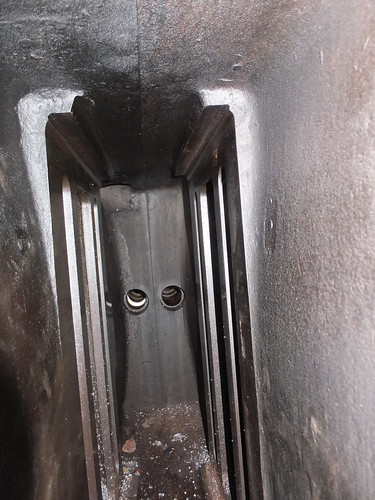
View inside the Valve Chest of an 'Austerity' under restoration showing (left and right) the rectangular steam and exhaust ports. Two (unbalanced) slide valves will be fitted back-to-back, each operated by a valve rod passing through the glands in the background.
'Balanced' slide valves sought to reduce these problems by reducing the area of the back of the valve exposed to live steam, reducing reducing the unbalance. The period of popularity of this type of valve was brought to a close by the development of successful 'Piston' valves, which are inherently 'balanced'.
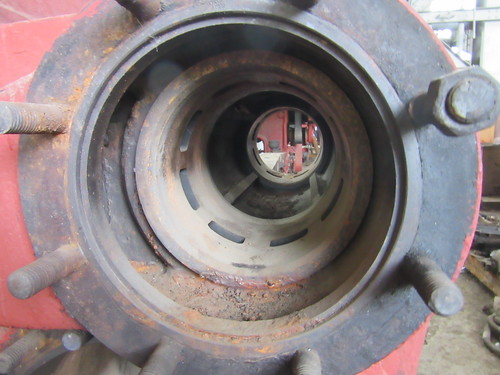 View of valve chest of piston-valved locomotive under restoration in Insein Works, Burma.
Second consideration, the type of valve gear fitted to operate the steam valve: Although many, many designs of valve gear were produced, in the United Kingdom the two main contenders became the Link Motion (often called Stephenson Link Motion, developed by two employees of Robert Stephenson and Company, Williams and Howe) and Walschaert's Valve Gear (independently developed by the Belgian Egide Walschaerts and the German Von Heusinger).
Stephenson's Link Motion, as fitted to the six-coupled 'Austerities', can be designed to give pretty efficient steam distribution in both directions, although it's better suited to inside-cylinder locomotives. Don Ashton has produced an authoritative review of Stephenson Link Motion here. The picture below shows "Sapper's" driving axle and eccentrics which, like 'Cumbria', uses Link Motion.
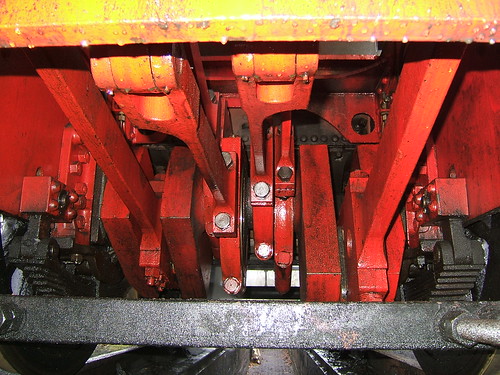 "Sapper's" driving axle and eccentrics viewed from below. L-R: RH axlebox and underhung laminated spring, RH crank driven by (red) connecting rod, RH fore eccentric and rod, RH back eccentric and rod, LH back eccentric and rod, LH fore eccentric and rod, LH crank driven by (red) connecting rod, LH axlebox and underhung laminated spring.
Click here for a larger view
There's a little more on the locomotive 'Sapper' here.
Walschaert's gear, with separate lap-and-lead motion can be helpful for fast passenger designs but it is also ideal for outside-cylinder designs, keeping all the motion which needs examination and oiling readily accessible. Whilst I'm a great fan of Churchward's designs, I've always been puzzled that, when he did use Walschaert's gear on his 4-cylinder locomotives, he hid it between the frames where it was difficult to get at. Stanier, when he became Chief Mechanical Engineer at Derby, made sure his larger 2-cylinder designs, like the '8F' 8624 (shown below with a strange 'paint job'), used Walschaert's motion on the outside.
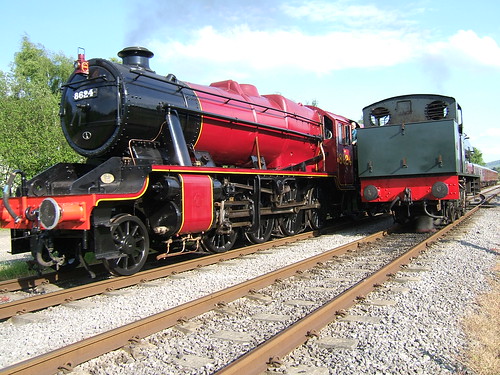 The public inauguration of the restored 8624 at Peak Rail on 23rd May 2009.
There's a little more about Stanier's '8F' design here.
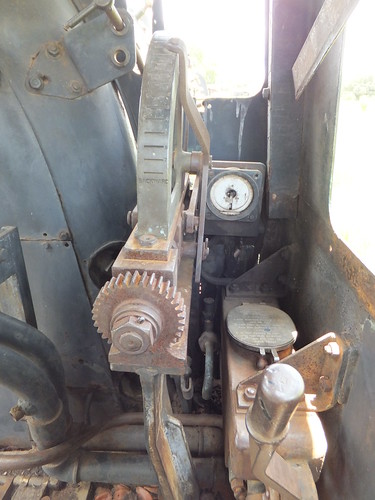
Third consideration, the type of reverser used to adjust the valve gear: In express locomotives, reversers were often screw-operated, permitting precise adjustment of cut-off to suit extended periods of fast running.
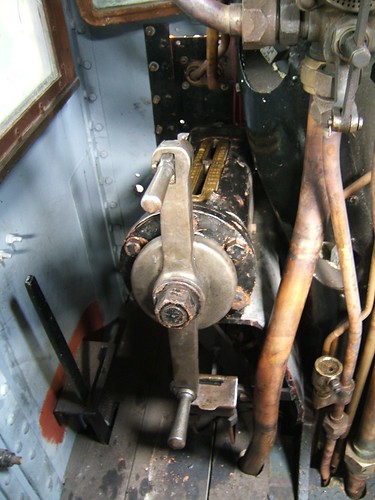
Stanier Screw Reverser on 8624.
But freight locomotives, like the six-coupled 'Austerity' often had a 'lever' or 'pole' reverser - convenient when frequently changing direction during shunting although not really suitable for delicate changes of cut-off when running in one direction.
Of course, some locomotives had a 'power' reverser (usually steam-operated in this country) so that the driver only adjusted a small 'pilot' lever to control the actual reversing mechanism. Bullied 'Pacifics', as built, had 'power' reversers, which I've seen described as "the biggest liar on the footplate"! In a Beyer-Garratt locomotive, there are often four sets of motion to adjust on two different engine units, so power reversers were common on these designs.
Hadfield Reverser on 20th class No. 708, built Beyer Peacock on display in Livingstone Railway Museum, showing control for steam reverser and cut-off indicator.
Some locomotives with a conventional 'lever' reverser had lots of slots implying the possibility of fine adjustment of cut-off. But I never met a driver who cared much what cut-off he operated at - he would just set the driving controls so that the engine 'felt right'. The reversing quadrant on 'Cumbria' subscribed to this common-sense approach to setting cut-off - in addition to the 'Mid Gear' notch, it had (in each direction) notches for 'Full Gear', 'Linked-Up a Bit' and 'Linked-Up a Bit More'.
Following a little experimentation, I decided that, after a few 'chuffs' in full gear, I would select 'Linked-Up a Bit More' and then let 'Cumbria' get on with it, progressively increasing the regulator opening to 'Full First Valve' if I wanted more speed.

Typical lever reverser on an 'Austerity' tank.
There's a bit about regulators in the posts Locomotive Regulators and The Best Laid Schemes ....
'Cumbria' was in need of some care and attention, which added to our difficulties. All the controls were rather stiff - water cocks took some strength to set correctly, lever reverser catch handle was stiff, even the valve spindle on the vacuum brake application valve needed some manual assistance. The fireman's side injector was temperamental to set, causing additional use of the (fairly reliable) driver's side injector. After shutting off steam, prior to a speed restriction or station stop, this often meant the additional task of 'setting' the driver's side water cock for the fireman at the same time as judging the vacuum brake application.
Like many industrial locomotives later fitted with an ejector to allow the operation of vacuum-braked passenger trains, the steam supply cock to the ejector required 'tuning' to obtain 'best vacuum'. This often means 'throttling-back' the steam since excessive steam supply can produce turbulence in the body of the ejector, impairing the desirable 'laminar fluid flow' and reducing the vacuum created. Depending upon the installation details, other events (such as operation of the safety valves or putting on a ejector or even adjusting the blower) can alter the level of vacuum created. In the case of 'Cumbria', it was desirable to pay close attention to the vacuum gauge as she would occasionally suddenly lose a few inches of vacuum, creating a partial brake application, for no discernable reason, resulting in furious 'twiddling' of the steam supply, to try to regain the "sweet spot".
I think all enginemen like the challenge of a slightly recalcitrant locomotive - but not too much of a challenge.
In the previous post in this series Gough Island, I described our Zodiac cruise off Gough Island. We then had a voyage of around 1,500 miles across the South Atlantic to Cape Town, a journey which would took four days.
...
I'm at Dubai International Airport, it's 05:15 local time and in a couple of hours I should be boarding the EK039 to Birmingham on my marathon journey to Argentina, the Falklands, South Georgia, Tristan da Cunha and Cape Town.
Here's a quick update on the last two days.
Tuesday, 22nd March 2016: Around Cape Point and Cape Town
Because the weather was kind on the voyage from Tristan da Cunha to Cape Town, we were off Cape Town harbour, waiting for the pilot to board, at 07:15, rather than the scheduled afternoon arrival. The expedition n team had arranged an additional trip and offered one of three alternatives:
Visit to the wine making areas
Visit to the Botanic Gardens
Trip to see South African penguins and the Cape of Good Hope.
I chose the last alternative, as did most of my fellow passengers, so we set off in two modern coaches, crossing the peninsula to Simonstown on the east coast. I'd visited Simonstown in 2011 (as described here) but the weather then was wet and cold so I didn't get beyond the town itself. The second time, we had splendid weather and stopped just beyond the town at Boulder, where South African penguins were dotted around the beach. After a while, we moved on to the formal nature reserve, crowded with people, where we could observe more penguins and birdlife from a boardwalk.
Back on the bus, we continued south through spectacular scenery to the Cape of Good Hope where we made a brief photographic stop (along with lots of people enjoying a public holiday) before continuing to Cape Point, again with lots of people. There was a funicular railway to near the top of the point which we took, leaving a series of steps climbing further to the viewpoint at the old lighthouse on the summit. Although we had return tickets for the funicular, most of us chose to walk all the way down to our transport. On the way back to the ship, we stopped to observe a group of Benobo monkeys. Troops of these monkeys have become a menace, stealing food and breaking into cars or houses in search of food. We'd compressed what's usually a full day tour into half a day so, not surprisingly, it was after 4.00 p.m. when we arrived back at the ship. The restaurant on the ship had kindly stayed open for lunch, with a somewhat restricted menu.
The ship had also arranged a small shuttle bus to run between the ship and the V&A Complex. This is the old part of the docks reborn as a modern shopping mall and a magnet for tourists. I took a trip on the shuttle bus to wander around the 'V&A' but, as expected, found little to detain me so I carried on walking back to Cape Town Cruise Ship Terminal, in the newer docks, where our ship was berthed.
The day finished with a convivial dinner on board where we said our 'goodbyes' to fellow passengers before we went our separate ways early the next morning.
Wednesday, 23nd March 2016: Robben Island and Cape Town
Just before 8.00 a.m., I left the ship, picked up my luggage, and was met by the friendly proprietor of a tour company with a people carrier. A trip to Robben Island, notorious for the imprisonment of Nelson Mandela and other political prisoners in addition to serving as a criminal prison. The island lay 11 km offshore, making escape virtually impossible. A fleet of ferries shuttle tourists to the island for a bus tour outlining the history of the island and a conducted tour of part of the former prison. I was on the catamaran 'Jester' in both directions.
Back at the V&A, we walked through the shopping centre to the vehicle and my new fried readily agreed to provide some opportunities to view the complex of railway lines leading from Cape Town railway station. Before taking me to the airport for my flight to Dubai, he did say it was the most unusual City Tour he'd been asked to provide!
All my posts on this trip can be found here.
My pictures
There's currently a reasonable collection of pictures illustrating this trip at South Atlantic Voyage, but the rest of my pictures will not be uploaded until I return to the U.K.