Wednesday, 30 May 2012

Pon Village School

11th November 2010

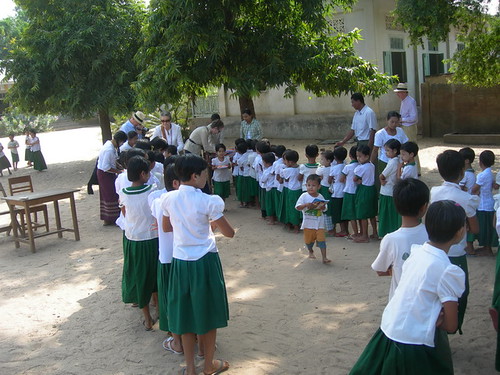
Four guests from the 'Road to Mandalay' visited Pon School on 11th November 2010 to distribute stationery.

There are 155 students, extending from Nursery to Grade 8.

Helped by the Headmaster and Teachers, each student received two exercise books and three pencils.

Surveying for new School Buildings

16th October 2010

Thick sand left behind on a major road.

On 16th October 2010, Dr. Hla Tun visited a number of villages on the way from Bagan to Mount Popa for survey purposes.

The villages of Kaung Nyo, Da Hat Kan, War Khing Gyi and In Chaung were being examined for suitability to receive new buildings funded by donors. At Kyoon Khing Gyi, a new building is already under construction, donated by guests from Australia.

Prior to this visit, the area had been subject to unusually heavy rain storms lasting over two weeks, making communication difficult. Normally dry areas became raging torrents - near Bagan a diesel locomotive and coaches were derailed! Young people continuing education after 5th grade frequently have to travel long distances on foot daily from their home village to the nearest school providing secondary education. Tragically, fatalities occurred involving young people being swept away by the water.

The flood water brought with it massive amounts of sand which, of course, were left behind after the waters receded.

Because of these hazards, many teachers and parents are keen to provide for local schooling beyond Grade 5 to avoid the time-consuming and sometimes dangerous daily commute undertaken by young people.

Pictures.

Opening of School Building in Chauk Kan

13th February 2010

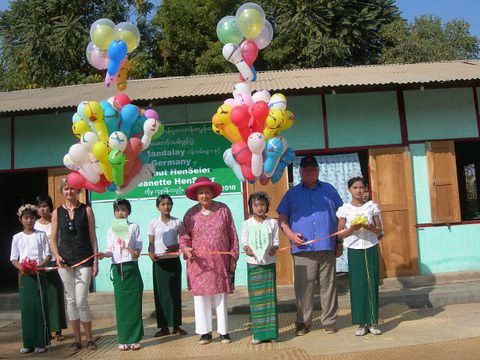
The Opening Ceremony.

The village of Chauk Kan in Myanmar is about 14 miles from Bagan. It lies on a side road branching from the road from Bagan to Mount Popa, about 45 minutes by car from Bagan.

A headmaster and eight teachers currently look after 271 students, up to 9th Grade. The Government provide salaries for only 5 teachers, covering up to 5th Grade. The other teachers are funded by payments from students of 700 Kyats per month in 6th and 7th Grade and 1,000 Kyats per month in 8th and 9th Grade. Grades 6 to 9 are open to pupils from two neighbouring villages where there is no local provision above 5th Grade.

The school in Chauk Kan was short of accommodation (the total population in the area is over 2,000) so the RTM Charitable Initiative planned a new building in 2009 which was funded by Mr. and Mrs. Henseler from Germany. The new building is about 25 feet by 40 feet with brick walls and zinc coated steel roof.

The opening ceremony was carried out by Mr. James B. Sherwood, Dr. Shirley Sherwood and a volunteer RTM Guest on 13th February 2010. Following the ceremony, an exercise book and three pencils were distributed to each of the 271 pupils and longyi were donated to 8 teachers and 3 headmasters. Prizes were awarded to outstanding students in each grade and a meal of noodles was provided for all the pupils. There was a tour of the school and the pupils put on a concert in the school compound.

More pictures.

Tuesday, 29 May 2012

Steam Charter to Peak Rail

'Oliver Cromwell' drifts through the Down Platform at Darley Dale with its 11-coach Charter, passing the empty stock from the 7-coach top-and-tailed service train standing in the Up Platform.

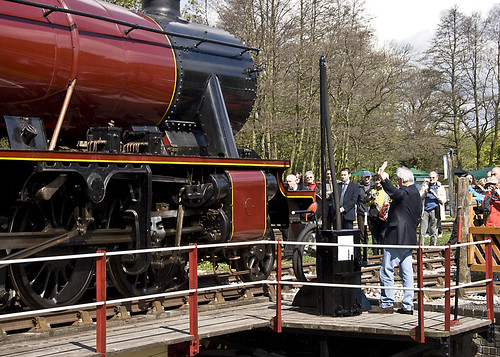
In May 2010, Pete Waterman inaugurated the turntable at Rowsley and I've described this in the post In a Spin with Pete Waterman.

Pete Waterman handsignalling '8F' 8024 onto the 60-foot turntable at Rowsley during the inauguration (Photo: Sheila Rayson).

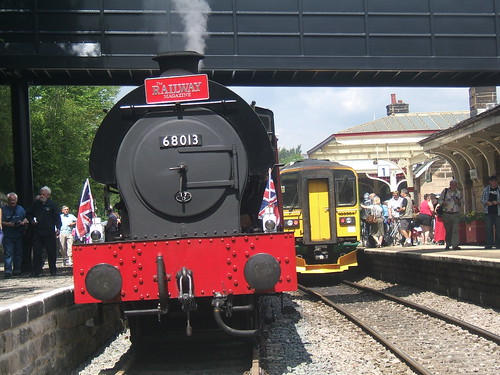
In July of the following year, Peak Rail's running line was extended from Matlock Riverside to Matlock Town Platform 2. This was the occasion for some festivity, described here.

Peak Rail veteran 68013, carrying headboard and union flags, alongside a completely out-classed '153' DMU at Matlock Town.

Normally, Network Rail and Peak Rail operate as separate railways but a Ground Frame allows trains to pass between Network Rail and Peak Rail when required.

The Network Rail Ground Frame at Matlock Town, released by the Key Token for the Ambergate - Matlock line.

These two events opened up the possibility of Steam Charter workings coming from Network Rail right through to Rowsley, where the Charter locomotive could be turned and serviced prior to working the Steam Charter back to Network Rail metals. Such a Charter was planned for 2011 but was cancelled. However, on 27th May 2012 a Charter from London via the East Coast Main Line triumphantly terminated at Peak Rail's Rowsley station and returned later in the day. This Charter was in the hands of the popular main-line certified 'Britannia' Class locomotive 70013 'Oliver Cromwell'.

Peak Rail's service train currently operates top-and-tailed with a diesel locomotive at one end and Peak Rail stalwart 'Austerity' tank locomotive 68013 at the other end in between Rowsley and Matlock Town. On the day of the Steam Charter, a special timetable had been arranged, allowing the service train to be 'recessed' when the Steam Charter arrived and departed and I was driver on 68013 with Richard as fireman.

The normal 6-coach rake had been re-inforced to 7-coaches because of likely interest and because it was intended to allow passengers from the Steam Charter to have a round trip on the Peak Rail service as an alternative to a road trip to Chatsworth and Bakewell. In another variation from normal, 68013 was to work at the north end of the train facing north with 'Peak' class diesel electric 'Penyghent' at the south end of the train. Our normal first departure is at 11:15 but on the day of the Steam Charter, the first train was at 09:45. 'Penyghent' hauled the train to Matlock Town and then 68013 returned us to Rowsley.

68013 ready to leave Matlock Town. The 'white feather' from the safety valve indicates that the engine is ready and Richard is taking a breather in the shade alongside the first coach.

With seven coaches and 'Penyghent' on the back, the trailing load on 68013 was well over 400 tons but this presented no problem and my normal setting of not-quite-full 'First Valve' and the reverser taken up two notches allowed us to maintain the timings even though much of the route is uphill at around 1 in 400.

When stopping at Darley Dale, the first two coaches had to be taken beyond the platform to ensure that 'Penyghent' was clear of the Track Circuit extending from the facing points into the platform. Failure to do this would prevent the signalman from reversing the points for an Up train (which would be important later in the day when we would be 'recessed' in the Down Platform for the Up Steam Charter to pass).

On arrival back at Rowsley, we took water from the grey tanker wagon which serves as our water supply. As is often the case with Steam Charters, it appeared that the journey on Network Rail metals was not without incident and we started to get reports of late running. We made our second round trip starting at 11:02 and by the time we got back to Rowsley the delay to the Steam Charter seemed to have extended. Undaunted, we set off again at 12:19 on the third round trip, watering again when we got back to Rowsley.

The special timetable called for our next working to be at 13:29, Empty Stock to Darley Dale where we were to wait on the Up whilst the Steam Charter passed us on the Down on its way to Rowsley. But the late-running Steam Charter was still miles away so instead we were told that there would be a fourth passenger round trip leaving at 13:39 which should allow us to get back to Rowsley around 14:38. On the trip back, when 68013 was doing the work, there were noticeably more photographers around lineside and in the fields. Perhaps it was my imagination, but I seemed to sense their disappointment that we were not the big green engine with a chime whistle that they were expecting. Most of them seemed to make the best of a bad job and took pictures of us anyway.

A fifth passenger round trip had been arranged for us, leaving Rowsley at around 14:50, with only a brief stop in Matlock Town, leaving at 15:17 to be back at Rowsley about 15:39. This trip was performed without incident but on the way back there seemed to be even more people watching. At least nobody was shaking their fist at us or making rude gestures because we were not 'Oliver Cromwell'.

When we got back to Rowsley, we watered again ready for the delayed Empty Stock working. Instead of the originally-planned departure at 13:29, we set off around 15:49 with 'Penyghent' in charge for the short trip to Darley Dale. Here we waited. It wan't too long before we heard a chime whistle and the long-expected train rumbled through and disappeared towards Rowsley.

Photographers and onlookers cluster on the Down Platform at Darley Dale as the delayed Steam Charter approaches.

The arrival was around two hours late, leading to a similarly-delayed departure back to the main line, so the carefully-arranged special timetable had to be abandoned. The original plan was to wait at Darley Dale until 'Oliver Cromwell' had gone on shed and the 11-coach charter train had been shunted into the loop at Rowsley. The Peak Rail service train was then to have returned to Rowsley and provided a round trip to Matlock not stopping at Darley Dale. This working was cancelled and we simply shunted the Peak Rail train across to the Down platform and waited, leaving the Up line free for the returning Steam Charter. We didn't get to see 'Oliver Cromwell' turned, coaled and watered but eventually, around seven o'clock the Steam Charter set off on its return journey.

The Charter return working approaching Darley Dale.

At last, we were able to take our 7-coach train back to Rowsley and shunt 68013 to No. 1 shed road for disposal. 'Penyghent' followed us onto No. 3 shed road. An interesting, if tiring, day.

More pictures here.

Battlefield Line Modellers' Weekend 2012

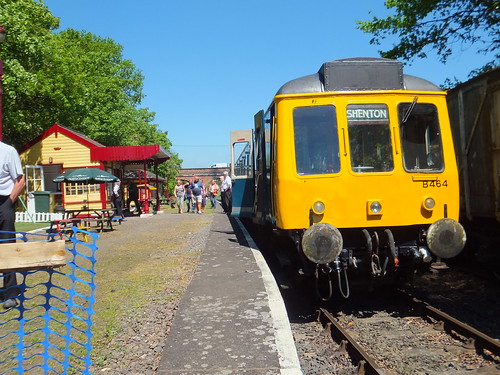
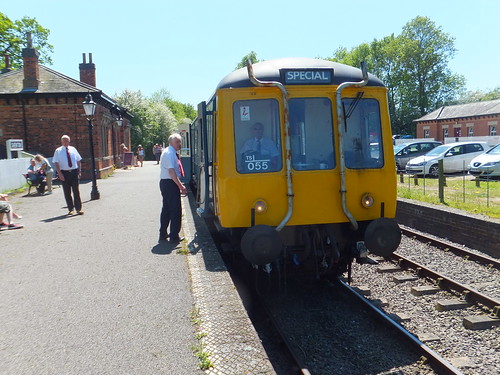
The DMU at Shackerstone ready to depart for Shenton. The Class 47 can be seen at the far end of the platform.

The Battlefield Line ran its Modellers' Weekend on Saturday 26th and Sunday 27th May 2012. On the Saturday, the service was provided by the diesel railcar and I was the driver. The formation was the single-unit 'Bubble Car' coupled to half of the 2-car Diesel Multiple Unit (DMU) and we were booked to operate five round trips from Shackerstone to Shenton, stopping at Market Bosworth where most of the models were exhibited.

Although preparing a DMU is much quicker than getting a steam locomotive ready, I always like to allow plenty of time, because you never know what you'll find. What I found was that the DMU was 'boxed in' by a Class 47 coupled to a van and 20-ton brake van. I did the normal checks and successfully started up the four 150 horse power engines.

Whilst the compressors produced sufficient air pressure for the Electro-Pneumatic (E.P.) controls, I considered whether we could propel the Class 47 and the two vehicles out of the way so that we could operate the first train at 11:15. The early DMUs had standard buffers and standard screw couplings meaning that, when necessary, they could run with 'tail traffic' or, as in this case, shunt other vehicles. The weight of the vehicles to be moved was approaching 150 tons but moving the vehicles was not the major consideration, rather it was had we sufficient brake power to safely control the movement.

I judged that the movement was safe so I moved the DMU up to the Class 47 and coupled up. By the time I'd released the handbrakes on the Class 47 and the box van, Adrian had arrived and he agreed to release the handbrake on the leading vehicle (the 20-ton brake van) and then 'ride the brake' acting as our shunter. Once the road was set from the signal box, we slowly moved the odd-looking train out of the DMU Siding and into Platform 1. We 'tied down' the Class 47 and the two vehicles at the North End of the Platform and detached them from the DMU, allowing the DMU to operate from the South End of Platform 1.

At Shackerstone, we're allowed to bring a passenger train into an already-occupied platform. The signal box authorises movements into both platforms with ground disc signals and, conventionally, ground signals authorise a driver 'as far as the line is clear towards the next signal' rather than to the next main signal. Many passenger stations needed this flexibility back in the days of mechanical signalling and a special form of Permissive Block Working called 'Station Yard' was often used. An approaching driver would be given an 'Off' Main Arm if the whole platform was clear or an 'off' subsidiary arm displaying a 'C' when 'off' for 'Calling On' onto an occupied line. In modern installations with colour light signals, matters are somewhat different but it is still common to find a 'subsidiary aspect', two white lights displayed diagonally when 'off' (often called 'cat's eyes') underneath a 'main aspect' displaying red for 'stop'.

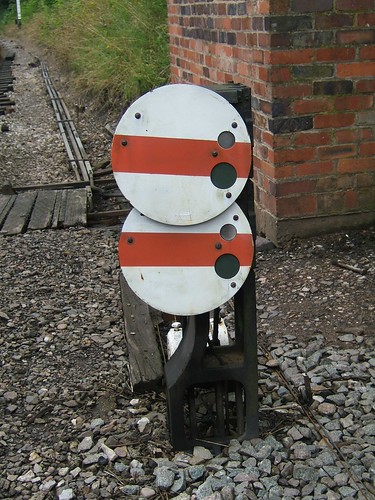
Driver's view of the Inner Home at Shackerstone. The upper disc reads to platform 1; the lower disc to platform 2.

On a glorious hot sunny day, we made the scheduled five round trips to Shenton, stopping at Market Bosworth in each direction.

The DMU pauses at Market Bosworth en route to Shenton.

An awful lot of effort has gone into bringing Market Bosworth station back into use. There's a car park and a gated pedestrian level crossing over the railway to reach the platform. Major work continues on the restoration of the ex-L&NWR signal box (there are some pictures of the work in progress here. With a childrens' play area and refreshments available, the station is now a destination in its own right. The former Goods Shed at Market Bosworth was in use as exhibition space for Modellers' Weekend and a large relocatable office building in the Yard held more layouts and displays.

View from Market Bosworth Platform looking towards Shenton. Left to right: Relocatable Offices, Goods Shed, Level Crossing.

Currently, the end of the line is at Shenton. We use the former up platform. There''s a run round loop flanked by the former down platform which is not in use but fenced off from the large car park. Another gated crossing allows people to cross from the cark park to the station and, via a footpath, the Visitor Centre for the Battle of Bosworth.

The DMU waits at Shenton, ready to return to Shackerstone.

With only a two minute booked stop at Market Bosworth, there wasn't really time for me to look at the exhibits but, on the last round trip, I agreed with the guard that I'd dash across to look at the models on display. As soon as we arrived, I 'tied down' the DMU and removed the Master Key before running over the crossing for an exceptionally quick look at what was there before returning to the DMU and continuing with the diagram.

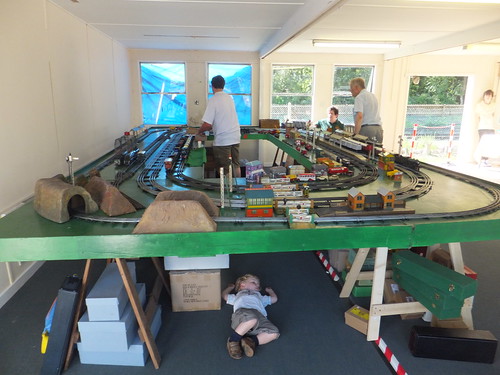
John Ward operating a large 3rd rail 'tinplate' layout.

By the time we returned to Shackerstone for the last time, Mike had pulled '3803' (the Great Western 2-8-0) out of the shed and lit up so that the Sunday service would be steam hauled. There's some information on '3803' here.

So it only remained to position the DMU in the long siding, shut down and perform the final checks before locking-up and signing off after an enjoyable 'non-steam' day.

More pictures here.

London & Birmingham in 2012

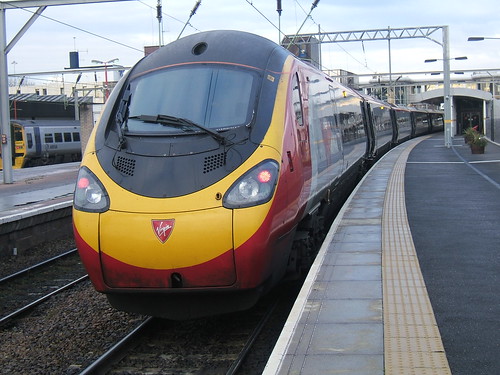
A 'Pendolino' on arrival at Wolverhampton's Platform 4 with a service from Euston in 2007.

Following the amazing success of the Liverpool & Manchester railway (opened 1830), London was linked to Birmingham in 1838 by a route still in use today. There's an earlier post on the origins of the London & Birmingham Railway.

In the post The Premier Line I disclosed my enthusiasm for the London & North Western Railway. This Company operated the London & Birmingham railway until the Railways Act of 1921 caused the 'Grouping' when the L&NWR became part of the London Midland & Scottish Railway. The LMS did good work and, like the L&NWR, was profitable.

The second world war took its toll on all the Britsh railways and the post-war Labour government nationalised the railways in 1948. The Euston to Manchester route was chosen for the first major 25kV a.c. overhead electrification project and the work was carried out during the 1960s.

By the 1990s the calamitous Railtrack had embarked on a disastrous project to modernise the whole of the West Coast Main Line which incorporates the London & Birmingham. Railtrack's successor Network Rail managed to complete a degraded form of this modernisation plan in 2009. There's a useful 'Wikipedia' article West Coast Main Line.

I use the route today reasonably regularly to get to London and back. So what of the modern travelling experience?

Well, reading my posts Brave New Railway and Brave New Railway (again) you might just gain the impression that I'm not a total fan of the way things are done now.

Passengers still leave London from Euston Station. In my post London's Terminal Stations, the present-day Euston gets short shrift compared with King's Cross (reviewed prior to the recent extensive rebuilding) and St. Pancras (reviewed after its incredibly expensive rebuilding which added 'International' to its title).

For Network Rail's 'take' on Euston, go to their Euston Webpages. There's a page with a brief history of the station.

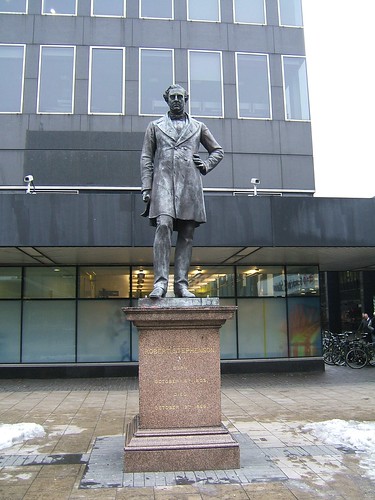
This statue of Robert Stephenson originally stood in the (long gone) Great Hall at Euston. It now stands in "Smokers' Corner", a depressing, muddled paved area immediately outside the present station building which Network Rail are pleased to dignify with the title 'Forecourt'.

Photographs

To illustrate the route today, there are various sets of photographs listed below. The camera technique for most of them is the "drive by shooting" taken from a moving train so the quality is pretty grotty, sorry.

London & Birmingham Railway.
London: Euston.
Rugby.
West Midland Railways.

References

You can find more detailed track and signalling diagrams of the route prior to electrification in the excellent series of publications from the Signalling Record Society 'British Railways Layout Plans of the 1950's'. Euston to Rugby is included in 'Volume 1: ex-LNWR main line, Euston to Crewe' (ISBN: 1 873228 00 7) and Rugby to Birmingham and Wolverhampton is in 'Volume 11: LNW Lines in the West Midlands' (ISBN: 1 873228 13 9)

For details of what remained of this route in 2005, refer to 'Railway Track Diagrams' Book 4: Midlands & North West', Second Edition, published by Trackmaps (ISBN: 0-9549866-0-1). The First Edition of this book was published by Quail in 1988.

Friday, 25 May 2012

Liverpool by Train

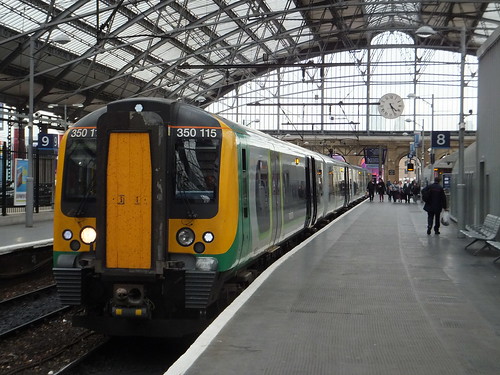
In an earlier post I wrote about a modern journey from Wolverhampton to Liverpool by 'London Midland' Class 350 EMU (a version of the Siemens 'Desiro' range). I repeated the trip on the 19th May 2012, in order to attend the Old Locomotive Committee Annual General Meeting at the Museum of Liverpool. There's a report on the A.G.M. here.

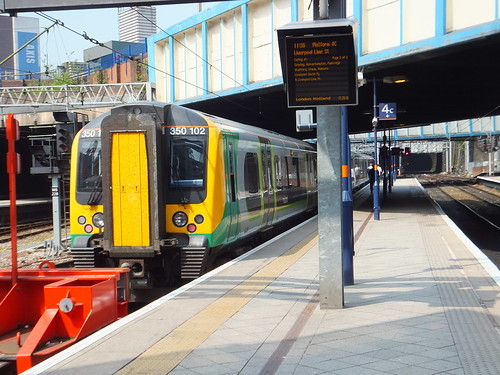
The 'London Midland' franchise started on 12th November 2007 and their service from Birmingham New Street to Liverpool Lime Street is now well-established. At New Street, a short bay platform called '4c' was added at the north end of the original Platform 4/Platform 5 island platform. It's not that easy for the uninitiated to find this bay. Because it's common to have two trains on a single through platform at New Street, the southern half of each through platform is called 'a' and the northern half 'b'. This in itself can be a bit confusing for unfamiliar passengers but, once you've got your head round that, where do you look for a 'c' platform? Because the bay 4c is a fairly modern addition, the Passenger Information Displays (PID) and signage aren't as helpful as they might be. If you manage to walk the right way along platform 4, there is a PID at the last moment to confirm you're in the right place but I have seen rather bewildered passengers trying to find the right train.

Platform 4c at Birmingham New Street with a Class 350 about to depart for Liverpool.

I've taken a few 'Modern Image' photographs around Birmingham and Wolverhampton - they're in the set West Midland Railways - but in my mind's eye I still see the railway as it was in steam days.

After a few miles of open country north of Wolverhampton and a brief stop at Penkridge, the line joins the Trent Valley Line at Stafford. My 'Modern Image' pictures are in the set Stafford Area. There are brief recollections of Stafford in steam days here.

After the four-track 'racing stretch' we arrive at Crewe, now a very pale reflection of what I remember from steam days. Some of my early recollections are in Railways at Crewe in the '50s. There are a few 'Modern Image' pictures in the set Crewe Area. Something of the earlier character of Crewe survives in the station buildings shown in the set Crewe Station Buildings: L&NWR.

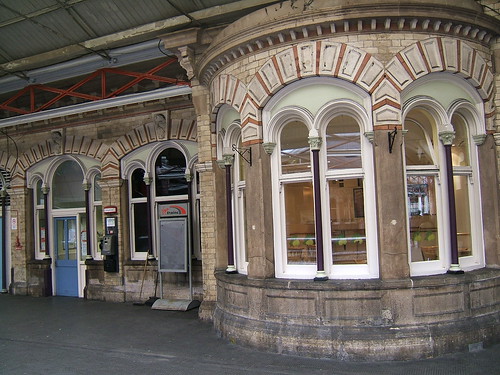
Crewe: The carved stone and elegant curves hint at the history of this now rather forlorn looking station..

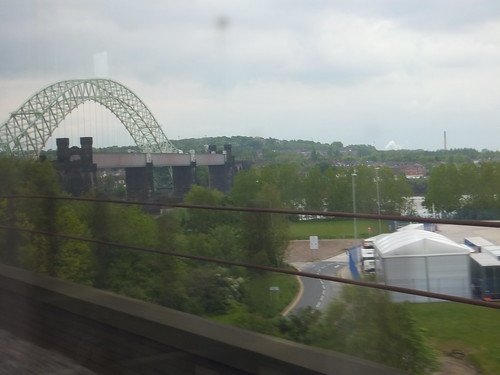
The route north of Crewe is still a muddle of four- and two-track sections until the River Weaver is crossed and the newer direct line to Liverpool diverges left, leaving the original Grand Junction line which continues to Warrington and the north. The signal box at Birdswood is long gone, but there are still signal boxes at Halton Junction and Runcorn. I'm always transported back in time passing over the Runcorn Railway Bridge across the Mersey. This was opened in 1868 and is still doing its duty. I wonder how many of our modern artefacts will be as durable?

The three spans of Runcorn Railway Bridge with its castle-like approach towers viewed from Ditton Viaduct. The arch bridge in the background is the modern road bridge which replaced the old Runcorn Transporter Bridge.

Speke Junction and Allerton Junction signal boxes survive as does the Power Box at Edge Hill and the pre-war 'A.R.P.' signal box at Lime Street.

You need to be quick to take in the station at Edge Hill, for our train does not stop, but the handsome stone-built station buildings from 1830 remain, pock-marked by a thoughtless modern clutter of signage, electric lights and waste bins, but still an amazing link with the origins of passenger railways.

The 1830 station buildings at Edge Hill, in a view snatched from a passing train.

Finally, our train descends through the deep sandstone cutting criss-crossed by a network of road bridges to reach the terminus at Lime Street, with its massive twin trainsheds.

The journey to Liverpool hadn't been bad but my return later in the day was rather disappointing. I was surprised, on reaching the right platform at Lime Street, to find the platform PID carrying the remark 'No toilets available on this train'. Once I'd boarded, the guard confirmed over the public address that the train had two toilets but that both were out of commission. The train was also strewn with empty drinks cans, discarded packing and (worse) uneaten food. I know that if people were better behaved in the first place, there would be no need for carriage cleaning but rail fares are now sky-high and the combination of a dirty train with no functioning toilets didn't improve my mood. For some reason, we also suffered a number of signal checks en route to Wolverhampton, but no explanation was offered for the late running.

Lime Street showing Class 350 forming a service to Birmingham. Note the large clock.

There are some 'Modern Image' pictures around Merseyside in the set Liverpool Area.

Sunday, 20 May 2012

Old Locomotive Committee A.G.M. 2012

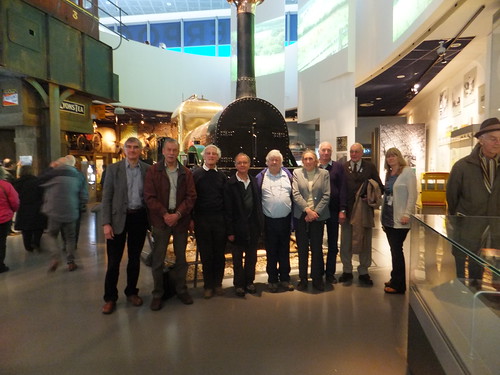
The 'group shot' in front of "Lion" after the A.G.M.

On the 19th May 2012, the Old Locomotive Committee held its 27th Annual General Meeting in Liverpool.

One year previously, the 2011 A.G.M. had been held at the Liverpool Museum Store, through the courtesy of the Museum's Transport Curator Sharon Brown, so as to give OLCO members a final opportunity to inspect 'Lion' closely before she was transferred to the new Museum of Liverpool. There's a report on that A.G.M. (with links to pictures) here.

The new Museum of Liverpool first opened to the public on 19th July 2011, although not all the Galleries were complete at the time. 'Lion' was installed in her new place of honour in time for the Official Opening of the Museum on Thursday 1st December 2011 by Her Majesty the Queen, accompanied by His Royal Highness The Duke of Edinburgh. There's a report on the Official Opening here. In terms of visitor numbers, the Museum has proved a resounding success - since the partial opening in July 2011 over a million visitors have already passed through the doors.

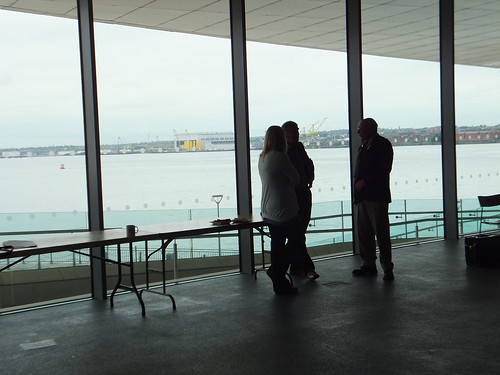
Sharon Brown kindly provided the venue for the 2012 A.G.M. but this time we were based in one of the Education Rooms at the new Museum of Liverpool situated at the Pierhead in Liverpool. Massive windows forming one wall of the Education Room gave panoramic views showing both the National Maritime Museum at Albert Dock and the Mersey looking upstream.

Sharon, John and Alfred chatting prior to the A.G.M. with the shipyards of Birkenhead visible in the background.

Sharon had also arranged a supply of tea, coffee and biscuits for which members were very grateful. The meeting was opened by the Chairman within a few minutes of the published time and business was dealt with in an efficient manner. Members of the Old Locomotive Committee will receive details of the proceedings in due course.

Of course, those attending took advantage of the opportunity to look at 'Lion' and check-out the audio-visual presentations. I'd not seen the 'Big Screen' display previously. This runs automatically every 30 minutes in high definition colour with sound. There are pictures of the 'Rocket' replica and 'Planet' replica performing but I'm pleased that the film also includes some archive shots of mine showing 'Lion' in steam at Wroughton, Manchester Museum and Birmingham Railway Museum. I'm not a great fan of locomotives 'stuffed and mounted' although I recognise the arguments for preserving an artifact for the future.

As an additional attraction, a number of groups of Morris Men were performing in Liverpool on the day of the A.G.M. I watched one group outside the museum and we could see a second group outside the National Martime Museum. I believe there were five locations all told and, after performing a set at one location, the group moved round to the next location. It's a while since I've seen Morris Men (but there is an earlier post here).

Morris Men performing immediately outside the Museum of Liverpool with the Albert Dock Complex in the background.

Oh, incidentally, the entire Committee were re-elected en bloc so I'm Secretary for a further year.

My photographs taken on the day are here.

I've posted a number of articles about 'Lion' and her 'supporters club' OLCO which you can find here.

Friday, 18 May 2012

Albion

(Click on sketch for a larger version).

Albion - No, not this Blessed Country of ours nor a certain football club but a long-gone station and signal box on the Stour Valley Line in the West Midlands. In the days of manual block signalling, the signal box at Albion was flanked by Dudley Port Junction on the Wolverhampton side and, originally, West Bromwich Gas Works Siding box on the Birmingham side. As far as I remember, West Bromwich Gas Works Siding was only opened 'As Required' and it was finally abolished in 1961, so that Oldbury became the next box to Albion in the Birmingham direction.

Sadly, I only visited Albion box once, in the early '60s. The visit was arranged by my friend Tommy Evans at Tipton box. Tommy had been a regular signalman at Albion for some time before taking the post at Tipton.

I was able to catch the 'Up Local' from Tipton to Albion station. The line through Albion was on a curve (with the Up line on the outside of the curve). Like Tipton, Albion had wooden platforms, but Albion featured distinctive round-topped canopies on both platforms. At the Birmingham end of the platform, there was a level crossing. This crossed the Up and Down main lines and also a siding which ran "back o' the box". Like Watery Lane, the gates were normally left open for rail traffic. I think there was just a single gate on either side so, when opened for road traffic, the roadway was not closed off from the railway, as is usually the case. There were wicket gates for pedestrians, plus a footbridge so that foot traffic was not interrupted when the wickets were locked. The footbridge also gave access to the two platforms.

I didn't make notes on my visit (or, if I did, they are lost) so the sketch above is made from memory, combined with information from the John Swift diagrams. I've deliberately shown the arrangement of signals before West Bromwich Gas Works Siding box was abolished.

The signal box itself stood on the Up platform, on the Dudley Port side of the station buildings. It was based on the usual L.N.W.R. design with a 40-lever Webb tumbler interlocking frame. The structure was pitched low so that the operating floor was only a couple of feet above platform level. This was presumably so that the signalman's view was not obstructed by either the Up platform canopy or the footbridge. There were two block instruments of the Fletcher Double Needle Absolute pattern, mounted on the substantial L.N.W.R. pattern block shelf.

Most running signals were upper quadrant on tubular posts but some of the shunting signals had miniature arms on wooden posts. I think most of the ground signals were L.M.S. disc signals.

Down Signals: There were two distants, both mounted under stop arms. The outer distant was mounted under Oldbury's last stop signal. The distant also served as the distant for West Bromwich Gas Works Siding so was slotted so that the arm came off only when both West Bromwich Gas Works Siding and Albion had cleared their distants. Albion's inner distant was mounted under the down home for West Bromwich Gas Works Siding. This inner distant was only about 260 yards from Albion's home, hence the need for an outer distant to ensure that approaching drivers had adequate warning. Albion's down home protected the level crossing, the connection to the down sidings and the crossover on the Birmingham side of the station. The final down signal was the Starter. By the time of my visit, this had been converted to a colour light signal situated a quarter of a mile from the box. This signal also served as the Down Distant for Dudley Port. Albion cleared the signal from red to yellow and Dudleyport then changed it from Yellow to green. The John Swift diagram shows the colour light as 4-aspect but I think the additional yellow was unused.

Up Signals: The Up Distant (lever 39) was semaphore and independent (that is, not on the same post as a stop signal). The Up Home (lever 38) was bracketed for sighting. The doll carried an Up outer distant for West Bromwich Gas Works Siding and a subsidiary arm (Shunt Ahead, I imagine). Lever 37 was a stop signal protecting the level crossing. The L.N.W.R. normally called such signals 'Home 2' (for instance, see Deepfields). The signal post was unusually short, presumably to prevent the station canopies or the footbridge from impairing the sighting of the signal from an approaching train. The post also carried an Up inner distant for West Bromwich Gas Works Siding. At the foot of the running signal there was also a 2-arm ground signal reading from the Up Main into the goods yard. Such facing connections into sidings had become quite unusual. Finally, there was the Up Starting Signal (lever 36). This was slotted by West Bromwich Gas Works Siding box so that it acted as Up Starter for Albion and Up Home for West Bromwich Gas Works Siding. A distant arm for Oldbury was mounted under the stop signal.

Green Lever: I was fascinated by a green lever in Albion, which I'd not seen before. It operated a shunters' gong over a signal wire up by Roway Crossing.

Sidings: The Down Sidings had once given access to a number of factories but, by the time I visited Albion, I don't think there was much traffic. The facing connection on the Up Main led to elaborate sidings leading to Albion Basin and a Coal Yard. Another level crossing, Roway Crossing, crossed these goods sidings. Near Roway Crossing, a through siding branched off which went behind the Up Platform. Two signals on the through siding protected the main level crossing. The through siding then served the Up Traffic Sidings. The Up Traffic Sidings could also be reached by setting back off the Up Main through a trailing connection on the Up Main (lever 31). The through siding then formed a headshunt. A separate connection formed a parallel road which eventually split into a fan of tip sidings. I was always amazed how far towards Dudley Port these sidings extended. John Swift shows 5 sidings. I suspect the ones furthest away from the main line had got fairly overgrown because, viewing from passing trains, I thought there were fewer sidings. In the late '50s, there were always wagons there, but they looked fairly abandoned. As far as I remember, once the Electrification Project started, the tip sidings seemed to regain importance.

Birmingham Power Signal Box: Albion ceased to be a Block Post on 9th January, 1966 with the commissioning of the Stour Valley Stage of Birmingham P.S.B. I believe Albion was retained as a Shunting Frame for a time but today there is very little evidence of what was once an important freight yard.

Tuesday, 8 May 2012

The 'Breakdown' at Bloomfield

After the commissioning of Wolverhampton Power Box, Bloomfield Junction signal box remained for a time as Bloomfield Junction Shunting Frame. I made a few visits but, of course, the working was a pale reflection of earlier times. However, 2nd October 1965 was a bit out of the ordinary.

Area around Bloomfield Junction Shunting Frame in the 1960s. The Stour Valley line runs from top left to bottom right. The 'Western' sidings are the two groups of sidings which diverge from the Stour Valley top left and curve towards the canal basins bottom right (Map: Old-Maps).

Bloomfield Shunting Frame, Saturday 2nd October 1965

I arrive at 07:10 and discover a little bit of excitement - there's three wagons 'Off the Road' down the 'Western' (these are the two fans of sidings leading to Tipton Five Ways Goods Depot). The 'Breakdown' has been summoned from Bescot.

Bloomfield Junction Shunting Frame, as detailed in Special Notice 745G.

The locking has been completely re-arranged and a lot of levers are now 'Spare' and painted white. There are now three release levers electrically controlled from Wolverhampton Power Box. Number 7 controls the trailing connection from the Down Main to the Down Sidings at the Wolverhampton end. The 4-aspect colour light for the Down Line (WN282 mounted on the signal gantry) is held 'On' (Red) whilst the release is given but the Ground Frame now controls the 'Cat's Eyes' (two diagonal white lights normally out) forming a subsidiary 'Shunt Ahead' signal mounted underneath the main signal. Numbers 27 and 28 control the crossover outside the box and the trailing connection to South Staffs Wagon Company.

There's not a lot to do now Bloomfield is demoted to a 'Shunting Frame' so I make my way through the overgrown sidings to inspect the damage. The derailed vehicles are DE190839, DM741097 and DB458080. It looks as if they came off whilst being propelled into the curving siding, possibly as a result of 'buffer-locking'.

Just before 11:00, a Ballast train arrives on the down with 60 wagons, mainly 'SOLES'. 8366 is the locomotive and it's reputedly Target 28. When we get release lever 7 from the Power Box, 8366 draws the whole train past the trailing connection with the Down Main. I made a note that Lever 12 failed to give an 'Off' indication (I think that was the 'Cat's Eyes'). We set the points for the 'Back Road' (number 2 Down siding) and clear the (semaphore) shunting signal for the move. The train cautiously sets back, controlled by handsignals from the Guard hanging out of his brake - when setting back 60 wagons towards a stop block, caution is good. While this is going on, the Down Parcels is standing at Tipton and the Breakdown Train is waiting at Princes End. Once the Ballast is safely 'Inside Clear' we restore the release at 11:32, allowing the Power Box to run the Parcels. Then he gives us all three releases so that we can turn out 8366 off the Ballast onto the Up Main, light engine to Bescot. We restore all the releases at 11:37.

The Power Box now looses the Breakdown (travelling as 1Z99 since he's on the way to an incident) 'Off the Top' and he arrives at 11:37, 8659 tender first, the Bescot Steam Crane, two Tool Vans, a Mess Van and another Tool Van. We get lever 7 released at 11:42, the breakdown draws clear of the trailing points, we set the road and he starts to back in. After a pause (perhaps whilst the Guard and Foreman decide which road down the Western to use), the train moves inside clear and we restore the release at 11:50. Whilst this is going on, 1S61 has come to a stand at Tipton and there's a train of Empty Stock behind that.

We're needed again when T54 comes 'Off the Top' with 8754, because he has "Three to put off at Bloomfield". He comes to a stand on the Down at 12:06, we get Lever 7 released at 12:10 and the engine goes inside on the 'Front Road' with the three wagons to detach. He doesn't hang about - we restore the release at 12:18 and T54 disappears towards Spring Vale.

The three derailed wagons are back on the track by 12:35 - apparently it was just a 'Jacking Job'. I'm not quite sure how we 'got rid of' the breakdown because there's a note about "reversing the train on 1 to get the crane next to the engine" which I don't understand (remember, we'd got 60 Ballast on 2 and three wagons on 1). There's also no note in my train register about getting releases to despatch 2Z99 back to Bescot. However, by 13:20, it was all done and we closed the Shunting Frame.

A copy of the Train Register entries covering these movements appears below:-

DOWN

UP

North British Locomotive Company Limited

North British introduced a distinctive diamond-shaped works plate, seen here on a locomotive built in 1926 now in Livingstone Railway Museum, Zambia.

Scotland, and in particular Glasgow, had a reputation for producing excellent engineers and engineering products. So it is perhaps no surprise that Glasgow was the home of a famous locomotive builder - the North British Locomotive Company Limited. The first locomotive built by the company was outshopped in 1903 but the company's origins are much earlier since North British was formed by the amalgamation of three locomotive builders.

The oldest of the three constituent companies was Sharp, Stewart and Company which had originated in Manchester. Locomotive building had started in the 1830s with 'Experiment' built for the Liverpool and Manchester by the firm of Sharp, Roberts and Company (already famous for textile machinery). Locomotive construction expanded as the firm became Sharp Brothers and, in 1852, Sharp, Stewart and Company. Locomotive construction continued in Manchester, for both British and Foreign railways, until the 1880s when the business was relocated to Springburn in Glasgow. By the time Sharp, Stewart and Company amalgamated in 1903, it had produced over 5,000 locomotives.

In 1836, Mitchell and Neilson was set up in Glasgow as an engineering company. This company traded under various names (all including 'Neilson') for the first few years at the Hyde Park Works in Finnieston. After producing a number of stationary steam engines, the firm started to expand into the business of building locomotives. In 1858 Henry Dubs became General Manager and supervised the move to a new works in Springburn (also called 'Hyde Park Works' to commemorate the firm's origins). In 1863, Dubs resigned as Managing Partner to set up his own business and was replaced by James Reid. In 1876, Reid bought out Neilson and the firm, again under a variety of names, continued to enjoy success. In 1893, Reid's four sons joined him in the business. James Reid died the following year and, in 1898, the firm's name was changed to Neilson, Reid and Company.

As noted above, Dubs left Neilsons in 1863, after acrimonious disagreements, to set up The Glasgow Locomotive Works in Polmadie (later called Queens Park Works). The locomotives were innovative and well-built and the Dubs business grew to become the second largest locomotive builder in Britain.

By the start of the twentieth century, the earlier success of these three Glasgow locomotive builders was being challenged by manufacturers in other counties, notably by Baldwin in America. To counter this threat, in 1903 Sharp Stewart, Neilson Reid and Dubs decided to amalgamate to form 'The Combine'. Initially, the three different works carried on independently, much as before, but they had sufficient success, particularly in the important export market, to carry on building steam locomotives until after the second world war.

Indian and African railways continued to be important markets for North British. It was only when I visited Livingstone Railway Museum in Zambia that I realised the significance of the African market to North British. Here's a summary of the preserved locomotives in Livingstone Railway Museum which had been built in Glasgow:-

No. 955, built Neilson Reid 1892.
No. 69, built Neilson Reid 1900.
No. 70, built Neilson Reid.
No. 1126, built Sharp Stewart 1902.
No. 91, built North British 1912.
No. 96, built North British 1912.
No. 181, built North British 1926.
No. 57, built North British 1957/8.

The only locomotives exhibited which were not supplied by 'The Combine' and its predecessors were three Beyer-Garratts and a Hunslet 2-6-2 tank.

Running number 1126 in the museum is an 8th Class locomotive, shown below:-
(Click on any of these images for a larger view)

Rhodesia Railways 8th Class, supplied in 1903/4 (Mitchell Library Collection).

Running number 181 in the museum is a 12th Class locomotive and I found a further, working example (No. 204) operated by Bushtracks on the Royal Livingstone Express. The 'ex-works' condition of this class is shown below:-

Rhodesia Railways 12th Class, ordered 1929 (Mitchell Library Collection).

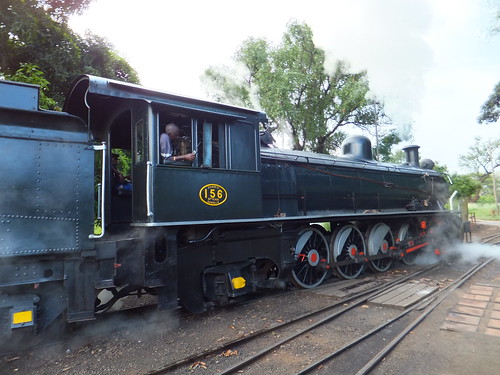
In addition to the working 12th Class, Bushtracks operate No. 156, a working example of the 10th Class also used on the Royal Livingstone Express and in steam at the time of my visit. The outline diagram of the 10th Class is shown below:-

Rhodesia Railways 10th Class, supplied in 1929/30 (Mitchell Library Collection).

North Britsh produced a surprising number of locomotives for the British railway companies. Often, the railway company would manufacture part of the Class in their own workshops and North British would produce the balance. At least 19 North British locomotives for the railways of Britain have been restored to action by the preservation movement (and I've worked on a least six of them). Birmingham Railway Museum Pannier Tanks 7752 (shown below) and 7760 were both built by North British in 1930.

Preserved 'Pannier' 7752 at Tyseley (Birmingham Railway Museum).

By the 1950s, potential customers were increasingly turning to diesel and electric traction and North British produced various designs using these more modern forms of motive power. Despite these innovations, trading conditions continued to deteriorate and the business was finally liquidated in 1962.

References

'North British Steam Locomotives built 1857-1956 for railways overseas' by John H. Court (D. Bradford Barton) ISBN 0 85153 332 9.
'Glasgow: Locomotive Builder to the World' Murdoch Nicolson, Mark O'Neill (Polygon Books) ISBN 0 948275 46 4.
'Giants of Steam' by Rodger P. Bradley published by Oxford Publishing Company ISBN 0-86093-505-1 provides a detailed history of the North British Locomotive Company Limited.

There is a North British Locomotive Preservation Group and you can find their website here.

There's a Wikipedia article on North British here.

Tuesday, 1 May 2012

'Thomas' at the Battlefield Line

'Thomas' was performing at the Battlefield Line on four days during April 2012. At this time, Britain was suffering from an Official Drought so, predictably, it rained most of the time I was there. I missed the first day, Saturday 21st April, because I was driving at Peak Rail but on the next day, I was rostered to drive 'Daisy' the DMU.

Sunday 22nd April 2012

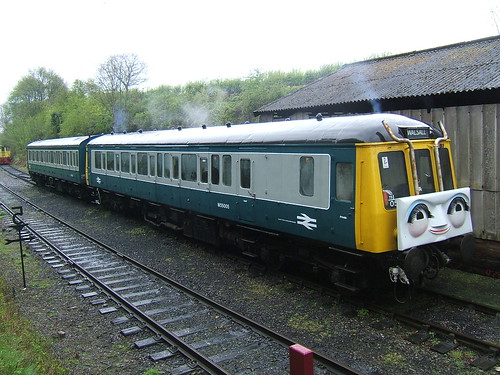
If you've followed earlier posts, you'll be aware that we're currently using the single-unit 'Bubble Car' 55005. This, obviously, doesn't have the passenger capacity of the 2-car set but, since only half of the 2-car set is currently under repair, the other half of the 2-car set has been coupled to the 'Bubble Car' to give a slightly odd looking 2-car formation. I was always impressed with the inherent flexibility of these multiple units where each coach had standard buffers, standard drawgear, standard vacuum and air hoses and standard jumper cables. This meant that they could, where necessary, attach vacuum fitted vans as tail traffic. In addition, in the event of a problem with any vehicle in a set, a coach from another set could be readily substituted on a 'mix and match' basis.

I remember once when I was working the Museum Signal Box at Birmingham Railway Museum, the adjacent Tyseley diesel depot sent across a single driving power car to turn on the Museum turntable so that they could make one good set out of two faulty ones once the vehicle had been turned so that the driving cab faced the direction they wanted. A 1-car DMU with a corridor connection on the rear looked very odd!

During preparation, one important point to check was that the sliding door on the corridor connection leading nowhere was secured. The door lock requires a standard 'No. 1 Key' and there should also be a 'French Bolt' on the outside for further security. There was a slight delay sorting out one cab where the AWS settings had been altered and that made us a little late into traffic but we performed five 'Daisy Shuttles' during the day, one coupled to 'Thomas'.

I still imagine that a day on the DMU is going to be relaxing but, on a 'Thomas' event, that's not really so. In between services, the DMU is stabled on the DMU siding out of the way. During the lay-by I usually walk down to the station but sufficient time must be allowed for walking back up to the DMU and getting ready to bring the empty stock into Platform 1 when required. Once passengers are loaded and the main train has returned to Platform 2, 'Daisy' is 'turned out' onto the single line for a short run to the vicinity of Headley's Crossing. The, the driver has to change ends. With the 2-car unit or the 1-car 'Bubble Car', the driver can walk through the train, greeting the passengers on the way. But, with the current configuration, the driver has to climb down onto the track (remembering to take the Single Line Staff), walk the length of the train (whatever the weather) and climb back into the cab at the Shackerstone end. We then drive back to Platform 1 at Shackerstone, allowing the passengers to leave the train. Most passengers will then make their way across the barrow crossing at the north end (the footbridge is currently out of use) to join the Main Train on Platform 2. The driver changes ends again and drives the empty DMU back to the DMU Siding for the next lay-by.

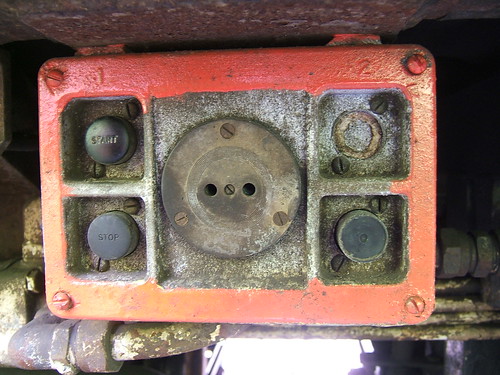
If possible, some engines are shut down for economy during the lay-by but to be able to do a rapid 'Cab Start' when the engines are re-started, you need to have sufficient air pressure to operate the electro-pneumatic controls. Usually, some engines are kept running to maintain air pressure. With low air pressure, a 'Ground Start' must be performed, walking from engine to engine 'on the floor' and operating the individual manual engine control panels which each incorporate a manual throttle control. Initial start-up each morning during preparation is, of course, a 'Ground Start'.

Adjacent to each engine, mounted on the underframe, is a manual engine control panel. There's also an adjacent manual throttle control (not shown in this picture).

Well, I enjoyed the day but we had more-or-less continuous heavy rain and strong winds so I felt sorry for our passengers. I was able to book off nice and early but, with the bad weather, the walking up and down the yard to and from the DMU and (particularly) all the climbing up and down, I felt as if I'd had quite a hard day.

There's more information about DMUs here.

Saturday 28th April 2012

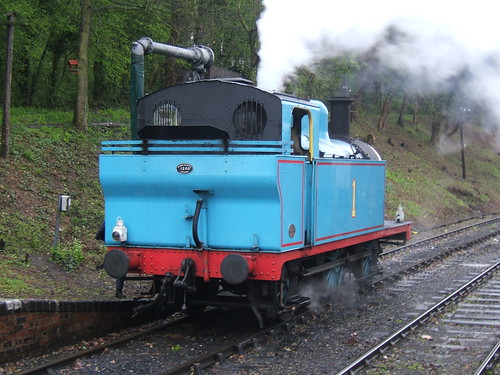
'Thomas' stands by the water crane at Shackerstone in the rain.

This time, I was on 'Thomas' which meant signing-on at about 6.15 a.m. 'Henry' (the Great Western '38') was half hidden in the gloom in the back of the shed, with 'Thomas' nearer the doors. Sam and Dave were busily engaged on various tasks and 'Thomas' was already in steam, having had a decent 'warming fire' put in on Friday evening. The '38' was standing over the pit and, since neither engine had sufficient pressure to move, I resigned myself to oiling round without benefit of a pit. At some point, I knew we'd move over the pit to empty the ashpan but, when it's possible to oil round without a pit, I tend to prefer it rather than risk running out of time. It was certainly possible to oil round and examine the locomotive without a pit but it was also very dirty and fairly unpleasant. You tend to emerge with stained overalls generally looking like 'The Creature from the Black Lagoon'. Once the pressure had come up, we arranged with John on the '38' to push him further into the shed so that we could clear the ashpan. Once unhooked from the '38' we moved out into the daylight to await our first move.

The Fat Controller joined us on the footplate for our debut appearance. In this Politically Correct era, I'm amazed we can still say 'Fat Controller' rather than, say, 'Avoirdupois-challenged Controller'. On the given signal, we moved down to Platform 1, whistle blowing furiously, to break the ceremonial tape which had been stretched in front of us. The DMU came into Platform 1 'on top of us' to form the 10.10 a.m. 'Daisy Shuttle'. Once she'd departed on her short trip, we moved across to the head of the 6-coach train in Platform 2. Whilst on shed, we'd 'borrowed' the water hose that the '38' had been using and managed to almost fill our side tanks - with 6-coaches standing in the platform we could not get to the water column.

Originally, our train had been timetabled to be 'top and tailed' with the '73' but the diesel had been delayed by a small brake problem so we were told we'd be going on our own with the (late running) 10.30 a.m. departure. That was fine with all three of us on the footplate and we had a good run to Shenton, ran round and had an even better run back to Shackerstone, stopping at Market Bosworth in both directions. The engine steamed well and is a lively runner but there's now a fair bit of wear on the 'bottom end' (axleboxes and motion) which discouraged excessive speed. The weather was overcast with a rather cold wind but without the lashing rain of the previous Sunday.

I think the '38' took the 11.40 departure and, once the main train had left, we watered at the now-accessible water column before becoming involved in engine races with the now-repaired '73', the 'there's-a-fish-in-the-water-tank' playlet and the 'Thomas' song 'the-wheels-on-Thomas-go-round-and-round'. When the '38' got back 'Daisy' made another foray down the line and then 'Thomas' and the '73' top-and-tailed the 12.55 p.m. 'Lunch on Thomas' train to Shenton. We continued with races, playlets and songs until the 3.00 p.m. 'Daisy Shuttle' when we coupled onto 'Daisy' and Stuart drove us up to Headley's Crossing and then I brought us back to Platform 1 at Shackerstone. With so much going on, I'm a bit hazy over who did what but I think the '38' did the 3.20 p.m. departure, allowing us to do more races, games and singing before moving onto the rear of the train with the '73' on the front for the 4.30 p.m. 'Tea on Thomas' train. We were still running late partly because of the need to ensure all the passengers who'd booked for the service had actually made it onto the train. Martin on the '73' said he was happy to have a little banking assistance on the uphill sections (the 4-cylinder English Electric diesel engine on the Class 73 is only rated at 600 h.p.) so, between us, we had a fairly spirited run to Shenton. We only stood for a few minutes and then we got the 'Rightaway' for the return journey. We put in another lively run on the way back but the Line Speed Limit is only 25 m.p.h. and parts of the line have lower limits, as shown below.

Location Speed m.p.h.
Shenton Station (to Ground Frame) 5
Underbridge 26 (approach to Market Bosworth) 5
Market Bosworth Station (Signal Box to Bridge 27) 10
Adjacent Headley's Crossing (Relaid track) 10
Shackerstone Approach (Barton Lane overbridge 32 to Signal Box) 10
Shackerstone Station (signal box to stop board on Plat 1 and 2) 5

Back at Platform 2 at Shackerstone, we quickly 'unhooked' and dropped down the north end so as to reach the shed via Platform 1 and the ground frame. Sam, Dave and I agreed we'd had an enjoyable day and it didn't take us long to clean the fire, fill the boiler and complete disposal.

Detail pictures of this locomotive taken at previous events.

Sunday 29th April 2012

The 1-car unit coupled to half of the 2-car unit stands opposite the signal box at Shackerstone ready for the next run.

I returned to Shackerstone the following day, rostered on 'Daisy' again. It had been very wet on the previous Sunday (as I described above) but the 29th excelled itself with gale force winds combined with lashing rain. On the way to Shackerstone, we'd found a large tree brought down across our road (bringing a telephone cable down with it). There was just room to creep by the obstruction by using the verge. After this experience, I was not surprised when Chris, the Signalman, asked if I could do a Line Inspection with the DMU because of the risk of obstructions on the railway caused by the high winds.

I'd less than an hour before the first scheduled passenger departure at 10.10 a.m. when I was due to operate a 'Daisy Shuttle' prior to the first train to Shenton at 10.30 a.m. In the lashing rain and wind, I carried out the examination of the DMU and did a 'Ground Start' of the four 150 h.p. underfloor diesel engines as quickly as possible. Once the engines had produced sufficient air pressure for the electro-pneumatic controls to operate, I was able to come 'off shed', change ends, and set off for Shenton with Dave as an observer collecting the single line staff from Chris at the Signal Box as we passed. We didn't hang about but, of course, we had to comply with the speed restrictions shown in the table above and keep a good look out not just for obstructions but for anything which might become an obstruction. The heavy rain didn't help, of course. The windscreen in front of the driver is provided with an air-operated windscreen wiper We had an uneventful run to Shenton. There were plenty of twigs blown around but nothing of any size either on the line or in obvious danger of becoming detached. I changed ends again and we returned to Shackerstone once again keeping a good look out. There had been some fairly drastic 'cutting back' or removal of trees, reducing the potential threats. On arrival at Shackerstone Box, I had to climb down and go to the box to make an entry in the Train Register Book about the inspection and the result.

I then moved 'Daisy' into Platform 1 in time to board our first passengers. Probably because the wind and the rain discouraged hanging about on the platforms, we took lots of passengers on the first run.

Then the '73' and 'Thomas' took the first service train to Shenton. When they arrived back, after an uneventful trip, we made the second 'Daisy Dash' to Headley's. The rain and the wind continued unabated.

By the time we arrived back at Shackerstone, the '38' was coupled to the main train ready to take the next Shenton departure. The small tender fitted to the '38' gives good visibility when travelling tender first but is not much fun in bad weather so the crew were rigging the Storm Sheet (or Cab Sheet or 'Dodger') between the rear of the cab roof and the front of the tender to keep out the worst of the weather. This problem was mentioned in my earlier post on the '38'. The wind had become really ferocious and we learned later that the '38' struck a branch of a tree on the way out and stopped on the way back to clear the debris. No damage was done (except to the branch).

The weather didn't improve and, for the rest of the day, we were trying to pull back the late running. Despite the foul weather, I had an enjoyable day - I only hope our passengers did.

There's a set of pictures taken on Sunday 29th April here.

There are various posts describing 'Thomas' events. You can find them all here.

Wednesday, 7 March 2012

Royal Livingstone Express

Only when I arrived in Livingstone did I discover that Bushtracks, a tourism company operating in Zambia, run a steam-hauled evening dining train on Wednesdays and Saturdays in conjunction with the Royal Livingstone Hotel. There's a website here (which I didn't find until afterwards).

Following my visit to Livingstone Railway Museum on 15th February 2012, the Curator of the Museum offered to come to the Victoria Falls Steam Railway yard in Livingstone and make introductions. All the people at the railway were quite charming and a footplate ride that evening was readily offered by the Manager, Ben Costa.

Locomotive 204 (12th Class) at the head of the train.

When I arrived at the station, locomotive 204 was at the head of the train of beautifully-restored coaches. I had a quick look on the footplate of 204 which was not in steam. On the adjacent line, locomotive 156 was "brewing up" and I was introduced to the Driver. I was given a tour of the train which comprised five coaches.

Carriage No.6049 Club Car / Kitchen Car

This houses a small lounge and bar, as well as the kitchen. This can be used as a private venue for pre-dinner drinks for approximately 10 -12 guests. There's also a diesel powered generator for electricity and two air compressors.

Carriage 4821 Chesterfield Dining Car

Luxurious leather seats for 48 guests configured:
6 x 4 seat tables 9 x 2 seat tables 2 x 3 seat tables

Carriage 211 Wembley Dining Car

Seats for 44 guests configured:
7 x 4 tables 8 x 2 tables

Carriage 4101 Lounge Car

The Lounge Car is serviced from the Observation Car Bar by waiters.

Carriage 4933 Observation Car

Bar and Veranda viewing deck.

Locomotives

Locomotive 156 is 10th Class from a batch supplied in 1922-1924 by North British.
Locomotive 204 is 12th Class supplied in 1928 by North British.

Both are imposing tender engines with a 4-8-2 wheel arrangement, two outside cylinders and Walschaerts valve gear. Although both were built by North British in Glasgow, they are rather American in appearance and have bar frames (rather than the plate frames of British engines). The track gauge is only 3 foot 6 inches but a generous loading gauge allows large locomotives.

After looking round the locomotives, I returned to the Royal Livingstone for High Tea and a shower and by 5.00 p.m. I was back at the station for my footplate ride. There was a small shunt required to remove 204 from the train and 'park' it, then 156 was attached to the train. This involved blocking the main road into Livingstone (no gates) but there was little road traffic so a couple of staff could provide fairly informal 'traffic control'. Automatic couplers were provided so coupling was straightforward. The train was vacuum braked but, in common with a number of overseas railways, two vacuum hoses were provided at the end of vehicles, one on each side. The shunter/guard was able to connect the nearest pair of hoses just by reaching in. The pair of hoses on the other side of the train remained on the 'stopper', of course. Then, the passengers arrived in a variety of taxis and were conducted over the foot crossing in front of the engine to join the train by a single set of substantial movable steps (there was no platform).

Locomotive 156 ready to depart with the 'Royal Livingstone Express'.

Only on my return to the U.K. did I find quite a good description of the journey on the AfricanMecca site here which I quote below:-

"The dinner trip incorporates a classic steam expedition with fine dining provided by Sun International's Royal Livingstone Chefs. You will now be able to make the adventure of 15 kilometers of newly refurbished Mulobezi railway line through the heart of the Zambezi River Valley in a most magnificent and romantic steam train. AfricanMecca Clients will be picked up at 5.00 PM from the Royal Livingstone Hotel for the 15 min transfer to the platform. On arrival at the platform there will be a short time available for photographs to be taken and guests will have a safety talk from the train manager. Tickets will be collected to allow guests to board the train and a welcome drink will be served. The train will set off at 5.45 PM, passing through Dambwa Township on its way up the Mulobezi Line. The railway line runs parallel to the Zambezi River and Sunset will be enjoyed while travelling through the Mosi-o-Tunya National Park. A set four course dinner will be served just after 7.00 PM when the train stops for water at the 15 kilometer peg. The locomotive will then back the train up to the run around point, uncouple and move to the front of the train. The train will start its return journey at approximately 8 PM and Dinner will continue to be served while the train is in motion returning to Livingstone. Clients will be transfer back to the hotel by 10:00 PM. The Royal Livingstone Express is made up of five carriages: Two Dining Cars, a Kitchen Car, Lounge Car and an Observation Car with Steam Locomotives 10th Class 156 and 12th class 204 both built by Northern British Locomotive works in the 1930's. Loco 156 was renovated by the famous Wildlife Artist David Sheppard and in 1971 donated to Zambia National Heritage and restored again in 2005. The beautiful Wembley Dining Car was built by the Birmingham Railway Carriage and went on display in London at the British Empire Exhibition in 1924. It was shipped to the Union and entered service on 19th May 1926. In honor of its exhibition duties it was renamed the Wembley. The Steam train will run on the Mulobezi line which runs parallel with the Zambezi River and through the Game Park. The Mulobezi Line was once the largest privately owed railway network in the world set up by Zambezi Sawmills in 1916."

Well, my journey was slightly different but the above gives a good idea of the format. I'd have found the map below useful, as well, but I didn't find it until I got back.

Map of the route. Click on map to enlarge (Copyright Zambia Survey Department).

With the passengers safely aboard, the guard gave the 'Rightaway' at about 5.30 p.m. There was plenty of room in the cab for the driver, fireman, me and two young workers whose function was not immediately apparent although they provided 'traffic control' as we set off across the ungated main road. We carried the single line Train Staff marked 'SIMOONGA TO LIVINGSTONE' and the driver also had a hand-held radio-telephone which was used to communicate with the guard as necessary.

I stood behind the driver looking at the overgrown track ahead. The area was built-up leaving Livingstone and there were lots of people around. The line was unfenced and the many level crossings were, of course, ungated so I was reminded of how strange I found it driving a broad gauge Pacific out of Delhi some years ago with people criss-crossing the line in front of me. The 'Royal Livingstone Express' was going at a fairly sedate pace, so everybody moved out of our way in time and stood watching the train. The presence of an elderly European woman on the footplate caused some friendly amusement, of course.

After about 5km, we stopped at a set of double gates across the railway. This was the entrance to Mosi-o-tunya National Park. The two young men on the footplate climbed down, opened the gates and we continued our journey. The driver pointed out a couple of giraffe browsing happily in the bushes.

I'd been told that they'd been having some problems with lack of adhesion and I'm afraid that 156 started to 'lose her feet'. The young men got off, found some gravel and started 'hand sanding'. The driver suggested that the problem was grass on the railhead. We carried on slowly but again got into difficulty so, this time, the driver got off and sanded the line well ahead of the train. We carried on, left the National Park through another set of gates and came to a run round loop with a siding holding a couple of bogie open wagons where we stopped. The young men on the footplate had brought a chair screw spanner, so I decided that the points were 'spiked' in the normal position. The locomotive ran round its train here (so we didn't follow the AfricanMecca description above) and, when everybody was back on board, we re-started, this time propelling our train to the 'Dinner Stop'. Whilst the passengers had their meal, I was invited to relax in the Observation Car and I was made very welcome by the train staff. The locomotive crew seemed to be having some problems with the electric generator but, eventually, the dual headlight on the tender lit reliably (we were returning tender first). I didn't get the opportunity to return on the footplate but, by then, it was completely dark and had started to rain very heavily. I spent the return journey chatting to the guests, who'd been very impressed with the meal which had been prepared on the train by a Royal Livingstone Chef with Royal Livingstone waiting staff.

My thanks go to everybody who made my visit to the steam railway so enjoyable.

My railway pictures taken on my visit and on the trip up the line on the evening dining train are here.

Livingstone Railway Museum, Zambia

This description is based on information from Livingstone Railway Museum

The most modern locomotive in Livingstone Railway Museum is the massive North British 'G' Class 2-8-2, originally supplied as part of a batch to Nyasaland Railways in 1957/1958.

In 1973 Zambesi Sawmills Railways ceased trading and its Locomotive Repair Sheds at Livingstone were abandoned. The National Monuments Commission declared the site a National Monument in 1976 and restoration work was commenced, resulting in the official opening of the Livingstone Railway Museum by the First Republican President of Zambia, Dr. D. K. Kaunda on 12th June 1987.

There's a brief description of Zambesi Sawmills Railways here.

The Museum is situated a short distance from the centre of Livingstone adjacent to the Livingstone to Mulobezi branch (used by the Royal Livingstone Express). The sheds are situated at the centre of a triangle (or 'wye') of lines. Where space permits, a turning triangle is often preferred to a turntable for its simplicity and, of course, a triangle can handle lengthy Beyer Garratt locomotives.

I made a brief visit to the Museum in February 2012 and was received graciously by the Curator, Mr. Nasilele. The exhibits include wagons, a coach and a massive Cowans and Sheldon steam crane. The stars, of course, are the steam locomotives, all re-painted and stored in the open but with many fittings removed and generally in poor condition. In the hot sun, I dashed around most of the exhibits, clambering on and off footplates until I was fairly tired.

My pictures of Livingstone Railway Museum are here. Below are brief notes on some of the exhibits.

Class: 7th
Running nbr: 955
Built: Neilson Reid
Works nbr: 4447
Date: 1892
Arrgt: 4-8-0
Livery: Blue + Black smokebox
Orig owner: Cape Government Railways
Acquired ZSR: Purchased 1966
Notes: Oldest loco. in Zambia. Part of first batch of 7th class entering service 1892. Renumbered 955 in 1910 with the amalgamation of Central South African and Cape Government railways to form South African Railways. Saturated with slide valves.

Class: 7th
Running nbr: 69
Built: Neilson Reid
Works nbr: 5791
Date: 1900
Arrgt: 4-8-0
Livery: Black + Silver smokebox
Orig owner: Rhodesia Railways
Acquired ZSR: In 1926 for £2,500
Notes: One of second batch delivered through Beira and assembled at Umtali. RR nbr 20 (other 3 in batch 11, 12, 17). ZSR fitted the loco with an electric generator and headlights in 1929 - this was the first ZSR loco to be so fitted.

Class: 7th
Running nbr: 70
Built: Neilson Reid
Works nbr: ?
Date: ?
Arrgt: 4-8-0
Livery: Black + Silver smokebox
Orig owner: Rhodesia Railways
Acquired ZSR: ?
Notes: Complete with bees nest!

Class: 8th
Running nbr: 1126
Built: Sharp Stewart
Works nbr: 4862
Date: 1902
Arrgt: 4-8-0
Livery: Blue + Silver smokebox
Orig owner: Imperial Military Railway which became the Central South African Railway which amalgamated with Cape Government railways to form South African Railways in 1910.
Acquired ZSR: Purchased in 1971.
Notes: Fitted with piston valves and assumed to be superheated. On ZSR worked 'forest mainline' trains and specials between Livingstone and Mulobezi until 1973. Remained at Mulobezi until 1976 on works trains and shunting firewood trains.

Class: 9th
Running nbr: 91
Built: North British
Works nbr: ?
Date: 1912
Arrgt: 4-8-0
Livery: Black + Silver smokebox
Orig owner: Rhodesia Railways. Sister engine 96 (below) was also supplied 1912. Both were part of the first batch of 18 9th Class locos.
Acquired ZSR: ? Notes: Displayed without tender, part dismantled and with boiler part sectioned to show construction.

Class: 9th
Running nbr: 96
Built: North British
Works nbr: 19822
Date: 1912
Arrgt: 4-8-0
Livery: Black + Silver smokebox
Orig owner: Rhodesia Railways. Sister engine 91 (above) was also supplied 1912. Both were part of the first batch of 18 9th Class locos.
Acquired ZSR: Purchased in 1963 for £1200 and worked up to 1973.

Class: 12th
Running nbr: 181
Built: North British
Works nbr: 23380 (The Museum gives the works number as 23392)
Date: 1926
Arrgt: 4-8-2
Livery: Black + Silver smokebox
Orig owner: Rhodesia Railways. Part of 1st batch of 20 12th Class.
Present owner: Zambia Railways (on loan to museum).
Notes: The class was ordered to replace ailing traction on the vital Salisbury-Bulawayo-Wankie route. Later nicknamed 'Glamour Girl' and a popular class. In 1967 (following independence) this was one of the locomotives assigned to Zambia.

Class: 15A
Running nbr: 401
Built: Beyer Peacock
Works nbr: 7353
Date: 1950
Arrgt: 4-6-4 + 4-6-4
Livery: Black + Silver smokebox
Orig owner: Rhodesia Railways. Part of 4th batch of an order for 30 'Class 15 Agaraes' intended for passenger and mail trains.
Present owner: Zambia Railways (on loan to museum).
Notes: Boiler 543 Engine 398. In 1967 (following independence) this was one of the locomotives assigned to Zambia. Regarded as the fastest of the Rhodesia Railways locos and free-running. Nicknamed 'Greyhounds'.

Class: 16A
Running nbr: 623
Built: Beyer Peacock
Works nbr: 7501
Date: 1952
Arrgt: 2-8-2 + 2-8-2
Livery: Black + Silver smokebox
Orig owner: Rhodesia Railways.
Present owner: Zambia Railways (on loan to museum).
Notes: In 1967 (following independence) this was one of the locomotives assigned to Zambia.

Class: 20th
Running nbr: 708 (The Museum gives the running number as 70)
Built: Beyer Peacock
Works nbr: 7693
Date: 1954
Arrgt: 4-6-4 + 4-6-4
Livery: Black + Silver smokebox
Orig owner: Rhodesia Railways. Intended for Wankie and Kabwe coal trains.
Present owner: Zambia Railways (on loan to museum).
Notes: At 233 tons, this was the heaviest Rhodesia Railways loco. In 1967 (following independence) this was one of the locomotives assigned to Zambia. Withdrawn in the late 1970s when diesels were introduced.

Class: ?
Running nbr: 1
Built: Hunslet
Works nbr: ?
Date: 1924
Arrgt: 2-6-2 Side Tank
Livery: Yellow, marked 'NCCM'+ Black smokebox
Orig owner: ?
Notes: In 1929 worked at the Bwana Mcubwa Mine and nicknamed '1-2', then worked at the Nkana Mine and then at the Nchanga Mine. Used for stores distribution in 1958.

Class: G
Running nbr: 57
Built: North British
Works nbr: 27779
Date: 1957/58
Arrgt: 2-8-2
Livery: Green + Silver smokebox
Orig owner: Nyasaland Railways (Malawi)
Acquired ZSR: Cost K5,000 + K322 delivery.
Notes: Development of 'River' class supplied to Nigeria Railways and East African Railways. Part of last batch from North British with RSH boiler. Nicknamed 'Jubilee'.

There are working examples of a 10th class 4-8-2 and a 12th class 4-8-2 in Livingstone: see the post on the Royal Livingstone Express.

See also the page on ex-Rhodesia Railways exhibits on Geoff's Trains.