Sunday, 19 February 2012

Zambesi Queen

Friday, 17th February 2012

The alarm either didn't go off or failed to wake me. I finally awoke at the Royal Livingstone Hotel at about a quarter to seven and rustled round getting dressed and finishing packing. After my customary breakfast on the terrace of the restaurant, I set off on my last 'jaunt' before leaving.

I knew that if I followed the river bank towards the falls, I should come to the hotel's 'Falls Gate'. Here, I was able to sign the register and pass into the nature reserve overlooking the Falls I'd visited the previous afternoon. I had a quick second-look at the Eastern Cataract and then moved to the path which led to the 'Boiling Pot' we'd not taken during my visit the day before. The length of this path was just under 700 yards, according to a marker stone, but I knew the path would also have to descend more than 300 feet to get to the water level in the 'Boiling Pot' so I wasn't expecting an easy walk. I was right. The path was made from sharp-edged rocks laid in concrete forming rough steps of varied depth and, like everything near the falls, permanently wet and slippery. I realised I'd have to be very careful to avoid a nasty tumble so I was almost relieved when a Zambian man appeared and appointed himself my guide. He looked about 16 years old to me but I discovered he had two children, one seven, one three, so he must have been much older than that. He was carrying a catapult and insisted that the path was infested with baboons. I'd seen catapults in use at the hotel to discourage the thieving vervet monkeys. We didn't see any baboons on the way to the Boiling Pot but my 'guide' let off a few small stones to show willing.

Eventually, I reached a large rock just a few inches above the water which I gathered was the loading point for the White Water Rafting Experience. The rafting is stopped with the seasonal increase of water flow and had already stopped by the time of my visit.
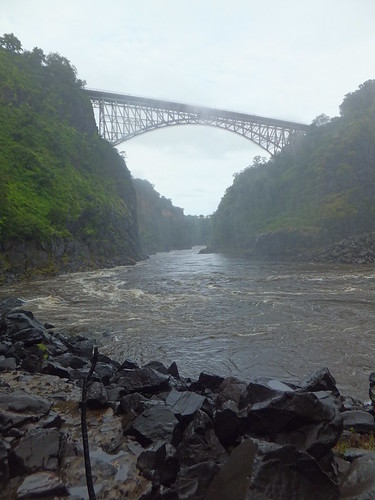
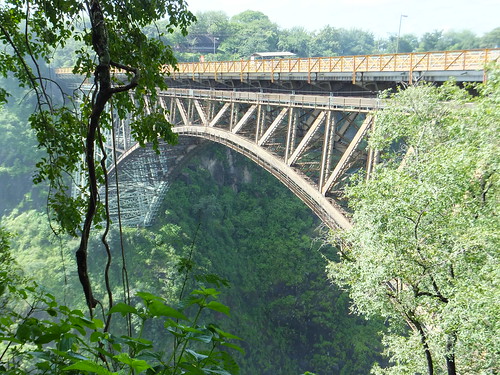
View from the shore of the Boiling Pot looking into the Second Gorge, showing the Victoria Falls Bridge.

I then had the unwelcome challenge of climbing back up again. Reaching the top reasonably unscathed, I paid off my 'guide' and made my way back to the Royal Livingstone where there was just time for a shower before checking out and meeting Jeff, my Wilderness Safaris guide from the previous day who was to take me to the border with Botswana, a road journey which would take about an hour.

We took the familiar road north to Livingstone town, where we made a left turn at the Catholic Church to follow a long, straight road which would take us west to the border, travelling parallel to but out of sight of the Zambesi River. Leaving town we passed various educational establishments including schools, the technology college, an orphanage and a smart-looking Seventh Day Adventist church. Jeff told me that about 90% of the population are Christian although there is still some belief in the old, local gods.

Leaving Livingstone, we passed a large group of schoolchildren.

We passed through a game reserve where we saw a number of giraffes happily grazing from the leaves at the top of the trees. We passed various small villages, some apparently without electricity but after passing a tall radio tower, there was an overhead supply, presumably to power the tower and any villages passed through. Two high voltage overhead power lines appeared on our right, fed from the hydro-electric power station at Victoria Falls, one apparently to provide power to the Kasengula area of Zambia, one to export power to Botswana and Namibia. After passing a high voltage substation on the outskirts of Kasengula, we turned left and followed the road to the border with Botswana.

We came to a long line of parked lorries facing the border, all articulated, some quite huge. Jeff explained that the Zambesi River forms the border between Zambia and Botswana and the lorries were waiting their turn on the vehicle ferry which crosses the river. Lorry drivers may have to wait seven days for their turn to cross. The road had deteriorated to a sandy track and, with the recent heavy rain, there were large pools of mud. At the gates to the ferry terminal we had to wait for a large lorry coming off the ferry to clear then we slowly drove ahead, past crowds of people milling around, and parked near the Immigration Office. Here I completed a Zambian Departure Form and submitted it with my passport for stamping.
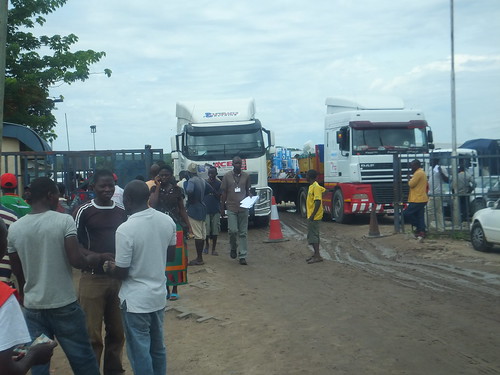
The chaos approaching the Ferry at Kasangula.

I could see two old vehicle ferries of similar design - a flat pontoon to carry the load, hinging ramp at each end which could be lowered to let vehicles on and off and a small wheelhouse mounted on a steel bridge structure. Either side of the pontoon, there was a deck extension large enough to carry a packaged diesel engine driving a propellor via a Z-drive. The propulsion system was similar to that in use on the pontoons I'd seen in St. Helena. There was another, newer vehicle ferry with 'Hydromaster' power plant and a hydraulic ram to pivot the arm of the Z-drive (presumably for easy attention to the propellor). In this case, the tiny wheelhouse was suspended aloft on a single, massive inclined steel tube, giving the vessel an even odder look. The wheelhouse was labelled 'ZAMBESI CRUISER ZL17'.

Jeff directed me to a small aluminium passenger ferry boat with an outboard. This had just arrived from the Botswana side by the simple expedient of driving into the mud at the shore line. A number of European tourists were disembarking and their luggage was lifted off by various willing hands after which my baggage was put on board and I clambered aboard. The friendly boat driver took me across the Zambesi to the Botswana shore, pointing out that, to our right, the Zambesi divided into the Chobe River, flowing in from the west and the Zambesi itself flowing in from the north west. Later, I discovered that the land between the Chobe and the Zambezi is part of Namibia and that the land on the southern bank of the Zambezi to the east of this important ferry crossing is part of Zimbabwe so four counties meet at this point. As we crossed the Zambezi, we passed yet another vehicle ferry carrying two lorries from Botswana to Zambia. The wheelhouse of this ferry was mounted at the side of the vehicle deck, giving the craft a fairly conventional appearance. On our left, on each bank, there were two tall transmission towers carrying the electric power from Victoria Falls to Botswana. The approach to the ferry on the Zambian side appeared to be just a sandy track leading down into the water but the Botswana side boasted a wide concrete ramp with lots of lorries lined up waiting their turn.

My ferry approached a dilapidated landing stage to one side of the concrete ramp where I was met by another driver with another Mercedes people carrier. We drove a few yards to Botswana Immigration and, whilst I completed the formalities for entering Botswana, the driver took the vehicle through a shallow 'sheep dip' forming part of the precautions Botswana takes against Foot and Mouth disease.

We headed west past along a reasonable road past a long line of big lorries waiting to cross from Botswana to Zambia. We then came to a length of road which was closed for road works so traffic just veered onto the sandy verge to bypass the proper road. I was intrigued that the closed section of road had been provided with a row of large stones spaced across the carriageway every so often. I'm not sure whether this was to discourage motorists from driving down the closed section or to sectionalise the road works. We soon came to the important town of Kasane which looked fairly prosperous compared with Zambia. I noticed a modern hospital and a modern police headquarters before we suddenly turned right into the compound of the Botswana Immigration Service on the bank of the Chobe River. My first visit to Botswana was to finish after only twenty minutes! Within a few minutes, I'd received the 'Exit' stamp in my passport and I waited with a some other tourists who were also destined for the 'Zambezi Queen' Houseboat. After a brief wait, we boarded a very smart aluminium ferry boat powered by an outboard with a capacity for about 13 passengers. We set off along the Chobe River and the various twists and turns left me completely disorientated. An opening in the undergrowth along the shoreline revealed a steep bank of loose sand and we 'parked' by driving the boat straight at the shore. We all disembarked and struggled up the bank to a flat, sandy area with offices at the far end. This, we realised, was Namibian Immigration for Kasika Conservancy. We had another wait under the shade of a large tree until somebody arrived to unlock the building and a little later the Immigration Officer himself arrived. Only a few people at a time could fit inside the immigration office so a line of people were left outside in the hot sun.

Waiting for the Immigration Officer on our entry to Namibia.

Eventually, everybody had been processed and our boat continued along the river to the 'Zambezi Queen' Houseboat. 'Houseboat' was the best description of our home for the next three days. With three decks above the waterline she had a rather ungainly appearance and I understood that she handles badly in winds with her flat bottom. We were welcomed aboard and taken up to the top deck for a Welcome Drink followed by lunch. A Preying Mantis appeared as part of the welcoming committee - appropriate since the boat is operated by the Mantis Group. What the 'Zambezi Queen' lacks in external elegance, she makes up for in passenger comfort.
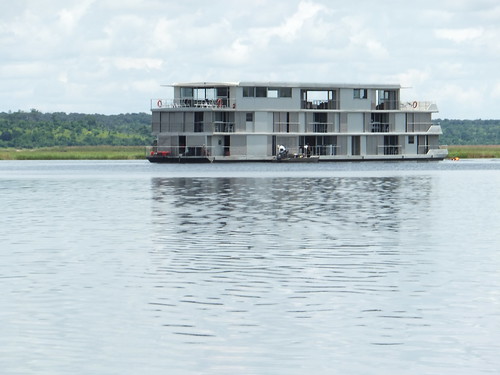
The 'Zambezi Queen' Houseboat.

After lunch, the boat started to cruise along the Chobe River. Near the Immigration Post we passed a number of holiday villas then we swung right into another channel with our direction reversed. On our left was the shore of the famous Chobe Game Park (in Botswana) and on our right an island, the ownership of which was originally disputed but now also part of Botswana. We had good sightings of hippo and various birds before another aluminium ferry boat roared towards us with the balance of our passengers who had, apparently, been delayed by Immigration at Livingstone airport.

The two aluminium boats were now tied alongside amidships - one on the port side, the other on the starboard side. At about four o'clock, all the guests clambered into the two boats for a Sunset Cruise game and bird spotting. Late afternoon is a popular time for game and bird sighting and we passed various other craft engaged in a similar pursuit.

At around seven o'clock, we assembled on the Upper Deck for drinks followed by an excellent dinner and an opportunity to talk to fellow guests. By ten o'clock I was more than ready to go to my spacious cabin, have a shower and prepare for bed.

More pictures:

Leaving Zambia.
Botswana Briefly.
Kasika Conservancy, Namibia.
'Zambezi Queen' Houseboat.
Cruising on the Chobe River.

Thursday, 16 February 2012

Victoria Falls

Thursday, 16th February 2012

View of part of the Victoria Falls from the Zimbabwean side.

I slept well again and took breakfast on the terrace overlooking the River Zambesi shortly after they opened at 7 o'clock. Returning to my room, I made a small bag ready for this morning's tour. I was to be picked up at 08:30 for a tour of the Victoria Falls from both the Zambian and Zimbabwean sides arranged by Wilderness Tours. The International Border between Zambia and Zimbabwe (Northern and Southern Rhodesia when I was young) runs down the middle of the Zambesi at this point so to see all of the viewpoints, it's necessary to visit both countries.

With three other people for the tour already picked up elsewhere, it took only a few minutes to reach the Zambian border post. We all had to go to Immigration before our guide and driver drove over the Victoria Falls Bridge with the single line railway crossing the bridge to our left. Approaching the Zimbabwe Customs Post, our guide parked and escorted us on foot to a pedestrian gate. Here, we were handed over to another Wilderness Safaris guide for the Zimbabwe part of our Falls tour. After we'd passed through Zimbabwe Immigration, we boarded a similar bus to the one we had left on the Zambian side and drove a short distance before parking near the entrance to the Victoria Falls Rainforest Reserve. We entered the Reserve for a tour of about 4 kilometres on a series of concrete paths.

Before this trip, I'm afraid I'd only the haziest knowledge of the geography of this part of Africa. I've commented before that I never cease to be amazed by my almost total ignorance of the world around me. The Zambezi River with a length of 2693 kilometres is the fourth longest in Africa. Immediately upstream from the Victoria Falls it's wide and reasonably fast flowing, as I could see from my room at the Royal Livingstone situated on the east bank as the river flowed south.

South of my hotel, this river broadens to about 1.7 kilometres wide and literally "falls off a cliff" as a chasm running east-west opens up in the river's path. The drop varies from about 70 metres on the west up to 107 metres in the Main Falls. At the bottom of the drop, the water is confined to a narrow channel in the basalt rocks where the only exit is through a narrow channel near the eastern end of the falls. Whereas the broad river upstream is typically 3 to 5 metres deep, in the narrow channel leading away from the falls it can be ten times as deep as the water seeks an exit through a roughly round chamber called the 'Boiling Pot'. The turbulence in the 'Boiling Pot' is quite spectacular. The 'Boiling Pot' discharges into the Second Gorge with a heading roughly to the south-west and it is this gorge that's spanned by the Victoria Falls Bridge. If you look north-easterly from the bridge, you can see the eastern part of the falls. But, after the bridge, the unyielding basalt rock forces another sharp deviation on the escaping water, turning the flow into the Third Gorge which flows more-or-less west-east. Still in a deep gorge, the water enters the 'Silent Pool' where the flow is turned to a south-westerly direction again, in the Fourth Gorge. Equally improbably, on a rocky shelf above the Silent Pool, there is a hydro-electric generating station which discharges into the Pool. I didn't find out where the water intakes are.

In February, the volume of water coming over the Falls is increasing, but not yet at its peak. I still found the spectacle very impressive. Of course, I was also interested in the Victoria Falls Bridge, opened in 1905. Originally, it was built as a double-track railway bridge but has now been reconstructed with a single track railway and roadway controlled by traffic lights ('robots', as they call them in Africa). The achievement, not just in the scale of the bridge but in the hostile, remote environment in which it is situated is amazing. There's an excellent website about the bridge here. Peter Roberts contributed to this site and he also wrote a history book 'Sun, Steel and Spray' (ISBN:978-0-620-50399-0) which is an essential reference.

The Victoria Falls Bridge.

'Rainforest' is the right term for the area, because in the vicinity of the falls the spray, having risen like smoke, turns into a rainstorm with amazing power which takes your breath away in places. We spent a couple of hours moving from viewpoint to viewpoint and, even wearing the poncho loaned by our guide, we all became completely saturated. After a walk round the Visitor Centre for some orientation (and the opportunity to buy souvenirs) we returned to our bus and reversed the earlier process of entering Zimbabwe to return to Zambia. Our first guide then took us around the viewpoints on the Zambian side where we suffered the same dousing, emerging like drowned rats. After more purchasing opportunities, we headed back towards Livingstone.

View of part of the Victoria Falls from the Zambian side.

I said goodbye to my new friends as I was the first drop-off at the Royal Livingstone Hotel. It was almost half past two and I was totally shattered. A shower, a change of clothes and I returned to the main part of the hotel to take Afternoon High Tea.

Tomorrow, I leave the Royal Livingstone Hotel. I should be picked up at ten o'clock to move on to the next part of my adventure.

My photographs of the Victoria Falls and the Bridge are here.

Livingstone

Tuesday, 14th February 2012

As often happens, writing things down whilst they're fresh in the memory conflicts with actually doing things so, on my return to the U.K., I've expanded my original brief update.

There was originally a settlement next to the Falls, as a staging point for crossing the Zambezi, but this settlement was moved to higher ground on Constitution Hill because of the problem of malarial mosquitoes near the river. In 1904 the new settlement was called 'Livingstone' after the Scottish missionary and philanthropist Dr. David Livingstone and in 1911 the town became the Capital of the British Protectorate of Northern Rhodesia and still retains some of the Edwardian colonial buildings of the period. In 1935, the capital was moved to Lusaka and Livingstone became a quiet town. Latterly, the development of tourism around Livingstone has restored the town's fortunes.

Main Street, Livingstone.

The Royal Livingstone is a resort hotel with rooms laid out in blocks of 8 along the bank of the Zambezi perhaps a mile up river from the Victoria Falls. From the manicured grass leading from rooms to the river bank you can see the spray rising from the Falls - 'Mosi-oa-Tunya' ('the smoke that thunders'). It's all very pleasant.

Reception, Royal Livingstone Hotel.

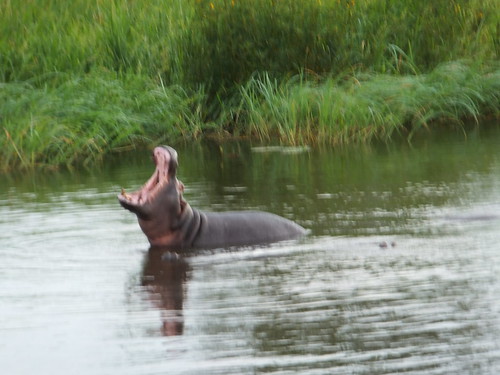
At 16:00, I had a 'Sunset Cruise' on the 'African Queen' (nothing like the boat in the film) which went upstream 'game spotting'. Lots of birds, hippos, crocodiles.

A Hippopotamus displays his dental work to passengers on the 'African Queen'.

Wednesday, 15th February 2012

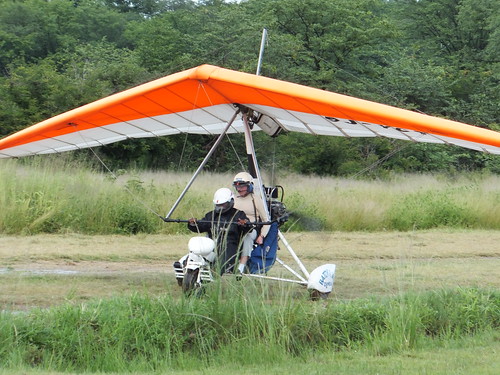
It transpired Wednesday was 'at leisure', so I made some arrangements of my own. 08:40 saw me being picked up for a 30-minute Microlight flight over the Falls and over some of the game reserves with Batoka Sky. It was splendid and I rather think should be compulsory for all visitors to the Victoria Falls. Alternately, United Air Charter operate helicopter flights, but I'm glad I elected for the Microlight.

The Microlight takes off with Pascal in charge and Jan in the back.

Then, I took the 'Heritage Tour' which didn't work quite as planned. The last call was supposed to be the Railway Museum (did you know there was a railway museum in Livingstone? - I didn't) but I made it the first call and, of course, it took longer than expected. There's a separate report on the Museum here.

I'd also discovered that Bushtracks operate a steam-hauled evening dining train in conjunction with the Royal Livingstone Hotel on Wednesdays and Saturdays so the Curator of the Museum offered to come to the railway and make introductions.

All the people at the railway, where the steam locomotive was 'brewing up' for the evening run that day, were quite charming and a footplate ride that evening was readily offered by the manager, Ben Costa.

By now running late, I took a quick tour round the Livingstone Museum in the town. This is Zambia's oldest and largest museum and gives a good impression of the work of Dr. David Livingstone. It was Dr. Livingstone, of course, who re-named the Falls after the then Queen and he was active in the abolition of the slave trade. It's interesting to note that Dr. Livingstone is still so revered in the country that, following Zambia's independence in 1966, the colonial name of 'Livingstone' for the town was retained. Sadly, the museum does not allow photography, nor does it have a catalogue for sale but it's well worth a visit.

I returned to the Royal Livingstone for High Tea and a shower and by 17:00 I was back at the station for my footplate ride. There's a separate report on the 'Royal Livingstone Express' dining train here.

I was back at the hotel by 22:00 exhausted, dirty but very happy. All excellent stuff.

More Pictures:

Royal Livingstone Hotel.
Livingstone area.
'African Queen'.
Microlight Flight.

[Link to Royal Livingstone Express article added 17-Dec-2012]

On to Zambia

Tuesday, 14th February 2012

After a good night's sleep, I got up fairly early, took a very simple breakfast in 'The Warehouse' and re-packed my luggage. I decided to take the 08:15 shuttle bus to the airport, which took less than ten minutes and the driver dropped me off at International Departures.

When I arrived the check-in desk wasn't yet open for my British Airways flight to Livingstone but after a short walk to check out the booking hall of the new Gautrain Station (Sandton in 15 minutes!), staff had arrived and I was swiftly checked in for the 737 flight. With the airport still quiet, security and passport control was painless and I was soon at the oddly-named SLOW Lounge. It titles itself 'The SLOW Lounge for Busy People' so they seem to have embraced the idea of a brief oasis between periods of stress. There were some interesting comments about time carved into the woodwork as you entered. The place was quiet, clean and the staff obliging. Although there was Wi-Fi available and fixed computers, both seemed to need a subscription and, at that time of the morning, it was far too ambitious to consider setting up an account. So I passed the time doing off-line text preparation on my computer.

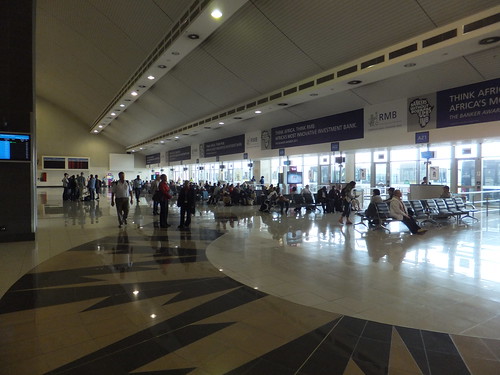
The Domestic Departure Hall at O. R. Tambo Airport.

At the requested time, I made my way to the Gate. A large departure hall had one wall completely glazed. This wall had a series of doors leading to a number of bus stands. Large airport transfer buses were backing up, loading passengers and taking them to the aircraft. Quite soon, my flight was called so we boarded the bus and, after a little delay waiting for stragglers, set off on one of the airport roads which crossed the apron. After a few hundred yards, we came to a row of smaller aircraft and pulled up beside a 737 which gleamed in the morning sun in its British Airways livery. This part of British Airways is run by Comair Limited.

After a couple of flights in 'Big Jets' the 737 seems rather small. Economy is laid out with 3+3 seating, with a single, central aisle but the first three rows had business seatng arranged 'two and a half'+3. The business seats are a little wider so the group of three seats on the starboard side extends a few inches into the central aisle. To compensate, the seat group on the port side is two business seats with a narrow 'seat space' in between so the central aisle width is maintained, with a slight "dog's leg" through the business section which is scarcely noticed. Flight BA6291 took us to Livingstone in Zambia in about 75 minutes and a pleasant meal was served en route.

Livingstone has a single, long runway set in scrub land. The existing terminal buildings are a little primitive by modern standards but massive building works are in progress. We had a fairly long walk across the apron from the aircraft to the immigration hall. Apparently, you can purchase 'Visa on Arrival' which slowed things down. Four people went through before me and the process involved taking a picture and fingerprints. I only had my picture taken, presumably because my visa had been obtained before I left the U.K. My bags arrived safely at the single, small baggage carousel so I was soon in the arrivals hall, checking the nameboards held by the 'greeters'. None carried the tour operator's name 'Wilderness' or my name so after a few moments of indecision, I asked one of the friendly-looking men. He turned to the car park and bawled a name.

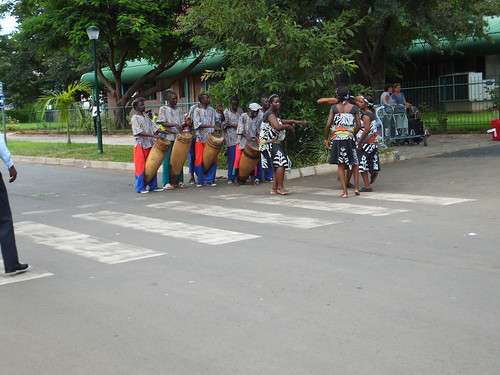
A tall Zambian in a blue 'Thompson Holidays' T-shirt came over. He seemed to be expecting me but said he had some other names to meet, inviting me to sit in the shade of his bus. I preferred to stand in the sun and watch the local dancers and musicians who were performing for the arriving tourists.
Local dancers and musicians performing outside the terminal building at Livingstone, Zambia.

Eventually, the 'Thompson Holidays' guy decided his missing passengers had not arrived on the aircraft so he set off to distribute us amongst various hotels. The airport road was a long, straight tarmac road, carrying little traffic. Workmen were using simple tools to dig out a trench at the side of the road. Further on, men were constructing a shallow 'V' in concrete in the trench, clearly to improve drainage. The airport road met Livinstone's main street at right angles and we made our way past a variety of building styles towards the main hotel area towards Victoria Falls. After dropping off a few passengers at other hotels, we were admitted via a gatehouse to the grounds of the Royal Livingstone Hotel and Zambezi Sun Hotel. At a road island, signs indicated that the road to the left led to the Zambezi Sun so we took the road to the right, passing first a group of giraffe, browsing on the high leaves of the trees and then a small herd of zebra. All the animals were completely nonchalent about the passing bus. Soon, we stopped at the central buildings of the Royal Livingstone Hotel.

More Pictures:

Protea Hotel.
O. R. Tambo Airport.
Livingstone.

Tuesday, 14 February 2012

Big Jet to Johannesburg

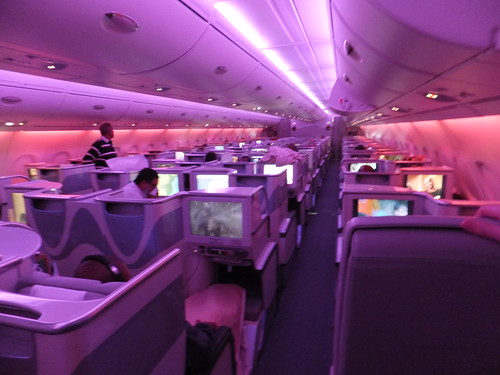
View of the forward Business cabin 'upstairs' in the Emirates A380 which took me to Johannesburg (it didn't really look that purple to the human eye, but I haven't attempted to 're-balance' the shot).

Monday, 13th February 2012

I made my way to the departure gate at the recommended time. They hadn't started boarding but I was a little horrified to see how many people were waiting to board.  Because of the crush, I had to wait until nearly everyone had shuffled towards the aircraft before I could present myself at the final boarding pass check. I was a little tired by this time so when I was directed to a lift, rather than the line of people moving towards the aircraft, it took a moment for the significance to sink in. Finally, I realised - the aircraft was a huge Airbus A380-800 and the business class boarding was directly to the upper deck via a high-level airbridge. It was my first flight on a A380 and I discovered that the business class was divided into two cabins and I was in the larger, forward cabin in seat 11K. I'm afraid it didn't particularly appeal at first sight. I believe the Emirates configuration gives 400 Economy seats downstairs and 100 Business seats in the two upstairs cabins. There's presumably a few First as well, but I didn't see that.

In Business, the seating is sort of 1-2-1. I say 'sort of' because each line of seats is staggered so as to make better use of the floor area. This is particularly noticeable on the 'window' seats - for instance, seat 11K is next to the window with a kind of 'bedside cabinet' on the aisle side whereas on the next row the seat is next to the aisle with the 'bedside cabinet' next to the window. To give privacy, a 'cubicle' surrounds each seat and, to me, it suggested those terrible open-plan offices full of workers in individual cubicles lampooned mercilessly in the Dilbert cartoons. The cubicle walls were all shiny material topped with stainless steel handrails - practical but not very relaxing. The rather claustrophobic atmosphere was heightened by cabin headroom which seemed less generous than the 777 of my previous flight (after all, we were on the upper deck on the A380), smaller overhead lockers, narrower aisles and apparently narrower openings to get from the aisle to the seat. On the plus side, every business passenger had an aisle seat.

With four big turbofans urging us skywards, taking off seemed to present no problems. Drinks and light refreshments were available but the crew seemed keen to get people to sleep for most of the seven hour flight. With a proper lie-flat bed, I was able to sleep for part of the flight but I also watched a couple of films. One was a Sci-Fi yarn called 'In Time'. Can't remember what the other was (must have been good). I gave up on 'Tin Tin' for the second time.

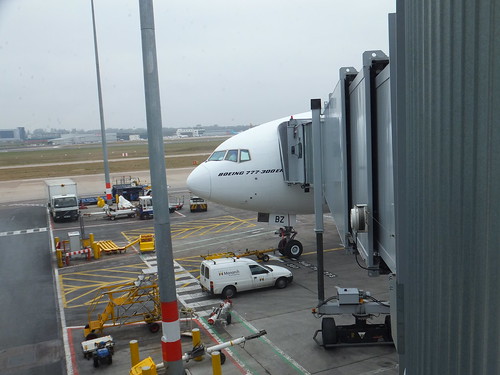
About an hour out of Johannesburg, they gave us a reasonable breakfast. The 'Airshow' giving details of the flight included a 3-dimensional simulation showing our track over the curving globe (as did the 777). What kept irritating me was that the detailed picture of our aircraft (in correct Emirates livery) was about 200 miles in length! As we got near to the runway, I was furiously switching my display between the 'Front View' camera, the 'Looking Down' camera and the 'Tail' camera. At 10:47 local time, we touched down on runway '03 Right'. Even with noisy reverse thrust, we used nearly all of the runway (I could read the runway designation '21 Left' upside-down near the end of the runway) before turning left onto what appeared to be a dedicated taxiway for A380s. After some delays, at 11:08 we pulled up at one of the special stands for A380 next to 'Air France' and 'Lufthansa' A380s. Connecting the upper-deck air bridge seemed to cause some delay so, by the time we started to disembark, passengers were streaming off the lower deck as well.

There's a useful Wikipedia article on the A380. The Emirates aircraft are equipped with the Engine Alliance GP7000 turbofans (Engine Alliance is what happened to GE and Pratt & Whitney).

There was the usual lengthy walk to Immigration, made a little easier by a number of moving pavements but my heart sank as I entered the already-full Immigration Hall. There were at least a couple of A380s-worth of passengers moving very slowly towards Passport Officers who were hidden from view by the arrivals in front of me. There's usually one or two staff deciding to shift people from queue to queue so, although hundreds of people arrived after me, somehow I became the last person to pass through at 11:55. I managed to stay civil but, as you may imagine, I was not best pleased. At least my two pieces of checked baggage were waiting for me on the carousel. They were the only pieces on the carousel - everything else had been collected!

Customs was uneventful so I then had to decode the rather ambiguous instruction in my itinerary - "Complimentary shuttle from the airport. Meet the shuttle at the bus terminal behind the Intercontinental Hotel. The office of 'Lux Express' will assist." To my surprise, I found the 'Lux' office but I'd the best part of half an hour to wait for the next shuttle bus which run to a timetable, not on demand. As our A380 stopped at the gate, I'd spotted the Protea Hotel, not 300 yards away from the gate as the crow flies. But when the shuttle picked me up (and one member of the hotel staff), it took him best part of a quarter of an hour, zig-zagging around the complex road system, to reach the hotel.

By this time, I was unsurprised to discover that the room would not be available until two o'clock (and it would be a Smoking room at that. Yes, South Africa still allows smoking in some places). The car booked for 13:00 to take me to my business meeting was already waiting so, rather than the quick shower and a change of clothes I'd been looking forward to, I had to settle for a quick wash in the Ladies Washroom.

Johannesburg sprawls over a large area in a rather unattractive way, the various elements linked by a complex road system which always seems busy and often at a standstill. A programme of road improvement works adds to the fun. On our way to my meeting, we seemed to be forever leaving one freeway and joining another, either by elaborate slip roads or sometimes strange 'back doubles' on residential streets. It took best part of an hour to get from my hotel to my destination in Aeroton. After a pleasant couple of hours talking to Paul, my car took me back to the hotel. We were travelling before the afternoon rush hour and made better time going back, completing the journey in around 40 minutes.

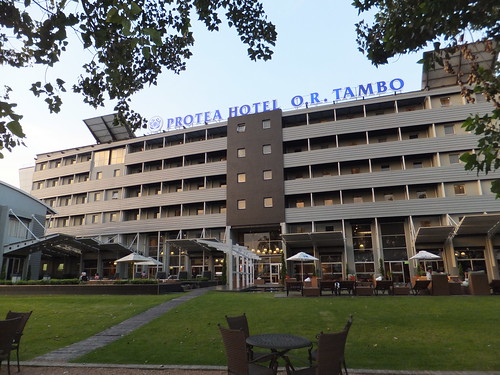
The Protea Hotel adjacent to O. R. Tambo Airport, Johannesburg

This time, I was able to check-in, go up to room 319 and finally have my shower. The Protea is a modern hotel with an aeronautical theme. The facilities in the room were quite reasonable.  The room was at the 'back' of the hotel, looking across to the airport with only a grassed area by the hotel pool and a dual carriageway between me and the apron! My pictures of the Protea O. R. Tambo are here.

My computer readily found the hotel's Wi-Fi and connected but I couldn't reach any web page. When I queried this with reception they said "Oh, the internet connection is down at present - it won't be back today!" so I was reduced to off-line text preparation.

I decided to take dinner in the hotel. The old aircraft photographs I found interesting and I was intrigued by the use of pilot's clipboards and aeronautical charts all over the place. The restaurant floor was a full-colour oversize reproduction of an area chart for Johannesburg - quite impressive. There was an aircraft simulator next to reception (switched off on Tuesday). But I was less convinced by the way the general architecture was themed 'industrial', with lots of floor plate used inappropriately (as wall cladding - some sheets fitted the wrong-way round!). The restaurant was called 'The Warehouse' so exposed steel beams abounded with 'fake' bolts and, as befits a warehouse if not a restaurant, wooden packing cases. However, the fish dish I ordered was good although I found the place rather noisy. I never understood the engine block in reception suspended from three (?) chain hoists or the oversize G-clamps attempting to stop the top of the reception desk from floating away. On its own admission, the hotel is seeking to be a 'Hot' destination in Johannesburg so I suppose it was doomed to not quite please me. 

After the meal, I returned to my well-appointed bedroom. The room had a smallish opening window and I was surprised to find it only single glazed. In fairness, I was some distance from the main runways and there was no disturbance from the arriving and departing aircraft. A couple of times, I could hear large turbo-fans starting up but it wasn't a problem. There was a continuous rumble from the road traffic, occasionally increasing as a particularly noisy lorry passed but, with the curtains drawn, it didn't spoil my sleep.

More when I'm able.


Sunday, 12 February 2012

Transit in Dubai

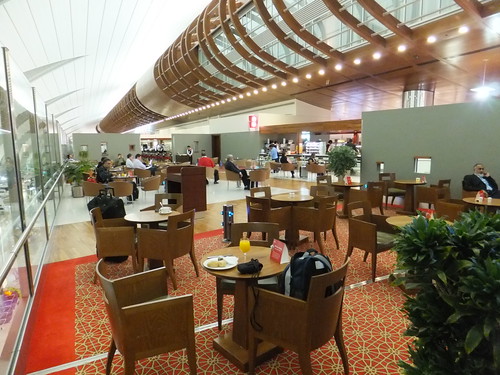
Just part of the Emirates Business Lounge at Dubai Airport.

Monday 13th February 2012

Following the late arrival of my aircraft at Birmingham, we were also late leaving. But Emirates have their own lounge in Birmingham now, so I was relaxed about the delay. My earlier post was entered using my Notebook and a good Wi-Fi. It was only after I'd made that post I discovered (tucked in a corner of the lounge) a business centre with seven PCs which I could have used.

Boarding the aircraft (a Boeing 777-300ER) was fast and I had seat 4A in business, next to a charming lady travelling back to Cairns with a brief stop-over in Dubai. The layout in business is 2-3-2 with a state-of-the-art 'lie-flat' seat and on-demand entertainment with hundreds of channels. There was fairly low overcast so, soon after take-off from runway 33, we lost sight of the ground but everywhere seemed white with heavy frost or snow. As we continued over northern Europe, the cloud cleared but the landscape was the same heavy frost or snow we'd seen over England.

They served a very reasonable lunch so I was quite comfortable and I decided to watch the recent cinema release of Le Carre's 'Tinker, Tailor'. I know the earlier BBC television series quite well so it was a bit odd to have different actors in all the roles but it seemed to have the same dystopian feel as the book and the television series so I enjoyed it. I had a brief look at the Speilberg 'Tin Tin' film but I decided I wasn't in the mood for CGI so I flattened the seat and rested. The flight to Dubai takes six to seven hours (depending upon wind). I was starting to get a little restless before we arrived so I watched the new Clooney release 'Ides of March' which I found a bit sub-'West Wing'. Regular readers will have realised that the only time I see new cinema films is during long-distance flights.

Dubai Airport has expanded so much that there are often air traffic delays on landing and we seemed to stooge around before making our final approach, touching down at about 00:45 against a scheduled time of 00:15. The air bridges were promptly connected and I was in the terminal by about 01:00, with plenty of time to kill because my connecting flight EK761 to Johannesburg wasn't scheduled to leave until 04:40.

I walked through the terminal and the experience was rather like visiting the Bull Ring Centre in Birmingham - modern architecture, shops everywhere and lots and lots of people. It amazes me that people are even awake in the middle of the night, let alone grasping these retail opportunities with such relish.

In the past, I've had trouble trying to find a Business Lounge at Dubai but this time I navigated straight to it. I've been to large lounges elswewhere but I think the one I found at Dubai must take the prize (although I suspect there are other candidates I've not yet seen). The lounge seemed to be big enough to qualify as a terminal in its own right and there were many passengers enjoying the various facilities. Having picked up an orange juice, I walked to a business lounge with about 16 PCs. It was quite busy but, fortunately, the users were quiet. So, I was able to give you this update before commencing the second leg of my tour.
To reach Dubai, we've come through a number of time zones and local time has moved forward by (I think) four hours so that locally it's Monday. But Blogger uses its own time and has timestamped the post 'Sunday'. I haven't changed the timestamp.
Into the Dark Continent

The 777-300ER which would take me to Dubai. On the other side of the airfield, just above the nose of the Boeing, you can make out the original terminal building. This reminded me of some of my early flights from Elmdon (as it was then known) some years ago.

Sunday 12th February 2012

Off again! So far I've made it as far as the Emirates Lounge at Birmingham International Airport. The journey to the airport via the M6 was painless and, although the terminal was teeming with passengers, Emirates check-in was prompt. I was told the inbound flight was about 15 minutes late and on my way to the lounge, I spotted the aircraft landing. There's an Express Lane leading to security but, oddly, one member of staff was dividing his time between checking boarding cards on the ordinary lane and the express lane. The Birmingham accent of this gentleman was very apparent as he declaimed in a loud voice "Ooh - Jo'burg. Very nice. And Up the Front all the way!".

Security was the usual unpleasant experience. Shoeless and less hat, scarf and jacket I passed through the arch of a metal detector whilst my possessions were separately X-rayed. A lady then gave me a very thorough 'frisking' before finishing off with a detailed check with a wand-type metal detector.

Once I'd finished getting dressed again, I had to run the gauntlet of duty free but eventually I came to the signs for the Emirates Lounge where I was warmly greeted. Armed with a cup of tea, I fired up the Notebook Computer to send this report.

I'm leaving on flight EK040 to Dubai, due to depart at 13:25 and scheduled into Dubai at a quarter past midnight. Then, I should take the EK761 onto O. R. Tambo Airport, Johannesburg, due in 10:50 on Monday the 13th. I've planned to have a meeting with one of our suppliers in Johannesburg before overnighting at the Protea hotel near the airport. Then, on Tuesday morning, I'm booked to take the BA6291 leaving O. R. Tambo at 11:00 for Livingstone, where I spend a few nights at the Royal Livinstone Hotel. Well, let's hope all these arrangements work out. I'll send an update when I'm able.

There are a few pictures of Birmingham Airport here.

Rail and Canal at Bloomfield

In general, the canals of England came before railways and many proposed railway schemes were opposed by canal owners as threatening their established business.

The construction of canals led to the creation of a mobile, skilled workforce of 'Navigators' ('Navvies') and these skills became vital in the susequent construction of railways. Earlier 'Contour' canals largely followed the existing geography but Telford's 'straight-line' canals were altogether more ambitious, requiring prodigious volumes of spoil to be moved. To produce these more direct canal routes, the surveyor had to determine where cuttings and embankments were required and, wherever possible, use the excavated soil from a cutting to form an embankments. This type of more direct route was exactly what railways were to require. Early steam locomotives had rather limited tractive effort and the inclines had to be kept reasonably gentle by the use of cuttings and embankments.

The success of railways ultimately brough about the demise of most of the canals but there was a period when railways and canals worked as parts of an integrated transport system. In many cases, railways bought up ailing canal companies and there are still remains of various canal/rail interchanges. Even after railways came to dominate the transport industry, the canal interchange traffic struggled on. I believe it survived the second world war but, by the time I was taking a serious interest in the railways of the West Midlands in the 1950s, canal interchange traffic had ceased and the canal basins which served the railways became derelict.

Part of a plan of the Birmingham Canal Navigation dating from around 1920.

When I started visiting Bloomfield Junction signal box on the L&NWR Stour Valley Line from Wolverhampton to Birmingham, I was aware of the abandoned Bloomfield Basins on the Up side and the still-just-active Tipton Five Ways Goods Depot on the Down side but I failed to study the sites in detail. Although I happily walked along main lines to reach signal boxes where I was expected, I was actually quite timid about trespassing. I walked down the sidings from Bloomfield box towards Tipton Five Ways as far as the bridges under the GW but I never actually went into the depot yard, so I only saw it when passing by train on the Stour. I remember walking along the Up sidings to inspect Bloomfield Basin but the site was very overgrown and had become rather hazardous.

Wagon turntables were in use on railways from very early days, initially on narrow-gauge arrangements at coal mines and similar installations.

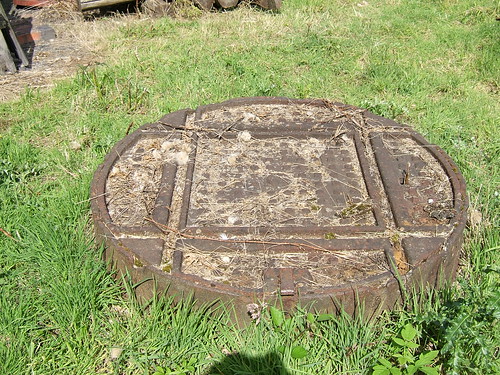
A cast narrow-gauge wagon turntable at Black Country Living Museum (without the approach tracks).

In the early days of railways, no passenger station would be complete without a battery of turntables to assist in marshalling each train but, eventually, such small turntables became confined to goods yards and canal interchanges. I remember finding a group of wagon turntables at Bloomfield Basins but all the top timbers which should have provided a walking surface had rotted away (or, perhaps, been stolen as fuel). What remained were deep, flooded pits filled with the rusting frameworks and pivots of the wagon turntables which, I'm sorry to admit, discouraged me from further investigation.

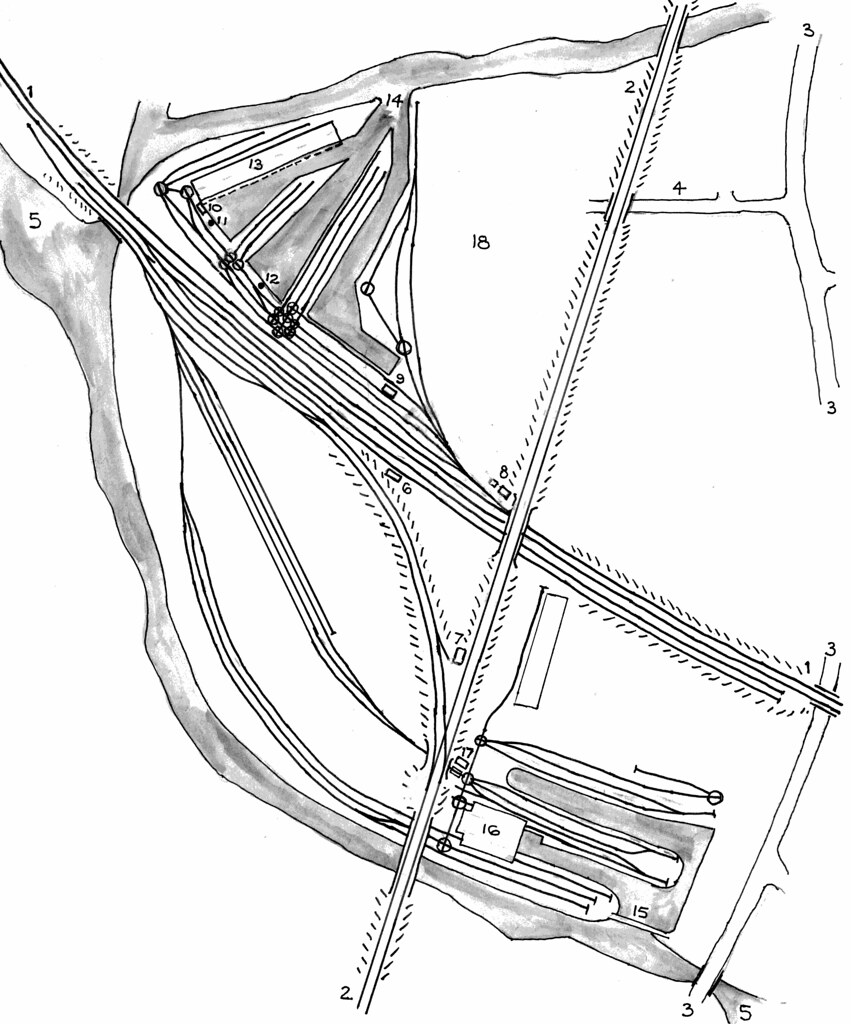
I've not been very successful in finding information detailing the area in its heyday. Old maps are not always clear and revision dates can be problematic. So I've prepared a sketch map from various sources which may not be accurate in all details or complete but which, I hope, gives an impression of how matters stood in the early years of the 20th century. The sketch map is below.

A larger version of this sketch can be found here.

The table below explains the numeric references shown on the sketch.

Number Description
1 Wolverhampton (High Level) - Birmingham (New Street) Stour Valley Line (L&NWR)
2 Wolverhampton (Low Level) - Dudley Line (GWR)
3 Bloomfield Road
4 Bloomfield Terrace (giving access to Bloomfield Basin)
5 Birmingham Canal Navigation
6 Bloomfield Junction Signal Box
7 Tipton Five Ways Signal Box
8 Platelayers' Hut
9 Weighbridge Office
10 Weighbridge Office (probable)
11 Crane
12 Crane
13 Transhipment Shed at Bloomfield Basin
14 Canal access to Bloomfield Basin
15 Canal access to Tipton Five Ways Basin
17 Weighbridge Office (Tipton Five Ways)
18 Bloomfield Basin undeveloped area (later occupied by sidings)

Let's first look at the L.& N. W. R. Bloomfield Basins, at the top of the sketch. There are three separate canal arms and access is not from the 'Main Line' canal but from an older canal. The Stour Valley railway line and Sidings 1, 2, 3 and 4 (siding 1 is nearest the Up Main) are at right angles to most of the quays, although siding 4 (behind the weighbridge office) is adjacent to short quays and two hand-operated cranes. Wagons can be transferred (one at a time) using various wagon turntables from these sidings to sidings running out along the quays. Bloomfield Basin seems to have had 14 wagon turntables in the period being described. As I comment above, at least some of these remained in derelict form into the 1960s.

More to follow ...

Monday, 6 February 2012

Railway Friends at Brewood

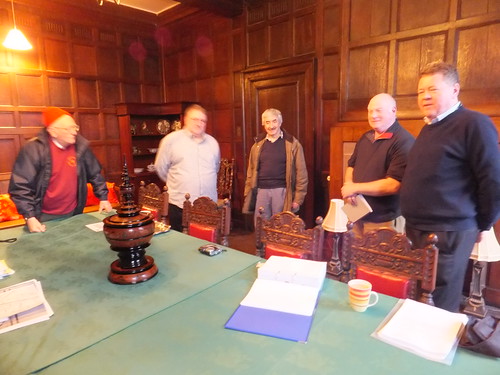
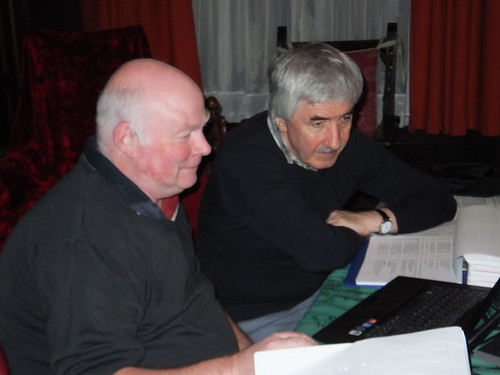
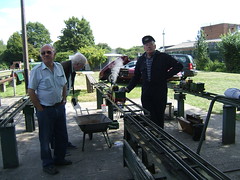
John, Phil, Mick, Ian and Mike in a rather formal pose.

A few of my railway friends visited Brewood Hall on 27th January 2012 for discussions and research. This time, there was no organised Slideshow, but Ian had brought his laptop so as to share some of his comprehensive records of the South Stafford Line.

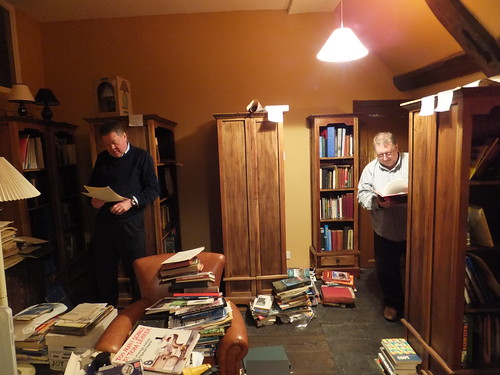
Mick and Phil at work in the library,

Towards the end of 2011, further shelving was installed in the library and a start has been made on organising the fairly extensive collection of books and documents but the job will take some time to complete.

Ian shows Mick some of his extensive computerised visual records.

It's exchanging information with this group which has encouraged me to keep posting some of the railway articles in this blog about my own recollections of the end of the steam era.

The evening finished with refreshments, discussions and a commitment to meet again soon. In the meantime, matters proceed via e-mail. Earlier meetings are described here and here.

Friday, 20 January 2012

Review of the Year - 2011

I'm pleased to be able to say that 2011 was another good year for me and I'll mention some of the highlights below. I'm still working at Ford Electronics where most of our projects are railway-related but, for commercial reasons, I don't normally put much in the blog about this important area of my life. The year wasn't all good, of course, but let's emphasise the good bits. I've divided the review into 'OVERSEAS TRAVEL', 'RAILWAYS' and 'BREWOOD HALL'.

OVERSEAS TRAVEL

There were three overseas trips in the year, all very enjoyable and instructive.

Saint Helena and Ascension

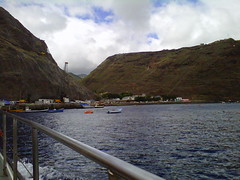
I was determined to visit the island of Saint Helena in the South Atlantic before they build the long-threatened airport, which will surely transform island life for ever. The picture shows Jamestown, St. Helena, viewed from the sea. After a few days on the fascinating island, I then sailed on to Ascension Island where there is an airport but the only flights are RAF Transport Command! This trip exceeded my expectations and you can find the various posts on the trip here.

Russia

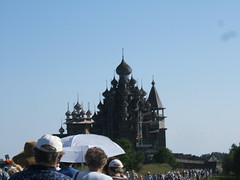
On the second trip, I flew to Moscow and joined one of the many river ships which cruise between Moscow and Saint Petersburg on a combination rivers and canals. There were some fascinating contrasts as we moved between cities, towns and villages. The picture shows the improbable-looking, wood-constructed Transubstantiation Cathedral on Kizhi Island.My reports are here.

Burma

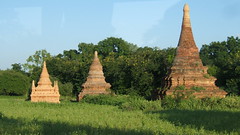
For my last overseas trip in 2011, I returned to the river cruise ship 'Road to Mandalay' in Burma. I re-visited two schools, visited three schools for the first time and visited two boys' and one girls' orphanage. At each place, I helped in the distribution of charitable support provided through 'Road to Manadalay' by the ship's passengers. I also participated in the official opening of a new Medical Clinic in Bagan built, staffed and supported by the 'Road to Mandalay' and its passengers. The picture shows a group of brick pagodas in Bagan. My reports on the trip are here.

RAILWAYS

During the year, I continued driving at Peak Rail, the Battlefield Line and the Museum of Science and Industry in Manchester on a regular basis. I'm still secretary of the Old Locomotive Committee (LION's supporters club). I'm also involved with an informal Historical Group researching railways in the West Midlands. In March 2011, the Historical Group held another Slideshow and Meeting at Brewood. For the rest of the year, communication was mainly by a (sometimes frantic) exchange of e-mails. In connection with that research, there are a number of articles in the blog about Traffic Movements and signal boxes in the '60s. I've also put rough sketches of a number of track diagrams in the blog (before I lose them again).

Old Locomotive Committee

The A.G.M. in May 2011 gave members a last chance to view 'Lion' before her transfer to the new Museum of Liverpool (see below).

Agecroft No. 1

In June 2011, I had my first opportunity to drive newly-restored Agecroft No. 1. She's proved a popular and reliable performer and made many new friends on her visit to the Tanfield Railway.

Day out with Thomas

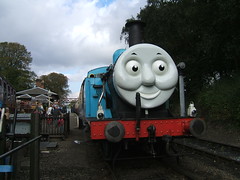
At the Battlefield Line Day out with Thomas, I shared the driving on 'Thomas' with Eddie on the 25th June 2011 and returned the following day to drive 'Daisy', the 2-car DMU.

Matlock Station Re-opening

The first Peak Rail trains into the former down platform at Matlock station ran on Friday 1st July 2011, reserved for invited guests and Peak Rail shareholders. The first revenue trains were on Saturday 2nd July 2011, when I drove 68103 as part of the Matlock Station Festival Reopening.

Lion Shoot

On 6th July 2011, John Hawley and I took part in the Lion Shoot, where Centre Screen filmed interviews to be incorporated in the Audio-Visual interpretation of 'Lion' in the Museum of Liverpool (see below).

Lionsmeet

Lionsmeet 2011 was held at Chelmsford on 30th July 2011. After a good contest, the Mike Parrot Memorial Cup was won by Jon Swindlehurst.

Summer Saturday at Shackerstone

On 27th August 2011, I had my first turn on the Great Western 2-8-0 currently at the Battlefield Line. More details here.

Thomas visits MOSI

Thomas made his second visit to the Museum of Science and Industry in Manchester in September and I was driver on 1st September 2011. More details here.

Thomas visits the Battlefield Line

'Thomas' was back at the Battlefield Line in October for two weekends. On the 9th October 2011, I was driving 'Daisy' the DMU and on the 16th October I was in charge of 'Thomas'. More details here.

Royal Opening of the Museum of Liverpool

I was present at the Official Opening of the Museum of Liverpool by Her Majesty the Queen on 1st December 2011. There's a report here.

Peak Rail Santa Specials

Peak Rail had another well-patronised 'Santa' season. I was the driver on 10th December 2011 on visiting locomotive 'Sapper'. My report is here.

Battlefield Line Santa Specials

The Battlefield Line Santa Specials were handled by popular visitor '3803'. I was the driver on 17th December and had a great time.

MOSI Christmas Trains

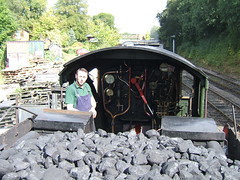
Agecroft No. 1 handled the MOSI Christmas Trains and I was driver on 29th December. The weather was pretty bad but we still had lots of passengers (the photograph above was taken earlier in the year).

The 'Mince Pie Flyer'

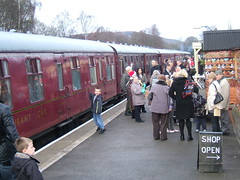
On New Year's Eve, I drove the recently-outshopped single-unit DMU ('Bubble Car') on the Mince Pie Flyer at the Battlefield Line. The weather was pretty good and plenty of passengers turned up. An enjoyable end to the year!

BREWOOD HALL

No major works in 2011, just ongoing maintenance. Various visits from friends and family, plus three Group Visits outlined below.

Wulfrun College Retired Staff Association

On 23rd February the Wulfrun College Retired Staff Association visited Brewood Hall. There's a very brief report here.

'History Walks'

A party of 41 from History Walks toured Brewood Hall on 8th May.

National Association of Decorative and Fine Arts Societies

NADFAS visited on 13th October and there's a report here.

EARLIER REVIEWS

2010
2009
2008
2007
2006

Wednesday, 18 January 2012

Peak Rail in Winter

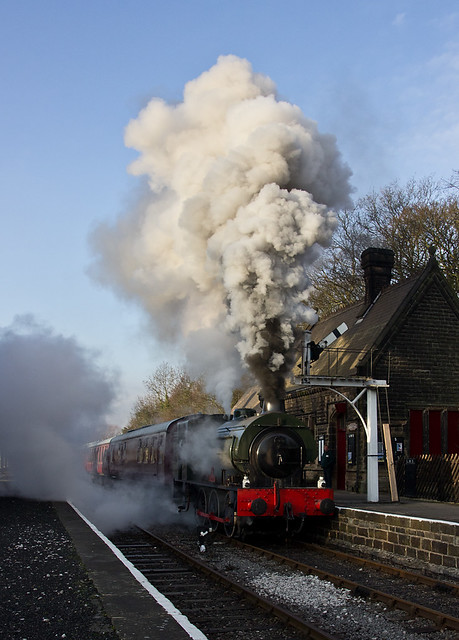
'Sapper' in the frost: Up train approaching Darley Dale. Click above for complete image.(Photo: Sheila Rayson)

Peak Rail tries to operate a passenger service all the year round but in winter it's restricted to Sundays. I was rostered as Driver on Sunday 15th January 2012, with Dave as Fireman. As I walked across the yard at Rowsley to the outside pit at the shed, I noticed that our train had been reduced to 5 coaches (we'd run with 7 on the Santa Specials). This wasn't surprising - the Santa trains usually run at peak loading (no pun intended) but the shorter train should be adequate to meet the demand on a cold January Sunday. As far as I knew, we were top-and-tail to Matlock (Town), as all the services have been since we re-opened Matlock Station, apart from the Santa Specials. I also wasn't surprised that there was no big diesel attached to the north end of the stock yet - the first passenger departure was not until 11:15. But I was surprised that the tank wagon parked opposite the south end of the stock used to replenish the locomotive water had been removed as this would make watering during the day harder.

Dave had signed on at 04:00 to 'light-up' so, by the time I arrived a little before 07:00, matters were well in hand and Austerity tank locomotive 'Sapper' was radiating warmth (although there were still four-inch icicles hanging from the underframe). It was still dark and the thermometer was down to minus five Celsius as I started oiling round. I'd no time to feel sorry for myself as we were due 'off shed' at 08:15, light engine to Darley Dale to pick up our candidate for a two-hour driving experience course. I've described the preparation of this class of engine here.

We were ready on time and, in possession of the single line staff for the Rowsley-Church Lane section, attempted to move away. Something was frozen but, after a slight pause, things freed themselves and we moved off. The hand points we had to change were stiff with frost and the ground frame which let us onto the running line was heavy to operate. We gently ran down to Church Lane Crossing where Rob let us through the gates and we surrendered the staff. I commented to Rob about the missing water tank to be told there was no diesel that day. "So we're on our own?" I exclaimed as the consequences sank in. If we were on our own, it would be like the 'old days' when we ran round the train each end and did all the work ourselves. Our destination would be Matlock (Riverside), where there are run-round facilities, rather than Matlock (Town). But, at least, we'd be able to water at the grey tank wagon at Rowsley as we ran round (provided it wasn't frozen!). Dave and I looked at one another - normally we'd both relish the extra work, but we'd turned up expecting a fairly easy shift and that had now changed. Oh well, "Embrace the Unexpected" is one of my sayings.

We continued to Darley Dale Up Platform and met up with our trainee driver, just as the Station Staff were arriving. By this time, Rob had driven by road from Church Lane to Darley Dale so that he could let us through the Darley Dale Level Crossing. Once introductions were made and our trainee was on board, Rob let us over the Crossing and gave us the single line staff for the Darley Dale-Matlock section. Our trainee was a good driver, although he'd never driven a steam locomotive before, so we had a pleasant but rather cold couple of hours pottering between Darley Dale and Matlock Riverside. I've described the format of the Peak Rail driving experience courses here.

With the current timetable, driver training is 08:45 to 10:45 then we're booked light engine back to Rowsley, ready for the first passenger train at 11:15. We said goodbye to our trainee in the Down platform at Darley Dale and Jackie called across that we'd be taking a film crew from Darley Dale on our first Up train. We hadn't time to find out more as we needed to water at Rowsley before 'tie-ing on' to our train. With the passenger coaches stabled in the platform at Rowsley, we had to go around the loop to get to the grey water tank (which, to our relief, was not frozen), take water and then return via the loop to get to the south end of our train. By the time we'd done this, we'd only a few minutes to start steam heating the coaches before the first passengers boarded - not long enough. I've talked about 'hooking on' to a train and steam heating in On the Footplate Part 2. Because of the heavy frost, I also wanted to be sure I'd done a 'functional' brake test on the vacuum brakes, checking that brakes could be applied along the train by the driver. If brake cylinders become frozen in the released position, the driver may discover he has a lot less braking effort than he expected! There's more about the vacuum brake in Section 4 of the article Brakes. A proper test involves a lot of walking up and down alongside the train, first checking that the brakes can be applied and then checking that they can be released.

I didn't make a note of our departure time by the time the station staff were ready to send us out. We were late and, I knew, destined to become later when we picked up the film crew. We had a gentle run down to Church Lane where we were checked by the signal whilst the signalman manually pushed the gates across. During the day, we were checked or even stopped each time we passed Church Lane. On one Up train, we were called on by a yellow flag so we approached the facing motor points very cautiously, to ensure they were correctly fitting-up, before we moved across them.

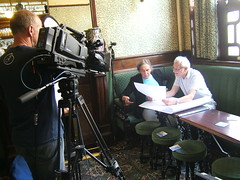
We arrived at Darley Dale and were introduced to James Lewis, an auctioneer and valuer well-known for his appearances on various television antiques programmes. He was already dressed in a boiler suit and was to travel with us on the footplate to Matlock and back with his cameraman. James proved to be good company and he was very enthusiastic about accompanying us. The footplate on an 'Austerity' tank is not that large so, with Driver, Fireman, Cameraman (porting a large, professional camera) and James aboard, I remember at one point saying "One of us is going to have to go on a diet!". Eventually, they had recorded the shots they wanted (and the third member of the film crew, the Director, had taken a footplate ride) so we said goodbye to our visitors.

James Lewis saying goodbye after his footplate experience. (Photo: Sheila Rayson)

Now about twenty minutes late, we carried on with the timetable. With the various temporary speed restrictions, there's not much scope for catching up lost time 'on the road'. It has to be done by smart running round or watering, leaving little opportunity for getting food or drink. At about 13:30, Dave was relieved by Phil as fireman. As the heading picture shows, the scenery looked very attractive with the heavy frost but, boy, was it cold. We normally try to avoid black smoke but, on an afternoon Up departure from Darley Dale, Sheila asked for a bit of an effort and you can judge the result (below) for yourself. In warm weather, of course, steam can remain invisible but cold air condenses steam to water vapour, giving quite impressive results.

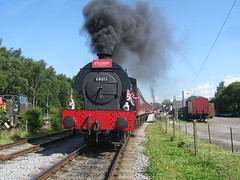
'Sapper' takes an Up train out of Darly Dale. (Photo: Sheila Rayson)

For the last round trip from Rowsley, we lit the locomotive lamps. There's an article on lamps here. By the time we arrived back, it was quite dark but we were on time. We 'hooked off' and made our way back to the shed's outside pit, about nine hours after I left it that morning. The method of disposal currently in use at Peak Rail is a little different from that described in the article Disposal, but the principles and the hazards are the same. I partially filled the boiler but left '100 pounds' (100 pounds per square inch) on the 'clock' so as to be able to make the final movement into the shed with an effective steam brake. By closing right up to the diesel shunter in the shed, we were 'inside, clear' and Phil was able to close the roller shutter door whilst I finished filling the boiler. As Phil and I had a wash (it's difficult to keep clean on a steam locomotive but I have worked with people who manage it) we agreed that we were both fairly exhausted but had had a good time.

There are detail pictures of 'Sapper' here.

A number of articles about working on locomotives are linked above. You can find all of them here.

Friday, 13 January 2012

The Titfield Thunderbolt

The well-known poster for the film by Edward Bawden.

All of the 'Ealing Comedies' series of films are well-known and well-loved. But 'The Titfield Thunderbolt', released in colour in 1953, is surely one of the most affectionately remembered. This is partly because of the use of a genuinely old locomotive called 'Lion' which, for the benefit of the film, was renamed 'The Titfield Thunderbolt' and turned out in a fairly striking livery.

In the 1950s, I think I saw the film four times in the cinema so, even at that tender age, perhaps my later association with railway preservation could have been predicted. In fact, it was not until I was in my mid-40s that I actually got involved in preservation, first becoming a member of 'Lion's' Supporters Club, the Old Locomotive Committee (OLCO) and later becoming involved with a number of railways and preservation initiatives.

The film's gentle, but witty, screenplay from T.E.B. Clarke was supposedly inspired by volunteers having taken over the running of the Talyllyn Railway which, in 1951, became "The World's First Preserved Railway".

My favourite dialogue from the film comes when the Vicar declares that they must not allow the Titfield line to be closed and the Town Clerk replies that they closed the historic Canterbury and Whitstable line. With full ecclesiastical gravity, the Vicar retorts:-
"Perhaps there were not men of sufficient faith in Canterbury".

There's more about the film in an article on Wikipedia.

From time-to-time the film is still repeated on television and I'm glad to report that it's still available on DVD.

The film screenplay was adapted as a stage play by Philip Goulding and in 2005 a professional stage production of 'The Titfield Thunderbolt' toured theatres in Horncastle, Coventry, Windsor and Eastbourne. It was great fun but nothing like the film, of course. I saw the production in Coventry with the Old Locomotive Committee (OLCO) President and his wife and my review (below) first appeared in the OLCO newsletter 'Lionsheart'.

THEATRE REVIEW
by our occasional drama critic, Jan Ford

No, there's not been much call for a drama critic in OLCO. But when 'The Titfield Thunderbolt' is adapted for the theatre, we had to check it out.

How can you adapt one of the best of the Ealing Comedy Films for the stage? Well, the 'Telegraph' drama critic Charles Spencer, having seen the production at Hornchurch, commented "You can't, but you can have a lot of fun in trying". His review encouraged me to see the staging in Coventry.

It's a strange mixture of the familiar and the new. Chunks of dialogue taken straight from the screenplay, interspersed with all sorts of plotlines not in the original, yet all done with such apparent affection that it remains true to the spirit of the original.

The original John Gregson role, Squire Chesterford, is transformed into Lady Edna Chesterford, played in "jolly hockeysticks" mode by Kate O'Mara. The Reverend Weech becomes much younger, as played by Steven Pinder and the Union Representative at the Enquiry, Mr. Coggett becomes Miss Coggett. A number of these changes are predicated by the multiple roles adopted by the actors – five actors cope with fourteen roles, involving some amusing on-stage quick-changes. The sheer gusto and good nature of the cast soon dispels any thoughts of wobbly sets or improbable plotting.

The short season (Hornchurch, Coventry, Windsor and Eastbourne) is now finished but, if there is another season, and I certainly hope that there will be, I strongly recommend that you check it out for yourselves.

The cover of the Programme for the 2005 production in Coventry of 'The Titfield Thunderbolt' starring Kate O'Mara and Steven Pinder.

I believe the stage play has since become a popular choice with dramatic societies. At the time of writing, I've just learnt that Southport Dramatic Club have a production running from 27th January 2012 to 4th February 2012 and I'm delighted to copy their playbill below:-

There are a number of articles in my blog about the locomotive that starred as 'The Titfield Thunderbolt' and the locomotive's "Supporters' Club", OLCO. You can find them here.