Monday, 23 April 2018

South by overnight coach

Events of 20th October/Saturday 21st October

We left the doctor’s house by taxi about 7.15 pm with the Doctor, his wife and the writer as passengers, together with our luggage and two large bundles of small, white towels given by a donor. The towels were packed in tens in polythene bags which had been bundled in sacking, then stitched to make secure parcels. In common with most Yangon taxis, the luggage space was reduced by a large propane gas tank in the boot. It took about an hour to reach the Eastern Long Distance Bus Terminal, which was as chaotic as ever.
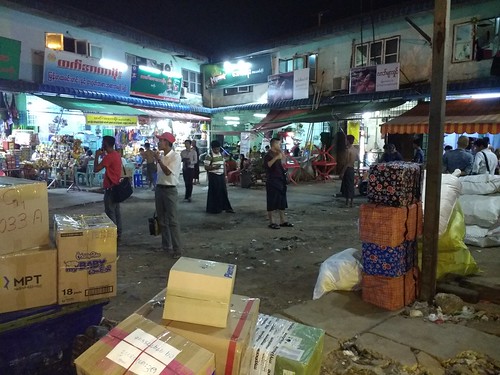

Eastern Long Distance Bus Terminal, Yangon: 21st April 2018.

Somehow, we got our own luggage into the commodious luggage hold but only after 7 men (5 runners, one unloader and one loader) had transferred the contents of a packed covered pick-up to the coach in an attempt to show the limits of the luggage space. The coach was a modern Chinese offering with left hand drive. The left hand drive was quite a relief in a country which now drives on the right (following a pronouncement by the notorious General Ne Win in 1970). Even when the legacy of right-hand drive vehicles for driving on the left had been replaced, the replacements were often from left-driving nations (most notably Japan), to the discomfort of nervous front seat passengers. Each side window of the coach was provided with heavily-swagged curtains giving, I thought, a curious 'Gipsy’ feel.
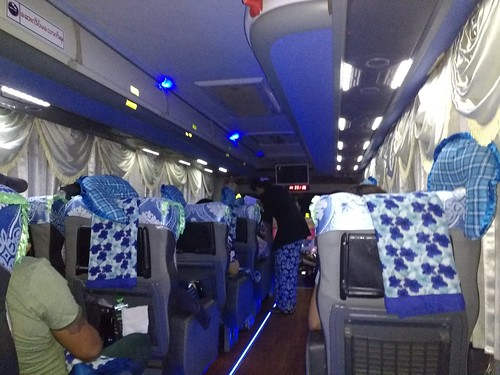

Our coach from Yangon: 21st April 2018.

We started our journey, around 9.15 p.m., travelling backwards. In common with many Myanmar bus stations, arriving buses head towards a long building divided into offices, waiting areas and maintenance bays for the various companies, meaning that departure involves reversing into a continuous flow of buses, taxis, pick-ups, motor cycles, push bikes and the variety of modified light carriers which inhabit these areas. After a series of starts, shouted warnings, urgent horns and fierce stops, the coach inserted itself into the melee and, now travelling forwards, after a few minutes we found ourselves on the main road where speed picked up giving a demonstration of just how hard the suspension was.

By midnight, we’d pulled up at one of the roadside cafes that service the long distance coaches. By western standards, most of the toilets at these places are rather primitive but, at the cafĂ© areas, the staff perform prodigious tasks of providing fresh-cooked Myanmar food to a rapidly-changing clientele. Fast it may be but it does seem to involve an awful lot of shouting between staff. After a couple more hours on the road we made another refreshment stop where the toilet facilities were quite restricted. I’d assumed we’d leave the coach at Mawlamyine around one hour later, as we had previously, but I discovered we were travelling further on the coach. We didn’t stop long at Mawlamyine Bus Station but we stopped again on the outskirts of town whilst parcels were extracted from our luggage compartments and stuffed into a pickup truck which had appeared. Around 6.30 Saturday morning, the coach stopped again near a road junction in Mawkan, which I recognised as our drop off point the previous year when we headed north from Dawei in a minibus. The manager from Ko-Dut Drop In Centre was again waiting for us with a taxi. There was a slight delay because the parcels unloading on the outskirts of Mawlamyine had managed to thoroughly mix-up the remaining parcels and luggage but, after a frantic few minutes, we’d retrieved everything we’d started out with and were able to board the taxi and drive the last few miles to Ko Dut. When we arrived, there were plenty of staff but the building wasn’t besieged by children so I wasn’t surprised when the Doctor told me the distributions would be held in Ko Dut Monastery, as the previous year.

Although I’d managed some sleep on the journey, tiredness was starting to overtake me but a shower (Burmese style) revived me a little and the Doctor, his wife and I took breakfast together (oatmeal, fried egg, white bread and margarine and English Breakfast tea for me). All the young volunteers then had a ‘second sitting’ of breakfast, by which time the taxi had returned and it was time to load the sacks full of uniforms, towels and snacks for transfer to the monastery. The attractive red and blue traditional Burmese shoulder bags had previously been packed with the stationery being given to each child and the volunteers ferried these to the monastery using their own motor bicycles, the driver and one or two passengers each festooned with as many bags as they could manage.
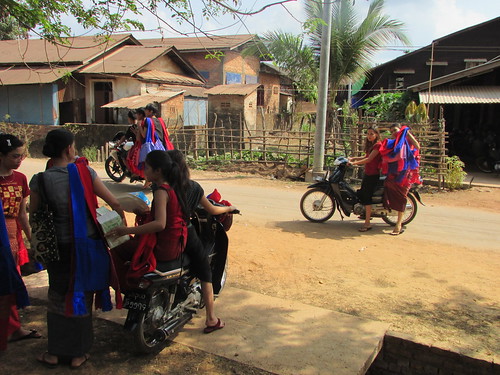

Distribution at Ko Dut Monastery, 2018: Volunteers ferrying school bags by motor cycle from the Drop In Centre to the Monastery.

Finally, the taxi returned to take the Doctor, his wife and the writer to the monastery. In the large assembly hall, there were separate groups of, mainly young, children from both Government schools and Mon Ethnic Schools who were to receive the distribution of stationery and a new school uniform.

As more children arrived, the individual groups were combined into two phalanxes, theatre-style but without the cbairs. Eventually, a senior monk from the monastery arrived accompanied by a young monk who, I was to discover, was an excellent English speaker. The monk encouraged the children to recite a clearly well-known prayer and afterwards he addressed them for a few minutes. Afterwards, the young monk translated the gist of the speech: the importance of education, remembering that it makes you clever, not necessarily good and the evils of drugs. Whilst not a Buddhist, I agreed with these sentiments. The monk also made gracious comments about foreign donors who make this type of distribution possible.


Distribution at Ko Dut Monastery, 2018.

The senior monk asked me to address the children and my brief English homily was translated into the Mon dialect by one of the teachers. The shoulder bags packed with stationery were then presented to each child. There were insufficient white towels to allow each child to have one, so the Doctor instituted a lottery which added to the fun. Square lottery tickets had been cut from white paper and winning tickets were marked with a symbol. Each ticket was then tightly rolled. Another little ceremony presented the winners with their prize.
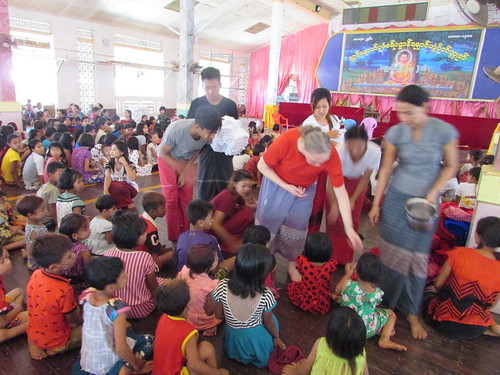

Distribution at Ko Dut Monastery, 2018: Jan helping to distribute lottery tickets for the limited number of white towels.

All the children then formed up on a large, concrete staircase for the traditional group photograph.
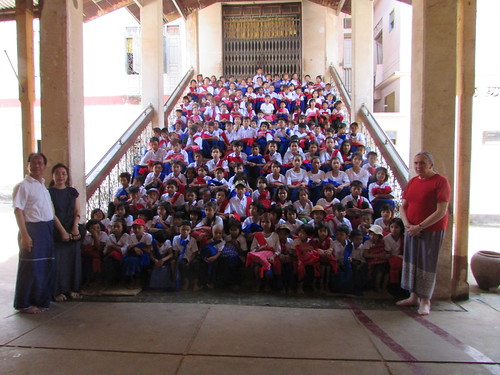

Distribution ar Ko Dut Monastery, 2018: the Group Photograph.

This format was repeated at our second visit of the day to the Drop In Centre at La Mine which is quite small but provides vital support to the youngsters. Most of the children remembered previous visits which I’d made and the teachers and volunteers were unchanged. The element of dependability can be so important in the lives of children lacking traditional family support.
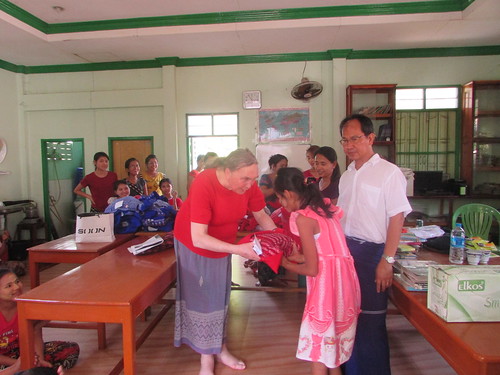

Distribution at La Mine Drop In Centre

The lottery for white towels followed: an Imaginative volunteer had decorated winning tickets with a 'smiley face'.
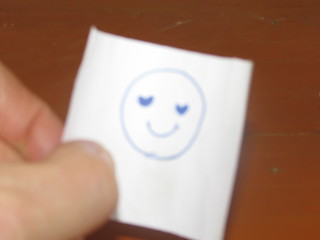

A winning ticket!
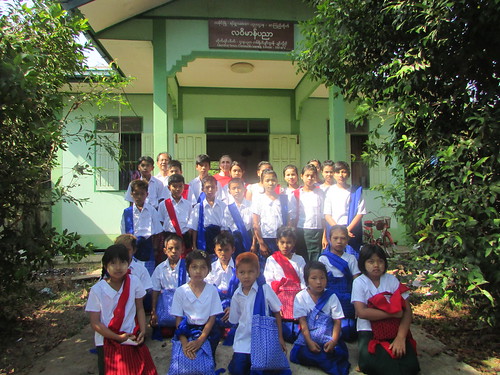

Distribution at La Mine Drop In Centre: the group photograph.

After the group photograph at La Mine, we drove to our final visit of the day, to another small Drop In Centre at Mot Ka Nin. Once again, staff and students were largely unchanged since my last visit about one year ago.
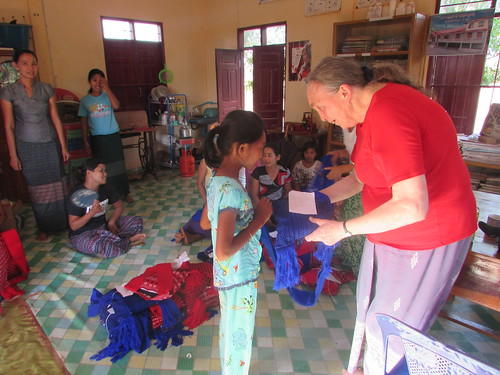

Distribution at Mot Ka Nin
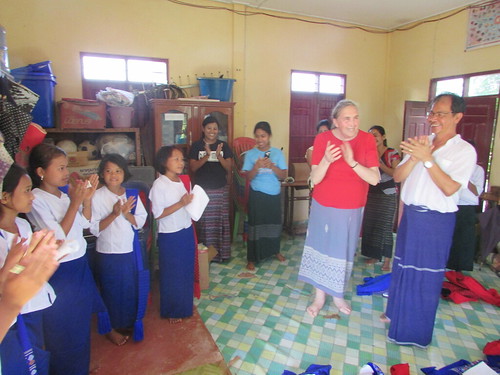

Distribution at Mot Ka Nin, 2018: Smiles all round!

We then retraced our route to La Mine where we took ‘sweet tea’ and dinner in one of the many tea shops near the large monastery.
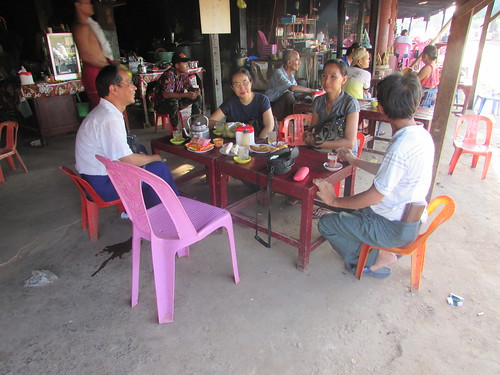

‘Sweet tea’ and dinner in one of the many tea shops near La Mine Monastery.

After our meal, my friends paid their respects to the Buddha Image in the temple. The simple piety of the Myanmar people I find very moving.

In the town, we stopped to purchase fresh Durian fruit. This is never a simple task in Myanmar and invariably there is good-natured haggling before the deal is struck.
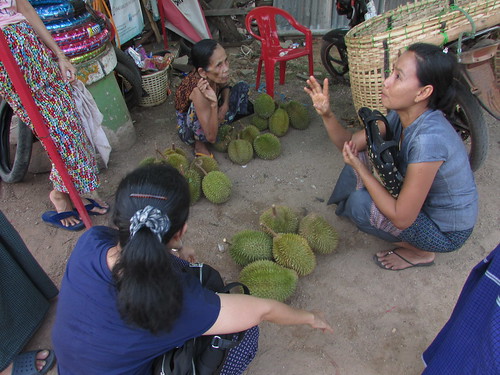

Purchasing Durian Fruit in La Mine

Then, it was back to Ko Dut Drop In Centre for the night. At present, electric power at the Drop In Centre is supplied by one of two elderly portable electric generators. The heat had tired me out and I was asleep before our generator was turned off.

Related posts on this website

This is one of a series of posts describing my 13th visit to Myanmar. The post Travelling again is the first post in the series.
Clicking on the 'Next report' link displays the post describing the next events. In this way, you may read about the trip in sequence.
Next report.
Alternately, clicking on the 'All my Burma-2018 reports' link displays all the posts on this trip in reverse date-of-posting order.
All my Burma-2018 reports.

My pictures

Distribution at Ko Dut Monastery, 2018
Distribution at La Mine Drop In Centre
Distribution at Mot Ka Nin
La Mine and Ko Dut D.I.C.

All my pictures on this trip to Myanmar can be found at Burma 2018.

[Pictures linked 10-May-2018, Pictures inserted 26-May-2018]

Friday, 20 April 2018

Resting in Yangon

Recovering Thursday/Friday 19th/20th April 2018

I must be getting old. The journey from England seemed to have taken its toll and I spent most of Thursday just lying on my bed. It's hot in Yangon at this time of year - the internet said 37 degrees Celsius (that's 99 degrees Farenheit). I've always tried to acclimatise to local conditions and persevered with the fan in my room for some hours before giving in and resorting to the air conditioning set to a moderate 25 degrees Celsius. It was early evening before I emerged, rather befuddled. Because of the heat, the number of Western tourists dwindles at this time of year. So why am I here now?

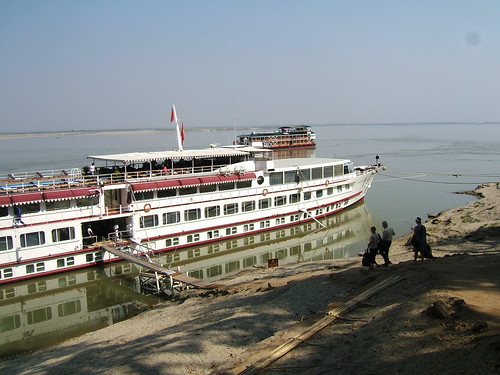
My host, Doctor Hla Tun, is Ship's Doctor on the luxurious Belmond 'Road to Mandalay' river cruise ship.


'Road to Mandalay' moored at Bagan during my very first trip to Myanmar in 2008. The vessel in the background is the rather less luxurious 'Government Ferry'.

When the ship is operating, his on-ship duties confine his charitable work to the Mandalay-Bagan area and the Bagan Medical Clinic. But, during the 'low tourist season', the ship stops operating allowing the Doctor to attend to charitable initiatives in other parts of Myanmar. For some years, the Orphans and Vulnerable Children (OVC) project in Mon State has been supported by the Doctor and, by travelling to Myanmar now, I'm able to see for myself what donations make possible.

Of course, having slept most of the day inevitably sleep eluded me for much of the night, particularly since I'd developed an itchy heat rash. I'm afraid I was largely inactive on Friday, too, gathering my strength for our trip south by overnight coach Friday evening.

During the day, the Doctor was arranging to parcel the items which would travel on the coach with us for distribution to children in Mon State. With distributions planned to over a thousand children at various locations around Mon State, it's a major logistical exercise to ensure that the required items are available.

Related posts on this website

This is one of a series of posts describing my 13th visit to Myanmar. The post Travelling again is the first post in the series.

Clicking on the 'Next report' link displays the post describing the next events. In this way, you may read about the trip in sequence. Next report

Alternately, clicking on the 'All my Burma-2018 reports' link displays all the posts on this trip in reverse date-of-posting order.
All my Burma-2018 reports

My pictures

You can find all the pictures taken on this trip at Burma 2018.

Thursday, 19 April 2018

Talking about Engines

In the post 'Learn to be a Driver' Courses at Birmingham Railway Museum I described the talks given to driving trainees about locomotive engineering at Tyseley.

The article below on Locomotive Boilers is based on some of my notes from that period.

So you want to drive a steam locomotive?

It takes some time to really learn the job. In the pre-war days of the 'Big Four' (LMS, GWR, LNER, SR), you could be working on the footplate for 20 years or more before you graduated to become a driver. In that time, you were expected to have picked up a lot of knowledge, a lot of experience. The engine driver is like the captain of a ship: on the footplate, he is in charge. Whatever happens, it's up to the driver to decide what to do. The confidence to take the right actions in an emergency depends upon familiarity with the construction and working of engines. Well, let's make a start and keep it fairly simple.


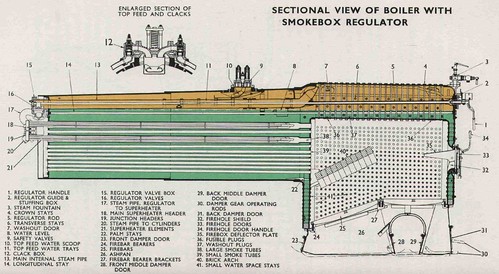
Great Western large taper boiler (less smokebox)
Click for larger version.


All the great locomotive designers have understood that the key to a successful engine design is its ability to boil water. If you can't make steam in the first place, everything else is a waste of time. Here, in the yard at Tyseley, we've a number of locomotives under restoration and this gives us the chance to look at a boiler which has been lifted out of the frames. This is a Great Western design boiler, taken off an 8-coupled freight locomotive, but fairly similar to the boilers used on all larger GWR engines (see diagram above). The principles are the same as almost all steam locomotives in the world - the classic 'Stephensonian' boiler going right back to the Rocket, built in 1829! Looking at the boiler, supported on wooden packing on the ground, it's apparent that the boiler unit is, in fact, three parts joined together. In the middle is the boiler itself, recognisable by its fairly cylindrical shape. This is chosen to give it sufficient strength to contain the high-pressure steam which will collect above the surface of the boiling water which will fill the boiler when it's in use. In a lot of locomotives the boiler is a proper cylinder and we call it a 'parallel' boiler. But this one is a bit more complicated, as it is coned slightly towards the front of the engine and is called a 'taper' boiler. The main reason for this tapering is to improve the internal convection currents in the water as it is boiled. The back end of the boiler is joined to a complex structure called the firebox, bristling with riveted stay heads. This is where the fuel is burnt to produce the heat energy which boils the water. The front end of the boiler is joined to a simpler, cylindrical tube called the smokebox which carries the chimney.

Let's have a closer look at the firebox. That's where the coal goes, so that's where it all starts. The firebox is rectangular in plan and towers above us in a sort of inverted-U section, open at the bottom. The front end of the firebox is joined onto the boiler barrel and the back end is solid, apart from a number of small piercings for mounting various boiler fittings and a circular hole about 18-inches diameter, called the firehole. That's where the coal goes, so the cab, sits immediately behind the firebox with the footplate, where the driver and fireman work, built up to a little below the firehole. This arrangement is supposed to make it easy for the fireman to swing round and collect coal from the bunker or tender containing coal behind the cab, then deftly deliver each shovelful through the firehole and onto the right spot on the fire. As you'll see when we get on the road, it's not always that easy.

This boiler is under restoration, so many of the stays are missing. Instead, you can see a tapped hole in the steel outer firebox which will receive the screwed stay which is riveted over after fitting to make it completely steam tight. Looking through the hole in the outer firebox, you can see an inner firebox wall about 3-inches away, with a corresponding threaded hole. The stays, thousands of them on a large boiler, suspend the inner firebox from the outer firebox making a strong, rigid structure. Because this boiler has been lifted up on sleepers, we can actually duck under the bottom of the firebox and stand up inside the firebox. Now the structure is a little clearer. We're standing in an upside-down box, open at the bottom. This inner firebox is made of copper, so that it can quickly conduct the heat from the fire, which would be where we're standing, through to the water on the other side, trapped in the space between inner and outer fireboxes. Around the base of the firebox, inner and outer fireboxes are riveted together through a substantial foundation ring. Brackets projecting inside the firebox near the foundation ring are used to carry a series of cast iron firebars which, when work on the stays is complete, will sit across the bottom to support the burning fuel. The firebars have ends wider than the middle so that narrow air spaces are left between adjacent firebars allowing combustion air to be drawn up through the burning fuel.

Perhaps we should briefly discuss the chemistry of the combustion of coal. Coal is a naturally-occurring substance extracted from the ground comprising mainly carbon and carbon in association with hydrogen. Analysis varies widely according to where the coal is found. Iron, sulphur and ash-forming impurities are normally present. The importance of coal is that, if warmed to a few hundred degrees Farenheit, it emits vapours which will burn in the presence of air. That means, principally, that the hydrogen in the coal combines with oxygen in the air to form water vapour and the carbon in the coal combines with oxygen in the air to form the colourless, odourless gas called carbon dioxide. These are the same combustion products given off by cars burning petrol or diesel which, like coal, are also hydrocarbons but in liquid form more readily burnt than coal. In all cases, the chemical reactions in which oxygen combines with hydrogen and carbon in the fuel gives off a lot of heat (the reactions are said to be 'exothermic') and this is what we're after - heat energy which can be converted into mechanical energy to make the engine go.

Coal doesn't burn that easily. We have to raise its temperature to about 800 degrees Farenheit (400 degrees Celsius) before it starts to emit a burnable gas. This is the oily, tarry volatile part of the coal, made up of complex hydrocarbons which give off heat when they are oxidised by burning in sufficient air. This air supply is critical. The oxygen needed for burning is only around 1/5 of air by volume. Air is mainly nitrogen, which is an inert gas playing no active part in our combustion. For the volatile hydrocarbons to burn away properly, we have to make sure that there's sufficient air to provide all the needed oxygen. A lot of the details of a locomotive boiler are concerned with arranging and controlling this air supply. If we don't provide enough oxygen, the hydrocarbons drift away as a yellowish gas and the heat we could have produced by burning them is lost.
When the volatiles have burned away, what remains is principally carbon, as coke. This will burn away fairly slowly. If sufficient combustion air is provided, then the carbon oxidises to carbon dioxide, giving off considerable heat in the process. This reaction takes place at a considerably higher temperature - around 2800 degrees Farenheit (about 1500 degrees Celsius). If the air supply is restricted, the carbon oxidises to carbon monoxide. This reaction takes place at a much lower temperature and liberates far less heat. Again, we lose energy.

So a conscientious fireman will understand the reactions taking place in the firebox and will regulate matters so that the coal is burnt efficiently, releasing the maximum amount of energy. That way, he will use less coal and use less physical energy himself.

As each individual lump of coal emits burnable vapours, it becomes smaller and smaller and sinks down towards the firebars, as fresh coal is added on the surface. Eventually, all the carbon is gone and what remains is the incombustible ash. If you're lucky, this will fall through the air spaces between the firebars and be collected in the ashpan suspended underneath the firebox. But many coals contain a certain amount of iron, often in the form of iron pyrite (Fool's Gold), comprising iron in association with sulphur. The sulphur in the iron pyrite is released as a gas, sulphur dioxide, discussed below, whilst the iron combines with the ash content to form a solid slag or clinker. This can spread out across the firebars as a solid sheet, blocking the air spaces and reducing the usable area of the firegrate. This problem is called 'clinkering' and may announce itself by the boiler suddenly stopping steaming as the grate chokes up. So a fireman will pay careful attention to the fire, firstly to minimise the production of clinker as much as possible and, where unavoidable, to break up the clinker before the pieces become too large.

The origin of the coal will determine its chemical analysis and thus its clinker-forming characteristics. Not all coals are suitable for locomotives. Coals with a high sulphur content are problematic. As with iron pyrite, the sulphur combines with oxygen in the combustion air to give sulphur dioxide which then further reacts with the water vapour produced by the combustion of the volatile hydrocarbons to give sulphuric acid - 'acid rain'. Not only is this environmentally unfriendly, but the smoke tubes in the boiler leading the gases away from the firebox to the chimney are damaged by the acid.

Unless very carefully controlled, burning coal can be a very dirty, smoky business. The volatile gases given off, if incompletely burned, give a dark grey exhaust at the chimney. In addition, small particles of coal tend to get carried away before they are burned, appearing as black smoke at the chimney.

The original Act of Parliament allowing steam locomotives to be used on railways (Railway Act 7th George IV) was very concerned about the tendency to produce black smoke and the legislation said that locomotives must "consume their own smoke". In 1829, when the design of the Stephensonian boiler evolved, the only way to achieve this with the readily-available fuels was by using coke, not coal to power the engine. As discussed earlier, coke is what you get when you heat coal and drive off the volatile hydrocarbons. This has to be done with a limited supply of air, allowing the hydrocarbons to be released, but preventing the second stage of burning as the carbon burns. Originally, this was done by digging a pit in the ground, filling it with coal, setting fire to it and covering the coal to restrict the available air. Although coke burning was effective as a means of preventing smoke, the separate production process was inconvenient and a number of locomotive engineers experimented to find a way of burning coal directly in the firebox. The answer, when it came, was relatively straightforward. Matthew William Kirtley of the North Midland Railway (later the Midland Railway) realised that gases and fine particles emitted from the burning fuel in a locomotive firebox were being drawn away from the hot area immediately above the firebed, where conditions were favourable to complete combustion, too quickly for all the reactions to take place. Some of the combustion air was being drawn straight through the firebed and through the smoke tubes to the chimney, without its oxygen being used up in helping to completely burn the fuel. What was needed was some means of promoting more intimate mixing of the combustion air with the hydrocarbon gases and small coal particles in the space above the burning fuel. The answer was an inclined arch set across the width of the firebox, made from heat-resisting refractory bricks. This deliberate obstruction to gases leaving the firebox via the smoke tubes causes the gases to be reflected back towards the fire and swirl around above the firebed, delaying their exit and giving an opportunity for all the oxygen in the air to be used up in complete combustion. When the engine is worked hard, the brick arch itself becomes very hot and this, in turn, helps to keep the gases at the high temperature needed for complete combustion.

There are two sources of combustion air to a locomotive fire. The first has been discussed: air drawn from under the locomotive, through the ashpan , through the slots in the firegrate and through the burning mass of fuel. This is called primary air, or 'bottom' air. But the firehole provides not only the means for getting coal into the firebox, but also a means of allowing further air into the firebox. This is called secondary, or 'top' air. Secondary air is introduced above the burning fuel, providing additional air which mixes with the gases being given off by the coal, supplying additional oxygen to allow complete, efficient combustion of the gases. This secondary source is used as required, the fireman judging when to run with the firedoors closed and when to run with the firedoors open or partially open. The fire will be hottest running on primary air alone, but unless there is adequate draught on the fire to pull sufficient air through the firebed, there is the chance of incomplete combustion or the production of excessive smoke. Opening the firedoors allows in additional air but since secondary air, unlike primary air, is not pre-heated by passing through the firebed, the effect will be to slightly cool the fire.

The main function of the ashpan, hung underneath the firebox, is to collect the ash and cinders produced by the burning coal as they drop through the spaces in the firegrate. A traditional ashpan is provided with a solid bottom and solid sides made from sheet steel but one or both ends are arranged with hinging doors called dampers. These can be manually opened and closed by a mechanical linkage to the footplate, allowing the fireman to manually regulate the amount of primary air. Gravity is normally arranged to keep the dampers closed and there is frequently a series of notches in the damper control lever allowing the fireman to latch the damper door at different openings.

During disposal of the locomotive on shed, all the dampers are opened wide allowing the disposal staff to stand in a pit and rake out all the ash. This is essential as, once the ashpan is full of ash, it prevents combustion air from passing through the ashpan to reach the fire. There are many different layouts of ashpans, dampers and damper control linkages. On small locomotives, there may only be a back damper with the front of the ashpan solid. Two dampers are most common, one front, one back (sometimes termed 'fore' and 'hind'). In some locomotive designs, the trailing axle gets in the way of the ashpan, which may have to hump up to clear the axle. This may require additional damper doors to ensure that all the ash can be cleared. In large GWR locomotives like 'Castles' or 'Kings', two completely separate ashpans are provided, one in front of the trailing axle and one behind. These ashpans are provided with a total of four dampers, two front and two back. 'Merchant Navy' and 'West Country' Pacifics have a screw arrangement operated from a handwheel in the cab to set the position of the dampers.

Clinker is the enemy of the fireman. The various overgrown pokers carried on engines, called fireirons, are provided to let the fireman poke about in the fire, to break up clinker and assist ash in dropping through the firebars into the ashpan. There's usually a selection to reach different parts of the firebox. In a narrow firebox of a large engine, the fireiron is about twelve feet long, so it's no easy task to wrestle it down from the tender, rake it through the mass of fire and then, with the working end now red hot, lift it back onto the tender. 'Cleaning' the fire is best done whilst stationary but, if the fireman is caught unawares by an engine that won't steam, the process has to be done on the road. But with good coal fired intelligently onto a fire that was clean to start with, an engine can steam all day without attention from fireirons.

Well, there's lots more to say about boilers but that'll do for now.

Arriving in Yangon

Events of Thursday 19th April 2018

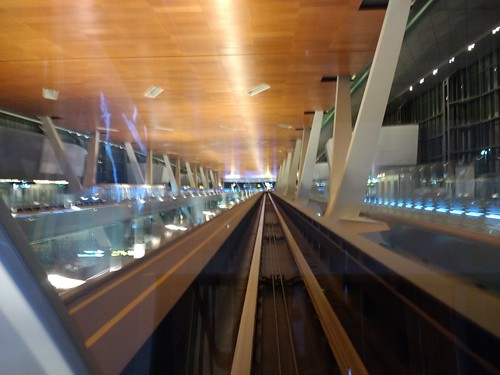
The flight from Doha to Yangon left from the 'E' group of gates which, because they are at the end of a long 'spine', are served by their own automatic 'railway', rubber-tyred and cable-hauled. Our gate was on the ground floor and we were led to a waiting, modern, articulated transfer bus indicating that the aircraft was at a remote stand.


Rubber-tyred, cable-hauled automatic 'railway' serving 'E' group of gates at Doha Airport 18th April 2018

The Business Class section of the waiting A319 had just eight modern seating units but I discovered that I was the only Business Class passenger so I was thoroughly spoiled by the friendly cabin crew. I watched 'Paddington 2' (about the bear, not the raiway station) whilst they served dinner then decided to sleep on the almost-flat bed. After a few hours sleep, I watched a couple of episodes of the 'sit-com' 'WIA' about the BBC whilst taking a continental breakfast. The flight duration was five and a bit hours and, although our published arrival was 06:00 we actually touched-down at five o'clock. To my surprise, by 05:15 my arrival formalities had been completed and I was reunited with my checked bag.

Doctor Hla Tun and his wife met me, as arranged, and we drove to the Doctor's home where a breakfast (fried egg, oatmeal, Coca-Cola which had become the 'default menu' on previous trips to suit my rather intolerant tastes) was immediately placed in front of me. The Burmese people are some of the most hospitable in the world. The Doctor prescribed rest after my long journey and, for once, I was disinclined to argue. I did, however, set-up my Dell laptop to allow me to work on the computer occasionally.

Related posts on this website

This is one of a series of posts describing my 13th visit to Myanmar. The post Travelling again is the first post in the series.

Clicking on the 'Next report' link displays the post describing the next events. In this way, you may read about the trip in sequence.
Next report

Alternately, clicking on the 'All my Burma-2018 reports' link displays all the posts on this trip in reverse date-of-posting order.
All my Burma-2018 reports.

My pictures

Doha Airport, Qatar.
(Pictures taken on this and previous transits/visits to Qatar).
Yangon Airport.
(Pictures taken on this and previous visits to Yangon).

[Pictures linked 25-May-2018]
Wednesday, 18 April 2018

Old Locomotive Committee A.G.M. 2018

The Old Locomotive Committee (OLCO) is the 'Supporters Club' for the 1838 locomotive 'Lion' and 'Lion' models. The full-size 'Lion' now has pride of place in the Great Port Gallery of the Museum of Liverpool on Liverpool's Waterfront.

Events of Saturday, 14th April 2018


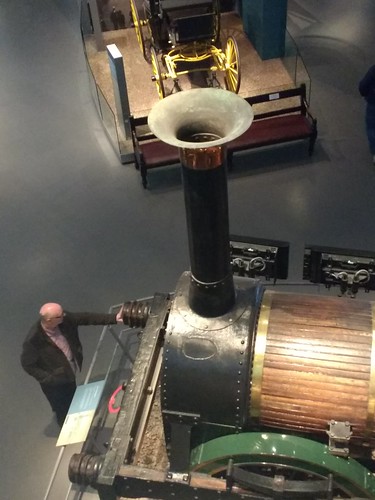
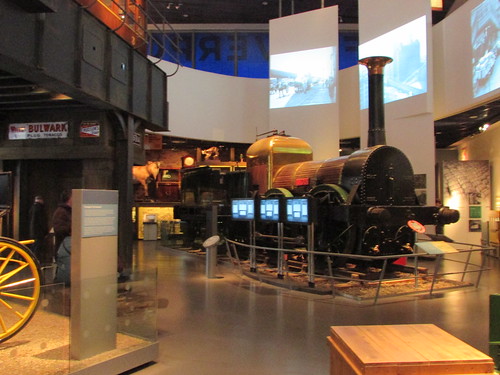
'Lion' in the 'Great Port' Gallery at the Museum of Liverpool.
This overhead view reveals the need for a bit of dusting.


Special Talk

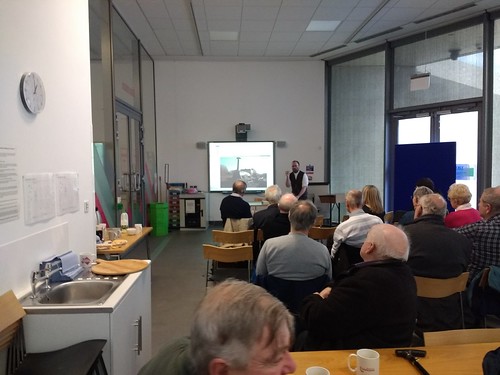
At 12 noon, prior to the A.G.M., the Chairman introduced a special talk about ‘Lion’ entitled "The Lion's tale" which was given by historian and author Anthony Dawson. This entertaining and informative talk described the design and build of the locomotive, her various patents and gave a glimpse of engine driving life in the 1830s.


OLCO AGM 2018: Anthony Dawson giving his talk "The Lion's tale".

The A.G.M.

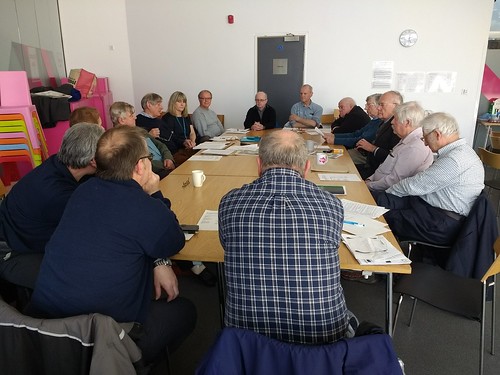
The 33rd Annual General Meeting of OLCO was opened by the Chairman of OLCO, John Brandrick in the Museum's Education Room 2 at 1.30 p.m. The meeting was very well attended this year and, in addition to electing a committee for the next year, there was much lively discussion about 'Lion' matters, both prototype and model. Members of the society will receive formal minutes of the proceedings. The Museum's Curator of Land Transport & Industry, Sharon Brown, was present and made OLCO Members welcome. The society is grateful to Sharon for providing the venue.


OLCO AGM 2018: The Chairman addresses the meeting.

The A.G.M. had been held at the Museum each year since 'Lion' was installed in the Great Port Gallery. There are brief reports on some earlier A.G.M. at the Museum in this blog:-
2012
2013
2014
2015
The Old Locomotive has its own website here.

Other posts about OLCO on this website

All my posts about OLCO and 'Lion' are here.

My OLCO Pictures

There's a small album of pictures taken on the day here.
All my pictures showing 'Lion' and OLCO events are in the collection The Old Locomotive Committee and Lionsmeet.

Travelling again

Events of Wednesday 18th April 2018

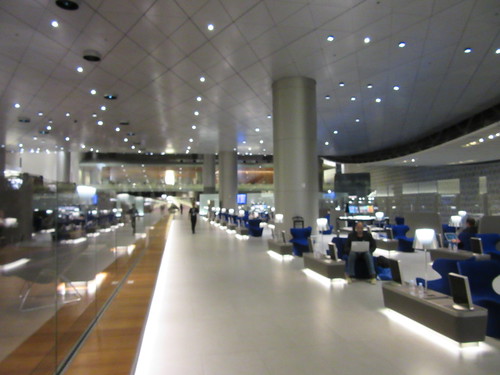
I'm writing this in the spacious Qatar Airways Business Lounge in Doha. I'm on my way to Burma (now called Myanmar) at the start of my 13th visit to Burma since my first tentative exploration in 2008.


Business Lounge, Hamad International Airport, Doha

This will be a mixture of visiting friends, sightseeing and finding out more about the charitable initiatives run by Doctor Hla Tun.

I left Manchester this morning at 08:20 on Qatar Airways Flight QR22, enjoying the excellent service provided on the comfortable Boeing 787-8. It's six p.m. as I write this and I should continue to Yangon at 19:55 on an Airbus A319, arriving six a.m. on Thursday morning.

Related posts on this website

This is one of a series of posts describing my 13th visit to Myanmar. This post is the first post in the series.

Clicking on the 'Next report' link displays the post describing the next events. In this way, you may read about the trip in sequence.
Next report.

Alternately, clicking on the 'All my Burma-2018 reports' link displays all the posts on this trip in reverse date-of-posting order.
All my Burma-2018 reports.

My pictures

Doha Airport, Qatar.
(Pictures taken on this and previous transits/visits to Qatar).

[Pictures linked 24-May-2018]
Friday, 13 April 2018

'Lion' Locomotive - the Lost Years


'Lion', now exhibited at the Museum of Liverpool.

'Lion' is a remarkable survivor. The locomotive was built in 1838 by the short-lived locomotive building partnership of Todd, Kitson and Laird as part of an order for the Liverpool and Manchester Railway. It was designated a 'luggage engine' meaning it was intended for freight trains. At that period, express engines were normally 'single-wheelers' (there's an article on 'single-wheeler types here). 'Lion', with a wheel arrangement of 0-4-2, had four coupled wheels, making it suitable for freight working. The engine spent some time as a bank engine on the Whiston Incline of the Liverpool and Manchester Railway.

During that early period of railways, locomotives were largely built using the skills of blacksmiths and frequent repair or modification was commonplace. 'Lion' was useful enough to survive with various rebuildings (replacing the boiler at least once and the cylinders apparently twice) long enough to pass into the stock list of the Grand Junction Railway in 1845 and, the following year, the London and North Western Railway. In 1859, the London and North Western Railway raised £400 by selling the redundant 'Lion' to the Mersey Docks and Harbour Board (there's a short article about the dock company here).

The Mersey Docks and Harbour Board modified 'Lion' to serve as a stationary engine driving a Ladder Pump used to empty the Princes Graving Dock each time another ship required to be dry-docked. 'Lion' was entombed in a rather handsome Pumphouse (see the article here) which originally had an associated brick chimney. 'Lion' served faithfully in this unusual role until around 1923 when members of the Liverpool Engineering Society discovered the stationary engine on a visit. Their research into the unidentified 'Old Locomotive' revealed that it was the 1838 'Lion'. After electric pumps replaced the Ladder Pump, the remains of 'Lion' were donated by the Mersey Docks and Harbour Board to the Liverpool Engineering Society for preservation.

At that time, preparations were in hand to celebrate the 1930 Centenary of the Opening of the Liverpool and Manchester Railway and the London Midland and Scottish Railway were induced to restore 'Lion' into a working locomotive capable of giving rides to the public on a continuous track laid in Wavertree Park as part of a major exhibition. After its long incarceration in the Pumphouse, 'Lion' will never be forgotten again and this amazing machine has earned the affection of many people on its various exploits since re-discovery. Some of these exploits are briefly chronicled in this blog under the label 'OLCO'.

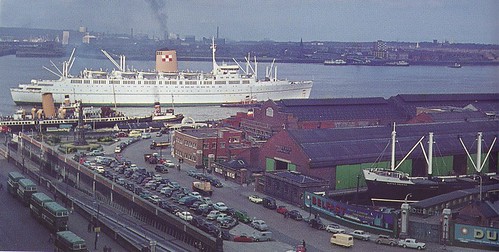
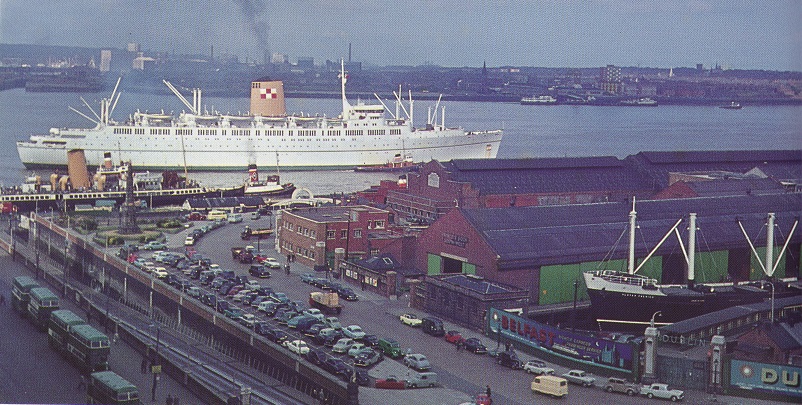
The Pumphouse has been demolished and the area redeveloped but I recently discovered a book called 'Reflections on a River' which has an excellent collection of colour photographs illustrating Liverpool Docks from the time when I was growing up, including the splendid view below which clearly shows the Pumphouse in 1961. The book is still available on the second-hand market.


Liverpool Pierhead in 1961 with the 'Empress of Britain' dominating the scene. Of interest to rail enthusiasts is the rare view of the Pumphouse (to the left of the 'Belfast' hoarding) from where the locomotive 'Lion' was rescued (Photo: N.P.B. collection from 'Reflections on a River').
Click for larger view.


'Lion' now has a more peaceful (if static) life as the star exhibit in the Great Port Gallery at the Museum of Liverpool.

There is a modern society, called 'The Old Locomotive Committee' dedicated to research about Lion's history and the construction of working models of the original with a website Lion & Old Locomotive Committee

Related posts on other websites

Lion & Old Locomotive Committee

Related posts on this website

'Lion' and the Pumphouse.
"Lion's" History (abstracted from the Engineer Nov 14, 1930).
More about 'Lion' (abstracted from Meccano Magazine 1930).
The Old Locomotive Committee.
Lion.

All my posts about the Old Locomotive Committee and 'Lion' can be found here.

My Pictures

Where necessary, clicking on an image above will display an 'uncropped' view or, alternately, pictures may be selected, viewed or downloaded, in various sizes, from the collection of albums listed:-

The Old Locomotive Committee and Lionsmeet

Sunday, 8 April 2018

'Learn to be a Driver' Courses at Birmingham Railway Museum

In the post Birmingham Railway Museum, Tyseley, I talked about some of my experiences working as a volunteer at Birmingham Railway Musuem. In an attempt to boost the Museum's income, 'Learn to be a Driver' Courses were introduced whilst I was there, allowing novices to spend a day learning a little about railways and actually driving steam locomotives. These courses were divided into a number of sessions and the format was immediately successful:-
1. Mandatory safety briefing.
2. The Shunter (person on the ground marshalling vehicles).
3. Signalling (using the Museum's working signal box).
4. Locomotive engineering (using locomotives under repair/restoration).
5. Driving and firing a small tank engine.
6. Driving and firing a well-known tender engine.

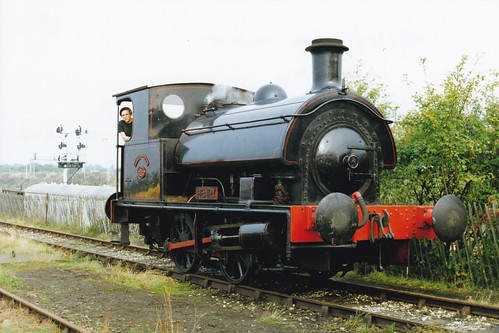
'Henry' often served as the small tank engine.


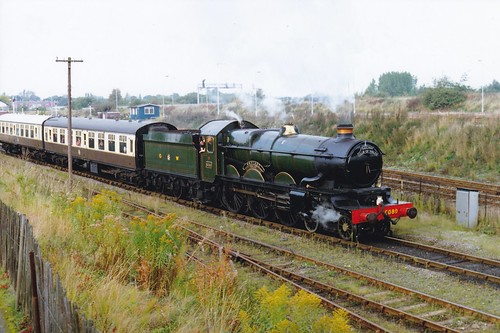
Initially, 5080 'Defiant' was the tender engine (here shown on a passenger train on a Gala Day on 9-Oct-1994).

The trainees were divided into groups of 3 on the footplate, with an Instructor Driver (who in addition to supervising the trainees was responsible for firing/boiler management). For the non-footplate sessions, two footplate groups were usually combined so museum volunteers gave talks to groups of 6 or more trainees and, if 'friends and family' chose to join these sessions, parties of 12 or more were common!

The Shunter's session looked at static wagons, examined manual and vacuum braking systems and demonstrated the use of the Shunting Pole and Brake Stick. Some trainees were keen to try for themselves. Some of the things we explained on these sessions are described in this blog in posts titled 'The Role of the Shunter', starting here.

In the signal box, apart from looking at the mechanical and electrical equipment in the locking room of the signal box, the operating floor gave opportunities for trainees to work the lever frame.

The Locomotive Engineering session conducted in the workshops and outside around the yard with various dismantled locomotives allowed close-up views of different parts of locomotives, including wheelsets, frames, cylinders, motion and boilers. The talks were a very simplified version of the syllabus being covered in Mutual Improvement Classes (MIC) for volunteers at Birmingham Railway Museum being run at the same time, in which I was involved. The background to MIC courses is described in the post here and there's an index of posts in this blog which have the kind of technical content covered in MIC Classes here.

Although the driving sessions were what people had come for, I was surprised and gratified at how much serious interest was shown in the shunting, signalling and locomotive engineering sessions, by both trainees and friends and family'.

Other locomotives were made available to drive from time to time, so the 'small tank engine' role was fulfilled variously by Avonside 'Cadbury No. 1', Bagnall 'Victor' and at least two Tyseley Panniers. A constellation of tender engines included:-
7029 'Clun Castle'
6024 'King Edward I
4920 'Dumbleton Hall'
45593 'Kolhapur'
6203 'Princess Margaret Rose'
34027 'Taw Valley'
35005 'Canadian Pacific'
4498 'Nigel Gresley'
Birmingham Railway Museum: Jan instructing on streamlined A4 4498 'Nigel Gresley'.

Remarkably the iconic Gresley A3 4472 'Flying Scotsman' also made a number of visits offering driving experiences - there's a post about 'Flying Scotsman' at Birmingham Railway Museum here.

Related Posts on this Website

Birmingham Railway Museum, Tyseley.
'Flying Scotsman' at Birmingham Railway Museum.
Index of MIC-related posts.

My Pictures

Where necessary, clicking on an image above will display an 'uncropped' view or, alternately, pictures may be selected, viewed or downloaded, in various sizes, from the album listed:-

Birmingham Railway Museum.
Tyseley 100.


Diesel Multiple Unit, Easter 2018

The Battlefield operated steam trains with 'Cumbria' over the 2018 Easter Holiday but, starting on Tuesday 3rd April, a Diesel Multiple Unit (DMU) service took over. On Tuesday, Ritchie ran a 2-car DMU comprising half of the 2-car set (the other half is awaiting 'shopping') connected to the single unit DMU 55005. The following day, I was to operate the same formation.

Events of Wednesday, 4th April

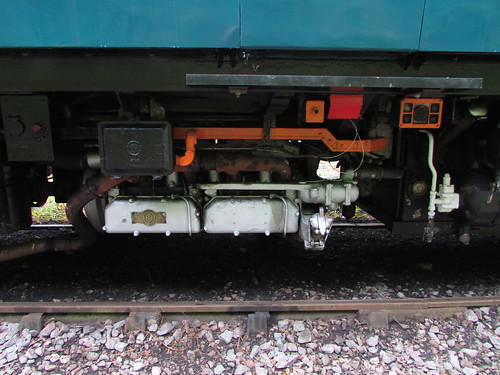
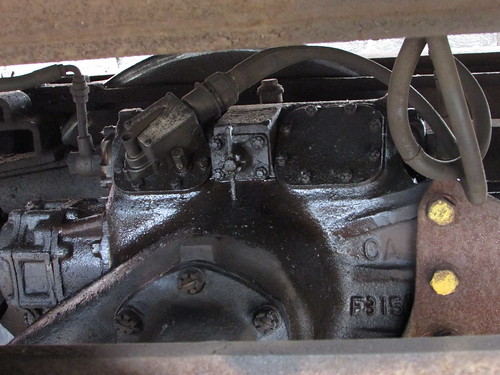
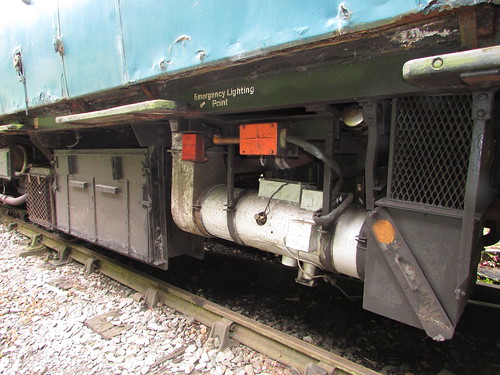
I performed the daily exam and check of levels then attempted ground start of the four 150 horse power 'flat six' bus engines. This is carried out on each underframe-mounted engine control panel in turn, holding the manual throttle in 'full rack' position whilst pressing the electric start button until the engine is firing.


'Flat Six' 150 h.p. bus engine. The red-painted box is the battery charging point. The orange-painted box top right is the engine control panel.

The manual throttle is then progressively eased back to the 'idling' position. To avoid the engine cutting-out, this may take a few seconds. If the engine does stop, a fresh attempt at 'cranking' can only be made after a short delay. The two engines on the single unit 'Bubble Car' started fine but neither engine on the other vehicle would crank. In each case, the starter solenoid came in with a reassuring 'clunk' but there seemed very little movement of the engine. Since both engines were similarly affected, I diagnosed discharged battery. Each vehicle has its own heavy-duty lead-acid 24 volt battery but the heavy current demand when starting each engine means that a good battery in an adjacent vehicle cannot be used to 'jump start' a failed car. The service could have been performed with both cars if one of the two failed engines could have been started, in which case the final drive on the failed engine would have been isolated but this is not recommended with both engines on a power car 'out'.


The vertical bar is the Final Drive Isolating Switch in the 'engaged' position. When horizontal, the drive is 'isolated'.

There seemed two options: put the discharged battery on mains charge or 'ditch' the problem car, performing the service with just the one-coach 'Bubble Car'. Depending on the charge remaining in the battery, it was possible that an hour's charging would allow engine start but, adding the time to connect up and remove the mains charger, that would have put the start of service seriously late. So, after a brief discussion, it was agreed to use only the single unit, which was the vehicle at the southern end of the set. So the 'Bubble Car' had to propel the failed vehicle out of the way at the north end of the station, 'tie it down' and then split the two vehicles. I'd hoped that we might be able to recharge the battery during the day from one of the power sockets provided on the platform face but this did not prove possible.


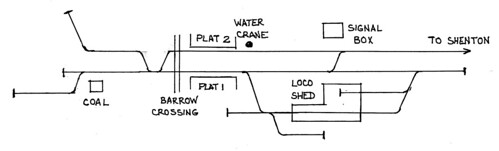
Shackerstone track diagram sketch. North is to the left on this sketch.

In the post Santa Specials at the Battlefield Line 2017 I commented "The rather cramped track layout at Shackerstone requires careful choreography to manage two trains" but, on the morning of 4th April, with various items of freight and passenger rolling stock awaiting shunting operations to be completed, our options were very limited and we decided to leave the failed vehicle in the north end of platform 1.

Splitting DMU vehicles, interconnected by a screw shackle, air hoses, duplicated vacuum hoses and various electrical jumpers is not a trivial task and I was grateful to Adrian for relieving me of this job.

Click for larger image
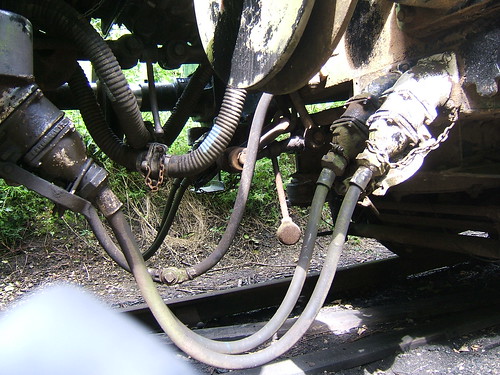
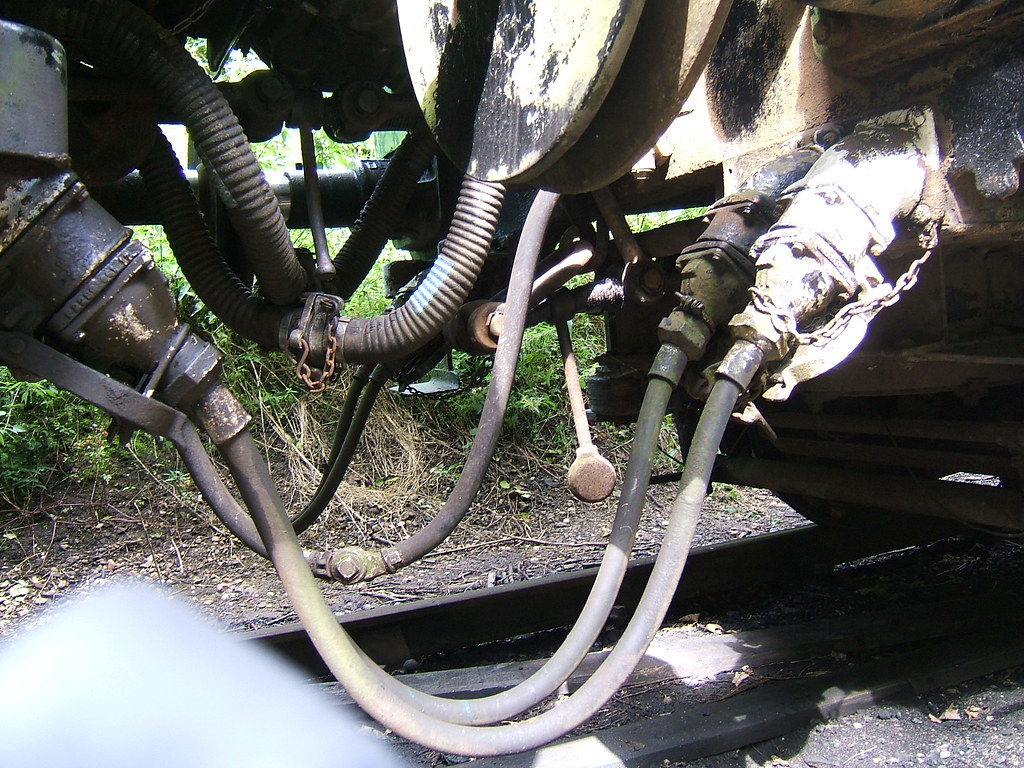
Details of the interconnections between vehicles.


The picture above shows the arrangement and, of course, there's not much room to work. Referring to the picture above, starting nearest the camera, you have:-
1. Jumper cable on left vehicle ('black') attached to multipole connector on right vehicle.
2. Jumper cable on left vehicle ('white')attached to multipole connector on right vehicle.
3. Control air hoses, joined with 'palm' coupling.
4. Vacuum brake train pipe corrugated hoses, joined with standard vacuum connection ('red').
5. Vacuum brake 'quick release' corrugated hoses, joined with 'reversed' vacuum connection ('blue').
6. Standard screw coupling on left vehicle, attached to right vehicle and tightened.
7. Standard screw coupling on right vehicle, not used and suspended from hook on underframe.
8. Jumper cable on right vehicle ('white') attached to multipole connector on left vehicle.
9. Jumper cable on right vehicle ('black') attached to multipole connector on left vehicle.
10. The round buffer heads nearer the camera are visible at the top of the picture.
Jumper cables not in use are 'stowed' in a receptacle adjacent to the jumper cable. 'Palm' couplings are standard on railways for air lines and they are mated and de-mated with an action similar to rubbing your hands together, hence the name. To avoid confusion between the two vacuum brake hoses, the fittings on the 'quick release' hoses are the mirror image of the standard coupling. On DMU, palm coupling fittings are often painted white, vacuum hose fittings red and 'quick release' hose fittings blue.

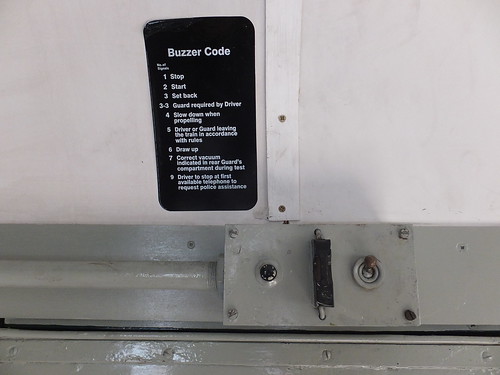
Finally, the Guard placed an unlit oil tail lamp on the lamp bracket at the south end of the failed vehicle as a warning to the driver of an approaching train during the day (me!). By the time all this was accomplished, we were around ten minutes late and our passengers had already boarded the 'Bubble Car' so the Guard gave the 'Right Away' (two buzzes on the Guard/Driver annunciator) which I acknowledged.


DMU: Guard's buzzer pushbutton and Buzzer Code.

We started our booked 'diagram' of four round trips to Shenton as the sky darkened and the weather deteriorated to heavy rain. I started the electrically-controlled diesel-fuel powered warm air heater and, after a while, the passenger compartment was quite cosy. The driver's cabs weren't bad, either.


Left: Battery Box, Right: Underfloor warm air heater.

Ritchie had installed new windscreen wiper blades as well but my initial optimism was tempered by the rather erratic wiper motion produced by the air motors. However, we completed our workings without incident and, by the time we'd finished, it had even stopped raining. It remained to retrieve the failed vehicle from the north end of Platform 1, stable on the DMU siding and put the battery on charge overnight ready for the next day. I closed up to the failed vehicle and Dave attached the screw shackle. I decided to leave all the jumpers and hoses disconnected, in case only the single unit was used the following day (we were not expecting large numbers of passengers).

However, when I'd shunted the failed vehicle that morning, I'd had the benefit of a working vacuum brake because it was still 'piped' to the Bubble Car so, once the vacuum was 'destroyed' the vacuum cylinders on each bogie applied the brakes. Although vacuum brakes will eventually 'leak off', in a well-maintained cylinder the brakes can remain applied for days before enough air leaks past the piston seal in the cylinder to reduce the partial vacuum above the piston and allow the brake blocks to release. Reliance is never placed on how good the leakage performance of a brake cylinder might be and handbrakes are always applied to an isolated vehicle. I had the choice of either re-connecting the brake hoses to the vehicle so that vacuum could be re-created below the piston or ensuring brake release by deliberately admitting air above the brake piston to destroy the persistent vacuum. This is done by opening a release valve associated with each brake cylinder. Because of the inaccessibility of these valves, there is normally a stout cord leading from the valve to framing on each side of the vehicle. Tugging on the cord opens the valve and, after a few seconds, the brake piston should have descended fully, releasing the brake.

In an ordinary bogie coach, the brake cylinders are normally mounted on the coach underframe, adjacent to each bogie. But in a DMU the underframe space is already filled with equipment - engines, transmission, compressors, exhauster - so the vacuum brake cylinders are mounted on the bogie frame itself, with the release cord on the outer end of the bogie. Manually releasing vacuum brakes on any type of vehicle is always called "pulling the strings".

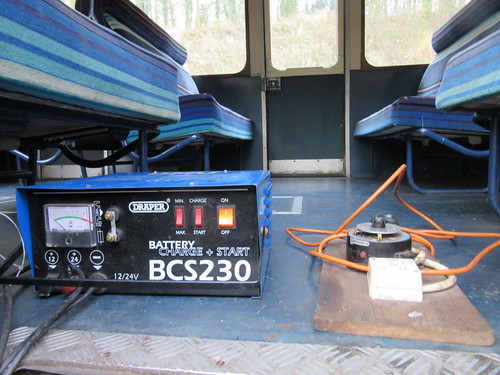
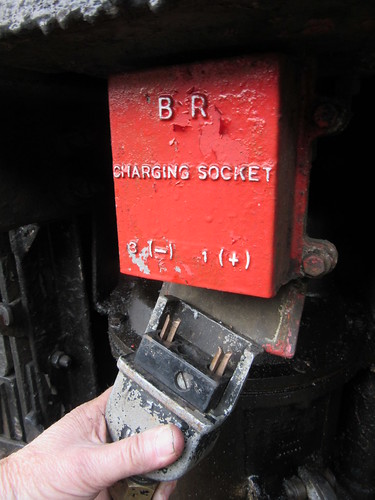
With the brakes released, the Bubble Car then dragged the failed driving motor coach into the siding, allowing the 'big shunt' to be completed by a diesel shunter at some stage. The engines were shut-down, handbrakes applied to both vehicles and the battery charger was connected to the battery charging socket on the failed vehicle in the hope of restoring the battery overnight.


DMU at Shackerstone: Battery Charger.


DMU at Shackerstone: Battery charging socket.

It just remained to complete all the paperwork and the day was done.

Saturday, 7 April 2018

Diesel Multiple Units (Index)

This is a list of the occasional posts I've written about Diesel Multiple Units (DMU), based on my experiences at the Battlefield Line. Content is mixed, sometimes including associated steam train working.

Posts are listed in reverse date-of-posting order but, just to confuse, each post describes events any time from the previous day to fifty years earlier. Alternately, selecting 'DMU' in the list of 'Labels to select a blog topic' will find all my posts about DMU (again, in reverse date-of-posting order). Finally, the Search Box in the page header (with the magnifying glass symbol) will find posts including any particular word or phrase.

Diesel Days 22-Jul-2018
Diesel Multiple Unit, Easter 2018 8-Apr-2018
Summer at Shackerstone 4-Aug-2017
DMU Days at the Battlefield Line 12-Jul-2017
Bank Holiday with Steam and Diesel 7-Jun-2017
The Heritage Railcar at Shackerstone, 2015 24-Jul-2015
The Battlefield Line, 2014 2-Apr-2014
Midweek at the Battlefield Line 9-Aug-2013
Battlefield Line 1940s Weekend (June 2013) 18-Jun-2013
Sunday Diesel 4-Mar-2013
Battlefield Line Modellers' Weekend 2012 29-May-2012
'Thomas' at the Battlefield Line 1-May-2012
The 'Mince Pie Flyer' 3-Jan-2012
Diesel Multiple Units 23-May-2010
Battlefield Line Mince Pie Specials 2009 3-Jan-2010
The Battlefield Line DMU Group 29-Apr-2007

Most of the above posts have links to albums of photographs which can be viewed or downloaded in various sizes. Alternately, you can go to a list of all my photograph collections on Flickr here and look for a particular picture.

[Post added 8-Apr-2018: Updated 14-Sep-2018]
Monday, 2 April 2018

Railway Signalling in Britain: Part 8: Colour Light Signals

In part 4 of this series here, I discussed the illumination of semaphore signals by paraffin or electric lamps to make the indications visible to a driver at night.

But in conditions of poor visibility, such as fog or falling snow, it was realised that the lamp indications needed to be much brighter. Once the lamp indication is visible in all conditions, there is no need for the moving semaphore arm at all. This gave rise to Colour Light Signals which are becoming universal. The semaphore arm (and moving parts) are eliminated and, both by day and by night, the indication is given by various combinations of powerful coloured and white lights. Some cherished techniques from the semaphore era had to be re-designed and electric detection and electric locking largely replaced the mechanical counterparts.

Searchlight signals

The searchlight signal was an early form of colour light with only one lamp, always lit and projecting lens. Different colours were produced by filter pivoted between the lamp and the lens which produced one (more restrictive) colour when an electric solenoid was unenergised and a different colour when the filter was moved by energising the solenoid. The simplest arrangement produced a stop signal (displaying red or green aspect) or a distant signal (yellow or green aspect). Three aspects could be produced by using a polarised solenoid giving 'red' when unenergised, 'yellow' with one polarity applied to the solenoid and 'green' with the opposite polarity applied.


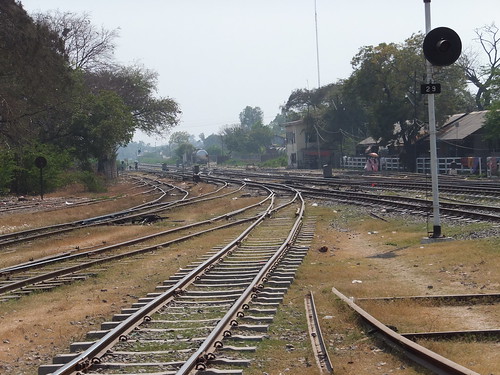
Front view of searchlight signal at Myo Haung, Burma.

Multiple aspect signals

In the U.K., searchlight signals gave way to designs with a separate lamp and lens for each colour where electromechanical relays controlled each lamp. These could be 2-aspect (like the London Underground signal illustrated below), 3-aspect or 4-aspect (described next).


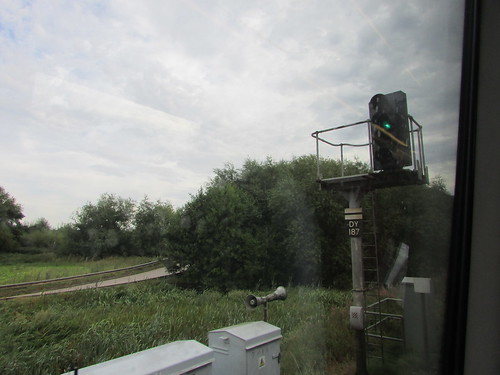
A typical 4-aspect colour light from the 1960s. This is Derby P.S.B. signal DY187 on the Birmingham to Derby line
Click for larger view.


The picture above illustrates the typical features of multiple aspect colour light signals. The platform carrying the signal head is cantilevered to the right of the main post to improve sighting from a distance. For the benefit of the Signal and Telegraph Lineman, a simple handrail is provided around the platform and there is a permanent access ladder. The main post carries an identification plate with the unique signal number (usually first and last letters of the name, here 'DY' for 'Derby' and a number up to 3 digits long). This signal is on plain line with no diverging routes so the signal is arranged to operate automatically, as track circuits become occupied or cleared by the passage of trains. The white top part of the identification plate with a black horizontal bar indicates that this signal is not controlled by the signaller but is an 'Automatic'. However, a telephone is mounted lower down the main post which communicates with the Signaller. The two grey metal cabinets in the foreground are 'Location Cases' containing the necessary signalling relays, cable termination and power supplies. Two loudspeakers are mounted on the top of the smaller location case. This was the, rather crude, 'Staff Location System' of the period. Mobile phones, as we now understand them, were not available in the 1960s (1973 is accepted as the date of the first call on a Motorola mobile phone). Instead, the signaller could send one of four distinctive tones (one for each of three engineering disciplines plus a continuous tone for 'cancel') to the loudspeakers in an area where staff might be. As you can imagine, in built-up areas at night, use of this facility was not very popular with the neighbours.

In this type of multiple aspect colour light signal, four tungsten filament lamps are mounted vertically in line. When lit, each produces 'white' light (with a 'yellow' tinge). Colour filters in front of each lamp provide red, yellow or green light which is concentrated by a lens system on each lamp to project an intense beam towards the approaching trains when the lamp is lit. From the bottom, the four lamps produce red, yellow, green and, at the top, a second yellow. Four different 'aspects' or indications are given - red, yellow, green or 'double yellow' (where both yellow lamps are illuminated, but separated by the unlit 'green'aspect so that the driver can distinguish between 'single yellow - "prepare to stop at next signal" and 'double yellow' - "prepare to stop at next-but-one signal").

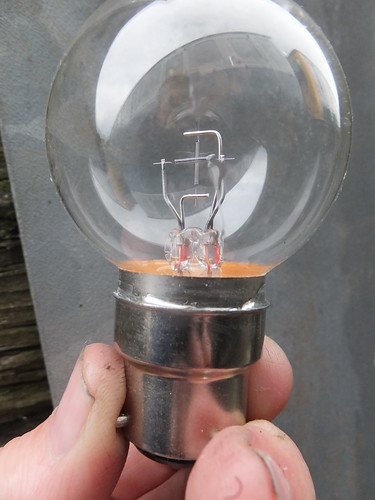
The most common repair would be 'replace failed lamp' but this type of low-voltage special bayonet-fitting lamp normally had two filaments.


Dual-filament lamp.

Failure of the main filament was detected by a lamp proving relay measuring the current flowing through the filament. Release of this relay upon failure of the main filament switched in the standby filament to keep the signal lit. The failure would be indicated to the Signaller (who, in the 1960s was still called a 'signalman') allowing the lineman to be alerted. Should the second filament fail or the power supply to the signal be lost, the signal would go 'dark'. In this case, the next signal in the rear would automatically be held at 'red' until relays proved that the failed signal should be showing a 'proceed' indication, in which case the signal in the rear would be allowed to display a 'single yellow' to keep trains moving whilst the problem was rectified.

There's more information about this type of signal and the electromechanical relay circuits which typically control them in the (as yet incomplete) series of posts on Princes End Electrical Controls starting here. The following description is taken from the post Princes End Electrical Controls (Part 4).

4-aspect signal head

Detail of 4-aspect signal head

Each lamp was fed from its own step-down transformer. The primary of each transformer (terminals 1 - 6 on the diagram above) was fed, via control relay contacts in the adjacent location case, with nominal 110 volts a.c.

The signal lamps were dual-filament low-voltage special bayonet-fitting type. Note that the 'Auxiliary' filament was fed from a lower voltage than the 'Main'. Each 'Main' filament was in series with a lamp proving relay mounted in the signal head ('ER1' to 'ER4'). If current was being drawn by the 'Main' filament, the appropriate lamp proving relay was energised and the 'Auxiliary' filament was disconnected. Release of the lamp proving relay connected the 'Auxiliary' filament via a normally closed ('back') contact.

Further contacts on the lamp proving relays were wired to indicate the status of the 'Main' filaments (terminals 7 - 9 on the diagram above). The contact circuit is drawn rather oddly but the effect is that the signal head presented a closed circuit between terminal 7 and terminal 8 (which was linked to terminal 9 externally) provided any of the relays 'ER1', 'ER2', 'ER3' were energised. The indication contact on 'ER4' (the second Yellow lamp used for the 'HH' 'Double Yellow' Aspect) could be shorted out by an external link when not used.

The signal head was a rectangular die cast box closed by a hinged door at the rear secured by a padlock. The front of the head had four apertures fitted with projecting sheet steel hoods to minimise the effect of overhead sunlight. Each aperture had a clear cast glass lens (the colour filtering was behind this lens). To project an intense beam visible at a distance, a Fresnel lens was used where the rear of the lens was shaped into a series of stepped rings. Because the Fresnel is so efficient at projecting light in a narrow beam, it could be difficult for a driver stopped close to the signal to confirm the aspect. In early signals of this type, a small second aspect was provided aligned to face a train waiting at the signal. This aspect was also provided with a small hood. Because of the shape of this hood, the device was often called the "pig's ear".


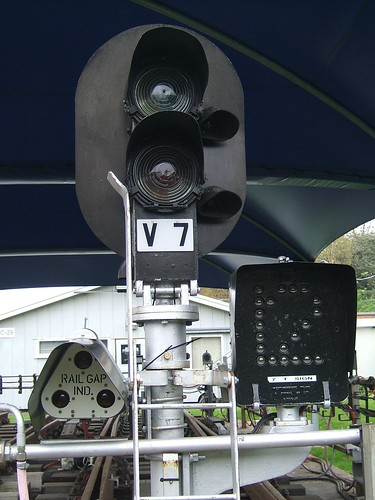
London Underground Signal Training facility, Bollo Lane, Acton: 2-aspect colour light signal with "pig's ear" aspects and 'theatre type' (multilamp) route indicator on the right capable of displaying '1' or '2'. Rail Gap Indicator on the left indicating section ahead discharged when lit.

However, by the 1960s, a simpler arrangement was in use. The section of cast glass Fresnel Lens between around 'four o'clock' and 'five o'clock' intentionally had a different profile, which deliberately scattered light towards a waiting train, rather than projecting it forward as part of the main beam.

The signal head was then mounted in a variety of ways, so as to give the driver the best possible 'sighting' of the signal. Straight tubular posts, brackets, massive cantilevers or gantry bridges were used, depending upon the geography.

Use of Light Emitting Diodes (LEDs)

To improve the reliability of signal lamps, replacement lamps were produced using multiple LEDs packaged as a plug-in replacement for a filament lamp.


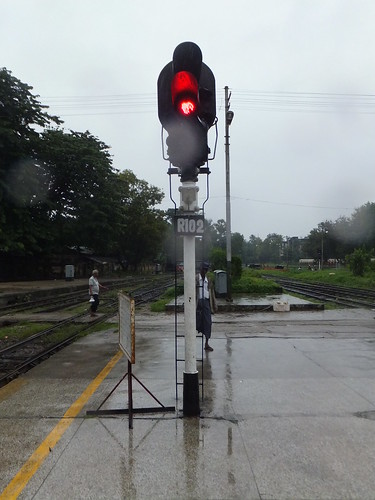
Signal 'R101' on Platform 2 at Yangon, Burma. A multi-LED lamp has replaced the original filament lamp.

The availability of very high light output LEDs has led to various manufacturers producing a range of modern equipment, some of which is barely-recognisable as railway signals.


LED 4-aspect signal at Wolverhampton. Note the small, red indication projected sideways - the modern "pig's ear". Position light subsidiary aspect.

Related Posts on this Website

Railway Signalling in Britain (Index).
Princes End Electrical Controls (Part 1).

My Pictures

2-aspect colour light signal head.

Photographs may be selected, viewed or downloaded, in various sizes.

Sunday, 1 April 2018

Train movements at Yangon Central station (3)

Train movements on Monday 16th October 2017

There's a not-very-technical description of the day at Around Yangon.

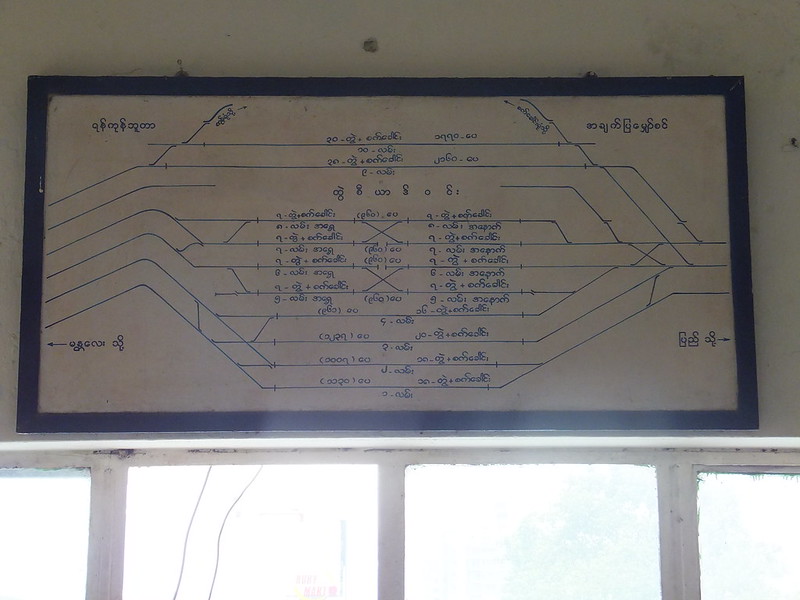
There are various operational problems in the Yangon area. At Yangon Central Station, long distance trains use platforms 1, 2, and 3 on the north side of the station whilst local trains usually use platforms 4, 5, 6 and 7 on the south side. To the west of the station, double track carries both Circle Line suburban trains and long-distance services to Pyay. To the east of the station, there are two non-passenger roads (Down Goods, Up Goods/Shunting Neck East) and four roads for passenger trains (arranged Down Local, Up Local, Down Main, Up Main) as far as Pazundaung. The whole station area is currently controlled from Yangon Central Power Signal Box by a Westinghouse Style 'L' miniature lever frame. Details of a visit I made on 25th April 2014 are here.

The platforms are long enough to accommodate lengthy long-distance trains but, since local services are more frequent and shorter, a scissors crossover is provided halfway along platforms 5 and 6 and a second scissors halfway along platform 7 and Through Road 8. At present, platforms 7 and 8 each operate as two separate platforms, West and East.


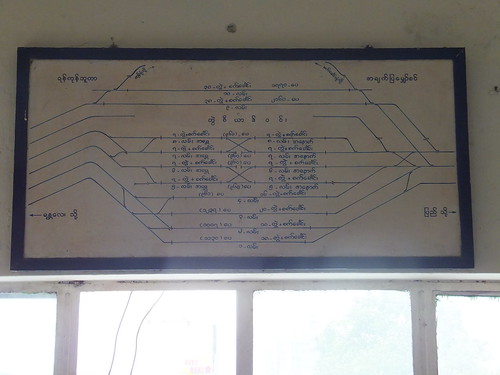
Yangon Central Power Signal Box: Simplified track diagram behind the supervisor's desk. Pazundaung is to the left and the double track west is on the right.
Click for larger version


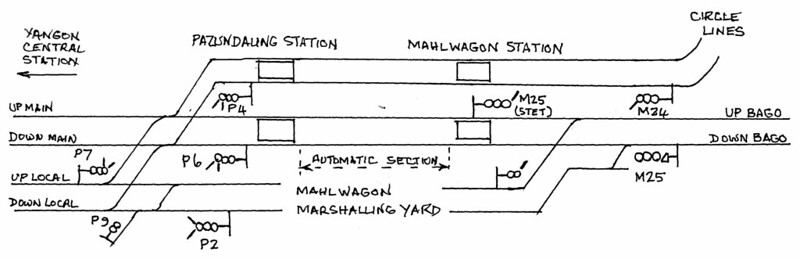
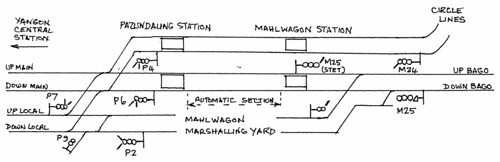
At Pazundaung a complex ‘flat crossing’ junction switches trains to and from the Circle Lines across the Up and Down Bago and Mandalay main lines as they pass from or to the local lines. This arrangement is shown in the diagram below and there's a little more information about Pazundaung and Mahlwagon here.


Myanma Railways: Simplified line diagram Pazundaung-Mahlwagon
Click for larger version


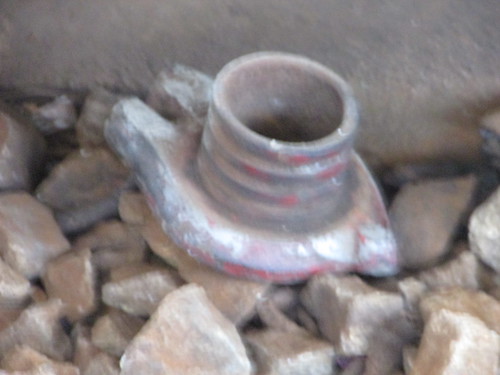
I was at the station from 10 o'clock in the morning for about an hour. I may not have included all movements as I was somewhat pre-occupied watching repairs to brakes on two trains. The first brake problem seems to have been a broken 'horn' on an 'ABC hose' coupling.


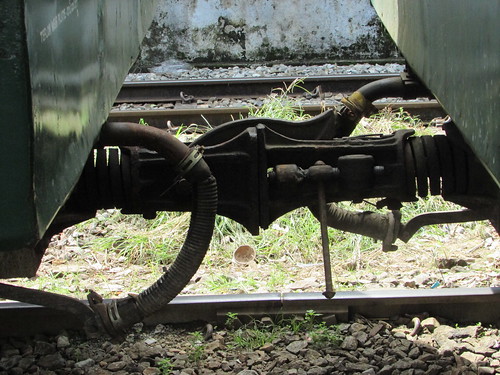
Repairing the vacuum hose ('ABS Hose') between two coaches on Platform 7: the alloy fitting with a broken horn which was replaced.

I'm not sure about the second problem. Initially, there appeared to be problems coupling the locomotive to the stock but then a mechanic was working on the brake rigging on one coach. The train finally left with the vacuum hoses 'split' between two coaches, so that only the front portion of the train had a working brake.


The 'bags' are 'split', leaving the rear of the train unbraked.

The movements I monitored are listed in the table below. Click on 'Photo' ref to view the associated picture. Use 'back button' (not the 'Back to photostream' button) to return to this post.

Time Notes Photo
10:01 Yangon Central Station, Monday 16-Oct-2017: DF.1240 on 6-coach train from the west having arrived in Platform 7 West. 8671
10:04 DF.1240 has moved ahead onto the Through Line (track 8). 8673
10:07 Having run-round its train in platform 7, DF.1240 on the left eases onto the stock. Note the approaching diesel railcar in the distance. 8676
10:08 Signal R56 is clear for DF.1240 to depart as RBE 3017 enters Platform 5. 8680
10:13 DF.1251 shut-down on train in Platform 6 West. 8688
10:20 Yangon Central Station, Monday 16-Oct-2017: DF.1240 finally sets off west. 8698
10:22 Stock in Platform 6 West (DF.1251) with DMU on 5 East. 8701
10:25 DF.1618 on arrival at Platform 7 East. 8703
10:26 DF.1618 runs forward onto Track 8. 8704
10:30 DF.1637 arriving in Platform 6 from West. 8707
10:32 Yangon Central Station, Monday 16-Oct-2017: East end of Platform 7. The signal is already cleared for the departure but there seems to be a problem 'hooking-on' DF.1618. Note the approaching train from the east on Track 8. 8711
10:34 Yangon Central Station, Monday 16-Oct-2017: A train formed from four single units including RBE 25119 leaves eastwards. 8713
10:40 The westbound train seen arriving at 10:32 departs from Platform 7 West. 8721
10:40 The delayed eastbound finally departs from Platform 7 East with DF.1618. 8723
10:43 DF.1243 arriving on Track 8 from the east. 8725
10:44 DF.1243 having arrived on Track 8 West (the Through Line) discharges passengers. 8727
10:48 DF.1243 on Platform 7 West, running round its train on 8 Through. Passengers boarded, but I left before the train departed eastwards. 8729


Related Posts on this Website

My first log of Train movements at Yangon Central station is in the post here. There's a later log here.

There are a number of posts describing Myanma Railways and my previous visits to Yangon Central station. You can find them all here or there's an Index (with links) here.

My Pictures

Railway pictures taken on 16th October 2017 referred to above form the collection Yangon Central Station (3).

All my pictures of Myanma Railways, including the Circle Line, are here.

Photographs may be selected, viewed or downloaded, in various sizes.

Saturday, 31 March 2018

Train movements at Yangon Central station (2)

Yangon (formerly known as Rangoon) is no longer the capital city of Myanmar (that's Naypyitaw - my visit to the capital in 2013 is described in the post here and the following posts). None-the-less the most intensive working of suburban trains in the country is to be found around Yangon and the 7-platform Yangon Central Station.

I first wrote about Train movements at Yangon Central station in the post here. The station is controlled from a miniature lever Westinghouse power frame which I described in a post here.

All Myanmar's trains are operated by various diesel locomotives or railcars. Some vehicles are now quite elderly, although there are increasing numbers of new Chinese-built 2,000 h.p. diesel electric locomotives. There's an outline of the locomotive classes in the post Diesel Traction in Burma whilst diesel railcars and multiple-units are shown in Diesel Railcars in Burma. Both of these posts need updating (in particular the railcar post from 2013 which only hints, in the section 'Recent Developments', at the influx of second-hand re-gauged Japanese multiple units which have eliminated some locomotive-hauled workings around Yangon).


Yangon Central Station 1-Oct-2017: The tantalising view from my hotel room on the 21st floor of the Sule Shanri-La.

Train movements on Sunday 1st October 2017

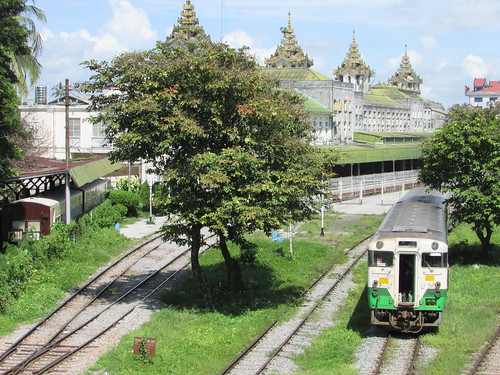
There's a fairly non-technical description of the day here. Whilst I was on the roadbridge at the west end of Yangon Central Station (taking pictures before continuing to the station itself), a Japanese diesel multiple unit (RBE25109 leading but multipled to, I think, 8 coaches) departed heading west.


Second-hand Japanese DMU leaves platform 4 heading west with the post-war 'Burmese-style' station building in the rear.

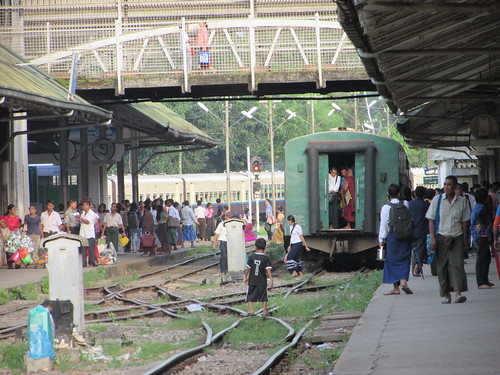
My vantage point on the road bridge also showed DF.1622 (as I later confirmed) stood at the eastern end of four coaches (all in green and blue livery) standing at the eastern end of platform 6 for a long time. DF.1200.03 was standing in the west end of platform 7, attached to a bogie goods van. One of the hard-working 900 horse power units had arrived with a local train from the east in platform 7 East and it had soon uncoupled from its train and crossed onto the Through line, ready to run round its train.


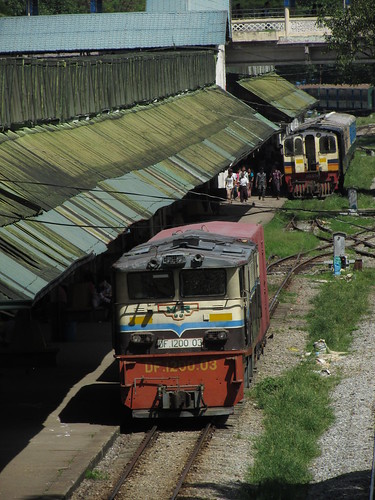
Yangon Central Station: DF.1200.03 standing in the west end of platform 7, with bogie goods van and unidentified 900 horse power loco with a local train from the east in platform 7.

Another unidentified Bo-Bo-Bo arrived from the west with its train and headed to the unoccupied platform 5. I then continued my walk to the station, recording the Japanese signalling modernisation and taking pictures of train movements for around 90 minutes. The pictures taken on Sunday are in the collection Yangon Central Station (2).

Train movements on Monday 2nd October 2017

There's a fairly non-technical description of the day here. In the late afternoon, I walked to the station where I observed the train movements during the afternoon 'rush' for around an hour.


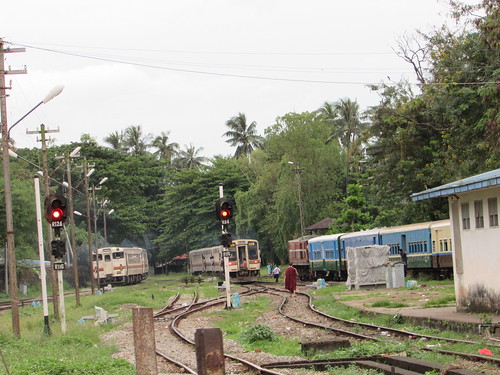
Yangon Central Station: View from platform 6, looking east.

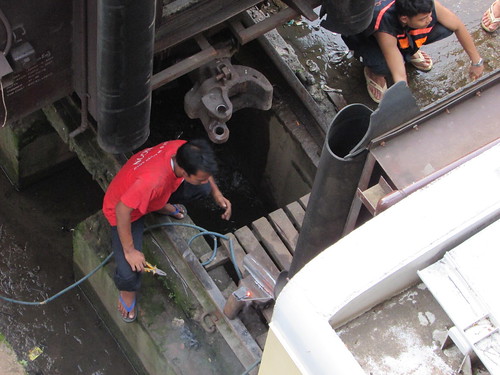
Yangon Central Station: Building-up the 'knuckle' of an automatic coupler with electric welding in the carriage sidings to the south of the station.

Train movements on Tuesday 3rd October 2017

There's a fairly non-technical description of the day here. Whilst taking breakfast, I made a few notes about movements at the west end of the station:-

07:10 DF 1200-class (perhaps) in Red/cream arrives from the west with a goods van and 2 black (?) coaches, onto goods avoiding line.
07:25 Co-Co (brown/cream) from plat 1 to north siding.
07:30 4-car DMU green/cream arrives from west.
07:40 Bo Bo Bo red/blue arrives from east into 5 (?) with passenger train.
07:50 Bo Bo Bo red/blue arrives into 4 (?) from west with 10-coach train, all modern, pale green.
07:55 Bo Bo Bo red/blue LE off 07:40 arrival heads into north siding, stops, proceeds further then heads east on goods avoiding line.

I visited the station in the late afternoon when there is plenty of train movement.


Yangon Central Station: 3-Oct-2017: Three trains moving at the east end.

The movements I monitored are listed in the table below. Click on 'Photo' ref to view the associated picture. Use 'back button' (not the 'Back to photostream' button) to return to this post.

Time Notes Photo
16:56 DF.1238 arriving in platform 7 with a local from the east. 6913
16:57 DF.1238 uncouples and draws onto the 'Through' (road 8) prior to running round. 6914
16:59 DF.1220 crossing via scissors from plat 5 to plat 6, heading east. 6916
17:04 Eastbound departures in platforms 6 (DF.1220) and 7 (DF.1238), DMU leaving on Up Main in background. 6924
17:05 Fuzzy shot of Train Number 3, 17:00 departure 5 minutes late hauled by Chinese Bo-Bo-Bo. Train has Upper Class Sleeping, Upper Class, Ordinary Class and a Restaurent, due Mandalay 07:45 following morning. 6925
17:06 Bo-Bo-Bo departs from 6 as a Japanese DMU RBE25127 (with red headlamps) arrives on 8 (Through). 6927
17:07 Japanese DMU in 5 with DD522 Kawasaki station pilot, flat car for shunters and Bo-Bo-Bo DF1264 in 3. 6928
17:07 DF1238 leaving 7 as RBE 25127 awaits access to 7 6929
17:08 DF2082 arriving with Down train (possibly train 32, 08:00 from Naypyitaw). 6931
17:13 Three trains moving at the east end (L-R) Japanese DMU departs east from 4, Japanese DMU also departs east from 5, whilst a Bo-Bo-Bo propels coaches into the carriage sidings. 6937
17:16 DF1264, with shunters flat car heads east from platform 3. 6940
17:18 DD522 takes empty coaches east. 6942
17:25 Yangon Central Station: 3-Oct-2017 Japanese DMU arriving in platform 5 from west. 6947
17:26 Bo-Bo-Bo about to leave platform 7 heading east with a passenger train. 6948
17:28 As a 900 hp arrives with 6 coaches with matching advertising logos (probably from Insein) a Bo-Bo-Bo heads east with a short train and many hangers-on. 6950
17:28 Yangon Central Station: 3-Oct-2017 DF1255 arriving in platform 7 from the west. A Japanese DMU stands in platform 6 West. 6951
17:28 Station Pilot propels empty stock into the carriage sidings. 6952
17:32 DF1246 arriving in platform 6 from the east with DF1255 in 7 waiting for the road. 6959
17:34 Yangon Central Station: 3-Oct-2017 DF1255 leaves platform 7 heading east. 6963
17:41 DF1248 runs round and couples-up ready to head back east at 17:43. 6967
17:45 DF2082 (which earlier brought in the train from Naypyitaw) appears light heading east on platform 5 and stops. 6974
17:47 DF1330 arrives with Train 90, 08:00 ex-Mawlamyine. 6977
17:51 DF1259 arrives in platform 7 from the west. 6981
17:56 DF2082 still awaits the road as an unidentified train departs eastwards. 6987


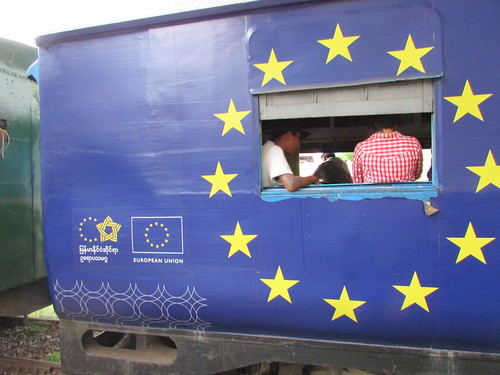
But don't ask about the coaches plastered with EU logos.


Yangon Central Station: 3-Oct-2017: Some elderly coaches are 'improved' by EU vinyls.

Related Posts on this Website

There are a number of posts describing Myanma Railways and my previous visits to Yangon Central station. You can find them all here or there's an Index (with links) here.

My Pictures

Railway pictures taken on 1st, 2nd and 3rd October referred to above form part of the collection Yangon Central Station (2).

All my pictures of Myanma Railways, including the Circle Line, are here.

Photographs may be selected, viewed or downloaded, in various sizes.