Thursday, 5 January 2012

Traffic Movements at Tipton Station box, 1965

There's an introduction to Tipton Station box as it was when I first knew it here.
There's a more detailed description of the modernised box in preparation.
There's a description of the box after demoting to a Shunting Frame here .

On Saturday 10th July 1965 I started the day at Tipton Curve Junction (traffic movements described here) and moved on to Tipton Station Box later in the morning. It was a rather difficult time for the signalling staff in the area since redundancy notices had been issued in connection with the commissioning of Wolverhampton Power Box, scheduled for August 1965.

Tipton Station box, Saturday 10th July 1965

Externally, the signal box was largely unchanged but inside it had received all the modern electrical safety refinements: continuous Track Circuiting, Illuminated Diagram and full Block Control with 'Welwyn' releases. This was only to last until August 1965, when the box was demoted to a 'Shunting Frame' following the commissioning of Wolverhampton Power Box.

As we arrive at 10:48 (the 24-hour clock was introduced with the summer timetables), the '4-1' from Princes End comes to a stand at our branch Home Signal. After the Up express, we run the freight off the branch and a light engine for Albion follows from Princes End. He passes at 11:03, a Class 8 (perhaps to work the Albion Tanks?).

Then weird things start to happen:-
1) The signal light repeater buzzes but, when we check, it's a 'spare' position causing the fault.
2) The Up colour light Distant 35a buzzes - the signal reports having gone to 'Standby'.
3) The Up Inner Distant Repeater 35 b/c goes to 'Wrong'.
Nobody knows what's going on.

On the Down we 'take on' 1S61 at 11:30 but when we try to offer the train forward, we discover that all bell and block communication with Bloomfield Junction has been severed! At least the 'phone still works, so 1S61 goes down 'on the phone', no block under Regulation 25 a (iii).

First the signal light repeater is restored, then the block comes back, then the colour light goes back to 'Normal'. That only leaves the distant repeater and that is restored in time for us to take the Up Local. We initially refuse the '1-4' offered from Princes End until the local has departed. The freight comes to a stand at our Up Branch home at 12:03. Meanwhile, the Up colour light distant fails again, restored at 12:20. We advised Bloomfield and managed to run the Up express. The Train Register shows we cancelled the express forward to Watery Lane and re-offered it. I don't know whether it was 'operator trouble' now the Up Starter is tied to the Block.

Tipton Curve opened (for just 9 minutes!) at 13:35, presumably to have a train onto or off the North Stour. Then Bloomfield Junction closed so we'd be working through to Spring Vale Sidings.

The Up Light Engine arriving at 14:58 was turned through the crossover road and despatched on the Down Branch. At this time on a Saturday, this engine would almost certainly have previously worked a train to Spring Vale and be scuttling back to Bescot for disposal.

The final entry on the Down is a Local accepted at 16:14. It amused me to 'send it on', wind the gates, pull off and then dash across to the Down platform to travel on the train back to Wolverhampton.

A copy of the Train Register entries is below:-

Wednesday, 4 January 2012

Deepfields Electrical Controls

Deepfields was one of the mechanical signal boxes I got to work (unofficially) in the early 1960s. The box is described in the posts Deepfields and Deepfields in Detail

Click on image to enlarge.

In a series of articles about Spring Vale Sidings box (which was the next box to Deepfields), I discuss the electrical controls applied to this type of signal box. Part 1 and Part 2 are published, other parts are in preparation. I didn't manage to obtain prints of the electrical controls for Deepfields, but I did make rough manuscript copies which appear below. Click on any picture for a larger image.

The principles of electrical control apply everywhere so, if you're familiar with the arrangements at Spring Vale for instance, it's much easier to understand the Deepfields controls.

Drawing Symbols and Labelling Conventions

The symbols for the various circuit elements are, in general, peculiar to railway signalling. Whereas the Spring Vale drawings use the 'old' symbols, some of the Deepfields drawings use the 'simplified' symbols which are probably harder to follow, until you get used to them. The student also has to become familiar with the letter codes used to label components. As in the Spring Vale drawings, a group of letters and figures is used to identify each component. For instance, the designation '20RGCR' means [20][Red][Signal][Proving][Relay]. Once you've mastered the principal codes, understanding diagrams becomes much easier.

The Drawing Set

The set of drawings for Deepfields was numbered CW.125/59/x, where 'x' was the sheet number. These drawings were prefaced by a Contents and Ordering page. The 'Contents' gave details of the drawing pages and I'd got as far as producing a typed version of this list:-

'Ordering' was a brief stores description of the various electrical items:-

Sheet 1 Controls

This information is presented as a table comprising a row for each running line and various columns:-

Line: There is a row of entries for each running line, Up Main, Down Main and Up & Down Goods.
Block Control: Shows that the Berth Track Circuit on the Up Main controls the Block.
Line Clear: Lists the conditions which must be satisfied to be able to give a 'Line Clear'. These conditions are divided into levers in the frame which must be proved 'normal' and actual signal indications which must be proved (by electrical contact boxes attached to signal arms or weight bars for semaphore signals or 'lamp proving' for colour lights).
Annunciator: Shows that the Berth Track Circuit triggers an audible warning if a train approaches the Home Signal when 'on' and shows the time (in seconds) for which the alarm sounds before the lever lock on the home signal is released.
Track Circuits: Lists the Track Circuits associated with each running line.

A second table details the requirements for electric lever locks. A row is provided for each lever requiring a lever lock or circuit controller and various columns:-

Lever and type: Lever Locks [L] may hold the lever Normal [N] or, in the case of Facing Point Locks, Reverse [R}. Lever 1 has a circuit controller for the Green [D] relay [R] controlling Bloomfield's Down Starter. Lever 39 has a circuit controller for the Yellow [H] relay [R] controlling Deepfield's Up Starter.
Lock Proving Contacts: Lists other levers which must be proved via Lock Proving Contacts [LCC].
Track Circuits: Lists Track Circuits which must be Clear or, in the case of certain home signals, occupied before the lock is released.
Block: Lists signals controlled by the Block.
Signals: Lists signals which must be On or, in the case of the distant signal prior to the colour light, Off before the lock is released.
Replaced: Records the criteria for the colour light to be automatically replaced to danger, even when the controlling lever is still reverse.
Notes: Records that lever 1 is a control on a Bloomfield signal and that Sealed Releases are provided for the Facing Point Lock levers.

Sheet 2 Block Control Up and Down Main

Sheet 3 Block Control Up and Down Goods

Sheet 4 Lever Locks Sheet 1

Sheet 4A Lever Locks Sheet 2

Sheet 5 TPR's, TPS & Annunciator

Sheet 6 Down Main Distant and Repeating

Details of the 3-aspect colour light were not recorded, sorry.

Sheet 7 Up Starting Signal

Details of the 3-aspect colour light were not recorded, sorry.

Sheet 8 Bonding

Tuesday, 3 January 2012

The 'Mince Pie Flyer'

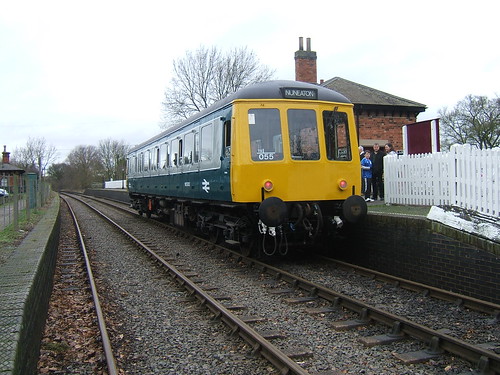
55005 at Shenton, waiting to return to Shackerstone.

My last railway 'turn' in 2011 was driving the single-unit 'Bubble Car' at the Battlefield Line on New Year's Eve. The four return trips from Shackerstone to Shenton with a stop each way at Market Bosworth had been advertised as 'The Mince Pie Flyer'. Every passenger was given a mince pie and a drink, alcoholic for the grown-ups, soft drinks for children. In contrast to my turn two days before on 'Agecroft No. 1' at MOSI, the weather remained dry and the sun was out. It did become a little cold later, but it was a splendid day to finish the year.

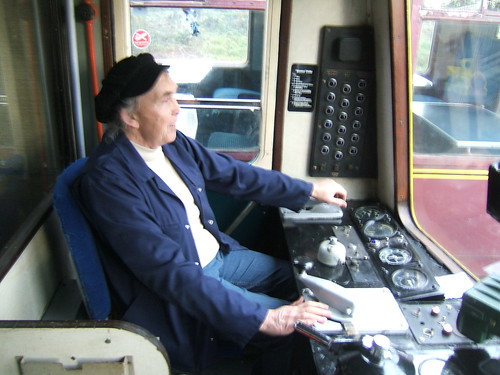
The single-unit W55005 has recently been 'outshopped' after fairly major work and it looked splendid. I'd never driven W55005 before but, of course, all the controls across a range of DMU types are similar. I'd been warned that, at start-up, I might need to restart Number 1 Engine a couple of times but, in fact, it fired up first go and ran sweetly for about ninety minutes. Then, on the way back to Shackerstone, that engine quit and refused to restart. I eased back into Shackerstone and Pete and I had another go at re-starting, without success. I decided to run on the remaining engine for the rest of the day so Pete and I isolated the final drive and isolated the engine. I completed the 'Diagram' on time without further incident. The most likely cause of the engine problem was air remaining in the fuel line after an earlier hose replacement, but the sound design of the 'Modernisation' Diesel Multiple Units meant that we didn't need to declare a failure.

I really enjoyed the day!

Jan 'in the chair' before departure from Shackerstone.

More pictures of 'The Mince Pier Flyer' are here.
Pictures showing W55005 in detail are here.

Agecroft at MOSI

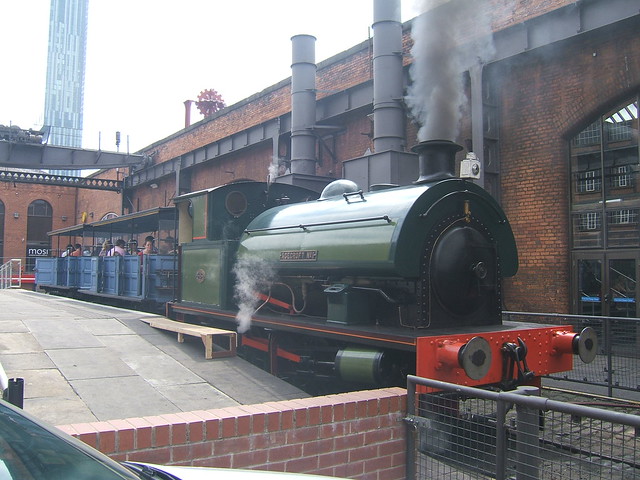
A photograph (taken earlier in 2011) showing 'Agecroft No. 1' with the semi-open passenger coaches. Click on picture for full image.

After a very successful visit to the Tanfield Railway, 'Agecroft No. 1' handled the Christmas services at the Museum of Science and Industry (MOSI) in Manchester. This has allowed the 'Planet' replica to be 'shopped' for repairs. I didn't do any of the 'Santa' trains, but I was driver on the 29th December 2011. Laurence was Fireman and Dave was Operating Officer. The weather was pretty foul all day - high winds and heavy rain much of the time - (hence no new photographs). The Guard, Duncan, elected to have the 20-ton piped brake van attached at the rear as offering somewhere to shelter from the worst of the weather. I was surprised at just how many passengers we carried in the day - the semi-open replica 1830 coaches are not ideal in inclement weather. At one stage, there was a torrential hailstorm with the hail coming virtually horizontally. I got quite wet and our passengers can have fared little better. Despite these problems, everybody retained their sense of humour and 'Agecroft No. 1' performed admirably, as expected.

Monday, 2 January 2012

Sedgeley Junction - Early History

1. Origins

The South Staffordshire Railway was initially completed from Wychnor Junction (where it joined the Midland Railway's line from Birmingham to Derby) to Walsall in 1846. By 1849, the line had been extended to Dudley. The short branch connecting Sedgeley Junction to Dudley Port High Level on the Stour Valley Line was finally opened to through traffic in 1854 (after some difficulties with the Railway Inspectorate because of the cramped site at Dudley Port High Level). The Midland Railway and the London and North Western Railway were shareholders, seeking to prevent the Great Western from encroaching further on their territories and for a time the railway was leased to John Robinson McClean. The London and North Western Railway bought McClean's lease in 1861 and finally bought out the other shareholders in 1867.

Cheslyn Hay and District Local History Society has a short history here and Rail Album has some details of the early locomotives here. There's an extended history of the railway in 'The South Staffordshire Railway - Volume 1' published by the Oakwood Press (ISBN 978 0 85361 700 6) containing a treasure trove of photographs.

2. Rules for Working the Dudley Incline

During his researches at local archives, my friend Ian has found 'The Rules for Working the Dudley Incline' from around 1872. The gradient from Great Bridge to Dudley Port Low Level was around 1 in 240, steepening to around 1 in 60 for the final stretch to Dudley. Working this incline presented an operational challenge throughout the line's long life. Trains stalling on the gradient delayed the service but the biggest risk was of trains or vehicles running away downhill.

Here's a summary of the instructions:-

Ascending: When ascending, drivers and guards were instructed to ensure that there was a 'Break' (brake van), with a Guard in charge, at the rear of every train. Goods trains exceeding ten loaded wagons were also required to have a 'Breaksman' able to operate further brakes if required. Where Goods Trains were provided with an Assistant Engine, this was to be behind the brake van. Each 'Passenger Van' was to carry two wooden 'Spraggs' and each 'Goods Van' six wooden 'Spraggs'. I assume they meant brake van in each case. The spraggs were used to scotch the wheels to prevent running away. There was also an instruction that Goods Trains must have a margin of at least 15 minutes before a passenger train is due before being allowed to leave Great Bridge.

Descending: Goods Guards were instructed to pin down one handbrake on every fifth wagon before leaving Dudley. Passenger trains were to have a brake van for every eight carriages, with a extra man in charge as far as Dudley Port. The signalmen at Dudley, 'Sedgley Junction' (note spelling) and Dudley Port were to keep spraggs ready for use. The Porters at Dudley Port were also required to have spraggs.

These rules were written in a time when passenger vehicles were simply coupled together and the handbrake in the brake van (or vans) was the only brake available on the train. Freight vehicles were usually provided with a lever-operated handbrake worked from the ground but going up inclines, only the locomotive brake and the handbrake in the brake van were available. If a bank engine was provided, this provided further braking effort in addition to 'pushing power'. Going downhill, trains would stop at the top of the incline and pin down brakes on a proportion of the train which would hopefully be sufficient to allow the driver to keep the train under control. The train would then stop at the bottom of the incline to release the brakes - a time-consuming process. Some of these practices were still in use in the 1960s.

By the end of the nineteenth century, matters were somewhat improved: at least all passenger trains were required by law to have an 'Automatic Brake' on all vehicles. This brake could be applied throughout the train by the Driver, the Guard or (through the Communication Cord) a Passenger. In the event of a train becoming divided, the brakes would be automatically applied on both portions of the train.

But, even in the 1950s, the majority of freight trains comprised wagons coupled together with individual handbrakes on the wagons worked from the ground and no brake operative throughout the train. A guard's brake van with a handbrake was provided at the rear of all freight trains, except on specially-authorised sections of line where short-distance movements might be allowed without a brake van. In an attempt to allow freight trains to run faster, some wagons were being fitted with 'Automatic Brakes'. Initially, these brakes were vacuum-operated but British Rail moved towards air brakes with the demise of steam traction. Since only the minority of the fleet of wagons received Automatic Brakes, only the most important freight trains were 'Fully Fitted'. As a halfway-house, the brake force available to the driver could be increased by having a proportion of the wagons fitted with the Automatic Brake and marshalled immediately behind the locomotive. This was called a 'Fitted Head'. There's more about braking systems in the article MIC - Brakes.

In the period when I visited Sedgeley Junction, most of the freight trains were controlled simply by the locomotive at the front and the brake in the Guard's Van at the rear. Banking assistance up to Dudley was provided on all but the shortest freight trains. To provide additional braking, descending trains might stop at Dudley to pin down wagon handbrakes, requiring a second stop at Great Bridge to release these brakes. Some of the 'through' goods trains were provided with a 'Fitted Head' and trains like the block oil train to Soho Pool were 'Fully Fitted'.

3. The 'Third Line'

In the time I knew Sedgeley Junction, the Up Loop extended from Sedgeley Junction to Dudley East and, with significant freight traffic tackling a gradient of around 1 in 60 up to Dudley, the usefulness of the 'Third Line' in managing freight trains sharing the route with passenger trains was obvious. The third track extended downhill from Sedgeley Junction to serve Palethorpes' loading shed. On the few occasions I walked the line between Sedgeley Junction and Palethorpes' sidings or Dudley Port Low Level, I'd noticed that the formation for the Palethorpes' siding nearest the running line seemed to carry on beyond the stop block near the loading shed.

It was only recently, studying the 1902 Ordnance Survey Map for the area based on a survey in 1885, that the explanation became apparent.

On the above map, the South Stafford line runs from top right to bottom left, crossing the Stour Valley line almost at right angles. Just clear of the aqueduct where the Birmingham Canal Navigation passes over the South Stafford, there's a facing connection to the Third Line, and a signal box to control it. So that was the explanation for the extended formation! Ian tells me that, from his library of old documents, the signal box at Dudley Port Low Level was open in 1908. On weekdays, the box closed between 10.15 p.m. and 5.45 a.m. At the weekend, the box closed from 8.15 p.m. Saturday to 5.45 a.m. Monday. Apparently, station staff worked the signals for any stopping trains when the signal box was closed. This signal box does not appear in the February 1909 and subsequent Working Timetables, so we assume that from this time Up freights had to struggle on to Sedgeley Junction before they could leave the main line. At least Palethorpes' benefitted from a nice siding to themselves.

3. Signalling Changes at Conygree Siding

The connection to Conygree Siding was another oddity when I knew Sedgeley Junction. It was only accessible to Down trains but involved blocking both the Up Main and Up Goods when in use. Early maps revealed that there had once been access to Conygree from the Up Goods as well and the extensive sidings at the time formed a triangular connection with the South Stafford Line.

During his researches at local archives, my friend Ian located a fascinating drawing detailing the proposals for signalling changes at Conygree Siding during the 19th century. The sketch was prepared by the L. & N. W. R. Signal Superintendents Office at Crewe in July 1887 and the document then spent the rest of the year being circulated around interested persons - the Signal Superintendent, Traffic Superintendent, Locomotive Superintendent, Mr. Neele, Mr. Harrison, Mr. Calkwell and, finally signed for the Chairman on 11th January 1888. The cost estimate for the work was £59! I've sketched the main features:-

The connection to the Down Main with a ground frame next to the trap points is exactly as I remember it but the connection to the Up Goods with its own ground frame had been removed at some point. The connection to the Down Main had been protected by an adjacent stop signal which was to be moved towards Dudley as part of this work. Near the connection to the Up Goods, the plan shows two parallel signal posts each originally carrying two fixed distant arms. The two splitting Down distants (reading to Dudley Port High Level and Great Bridge) were to 'come out'. The two Up distants, applying to Up Goods and Up Main were to remain. Note that the Up Goods distant carried a ring to indicate a less-important line. At 'A' there are to be two parallel posts. There's a fixed splitting distant for Dudley Port High Level on the left. The post on the right carries a stop signal (presumably Dudley's Down Starter) which is to be slotted by Conygree, with a fixed splitting distant for Great Bridge below. This slot, later controlled from Sedgeley Junction, survived as a means of protecting the connection to Conygree until the end. Distances next to signals will be from Sedgeley Junction signal box.

There's a little more on L&NWR signals here.

Note that the L&NWR drawing uses the spelling 'shewn', 'Coneygree' and the singular 'Siding' (although the note regarding the slot uses 'SDGS').

4. Addition of Signalling Detection at Sedgeley Junction

Ian also located a drawing in Local Archives detailing the proposals for adding signalling detection at Sedgeley Junction.

Mechanical interlocking of lever frames ensured that, for instance, the signal lever could only be moved when the point levers had first been set appropriately. A later refinement where the signal 'read' over facing points was to route the wire to operate the signal through a 'Detector' next to the points, ensuring that the signal arm could only move if the points themselves were lying correctly.

The scope of these changes was to add facing point detection to the Up Walsall, Up Dudleyport and Down home signals. The sketch was prepared by the L. & N. W. R. Signal Superintendents Office at Crewe in April 1894 and the document then spent the rest of the year being circulated around interested persons - the Signal Superintendent, Traffic Superintendent, Locomotive Superintendent, Mr. Neele, Mr. Harrison, Mr. Calkwell and, finally, the Chairman signed on 7th December 1894. The cost estimate for the work was £32! I've sketched the main features:-

The layout of the junction was rather different then from when I knew it, incorporating both a single slip and a double slip. This may explain the multiple spaces in the frame which intrigued me during my visits, if we assume that the remodelling to remove the single slip and double slip removed the need for a number of levers which, rather than being painted white and left as 'Spare', were taken out and converted into 'Spaces' (Section 4 of the post Sedgeley Junction - Signalling Alterations 1964 lists the spaces as 3,5,6,9,11-14,26-28,33-34,37 and 40).

The Up signals also show the arms in a second, and in some cases third, position. This is the way of representing 'Slotting'. From consideration of the layout of Conygree described in section 3 above, the slots appear to be operated from the ground frames controlling the Down Main and Up Goods connections at Conygree, as shown in the table below:-

Signal Down Main Ground Frame Slot Up Goods Ground Frame Slot
Up 3rd line home Yes Yes
Up Main to 3rd line home Yes Yes
Up Main to Up Main home Yes No
Up Dudley Port to 3rd line home Yes Yes
Up Dudley Port to Up Main home Yes No

Friday, 30 December 2011

Heaviest Single Load carried by British Railways

My introduction to Tipton Curve box here refers to the "largest single load ever carried by British Railways". On 27th March 1965, I signalled this load through Tipton Curve Junction, thanks to the kindness of my friend Tom. Earlier that day, Tom and I had covered Deepfields from 8.0 a.m. to 2.0 p.m. It looks as if we 'doubled back' to cover the evening working. I've located my Train Register covering these movements and a copy appears below.

I don't know whether larger loads have been carried since but at 122 feet long and weighing 240 tons, it was fairly impressive. In theory, any weight can be carried by rail, provided it is spread over sufficient carrying wheels so that the Civil Engineer's axle load limit is not exceeded. As far as size goes, the British loading gauge is quite restrictive (much more restrictive than, say, the 'Berne Gauge' widely adopted in continental Europe). Obviously, the load can't be so large that it starts bumping into bridges or other lineside structures. Length is significant, too, because as the load traverses curves, overhang and end throw may put structures or trains on adjoining lines "in harm's way". Considerable pre-planning is necessary before 'Out-of-Gauge' loads can be run.

As far as block signalling was concerned, three different 'Is Line Clear?' bell signals were generally authorised, depending upon just how out-of-gauge the load was. There was also a special bell code to ensure adjoining lines were 'blocked' where necessary. The bell signals are listed below:-

Bell Code Description
2-6-1 Is line clear for a train which can pass an out-of-gauge or exceptional load similarly signalled on the opposite of adjoining line?
2-6-2 Is line clear for a train which cannot be allowed to pass an out-of-gauge load of any description on the opposite or adjoining line?
2-6-3 Is line clear for a train which requires opposite line, or an adjoining line to be blocked between specific points?
1-2-6 Opposite line, or adjoining line used in the the same direction, to be blocked for passage of train conveying an out-of gauge load.

There was a special notice covering the working, but I don't have it. Because of the tight curve between Bloomfield Junction and Tipton Curve Junction, the train was to travel as a '2-6-3' between these points. It was then allowed to go forward to Princes End as a '2-6-2'. Two different reporting numbers were allocated - 8Z03 normally, changing to 8Z04 in between Bloomfield Junction and Tipton Curve Junction.

Tipton Curve, Saturday 27th March 1965

We opened the box at 7.15 p.m. and just after 8.0 p.m. we acknowledged the '1-2-6' to Bloomfield and 'Blocked Back' in the Tipton direction. We 'took on' the '2-6-3' at 8.17 p.m. and immediately 'Sent on' a '2-6-2' to Princes End. We received 'Section' from Bloomfield at 24 minutes past and the train passed, at walking pace, five minutes later. The special train was diesel-hauled and carried a long silver-coloured drum on a number of wagons. It passed me at walking pace and was accompanied by more-than-enough inspectors making sure it didn't get into trouble. As soon as I sent 'Train out of Section' to Bloomfield, he lost no time in closing the box. I also removed the 'Block Back' to Tipton. At 8.36, Princes End sent 'Train out of Section' and we closed Tipton Curve box.

DOWN

UP

I think there must have been a series of these shipments but I only saw one myself. Below is a cutting from the 'Express and Star' dated 31st May 1965 showing one of the massive drums leaving John Thompson by road for rail shipment from the goods depot at Ettingshall Road. Apparently, they were Steam Drums for the power station at Eggborough. An idea of just how different the world was then can be gained from the employment adverts adjacent to the picture of the Steam Drum, particularly noting the salary of two thousand pounds a year being offered to the Works Manager of a presswork company.

Sunday, 25 December 2011

Sedgeley Junction - Signalling Alterations 1964

The Dudley - Birmingham (Snow Hill) passenger service finished on Saturday June 13th 1964. Three weeks later, I did a morning shift at Sedgeley Junction on Saturday 4th July 1964. This was the last day of the Dudley - Walsall and Dudley - Dudley Port services. The timings are on pages 38 and 39 of Jan's Train Register Book.

I think it was that day I found copies of the drawings detailing the changes to be carried out to the interlocking at Sedgeley Junction box which were intended to 'single' the line to Dudley Port, retaining it as an Engineer's Siding. I hastily made my own sketches from the drawings.

I never returned to Sedgeley Junction so I don't know whether the planned alterations were introduced - on 20th September 1964 the box was destroyed in a fire. Certainly, alterations were made at Dudley Port, turning the branch into an Engineer's Siding. The changes at Dudley Port are described in the section titled 'Changes at Dudley Port Friday 2nd October 1964' in the post Traffic Movements on the Stour Valley, 1964

On Sunday 20th July 1964, Sedgeley Junction signal box was destroyed by fire and not re-instated. In the immediate aftermath, all the signals at Sedgeley Junction were maintained 'off' and the adjacent box at Horsley Fields was manned continuously to shorten the block section.

The four sketches I made are reproduced below. Click on any sketch for a larger view. These sketches not only show the alterations but give a good idea of the the situation in the previous period when I worked the signal box. For more information about L & NWR signal boxes and the 5.5 inch centres Tumbler Interlocking Frame fitted at Sedgeley Junction, refer to the excellent book 'A Pictorial Record of L.N.W.R. Signalling' by Richard D. Foster, published by Oxford Publishing Company in 1982 (SBN: 86093 147 1).

1. Title Page

This is a simplified sketch of the standard title sheet in use at the time. Note that the 40-lever frame is made up from two 15-lever girders and one 10-lever girder.

2. Locking Diagram showing Alterations

The book referred to above has a copy of an interlocking diagram dated 1878 which uses virtually identical symbology to this sketch. I'm afraid my hastily-made sketch isn't too clear. The vertical lines represent the Hook Racks operated by each lever which move in the Guide Rack. Horizontally, there are twelve channels for U-section Locking Bars. The symbol ' ][ ' indicates that two shorter Locking Bars share the same channel. Horizontal movement of the Locking Bars is effected by a Drive Stud attached to the Locking Bar operated from an 'L' shaped bell crank called the Actuator from the movement of the appropriate Hook Rack. Full or Half Locks attached to each Locking Bar allow or prevent movement of the Hook Racks attached to other levers as required by the desired interlocks. The whole Locking Rack is held together by a series of vertical Backbones which hold the Locking Bars and Hook Racks in position.

3. Locking Table showing Alterations

For each lever, this table tabulates what lever must be pulled before the lever in question can be pulled. The last three columns show which other levers are locked Normal, locked both Normal and Reverse and released by the lever in question.

4. Lever Colours, Pulls, Nameplates showing Alterations

This table shows which positions are working levers, spare (unused levers) or spaces (position where a lever could be fitted). The last three columns show, for each lever, the colour, the detail on the Pull Plate and the text on the Name Plate.

Sedgeley Junction (again)

I introduced this fascinating signal box in the post Sedgeley Junction. I hadn't located my early notes so I produced a (not very good) box diagram from memory for this post. Because of interest from my friend Phil, I started to expand on this theme in the post Sedgeley Junction Remembered. Eventually, I located a notebook containing notes on traffic movements at Sedgeley Junction which got issued in a whole series of posts called 'Traffic Movements at Sedgeley Junction 1962-1963'. Later still, I found a train register book with detailed timings of some of my visits. I've described this in the post Jan's Train Register Book with a link to the complete document. If this all seems a little backwards, well, it is but after losing the information for half a century, it seems better to try to nail it down in a less-than-ideal manner now.

All this is leading up to saying that I've found more contemporary notes and sketches relating to Sedgeley Junction. Rather than wait another fifty years for these to be converted into a better form, I'll post them as they stand. Once you're familiar with the way a signal box is laid out, it becomes easier to understand any other signal box. In the earlier post Deepfields in Detail, I give an explanation of some of the features of an L&NWR box, and it may be worth referring to that post for more information.

Box Diagram & Block Shelf

The best way to orient yourself in any signal box is to study the box diagram. I've also sketched the layout of the block shelf:-

Sedgeley Junction - Copy of box diagram and sketch of block shelf layout. Click on sketch to enlarge.

At Sedgeley Junction, the block shelf only extended between levers 1 to 30 - the last ten lever positions had no block shelf above. The four L & NWR Block Instruments and the Block Switch (allowing the box to 'switch out') huddled together near the left end of the shelf. The order, from left to right, was Horsley Fields, Dudley Port Junction, Block Switch, Dudley East (Main Lines), Dudley East (Loop Line). To the right of the block instruments, the Box Diagram was suspended from the roof and to the right of the diagram there was the antique telephone and L & NWR Single Stroke Bell communicating with Conygree Siding Ground Frame.

The front face of the block shelf mounted a number of Signalling Repeaters. From left to right there was the Distant repeater for lever 1 (a miniature yellow arm on a brass 'signal post'), the Track Circuit Indicator for TC2205 (discussed below) and the Weight Bar Repeater for lever 7 (the Up Distant from Dudley Port High Level direction). The right hand end of the block shelf was fitted with an indicator for the track circuit. This was in the form of a pointer moving between 'LOCKED' and 'FREE'. To the left of this indicator was a Sealed Release. The front face of the block shelf was also furnished with a number of protruding nails to suspend a number of reminder links used as Lever Collars and 'Train Waiting at Signal' reminders for the commutator of block instruments. As far as I remember, lever 35 (the Down Slot protecting Conygree Siding) and lever 39 (the Down Distant) also had repeaters. In the absence of a block shelf above these levers, each repeater was mounted on top of a vertical tube rising out of the floor behind the frame.

Looking at the box diagram, note that, with the point levers 'normal', both Up and Down roads are set towards Dudley Port High Level (not as shown in my earlier posts). Presumably, this is considered 'safer' as any vehicles running away would be diverted onto a rising, rather than falling, gradient. However, when I was visiting levers 20 and 21 were left reverse for most of the time because that was the way most trains went.

Facing points 18 and 21 were each provided with a mechanical locking bar (to prevent attempted movement of the points when vehicles were passing over). Facing point 30 had been modernised and protection was provided with a track circuit (T1). This track circuit controlled a Back Lock on lever 29 and the associated Locked/Free indicator mentioned above.

Track circuit TC2205 was something of an oddity. I believe it indicated the presence of a train in Dudley Port Low Level station on the Down Line. Since this was in Horsley Fields block section, it wouldn't normally be of interest to Sedgeley Junction. It might have been involved in the control of the electric lock on the Down Walsall Home (lever 38 - the only signal in the box with an electric lock) but I don't know. I can't remember our taking a lot of notice of this track circuit although you'd hear a 'click' as a down train left the track circuit and the indicator moved back to 'TRACK CLEAR'. Originally, the L.M.S. numbered all its track circuits in a single series, hence the rather large number 'TC2205'. But as track circuits started to proliferate, a change was made so that the track circuits for each box were in a 'local' series, starting with T1, without renumbering any existing track circuits.

Levers and Pulls

Then, you need to study the layout of the levers. The colour indicates the function, of course, for instance red for stop signals, black for points and so on. Fixed to the front of each lever is the 'Pull Plate' showing which other levers need to be reversed before that lever can be pulled. Further guidance was given by the text on the Back Plates fixed on a board behind the levers.

Sedgeley Junction - Lever Pulls (First column is lever number, next columns list the 'Pulls', final column gives description as on the Back Plates) Click on sketch to enlarge.

This is fairly straightforward, although I suggest that the pull 'Lever 24 requires Lever 36' is a transcription error for 'Lever 24 requires Lever 35'.

Gradient profiles

It's important that the signalman has a clear idea of prevailing gradients. If a train becomes divided, particularly a 'loose coupled' freight without continuous brakes, it's important that the signalman understands what may happen to any vehicles running away. Gradient profile information is included on the box diagram and is given below.

Sedgeley Junction - Gradient Profiles. Click on sketch to enlarge.

It was a tough slog for freight trains from Great Bridge up to Dudley. The diagram above shows a section of 1 in 62 just outside Sedgeley Junction box. That, combined with weight transfer on the wheelsets of locomotives passing through common crossings on poinwork near the box resulted in many engines 'losing their feet' near the box. In contrast, the line from Sedgeley Junction to Dudley Port High Level was, according to the diagram, a bit of a switchback.

Saturday, 24 December 2011

Sealed Release for Signal Boxes

Most people are familiar with a 'Break Glass' plunger for activating a fire alarm. The electrical plunger is covered with glass to discourage 'nuisance' operation. To press the plunger, you need to first break the 'glass' (these days, it's more likely to be thin, clear, moulded plastic) and the location of the alarm activation is then readily identified by the broken 'glass'.

Something similar, called a 'Sealed Release' is used in Signal Boxes. The most common application is in connection with facing points protected by a Track Circuit.

A Sealed Release in Shackerstone Railway Museum, unmounted (it would normally be fitted to the front of the block shelf above the associated lever). No glass or label is fitted. This example had apparently been installed with the larger side vertical but the examples I saw in the West Midlands always had the smaller side vertical as the sketch below.

Facing points (that is, points which, in the direction of travel, divide one line into two) are dangerous because of the risk of derailing a train if the signalman attempts to move the points when a train is moving over them. Originally, a Locking Bar was provided which usuaally lay below the level of the wheel flanges but was raised by rodding operated from the signal box before the actual points could be moved. If a train was standing or passing over the locking bar when the signalman attempted to raise it, the wheel flanges would interfere with the raising of the Locking Bar and prevent the points from being moved. This was an effective technique but could be cumbersome to implement.

Long before the idea of 'continuous' track circuiting was common, providing fairly short track circuits over facing points could improve safety avoiding the mechanical complexity of a Locking Bar. If the track circuit was clear, the points could be moved - if occupied, the points were locked in position. This was achieved by providing an electric lock on the facing point lock lever in the signal box.

But track circuits could fail and they were carefully designed to always fail in the 'track occupied' state, for safety. So a track circuit failure could stop traffic by preventing facing points protected by track circuit from being moved to the required route. To cater for this occurence, the signalman is provided with a special switch which is operated manually to allow facing points protected by track circuit to be moved during the failure. To prevent casual use of this special switch, the pushbutton is placed behind a glass panel which must be broken before use. This special switch is the 'Sealed Release'. The principal dimensions are given below:-

The Signal and Telegraph Lineman was expected to rectify faulty track circuits urgently and the broken glass would be replaced by pulling the catch inside the Sealed Release, allowing the front half to hinge open. Behind the glass, a paper label was fitted with details of location, attending lineman and date. The paper label was torn out of a small book of numbered labels and counterfoils. An unused counterfoil/label is shown below:-

Sunday, 18 December 2011

Battlefield Line Santa Specials 2011

Jan, with Christmas hat, relaxes during a station stop at Market Bosworth (Photo: Sam Brandist).

I had one day driving the 'Santa Specials' at The Battlefield Line on Saturday 17th December 2011. The special timetable called for four departures from Shackerstone at 10:00, 12:00, 14:00 and 16:00 each giving a round trip to Shenton, with a stop at Market Bosworth on the outward journey. Danny was 'marked' as Fireman with Sam (now almost-qualified as a fireman) and the locomotive was 3803, so I was pretty sure in advance we'd have a good day and so we did. It was only my second 'turn' on this engine - the first one is described here. This earlier post includes some background on these engines.

It was a cold morning with a hard frost and still dark when I arrived at the shed at 06:30. The big doors were open and 3803 wasn't immediately visible as she was boxed in by a diesel shunter but making itself known by the smoke lazily drifting at roof level. Danny and Sam had already checked the firebox, cleared both grate and ashpan and a new fire was taking hold.

It's second nature to check that the engine is secure (handbrake hard on, regulator shut, reverser in mid-gear and cylinder drain cocks open). I also satisfied myself that there was sufficient water showing in the gauge glass. It's not that you don't trust your mates, it's part of the relentless culture to ensure safety on railways. Opening the firedoors showed a sluggish fire but Danny and Sam had matters well in hand and additional wood soon got the fire away.

This left me free to oil round and carry out the daily 'Exam' of the engine. Although the shed had a number of fluorescent lights, the part you're checking always seems to be in shadow so I used a wind-up LED torch as I made my way round the engine. I always feel rather guilty that I'm not using a 'Duck Lamp' which was the type of hand-carried flare lamp traditionally used by enginemen. When I was at Tyseley Railway Museum, I used 'Duck Lamps' fairly frequently for authenticity, if not convenience.

Once I'd finished using the pit to access the underside of the locomotive, it would have been nice to drag 3803 outside with the diesel shunter but it was clear, from the brief 'eeeergh' from the starter motor as as Danny attempted to start the diesel engine, that the battery was not up to the job. I decided that, once we'd sufficient pressure to move the engine, we'd propel the diesel shunter through Platform 1 to the north end and stable it there, out of the way. A steam locomotive will move at much less than the nominal boiler pressure (225 p.s.i. for '3803') but, at low pressures, you may have to rely on the tender handbrake to control the movement. Danny travelled on the shunter, to keep a lookout ahead, Sam stood ready by the handbrake and we gently propelled the diesel shunter to the north end. Danny 'tied down' the shunter and 'unhooked' it from '3803' and we slowly made our way back to the platform.

We were soon ready to move across to our train in Platform 2 to start steam heating the coaches ready for our ten o'clock departure, but the signalman was initially reluctant to authorise the move as the Train Staff had not been located and a prior Engineering Possession on the single line had not been 'signed off' as withdrawn. After some delay, we 'got the road' to shunt across to our train - five coaches plus a 'BG' serving as "Santa's Grotto" as the last vehicle.

We 'hook-on', Sam starts the steam heating and I create vacuum so that the Guard can carry out a 'Brake Continuity Test'. When I see the 'Train Pipe' needle of the duplex vacuum gauge drop away and then come up again as the ejector re-creates vacuum, I know the test has been carried out. This should be done by unseating the vacuum hose from the 'stopper' on the rear coach so that the Guard is confident that the flexible vacuum hoses on all vehicles have been correctly coupled-up.

Tickets for 'Santa' trains are pre-booked and Stewards are provided with lists of passengers to check-off as they arrive. This means that departure times are only approximate if we're waiting for missing passengers so we were a little late getting the 'rightaway' for the first train.

Lever reverser into full back gear (we're running tender first to Shenton), whistle, handbrake off, ease the regulator partly open and gently move away, the front of the engine wreathed in clouds of steam from the open cylinder drain cocks. The use of drain cocks is not quite so crucial on engines with slide valves ('flat' valves), since the valve can move away from the cylinder port face to help clear any water from the cylinder but '3803' has piston valves. Piston valves are intended to be tight-fitting by the use of piston rings and so agressive use of the drain cocks when starting away after standing for any time is essential to avoid possible damage from trapped condensate.

I always 'link-up' very early. With the light loads encountered on preserved railways, once the train is moving there's little need to develop maximum torque so I believe in 'notching-up' by moving the reverser a few notches towards 'mid gear'. The term 'link-up' derives from the fact that, with a conventional arrangement of Stephenson Link motion, the expansion link is in its lowest position with the reverser fully forwards selecting 'forward full gear' so lifting the link will produce an earlier cut-off of steam during the piston stroke and hence use the steam expansively. Of course, if you're running tender first, you're actually lowering the link from the 'full back gear' position but it's still called 'linking-up'. There's a diagram illustrating the layout of the valve motion of '3803' in the earlier article referred to above.

Now we can shut the drain cocks. Great Western engines have about the best control for the cylinder drain cocks that I know. The cocks are opened by pulling back a handle which rises only a few inches above the cab floor. The handle is retained in the 'back' position by a pivoted catch working in a ratchet. To close the cocks, you stamp on the end of the pivoted catch which disengages it from the ratchet and allows the handle to move forward, snapping the drain cocks closed.

There's a 5 m.p.h. restriction over the crossover by the box so we keep going gently until we've collected the single line staff from the 'Bobby' on the landing in the signal box steps and the whole train has passed the '5' restriction sign applying to the opposite direction. I give her a little more steam, but we still have a 10 m.p.h. restriction until the train has passed under the first bridge. We're in no hurry with a 'Santa' train, because it takes some time for parties of children to be led back to the Grotto at the rear of the train to visit Santa, so I just open the regulator to 'Full First Valve' and let her run for a while. Most preserved railways have a Line Speed Limit of 25 m.p.h. so, providing the boiler is somewhere near the 'sizzling point', the settings I'd chosen would produce around that speed.

'Sizzling point'? I'd mentioned this in an earlier post on locomotive '813'. The Great Western were never seduced by the attractions of Ross Pop safety valves and always used their version of the early Ramsbottom design. This lets you bring the boiler pressure close to the blowing-off point with just a wisp of steam continuously escaping from the safety valves, in true Great Western fashion, rather than having the intermittent wasteful (and often noisy) discharge typical of Ross Pop safety valves. It was a point of honour amongst Great Western fireman to 'balance' the boiler with the valves just 'fizzing' to indicate to your driver (and everybody else) that you were on top of the job. Even when I was at Tyseley Railway Museum, if the pressure gauge was more than 10 pounds below the red line on a Great Western engine, the old-time enginemen would enquire "What's the matter? Won't she steam?".

As we approached Headley's Crossing, I shut off and allowed the engine to drift towards the 10 m.p.h. 'slack' over the relaid track. Drifting on a Great Western engine with a Sight Feed Lubricator is a bit more complicated than shutting the regulator (and finding the best setting for the reverser) - the regulator is deliberately not quite closed against the stop so as to maintain lubrication to the cylinders and valves. The earlier article referred to above discusses the Sight Feed Lubricator and has a link to full details in Great Western Circular 5801. The photograph below shows the regulator complication. Above the regulator, there's a curved, slotted link, pivoted on the left. The regulator handle has an extension piece (extending upwards at about one o'clock in the picture), the top of which is pinned to the slot in the curved link. The slot is 'Z' shaped at the right so that initial movement on opening the regulator lifts the right hand side of the curved link but further movement produces no additional lifting action. The lifting of the link is communicated via a link (almost-vertical, red-painted) so as to open a steam valve mounted on the boiler backhead below the regulator. This valve is called the Jockey Valve or, sometimes, the 'W Valve' (because it's referred to as item 'W' in Circular 5801). The Jockey Valve controls the supply of steam to the Sight Feed Lubricator which, in turn, controls the supply of oil to the 'front end'. Thus, if the engine is being worked or 'drifting' (with a breath of steam or no steam), oil is being fed to the cylinders and valves.

Jan Ford on the footplate of '3803' (well wrapped-up against the cold and having reverted to her battered 'Grease-top').

A vacuum brake application (at 15 in/Hg) was also necessary to ensure that we passed the '10' board at the right speed. Once the whole train had passed the '10' board for the opposite direction, I re-applied steam until we had passed the out-of-use 2-aspect colour-light distant for Market Bosworth, where I shut-off again. Another brake application brought us down to 10 m.p.h. at the points on the approach to the station and we ran along the platform to come to a stand with the leading coach just at the top of the platform ramp. I shut the regulator fully so that the Jockey Valve stopped the oil feed to the front end and opened the drain cocks. There's a variable length stop here, according to how well Santa is getting on with meeting all the children, so Sam wound on the tender handbrake and I put the reverser in Mid-Gear and shut down the vacuum ejector to save steam (and make the footplate a bit quieter).

Once we were told that they were ready to depart, I created vacuum and heaved the reverser into full back gear. On receiving the Guard's 'Rightaway', I whistled, Sam released the handbrake and I eased the regulator open. Soon, I'd linked-up and closed the drain cocks. We kept a very sharp look-out over the foot crossing (although the station was closed to passengers) and waved to the restoration crew working on the Signal Box. They'd got the newly-completed stove going in the box. There's a 5 m.p.h. slack over the bridge in a few hundred yards so we kept going nice and easy until we were past the restriction, then it was full first valve to let her accelerate up the bank and back to drifting to come over the top and roll down the other side to Shenton. Gentle braking from the fixed distant signal to come over the points at 10 m.p.h. and along the platform, keeping a sharp look-out for people straying onto the foot crossing then bring the train to a halt with the leading coach just on the platform ramp. Danny uncoupled us from the train and we ran round.

Soon we were on the way back, chimney leading. No stop was required at Market Bosworth, so we just drifted through at 10 m.p.h. before steaming up the bank until the 10 m.p.h. slack over the relaid track. Steam on again until the old platelayers' hut on the approach to Shackerstone and then bring the speed down to both comply with the 10 m.p.h. slack at the road overbridge and be able to stop at the outer home signal, if needed. You can't sight the outer home until you come under the bridge - it was against us so I gave a long whistle. The signal soon came 'off', the arm threatening to go right over the top but settling down pointing almost vertical (reminding me of 3-aspect semaphore signals) so we didn't come to a stand. I gave a little 'pop' on the whistle to say 'thank you' and we rolled down the cutting. More braking was needed to comply with the 5 m.p.h. restriction over the crossover and the 'top dolly' of the ground signal came off, routing us over the crossover into Platform 1. Danny surrendered the staff to the signalman who verbally authorised us to "Pass the Stop Board to Run Round". This meant we could take the engine beyond the 'Stop Board' at the end of the platform and come to a halt with the leading vehicle (Santa's Grotto) just at the top of the platform ramp. One trip down - three to go!

Danny, Sam, Andy and Ross in earnest discussion at Shackerstone. The left hand loco lamp is wearing a 'Santa' hat.

We ran round our train ready for the second trip. Again, there was delay awaiting passengers. Apparently, there'd been a Road Traffic Accident on the A5 because a number of passengers phoned in to say they were delayed. Eventually, we got the 'Rightaway' and made our way fairly gingerly out of Platform 1 and over the crossover. The journey to Market Bosworth was uneventful but we were told we'd stand there for at least half an hour, so I accepted an invitation to go and look at the restoration work on the signal box. I was very impressed with the work on the structure and took a number of photographs, including this elevated view of the station:-

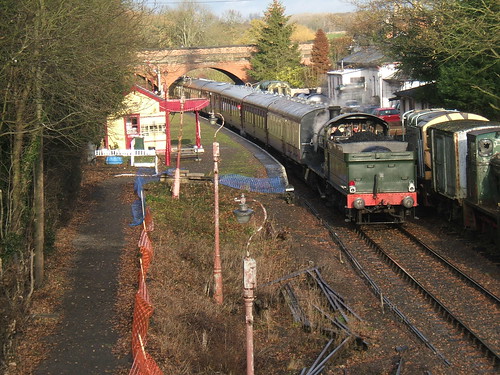
A 'Santa Special' at Market Bosworth, viewed from the scaffolding around the signal box.

When the guard announced that he was ready to take the train out, a whistle from the engine (as arranged) brought me running back to the footplate and we set off for Shenton. Although the day was still cold, the sun was out and it was quite pleasant, except on the footplate where the wind was quite chilling, particularly running tender first. The 3,000 gallon tender might give you better visibility tender first but it gives you very little protection from wind and rain. We completed the second round trip without incident, arriving back in Platform 1 again and running round for the third trip.

By this time, the weather had deteriorated and it was raining fairly hard, reminding me of my dictum "Anybody can work on engines in good weather - it takes railwaymen to do it in bad weather". Sam was tucked in the front corner of the cab, next to the warm boiler backhead to keep out of the worst of the weather, but Danny and I remained more exposed, trying to keep a good lookout. When we ran round at Shenton, we also lit the two engine lamps - although it was only around three-thirty, it had become really murky. At least the cab was more effective returning to Shackerstone but I found I had to lean out of the side of the cab or keep the front spectacle open to maintain a reasonable view ahead. Once again, we were routed into Platform 1 but, this time, we stopped to take take water at the column. Adrian provided a 'dose' of water treatment and suggested that we fill the tender tank to capacity.

By the time we were backed up on our train, we were already past the published departure. This train was not loaded to capacity so we didn't have to wait long before we got the 'Rightaway'. It's a completely different experience in the dark. In the steam era, British trains never carried high-intensity headlights although many foreign railways did. Everybody's familiar with pictures of American wood-burning 4-4-0s with a diamond stack and a huge rectangular headlamp but, in Britain, the head lamps performed the same task at night as in the daylight merely indicating the class of train.

The only light on the footplate was usually from a gauge lamp mounted near the gauge glass to assist the fireman in confirming the boiler water level. We had a working gauge lamp on the bracket next to the gauge frame. I'm afraid our gauge lamp was burning paraffin. In the old days, the gauge lamp always used rape oil which, being less volatile than paraffin, was less likely to explode into flames in its warm location next to the boiler backhead. In addition, a paraffin handlamp was often carried. With a white shade, it could be used when coupling, uncoupling, examining parts of the engine or just to help when walking about 'on the floor'. At night, a white light would be shown to the Guard in acknowledgement of his 'Rightaway'. We didn't have such a handlamp with us but used electric torches to acknowledge the Guard.

When the fireman opens the firedoors to shovel in more coal, the footplate is bathed in an orange or white light, depending how hard the engine is being worked. The driver will do well to protect his eyes from the glare, otherwise his night vision can be lost for a while. Some locomotives (particularly L.N.E.R. examples) were provided with a hinged shield to reduce the glare spilling across to the driver.

It wasn't completely dark as we made our way down the line for the last time. Some lineside features could still just be distinguished in silhouette against the inky sky. At night, sounds take on a more important role. The old drivers could work a train virtually 'with their eyes shut', listening to the distinctive sounds made by every rail joint, bridge and passing feature. We reached Market Bosworth safely, pausing briefly for the last time, then continued to Shenton. Uncoupling and coupling becomes more difficult in the dark and, when shunting through pointwork, it's vital that particular care is taken before moving points and that any handsignals given by lamp are clearly understood.

We ran round without incident and, having seen the Guard's green 'Rightaway' and acknowledged with a white, we set off back to Shackerstone. This time, we were routed into Platform 2. We lost no time in 'unhooking' and dropping forward clear of the points but then we had to wait a short while to allow the disembarking passengers to cross in front of us using the sleeper crossing at the end of the platform. We set back to the Ground Frame controlling access to the shed and, once called back by Danny, moved into the shed. Once the fire was cleaned and the boilers was filled, we were almost finished. By now quite tired, we made our way back to the station where I completed the repair sheet and signed off. Danny, Sam and I agreed we'd had an enjoyable, if tiring day.

My pictures taken on the day are here.
My pictures of the restoration of the signal box at Market Bosworth are here.
More pictures of 3803 are here.
Sam Brandist has his own blog - Sammy's World.

Friday, 16 December 2011

Single-stroke Bells

When railways introduced the Block System for the control of trains, electricity was used to power the bi-directional single-stroke block bell between adjacent signal boxes and the galvanometers used as block indicators. There's a brief description in the post on L&NWR Block Signalling Instruments. As explained there, many railways used separate wooden-cased units for the Block Bell, the 'Pegging' Block Indicator and the 'Non-pegging' Block Indicator. The picture below shows the typical appearance of the block bell.

Wooden-cased single stroke bell at Shackerstone Railway Museum. Note the studio portrait in the background of a proud railwayman in uniform

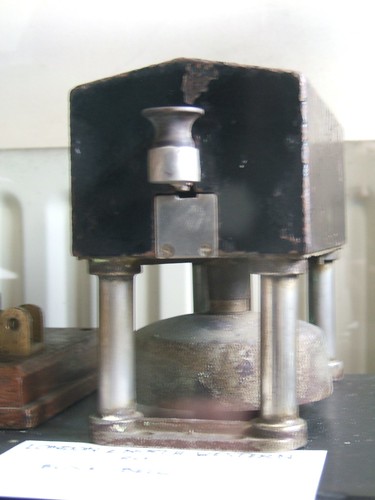
However, the L&NWR developed a 'Combined' Block Instrument, joining Bell and Block Indicators into a single unit. But there were still applications for single-stroke bells alone, where the Signalman exchanged bell codes with, for instance, a Guard or Shunter at a Ground Frame. The picture below shows an early form of the L&NWR single-stroke bell mounted on a cast frame.

L&NWR single-stroke bell (early version) at Shackerstone Railway Museum.

Later versions used a larger housing with the bell tapper moved to a central position and replaced the cast frame with four round, hollow columns. The hollow columns copied the technique used on the later 'Combined' Block Instruments which offered a neat way of bringing the wiring from the block shelf into the bell housing.

L&NWR single-stroke bell (later version) at Crewe Heritage Centre.

Only one wire is required between the two bell units - an earth-return is usually adequate. Each key or tapper has one changeover contact. In the quiescent state, the incoming wire at each end of the line connecting the two bell units is fed to one end of the bell coil and the other end of the coil is earthed. When the key is operated, the local coil is disconnected and a suitable voltage from an earthed battery is fed to line, operating the bell coil at the remote end of the line. The coil forms an electromagnet which attracts a moving armature connected to a bell hammer. The ball at the end of the armature strikes the bell dome to produce the sound. A spring attached to the armature returns the bell hammer to its rest position against an adjustable stop when the bell coil is de-energised.
There was a single-stroke bell of the later version between Sedgeley Jn. and Conygree Sidings Ground Frame. One day fifty years ago I sketched some of the dimensions:-

Sketch showing the principal dimensions of the later form of the single-stroke bell.

I also sketched the rear base casting which mounted the rear two columns. It had a tapped projection for fitting an adjustable back stop for the bell hammer:-

Sketch showing bell hammer adjustable back stop at rear of unit.

Tuesday, 13 December 2011

Jan's Train Register Book

In 2011 I scanned 'my' train register and, although there were some errors, posted it on the 'Scribd' site. However, it was removed from the site after a while (presumably because of low readership). I'm afraid it's taken me until 2021 to re-instate these pages (this time using Google Drive). The incorrect page 2 and various other editorial errors have not yet been put right, sorry.

I've now located one of 'my' train register books with details of most of the 'observations' I made between September 1963 and November 1965. Wolverhampton Power Signal Box had been commissioned on the 13th and 14th August 1965 so after this date Stour Valley signalboxes had either been abolished or downgraded to Shunting Frames. I think there should be an earlier train register book but I'm afraid this hasn't come to light.

This post is an index of the dates and locations covered by the train register, with links to the train register. The register pages are divided into two PDF files. 'Binder1.pdf' here and 'Binder2.pdf' here.

Location Date Register Pages
Deepfields Saturday 28th September 1963 2,3
Bloomfield Jn. Saturday 19th October 1963 2,3
Bloomfield Jn. Saturday 26th October 1963 4,5
Bloomfield Jn. Saturday 2nd November 1963 6,7
Bloomfield Jn. Saturday 9th November 1963 6,7
Watery Lane Saturday 16th November 1963 8,9
Watery Lane Saturday 23rd November 1963 10,11
Deepfields Saturday 30th November 1963 12,13
Watery Lane Saturday 14th December 1963 12,13
Bloomfield Jn. Friday 27th December 1963 14,15
Bloomfield Jn. Saturday 4th January 1964 16,17
Bloomfield Jn. Saturday 11th January 1964 18,19
Bloomfield Jn. Saturday 18th January 1964 18,19
Deepfields Saturday 1st February 1964 20,21
Deepfields Saturday 29th February 1964 22,23
Deepfields Saturday 7th March 1964 22,23
Deepfields Saturday 14th March 1964 24,25
Sedgeley Jn. Wednesday 25th March 1964 26,27
Sedgeley Jn. Saturday 28th March 1964 26,27
Sedgeley Jn. Saturday 11th April 1964 28,29
Sedgeley Jn. Saturday 25th April 1964 30,31
Deepfields Saturday 2nd May 1964 32,33
Deepfields Friday 15th May 1964 32,33
Deepfields Saturday 30th May 1964 34,35
Deepfields Saturday 6th June 1964 34,35
Tipton Curve Saturday 13th June 1964 36,37
Deepfields Saturday 20th June 1964 36,37
Sedgeley Jn. Saturday 4th July 1964 38,39
Deepfields Saturday 11th July 1964 38,39
Deepfields Saturday 25th July 1964 40,41
Deepfields Saturday 1st August 1964 40,41
Bloomfield Jn. Friday 2nd October 1964 42,43
Tipton Sta. Friday 2nd October 1964 42,43
Tipton Sta. Wednesday 7th October 1964 42,43
Tipton Sta. Saturday 10th October 1964 44,45
Deepfields Saturday 17th October 1964 44,45
Deepfields Saturday 24th October 1964 46,47
Deepfields Saturday 31st October 1964 46,47
Tipton Curve Jn. Saturday 7th November 1964 48,49
Deepfields Friday 13th November 1964 48,49
Deepfields Saturday 28th November 1964 50,51
Deepfields Saturday 5th December 1964 50,51
Deepfields Saturday 19th December 1964 52,53
Deepfields Saturday 2nd January 1965 54,55
Deepfields Saturday 16th January 1965 54,55
Deepfields Saturday 30th January 1965 56,57
Deepfields Saturday 13th February 1965 56,57
Bloomfield Jn. Saturday 6th March 1965 58,59
Deepfields Saturday 27th March 1965 60,61
Tipton Curve Jn. Saturday 27th March 1965 60,61
Deepfields Saturday 10th April 1965 62,63
Deepfields Tuesday 20th April 1965 62,63
Deepfields Saturday 24th April 1965 64,65
Deepfields Saturday 8th May 1965 64,65
Deepfields Saturday 22nd May 1965 66,67
Tipton Curve Jn. Saturday 29th May 1965 66,67
Deepfields Saturday 5th June 1965 68,69
Deepfields Tuesday 8th June 1965 70,71
Deepfields Saturday 12th June 1965 70,71
Deepfields Saturday 19th June 1965 72,73
Deepfields Saturday 26th June 1965 72,73
Watery Lane Saturday 26th June 1965 74,75
Deepfields Saturday 3rd July 1965 76,77
Tipton Curve Jn. Saturday 10th July 1965 76,77
Tipton Sta. Saturday 10th July 1965 78,79
Tipton Curve Jn. Saturday 17th July 1965 80,81
Deepfields Saturday 24th July 1965 80,81
Tipton Curve Jn. Saturday 31st July 1965 82,83
Deepfields Saturday 7th August 1965 82,83
Tipton Shunting Frame Saturday 28th August 1965 84,85
Bloomfield Jcn. Shunting Frame Tuesday 31st August 1965 84,85
Watery Lane Shunt Frame Saturday 4th September 1965 84,85
Tipton Station Shunt Frame Saturday 18th September 1965 86,87
Bloomfield Jn. Shunt Frame Saturday 2nd October 1965 86,87
Bloomfield Jn. Shunt Frame Saturday 6th November 1965 86,87


[Note about 'Scribd' added 29-Oct-2016: links to PDFs re-instated 06-Mar-2021]