Tuesday, 13 June 2017

The Great Eastern Railway


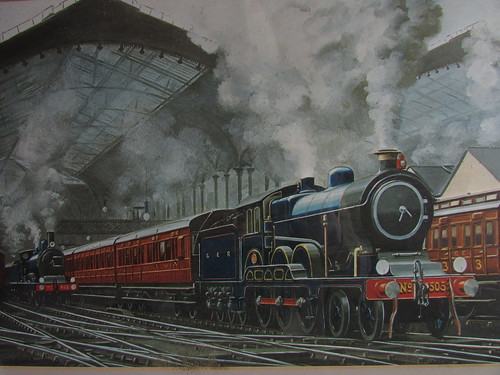
Locomotive 1505 leaving Liverpool Street ('Proud Steam' by C. Hamilton-Ellis).

Although the Great Eastern Railway was absorbed into the London and North Eastern Railway following the Railways Act of 1921 which combined Britain's railways into four Groups, much of the railway's distinctive flavour survived. Unfortunately, being brought up in the West Midlands I didn't have much opportunity to savour that flavour.

Probably my first visit to a former Great Eastern station was in 1951, when my mother took me to the Festival of Britain celebrations in London. We were both impressed by the South Bank site. But I insisted on visiting a number of the main line terminal stations in London, including the former Great Eastern terminus at Liverpool Street.

Sometime later, my mother and I travelled, by train, to an appointment she had in March (the town). A brief introduction, I'm afraid, to a railway of great character.

Over the years I made various train journeys to places on the former Great Eastern network like Cambridge and Ipswich and once went from Stratford (Low Level) to Woolwich in a 2-car DMU. On that journey, I still remember the sense of dereliction hanging over the area around Silvertown. Part of that route is now used by the Docklands Light Railway.

In the 1990s, I visited Sheringham a couple of times by train to visit the marvellous North Norfolk preserved railway, where I was a "guest driver" on 'Ladies Days'. I got to drive the amazing 'B12'. As the '1500' class (shown in the picture above in the handsome livery of the Great Eastern), this long-lived class was one of the star performers on the Great Eastern.

More recently, on 30th July 2011, I travelled to Chelmsford by train to attend Lionsmeet 2011. On 1st July 2013 I travelled to Ely (described here) and, on 8th September 2014, I looked at the Great Eastern in the London Area (and wrote about it here). In January 2017, I made another journey from Liverpool Street to Stratford, described in the post Interlude in London.

The 'Jazz' service

Prior to the electrification of its suburban services in 1960, Liverpool Street was famous for its intensive steam-hauled local trains, known as the 'Jazz', introduced in 1920. This service is recalled by Keith Jaggers in an article here and there's an excellent analysis of the 'Jazz' services in the post The Development of timetables at Liverpool Street station over the past 100 years.

Great Eastern Railway Society

The Great Eastern Railway Society website has comprehensive information about the railway (and a shop).

Signalling

The Great Eastern was distinctive in signalling matters and used 'somersault' semaphore signals widely. These display a conventional horizontal arm when 'on' but, in the 'off' position, the spectacle turns so as to change the filter displayed in front of the lamp in the conventional manner but the arm pivots away from the spectacle at an angle usually exceeding 45 degrees, giving the appearance of being broken! The advantage of this arrangement is that, during the day, the position of the arm is easier to read at a distance.

Locomotive Headcodes

The Great Eastern also had its own, complex, arrangement of headcodes on locomotives, justified by the intensity of suburban services operated. I discussed this, briefly, in the post British Locomotive Headcodes, which has links to more information on the Great Eastern Railway Society website.

The East London Railway

Marc Brunel's Thames Tunnel never managed to provide a cross-river link for horse-drawn vehicles, as was the original intention, but its dimensions allowed it to be adapted for rail traffic. In 1865, the Great Eastern Railway was one of the six subscribers to the East London Railway which purchased the tunnel and converted it for railway use.

The six railways in this joint venture were:-
Great Eastern Railway
Metropolitan Railway
District Railway
London, Brighton & South Coast Railway
London, Chatham and Dover Railway
South Eastern Railway

There's a brief history of this interesting line here.

Maps

The Great Eastern Railway connections around London are shown on the Railway Clearing House maps. These are linked below:-

Great Eastern around Liverpool Street.
Great Eastern connections south of the Thames via the East London Railway.
Great Eastern around Stratford.
Great Eastern around Millwall and Poplar.

Book References

[1] ‘Great Eastern Album’ by R. C. Riley (Ian Allan) ISBN 7110 0063 8.
[2] ‘The Great Eastern Railway’ by C. J. Allan (5th edition paperback Ian Allan 1975) ISBN 07110 0659 8.

Related posts on other sites

Great Eastern Railway Society.
Great Eastern Railway.
Liverpool Street, and all that Jazz (PDF).

Related posts on this site

The Great Eastern in the London Area.
Interlude in London
East London Line.


My Pictures

Where necessary, clicking on an image above will display an 'uncropped' view or, alternately, pictures from may be selected, viewed or downloaded, in various sizes, from the albums listed:-
Ely Station.
London: Former Great Eastern Line.

Train movements at Yangon Central station

Events of Thursday 20th April 2017

This post documents 90 minutes of observations at Yangon Central station, to give an impression of the working at this busy station. The station is controlled from a miniature lever Westinghouse power frame which I described in a post here.

The movements are listed in the table below. Click on 'Photo' ref to view the associated picture. Use 'back button' (not the 'Back to photostream' button) to return to this post.

Time Notes Photo
15:11 Loco-hauled pass in plat 6, facing west.
Unidentified pass in plat 3, facing west.
1342
15:16 Stock for an express propelled into plat 1(?) from the east. 1344
15:18 Station Pilot Kawakasi 500 h.p. diesel hydraulic DD.521, attached to bogie flat WBH/V 14469 for shunters propels stock shown above from the east. The /V indicates vacuum brakes have been removed. 1347
15:18 DF.1200.08 (dual-braked with auto-couplers) heads east, crossing via scissors from plat 5 to plat 6, dragging similarly-fitted DF.2072 in 'modern' livery. 1348
15:20 Locos stand in plat 6 East. DF.2072 (dual-braked with auto-couplers) in 'modern' livery was built by CST Sifang. 1350
15:21 DMU number RBE25126 (second-hand Japanese) travelling west, crosses via scissors from Through to plat 7 west. 1351
15:33 DF.1637 in blue and cream livery (vacuum-braked with ABC couplers) heads east, crossing via scissors from plat 5 to plat 6. 1353
15:45 Station Pilot DD.521 (Kawakasi 500 h.p. diesel hydraulic), attached to bogie flat WBH/V 14469 for shunters, propels coaches westwards into the carriage sidings. 1360
15:48 DMU number RBE.25119 (second-hand Japanese) travelling west, about to cross via scissors from Through to plat 7 west. 1362
16:01 DD.933 (vacuum braked and auto-coupler) arrives in plat 6 East with a local from the east. 1366
16:07 DD.933, having uncoupled and crossed to plat 5 west, now runs round via plat 5 east. In background, DMU (repainted second-hand Japanese) arrives from west in plat 4. 1370
16:09 DMU number RBE-25.106 (second-hand Japanese) travelling west, waits for signal before crossing via scissors from Through to plat 7 west, as passengers disembark. 1371
16:18 DF.1221 (vacuum brake and ABC coupler) arrives in plat 7 east with a train from the east. 1373
16:19 DF.1221, having uncoupled, crosses to Through west, to run round via Through east. 1374
16:40 The loco-hauled westbound train (which has stood in plat 6 west throughout) finally about to leave. 1375
16:40 A terminating DMU arrives from the west into plat 7 west. 1376
16:42 A train from the east has arrived in plat 6 east, hauled by an unidentified 900 h.p. loco which has quickly run round its train to form an anti-clockwise Circle Line departure. 1377
16:47 View of east end of Yangon Central from my departing anti-clockwise Circle Line train. DF.2069 in platform 3 and station pilot DD.521 in platform 1. 1378


Related Posts on this Website

There are a number of posts describing Myanma Railways and my previous visits to Yangon Central station. You can find them all here.

There's a brief introduction to railway diesel traction in Myanmar, and the various classes in use, here.

My Pictures

Pictures referred to above are here.

All my pictures of Myanma Railways, including the Circle Line, are here.

Photographs may be selected, viewed or downloaded, in various sizes.

Wednesday, 7 June 2017

Bank Holiday with Steam and Diesel

Following an e-mail from Steve A. (Footplate Roster Clerk at the Battlefield Line) seeking additional crews to cover the Spring Bank Holiday period, I was rostered as driver on 'Cumbria' - an 'Austerity' tank locomotive - on Monday, 29th May 2017.


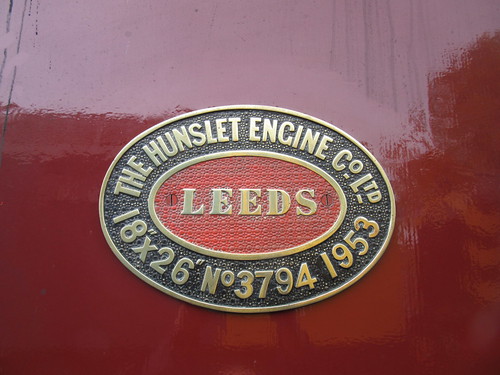
Worksplate on 3794 'Cumbria'.

Prior to the normal service of five round trips to Shenton, we had a Gold Footplate Experience booked. These popular courses give the trainee one round trip driving to Shenton and back 'light engine', followed by a second round trip to Shenton with a train attached. Friends and family of the trainee may travel in this train.

A text the night before informed me that Martin Sargent would be fireman for the Gold Footplate Experience but he would not be available all day so it might be necessary to run some of the service trains with the Diesel Multiple Unit.

I 'signed on' in the Staff Room at the station just before 6.30 a.m. - Martin had arrived forty minutes earlier. Having read the 'Notices' displayed in the glass-fronted notice case, I collected a copy of the Operating Notice covering the holiday period. The Operating Notice is issued periodically and lists the speed restrictions currently in effect on the line, important engineering work, the trains to be run day-by-day, special instructions and a list of important telephone numbers.

Preparation

I walked to the Engine Shed and met Martin. Having completed all the initial checks on the locomotive, he was about to 'light-up'. I hunted for oil feeders, oil bottles and oil to allow me to 'oil round' and carry out the all-important daily examination of the locomotive. I commented to Martin that the 'top' of the engine (all the painted areas above the foot-framing) looked very clean, shining in the artificial lighting in the shed. Sadly, the same was not true of the 'bottom' (wheels, motion and the area between the frames) and my overalls were soon liberally coated in oil and dirt.

Raising steam, oiling and the 'daily exam', together with cleaning as time permits comprise 'Preparation', which is an important part of footplate work. In the old days, footplatemen acquired the necessary technical knowledge by attending Mutual Improvement Classes, briefly described here. There's a list here of articles in this blog which describe working on the footplate or cover topics dealt with at Mutual Improvement Classes.

An earlier article here describes the preparation of a similar 'Austerity' tank at Peak Rail and the post 'Operation: Market Bosworth' - On the Footplate describes the preparation of 'Cumbria' at Shackerstone on a previous occasion.

Gold Footplate Experience

We came 'Off Shed' at about 8.40 a.m. with a full tank of water (using the hose inside the shed) and picked up our Trainee Driver. I briefly described the main driving controls (regulator, reverser, steam brake) and outlined the use of the whistle and cylinder drain cocks. The signalman had set the crossover road and cleared the signals for us so we set off slowly, with the Trainee Driver at the controls, collecting the necessary single line token from the signalman as we passed the signal box. Most Trainees have not driven a steam locomotive before, so the rush of sensations as their actions starts the locomotive usually makes quite an impression! The experience is very different from driving a car - 'Cumbria' on its own, when full of coal and water, weighs around 50 tons.

The driving was complicated by my insistence that we economise on steam by 'linking-up' the motion on the road, the need to comply with the various speed restrictions and whistle at the mandatory 'Whistle' boards but we made good progress to Shenton and stopped in the platform briefly. Having hauled the reverser into full forward gear, we set off back to Shackerstone, with the Trainee Driver now gaining more confidence. On our arrival, I surrendered the Single Line Token to the signalman.

Before coupling onto the train for the second part of the Gold Footplate Experience, we replenished the saddle tank and I described the vacuum braking system that we would use when hauling the train, where the Driver's Vacuum Brake Valve would control the vacuum brake cylinders throughout the four-coach train. Our Trainee's family boarded the train and, on receiving the 'Right Away' from the Guard, we set off again, this time with the Trainee having a better idea of the route he was driving over and the way in which the the locomotive responded to the controls. With four coaches attached, the total train weight was around 200 tons and, of course, we were using the vacuum brake for stopping. Our Trainee did very well and, after Martin had uncoupled 'Cumbria' from its train at Shenton, the Trainee shunted the engine to the opposite end of the train ready for the return leg.

We were soon on the move again and made our way back to Shackerstone, where our Trainee stopped the train correctly in platform 2. His family gathered round to congratulate him and Mark H. asked me, as Supervising Driver, to present the documentation testifying to his Experience.

The Weather

Although the previous few days had been warm and sunny, the weather forecast for the Bank Holiday (naturally) was not too good and the morning was dry but rather overcast. In fact, this type of 'slightly dubious' weather can be helpful to the railway in encouraging people to decide to visit an attraction where the train itself will protect them from any rain and there are things to do under cover (at its three stations, the Battlefield Line boasts three cafes, four shops and a railway museum). Really hot, settled weather encourages people to pursue outdoor activities like the beach and may reduce visitor numbers at the railway. That certainly seemed to be the case on Bank Holiday Monday and both Martin and I were surprised at how many people had arrived for the first departure at 11.15 a.m. Although Martin had arranged to be elsewhere during the day, he decided that he would definitely fire the first round trip, so that we provided the expected steam service to our passengers.

The Service Trains

Having said 'Goodbye' to our Gold Footplate Experience trainee, I ran 'Cumbria' round its train, pausing at the water column where Martin and I filled the saddle tank again, then Martin attached us to the train and I created vacuum in the train pipe. After all the passengers had sorted themselves out, we left somewhat late.

In the earlier post here (also referred to in 'Preparation' above) I listed the various speed restrictions in force some months ago and I'm afraid these remain in place, except that the length of track affected by the 'slack' at Headley's Crossing has been reduced. I discussed some of the issues regarding methods of driving 'Cumbria' in the section "Notes on driving 'Cumbria'" in the earlier post Sunday at Shackerstone. One of the attractions of working on the footplate is that, whilst an understanding of the principles involved in steam locomotives is essential, the final success (or otherwise) is dependent upon the willingness of both driver and fireman to closely observe, every day, the result produced by each action and modify those actions, where required. It's been said it's both a Science and an Art.
After a couple of turns of the coupled wheels in 'Full Gear', I set the reverser to what I call 'Linked-Up a Bit More' (explained in 'Sunday at Shackerstone', mentioned above) and controlled the speed on the regulator until we were clear of the 10 m.p.h. 'slack' at Barton Lane overbridge, when I pushed the regulator handle over to 'Full First Valve'.

Locomotive Regulators

A couple of earlier posts talk about regulators used on steam locomotives - Locomotive Regulators (part 1) and Locomotive Regulators (part 2).

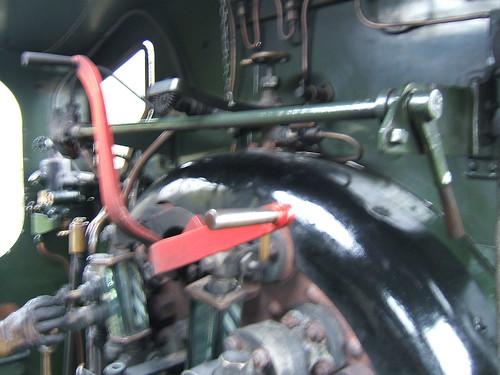
On most locomotives fitted with a slide-valve regulator with two valves, when the regulator handle is at 'Full First Valve' it feels as if there's a definite 'stop', although the quadrant extends further. This occurs when the pilot valve has completed its travel and further movement of the handle requires the much-larger main valve to move. The steam pressure holding the larger main valve against the port face means that a greater effort is required to start to move it. The picture below (looking down on the regulator valve assembly from above) illustrates the difference in size between First Valve and Main Valve on the vertical slide valve regulator of an 'Austerity' Tank Locomotive. Of course, you can only see this when the dome cover has been removed and the steam dome inspection manhole has been unbolted - the picture was only possible during repairs following a regulator failure in service which is described in the post The Best Laid Schemes ....
View of regulator valve, showing 'U' shaped pilot valve in front of the broad main valve.

The First Service Train

Because we were running late, apart from the various speed restrictions and our booked stops at Market Bosworth, most of the running was performed with the reverser set to 'Linked-Up a Bit More' and the regulator at 'Full First Valve', producing a satisfying roar from the chimney top when running at line speed. I personally don't often use main valve - on the types of railways I work on with moderate gradients and modest loads, it's rarely needed and, if your fireman has not had a chance to prepare for the greatly-increased demand for steam when on main valve, the boiler can become 'winded' and lose pressure. However, on a couple of occasions when I pushed the regulator handle over to 'Full First Valve', the handle didn't stop part way across the quadrant, as expected, but moved further, suggesting that the main valve had started to move. 'Cumbria' has suffered a long-term problem in getting the regulator to shut properly also indicating that the main valve is not always, as it should, moving independently of the pilot valve.

Steam Lock

It's possible for a steam locomotive to become 'steam locked', where steam becomes 'trapped' in the steam chest when the locomotive is stationary and the steam pressure on the valve makes the reverser very hard to move. This can occur if the main valve remains partly open with the regulator handle in the fully closed position and open drain cocks are unable to adequately vent the system. Potentially, any locomotive with unbalanced slide valves can develop this difficulty. Even the 1838 locomotive 'Lion', the first locomotive I ever drove, occasionally 'steam locked'. The remedy was to wait and eventually the cylinder drain locks would reduce the pressure sufficiently for the reverser to be moved. I've discussed driving 'Lion' in the post Driving 'Lion' (although I didn't mention 'steam locking').

'Cumbria' has an unfortunate tendency to 'steam lock', making adjustments to the reverser very heavy. This is particularly problematic after 'easing up' to slacken the coupling when 'unhooking' from a train. The effect is similar to a regulator being 'gagged in second valve' described in the post on regulators 'Locomotive Regulators (part 1)' mentioned above. When 'steam lock' occured on 'Cumbria', the technique which worked on 'Lion' offered no solution and brute force on the reverser seemed to be called for. However, I found a slightly-altered driving method reduced, but didn't eliminate, the chance of a 'steam lock' occurring by ensuring that each time the regulator was closed, it was done smartly and from 'Full First Valve' position. The cylinder drain cocks were also opened whilst the train was still in motion, in the hope that any residual steam would be discharged before the locomotive came to a stand.

Later Service Trains

As the engine became thoroughly 'warmed through' both steaming and running seemed to improve and both Martin and I agreed that we were enjoying ourselves. The only tedious part of the proceedings was the need to take on water each time we ran round at Shackerstone - 'Cumbria' does seem rather thirsty. Martin decided that, rather than leaving early as he'd arranged, he'd carry on firing for at least one more trip.


The driving controls of 'Austerity' tank locomotive 'Sapper' illustrated here are similar to 'Cumbria'.

In fact, we ran four of the five booked service trains with 'Cumbria'. By this time, the dry but overcast weather of the morning had deteriorated into drizzle which eventually turned into continuous rain, prompting me to repeat my usual remark "Anyone can work on an engine in good weather - it takes a footplateman to do it in bad weather". We'd agreed that, on completion of the fourth round trip, we'd put 'Cumbria' on shed and, whilst Martin carried out disposal of the steam locomotive, I would 'fire-up' the Diesel Multiple Unit for the final service train, where passenger numbers are usually lower.

The Diesel Multiple Unit

The Battlefield Line is fortunate in being home to the Diesel Multiple Units owned by Ritchie Marcus. There's an introduction to Diesel Multiple Units in the post here.

At Shackerstone, there's a single-unit 'Bubble Car' (55005, built by Gloucester Railway Carriage and Wagon Company in 1958) and a 2-car set (51131 built Derby in 1958 paired with 51321 built Birmingham Railway Carriage and Wagon in 1960). When necessary, all three cars can be worked in multiple. In 2016, the single-unit could sometimes be seen working with half of the 2-car set whilst the other half of the set was undergoing renovation but all three cars are now back in traffic after significant work by Ritchie and his team.

Lined up on the Railcar Siding I found the 'Bubble Car' and, next to the outlet signal having been used the previous day, the 2-car set. Having been on a steam locomotive all day, I had to "switch hats" and think about a completely different form of traction. This was the similar to sudden change that countless steam footplatemen were faced with during British Rail's Modernisation Programme in the 1950s and 1960s. Some men adapted well and saw the advantages of a better working environment: others couldn't face mastering a new technology and were devastated by the loss of a way of life.


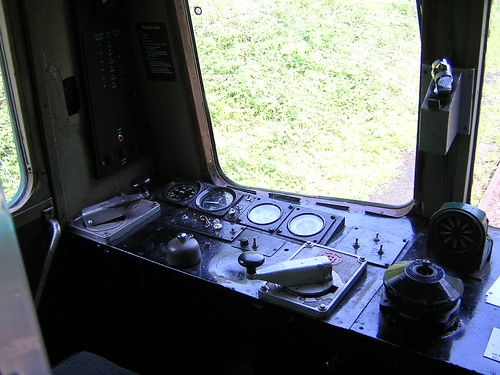
On a DMU, the driving controls are neatly laid out on the desk in front of the driver.

I can sympathise with both reactions but, as the rain sluiced down, the prospect of sitting on a padded seat in a enclosed cab for the last round trip certainly appealed. I set about carrying out the check of levels and daily exam - much simpler than on a steam locomotive but equally vital.

Having started all four engines from the ground, I was able to climb inside as I waited for the compressors to produce sufficient air pressure to be able to operate the electro-pneumatic controls and carry out the start-up checks, including the all-important test of the Driver's Supervisory Device (DSD), more popularly known as the "dead man's handle", in each cab. Since Diesel Multiple Units are single-manned, the DSD is needed to stop a train in the case of incapacitation of the driver.

The Guard had joined me from the main train and unlocked all the doors. The signalman had 'set the road' and cleared the signal so I gently drifted down to Platform 1 to pick up our passengers. I'm afraid the changing over from steam to diesel made us late away but, with 600 horse power available for a 2-coach train, we could accelerate rapidly although subject to the same speed limits as the steam train. I'd already noted from the previous day's report sheet that one engine had shut down 'on the road' so I wasn't worried when the same engine shut down on me. A push of the engine start button in the cab restarted it and no further problem occurred. We stopped at Market Bosworth for a few passengers, but the station buildings were already locked. At Shenton, I changed ends. That involves switching the electric marker lights at what was the front to red and taking the Master Key, 'Spoon' handle, Brake Handle and Train Staff to what will become the leading cab. I often manage to forget one of these items, resulting in an extra trip back to the other cab.

By the time we set off on our return journey, the rain had started to ease but I was still glad of the air-operated windscreen wiper. However, rain or shine, I normally keep the cab window open so that I can listen to the noises from the train. I'm reluctant to become too isolated in the cab, reliant on the instrumentation provided. The Guard had determined that there were no passengers to alight at Market Bosworth so, as I approached the platform, he buzzed me to omit the station stop. Once through the speed restriction in the station, I was able to accelerate to line speed and we were soon back at Shackerstone. While the Guard closed windows and locked the passenger doors, I changed ends then I took the train back to where I'd found it, shut it down and completed the daily report sheet.

Although tired after a shift of more than 11 hours, I'd had an excellent day and the contrast between the two types of traction we'd used was interesting.

My pictures

Where necessary, clicking on an image above will display an 'uncropped' view. Although I didn't get a chance to take pictures on the day, the albums below (from which pictures may be selected, viewed or downloaded, in various sizes) show the motive power we used:-

'Cumbria'.
2-car DMU.

Saturday, 20 May 2017

Leaving Hobart

Events of Saturday 20th May 2017

I'd the morning available for more exploration but in the afternoon I'd start my long journey home. I started with a walk around the docks near my hotel, looking at the almost-complete MACq 01 Hotel. Needless to say, the odd name irritated me. With a mixture of upper case, lower case and numerals it looked more like a strong computer password than the name of a hotel. I correctly guessed that it was derived from 'Macquarie' but it took a little hunting to find the derivation. The area was formerly part of Macquarie Wharf and the hotel, developed by family-owned Federal Group (which also owns the Henry Jones Art Hotel) is located on the site of Transit Shed 1.


Around Hobart: The MACq 01 Hotel nears completion.

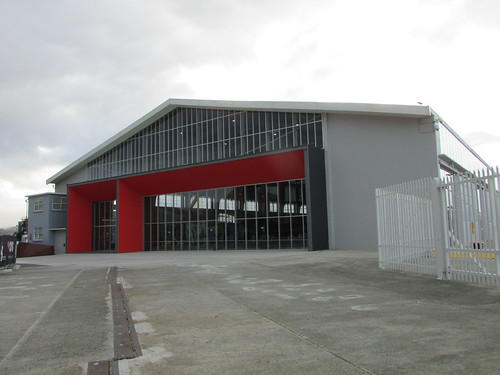
Nearby, I looked at the converted Macquarie Wharf Number 2 Shed, now a "marquee cruise port and gateway for shipping to Antarctic" according to the Tasports site here.


Around Hobart: Tasports Cruise Terminal

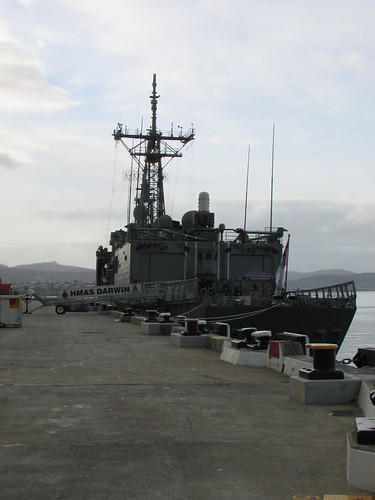
No cruise ship was docked but I did see HMAS 'Darwin', which I knew from the newspaper was on a farewell visit to Hobart prior to de-commissioning in Sydney. There was a report on the internet here and a Wikepedia article on this American-built guided missile frigate here.


Around Hobart: HMAS 'Darwin'.

Having looked at the imprisonment of men in Tasmania the previous day, I decided to look at the Cascades Female Factory in South Hobart, just a ten-minute taxi ride from my hotel. This is also a World Heritage Site.

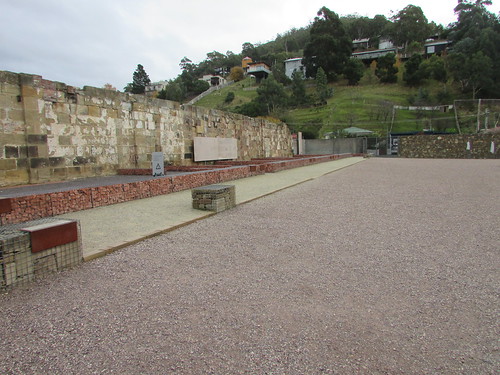
Despite the innocuous-sounding name, this was the female prison - the term 'Factory' refers to the laundry work carried out by the inmates. Apart from the Matron's House, not much of the site remains other than external walls but the earlier ground plan has been marked out meticulously with low 'walls', actually metal baskets filled with coloured stone chippings called 'gabions'. It was more like visiting an archaeological site, indeed, digging is still going on to reveal more of the site's history.


Cascades Female Factory, Hobart:

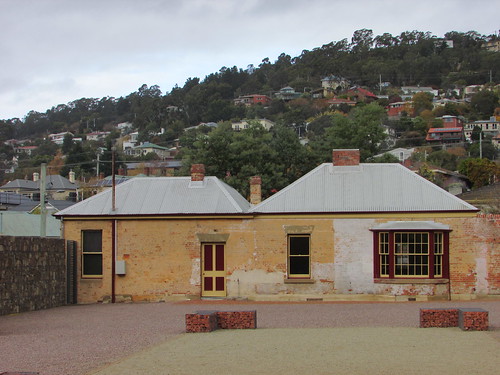
With limited time at my disposal, I elected for the 'self-guided tour' rather than a conducted tour. To help bring the tragic stories of specific prisoners to life, they also use re-enactors on some tours. The 'Matron's Quarters' are open to visitors and a project under way is restoring the appearance to that in the 1850s.

Cascades Female Factory, Hobart: Present appearance of 'Matron's Quarters' building.

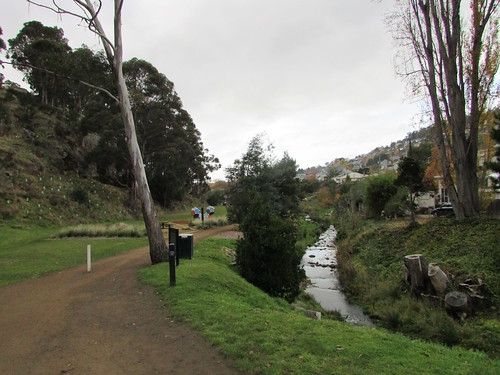
To see a little more of the city, I decided to walk back to my hotel, a journey of perhaps 4 km. A stream, called Hobart Rivulet, passes the Cascades Female Factory and flows towards the centre of Hobart. Part of this has been arranged as an attractive 'Linear Park', used by dog-walkers and cyclists.


Around Hobart: Hobart Rivulet Linear Park.

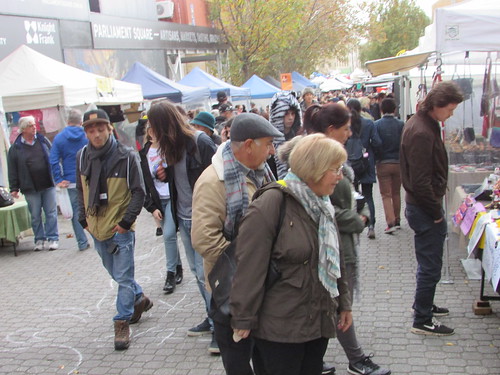
This gave me an interesting walk which I concluded by rejoining the public roads and walking through Salamanca Market back to the harbour. The market seemed to be mainly craft items and artisan foods.


Around Hobart: Salamanca Market.

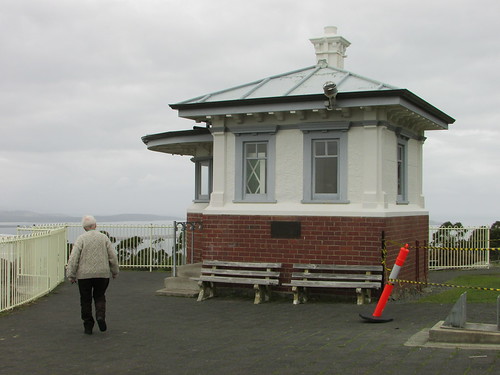
On arrival back at my hotel, I found Jill Ford waiting for me. Nancy, whom I'd met two days earlier, had given Jill my details since both of them have associations with Burma and Jill, with some ingenuity, had tracked me down. Jill offered to take me to see one of Hobart's viewpoints, Mount Nelson Signal Station. Commissioned in 1811, flag sinalling was in use until 1831 then the semaphore telegraph was in use here until late in the 19th century. The area is now managed by the Tasmania Parks & Wildlife Service and there's a little more on the signal station history here.


Mount Nelson Signal Station, Hobart: Lookout House, dating from 1910.

We shared a very pleasant, unexpected interlude and enjoyed hot chocolate and cream cakes at the Signal Station Brasserie housed in the former Signalman's house before Jill returned me to the hotel.

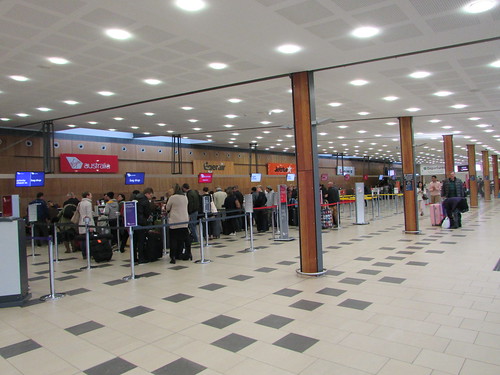
My booked car to the airport arrived early, so Jill and I said our "Good-byes" and I was whisked back to the airport after a very interesting, if brief, visit to Tasmania. Check-in, by a friendly human being, was quick and I discovered that the facilities were more spacious than I'd realised on my arrival.


Hobart Airport Departures Hall.

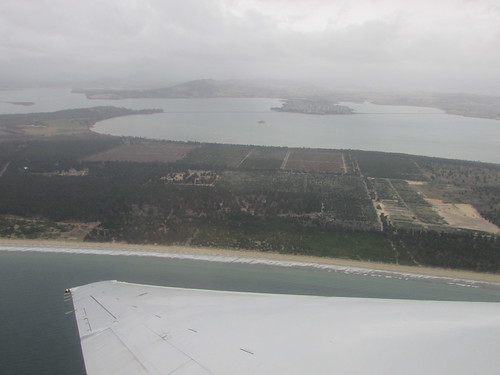
I'd made sure I had a window seat on the Boeing 719 to Sydney.


Leaving Tasmania.

At Sydney, I made it through the security checks and the obstacle course of Duty Free without getting too exasperated.


Transiting Sydney: The obstacle course of Duty Free.

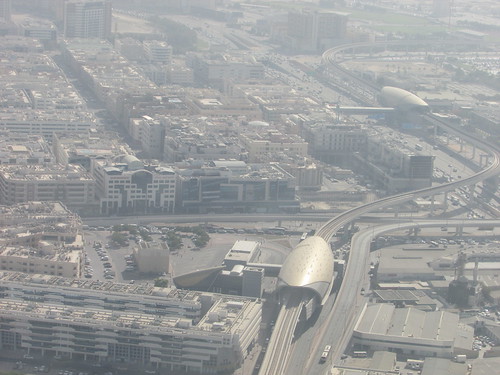
I boarded a huge Airbus A380 at Sydney for the flight to Dubai where I had a final transit to a flight to Birmingham. Leaving Dubai, I managed to take the picture below which shows the elevated Dubai Metro snaking across the city.


Leaving Dubai for Birmingham: view showing the overhead Metro System.

My plane arrived at Birmingham on time on Sunday morning and a car took me, tired but happy, back home after amazing experiences in Myanmar and Australia..

Related Posts on this Website

All Burma-2017 Trip posts.
All Australia-2017 posts.

My photograph albums

Where necessary, clicking on an image above will display an 'uncropped' view or, alternately, pictures from may be selected, viewed or downloaded, in various sizes, from the albums listed:-
Cascades Female Factory, Hobart.
Hobart, Tasmania.
Mount Nelson Signal Station, Hobart.
The Henry Jones Art Hotel, Hobart.
Hobart Airport and its aircraft.
Sydney Airport.
Dubai Airport, U.A.E..

[Text added, links to pictures added 18-Aug-2017: Text amended, pictures added 14-Sep-2017]

Friday, 19 May 2017

Trip to Port Arthur

Events of Friday 19th May 2017

Friday was my last full day in Tasmania, and I'd accepted my travel agents suggestion to make a day trip to Port Arthur which had been pre-booked with 'Under Down Under Tours'.

I was picked up from my hotel at 7.30 a.m. by a charming Swiss driver/guide in a 15-seater Japanese minibus and, after more pick-ups, we set off towards Port Arthur. We made our first stop at the pretty village of Richmond, very English in appearance.


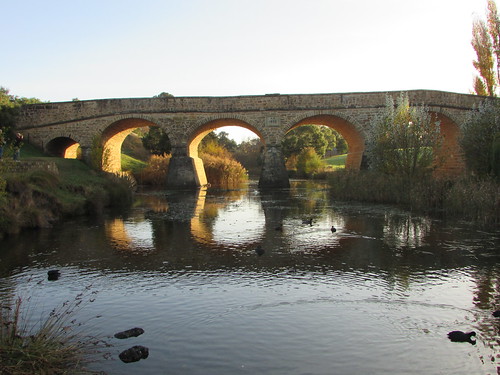
Richmond, Tasmania.

Further on, we stopped again for sea-views at Pirates' Lookout.


Pirates' Lookout.

Our final stop before the World Heritage Site at Port Arthur was at Port Arthur Lavender Farm, too late in the season (we were told) to see the floral displays. I tried the lavender-flavoured chocolate shavings samples but didn't feel impelled make a purchase.


Hobart to Port Arthur: Part of Port Arthur Lavender Farm.

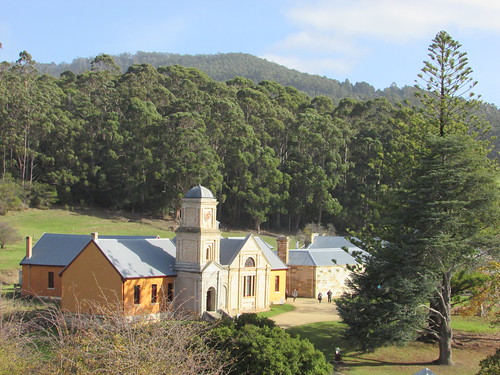
Soon after leaving the Lavender Farm, we arrived at the Port Arthur Historic Site visitor centre which in in the process of being massively extended. Since becoming a World Heritage Site in 2010, visitor numbers have increased significantly.


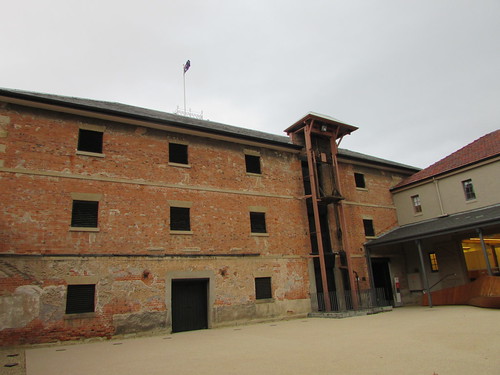
Port Arthur Historic Site: The remains of the Penitentiary.

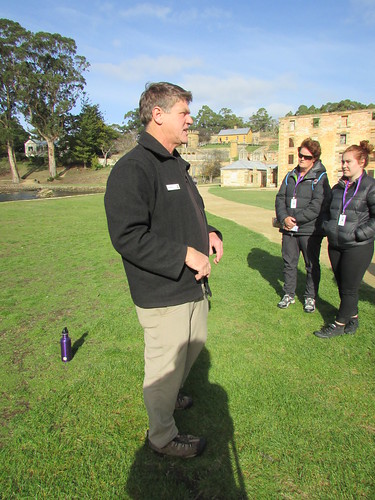
After a 40-minute orientation by an excellent guide, Andrew, we were free to explore.


Port Arthur Historic Site: Site Guide Andrew.

I'm afraid I knew very little about the period of Transportation when large numbers of convicts from England, Ireland, Scotland, Wales and the British Empire were sent to Australia for imprisonment (partly to ease chronic overcrowding in British Gaols). Wikipedia has an article here and the official Port Arthur Historic Sites website here provides a lot of useful information, from which the notes below were condensed.

Sentences varied from seven years to life and those convicts who survived the harsh conditions and were released stood very little chance of ever being able to afford the passage back to their birthplace.

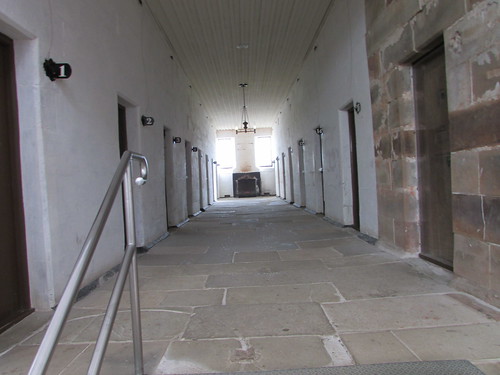
Port Arthur was established as a penal settlement and timber camp in 1830, extracting valuable timber. It has what has been described as "the finest natural harbour in the southern hemisphere", making it a suitable destination for ships carrying convicts or exporting timber. Ship building was established in 1834 and, although successful, had virtually ceased by 1848. By 1840, the convict population was 1,100 and all kinds of support industry had been established. In 1844, numbers had risen to 3,500 and an ambitious project was undertaken to construct a water-powered flour mill. But the water supply proved unreliable and ten years later, the mill was converted into the Penitentiary. The large site had no external walls: the remote location was largely sufficient to deter escapes by land or water, particularly since the use of manacles and weights attached to prisoners was commonplace. In 1850 the Separate Prison was built when changing ideas promoted the use of solitary confinement rather than physical punishment and flogging.


Port Arthur Historic Site: Cells in the Separate Prison.

In the 1860s, an aging population of convicts lead to the so-called 'welfare phase'. The Asylum, dating from 1863, provided basic care for the mentally ill. Having subsequently been rebuilt and used as a school, town hall and museum, it survives as a poignant reminder of earlier days.


Port Arthur Historic Site: The Asylum.

Use as a penal settlement finally ceased in 1877, after which the location was renamed Carnarvon, the land was auctioned and, despite suffering serious fires, settlers created a viable community. The unsavoury history of the area served as a magnet for tourists. In 1927, the name reverted to Port Arthur and the tourist trade supported 3 hotels, 2 museums and numerous guides. The former Commandant's House became 'The Carnarvon Hotel' in 1885 and the building has been restored to reflect that period.


Port Arthur Historic Site: The Commandant's House, restored in the period of 'The Carnarvon Hotel'.

Although many of the original buildings have been damaged (or destroyed), what remains has been carefully preserved to give an eerie insight into the prison regime.

I walked around the site, from building to building, taking photographs and trying to absorb the enormity of the earlier history. My party was booked on the 1.40 p.m. harbour cruise in a modern catamaran so I had to hustle to get to the boat in time - I could have spent much longer exploring the site.

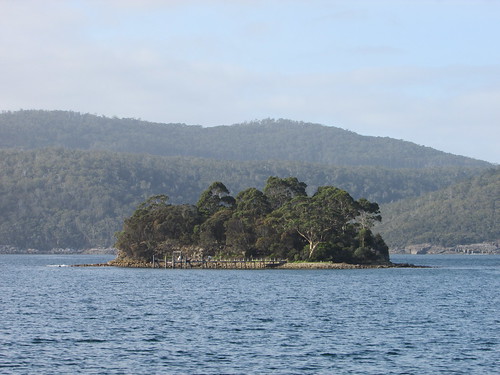
The harbour cruise gave interesting views of Port Arthur and also berthed at the Island of the Dead - Port Arthur's cemetery for both convicts and free men. Here, visitors booked on an optional walking tour of the small island disembarked and we picked up visitors from an earlier walking tour.


Port Arthur Historic Site: The Island of the Dead.

The autumn sun shone benignly throughout and, seeing the site as a visitor remaining just a few hours, the site was beautiful. An unexpected comparison sprang to mind - I was reminded of the television series 'The Prisoner' (there's a Wikipedia article here) which was filmed in Portmerion, Wales. My album of pictures taken at Portmerion is here.

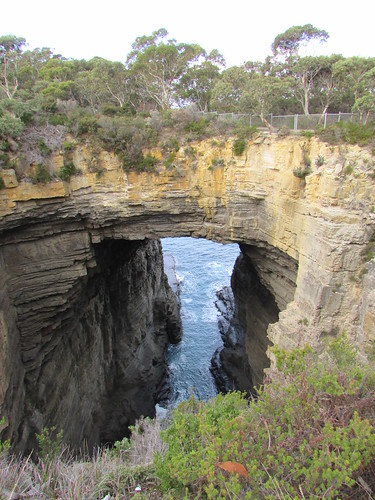
On the long drive back to Hobart, we made various stops at natural sea-related land formations - Tasmans Arch, the Devil's Kitchen, the Blowhole.


Port Arthur to Hobart: Tasmans Arch.

Interesting, but not the thought-provoking experience the Heritage Site at Port Arthur had furnished.

Related Posts on this Website

All Burma-2017 Trip posts.
All Australia-2017 posts.

My Pictures

The Henry Jones Art Hotel, Hobart.
Hobart, Tasmania.
Richmond, Tasmania.
Hobart to Port Arthur.
Port Arthur Historic Site. Port Arthur to Hobart.

[Links to pictures added 18-Aug-2017: Text added, pictures added 14-Sep-17]

Thursday, 18 May 2017

Around Hobart

Events of Thursday 18th May 2017

I commented in an earlier post that Tuesday 16th May turned into a 'Railway Day'. Well, Thursday 18th May turned into a 'Museums Day'.

The hotel staff had recommended the 'Museum of Old and New Art', generally called 'MONA'. In my previous report, I remarked that both the City and my hotel seemed a little 'arty' for my taste and the 'flyer' I'd been given reinforced my fear that 'MONA' might prove too pretentious. But I'd been told that you can reach 'MONA' by a fast catamaran service which took 30 minutes from Brooke Street Pier, no more than ten minutes walk from my Hotel.

The prospect of a river trip convinced me so I took a light breakfast and walked past Victoria Dock, Constitution Dock and Elizabeth Street Pier to reach Brooke Steet Pier. Elizabeth Street Pier was the traditional, long 'finger' of land, thrust into the dock with moorings on both sides. A building with the general appearance of the earlier Transit Shed, either thoroughly modernised or perhaps new build, extended the length of the pier. The remains of railway sidings flanked the transit shed on both sides, 'inset' into the pier and with the now-redundant flangeways filled with tarmac. Only later did I discover that the building is now 'Somerset on the Pier' - serviced apartments.


Hobart: Elizabeth Street Pier, looking towards the city.

Brooke Street Pier, at first sight, appeared similar to Elizabeth Street Pier, although I was puzzled by the need to access the pier via a broad, wooden 'gangway' which I assumed at the time to be an "architect's affectation". Once again, it was much later that I discovered that the original 'pier' had been removed and replaced by a floating, concrete pontoon carrying a purpose-built construction housing various places to eat and drink, souvenir shops and booking for the catamaran to 'MONA'. I purchased a combined Ferry/Museum ticket and only had about ten minutes to wait before boarding for the first trip of the day at 9.30 a.m.


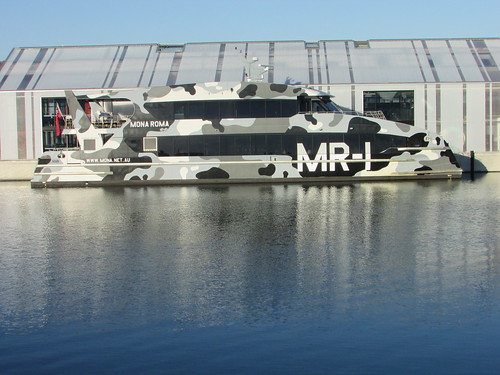
The fast catamaran 'Mona Roma' in her unusual livery, moored alongside Brooke Street 'pier'.

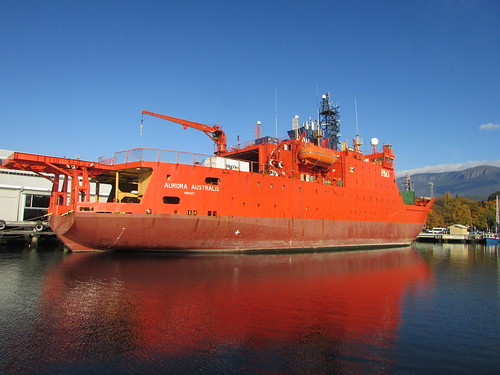
The fast ferry left on time, the sun came out and I decided I'd made a good decision. As we left the pier, I had a good view of the Australian-built icebreaker 'Aurora Australis' at her berth. Built in 1989, this ship is owned by P & O but regularly chartered for research and support in Antarctica. Now at the end of her 'predicted service life', the Australian government plan to have a replacement built. There's a Wikipedia article here.


Icebreaker 'Aurora Australis' berthed in Hobart.

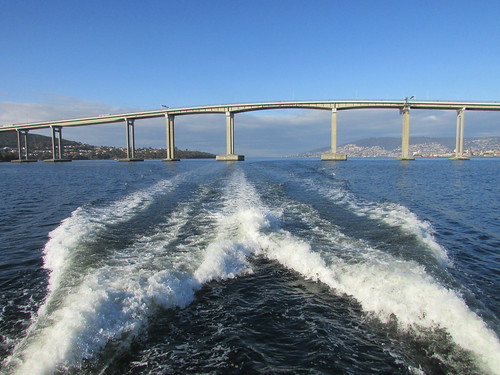
The catamaran headed upstream on the River Derwent, past the dock quays on the West bank. The cargo ship I'd spotted the previous day had departed and been replaced by a smaller cargo ship. On the East shore, we passed residential areas. We passed through the centre span of the Tasman Bridge, which I'd crossed by road the previous afternoon on the way in from the airport.

Looking astern, having passed under the Tasman Bridge.

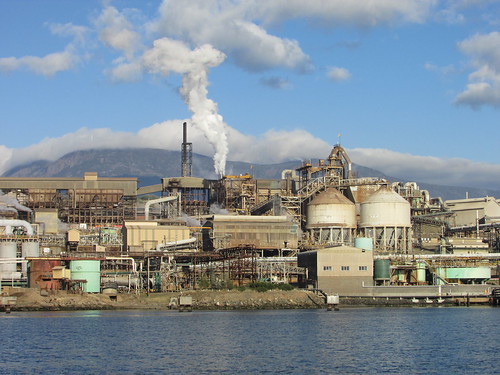
The tanker ship I'd seen at the oil depot the previous day had sailed and the oil berth was unoccupied. Further on, a large, fairly elderly industrial plant discharging steam appeared on our left and the ferry slowed as we passed the site. I'm afraid I didn't recognise the plant's function. Only later did I discover that it produces zinc from zinc ores (like zinc suphide). The Hobart Zinc Smelter is operated by an international group I hadn't heard of called Nyrstar, formed in 2007 by the merger of the smelting operations of Australian mining company Zinifex and Belgian materials technology company Umicore. There's a comprehensive and informative website here and an overview of the company's metal processing activities, including the Hobart large-scale smelter (which was founded in 1917!) at Nyrstar Metals Processing.


Fast Catamaran to MONA, Hobart: Nyrstar Hobart Zinc Smelter.

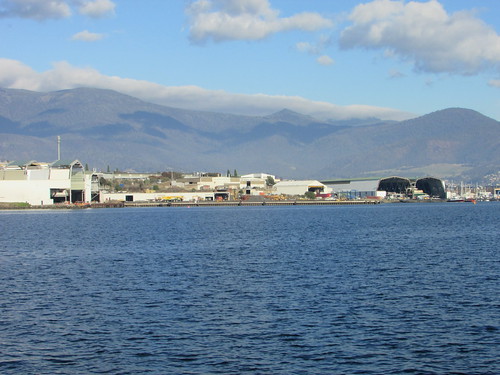
Having passed the smelting plant, we then speeded-up again, next passing a shipbuilding yard, also on our left. I realised we were passing the yard of Incat, world famous for high speed catamarans (there's a Wikipedia article here). In fact, the very catamaran I was aboard was built by Incat - their Hull 073. Only later did I find out that Incat's Hull 077 was Brooke Street Pier itself, where I'd boarded 'Mona Roma'. I'd also seen Incat's Hull 050, a wave-piercing catamaran now called 'Manannan', at Liverpool on various occasions (for instance, as mentioned in the post here).


Fast Catamaran to MONA, Hobart: Passing the Incat shipbuilding yard.

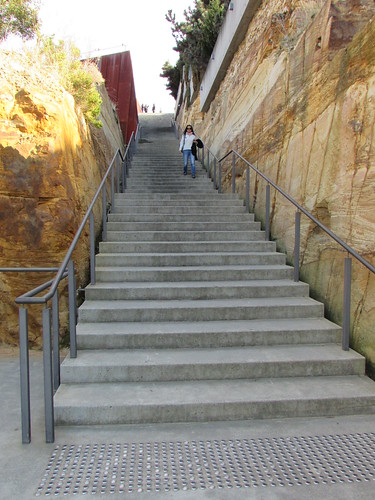
We completed our journey across the bay to MONA's landing stage, where we disembarked and climbed the 99 steps to the top of the hill and the entrance to MONA.


MONA (Museum of Old and New Art), Hobart.

The MONA website is here. Some of the advertising copy I'd read about 'MONA' was vaugely amusing - "Mona: A museum or something in Tasmania or somewhere. Catch the ferry. Drink beer. Eat cheese. Talk c**p about Art. You'll love it" (My asterisks). But when I arrived, the numerous staff, mainly young and black-attired, seemed to take it all rather seriously. There's a Wikipedia article here.

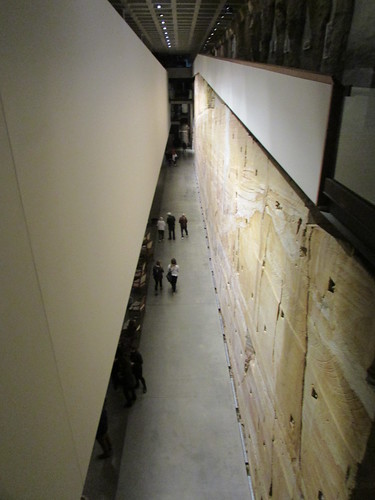
The entrance building on the top of the hill houses a large souvenir shop and cafe. There are three underground galleries at different levels below ground, chiselled out of rock. Access is by spiral stairs coiled around a circular lift.

What did I make of it? The subterranean galleries, carved out of living rock, I found stunning.


MONA (Museum of Old and New Art), Hobart: The subterranean galleries.

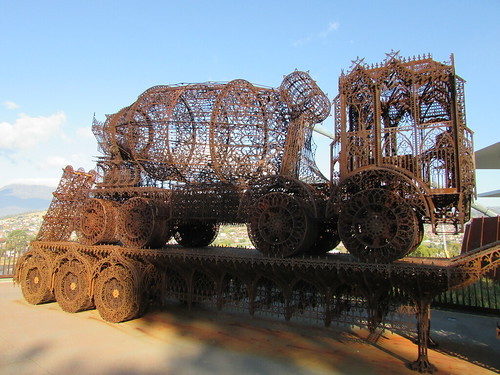
The perpetual ethereal music I found annoying. The exhibits, for me, varied from mildly interesting to irritating or juvenile. I was happy to return above ground where one or two items appealed. I liked Wim Delvoyes 'Flatbed Truck, Trailer and Cement Truck' but more for the technical skill displayed in assembling the artefact from intricately laser-cut steel plate.


MONA (Museum of Old and New Art), Hobart: Wim Delvoyes 'Flatbed Truck, Trailer and Cement Truck'

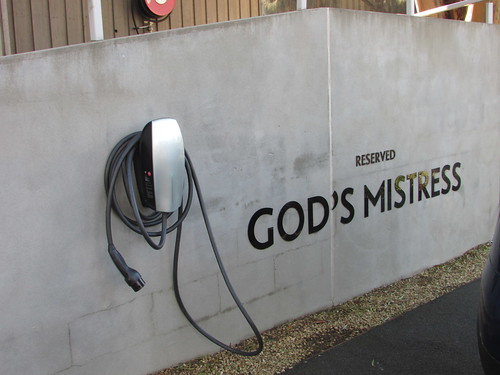
I would probably have liked his 'Church' exhibit too, but didn't get that far. I was intrigued to find two car parking spaces professionally labelled "Reserved GOD" and "Reserved GOD'S MISTRESS". It is perhaps to be expected that they apparently both drive electric cars, since electric charging points were provided.


MONA (Museum of Old and New Art), Hobart.

I was happy to return to Hobart on the 11.30 a.m. ferry and very much enjoyed the cruise back. I'm glad I've seen 'MONA' but didn't find it life-changing.

Next on the museum circuit was the Maritime Museum of Tasmania but, on the way, I met a retired lecturer, Nancy, who recognised my longyi (Burmese skirt) from her own time in Burma and we exchanged details before I continued to the museum.

The building occupied by the Maritime Museum of Tasmania dates from about 1900 and served as Hobart's central library until the 1960s. I found the museum staffed by very friendly volunteers and immediately felt 'at home'. They were hosting a travelling exhibition arranged by the Australian National Maritime Museum called 'War at Sea', describing the role of the Royal Australian Navy during World War I. This seemed particularly well-researched and I spent a long time here.


Maritime Museum of Tasmania: 'War at Sea' Travelling Exhibition - Royal Australian Navy uniforms of World War I.

In the ground floor galleries the local maritime history was covered. I found this equally absorbing. You can find out more about the museum at their website here.


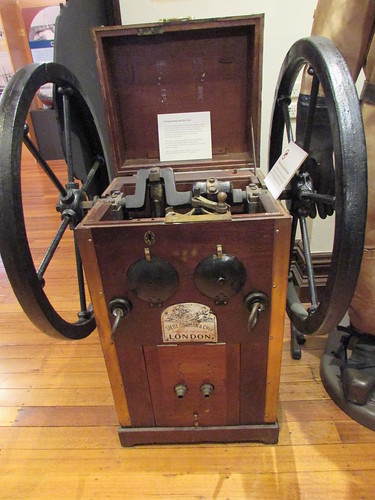
Maritime Museum of Tasmania: Siebe Gorman Diving Pump.

Not far away was the third museum of the day - the Tasmanian Museum and Art Gallery (their website is here). This is a large museum and I could have done with more time but they closed at 4.00 p.m. The main building is suitably grand in style, with a network of galleries on three floors covering a host of topics. This is supplemented by the adjacent Bond Store which, as its name suggests, is a converted warehouse with exhibits on four floors. I found all the museum sections very interesting: the art sections rather less so.


Tasmanian Museum and Art Gallery: View from the Courtyard with the Bond store on the left and the Queen's Warehouse on the right.

I'd considered a late lunch at the Museum's Courtyard Cafe but ran out of time so had french fries and a cold drink back at the hotel. I'd had a great day but, inevitably, I was totally shattered by 5.00 p.m.

Related Posts on this Website

Next Post describing this trip.
All Burma-2017 Trip posts.
All Australia-2017 posts.

My Pictures

The Henry Jones Art Hotel, Hobart.
Hobart, Tasmania.
Catamaran to MOMA.
MONA, Hobart.
Fast catamaran back to Hobart.
Maritime Museum of Tasmania.
Tasmanian Museum and Art Gallery.

[Links to pictures added 18-Aug-2017: Text amended, pictures added 11-Sep-2017]

Wednesday, 17 May 2017

On to Tasmania

Events of Wednesday 17th May 2017

I'd never been to Tasmania so, after Melbourne, I'd arranged to tack a couple of days in Hobart on the end of my marathon trip.

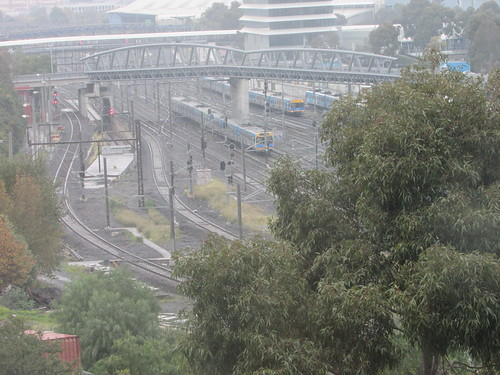
Before leaving the Hotel Lindrum on Wednesday morning to fly to Hobart, I'd intended to see a little more of the Melbourne, using train or tram. Although I started to get up when my alarm went off at 6.00 a.m., two things discouraged me from carrying out my planned exploration. Firstly, although I'd slept soundly, I still felt pretty tired - it had been a fairly intensive few weeks and I don't appear to have the stamina I once enjoyed. Secondly, it was raining and miserable outside. So, instead, I just worked in my room on the computer and watched the suburban trains go by, still impressed by the intensity of the service.


Melbourne: On a rainy morning, watching the trains go by.

I checked out a little before the arranged pick-up time of 10.30 a.m. and found the very professional driver to take me to the airport was already waiting outside with an immaculate Audi saloon. By this time, the rain had stopped and I had a very comfortable ride to Melbourne's Quantas Domestic Terminal where it was the usual do-it-yourself check-in.

The aircraft type was a Boeing 719 which I didn't think I'd flown before so not knowing quite where the seat I was allocated (23D) was, I left it unchanged - this proved to be a mistake.

The terminal was quite spacious without too many people travelling so, having browsed a few shops, I took a seat directly opposite the ramp where my aircraft was to arrive.


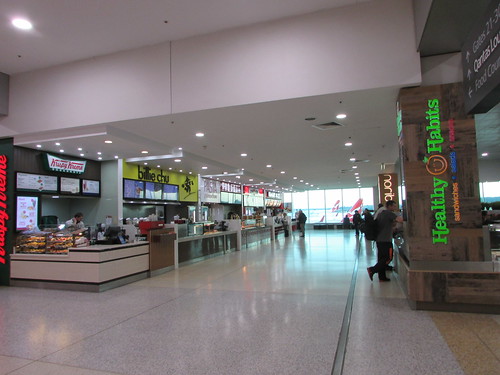
Melbourne Domestic Terminal: Lots of opportunities to spend money!

The inbound aircraft was delayed and frequent apologies were made over the public address. It was about 30 minutes late by the time it had shut down the engines and I amused myself taking pictures of all the different teams at work around the aircraft.


Boeing 717-200 operated by QuantasLink at Melbourne.

At last we boarded the Boeing 719 - a narrow-body, of course, but with it's two engines strapped to the fuselage rather than being wing-mounted. Seating in economy was 3+3 and, although row 23 had windows, the view was restricted by the engines. My row, row 24 only existed on the starboard side so my seat, 24D, was the aisle seat. The port side of the aircraft was completely obstructed with storage for catering equipment and there was no window on either side of the aircraft.

When 'Concorde' was designed, the passenger compartment originally had no windows - that solved an awful lot of engineering problems. But the response of people shown the 'mock-up' was so adverse that they decided to put windows in after all. I share that aversion to a lack of windows so I was quite uneasy on the flight which, fortunately, only lasted just over an hour.

Once I got off the plane in Hobart, I felt much happier. My driver met me in the crowded baggage hall but we had a few minutes to wait for the bags to arrive on the single baggage conveyor. A sniffer dog and his handler, having first checked the arriving passengers, jumped repeatedly on and off the conveyor (yes, both dog and handler) checking the bags as they appeared. Hobart was a much smaller airport and, having retrieved my bags, we only had a short walk to the car park and a waiting Mercedes saloon.

I think the journey into the city was about 18 km, on an uncrowded dual carriageway which passed through attractive, wooded hills. As we neared Hobart, we crossed the River Derwent on the impressive Tasman Bridge. This River Derwent is a broad estuary navigable by ocean-going ships, very unlike the Derbyshire River of the same name I'm familiar with.


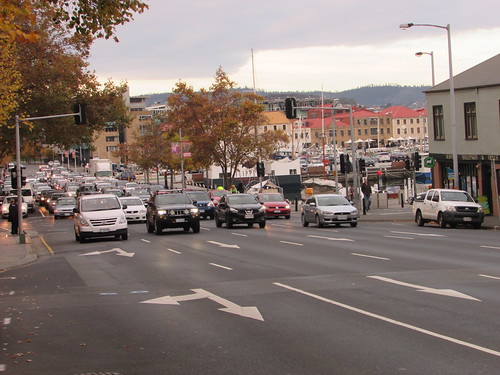
Around Hobart: Approaching Hobart from the Airport.

Rather like Melbourne, but on a smaller scale, the city is a mixture of old and new buildings. The older English-style buildings, often 're-purposed', I found very appealing. We approached the harbour area, largely now a marina but retaining some working boats, and parked outside my hotel, which was formerly Henry Jones' extensive jam factory but is now an up-market hotel called 'The Henry Jones Art Hotel' (the hotel's website is here). Check-in at the hotel was friendly and I was soon in my first-floor room with views over the Victoria Dock.


View of Victoria Dock from the Henry Jones Art Hotel, Hobart.

In addition to being a hotel, it's an Arts Centre, based around the 'IXL Atrium', another part of the original jam factory. There are Studios, Galleries, various eating opportunities, shops and a bar. I didn't fully explore this interesting establishment as I'd promised myself a walk around the old dock area and the part of the town adjacent before it became dark.


Hobart, Tasmania, with the Henry Jones Art Hotel visible in the background.

On my return, I had a snack and a drink at the Peacock and Jones restaurant before retiring to my room. I'm very taken with Hobart and the hotel, although both are a tad 'arty' for my taste. But it appears an excellent location to end my marathon trip.

Related Posts on this Website

Next Post describing this trip.
All Burma-2017 Trip posts.
All Australia-2017 posts.

My Pictures

Hotel Lindrum, Melbourne.
Melbourne's Local Railways (2006 and 2017).
Melbourne Airport.
Hobart, Tasmania.
The Henry Jones Art Hotel, Hobart.

[Text amended, pictures added 8-Sep-2017]

Tuesday, 16 May 2017

Around Melbourne

Events of Tuesday 16th May 2017

After Myanmar's summer heat, it had been a shock to cross the equator and arrive in Perth in their autumn. Although I was warm enough in the day, each night as the temperature dropped I felt cold and needed an extra blanket on the bed. Melbourne was similar. My hotel room had Air Conditioning but my normal reaction is to turn it off, to prevent the noise from the fan disturbing me. However, without the Air Conditioning heating the room during the night, I'd needed an extra blanket for comfort but I slept well in the huge bed.

Having checked out the walking route from my hotel to Flinders Street Station the previous day and taken the precaution of purchasing the 'Myki' credit card-sized local transport ticket to use on Tuesday, readers will not be surprised that Tuesday turned into a 'Railway Day'. In addition to trying out the 'Metro' local trains, I wanted to travel on the Puffing Billy Railway - a substantial tourist railway in the hills to the east of the city. I knew from my previous visit back in 2006 that it was possible to reach the tourist railway by local electric train from Flinders Street, although on that occasion I was on a coach trip. This time, I was warned to allow at least 90 minutes for the journey travelling by rail.

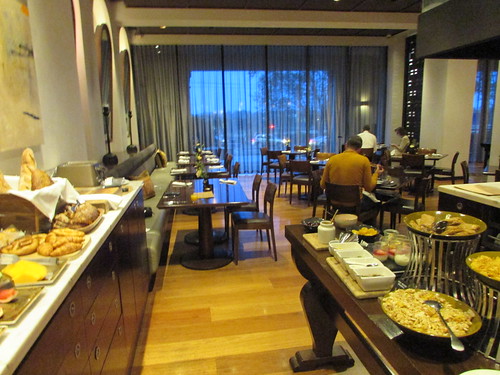
I took breakfast in Hotel Lindrum's restaurant named, oddly, 'Felt' (Lindrum was a famous billiards player so the name refers to the green baize covering a billiard table).


Hotel Lindrum, Melbourne: 'Felt' Restaurant.

I walked to Flinders Street Station in time to catch the 8.22 a.m. to Blackburn, with the intention of changing at Blackburn to a following train which went on to Belgrave.


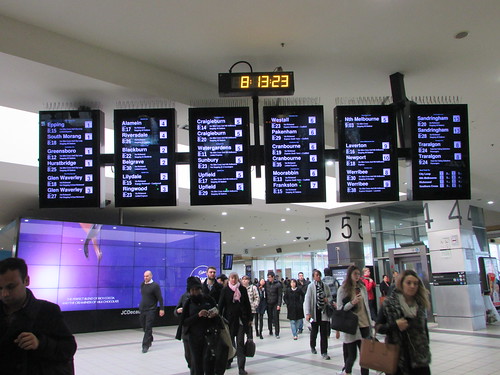
Melbourne to Belgrave: Concourse area at Flinders Street.

The 8.22 a.m. train was a few minutes late arriving at Blackburn and, by the time I'd worked out that I needed to go to a different platform at Blackburn to join the train onwards to Belgrave, I was in time to see it depart without me.


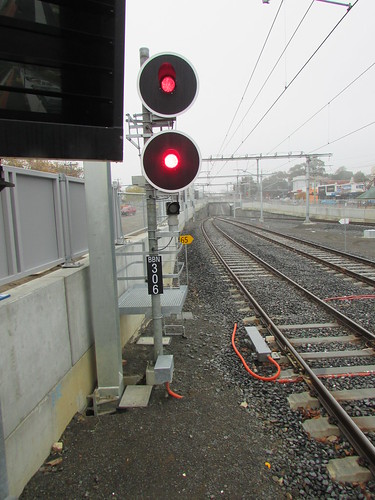
Melbourne to Belgrave: Blackburn, looking towards Belgrave, showing 'Victorian' pattern signal and train stop.

However, I successfully caught the next train to Belgrave and, on arrival at Belgrave, a footpath (identified with a painted, blue line) led me to the terminus of the Puffing Billy Railway.

The Puffing Billy Railway's website is here or, for more technical information, see the Wikipedia article here. On the day of my visit, trains were operating as far as Lakeside and I purchased a return ticket to travel to Lakeside on the first departure, the 10.30 a.m.

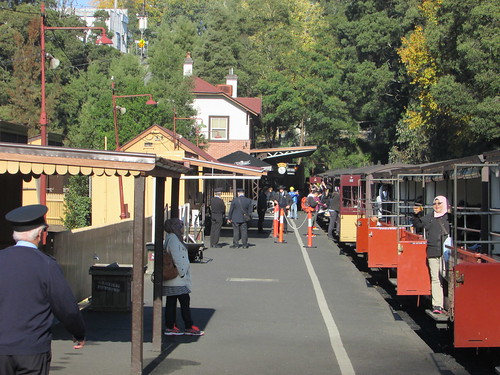
Puffing Billy Railway: Belgrave - Lakeside: Passengers boarding the 10.30 a.m. at Belgrave.

It's a charming railway, run mainly by friendly volunteers, but (with my background on British railways) I couldn't get used to the officially-approved seating position adopted by many of the passengers.


Puffing Billy Railway: Belgrave - Lakeside: I didn't try the officially-approved seating position adopted by many of the passengers.

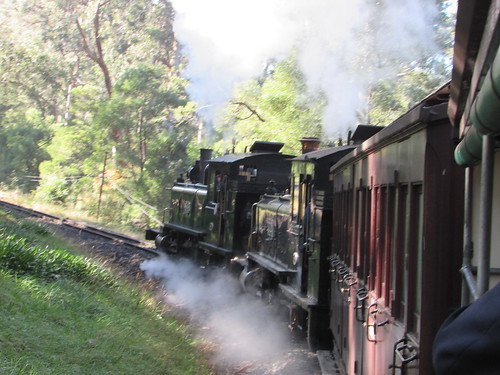
The gradients require the narrow gauge 2-6-2 tank locomotives forming the majority of the motive power to work quite hard. The 10.30 a.m. was a long train and we were double-headed from Belgrave to Menzies Creek.


Puffing Billy Railway: Belgrave - Lakeside. The gradients require the narrow gauge 2-6-2 tank locomotives to work quite hard.

At Menzies Creek, the train divided and the pilot engine left us in order to work the detached coaches back to Belgrave to form a later train. We then continued to Lakeside where our engine took water and ran round the coaches, leaving the locomotive crew a short break before setting off back to Belgrave at 12.30 p.m.


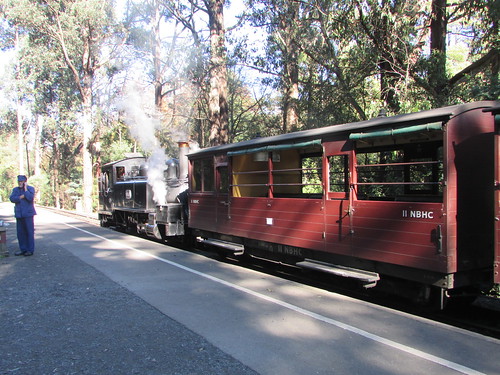
Puffing Billy Railway: Locomotive 14A ready to return from Lakeside.

I decided to return on the 12.30 p.m. train, continuing to take lots of pictures. In addition to the elegant and well-maintained steam locomotives, a feature of the line which particularly appealed to me was the semaphore signalling, much of it Mackenzie and Holland lattice posts.


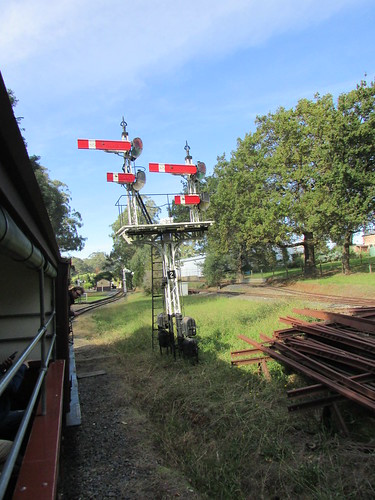
Puffing Billy Railway: Lakeside - Belgrave. Leaving Menzies Creek, showing a 4-arm bracket signal (motor operated).

I've no doubt I will produce a more technical report on this remarkable line in the future.

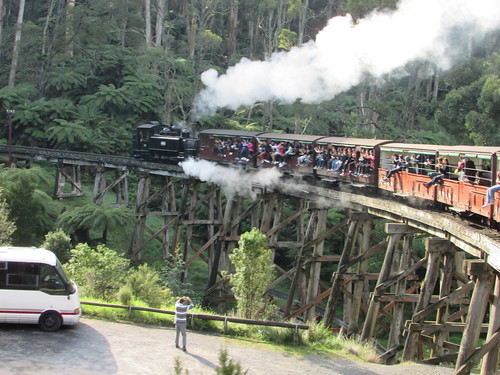
Puffing Billy Railway: Lakeside - Belgrave. Crossing the timber trestle bridge.

Back at Belgrave, I walked to the electrified broad gauge 'Metro' station and only had a few minutes to wait before the next train via Richmond to Flinders Street.


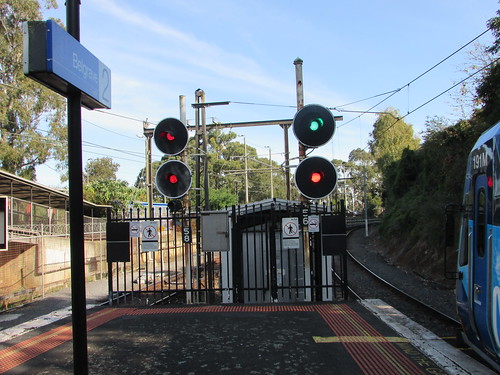
Belgrave station, with the train I caught to Melbourne on the right.

On arrival at Flinders Street, I decided to traverse the mainly underground 'City Loop', passing through the huge, modern Southern Cross station, followed by subterranean stations at Flagstaff, Melbourne Central and Parliament. Having reversed direction around the City Loop, the next station was Richmond (again), where I alighted. Richmond, with its ten platforms, seems to be Melbourne's 'Clapham Junction'.


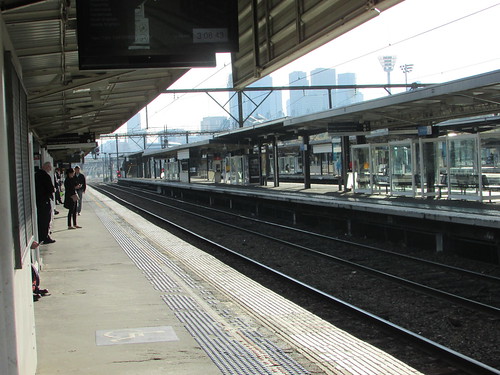
Richmond station, with Melbourne's skyscrapers in the background.

I crossed to Platform 1 for the next service back to Flinders Street which took around four minutes to reach the southernmost platform at Flinders Street, a bay. Exhausted by all this travelling, I walked back to my hotel and didn't venture out again, taking a dinner of soup and sorbet in my room whilst working on the computer and just watching the trains go by.

Related Posts on this Website

Next post describing this trip.
All Burma-2017 Trip posts.
All Australia-2017 posts.

My Pictures

Hotel Lindrum, Melbourne.
Melbourne (2006 and 2017).
Melbourne's Local Railways (2006 and 2017).
Puffing Billy Railway (2006).
Puffing Billy Railway: Belgrave - Lakeside (2017).
Puffing Billy Railway: Lakeside - Belgrave (2017).

[Text amended, pictures added 7-Sep-2017]