skip to main |
skip to sidebar
Events of Friday 5th May 2017
After another excellent breakfast at Loikaw Lodge, I was picked up by my guide and driver at 8.30 a.m. I was to see a little of Kayah State outside the capital, Loikaw. We set off on Route 5 which leads south from Loikaw right through Kayah State. We passed through the important town of Demoso and skirted Ngwe Taung lake and dam, which I was told we would visit later in the day.

Mopeds carrying large loads are a common sight.
We were heading for the Padaung village of Pan Pet, taking us onto a spectacular road through the mountains. This was another of the roads in Myanmar being widened and improved ("New Government - New Roads", I had been told).

The road through the mountains was being widened and improved.
A small sign in Myanmar language seemed to suggest that we had to divert onto a temporary dirt road but after a short distance our driver decided to go back along the dirt road and continue along the metalled road. But a little further on, the road was completely blocked and we could see a road construction gang in the process of building the road's continuation. Our driver went ahead on foot to see if any alternative route existed but returned with the news that we would have to walk the rest of the way to the village, perhaps 15 minutes away. So I had an opportunity to examine road building techniques close-up. Most of the way, there was a narrow strip from the former dirt road available to walk on and we passed occasional motor cycles bouncing along this strip.

Men and women road-building. The foreman has a hard hat, perhaps to confirm his status.
In due course we arrived in Pan Pet, a Padaung tribe village. The Padaung are animists and some of their women are 'long-neck' women, encasing their necks and lower legs in a substantial brass wire helix. I'm afraid it's not a tradition I'm in favour of and I was encouraged to learn that, out of a total population in Pan Pet of 80, only 12 ladies have neck rings, although one was a child who could have been no more than ten years old. My guide introduced me to one of the long-neck women who runs a shop, supplying necessities to the villagers with a sideline in souvenirs for the tourists. This lady of 47 with six children had a very intelligent gaze and seemed to find my presence most amusing so we spent most of the time laughing together. She was very competent on a simple 4-string guitar. Their neck-rings comprise a slightly larger diameter coil which rests on the shoulders with a long coil reaching under the chin, totalling 8 kilograms in weight and they are permanent. A pair of similar rings on the lower legs add a further 3 kilograms.
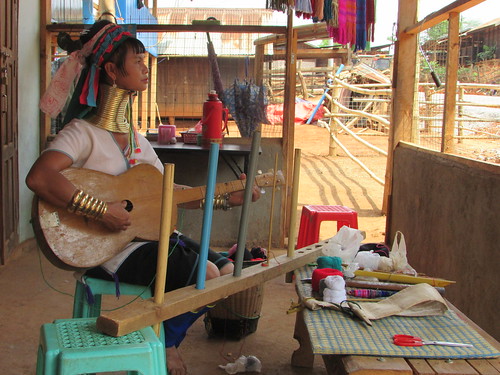
The long-neck Padaung lady shopkeeper with her guitar.
For some reason, the lady and my guide insisted that I 'play' the guitar (I'm afraid I don't play). I also reluctantly submitted to being decorated with a small neck ring sliced into a semicircular shape and merely tied into place and a Padaung head-dress. Needless to say, this provoked further gales of laughter.
As we started our walk back to the car, I saw an animist shrine comprising a group of Kutopoe Pillars, similar to those I'd seen the day before in Loikaw.
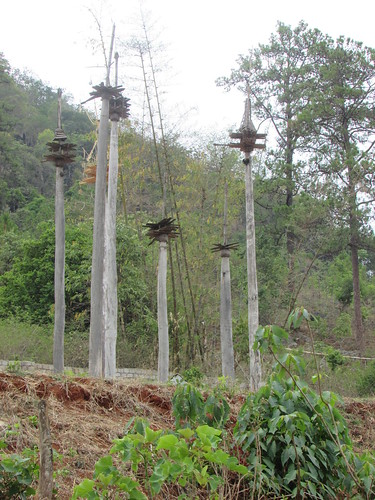
Kutopoe Pillars at Pan Pet village.
Re-united with our vehicle, we retraced our route. Although the road building near Pan Pet had been a purely manual operation, heavy machinery is employed where necessary and we saw Backhoes, Road Rollers, a large Motor Grader from SDLG and various BOMAG machines.
Back at Ngwe Taung Dam, we had a closer look. The dam appears to be purely for irrigation purposes - a sluice halfway along the dam controls water flow to a canal which provides water to the rice-growing area. Needless to say, this area is a magnet for young boys who were joyfully diving into the lake or swimming in the canal.
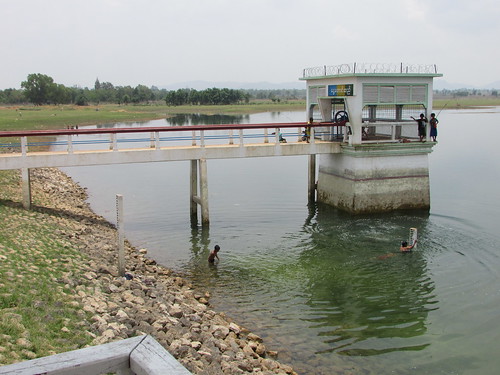
Sluice Gate at Ngwe Taung Dam.
A couple of working elephants, each with with their mahout, passed us and delicately negotiated the steps from the dam to the road before disappearing along the bank of the canal.
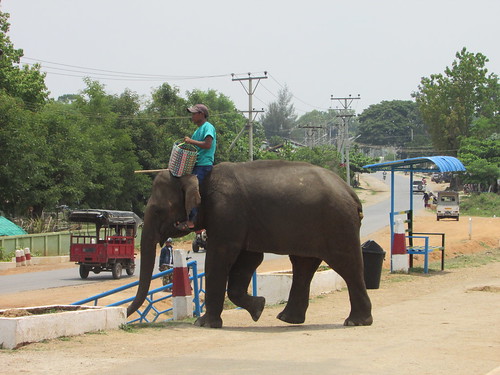
A working elephant at Ngwe Taung Dam.
We stopped for a pleasant lunch at the Marco Polo Restaurant. Although only a couple of hundred yards from the main road, it was a tranquil spot, overlooking the plain where cattle idly grazed.

The Marco Polo Restaurant.
As we continued back towards Loikaw, we passed a number of Catholic Churches and one Cemetery before turning off to see Umbrella Lake. This turned out to be a fairly small pool where usually a shallow 'hump' is visible, vaguely resembling an umbrella. We were particularly lucky in that two 'umbrellas', plus a 'baby umbrella', were visible on our visit. In the centre of the 'umbrella' a small orifice discharged a trickle of water so I assume geothermal activity produces this effect.
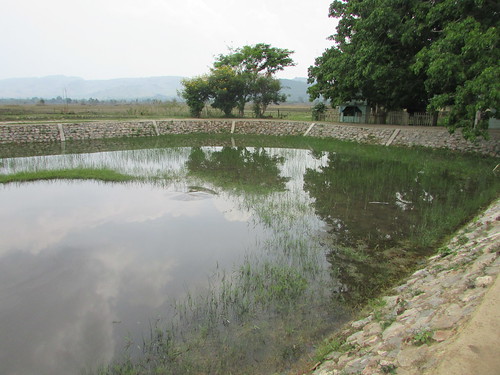
Umbrella Lake.
The lake is surrounded by a number of Buddhist shrines but there was also an Animist shrine with Kutopoe Pillars. Before we left, thunder and lightning started but we were back at the car before the rain started.
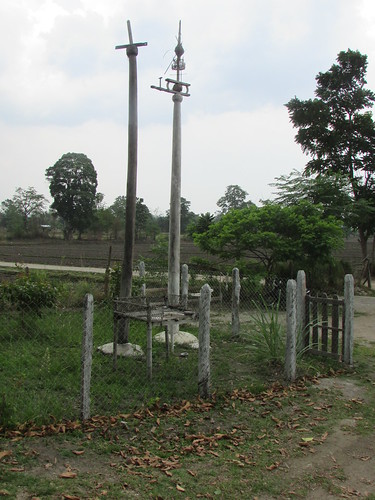
Kutopoe Pillars at Umbrella Lake.
Our journey continued to Seven Steps Lake, by which time it was raining quite hard but there was a wooden shelter with a 'tin' roof from which we admired the setting with wooded hills coming down to the water. I believe the name derives from the fact that the one large lake is made up of seven sections interconnected by narrow channels.
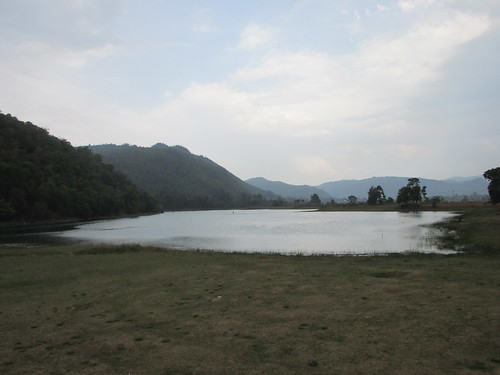
Seven Steps Lake.
Back in the familiar surroundings of Loikaw, we went to a business where the special Kayah Sausage is made. This prized pork sausage, flavoured with ginger and other spices, is supplied ready-cooked as a large spiral and costs 9,000 Kyat. In appearance, it reminded me of the English Cumberland Sausage.
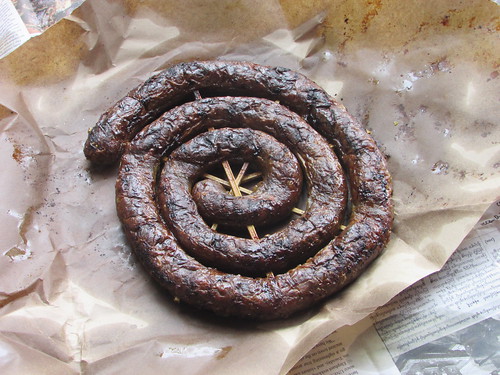
The Kayah Sausage.
The car finally delivered me to my hotel after a tiring but interesting day. Once safely back at the hotel, a thunderstorm hit Loikaw and this was followed by fairly heavy rain.
Related Posts on this Website
Next post describing this trip.
All Burma-2017 Trip posts.
My Pictures
Where necessary, clicking on an image above will display an 'uncropped' view or, alternately, pictures from may be selected, viewed or downloaded, in various sizes, from the album listed:-
Pan Pet Village trip.
Loikaw, Kayah State.
Loikaw Lodge.
[Links to pictures added 24-May-2017, pictures added and minor text changes 2-Sep-2017]
Events of Thursday 4th May 2017
I was delighted with the friendly reception I received and the facilities at the Loikaw Lodge. I slept well in their large, soft bed and enjoyed a filling, English breakfast.
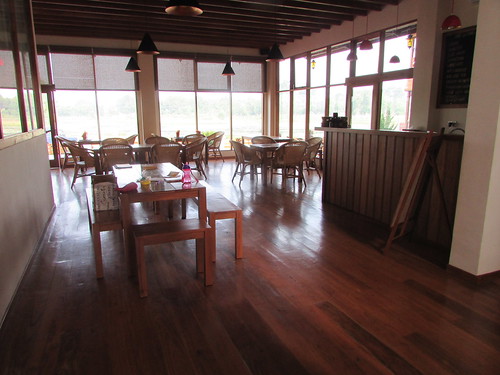
Loikaw Lodge: The Dining Room.
At 8.30 a.m., I was picked up by my guide and driver and we made our way to Loikaw Market. The market was large with both outside stalls (often provided with sun shades of various types) and an extensive, gloomy covered market. Everything you can imagine is available in these markets - vegetables (familiar and exotic), spices, fresh and dried fish, chicken, beef.
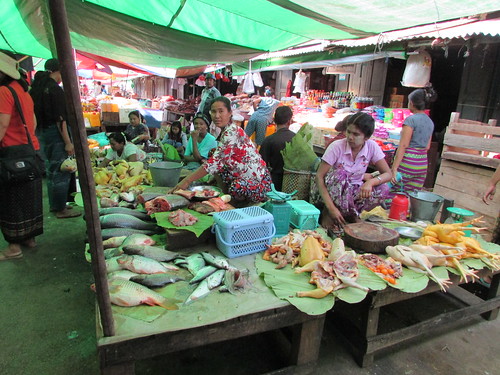
Loikaw Market.
Many of the stallholders were wielding serious-looking knives which they used to prepare their wares. The inside market was mainly dry goods of all kinds - clothing, toiletries (including make-up and shampoo), luggage, backpacks, ladies fashion handbags, sturdy shopping bags. A seamstress with a treadle sewing machine offered alteration and a watchmaker offered repairs. There was also a large hardware stall selling a bewildering array of items, including loose nails in various sizes. At one stall, a lady was expertly using four frying pans at once to prepare thick pancakes while you wait.
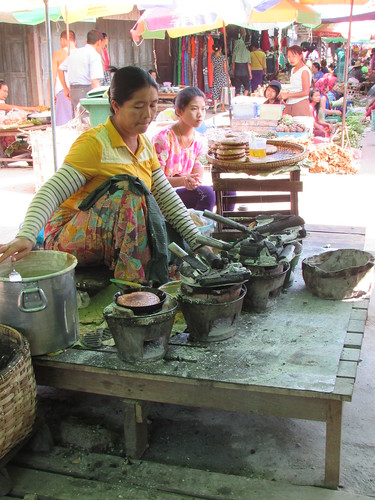
Loikaw Market: Making four pancakes at once
Next, we visited Loikaw Railway Station. The station had and impressive reinforced concrete two-storey building with steel-framed overall roof, appropriate to a State Capital. Footbridges were provided at each end of the station - somewhat unnecessarily as gaps were deliberately provided in the concrete-post and barbed wire fence between the tracks alllowing everybody to cross at ground level. The station has just one departure a day at 05:00 which takes ten hours to reach Kalaw and this service returns in the evening at 21:45. The Ordinary Class single fare is 1,500 Kyat, The Upper Class fare 2,000 Kyat.
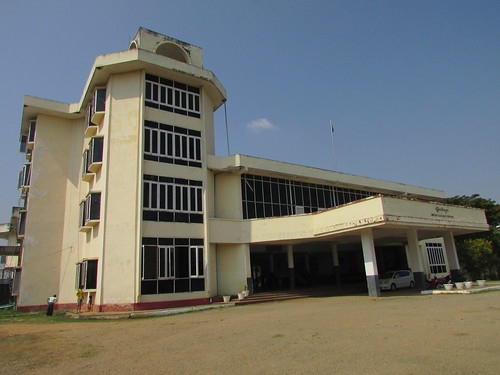
Loikaw Station: This impressive station building handles just a morning departure and an evening arrival.
Our next visit was to the Poa Pa Yone monastery where there were 311 novices and 43 monks (although a number of monks were absent on the day of our visit). We stayed to watch the novices summoned to lunch which they ate in a large dining room with round, low tables. Monks have only two meals a day - breakfast and lunch. We also visited the monastery kitchen where the monks' food is prepared.
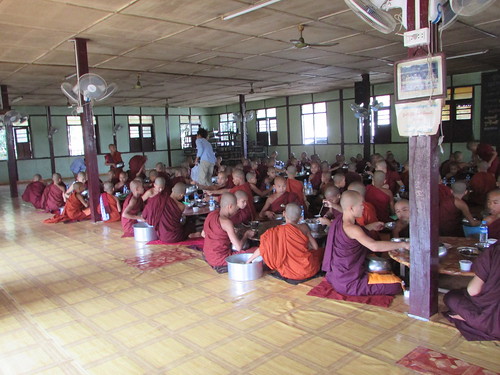
Loikaw Monastery: Novices taking lunch.
Our car then took us to a weaving factory where fabrics in the various traditional designs are produced. One wooden hand loom was in use and it was remarkable how quickly fabric can be produced in this way. There were also two fairly elderly motorised machines. The one was used to load the small bobbins with thread. The bobbin is carried inside the shuttle which performs the actual weaving as it oscillated across the weaving frame. The other machine was a power loom which was certainly quicker than the hand loom, but much noisier.

Loikaw: Hand loom in use.
Near the weaving factory, I looked at a rather rickety wooden road bridge which seemed to carry a lot of traffic. From the bridge, I had a good view of daily life along the river bank. I could also see numerous tiny pump-houses drawing up the brown river water with electric pumps and delivering it through exposed blue plastic pipes to various premises. Adjacent to the bridge was a tall wooden tower which appeared to be a public water supply. I presumed that a larger electric pump was drawing river water into a storage tank at the top of the tower, from which various discharge pipes could service water tankers to distribute the water. A large road tanker noisily moved away having filled-up and it was soon replaced by one of the smaller rather primitive-looking lorries powered by a noisy Chinese diesel engine, where the load space was completely occupied by a large, rectangular water tank.
The Loikaw Cultural Museum formed our next destination. This was another reinforced concrete structure in 'municipal' style but freshly-painted and with immaculate gardens. In Kayah State, nine different ethnic sub-groups are recognised and the museum featured the distinctive clothing used by each tribe. There's a little more about Kayah State and its ethicities in the Wikipedia article here and about the 135 ethnic groups recognised in Myanmar in the Wikipedia article here. I spent some time studying the interesting exhibits. In the 'Show Room of Kayah State Historical Record and Kayah Chief, I was particularly intrigued by a photograph of the ceremony erecting a tall wooden post which I learned was called a Kutopoe Pillar.
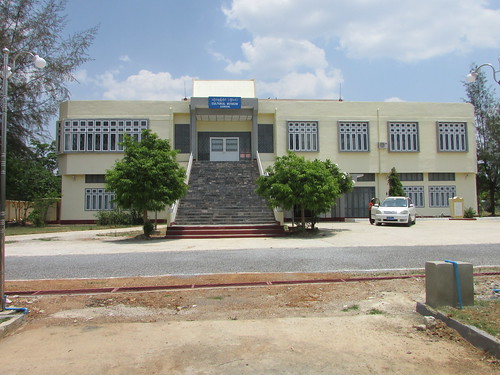
Loikaw Cultural Museum
After lunch at a typical teashop, I was taken to the site where many white-painted Kutopoe pillars have been erected. I'd seen plenty of evidence of Buddhism and Christianity in Kayah State but Animism also exists and the Kutopoe Pillars form part of the Animist tradition.
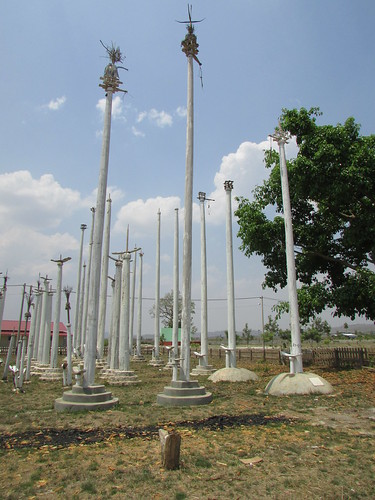
Kutopoe Pillars.
Then it was back to the hotel for a rest before setting off again at 4.30 p.m. to see one of the most famous features in Loikaw - Taung Gwe Zedi. Near the centre of Loikaw, a rocky outcrop rears out of the plain, fractured and fissured leaving a number of pinnacles. In this unlikely location, a series of increasingly improbable pagodas have been erected, accessible from the ground by a number of twisting stairs, forming Taung Gwe Zedi. Some of the pagodas overhang the rock, cantilevered into space on concrete 'rafts' and the various pinnacles are interconnected by a bewildering series of bridges and stairways. A modern elevator (lift) provides easy and quick access to the main level but to explore other pinnacles involves going up and down various stairs, so I eventually elected to descend to ground level using the stairs, although this meant negotiating two very steep sections of straight steel stairs, like a ship's companion way. It was an excellent end to a fascinating day.
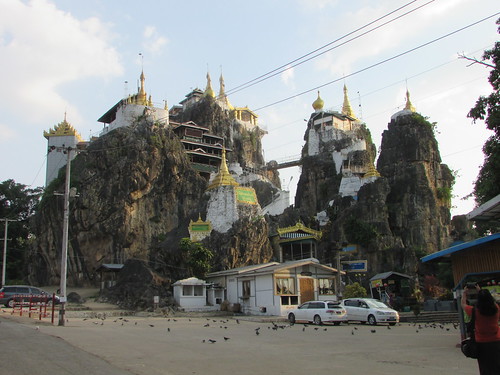
Loikaw: Taung Gwe Zedi.
Back at Loikaw Lodge, I decided to have an evening meal and selected their Spaghetti Carbonara which was most enjoyable.
Related Posts on this Website
Next Report on this trip.
All Burma-2017 Trip posts.
My Pictures
Where necessary, clicking on an image above will display an 'uncropped' view or, alternately, pictures from may be selected, viewed or downloaded, in various sizes, from the albums listed:-
Loikaw, Kayah State.
Loikaw Market.
Loikaw Station.
Loikaw, Poa Pa Yone Monastery.
Loikaw Cultural Museum.
Loikaw, Kutopoe Pillars.
Loikaw, Taung Gwe Zedi.
Loikaw Lodge.
[Links to pictures added 24-May-2017, text and pictures added 1-Sep-2017]
In earlier posts in this series,I've described my visit to Mon State with Doctor Hla Tun, principally in connection with the educational support given to the Orphans and Vulnerable Children work. I've described my visit to Bagan Medical Clinic, as a donor very impressed by the work being carried out. I've also outlined the education support given to certain schools in the Bagan area. These three initiatives have evolved into a regular pattern.
But I also try to manage a 'side trip' which is pure sight-seeing, to learn more about this fascinating country. In 2017, I visited Kayah State, the smallest state in Myanmar with the State Capital at Loikaw.
Events of Wednesday 3rd May 2017
Although there is a direct air service from Yangon to Loikaw, the flight times were not convenient (May is in 'low season' when not so many tourists visit Myanmar) so my travel agents suggested flying to Heho and driving by car to Loikaw. Thus, after a light breakfast, I left the Belmond Governor's Residence by taxi at 06:30 in order to be on Air KBZ Flight K7 200 at 08:00 from Yangon's new domestic terminal to Heho. Check-in at Yangon was delayed by a party of young male tourists with a remarkable amount of excess baggage.

Check-in at Mingalardon was delayed by a party of young male tourists with a remarkable amount of excess baggage.
Departures is now on the first floor so we made our way to the aircraft via a smart new airbridge but then had to descend to apron level via open stairs and join a transfer bus which took us a couple of hundred yards to a waiting ATR-72-600 (I think). Although there are now a number of competing private airlines operating the internal services in Myanmar, almost all the work is done by the ATR72 Short Take off and Landing (STOL) turbo-prop aircraft of various types.
It was a busy time for departures. We were a few minutes late starting to taxi and then we had to queue for the runway. First to go was an unidentified 4-engine propellor aircraft, followed by a twin jet with winglets (probably a Boeing 737). Then an ATR72 belonging to a different airline took off. Finally, we were able to take off, banking hard right as we gained altitude to get the correct heading. I think the announcement said our en-route clearance was at 17,000 feet.
After a smooth landing at Heho, the passengers were allowed to walk to the terminal and present themselves to Immigration (we were now in Shan State).
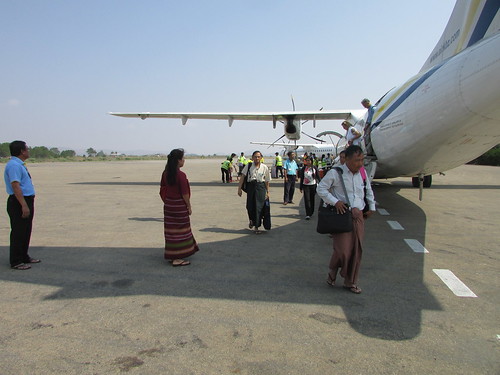
At Heho, the passengers were allowed to walk to the terminal.
The Immigration Desk had two sections - Myanmar residents presented their identity card whilst foreigners had their passport checked. This process was quick and friendly. Checked luggage had been laid out nearby and my luggage receipt was collected and matched against the bag tag before I took possession. I quickly spotted my lady guide by her sign - the agents had me as Mrs. Jam Ford but I thought that rather nice (there's a joke in there somewhere about "Jam Tomorrow") and, after exchanging greetings, we went outside to the car and driver.
We set off on our long journey (about 180 km) initially travelling broadly west towards Kalaw, climbing over a fierce mountain range with many twists and turns. I recognised the important town of Aung Ban which I'd passed through last year on my way from Kalaw to Heho (see post Around Kalaw). I enquired about the station and this time managed to do a quick photographic survey. Aung Ban station is the junction for the line to Loikaw and that line ran close to our onwards route in many places.
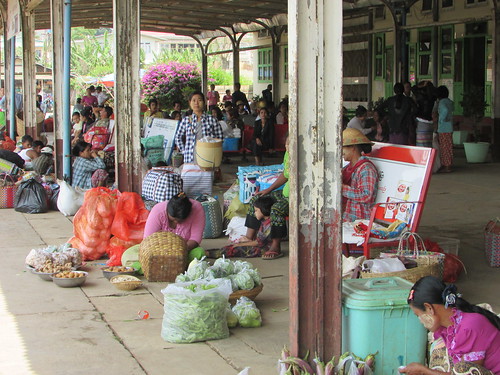
Aung Ban Station
Before reaching Kalaw, we turned south onto Route 54 which ran along the line of the mountain range and gave some spectacular views. The soil is fertile and a wide range of vegetables are grown and exported. In some places, the hills have been terraced for rice growing. In other places Zucchini or courgettes are ground under bamboo frames. I'd seen this on my Thazi to Kalaw train trip last year (described here but not identified the crop. I was amazed that most of the houses seemed to be modern and solidly-built - very few buildings retained woven bamboo panels and new housebuilding was everywhere.
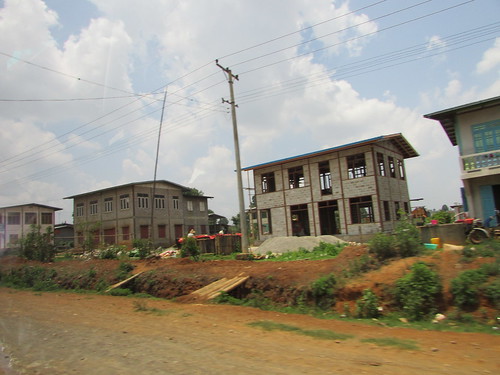
"New housebuilding was everywhere."
Route 54 is one of the many major roads in Myanmar being improved and widened and there was frequent evidence of work in progress. On hilly sections, deep run-off channels were provided for rain water and retaining walls made of stones carefully mortared together were frequent. On one section, two men were delicately painting the mortaring white!
Unexpectedly, there was suddenly a large industrial plant ahead of us - the 'Dragon' Cement Works, owned by a Pa-O businessman, I was told.
We came to a fairly large town, Pin Laung, with an impressive pagoda. Despite the impressive exterior, there was only a tiny temple inside.
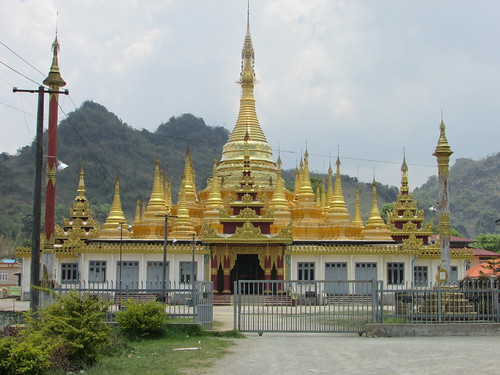
Pin Laung's impressive pagoda.
I'd seen ancient diesel engines driving electric generators in Bagan, where steel ferries were being built using electric arc welding (described in the post Bagan Medical Clinic - Sunday). In Pin Laung, a parked lorry had a similar generator sets coughing away in the load space. A steel frame with four solid, cast wheels mounted what appeared to be the ubiquitous Chinese-made diesel engine with a flywheel driving a Mindong generator (also Chinese-made) through a belt.
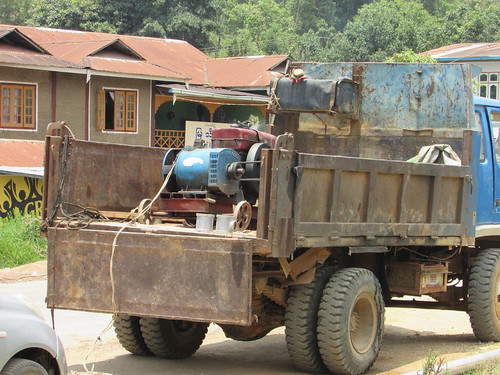
Welding generator mounted on a lorry.
I could see leads dangled off the back of the lorry but couldn't immediately see where they led, until I crossed the road. Two leads (which seemed to me very thin for electric welding) were laid across the tarmac, being run over by the frequent traffic. The leads passed into a trench where a welder was working on steel pipes, watched by his happy mates.
Having passed through the main part of the town, we stopped at a restaurant for lunch where I had a very acceptable steamed rice with fresh vegetables including tomato, cauliflower, carrots and beans, together with a potato and onion soup, all washed down with hot green tea and a slightly cool Coca Cola.
Beyond Pin Laung, the road turned east and descended to the plains. Ahead of us was a huge lake (Moebyel, I think) and we turned south again to run near the edge of the lake. At the town of Phe Khang there appeared to be numerous Catholic churches. One tall hill nearby was topped with a white-painted cross, I imagined in rebuke to a golden pagoda on the opposite side of the valley,
In the plains there were broad rice fields and some water buffalo but there were also farmers with mechanised cultivators. The area produces two rice crops each year.
Without ceremony, we passed a sign saying we had entered Kayah State. A little further on, another sign said we were now in Loikaw. There was a dual carriageway, large educational college, anonymous government buildings and at least two military camps. We turned off into the suburbs and made our way to my home for three days, Loikaw Lodge. Open only eight months, the styling is very modern with large rooms with a balcony overlooking a small lake. To my surprise, I found it all charming.
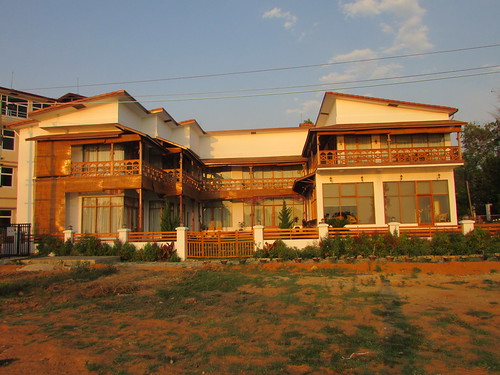
Loikaw Lodge: Viewed from the lake.
Related Posts on this Website
Next Post describing this trip.
All 2017 Burma Trip posts.
My Pictures
Where necessary, clicking on an image above will display an 'uncropped' view or, alternately, pictures from may be selected, viewed or downloaded, in various sizes, from the albums listed:-
Yangon - Heho by air.
Aung Ban Station.
Aung Ban - Loikaw by road.
Aung Ban to Loikaw railway.
Loikaw, Kayah State.
Loikaw Lodge.
[Links to pictures added 24-May-2017, Text amended & pictures added 1-Sep-2017]
Events of Tuesday 2nd May 2017
I slept well in the luxurious surroundings of the Governor's Residence and took a simple breakfast in the open air on the Garden Terrace (there is the alternative of an 'inside' restaurant with air conditioning).
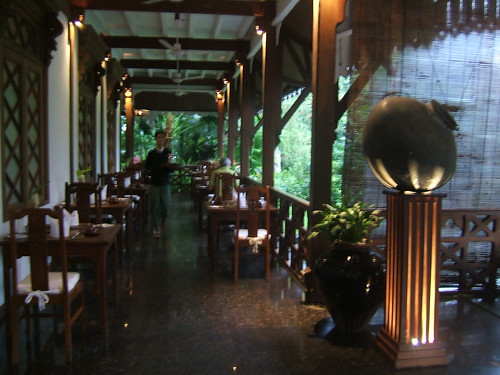
The Governor's Residence: Part of the open air Garden Terrace.
I toyed with various ideas as to where I might go but I still felt very tired so, in fact, I spent the whole day in my room dealing with e-mails, amending or adding blog posts and uploading photographs to my 'Flickr' site which is linked in my blog posts.
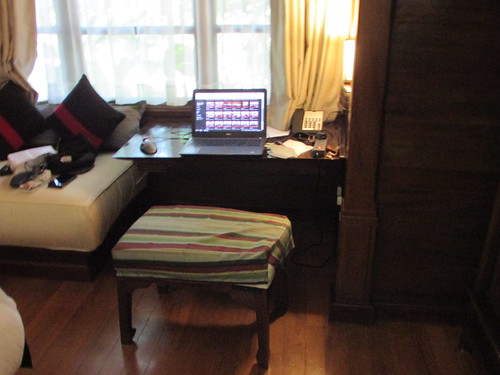
The Governor's Residence Hotel, Yangon: 2017: At work on my computer.
Even with the benefit of the fast internet connection, it became clear that I would not complete the work so I broke off for a pot of tea and a cheese sandwich (a very elaborate and superior cheese sandwich). After the break, I did more computer work but, having concluded that the alarm would need to be set for 5.45 a.m. on Wednesday, I stopped fair early and retired for the night.
Related Posts on this Website
Next Post describing this trip.
All 2017 Trip posts.
My Pictures
Where necessary, clicking on an image above will display an 'uncropped' view or, alternately, pictures from may be selected, viewed or downloaded, in various sizes, from the album listed:-
The Governor's Residence Hotel.
[Pictures added: 1-Sep-2017]
Events of Monday 1st May 2017
The Clinic was strangely quiet on Monday morning with all the patients departed. Dr. Hla Tun had decided that, before we returned to Yangon, we would visit three village schools in the area, distributing exercise books, pencils, erasers and plastic rulers.
I joined the monk who supervises the Clinic, Doctor Hla Tun and some of the Clinic staff in the monastery 'Hi-Ace' people carrier and we visited three remote villages. But our first stop was at Nyaung Oo Long-Distance Bus Terminal.
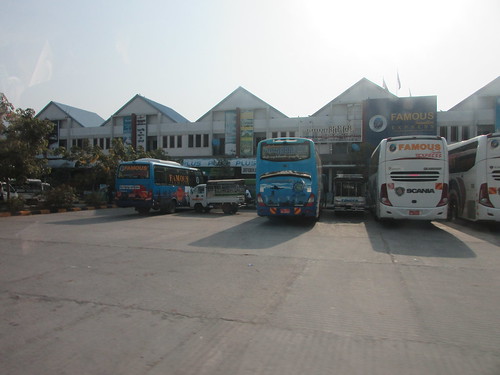
Nyaung Oo Long-Distance Bus Terminal.
Whilst rail travel in Myanmar is cheap, at present it is slow and not very comfortable, so a network of modern, long-distance coaches provides a popular alternative, also supporting a thriving parcels business. Doctor Hla Tun had ordered the stationery we were to distribute from a supplier in Yangon and our call at the Bus Terminal was to collect a number of heavy parcels of stationery wrapped in sacking.
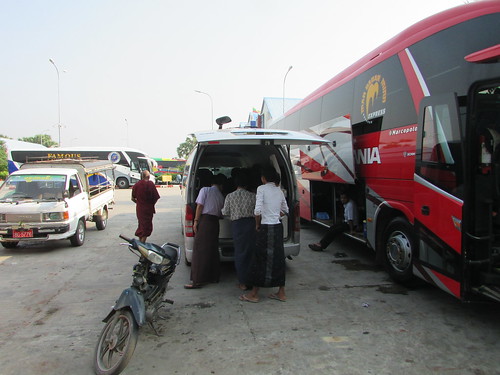
Picking up parcels of stationery at Nyaung Oo Long-Distance Bus Terminal.
We then travelled along the road to Kyaukpadaung, through a fertile plain with many Toddy Palms (my introduction to the Toddy Palm was in 2009, described in the post Mount Popa, Myanmar). Sections of the road are subject to seasonal flooding and it's normal for road repairs to be in progress to re-instate the surface. But on this trip, I noticed somewhat more major work in progress.
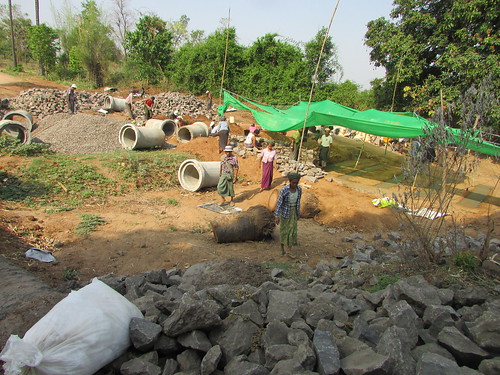
From Bagan Clinic to Htee Pu by road: Road improvements on the section subject to seasonal flooding.
We turned off the main road an continued across the hills in the direction of our first school, then turned onto the dirt track which led to Htee Pu village. Even the dirt track to the village was being improved. My first visit to Htee Pu was in 2009, described in the post Ti Pu Village (Romanisation of Myanmar words is a bit variable but the spelling 'Htee Pu' now seems most common). Since that first visit which induced me to become involved in educational support in Myanmar, I've been back to Htee Pu many times (I was involved in the opening of a new classroom in 2010, described here). The Head Monk is aware that his rather remote location makes it less likely that overseas travellers will visit Htee Pu, so he is especially appreciative of support. Although it was school holidays, most pupils were happy to attend school to receive the distribution. Only those with family commitments or long distances to travel were missing and we left sufficient materials to pass on to them.
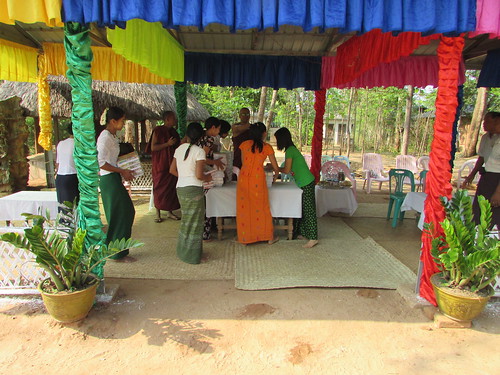
A pavilion in the yard had been decorated for the occasion and willing hands unpacked the stationery.
After Dr. Hla Tun addressed the children, Jan said a few words of encouragement in English, which were translated by the Doctor. Then, with remarkable speed, the serious business of distributing the stationery was completed.
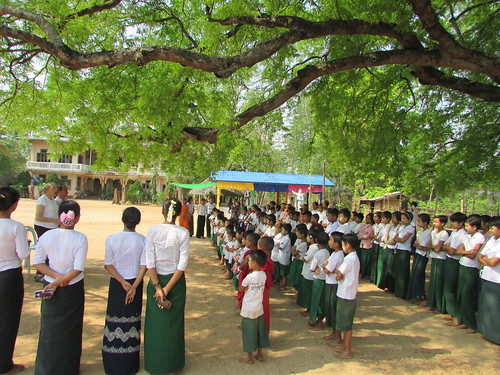
Distribution at Htee Pu (2017): After Dr. Hla Tun addressed the children, Jan said a few words of encouragement in English, which were translated by the Doctor.

Jan assisting with the stationery distribution.
Welcome refreshments had been laid on for the visitors but, with two more schools to visit, we were soon back on the road.
By the time we arrived at the second school, it was really hot. As a mark of respect to the visitors, two men from the village committee were tasked with holding umbrellas above Dr. Hla Tun and myself. I'm never very comfortable with this practice but acquiesced to avoid giving offence. Before long, the stationery had been unpacked and the first group of pupils lined up.
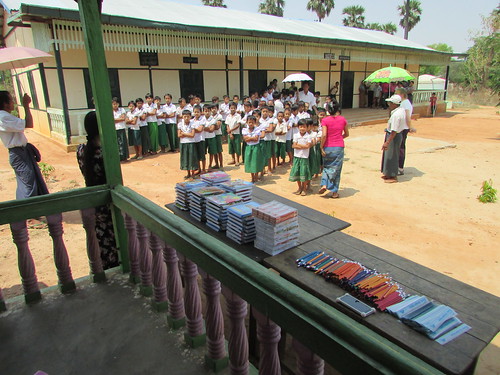
Before long, the stationery had been unpacked and the first group of pupils lined up.
Occasionally, children are unsure what they have to do. I try to appear unthreatening (but I don't know how successful that is). I happily chatter away in English but rely on handsignals to give guidance.
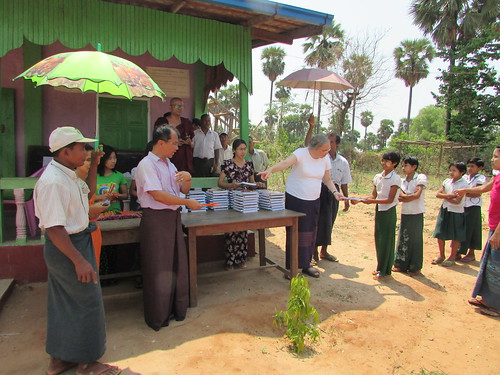
"And the Doctor will give you pencils, as well".
Once again, refreshments were provided before we boarded the 'Hi-Ace' again. A small tracked excavator was engaged in widening the unsurfaced track from the village, but it had not made sufficient progress to prevent us being held up for about five minutes following a slow-moving Chinese-built lorry. We finally reached a spot wide enough for us to pass, after which our speed was limited by the ruts in the track until we turned onto a surfaced road.
Our last school at Nga-Minn-May is also located at the end of a lengthy, unsurfaced track. I think my first visit was is 2012, described here, then I returned in 2013, described here, and again in 2016, described here. Once again, we were made very welcome by the village committee and the teaching staff. Despite it being a school holiday, there were many pupils waiting in the shade of a venerable tree.

Pupils waiting in the shade of a venerable tree.
Rulers, pencils and exercise books were given to all the children present and the remaining stationery was left for pupils not able to be present.
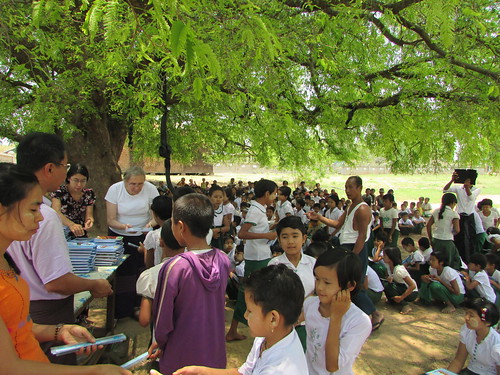
Rulers, pencils and exercise books were given to all the children present.
Then it was back to the Clinic for a meal and a rest before the Doctor and I were driven to Nyaung Oo airport to catch evening flights back to Yangon. This time, rather than staying at Doctor Hla Tun's home, I was driven to the Belmond Governor's Residence Hotel. Eddie Teh had invited me to stay there and make use of the fast internet connection to allow me to upload some of the many pictures I'd taken since my arrival in Myanmar.
Related Posts on this Website
Next Post describing this trip.
All 2017 Trip posts.
My Pictures
Where necessary, clicking on an image above will display an 'uncropped' view or, alternately, pictures from may be selected, viewed or downloaded, in various sizes, from the albums listed:-
From Bagan Clinic to Htee Pu by road.
Distribution at Htee Pu (2017).
Distribution at Bagan School (2017-2).
Distribution at Nga-Minn-May School (2017-3).
All my albums for Burma 2017.
[Text and pictures added: 31-Aug-2017]
Events of Sunday 30th April 2017
At 7.30 a.m., I toured the clinic compound. It was noticeably quieter than the previous day. 150 patients had been registered. The Clinic is only open on Friday, Saturday and Sunday each week so registered patients must be seen before the Clinic closes on Sunday.
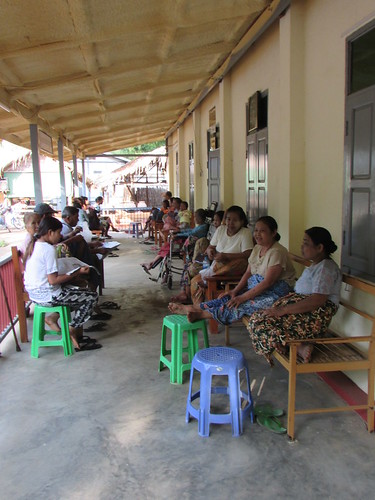
Around Bagan Clinic - Sunday: Patients waiting for Dr. Hla Tun to start consultations.
The clinic compound is situated on the raised East Bank of the Ayeyarwaddy. I decided to walk to the river's edge, and find the source of an incessant racket. I discovered an area of the sloping river margin, completely unfenced, was in use as an impromptu steel boat building yard. A floating steel hull was moored in the river with a part-built superstructure awaiting completion. On the bank, three smaller steel-framed boats were being constructed.
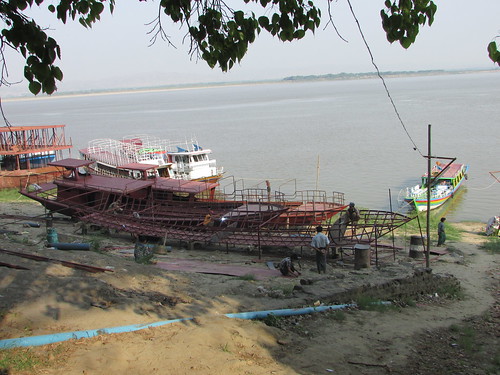
The Ayeyarwaddy at Bagan (2017): Three new steel boats under construction.
One boat builder was marking out a large sheet of steel into strips, using a long steel rule and chalk, presumably prior to dividing the sheet. Squatting, he held one end of the ruler with his left hand and the other end with the toes of his right foot, leaving his right hand free to mark the sheet.
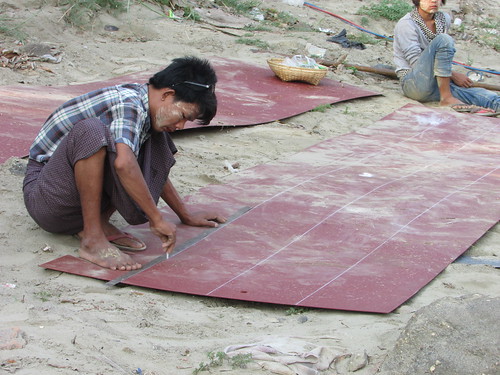
The Ayeyarwaddy at Bagan (2017): A boatbuilder marking out a sheet of steel.
Another boatbuilder was welding the frames of the largest of the three boats on the bank using an electric arc welder. The source of the electric power was one of two ancient-looking diesel generators. The diesel engine ran in the customary noisy fashion, until the arc was struck when the engine seemed to stagger and almost stop. Once the arc was broken, the engine would recover. After fuelling the second diesel generator, a second welder started work, adding to the racket.
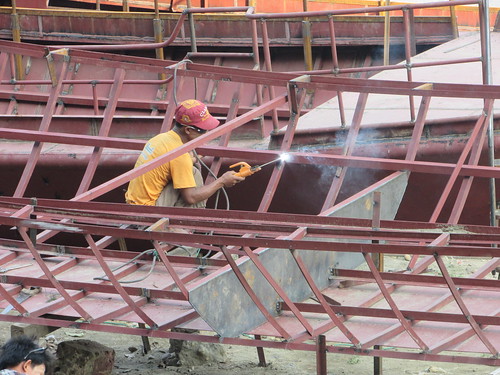
The Ayeyarwaddy at Bagan (2017): A boatbuilder welding the frames of the largest of the three boats on the bank.
A rather derelict paddle steamer has been moored nearby for years. I'm always drawn to it as it conjures-up visions of the 'Irrawaddy Flotilla', but I've still not discovered its history.

The Ayeyarwaddy at Bagan (2017): This rather derelict paddle steamer always conjures visions of the 'Irrawaddy Flotilla'.
I returned to the Clinic just after 9.00 a.m. and found Doctor Hla Tun (who'd worked until 3.00 a.m. Sunday morning) taking breakfast, before resuming consultations.
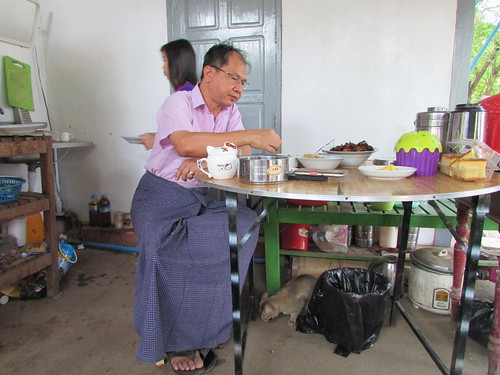
Around Bagan Clinic - Sunday (2017): Dr. Hla Tun takes breakfast, before resuming consultations. I sat in with the Doctor for a time.
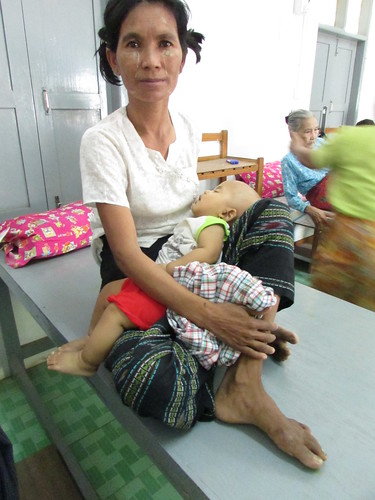
Around Bagan Clinic - Sunday (2017): Mother and baby.
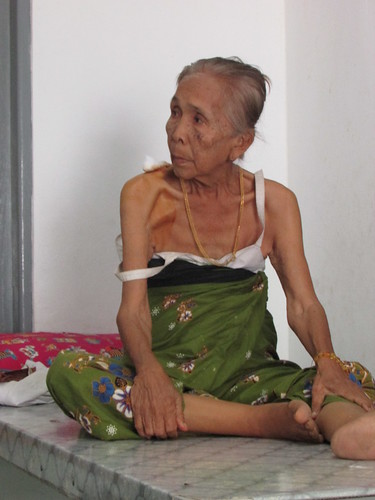
Around Bagan Clinic - Sunday (2017): An elderly patient.
Shortly after 11.00 a.m., the Head Monk appeared to supervise the distribution of the free lunches to patients and their companions.

Around Bagan Clinic - Sunday (2017): The Head Monk supervises the distribution of the free lunches.
I returned to sit-in with Dr. Hla Tun later. Many of the patients had a variety of mobility issues, often age-related.
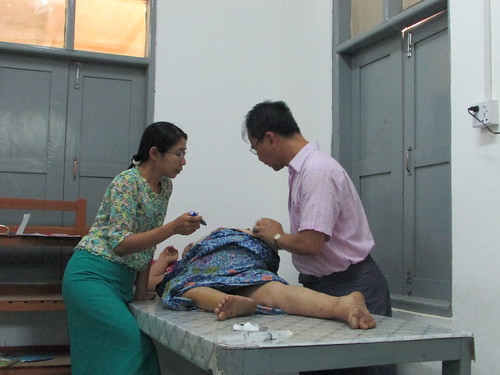
Around Bagan Clinic - Sunday (2017): Dr. Hla Tun diagnosing mobility issues on a female patient.
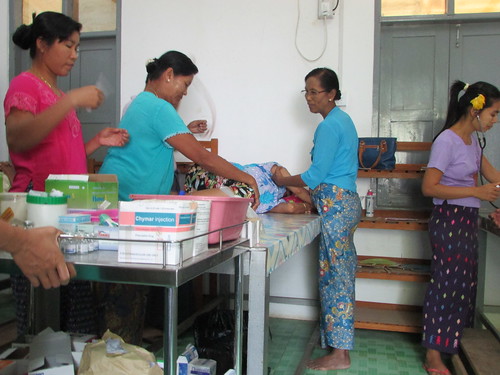
Around Bagan Clinic - Sunday (2017): A female patient attended by two family members.
Work continued during the day on the construction of the Hospital Building. Joiners were using both hand and power tools.

Around Bagan Clinic - Sunday (2017): A joiner planing timber for the Hospital Building.
At 5.00 p.m., Doctor Hla Tun had a short break to take dinner. At that time, there were 24 patients left to be seen.
In the early evening, I returned to the riverbank to see what progress had been made by the boat builders. The men were still hard at work. Painters had transformed the hulls of the two boats nearer the river from bauxite brown to a gleaming white and a number of hull plates had been attached to the frames of the third boat. I watched as a plate was shaped to the frames, prior to welding.

The Ayeyarwaddy at Bagan (2017): A steel hull plate being shaped to the frames, prior to welding.
Once again, I retired early, leaving the Doctor and his team to complete their work.
Related Posts on this Website
Next Post describing this trip.
All 2017 Trip posts.
My Pictures
Where necessary, clicking on an image above will display an 'uncropped' view or, alternately, pictures from may be selected, viewed or downloaded, in various sizes, from the album listed:-
Around Bagan Clinic - Sunday.
The Ayeyarwaddy at Bagan.
All my albums for Burma 2017.
[Text and pictures added: 15-Aug-2017]

