skip to main |
skip to sidebar
Events of Friday 28th April 2017
I had to set my alarm for 4.30 a.m. because we needed to leave for the airport at 5.45 a.m. in order to catch the seven o'clock KBZ Air flight K7 262 to Nyaung Oo. This was my first flight from the recently-opened new Domestic Terminal which has a similar design to the existing International Terminal (which replaced the earlier International Terminal which was in use on my first visit to Myanmar in 2008).

Yangon Airport: Using the new Domestic Terminal to fly to Nyaung Oo.
We arrived at Nyaung Oo on time and the monastery car was waiting to take us to Bagan Medical Clinic. Doctor Hla Tun immediately started consultations whilst I was free to explore the busy monastery compound where the various clinic buildings are located. When I checked before lunch, 285 patients had registered. The Friday list had been closed at 250 patients, so the last 35, and subsequent registrations, were placed on the list for Saturday.
Soon, waiting patients were queuing up for the free lunch provided by the monastery. As usual, the abbot started distributing the meals but after a while, he invited me to continue the process.
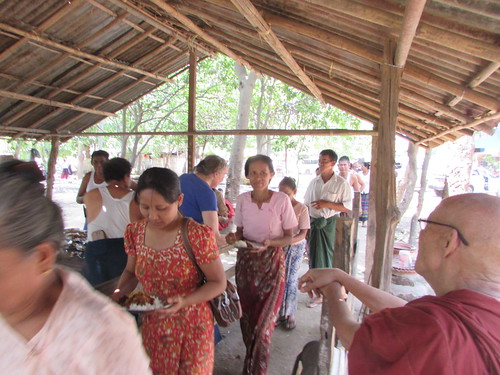
Around Bagan Clinic - Friday: Jan helping to distribute lunches to patients, under the watchful eye of the Abbot.
In a remarkably short time, around 300 lunches had been served, the metal plates and cutlery rinsed by the diners and everything cleared away until the next day.
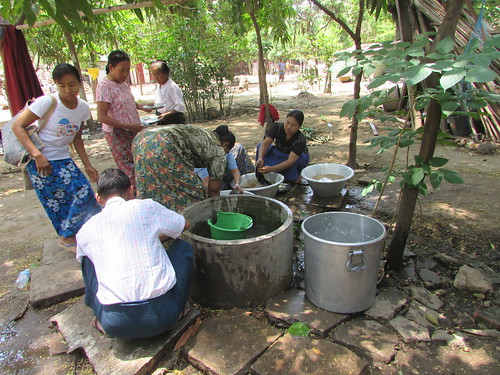
Waiting patients or their friends washing up after lunch.
A brief tour of the site
I decided to take a walk through the monastery compound looking at developments. It's hard to believe that, in 2010, the whole area now occupied by the clinic was just dusty, beaten earth owned by the monastery. There was no wall or fence around the compound (that's still the case). Back in 2010, the occasional vehicle could be seen, on its way to the monastery itself, the private landing stage on the adjacent Ayeyarwaddy River or passing through to Taung Be village beyond.
Approaching the clinic from the south in 2017, there is now a row of simple stalls on the left to serve the waiting patients, with a couple of tea shops and more stalls on the right.
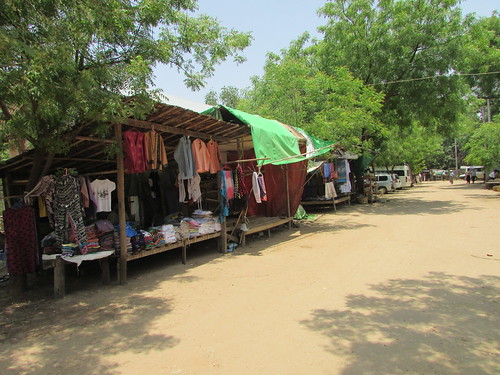
The approach to Bagan Clinic from the south, showing stalls on left of roadway.
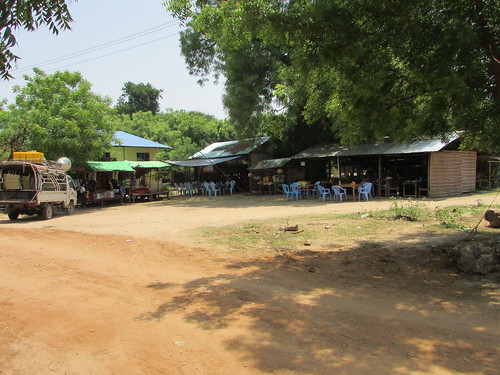
The approach to Bagan Clinic from the south, showing tea shops and stalls on right of roadway.
The next building on the right is of substantial wood frame with block walls rendered and painted. It's part of the clinic, but not medical and serves as a communal dormitory building. Donations from the Ultimate Travel Company in the United Kingdom funded this and other developments. Because of the long distances many patients travel, they often need to spend one or more nights at the clinic before receiving treatment. The dormitory building, simply equipped with raised sleeping platforms, provides basic accommodation for patients and accompanying friends and relatives.

The Dormitory Building for waiting patients.
I then came to the main complex of clinic buildings. On my left, I passed the second clinic building to be erected at Bagan. This large building has a reinforced concrete frame construction, block walls rendered and with a spacious waiting verandah. It houses the clinic's laboratory and a well-equipped physiotherapy department.
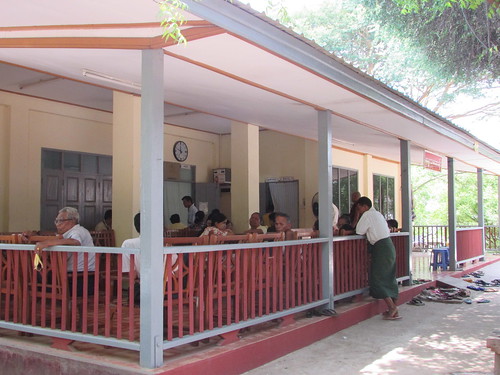
The second clinic building at Bagan is large with a spacious waiting verandah. It houses the clinic's laboratory and a well-equipped physiotherapy department.
In front of the second clinic building is the lofty patient waiting area. This permanent building has replaced an earlier bamboo structure.
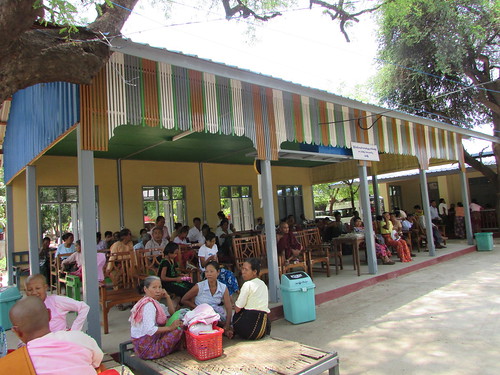
The patient waiting area at Bagan Clinic.
The patient waiting area faces the first clinic building, opened in 2011. There's a report on the early days at the clinic here. The original building has a substantial wood frame with block walls rendered and painted. The structure has been extended by providing a verandah at the front and a covered staff kitchen at the rear.
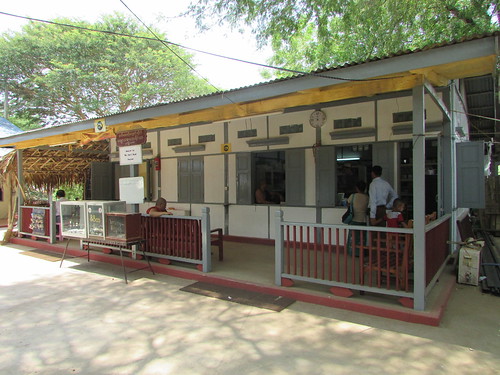
The first Bagan clinic building, showing the verandah which has been added.
Beyond the first clinic building, there's a simple shelter where donations to the work of the clinic are accepted. The concept of charitable giving is an important part of Buddhist beliefs. Next, there's a second, similar shelter currently used by the carpenters engaged on the building extensions. Doors, window frames and shutters are all produced on site to a high standard using hard wood. Experienced joiners carry out this work, principally using hand tools although there is limited use of power tools.
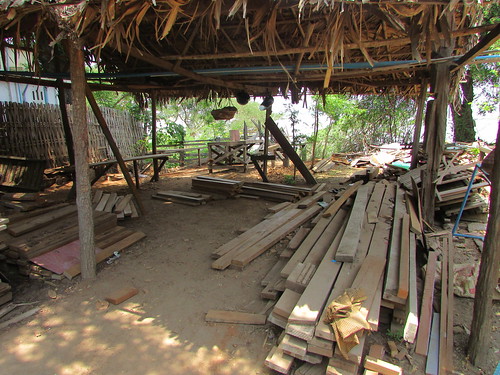
The Joiners' Workshop.
Next, I passed the third clinic building - a slightly larger version of the original building with a substantial wood frame and block walls rendered and painted. There is a verandah at the front and staff toilets at the rear. This building was donated by the Ultimate Travel Company in the United Kingdom
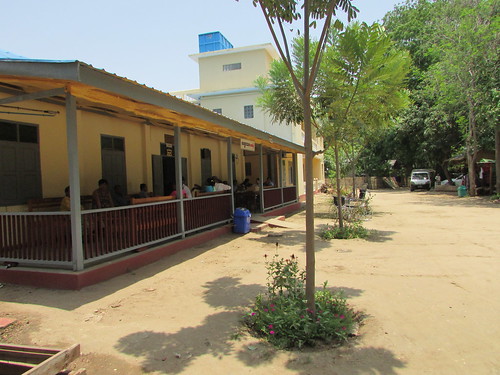
The third clinic building, with Doctor Hla Tun's Consulting Room (left).
This building has a large consulting room with three examination/treatment beds used by Doctor Hla Tun. Myanmar does not embrace Western ideas of privacy and three patients at a time are dealt with in this room, with Doctor Hla Tun moving from patient to patient. Where simple procedures can be dealt with by one of his assistants, the Doctor will attend to the next patient whilst his assistant carries out the work. More complex procedures are always performed by Doctor Hla Tun himself. If laboratory tests are required, the patient will take an order form to the laboratory (situated in the second clinic building), returning to Doctor Hla Tun later with the results. In this way, Doctor Hla Tun can see around 90 patients in a gruelling, whole-day shift.

Around Bagan Clinic: Doctor Hla Tun at work.
Having passed the third clinic building, the impressive fourth clinic building draws the eye. This large, two-storey building has been built to allow the range of treatments provided by the clinic to be further extended. Because of the site conditions, adjacent to the east bank of the Ayeyarwaddy River, extensive reinforced concrete foundations were required. The building itself has been constructed to high standards, to allow X-ray facilities and operating theatres to be accommodated. At the time of my visit, the building itself was still being completed but opthalmology, dentistry and bedrooms for visiting doctors were already in use. A number of donors have provided financing for this important development.
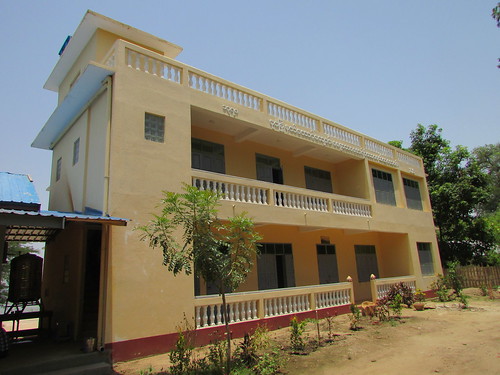
The fourth clinic building nearing completion.
There was one further building under construction, just on the landward side of the two-storey building. This is also a two-storey building of reinforced concrete which will provide a 28-bed hospital unit.
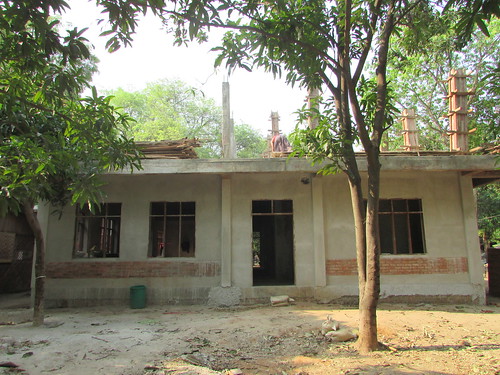
Around Bagan Clinic: End view of Hospital Building under construction, showing main entrance.

Hospital Building Ground Floor Plan.
The growth of the Bagan Medical Clinic since its modest beginning in 2011 never ceases to amaze me. It testifies to the pressing need for better medical care in Myanmar and to the generosity of donors both in Myanmar and around the world who have supported the work.
Related Posts on this Website
Next Post describing this trip.
All 2017 Trip posts.
My Pictures
Where necessary, clicking on an image above will display an 'uncropped' view or, alternately, pictures from may be selected, viewed or downloaded, in various sizes, from the album listed:-
Yangon Airport.
Around Bagan Clinic - Friday.
[Text added, pictures added to text: 21-Jul-2017, 27-Jul-2017]
Events of Thursday 27th April 2017
After the exertions of the previous few days, I decided on a quiet morning at the Doctor's house in Yangon, blogging and backing up pictures ready to upload when possible.
The Doctor's wife had learned that coverage of our Distribution to children in Hlaing would be in the Sky Net television news programme sometime between ten and eleven so I moved my computer to the room with a television and waited with the Doctor's wife, carrying on working on the computer until the item came on.
The segment was about six minutes long and featured two interviews with local staff followed by lots of pictures of the distrbution itself with a voice-over commentary.
In the afternoon, the Doctor and I went to the Belmond Governor's Residence Hotel in Taw Win Road for a meeting with Eddie Teh, General Manager Belmond Myanmar Hotels and Cruises, to discuss the Belmond Myanmar Foundation (of which I am a trustee). Eddie is a strong supporter of the work being carried out and has very clear ideas on the way ahead which I fully endorse.
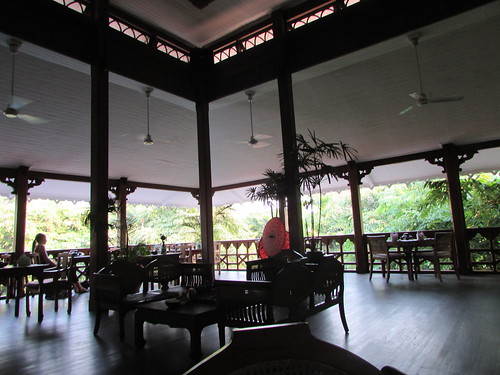
The elegant, open-sided lounge on the upper floor of the Governor's Residence.
Related Posts on this Website
Next post describing this trip.
All 2017 Trip posts.
My Pictures
The Governor's Residence Hotel, Yangon.
Events of Wednesday 26th April 2017
After a relaxing night, we took breakfast in the hotel's restaurant before a pick-up truck loaned by Care Myanmar and driver collected us to drive to Hlaing, situated in a poor area of Mawlamyine. Around four hundred children were waiting for us.
Late arrivals were still being registered at a series of desks set up on the open land adjacent to the Drop In Centre and being given a bottle of orange drink and a piece of cake together with the all-important voucher which would be collected immediately prior to their receiving the donated items. Two television news cameramen were operating around the site, one from Sky Net, one from MTV.
Doctor Hla Tun and I made a small number of special awards inside the Drop In Centre before moving outside where the children were seated on the ground beneath a series of portable, folding shelters facing a simple 'stage' made by placing a number of benches together. A banner at the back of the stage named the donors in English and Myanmar language.
The stage was a sea of over four hundred bright yellow plastic carrier bags, each containing a single distribution. Each bag was marked in felt tip to indicate, for instance, whether it was intended for a boy or a girl.
There was a sound system with a radio microphone which Doctor Hla Tun used to introduce the 'Road to Mandalay' ship and the educational support work carried out. Then I was asked to make a little speech which the Doctor translated, before the serious business of distributing the new uniforms and stationery in the yellow plastic bags.
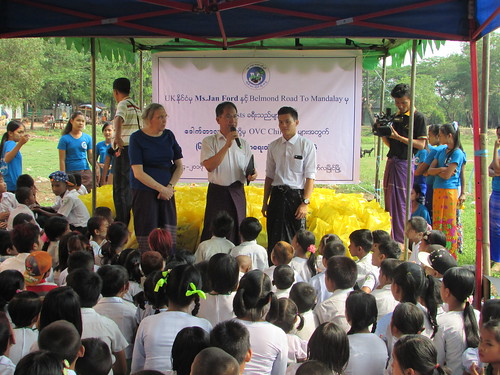
Doctor Hla Tun talks about the 'Road to Mandalay' ship and the educational support work carried out.
One assistant collected the vouchers as each child game up, sometimes requiring a hunt in the bag containing the cake and drink before it was located. Other staff clambered around the stage looking for the appropriate type of yellow bag which was then handed to me to present to the child.
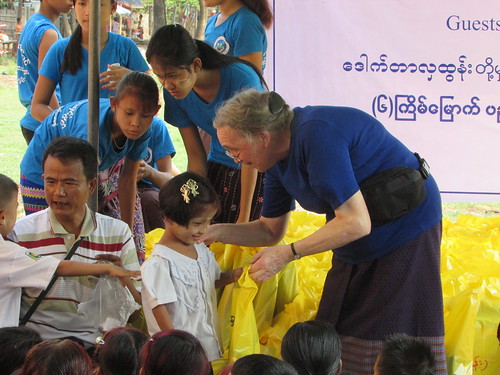
Hlaing Drop In Centre - 2017.
Mistakes were occasionally made in identifying the correct type of bag for a child, particularly with girls with short-cropped hair and shorts. Then the cry would go up from the voucher collector, in Myanmar language, "Boy, Boy!" or 'Girl, Girl!". I even learnt the words myself and joined in the shout although I forgot them immediately the presentation was done.
Many, many photographs were taken: members of staff of the Drop In Centre each wanted their personal record on camera or mobile phone. This was a very special once-a-year event for both the staff and children involved.
Once the children were wearing their new uniforms, sometimes over their everyday clothes, a series of pictures of the whole group was taken.
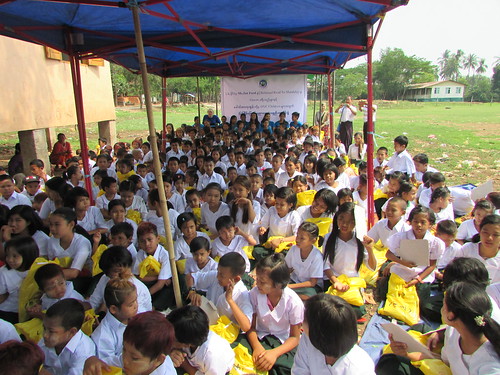
Hlaing Drop In Centre - 2017: Group photograph.
As the happy children departed, we returned to the Drop In Centre and Doctor Hla Tun addressed all the staff.
Then, it was back to our hotel. Whilst Doctor Hla Tun's mother was preparing to leave, the helpful Care Myanmar manager who'd assisted us, the Doctor and I went to a nearby teashop for discussions.
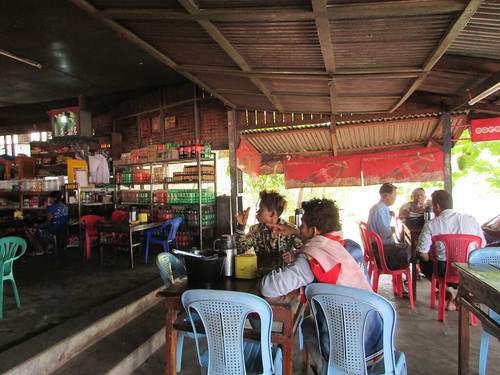
Teashop near our hotel.
When we finally checked-out of the hotel, the friendly porter insisted on taking our photographs in front of two detailed wooden models of bullock carts displayed by the hotel.
We were then driven to the Mawlamyine offices of the Care Myanmar charity - not the rather cramped offices I'd visited in previous years but a much larger, modern property necessitated by the number of projects being handled. In addition to the Orphans and Vulnerable Children (OVC) project there are projects to develop rubber-growing and combat Human Trafficking.
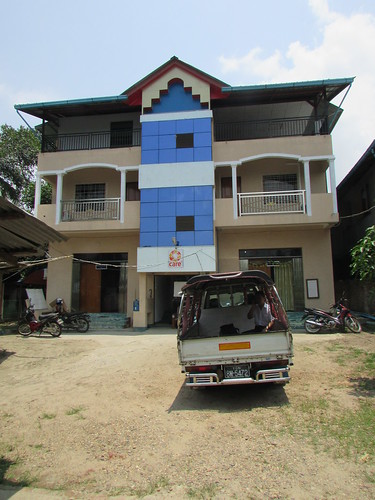
Care Myanmar Offices, Mawlamyine.
One ground floor entrance was for the 'Finance and Admin & Logistics Team' another 'Global Fund'. After a brief wait, the pick up then drove us to the Shwe Zee Kyet restaurant - a large, upmarket, rather Western version of the tea shop with a sound system playing pop music. There were few diners whilst we took our lunch but I imagine it becomes crowded in the evening: Myanmar people seem inherently sociable.
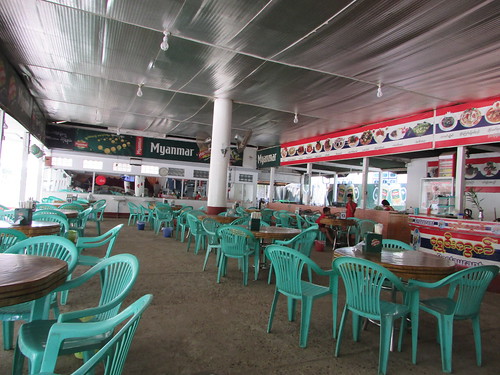 Shwe Zee Kyet restaurant.
Back at the Care Myanmar offices, the Doctor's Mother and I were invited to rest in a separate, upstairs bedroom. I assume that this bedroom was intended for visiting foreigners for, in addition to the usual sleeping mats, there was one mattress two inches thick, air conditioning and an en-suite shower with Western-style toilet.
I enjoyed resting here before we carried out our final distribution in Mon State at the Shwe Myaing Thiri Drop In Centre. Once again, we had seen many of the staff and children on previous visits. After Doctor Hla Tun addressed the children, I was required to add my words of explanation and encouragement. The donated items are tailored to the needed of each Drop In Centre (within the constraints of a limited budget) so here the children received both uniforms and umbrella, proudly displayed for the 'group shot'.
We were able to return to the Care Myanmar offices for more relaxation, with the inevitable visit on the way to a surprisingly-clean teashop.
Our work complete, the pick-up truck was loaded with our luggage for the final time. We made visits to the three most famous pagodas in Mawlamyine before stopping at another restaurant for a farewell dinner with two of our friends from Care Myanmar. There was just time to drive to the PTT offices to load our luggage and board the 10 p.m. bus to Yangon, with one restaurant stop near Kyaikto. I still didn't exactly enjoy the ride but seven and a half hours was decidedly less demanding than the thirteen and a half hour ride it had taken to reach Dawei on the way south.
We had made distributions to 1,282 children in Mon State, as follows:-
Yaye Township 422 children in total at
La Mine 45 children
Ko Dut 329 children
Mok Ka Nin 48 children
Mudon Township 258 children in total at
Ka Mar Wet 37 children
Mudon 142 children
Kot Kha Pon 79 children
Mawlamyine Township 602 children in total at
Hlaing 427 children
Shwe Myaing Thiri 175 children
Related Posts on this Website
Next post describing this trip.
All 2017 Trip posts.
My Pictures
Where necessary, clicking on an image above will display an 'uncropped' view or, alternately, pictures may be selected, viewed or downloaded, in various sizes, from the albums listed:-
Kaung Myat Hotel, Mawlamyine.
Hlaing Drop In Centre - 2017.
Around Mawlamyine - 2017.
Care Myanmar Offices, Mawlamyine.
Shwe Myaing Thin Drop In Centre - 2017.
[Pictures added to text 19-Jul-2017]
Events of Tuesday 25th April 2017
It was time to say 'goodbye' to our friends at Ko Dut and continue north. We drove to Thanbyuzayat where we stopped at a teashop before continuing to Khaikhami village and the nearby Khaikhami Yele Paya Pagoda, built out into the sea, already thronged with pilgrims by the time we arrived. There are reports on previous visits I've made to this very special pagoda in 2012, with Dr. Hla Tun in 2014 and again in 2015.
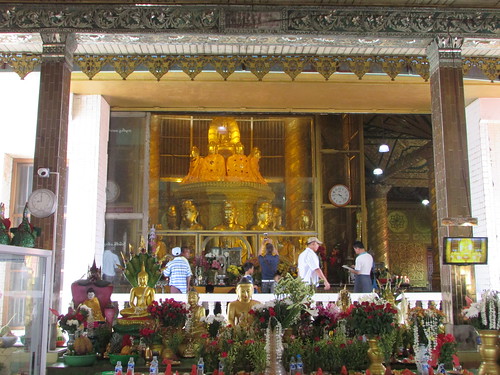
Khaikhami Yele Paya - 2017
Following the pagoda visit, we continued to Mudon Drop In Centre where the children were sitting on the floor waiting patiently for our arrival. Doctor Hla Tun talked to the children about our visit and the Distribution we were about to make and, as he often does, asked the children if they remembered seeing me on a previous visit. A remarkable number of hands shot up. The importance of long-term support for these projects, where children need and deserve assistance for a period of years cannot be over-emphasised. It's encouraging that the staff, too, remain the same year after year so these visits become a real meeting of friends.

Distribution at Mudon Drop In Centre.
After the 'Group Shot' outside the Drop In Centre with the children proudly displaying their new uniforms, we were invited to stay for refreshments, after which they kindly presented me with a longyi in a traditional Mon pattern.
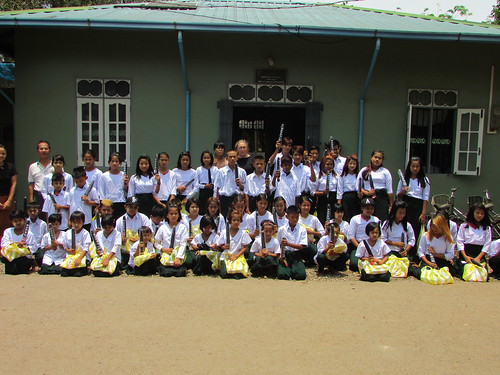
A group shot at Mudon
They were keen to measure and fit the longyi so, having taken brief measurements, they set to on one of a number of Singer treadle sewing machines to hem the garment and fit the waist securing tape. On the slim frame of a typical Burmese woman, the simple garment is elegant and hangs well with a straight front 'pleat'. The seamstress was not entirely satisfied with the effect on my overweight frame, so I had to have a second fitting before they were happy. All of this occurred with much happy laughter and my lack of Myanmar language seemed unimportant. I left wearing my now correctly-fitting longyi.
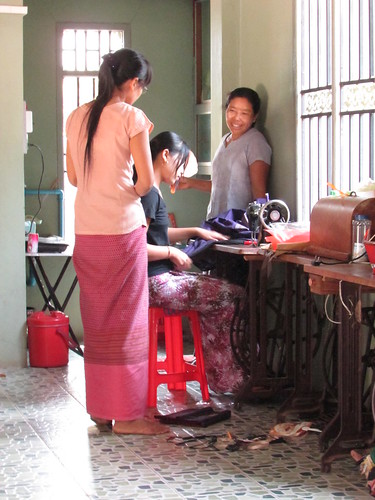
Mudon Drop In Centre - 2017: Longyi adjustments while-you-wait.
One of the local Drop In Centre staff on a moped then led the way for our driver to the next distribution at Ka Ma Wet Drop In Centre.
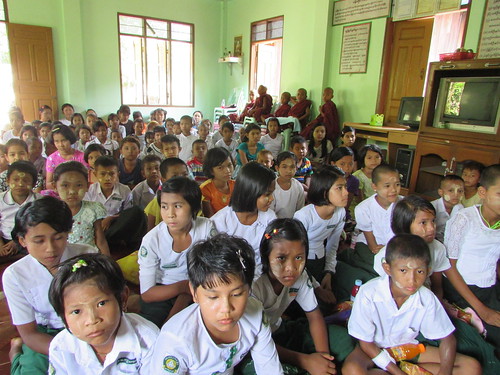
Ka Mar Wet Drop In Centre: Children waiting patiently for our arrival.
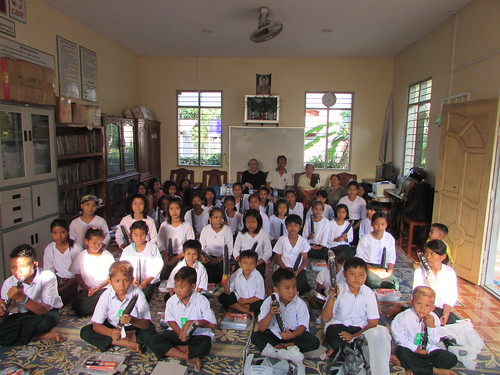
The Distribution proceeded as usual, including what now seemed to have become a regular feature of my being asked to address the children briefly in English, with translation by Doctor Hla Tun.
Ka Ma Wet Drop In Centre.
We then watched the happy children leave. Those from further away bundled onto a converted pick-up truck with seats and a motor-cycle taxi. These two types of vehicle provide the majority of local transport in Myanmar and the number of people who can be crammed aboard is remarkable. I think I counted nine children perched in the 'luggage rack' on the roof of the pick-up and I couldn't see how many inside.

Ka Mar Wet Drop In Centre: The heavily-loaded pick-up converted into taxi departs.
When the motor cycle taxi tried to leave, similarly overloaded, a small tree root across the dirt road in front of the vehicle almost prevented his departure!
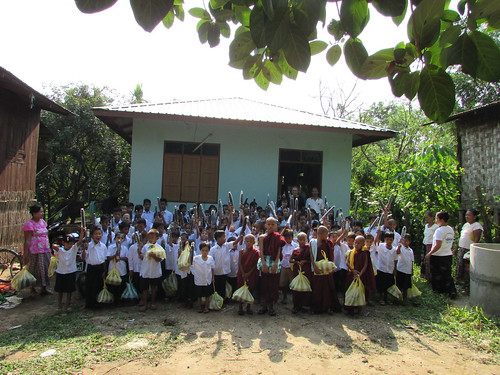
Then it was our turn to depart and head for our appointment at Kot Kha Pon Drop In Centre where we repeated the distribution pattern. In some of the areas more prone to rain, folding umbrellas had been specifically requested so the children proudly held these aloft for the group photograph outside the Drop In Centre.
Kot Kha Pon Drop In Centre.
There was time for us to visit the 'Largest Reclining Buddha Image In The World' and the mausoleum of its founder at the Win Sein Taw Ya Pagoda. My visit to this amazing construction in 2012 is described here, then I returned in 2015 (described here and again in 2016 (described here.
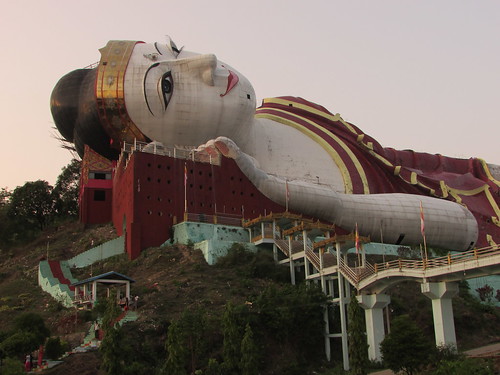
The World's Largest Reclining Buddha.
Then we completed the journey to Mawlamyine, where the Doctor had arranged accommodation at the Kaung Myat Hotel.
I was delighted to discover that, apart from air conditioning and a bed with a thick mattress, there was Wi-Fi, so I declined the offer of an evening meal with Doctor Hla Tun and his mother and stayed in my room trying to deal with e-mails, after which I added an update to my blog.
Related Posts on this Website
Next Post describing this trip.
All 2017 Trip posts.
My Pictures
Where necessary, clicking on an image above will display an 'uncropped' view or, alternately, pictures from may be selected, viewed or downloaded, in various sizes, from the albums listed:-
Mudon Drop In Centre.
Ka Mar Wet Drop In Centre.
Kot Kha Pon Drop In Centre.
The World's Largest Reclining Buddha.
Kaung Myat Hotel, Mawlamyine.
All my albums for Burma 2017.
[Photos added and corrections to text: 16-Jul-2017]
Events of Monday 24th April 2017
Helpers from Ko Dut Drop In Centre arrived at our accommodation fairly early and, after preparing breakfast for the Doctor, the Doctor's mother and the writer, they lifted the large sacks of materials for the Distribution to Children from upstairs in the house to a waiting pick-up.
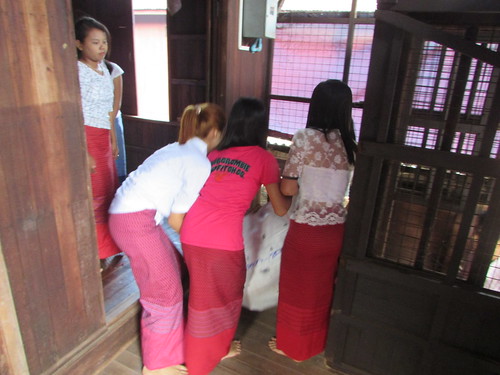
Around Ko Dut: Helpers from Ko Dut Drop In Centre moving the large sacks of materials for the Distribution to Children from upstairs in the house to a waiting pick-up.
With Ko Dut Drop In Centre temporarily unavailable, the monastery had agreed that the Assembly Hall there could be used for the distribution, so we arrived to find around 300 excited but surprisingly quiet young people sitting on the floor of the hall.

Distribution at Ko Dut Monastery.
Soon, a senior monk arrived, deputising for the abbott who had been called away. The senior monk sat facing the children together with a second monk. A simple portable amplification system with a radio microphone was set up.
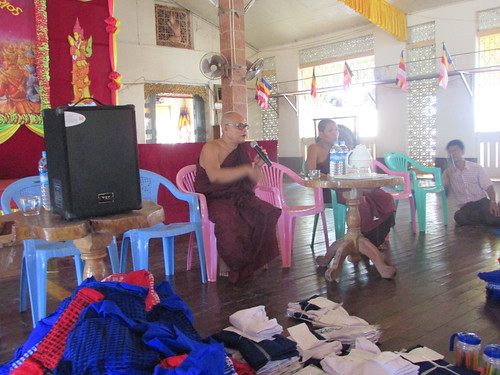
The Senior Monk at Ko Dut Monastery addresses the children.
After a brief exhortation by the Senior Monk, Doctor Hla Tun explained about the new donated school uniforms, school bags and stationery which was about to be distributed. The senior monk then suggested that I addressed the children. First, I would say a few sentences in English. Then I passed the microphone to Dr. Hla Tun who translated into standard Myanmar language. Then the microphone passed to one of the helpers, a fluent Mon speaker, to translate into the Mon language, as not all the children understood the standard Myanmar language. Then the microphone was returned to me, to say a little more.
The helpers from the Drop In Centre had prepared the donations by placing everything else in the new school bag so, as each child was called up, a helper passed the appropriate bag to me, and I presented it to the young scholar.
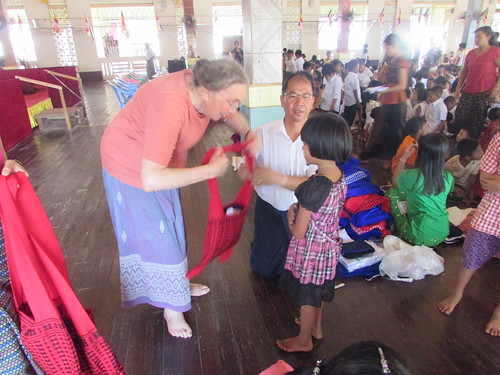
Distribution at Ko Dut Monastery.
Each child was then asked to put on the new uniform, with helpers giving assistance to the younger children, as necessary.
The work of presentation was not quite over. Each child then received a snack and soft drink which Jan assisted the helpers in distributing by moving among the seated children.
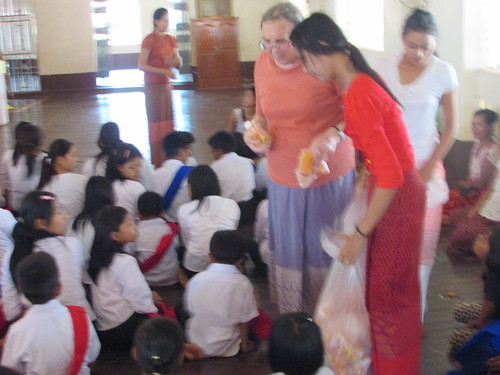
Snack and soft drink being given to children in their new uniforms.
Wearing their new uniforms, the students moved outside the assembly hall and sat in rows under a covered walkway for the 'group shot'. This took a few minutes as there were lots of cameras waiting to record the event. Someone then suggested that re-positioning everyone on nearby concrete steps would give a good effect, so all the children moved across and more pictures were taken.
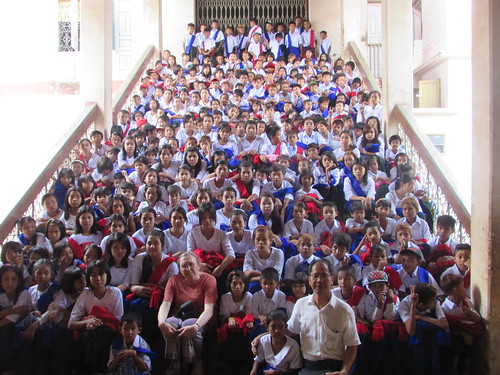
Distribution at Ko Dut Monastery: The 'group shot'.
Doctor Hla Tun explained to me that the pupils we'd just seen came from seven schools in the area:-
Ko Dut Mon Ethnic School
Ko Dut Government Primary School
Ko Dut Government High School
Kot Cha Mon Ethnic School
Kot Cha Government School
Fel Gu School
Ku To Seik Mon Ethnic School.
We then drove to our final distribution of the day at the small Drop In Centre at Mot Ka Nin which I'd visited before. We were given the usual cordial greeting and all passed off smoothly.

Mok Ka Nin Drop In Centre.
Back in our car, we travelled back through La Mine to Ku To Seik Mon Ethnic School where various donations have been made in the past to assist in building completion. This was closed for the holidays but one of the teachers showed us around so that we could see the progress on the building.

Ku To Seik Mon Ethnic School.
I think I first visited Ku To Seik Mon Ethnic School in 2014 (as described here) and I returned in 2015 (as described here. This time, after inspecting the buildings, we didn't visit the nearby fishing village but instead returned to our accommodation in Ko Dut. I was relieved that the persistent drumbeat was not being played but the combination of heat, hard bed and my own joint pains meant that I still didn't get a very good night's sleep. During the night, there was a noisy thunderstorm then, after a delay, heavy, tropical rain for a while. By morning, there were only damp patches on the ground witnessing the earlier downpour.
Related Posts on this Website
Next post describing this trip.
All 2017 Trip posts.
My Pictures
Where necessary, clicking on an image above will display an 'uncropped' view or, alternately, pictures from may be selected, viewed or downloaded, in various sizes, from the albums listed:-
Around Ko Dut.
Distribution at Ko Dut Monastery.
Mot Ka Nin Drop In Centre.
All my albums for Burma 2017.
[Photos added to text and minor changes: 16-Jul-2017]
Events of Sunday 23rd April 2017
Fairly early, we loaded up the car and set off into the wooded hills. The road we took was narrow and twisting but, again, there was evidence of improvement work. At one point, a new reinforced concrete bridge was under construction. The stream being crossed was shallow enough that we were able to take a temporary route which forded the stream close by.
We passed an elderly carpenter working on the hull of a new wooden fishing boat so I realised we must be near a creek, which I spotted on our right. But I had not realised that the sea was close by on our left. As the road climbed a little, a beautiful white sand beach appeared on our left. The creek on our right opened out into a wide lake with a fleet of at least thirty sea-going, wooden-hulled fishing vessels moored.
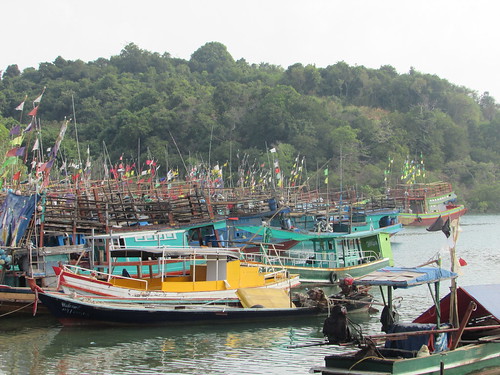
Trip to Myaw Tit Pagoda: Moored fishing fleet.
The fishing vessels looked very gay, each with a number of floats for their nets stored on deck because each float was topped with a bamboo flagpole carrying a number of differently-coloured pennants. This was very similar to the smaller fishing vessels I'd seen the previous year at the Mergui Archipelago (there's a series of posts describing this trip here).
We continued on a very rough, narrow track which terminated in a small car park surrounded by souvenir stalls overlooking the sea. From the car park, a concrete pedestrian causeway led to a small island with pagodas. We had arrived at Myaw Tit Pagoda. Because it was early in the day, there was only one coach carrying pilgrims in the car park and we were able to explore the location whilst it was still peaceful.
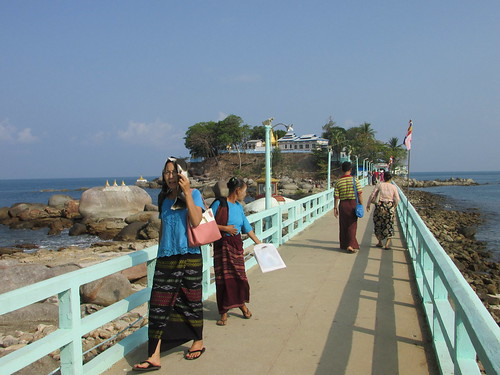
The Causeway leading to Myaw Tit Pagoda.
After our visit, we drove back to Dawei, passing a number of coaches and pick-up trucks taking more pilgrims to Myaw Tit.
In Dawei, we said goodbye to the Doctor's relative and the Doctor, the Doctor's Mother and I transferred to a shared-taxi people carrier together with our luggage and quite a number of other passengers, giving quite a cramped experience on the way north. This time, we passed through the mountain section and the road improvements in the daylight and work was in progress. Our driver chose to stop at a restaurant high in the hills to allow his passengers to take food. His chosen venue won my award for the dirtiest cafe I've seen in Myanmar (and that was against some pretty stiff competition). We stopped for immigration formalities as we passed from Tanintharyi Division back to Mon State. In daylight, the location looked less like a set for a spy film set in Berlin than it had when we passed through in the middle of the night in the opposite direction less than two days earlier!
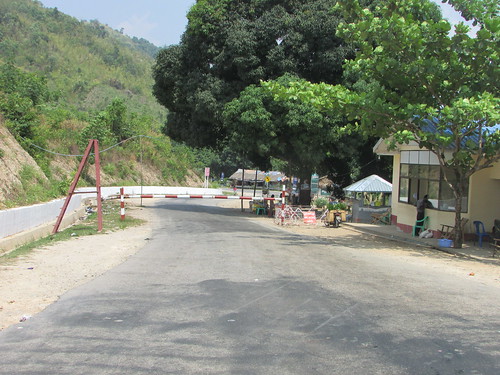
Returning North: The Border between Tanintharyi Division and Mon State.
We left the people carrier at a village on the main road north near to La Mine, together with some of the other passengers. I was delighted (and relieved) to see the lady who runs Ko Dut Drop In Centre, together with a car and driver. Having transferred all our luggage (again), we set off towards La Mine township.
About half an hour later, we pulled up at the small Drop In Centre of La Mine, which I'd visited before and most of the children there confirmed to the Doctor that they remembered my previous visits. The usual joyful proceedings followed as stationery and new school uniforms were distributed to the children. Attired in their new clothes, the children proudly posed for the 'group shot' on the steps of their Drop In Centre.
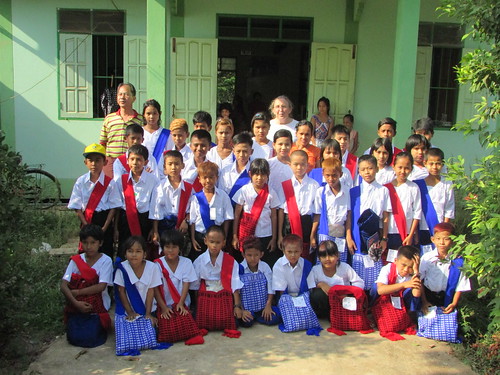 La Mine Drop In Centre - 2017
Back in the car, we carried on through La Mine and took the road to Ko Dut. On the outskirts of Ko Dut, we stopped at the school which has been under construction during the last few years, as funds permitted. I was delighted to see that it is now in use, forming part of the Government's Basic Education system.
We arrived at Ko Dut Drop In Centre, which now stands next to an almost-complete Government Health Clinic. Construction of this clinic had also been protracted because of funding problems. I learnt that, this year, we would not be staying overnight at the Drop In Centre which had been temporarily closed for refurbishment following use as dormitory accommodation by contractors working on the Clinic. Instead, we would sleep in a house in the village, a traditional wooden house where the Doctor and his Mother slept in the large upstairs room whilst I had a separate upstairs room. In my room, two mats covered part of the floor and a single blanket and pillow were provided.
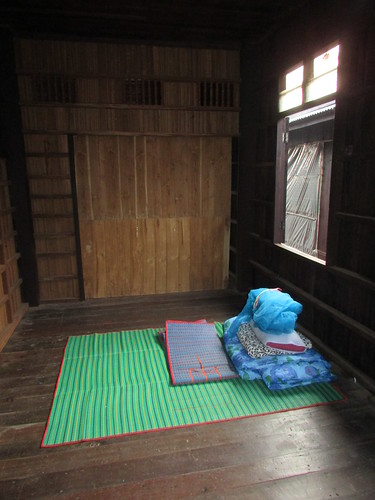
Ko Dut - 2017: My bedroom, with the blue mosquito net awaiting deploymemt.
Helpers from the Drop In Centre rigged my mosquito net (a skill I've never had to acquire) and, after a friendly evening meal, I tried to backup my pictures before the electricity went off. In Ko Dut, a generator at the monastery provides power from 4.00 a.m. to 6.00 a.m. and from 4.00 p.m. to 10.30 p.m.
It was not a very quiet evening. Apparently, the monastery was conducting an appeal for funds to support the new intake of novices. The villagers were reminded of this appeal by continuously playing a loud, penetrating drumbeat. This 'music' was, I think, coming from one or more 'Wall of Sound' installations I'd spotted in various locations (but failed to photograph). Most eating establishments have at least one modern amplifier/loudspeaker arrangement in a rectangular box with impressive-looking loudspeakers. In the 'Wall of Sound' quite a few of these boxes, of various types and in different sizes, are bolted together to form a 'wall' at least eight feet square of fearsome appearance and producing deafening sound.
I didn't sleep particularly well on the hard floor in any case but, around 4.00 a.m. on Monday, the drumbeat started up again, alternating with modern Myanmar vocals.
Related Posts on this Website
Next Post describing this trip.
All 2017 Trip posts.
My Pictures
Where necessary, clicking on an image above will display an 'uncropped' view or, alternately, pictures from may be selected, viewed or downloaded, in various sizes, from the albums listed:-
Trip to Myaw Tit Pagoda.
Returning North.
La Mine Drop In Centre - 2017.
Around Ko Dut.
All my albums for Burma 2017.
[Links to pictures added: 2-May-2017, pictures added to post 19-Jun-2017]
Events of Saturday 22nd April 2017
Before 7.00 a.m., the people carrier had dropped us and our luggage at the house of the Doctor's relative who had accompanied us.

A street scene in Dawei.
A walk to the nearby market was decided upon. The range of fruit, vegetables, fish and meat on offer in Myanmar never ceases to amaze me, although the conditions would probably cause a European food inspector to expire on the spot.
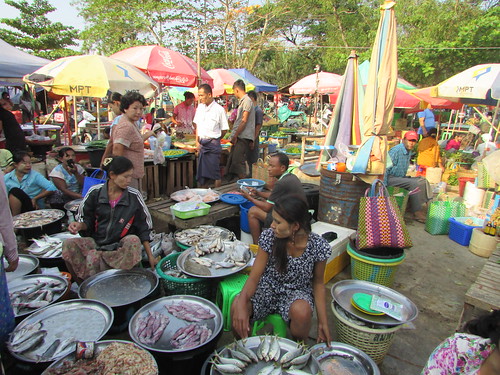
Around Dawei: Dawei Market.
After our market tour, we stopped at one of the Tea Houses that are such a feature of Myanmar life, where we took breakfast. By the time we returned to the house, a Toyota saloon and driver had appeared. With the Dawei relative acting as our guide, we set off to see a little of Dawei.
Our first visit was to a famous wooden Buddhist pagoda with a natural spring believed to have health giving properties.

Around Dawei: Visiting a local pagoda.
Another Buddhist pagoda of wooden construction featured a series of old paintings depicting scenes from the Life of Buddha.
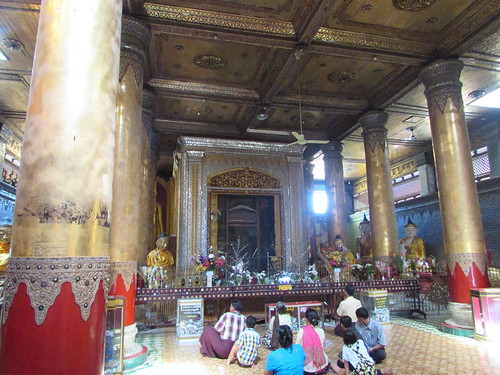
Around Dawei: Visiting second pagoda.
Up in the hills, we visited a large, reclining Buddha image, protected from the weather (as at similar sites) by a huge steel framework supporting a massive roof.
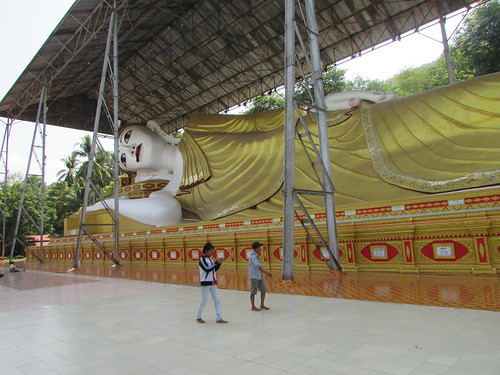
Around Dawei: Reclining Buddha image.
Various 'flavours' of the Baptist Church remain active in Myanmar. We visited the Karen Baptist Church, founded in 1922 and dedicated as a memorial to Marion Sutton.
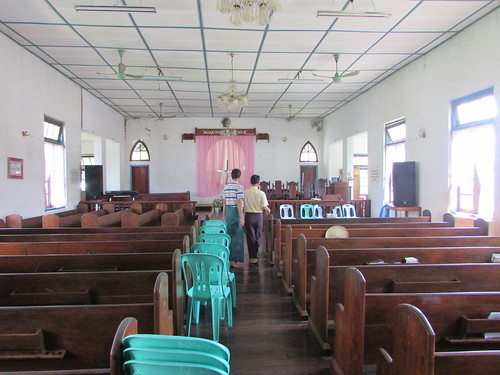
Karen Baptist Church, Dawei.
We paused at a large British Colonial style building now serving as Dawei Education College. Whilst schools were currently on their summer break, the college grounds were crowded with teachers undertaking training.
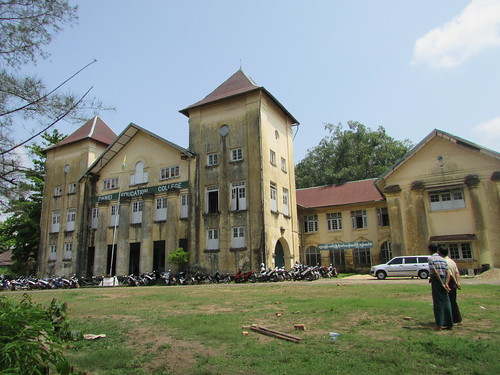
Dawei Education College.
Finally, we visited perhaps the most famous Buddhist complex in the area at Pha Yar Gyi, including the Shwe Taung Sar Pagoda. There's a website here.
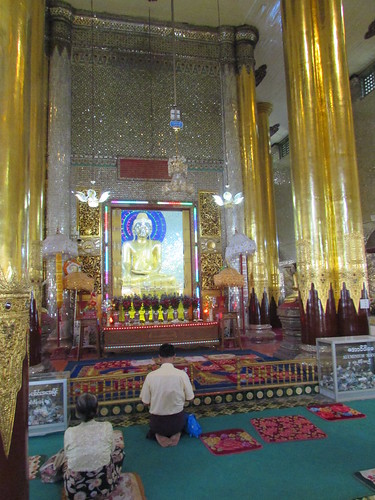
Shwe Taung Sar Pagoda.
Back in the town centre, we took lunch at the Daw San Family Rice and Curry Shop. The food and service was excellent but I was fascinated that a traditional wooden building is in course of being rebuilt into a reinforced concrete structure, with all sorts of trip and other hazards whilst this work proceeds.
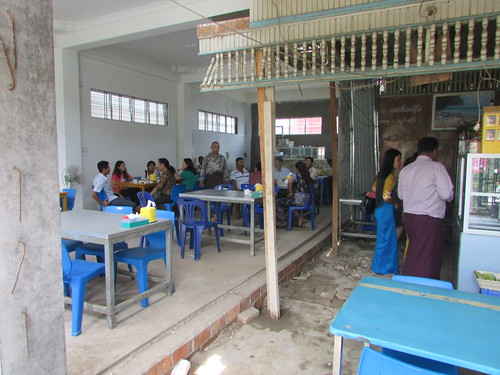
Around Dawei: Daw San Family Rice and Curry Shop (new construction on left, old on right).
I discovered that we were to spend the weekend at wooden beach cottages at Maung Makan Beach so, with our luggage transferred to the Toyota, we set off through the hills to reach the beach, a beautiful white sand expanse fringed with palm trees. But also quite popular with day trippers, as attested by the number of stalls and beach restaurants we passed on an exploratory walk.
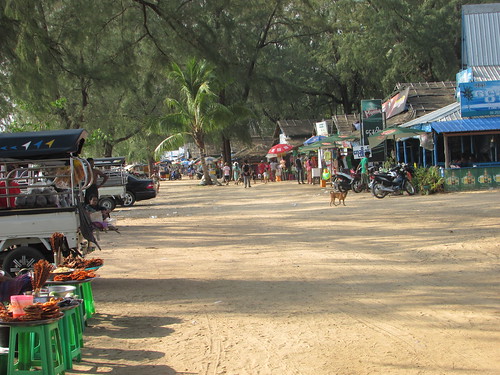
Maungmakan Beach.
We occupied two of the four or five cottages which had been erected on a private strip of land and I was allocated my own cottage. It was a lovely spot but, although my cottage had a raised bed, the plywood base with a thin sleeping mat on top was, shall I say, rather firm for my taste.
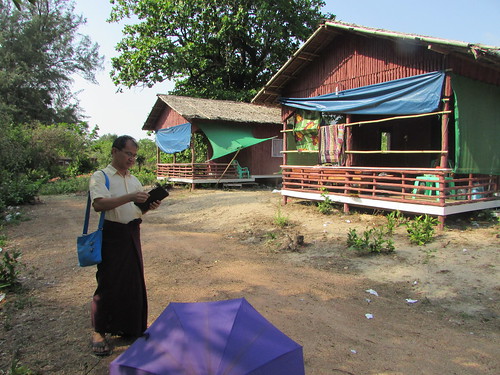
Maungmakan Beach: I was given the cottage in the background to myself.
I managed a paddle in the ocean on Saturday evening but Dr. Hla Tun and his Dawei relative had a lengthy swim. Later, we all had dinner at a beach restaurant near our cottages. Fish was on the menu!
Related Posts on this Website
Next post describing the 2017 Burma trip.
All 2017 Trip posts.
My Pictures
Where necessary, clicking on an image above will display an 'uncropped' view or, alternately, pictures may be selected, viewed or downloaded, in various sizes, from the albums listed:-
Around Dawei.
Maungmakan Beach.
All my albums for Burma 2017.
[Minor additions: 1-May-2017, Links to pictures added 2-May-2017, Pictures added 12/13-Jun-2017]

