skip to main |
skip to sidebar
Even casual perusal of this blog is likely to reveal my enthusiasm for driving steam locomotives, latterly at a couple of preserved railways in the United Kingdom. At the Battlefield Line, I also drive the Diesel Multiple Units (DMU) owned by Ritchie Marcus and there's a steadily-increasing number of posts describing this (you can find them all here or by selecting 'DMU' from the list in 'Labels to select a blog topic').
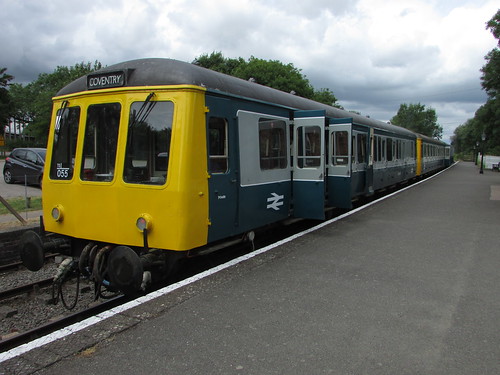
DMU Days at the Battlefield Line: After taking the school party to Shenton on 4th July 2017, the 1-car coupled to the 2-car set wait at Shenton prior to the return to Shackerstone.
In the summer of 2018, these diesel railcars provide the 'Midweek Services' on Tuesdays, Wednesdays and Thursdays so I seem to be getting regular DMU driving turns. I've always enjoyed driving the 'British Railways Modernisation' DMUs, which I remember from my own childhood when they were first introduced but the afflictions of increasing age make a 'diesel day' increasingly attractive for a number of reasons.
Firstly, preparation time is much reduced, compared with steam. 'Checking levels', as on a car, is required but the laborious 'oiling round' is avoided. Whilst a visual examination around the underframe is essential, once the engines are started, also from ground level, the driver can return to the cab whilst the compressors establish sufficient control air pressure to allow movement.
Secondly, driving is carried out whilst seated. Whilst I don't find the seat design particularly good (and manoeuvring around it is tight), it represents luxury compared with most steam locomotives which either make no provision for sitting or offer a rather mean wooden tip-up seat. Gresley is renowned for fitting a padded leather bucket seat on some of his steam locomotives. On most designs, many drivers (the writer included) preferred to remain standing to make the most of the poor forward vision offered by the cab design.
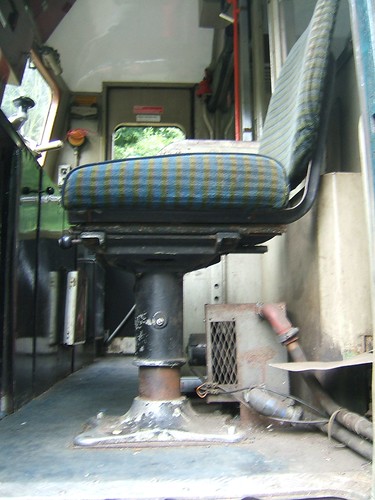
Detail of the driver's adjustable seat.
I often say '90% of a driver's attention should be focussed on the line ahead'. We can debate the exact percentage but keeping a good lookout is vitally important. The windows across the full width of the DMU cab give a panoramic view down the line very welcome to steam drivers brought up on leaning out of the cab to get reasonable sightlines around the front of the boiler. Provided the blinds at the rear of the DMU cab are raised, the passengers, too, can enjoy the view of the route ahead. The blinds were provided, of course, for use at night when the lights in the passenger compartment would otherwise damage the driver's night vision. More modern designs of diesel railcar reverted to solid walls between passengers and cab.
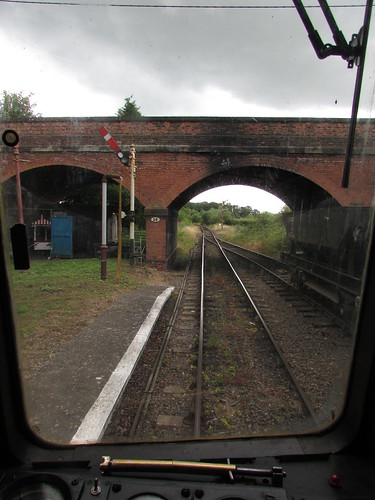
DMU Days at the Battlefield Line: Driver's view leaving Market Bosworth for Shackerstone.
On a steam-hauled train, to give the driver any chance of watching the line ahead, it's a requirement that the locomotive is a the front of the train (except where special arrangements are made called 'push-pull' or 'auto' trains). This means that, at each and of the line, there's a period of furious activity where the locomotive is uncoupled from the coaches, shunted to the other end of the train and re-coupled. On DMU, a driving cab is provided at each end of the train so that, at the end of the line, it's only necessary for the driver to 'close' what had been the leading cab, move to the other end of the train and 'open' what had been the 'back cab' so as to become the leading cab. The business of 'closing' and 'opening' cabs involves the transfer of an electrical master key and removable handles to control the final drive and braking systems.
Although the supply of coal carried by a steam locomotive is normally arranged to suffice for a whole day, the water supply (which is boiled to produce steam, used to impel a piston up and down a cylinder producing useful work and then discharged as exhaust steam from the chimney) often requires replenishment a number of times a day. By contrast, a DMU may be able to run for a number of days before the diesel fuel tanks require topping-up and water (used to cool the diesel engines, as in a car) is recirculated.
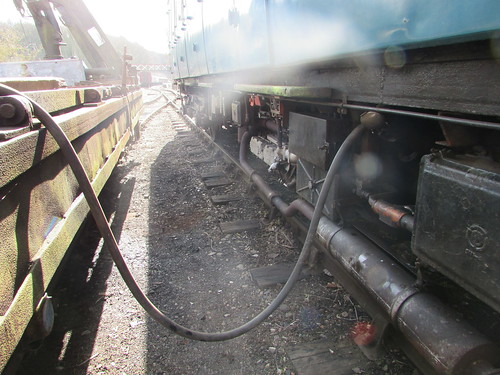 Refuelling the DMU at Shackerstone.
On a DMU, the driving controls, instruments and indications are laid out on the desk in front of the driver in a reasonably ergonomic manner unheard of on steam locomotives although Riddles, in designing the British Railways 'Standard' steam locomotives, attempted a convenient layout.
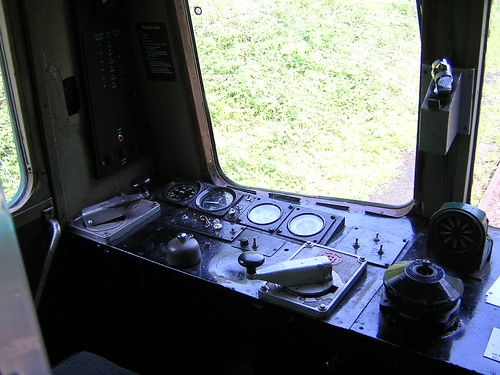
The driving controls, instruments and indications are neatly laid out on the desk in front of the driver.
Drivers also appreciated the 'power on demand' nature of the DMU. With steam traction, the power available to work the train depended upon many factors including time since last 'shopping', time since last boiler washout, quality of coal and, not least, attitude and competence of the fireman. In contrast, a DMU normally works as intended or doesn't work at all. That's a bit of a simplification but, in general, when a diesel driver opens the throttle, the power will flow, giving the driver a feeling of confidence that the job will go well.
But perhaps the best feature of working on a DMU is the opportunity to meet passengers. Many passengers seek out a seat in the leading coach where they can see the line ahead and watch the driver at work. In stations, passengers (men, ladies and children) can often be seen studying the cab and may ask questions. When working on steam, although we always try to acknowledge anyone nearby, the workload involved hinted at above means that a protracted chat is rarely possible. In contrast, when working on a DMU there are better opportunities for passengers to take photographs of the driver's 'office' or to answer questions (admittedly at the risk of boring them to tears - 'too much information'). I never cease to be amazed at the interesting backgrounds and experiences of our visitors. And, at the end of the day, I'm not quite as shattered (or dirty) as after a steam 'turn'.
On Saturday, 7th July 2018, the Brewood Garden Party was held, for the sixth time, in the garden at Brewood Hall. The event is organised by 2nd Brewood Scouts, Brewood Parish Church and the informal group Friends of Brewood Hall. All of the work organising and running the event is carried out by volunteers.
Preparations
As in previous years, there was an organising committee who met a number of times in the months prior to the event to ensure that visitors enjoyed their visit on the day. 'Flyers' had been distributed around the village, posters and a banner had been put up and there were announcements on social media. Erection of the tents and stalls was started on the evening of Friday, 6th July, using a different layout to previous years which proved popular.
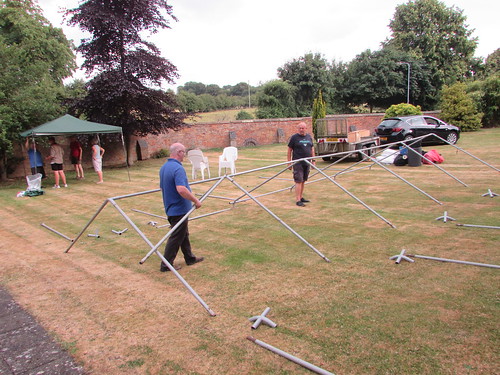
Brewood Garden Party 2018: Setting-up on Friday: Methodical erection of the craft marquee.
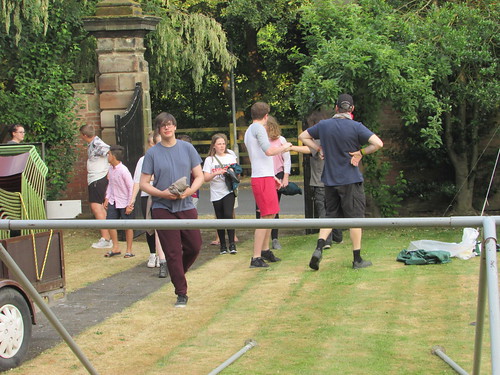
Brewood Garden Party 2018: Setting-up on Friday: Welcome reinforcements!
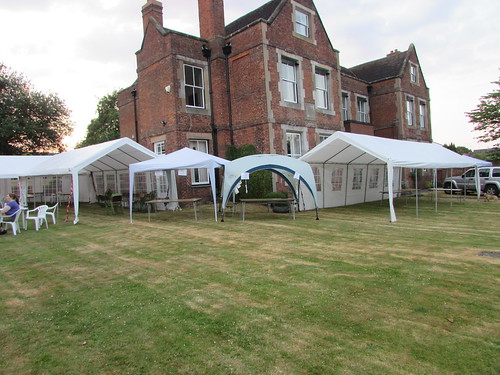 Brewood Garden Party 2018: Setting-up on Friday. L-R: Band tent, Pimm's Tent, Tombola tent, Craft Tent.
Setting-up was completed on Saturday morning, following an early start, so as to be ready for the opening at noon.
The Event
The whole week had been warm and Saturday was the same. All the usual stalls and diversions were provided, plus some innovations.
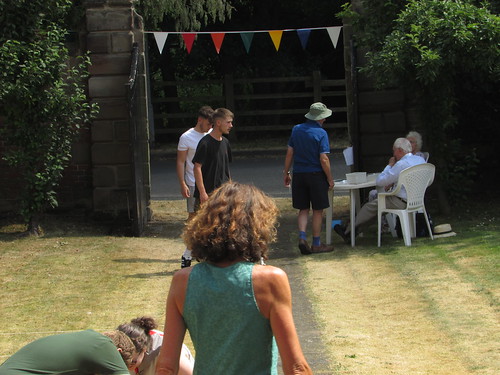
Brewood Garden Party 2018: Admission desk at front gates.
The Staffordshire Corps of Drums opened the proceedings with an impressive display. They admitted that, in the heat, the woollen uniforms were very uncomfortable.
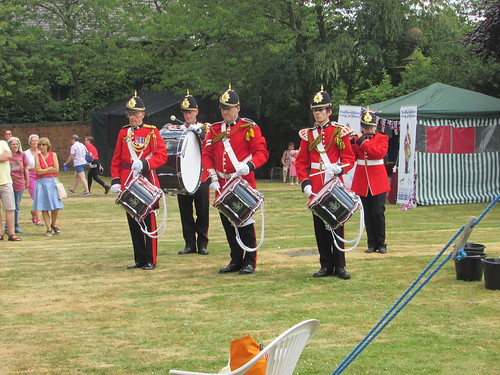
Brewood Garden Party 2018: The Staffordshire Corps of Drums opened the proceedings.
The Refreshment Tent quickly became busy and remained busy. This year, the local Midland Counties Co-op store provided additional help which was very welcome.
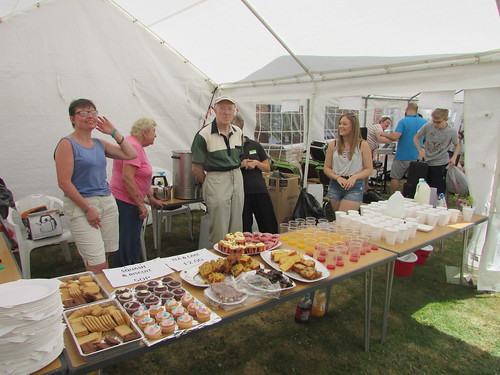
Brewood Garden Party 2018: A wide range of snacks were available in the popular Refreshment Tent.
For the first time, local traditional butchers Maiden's offered hot dogs, burgers and frozen snacks.
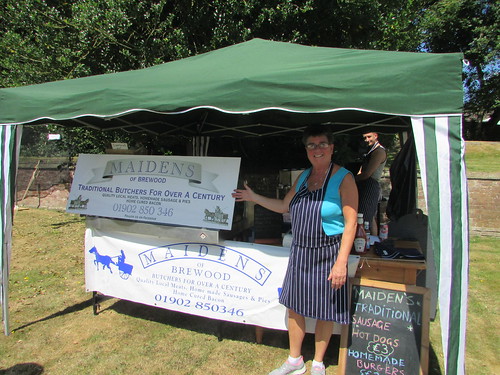
Brewood Garden Party 2018: Maiden's ready for business.
The Pimm's Tent, Tombola and Plants and Produce stall remained popular.
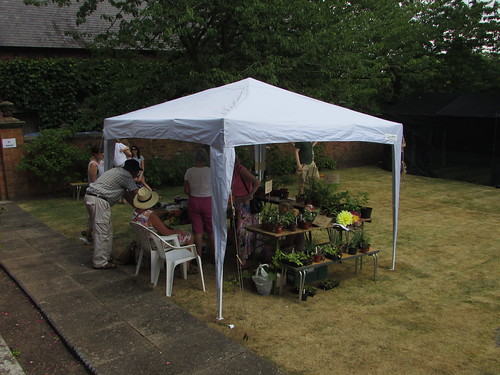
Brewood Garden Party 2018: Plants and Produce Stall.
The Craft Tent featured the work of a number of local artists and crafters.
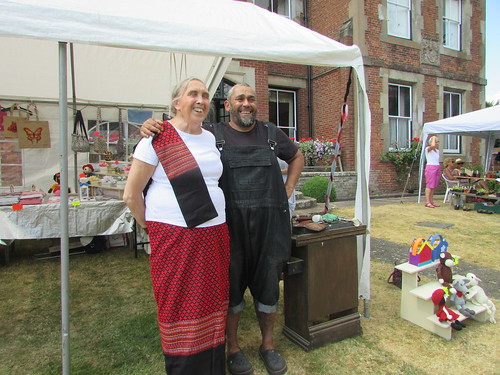
Brewood Garden Party 2018: Jan with local artist Rob.
Black Country Live Steamers appeared again with two immaculate miniature traction engines and, located in the driveway, were able to give rides.
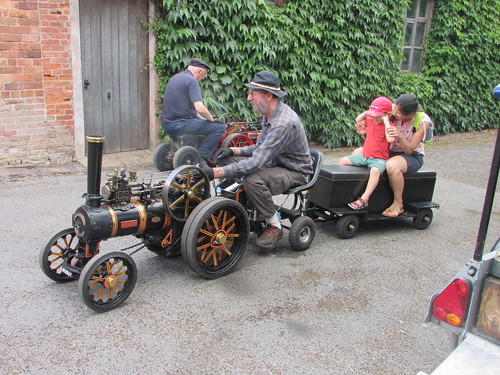
Brewood Garden Party 2018: Miniature traction engines from Black Country Live Steamers.
Chase Ferret Rescue were appearing for the first time. They had brought a number of ferrets and everybody was most impressed by the quality of the accommodation provided for the ferrets and the knowledge and care displayed by their volunteers.

Brewood Garden Party 2018: The Ferret Rescue stand.
I'd never handled ferrets before and I admit I was entranced by the creatures.
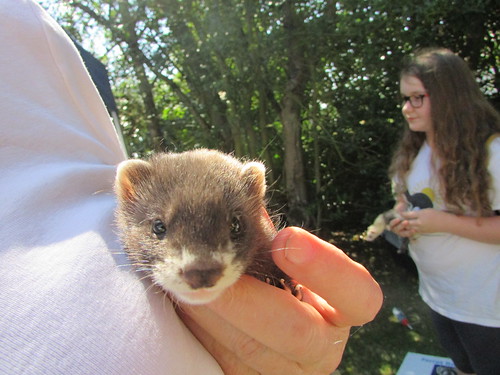
Brewood Garden Party 2018: Jan makes friends with a young ferret.
To appeal to our younger visitors, we had the Coconut Shy, Catapult Range and Wet Sponge Throwing together with the supervised Kids' Under-5 Zone.

Brewood Garden Party 2018: A busy time at the Kids' Under-5 Zone.
A new attraction in 2018 for children was the Toys and Sweets stall.
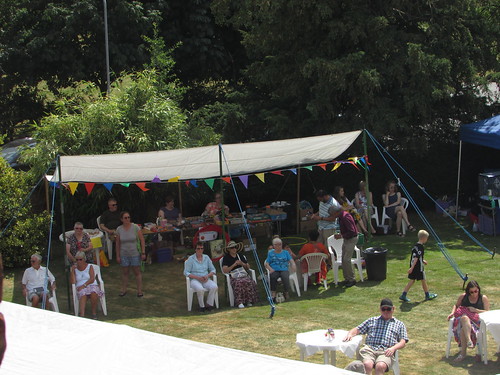
Brewood Garden Party 2018: View of Toys and Sweets Stall which also provided welcome shade to some visitors.
Later in the afternoon, there were Egg and Spoon and Sack Races.
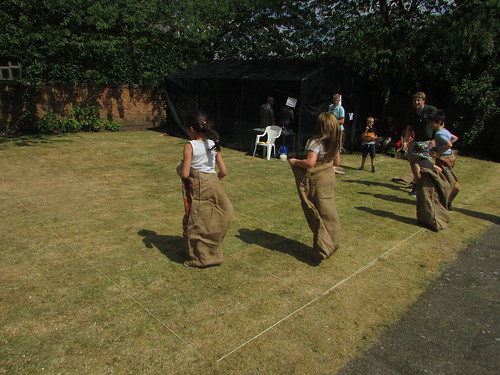
Brewood Garden Party 2018: Childrens' Sack Race.
Everyone was delighted that, once again, the Cannock Bands, based at the Cannock Performing Arts Centre, returned to play for us.
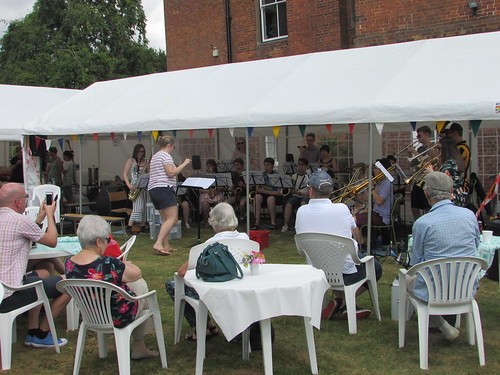
Brewood Garden Party 2018: Cannock Wind Band performing. Because of the heat, they were not in their customary black uniforms.
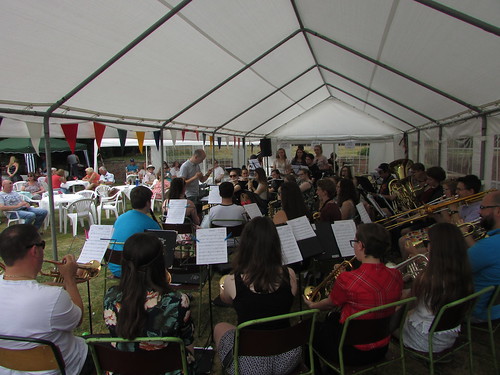
Brewood Garden Party 2018: Cannock Big Band performing: The view looking towards the audience.
Finally, the Staffordshire Corps of Drums gave a second display.

Brewood Garden Party 2018: A second performance by the Staffordshire Corps of Drums.
In choosing the date for this year's garden party, the organising committee were faced with the difficult problem of trying to avoid competing attractions. What they could not have known was that the English football team would achieve a measure of success in the World Cup being played in Russia, resulting in the team having a match starting at 3.00 p.m. on the day of the garden party. A mass early exodus was anticipated with people seeking to watch the match on television. The timing of the band performances at the garden party was brought forward to help and the Scouts brought their 50-inch plasma television. This was set up in the band tent (after the band performances) and hooked-up to the Brewood Hall aerial system, allowing people to remain on site and watch the game!
England lost in their World Cup match but lots of people confirmed that the Brewood garden party had been a splendid event.
Reports on earlier garden parties at Brewood Hall
Brewood Vintage Garden Party 2013.
Brewood Vintage Garden Party 2014.
Brewood Garden Party 2015.
Brewood Garden Party 2016.
Brewood Garden Party 2017.
Pictures of the event
Where necessary, clicking on an image above will display an 'uncropped' view or, alternately, pictures from may be selected, viewed or downloaded, in various sizes, from the album below:-
Brewood Garden Party 2018.
In 2018, the Battlefield Line was closed until Easter to allow track relaying to be carried out.
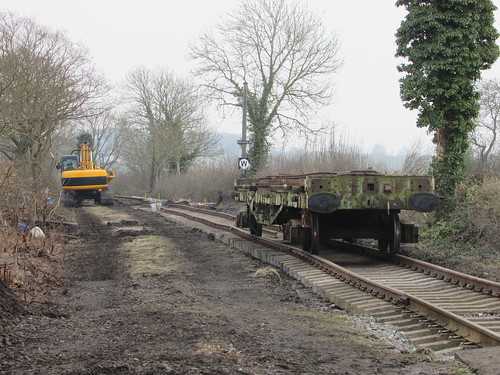
Battlefield Line, early 2018: Relaying south of Headley's Crossing.
Whilst the railway was closed, in connection with testing work for an outside client, I did drive the single unit diesel railcar on a few days. This was confined to running between Shackerstone and Headley's Crossing.
My first passenger turn at the Battlefield line in 2018 was on Wednesday, 4th April, just after Easter, when the 2-car Diesel Multiple Unit was rostered. That day didn't go quite to plan and I ended up operating with the single unit diesel, as described here.
Then, I was overseas for a few weeks in Myanmar (Burma), as described in a series of posts starting at Travelling again.
So my first steam 'turn' at the Battlefield Line in 2018 wasn't until the Fish and Chip Evening Special on 9th June 2018. The popular 'Fish and Chip' trains operate on a number of dates during the year and I described an earlier 'Fish and Chip Special' (using 'Cumbria') here.
Events of 9th June 2018
Carl was rostered as driver for the five service trains during the day but he asked if I'd care to take the last round trip as he was Signalman for the evening 'Fish and Chip' train. So I was waiting on platform 2 at Shackerstone when the 'Light Prairie', 5542, arrived after the fourth round trip.
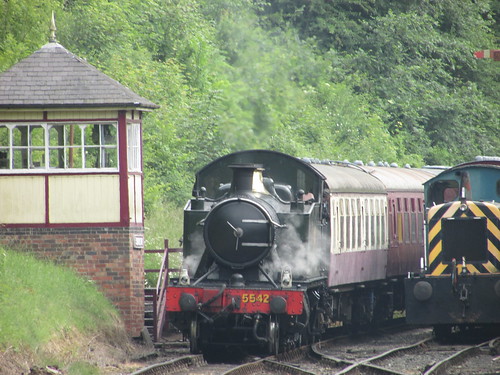
Battlefield Line, 9th June 2018: 5542 drifts into Shackerstone on the 4th service train of the day.
Carl turned the engine over to me, Tracy uncoupled and we ran around the train, pausing for water before coupling onto the train ready for the 4.15 p.m. departure to Shenton.

Battlefield Line, 9th June 2018: Carl dismounts from 5542 on arrival back at Shackerstone with the 4th service train of the day.
We operated the last round trip to Shenton and on arrival back at Shackerstone were routed into platform 1 where the main station facilities (tea room, museum and toilets) are located. There was then plenty of time to uncouple and run round, stopping to fill the side tanks at the water column on platform 2. Now hooked onto the south end of our four coach train, the engine simmered as we waited for our 80 guests to arrive.
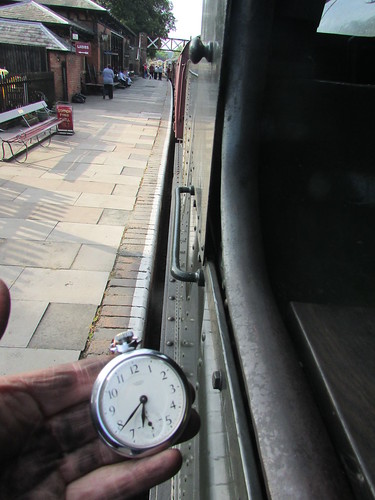
Battlefield Line Fish and Chip Evening Dining train, 9th June 2018: Waiting for our guests to arrive.
Slowly, the train filled with our diners and at 7.00 p.m. we received the 'Right Away' from the Guard. I gently started the train away, complied with the 5 m.p.h. speed restriction on the crossover leading to the single line and collected the Single Line Staff from the Signalman. There's a 10 m.p.h. speed restriction passing through the cutting to Barton Lane road bridge but once clear of the 'slack' I only let the speed rise a little - we were in no hurry on this trip as we trundled down the line and the tantalising smell of fish and chips wafted towards us from the train.
We were not booked to stop at Market Bosworth but we slowed right down when passing through the platform, allowing staff on the train to pass a portion of fish and chips to one of our Volunteers waiting on the platform. Once the delivery had been safely made, I let speed rise a little as we passed into the gently uphill cutting section spanned by three successive overbridges which took us towards Shenton. Once clear of the cutting, the line became gently downhill on Shenton Bank with views across the Leicestershire countryside on both sides of the train.
Near Shenton's fixed distant signal, I brought the train to a gentle stop so that our diners could admire the peaceful spot as they enjoyed their meal. Whilst at a stand, the locomotive crew were also issued with fish and chips - a welcome treat!.
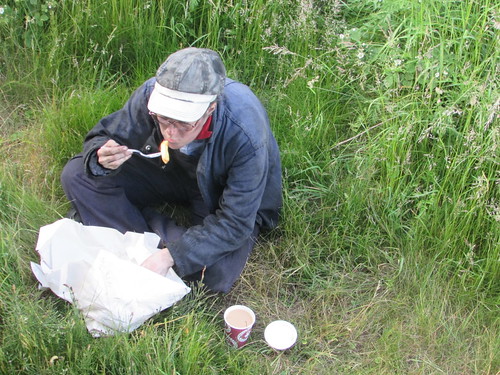
Tracy enjoys her fish and chips.
After ten minutes or so, we received the about 'Right Away' from the Guard and trundled into Shenton station. There was then a few minutes of activity as we uncoupled, ran round and coupled back onto the train ready for the journey back to Shackerstone. It was a warm evening, still light and many passengers came onto the platform to take photographs or simply admire the locomotive. After a while, the train staff persuaded everybody back on board and the Guard gave the 'Right Away'. We were told to take it gently to Market Bosworth and then complete the journey at Line Speed, so we were able to have an enjoyable 'romp' to complete the trip. We were routed into platform 1 and, as our happy passengers made their way back to their cars, Tracy uncoupled to the final time. It didn't take us long to shunt onto the shed and complete disposal.
Related posts on this website
Battlefield Line Fish and Chip Evening Special (an earlier 'Fish and Chip' train).
To see all my posts about the Battlefield Line, select Label 'Battlefield Line' or click here.
My photograph albums
Where necessary, clicking on an image above will display an 'uncropped' view or, alternately, pictures may be selected, viewed or downloaded, in various sizes, from the albums listed:-
5542 GWR Locomotive
Battlefield Line, 2017-2018
All my Battlefield Line albums
Events of Saturday, 2nd June 2018
I travelled to Ely where Ann Matthews was "being presented" at the Open University Degree Ceremony in Ely Cathedral having graduated as Master of Arts in History. Five years previously, I'd made the same journey for her Bachelor of Arts Ceremony (that day is described here).
The Rail Journey
I took a taxi to Wolverhampton and train to Birmingham. From here, Cross Country still operate a service to Stansted Airport. A 2-coach 'Turbostar' DMU was deemed appropriate that day and we made a fairly leisurely progress through Nuneaton and Leicester onto the Peterborough line, still equipped with semaphore signals and manual signal boxes. At Oakham, we stopped but remained in the station. After a few minutes, the lady Train Manager (or whatever they are calling Train Guards at present) announced over the public address that we were awaiting Police to deal with a disruptive passenger. About twenty minutes later, a single police officer boarded the train. The passenger had clearly been disruptive very quietly as I was surprised to find that I was only a couple of seat rows away from him. Very politely, I heard the Officer explain that the passenger would not be allowed to travel further since the Train Manager claimed he had been rude. After further discussion, the passenger and police officer got off the train which then continued on its journey. Beyond Peterborough, we entered a former Great Eastern Railway line, which also retains semaphore signalling. Crossing this flat landscape through March towards Ely, there are numerous level crossings (mainly automatic half-barrier). We managed to lose a further ten minutes because of a signalling failure before joining the overhead electrified line from Kings Lynn at Ely North Junction, two miles north of Ely station where I left the train which continued through Cambridge to Stansted.

Ely Station, 2nd June 2018.
Railway Maps
'Railway Track Diagrams Book 4: Midlands & North West', Second Edition, published by Trackmaps (ISBN: 0-9549866-0-1).
'Railway Track Diagrams Book 2: Eastern', Third Edition, published by Trackmaps (ISBN: 0-9549866-2-8).
My railway pictures
West Midland Railways.
Nuneaton Station.
Leicester area rail.
Ely Station
The Ceremony
I walked as fast as I could from the station to Ely Cathedral to meet Ann, Dean and Dean's sister and we took our positions for the ceremony. The packed cathedral formed a suitably impressive venue. Ely Cathedral is famous for its architecture and for the remarkable octagonal tower above the nave crossing.
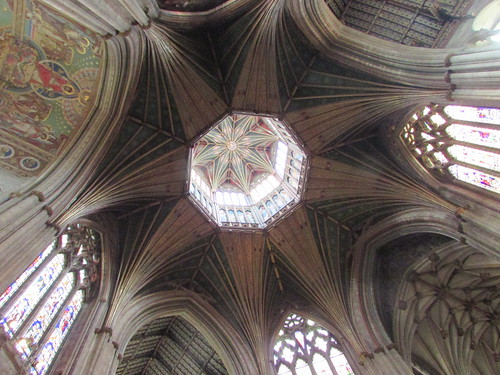
Ely: 2nd June 2018: The tower above the nave crossing.
A temporary stage had been built at the nave crossing for the Open University dignitaries.
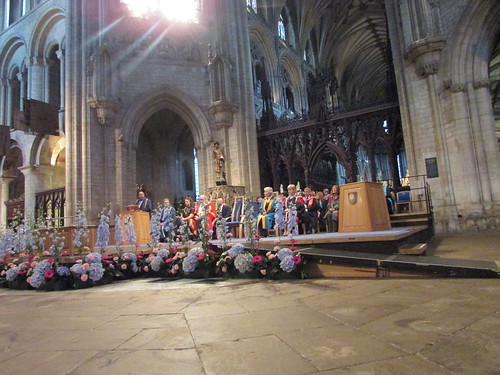
Ely: 2nd June 2018.
With a few hundred presentations to be made, the business was carefully choreographed and proceeded briskly. Ann was presented fairly early in the morning's proceedings.
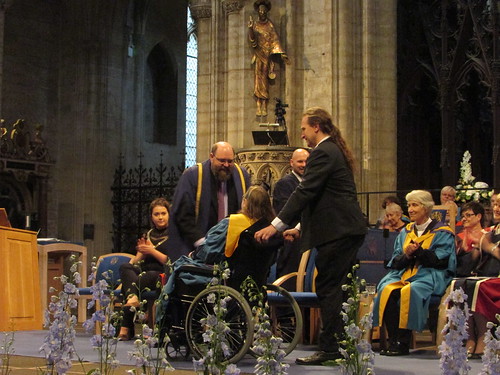
Ely: 2nd June 2018: Ann Matthews being presented.
At the completion of the presentations for the morning session, everybody trooped outside into the bright sunshine where something of a carnival atmosphere prevailed.

Ely: 2nd June 2018
We spent the afternoon enjoying the town and the market before having a celebratory meal at an Italian restaurant. Ann and Dean drove me to the station (they were staying overnight in Cambridge) and I had time to explore the station before catching a very crowded train back to Birmingham, then on to Wolverhampton and a taxi home.
My pictures of Ely and the ceremony
Ely 2018
Sunday, 13th May 2018
I awoke on Sunday to find it raining although not cold. The hills were shrouded in mist. As arranged, morning tea was served in my lodge at 6.30 a.m. Breakfast was available in the main lodge between seven and nine and the rain had stopped when I went up the stone path for my meal. The stillness of the mountain top location was very relaxing and, after breakfast, I was quite happy to wander around the main lodge, studying the layout.
An engraved brass plate commemorated those involved in the creation of the lodge, which was opened by Sir Edmund Hillary in 1998 and has since hosted Prince Charles and Princess Anne.
During the day, the mist lifted and it was pleasantly warm, but without the bright sunshine of the previous day. After lunch, one of the guides induced me to take a short trek with him to the nearby village, although I was a bit worried about the terrain and my impaired mobility. I armed myself with a wooden stick from the lodge (albeit rather long for me) and we safely completed the walk, including a rather stiff climb up a hill to a viewpoint which I'd seen from my lodge. At the viewpoint was an abandoned house, now used as a rendezvous by the young people of the district. We also met my guide's wife, who was displaying jewellery and artefacts.
In the evening, the same friendly group of four dined together. I'd enjoyed the day immensely, although not done a lot. I retired a little earlier than the previous night but was woken up during the night by the crashing thunder of a furious thunderstorm.
Related posts on this website
This is one of a series of posts describing my first visit to Nepal. Clicking on the 'Next report' link displays the post describing the next events. In this way, you may read about the trip in sequence.
Next report.
Alternately, clicking on the 'All my Nepal reports' link displays all the posts on this trip in reverse date-of-posting order.
All my Nepal reports.
My pictures
Tiger Mountain Pokhara Lodge
Trek at Tiger Mountain Pokhara Lodge, 13th May 2018
All my pictures on this trip to Nepal can be found in the collection Nepal.
[Pictures linked 8-Aug-2018]
Tuesday, 15th May 2018
I'll describe my journey back to Kathmandu and my sightseeing in nearby Bhaktapur City on Monday, 14th June when I can.
After a comfortable night at Dwarika's, I'm about to set off on the long journey home. It should be Qatar Airways A320 to Doha on the QR649, transiting to a 787-8 on flight QR023 to Manchester. The last few weeks have certainly earned the title 'Journey of a lifetime'.
Related posts on this website
This is one of a series of posts describing my first visit to Nepal. Clicking on the 'Next report' link (where shown) displays the post describing the next events. In this way, you may read about the trip in sequence.
Alternately, clicking on the 'All my Nepal reports' link displays all the posts on this trip in reverse date-of-posting order.
All my Nepal reports.
Clicking on the 'All my Burma-2018 reports' link displays all the posts on my time in Myanmar prior to arriving in Nepal, again in reverse date-of-posting order.
All my Burma-2018 reports.
My pictures
Tiger Mountain Pokhara Lodge
Tiger Mountain, Pokhara, Nepal
Pokhara, Nepal
Pokhara to Kathmandu by Buddha Air Beech 1900D
Kathmandu Airport
Kathmandu
Dwarika's Hotel, Kathmandu
Bhaktapur City, Nepal
Nepal from above
All my pictures on this trip to Nepal can be found in the collection Nepal.
[Pictures linked 8-Aug-2018]
Saturday, 12th May 2018
The main building of the Tiger Mountain Pokhara Lodge is large, single-storey, stone built, with lots of glazed doors which give access to an open terrace with superb views over the valley below with snow-clad mountains in the background. At one end of the building, the kitchen is at a lower level, forming a basement area. There were lots of male staff in attendance, all English speakers.
"Your lunch is ready", they announced, setting a brass tray with lots of small dishes and rice at a table on the terrace. It was Nepali-style cooking. I enjoyed what I was able and then, no doubt to the disappointment of the Chef, arranged that I would stick to bland, European-style food for the rest of my stay.The sun was warm and visibility good that afternoon: thereafter it remained cool with moderate to poor visibility, for which they apologised. But I enjoyed the ever-changing, rather mysterious views of mist-shrouded mountains.
I believe they have 19 lodges for guests. Appropriately, I was given number 7, the nearest to the main lodge, which still involved a flight of stone steps and a steep path rough-hewn into the living rock. My lodge was well-appointed with a very large double bed and a single bed. I selected the double bed. A section at one end of the lodge had a shower, wash handbasin and W.C. A covered terrace outside the front door was furnished with a table, easy chair and staggering views across the valley. I knew I would enjoy my brief stay.
After my early start that day to take the Mountain Flight from Kathmandu, I was happy to spend the rest of the afternoon in my room backing up photographs and preparing text offline for the blog. I was told that dinner was 'seven for seven-thirty' and found, because it was near the end of the season, only two other guests, Hannah and Oliver Knight, a young couple from London. Our host was the English manager of the lodge, and we dined together very agreeably at a table for four set up in an annexe to the large dining room. I'd remembered to bring the wind-up torch from my room to light my unsteady way back to my room, but the path was also lit by a number of paraffin Hurricane lamps which produced a nostalgic aroma. Exhausted, I slept well.
Related posts on this website
This is one of a series of posts describing my first visit to Nepal. Clicking on the 'Next report' link displays the post describing the next events. In this way, you may read about the trip in sequence.
Next report.
Alternately, clicking on the 'All my Nepal reports' link displays all the posts on this trip in reverse date-of-posting order.
All my Nepal reports.
My pictures
Tiger Mountain Pokhara Lodge
All my pictures on this trip to Nepal can be found in the collection Nepal.
[Pictures linked 8-Aug-2018]
Saturday, 12th May 2018
The late running of my early morning Mountain Flight meant that I had less time than planned for breakfast at Dwarika’s Hotel but I had an omelette, tomato juice and tea provided promptly by the attentive staff in the restaurant. I had decided to travel light for my trip to Pokhara so I crammed a few clothes in my rucksack with my computer and put two bags in the hotel’s luggage store until my return. At ten o’clock my guide, driver and the writer set off back to the airport I’d so recently left. The police presence was even more intense: police lined both sides of the main road every 50 yards and there were periodic groups of paramilitary ‘riot squads’, supported by lorries marked ‘Mobile Rest Room’.
At Tribhuvan Airport, I now knew the system for embarking on domestic flights. My booking to Polhara was on the noon flight. The pleasant young man who’d earlier issued my boarding pass for the Mountain Flight recognized me and explained that, because flights were disrupted by the VVIP visit, he was booking me on flight U4 609, due to leave at 10:35 but that this would leave late. I went through security and secondary security into the crowded, noisy Gate Area. On the Buddha Air Flight Information screen, many flights, including mine, had the note ‘DELAY DUE TO VVIP MOVEMENT’. Occasionally, painstaking amendments would be made to the display, or the Windows start-up screen would appear for a while or the public screen would shut down and require re-start by a member of staff with a hand-held remote control. Having found a seat with a view of the Flight Information screen, I stayed put. Thus, the morning slowly passed. Around 12:30, my flight was called and passengers filled up a couple of transfer buses. Then we waited. The Thai flight from Bangkok which I’d arrived on the previous day landed, an ATR-62 local flight took off, followed by a twin jet. Then a Malaysia Airlines 737-800 landed and taxied to the stand, followed by a Simrik Airlines local flight. Kathmandu is a very busy airport. After 20 minutes, the bus drove across the apron to the domestic flight line, where we stopped adjacent to a Buddha Air ATR-62 turbo-prop. Another wait followed. Then we boarded the aircraft and there was a further wait whilst the two stewardesses plied us with peanuts, a fruit drink and water. Suddenly, the engines were started, our snacks were hurriedly cleared away and we taxied to the runway.
We rapidly climbed away from Kathmandu, and emerged above the clouds with views of snow-clad peaks brightly lit by the sun on our right. Before long, we descended through the clouds to a plain well covered with buildings – Pokhara is, I think, the second largest city in Nepal after Kathmandu. The approach to Pokhata is interesting. When approach flap was selected, I knew we were getting close to landing, but I couldn’t spot the runway ahead. Then we commenced a steep right bank, turned right and kept turning. As we continued to turn, I saw what appeared to be a new runway under construction further out on the plain. Just before the runway threshold, the pilot levelled out and we made a fairly fast landing. Landing at Pokhara can be quite a challenge for pilots, so I could see why a new airport is being built, presumably with easier approach from the air. We walked from the aircraft to a small baggage hall but with hand baggage only, I was quickly in the small car park looking for the representative from Tiger Mountain Lodge. I located him and we set off in a black Land Rover through the centre of Pokhara, larger than I expected. A straight main road led us through ribbon development for a few kilometres then the scenery became more rural and we turned off the main road onto a steeply-inclined road ascending Tiger Mountain. It soon became clear why we were using a Land Rover as the narrow road twisted and turned up the mountain through a series of tight hairpin bends. An unsurfaced lane led us to a small car park from where we walked up a path cut into the rock and climbed stone steps to enter the main building of Tiger Mountain Lodge, my home for two nights.
Related posts on this website
This is one of a series of posts describing my first visit to Nepal. Clicking on the 'Next report' link displays the post describing the next events. In this way, you may read about the trip in sequence.
Next report.
Alternately, clicking on the 'All my Nepal reports' link displays all the posts on this trip in reverse date-of-posting order.
All my Nepal reports.
My pictures
Nepal from above
Kathmandu Airport
Kathmandu
Dwarika's Hotel, Kathmandu
Pokhara, Nepal
Tiger Mountain, Pokhara, Nepal
Tiger Mountain Pokhara Lodge
All my pictures on this trip to Nepal can be found in the collection Nepal.
[Pictures linked 8-Aug-2018]
Saturday, 12th May 2018
To cater for the interest of tourists in the Himalayan mountains and, of course, Mount Everest there are daily flights from Kathmandu airport to view the peaks. The weather can be very changeable so good views and the flights themselves are not guaranteed. There are a number of similar flights each day, all operating early morning to secure the best views.
I was booked with Buddha Air, due to leave at 06:15 but I was warned that flight times are notoriously variable, according to weather conditions. In addition, we had the movements of Indian Prime Minister Mr. Modi to contend with, hence I was picked up by my guide at 4.30 a.m. The guide said the flight would be affected by Mr. Modi’s planned visit to a temple. The flights leave from Tribhuvan Airport where I’d arrived the previous day but there’s a separate Domestic Terminal for internal and ‘Mountain’ flights. The guide wasn’t allowed into the terminal building so he described the arrangements I’d find. First, there was a ticket and passport check, then hand baggage was X-rayed and, after passing through a detector arch, there was a body search (separate for men and women). I was then in a noisy, barn-like Ticket Hall where I found a group of Buddha Air check-in counters, most with a destination board hung up. I queued at the one with the sign ‘MOUNTAIN’ and was issued with a boarding card by a friendly young man who, like a lot of the people I met, spoke good English. I then passed into a crowded waiting area but noticed that many people were passing through a secondary security to what appeared to be the Gate Area. Since there was no passenger information screen in the waiting area, I went through security to an even more crowded, even noisier gate area. There were a couple of fairly standard display screens but the Buddha Air flights weren’t shown.
But near one of the two gates, there was a single counter with a display screen above in a frame marked Buddha Air Flight Information. There were six ‘Mountain’ flights shown, all departing at 06:15. As I watched, the screen started to change, but slowly, one character at a time. To confirm my suspicions, I walked to the side of the counter and there was a screen and keyboard with a girl typing in the day’s schedule from a printed list originated by another system. It rather looked as if she was using Word, Excel or Access to create the schedule and that the public display was simply a second screen on her computer. New entries appeared in a very small font, so each field was laboriously resized individually, with all the option menus appearing on the public display as well. Occasionally, an existing field would be copied to save retyping. I was fascinated watching this lengthy process and realized that all changes throughout the day were going to be made by this labour intensive process. There was a permanent crush of people around the desk, bombarding the girl with questions but I decided that I could probably use the screen as a source of information. Northing else happened for a while, except that more people arrived in the Gate Area. Then all the ‘Mountain’ flights were bracketing together on the display with the ominous message ‘AIRPORT CLOSED DUE TO VVIP MOVEMENT’. Initially, the girl had type ‘VIP’ but one of her colleagues suggested that she amend it to read ‘VVIP’. To get the remark in red characters, she had to use another sub menu to select colour. A few minutes later the message was amended to ‘AIRPORT CLOSED FOR SOMETIME DUE TO VVIP MOVEMENT’.
A loud roar announced the manoeuvring of a large Indian Air Force helicopter, which was presumably about to fly Mr. Modi on his temple visit. Everybody became very excited and rushed towards the windows to watch. Presumably Mr. Modi had left, because they started to board Mountain flights.
Eventually, my flight was called and a small group of passengers were ushered onto a transfer bus. Three or four other Indian Air Force helicopters started manoeuvring – presumably a backup, the Prime Minister’s entourage and perhaps the Press Corps. The transfer bus drove across the apron and stopped adjacent to a Buddha Air twin-engined Beechcraft. Then we waited. One or two aircraft took off and a fuel bowser replenished the aircraft next to us and then both wing tanks of the Buddha Air Beechcraft. A stewardess looked out of the cabin door, then retreated inside. The pilot was clearly on board, as I watched him exercise ailerons and rudder for “full and free movement”. At last, we boarded the aircraft and took off about 75 minutes late.
We climbed rapidly above the clouds and then the ragged, snow-covered outline of the Himalayas appeared on our left. The seating was 1+1 with a window by every seat but visibility was not too good and as the flight proceeded, the cabin windows started to ice-up. I presume that’s why the stewardess started to call passengers, one by one, to the front of the aircraft where the flight deck windows were all heated. It was all a bit confusing, with passengers moving forwards and backwards in the narrow aisle and crossing a slight ‘hump’ halfway down the cabin where the main wing spar passed under the floor. I didn’t positively identify any mountains at the time, but perhaps I’ll be able to later. We turned to make our return to Kathmandu with the mountains now on our right (the side I was sitting). The icing grew worse as we dropped below the clouds. I heard the rumble from the actuators as the co-pilot selected approach flaps. As we neared the airport, full flaps were selected to reduce the stall speed for landing and after touch-down we taxied to the domestic apron. A transfer bus returned us to the Domestic Terminal and, just outside, my guide was waiting. The same people carrier and driver returned me to Dwarika’s for breakfast but, this time, we were able to use the ‘posh’ front entrance.
Related posts on this website
This is one of a series of posts describing my first visit to Nepal. Clicking on the 'Next report' link displays the post describing the next events. In this way, you may read about the trip in sequence.
Next report
Alternately, clicking on the 'All my Nepal reports' link displays all the posts on this trip in reverse date-of-posting order.
All my Nepal reports.
My pictures
Nepal from above
Kathmandu Airport
Mountain flight, 12th May 2018
Kathmandu
Dwarika's Hotel, Kathmandu
All my pictures on this trip to Nepal can be found in the collection Nepal.
[Pictures linked 8-Aug-2018]
Friday, 11th May 2018
Early Friday morning, I’d been booked to leave Yangon on the Bangkok Airways flight PG706 to Bangkok leaving at 5.50 a.m. Eddie Teh kindly suggested that I stay at the Belmond Governor's Residence on Thursday, allowing me to upload some pictures to the internet. This had the advantage that, rather than worry about my departure, Doctor Hla Tun could concentrate on his own flight Friday morning to Bagan, where he would no doubt face another gruelling weekend of consultations at Bagan Medical Clinic.
It was recommended to report to the airport at least two hours before departure for international flights so the hotel car dropped me at the airport about a quarter to four in the morming. There were a few travellers waiting outside the terminal building being held at bay by a rather aggressive young lady with a machine gun. Staff were arriving through the one entrance which was open but passengers were not allowed inside until 4.00 a.m., when I was the first person to enter and pass through a very friendly security check (ticket and passport checked, luggage X-rayed, passengers first through a detector arch then a cursory ‘frisk’ with a ‘wand’). I quickly found the Bangkok Airways check-in counters but it didn’t do me much good – they were all unstaffed. I chose to sit down and wait with my luggage nearby but younger, later arrivals formed a queue at the check-in counter. Eventually, staff arrived and spent some time meticulously preparing for the day’s work and two girls logged on to their booking system. One man appeared with a large plastic storage box from which he unloaded all the various notices to passengers which sit on top of the counters and, a nice touch, a potted plant for each of the three counters. Two of the three desks were staffed and they started check in. This process soon slowed as one of the computer screens stopped working. Just before my turn came, they managed to coax the failed screen back into life. After this frustrating start, the actual flight to Bangkok was uneventful, if noisy, as there was a party of about twenty Thai ladies on board who kept up loud chatter and laughter throughout the journey.
Bangkok Airport is huge. After we landed, it took us over ten minutes to taxi to the stand, then at least as long for the transfer bus to ferry us to the terminal. Then, I had to find the Transfer Desk and get my boarding pass for my onwards journey. The signs said that there were two transfer desks, one East, one West and each a few hundred yards away from me. I couldn’t work out which was appropriate to my flight, so I guessed (a 50-50 shot) and was lucky. A lot of walking and moving pavements took me to a very thorough Transit security check (all items in blue plastic trays for X-ray, shoes in red plastic tray for X-ray, whole body scan cubicle, cursory body search) which, combined with rather officious security staff, always spoils my mood. At least I was near the correct Transit Desk, obtained my boarding pass for the onwards journey to Kathmandu, Nepal, and took refuge in the nearby Thai lounge for a few minutes.
I only had a short walk from the lounge to the departure gate, too, and a transfer bus took us to a remote stand and our waiting aircraft. Matters quickly improved as the cabin service was excellent. It was a busy time at the airport with a stream of aircraft waiting to use the departure runway and it took at least 30 minutes of queuing and taxiing on the ground before our aircraft took off.
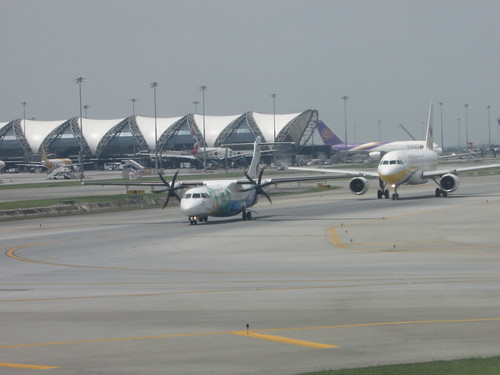
Yangon to Kathmandu via Bangkok, 11th May 2018: The queue of aircraft waiting for take-off extended behind my aircraft.
I enjoyed a very decent lunch on the flight. I was surprised that there was no multi-channel passenger entertainment system but a copy of the ‘Bangkok Post’ kept me engrossed for most of the journey.
Of course, our route to Nepal took us back over Myanmar and, eventually, over the mountainous terrain approaching Kathmandu. I had not expected such a large, sprawling conurbation of modern buildings. Even individual dwellings seemed to rise to five stories to make most use of the site area but there were also large blocks of apartments which would not have looked out of place in Europe.
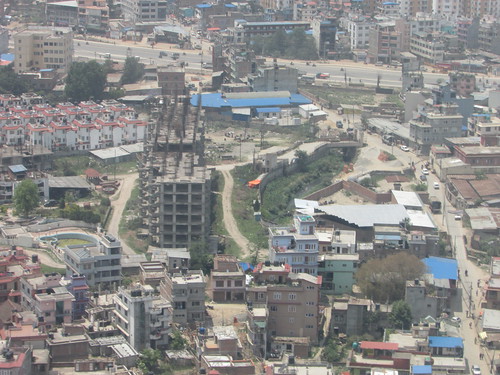
Nepal from above: Arriving in Kathmandu 11th May 2018
I found the ‘Visa on Arrival’ system confusing and eventually managed to apply using a touch-screen machine similar to an automated airport Check-in terminal but including a camera to take a passport-style image of the applicant. This machine issued a receipt confirming my application which I then presented at a payment counter with 25 U.S. Dollars. Armed with a receipt for the application, the cash receipt and my passport, I then went to the row of immigration desks marked 'Foreigners' and was officially admitted to Nepal. Of course, each of these stages involved separate queues. By the time I reached the crowded Baggage Hall, my two bags were on the belt so I was able to quickly move through the Green Channel in customs and into an Arrival Hall lined with tourist information and taxi offices. There was no sign of representatives from tour companies and I found myself on the pavement outside with cars and taxis streaming by. Seeing my bewilderment, a policeman asked, in excellent English, if he could help and he pointed out a row of representatives behind a barrier on the other side of the road. I spotted the representative from ‘&Beyond’ and, having met up, we made out way to the car park and a people carrier. He explained that security in Kathmandu was unusually tight because the Prime Minister of India, Mr. Modi, was about to arrive on a diplomatic visit to Nepal.
The main roads bristled with police security and traffic was heavy. The flags of India and Nepal were frequently displayed and we passed a couple of temporary arches of welcome. Off the main roads, shops lined both sides of the narrow streets, frequently unsurfaced, with traffic and pedestrians crammed together. The effect was a bit like Yangon, a bit like Delhi but, I suspect, essentially Nepali.
We were headed for Dwarika’s Hotel but, my guide explained, Mr. Modi was hosting a dinner at Dwarika’s in the evening (although staying at the larger Hyatt Hotel) and that we would not be able to use the front entrance. Instead, we stopped in a very narrow lane and walked up an unpromising-looking alley to a set of padlocked gates. We were admitted by a uniformed security guard, who gave me a smart salute, and ushered to an outdoor reception desk. A member of the hotel staff gave me a brief tour of the layout of the hotel whilst waiting for a ‘thumbs up’ from a colleague to indicate that my room was ready.
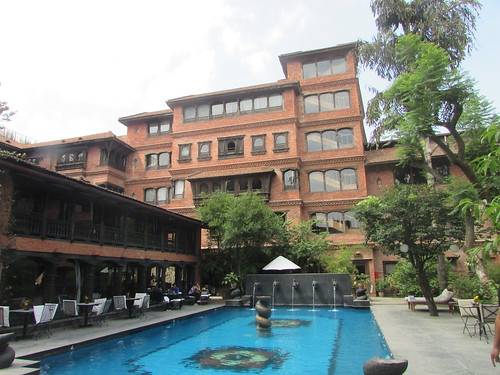
Dwarika's Hotel, Kathmandu, 11th May 2018
I was shown up to my spacious and charming room and, after a short interlude allowing a quick wash, I met my guide at the unlikely back entrance and we went on an absorbing sightseeing tour. First, we went to historic Patan Darbar Square where a number of important buildings and temples are being reconstructed, with international assistance, following the devastating 2015 earthquakes.
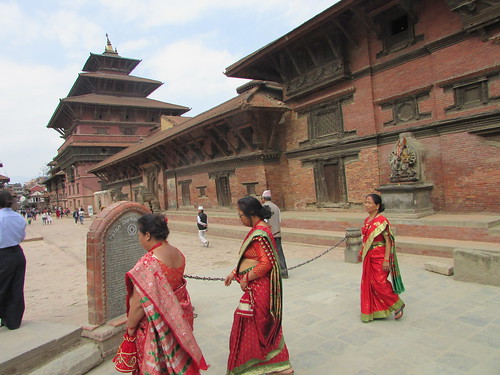 Patan, Kathmandu 11th May 2018
In the height of the afternoon rush hour, we made very tedious progress across the city to the Swayambhu Mahachaitva, the iconic hilltop Buddhist shrine. Although Nepal is only about 11% Buddhist and 80% Hindu, this shrine, dubbed the ‘Monkey Temple’ by ‘60s hippies who ‘discovered’ Nepal, is important to both Buddhist and Hindu. There were certainly crowds of visitors during my visit.
Another slow journey, giving further opportunities to study street life in Kathmandu, returned me to Dwarika’s (via the back gate) and my guide said he’d pick me up at 4.30 a.m. the following day. I didn’t venture out again that evening, very comfortable in my room. There was a very adequate Wi-Fi so I worked for a time and then slept very well in the large bed.
Related posts on this website
This is the first in a series of posts describing my visit to Nepal in 2018. Clicking on the 'Next report' link displays the post describing the next events. In this way, you may read about the trip in sequence.
Next report
Alternately, clicking on the 'All my Nepal reports' link displays all the posts on this trip in reverse date-of-posting order.
All my Nepal reports.
My pictures
Yangon to Kathmandu via Bangkok
Nepal from above
Kathmandu Airport
Patan, Kathmandu
Swayambhu Mahachitva Temple, Kathmandu
Kathmandu
Dwarika's Hotel, Kathmandu
All my pictures on this trip to Nepal can be found in the collection Nepal.
[Pictures linked 2-Jul-2018: Pictures added 7-Aug-2018]
Thursday, 10th May 2018
This was my last day in Yangon. I had breakfast, finished packing and said farewell to everybody in Doctor Hla Tun's household. I was sad to be leaving. The Doctor ran me to the Belmond Governor's Residence hotel for a meeting with Eddie Teh, Belmond's General Manager in Myanmar, about the activities of the Belmond Myanmar Foundation in Myanmar.
Early Friday morning I was booked to fly to Bangkok on flight PG706 at the rather inconvenient time of 05:50, requiring a check-in at 03:50. Eddie kindly suggested that I stay at the Belmond Governor's Residence in the meantime, allowing me to upload some pictures to the internet. This has the advantage that, rather than worry about my departure, Doctor Hla Tun could concentrate on his own flight Friday morning to Bagan, where he would no doubt face another gruelling weekend of consultations at Bagan Medical Clinic.
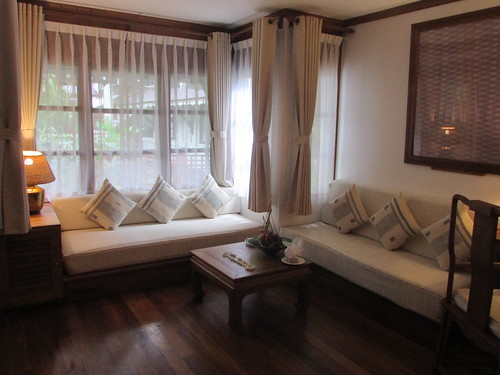
Belmond Governor's Residence.
Related posts on this website
This is one of a series of posts describing my 13th visit to Myanmar. The post Travelling again is the first post in the series and then, by clicking on the 'Next report' links you may read about the trip in sequence.
Alternately, clicking on the 'All my Burma-2018 reports' link displays all the posts on this trip in reverse date-of-posting order.
All my Burma-2018 reports.
This is the last report on my Myanmar trip but from Bangkok, I flew to Kathmandu for a few days in Nepal. The first report on the Nepal trip is here.
Alternately, clicking on the 'All my Nepal reports' link displays all the posts on this trip in reverse date-of-posting order.
All my Nepal reports.
My pictures
The Governor's Residence Hotel, Yangon
All my general pictures on this amazing trip to Myanmar can be found in the collection Burma 2018.
['My pictures' links and picture added 7-Aug-2018]
Wednesday, 9th May 2018
The Doctor had made arrangements for an official visit to Bago station and he drove me there and accompanied me on tour. We left at about 11.20 a.m. and spent the next 45 minutes struggling through Yangon's horrendous traffic. Once clear of the worst of the traffic, we made better time on the road to Bago, a dual carriageway with three lanes in each direction. There wasn't much proper countryside visible - 'strip' development continued to Bago.
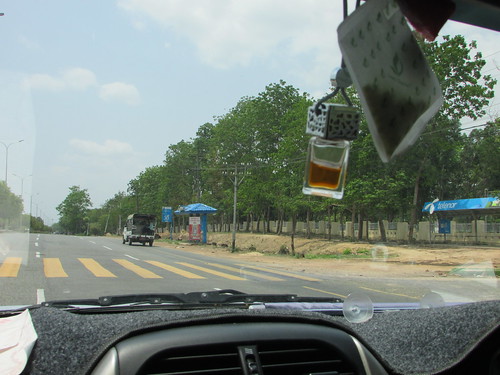
The road from Yangon to Bago, near Bago, 9th May 2018.
The Doctor and I arrived at Bago station at 1.00 p.m. and were ushered into the Station Master's spacious meeting room.
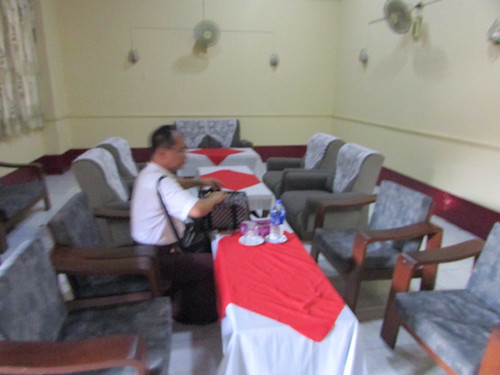
The Railway at Bago, 9th May 2018: The Station Master's spacious meeting room.
After introductions to the people who would accompany us on our tour, including an English speaker, we set off to check out the area. We started at the Station Master's Office, where one man directs all train movements in the area. Then we crossed various tracks to reach the North signal cabin. Our hosts were fascinated with my attention to detail, as I delightedly photographed trackside equipment from a former era.
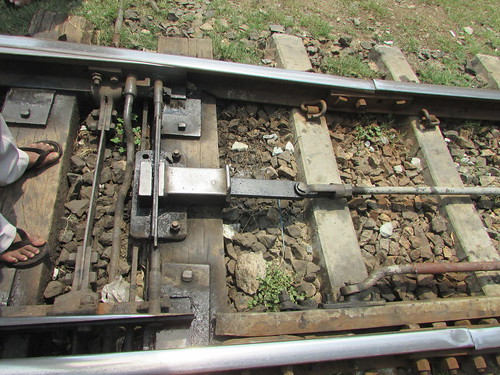
The Railway at Bago, 9th May 2018: Facing point lock and Locking Bar.
We entered the mechanical signal cabin of Bago North where, on the operating floor, two signalmen were on duty. I photographed everything in sight for later study and the young signalman set up a route to demonstrate the operation of the levers (but I didn't ask to try myself).
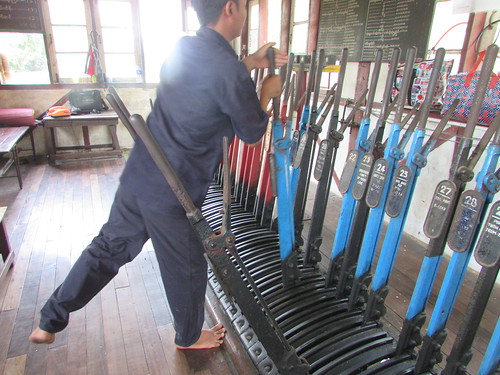
The Railway at Bago, 9th May 2018: The young signalman set up a route.
I asked to see the locking room and, again, took a number of photographs.
To my delight, they offered to show me to locomotive shed, where I knew they kept three steam locomotives sometimes used by the German travel firm FarRail Tours (www.farrail.com) for photographic charters. Their Trip Reports are full of interesting information and pictures. I climbed onto the footplate of each locomotive in turn, grabbing as many pictures as I could.
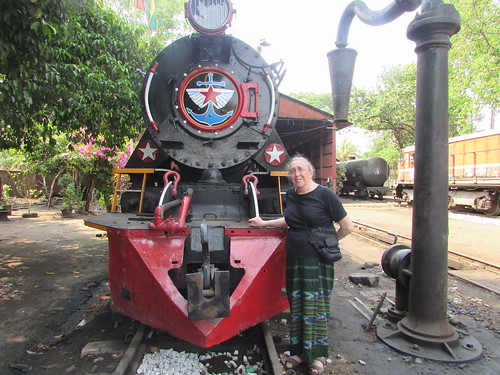
The Railway at Bago, 9th May 2018: For once, Jan looks quite happy.
With temperatures in the high 30s Celsius, I was fairly tired when I'd finished but still disappointed when they said there wasn't time to visit Bago South signal cabin.
This was because it had been suggested that I might like to return to Yangon by train, a suggestion I readily accepted. Train 32 from Naypyitaw (from where it departed at 08:00) was due to arrive, they said, at 15:00. They also suggested that my photographic opportunities might be better in an Ordinary Class coach, where all the windows were sure to be fully open, rather than an Upper Class coach. I agreed with their reasoning and a ticket was issued. Then they said the train was 15 minutes late and it actually arrived about 15:20.
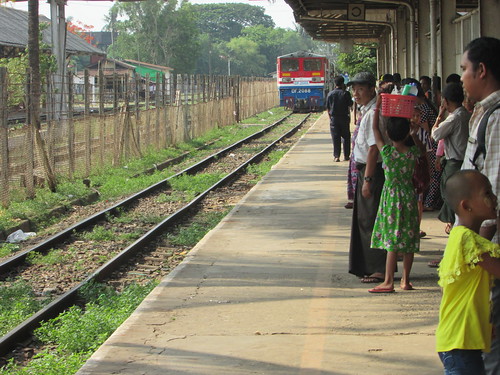
The Railway at Bago, 9th May 2018: Train 32 from Naypyitaw arriving at Bago.
According to the rail travel website 'The Man in Seat 61' here, the train was not due in until 15:20 and was due to depart at 15:23, arriving Yangon at 17:00. Well, we left about 15:23 and cracked along at what, for a Burmese train, was a a very good speed. We made just one stop and arrived at Yangon Central Station at 17:00.
The Doctor made the journey back in his car and met me at Yangon Central Station. Then we picked up the Doctor's wife and daughter and drove back to the Doctor's home.
I’ll defer the technical railway stuff to a later post.
Related posts on this website
This is one of a series of posts describing my 13th visit to Myanmar.
The post Travelling again is the first post in the series.
Clicking on the 'Next report' link will show the post describing the next events. In this way, you may read about the trip in sequence.
Next report
Alternately, clicking on the 'All my Burma-2018 reports' link displays all the posts on this trip in reverse date-of-posting order.
All my Burma-2018 reports.
My pictures
Where necessary, clicking on an image above will display an 'uncropped' view or, alternately, pictures may be selected, viewed or downloaded, in various sizes, from the albums below:-
Yangon around and about.
Bago Station (earlier pictures).
The Railway at Bago, 9th May 2018.
Bago to Yangon by Train, 9th May 2018.
All my general pictures on this trip to Myanmar can be found at Burma 2018.
['My pictures' links and pictures added 6-Aug-2018]
Tuesday, 8th May 2018
Last night, the Doctor and I returned to his Yangon home for the first time since leaving on Friday 27th April. In that time, the Doctor has carried out two full weekends of consultations at Bagan Medical Clinic and, in between those weekends, we made a fascinating side trip to Chin State led by the Monk from the Clinic and accompanied by the Doctor's wife. After the second weekend at the Clinic, we made food donations at two Orphanages in Pyin Oo Lwin and made a journey by train over the famous Gokteik Viaduct before flying back to Yangon from Mandalay.
I slept very well on Monday night and was told that Tuesday was to be a rest day for me. After breakfast, I settled down in my room to work on the internet, dealing with e-mails and updating this blog.
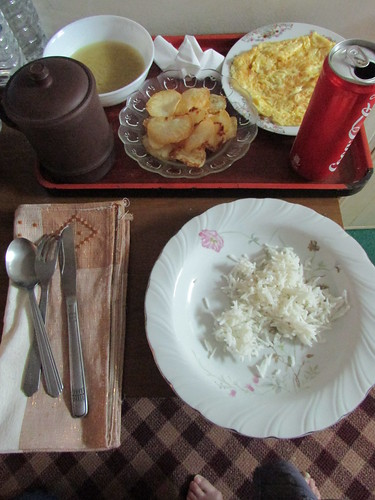
A splendid meal, tailored to my rather conservative tastes, at the Doctor's house in Yangon.
I've enjoyed many great experiences visiting different parts of the world (for more details, see the post Jan Ford's Travels) but I think that this trip has surpassed any previous travelling I've done. The emotion of being immersed in all this activity is almost overwhelming. I've met some lovely, welcoming people.
Tomorrow, the Doctor and I go on a railway visit (surprise, surprise) then on Thursday I've a meeting with Eddie Teh, Belmond's General Manager in Myanmar.
Then, my extraordinary trip to Myanmar will be over and early Friday morning I'm booked to fly out of Yangon's Mingalardon airport.
Related posts on this website
This is one of a series of posts describing my 13th visit to Myanmar. The post Travelling again is the first post in the series.
Clicking on the 'Next report' link displays the post describing the next events. In this way, you may read about the trip in sequence.
Next report
Alternately, clicking on the 'All my Burma-2018 reports' link displays all the posts on this trip in reverse date-of-posting order.
All my Burma-2018 reports
My pictures
Where necessary, clicking on the image above will display an 'uncropped' view or, alternately, pictures may be selected, viewed or downloaded, in various sizes, from the albums below:-
Yangon around and about.
All my pictures on this trip to Myanmar can be found at Burma 2018.
['My pictures' links and picture added 6-Aug-2018]
This post adds some technical comments to the post Gokteik Viaduct
We arrived at Pyin Oo Lwin station a little before 08:00 and went to the booking office for our pre-arranged tickets from Pyin Oo Lwin to Nawngpeng. Handwritten tickets for Upper Class with seat reservations were prepared with due ceremony and my passport number was included in the ticket information.
In the booking hall there was a black notice board with details of the two departures and with that day's notes added in chalk in English. Our train number 131 was shown as an Up train. In the past, it took me a while to realise that UP and DOWN on the Mandalay-Yangon line refer to trains to and from Mandalay, respectively. Thus, I'd expected the train we were about to board to be a Down train but, apparently, it's not so.
To help passengers find their correct coach, at principal stations there is an Arrivals and Departures board showing the make-up of passenger trains. Each coach is represented by a disc with vehicle details inscribed. The appropriate discs are hung on a horizontal series of small hooks so that the composition of each train is readily visible.
The discs representing our train number 131, left to right, were marked Guard, Parcels, Upper 2, Ordinary 3, Ordinary 2, Upper 1, Ordinary 1, Locomotive.
Train number 132 was similarly represented.
Our train number 131 was already in the platform with Bo-Bo-Bo DF.2080 in red and blue livery (built in China by Dalian Locomotive and Rolling Stock) on the front of 3 air braked carriages (2 Ordinary Class and 1 Upper Class) with a bogie parcels van (type GBHV) and a bogie Guard's/Parcels van (type VBHV) on the rear. The locomotive and all vehicles were air braked and fitted with automatic couplers. The Doctor said his friend had told him that the load limit from Mandalay to Pyin Oo Lwin is 180 tons but that, beyond Pyin Oo Lwin, the limit is increased to 240 tons.
Another Bo-Bo-Bo, DF.1629 in brown and cream livery, was propelling two flat cars used as shunters' wagons towards the rear of our train, number 131.The flat cars were modern, air braked with a wheel to operate a handbrake. Both cars had locating dowels at each corner for carrying a standard shipping container. The one flat car, R.9.2021 had two additional dowels perhaps for carrying half-length containers and the maker's plate 'TITAGARH WAGONS LIMITED 2013'. The Titagarh Group (website here) is a heavy engineering company based in India but now developing an export market.
It was clear that DF.1629 was going to remove the two goods wagons from the rear of train number 131, with a view to strengthening the passenger accommodation. But it took three attempts before the coupling between the leading shunters' wagon and the rear coach mated correctly.
Whilst the additional coaches were being fetched, we'd visited the Stationmaster's Office so that I could photograph the track diagram. The 'wye' at the bottom of the diagram serves the loco shed which I understand is still in use.
Approaching a Block Station like Pyin Oo Win in either direction, the first indication a driver receives is a white, rectangular warning board, set half a mile before the distant signal. All distant signals are fixed and come in a wide variety of designs. Next comes the 'Outer' or 'Home' stop signal. This is operated by the pointsman at the entrance to the station where a green flag indicates that the points have been set and clipped for the train to enter the station. Before leaving the station, the driver must be in possession of a paper Line Clear form for the Block Section ahead and must have a green flag from the pointsman to indicates that the points have been set and clipped for the train to leave the station. Finally, the train passes a 'Limit of Shunt' board. This is a white square with a smaller red square in the middle.
The station is not interlocked in the sense of having a lever frame but four Trapped Key Locking Boxes were mounted on the wall near the door. The Locking Boxes for roads 3, 4 and 5 had their keys but the unmarked box had no key, presumably because of the shunt in progress. I took pictures of the Stationmaster on the radio, the book of paper Line Clear forms authorising train movements and the Train Register book.
For more information on the control of trains in Myanmar, see the post here and for information about the control of points and interlocking see the post here. Alternately, there's an index of all my Myanma Railways posts (which may not always be up-to-date) here.
Back on the platform I watched DF.1629 propelling two Upper Class carriages and the two goods wagons onto the train and, to my surprise, the re-inforced train departed at 08:22 as scheduled.
The ruling gradient appeared to be downhill and we we travelling faster that I previously recalled. We came to a brief stand at the approach to a station and, once the points were set away from a sand drag, the upper quadrant signal cleared and we entered the platform. We carried on, making brief intermediate stops, to Hsam Ma Hse. This had the normal passing loop plus a third line on which DF.2063 (red and blue livery) waited with a ballast train, adjacent to a yard with numerous large piles of ballast. There was a belt-type elevator which apparently was used to load the ballast wagons.
Our next stop was at Nawnghkio, a more important station, where we stood for a few minutes loading and unloading freight.
Five or six kilometres beyond Nawnghkio, we started getting views of the famous viaduct. What struck me was how much higher than the bridge we were and I wondered how we'd lose height. Well, we did it by twisting and turning down the mountain side, around tight curves and descending through rock cuttings. Finally, we headed away at right angles with the bridge on our right. Below us, there was a parallel line at lower level with the semaphore Outer signal for Gokteik. We traversed the expected 'dumbell' loop now heading back towards the bridge now on our left and stopped at the small isolated station of Gokteik. The line curved left to lead us onto the viaduct which we traversed slowly (there's a 5 m.p.h. limit displayed). This monumental structure, set in impenetrable jungle, gives feelings of awe that are hard to convey.
at the entry to the station where hand operated
Immediately after the viaduct, there are two tunnels. The second was certainly brick-lined, I'm not sure about the first. The locomotive was now working hard as we climbed away from the bridge, so I was not surprised when we passed a sand drag (trailing to us) protected by stop signals. Soon, we arrived in Nawngpeng, where we disembarked. I made it a 'right time' arrival. However, the train did not, as suggested by the travel website ‘The Man in Seat 61’ here wait for train 132 to arrive and leave at 12:25 but set off for Lashio a few minutes after noon.
Station distances from Wikipedia
Pyin U Lwin 422 1/2
Pwe Kaul 427 3/4
Wet Wun 433 1/2
Sin Lan Su 438 1/4
Hsam Ma Hse 444
Nawnghkio 456
Gokteik 463 Gokteik Viaduct
Nawngpeng 472 1/4
The complete list is here.
Information from 'The Man in Seat 61'
There is one passenger train daily each way over the Gokteik Viaduct. Upper and Ordinary Class seats are provided.
Mandalay to Pyin Oo Lwin is 67 km (42 miles).
Mandalay to Hsipaw is 206km (129 miles).
Mandalay to Lashio is 280 km (175 miles).
Train number 131: Mandalay > Pyin Oo Lwin > Lashio
| Station |
Arrive |
Depart |
| Mandalay |
|
04:00 |
| Pyin Oo Lwin (Maymyo) |
07:52 |
08:22 |
| Gokteik |
11:03 |
11:08 |
| Nawngpeng |
11:58 |
12:25 |
| Kyaukme |
13:19 |
13:39 |
| Hsipaw (Thibaw) |
14:55 |
15:15 |
| Lashio |
19:35 |
|
Train number 132: Lashio > Pyin Oo Lwin > Mandalay
| Station |
Arrive |
Depart |
| Lashio |
|
05:00 |
| Hsipaw (Thibaw) |
09:25 |
09:40 |
| Kyaukme |
11:05 |
11:25 |
| Nawngpeng |
12:22 |
12:30 |
| Gokteik |
13:23 |
13:25 |
| Pyin Oo Lwin (Maymyo) |
16:05 |
17:40 |
| Mandalay |
22:40 |
|
For all the information on train travel in Burma on this website, click here.
My pictures
Where necessary, clicking on an image above will display an 'uncropped' view or, alternately, pictures from may be selected, viewed or downloaded, in various sizes, from the albums below:-
By train over Gokteik Viaduct 7th May 2018.
All my pictures on this trip to Myanmar can be found at Burma 2018.
['My pictures' link added 4-Aug-2018]
Did I mention my interest in railways? All my posts on the railways of Myanmar can be found here. When I first told the Doctor that I wanted to travel on the train over the famous Goktiek Viaduct, he insisted on making arrangements for me. As things worked out, he was also able to accompany me on the train.
Monday, 7th May 2018
I took breakfast in the Dining Hall on the 5th floor of Hotel Maymyo then checked out ready to be picked up by the Doctor at 7.40 a.m. to catch the train from Pyin Oo Lwin station across the Gokteik Viaduct.
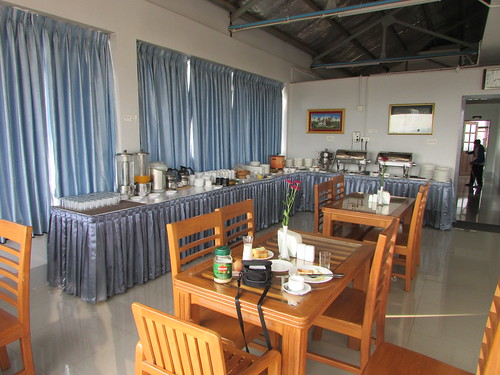
Breakfast at Hotel Maymyo, Pyin Oo Lwin, 7th May 2018
The Gokteik Viaduct, opened 1900, is a steel trestle bridge on the railway line from Mandalay to Lashio almost 700 metres long which carries a single track at a height of over 300 metres above the ground. There's a Wikipedia article here.
The height and length of the viaduct make it a ‘must see’ for many tourists and the travel website ‘The Man in Seat 61’ has more information here.
Train 131 from Mandalay to Lashio was scheduled to leave Pyin Oo Lwin at 08:22, pass over the Gokteik Viaduct and arrive at Nawngpeng at 11:58. It was arranged that our car would go ahead by road to Nawngpeng using the Oriental Highway, pick up the Doctor and the writer on arrival by train then drive us via Pyin Oo Lwin to Mandalay Airport. The Doctor had booked tickets for us to Yangon on separate flights to keep the cost down.
Well, all the arrangements worked well and the viaduct is certainly impressive. There were a number of European travellers on the train who also seemed to enjoy the experience and many photographs were taken. You’ll probably be relieved to learn that I’m deferring the technical railway stuff to a later post (but you can find it at Gokteik Viaduct Notes then use the 'back button' to return here).
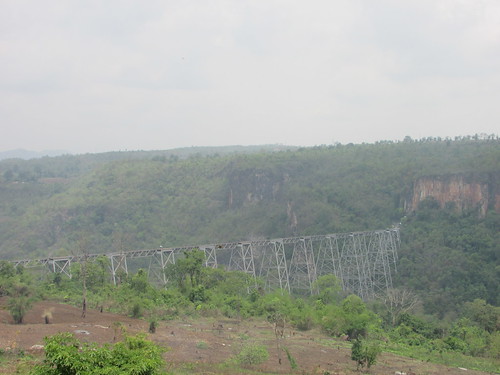
By train over Gokteik Viaduct 7th May 2018
The car collected us at Nawngpeng as planned and we set off on the Oriental Highway towards Pyin Oo Lwin. The amount of lorry traffic was astonishing, mainly 8-wheel fixed wheelbase and 10- and 12-wheel articulated rigs. Via a series of spectacular zig-zags, the road descended into the valley then, using a similar technique, climbed up the opposite side of the valley.
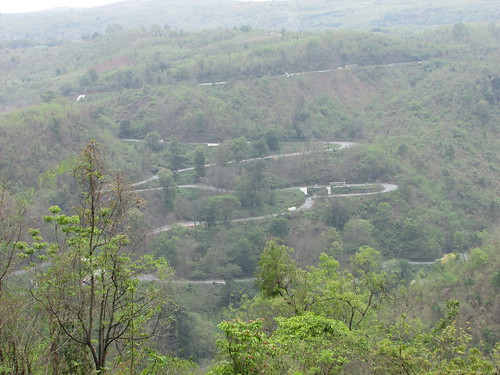
Nawngpeng - Mandalay Airport by road 7th May 2018: View of zig-zag road from opposite side of valley.
As I’ve previously reported, Myanmar drives on the right (despite the fact that many vehicles, like the Toyota Crown I was travelling in, have the driver on the right). However, the bigger lorries need space to turn so, even if they should be driving on the inside of a hairpin bend, they simply take the wrong side of the road so as to be on the outside of the hairpin. Drivers of smaller vehicles travelling in the opposite direction, with admirable pragmatism, simply also adopt the wrong side of the road until they’re clear of the offending lorries and so the traffic keeps moving (though it looks frightening).
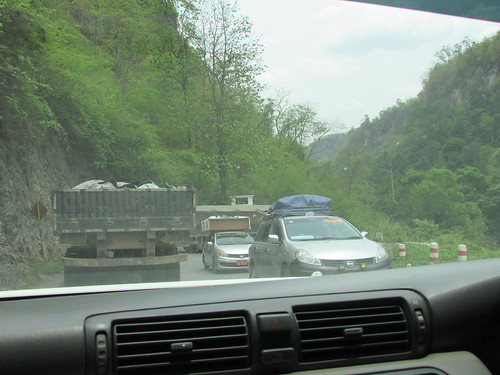
Nawngpeng - Mandalay Airport by road 7th May 2018: On the hairpins, traffic informally adopts the wrong side of the road to allow lorries space to turn.
Having reached a plateau, our route continued on easier gradients. We stopped at a large, obviously popular, tea-shop. The floor was littered with empty water bottles and debris from a busy morning but I was amazed when the place setting for each diner (plate, bowl, tea cup and cutlery) arrived packed in a plastic bag and looked clean. Fearing my foreigner’s delicate digestion, the Doctor often washes cups or cutlery again before letting me use them but on this occasion there was no need.
We carried on to Pyin Oo Lwin where the Doctor and I enjoyed a cup of heated milk (a sort of informal Pasteurisation) at a roadside shop.
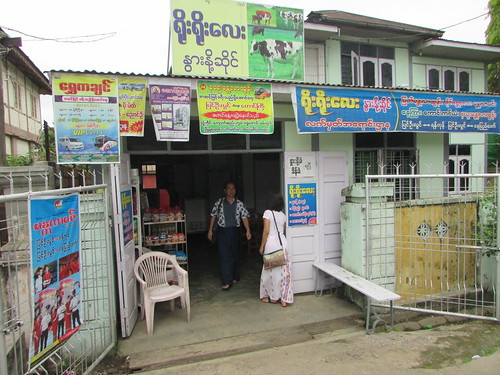
The roadside shop in Pyin Oo Lwin where we drank heated milk.
As we left Pyin Oo Lwin, the Doctor made some purchases at a group of roadside stalls (Pyin Oo Lwin is famous for strawberries).
Although parts of the road descending to the plain were already dual-carriageway the last time I was on it, massive road improvement has occurred since. This construction project is ongoing - as we came nearer to Mandalay, the Oriental Highway became one vast construction site with traffic in both directions rushing across a dusty, unsealed surface with no markings or verges and poor visibility from the clouds of dust. The speeding vehicles were sharing the space with dozens of excavators, graders, road rollers and tipper lorries all oblivious to the traffic and operating within inches of the passing cars, pick-ups lorries and tankers. It was an amazing, anarchic scene. There were also a number of rather alien-looking tracked vehicles, each attached by an umbilical cord to a large, wheeled packaged unit. I assumed that they were pneumatic rock drills.
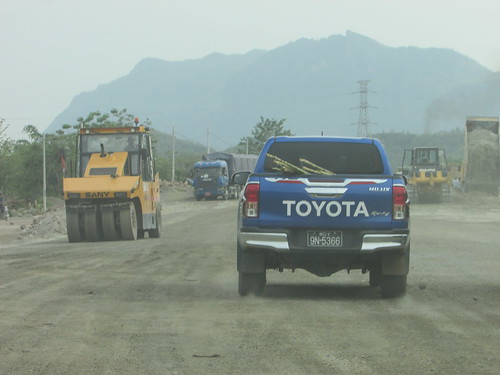
Road improvements in progress on the Oriental Highway.
At last, we returned to the relative discipline of a dual carriageway, paid at a couple of toll stations, passed through Myitnge and took the road to Mandalay Airport.
The Doctor had little time to catch his flight to Yangon and dashed off to check-in, encumbered with various shopping carriers of his purchases. I said farewell to our driver and the young lady from Belmond as they set off on the long drive back to Bagan. I then had a couple of hours before my own flight to Yangon. A little after 9.00 p.m., I arrived at Mingalardon Airport to find the Doctor and his wife waiting for me. We returned to the Doctor's house by taxi and, tired but thrilled by our various explorations, I slept well with the promise that the following day was a day of rest for me. For once, I was disinclined to argue.
Related posts on this website
This is one of a series of posts describing my 13th visit to Myanmar.
The post Travelling again is the first post in the series.
Clicking on the 'Next report' link will show the post describing the next events. In this way, you may read about the trip in sequence.
Next report
Alternately, clicking on the 'All my Burma-2018 reports' link displays all the posts on this trip in reverse date-of-posting order.
All my Burma-2018 reports
My pictures
Where necessary, clicking on an image above will display an 'uncropped' view or, alternately, pictures from may be selected, viewed or downloaded, in various sizes, from the albums below:-
Hotel Maymyo, Pyin Oo Lwin, 7th May 2018.
By train over Gokteik Viaduct 7th May 2018.
Nawngpeng - Mandalay Airport by road 7th May 2018.
All my pictures on this trip to Myanmar can be found at Burma 2018.
['My pictures' links added 4-Aug-2018: Pictures embedded 23-Aug-2018]

