skip to main |
skip to sidebar
The Mutual Improvement Classes of the old steam railways still continue for today's preservation volunteers. This is one of a series of posts based on notes of talks given by Jan or with technical content which may be of use to today's volunteers. To find them all, select label 'MIC' or click here. There is also a list of these posts (not always up-to-date) here.
There is an earlier post which introduces the role of the shunter here and the comments on safety in that post equally apply here. The introductory post discussed simpler coupling systems widely used on standard-gauge freight rolling stock. This part discusses couplings used on passenger rolling stock.
Screw Couplings
Whilst the 'loose coupling' provided by three-link couplings was acceptable on freight trains, passenger vehicles needed to be more tightly coupled to give a reasonable level of comfort. For many years, passenger coaches in Britain used 'screw-couplings'.
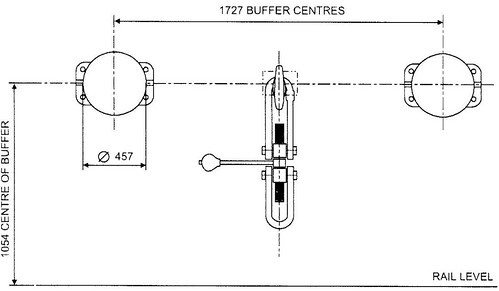
Vehicle with Screw Coupling hanging: End view (from a Railtrack document).
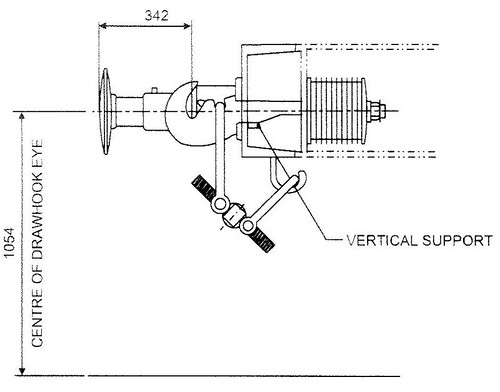 Vehicle with Screw Coupling stowed on hook: Side view (from a Railtrack document).
Once the coupling is on the drawhook of the adjacent vehicle, it is tightened up by rotating a threaded screw which has one end with a left-hand thread, the other end with a right-hand thread, using a built-in tommy bar incorporating a counterweight. This draws the two D-links together tightening the coupling so that, on straight track, the buffers will be equally compressed but, on curves, the buffers on the inside of the curve will be further compressed and the buffers on the outside of the curve will slacken slightly. At all times, the buffers should remain under some compression, so that the train cannot bang in and out. The comfort of the passengers depends upon the screw adjustment being correctly carried out. The complete process of coupling vehicles is outlined in the article On the Footplate (Part 2).
The picture below shows restored L.M.S. coach 7828 attached to 'Austerity' Tank 'Lord Phil' at Peak Rail.
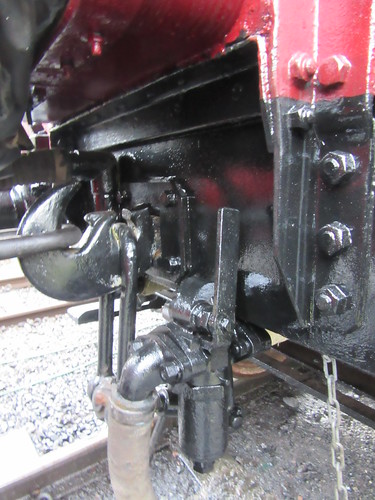
Restored coach 7828 at Rowsley: View showing coach drawhook, with unused coach 'D' link hanging down. The rest of the stowed coach screw coupling is obscured by the steam heating hose. The coach has been attached to 'Austerity' Tank 'Lord Phil' using the locomotive coupling.
Although screw couplings were effective, the results of accidents, particularly at higher speeds, showed the limitations of screw couplings. Part of the train could twist or even break free, increasing the chance of serious injuries.
Automatic Couplings
In other countries, various forms of 'Automatic' coupling had been developed to provide extra strength and simplify the business of coupling and uncoupling vehicles. In America, Eli Janney patented his design in 1873 and, in 1893, legislation made this the standard coupling in America. In 1915, John Willison of Derby patented his own automatic coupling which, with modifications, was adopted in 1935 by the Soviet Union as their standard coupler.
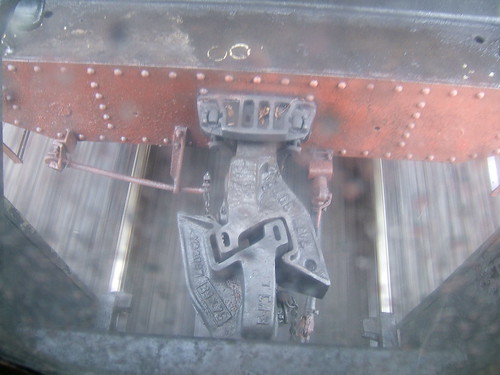
Ukraine Steam: Locomotive Em 735-72 at speed in the rain, showing Russian pattern autocoupler between tender & coach.
A variation of the Janney coupling with side release called the 'Buckeye' was adopted by the L.N.E.R. and the Southern in the 1930s, retaining side buffers. Since not all vehicles were fitted with 'Buckeye' couplings (and only one class of British steam locomotives was fitted - Gresley's 'A4'), the 'Buckeye' fitted to coaches was a 'drophead' pattern where the automatic coupler head could be lowered to reveal a conventional drawhook for use with a screw coupling. After the 1948 Nationalisation of British railways, a range of standard passenger coaches were built, similarly fitted with a conventional drawhook, 'drophead' 'Buckeye' coupler and adjustable side buffers (each with two positions - 'long' for use with a conventional screw coupling and 'short' when using the 'Buckeye').
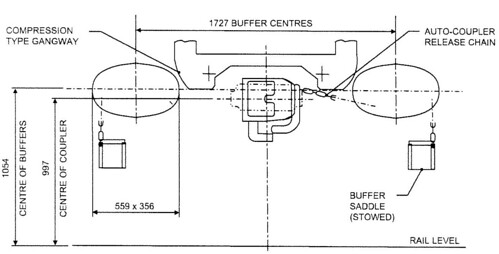
Buckeye Coupling as fitted to B.R. Mk 1 and Mk 2 gangwayed vehicles: End view (from a Railtrack document).
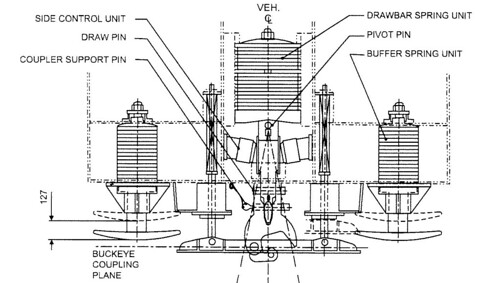
Buckeye Coupling as fitted to B.R. Mk 1 and Mk 2 gangwayed vehicles: Top view (from a Railtrack document).

Buckeye Coupling as fitted to B.R. Mk 1 and Mk 2 gangwayed vehicles: Side view (from a Railtrack document).
The 'Buckeye' has a substantial hinging 'knuckle'. To couple, two vehicles are brought together with one of the knuckles in the 'open' position and the adjustable buffers set to the 'Short' position, as shown in the picture below.
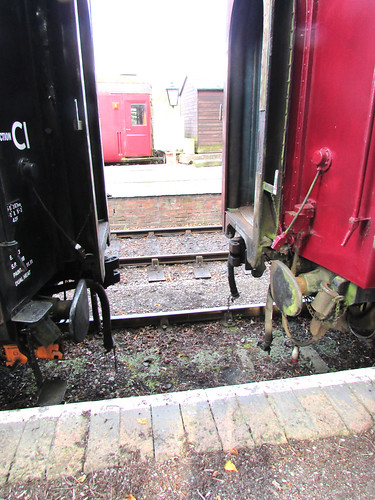
BR Coaches being shunted together. Buffers in 'Short' position for use with Buckeye coupling. Unused 'saddles' are stowed on a bracket adjacent to each buffer.
As the two couplings contact, the open knuckle is forced closed and a mechanical latch drops, locking the knuckle closed. In addition to the shunter confirming visually that the 'pin' has dropped, a 'pull test' is conducted where the locomotive tries to separate the vehicles.
To uncouple, pulling a chain on either coupling head unlatches that knuckle, allowing the knuckle to swing open and the vehicles to be drawn apart.
When coupling or uncoupling the shunter stands alongside the vehicles and controls the movement by hand signals given to the driver of the locomotive performing the shunt. Unfortunately, to connect or disconnect the brake hoses and, when required, the steam heating hoses, the shunter still has to clamber underneath the vehicles, after coming to a clear understanding with the driver that it is safe to do so. The electrical jumpers between vehicles which allow the guard to control the carriage lighting also require connection/disdconnection.
Related posts on this website
The Role of the Shunter (Part 1).
On the Footplate (Part 2).
MIC - Brakes.
Mutual Improvement Classes (2) (List of MIC posts).
My photograph albums
Where necessary, clicking on an image above will display an 'uncropped' view or, alternately, pictures from may be selected, viewed or downloaded, in various sizes, from the albums listed:-
Passenger Rolling Stock.
['Related posts' amended 13-Apr-2020]
In 2013, the Brewood Village Garden Party annual event was restarted, re-located to the garden at Brewood Hall. Deemed a success, it has been held in 2014, 2015, 2016 and, as described below, on Saturday, 8th July 2017.
Preparations
Each year significant effort by volunteers, which starts months earlier with a series of planning meetings, is needed to ensure that people enjoy their visit to the event. In 2017, erection of the tents commenced two days before the Garden Party.
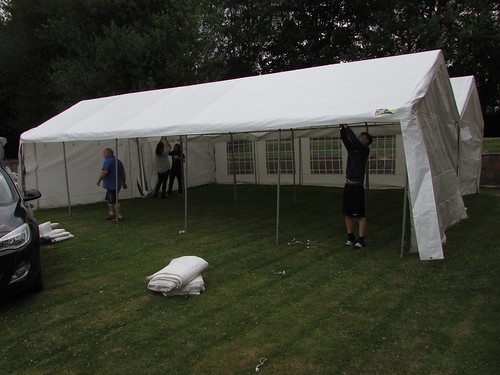
Brewood Garden Party 2017: The Refreshment Tent takes shape.
Preparations continued on the evening before the event. These included the erection of the large marquee which would serve as the 'Craft Tent'.
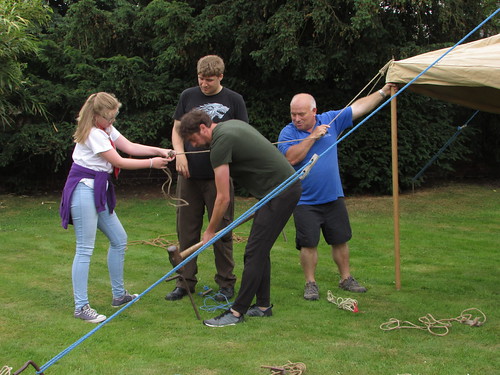
Brewood Garden Party 2017: Putting up the large Marquee.
The Event
Once again, the weather was kind on the day of the event and visitors started to arrive at the entrance gate a little before noon.

Brewood Garden Party 2017: The Admission table.
The Refreshment Tent was soon busy and remained busy. The combination of covered and open air tables, with the Pimm's Tent nearby, catered for all tastes.
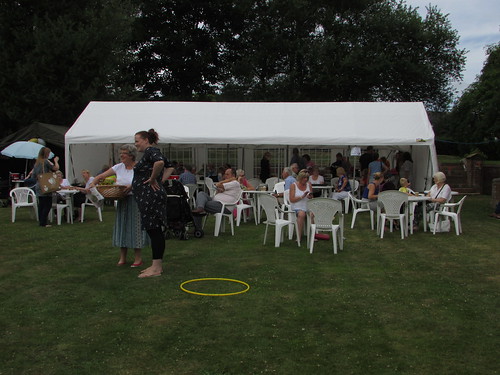
Brewood Garden Party 2017: The Refreshment Tent is always popular.
For the first time, food was also available from a 'Pizza Van' which used a traditional wood-fired oven. This was a very successful innovation and many people commented favourably on the quality of the pizza.
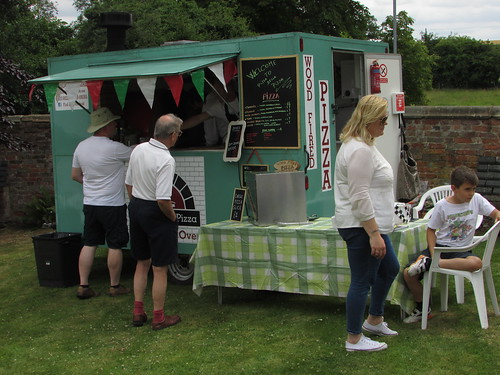
Brewood Garden Party 2017: A successful innovation in 2017 was the 'Pizza Van', using a traditional wood-fired oven.
Traditional entertainments included wet sponge throwing at a human target and the ever-popular coconut shy. There was also a catapult range and a supervised Under-5 Play Zone.
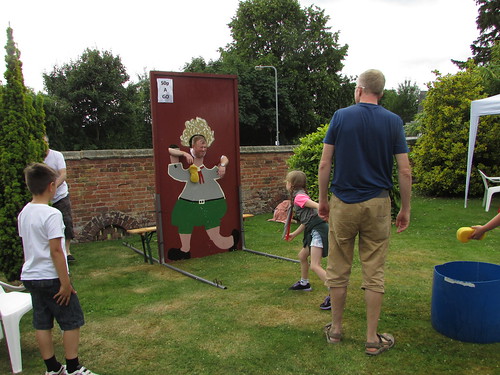
Brewood Garden Party 2017: Traditional entertainments included wet sponge throwing at a human target.
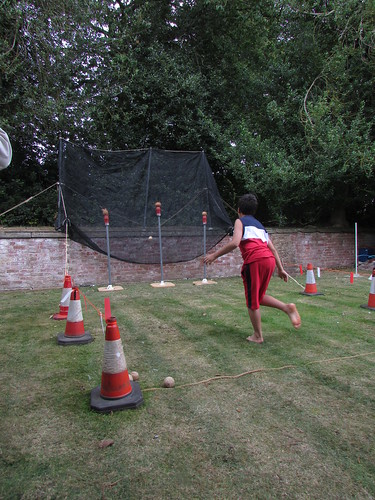
Brewood Garden Party 2017: The coconut shy is popular with all ages.
The Craft Tent featured the work of a number of local artists and crafters whilst the well-stocked Plants and Produce stall organised by the parish church provided shopping opportunities.
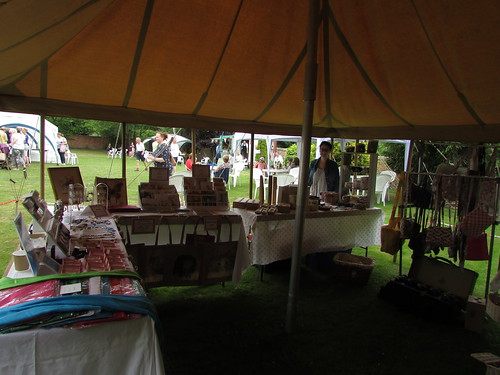
Brewood Garden Party 2017: The Craft Tent featured the work of a number of local artists and crafters.
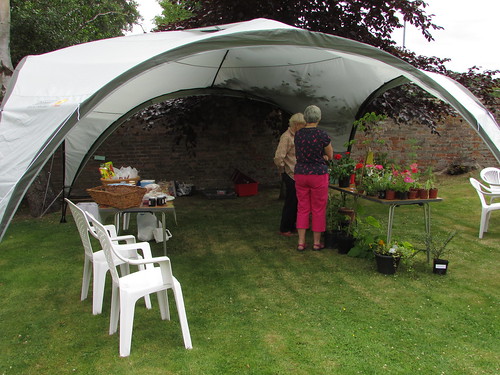
Brewood Garden Party 2017: The well-stocked Plants and Produce stall organised by the Parish Church provided shopping opportunities.
For the first time, Black Country Live Steamers displayed two marvellous live-steam scale models of traction engines, which created a lot of interest. You can read more about Black Country Live Steamers on their website here.

Brewood Garden Party 2017: Live-steam scale model of a Fowler traction engine, with a young admirer.
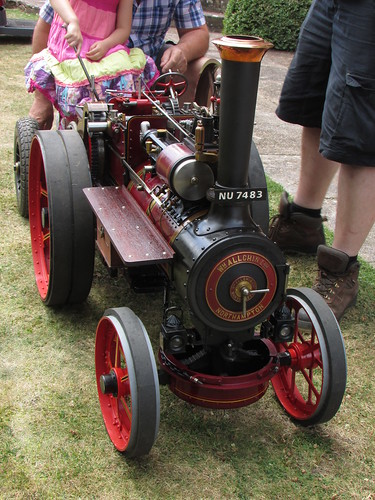
Brewood Garden Party 2017: Live-steam scale model of an Allchin traction engine.
An unexpected "visitor" was the preserved World War II Lancaster Bomber from the Battle of Britain Memorial Squadron, which overflew our event. You can read all about this historic arcraft on the website here.
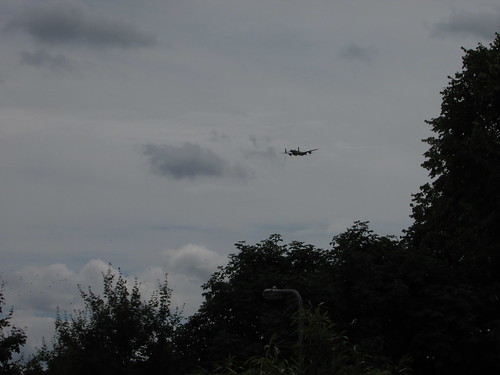
The preserved World War II Lancaster Bomber overflew the Garden Party.
As in previous years, live music was provided by the talented young musicians from the Cannock Wind Band and the Cannock Big Band who are based at the Cannock Performing Arts Centre.
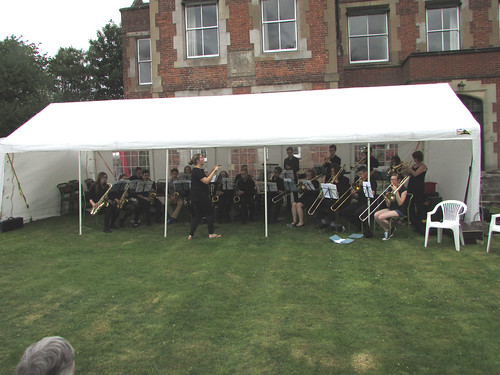
Brewood Garden Party 2017: Live music was provided by the Cannock Wind Band and the Cannock Big Band.
Later, a contingent from the Staffordshire Corps of Drums gave a demonstration. Captain Keates provided a virtuoso drum performance, accompanied by what I call a marching glockenspiel (but which I learn is also known as a Bell Lyre or a Lyra Glockenspiel - see Wikipedia here).
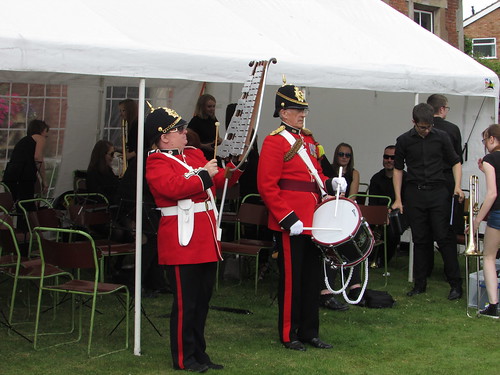
Brewood Garden Party 2017: A contingent from the Staffordshire Corps of Drums gave a performance.
As in previous years, a series of Sack Races and Egg and Spoon Races for children were held and, once again, proved popular. All the entrants were enthusiastically supported by the visitors. Each of the competitors was awarded a selection of confectionery,
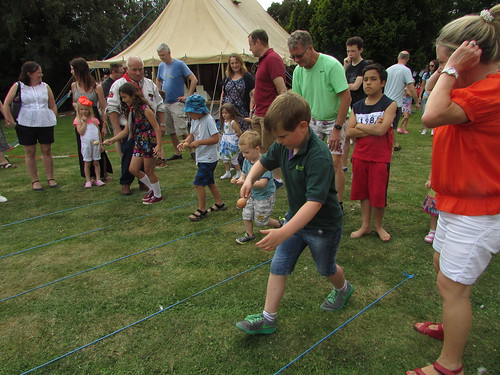
Brewood Garden Party 2017: The children entering the Sack Races and Egg and Spoon Races were enthusiastically supported by the visitors.
Everybody agreed that, once again, we'd had a very successful event (and the sun shone). This year, the organising committee made four awards - a special award to Compton Hospice and awards to Brewood Scouts, the Brewood Parish Church and the Jan Ford Foundation.
Reports on earlier garden parties at Brewood Hall
Brewood Vintage Garden Party 2013.
Brewood Vintage Garden Party 2014.
Brewood Garden Party 2015.
Brewood Garden Party 2016.
Related posts
More information on the charitable work supported by the Jan Ford Foundation in Myanmar (formerly Burma) can be found by following the links below:-
Education Support
Medical Support.
Pictures of the event
Where necessary, clicking on an image above will display an 'uncropped' view or, alternately, pictures from may be selected, viewed or downloaded, in various sizes, from the album below:-
Brewood Garden Party 2017.
Each year, The Old Locomotive Committee (OLCO) has an event for live steam models of the 'Lion' locomotive.
In 2017, the event, called 'Lionsmeet', was held on Saturday, 22nd July at the Worden Park track of the Leyland Society of Model Engineers.
I travelled to Preston on an Edinburgh train which I joined at Wolverhampton. The journey, operated by Virgin using two 5-car 'Voyager' diesel-electric units, was swift and on-time (although it never ceases to irritate me that so many long-distance journeys 'under the wires' remain operated by diesel traction). I first spent a while exploring Preston city centre on foot - still strangely quiet as early morning shoppers started to fill the streets. I walked as far as the Harris Museum and Art Gallery, with its all-embracing, gilded, carved inscription
'TO LITERATURE ARTS AND SCIENCE'.

The famous Harris Museum and Art Gallery in Preston.
Then, I retraced my route back to the station and took a taxi south of the city centre to Leyland. The taxi dropped me at the Park Gate and I had a walk of a few hundred yards to reach the Club House and Steaming Bays but, fortunately, my 'railway homing instinct' did not fail me.
I was welcomed by Andrew Neish, who is currently the 'Lionsmeet' organiser for OLCO and the other early arrivals. Members of the host club were also there in force and I was soon drinking a welcome cup of tea in the clubhouse.
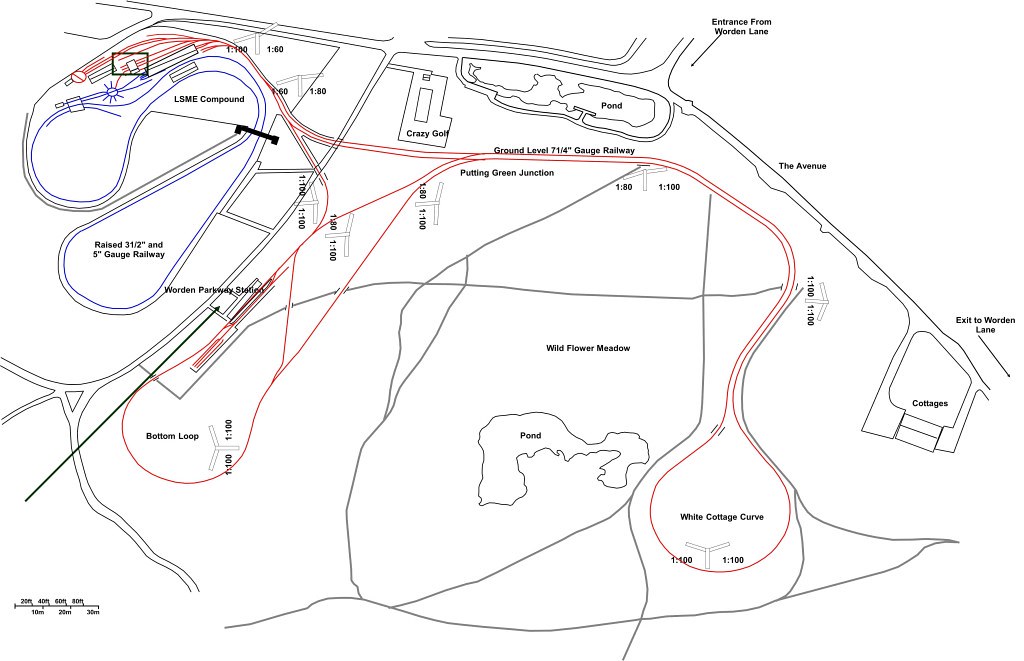
The club has established a 1617 foot continuous raised track for 3½ and 5 inch gauge models (arranged as a 'folded dumb-bell') and a ground level 7.25 inch track extending to one kilometre (laid out as a 'slightly-bent dumb-bell'). There are covered steaming bays, turntables and station facilities for each gauge.
Click for larger image
Worden Park, Leyland: Plan of model railway facilities. (Map: Leyland Society of Model Engineers).
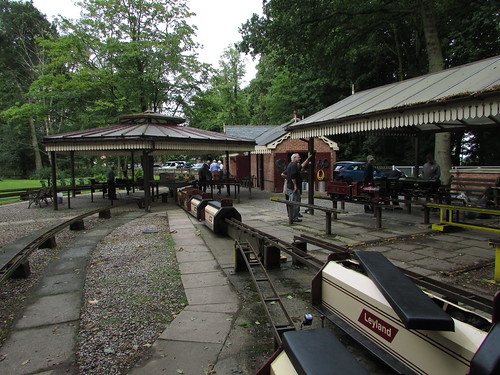
'Lionsmeet 2017' at Leyland SME: View looking west from the Stock Shed towards the 3½in and 5in steaming bays with the 7.25in steaming bays on the right.
My eye was drawn to an impressive 7.25in model of 60809 'The Snapper', brewing-up in the steaming bays. I learned that this would be giving public rides during the day on the ground-level track. Soon, a 7.25in 'B1' was also being steamed.
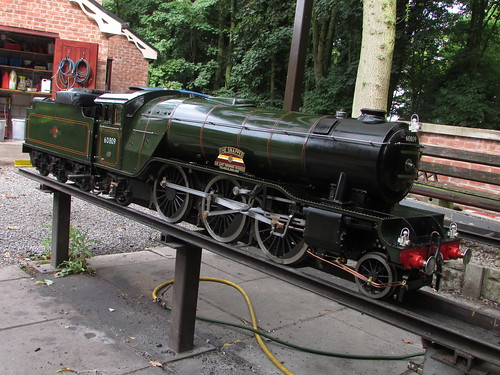
'Lionsmeet 2017': 7.25" gauge locomotive 60809 'The Snapper' being prepared for service on the ground level track.
Although we've had 7.25in gauge 'Lion' models in steam at some previous 'Lionsmeets', none attended in 2017 and so the OLCO activities were confined to to raised track. Club members first extracted their battery electric locomotive 'Worden Ranger' from its 'garage' (where battery charging takes place) and marshalled a train of two passenger car and a 'tool car'.
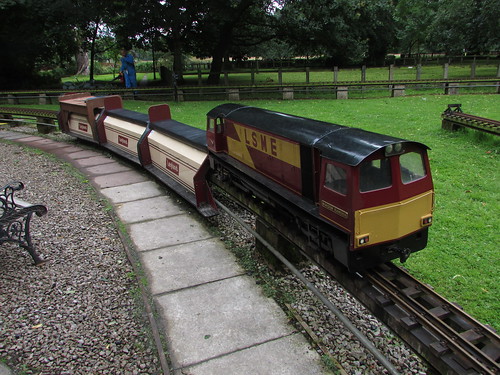
'Lionsmeet 2017' at Leyland SME: The Battery Electric locomotive 'Worden Ranger' ready to perform a line inspection of the elevated track, with two passenger cars and a tool car.
After the line inspection was completed, I was invited to make a couple of circuits with 'Worden Ranger'. Driving was straightforward, with just a direction selector and a single power controller handle. The handbrake on the leading passenger car was used for train braking although there was also a 'parking brake' on the locomotive. I found the locomotive responsive and powerful. A (rather feeble) two-tone horn was provided. For part of the morning, the host club gave public rides with 'Worden Ranger' and its train but the raised track was generally reserved for OLCO members.
Models were steamed by David and Andrew Neish, Jon Swindlehurst and Adrian Banks. David and Andrew, as usual, alternated in driving David's model.
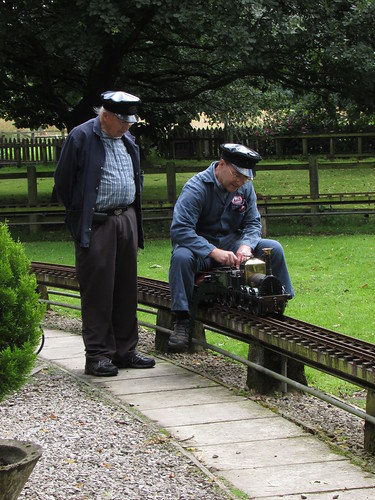
'Lionsmeet 2017' at Leyland SME: David Neish and Andrew Neish on the elevated track.
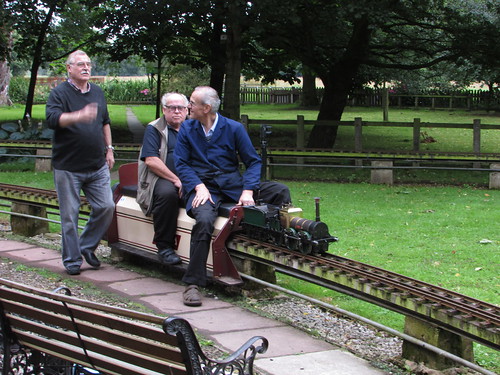
'Lionsmeet 2017' at Leyland SME: Jon Swindlehurst about to depart with his 'Lion' with John Oliver as passenger.
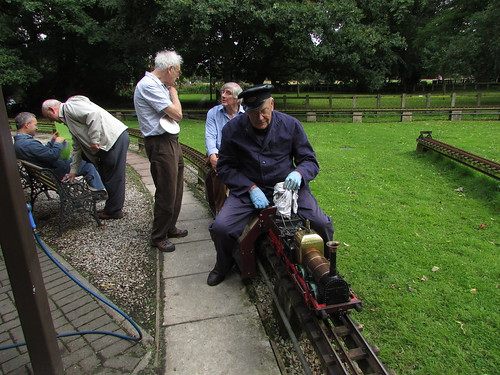
'Lionsmeet 2017' at Leyland SME: Adrian Banks pauses adjacent to the steaming bays whilst he 'fettles his fire', allowing his passenger, John Brandrick, to chat to John Hawley.
In addition, a number of part-built 'Lions' were displayed in the Club House. David Forrest's beautifully-built model (on the right in the picture below) attracted many favourable comments. He had produced a number of trial '3D-Printed' plastic components during the development of his design.
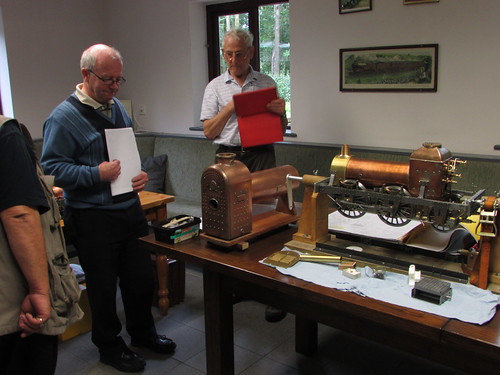
'Lionsmeet 2017' at Leyland SME: Discussions in the Club House: John Oliver, David Forrest, John Hawley.
The host club laid on a splendid buffet lunch and free-running of the models in steam continued into the afternoon. OLCO Chairman John Brandrick made a short address of thanks to Leyland S.M.E. for their hospitality, following one minute's silence to commemorate the death of Justin Garside-Taylor from the Museum of Liverpool.
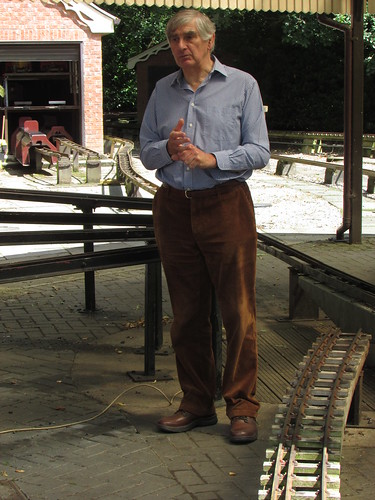
'Lionsmeet 2017' at Leyland SME: During the afternoon John Brandrick, Chairman of OLCO, made a short address of thanks to Leyland S.M.E. for their hospitality.
Some of the OLCO visitors made their way across to the 7.25 inch ground level track at the adjacent Worden Parkway Station, where rides were given to the public throughout the day. In the morning, 'The Snapper' was the motive power but, by the time John Hawley and I went across, B1 'Reedbuck' had taken over.
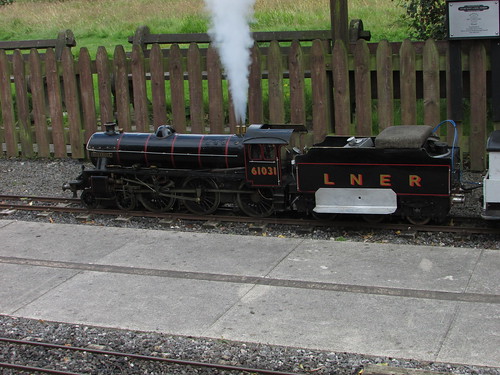
'Lionsmeet 2017' at Leyland SME: Worden Parkway Station on the 7.25 inch ground level track showing 'B1' 61031.
John Hawley kindly ran me to Preston Station for my return train, so I missed the informal 'OLCO Dinner' held later in Euxton.
Related posts on other websites
Leyland Society of Model Engineers.
Related posts on this website
All my posts regarding the Old Locomotive Committee can be found here, with links to my pictures.
My pictures
Where necessary, clicking on an image above will display an 'uncropped' view or, alternately, pictures from may be selected, viewed or downloaded, in various sizes, from the albums listed:-
Lionsmeet 2017.
Preston.
All my 'OLCO' albums.
On the weekend of 5th and 6th August 2017, Peak Rail ran its popular '1940s Weekend'. On the Sunday, I was the driver of the steam locomotive 'Jennifer' operating the 6-coach passenger train between Rowsley and Matlock Town, top and tailing with diesel-electric 'Penyghent'.
My arrival at Rowsley was later than normal, as we had no 'Driving Experience' course prior to the first service train. The Picnic Area and the woods are normally deserted as I make my way to the shed but, on a '1940s Weekend', the area becomes a series of tented military encampments for the re-enactors. Many of the re-enactors were getting ready or taking breakfast in their camps.
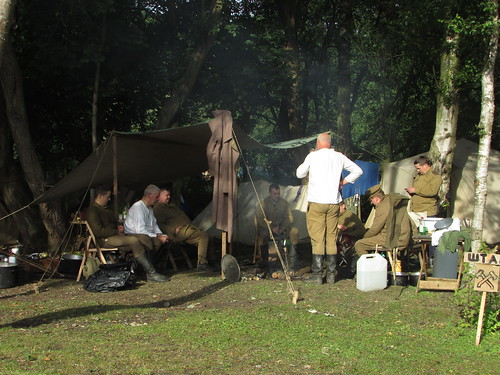
Peak Rail 1940s Weekend 2017: Breakfast in Camp.
I signed-on at the shed and there was some discussion with Dave Pendleton, the fireman, about our pairing on the '1940s Weekend' the previous year when our motive power became a complete failure early in the day. That day is described here. We hoped that history wouldn't repeat itself and it didn't. 'Jennifer' was simmering on the outside pit so I set to oiling-round and carrying out the daily exam.

Peak Rail 1940s Weekend 2017: 'Jennifer' simmering on the pit at Rowsley.
Nice and early, we made our way 'off shed' and across to the north end of our train. Waterman Railway Heritage Trust locomotive 5224 (a Great Western Railway 2-8-0T of the 5205 class, built by Collett in 1923) was on display on the turntable. Turntables always seem to fascinate visitors - it's a pity ours doesn't get more use. There's an article about turntables here.
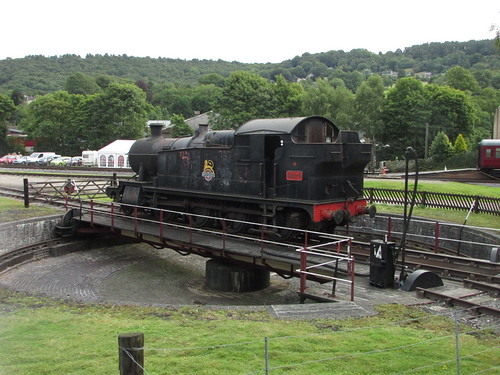
Peak Rail 1940s Weekend 2017: 5224 (awaiting restoration) on the turntable.
The first departure was delayed, waiting for one of the coach parties booked on the train which was delayed in a traffic hold-up somewhere.
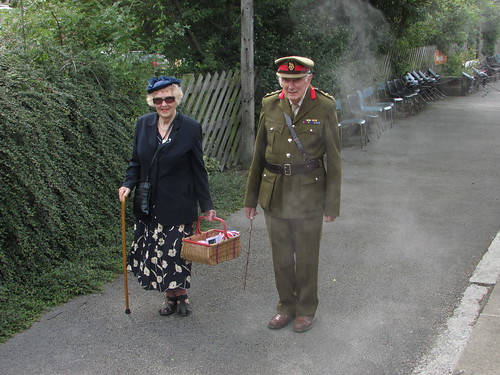
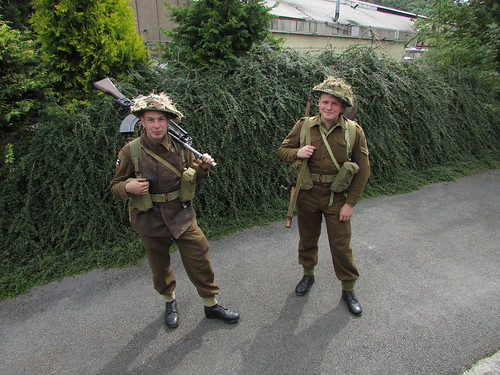
Our train was certainly full when we left, about ten minutes late. I was wearing my 'tin helmet', which alternated with the normal 'grease-top' throughout the day. Of course, we were 'tail end charlie' on the way to Matlock, with 'Penyghent' doing all the work. At Darley Dale, a Remembrance Service had been held.

Peak Rail 1940s Weekend 2017: A Remembrance Service was held at Darley Dale.
There was a lot of activity on the platform at Matlock Town but, eventually, we received the 'Right Away' and, with a whistle, I set off for Rowsley. I'd discovered previously how readily 'Jennifer' copes with the train when hauling northwards (and the 'surging', although not eliminated, is much attenuated), as I described in the post here, so I was able to enjoy our trip back to Rowsley. Then I had a chance to have a quick look around the stalls near the station. I was surprised to discover the prices genuine second-hand period clothing, sought by re-enactors, now commands.
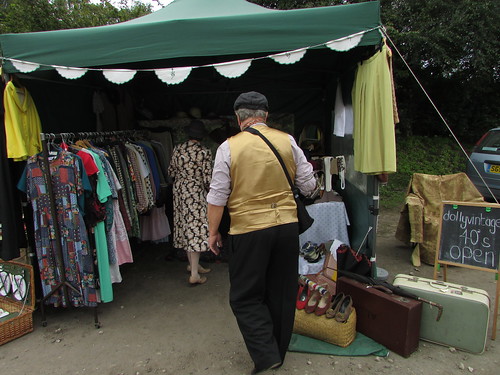
Peak Rail 1940s Weekend 2017: A stall selling period clothing.
The large marquee is always popular, featuring refreshments, a licensed bar and a variety of live period entertainment. I called in when Sue and Steve Mace were dancing to the music of the Ashby Little Big Band.
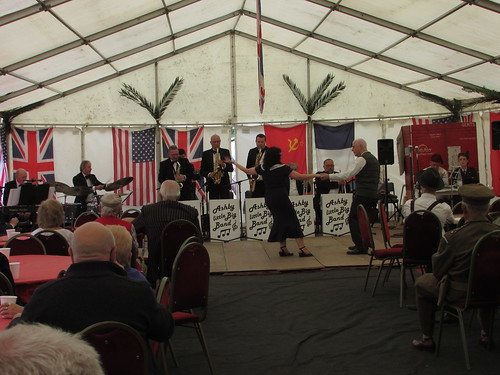
Peak Rail 1940s Weekend 2017: The Marquee with Sue and Steve Mace dancing to the music of the Ashby Little Big Band.
The highlight of the day was the Mock Battle with pyrotechnics which took place in front of the wooded area facing Rowsley Station platform, with a commentary by Paul Harper. Of course, this happens only once the train has departed for Matlock so, if you're on the footplate, you miss the action. The picture below, taken as we left Rowsley, shows the large crowd eagerly awaiting the start of the mock battle.
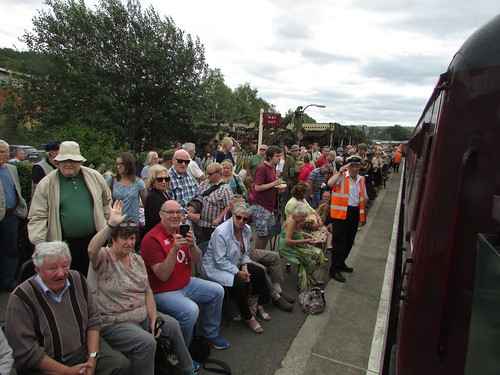
Peak Rail 1940s Weekend 2017: View from 'Jennifer' as we depart for Matlock, hauled by 'Penyghent', prior to the start of the Mock Battle.
I think everyone had an enjoyable day: I certainly did. At the end of traffic, we followed 'Penyghent' onto shed and, after disposing on the outside pit, stabled 'Jennifer' inside on number 1 road, adjacent to 'Penyghent' on number 2.

Peak Rail 1940s Weekend 2017: End of Shift - 'Jennifer' stabled on number 1 road, next to 'Penyghent' on number 2.
Related posts/pictures
I've participated in the 1940s Weekend at Peak Rail on a number of previous occasions.
Peak Rail 1940s Weekend, 2016 (article with link to pictures).
Peak Rail 1940s Weekend, 2015 (article with link to pictures).
2014 event (pictures only).
2013 event (article with link to pictures).
2012 event (article with link to pictures).
2009 event (article with link to pictures).
2008 event (article with link to pictures).
2007 event (pictures only).
2006 event (pictures only).
To see all my posts about Peak Rail, select Label 'Peak Rail' or click here.
Related photograph albums
Where necessary, clicking on an image above will display an 'uncropped' view or, alternately, pictures from may be selected, viewed or downloaded, in various sizes, from the albums listed:-
Peak Rail 1940s Weekend 2017.
'Jennifer'.
All my Peak Rail albums.
Ty Gwyn is a small commercial woodland around 27 hectares in area near Corwen in Wales.
A Recent Timeline
By 2006, the whole plantation was mature and, but for depressed timber prices, would have been harvested.
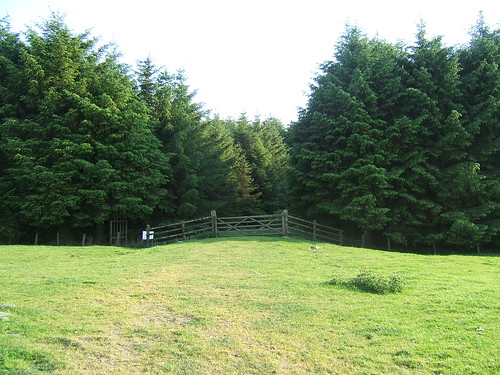
View of the entrance to the plantation in 2006.
Timber prices recovered by 2009 and around half of the plantation was harvested.

View of the entrance to the plantation in 2010 with harvesting in progress to the left of the road.
In 2010, the harvested area was replanted.
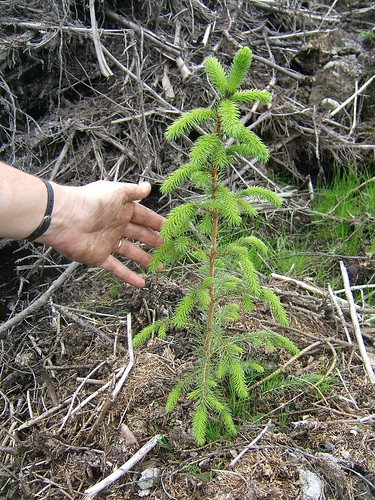
Around 6 months after planting, the trees were already well-established.
In 2014, a further 10 hectares were harvested. The picture below shows this harvesting in progress to the right of the entrance with the area to the left (replanted 2010) growing well.
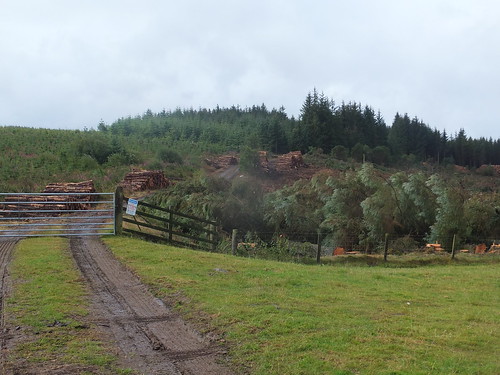
View of the entrance to the plantation during harvesting in 2014.
In November, 2015 the recently-felled area was replanted.
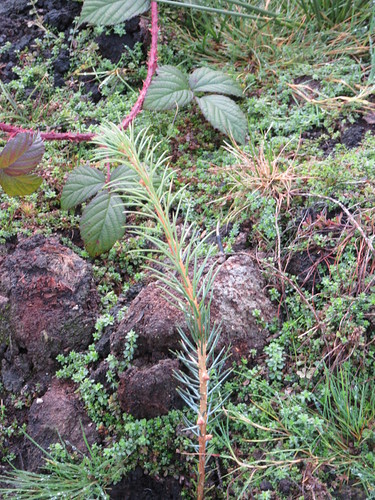
Ty Gwyn, November 2015, Cell grown sitka (1 of 18,000) a few days after planting.
The picture below shows the entrance to the plantation in August 2017. The sturdy trees on the left have had seven growing seasons, those on the right barely two. In the background, there are mature trees not yet harvested.
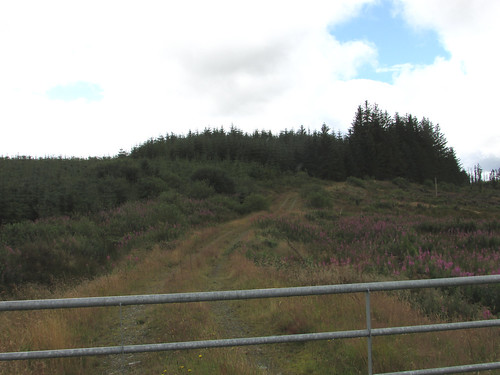
View of the entrance to the plantation in 2017.
Visit to Ty Gwyn on Tuesday, 1st August 2017
Rob MacCurrach, the Forester who'd managed the plantation for some years, was retiring and so this visit was to thank Rob for his efforts and meet his successor, Tegwyn Hughes. The weather was overcast, not too warm and it rained periodically but the three of us spent a couple of hours inspecting the site and discussing future actions to ensure that the crop continues to flourish.

Ty Gwyn 2017: Rob MacCurrach (L) and Tegwyn Hughes (R) examining the 2015 planting.
Related posts on this website
To see all my posts about Ty Gwyn, select Label 'Ty Gwyn'
or click here.
My photograph albums
Where necessary, clicking on an image above will display an 'uncropped' view or, alternately, pictures from may be selected, viewed or downloaded, in various sizes, from the albums listed:-
Ty Gwyn 2017.
All my Ty Gwyn Albums.