skip to main |
skip to sidebar
In the previous post in this series South Georgia (day 1), I talked about my first experiences in this fascinating place. But we were destined to see more...
Tuesday, 8th March 2016
On Tuesday morning, we explored the two and a half mile long steep-sided inlet called Larsen Harbour by Zodiac.
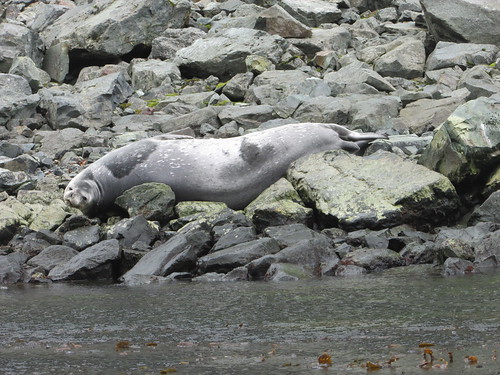 Larsen Harbour: Weddell Seal (about 9 feet long) relaxing on the rocks.
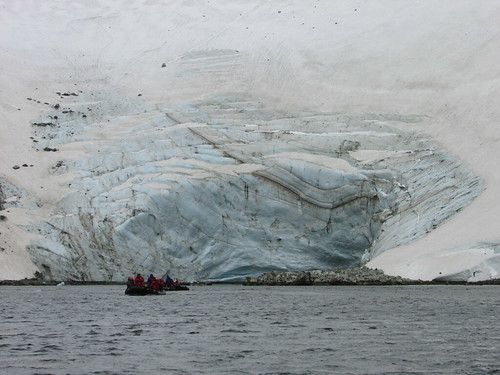 Larsen Harbour: the face of the Glacier.
With everybody back on board, the Captain took our ship for a cruise along Drygalski Fjord, pirouetting the ship when we reached the glacier face so that everybody had an opportunity to appreciate the beauty of the place.
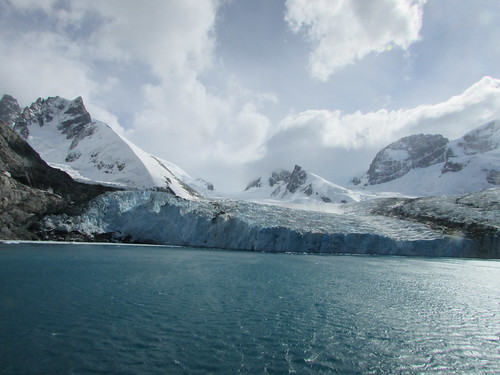 The face of the Glacier, Drygalski Fjord.
 The passengers admire the face of the Glacier, Drygalski Fjord.
Whilst the passengers enjoyed lunch in the dining room, the Captain moved the ship to Cooper Bay where we saw fur seals, King and Chinstrap penguins also Macaroni penguins with their extravagant plumes.
 Life on the beach in Cooper Bay.
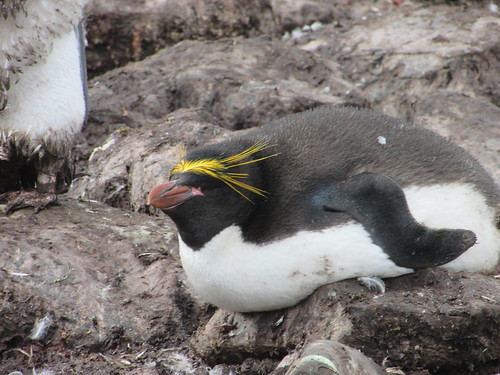 Macaroni Penguin, Cooper Bay, South Georgia.
Related posts
Next South Atlantic post.
All my South Atlantic posts.
My pictures
You can find all my pictures on the trip in the Collection Cape to Cape (still being added to, at the time of writing).
There are a few pictures of the trip in the album South Atlantic Voyage.
['Cape to Cape' collection added 5-Apr-2016]
In the previous post in this series Sailing to South Georgia , I described the two-day journey to reach South Georgia. On the first day in South Georgia, I started to understand why so many of my fellow passengers are returning to this remarkable place after one or more previous visits ...
Monday, 7th March 2016
Around 6.30 a.m. the ship reached northern side of South Georgia and our earliest views confirmed the description sometimes used of ‘The Alps in the Sub-Antarctic’. Through the early morning mists, we could see snow-covered mountain peaks rearing up inland. The ship anchored in the Bay of Isles a few hundred yards from Salisbury Plain – the largest area of flatland in South Georgia, flanked by the Grace Glacier to the West and the Lucas Glacier to the east. After our Zodiacs scouted a suitable beach landing site, passengers wishing to take the “long strenuous hike” were landed. At around 8.00 a.m. the remaining passengers (including me) were landed.
Salisbury Plain is famous for its large colony of King Penguins (estimated at 30,000 breeding pairs) and, as we approached the shore, the racket made by the penguins was apparent before the smell. The beach was made up of large flat stones, quite tiring to walk upon. Although there were hundreds and hundreds of King Penguins near the edge of the beach where we landed, this was not the main colony which we reached by walking east, near the water’s edge. The view of thousand upon thousand of King Penguins was staggering. In addition to filling the width of the beach, many more penguins occupied the low hillside leading inland.
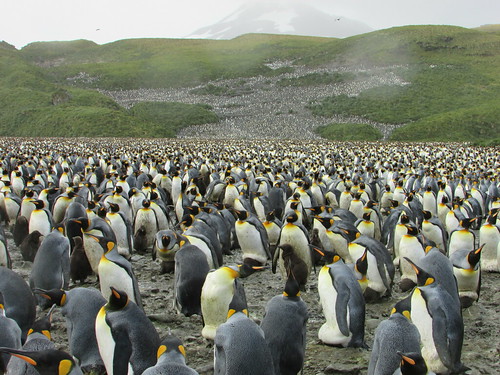 Thousands of King penguins at Salisbury Plain, South Georgia.
Our visit was near the end of the breeding season so, in addition to the young produced by the Early Breeders, incubation was still going on amongst some of the Late Breeders. It was an amazing sight.
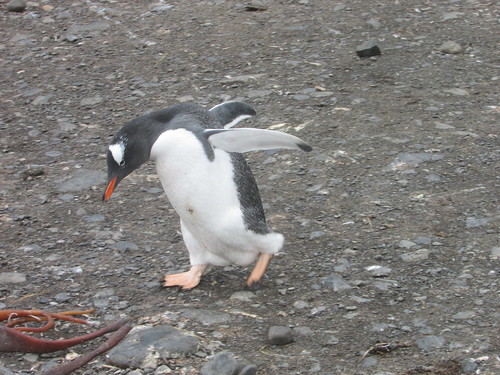 Salisbury Plain: Gentoo Penguin "I'm late, I'm late, for a very important date".
Whilst we took lunch, the ship moved to Prion Island, named after the Antarctic Prions which nest there. Fur seals and Wandering Albatrosses were also abundant. A well-built set of 180 steps made ascent to higher level easy (if you avoided the fur seal pooh). There’s lots more to describe (and lots of pictures to upload), but at least that gives you a brief introduction to this marvellous place.
Related posts
Next South Atlantic post.
All my South Atlantic posts.
My pictures
You can find all my pictures on the trip in the Collection Cape to Cape (still being added to, at the time of writing).
There are a few pictures of the trip in the album South Atlantic Voyage.
['Cape to Cape' collection added 5-Apr-2016]
Although, as far as I’m able, I like to describe these experiences as soon as possible after the event, whilst the memories are vivid, there’s usually some delay. This delay can extend to years, I’m afraid. But I didn’t realise at the time that my internet session on board 'Silver Explorer' on 8th March 2016 would be the last for some days. The next morning, the internet was ‘down’. “Oh”, the ship staff explained, “It’s because we’re close to the mountains”. But even when the ship moved to open water, there was no internet. “We’re looking into it”, came the message. On the 11th March we were told it was a hardware problem which could not be repaired until Cape Town.
I was offered a short satellite telephone call to advise my firm that I couldn’t reply to e-mails already received. A time was booked, early on the 12th March, for me to report to reception, dressed warmly. I was solemnly conducted to the bridge where my guide collected a hand-held satellite telephone and solemnly punched in the number. He then slid open the door to the outside bridge, explaining that a signal could not be received on the covered bridge. This explained the need for warm clothing – there was a strong, chill wind. Although the telephone eventually connected, the link suffered from temporary drop-outsand the howling gale meant that speech my end was almost inaudible. I gathered I’d reached the answering machine, so left a short message.
On 15th March, we spent a magnificent day on Tristan da Cunha. A number of passengers, including me, sought out the Internet Café. Despite an impressive satellite ground station immediately outside with one dish a few metres across and two more small antennae in radomes, the connection was the slowest I’ve suffered for a long time, and suffered periodic disconnections. But, with some perseverance, I managed to send one e-mail to my firm with copies to friends.
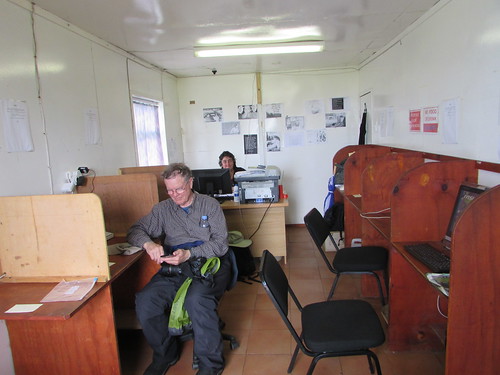 Tristan da Cunha: The Internet Cafe with Brenda at her desk and a ship's passenger using WiFi.
I returned very reluctantly to the ship on the last-but-one Zodiac at 6.00 p.m. to discover that, whilst the ‘Silver Explorer’ had waited all day at anchor, they’d managed to point the satellite antenna manually at the satellite, then reset the whole system after which the automatic tracking started to work correctly (at least for now).
Whilst it’s irritating to be out of touch, it’s also important to realise just how amazing the technology is when working, in allowing a ship to connect to the vast resource of the internet from virtually anywhere.
Related posts
All my South Atlantic posts.
My pictures
You can find all my pictures on the trip in the Collection Cape to Cape (still being added to, at the time of writing).
There are a few pictures of the trip in the album South Atlantic Voyage.
['Cape to Cape' collection added 5-Apr-2016]
In the previous post in this series Stanley, Falkland Islands , I described an enjoyable day spent on land. For the next two days, we were confined to the ship as we sailed towards South Georgia. Now read on ...
Saturday, 5th March 2016
This cruise was originally booked by a travel firm, Apex, who specialise in tours to appeal to people interested in all aspects of the natural world and, particularly, ‘birders’. The expedition team included world-class experts on geology, plants, animals, birds and history. Ashore or at sea the expedition team interpreted what was being seen, or assisted people in locating things (or species) of interest. At sea, there was also formal programme of lectures in the well-equipped theatre. On Saturday, these were the lectures on offer:-
Power of Erosion by Ice – Landscapes of South Georgia and Antarctica by John Buchanan.
Ocean Nomads: The Albatrosses by Peter Harrison.
Ernest Shackleton and the Greatest Expedition of the Antarctic Heroic Age by Victoria Salem.
In addition, there was a ‘Mandatory South Georgia Briefing’ which included a 35-minute Government video. This briefing was in connection with the Bio-security safeguards in place. It is now recognised that invasive animal and plant species represent a real threat to the area’s vulnerable environment and these safeguards seek to prevent the introduction (or transfer between sites) of organic material including animals, plants, seeds, soil or disease.
The bio-security safeguards are taken very seriously: After the mandatory briefing, we had to take all our outerwear, boots, walking sticks to Reception for examination by the Expedition Crew
At sea, the suberb meals available at breakfast, lunch and dinner became, perhaps, even more important, to the passengers. Main meals were offered in offered in the restaurant at the rear of the ship commanding panoramic views of the ocean but early morning tea, coffee or similar were available from 5.00. in the Observation Lounge (deck 6 with views ahead). Meanwhile, the Panorama Lounge (deck 5) offered a bar service from 9.30 a.m. until late evening and a simple breakfast at 10.0 a.m. after the main restaurant had closed, Boillion from 11.00, afternoon tea from 4.00 to 5.00 p.m. and and Tapas from 6.0 p.m. to 8.00 p.m. If the weather was suitable, drinks were also available in the open air bar on deck 6 from 10.00 a.m. to 6.00 p.m, so everyone’s requirements were catered for.
Other facilities available included a Fitness Centre, Beauty and Massage Parlour, The Boutique (general stores) a Steam Room and, in the open on deck 6, two Jacuzzis. I didn’t trouble most of these facilities. Computers with internet access via satellite were available on deck 5, but I made use of the WiFi internet which I could use in my cabin.
Sunday, 6th March 2016
On Sunday,there were similar arrangements. This time, four lectures were on offer during the day:-
The Birdlife of South Georgia by Johnathan Rossouw.
The History of South Georgia by Victoria Salem
The Pugnacious Pinnipeds: Part 1 by Giovanna Fasanelli
Penguins 101 by Peter Harrison
In the afternoon, we passed to only ‘land’ we’d see between the Falkland Islands and South Georgia – the tiny pinnacles of Shag Rocks. The following morning, we would arrive South Georgia.
 Shag Rocks.
Related posts
South Georgia (day 1).
Interlude (notes on the loss of internet service).
All my South Atlantic posts.
My pictures
You can find all my pictures on the trip in the Collection Cape to Cape (still being added to, at the time of writing).
There are a few pictures of the trip in the album South Atlantic Voyage.
['Cape to Cape' collection added 5-Apr-2016]
In the previous post in this series Visiting West Point Island, I briefly described our visit to West Point Island. Now read on ...
Events of Friday, 4th March 2016
After leaving West Point Island, the ship then sailed eastwards during Thursday night, passing firstly West Falkland and then East Falkland, leaving both islands to our starboard. Once clear of East Falkland, the ship turned south to reach the ‘indentation’ in the coast line which led to Stanley. Here, we were sailing west briefly, passing one cargo ship at anchor, awaiting its turn to offload. Stanley Harbour is an oval body of water lying east-west and very protected because the only entrance is via a small opening between Engineer Point (to port) and Navy Point (to starboard), requiring the Captain to turn south again. The main wharves lay ahead, on the south shore of Stanley Harbour with a number of ships in view. Finally, we sailed west again until we were opposite the town itself and its Public Jetty. We anchored in the middle of Stanley Harbour, with good views of the town.
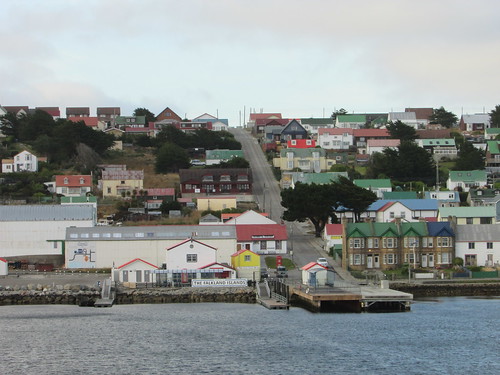 View of Stanley from the ship.
A road trip to Bluff Cove, on the southern coast of the island a few miles west of Stanley had been offered, with the passengers divided into two groups being picked up on shore at nine o’clock and ten o’clock, after transferring from the ship by Zodiac.
I was in the later group but went ashore as soon as transfer of the early group had been ferried to land. Brightly-coloured houses, none more than two stories high lined a number of streets, each running parallel to a promenade on the shoreline. A few of the buildings were brick, in late British Victorian style but most appeared to be wooden-clad with corrugated iron (‘tin’) roofs. Quite a few buildings appeared to have had the wooden weatherboarding replaced by modern plastic ‘planks’ (probably uPVC). I walked west along the promenade, Ross Road, past the Anglican Cathedral, Police Headquarters (including a prison), Catholic Church, the Department of Mineral Resources, the Bank, the Post Office (with traditional British telephone kiosks outside) and the offices of the local newspaper (‘The Penguin’).
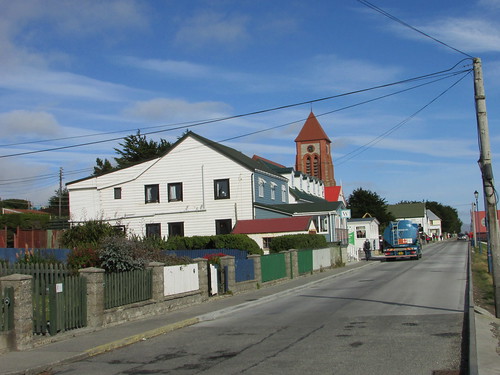 Ross Road, Stanley.
Opposite the ‘Malvina House Hotel’ (named, I was later assured, after the owner’s daughter and not to show sympathy with Argentinian territorial claims) I found the delightful ‘Historic Dockyard Museum’, which provided a very professional display of all aspects of the history and community of the Falklands. Just after ten o’clock, a 16-seat coach picked a group of us up outside the museum but I returned later in the day to this fascinating location.
The 16-seat coach was one of a fleet which took us to Bluff Cove Lagoon. The road climbed out of Stanley past the hospital, power station (with a number of diesel generators) and a satellite earth station to take the tarmac road leading across the rather desolate, rock-strewn plain to the airport. Temporary traffic lights controlled a short section of road where a group of men dressed in the familiar fluorescent yellow aided by modern machinery were engaged in resurfacing work. We passed a quarry on our left which provides stone for building projects, near a group of six wind turbines which, we were told, provides up to one third of the island’s power when the wind is favourable.
As a grim reminder of the 1982 Falklands War, the heathland on the seaward side was fenced off with barbed wire, frequently displaying fading ‘MINES’ notices. Apparently, private contractors are engaged in the work of mine removal. As always, the consequences of war are felt long after the conflict has ceased.
Our coach pulled off the road at an isolated car park, to join two similar coaches and a number of Land Rovers. We divided up into various Land Rovers which set off, in convoy, on a rough farm track leading to the sea.
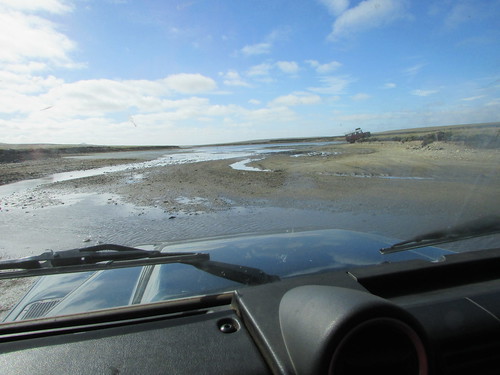 A convoy of Land Rovers took us to Bluff Cove Lagoon.
The need for rugged vehicles soon became apparent as we bounced along the track and forded a stream so we were quite relieved to leave the vehicle when it parked on grassland next to a white beach. We had arrived at Bluff Cove, a 35,000 acre sheep farm which is also host to 1,000 breeding pairs of Gentoo penguins, a small number of King penguins and visiting Magellan penguins, together with various wild birds.
Our enjoyable visit ended with tea and cake in the ‘Sea Cabbage Café’, including scones with jam made from the berries of the local wild Diddle Dee, before boarding Land Rovers for the return journey.
This time, the Land Rovers took us all the way back to Stanley and gave us a short town tour before dropping us near Ross Road. We had some free time to explore the town, shop, have lunch in town or return on the Zodiac shuttle service to the ship for lunch. I stayed in town, dividing my time between the museum, visiting the Cathedral (actually parish-church sized) and taking photographs around the town.
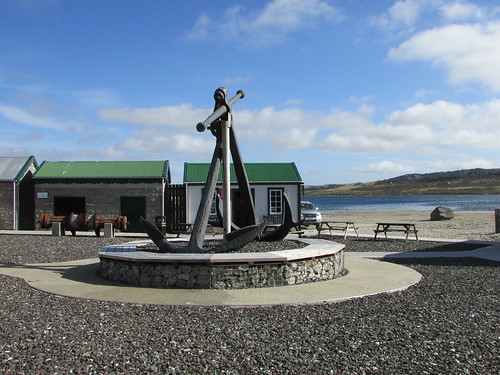 Some of the museum buildings with Stanley Harbour in the background.
The last Zodiac back to our waiting ship anchored in Stanley Harbour was advertised for 3.30 p.m. but I returned a little before the last boat. Once everyone was aboard and the cranes had retrieved all the Zodiacs, we reversed our morning’s route to reach open sea again.
Back in open water, our course was slightly south of due east. We would next have two full days sailing across the Scotia Sea to reach land at South Georgia.
Related posts
Next South Atlantic post.
All my South Atlantic posts.
My pictures
You can find all my pictures on the trip in the Collection Cape to Cape (still being added to, at the time of writing).
There are a few pictures of the trip in the album South Atlantic Voyage.
['Cape to Cape' collection added 5-Apr-2016]
Afternoon of Thursday, 3rd March 2016
In the previous post in this series Visiting Steeple Jason Island, I described our marvellous morning studying penguins and the Black-browed Albatross rookery on Steeple Jason Island. Now read on ...
Once our Zodiacs had returned us to ‘Silver Explorer’ and the hydraulic cranes had been used to stow the Zodiacs onboard, the Captain raised anchor and moved the ship around 30 miles (as the crow flies) south-east to anchor off West Point Island. This island is privately owned but the elderly owner now lives in Stanley. A couple who have sailed around the world on their own boat (moored in the bay awaiting their next expedition) are currently caretakers of what is now a conservation zone.
The ship sent a ‘scout’ Zodiac to the small, stone jetty to make final arrangements with the lady caretaker and, before 3.30 p.m., the passengers had started to be ferried ashore. We were offered a hike across moorland to a clifftop called the Devil’s Nose where there were colonies of Black-browed Albatross alongside Rockhopper penguins. The walk, we were assured, was 1.2 miles but two Land Rovers were available to provide a shuttle service for those who preferred to ride.
I chose to walk but it seemed a particularly long 1.2 miles (and a number of other elderly passengers confirmed my impression). The weather was dry and quite mild when we set off and the trek was very enjoyable, watching the bird life and getting the ‘lie of the land’ but I was quite tired on arrival at the cliff top. The steep way down the cliffs to the various nesting sites was through tall Tussock Grass and I’d experienced that morning the difficulties of moving safely through this dense vegetation. There was also some confusion regarding the exact location of the sites and the best access routes so a number of passengers decided to abandon the attempt. I learned afterwards that a few people suffered slight sprains or immersion knee-deep in mud. By this time, it had also started to rain fairly heavily so, with some reluctance, I decided not to proceed further but to take the next Land Rover shuttle back to the landing point.
Near the landing point, there was a very English-looking cottage reached through a fenced garden where we had been invited to take tea with the lady caretaker.
 The farmhouse on West Point Island where we took afternoon tea.
In addition to providing welcome tea or coffee, the large table was covered with cakes, biscuits and various fancies, all home made. The lady was from Sweden, where there is a tradition, apparently, of providing at least seven different snacks. A Swedish lady passenger found out that they both used the same traditional cookery book! This provided an enjoyable interlude, after which we were invited to explore the gardens. Despite the continuing rain, it was fun to discover the various interconnected plots – formal, wild and vegetable gardens. Around six o’clock, thoroughly exhausted by the exertions of both the morning and afternoon landings, I returned to the ship by Zodiac.
 Home-made cakes on West Point Island.
At 7.15 p.m., there was a briefing in the Theatre regarding the plans for the following day which we were to spend in the capital of the Falkland Islands, Stanley. This was followed by a dinner in the Restaurant on Deck 4. All-in-all, a very educational, if tiring, day.
Related posts
Next South Atlantic post.
All my posts on this trip can be found here.
My pictures
You can find all my pictures on the trip in the Collection Cape to Cape (still being added to, at the time of writing).
There are a few pictures of the trip in the album South Atlantic Voyage.
['Cape to Cape' collection added 5-Apr-2016]
Morning of Thursday, 3rd March 2016
In the previous post in this series Sailing to the Falkland Islands our ship was sailing to the Falkland Islands. Our first landings in the Falklands proved tiring but exhilarating ...
We arrived at Steeple Jason Island around 6.0 a.m. This is one of of the Jasons, a group of small islands to the north west of the main Falkland Islands, West and East Falkland. I took breakfast in my cabin at six so as to be ready for disembarkation by Zodiac a little after seven. Steeple Jason is around four miles long and half a mile wide, lying roughly north-west to south-east, saddle shaped with raised ground at each end (the taller rising to about 1,000 feet above the sea) and a low isthmus in the centre where we made our landing.
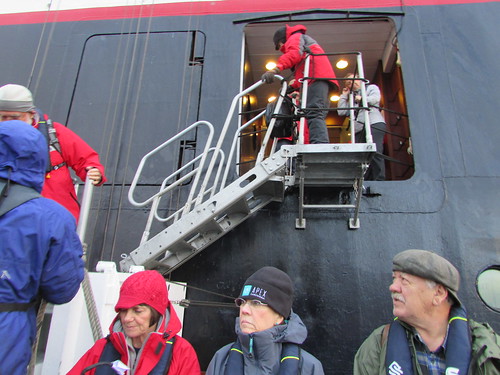 Passengers leaving the ship at Steeple Jason Island for the first landing of the trip.
The sea was calm, there was little wind but our landing was made on to a very rocky shore where the landing party had laid a succession of towels and carpets along a cleft in the rocks to allow us to reach the sparse grassland beyond. Informally divided into various groups, each with a naturalist as guide, we started our walk and soon came to the extensive colonies of young penguins who seemed quite untroubled by the line of people walking by. There were various bird species, particularly the Striated Caracara, who just stood and watched or patrolled the area on the ground, looking for food, equally untroubled by our presence. We continued our walk on rising ground in order to reach the rookery of the Black-browed Albatross, where we expected to see over 1,000 young birds.
 Gentoo penguins on Steeple Jasob Island.
To get close to the rookery, we had to descend, in single file, through luxuriant Tussock Grass which extendied to head height. Our group then stood or sat around periphery of the nursery of young birds. Each breeding pair produces one egg a year which is placed in a dished recess topping a short nesting pedestal and incubated, in turn, by both parents. Once hatched, the chick waits on the nest for a parent to arrive with food. Both parents hunt for food and, on returning to the nest, the parent will feed only its own chick, by a combination of visual recognition and audible signals. We spent a magical hour just watching the mesmerising scene or taking pictures. Jonathan Roussouw was on hand to provide detailed explanations of the life of these birds.
 A Black-browded Albatross chick.
Eventually, Johnathan indicated that it was time to walk back to our landing point and return to the ship by Zodiac. With a certain reluctance, we complied and, over lunch on board, exchanged our morning’s experiences with the other passengers.
Related posts
Next South Atlantic post.
All my posts on this trip can be found here.
My pictures
You can find all my pictures on the trip in the Collection Cape to Cape (still being added to, at the time of writing).
There are a few pictures of the trip in the album South Atlantic Voyage.
['Cape to Cape' collection added 5-Apr-2016]
In the previous post in this series Ushuaia I described the first evening on the ship. The story continues ...
Evening of Tuesday, 1st March 2016
Most passengers were on deck as our ship made its way through the Beagle Channel to the South Atlantic. We passed one small cruise ship heading for Ushuaia - the 'Bremen', operated by Hapag-LLoyd. After we’d enjoyed the very pleasant experience, dinner was available in the restaurant on Deck 4 at the stern of the ship. With windows on three sides, the restaurant always offered good views but on that evening there were spectacular views of the sun setting behind us, to the accompaniment of good food and excellent company.
Seating was not pre-allocated so, from meal to meal, I was able to move from table to table and meet some of the interesting passengers on board. We were just over one hundred passengers, attentively looked after by over one hundred and twenty crew.
After the meal, it was possible to move to the lounge for drinks and conversation with music from Alfredo, the talented Phillipino keyboard player. However, I was happy to return to my cabin (409 on the starboard side, forward) and get a good nights rest.
Events of Wednesday, 2nd March 2016
We spent the whole day at sea, completing the 300 miles from Ushuaia to the Falkland Islands, punctuated by convivial meals in the restaurant for breakfast, lunch and, in the evening after the Captain’s Welcome Cocktail Party, dinner.
I missed the lecture on plate tectonics whilst catching up on e-mails and blogging (courtesy of the ship’s satellite communication system) but I attended Victoria Salem’s interesting account of the history of the Falkland Islands.
In the afternoon, there was the ‘Mandatory IAATO and Zodiac Briefing’ followed by an outline of the plans for the following day. Then, rubber boots were available on loan for fitting, although most passengers had brought their own which were inspected and labelled by expedition staff. In the Theatre, Jonathan Rossouw gave a lecture on Falkland Birds which I was able to follow on the television in my cabin, whilst working on the internet. Then, it was time to get ready for the cocktail party followed by dinner with Isabel and four passengers I’d not talked to before. After an enjoyable evening with my new friends, I returned to my cabin to sort things out for the following day, when we had an early start to go ashore at Steeple Jason Island in the Falkland Islands.
Related posts
Next South Atlantic post.
All my South Atlantic posts.
My pictures
You can find all my pictures on the trip in the Collection Cape to Cape (still being added to, at the time of writing).
There are a few pictures of the trip in the album South Atlantic Voyage.
['Cape to Cape' collection added 5-Apr-2016]
In the previous post in this series Buenos Aires I finished still up in the air en route to Ushuaia. The story continues ...
Events of Tuesday, 1st March 2016
On the Charter flight from Buenos Aires to Ushuaia, I was in an aisle seat without a very good view. Nonetheless, the approach to our destination still impressed me. Fairly unusually for this area, bright sun flooded the area, showing off this isolated, fast-growing town which is surrounded by jagged, snow-covered mountain ranges. Government subsidy has helped Ushuaia, which is situated on the southern tip of Argentina in Tierra del Fuego and accessed by sea from the Beagle Channel, become the main access port for tourists taking cruises in the Antarctic region.
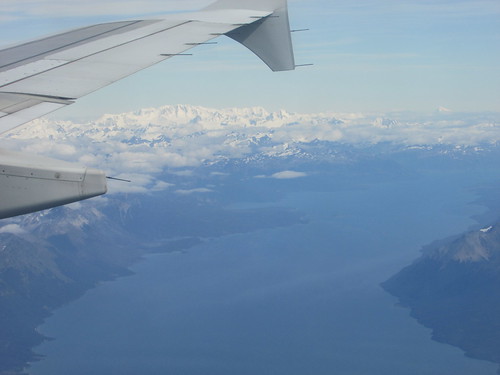 Approaching Ushuaia, with snow-covered mountains in the background
As we approached the small, modern airport, I spotted the outlines of the ship I was joining, the ‘Silver Explorer’, moored at the single jetty which thrusts out from the town into Ushuaia Bay. We taxied to the architect-designed wooden terminal building and were soon walking across the apron, in balmy weather, to be re-united with our checked luggage at the single baggage conveyor. On leaving the rather cramped Baggage Hall, Silversea staff relieved us of our large bags and distributed the passengers amongst three modern, bright blue tour buses.
All this logistical work took a few minutes, then we set off, with the Beagle Channel on our left, towards the National Park area. Whilst the road was surfaced in the town itself, it soon became a dusty, fairly rutted surface of stone. A large Scraper machine was driving up and down a section of this road, repeatedly ploughing the loose stone to improve the surface. We passed the ‘Fin Tren del Mundo’ (the Train at the End of the World), the tourist railway where I was made so welcome on my previous trip to Ushuaia (February, 2007, part of my Round The World Trip 4. Ushuaia is described here and details of the complete trip are here) but carried on for lunch at at the Patagonia mia Casa de Te Restaurant, situated a little before the entrance to the National Park.
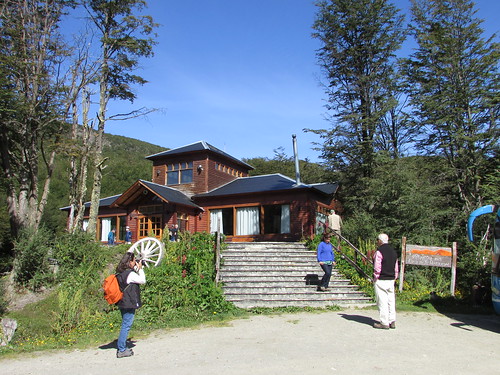 The Patagonia mia Casa de Te Restaurant
After a convivial meal, the buses finally took us to our ship. On board, our passports were collected, an identity photograph was taken and we were issued with our credit card sized ‘room key’ which would also be used to log us off and on the ship during shore visits.
At 5.30 p.m. there was a mandatory lifeboat drill, starting with a briefing in the Theatre, after which we had to demonstrate that we could correctly don our lifejacket. Thus adorned, we were taken, Indian-style, in groups to assemble on deck 6 near two of the lifeboats. We were then released, to re-assemble at little later in the Theatre for introductions to key personnel from the Hotel Department and to the Expedition Team. Before the Cruise Director had quite finished, the ship slipped away from the quay and we all trooped up to the various outside decks to watch the ship make its way down the Beagle Channel as the sun set astern of us.
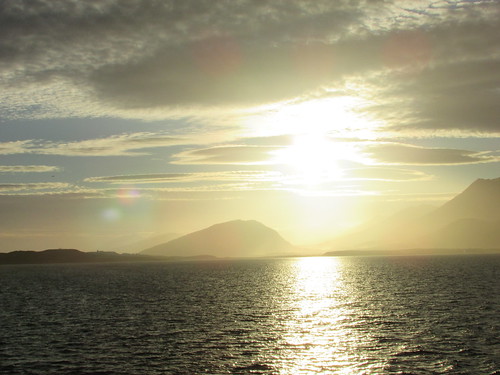 View astern as the ship left Ushuaia.
Many of the passengers were keen photographers or ornithologists (or both) and there was an impressive display of camera equipment on display. By 8.0 p.m., we were losing the light so there was a general exodus towards the Restaurant at the stern of the ship for Dinner.
Related posts
Next South Atlantic post.
All my South Atlantic posts.
My pictures
You can find all my pictures on the trip in the Collection Cape to Cape (still being added to, at the time of writing).
There are a few pictures of the trip in the album South Atlantic Voyage.
['Cape to Cape' collection added 5-Apr-2016]
After stupidly leaving my camera in a taxi, I was a touch depressed. Unfortunately, I have form in this area. Many years ago, in Bangkok, I lost a Nikon on the way to photograph preserved steam locomotives. My trip to St. Helena was threatened when I found I’d omitted to take a battery charger. The purser was very sure that a spare charger could be found in his stock of things acquired, but he was wrong, so I finished the trip using the camera in my mobile phone which was much better than nothing but I did miss the optical zoom my camera provided. Near the end of a recent cruise, another pocket camera suddenly died with the lens turret hanging at a crazy angle. These are motor driven to retract when you switch off – I assumed I’d not waited for the motor to finish its work after taking a shot and that I’d managed to thump the exposed lens whilst energetically climbing stairs.
A possibility was to use the camera in my mobile phone (a different one to that in use on the St. Helena trip) but again I was worried about the lack of optical zoom so, after enquiring locally about camera shops, I decided to explore on foot and see what was available. The answer, it appeared, was very little within my walking limit. Prices were also high, compared with the U.K. but I eventually purchased a Canon from a sort of ‘Argentinian Currys’ called Garbarino.The store was very modern, brightly lit and fully computerised. Language was more of a problem than I anticipated, considering the store was on the main tourist shopping street, Florida, which is pedestrianised. The assistants were, however, used to using their smart phones to capture a phrase using speech-to-text software or typing and then using the internet to translate into the appropriate language. I assumed that, having made a decision, the actual purchase would be quick. I was wrong. As a new customer, the salesman had to set up an account. Although I was asked to supply very little information, the confident keyboard entry seemed interminable. Then, a computer stock enquiry was necessary (I think the stock was held in a room at the back of the store). Next, my credit card had to be checked. A sales voucher was then printed and I was led to an accounts counter staffed by three ladies. Here, payment was taken from my card by both ‘chip and pin’ and ‘signature’. I then discovered that the purchase price was split into two (I wasn’t quite sure why, but the total was what I expected) so a second payment was taken in the same way. The sales voucher was then solemnly receipted by the accounts lady but we were not done yet. I was directed to a Despatch desk, where I waited for a previous customer to complete the exchange of a mobile phone. Then, the despatcher disappeared into stores to locate my purchase which he unpacked in front of me so that we agreed that the kit was complete. After re-packing, the box was placed in a plastic carrier bag and handed to me with a smile. Everybody in the store had been helpful and friendly but a transaction I expected to take five or ten minutes had taken over three quarters of an hour. I realised that I still had much to learn about the ‘South American Way’.
Back at the hotel, I was delighted to find that the broadband really was fast so I decided that, although I was very tired, I ought to try to do a bit of blogging and photograph management, as I didn’t know what I’d find later in the trip. It was very late when I finally reached the large, comfortable bed and I slept well, if not for very long, since my taxi from the Plaza Hotel had been booked for six. I was to travel to Ushuaia on a Silversea charter flight operated by LAN which would take all the cruise passengers. from Buenos Aires Domestic Airport. Flight LA 4962 was intended to board at 07:50 for an 08:25 departure but arrival at the airport was required to be 2 hours before departure, hence the 6.0 a.m. taxi.
 Part of the lobby at the Plaza Hotel, Buenos Aires.
The taxi was a few minutes early but I was waiting after a brief well-presented continental breakfast in my room provided by Room Service. It was still dark when I left the hotel and it had been raining quite heavily during the night. With light traffic it only took around 20 minutes to reach the domestic airport. I identified my flight on the depatures screen and made my way towards the check-in. Suddenly, a porter brandished a printed sign saying ‘SILVERSEA’ in front of me and, when I confirmed that I was a passenger, he moved a tape barrier to allow me to join a small group of passengers who, like me, were joining the tour at the airport. Most of our fellow travellers, I learned, would be arriving in two coaches shortly, having used one of Silversea’s ‘Pre-cruise options’. Presently, a local Silversea lady representative came up, identified the waiting group on her list of passengers and allowed the porter to take our heavy luggage, saying that the bags would magically re-appear in our cabins on the ship. She distributed boarding passes to us, so all we had to do was run the gauntlet of security to enable us to enter the departure hall, overlooking the apron, and wait for our flight to be boarded.
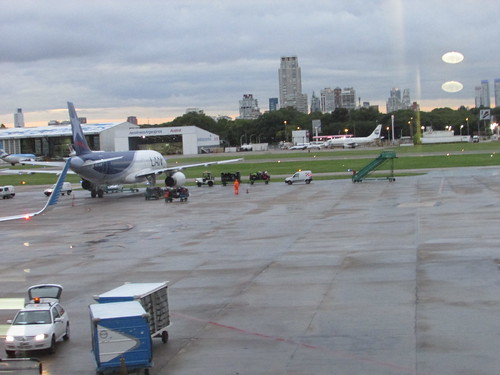 Buenos Aires Domestic Airport, with the city in the background.
Before half past seven, there were more than 100 people waiting near gate 11. It was after eight o’clock when we started to board but everybody seemed quite cheerful and only slightly less pleased as we had to descend stairs to ground level and board a transfer bus. My bus was very, very full but after we’d driven across the apron to a rather tired-looking LAN A320, we discovered at least one bus had already dropped-off a load of passengers, so there were some delays in reaching our allocated seats. I didn’t note our take-off time but we must have been at least 75 minutes late leaving but the weather was good, we were pretty sure our ship would wait for us and the mood remained cheerful.
Next post in this series.
My pictures
When I can, I'll post pictures of the trip to the album South Atlantic Voyage.
You can find all my pictures on the trip in the Collection Cape to Cape (still being added to, at the time of writing).
['Cape to Cape' collection added 2-Apr-2016]
In the first post in this series here, I grumpily described the trip to Sao Paulo. I joined the queue for security which inched forward at a rate which would have shamed any self-respecting snail until a couple of staff appeared and started to divert the rear of the queue, including me, a different route. It seemed that they'd decided to open up another security lane to clear the backlog. Unfortunately, the lane they'd opened only lead to Terminal 2, which none of the queue wanted. Two more staff impatiently urged the 'cleared' passengers down the stairs (no namby-pamby escalators in this part of the airport) and we all, rather naively, assumed they'd made arrangements to route us back upstairs. They hadn't so two passengers opened one of the moveable tape barriers and we appeared at another staffed, but otherwise quiet, security. We quickly gave up trying to explain we'd just been through a different security and submitted to a second check before finally being allowed back into Terminal 3.
There was then a fair walk to locate the TAM Airways lounge, which was quite an impressive affair. Because of the delays we'd suffered, I didn't think I had sufficient time to set up my laptop computer and log on the free WiFi, so instead I had a decent wash before scurrying off on the walk ("allow 20 minutes" the desk told me) to the gate for my onward flight to Buenos Aires. There were plenty of people waiting but no movement. The check-in staff advised me of a 70-minute delay so I traipsed back to the Lounge where one of the girls apologised profusely - they'd been unaware of the delay. I then hunted for a 'fixed' computer. I only found one (not one free, just one computer), carefully set on a high shelf with no high chairs, forcing the user to stand. I assumed this was a cunning plan to stop people from 'hogging' the computer but I hurridly published my first report before returning to the gate.
The crew managed to board everybody and ran the safety briefings. This one was a rather irritating affair with Computer Generated Images. Unfortunately, it was a while before we were cleared to taxi so, by the time we took off from runway zero nine left, we were about two hours late. The Boeing 767 appeared more modern than the 777 on the first leg - I even managed to watch the rest of the James Bond film with sound. However, they were running the passenger cabin so cold, I had to make use of the duvet they provide.
On our arrival at Buenos Aires, when we finally stopped at the gate, everybody was on their feet ready to disembark. Although the air bridge moved across to us, apart from some rather ominous shaking as the air bridge repeatedly 'rammed' us, nothing else happened for about fifteen minutes. Whilst parts of Buenos Aires International Airport are fairly modern, we were clearly at an older part, with older air bridges. I don't know whether this had any bearing on the final late disembarking. Immigration Control was fairly quick and friendly, but did require foreigners to have a photograph and right hand thumbprint taken. One consequence of the delay opening the cabin door was that lots of luggage was already waiting when we got to the baggage reclaim carousel and the baggage loaders were sending through even more bags. At each bend, the overloaded belt was dropping bags on the floor and, just after I spotted the distinctive multi-coloured strap on my bag, the conveyor started issuing painful noises and slowed almost to a standstill. I didn't see what happened next, as I was trying to locate the end of a long queue of people with bags waiting to go through customs. My assumption that over-zealous customs officers were causing the delay was quite wrong - no customs officials were apparent and the customs forms we'd filled-in on the aircraft didn't seem to be being collected. The hold-up was caused by all arriving bags being X-rayed by a battery of machines. Although there were lots of staff in attendance, passengers were being allowed to do all the lifting-on and lifting off. With all the delays, I was more concerned as to whether I would be met in the arrivals hall, as arranged but this, and the rapid transfer by taxi to my city centre hotel, was the one part of the day which went to plan.
However, tired and hot, I'd only just found my room on the 8th floor when I discovered that my camera, which I'd been using regularly from Heathrow until just before arrival at my Buenos Aires hotel, was missing. I assumed it was on the back seat of the taxi, overlooked as I struggled to collect the other items. The hotel reception staff phoned the firm who'd provided the taxi transfer but, at present, nothing is known regarding the fate of this important accessory. As you can imagine, this rather limited my enjoyment of my short time in Buenos Aires as, the following morning, I faced another flight to Ushuaia on the southern tip of Argentina where I was to join the ship for my South Atlantic Voyage.
Related posts
Next South Atlantic post.
All my South Atlantic posts.
My pictures
You can find all my pictures on the trip in the Collection Cape to Cape (still being added to, at the time of writing).
There are a few pictures of the trip in the album South Atlantic Voyage.
['Cape to Cape' collection added 5-Apr-2016]
Leaving Home
I´m always a little sad to leave home but at 4.45 p.m. on Sunday, 28th February 2016, John J. picked me up to take me to Terminal 3 at the hated (by me, at any rate) Heathrow. Here, I boarded flight JJ8085 to Sao Paulo, Brazil. This was a Boeing 777-300 operated by the Bazilian carrier TAM, with whom I´ve not flown before. Before boarding, I made a quick visit to the British Airways Galleries Lounge which TAM passengers use because TAM are part of the ´One World´consortium. We commenced taxiing about right time (21:15) and made our way to the inevitable take-off queue. Runway 09R was in use for take-offs.
Well, the crew were friendly enough but I´ve been rather spoiled by recent flights with Quatar Airways and Emirates - the TAM equipment was not quite so modern, the menu not quite as comprehensive. The aircraft did have video on demand, but I couldn´t get it to work properly, so I had the novel experience of watching part of the recent James Bond film ´Spectre´ with no sound track and subtitles in Portuguese (Brazil´s main language). However, the seat went properly flat for sleeping, so I actually managed some periods of shut-eye, but I still found the eleven-and-a-bit hour flight tiring.
I´ve transited through Sao Paulo International once before. I didn´t enjoy that experience and the second attempt was no better. We arrived at the stand about 06:00 but, for some reason, it took over ten minutes to get the air bridge connected. The airport had been thoroughly rebuilt and enlarged since my first visit which meant that, despite moving walkways in places, the amount of walking was horrendous. I knew I wanted connecting flight JJ8018 for Buenos Aires and Heathrow has issued my boarding pass, but none of the departure screens showed the gate - just saying ´Check-in at area F´. Direction signage was in English and Portuguese but I found the positioning confusing. I realised I´d taken a wrong turn because what I thought was ´Transfer to International Departures´ appeared to lead only to 'Domestic Departures'. I retraced my steps to discover that the queue of hundreds of people which I'd thought was for the enquiry desk was actually the queue I wanted for Security before you could get back to International Departures.
This report was sent from Sao Paulo International Airport, which markets itself as ´GRUAirport´ ('GRU' is the ticketing code for the airport). I unkindly concluded that ´GRU´ might be short for ´Gruesome´. Rant over (for a while).
Related posts
Next South Atlantic post.
All my South Atlantic posts.
My pictures
There are a few pictures of the trip in the album South Atlantic Voyage.
You can find all my pictures on the trip in the Collection Cape to Cape (still being added to, at the time of writing).
['Cape to Cape' collection added 2-Apr-2016]
I've been to Blackpool many times. The earliest trip in this blog here recollects a steam-hauled trip in 1957. My trip in January 2014 is described here and there's a later post about railways around Blackpool here. On 13th February 2016, I thought it was time to go back.
The journey to Blackpool didn't go quite to plan so 'part 1' only describes getting there. Much later, I added 'part 2' here describing my (literally) pedestrian explorations in Blackpool and Fleetwood.
Click on any image below for 'uncropped' view, or search 'My pictures' to view or download in various sizes.
By train to Crewe
Relying on the local bus to reach the station at Wolverhampton, the earliest train I could catch north was the 07:54 London Midland Class 350 Electric Multiple Unit to Liverpool. This took me as far as Crewe. With stops at Penkridge and Stafford, this is allowed 36 minutes to Crewe, six minutes longer than the later Virgin 'Pendolino' at 08:37 from Wolverhampton which is non-stop. With a slack through Norton Bridge (probably because of the ongoing project to construct a flyover junction here) and the seemingly-obligatory stop at Crewe South Junction waiting for signals, we may have been a couple of minutes late arriving.
Whilst we waited for the signal, I mused about the long-gone mechanical signal box at Basford Wood, in between Basford Hall Junction (still, amazingly, a signal box) and Crewe South Junction. Basford Wood controlled a facing connection from the Down Slow to the Down Goods Line and connections from the Up Goods Line (and the Carriage Shed) to either the Up Fast or Up Slow. The trailing connection to the Up Fast remains, controlled by a Ground Frame.
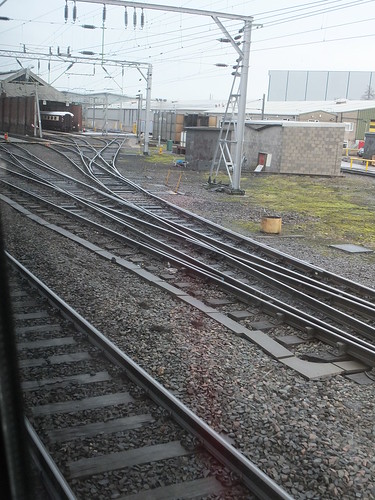
2014 View of the former Carriage Shed on the Up side, latterly the LNWR depot, from the south. Note the two tandem turnouts ('triple leads').
The facing connection from the Down Slow was removed but track of the former Down Goods line remains, still featuring the original bullhead rail. A buffer stop has been placed partway along the line and north of this buffer stop is now called a Down Siding, with a trailing connection back to the Down Slow at Crewe South Junction. I don't think the siding gets much use but I spotted a Virgin-liveried passenger coach parked there a while ago.
 Crewe: South Junction: Stop block on former Down Loop.
The derelict structure of Crewe South Junction signal box remains, as a permanent rebuke to Network Rail. As a reinforced-concrete 'Air Raid Precautions' design, I suppose it's regarded as too expensive to remove, like the numerous concrete World War II fortifications which still litter the country. There's a bit more about Crewe South Junction signal box here.
On arrival at Crewe, I had to wait for the later 08:37 from Wolverhampton to catch up with me. This train was due to go forward at 09:09, arriving Preston at 09:52, giving me around half an hour to leave the station and explore.
Crewe Signalling Centre
Crewe Signalling Centre was supposed to be a 'temporary' affair, presumably accounting for its appearance which I always think looks like a B & Q warehouse. Hiding behind a tall galvanised fence on the site of Crewe North locomotive shed, I've never been able to get a reasonable picture from the railway so I thought I might just have time to leave the station and get a closer look from the nearby housing estate. As I got nearer the railway, there was a forest of standard galvanised railway fencing extending in all directions, marking out the railway boundary, the public car park and the railway staff car park. As I was about to give up, I came upon a spot when one fence panel had been neatly removed and laid to one side. I don't know why, but it could have been to provide an unofficial walking route to the staff car park.
Passing through the opening, I came to the rather forbidding compound of Crewe Signalling Centre, with its extra-tall barbed-wire topped fence, numerous lighting standards with high-intensity lighting fittings and tall poles with surveillance cameras. To prevent 'ram-raiding', a regular series of tough-looking bollards had been set up all around the periphery of the compound inside the fence. Entrance to the compound was via a serious-looking automatic gate with an intercom and card reader. There was space inside the compound for vehicle parking and the end of the building near the parking area was protected by 'Armco' barriers. I concluded this was a defence against employees' poor driving, rather than against 'enemy action'. I managed a few pictures which don't add a lot but do show two Relocatable Equipment Buildings (REBs) in the compound, one provided with a fire suppression system, judging by the external warnings (Since fire suppression systems seek to extinguish or limit fire by the exclusion of oxygen, it's essential that the systems be isolated before staff carry out work in these areas).
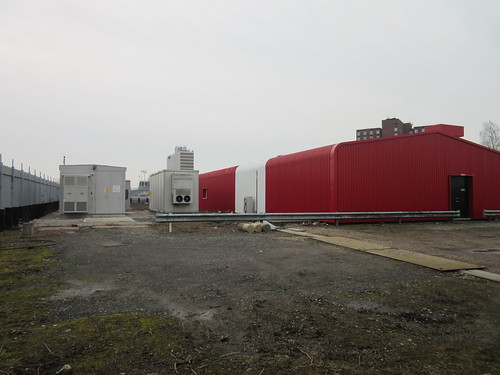 Crewe Signalling Centre (R), with two Relocatable Equipment Buildings (L).
Before returning to the station, I took a picture of the old Cable Bridge which runs across Crewe North Junction and a much newer Cable Bridge I'd not really noticed before (although it shows up on a number of my pictures).
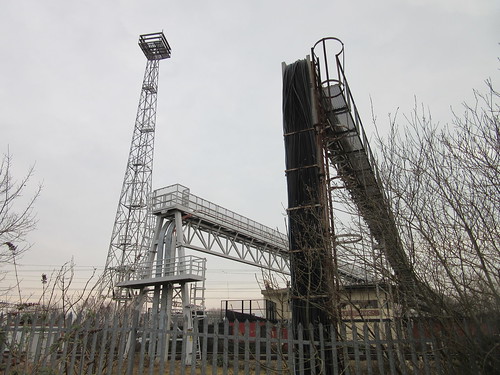 Crewe North Junction: Cable Bridges - New (L), Old (R). The preserved former Crewe North Junction signal box is in the background.
Bewilderment at Crewe
Back at the station, the departure displays suggested my train was already in platform 11 and, indeed, a 'Pendolino' was standing there, with doors open. But there seemed a lot of people hanging about on the platform, rather than boarding. There was an announcement on the public address as I made my way to the platform but coverage at Crewe is rather patchy and I couldn't make it out. The electronic displays mounted in the slidin-plug doors of the train gave the destination as Liverpool. I heard part of an announcement by the Conductor/Guard over the train public address talking about cancellation of the train which would now return to London. If passengers wanted to "abandon their journey" and go back, they were told not to worry about ticket validity. Clearly something was badly amiss. The platform display had changed to show my train as 'Delayed'. The station public address was silent and the platform staff had disappeared. The platform enquiry office had two harrassed looking staff slowing working through a long queue of worried passengers which snaked all the way round the outside of the building. A station cleaner I knew believed the emergency services were dealing with a incident to the north of Crewe.
Trains did not appear to be running on the Manchester line because of planned engineering work. There was one departure shown to Manchester Oxford Road only, but it suddenly got cancelled according to the platform display, without explanation. It was only later I realised that, denied the normal route from Crewe, this train had been scheduled to travel via Warrington and join the Liverpool and Manchester line to Oxford Road, hence the lack of intermediate stops.
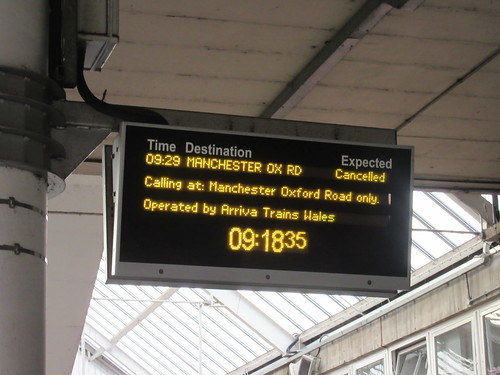 Suddenly cancelled Manchester service.
I realised that Liverpool could be reached by taking a Chester train and then the 'Merseyrail' electrics to Liverpool (as I'd done previously, for instance as described in Birkenhead and New Brighton by train (Part 1)). I vaguely wondered whether to attempt Liverpool this way but, by the time I'd reached the platform, the 2-coach diesel multiple unit was absolutely packed, with a crowd of disconsolate people still on the platform, faced with waiting for a later service.
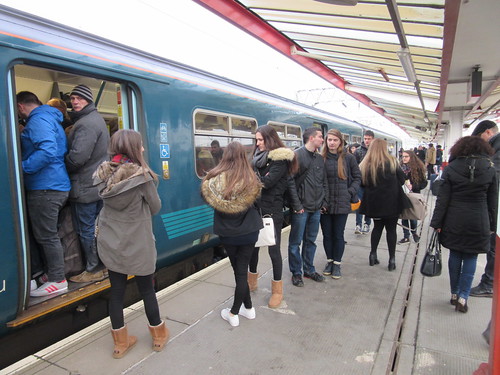 Overloaded Chester service.
Eventually a couple of Virgin staff appeared on the platform and attempted to give some information to the waiting throng. There had apparently been a fatality at Acton Bridge which the emergency services were attending and there would be no trains to or from the north until this was dealt with. One member of Virgin staff acquitted himself, I thought, very well remaining cheerful under the barrage of questioning and trying to make helpful suggestions as to how people might continue their travel or return to their starting point. A train had hit and killed a person at Acton Bridge, he said, adding that Emergency Services are allowed to close a line, in the first instance, for up to three hours but that if it's a straightforward suicide the closure can be as short as one hour.

Bewilderment at Crewe: Virgin staff try to help.
I was surprised that there wasn't chaos, there wasn't apparent anger, just resignation and bewilderment. From time to time, the departure displays would change, replacing one set of incorrect information with a different set of wrong information. Nothing arrived from the north, but various trains arrived from the south and disgorged their passengers. The strategy appeared to be to turn these trains round and send them back. With the unknown delay in getting a train to my intended destination, I wondered whether to head back home.
The 10:02 London Midland Service to Euston via Stoke would have taken me at least as far as Stafford and, since this train was already standing in platform 3 Bay, staff were enthusiastically directing Southbound passengers to it. The train was already fairly full but I couldn't see a Guard or a Driver so I hovered near the open door. Just after ten o'clock, the signal cleared, so I wondered if I was wrong but, after a couple of minutes inactivity, a member of station staff came to find out what the delay was. "I don't think we've got a crew" I said, as he went to check the driver's cab. A minute later, the signal went back to red so, letting a nearby passenger know, I 'bailed out'. The station staff didn't update the waiting passengers and, of course, without a driver or guard, there was no on-train announcement but by the time I'd got level with the nearest platform departure display, it had changed from '10:02 Euston' a few minutes earlier to '11:02 Euston'.
Whilst this little fiasco was being played out, I'd noticed a 'Class 350' arrive from the south and, unusually, run into the little-used platform 12. A few minutes later, a second 'Class 350' followed, also into platform 12. I pointed out to the Virgin staff that their assurances on the 10:02 had not worked out but they were equally confident that the train "already waiting in platform 12" would soon be heading south. The 'Pendolino' which had been occupying platform 11 departed south for Milton Keynes and Euston and the platform departure display immediately changed to show '10:09 Preston'. Very mistrustful of this information, I started to make my way to platform 12 for the southbound train when a non-stop 'Pendolino' roared through on the Down Through line. Does that mean, I wondered, that the line has been re-opened? I returned to platform 11 and, about ten minutes late, what was to be the 10:09 Preston pulled into the crowded platform. I boarded and didn't even attempt to locate a seat on the packed train but located myself by the small window of the left-side sliding-plug automatic door at the rear of the quiet coach, resigned to standing to Preston.
 Bewilderment at Crewe: Arrival of 10:09 to Preston.
The tragic cause of all this was probably not the fault of any of the many railway organisations involved but I do blame them all for the inept handling after the cause and, particularly, for the lack of accurate and timely information to the bewildered passengers.
Continuing to Blackpool
We made reasonable speed as we left Crewe. Beyond Hartford, I noticed a 'Class 350' stationary on the Down Slow, just before the Down Slow and Down Fast converge into a single Down line through Acton Bridge station as far as Weaver Junction. Later, I realised that this was very probably the 07:54 from Wolverhampton to Liverpool I'd travelled on as far as Crewe. This should have passed through Acton Bridge at about 08:45 so it was most likely the train involved in the fatality. Our speed was slightly reduced through Acton Bridge, then we sped through Weaver Junction, where the Liverpool Line diverges to the left.
We were soon approaching the Manchester Ship Canal. There are some historic disused railway bridges on the Up side I've not yet managed to photograph. The original line ran at a lower level under these bridges but, to obtain the necessary clearance for ships when the Manchester Ship Canal was built between 1887 and 1894, a deviation line was constructed to the west with a rising gradient leading to the bridge. I discussed a similar deviation required by the construction of the Manchester Ship Canal further east, at Irlam, in the post By Train to Irlam. As we rattled across the ship canal bridge, I could see Fiddler's Ferry coal fired power station, recently in the news as the owners, SSE plc, announced the intended closure of 3 of the 4 generating units here in April 2016.
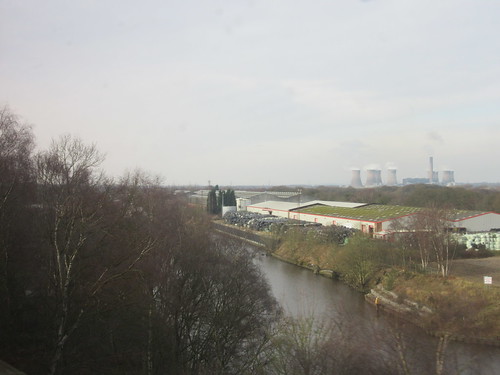 Crossing the Manchester Ship Canal at Acton Grange, with Fiddler's Ferry Power Station in the background.
Our stop at Warrington Bank Quay was a little longer than normal, because of the number of people getting off and on. Then, we were off again. A few minutes after leaving Warrington, near Newton-le-Willows, we entered a sandstone cutting to dive under the Liverpool and Manchester Railway, 'the first inter-city railway in the world'. I've not yet managed a reasonable picture when passing through the cutting but the picture below was taken when passing over the top on 27th July 2013 when I was off to the Museum of Science and Industry in Manchester at the end of a rather crowded few days described in the post A Busy Week.
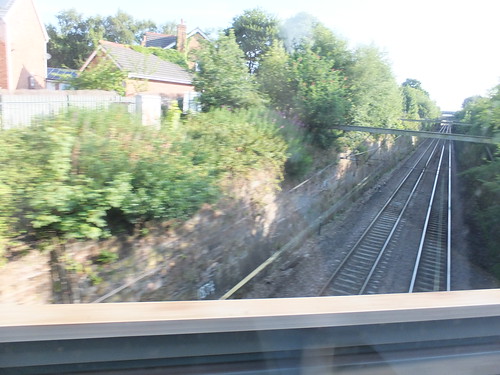 A view taken in 2013 from the Liverpool and Manchester Railway, showing the West Coast Main Line passing under in a sandstone cutting near Newton-le-Willows.
Our next stop was Wigan North Western and, as we left, we passed over the former Lancashire and Yorkshire Railway, with its diverging routes from Wigan Wallgate to Kirkby (change for Liverpool) on the left and Southport on the right. A trip including both of these routes is described in Day Trip to Southport and Liverpool (Part 1) and Day Trip to Southport and Liverpool (Part 2).
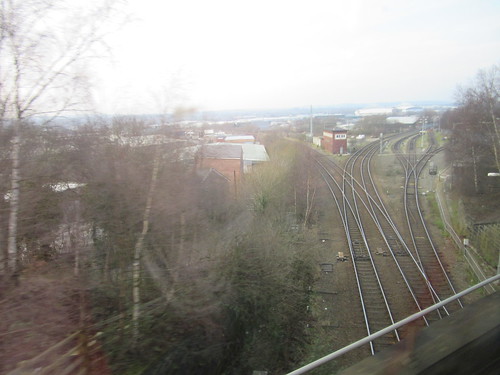 Wigan Wallgate Junction.
We made a fairly spirited run to Preston but were still about as late arriving as the departure from Crewe had been. I quickly made my way to platform 1 for the next Blackpool service - a Northern Rail train stopping at Kirkham, Poulton-le-Fylde, Layton and Blackpool North.
Whilst I waited with the large crowd on the platform for the arrival of the Blackpool train, a Northern Rail single-car 'Class 153' service from Ormskirk arrived on the other side of the island platform, platform 2, discharged its passengers and quickly loaded up, ready to go back to Ormskirk. I described using this line in the post Preston to Liverpool by Rail. My train arrived a few minutes late, one of the dreadful 2-car 'Class 142' units, first introduced in 1985, which still live on although they should never have been foist on an unsuspecting public in the first place. I was lucky in getting a seat for the journey - quite a number of passengers were forced to stand. With 4-wheel, long-wheelbase coaches we 'lolloped' along to Blackpool in what has been politely described as 'nodding donkey' fashion (I'm sure less-complimentary descriptions must exist). With such a crowded train, I couldn't see too much on the journey. I was just glad to arrive in Blackpool at around ten to twelve, when earlier it seemed doubtful I'd make it at all.
Book References
[ 1] ‘British Railways Layout Plans of the 1950’s - Volume 1: ex-LNWR main line, Euston to Crewe’ (Signalling Record Society) ISBN: 1 873228 00 7.
[ 2] ‘British Railways Layout Plans of the 1950’s – Volume 5: ex-Lancashire & Yorkshire Railway Lines in West Lancashire’ (Signalling Record Society) ISBN: 1 873228 04 X.
[ 3] ‘British Railways Layout Plans of the 1950’s – Volume 6: West Coast Main Line (Euxton Junction to Mossband) and Branches’ (Signalling Record Society) ISBN: 1 873228 00 7.
[ 4] ‘British Railways Layout Plans of the 1950’s - Volume 9: LNW Lines Crewe to Euxton Junction, Liverpool to Manchester (and associated branches)’ (Signalling Record Society) ISBN: 1 873228 11 2.
[ 5] ‘Railway Track Diagrams Book 4: Midlands & North West’ (TRACKmaps: 4th edition) ISBN 978-0-9549866-7-4.
[ 6] ‘Along LMS Routes’ by Bill Hudson, Volume 1 Central & Western Divisions (Headstock Publications) ISBN 0 9512793 4 3.
The posts Railways around Blackpool and Railways around Preston list further books.
Related articles in this blog
Halfex to Blackpool.
A Trip to the Seaside.
Railways around Blackpool.
Railways around Preston.
Wolverhampton to Preston by rail.
Return to Blackpool and Fleetwood (part 2).
My pictures
Stafford Area rail.
Crewe Area rail.
Warrington Area rail.
Railways around Preston.
Blackpool's Railways.
Click on any image below for 'uncropped' view, or search 'My pictures' to view or download in various sizes.
Events of Saturday 6th February 2016
By train to Llandudno
Although it was raining quite hard at home when I got up, I decided I would take the first bus to Wolverhampton and travel to Llandudno (a favourite destination) by train.
The first departure from Wolverhampton was an Arriva Cross Country to Manchester which I took as far as Stafford. Whilst waiting for the following London Midland Liverpool train, I was able to study the historical pictures displayed in the waiting room.
 A 1938 view of the north end of Stafford, with the Wellington line (long gone) curving to the left, the four tracks to Crewe in the centre and the Uttoxeter line (long gone) curving to the right.
The London Midland Class 350 made good time to Crewe. As we slowed down into platform 11, I spotted a steam locomotive outside the Locomotive Storage building. From the brief glimpse, I took it to be 'Royal Scot', which I later confirmed. Since I had a while to wait before my connection to Chester, I decided to have a walk down Gresty Road (it was still raining hard). Leaving the station, there was smoke rising from the north side of the Nantwich Road bridge, so the steam locomotive had apparently moved down, ready to shunt onto its steam special train.
When I first visited Gresty Road, it was home to British Railways Signal Workshops, housed mainly in various LNWR-built buildings. I had a number of business meetings here when we were supplying telecommunication systems to the railways (briefly described here and here).
The first long block of offices I came to was typically LNWR - functional yet pleasing. I discovered it's now the Technical Investigation Centre for Signalling Projects operated by the consultants 'Atkins' (who have succumbed to replacing the 'A' in 'Atkins' with an upside-down capital 'V', following the same illiterate convention as the car company 'Kia' which I complained about in the post By Rail to Guildford. In case mis-spelling 'Atkins' fails to confuse the visitor sufficiently, they've also turned the whole name through 90 degrees on the sign).
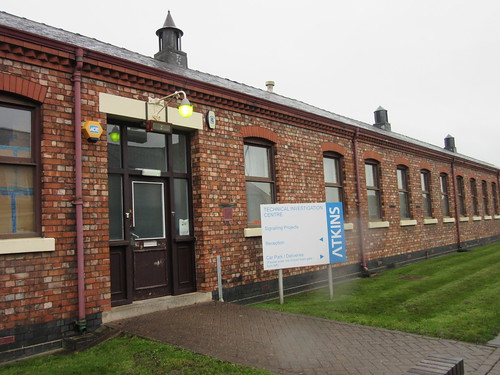 Gresty Road showing Technical Investigation Centre for Signalling Projects operated by the consultants 'Atkins'.
The next group of LNWR buildings are now part of the extensive Unipart Rail site. Opposite, the road leading into a housing estate is called 'Claughton Avenue'. Bowen-Cooke's 4-cylinder 4-6-0 class was introduced in 1913, but named after the then-chairman of the LNWR, Sir Gilbert Claughton (1856-1921)
 Gresty Road showing entrance to Unipart Rail.
I remember when Technical Investigations at Crewe were still part of British Rail. Most of the British Rail signalling workshops were initially privatised as N.R.S. (National Railway Supplies) but it now forms Unipart Rail.
Before turning back, I came to YMCA Crewe. I don't know the history of this modernised building but it certainly looks as if it could have served as a locomens' lodge or similar. Can anyone enlighten me, please?
 YMCA Crewe in Gresty Road.
On my walk back to the station, I tried, unsuccessfully, to get a better view of a complete British Railways standard design signal box and colour light signals on the Unipart Rail site, presumably part of a training facility. But I could read the sign on an adjacent training room:-
Welcome to the
FACULTY ON THE FLOOR
This is where we ..
..learn to use and improve the principles, systems, tools and techniques of the Unipart Way, access best practice developed elsewhere, and develop new ideas and coach each other in their use.
For more on 'the Unipart Way', look here.
Approaching the station, I was joined by large numbers of people I guessed were about to join the steam special. I made my way to platform 9 for the 09:23 DMU to Chester, noting that the steam special was due to follow my train after 6 minutes. Maroon-liveried 'West Coast' stock was standing in platform 12 and 'Royal Scot' with its "blood-and-custard" support coach had already drawn forward onto the Down Chester, awaiting the signal to set back onto the train. After a short pause, 'Royal Scot' backed onto its train, sporting a rather 'posh' storm sheet between the trailing edge of the cab roof and the tender.
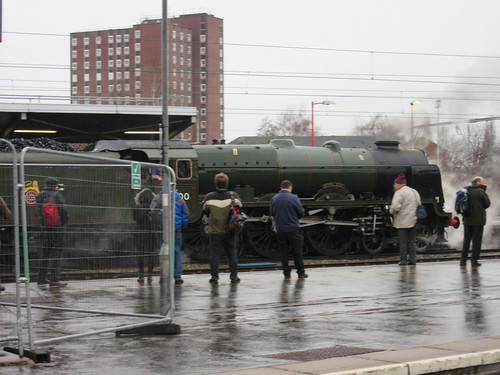 'Royal Scot' (and support coach) backs onto its train in platform 12.
My 2-car DMU arrived and a lot of passengers got off. Then a lot of passengers, including me, got on and we were soon under way for the trip to Chester, where we arrived in the bay platform. A Manchester - Llandudno train was expected in a few minutes, so I positioned myself on platform 3B (the western end of the long down through platform) ready to board the connection and I was soon under way again. I noticed a significant police presence on the station, which was probably due to the following steam train. The middle aged men with cameras hanging around were certainly there for 'Royal Scot'.
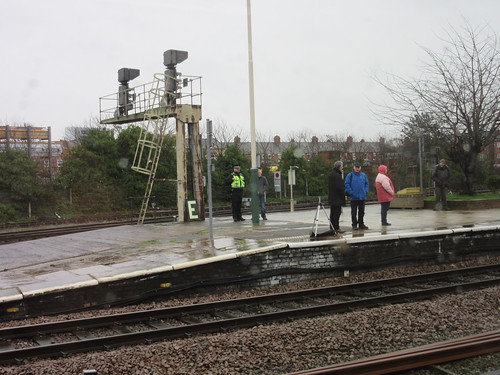 Chester station, waiting for 'Royal Scot' on the Holyhead Private Charter.
These enthusiasts could also be seen as I continued to Llandudno Junction, despite the inclement weather, not just at stations but also at various farm gates along the line. I'm afraid I didn't see the steam special again myself after leaving Crewe.
When we paused at Shotton Low Level, I was interested to see rodent traps deployed, because I'd noticed these at Shotton High Level on an earlier trip (8th March 2014), described here.

Shotton Low Level Up Platform (with what appears to be a rodent trap at the base of the lamp post).
We made our scheduled stop at Fflint (more enthusiasts), sped past the now very sad looking 'Duke of Lancaster' (which still has a website here), stopped at Prestatyn then Rhyl. The line is only double track now but a number of signal structures remain cantilevered 2-doll brackets which originally served the 4-track route, now equipped with just one arm. Distant signals are a mixture of colour light and semaphore.
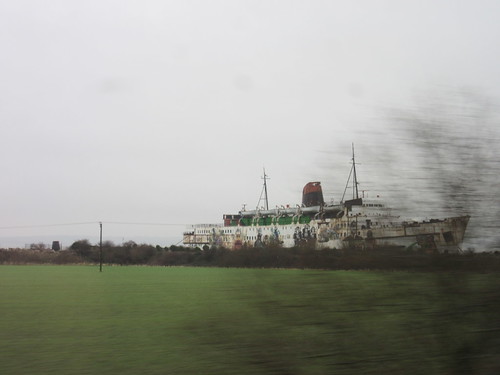 The beached 'Duke of Lancaster'.
Beyond Rhyl, we hurried through Abergele in the rain without stopping. When I was young, I always thought this a romantic railway location - four-track with platforms flanking the outer slow lines, Camping Coaches on the seaward side and a dignified LNWR signal box in the middle of it all. Now, it's just 2-track but the down line throws off a loop to the platform line. The facing points leading to the down loop are controlled by two rodding runs - one for the Facing Point Lock, one for the points themselves. The trailing points just need one rodding run to operate the points. Signals around the station remain LMS upper-quadrant. There's a series of posts in this blog about British railway signalling, starting here. Mechanical Operation of Points is described in Part 6. I'm happy to report that, for some reason, the signal box has avoided the worst of the structural alterations I usually complain about and, whilst there are external changes, it looked 'right' (at least from some vantage points). I spotted the expected contingent of steam enthusiasts sheltering under the awning on the Up platform, waiting for 'Royal Scot'.
We stopped briefly at Colwyn Bay which has lost two of the four platforms I remember,together with some of its station buildings, its LNWR glazed screens and is no longer a block post. Between Colwyn Bay and Llandudno Junction, the line was quadruple from 1904 to the 1980s, when it reverted to double track and the A55 Expressway took over the freed-up land. This section of line has a place in railway history for two reasons, which I'll cover in a later post.
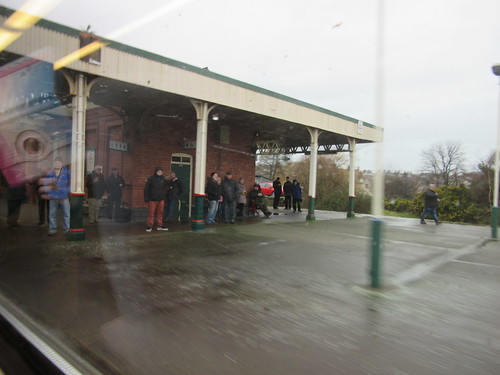 Stopping at Llandudno Junction. Note the steam enthusiasts awaiting the arrival of the following 'Royal Scot'.
After another brief stop at 'The Junction', we were soon underway on the final, short leg of our journey. Deganwy is now shown as a 'request stop', and we sailed right through on this occasion.
It was still raining when I got off the train at Llandudno but, undaunted, I set off on foot along Vaughan street to the promenade, crossing the end of the main Victorian shopping street, Mostyn Street, at the delightfully named 'North Western Gardens'.
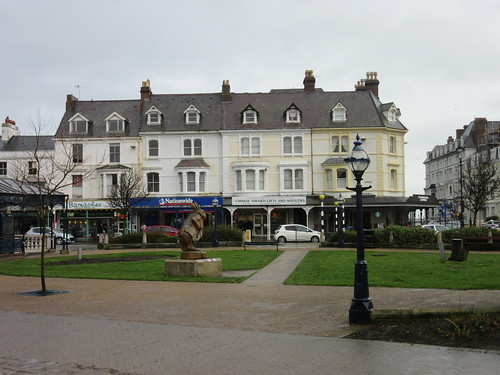 View across North Western Gardens showing the canopied shops in Mostyn Street.
The modern shopping centre, with its large car park, lay a few yards on my right - I don't believe I've ever visited it. Arriving at the promenade near the Imperial Hotel, the curve of the bay between the Little Orme and Great Orme headlands, with the wide pedestrian promenade and the arc of hotels facing the sea, captivated me, as it always has. I happily walked along the promenade towards the pier.
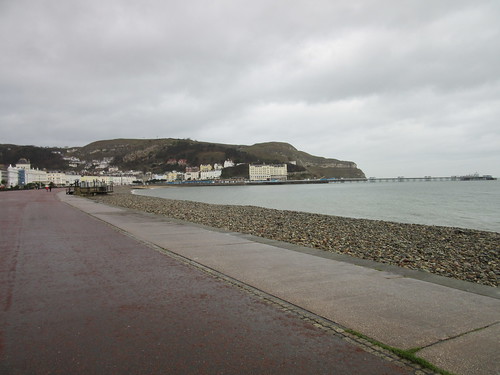 Llandudno: The Promenade looking towards the Great Orme, with the pier on the right.
Much of the beach is shingle but, near the War Memorial, there is often a sandy stretch until the tide comes in which I was happy to share for a while with a few children and dogs. I then headed away from the sea via St. George's Place, crossed Mostyn Street and continued along Lloyd street to the Town Hall, where the local 'Lions Club' were holding a charity Antiques Fair which I decided to support.
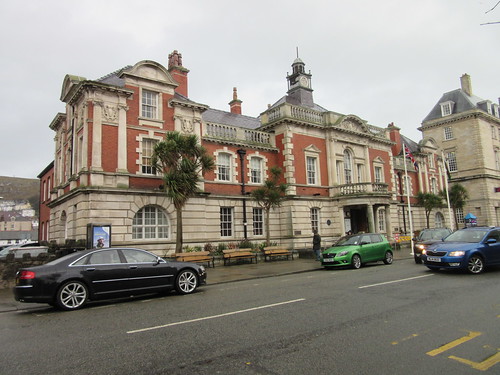 Llandudno: The Town Hall.
On one stall, I was surprised to find two black-and-white framed locomotive photographs which I recognised as North British works photographs. One was 'Royal Scot' as built and I commented to the stallholder that I'd seen that very engine (in its rebuilt form) a little earlier. I resisted the strong temptation to purchase it, instead selecting the picture of ill-fated 6399 'Fury'. This experiment in the use of high-pressure steam was abandoned and the locomotive was rebuilt as a conventional 'Royal Scot'.
Near the Town Hall is the famous fish and chip restaurant 'Tribells' so I decided to try their take-away service. Both fish and chips were cooked while I waited (reminding me of fish and chips I had in Sydney on my Round the World One trip in 2001). I started to eat as I walked back to the prom and then sat watching the grey sea. The rain had stopped and the food was excellent. Two seagulls patiently waited on the tarmac a few feet away as I ate - a bit different from a few years ago when they would 'dive-bomb' for food. In view of their good manners, I allowed a small piece of fish to fall as I disposed of the polystyrene tray in a litter bin. I later found notices warning against feeding and littering but there was certainly no litter left!
I made my way back to Mostyn Street to look at some of the shops. Opposite Marks and Spencers, there's the Victoria Centre with its roof-top car park. It's cod-Victorian, not real but does capture some of the atmosphere of the original Victorian shopping arcades, so I don't object to it too much. Many of the shops along Mostyn Street retain Victorian canopies over the pavement (with various degrees of modernisation to keep them watertight). I was soon drawn back to the Promenade and decided to patronise the covered terrace restaurant at the Imperial Hotel, where I enjoyed a toasted teacake and a pot of tea tea with panoramic views of the sea.
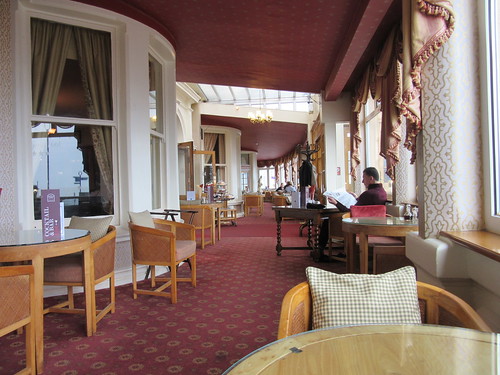 The Terrace at the Imperial Hotel.
I'd made a note of trains back to Wolverhampton in time to let me take a bus back to my village, so I reluctantly stirred myself from the Imperial and made the walk to the station, which took around ten minutes. The LNWR station buildings have been quite tastefully modernised, so I took a few pictures before joining the waiting train - a 3-coach 'Class 175' only going to Llandudno Junction before returning to Llandudno.
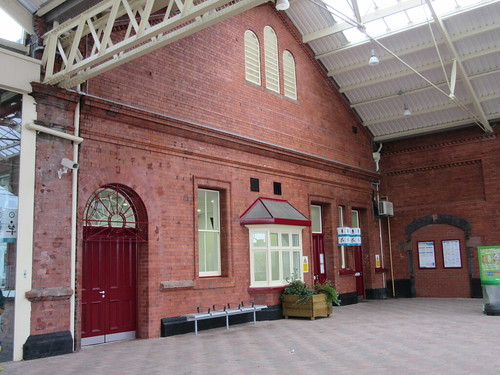 The modernised concourse at Llandudno station.
I boarded at the front of the train and noticed that the cab door was open, because the Driver was in the passenger section chatting to another railwayman. The friendly driver readily agreed to my taking a couple of pictures of the cab before he left.
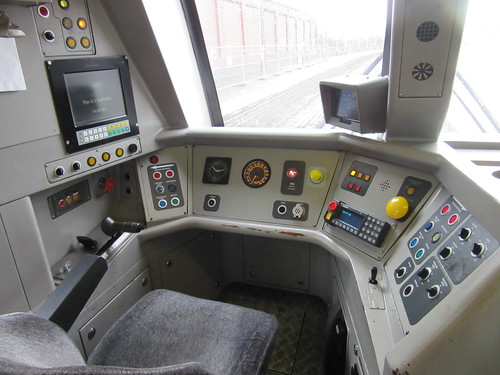 Cab View of 'Class 175' at Llandudno station.
This time, we paused at Deganwy and I took a rather grey picture of Conwy and its ancient castle as we departed. There's a bit about Conwy, its river bridges and castle in my post Trip to Holyhead (Part 2: Llandudno to Holyhead).
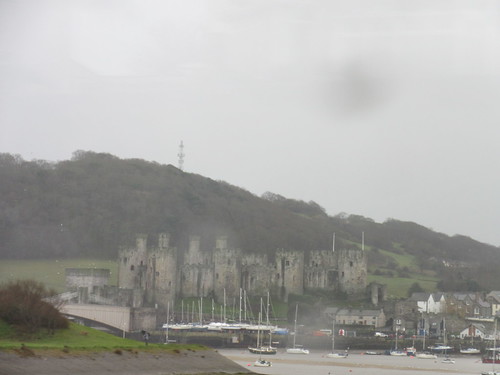 Conwy viewed from Deganwy.
I only had a few minutes to wait before my connection arrived - a 2-car multiple unit which made a few stops before Chester. Here, I had a choice - I could stay on the train which reversed at Chesterand took the former Great Western Railway route through Wrexham and Shrewsbury, calling at Wolverhampton before continuing to Birmingham International. The alternative was a Virgin Voyager service to Crewe, changing to a London Midland Electric Multiple Unit to Wolverhampton. The cheerful Welsh lady Conductor/Guard, having checked my ticket, used her portable ticket issuing machine to confirm the timings via Crewe. She recommended staying on her train, which would arrive at Wolverhampton only about five minutes later than the alternative involving two changes.
But, of course, with my allegiance to the "Nor'Wessie" and its successor the L.M.S., I chose to change at Chester and Crewe. Although I was getting fairly tired, I managed a few more pictures of the imposing station buildings at Chester, before boarding the 'Quiet Coach' at the rear of the Virgin 'Voyager' already waiting in platform 4.
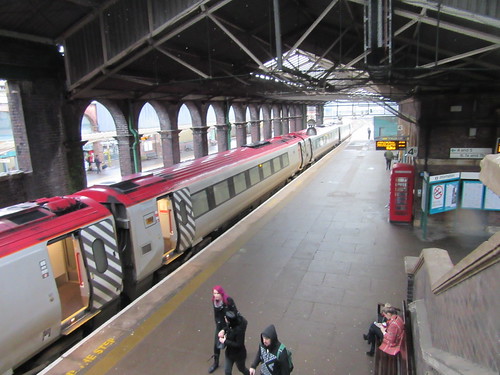 Virgin 'Voyager' from Holyhead to London at Chester.
Fortunately, the rest of the journey back to Wolverhampton worked well, the bus was on time, so I was back home happy but fairly exhausted. The next day, I was on the footplate at Peak Rail!
Book References
[ 1] '‘British Railways Layout Plans of the 1950’s - Volume 1: ex-LNWR main line, Euston to Crewe’ (Signalling Record Society) ISBN: 1 873228 00 7.
[ 2] ‘British Railways Layout Plans of the 1950’s - Volume 10: LNW Lines in North Wales, Chester and Wirral areas’ (Signalling Record Society) ISBN: 1-873228-12-0.
[ 3] 'An Historical Survey of Chester to Holyhead Railway Track Layouts and Illustrations' by V. R. Anderson and G. K. Fox (Oxford Publishing Co.) ISBN 0 86093 216 8.
[ 4] ‘Along LMS Routes’ by Bill Hudson, Volume 1 Central & Western Divisions (Headstock Publications) ISBN 0 9512793 4 3.
Related articles in this blog
A Trip to the Seaside (Part 1).
A Trip to the Seaside (Part 2).
Trip to Holyhead (Part 1: Crewe to Llandudno).
Trip to Holyhead (Part 2: Llandudno to Holyhead).
The Holyhead to Crewe Railway Line.
Llandudno.
Llandudno Railway Station.
My pictures
Stafford Area rail.
Crewe Area rail.
North Wales Line (Crewe - Llandudno).
Llandudno (pictures around the town).

