skip to main |
skip to sidebar
I was quite sorry to be leaving the St. Regis Hotel. I took breakfast around 7.00 a.m. and then returned to my room to try to finish off the 'Work work' I was doing. I just managed to e-mail it before checking-out. My guide and driver and I set off about 9.20 a.m. for the long drive to Shigatse. I think it's 280 km and we did it in five hours with a few brief stops but no toilet or meal breaks.
We headed through reasonably heavy traffic to the south west of the city, crossed the Lhasa River and took Century Road leading to the dual carriageway highway serving the airport. A railway appeared on our left which was apparently the extension of the railway to the west beyond Lhasa. Its construction was similar to the line I travelled on – embankments, bridges and tunnels. Construction was clearly well-advanced here with track laid. I saw one Engineering train hauled by a blue diesel electric locomotive.
The dual carriageway came to an end and we continued on a single carriageway with a line down the middle which some drivers didn't seem to notice. Apparently, this is the G318 road which runs (or will run) from Shanghai to Nepal. There were milestones, sorry, kilometre markers every kilometre and, since the numbers start at Shanghai, numbers were already in the four thousands. After a while, we came to a sudden stop with vehicles heading in our direction all over the road and traffic coming the other way getting through only with difficulty.
From the apparent chaos, I assumed it was an accident but, no, it was a traffic checkpoint. Our guide took the driver's credentials to the office and returned after a few minutes with a piece of paper. I didn't really get to the bottom of it but, most importantly, the paper showed our time leaving the checkpoint. We were then to report to the next checkpoint in not less than an hour.
 Congestion at a traffic checkpoint. The saluting policeman in the background is a dummy.
The new railway was still alongside and we passed a depot with two large portal cranes. It looked as if they were involved in loading prefabricated sections of concrete-sleepered track onto Work Trains or, possibly, actually being used to assemble the track 'panels'.
The river valley we were travelling through became narrower and we lost the new railway for a while. It re-appeared high above us on the right, emerging from a tunnel. We were now travelling with a turbulent river on our left and a practically vertical rock wall on our right. This section was not without its problems as there had been a number of rock falls onto our road. A gang of men with long shovels were attempting to clear the rock away. Reluctant to slow down, our driver was swerving from side to side to find the clearest section of the carriageway.
The logistical problems in building a new railway in such a mountainous, inhospitable area were becoming clear. There were frequent Work Camps, from which temporary construction roads fanned out to reach various Work Sites. The larger Camps could be spotted by the array of storage silos for cement and other materials. Camp walls, tunnel mouths and bridges often had some sort of exhortation in large, red Chinese characters. After passing one such camp near a tunnel mouth, the new railway crossed the road on an incomplete long-span bridge. The railway was then to continue on a viaduct of a large number of 'standard' concrete spans but only the tall, concrete bridge piers had been completed, suggesting the relentless march of an army across the countryside.
 The new railway to Shigatse under construction.
Further on, the new railway was lost from sight as it scrabbled across loose scree. Then, a tunnel mouth would appear, confirming where the line would be when finished. At another work camp, I saw a row of ready-mixed concrete lorries parked up. They clearly provide a shuttle service from the work camp to each of the work sites where concrete is required, using the temporary construction roads I'd seen earlier. Putting aside political considerations, I couldn't avoid being impressed with the organisation which could tackle such a job.
We passed a broad concrete arch road bridge which I at first thought was a new road bridge. It became clear that it was the bridge which formerly carried the road we were on undergoing major repairs, because we plunged onto a very temporary road of loose roadstone and approached the river bank a few hundred yards past the arch bridge where a 'Bailey Bridge' had been set-up. We crossed the river and made a fairly terrifying passage on another stretch of loose roadstone to join the 'Old Road' next to the arch bridge. The tarmac road wasn't always very good, but it was better than the loose roadstone!
 The concrete arch road bridge under repair, forcing traffic to cross the river on a temporary Bailey Bridge.
We passed kilometre marker 4759 shortly before approaching a river crossing for the new railway. Two tall piers set in the river carried two 'half arches' balancing one another, so that each pier looked like a letter 'T'. In the middle of the river, the two 'half arches' joined to form a complete arch. The other two 'half arches' rested on substantial piers on either bank. There were then a series of 'normal' bridge piers which, once fitted with 'standard' pre-cast bridge sections, would form the 'approach spans' on either side of the river. Adjacent to each of the four main bridge piers there was a yellow-painted tower crane, essential to making this bridge-building a possibility.
Further on, we passed another construction site where a single-arch concrete bridge was being built over the river, apparently for a road. The method of construction here used an 'aerial ropeway'. On our side of the river, a massive 'A' Frame had been erected. A number of suspension cables were then laid to the other side of the river where, I think, they were terminated in a massive concrete block. Two 'trollies' ran on the suspension cables, capable of being hauled back and forth across the bridge under construction. Finally, each trolley carried a hook for lifting and lowering loads. Multi-sheave pulleys were in use because of the weight of the concrete bridge sections which were being dealt with.
Later, the new railway crossed onto our (right) side of the river then we crossed to the left. I could see why the road builders had chosen the left bank – on the right bank a steep mountainside, full of loose rock, came down to the water's edge. But the railway builders had no option but to scrabble a route through a series of tunnels and bridges. At one point, the railway had built a tall bridge pier carrying two 'half arches' forming a 'T'. But in this case, the ends of the 'half arches' rested on either side of a deep ravine. The railway popped out of a tunnel on one side of the ravine, crossed the 'T' and immediately entered a tunnel on the other side of the ravine.
With the new railway running high on the mountain side, some of the construction roads giving access to the work sites looked pretty 'hairy'. Since our road was being used to serve all the main work sites (we saw plenty of road cement tankers!) in at least a couple of places, the railway builders had needed to build their own river bridges to link Work Camps up on the mountain on the right with our road on the left.
We stopped for a rest for a few minutes at a road junction where the side road led to the Chamchin Monastery. The peace of the remote spot was frequently interrupted by the air horns of the 8- 12- and 16-wheeler lorries rushing past.
 The side road leading to the Chamchin Monastery.
My Pictures
Lhasa - Shigatse by Road
[Pictures inserted and link to pictures added 22-Aug-2013].
I arose about 6.10 a.m. and had a decent breakfast in the restaurant. I then worked on the computer until around 9.20 a.m. when I went to reception to meet my guide.
Once in the waiting car, we set off for Drepung Monastery, north west of the city. My admission ticket had a potted history on the reverse (in tiny print) which I think stated that Drepung Monastery is one the six largest monasteries of the Gelupa Sect, set at the foot of West Valley Mountain about 10 kilometres from Lhasa. It was built in 1416 by Jamyang Choje Tashi Phlden, a disciple of Tsong Khapa. Over ten thousand monks resided there before liberation. The six main temples are Gaden Palace, Tsochen, Ngakpa, Losaling, Gomang and Dyeyang. Many important relics are kept here. There are three monastic colleges for the study of philosophy and one for the practice of Tantric Buddhism. The monastery covers an area of over 20,000 square metres.
 The Main Gate at Drepung Monastery.
The monastery is set on a steep mountain side and considerable new building work was going on. As we climbed to the main assembly hall, we passed rows of Prayer Wheels and two water-driven prayer wheels. We entered the main assembly hall which was impressive in size. The whole place suggested antiquity and spirituality. Neither the guide nor I could enter the one small temple marked 'PLEASE DON'T COME IN WOMAN THIS CHAPEL' in English (presumably the Chinese version above the English said something similar). Although there were a number of Tibetan pilgrims around, the place remained quiet and reverent. Once again, a big contrast with the Potala Palace. I found my first butter lamp powered prayer wheels. A small butter lamp is placed under a glass case and the rising warm air turns a fan attached to a lightweight prayer wheel suspended above. Soon I was suffering complete overload from the number of temples, images, thangka (religious wall hangings) and other treasures but I found it a wonderful visit.
 One of the many chapels at Drepung with numerous Stupas (reliqueries) behind the painted statue.
A short car ride took us to Norbulingka. The name means 'Treasure Garden or 'Treasure Park'. My admission ticket here was imaginatively in the form of a plasticised card with an image of the buildings which appears three-dimensional as you 'rock' the card. It was originally built in the mid-18th century by the 7th Dalai Lama Kelsang Gyatso as his summer residence (the Potala Palace was the winter residence). Expanded over the years, the gardens cover 36 hectares and form the largest horticultural park in Tibet. The site became a World Heritage site in 2001. It was interesting to see the former residence of the present exiled Dalai Lama but, for me, the site lacked the impact of Drepung Monastery.
 Completed as recently as 1956, the Dada Mingjur Palace was the residence of the present Dalai Lama prior to exile.
We drove back to the city centre and the guide and I were 'dropped off' by the driver. We walked through the commercial area near the Jokhang Temple to an upstairs restaurant where we sat by an open window offering splendid views of 'the passing show'.
At lunch the previous day, I'd been amused by the number of menu items incorporating Yak. It reminded me of a Monty Python comedy sketch called, I think, 'Spam' set in a restaurant where a diner was unable to find any item which wasn't 'Spam'. At lunch on Sunday, I wrote down the items on their extensive menu which included yak. I was amazed at the list:-
Yak Noodle Soup
Yak Sizzler with Noodles and Chips
Yak Steak with Chips and Vegetables
Yak Pizza
Yak Burger
Yak Curry
Yak Chilli
Yak Biriyani
Yak BBQ
Yak Skewer
Yak Spring Roll
Yak Thukpa (?)
Yak Momo (?)
I thought that was an impressive list, but another dish caught my eye called 'Tashi Delek with Vegetables and Rice' because, in Bhutan, 'Tashi Delek' is a greeting, something like "How are you?". My guide said that 'Tashi Delek' meant the same in Tibet, but she couldn't tell me what it meant as the name of a dish. So we asked the waitress and I thought her answer made a perfect finale to my All-New 'Yak' sketch.
“Tashi Delek? It's Yak with extra rice”.
After a leisurely, enjoyable meal, we walked round the corner to the Jokhang Temple. Started in the year 647 a.d. by King Songstan Gampo, it was subsequently extended to an area of 25,100 square metres. Because of its antiquity and its treasures, it is particularly special to Tibetans and regarded as the holiest site in Tibet – unlike the Potala Palace, Tibetans do not pay for admission. I believe foreigners are only allowed to pay and enter in the afternoon, leaving the Temple free for Tibetans in the morning. Recognising its importance, the State Council have listed it as one of the important cultural 'relics' to be especially protected. Not sure about the 'relic' tag. There were plenty of Tibetans around when I visited in the afternoon and the Temple appeared to have a vital significance to them which maintained the spirituality of the place, despite the large number of foreigners milling around. An excellent visit.
 An inner courtyard at the Jokhang Temple, showing the gilded balcony where the Dalai Lama formerly appeared.
We concluded the day by walking along Barkhor Street, Lhasa's oldest commercial street and part of the Pilgrims's circum-ambulatory route around the Jokhang Temple. I saw two fairly young male pilgrims working along the route, chest protected with a stout apron and wooden-faced 'mittens' on each hand allowing them to fully prostrate themselves, flat to the floor, every couple of yards, oblivious of all the commercial activity around them. That takes some stamina and a strong belief.
 The pedestrianised shopping area around Barkhor Street is a magnet for Tibetans and visitors alike.
We passed through the Muslim area of the city. There is quite a sizeable Muslim immigrant population in Lhasa and near the Mosque (rebult in 1960) many shops are operated by Muslims, including a number of butcher's shops where large sides of meat are displayed next to the pavement. I didn't enquire, but I imagine it's yak meat. A few yards further on, we came to my hotel and I said goodbye to my guide after an exhausting but very interesting day.
My Pictures
St. Regis Hotel, Lhasa, Tibet.
Lhasa, Tibet.
Dprepung Monastery, Lhasa, Tibet.
Norbulinka, Lhasa, Tibet.
Jokhang Temple, Lhasa. Tibet.
The alarm went off at 6.00 a.m. but I decided to sleep a little longer. It was half past seven when I woke and I still felt a little fragile but I got up and made my way to the restaurant for a buffet breakfast. I had tea, porridge, bread and orange juice – less than I would normally have when 'on tour' but enough.
 Buffet breakfast at the St. Regis Lhasa Resort.
I had time to write some more about my trip and e-mail it before making my way to reception where my guide was already waiting. Outside the driver was ready with the car so we set off into the traffic. The population of Lhasa is only 140,000, I believe. The population of the whole of the Tibetan Autonomous Region is around three million but a proportion of these are immigrant Chinese.
The driver stopped near the Potala Palace and the guide and I walked to the entrance, which was thronged with visitors, mainly Chinese. The view of the massive bulk of the Potala Palace is an iconic image I've known all my life – it was remarkable to actually see it for myself. It's now a World Heritage Site and attracts large numbers of visitors. From ground level, we made our way up the broad, stone steps which zig-zag up the front of the building to the entrance to the White Potala.
 The Potala Palace, Lhasa.
The Potala Palace, started by one of the early kings of Tibet, came to represent the two powers of religion and politics. The White Potala is the name given to the lower floors which deal with civic administration – political power. The upper floors – the Red Potala - are devoted to religious matters. I'd previously seen this dual structure on my visit to Bhutan for there the Dzongs incorporate both religioua power and civil administration. The entrance to the White Potala is wooden, heavily carved and with painted decoration. Inside, the lobby contained huge wall paintings. We started to ascend the complex internal structure by stairs and along passages. At various points, there were openings in the outer wall to let in light, revealing the substantial construction and great thickness of the walls which have resisted earthquake damage for centuries. We reached an open square which was the last point at which photography was allowed.
As we continued to climb within the Red Potala, the press of visitors became more intense. Admissions are strictly timed, but the authorities still cram in so many visitors that it is difficult to obtain a proper perception of what is an enormously important building. Continually being buffeted by unmannerly visitors (and, particularly, being hit by swinging backpacks) rather weakens spiritual considerations. I'm afraid commercial considerations rule under the current administration. A few monks, around ten I think, sit in various parts of the Palace. I can only imagine their thoughts on the continuous stream of humanity passing before them but in one room we received an 'assembly-line blessing' from one of the monks. In places there are window openings to let in light but, generally, the rooms are gloomy. There were large Butter Lamps everywhere. The broad metal bowls were filled with butter made from yak's milk, in which a row of perhaps ten wicks were positioned. These lamps appear to serve the dual purpose of providing illumination and devotion. At many points, visitors made donations and showed respect. I commented to the guide that many of the visitors seemed to have religious beliefs and were pleased to make donations, yet seemed rather lacking in good manners. My guide shrewdly commented that giving money comes from "the outside, not the inside". She went on to say that few native Tibetans now visit the Potala, resenting the fact that a charge is now levied. We processed through a number of temples and past impressive stupas holding relics. It is an amazing rabbit-warren of a place. With so much wood used in the construction, fire is an ever-present danger. I noted the odd fire main or canvas fire hose and there were frequent wooden cupboards with hand-held fire extinguishers. Many of the rooms had a Fire Watchman, easily recognisable by their orange overalls. My guide started looking at her watch and I asked what the problem was. She explained that not only are entrances strictly timed but you are allowed one hour to complete the tour of the upper rooms. If you are even one minute late checking out, a fine of 100 Yuan is levied, she explained.
Well, we made it on time to the checkpoint, then descended the steps at the rear of the Potala Palace to ground level. A short walk reunited us with our driver and transport.
All three of us had lunch at a Tibetan Steak House. The menu had English translations and I saw you could order Yak Steak, Yak Fritters, Yak Burgers, a Yak Sizzler (which my guide opted for) and other Yak specialities. I had a Tibetan vegetable soup and Spaghetti Carbonara (very Tibetan). The food arrived quickly and was good. My guide insisted I sample her yak meat and I agreed with her that it was similar to beef.
After lunch we drove to the Sera Monastery in the north east of the city. This is a major training centre for monks and the atmosphere was immediately different from the pressure of the Potala Palace. Now, there were many Tibetan pilgrims and most of the foreign visitors were westerners. We took a leisurely walk along the road which leads past the various buildings comprising the monastery. My guide pointed out the building where elderly monks are looked after by younger monks.
This monastery is famous for its religious debates which happen at 3.00 p.m. daily and I was keen to see a debate. We came to a crowd of people, mainly westerners, waiting next to a closed door in the wall alongside the road and joined them. A little before three, the gate opened and we all filed into an open courtyard. The centre of the courtyard was gravel and it was surrounded by a roughly circular raised pavement. There were a number of trees around the outside and a couple on the gravel. Most of us set on the edge of the pavement dangling our feet into the gravel. Others remained standing. At three o'clock promptly a couple of young monks and an older, dignified monk whom I took to be the pupil master entered via another gate. Over the next few minutes, more monks arrived from all directions, some carrying a square cushion, until the must have been 30 monks present.
The monks broke up into groups of three or more. In each group, one monk remained standing, all the others sat on cushions facing the standing monk who would declaim some religious question in a theatrical tone and the seated monks made reply. Frequently, the standing monk would perform a stylised movement ending in a loud handclap accompanied by a cry (my guide informed me) of "wake up from your ignorance". With so many groups all performing in a small space, it was a fairly noisy affair. Of course, I couldn't understand a word but it was still hugely entertaining and very good-natured. There was a lot of smiling from the participants which I found infectious. Visitors were coming and going all the time so, after half an hour or so, my guide and I left, although I would happily have stayed longer.

The religious debate at Sera Monastery.
You can see a short video of the debating here. When you've seen the video, the Back Button will return you to this post.
On the way back to my hotel, we stopped at a Tibetan carpet workshop and showroom. I was very impressed with the intricate work involved and spent some time looking at carpets for sale but in the end, I did not make a purchase.
Back at my hotel, I spent a quiet evening checking my e-mails, writing up my recollections, backing-up my photographs and even doing some "work work" for Ford Electronics
My Pictures
St. Regis Hotel, Lhasa, Tibet.
Lhasa, Tibet.
The Potala Palace, Lhasa, Tibet.
Sera Monastery, Lhasa, Tibet
[Video of Sera Monastery added 23-Jul-2015]
With diesel traction on the front we left the station at about twenty to one in the morning. I slept until 2.00 a.m. to find the train had just stopped. I couldn't see anything until ten minutes later when a passenger train passed in the opposite direction. We'd clearly been waiting on a passing loop for the section ahead to clear. I looked out again about 3.00 a.m. and it seemed very misty.
We stopped in a passing loop at about 3.45 a.m. and five minutes later another express in the opposite direction passed us. I slept again until we slowed for another station. After a wait of about 6 minutes, we carried on, passing another station that was not lit up at about 6.25 a.m.
 A rather bleak view across the Tibetan Plateau.
We were certainly on the Tibetan Plateau and quite high-up – the grassland had white patches of snow or heavy frost and white fog banks obscured the view from time to time. As it started to get light, I could see a road parallel to us on the left with many lorries. The largest lorries were articulated with long six-wheel trailers and the load sheeted-up. The road was commonly built on a bank of 1 or 2 metres and sometimes marker posts (presumably reflective) were fitted on either side of the road surface to discourage vehicles from plunging og the bank. These poles could be as tall as around 8 feet or as short as 3 feet but in many areas, no markers were provided, even when the road was on a bank little wider than the carriageway. I spotted a religious stupa in the Tibetan style. This, combined with the prayer flags we'd passed in a number of places confirmed my belief that faith was still a powerful force in Tibet. At regular intervals, we passed cellular radio towers. Some of the had elaborate solar arrays nearby. I'd noticed that passengers on the train had no difficulty in making calls on their mobiles, even when we were in remote places.
At 7.15 a.m. we negotiated another passing loop with a short passenger platform. This was near a fair-sized town with a river running through it, Tibetan-style houses, a petrol station with a massive forecourt and overall roof, a large Tibetan stupa and lots of prayer flags. Leaving the town, I watched 8-wheeler lorries negotiating minor roads which were sometimes only dirt-tracks. I eventually realised that the herds of long-haired cattle were yaks. Out in the country, I saw an isolated road-mending camp complete with either tar boilers or coated roadstone plant.
Half an hour later, we passed another small station but not much in the way of the community it served was visible. By 8.15 a.m. we were rolling through another station, provided with large station buildings in the modern 'Triumphalist Chinese' style - I realised later that this was Tanggula, at 5,068 metres the highest station in the world.
I wasn't feeling too good – I'd developed a blinding headache and felt very sick. I suspected it might be 'Altitude Sickness'. At 9.20 a.m. we paused for a few minutes at An Duo station, where the station nameboard gave the elevation as 4,702 metres. On boarding the train at Xining, I'd seen a number of small oxygen bottles sitting at the end of a coach and I'd photographed the installations in my cabin but I don't know whether my diagnosis was correct. I did have similar symptoms when I stayed in Cuzco, Peru, which is also quite high.
 Our route took us alongside a lake at high altitude.
At 9.45 a.m. a large lake appeared on the right and this remained with us for some time. There was another passing loop with a station platform right next to the lake shore. I managed to sleep for a time, waking at half past eleven as we ran through a station with the passing loop occupied by a train of track maintenance machines and coaches which I assumed provided accommodation for the workers.
At 11.40 a.m. our speed reduced to a crawl and I guessed, correctly, that we were approaching another passing loop and that we had not yet got the signal to enter the loop. After a few minutes, out speed picked up. There were four loops at this location. The leftmost was occupied by track maintenance machines and coaches, this time with a red diesel electric attached to the Lhasa end. Waiting on the line next to us was an eastbound passenger train, headed by one of the huge 2-section diesel-electric locomotives used on this line. We passed another eastbound passenger train in a simple passing loop around 12.08 p.m. This time, the other train must have cleared the section ahead earlier, because our speed didn't reduce to a crawl.
At Dang Xiong, I could see a substantial town and the station had three through platform lines plus a fourth loop line. We entered the rightmost platform line because this was the platform with all the station buildings and road access. After a five minute stop with quite a lot of passenger activity, we set off again at 12.33 p.m.
At 1.15 p.m., we were routed through the middle one of three passing loops without stopping. Nearby, there was evidence of possible peat cutting as fuel for the stoves every dwelling is provided with. It seemed likely that dung may also be used as a fuel and perhaps a building material, gluing together the rounded stones that are commonly used to construct dwellings. But there are also plenty of buildings made from rectangular building blocks held together with cement.
We were still passing tents pitched against the railway fence, some with the Chinese flag outside and either a motor bike or small car parked nearby. There was usually a polythene-sheeted mound nearby – the stash of supplies or fuel for the stove or both.
We didn't have to slow at the next station, either. There were three or four lines through the station. An eastbound passenger train with the customary massive 2-section locomotive was waiting on one side of an island platform whilst we sailed by on the other side of the island platform.
The scenery was becoming much more rugged and we encountered a series of tunnels. The first was the longest and it took us nearly three minutes to pass through. As we plunged into the tunnel, I spotted the neat Guard House with a proper, uniformed guard on duty. There were four more tunnels, much shorter and then we passed through the small station of Ang Ga – just two lines with a platform on the right hand line.
We crossed a river and I noticed a small yard on the river bank making building blocks. There was one corrugated iron workshop building, presumably where the blocks were moulded, a drying yard with hundreds of blocks laid out and, out in the open, one large capacity cement mixer. It occurred to me that the adjacent river probably provides the sand, gravel and water, only requiring cement to be bought in.
I didn't manage to get the name of the station we ran through at 1.42 p.m. but there was a large factory with railway access on our left. I couldn't work out what the factory made.
It was clear that our line was descending through the river valley, raised on viaducts and crossing the river a number of times to get the best route. The main road was still following us, making its own choices as to the best route to follow. Although we were running through a fertile valley, tall mountains lay on both sides in the background with mist trailing from the mountain tops and streaks of snow in the shaded parts.
We were still passing the periodic radio transmission towers but in this area, the towers bristled with CCTV cameras, unlike the earlier installations we'd passed. The weather was still overcast but now it was also definitely wet as well. We passed some sort of market with lorries, horses and more than a dozen gaily-decorated tents.
 A colourful but puzzling event at a small town.
At 1.50 p.m. we ran through the small passing station of Gu Rong. The rock face was very close to the railway and was strewn with loose boulders. As I'd seen earlier, a heavy netting had been fixed over the rock face to protect the railway.
At various points along the line, I'd seen the Tibetan version of the 'polytunnel' form of greenhouse. But now we passed a 'polytunnel city' with the structures crammed together extending over many acres. They build one solid, straight wall to about six feet in height. A large number of roof members then extend, in an elegant curve, from the top of the wall to the ground. The roof members then support a polythene roof.
 Part of 'polytunnel city'.
At these somewhat lower levels (Lhasa is still 2,650 metres elevation), we passed more human habitation and more industry.
At 2.00 p.m., we slowed for the larger station of La Sa Xi (Lhasa West). There was a major high voltage switching station on our left, with an army of transmission towers marching to it across the landscape from a number of directions. There was a rail-connected petrol depot also on our left. On our right, there was an extensive goods depot with a horde of lorries delivering to, or collecting from, long lines of covered bogie goods wagons. There was also a group of private sidings wandering off but I couldn't see where to.
After the complexity of La Sa Xi, we returned to a single line but the character of the countryside had changed. We were in the developed corridor leading to our destination with major roads (some dual carriageway), apartments and industry. We crossed over a broad river, overlooked by a Guard Tower perched high on the rock face then, on an embankment, headed into a single line tunnel. Above us, the major road swooped across us on a viaduct before plunging into the same mountain using twin tunnels.
There was a large group of sidings on our right full of bogie tank wagons guarded by a blue diesel electric locomotive. The trackwork now became complex and fanned out into (at least) six platform roads. We passed under a huge all-over roof and slowly made our way along the broad platform 1. At 2.14 p.m. we had arrived in Lhasa!
I was feeling a little better and hauled my luggage into the corridor. There was a slight delay as a numbered of uniformed railway officials were in a compartment further down my coach assisting the party there onto the platform. Waiting actually on the platform was a car and a people carrier to collect the party and their luggage. I didn't actually see who had been in that compartment, but I think I found out what happened to my original tickets!
 On arrival at Lhasa, passengers from my train swarm along the platform towards the hall where document checks are carried out.
There were crowds of people making their way along the platform towards the exit and hundreds more presumably waiting to get onto the train for its return journey. I had hoped to have a look at our locomotive but it had uncoupled by the time I got near and quietly dropped forward onto what is currently a headshunt but I believe will become an extension further into Tibet.
There were a number of parallel queues shuffling through the massive hall so I joined one, wondering what happened next. Most people had a credit card sized identity card and they were passed through quickly. I saw one family diverted to a small Police Office. I presented my passport and Special Tibet Visa. Another official was immediately summoned and, very politely in reasonable English, he asked me to follow him. We went outside to where there was a separate building which seemed to deal with foreigners. There were quite a few people apparently waiting for attention but I was cleared almost immediately. Explaining that I was expecting to be met, I was then led outside to a barrier with guides waiting for their charges. I immediately spotted a young girl displaying a computer-printed 'Jan Ford' sign and once the official had checked that the guide had a copy of my 'Special Tibet Visa' he wished me an enjoyable stay and went to find other customers.
My guide, Tse Dol Kar, a young married Tibetan girl with one daughter, spoke good English and led me to a Toyota SUV and driver waiting nearby so I was soon loaded on board and we were on our way to my hotel. I was pretty tired but happy and not a little relieved. I'd made it!
 The reception area at the St. Regis Lhasa Resort.
The St. Regis Lhasa Resort was the first international luxury hotel in Tibet, opened in 2010 and part of the Sharwood Group. It fully met my expectations – the staff were friendly, attentive and with good English. Once my guide was happy with the arrangements, she arranged to pick me up at 10.30 a.m. the next day and wished me goodnight. I decided to have a bite to eat – the cod fillet with lemon butter sauce and mashed potatoes was one of the best pieces of fish I've had. Accompanied by a glass of Coke and followed by two scoops of vanilla ice cream, I was very satisfied. Soon, I was in the huge bed and slept quite well. Tomorrow - the famous Potala Palace.
My Pictures
QingHai - Tibet Railway.
St. Regis Hotel, Lhasa, Tibet.
I'll give you a very brief description of the train journey. I appreciate that not everyone is a railway enthusiast, so I'll try to omit the technical bits and save them for another report later ('Thank goodness', I hear you cry).

My 4-berth cabin. The rose was plastic.
When boarding, I hadn't had a chance to look at what was on the front of our train but the overhead electric catenary continued to the west of Xining so I presumed we were electric hauled. The journey was very smooth and I was impressed. Looking at the railway infrastructure, it appeared well-maintained and I concluded that these were serious railway people. That's not to say that the occasional 'bodge' did not appear, but the overall standards were very good. The similarities with the Russian Railways I was able to study last year (see my posts Trans-Siberian) were significant, apart from the track gauge – China is 'standard gauge'.
After we'd been travelling a little over half an hour, the uniformed coach attendant came round and gave me a Passenger Health Declaration form for completion. This certified to the QingHai – Tibet Railway Company that I was fit for travel at elevations above 3,000 metres above sea level. Xining was two thousand something metres elevation, Lhasa is 3,600 metres elevation but on the way, we would climb to around 5,000 metres elevation. My paper train tickets had been inspected when I boarded but not collected so the coach attendent swopped my tickets for plastic credit cards identifying the berths I was entitled to use but not the date or route. Near the end of the journey, she then swopped the credit cards back for the paper tickets which I still have.
We passed a large group of sidings on our right full of bogie coal wagons. This appeared to be the loading point. I spotted the screening plant but not the source of the coal which I assumed was opencast.
Initially, we were running through an industrial area but eventually this gave way to grassland with rolling hills and lakes but it was very noticeable how many high voltage power transmission lines were following our route. Electrification of any country is important but China, with its high growth rate, has made big demands on its electricity grid. I found the rural areas reminiscent of Mongolia (where I made a brief visit last year, described here). From time-to-time, we passed traditional buildings with arrays of prayer flags nearby.
 Traditional buildings and prayer flags on the grassland.
Also dotted around the grassland, there were a few tents, each with a stove pipe sticking through the roof. Some of these were rectangular, some round (but not having the proportions of the Mongolian 'Gyr' tent). I concluded that these were used by nomadic herdsmen and this seemed to be confirmed when I started to see long-haired cows, mainly black, wandering free.
Periodically, there were tents erected just outside the railway fence but I thought at least some of these were used by railway security workers for we frequently passed lone men wearing either 'High-Visibility ' jackets, Army Camouflage or various uniforms. Some of them stood to attention or saluted as we passed (often standing on a dais made of concrete slabs), some of them waved at the train and some totally ignored us. In addition, we passed periodic properly-built two-storey guard rooms. Here we could expect to see at least one man in a smart uniform saluting the train. Incidentally, at stations, the staff stood to attention sometimes with a salute as we passed – this is something you can also see in Russia.
After we'd been travelling about three hours, we passed through a large station and turned off to the right on a curving single line. Looking along the continuation of the double track main line we'd left, the track bed continued to two tunnel mouths, but there was no track! I can only assume this was a new piece of railway still under construction.
Our electrified single line now started to look more like Switzerland, with mountains rearing up left and right and our route twisting first to the left, then to the right to find a way through. At least I was able to catch a glimpse of our locomotive on the curves and confirm that it was a single electric unit.
Some of the cuttings we negotiated had been stabilised with a steel mesh.
Because we were on a single line, there were loops every few kilometres, allowing trains travelling in opposite directions to pass one another. At the first of these loops, we went straight through, passing a waiting freight train on our right loaded with military tanks. We went straight through at the second passing place.
At Nanshan, we passed another waiting freight and then the line certainly emulated Switzerland in order to lose height, for it corkscrewed to the right, then to the left, sometimes crossing under itself and continued in this fashion for a bewildering few kilometres. From time to time, the rock wall loomed very close to the line, in other places strong fences had been erected to protect against falling rocks.
 In the mountains between Nan Shan and Luo Bei, the railway twists and turns, sometimes crossing under itself.
Finally, we passed through a tunnel curving to the right and then made a broad sweep to the left to take us to the passing loop at Luo Bei where another freight was waiting for us to clear. A couple more tunnels took us to a fairly complex junction where a double track line joined on our left. We passed through without stopping but there were at least two more freight trains waiting on parallel tracks. After three more tunnels, we passed the small station of Mulan.
By 9.00 p.m. it was pretty dark. I didn't get the name of the large station we stopped at but seven minutes later, we were on the move again. I wasn't feeling brilliant so I decided to go to bed early. I was fairly comfortable on one of the lower bunks but I'm not used to sleeping in a single bed. I slept intermittently until midnight when perhaps the sound of a passing train woke me. Ten minutes later we stopped at a large station whose name I didn't get. As we rolled in, I'd seen a massive 2-section diesel electric in the sidings and I wondered if this was where the traction changed to diesel electric – it was. There was a roadway next to us on the non-platform side and I was not surprised to see a number of workers waiting for us to stop.
In the 30 minutes we stood at the station, at least four 'honey wagons' passed alongside emptying the lavatory tanks. Our coach was provided with two toilet cubicles – one with a 'western style' pedestal W.C., the other with a 'squat' toilet. Both had 'vacuum flush' where pressing a pushbutton runs water into the bowl and after a few seconds delay the contents of the bowl are sucked into a large tank carried underneath the vehicle. Sadly, for most of the journey, both types of toilet had urine swilling about on the floor. I'm afraid this probably has more to do with the habits of the passengers than any defects in the system design.
And on that not-very-salubrious note, I'll conclude this report. We still had another 14 hours to go before Lhasa and I'll tell you about that next time.
My Pictures
QingHai - Tibet Railway.
Buffet Breakfast was served in the lobby restaurant at the hotel. The array of food on offer was remarkable – mainly Chinese-style but I managed to put together a reasonable meal to suit my rather conservative taste. I contemplated exploring more of the city but decided to concentrate on getting ready for my train journey – the weather was very overcast and none-too-warm so I sorted out my photographs and backed them up and managed to send an e-mail about yesterday.
 A small part of the extensive breakfast buffet.
Then I received a phone call. It was Eric who had met me at Beijing airport the previous day with "bad news". The sleeping cabins are 4-berth so to avoid sleeping with strangers, they'd purchased four tickets to give me a private cabin. But the Government, he said, had required him to surrender the tickets at short notice for a Government Official and no other cabin was available. With commendable restraint, I asked him to continue to make what efforts he could to make an alternative booking and mildly said "I'm not happy". I gloomily looked out of my window at what I'd described as 'a park' but is actually called 'Central Square' and tried to keep calm.
Later in the morning, Eric phoned again and said he had four new tickets which had to be exchanged at the station so I might have to leave earlier. I didn't quite understand this business of ticket exchange but it was decided that the previously agreed meeting time with the guide, Co-Co, would be satisfactory. I thanked Eric for resolving the problem.
I checked out at the hotel's standard noon check-out and waited for Co-Co. She suggested I had lunch whilst we waited for the car pick-up which had been arranged for 1.30 p.m. Co-Co had already had lunch so I just had a hot chocolate and a slice of apple pie in the lobby restaurant before we were driven through the city to a fairly unprepossessing area to the west of the centre where we unloaded in a car park adjacent to an electrified railway but with no station in view. We then walked for a few hundred yards along a broad avenue which had been pedestrianised by erecting a motley selection of barriers. We passed a row of grocery shops which suggested to me that we might be nearing a station and, indeed, there were a number of pedestrians heading our way with luggage and what could have been refreshments for a long train journey.
We arrived at a large but singularly unimpressive building which Co-Co confirmed was 'Xining West' station. There are a few pictures of this station at the beginning of the set here. Apparently, it's a temporary affair, opened about two years ago, whilst a new station is built at Xining East. Police were checking the documents of arriving passengers but when Co-Co and I joined the queue, we were denied entry to the station building. I wasn't clear why but Co-Co made a number of phone calls, approached another official and, accompanied by the official, we tried again, meeting the same refusal. This, of course, was the trigger for more phone calls whilst I copied the local practice of sitting on a long line of welded tube barriers which made reasonable seats. We then tried again, this time with only the minor glitch that Co-Co presented my passport to the puzzled policeman open at a page showing a Myanmar visa including my photograph. When I realised the error and opened the document at the proper photograph page, it was smiles all round and we were waved inside. I never found out the reason for the initial reluctance to admit us. We entered a large waiting room with hundreds of passengers waiting on plastic seats, reminding me of my visit to Hanoi Station earlier in the year.
 A view of the waiting room at Xining West Station.
Co-Co said that we now had to wait for the replacement tickets to arrive before we went onto the platform. A train arrived a few minutes later and we went onto the platform. Co-Co had engaged a porter for my large case and one of the friendly group of porters spoke reasonable English which he was keen to try out.
On the platform, Co-Co met a business-like woman who appeared to have just got off the train and she had the four replacement tickets. These were collected by one of a group of ladies in railway uniform after my 'Special Visa' for Tibet had been checked. I was waved on board and Co-Co and the lady who'd brought the tickets came to show me the cabin. They then asked me for the tickets and thought I was confused in saying that they had been collected already. They insisted on my emptying my purse and the bag I was carrying. Only after they'd each searched the contents did they go back to the platform and find the official who'd actually got the tickets. Well, I'd finally got my cabin for sole use so I thanked Co-Co and the lady who'd brought the tickets and we said our goodbyes.
At five past three, my train quietly departed for the 24-hour trip to Lhasa.
My Pictures
Yinlong Hotel, Xining.
QingHai - Tibet Railway.
As we started our descent into Beijing, there were signs of major building work – mainly very tall apartment blocks. The weather was very overcast and, as we landed, the cabin windows showed that it had started to rain. After we landed, the aircraft was braked quite hard so as to enter the complex system of taxiways. It was clear that the airport was huge.
 The rather odd design of the international terminals at Beijing.
After passing numerous terminals, apparently laid out in a linear fashion, we pulled up at our gate and two air bridges started to move towards our aircraft – the front one for First and Club World passengers, the other for the remaining passengers. I was off the aircraft pretty smartly and I arrived at immigration whilst it was relatively quiet.
Very soon, I was following the signs for 'Baggage Reclaim' which, to my surprise, instructed passengers to catch a driverless train to another location. The station was the usual island platform with Platform Edge Doors, similar to the arrangement I'd seen at Heathrow. There was a train in the right hand platform, out of use. Presently another train arrived on the left hand platform and all the waiting passengers piled in. This line was overground and it was definitely raining. After a minute or two we arrived at a Domestic Terminal where the train waited while a prerecorded voice told us (in Chinese and English) to stay on the train. After another rapid journey, we arrived at our destination and I followed the signs (and the other passengers) to a huge Baggage Hall. We waited (at carousel 37, I think) and after a few minutes, bags started to appear intermittently. Fortunately, it wasn't long before my bag popped out. I walked straight through the Green Channel at Customs and into the Arrivals Hall. There, amongst the long row of 'meeters and greeters' was a young man holding up a printed 'Jan Ford' sign. The young man said that I was booked on the domestic flight to Xining and that we would take a car a few kilometres to the domestic terminal. Outside, there was a car and driver waiting. The rain had stopped but everyone appeared to be clutching umbrellas.
In the car, I was presented with my 'Special Permit' for Tibet. I was now officially the sole member of Travel Group Number TRZ130710.
 The essential 'Special Permit' allowing travel to Tibet.
We were soon at the terminal and I was glad of my guide, Eric, who led us through crowds of passengers to the carpeted upper class check-in lounge for the China Southern airline. I'm still confused – they seem to have both 'VIP Class' and 'First Class' but, apparently, I was travelling first class. After checking in one bag, we went back to the main check in hall, with my checked bag being taken by a young porter. Once he'd left the bag at a normal check-in desk, my guide directed me to security and said goodbye. Of course, all my hand baggage was X-rayed and I passed through a metal detector arch leading to a very thorough, but not unfriendly, 'frisking' by a young lady with a hand-held 'wand'. I made my way towards the departure gate, clutching my invitation to the VIP lounge. When I got to the lounge, my boarding pass told them I was actually first class and they directed me to a second lounge nearby. I'd had to remove my computer from my shoulder bag for X-ray and I was still carrying it separately, so I went into the washroom intending to re-pack it. However, somehow the computer got left behind in the washroom. Fortunately, within a minute or two, one of the young ladies on the reception desk came to me, enquiring about a computer. "Yes", I replied confidently, "I have one in my bag here". I opened the bag – oops! No computer. I still can't believe I was confused enough to leave it behind but the computer and I were re-united so it was smiles all round.
Very soon, one of the girls in the lounge prompted me to make my way to gate 25H for China Southern flight CZ6994 to Xining (XNN). There were only half a dozen people waiting and I was asked to join them. After a minute or two, my small group was ushered outside onto a 'VIP Bus' and we were each presented with a credit card sized Boarding Pass Confirmation Card. We had quite a long drive across the airport until we found our A319/A320 aircraft (I'm not sure which – even the safety instructions on board listed both types). The 'front cabin' was arranged 2+2 for just eight passengers, with curtains dividing it from the economy seats arranged 3+3 behind. I was in aisle seat 2H. It appeared that we were first to board – the remaining passengers arrived later and we took off a little after noon. I hadn't realised the flight to Xining would be over two hours. Apparently, Xining is about 2,000 km from Beijing and Lhasa a further 2,000 km beyond Xining. The two lady cabin attendants looked after us well and by mid-afternoon we crossed a fairly mountainous region and came into the airport at Xining.
Coming in on a domestic flight, there were no formalities so it was straight into the Baggage Hall – a more modest affair with just two belts. Whilst waiting for the bag, I could see the row of 'meeters and greeters' so I located the young girl displaying my name and, by signalling, indicated I'd just be a short while. The bag arrived, I met my guide, Co-Co, and we went outside to join my car and lady driver. It was quite warm, but very overcast. We set off for what I was told would be a 40 minute drive to my hotel. The area was quite hilly, with numerous excavations revealing a sandy soil. Building work seemed to be going on everywhere, either roads perched on delicate concrete bridges criss-crossing the area or skyscraper apartment blocks. We were running parallel to an electrified railway line and we seemed to pass frequent freight trains.
Traffic grew heavier as we came to Xining city. The centre was a riot of tower blocks in strange, contrasting styles. My guide said the population was around two million but, looking at the scale of things, it was hard not to imagine it was higher. We pulled up at the multi-storey Yinlong Hotel. This claims to be the first 5-star hotel in Qinghai Province. There was a slight hiccup as I was not expected at Reception. I sat on a sofa in the lounge whilst my guide pursued earnest discussions with the reception staff and numerous telephone calls on her mobile. As you might have guessed, almost everyone (it appears) has some sort of I-phone lookalike almost permanently stuck to their ear. Eventually, matters were resolved and I was presented with a credit-card shaped electronic 'key' for room 519. My guide directed me to the lifts and we said 'goodbye' until the following day.
The room was of a good standard such as you can find all over the world. My room overlooked a park with the tall buildings of the city centre just on the other side of the park. After a rest, I decided to have a walk to see a little more. In an hour, I'd collected a bewildering array of impressions, some of which I tried to capture with my camera. I was also exhausted and returned to the hotel where I took a simple evening meal in the lobby restaurant – the 'Paris-time Western Restaurant'. This restaurant had the nearest menu to Western-style but the hotel had seven other restaurants, including the 'Xing Yue Islamic Restaurant' (I'd noticed at least three mosques on the way in from the airport).
I managed to get some internet connectivity in the evening but it was very selective in what it would let me look at. And so ended my first day in China. The next day, I was to travel on to Tibet by train.
My Pictures
Beijing Airport.
Xining Airport.
Railways around Xining, China.
Xining, China.
Yinlong Hotel, Xining, China.
It wasn't as hard as I feared to get to my gate. The rectangular main building at terminal 5 had the Departure (upper) and Arrival (lower) halls along one long side, served by roads. Air bridges for aircraft are located on the other long side. There are two further buildings, similar in style but with facilities for aircraft on both sides - satellite B is a few hundred yards east of the main building, satellite C is further east again.
An underground 'railway' links the three buildings. Technically, as it appears to be rubber-tyred with a central rail for guidance, we should call it a 'Guided System'. There are some pictures here. Two 8-coach driverless trains shuttle up and down two parallel tracks between the main building and satellite C, stopping at an intermediate station at satellite B.
Long escalators took me up to departure level and a short walk took me to gate C55. Large windows gave a good view of the activities outside and the massive bulk of our 747-400 gleamed in the sunshine.
Within a few minutes, I was on the aircraft and located my seat in Club Class on the Upper Deck, which I reached by an internal staircase.
 As we settled-in, the Pilot and Co-Pilot discussed our departure with Ground Staff. Access to the Cockpit is at the front of Business Class on this aircraft type.
My 'pod' was just next to the stairs and opposite a toilet so I found it quite convenient. I say 'pod' because the seating was arranged with twin-seat units on either side of a central aisle. Each pair of seats had the aisle seat facing forward and the window seat facing aft. A vaguely S-shaped wall embraces each pair of seats providing high seat backs and location for video screen, tray table and other paraphernalia. The wall is cut-away so that the two passengers are facing one another and can talk. Alternately, the cut-away can be blocked by an electrically-operated privacy screen if preferred. The aisle seat next to my window seat remained unoccupied during my flight, giving my window seat better access to the aisle, a boon on a long flight. My seat and the one opposite were the most rearwards in the cabin so there's no seatback for the next pod, just extra space. Because of my location above the head of the stairs, there was a bit more space on my side – not very useful but contributing to a pleasing sense of spaciousness. There was a drop-down table on the rear cabin bulkhead so I assume the seat I occupied is allocated to mother and baby, when necessary.
We pushed-back on time at 16:40 and slowly taxied towards the departure runway, Zero Nine Right (09R). Quite a few other aircraft had the same idea so we made a stop-go progress, finally reaching the runway threshold and taking off at about 17:10. We made a rapid climb away from the airport and headed across North London on our Great Circle route to China.
The two friendly ladies (Australian?) serving the Club Class came round with drinks and (unusually for me) I risked a glass of champagne, since it was Taittinger. A little later, they served Dinner, with a selection for starter, main course and desert.
After the meal, I decided to try the video on demand. Spoilt by the state-of-the-art installations customary on Emirates aircraft, I found the technical quality rather poor and the selection a bit limited. I settled for Bruce Willis in 'A Good Day to Die Hard' which, near the beginning, features a remarkable "smash 'em up" vehicle chase through Moscow.
Having reset my watch to Beijing time (currently 7 hours ahead of London, I think), it was the middle of the night where I was, so I decided to try to sleep for a while. The electric seat could be adjusted to 'lie-flat' but needed to be augmented by a strange, toadstool-like 'footstool' whose main function seems to be to obstruct access to and from the gangway, even when hinged out-of-the-way into its 'stowed' position.
I slept for a couple of hours or so and then decided to revive myself with a quick all-over wash and a change of clothes. I got out the computer to write this text and then they served quite a decent breakfast (but who thinks that hash browns are part of a 'Full English breakfast'?). As I write this, we're at 39,000 feet travelling at 585 miles a hour with an outside temperature a rather chilly minus 45 degrees Celsius. We're due to arrive Beijing in a little under an hour from now at 09:30 local time.
My Pictures
Pictures taken on various visits to Heathrow (including this one) are here.
Pictures of the 'Driverless Trains' are here.
Pictures taken on aircraft (including this one) are here.
"The journey of a Thousand Miles starts with a Single Step" is a Chinese Proverb. Particularly appropriate today, I thought because I'm off to China.
The 'Single Step' (or a few of them) took me to John's car for the journey to Heathrow Terminal 5. Since the weather in the U.K. improved in time for the recent Brewood Vintage Garden Party a few days ago, we've enjoyed a heatwave so the journey was a bit warm but, fortunately, uneventful.
Arriving shortly after 2.00 p.m., I found the huge Terminal 5 quite empty. I had a fair walk to the correct Check-In Desk but the actual process was both prompt and painless and the British Airways lady polite and friendly. Even Security (which usually can be relied upon to worsen my mood) was pretty quiet and the only member of staff I spoke to was friendly.
Another walk took me to the Gallery South Lounge. Signage at airports is sometimes more artistic than informative so I initially managed to get to the wrong lounge but a bit more walking took me to the right place.
 View from the Gallery South Lounge looking towards Satellite 'B' with the Control Tower in the background.
Whilst the lounge was quite busy, it was reasonably quiet so I relaxed a little. I found a spare computer (a rather tired Dell running an Internet Explorer so old that Google kept complaining about it. I'd got my Notebook Computer with me but didn't want to faff about setting it up) and prepared this Blog Post.
I'm leaving on the BA39 to Beijing at 16:40. This route still uses Boeing 747 'Jumbos' which have been one of my favourite aircraft types for years. I'd been warned it would take me twenty minutes or so to reach Gate C55 from the lounge - I believe it must be in the 'Satellite' terminal accessed by a driverless train.
The non-stop flight to Beijing is, of course, considerably more than "a Thousand Miles" but is planned to take less than eleven hours, such are the marvels of modern international air travel. Wish me 'Bon Voyage', Gentle Reader and be assured I will post updates when I'm able.
My Pictures
Pictures taken on various visits to Heathrow (including this one) are here.
 A view from the Tea Tent during the afternoon.
A Vintage Garden Party was held on Saturday 6th July 2013, in glorious weather. This was a joint initiative by the Parish Church and the Brewood Scouts. Until a few years ago, a Church Fete was held annually in Brewood, but it was discontinued. In 2013 members of the Church and the Brewood Scouts decided to re-commence the event in the form of a Vintage Garden Party and Jan Ford agreed to provide the garden at Brewood Hall as a venue.
An event such as this requires a lot of time in planning beforehand and a lot of effort on the day. My pictures (here) include these 'behind the scenes' activities which the visitors to the event don't usually see.
The superb weather helped to make the day a memorable event and Brewood Hall seemed to work its usual 'magic' on over 300 guests. The modest admission fee included refreshments (tea, coffee and an amazing variety of home-made cakes) and two marquees were provided: in the first the volunteers were kept busy dispensing the refreshments whilst the second was furnished with tables and chairs. More tables and chairs were provided outside although many people were happy to just relax on the grass.
There were a number of stalls - White Elephant, Plants, Books, Jewellery, Handicrafts, Face Painting and the Staffordshire Corps of Drums. There were various games - 'Play Your Cards Right', 'Spin the Wheel', 'Hook-a-Duck', 'Splat the Rat', 'Ping-Pong Ball in Jam Jar', a Coconut Shy and a 9-pin skittle alley.
Everybody appeared to enjoy their afternoon and before closing at 5.00 p.m., the raffle winners were drawn. Jane thanked Jan Ford for making the venue available and Jan reminded people of the efforts put in by the Church Members and the Brewood Scouts in creating such a successful event. Jan was presented with chocolates and flowers before being made an 'Honorary Scout' by Ian.
My Pictures
Vintage Garden Party at Brewood Hall.
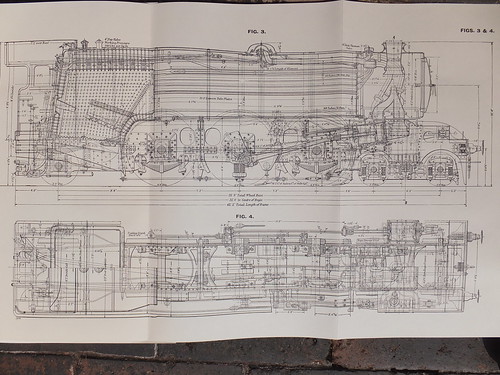 Click here for other sizes
The drawing of the locomotive included in the British Empire Exhibition publication [reference 5]
The railway locomotive 'Flying Scotsman' is the one locomotive (perhaps together with 'Rocket') which almost everybody seems to have heard of, although there's often confusion between 'Flying Scotsman' (the Named Express Service from King's Cross to Edinburgh) and 'Flying Scotsman (the locomotive - one member of the class which frequently hauled the Named Express).
The L.N.E.R. period
The prototype 'Pacific' locomotive designed by Nigel Gresley was built during the Great Northern Railway's last year of existence in 1922 and, appropriately, was named 'Great Northern'. The 1921 Railways Act created the 'Big Four' (L.M.S., G.W.R., L.N.E.R. and S.R.) from the end of 1922 so the first production batch of the 'Pacific' design (including 'Flying Scotsman') was ordered in 1922 by the Great Northern Railway and completed in 1923 by the newly-formed London and North Eastern Railway. After comparative trials against the Raven-designed 'Pacific' of the North Easter Railway in 1923, the Gresley design was chosen as the L.N.E.R's main express passenger class and building continued until 1935 by which time 79 locomotives had been constructed.
'Flying Scotsman' was selected to appear at the British Empire Exhibition in 1924-1925 held at Wembley, where the engine became a favorite with the crowds. Other major railways also displayed locomotives and the Great Western railway had 'Pendennis Castle' on display, claiming that it was the most powerful locomotive in Britain. However, with its tapered boiler, relatively small diameter smokebox and copper-topped chimney, the crowds found it difficult to accept that this elegant locomotive could be more powerful than 'Flying Scotsman' with its massive boiler suggesting raw power.
The Publicity Department of the L.N.E.R. were particularly active and, partly through them, the 1925 locomotive exchanges took place, with a Gresley 'Pacific' operating on the G.W.R. and a 'Castle' running out of King's Cross.
.jpg)
4079 "Pendennis Castle" GWR and 4475 "Flying Fox" LNER at King's Cross during the 1925 locomotive exchanges (From 'The Steel Highway' [reference 2]).
The results were not to the L.N.E.R's satisfaction. Gresley complained to one of the Locomotive Inspectors involved in the trials who dared to tell Gresley that the Great Western "have a better valve than us". The steam valve (which controls the admission and exhaust of steam from the cylinders) is crucial to the efficiency of a steam locomotive. Some twenty years before, G. J. Churchward of the Great Western had realised the significance of 'long lap, long travel' valves and these became standard on his piston-valved engines. Finally, Gresley realised importance of this innovation and 'long lap, long travel' valves were then fitted to his 'Pacifics' giving notable improvement in performance. Gresley also introduced a programme which changed the original 180 p.s.i. boilers for 220 p.s.i. boilers (changing the class designation from 'A1' to 'A3').
This led to perhaps the zenith of express train running in the steam era, in terms of speed, punctuality and comfort. An idea of this period can be gained from the reprint of a 1930s article about the 'Flying Scotsman' train on the EngRailHistory site. The Second World War brought an end to that period of railway history. During the War, all locomotives, including Gresley's, were required to undertake prodigious tasks of haulage under difficult conditions. When Peace came, British railways were thoroughly run-down and were Nationalised by the incoming Labour government.
The British Railways period
After Nationalisation of the railways in 1948, British Railways modified the class, substituting a double-chimney with Kylchap exhaust for the original single chimney. The modification also added rather small smoke deflectors, very much in the Continental tradition, which were invariably and appropriately referred to as "blinkers". A new livery was applied and 'Flying Scotsman's' running number became 60103.
Alan Pegler's ownership
Alan Pegler (born 16th April 1920) was a member of the Family which owned the Northern Rubber Company, based in Retford. He had been a lifelong railway enthusiast and at one time organised enthusiast excursions, such as the double-headed steam trip from Retford to Liverpool on 4th September 1954. In 1963, when British Railways were aggressively withdrawing steam traction, Alan Pegler purchased 'Flying Scotsman' from British Railways for three thousand pounds, using some of his proceeds from the sale of the Northern Rubber Company to Pegler's Valves (a company which had been started by his Grandfather). Alan Pegler was also closely involved in the Festiniog Railway and, in April 1963, 'Flying Scotsman' hauled a special train from Paddington in connection with the Annual General Meeting of the Festiniog Railway. 'Flying Scotsman' undertook a number of charters in the following years, culminating in a re-creation of the first London to Edinburgh non-stop run forty years after the first.
In 1969, with Government Assistance, Alan Pegler took 'Flying Scotsman' to the United States of America to haul an Exhibition Train promoting Britain. Encouraged by the interest in this iconic locomotive, Alan Pegler continued to operate the locomotive in North America after the Government funding expired, first in Canada and then in San Francisco but, sadly, this was not a commercial success, resulting in bankruptcy for Alan Pegler. The locomotive was sold to Sir William McAlpine who managed to return the locomotive to England. Alan Pegler's involvement with railway preservation continued and, in 2006, he was made an O.B.E. for "services to rail heritage". He died on 18th March 2012.
Sir William McAlpine's ownership
On its return from North America in 1973, Sir William McAlpine commissioned light repairs and repainting at BREL Derby. The British Rail modifications had been reversed prior to the visit to the U.S.A. but BREL fully restored her appearance to what I call "As God and Gresley intended" - apple green, numbered 4472, with conventional drafting and the rather tiny single chimney which, surmounting the massive boiler, contributed to the impression of raw power. 'Flying Scotsman' then undertook a season on the Torbay Steam Railway followed by various main line trips. In 1974, Steamtown at Carnforth became the locomotive's new base from where a number of main line charter workings were undertaken. An appearance was made at the 150th Anniversary of the opening of the Stockton and Darlington Railway in 1975. More charter work followed until 'Flying Scotsman' went to the Vickers Works in Barrow-in-Furness for heavy repairs at the end of 1977. A variety of main-line trips followed until another major overhaul at Carnforth in 1985. 'Flying Scotsman' was then moved to Marylebone for a series of 'Shakespeare Limited' luncheon trains with Roland Kennington in charge of maintenance.
In 1988, Roland Kennington accompanied the locomotive to Australia for a very successful programme of special trains, after which both he and his charge returned safely to England.
'Flying Scotsman' resumed an intensive programme of main line runs, with the last on 25th October 1992, just two days before the locomotive's 'Main Line Ticket' expired. The plan was for the locomotive to work out the rest of its 'Boiler Ticket' on preserved railways, starting with the first of what was to prove a number of visits to Birmingham Railway Museum. I've described 'Flying Scotsman' at Birmingham Railway Museum in a post here.
The 'Learn to be a Driver' scheme at Birmingham Railway Museum had attracted considerable interest and on the 26th October 1992 the world-famous 4472 'Flying Scotsman' became the star attraction, giving enthusiasts the chance to actually drive and fire the locomotive. It was during this period that I first became intimately acquainted with 'Flying Scotsman', since I was an Instructor Driver at the Museum. The Autumn Gala on the weekend of 28th and 29th November 1992, featured locomotives from three of the 'Big Four' railways with 4472 'Flying Scotsman', 7029 'Defiant', 6024 'King Edward I' and 46203 'Princess Margaret Rose' all in steam. 46203 was away most of the Saturday on a Main Line Railtour.
On 1st December 1992, 'Flying Scotsman' left Birmingham Railway Museum for visits to the Great Central Railway, the East Lancashire Railway and Llangollen where an inspection on 4th March 1993 found 29 defective boiler tubes and other defects, resulting in the locomotive being 'stopped'. 'Flying Scotsman' was moved by road to the works of FKI Babcock Robey in Oldbury for them to carry out the necessary repairs, assisted by Roland Kennington and others. When the locomotive emerged from FKI Babcock Robey on 22nd July 1993 the British Railways modifications had been re-applied so the locomotive appeared in British Railways green, numbered 60103, with Continental smoke deflectors, double chimney and dual 'Kylchap' exhaust. I accept that the revised drafting improved the steaming, but I never liked the appearance and it proved controversial with the enthusiast community.
In September 1993, Pete Waterman acquired a 50% interest in the locomotive from Sir William McAlpine. After stints at the Paignton and Dartmouth Steam Railway and the Gloucester Warwickshire Railway, 'Flying Scotsman', in its new guise as 60103, returned to Birmingham Railway Museum on 3rd November 1993 for more 'Learn to be a Driver' work. There were still lots of people keen to drive 'Flying Scotsman' and I remember it as a very busy period with courses carrying on well after dark each evening. The locomotive returned to Llangollen on 17th February 1994 for a triumphant season, followed by an equally successful time at the Nene Valley. Then it was onto the Severn Valley and back to Birmingham Railway Museum from 18th November 1994 to 11th January 1995. During another visit to Llangollen, the locomotive became derailed. Although passed as 'fit' after re-railing, the following day (24th April 1995) a crack appeared in the boiler backhead neccessitating withdrawal from service and return to Southall for heavy repairs.
Tony Marchington's ownership
Tony Marchington (born 1955 at Buxton) purchased 'Flying Scotsman' from Sir William McAlpine on 23rd February 1996 for a reported one and a half million pounds, expending a further one million in order to restore her to steam in 1999. I may not have liked the locomotive's appearance as '60103' but at least it was historically correct. What emerged from the works in 1999 was a confection combining 'Kylchap' exhaust and double chimney, LNER livery, the running number 4472, no smoke deflectors (at least initially) and air brakes. A Polish steam-driven air compressor had been mounted between the frames. Whilst the compressor was not visually intrusive, it produced a very foreign-sounding slow, repetitive 'thump - chuck - thump - chuck'.
In 2000, the locomotive appeared at Peak Rail during a 9-day 'extravaganza'. I was rostered for seven of these days, either as Conductor Driver or Driver on 'Flying Scotsman' or Driver on the 0-6-0T 'Austerity' which 'top and tailed' the passenger trains with 'Flying Scotsman'. It was a pretty hectic period, with unprecedented crowds, and my recollections are here. Alan Pegler was re-united with 'Flying Scotsman' on one of the days and this was the only time I met him.
'Flying Scotsman' became a regular performer on the British Pullman trains operated by Venice Simplon Orient Express (VSOE). It was only recently that I had an opportunity to inspect the luxurious restored Pullman train - there's a brief description here.
Flying Scotsman plc was floated in 2002, with ambitious plans by Tony Marchington for a 'Flying Scotsman Village' near Edinburgh. The plans fell through and Tony Marchington was declared bankrupt in September 2003. He later died of cancer in 2011. Peter Butler, the Chief Executive Officer of Flying Scotsman plc, revealed a serious position in October 2003 and dealing in the Company's shares was suspended.

'Flying Scotsman' at the 2003 Doncaster 'Open Day' (Photo: Rich@rd).
National Railway Museum ownership
Following the collapse of Flying Scotsman plc, sealed bids were invited for the purchase of 'Flying Scotsman'. A public appeal was launched to prevent what was called "The People's Engine" from probably going abroad. The public appeal raised 365,000 Pounds Sterling which was matched matched by a donation from Sir Richard Branson on behalf of the Virgin Group. Together with a grant of 1.8 million Pounds Sterling from the National Heritage Memorial Fund, a successful bid was made and 'Flying Scotsman' was purchased by the National Railway Museum, becoming part of the 'National Collection' at the National Railway Museum, York.
After various repairs, a number of Steam Charters were operated before a series of failures prompted withdrawal for another overhaul in 2005. This overhaul was completed in 2009 but there remained serious concerns over reliability. As repair work continued, the affair turned into a full-blown scandal, resulting in a review by 'First Class Partnerships' who are 'Rail Consultants'. A heavily-redacted version of this report is now in the public domain here. NRM states that the redacted text is "either because they are commercially sensitive or to protect the privacy of individuals". I found the report to the Trustees of the Science Museum Group by Bob Meanley far more informative. You can find it here. It appears that this saga will 'run and run'.
Book References
There are many, many books about this famous locomotive, her designer or her exploits. I list a few books below, including some describing the L.N.E.R. and the working of the East Coast Main Line in steam days.
[1] 'The World's Most Famous Locomotive' complied by David Clifford published by Finial Publishing in collaboration with the Flying Scotsman Associated in 1997 (ISBN 1 900467 02 X).
[2] 'The Steel Highway' by Cecil J. Allen, published Longmans, Green and Co. in 1928.
[3] 'Flying Scotsman: On Tour: Australia' published by Chapmans in 1990.
[4] 'The Flying Scotsman 1862 - 1962: Portrait of a Train' by C. Hamilton Ellis published George Allen & Unwin 1962.
[5] 'The London and North Easter Railway Company: Three-Cylinder Superheated 4-6-2 PACIFIC TYPE Express Tender Locomotive exhibited at the British Empire Exhibition Wembley 1924' reprinted in 2000 by the Pleasaunce Press (ISBN: 0 902372 12 2).
[6] 'The Gresley Pacifics' by O. S. Nock, omnibus edition with parts 1 and 2 published by Book Club Associates 1985.
[7] 'Gresley Locomotives - A Pictorial History by Brian Haresnape' reprinted by Ian Allen 1993 (ISBN 0 7110 0892 2).
[8] 'The Locomotives of Sir Nigel Gresley' by O. S. Nock; second expanded and re-illustrated edition published by Patrick Stephens 1991 (ISBN 1-85260-336-4).
[9] 'East Coast Pacifics at work' by P. N. Townend published by Ian Allen 1982 (ISBN 0 7110 1170 2).
[10] 'The Gresley Influence' by Geoffrey Hughes published by Ian Allen 1983 (ISBN 0 7110 1272 5).
[11] 'The Gresley Legacy: A Celebration of Innovation' by Martin Smith published by Argus Books 1992 (ISBN 1 85486 079 8).
[12] 'Nigel Gresley: Locomotive Engineer' by F. A. S. Brown, first published 1961, 1975 edition published by Ian Allen (ISBN 07110 0591 5).
[13] 'Non-Stop!: London to Scotland Steam' by A. J. Mullay published by Alan Sutton 1989 (ISBN: 0-86299-600-7).
[14] 'LNER Steam' by O. S. Nock, first published 1969 by David & Charles, paperback edition 1971 by Pan Books (ISBN 0 330 02680 1).
[15} 'Great Northern Locomotives: 1847 - 1947' by R. A. H. Weight, second edition published 1970 by The Gresley Society.
Related posts on this Website
'Flying Scotsman' at Birmingham Railway Museum.
'Flying Scotsman' at Peak Rail.
External Websites
'Flying Scotsman' (Wikipedia).
Nigel Gresley (Wikipedia).
British Empire Exhibition (Wikipedia).
G. J. Churchward (Wikipedia).
EngRailHistory site.
Alan Pegler (Wikipedia).
Sir William McAlpine (Wikipedia).
Tony Marchington (Wikipedia).
[Link to post 'Flying Scotsman' at Birmingham Railway Museum added: 29-Jul-2015]
[Link to post 'Flying Scotsman' at Peak Rail added: 8-Oct-2016]
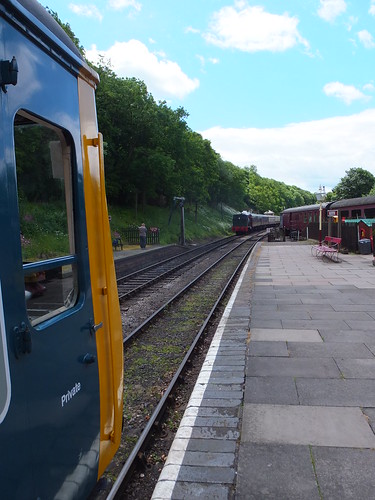
The DMU waiting for 'Sir Gomer' to clear the single line.
The Battlefield Line ran a '1940s weekend' on the weekend of 15th/16th June 2013. 'Sir Gomer' operated the 4-coach service train, providing five round trips between Shackerstone and Shenton, stopping at Market Bosworth each way. Departures from Shackerstone were timed for 10.30 a.m., 12.00 noon, 1.30 p.m., 3.00 p.m. and 4.30 p.m. During the 35 minutes allowed at Shackerstone to run round and take water the single line section was available, allowing the DMU to make a trip to Market Bosworth and back. The DMU was scheduled to depart Shackerstone at 10.00 a.m., 11.30 a.m., 1.00 p.m. 2.30 p.m. and 4.00 p.m. This was the second year that the Battlefield Line arranged a '1940s weekend' - my report on the 2012 event is
here.
On Saturday 15th June 2013 I was booked to drive the diesel railcar. I'm afraid a 1960s DMU (particularly in blue and grey livery) is the wrong period for a 1940s Weekend but it seemed to offend me more than anyone else. The plan was to use the single-unit DMU 55005 (at the north end) coupled to half of the 2-car DMU (at the south end). I found the set, as expected, on the railcar siding.
The Technical Stuff
I completed my 'Daily Exam' and successfully started all four engines. There was a slight delay while I allowed the compressors to build up control air pressure in the air receivers - ideally 75 p.s.i. is required for correct operation of the Electro-Pneumatic (E.P.) valves controlling gear change on the epicyclic gearboxes and selecting direction on the final drives.
I 'opened' the southern cab with the master key and engaged the final drive, correctly obtaining six blue lights on the engine monitoring panel (left hand engine, air and axle, right hand engine lit for both power cars). With the "Dead Man's Handle" depressed, I 'blew-up' the vacuum brake (having ensured the handbrake was applied in the north end cab), then released the "Dead Man's Handle" and waited for the vacuum to collapse and automatically re-apply the brakes. This, of course, is the original method of ensuring that a train with only one person in the cab will be brought to a stand if that person becomes incapacitated.
I also tested the running lights at that end. There are two lamp clusters which can each show white or red.
 Detail of a Red/White lamp cluster on a Diesel Multiple Unit.
Satisfied, I 'closed' the cab and repeated these checks from the cab at the northern end.
There was still some time before our first booked departure at 10.00 a.m. but John, the Signalman, "gave us the road" and I moved the 2-car train down to platform 1. A little later, I was standing in the south end cab when there was a loud 'bang' under the cab floor, followed by a loud hissing. The control air gauge was 'heading south' rapidly. I quickly dropped down onto the track to look at the various air connections under the cab and found a white-painted air main just venting the last of our control air. A little later, I confirmed that the connection between a reinforced plastic pipe and the metallic air main (secured by a jubilee clip) had become detached. We quickly concluded that we'd not be able to work our first train but the flexibility of the design of these multiple units offered the possibility of 'ditching' the failed vehicle and operating with just the single car. Of course, if I'd been confident we could repair the failed connection in a reasonable time, we might have been able to run with both vehicles but we agreed that the more certain solution was to operate with the single car. We judged that we'd have sufficient passenger capacity with the single car and so it proved. Later in the day, I attempted a repair on the reinforced plastic pipe and satisfied myself we'd made the correct decision in not trying to fix the problem earlier.
The control air main is continuous along the train, passing through flexible couplings provided with isolation cocks between vehicles, so we had no control air in the single car DMU at the northern end, either. We closed the isolation cock between the vehicles and I restarted the engines in the single car DMU at the north end (I'd shut down all engines whilst we agreed what to do). Control air was restored in the single car DMU. I opened the south end cab (with the 'failed' car in front of me) and created the vacuum brake, which still controlled both vehicles. With the Guard in the leading cab of the failed vehicle and Martin 'on the ground', I slowly drove back to the DMU siding, propelling the failed vehicle. The Guard applied the handbrake on the failed vehicle and I 'eased up' so as to slacken the coupling before applying the brakes on the 'good' car. Martin then uncoupled the 'dead' vehicle.
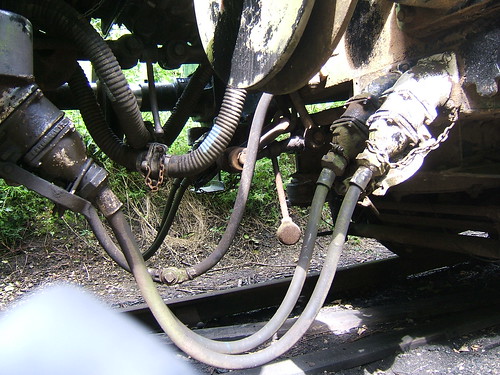 Click for larger image
Details of the interconnections between vehicles.
The picture above shows that it's a bit more involved than on ordinary coaching stock and, of course, there's not much room to work. Referring to the picture above, starting nearest the camera, you have:-
1. Jumper cable on left vehicle ('black') attached to multipole connector on right vehicle.
2. Jumper cable on left vehicle ('white')attached to multipole connector on right vehicle.
3. Control air hoses, joined with 'palm' coupling.
4. Vacuum brake train pipe corrugated hoses, joined with standard vacuum connection ('red').
5. Vacuum brake 'quick release' corrugated hoses, joined with 'reversed' vacuum connection ('blue').
6. Standard screw coupling on left vehicle, attached to right vehicle and tightened.
7. Standard screw coupling on right vehicle, not used and suspended from hook on underframe.
8. Jumper cable on right vehicle ('white') attached to multipole connector on left vehicle.
9. Jumper cable on right vehicle ('black') attached to multipole connector on left vehicle.
10. The round buffer heads nearer the camera are visible at the top of the picture.
Jumper cables not in use are 'stowed' in a receptacle adjacent to the jumper cable. 'Palm' couplings are standard on railways for air lines and they are mated and de-mated with an action similar to rubbing your hands together, hence the name. To avoid confusion between the two vacuum brake hoses, the fittings on the 'quick release' hoses are the mirror image of the standard coupling. 'Quick release' relates to the speed at which the driver can create vacuum compared with a traditional one-pipe vacuum brake - desirable on some suburban workings with frequent stops.
.
I've gone into a little detail in order to highlight what I think are some of the design strengths of the 'Modernisation' DMUs. The technology used was well-proven and fairly simple, making it easier for "dyed-in-the-wool" steam drivers to make the transition from steam to diesel. Not all accepted the new traction - the lack of a 'mate' in the cab made the job too solitary for some but, in general, the equipment was well-received. A certain amount of fault-finding was within the scope of a driver (without the use of now-universal computers to monitor and identify problems).The 'Multiple Unit' concept with Electro Pneumatic control meant that trains could readily be made longer or shorter to cater for different duties. I think the design of these DMUs stands up well, particularly compared with the later abyssmal 'Pacers' (which still plague some areas of our railways).
For more information, see my post Diesel Multiple Units which has links to 'Lecture Notes and Drawings' by the British Railways Diesel Training School and four black and white sound films on YouTube.
In Traffic
Having dealt with the failure of one vehicle described above, we were "back in business" with a one car unit, ready for our 11.30 a.m. departure. The weather wasn't too good - intermittent rain and a cold wind. The sun would start to appear, only to be covered by cloud. Passenger numbers weren't brilliant - a great pity after the efforts made organising the event but I enjoyed meeting the re-enactors travelling with us.
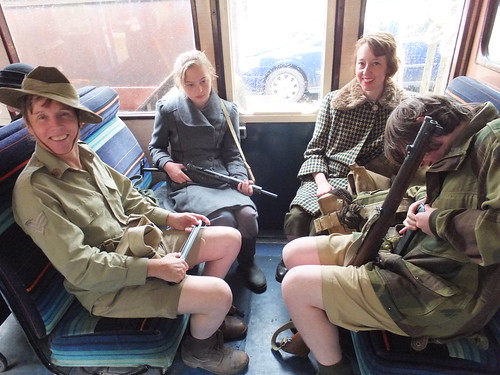 Re-enacters on the train. The Australian Sergeant on the left really is from Sydney
In addition to the normal attractions at Shackerstone - the Victorian Tea Room, Shops on both Platform 1 and Platform and the Museum, an old radio in the Waiting Room was playing wartime programmes.
Although the Main Train hauled by 'Sir Gomer' went to Shenton, the diesel railcar only went as far as the intermediate station at Market Bosworth. This was where the main displays were held but the DMU had a very quick turn-around each time it was at Market Bosworth so I didn't get to see them.
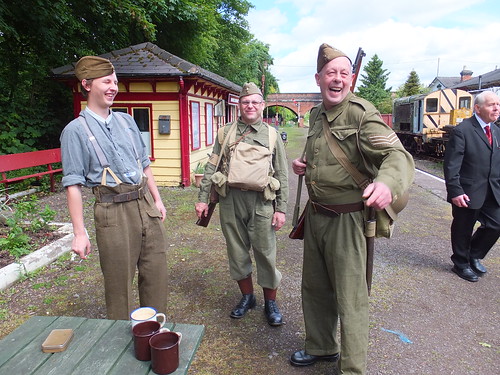 Re-enacters on Market Bosworth Station.
We completed our 'diagram' without further incident and I stabled our single car unit on the railcar siding, ready for the following day.
My Pictures
Saturday 15th June 2013.
Shackerstone DMU Group.
Bubble Car.
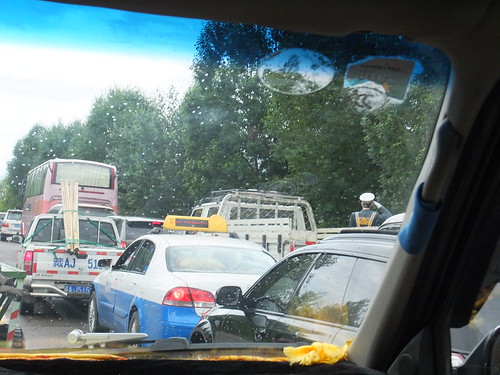 Congestion at a traffic checkpoint. The saluting policeman in the background is a dummy.
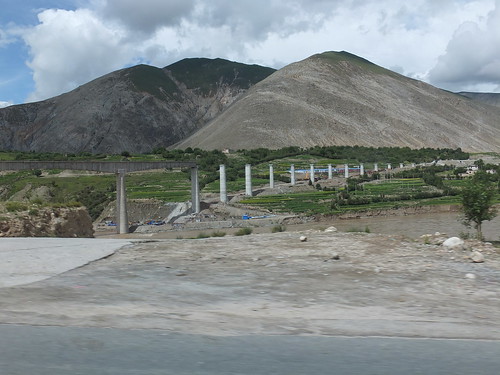 The new railway to Shigatse under construction.
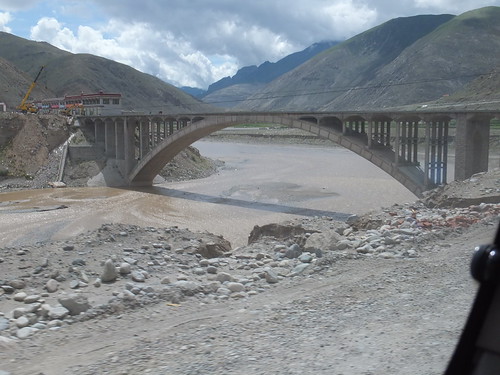 The concrete arch road bridge under repair, forcing traffic to cross the river on a temporary Bailey Bridge.
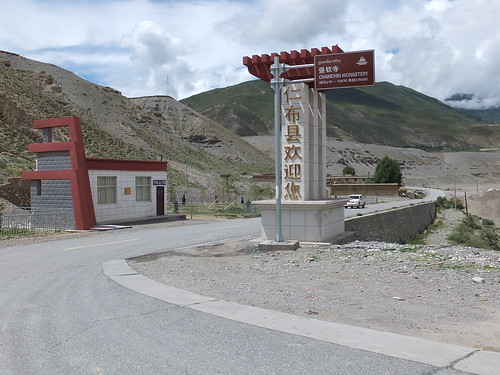 The side road leading to the Chamchin Monastery.

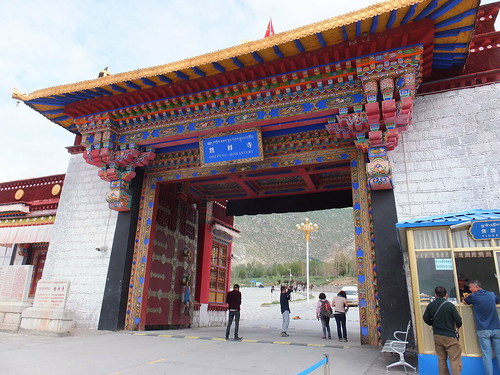
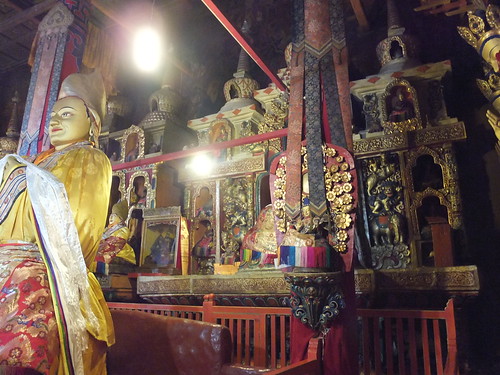
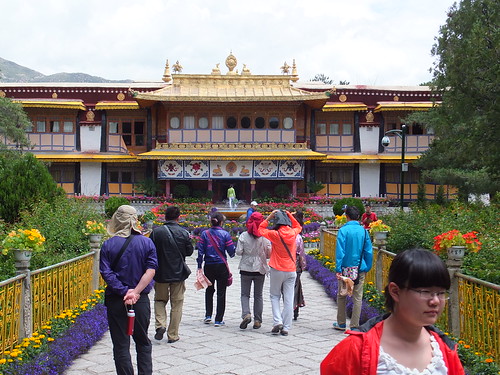
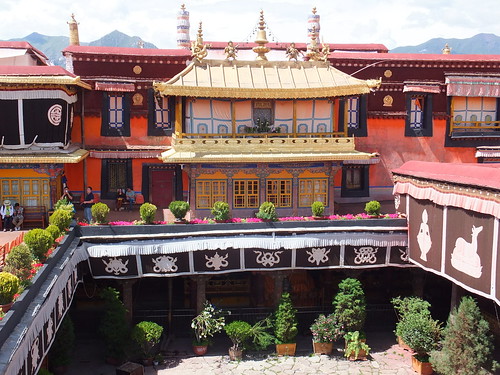
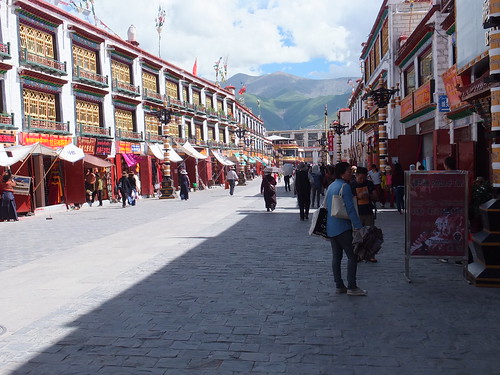
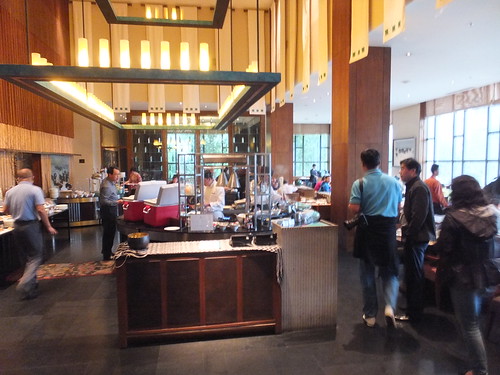
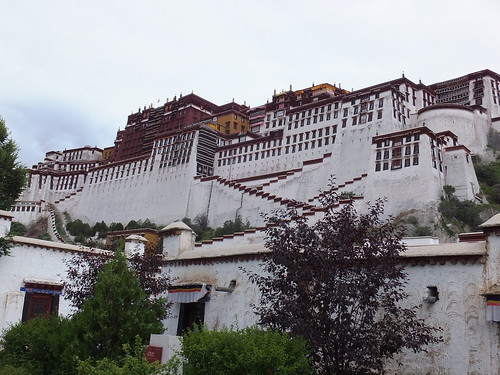
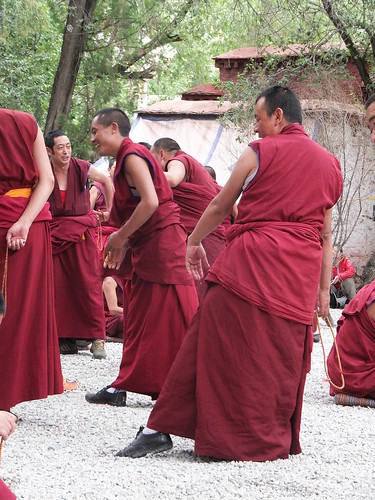
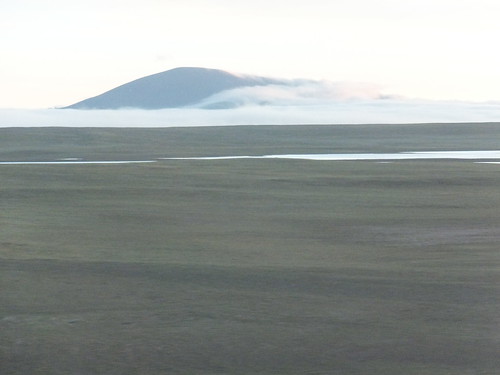
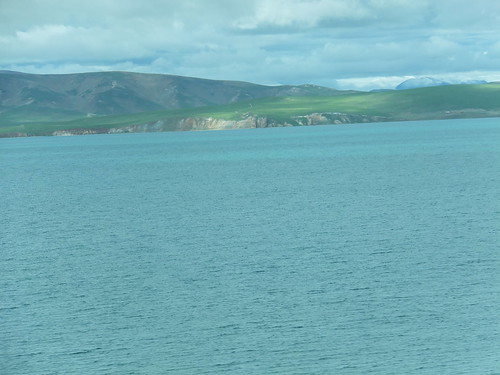


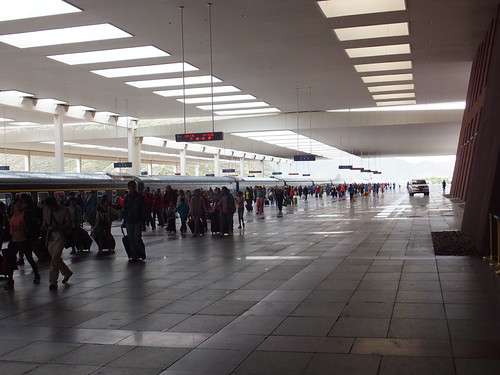
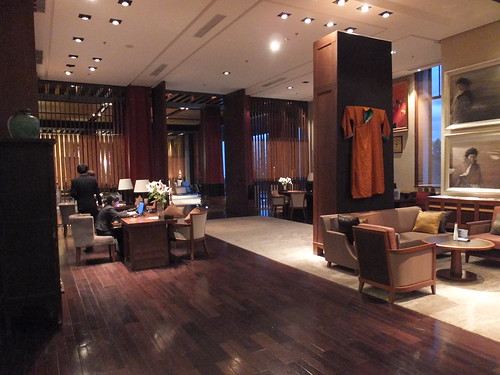
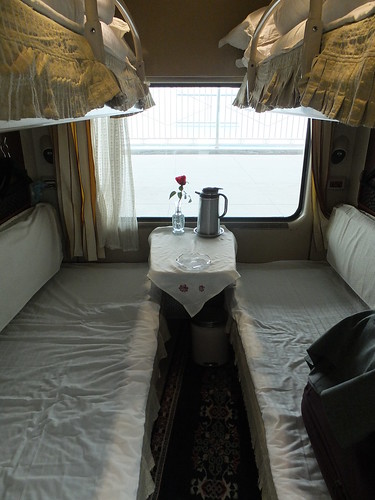

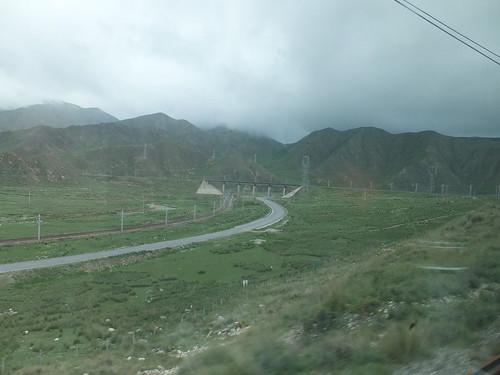
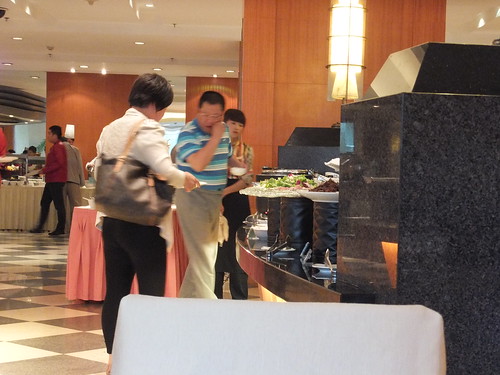
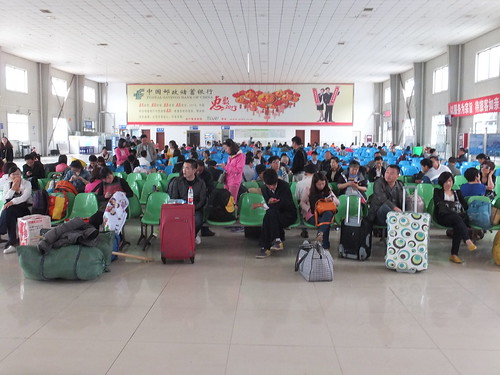
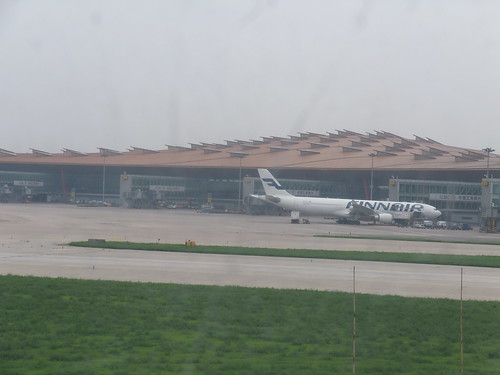
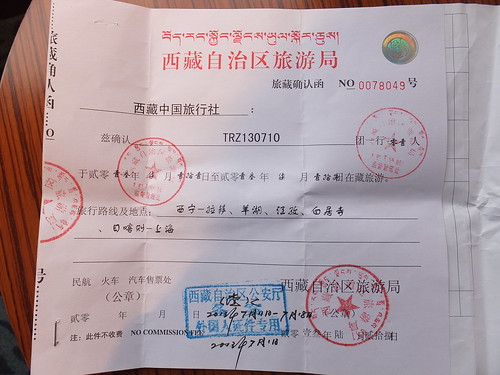
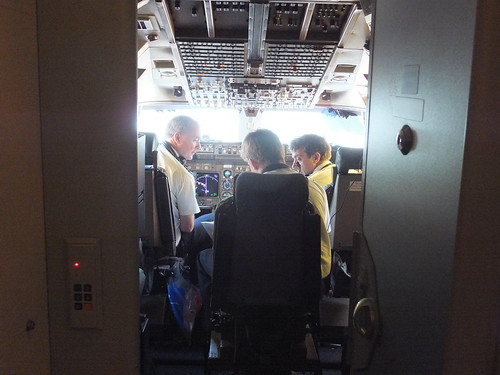
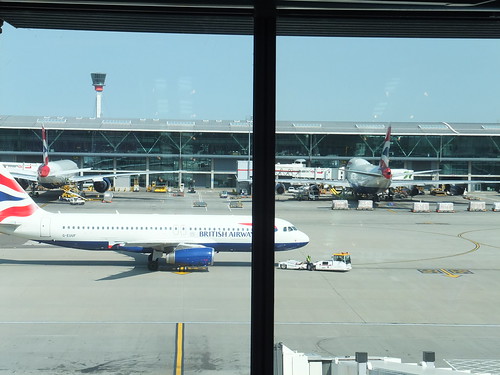
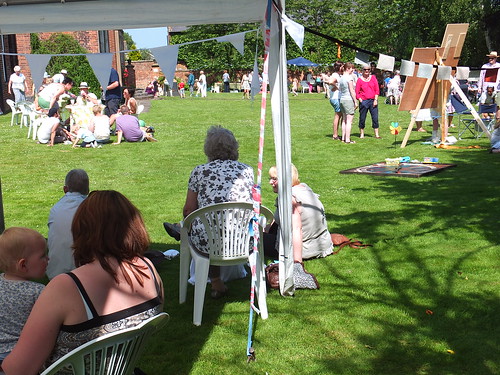
.jpg)