skip to main |
skip to sidebar
On Friday, 8th July 2022, I made a trip by rail to Manchester area to visit a friend.
Over the years, I've made many trips to Manchester, particularly when I was a volunteer at what was then called the Manchester Museum of Science and Industry. My previous trip on the route, as far as Stockport, had been in November 2021 and that is described here.
I caught the 07:30 bus to Wolverhampton, then walked to the railway station passing the West Midlands Metro extension where numerous workers in high visibilty clothing and hard hats swarmed over the new construction. I made my way to platform 2 for the 08:14 train to Manchester. I used Railcam UK (described here) to confirm that my train, reporting number 1M18 had been scheduled to depart Southampton at 05:15 that morning, leaving Birmingham New Street at 07:57, Wolverhampton 08:14½, Stafford 08:28½, Stoke 08:44½, Macclesfield 09:01½, Stockport 09:14½ and arriving at Manchester Piccadilly at 09:23. On that day, the train was reported three minutes late leaving Birmingham. When the train arrived, I had some confusion identifying the correct coach for my reservation as, although the passenger information display on the platform indicated the marshalling of the two 4-coach 'Voyager' sets was with the two First Class areas in the centre of the train, on that day, the leading set was in reverse. Anxious to get the train away, the platform staff advised "just get on and walk through". However, the nearest door was blocked by what I assumed was an assistant guard who only relectantly let me use 'his' door. We left two minutes 'down' and I walked through the leading set to reach my booked seat. That seat was already occupied but a number of adjacent seats were available so I settled down for the journey.
After our Stafford stop, we were only one minute late departing, passing a Down train of sand in bogie vehicles headed by 66160 waiting on the goods line next to platform 6. Departing from our Stoke stop, we were two minutes late as I noted the Northern Electric Multiple Unit reporting number 2H82 in platform 3 ready to work the all-stations to Crewe. As expected, we picked up a crowd of commuters at Macclesfield, leaving three minutes late. We left Stockport two minutes late and I didn't note our arrival time at Piccadilly but the leisurely timings specified combined with the reserves of power provided by the eight Cummins QSK19 diesel engines on the train offer plenty of scope for recovering lateness where local speed limits permit.
I'd travelled early to allow a visit to witness some testing in Stockport before visiting my friend but, at the last moment, the testing was cancelled so I had some time free. I'd decided to make a visit to the former Manchester Museum of Science and Industry which is now part of the Science Museum with the logo 'SCIENCE+INDUSTRY MUSEUM' with a website here. I'd started volunteering at the museum back in 1988 and you can find the posts about my involvement here. Back then, my travel to the museum from home would either be by car door-to-door or by train to Manchester Piccadilly. Sometimes, I'd walk from here to the museum, just over a mile away. If I was lucky, I could cross to platform 14 and catch a local train to Deansgate, leaving a walk of only 0.3 miles to the museum. Not all trains stopped at Deansgate so an alternative was to alight at Oxford Road and walk the 0.7 miles from there to the museum but I rarely adopted this strategy. In 1992 the Manchester Metrolink trams started running from Piccadilly to Deansgate Castlefield tram station and then on to Altrincham, offering another method of reaching the museum.
On 8th July, I decided to use the tram so I descended into the undercroft at Piccadilly, part of which forms the tram station. A tram for Altrincham arrived after a few minutes and I boarded for the journey to Deansgate Castlefield tram station. The tram runs at street level through Piccadilly and St. Peter's Square but then climbs above ground approaching Deansgate before continuing on part of the Castlefield Viaduct which originally carried the approach tracks to Manchester Central Station which was the Manchester terminus of the Cheshire Lines Committee and featured a remarkable arched train shed, listed grade II*, now re-purposed as Manchester Central Convention Complex ('GMEX'). When this tram station first opened, there were just two lines passing through but, since it serves 'GMEX', it has been expanded to three platform tracks with facilities for reversing trams.

The expanded Deansgate Castlefield tram station in 2016
In a welcome improvement, the original fearsome steps between the tram station and ground level have been supplemented by a lift so I was able to descend to Deansgate itself in comfort and then walk to Liverpool Road.
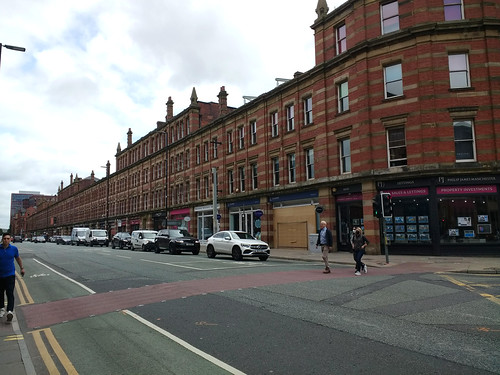
Manchester: Deansgate, looking north from the junction with Liverpool Road.
The museum didn't open until 10:00 so I spent some time in Castlefield Urban Heritage Park which displays remains of Roman Castlefield and a quite nice re-creation of the appearance of the North Gate of Mamucium Roman Fort. My attention was drawn to the set of stairs leading from Beaufort Street to the approach to Castlefield Viaduct which serves as Collier Street Car Park which is now joined by a nearby lift I didn't remember. This prompted a bit of searching which revealed that the National Trust is converting a 300 yard section of the listed viaduct structure into a 'Urban Sky-Park', presumably inspired by New York's High Line. Public viewing, I read, should start at the end of July 2022.
The museum frontage on Liverpool Road was completely obscured by scaffolding and hoardings proclaiming 'REVOLUTION IN PROGESS'. Additional signage read 'A multi-million-pound restoration programme is underway at our globally significant industrial heritage site to carry out crucial restoration work and reveal new spaces and perspectives for all visitors to enjoy, play and learn in.' The museum entrance is in Lower Byrom Street, with a separate entrance to a ground floor cafe which already seemed quite busy. The museum itself was still quiet but a young member of staff confirmed, after checking his watch, that they were open. Years ago, I made some useful purchases in the large retail shop but, on this visit I found only overpriced rubbish, I'm afraid. Because of the 'revolution in progress', most of the museum areas were closed. There was a large display of textile machinery I found interesting but the explanatory text was rather limited. On the first floor the 'Discovery' section introduces young children to various scientific principles. I found the alternating light levels between 'fairground primary colours' and sepulchral gloom rather irritating. The large first floor bistro was still closed. I didn't take in the temporary special exhibition of black and white pictures of Amazonian tribes but I was amused to see another temporary exhibition - one of Rowland Emett's eccentric steam train creations called 'A Quiet Afternoon in the Cloud Cuckoo Valley' but I didn't return later to see the demonstration of the 'kinetic sculpture' moving.

'A Quiet Afternoon in the Cloud Cuckoo Valley' by Rowland Emett: Science+Industry Museum, Manchester
I appreciate I didn't see the museum at its best, but the contrast with my happy memories of working at the site made me rather sad. Looking along the derelict Pineapple Line towards the new bowstring bridge on Network Rail's Ordsall Chord line which has truncated the site emphasises that offering the experience of real steam train rides in the future at the birthplace of passenger railways would be very difficult.

Now-derelict Pineapple Line looking towards the girders of the new bowstring bridge on the Ordsall Chord line which truncates the site: Science+Industry Museum, Manchester
I left the museum and retraced my route to Deansgate tram station, pondering my next move. I decided to catch a tram one stop back towards Piccadilly, alighting at St. Peter's Square and walking to Manchester Art Gallery, which seems to have resisted modernising revolution fairly well and I relaxed sufficiently to enjoy an orange juice in the Gallery Cafe before touring as many of the rooms as time permitted. The Gallery website is here. My lunchtime appointment was in Altrincham so I left the gallery in sufficient time to walk back to the St. Peter's Square tram station and catch the next service back through Castlefield and then on to Cornbrook, continuing on the former Manchester South Junction and Altrincham route.
The Manchester South Junction and Altrincham Railway opened in 1849 using steam traction. Following the 1923 Grouping, ownership and operation passed to the MSJ&AR Committee representing the L.M.S and L.N.E.R. An electric service using 1500 volts d.c. third rail started operation in 1931, using standard 3-car electric trains of a design already in use on the L.M.S. In 1971, a modernised service was introduced on the line, after conversion to the British Rail standard of overhead 25 kV a.c. electrification. This continued until the end of 1991 when the line was closed to allow Manchester Metrolink to take over much of the line. Many of the existing overhead supports were retained as part of a new 750 volts d.c. scheme. Towards Manchester, significant re-routing was necessary and the Metrolink trams now use part of the abandoned C.L.C. route as far Deansgate tram station before descending to street level and finally passing through the Undercroft of Piccadilly main line station. For more about the early history of the line, see the Wikipedia article here; for more about the line as part of Manchester Metrolink refer here.
Whilst running at street level, the speed of trams is fairly low but once on the dedicated former MSJ&AR route, the line speed limit increases to 80 km/h, allowing some spirited running between the original stations.

View from tram approaching Deansgate Junction, where the double-track Metrolink becomes single towards Altrincham: Manchester Metrolink

Manchester Metrolink, Altrincham: View from platform 1 looking south.
I arrived in platform 2 at Altrincham in plenty of time to walk to my friend's home. Together with my friend's daughter and her husband, we enjoyed an excellent salmon lunch and spent the afternoon chatting. Because of the pandemic, it was our first face-to-face meeting in three years.
I'd not pre-booked my return journey but knew that there was an hourly Northern Service from Altrincham to Stockport which then continued to Manchester Piccadilly. I'd first used this route in 2014, as described here and again in 2018, described here. I walked back to Altincham Interchange and booked a ticket to Stockport. As in 2018, the journey was in peak hours so the train was crowded and it was again raining heavily but at least the dreadful 4-wheeled 'Pacer' units had been upgraded to 'Sprinters'. At Stockport, I anticipated enough time to obtain a ticket for my onward journey to Wolverhampton: I had not anticipated that the ticket office would already be closed so I had to tangle with an unfamiliar design of automatic ticket machine with a large vertical touch-screen display. More by luck than judgement, I managed to purchase the appropriate ticket and proudly headed to platform 2 to await the Manchester to Bournemouth 'Voyager' service which would return me to Wolverhampton.
As I anticipated, there was a fair crowd awaiting the train which was already quite full when it arrived from Manchester Piccadilly. A number of passengers were content to remain standing in the vestibules at each end of the coaches but I managed to find a seat. Our first calling-point was Macclesfield, where a number of passengers I assumed to be regular commuters to Manchester left the train. I managed to secure the use of a pair of seats for the rest of the journey but I'm not a fan of the rather cramped seat layout in the 'Voyager'. I didn't pay much attention on the rest of the journey but approaching Stoke-on-Trent I caught a glimpse of a freight train attached to a Class 66 in the sidings on the Up side near Longport. Railcam UK suggested this was reporting number 6Z76 which had left Redcar at 21:20 the previous evening, arriving at 'Colas Longport' at 06:20.
On my arrival in Wolverhampton, I walked to the taxi rank and completed my journey home after an enjoyable, if tiring, day.
Related posts on other websites
Science and Industry Museum
Manchester, South Junction and Altrincham Railway
Altrincham Line
Manchester Art Gallery
Related posts on this website
Note that the dates below are posting dates, not the date of the events described.
To Stockport by Rail 14-Nov-2021
The Cheshire Lines Committee 2-Oct-2014
The Cheshire Lines Committee Routes Today 7-Oct-2014
To Altrincham via the former C.L.C. 27-Aug-2018
My pictures
All my rail transport pictures showing areas passed through:-
West Midland Metro
West Midland Railways
Stafford Area rail
Manchester Area Rail
Manchester Metrolink
Altrincham Station
All my Manchester pictures:-
Manchester
Depending on the display device, the right hand edge of pictures may not display. To see an uncropped image, click on the picture. Alternately, you can find the image by following the 'My pictures' links and display or download the image in various resolutions.
My day trip to Llandudno in April 2022 (described here) was marred by leaving my camera on a London-bound West Midlands Trains service on my return. West Midlands trains staff at Wolverhampton explained that their lost property is now dealt with through a website called MissingX.
MissingX (https://www.missingx.com/) is an international database of lost property covering the transport sector including airports and railways. It was started in Norway in 2000 to provide an easy method of reporting lost property and claiming found items. I found it easy to enrol online and I was invited to enter details of the loss and where it occurred. There's a separate section of the database with the details of found items. For a few days, nothing appeared in the 'found' section and I was fairly certain that the camera (with all my pictures of the trip to Llandudno which the camera does not backup automtically) was lost. Then, a description of a camera located at Euston appeared in the 'found' section so, as instructed, I made an online claim and printed a copy of the details. The website informed me that I would then be contacted by the location holding the item.
So far, very encouraging. But after another week I'd not been contacted so I found a general West Midland Trains customer support telephone number where a friendly gentleman offered to send a chasing email to the team at Euston. After another week, I tried customer support again. A different gentleman diagnosed that the chasing email had indeed been sent but to the wrong recipient. He said he's speak to the appropriate person and get them to phone me directly.
A couple of hours later, I received a call from the West Midlands Trains Duty Manager at Euston who confimed that they were holding what seemed to be my camera in their high-value property store. Unfortunately, although I was happy to pay for carriage and packing to return it to me, they seemed to lack a mechanism for that. After some negotiation, I decided I'd have to go to Euston myself to collect the camera, so I booked a 'quickie' trip to London just to retrieve the camera. I was able to book Advance tickets there and back for Friday, 20th May 2022, allowing a little under two hours at Euston to actually make the collection, anticipating that matters might not be completely straightforward.
The journey to London on 20th May followed the pattern of my earlier trip on 8th April described here involving bus, Cross Country 'Voyager' service to Stafford then an Avanti 'Pendolino' service non-stop to Euston. This time, I travelled First Class so was able to have breakfast on the fast journey, distracting me from studying operations too closely. As before, my train was preceded by a West Midlands Trains service to Euston (reporting number 1U22) but we overhauled this train at Tamworth as it made a station stop when on the Up Slow. I noticed (using Railcam UK)that we were being followed by a Birmingham-Euston Avanti 'Pendolino' just a few minutes later. My arrival at Euston found me in an optimistic frame of mind, although the weather which had been dry at Stafford had deteriorated as we headed south and our arrival at Euston had neen accompanied by drizzle and overcast skies. We were routed into platform 16, on the Down side, close to the works for the new HS2 terminus but black hoardings limited views of the advancing works.

London Euston: HS2 works viewed from arriving train showing bulk storage silos
I'd been given directions to make my way to the ticket Gate Line for the suburban platforms and ask the staff there for the West Midlands Trains Duty Manager, who was summoned by radio. This seemed to create some interest among the staff and we had assembled a group of four employees chatting by the time the Duty Manager arrived. I was admitted through the gate to wait on the platform whilst the Duty Manager despatched a West Midlands train service then I explained my mission. He then telephoned another person who had the key to the high-value property store and asked me to wait for her arrival before leaving to carry out other tasks. As I waited, another West Midlands Trains electric multiple unit arrived and crowds of passengers swept past me towards the ticket gates. A little later, the lady with the key arrived, examined the copy of my online claim form and asked me to wait whilst she fetched the camera from the store which was located at the far end of the platform we were on. After a few minutes, she returned with the camera, intact with its case and spare batteries. A quick check showed that the pictures on the memory card were those I'd taken in April so the camera was returned to mr. Expressing my thanks, I was passed through the ticket barrier again.
I'd just under an hour before the departure of the train I was booked on to return. During my earlier trip in April, there had been no Tube service from Euston via London Bridge to Moorgate because of major engineering work at Bank station to improve the platforms. Realising that the line had re-opened a few days before, I decided that I'd time to travel to Bank underground station to look at the improved facilities, so I hurried across the concourse at Euston towards the underground station. As I've commented before, this transfer has been re-organised and now involves briefly going outside before re-entering the building by a separate entrance. I discovered it was now raining quite heavily, revealing the disadvantage of the altered arrangements. I made my way to the Southbound Platform on the re-opened City Branch of the Northern Line and was soon noisily speeding towards Bank, where we arrived at the wide, straight new platform which has replaced the narrower, sharply curved earlier arrangement.

Bank Northern Line: New Southbound Platform
Looking at my watch, I was a little alarmed at the time so, after a very cursory examination of the revised access from the surface, I moved to the Northbound platform so as to return to Euston. The Northbound platform, which appeared unchanged, is straight but much narrower than the new Southbound platform.

https://live.staticflickr.com/65535/52087451527_49841d54c4.jpg
After a short wait, a Northbound Northern Line train arrived and I returned to Euston, discovering as I transferred from Tube to 'Heavy Rail' that it was still raining. My journey back to Wolverhampton was booked on the 11:43 'Pendolino' service to Blackpool North via Birmingham which was displayed on the Departure Screens, but without a platform number showing. This normally meant that the incoming train was late arriving and cleaning was still in progress prior to boarding. I amused myself by using Railcam UK to try to identify which platform was holding the trainset which would form my train. I'd just drawn the correct conclusion when the platform number appeared on the Departure Screen so I joined the mass of passengers heading for ramp to the indicated platform. Unless at trainset has become 'reversed', First Class is normally near the entrance ramp so I only had a short walk to my seat where (using Railcam UK) I identified our train reporting number as 9P65.
Our departure was 5 minutes late and we were routed on line 'X' which allows trains leaving from low-numbered plattforms on the 'Up' side of the station to cross under the other lines approaching Euston (lines A -E) so as to emerge on the 'Down' side, minimising conflicting movements. This re-purposed 'fly-under' was originally built to facilitate the removal of empty carriages from arriving services for attention at a carriage shed. Nowadays, with more intensive use of rolling stock, limited cleaning and replenishment between workings is carried out at the platform, deferring other work until arrival at the Traincare Depot at the end of service. Once again, I had limited views through the rain of the HS2 work in progress.

London Euston: HS2 works viewed from a departing train on Line 'X'
We'd lost a further minute by Bletchley, apparently because we were following a West Midland Trains Euston to Crewe via the Trent Valley Line stopping service (reporting number 1U33). When this train made its scheduled stop at Milton Keynes, I thought we might be allowed to overtake but, in fact, the stopping train continued to precede us, making us 9 minutes late leaving Milton Keynes. Three minutes of this was 'pulled back' by Coventry but, once in the congested West Midlands area, there seems to be little opportunity to make up lateness except by reducing 'dwell' time at stops like Birmingham New Street where this is possible.
My last leg, from Birmingham New Street to Wolverhampton, was particularly frustrating as we seemed to be following an 'all stations' to Wolverhampton (reporting number 2W28). On our arrival at Wolverhampton, I walked quickly to Lichfield Street hoping I'd still catch the bus home I'd planned on. I needn't have worried - the bus was ten minutes late arriving.
Not only was my camera retrieved intact but all my pictures taken on my trip to Llandudno were safe. I consider myself very fortunate that I had such a happy outcome. Mission accomplished!
Related posts on this website
Llandudno in April
Return to Croydon
My pictures
Northern Line
London: Euston Station
Depending on the display device, the right hand edge of pictures may not display. To see an uncropped image, click on the picture. Alternately, you can find the image by following the 'My pictures' links and display or download the image in various resolutions.
Following the success of a recent day trip by rail to New Brighton (report here), I decided to make a trip to another favourite destination, Llandudno. I booked any Anytime Return online and decided on First Class. This was a questionable decision, since all Transport for Wales (TfW) trains are standard class only, apart from the Premium First service between Cardiff and Holyhead I mentioned in my post here). In addition, Avanti have a 'Voyager' service, currently between Holyhead and Crewe which has a First Class section. Although we are in the phase of 'Living with Covid', railway timetables are still not back to normal and services are liable to disruption at short notice.
Getting there: Friday, 22nd April 2022
I took the customary 07:30 bus to Wolverhampton, discovering that the £2.60 single fare has risen to £2.80. The pedestrian approach to the station still entails an ever-changing obstacle course as work continues on the modest yet late-running extension of the West Midlands Metro tram service from the current terminus at St. Georges to the railway station.

Wolverhampton Station, showing continuing work on the Metro extension, with the railway in the background (Llandudno trip)

Entrance to Wolverhampton Station with yellow arch and name displayed (Llandudno trip)
I had a few minutes to wait before my train, giving me a chance to study the fire alarm map showing the odd-shaped, vaguely triangular site which the new, unloved building occupies. My train 9S44, a 'Pendolino' service from London Euston to Edinburgh via Birmingham arrived on time. Although this train is only allowed 29 minutes to Crewe, the friendly staff in the First Class section found time to provide a glass of orange juice with two rounds of toast and preserves so that I arrived at Crewe in good spirits. Checking Railcam UK on my 'phone (see post here), I discovered that the Diesel Multiple Unit (DMU) in the north end bay platform 9 would form train 1D82 to Chester at 09:51, but the passenger information displays showed an earlier departure from platform 11 at 09:17. A quick check on Railcam UK showed train 1K33 already approaching platform 11 from Chester. A fair number of passengers got off and a reasonable number boarded but the refubished Class 153, operating as a 2-car train provided plenty of space. I noticed extensive tree-cutting as we made the usual speedy run to Chester, arriving in bay platform 1.
Then I was a little unsure of the best train forward. There seemed to be three departures in the next 30 minutes which would all take me to Llandudno Junction but that day arrangements seemed a little disarranged. When in doubt, I normally take the first available service, particularly remembering I needed a connecting service from Llandudno Junction to take me to Llandudno itself. I took the first departing DMU, from platform 3 which I think was 1D33 from Manchester to Holyhead, quite well turned out in TfW livery, well-patronised but not crowded. Chester Power Box controls the line up to the vicinity of the short (99 yards) Rockliffe Hall Tunnel beyond which there is a section of modernised signalling controlled from a Railway Operating Centre (ROC).
The Wales ROC, situated just west of Cardiff Central station opened in 2010 and in 2018 added the North Wales Desk with a single workstation for the Rhyl area, controlling the section from the Chester Power Box boundary in the east to the Llandudno Junction boundary in the west. The control code for signal numbers in the Rhyl workstation area is 'FH', which I assume stands for Fflint-Holyhead.
We made the usual progress, bursts of high speed running alternating with frequent station stops where a flurry of passengers boarded and alighted. During our stop at Fflint (a station I'd travelled from a few months earlier, described in the post Rail Travel in January 2022), I took a couple of pictures showing the well-proportioned station building on the Down side, presumably a relic of the Chester and Holyhead railway company.

Fflint Down Side Station Building (Llandudno trip)
Near Fflint, we passed an Avanti 'Voyager' on the Up line - the 08:55 Holyhead to Crewe, reporting number 1A23. We were under the control of Llandudno Junction's colour-light signals by the time we stopped at Bae Colwyn, which was still known as Colwyn Bay when I was growing up. At that time, like Rhyl, it was an important destination for holiday-makers using the railways, as testified by the broad steps of the footbridge

Colwyn Bay station footbridge, Down side (Llandudno trip)
At Llandudno Junction, we used platform 3 which is one face of the through platform island and, as I hoped, I found the connecting shuttle service to Llandudno waiting in plaform 2, the remaining terminal bay let-into the west end of through-platform island 1 and 3. In steam days, there were two adjacent bays let-into this island, with a similar island platform on the Down side now simplified to a flanking platform 4. As I waited for our departure, a Down train quietly rolled into platform 4, paused briefly and then noisily set off towards Conway. The train was Mark 4 Driving Van Trailer leading a train of Mark 4 coaches and being propelled by a Class 66 diesel electric. It was clearly one of the TfW Preium First services from Cardiff to Holyhead but it was a while before I realised it must have been the 06:45 from Cardiff, running late.
My train was a Class 175 with just a handful of passengers, quite attractive inside, carrying Covid warning signs with pictograms advising mask-wearing, distance-keeping and regular hand washing. We left on time at 10:59 for the short journey through Deganwy, with views of Conwy castle and the estuary of the Conwy river, to Llandudno.

TfW 3-car Class 175 in platform 2 (bay) at Llandudno Junction
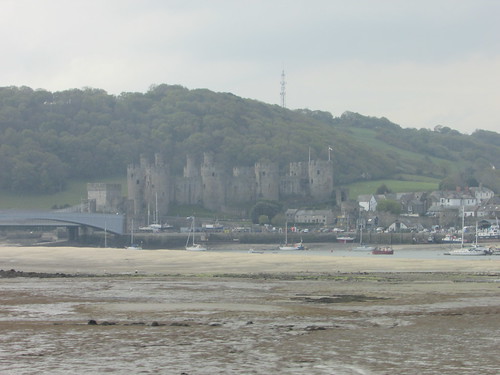
Conwy castle and the estuary of the Conwy river
On arrival at Llandudno station, I walked across the booking hall of the modernised station building, through the automatic glass doors and headed along Vaughan Steet to the sea front. The appearance of the sea front betrays its Victorian origins. A broad, pedestrian promenade around the curving bay is flanked by a road with attractive hotels on the landward side with the bulk of the Great Orme to the west and the Little Orme to the east. The weather was dry and reasonably warm but overcast, rendering the offshore wind farm virtually invisible.

Llandudno beach, showing the Pier and the Great Orme (Llandudno trip)
I took the promenade west past the bandstand and, once past the shingle, continued along the sandy beach for a time, returning to the promenade before choosing my next target, either the pier or the Great Orme Tramway. I decided to look at the tram so I crossed to Church Walks, the fairly steep approach to the lower terminus of the tramway, passing hotels and boarding houses on both sides along the way. I discovered that the tram was operating so I purchased a ticket to travel to the summit and back.
The Great Orme Tramway
The Great Orme Tramway ascends on a route about one mile long from Victoria Station to Summit Station at the top of the Great Orme headland in two, completely separate stages requiring passengers to change between lower and upper trams at the Halfway Station which includes the Engine House controlling the cables for both sections. Both sections follow the geography of the land, with changes in gradient and variable curvature. It is a type of cable railway called a Funicular where descending and ascending cars are linked by cable, reducing haulage power requirements.
As built, haulage was by winches operated by steam engines located in one Engine House at Halfway Station. On the lower section, each car was connected by cable to a winch at the Engine House with two cable drums so that as one car is hauled uphill, the other descends. The Upper section is similar but, because the powered winch is at the lower end of the section, a third cable links the upper end of the two cars via an Idler pulley at the Summit station. Electric winches finally replaced the steam engines in 1957. For more information, see Book Reference [1].
Around 2000, funding from the Lottery, the European Union and the Local Authority allowed comprehensive modernisation. There's more information on the Great Orme Tramway website here together with Book Reference [1] and Book Reference [2].
The lower terminus is called Victoria Station because it is built on the site of the former Victoria Hotel. It was some time before the incongruity of this single-track station sharing its name with the rather larger terminus in London (briefly described here) struck me.

Llandudno: Victoria Tram Station in 2014
There are normally three tram departures an hour (although additional services can be added in very busy periods). The tram station was bustling with people and I failed to board the first tram but the overcast was giving way to blue sky and bright sun so I was content to wait for the next service which took me to Halfway Station.

Tram No. 5 ready to leave Victoria Station with a full load.
The lower section shares the route with a public right-of-way for most of its length and uses 'inset' track to provide a level road surface. The haulage cable is below road level with a slot between the rails allowing each car to be connected to the cable. A passing loop is provided at the midpoint of the lower section with the line below the loop arranged as '2-rail' and that above the loop as '3-rail', as explained in the Wikipedia article here). Although the line from the lower section loop to Halfway Station is classed as '3-rail', there are actually 4 rails, with the middle two close together.

Great Orme Tramway: View of passing loop on the lower section from an ascending tram, showing the descending tram approaching the loop.

Great Orme Tramway: View of lower section tramshed at Halfway Station. Note two tracks, side-by-side ('3-rail') as far as the lower passing loop.
At Halfway Station, a brisk walk through the Engine House with the other passengers took us to the waiting upper section tram which departed once we had all boarded.
The upper section passes through unfenced moorland using sleepered track with stone ballast. The haulage cable is above ground, supported on a variety of pulley wheels. A passing loop is provided at the midpoint of the upper section and the line both above and below the loop is arranged as '2-rail'.

Great Orme Tramway: View of the upper section from an ascending tram, with the passing loop visible on the left. Note the level crossing.
On the upper section, exit from the loop to either 'uphill' or 'downhill' sections is via a 'trailable' set of points allowing a car leaving the loop to force the points to the correct position. A special Tumbler mechanism then holds the points in that position, so that the returning car is directed to the correct side of the loop. For more information about the 'trailable' points and the Tumbler mechanism, refer to the report on an accident which occured in 2009 here.

Great Orme Tramway: View of upper section passing loop from ascending tram nearing exit points. Note extra 'crossings' to accommodate the cable joining the trams via the Idler pulley at Summit Station

Llandudno: Great Orme Tramway: This small building at Summit Station houses the large Idler pulley on the third cable which connects both upper section trams. Winding for both the Upper and Lower sections is from Halfway Station.

Great Orme Tramway: View of Summit Station and Museum. Note the telecommunications tower
The Summit area was quite busy when we arrived and the car park was well-patronised. There's a large restaurant, various amusements and small museum next to the tram station which outlines the history of the Great Orme. The haze had largely cleared and it was pleasantly warm. I walked for a while taking in the sea views and re-visited the museum but, with limited time, I boarded the next descending tram.

Great Orme Tramway: View of 'top hat' cable pulleys from descending tram on upper section. Note cables clipped to sleeper ends
At Halfway Station, windows give a view of the winch gear as you walk through the engine house to board the tram for the remaining section.

Great Orme Tramway: View of upper tramway cable haulage motor (blue) and gearbox (white) with twin winch drums visible in the background at Halfway Station

Great Orme Tramway: View of lower tramway cable haulage motor (blue) and gearbox (white) with twin winch drums just visible in the background at Halfway Station
On the lower section, there's a road/tram crossing with conventional traffic lights for road vehicles and the usual row of white lights applying to the tram (horizontal row: stop, vertical row: proceed). I believe that a magnet under the tram should ensure that trams always receive a 'proceed' signal: if not, the tram attendant issues an 'emergency stop' and winching (of both cars) halts until the system is reset which I'm told involves a 'magnet on a stick'.

Great Orme Tramway: Road signal (red) and tram signal (proceed) viewed from descending tram on lower section
Llandudno Town
Rather than retrace my steps back to the promenade, I turned into Mostyn Street, the town's major traditional shopping area. Encouraged by the good weather, the street was quite busy. I called in a one shop selling discounted new books, but refrained from making a purchase. I remember trams running along Mostyn street because trams operated along an eight mile route to Colwyn Bay until 1956. There's a Wikipedia article here.
Already fairly tired by my adventures, I determined to have lunch before making the return journey home so I turned into Vaughan Street to reach the promenade and the Imperial Hotel where I enjoyed a leisurely lunch in the enclosed terrace restaurant with panoramic views of the sea.

Imperial Hotel, Llandudno, viewed from the promenade in 2011.
Suitably fortified, I spent a few more minutes on the promenade enjoying the sea air and the sun before walking back to the railway station to start my return journey.
The Return Journey
That's the point at which things started to go wrong. I'd intended to catch a shuttle to Llandudno Junction, connecting with an Avanti 'Voyager' to Crewe. Then, an Avanti London service would take me to Stafford where West Midlands Trains would complete the journey to Wolverhampton. At Llandudno, I walked confidently up to the automatic glass doors and was surprised that they failed to open. Undaunted, I moved to the adjacent manual glass doors and found them locked. Then I noticed a small paper notice secured to the glass giving station closing times. It appeared the station had closed ten minutes previously. Through the glass, I could see the train I intended to catch in the platform and I was temporarily bemused. A kindly pedestrian passing by had seen this little pantomime played out and called "When it's locked, you have to go round the side and through the little gate". Thanking him profusely, I hurried to the car park at the side of the building and found the gate giving access to the platforms, in time to see my train depart.
I was anxious to be on my way but the next train to Llandudno Junction was not for an hour. Before the pandemic, taxis could frequently be found waiting outside but, with a reduced timetable in use post-Covid, the station was very quiet. Then I noticed a taxi office at the far end of the station building. The street door of the taxi office led to a waiting area and an internal door led to a counter behind which a base station radio operator was visible. I ordered a taxi to take me to Llandudno Junction which, to comply with the company's 'Covid Safe' rules, was done by shouting details from the waiting area. I waited in the street for about ten minutes for the taxi to arrive and the cheerful driver quickly drove me to Llandudno Junction station.
I hastened over the footbridge to platform 1 which was crowded with passengers supervised by two well-built security men as an already well-loaded DMU arrived. It took a little while to fit all the waiting passengers together with the security men onto the train and I settled for a cramped standing position next to a door. It appeared that there had been some prior dislocation to the services but I never discovered the details. Using Railcam UK on my mobile phone, I found out that I'd caught the 14:34 from Holyhead to Cardiff, reporting number 1V97, and that we were being closely followed by the 14:50 Holyhead to Crewe Avanti 'Voyager' service, reporting number1A53, so I came up with a plan to disembark at Rhyl and transfer to the 'Voyager'. The surge of passengers and bicycles getting off and on at Rhyl meant that I was trapped at the wrong side of the vestibule and, as the doors closed, I resigned myself to continuing to stand until Chester.
But I was disappointed when we were brought to a stand at Saltney Junction where the former Great Western Line from Wrexham trails in from the right. Railcam UK showed the line ahead clear to Chester but there was a Cardiff to Holyhead service, reporting number 1W94, approaching from Wrexham. "Surely", I thought to myself, "they won't cross this in front of us?". But they did, so we sat there, sardines in a tin, whilst I watched on screen as 1W94 made what seemed its agonisingly slow progress in front of us to Chester and 1A53 waited a block behind us. I can remember when there was quadruple track, paired by use, from Saltney Junction over the Roodee Viaduct and through the tunnels into Chester which allowed two trains to simultaneously approach the station. The arrangements were simplified by British Rail to a simple double-track junction with only two lines over the Roodee Viaduct and additional slow lines (this time paired by direction) commencing nearer Chester which was the arrangement inherited by Chester Power Signal Box in 1984.

Chester: West end of Roodee Viaduct in 2014. Note Guard Rails between Running Rails over the bridge.
My screen showed train 1W94 being crossed to bay platform 2 so, once he was clear, I was not surprised that we were routed into the adjacent through platform 3, leaving through platform 4 available to handle train 1A53 behind us. Once off the crowded train, I made my way over the footbridge to catch 1A53, the Avanti 'Voyager' to Crewe, which was 8 minutes 'down' on departure. There was plenty of space in First Class and I managed a welcome cup of tea on the journey before we arrived in bay platform 9 at Crewe, having lost a further minute on the short journey.
The late running destroyed my chance of connecting with Avanti 'Pendolino' service 9M84 from Blackpool to London via Birmingham which would have returned me to Wolverhampton in style. Instead, I disconsolately watched this train depart from platform 5 whilst I was still heading to the footbridge from platform 9.
Whilst I was trying to work out the next departure towards home, another 'Pendolino' arrived in platform 5 from the Manchester line and the public address announced that it was not in service so, intrigued, I sought more information from Railcam UK which revealed an Empty Stock working, reporting number 5T25 from Longsight Carriage Maintenance Depot to Widnes Transport Technology at Ditton Junction. Longsight is Alstom's centre for bogie maintenance and Widnes Transport Technology is the 13,000 square metre train modernisation and repainting facility opened by Alstom in 2017.
I decided to catch the West Midlands Trains 17:33 stopping train to Euston, reporting number 1U40, alighting at the first stop, Stafford. I made myself comfortable in the rear First Class section of the 8-car Siemens 'Desiro' Electric Multiple Unit (EMU) in bay platform 7, awaiting departure. We were 4 minutes late leaving, awaiting the arrival of a late-running Shrewsbury-Crewe DMU in adjacent bay platform 8 because bays 7 and 8 share a common 'throat' track.
As we passed the remodelled junctions at Norton Bridge (outlined in the post here), we passed a Class 66 hustling a container train north on the Down Slow. Railcam UK revealed this as the 09:32 from Felixstowe via the Northampton Loop due at the O'Connor Freightliner Terminal, Ditton at 19:41.
By now rather tired, I just managed to get off at Stafford platform 1 before the doors closed and the train left. There was a Wolverhampton service expected on platform 4, so I hurried across the passenger bridge, grateful for working lifts.
I was puzzled to see the signal at the end of platform 4 displaying a single, flashing yellow, since I'd never seen a flashing yellow displayed at that location before. Railcam UK clarified that the approaching train was not a passenger but a fast freight: the 15:49 from Garston Car Terminal to Dagenham Dock Reception Ground Frame, due there 23:10. This train, reporting number 6L48, is routed via the Crewe Independent Lines, thr Trent Valley, Northampton Loop, Camden. Stratford and Ripple Lane. This train is allowed to travel at 60 miles an hour and was certainly shifting as it swept through the platform with a Class 66 heading a long train of empty 'Carflats'.
The public address then announced a platform change for the expected passenger train to platform 1 so all the passengers trooped across to platform 1, either using the stairs or the lifts. By the time I was back on platform 1, I realised I no longer had my Canon camera with me.
At first thinking I'd left it on a seat on platform 4, I decided to miss the approaching Wolverhampton train and return to platform 4 to search but I found no camera. Then I became certain that, in my haste to leave the Euston train at Stafford, I'd in fact left the camera on the train seat which was speeding towards London.
I then took the next service to Wolverhampton (a Cross Country 'Voyager from Manchester, reporting number 1O68) and made a report to the West Midlands Train staff at Wolverhampton. The supervisor at Wolverhampton explained that West Midland Trains use a third party website called MissingX to deal with lost property enquiries, although he didn't display much confidence in the arrangements. So I finally caught a taxi home after a mixed day of good and not-so-good experiences.
Book References
[1] 'Great Orme Tramway: The First 80 Years' by R.C. Anderson (Light Rail Transit Association)
[2] 'The Great Orme Tramway: Over a century of service by Keith Turner (Gwasg Carreg Gwalch 2003) ISBN 0-86381-817-X
[3] ‘British Railways Layout Plans of the 1950’s - Volume 10: LNW Lines in North Wales, Chester and Wirral areas’ (Signalling Record Society) ISBN: 1-873228-12-0
[4] ‘A Regional History of the Railways of Great Britain: Volume 11 North and Mid Wales’ by Peter E Baughan, published by David & Charles (ISBN 0-7153-7850-3) [2].
Related articles on other websites
Great Orme Tramway
Collision on the Great Orme Tramway
15 September 2009
British Rail Class 153
British Rail Class 175
Funicular (Wikipedia)
Llandudno and Colwyn Bay Electric Railway
Related posts on this website
Llandudno by Train
Rail Travel in January 2022
A Trip to the Seaside (Part 2)
Trip to Holyhead (Part 1: Crewe to Llandudno)
Llandudno (2014)
Return to Llandudno
A Trip to the Seaside (Part 1)
Llandudno Railway Station
The Holyhead to Crewe Railway Line
Watching The Trains Go By
Return to Manchester (Norton Bridge remodelling)
My pictures
Llandudno trip (This trip)
North Wales Line (Crewe - Llandudno) All pictures
Crewe Area rail All pictures
Great Orme Tramway All pictures
Llandudno Earlier pictures
Depending on the display device, the right hand edge of pictures may not display. To see an uncropped image, click on the picture. Alternately, you can find the image by following the 'My pictures' links and display or download the image in various resolutions.
On the 8th, 9th and 10th April 2022, I visited my friend Rita in Croydon, travelling by train. Prior to this trip, I'd been to Croydon in September 2021 (described here).
The journey to Croydon
On Friday, 8th April, I caught the first bus to Wolverhampton at 07:30 giving me plenty of time to walk to the railway station, clutching my pre-booked tickets. On this occasion, I'd booked via Stafford so the first 'leg' was to head back by train, on almost the reciprocal of the heading I'd just arrived by bus! When I was young, there was a station within a couple of miles (around 3 km) measured in a straight line 'as the crow flies' from where I now live. Of course, country roads (unless the legacy of the Romans) tend not to be straight so I'm sure the distance by road was probably around twice the figure I've quoted. This minor station was called Four Ashes but was closed in 1959, with the signal box surviving a few years longer.
I'd intended to catch the 08:21 West Midland Trains service from Wolverhampton to Liverpool as far as Stafford but my slightly earlier arrival at the station allowed me to catch the prior Cross Country Trains 'Voyager' service to Manchester which also called at Stafford. On arrival at Stafford, I went to platform 1 for a connection providing another reversal of direction. My general heading would be south-east and the straight-line distance from Stafford to Euston is about 122 miles (just under 200 km). I was quite surpised that the train I intended catching (a Liverpool to Euston express) was preceded by a Crewe to Euston stopping service and I wondered whether this would delay my train.

Stafford Station looking north from platform 1 with Crewe-Euston stopping train arriving.
The stopping train departed and my train followed - an Avanti 'Pendolino'. I snuggled into a quiet corner in Standard class for the non-stop journey to London. We didn't appear to be baulked by the preceding local which I think we passed either at Lichfield or Tamworth when the local was on a platform loop. We arrived at Euston within one minute of 'right time'. Normally, I'd head to Victoria by Tube and there catch an East Croydon service. But, presumably because of 'engineering works', passengers were being advised to travel from London Bridge, rather than Victoria. To add to the misery, there was no Tube service from Euston via London Bridge to Moorgate. Since my friend Rita would not be available until the afternoon, before continuing to East Croydon I'd decided to try out the new Northern Line Extension which now branches from the Northern Line south of Kennington to serve a new intermediate station at Nine Elms and a new terminus at Battersea Power Station. My company had supplied control equipment for this extension which had opened to the public in September 2021 but I'd not yet travelled on it.
At Euston Underground Station I descended to the Charing Cross Branch Southbound platform. All the escalators appeared to be working but the various areas were thronged with the usual mass of bewildered passengers unsure as to which way to go. The first arrival was for Morden, so I waited for the next train, shown as bound for Battersea Power Station. I took this train to the end of the line at Battersea Power Station, about two miles beyond Kennington. I noticed the new Step Plate Junction where the southbound tunnel has been modernised and broadened to accommodate the turnout leading to the extension but otherwise the new tunnel was relatively featureless. As we paused at Nine Elms and its single island platform, I was able to see that the architectural style at platform level was similar to other recent station modernisations with clear signage, uncluttered layout and lots of stainless steel panelling.
Battersea Power Station also has an island platform and trains can arrive at and depart from either platform. The far end of the platform lines terminate in stop blocks but planning has allowed for the line to be extended to Clapham Junction in the future.

Battersea Power Station underground station: Platform 2 with High Barnet train of '95' stock
The control equipment cubicles my company had supplied are locked-away inside the various Traction Sub Stations serving the the line but I did find the Traction Current Discharge Plungers associated with our system, neatly accommodated behind stainless steel hinged doors integrated into the stainless steel wall cladding. These plungers allow staff to isolate the traction current in an emergency and, to discourage unwanted use, the hinged doors are fitted with a plastic seal.

Battersea Power Station underground station: Modular stainless steel wall cladding allowing various items of equipment to be integrated.
I spent a few minutes on the platform studying the trackwork entering the platform before taking the escalator to the intermediate concourse level.

Battersea Power Station underground station: View from platform 1 towards Nine Elms showing pit alongside platform, conductor rail ramps, turnout with point machine and backdrive.

Battersea Power Station underground station: Concourse level, with the Station Supervisor's Office on right.

Battersea Power Station underground station: View across concourse level from near Station Supervisor's Office, showing Ticket Gate Line.
Having passed through the Ticket Gate Line to the 'unpaid area' of the Concourse, signs pointed to a group of three escalators leading to the surface offering destinations 'The Power Station', 'New Covent Garden Market', 'Buses' and 'Battersea Pier', whilst a row of five ticket machines (with glowing display screens) stood ready to serve arriving passengers. I found myself quite impressed with the Northern Line Extension.

Battersea Power Station underground station: Concourse 'unpaid area' showing three escalators to the surface.
Once above ground, without a clear plan, I headed in the general direction of the original power station building. There's a Wikipedia article here with history of this iconic (Grade II* Listed) building, plus an outline of the indignities it suffered after closure as a generating station.
Back in 2009, I managed a reasonable aerial view of the then part-dismantled power station as I landed at Heathrow after a memorable trip to the Middle East (described here and the picture's title, written at the time, reads:-
Returning from Amman on 24-Mar-2009, we initially stooged around over London and then made an East to West pass over the city to land on runway 28L at Heathrow.
Battersea Power Station (or what's left of it). Top left, Chelsea Bridge, top middle Grosvenor Bridge taking the railway lines to Victoria. Coal-fired Battersea Power Station 'A' was built in 1930 and caused some consternation. The architect Halliday provided many Art Deco features but the external 'brick cathedral' appearance was due to Giles Gilbert Scott. The 'B' station was added in the 1950s, giving the present appearance. The building was listed Grade II in 1980 when closure was threatened and generation ceased in 1983. Although it remains a much-loved icon, a sustainable future has not yet emerged.

Battersea Power Station from the air
Click for larger views
Later in 2009, I took the picture below showing the part-dismantled structure from a train leaving Victoria station (using the camera on a 'Blackberry' mobile phone).

The skeleton of Battersea Power Station, viewed from a train leaving Victoria.
At that time, the building dominated the skyline but, since then as I've travelled to and from Victoria station, I've watched the huge structure disappear from view as modern apartment blocks have been constructed on all sides except the river elevation. The aerial picture below illustrates this.

Battersea Power Station, aerial view (Photo:Battersea Power Station 2022)
As I continued my walk from the new Northern Line station, the Power Station building came into view, although sightlines were cramped and the modern apartment block on my left overhung my route in a rather disturbing manner.

Battersea Power Station
Further on, the buildings at least had walls that were vertical (matching the massive power station building to my right) but I was not tempted to call in at the estates office to enquire about the attractions of apartments available on the site but the website here lists all the advantages. And so, I arrived at the River Thames and Battersea Pier, a modern, rectangular floating pontoon allowed to move up and down two massive steel restraining posts sunk into the river bed, according to the river level. A link span provides pedestrian access from the bank at all states of the river level.
The Pier is a little downstream of Grosvenor Railway Bridge which carries the eight tracks approaching Victoria Station. I was surprised to see a train of Pullman coaches crossing the bridge, heading for Victoria and failed to identify the locomotive at the head, but it might have been a Class 73 'Electo-Diesel'. At the rear of the train, there was a Rebuilt Bullied Pacific being unceremoniously dragged tender-first. So then I realised, this was the British Pullman empty stock from Stewarts Lane to Victoria prior to working a Belmond train. Back in 2013, I visited the carriage workshops at Stewarts Lane and there's a short post here.
I was too slow to take a picture of the British Pullman on Grosvenor Railway Bridge, but took one of the bridge a few minutes later which also shows, in the background, the imposing chimney and main building of the Western Pumping Station built by Bazalgette as part of his improvements to the London Sewer System.

Grosvenor Railway Bridge, with Bazalgette's Western Pumping Station in the background, viewed from Battersea Power Station.
From my position adjacent to the Pier, it was finally possible to get a reasonable view of the huge Power Station structure.

Battersea Power Station viewed from Battersea Pier
I walked onto the Pier as a gentleman was struggling to complete a ticket purchase from the automatic machine. When I followed, I understood his problem. For the convenieince of wheelchair passengers, the solitary machine has been installed at low level, necessitating adopting a crouch position during the transaction. Further, the display device was a liquid-crystal device, apparently without backlighting which, in daylight, can be difficult to interpret. After a while, the machine, satisfied with my fumbling, issued me with a paper ticket. I had a few minutes to wait before the River Bus arrived. For some years modern catamarans have provided the service which preferred to style itself 'Thames Clippers' - sorry, MBNA Thames Clippers. MBNA started in 1982 in the USA as the Maryland Bank National Association. Since 1993 MBNA, which provides credit cards and loans, has been based in Chester (yes, Chester, England) and in 2017 became part of Lloyds Banking Group. But now, the River Bus service additionally calls itself 'Uber Boats'.
When my Uber Boat arrived, it was appeared to be one of their newer vessels and certainly more appealing than the rather care-worn Thames Clipper I travelled on some time ago. I found a large a large enclosed passenger cabin (with shop and toilets) towards the front but, on impulse, I selected a seat on the semi-open deck at the rear. Although I had no view ahead, I had unobstructed views astern for photography and this proved a good move because, when I finally checked out the front cabin, I discovered that although the windows gave good views, spray thrown against the glass when moving at speed gave a rather mottled appearance when attempting photography.
We set off down-river, commencing a series of pick-ups at the frequent piers on both sides of the river.

Vauxhall Bridge on the River Thames with Vauxhall (St. George Wharf) Pier visible through left arch.

Secret Intelligence Service (MI6) Building at Vauxhall on the River Thames.

St. Thomas' Hospital, River Thames

The London Eye and Waterloo Pier: River Thames (Battersea Power Station to North Greenwich)

The Houses of Parliament and Westminster Pier: River Thames
By the time we'd called at Westminster Pier, the boat was quite full and I was pleased with my choice of seating location. More stops followed, as we passed the familiar landmarks - Tate Modern, the pedestrian Millenium Bridge, Blackfriars Railway Bridge, H.M.S. Belfast, The Tower of London, Tower Bridge.

Tate Modern Gallery (converted from redundant Bankside Power Station): River Thames

Tower Bridge with The Shard in the background on the left: River Thames>
As sea transport has moved to containerisation and larger ships, London's once-famous docks have been largely given over to office and residential use. There's an article on 'The Container Revolution' here.
Deptford once had an important power station, designed by Sebastian Z. de Ferranti and opened in 1889. Ferranti was convinced that generation of alternating (rather than direct) current was the way forward at a time when direct current had many proponents. To allow generation to be further from the point of consumption, he also proposed high-voltage transmission at 10,000 volts which many considered unsafe. The project encountered many problems but Ferranti is now regarded as far-sighted and the site is regarded as the first centralised, high-voltage power station in the world. There's a brief history on Wikipedia here. The plant was coal-powered and the large jetty for receiving coal by ship survives but, after final closure in 1983, the site has been redeveloped, apart from the remaining high voltage switchyard.

Deptford from the river. L-R: modern housing, former coaling jetty, high voltage switchyard (River Thames)

Deptford Creek (River Thames)
Our penultimate stop was at Greenwich, adjacent to Greenwich Foot Tunnel (opened 1902 with a Wikipedia article here and the famous 'Cutty Sark' clipper ship built in 1869. There's a Wikipedia article here. The ship is now managed by Royal Museums Greenwich, along with the National Maritime Museum, Queen's House and the Royal Observatory.

Greenwich, with (foreground) domed stairway leading to Greenwich Foot Tunnel and (background) preserved 'Cutty Sark' (River Thames)
After a lot of passengers had left the ship at Greenwich, we carried on to the final stop at North Greenwich situated on the 'Greenwich Peninsula' formed by the sharply-bending river. This is the site of the curious Milennium Dome which originally formed the centrepiece of the 'Milennium Experience' exhibition intended to celebrate the new Milennium in 2000. This proved rather underwhelming but, now owned by Anschutz Entertainment Group (ARG) and called, curiously, 'The O2' (since the mobile phone company O2 purchased 'naming rights') the area is has been developed as a "large entertainment district".

'The O2' (showing February 2022 storm damage to the roof fabric) viewed through the windows of a Uber Boat arriving at North Greenwich Pier, with apologies for the 'mottled' appearance.
On disembarking, I headed towards where I imagined North Greenwich Underground station would be, passing more modern apartment blocks in a rather curious range of designs. In 1999 my company was involved in site commissioning control equipment we'd supplied for the Jubilee Line Extension project and I'd spent many hours (usually at night) working at North Greenwich when the area around the station was completely undeveloped. I arrived at the large Tube station without incident. After checking out the new line to Battersea Power Station and spending around 90 minutes on the Uber Boat, my appetite for exploring London was satisfied, so I decided to catch a Jubilee Line train to London Bridge and catch a further train to East Croydon.
I'd not been on the Jubilee Line since before the Covid Pandemic but it seemed little changed. This line is fitted with full-height Platform Edge Doors, generally referred to as 'Peds' by technicians, so it's important that trains stop accurately with the train doors correctly aligned with the platform edge doors. This is controlled automatically and, once achieved, both sets of doors open to allow passengers on and off.
At London Bridge, there was a fair walk to get from the Underground station to the concourse of the rebuilt main line station but I discovered that a Thameslink service to Brighton, first stop East Croydon, was due in a few minutes, so I happily caught this train to my destination.
High spot of the weekend was an excellent lunch on Saturday at the Horseshoe, Warlingham, accompanied by Rita's friend Douglas.

Douglas and Rita at The Horseshoe
The journey home
On Sunday afternoon, I caught a well-patronised bus to East Croydon where I waited for the next Thameslink service heading north, which are all now operated by Siemens Class 700 trains. The train was quite crowded. Bearing in mind the closure of part of the City Branch of the Northern line, I decided to stay on the Thameslink train until St. Pancras Thameslink. Emerging above ground on the west side of St. Pancras station, I then walked along Euston Road to Euston station. As soon as the platform for my Avanti 'Pendolino' was announced, I headed for the train, along with a large crowd of passengers. I walked the length of the train to reach the Quiet Coach at the front and found a corner seat where I was able to relax on the journey back to Wolverhampton.
Related posts on other websites
Northern line extension to Battersea (Wikipedia)
Clive's UndergrounD Line Guides: Northern Line
Battersea Power Station - THEN & NOW (Wikipedia)
Battersea Power Station - NOW
Deptford Power Station (Wikipedia)
Greenwich Foot Tunnel (Wikipedia)
Cutty Sark (Wikipedia)
Clive's UndergrounD Line Guides: Jubilee Line
Related posts on this website
By Train to Croydon
My pictures
Northern Line
River Thames
Depending on the display device, the right hand edge of pictures may not display. To see an uncropped image, click on the picture. Alternately, you can find the image by following the 'My pictures' links and display or download the image in various resolutions.

