skip to main |
skip to sidebar
Each year, The Old Locomotive Committee (OLCO) has an event for live steam models of the 'Lion' locomotive.
In 2017, the event, called 'Lionsmeet', was held on Saturday, 22nd July at the Worden Park track of the Leyland Society of Model Engineers.
I travelled to Preston on an Edinburgh train which I joined at Wolverhampton. The journey, operated by Virgin using two 5-car 'Voyager' diesel-electric units, was swift and on-time (although it never ceases to irritate me that so many long-distance journeys 'under the wires' remain operated by diesel traction). I first spent a while exploring Preston city centre on foot - still strangely quiet as early morning shoppers started to fill the streets. I walked as far as the Harris Museum and Art Gallery, with its all-embracing, gilded, carved inscription
'TO LITERATURE ARTS AND SCIENCE'.

The famous Harris Museum and Art Gallery in Preston.
Then, I retraced my route back to the station and took a taxi south of the city centre to Leyland. The taxi dropped me at the Park Gate and I had a walk of a few hundred yards to reach the Club House and Steaming Bays but, fortunately, my 'railway homing instinct' did not fail me.
I was welcomed by Andrew Neish, who is currently the 'Lionsmeet' organiser for OLCO and the other early arrivals. Members of the host club were also there in force and I was soon drinking a welcome cup of tea in the clubhouse.
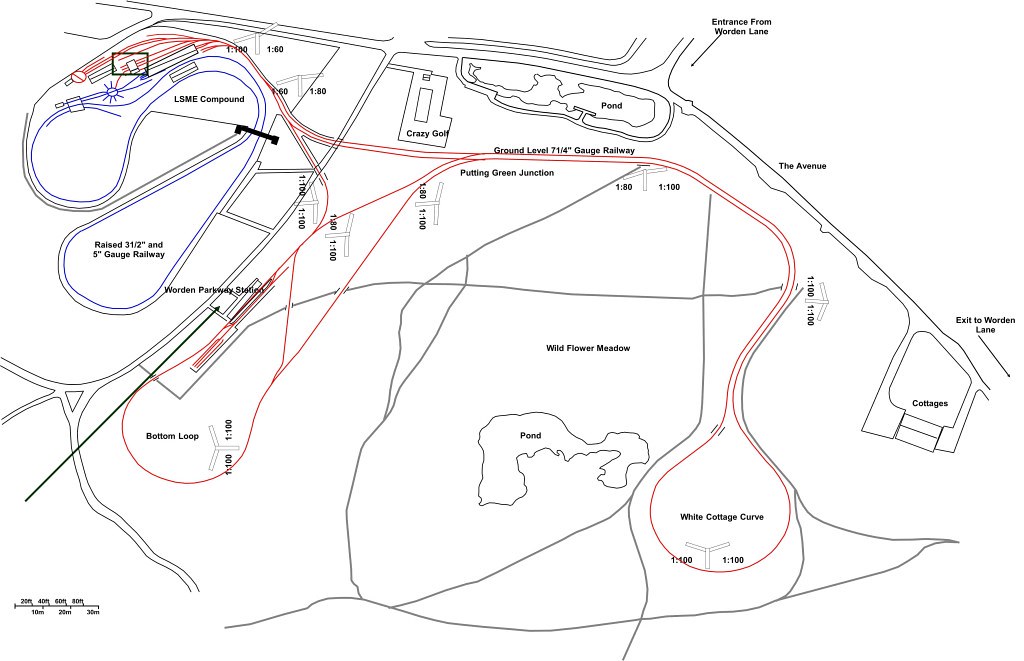
The club has established a 1617 foot continuous raised track for 3½ and 5 inch gauge models (arranged as a 'folded dumb-bell') and a ground level 7.25 inch track extending to one kilometre (laid out as a 'slightly-bent dumb-bell'). There are covered steaming bays, turntables and station facilities for each gauge.
Click for larger image
Worden Park, Leyland: Plan of model railway facilities. (Map: Leyland Society of Model Engineers).
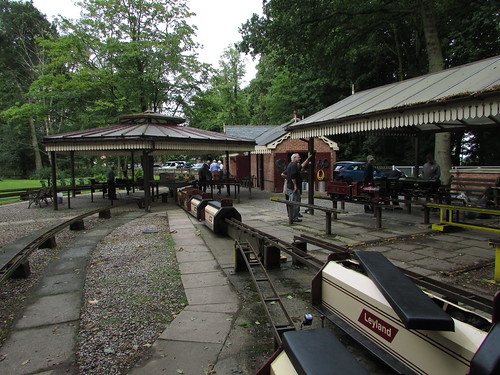
'Lionsmeet 2017' at Leyland SME: View looking west from the Stock Shed towards the 3½in and 5in steaming bays with the 7.25in steaming bays on the right.
My eye was drawn to an impressive 7.25in model of 60809 'The Snapper', brewing-up in the steaming bays. I learned that this would be giving public rides during the day on the ground-level track. Soon, a 7.25in 'B1' was also being steamed.
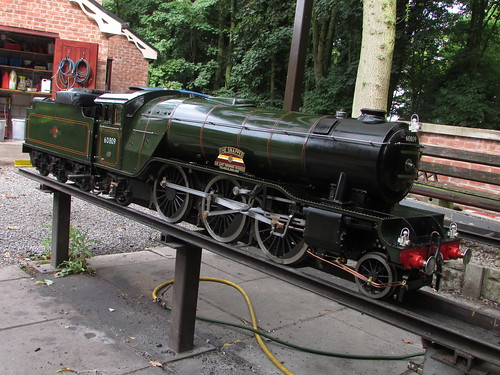
'Lionsmeet 2017': 7.25" gauge locomotive 60809 'The Snapper' being prepared for service on the ground level track.
Although we've had 7.25in gauge 'Lion' models in steam at some previous 'Lionsmeets', none attended in 2017 and so the OLCO activities were confined to to raised track. Club members first extracted their battery electric locomotive 'Worden Ranger' from its 'garage' (where battery charging takes place) and marshalled a train of two passenger car and a 'tool car'.
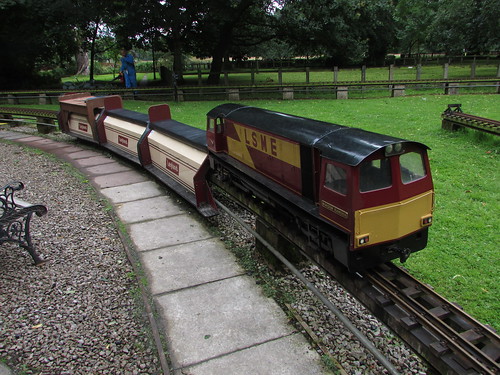
'Lionsmeet 2017' at Leyland SME: The Battery Electric locomotive 'Worden Ranger' ready to perform a line inspection of the elevated track, with two passenger cars and a tool car.
After the line inspection was completed, I was invited to make a couple of circuits with 'Worden Ranger'. Driving was straightforward, with just a direction selector and a single power controller handle. The handbrake on the leading passenger car was used for train braking although there was also a 'parking brake' on the locomotive. I found the locomotive responsive and powerful. A (rather feeble) two-tone horn was provided. For part of the morning, the host club gave public rides with 'Worden Ranger' and its train but the raised track was generally reserved for OLCO members.
Models were steamed by David and Andrew Neish, Jon Swindlehurst and Adrian Banks. David and Andrew, as usual, alternated in driving David's model.
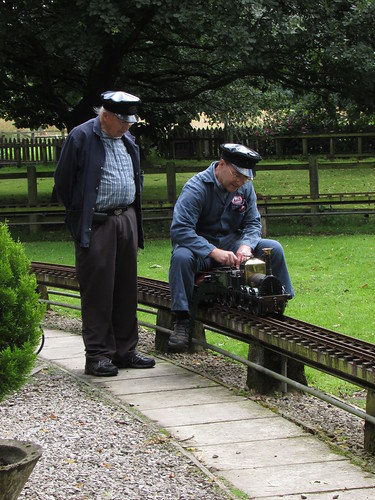
'Lionsmeet 2017' at Leyland SME: David Neish and Andrew Neish on the elevated track.
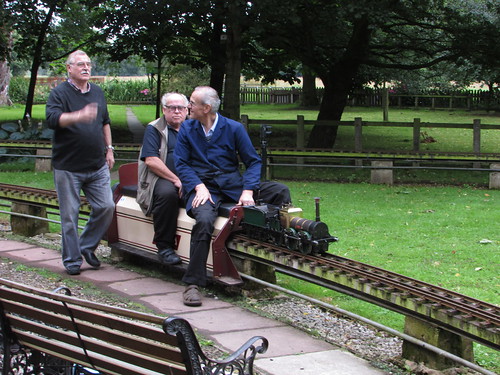
'Lionsmeet 2017' at Leyland SME: Jon Swindlehurst about to depart with his 'Lion' with John Oliver as passenger.
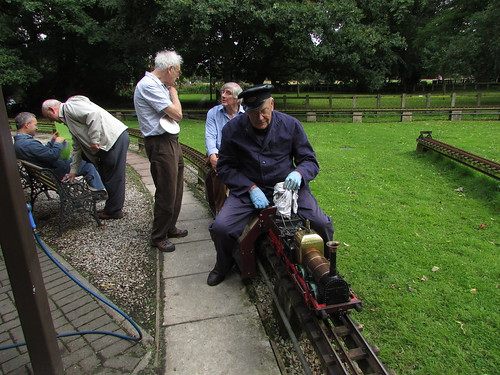
'Lionsmeet 2017' at Leyland SME: Adrian Banks pauses adjacent to the steaming bays whilst he 'fettles his fire', allowing his passenger, John Brandrick, to chat to John Hawley.
In addition, a number of part-built 'Lions' were displayed in the Club House. David Forrest's beautifully-built model (on the right in the picture below) attracted many favourable comments. He had produced a number of trial '3D-Printed' plastic components during the development of his design.
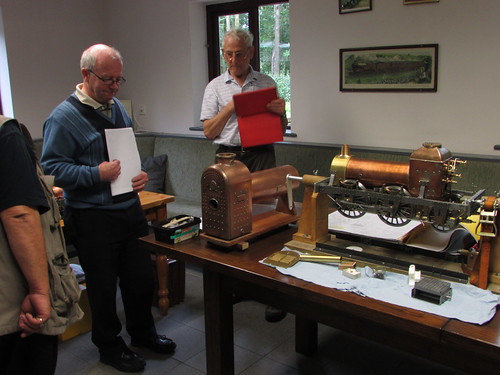
'Lionsmeet 2017' at Leyland SME: Discussions in the Club House: John Oliver, David Forrest, John Hawley.
The host club laid on a splendid buffet lunch and free-running of the models in steam continued into the afternoon. OLCO Chairman John Brandrick made a short address of thanks to Leyland S.M.E. for their hospitality, following one minute's silence to commemorate the death of Justin Garside-Taylor from the Museum of Liverpool.
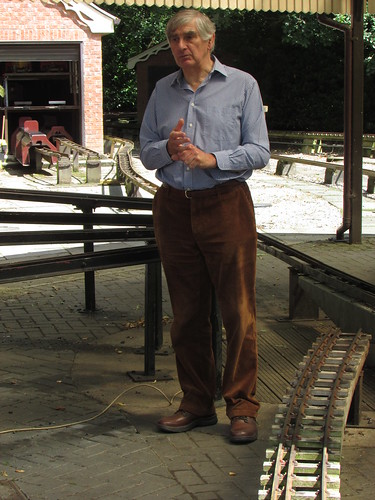
'Lionsmeet 2017' at Leyland SME: During the afternoon John Brandrick, Chairman of OLCO, made a short address of thanks to Leyland S.M.E. for their hospitality.
Some of the OLCO visitors made their way across to the 7.25 inch ground level track at the adjacent Worden Parkway Station, where rides were given to the public throughout the day. In the morning, 'The Snapper' was the motive power but, by the time John Hawley and I went across, B1 'Reedbuck' had taken over.
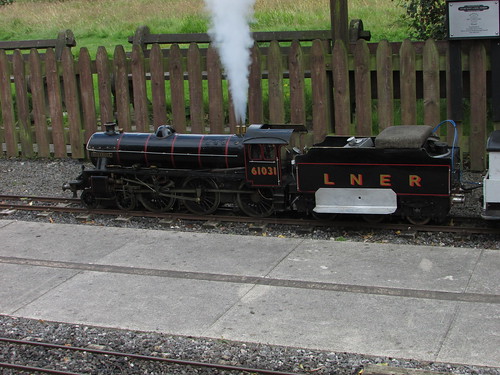
'Lionsmeet 2017' at Leyland SME: Worden Parkway Station on the 7.25 inch ground level track showing 'B1' 61031.
John Hawley kindly ran me to Preston Station for my return train, so I missed the informal 'OLCO Dinner' held later in Euxton.
Related posts on other websites
Leyland Society of Model Engineers.
Related posts on this website
All my posts regarding the Old Locomotive Committee can be found here, with links to my pictures.
My pictures
Where necessary, clicking on an image above will display an 'uncropped' view or, alternately, pictures from may be selected, viewed or downloaded, in various sizes, from the albums listed:-
Lionsmeet 2017.
Preston.
All my 'OLCO' albums.
On the weekend of 5th and 6th August 2017, Peak Rail ran its popular '1940s Weekend'. On the Sunday, I was the driver of the steam locomotive 'Jennifer' operating the 6-coach passenger train between Rowsley and Matlock Town, top and tailing with diesel-electric 'Penyghent'.
My arrival at Rowsley was later than normal, as we had no 'Driving Experience' course prior to the first service train. The Picnic Area and the woods are normally deserted as I make my way to the shed but, on a '1940s Weekend', the area becomes a series of tented military encampments for the re-enactors. Many of the re-enactors were getting ready or taking breakfast in their camps.
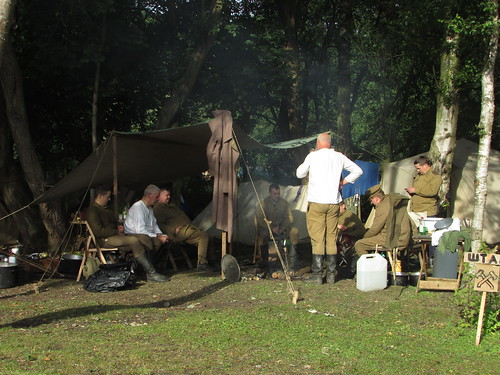
Peak Rail 1940s Weekend 2017: Breakfast in Camp.
I signed-on at the shed and there was some discussion with Dave Pendleton, the fireman, about our pairing on the '1940s Weekend' the previous year when our motive power became a complete failure early in the day. That day is described here. We hoped that history wouldn't repeat itself and it didn't. 'Jennifer' was simmering on the outside pit so I set to oiling-round and carrying out the daily exam.

Peak Rail 1940s Weekend 2017: 'Jennifer' simmering on the pit at Rowsley.
Nice and early, we made our way 'off shed' and across to the north end of our train. Waterman Railway Heritage Trust locomotive 5224 (a Great Western Railway 2-8-0T of the 5205 class, built by Collett in 1923) was on display on the turntable. Turntables always seem to fascinate visitors - it's a pity ours doesn't get more use. There's an article about turntables here.
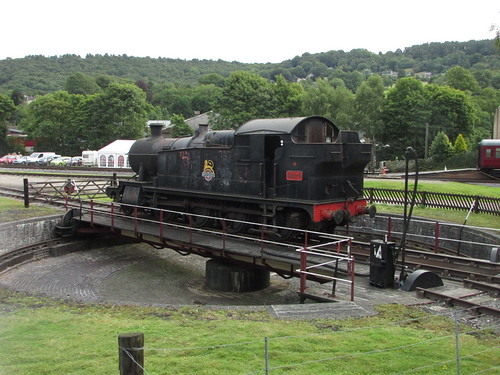
Peak Rail 1940s Weekend 2017: 5224 (awaiting restoration) on the turntable.
The first departure was delayed, waiting for one of the coach parties booked on the train which was delayed in a traffic hold-up somewhere.
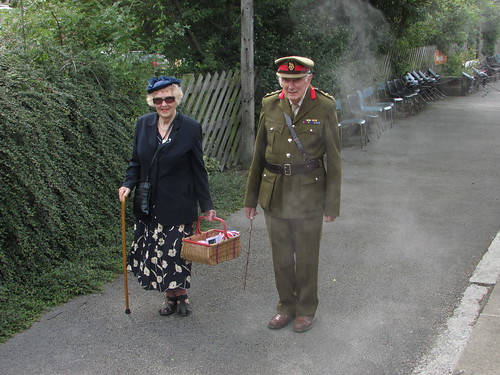
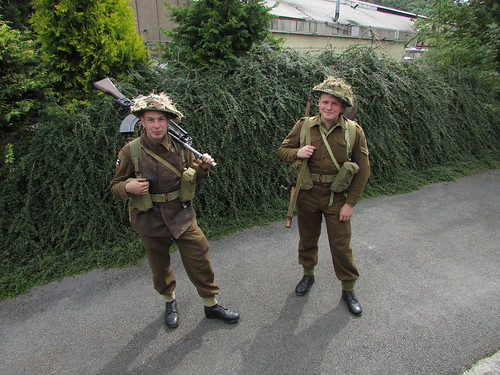
Our train was certainly full when we left, about ten minutes late. I was wearing my 'tin helmet', which alternated with the normal 'grease-top' throughout the day. Of course, we were 'tail end charlie' on the way to Matlock, with 'Penyghent' doing all the work. At Darley Dale, a Remembrance Service had been held.

Peak Rail 1940s Weekend 2017: A Remembrance Service was held at Darley Dale.
There was a lot of activity on the platform at Matlock Town but, eventually, we received the 'Right Away' and, with a whistle, I set off for Rowsley. I'd discovered previously how readily 'Jennifer' copes with the train when hauling northwards (and the 'surging', although not eliminated, is much attenuated), as I described in the post here, so I was able to enjoy our trip back to Rowsley. Then I had a chance to have a quick look around the stalls near the station. I was surprised to discover the prices genuine second-hand period clothing, sought by re-enactors, now commands.
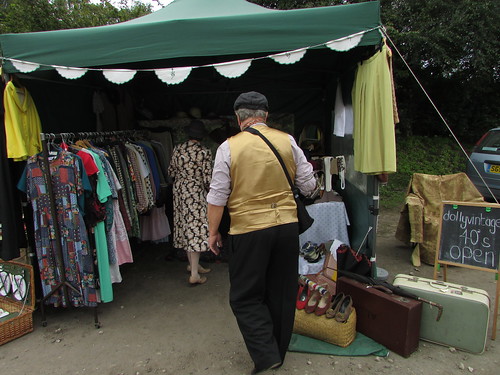
Peak Rail 1940s Weekend 2017: A stall selling period clothing.
The large marquee is always popular, featuring refreshments, a licensed bar and a variety of live period entertainment. I called in when Sue and Steve Mace were dancing to the music of the Ashby Little Big Band.
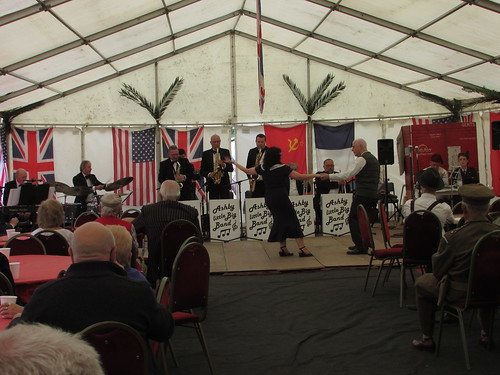
Peak Rail 1940s Weekend 2017: The Marquee with Sue and Steve Mace dancing to the music of the Ashby Little Big Band.
The highlight of the day was the Mock Battle with pyrotechnics which took place in front of the wooded area facing Rowsley Station platform, with a commentary by Paul Harper. Of course, this happens only once the train has departed for Matlock so, if you're on the footplate, you miss the action. The picture below, taken as we left Rowsley, shows the large crowd eagerly awaiting the start of the mock battle.
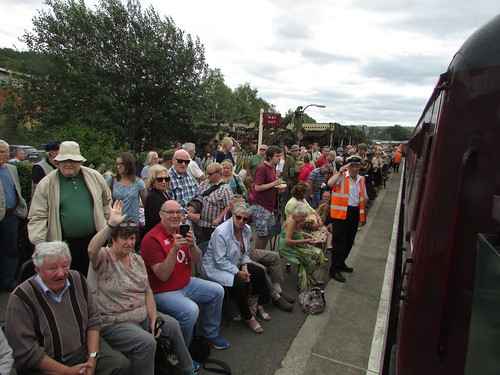
Peak Rail 1940s Weekend 2017: View from 'Jennifer' as we depart for Matlock, hauled by 'Penyghent', prior to the start of the Mock Battle.
I think everyone had an enjoyable day: I certainly did. At the end of traffic, we followed 'Penyghent' onto shed and, after disposing on the outside pit, stabled 'Jennifer' inside on number 1 road, adjacent to 'Penyghent' on number 2.

Peak Rail 1940s Weekend 2017: End of Shift - 'Jennifer' stabled on number 1 road, next to 'Penyghent' on number 2.
Related posts/pictures
I've participated in the 1940s Weekend at Peak Rail on a number of previous occasions.
Peak Rail 1940s Weekend, 2016 (article with link to pictures).
Peak Rail 1940s Weekend, 2015 (article with link to pictures).
2014 event (pictures only).
2013 event (article with link to pictures).
2012 event (article with link to pictures).
2009 event (article with link to pictures).
2008 event (article with link to pictures).
2007 event (pictures only).
2006 event (pictures only).
To see all my posts about Peak Rail, select Label 'Peak Rail' or click here.
Related photograph albums
Where necessary, clicking on an image above will display an 'uncropped' view or, alternately, pictures from may be selected, viewed or downloaded, in various sizes, from the albums listed:-
Peak Rail 1940s Weekend 2017.
'Jennifer'.
All my Peak Rail albums.
Ty Gwyn is a small commercial woodland around 27 hectares in area near Corwen in Wales.
A Recent Timeline
By 2006, the whole plantation was mature and, but for depressed timber prices, would have been harvested.
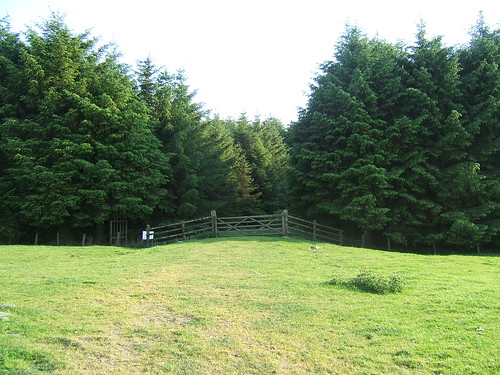
View of the entrance to the plantation in 2006.
Timber prices recovered by 2009 and around half of the plantation was harvested.

View of the entrance to the plantation in 2010 with harvesting in progress to the left of the road.
In 2010, the harvested area was replanted.
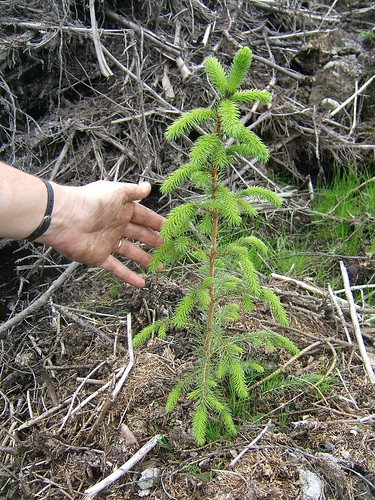
Around 6 months after planting, the trees were already well-established.
In 2014, a further 10 hectares were harvested. The picture below shows this harvesting in progress to the right of the entrance with the area to the left (replanted 2010) growing well.
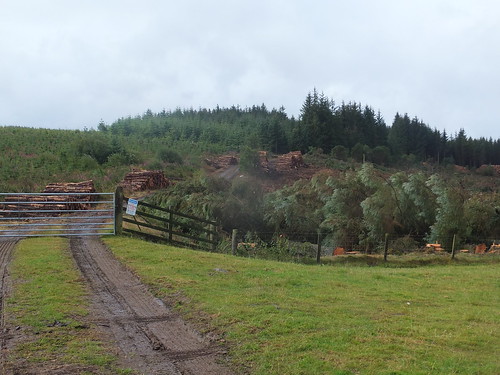
View of the entrance to the plantation during harvesting in 2014.
In November, 2015 the recently-felled area was replanted.
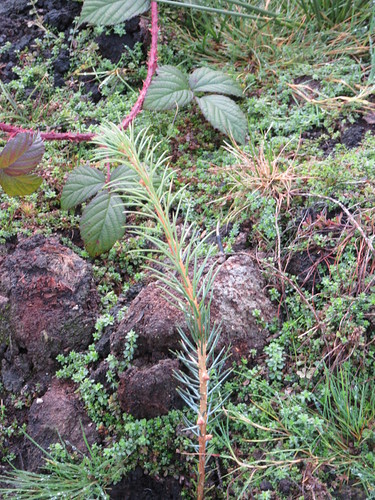
Ty Gwyn, November 2015, Cell grown sitka (1 of 18,000) a few days after planting.
The picture below shows the entrance to the plantation in August 2017. The sturdy trees on the left have had seven growing seasons, those on the right barely two. In the background, there are mature trees not yet harvested.
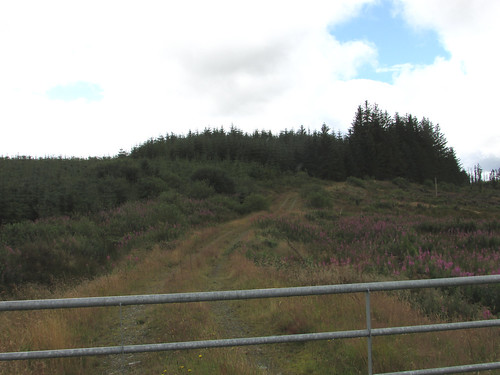
View of the entrance to the plantation in 2017.
Visit to Ty Gwyn on Tuesday, 1st August 2017
Rob MacCurrach, the Forester who'd managed the plantation for some years, was retiring and so this visit was to thank Rob for his efforts and meet his successor, Tegwyn Hughes. The weather was overcast, not too warm and it rained periodically but the three of us spent a couple of hours inspecting the site and discussing future actions to ensure that the crop continues to flourish.

Ty Gwyn 2017: Rob MacCurrach (L) and Tegwyn Hughes (R) examining the 2015 planting.
Related posts on this website
To see all my posts about Ty Gwyn, select Label 'Ty Gwyn'
or click here.
My photograph albums
Where necessary, clicking on an image above will display an 'uncropped' view or, alternately, pictures from may be selected, viewed or downloaded, in various sizes, from the albums listed:-
Ty Gwyn 2017.
All my Ty Gwyn Albums.
In the earlier post DMU Days at the Battlefield Line, I described a couple of days driving Diesel Multiple Units (DMU) at the Battlefield line. My next driving turns at the Battlefield Line, outlined below, featured mixed weather and mixed traction.
Events of Tuesday, 25th July 2017
This time, the single-unit 'Bubble Car' 55005 was used for four round trips from Shackerstone to Shenton, leaving Shackerstone at 11:00, 12:30, 14:00 and 15:30.
During my daily examination before we started, I'd noticed brown staining on the corner pillar at the south end of 55005 which I initially thought was the result of a previous 'bird strike'. Once I'd brought the unit into the platform at Shackerstone, I attempted to remove the marks with detergent, without success. Closer inspection suggested that the culprit was fruit juice from wild berries growing near the track. There had been a lot of rain, encouraging wet branches on lineside trees to lower themselves, potentially striking the train.
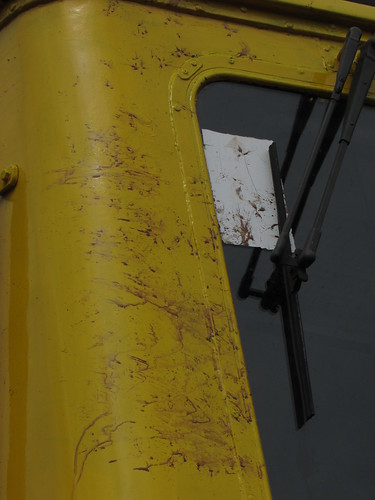
Staining on the corner pillar at the south end of 55005.
Although it was not raining on the Tuesday, there were still a few places along the line where sodden branches hit the train. Keeping the railway clear is a major task, akin to the proverbial 'painting the Forth Bridge'. Regular efforts by volunteers are needed in the growing season. Other than a few 'slaps' from branches, we arrived at Shenton without incident.
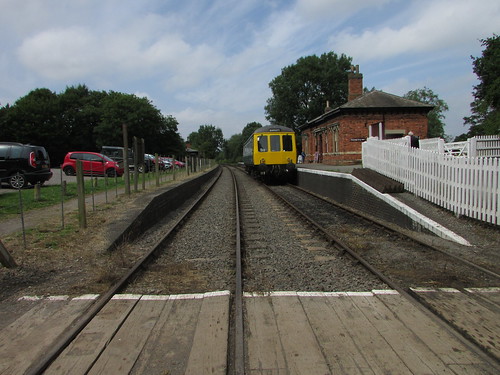
55005 at Shenton, viewed from the foot crossing.
From time to time, the sun emerged, allowing me to photograph Tony, the Guard (who is also a DMU Driver) and Bernard, on that day acting as Travelling Ticket Inspector (TTI).
Tony (Guard) and Bernard (TTI) at Shenton.
The only problem during the day was an intermittent loss of control air pressure caused by a sticking 'E.P. valve'. The 'E.P. valves' are electro-pnuematic solenoid-operated valves which remotely control engine throttles, gear-changing and the final drives mounted on the powered axles. Tony and I opened up the suspect control box but failed to locate the occasional fault.
Events of Sunday, 30th July 2017
I was rostered to drive regular performer 'Cumbria' but, on Saturday night, I had a text from Steve A. who was booked to fire on Sunday saying that 'Cumbria' had failed with injector problems and we would be using 'Sir Gomer'. It had been some time since I'd driven resident engine 'Sir Gomer', so I welcomed the opportunity to re-acquaint myself with the locomotive.
'Sir Gomer' is a six-coupled Peckett, class OX1, works number 1859 of 1932 with two 18 x 24 inch outside cylinders and 3 feet 10 inch diameter wheels. Nominal weight is given as 34.5 tons. The locomotive worked at Mountain Ash Colliery until preservation in 1981, before moving to the Battlefield Line in 2001. There's a little more history (and an explanation of the name) on 'Wikimedia Commons' here. I think that back in 2001 the locomotive was in plain green livery but, more recently, she carried a handsome lined-out green. Her last repaint was in unlined blue.
Prior to working the service trains, we had a 'Gold Footplate Experience', where the trainee driver has one round trip to Shenton light engine, followed by a second round trip hauling the passenger train, carrying the trainee's family and friends. Whilst our trainee was on the footplate, it remained dry although overcast and he said that he thoroughly enjoyed the experience. There are a number of posts in this blog which talk about driving experience courses at different sites.
Because of a problem with the Buffet Car 'Jessie' all the service trains during the day departed from and arrived in platform 1, to ease the problem of replenishing the water supply. It was still dry when we set off with the first train, about ten minutes late, but later in the day, we had a number of heavy rain storms. I normally drive leaning out of the cab, for better visibility ahead and I had little option with 'Sir Gomer' - I'm not very tall and I found the spectacle glasses set too high up to keep a good look-out. In any case, when moving in driving rain, the spectacle glasses give a very limited view, so I resigned myself to getting wet. But, even leaning out, it's not ideal with rain sluicing towards you (I remembered my mantra - "Anyone can work on an engine in good weather, it takes footplatemen to do it in bad weather").
We managed to make up the lost time and finished the day very close to 'right time'. Although it remained overcast, it didn't rain all the time and I enjoyed the day. Incidentally, 'Sir Gomer' was sporting a loaned chime whistle which I believe originally graced a South African locomotive. I normally disapprove of non-authentic fittings, but I have to admit it did rather grow on me!
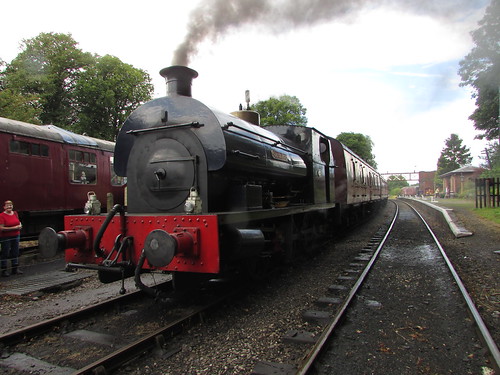
'Sir Gomer' in platform 1 at Shackerstone.
Events of Wednesday, 2nd August 2017
After signing in and reading the Operating Notices, I walked to the DMU Siding and discovered that the diesel railcars had been 'swopped around', so that we would be running with the 2-car set (51131/51321). There had been heavy rain (which returned during the day) and I was warned that a tree had come down the previous day so I proceeded with caution on the first trip in case there were any new obstructions. Other than the front corner of the driving cab receiving a slight 'slap' occasionally from a branch, all was well.
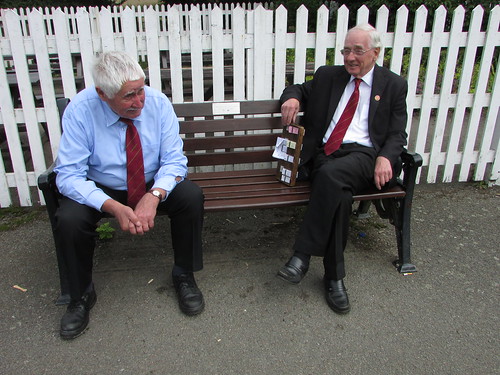
I hadn't realised that it was exactly 25 years since passenger services returned to Shenton in 1992 (although I'd started my career in preservation in 1988, I didn't join the Shackerstone Railway Society until after 1992). Dave Weightman, the Guard, however, remembered bringing a table from home on the inaugural day which he set-up on the platform at Shenton (there was no station building then) and from which he sold tickets!
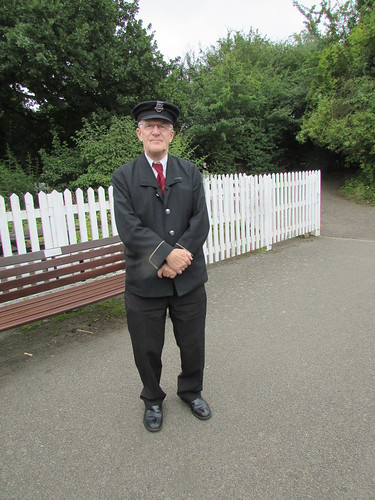
Dave Weightman (Guard) at Shenton, 25 years after the public re-opening of the station, near the spot where he set up his ticketing table.
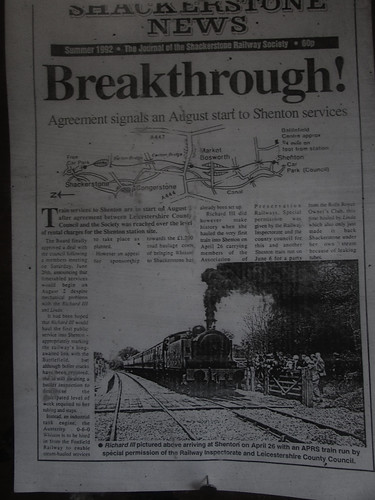
The Summer 1992 copy of 'Shackerstone News' had this article about passenger services returning to Shenton.
I'm afraid there was no celebration in 2017, no bunting, but a member took a picture of Dave, Jan and the DMU.
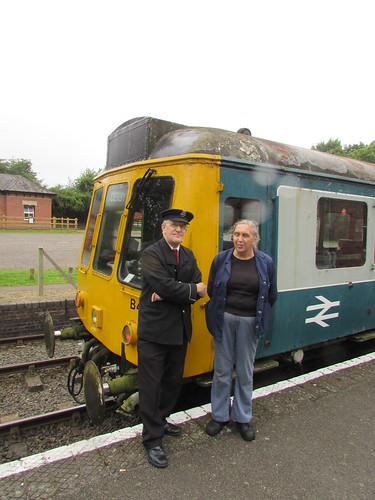
Dave Weightman (Guard) and Jan Ford (Driver) at Shenton, 25 years after the public re-opening of the station.
The well-proportioned and elegant Shenton Station Building originally served as the Ticket Office at Humberstone Road Station, Leicester. In 1992 it was redundant and Leicestershire Country Council, with help from a number of organisations, took it down, and re-erected in in its present location.
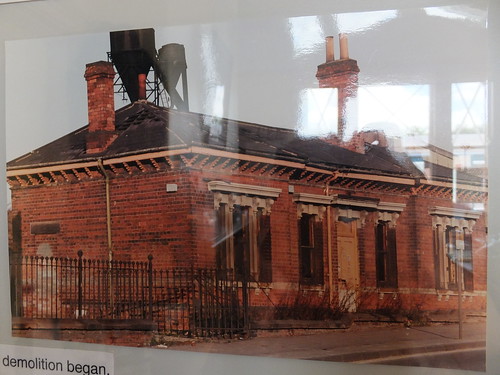
The redundant building in Leicester, prior to dismantling.
The roof was removed and slates were reclaimed. Roof timbers were not good enough to re-use and were replaced. The walls were dismatled at section at a time, the bricks cleaned and palletised for transport to Shenton. By February, 1993, the Humberstone Road site had been cleared.
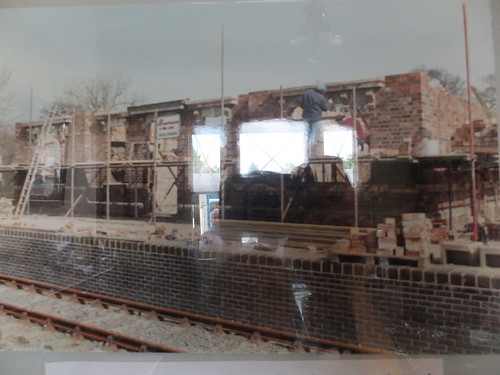
The building in course of re-erection at Shenton.
By April 1993, the building at Shenton was ready for tiling.
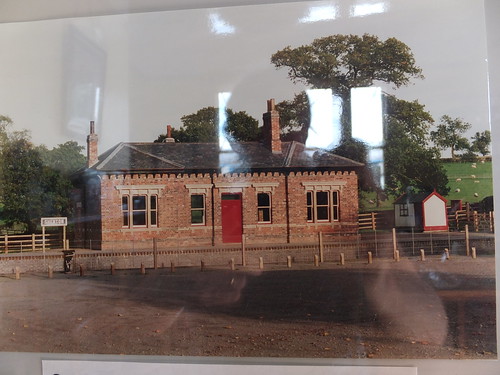
Shenton Station Building, shortly after completion.
On the final journey of the day from Shenton back to Shackerstone, it was agreed to stop in a few places to allow Dave to 'lop' overhanging branches. Another interesting day, well-supported by passengers.
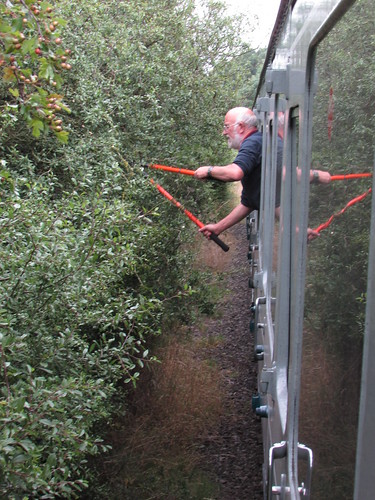
Branches being 'lopped' by Dave.
Related posts on this website
To see all my posts about DMU at the Battlefield Line, select Label 'DMU'
or click here.
To see all my posts about the Battlefield Line, select Label 'Battlefield Line'
or click here.
My photograph albums
Where necessary, clicking on an image above will display an 'uncropped' view or, alternately, pictures from may be selected, viewed or downloaded, in various sizes, from the albums listed:-
DMU at the Battlefield Line (2).
'Sir Gomer'.
DMU at the Battlefield Line (3).
Shenton Station Building.
All my Battlefield Line albums.
During the Summer Season in 2017, the Battlefield Line scheduled a midweek diesel railcar service to make four round trips from Shackerstone to Shenton, leaving Shackerstone at 11:00, 12:30, 14:00 and 15:30. These were operated by the single-unit 'Bubble Car' (55005) or a 2-car set (51131 and 51321). If either 51131 or 51321 becomes unavailable, the remaining vehicle can be attached to 55005. Exceptionally, all three vehicles can operate as a 3-car set.
On Saturdays and Sundays, the railway usually operates a steam-hauled service but sometimes a diesel railcar is substituted.
Events of Saturday, 1st July 2017
I'd offered to drive 'Cumbria' on the steam service on Saturday, 1st July but on Friday evening I was asked, because of the unavailability of a fireman, if I could operate the diesel railcar instead for the five scheduled round trips of the 'Weekend' timetable. I'd also been told that the 'Bubble Car' had operated the previous 'Midweek' service but that it was low on fuel for a further full day's service so I'd need to use the 2-car set. All three vehicles are normally stabled on the long siding at the side of the Locomotive Shed called the 'DMU Siding'. Since the single unit had been the last to be used, I knew the order of vehicles, from the buffer stop end, would be 51321/51131 and then 55005. So the first order of business was to 'dig-out' the 2-car set from 'behind' 55005. Fortunately, the Signalman has arrived to work the 'box' for the shunt. The moves were:-
1. Fire-up the single-unit and shunt it to the running line, just clear of the crossover by the signal box and 'tie it down'.
2. Perform the daily exam on the 2-car, start it up and position it in platform 1, so that the Guard could unlock the passenger doors and prepare the train as necessary.
3. Shunt the single unit back to the DMU Siding, far enough towards the buffer stops to allow the 2-car set to be stabled behind it at the end of traffic, then shut it down.
I've omitted all the details of starting, testing and shutting down the units, all the walking about from unit to unit and and all the clambering from track to cab and back again. By the time I'd returned to the station and the waiting 2-car set, I felt I'd already done a day's work!
The rest of the day was spent carrying out the five round trips to Shenton. Of course, some of the passengers were disappointed that the trains were not steam hauled (but none more than the writer!). Fortunately, the weather was kind with blue skies, wispy clouds and warm sun, as you can see from the picture below taken at Shenton.

51131 (nearest camera) and 51321 ready to work back to Shackerstone from Shenton.
51131 is the most recently 'outshopped' vehicle, with a repaint and extensive work carried out and looked splendid. The picture below is a detail of the underfloor-mounted Stone's 24 volt d.c. generator which charges the 24 volt battery used for all lighting, indications, engine starting and the electro-pneumatic control system via a Stone's 'IONUM' Generator Control Panel.
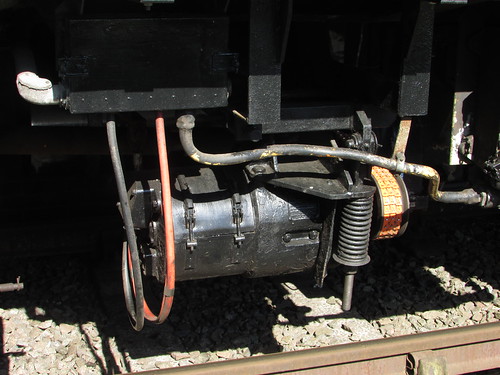
Detail of Generator on 51131. Note triple drive belt on the right.
In the 1950s, British Railways designed various patterns of diesel multiple unit and the large numbers required to eliminate steam working on suburban and secondary routes meant that manufacture was divided between a number of works. The three cars preserved at Shackerstone come from three different suppliers (Gloucester Railway Carriage and Wagon, British Railways Derby and Birmingham Railway Carriage and Wagon) but can be used in multiple. The early sets were 2-car, with a Driving Motor Car attached to a Driving Trailer Car. The motor car was equipped with two underfloor bus engines, controlled together by an Electro-Pneumatic (E.P.) control system. Various configurations were produced including 3-car sets (with a non-driving trailer in the middle) and, for lightly-used lines, a single motor car with a driving compartment each end (always called 'Bubble Cars'). The power came from underfloor-mounted modified bus engines.
 One of the underfloor mounted 150 h.p. adapted bus engines.
Completing the 'diagram' of five round trips was certainly easier than on steam, but I was still pretty tired by the end of the day.
Events of Tuesday, 4th July 2017
A couple of days later, I was back at Shackerstone as driver of the scheduled diesel railcar service of four round trips. At the end of service on the Sunday, I'd left the 2-car set on the DMU Siding and expected an easy start - just check levels, perform daily 'Exam', start up and drift down to the platform. However, I still arrived on site early, because you never know what you'll find. What I found was Steve A. saying that, because of the size of the school party booked on the second train from Shackerstone, arrangements had been made to fuel the 'Bubble Car' (which I'd left, low on fuel, behind the 2-car set) and then run as a 3-car set. I was told that Adrian would fuel (from the locked-up oil drum mounted on a wagon at the north end). Space was restricted at the north end, so I knew that I'd have to take the 'Bubble Car' down on its own and attach it to the 2-car set after fuelling.
So, I'd a bit of a shunt to do, after all! I discussed the moves with the Signalman and 'prepped' the 2-car unit. When I'd sufficient air pressure built up in the air receivers to operate the E.P. (Electro-Pneumatic) controls, I shunted the set to the running line, clear of the crossover by the signal box, applied the handbrake and made it safe to leave. Then it was across to the adjacent DMU Siding to start the 'Bubble Car'. Once I'd sufficient air, I drifted through platform 1 to the north end and parked the vehicle to Adrian's instructions. He said he'd refuel whist I moved the 2-car set into the platform. So I walked back through the station to the waiting 2-car set on the running line and moved it to platform 1 before walking to the north end to pick up the now-fuelled single car unit. I drove back to the station and slowly closed up to the waiting 2-car set. Steve was on hand to couple up - not a trivial task. I described the various connections between vehicles in the section 'The Technical Stuff' forming part of the post Battlefield Line 1940s Weekend (June 2013).
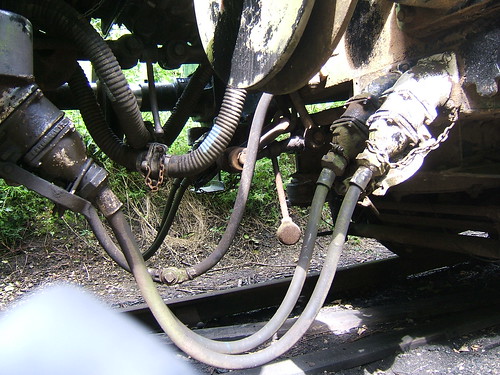
Details of the interconnections between vehicles.
Unfortunately, Steve couldn't obtain a proper seal on the Control Air Palm Coupling, because of the poor condition of the 'washer' or 'rubber'. After Adrian also had a look, we decided to uncouple and run the first train just with the 2-car set, whilst Adrian attempted a repair. So, having struggled to couple the units, there was a further struggle to uncouple them! To make sure everything was back as it should be, I repeated the cab tests.
We set off, as a 2-car set, with the first train of the day, a few minutes late. With 600 horse power on a 2-car unit, acceleration was quite good, so, despite needing to observe the same speed limits as the steam trains, we were about right time into Shenton. After our wait in Shenton, our departure on the return journey was right time, as was our arrival at Shackerstone.
Whilst I was down the line, Adrian had moved the 'Bubble Car' onto platform 2 so that platform 1 was clear for our approach. I discovered that he's not found a replacement 'washer' for the palm coupling but he'd had the same idea that had occurred to me - couple the 'Bubble Car' onto the south end of the 2-car set, rather than the north end. The damaged seal at the north end could remain isolated (there's a white-painted shut-off cock for this purpose). I moved the 1-car unit across from platform 2 and gently buffered up, this time at the south end of the 2-car set. The large school party were already aboard the 2-car set so I was relieved that I managed to just 'kiss' the large buffers together. I was even more relieved when the coupling-up was completed and there were no air leaks. All that remained was to repeat the cab tests to ensure that I had control of all three coaches forming the train (and all six engines!).
Including teachers, the primary school party totalled around 140 and we also carried our individual passengers, who were able to spread themselves out in the leading 'Bubble Car' which had just been attached. Once again, departure was a little late, but we'd recovered this by the time we arrived at Shenton. The well-behaved children formed up on the platform and, when everybody was safely off the train, the School Party were led in a 'Crocodile' to the nearby Battle of Bosworth Site.
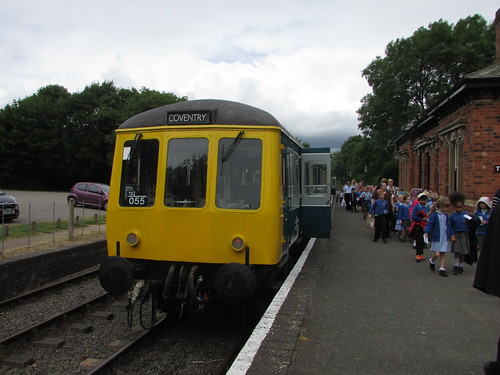
On arrival at Shenton, the School Party were led in a 'Crocodile' to the Battlefield Site.
Excitement over, we left Shenton right time and made our booked stop at Market Bosworth before continuing to Shackerstone.
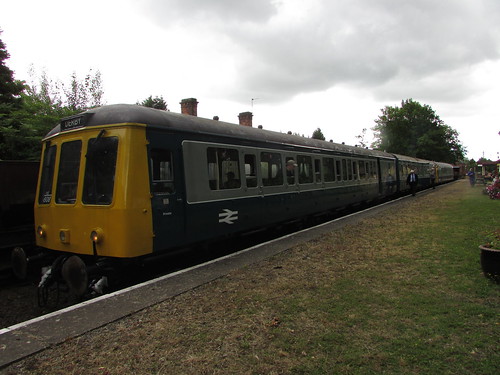
After taking the school party to Shenton, the 3-car set pauses at Market Bosworth on the return to Shackerstone.
We learnt that the School Party were not returning by train but continuing by coach after their visit to the Battlefield so the Guard elected to carry out the remaining two round trips with only the 2-car set. Adrian kindly 'unhooked' the 'Bubble Car' which I drove back to the DMU Siding and shut down, now fuelled and available for future service.
The last two trips were uneventful, except for the Number 1 engine on car 51131 deciding to shut down a few times as we were moving. It's possible to use electric restart from the cab which is generally effective but on a couple of occasions, it wouldn't restart remotely. In such cases, restart has to be attempted from the ground (as in first startup in the morning) which I performed once at Market Bosworth and once at Shackerstone. Starting appeared a little 'sluggish' but, once running, the engine sounded perfect. Had I been unable to restart the engine, the failed engine would have been isolated and the associated final drive disconnected, allowing the DMU to carry on with the remaining engines.
At the end of traffic, the Guard made sure windows were closed and all doors (except Driver's doors) locked then I stabled the set in the DMU Siding and shut down, with the handbrake firmly applied. The problem with the engine was written-up in the daily record sheet at the end of the day. Checking through the train, I found a discarded child's ticket, shown in the picture below. I went round locking Driver's doors, and clambered down to the ground, locking the final door. I then made my final ground level inspection, isolating the battery in each vehicle, checking all lights out and visually inspecting the engines and all underfloor equipment.

An Edmondson pasteboard Child Ticket issued on the day. Note the triangular area on the left punched out by the Ticket Inspector's ticket clipper to show that the ticket has been used.
Related posts on this website
To see all my posts about DMU at the Battlefield Line, select Label 'DMU'
or click here.
To see all my posts about the Battlefield Line, select Label 'Battlefield Line'
or click here.
My photograph albums
DMU Days at the Battlefield Line (51131/51321/55005 in 2017).
Midweek DMU Service (55005 in 2013).
Bubble Car (2011).
Shackerstone DMU Group (Earlier pictures from 2007 onwards).
All my Battlefield Line albums.
Events of Wednesday, 28th June 2017
In 2017, Peak Rail was operating the six-coupled side tank locomotive 'Jennifer', as I described in the post Peak Rail in 2017. It was raining hard on my journey to Rowsley on 28th June, where I was booked to drive 'Jennifer', and the rain seemed to intensify on my arrival. 'Jennifer' had been turned since my last visit, so that the chimney was at the north end, prompting the conclusion that we were going to couple at the north end of the train, with the 'top and tail' diesel at the south end. This was one of the suggestions made previously to investigate the 'surging' problem mentioned in the earlier post. The theory was that, with 'Jennifer' working uphill for most of the journey, the weight of the train would help to keep the couplings tight and reduce the 'surging'.
I was pleased that I'd have an opportunity to see if the theory was valid. Mike, who had driven the previous day with the 'new configuration' was fireman and he had steam raising well in hand. I was pretty wet by the time I'd oiled round but I endeavoured not to complain too much. We'd a two hour driving experience before the service train which concluded with the trainee shunting around the loop to couple onto the north end of the train.
Although my principal interest is 'steel wheels on steel rails', all forms of engineering fascinate me so I was intrigued to see that a coach had been reserved for the 'SUNBEAM TALBOT DARRAQ REGISTER' and, within minutes, a stream of vintage cars started to arrive.
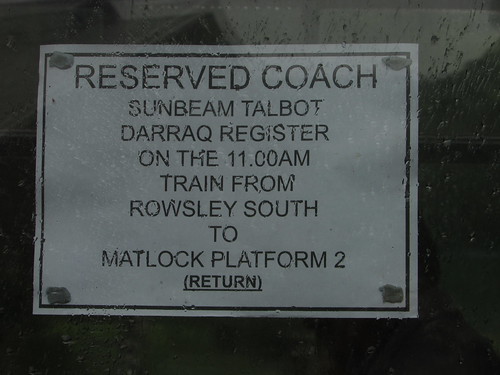
This sign in the rain-splattered coach window (with a missing 'C') alerted me to the arrival of the vintage cars.
The rain had eased somewhat and I managed to take pictures of some of the vehicles but I'd only a few minutes before the train departed, with 'Jennifer' at the tail end. There's a website describing the Sunbeam Talbot Darracq Register vintage car club here.
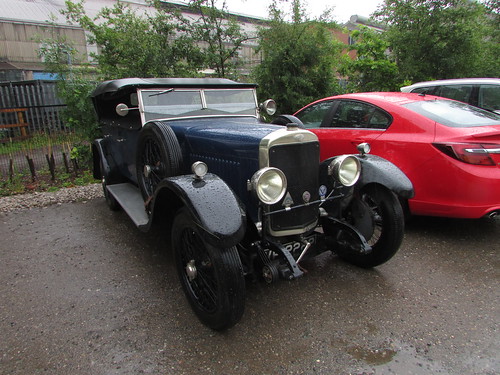
'Sunbeam' produced high-quality motor vehicles ...
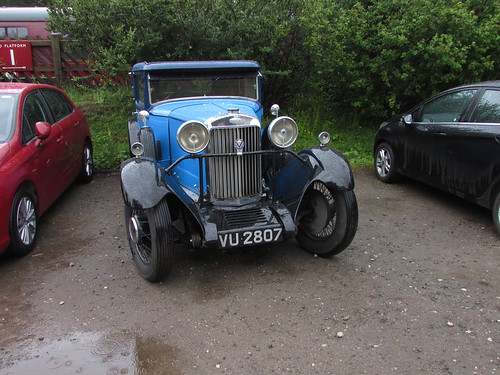
... in a range of styles.
The famous 'Sunbeam' cars were built in Wolverhampton where both my parents originated and where I lived or worked for many years. But the real connection is that my grandfather was Chief Jig and Tool Designer at Sunbeam, three of my uncles had engineering posts there for a time and my mother had a spell as a secretary there. 'Sunbeam' were closely associated with motor racing and, when I was young, my grandfather would proudly discourse on his involvement in the building of the 1,000 h.p. car in which Henry Segrave exceeded 200 m.p.h. for the first time in 1927 at Daytona Beach. Sadly, by the time I was old enough to have a proper understanding, my grandfather had passed away but he had enthused me with a lifelong interest in engineering. The car club have a page on Henry Segrave's exploits here, with a link to a video.
As I expected, with the 'Peak' hauling the train, we experienced some 'surging' on the way to Matlock. At Matlock, we collected the Train Staff from the diesel ready for the return journey. When we received the 'Right Away' from the Guard, I was surprised at how readily we moved away, until I realised that the line from the platform to Matlock Riverside is downhill (at around 1 in 170) and the uphill climb only starts beyond Bridge 26, the Derwent Bridge.
 Gradient Diagram Ambergate - Bakewell
Braking was needed to reduce speed for the long-standing 5 m.p.h. restriction through Matlock Riverside, then I put on steam for the climb at around 1 in 400 to Darley Dale. Even with around 300 tons on the drawbar, this was not very taxing. Most importantly, the 'surging' effect appeared considerably attenuated.
I found that stopping accurately was proving more difficult. Like many industrials in preservation, a vacuum brake system has been added to an engine which originally had only steam- and hand-braking. A British Railways pattern combination steam brake had been fitted to the engine so that, as vacuum is reduced in the train pipe to brake the train, the steam brake should apply proportionately to brake the locomotive. Unfortunately, the application of the steam brake applied this way I found rather harsh. A British Railways pattern application valve mounted right in the front corner of the cab I found hard to reach, since I'm not very tall, and having grasped it, my visibility outside was impaired.
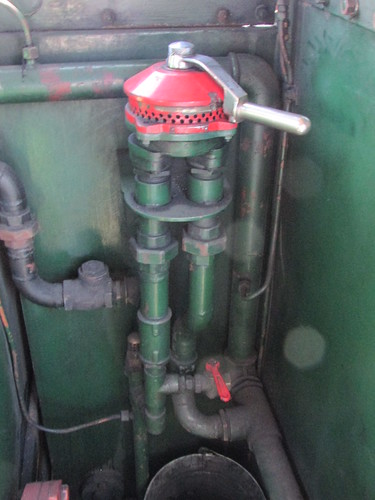
Locomotive 'Jennifer': British Railways pattern Driver's Vacuum Brake Application Valve with reservoir release cock (red handle) below.
The stop at Darley Dale wasn't too bad but at Rowsley, I overran a few feet, making it difficult to take water from the Grey Tank Wagon. In any case, a badly-fitting delivery hose meant that, even when stopped correctly, everybody within about twenty feet received a good soaking.
On the second return trip, I used a little more power and we judged the 'surging' to be further attenuated, until steam was turned off during braking when 'bumping' resumed. I was still having trouble with the braking, overrunning a little more than the first time, necessitating getting permission from the Guard to set the train back before we could replenish the tank.
At this point, Mike was relieved for the rest of the day by Chris W.
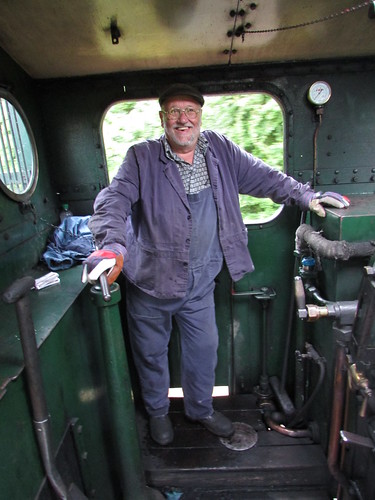
Chris Ward on the footplate of 'Jennifer'.
The third return trip went well and I stopped correctly for water at Rowsley. However, having used only around one third of a tank, Chris and I agreed to make the fourth trip before watering.

A thoughtful Jan keeping a lookout as the 'Peak' completes the journey to Matlock Town.
The fourth trip was uneventful and we filled with water again for the last time that day and Chris and I enjoyed the fifth and last trip. Even the weather was improving! Our conclusion was that comfort, if not perfect, was at least much improved operating with 'Jennifer' at the north end of the stock.
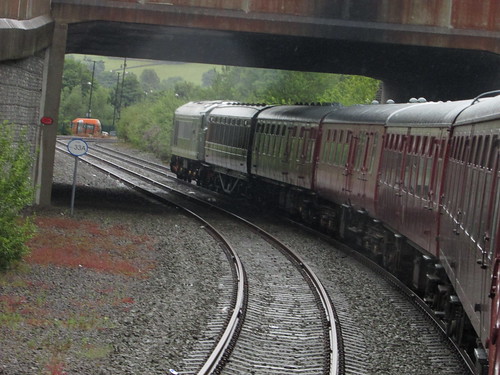 Cars and trains at Peak Rail: View from 'Jennifer' trailing as the 'Peak' approaches Matlock Town.
Related posts on this website
To see all my posts about Peak Rail, select Label 'Peak Rail' or click here.
My photograph albums
Cars and Trains at Peak Rail.
'Jennifer'.
All my Peak Rail albums.

