skip to main |
skip to sidebar
On Wednesday, 4th May 2016 I travelled on the 7.00 a.m. train from Thazi to Kalaw. The first four hours of the journey, including the first 'Zig-Zag' are described here. Now read on ...
As we continued towards Kalaw from the upper junction of Zit Zat Reverse (A), I looked back along the train and saw the 'downhill direction' fixed distant signal for the upper junction, with its arm extended the 'wrong' way.
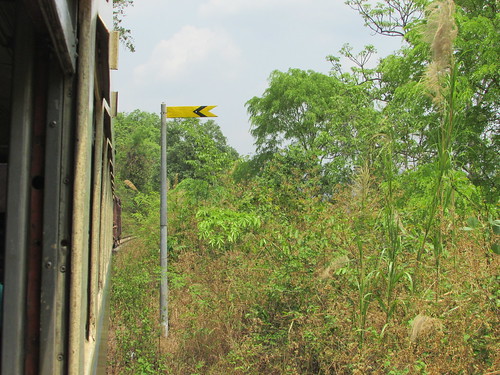 'Downhill direction' fixed distant signal for the 'Zit Zat' upper junction, with its arm extended the 'wrong' way.
We passed a series of ungated, minor road crossings. Approaching each crossing, the driver sounded the locomotive horn. The train passed another village of bamboo houses. The back yards of these houses had enclosing fences close to the railway with a back gate opening onto the track. I noticed one house with an gateway covered in masses of beautiful pink flowers but with no actual gate.
The meals served at stalls on stations or by vendors travelling on the train are served in expanded polystyrene boxes. I'm afraid that, in general, the Myanmar people have no concept of 'litter' so, once the food is consumed, the plastic box is flung from the open window of the train. For some reason, it appeared that certain lengths of trackside passing through shallow cuttings seemed to be unattractively festooned with lots of cast-off boxes. I didn't notice the same concentrations of boxes when views across the mountains were available.
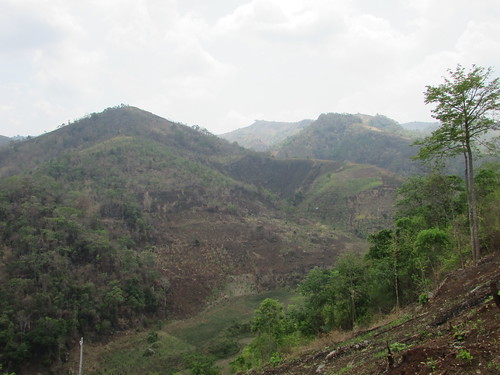 View of mountains as we approach Hkway Yok.
Twenty minutes after leaving the first Zig-Zag we passed a home signal (maintained at danger) and stopped at the second Zig-Zag station, named Hkwye Yok. The facilities were similar to those at the previous Zig-Zag station (but without the 'scissors' crossover). The line from Kalaw converged on our right at a turnout, then re-divided into a platform line on our left (which my train took) and a parallel siding. There was a similar proliferation of signals and an elevated ground frame beyond the end of the platform. As we slowly pulled down the platform, a growling on the right alerted me to a descending train waiting in the parallel siding - a unidentified Bo-Bo-Bo in red white and blue livery at the head of a train of empty, air-braked bogie ballast hoppers.
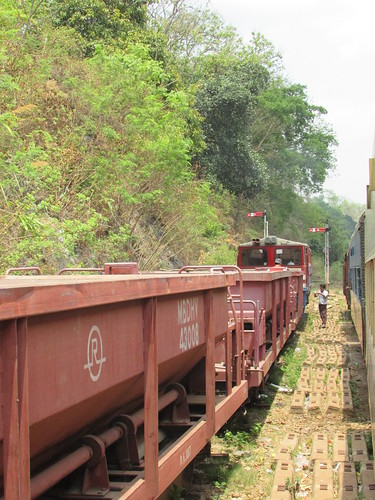
Hkway Yok Zig-Zag Lower Station, with an empty ballast train waiting to descend.
A row of food stalls lined the platform and ladies selling fruit, balanced on metal trays carried on the head, patrolled the length of the platform.
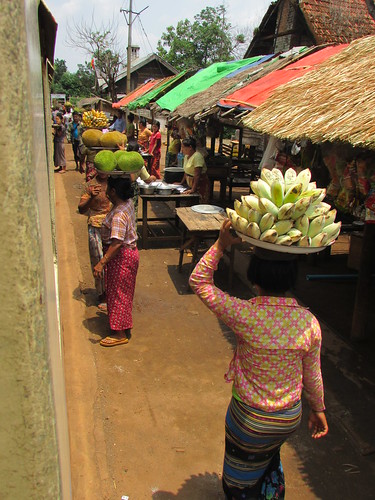
Hkway Yok station platform.
A loud 'clank' from the opposite side of the train indicated that the ballast train was restarting its descent. After a few minutes, the points had been reset and we continued our ascent, with our locomotive propelling from the rear as far as the upper junction of the zig-zag.
As we left the station, I had a better view of the elevated ground frame, an 8 lever-frame, suitable for signal box use with a conventional horizontal locking tray, but with the building omitted. Instead, a small steel platform provided with a handrail had been erected with a length of signal ladder to allow access from the ground. I was amused to note that the steel platform appeared to be second-hand pierced steel planking. Levers 1 to 6 were painted red, with the first four in the normal position, the other two reverse. Lever 7 was spare, painted white, and lever 8 was yellow. All levers except the spare were fitted with 'Trapped Key' locking boxes (there's a little more information about 'Trapped Key' locking here). Levers 1,2,5 and 6 had signal wires attached (although all the movements I saw were signalled by flag). There was no connection to the frame for point operation although one run of tubular rodding half-buried in the sand suggested that this had once been provided.

The elevated ground frame at Hkway Yok Station.
Our locomotive, working hard, propelled the train up the gradient and over the points at the upper junction, where there was an elevated ground frame as at the other zig-zag junctions, this one with an adjacent substantial hut for the operator. Frame and hut were located at the edge of a fairly precipitous drop. The ground frame was 6-lever with the usual horizontal locking tray. Some of the levers were provided with 'Trapped Key' locking boxes. Levers 1 and 2 were red, with signal wires leading away. Lever 3 was yellow, now disconnected from the cranks and tubular point rodding which once operated the single set of points. Levers 4 and 5 were also red but I only spotted a signal wire from lever 5. Lever 6, although red, was spare.
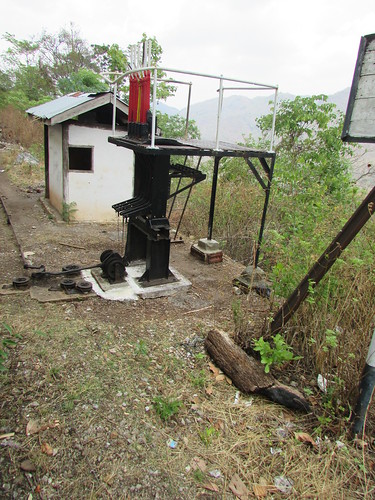
Hkway Yok Upper Zig-Zag Junction Elevated Ground Frame.
A longyi-clad pointsman, who had apparently travelled with us from Hkway Yok Station, dropped off the diesel as the train passed the points and came to a stand in the siding. Very soon, the pointsman had removed the point clip, operated the points, re-clipped them and signalled us away on our journey to Kalaw with the usual grubby green flag. The junction points themselves were provided with the usual, battered, point indicator.
 Departing Hkway Yok Upper Zig-Zag Junction, watched by the Pointsman.
Whilst we waited, I noticed a semaphore signal behind our train. This was presumably for the benefit of descending trains where the locomotive would have stopped well down the siding to ensure the rear of the train had cleared the points. The signal presumably indicated when the locomotive could start to propel the train down the gradient to Hkway Yok Station. In addition to this signal, there was a home for the line from Hkway Yok Station (although I didn't spot one for trains approaching from Kalaw). There were certainly starting signals for both directions. Most of the signals had short, wooden posts, all had short corrugated arms arranged as upper quadrants but with a heavy, cast spectacle which looked designed for lower quadrant. The arm of the starting signal towards Kalaw was virtually centre-pivoted and the arm projected to the right of the post, with the spectacle on the left, so it looked very curious indeed. As expected, none of the interesting signals was operated for us, although all were quite neatly painted.
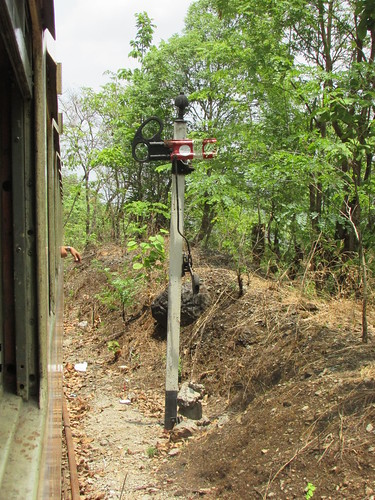
The curious starting signal towards Kalaw at Hkway Yok Upper Zig-Zag Junction.
We passed a fixed distant and the driver sounded the horn as we approached an ungated road crossing. We were treated to impressive vistas across the mountains are we continued our journey. We passed another short, corrugated arm signal with a cast lower-quadrant style spectacle this time, for variety, arranged for lower-quadrant operation but it was no surprise to be called on by a flagsignalman with a green flag. We paused at an attractive country station which I took to be Hsin Taung. A broad valley had opened on our right with a golden standing Buddha and monastic buildings visible. There was no passing loop at the station but a branch on our left as we left the station appeared to have a loop. The 'downhill' home signal had a short, corrugated arm, lower-quadrant style spectacle but arranged for upper-quadrant operation. The signal post was U-channel rolled-section. I also glimpsed a tall 'Outer Home' signal.
We were now engaged in a stiff climb over a curving route. Although I knew we were climbing, it was still a surprise to look out on the right and see the line we'd travelled about ten minutes before at right angles to our present heading and considerably lower.
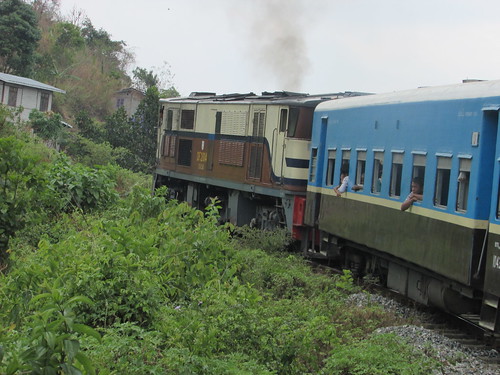 "We were now engaged in a stiff climb over a curving route".
Once again, our route was on a 'shelf' cut into the mountain side and retaining walls were needed. Earlier ones were brick, more recent ones concrete with embedded plastic drainage tubes. Some walls featured a concrete plaque commemorating the completion date. One I noticed was '21-1-2016'. We passed through a noisy, reverberating tunnel, concrete-lined followed by more retaining walls with various dates in different styles.

Emerging from the first tunnel.
We passed through a second, short tunnel and whistled for a road crossing before a period where our speed became fairly erratic but I couldn't determine whether this was because of engineering speed restrictions or the line profile. Our route was now through paddy-filled upland. A tall Outer Home signal (unusually, in the 'off' position) indicated that we were approaching Myin Daik. Here, the leftmost track with platform and station buildings was occupied by waiting DF.2010 with a 'downhill' train. We took the loop to the right. As we stopped, I saw yellow-liveried Engineering Maintenance Car EMC.D.2 in the loop on our right.
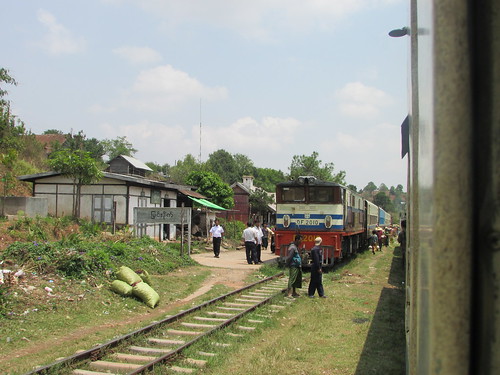 Myin Daik Station.
The 'downhill' train left before us, then we were off on the final eight miles to Kalaw, passing through paddies where people were working as they have done for centuries.
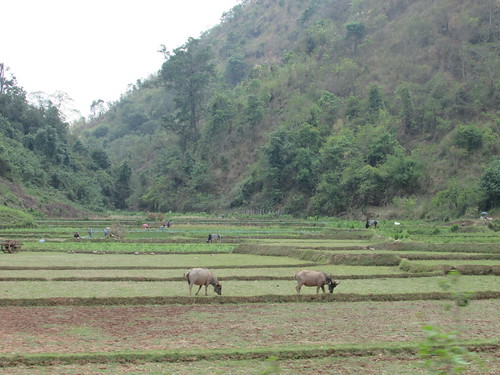 Working in the paddy fields.
As we approached Kalaw, the area became more built-up. On the left, next to the railway, I spotted The Kalaw Hotel (now the Kalaw Heritage Hotel), opened by the British in 1902 then we rumbled over a road crossing and came to a halt. Another train, also hauled by a Bo-Bo-Bo, was shunting on the leftmost platform line so, again, we stopped in the loop to the right. In a siding on our right, I saw Railway Gang Car RGC/6 before struggling to the ground with my luggage. My guide, Sai Kyaw Kyaw, was waiting and instantly recognised me as the only unaccompanied elderly female tourist to disembark (I think the only tourist to disembark from the train). Kalaw has a distinctive 'Swiss Chalet' design station building so, after a few photographs, my guide took me to my accommodation after a tiring, but fascinating, journey from Thazi.
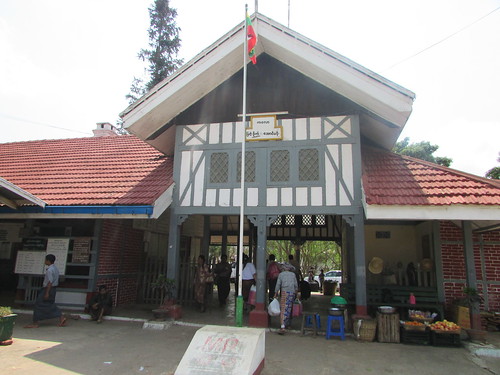 Kalaw Station Building.
Related posts in my blog
Thazi-Kalaw.
Thazi Railway Station and Diesel Locomotive Depot.
All my Myanma Railways posts.
My Pictures
Pictures in this article can be viewed uncropped by clicking on the image. To view in other resolutions or download, select from the album Thazi to Kalaw by Train.
There are also a few pictures taken around Kalaw station on 5th May 2016 here.
All my Myanma Railways Pictures.
On Wednesday, 4th May 2016 I travelled on the 7.00 a.m. train from Thazi to Kalaw. Having identified my reserved Upper Class Seat, there was time to look at the locomotive, Alsthom-built DF.2014 re-powered with a CAT 3515 engine, before boarding the train.
 DF.2014 at the head of the 7.00 a.m. departure from Thazi.
The train had two Upper Class Coaches in cream and brown sandwiched between 2 Ordinary Class coaches in blue and brown. Two bauxite-coloured bogie vans were at the rear. The train had vacuum brakes, supplemented by 'straight air' brakes on the locomotive.
To my amazement, the train departed dead on time. Just south of the station we crossed Thazi's dual-carriageway 'main street' on a level crossing which, unusually, had full gates rather than the usual 'half barriers'. Here, there were three running lines - our single line to Kalaw, Up Mandalay and Down Mandalay.
 Thazi Level Crossing, looking east.
After a few hundred yards, our line turned eastwards across the plain, and we passed a series of minor level crossings, each with its flagman.
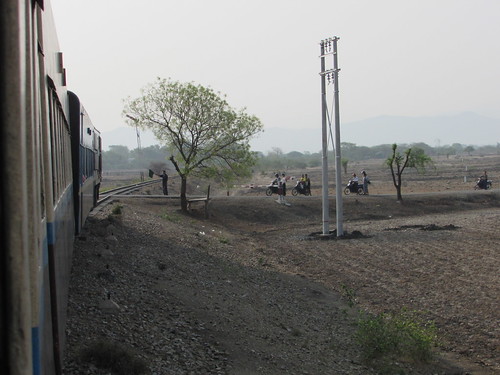 Passing a minor level crossing and approaching an outer home signal showing 'clear'.
We made our first stop at the small station of Hlaingoet, the next at the larger station at Payangazu.
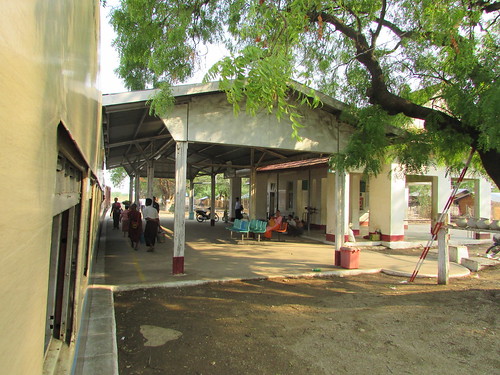 Payangazu station.
A flagman warned us across 2-span bridge number 48. Through the heat haze, the grey silhouette of the mountains was visible and loomed larger as we continued our climb. I noticed that the tops of the mountains were fringed with trees and it made me think of stubble on on an unshaved man's chin. We passed another level crossing at road marker 'km49'. Bridge 55 was traversed near a screeching reverse curve. The line twisted and turned through cuttings hewn in rock, with the loco working hard. We slowed to observe a 5 m.p.h. restriction over a tall, curving multi-span river bridge.
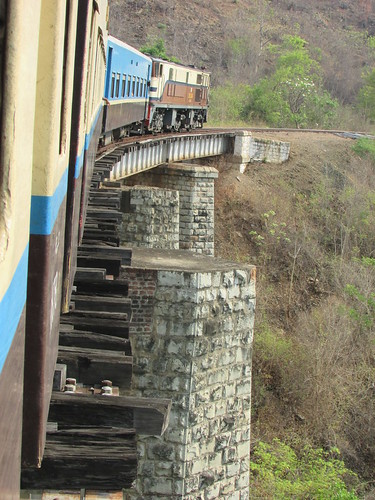
Crossing the tall, multi-span river bridge.
The track continued to curve to the right and were still going very slowly as we passed a large stock of concrete sleepers, apparently thrown trackside from a train ready for relaying. Looking down, I could see the tall, multi-span river bridge below us we'd just crossed. In less than five minutes, as the train climbed, we'd also turned 180 degrees.
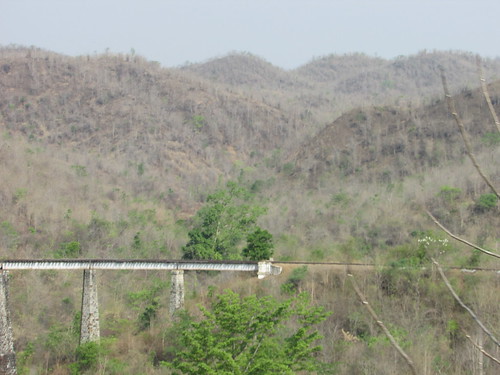 Looking down on the multi-span bridge with mountain tops fringed with trees in the background.
Before the railway came, this must have been fairly impenetrable forest. Our Bo-Bo-Bo locomotive was still working hard on the front of the train as we entered another cutting, whistled for a short tunnel and emerged into another cutting.
The cutting opened out on an elevated plateau with a large village. Most of the buildings were bamboo framed with woven walls but some also sported satellite dishes. There were numerous ungated crossings, some no wider than passageways. After a broader, gated road crossing we stopped at Yin Mabin station with the usual loops, one stabling a Railway Gang Car (RGC.008). Our train had stopped adjacent to an abandoned water column which, back in the days of steam, must have been a great consolation to trains struggling up the fierce gradients. Two track workers dumped their tools in the end of my coach and squatted in the vestibule as we set off.
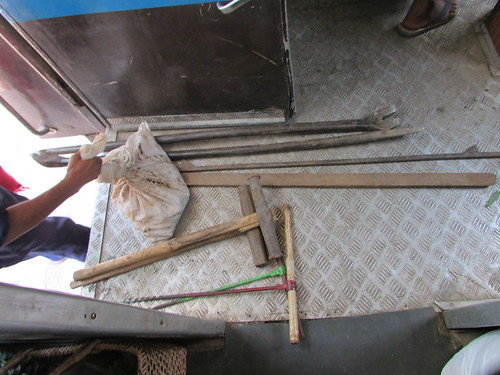 Track workers loading their tools at Yin Mabin.
The modest station buildings had the usual ceremonial flagpole on the platform. There was also a remarkably neat stall supplying meals, nowadays supplied in the dreadful expanded polystyrene boxes. Alternately, similar food could be purchased from the various vendors who walked through the train, together with fresh fruit, bottled water bottled soft drinks and even ice lollies (from a cool box).
Yin Mabin (together with a number of other stations on the line) featured the same type of horizontal windlass I'd seen on the line to Pyin Oo Lwin. They appear to operate signal wires and I assume that they once operated home signals, allowing only one signal to be cleared at a time.
 Yin Mabin station. Note the horizontal windlass set on a circular platform on the right.
Leaving Yin Mabin the terrain became fairly open as we passed over a 3-span plate truss bridge (number 104) set on stone piers and abutments. Bridge 105 was of similar construction. We passed one of the individualistic fixed distant signals - on this example, the arm extended to the right of the post! We pass a home signal with the odd-looking 'lower quadrant arm arranged for upper quadrant'.
We passed through Pyi Nyaung, provided with a platform line and two loops, without stopping. The line passed over an elderly lattice girder bridge which had been left in place but with its load taken over by modern through girders. After passing slowly through another cutting, we slowed again to pass over over a bridge where the two track workers who'd joined the train at Yin Mabin jumped down with their tools, joining a group of workers already there working to renew wooden sleepers over the bridge. I noticed I'd been travelling for two and a half hours hours.
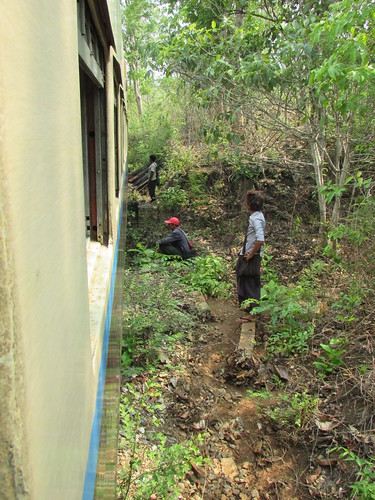
Track workers adjacent to a bridge where wooden sleepers are being renewed.
The driver then applied power as we struggled in and out of curving rock and shale cuttings high above a broad valley and passed through forests of bamboo.
In places, I saw the remains of a former railway telephone wire route which appeared to have once carried just two wires. The railway now seems to rely on a collection of fairly old technology radio systems for its communications and tall bamboo masts supporting an antenna can be seen at most stations. I noticed bridge number 167 before we passed over a level crossing equipped, unusually, with a continuously-sounding warning horn.
Smoking is now prohibited on Myanma Railways. From time to time, a smoker would pass through the coach to take a quiet smoke in the vestibule. Since the doors on these coaches are normally left open for ventilation and there are often massive openings around gangway connections, other passengers are not inconvenienced by this practice.
The train twisted and turned, running along a narrow 'shelf' cut into the contours the hills with a broad valley on one side and a rock and shale wall, with numerous trees relying on a precarious root-hold, on the other. The train didn't stop at Ye Bu but some two miles further on we paused at Le Byin where there is a platform line and three loops. A Carriage and Wagon Examiner appeared and walked down the train 'wheel-tapping' - a once-common sight in Britain. The sound of a tinkling bell told that an ice-lolly vendor was also working his was down the train. An indication of the elevation was given by the fact that the small, corrugated iron roofed station building was provided with a chimney for an internal fireplace. Everything around the station appeared neatly painted in black and white. Even the mast for the radio antenna was painted in black and white bands.
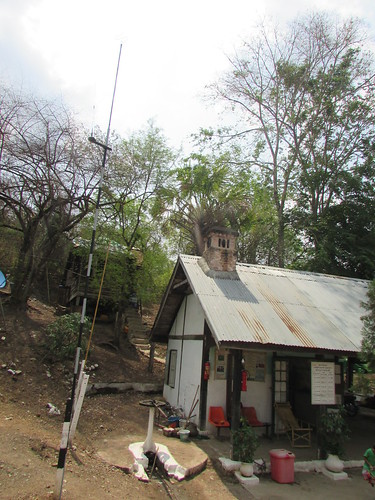
Le Byin station.
We departed at 10.20 a.m., passing another abandoned water column and a raft of loaded bogie ballast wagons parked in one of the loops. The points were operated by ordinary hand levers. After passing over a minor level crossing closed by hinging bamboo poles, we passed a group of pigs happily foraging along the trackside. I was intrigued by Le Byin's 'downhill' home signal - an attractive lattice post and finial with a corrugated steel upper quadrant arm (just an arm, not even a 'vestigial' spectacle). Mounted on the post was a mechanical 'slot', allowing control of the signal from two locations (there's a short description of 'slotting' here).
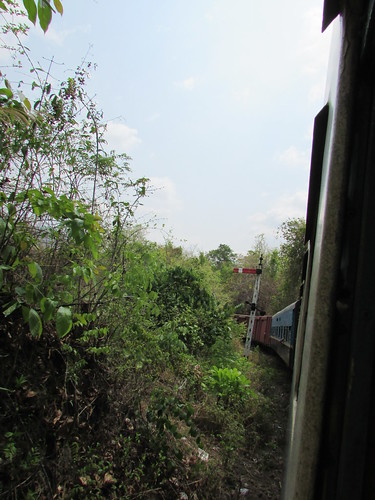
Le Byin's 'downhill' home signal with a mechanical 'slot'.
In the next 20 minutes, we passed a group of farmers restraining their oxen as the train passed, rock cuttings, glimpsed a large village in the valley on our left and came to the first 'Zig-Zag' where the line from Kalaw converged on our right at a scissors crossover. Beyond the scissors, there were two parallel tracks with a disused water column between them. We look the left line which was provided with a platform, station buildings and the standard wooden station nameboard solemnly labelled ZIT ZAT REVERSE (A). Beyond the nameboard, there was an elevated ground frame with red and yellow levers which I didn't get a decent look at. There was a wide assortment of semaphore signals - wooden post, lattice post, full arm, short arm but with corrugated arms and proper 'lower quadrant' style spectacle frames (no glass) arranged for upper quadrant working. As I've found elsewhere, not many signals actually seem to be worked and reliance is placed on handsignals given by flags in various shades of green. The platform was busy with passengers and vendors.
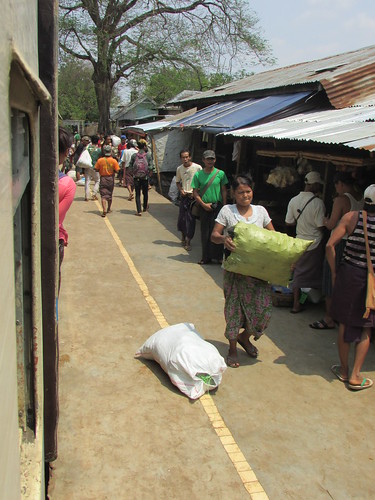
The platform at ZIT ZAT REVERSE (A).
After about seven minutes, during which time a member of the locomotive crew studied coach wheels, perhaps looking for dragging brakes, the points had been reversed and we set off backwards, the locomotive propelling the train which snaked onto the climbing Kalaw line. With the locomotive working hard, within a couple of minutes we were at the top of the Zig-Zag and passing a neat short-arm starting signal for the Kalaw line.
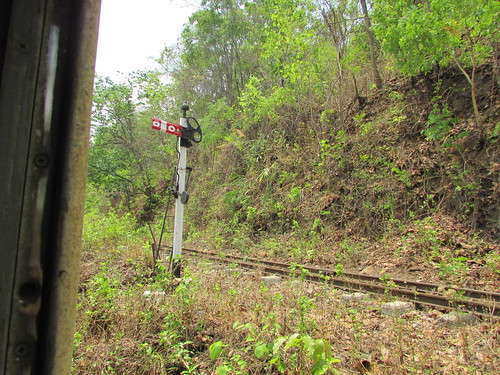 A neat, short-arm starting signal at the top of the first Zig-Zag.
We came to a stand with the locomotive clear of the points which were changed to allow the train to proceed to Kalaw with the locomotive once more at the front of the train. I could see all three sections of the Zig-Zag as we continued out climb.
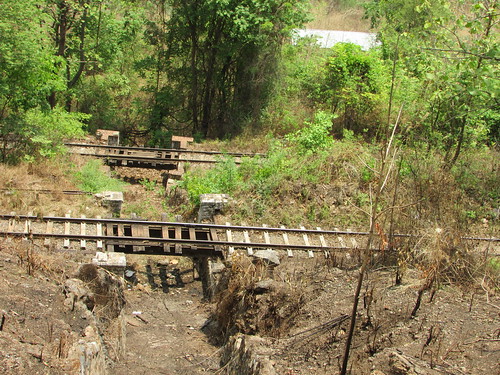 The low level and middle levels of the zig-zag viewed from my train on the upper level.
It was now 11 o'clock and I was four hours into the journey.
The description of the rest of my jorney to Kalaw is here.
History
When the railway was first extended from Taungoo to Mandalay in the late 19th century, Thazi had not established itself. I found a reference only to 'Meiktila Road' (Meiktila is a town 14 miles west of Thazi). An early traveller to Kalaw had to complete the journey from Meiktila Road to Kalaw on horseback. But just as the British, having chosen Pyin Oo Lwin as a suitable Hill Station (and re-named it 'Maymyo' after a British officer), constructed a railway over difficult terrain linking Mandalay and Pyin Oo Lwin, so a similar line was provided from a junction with the Yangon - Mandalay main line over a similarly arduous route to Kalaw and beyond. The main line junction became Thazi and a town grew up around it.
Related posts in my blog
Thazi Railway Station and Diesel Locomotive Depot.
Thazi - Kalaw (part 2).
All my Myanma Railways posts.
My Pictures
Pictures in this article can be viewed uncropped by clicking on the image. To view in other resolutions or download, select from the album Thazi to Kalaw by Train.
All my Myanma Railways Pictures.
Location
Da Nyn Gone is a junction station about twelve miles north of Yangon, where the Circle Line diverges from the line to Pyay. A busy, broad road crosses the railway just north of the platforms. The road is called Khayae Pin Road to the west of the level crossing and Da Nyn Gone Station Road to the east. The station building is on the east side (Circle Line Down platform) and is provided with a small canopy. The island platform (serving the Up Circle Line and the Down Pyay Line) also has umbrella roofing.
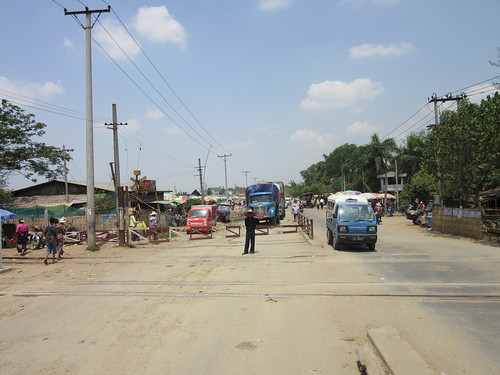 The level crossing at Da Nyn Gone Station, looking west along Khayae Pin Road.
There is a large market a little to the west, which also spills out onto stalls on both sides of the station and numerous vendors on the platforms themselves. In 2014, the whole station area was unfenced, as shown in the view below.
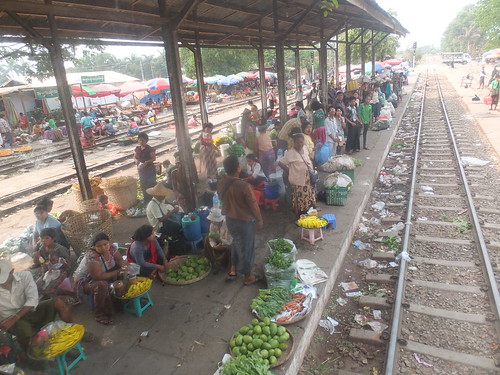 Approaching Da Nyn Gone station with its 'impromptu market', viewed from a clockwise Circle Line Train.
By the time of my visit in 2015, fences had appeared to the west of the station, in between the Up and Down Pyay lines and in between the Up and Down Circle lines, as seen below.
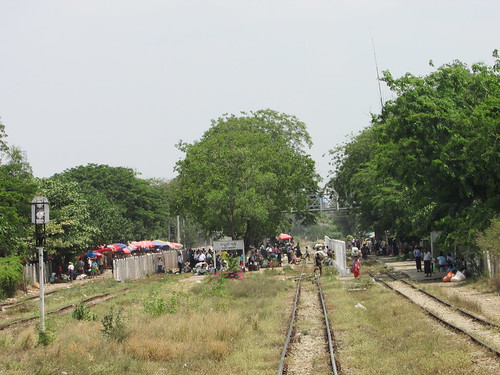 Da Nyin Gone staion, viewed from an approaching Clockwise Circle Line DMU.
Origins of Da Nyn Gone Station
Rail transport was first introduced in Myanmar in May 1877, when Lower Burma was a British colony, with the opening of the 163-mile (262 km) Yangon to Pyay line which passed through Da Nyn Gone by The Irrawaddy Valley State Railway. At that time, the Yangon terminus was at Kyee Myin Daing. Da Nyn Gone became a junction when the Circle Line was constructed, diverging to the north east from Da Nyn Gone and then looping back south so as to provide a route back to Yangon.
Track Layout
Rather than providing a 'classical' double track junction incorporating a diamond crossing (as is provided at Pazundaung and Yangon Central Station), the junction between the original line to Pyay and the later Circle Line is now implemented as a trailing crossover and two facing turnouts, in accordance with more modern practice. There are two sidings, controlled from hand levers, which appear to be out of use. One is south of the platform on the Up Circle Line, the other north of the level crossing on the Down Pyay Line. All other turnouts are operated by electric point machines.
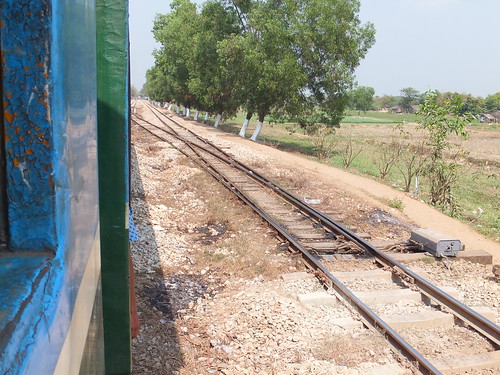 View from train approaching Da Nyn Gone station, showing electric point machine at the south end of the trailing crossover.
Signalling
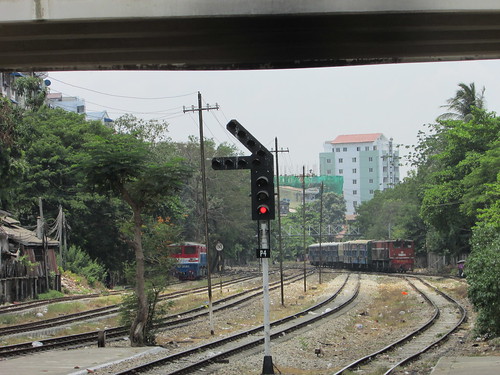
The station area is controlled by a mixture of 2-aspect and 3-aspect colour light signals.
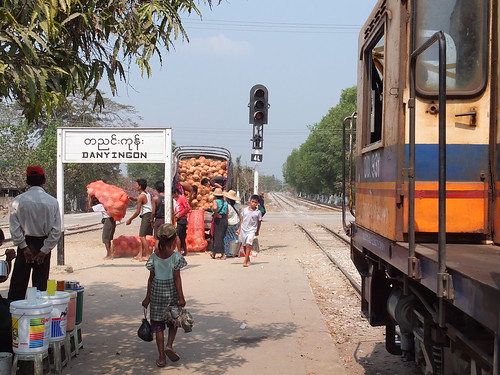 In 2013, DD.931 waits for signal 4L at Da Nyn Gone with a clockwise Circle Line train. The level crossing is in the background.
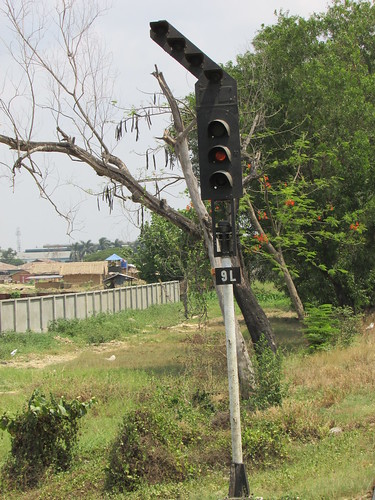
Signal '9L' is a 3-aspect with a route indicator of four white inclined lights which are illuminated for movements onto the Pyay line.
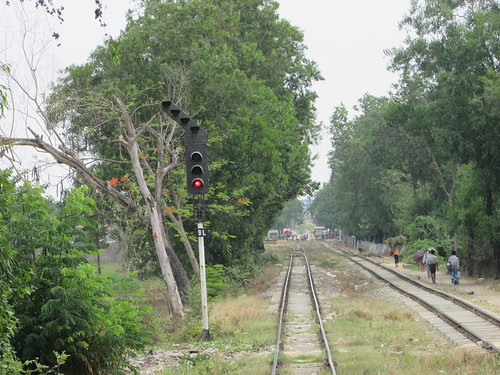 Da Nyi Gone signal '9L' displaying a 'Red'. The station is visible in the background
 Signalling Control Panel at Da Nyn Gone.
Signalling Control
A small signalling control panel is situated in the station building.
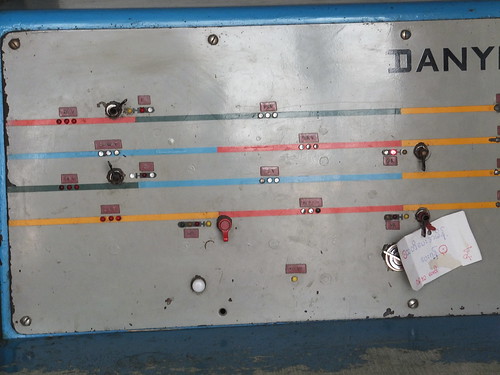 Enlarged view of left side of Signalling Control Panel at Da Nyn Gone.
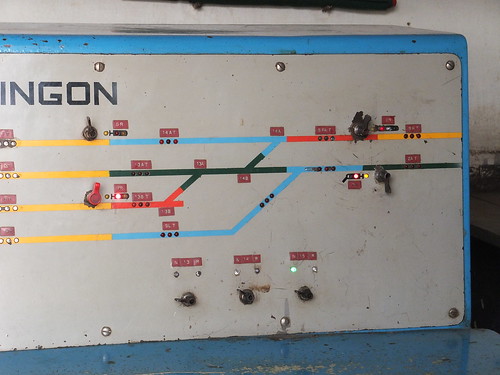 Enlarged view of right side of Signalling Control Panel at Da Nyn Gone..
Background
I first saw this station in 2008 when I made a round trip on the Circle Line (described in the post The Circle Line, Yangon), but there are no pictures of Da Nyn Gone.
In 2012 I travelled on part of the Circle Line (report here) but didn't pass through Da Nyn Gone.
The following year, on 14th February 2013, I travelled from Yangon Central Station to and from the junction at Da Nyn Gone, producing pictures here and the post Yangon Area Railways.
On the 25th April 2014, I made a cab ride around the Circle line (see post Cab Ride around the Circle Line), and pictures here.
By 2015, the 'New' Diesel Multiple Units were being introduced and, on 4th May 2015, I went around the Circle line on one of these collecting more views in album The Circle Line by DMU.
Another 'New' Diesel Multiple Unit provided the motive power on 22nd April 2016 when I made another clockwise trip of the Circle Line with my young friend Aung (pictures here).
Related posts in my blog
The Circle Line, Yangon (2008).
Exploring Yangon's railways.
Railway Signalling in Burma - Part 2: Colour Light Signals & Motor Points.
Railway Signalling in Burma - Part 6: Signal Boxes with Electrical Interlocking.
Yangon Area Railways
All my Myanma Railways posts.
My Pictures
Pictures in this article are taken from the album Da Nyn Gone Railway Station
Railways in Myanmar (formerly Burma) (2008).
Yangon to Insein by Train (2016).
Cab Ride on the Circle Line (2014).
The Circle Line, Yangon (2013).
Circle Line Revisited (2012).
The Circle Line by DMU (2015).
Around the Circle Line in 2016 (2016).
The Circle Line, Yangon, Myanmar (2009).
Burma: Colour Light Signals & Motor Points.
Yangon Central Station.
Railways in Myanmar (2008).
All my Myanma Railways Pictures.
On Friday, 22nd April 2016 Aung Ko Latt and I made a clockwise trip on Yangon's Circle Line together. This is the 'technical review' threatened in the earlier post Back in Yangon.
We arrived at Yangon Central Station around 10.00 a.m. and found two DF.1200 class locomotives nicely posed side-by-side.
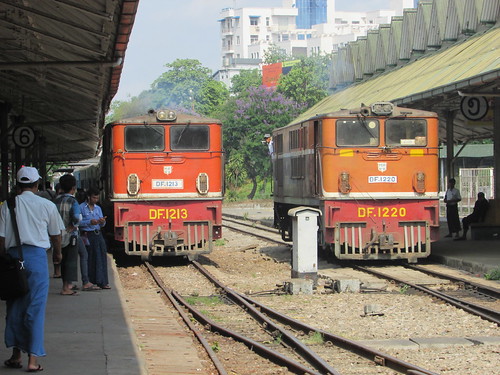 DF.1213 on an arrival in platform 6 west next to DF.1220 in platform 5 light engine having brought a train into platform 6 east.
I wondered if the train in platform 5 west would be the first departure but we were told platform 7 and presently one of the 'new' Japanese 5-car diesel multiple units, set RBE3045, arrived from the west and Aung and I boarded. I took up a position near the front, noting the open doors to the cab and at the front of the set which offered a reasonable view ahead. From time-to-time, I shared this view with other interested passengers.
We set off on a clockwise circuit of the 'Circular Railway', leaving on what is designated the 'Up' line. I noticed the fearsome-looking check-railed trap points on the way from platform 7 to the main line.
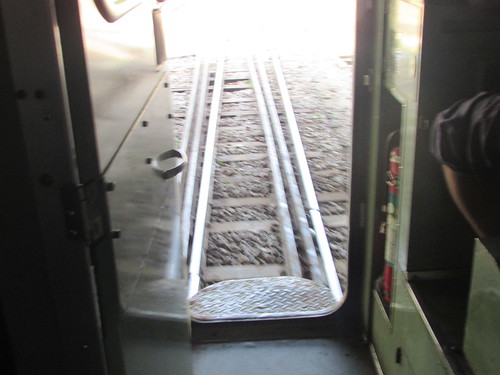 Negotiating fearsome-looking check-railed trap points on the way from platform 7 to the Up Main (clockwise Circle Line).
We were soon stopping at Pha Yar Lan station, passing DF.1263 (rather fetching in pale blue and white livery) heading for Yangon Central Station with a Down passenger train.
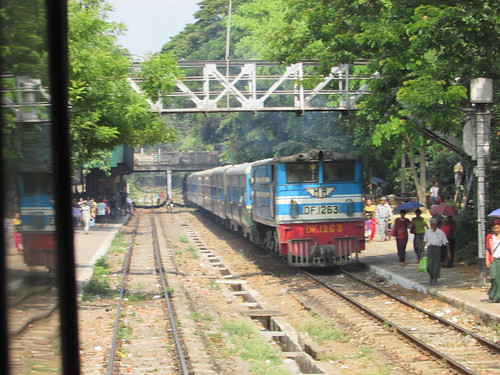 DF.1263 (in blue and white livery) at Pha Yar Lan, heading for Yangon Central Station.
I wasn't expecting the bright yellow Railway Gang Car and trailer which was following a few yards behind the passenger train!
 Railway Gang Car and Trailer closely following a Down passenger train on the Automatic Block section at Pha Yar Lan Station.
Most of the double-track Circle Line operates under 'Automatic Block' regulations with colour-light signals, where the occupation of an electrical track circuit by a passing train replaces each signal to 'danger', reverting to 'proceed' for a following train when the first train has passed clear of the track circuit. Because there is no signalman, regulations for automatic block usually allow a train to pass a 'Red' signal. Typically, under 'Stop and Proceed Rules' the driver must wait a predetermined time before moving off. On Yangon's Circle Line, trains don't stop but continue under caution at a 'Red' signal, presumably because of the low line speeds.
Our train was also in the 'Automatic Block' area. We passed a number of colour light signals displaying 'Yellow' aspects, marked clearly 'A' to indicate that 'Automatic Block' regulations appied, odd-numbered progressively from Yangon (automatic signals on the Down line used even numbers). Signal 'K48' (a 3-aspect colour light) was a 'Controlled Signal' where 'Stop' means 'Stop' (what they call in some countries 'Stop and Stay' as opposed to 'Stop and proceed'). However, 'K48' (worked by Kyee Myin Daing South Signal Cabin) was displaying 'Yellow', beckoning us into the station. After pausing at the station and passing a 'Yellow' 3-aspect colour light 'S15' (worked by Kyee Myin Daing North Signal Cabin), we were back in an 'Automatic' area. We passed DF.1631 noisily making its way to Yangon with another passenger train.
Signal 'A23' was displaying 'Red' but we kept moving. There was a permanent way gang working in the vicinity, which I at first assumed was the reason for the 'Red' signal. In Myanmar in the past, I've only seen ballast tamping and packing carried out manually, but this track gang was using a small portable generator and power tools.
 Permanent Way Gang with not a High Visibility Jacket in sight (but one hard hat - the foreman)!
The next signal, 'A27', was also 'Red'. Again, we kept moving, but the reason was not revealed until we'd passed both 'A29' and 'A31' at 'Red' and were approaching 'A33', also 'Red', when we could see a preceding Diesel Multiple Unit halted at the next station with passengers getting on and off. We continued our stop-start journey (we, too, were 'Stopping All Stations'). From time to time, we were within two train lengths of the preceding train. At Gyogone station and level crossing, we passed a 5-car diesel multiple unit (RBE25112) on the Down line, with a green lower body and grey upper body. Having attempted to close the road crossing, the Crossing Keeper stood in the wide space between the two lines so that his grubby green flag was visible to both approaching trains. Only half-barriers are used in Myanmar (manual gates or barriers on wheels, bamboo poles or nothing, depending upon the importance of the crossing) so, despite the efforts of the crossing keepers, it's common for impatient users to continue to cross as trains approach.
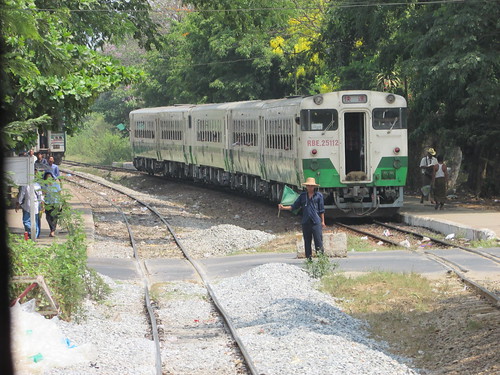 Gyogone Station with RBE.25104 ahead of us on the Up and RBE.25112 on the Down.
We caught up with the preceding train again as it waited for signal '1R' to enter Insein station, giving us a good view of the livery (green upper body, white lower body with blue lining) and running number (RBE.25104). Once that train had moved on, our train was detained for two minutes before the signal turned 'Yellow' for us with '5' displayed in the theatre-type route indicator for platform 5.
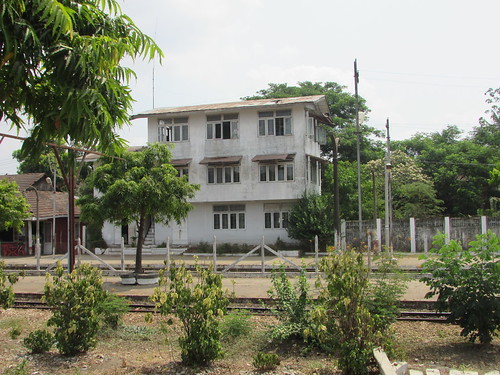 The Power Signal Box at Insein.
When we left Insein, instead of the expected main signal '15R', the subsidiary aspect '55R' (two white lights displayed diagonally) was cleared.
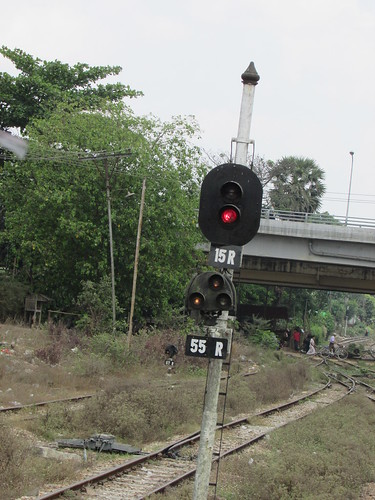
Leaving Insein, instead of the expected main signal '15R', the subsidiary aspect '55R' was cleared.
Insein's last controlled signal '17R' was also red, but, up ahead, we could see a track worker removing a large red banner from our track, as the gang had finished their task and were walking back towards Insein.
Signals 'A41', 'A43' and 'A45' were all passed at 'Red' and, as we approached Phawkan, we again had a good view of the train we were following.
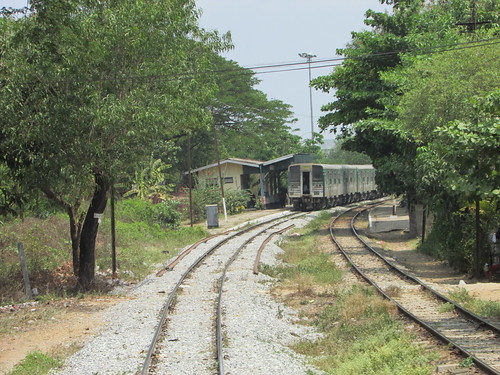 Phawkan Station, with RBE.25104 leaving as we approach.
After passing signals 'A47' and 'A49' at red, we stopped at controlled signal '9L' for two minutes, waiting for the preceding train to enter the junction station at Da Nyi Gone on the Pyay line.
Da Nyi Gone signal '9L' displaying a yellow without the four inclined lights for our Circle Line train.
After our station stop at Da Nyi Gone and no longer closely following a train, the series of automatic signals showed us 'Yellow' aspects and we continued past signal 'A59', made brief stops at Kyaikkale and Mingalardon Market stations before continuing to Mingalardon. Here, controlled signals, electrically-worked crossovers and position-light ground signals were provided to allow a locomotive-hauled train to terminate, run-round and return in the same direction from which it arrived.
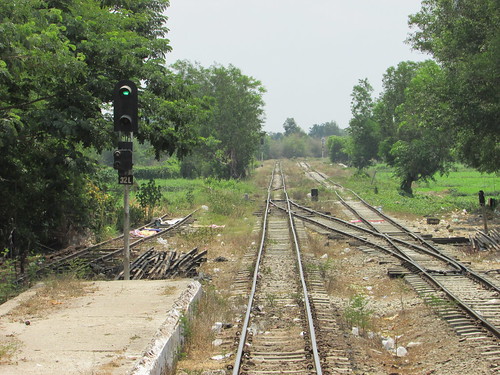 Mingalardon looking south, showing main signal, lower position-light subsidiary signal, crossover and position light ground signal.
Signal 'A67' was 'Red' but, under Automatic Block rules, we kept going to Pa Ywet Seit Gone where, like Mingalardon, there were controlled signals, electrically-worked crossovers and position-light ground signals to allow a locomotive to run-round its train. Signal '4L' before the platform was yellow as we passed an unidentified 5-car diesel multiple unit in cream livery travelling in an anti-clockwise direction. A 'Green' at signal '2LM' allowed us to depart (there's also a position light subsidiary aspect '32L' on the same post) and we were then back under Automatic Block again, passing multiple unit RBE.25110 (green lower body, grey upper body). We made stops at each of the closely-spaced stations and passed multiple unit RBE.25112 for the second time (earlier seen at Gyogone station).
After a succession of 'Yellow' signals, 'A89' leaving Tamwe remained 'Red', I assumed because of equipment failure. As far as possible, any failure in signalling systems, such as track circuit failure, is designed to give a more restrictive indication but Automatic Block regulations allow trains to continue under caution.
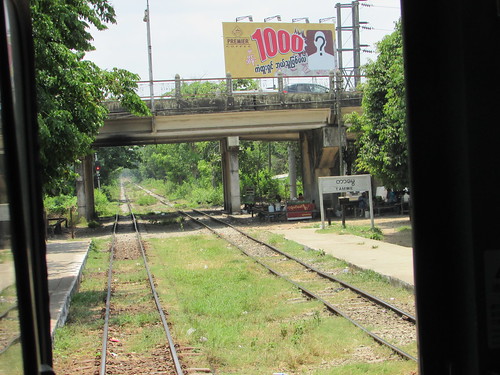 Tamwe station with 'Red' signal 'A89' beyond the road bridge.
We passed yet another of the 'new' diesel multiple units (RBE.3030 in cream livery with partial orange and green waistline). The introduction of more of these second-hand train has reduced the number of locomotive hauled trains operating in the Yangon area.
 Diesel Multiple Unit RBE.3030 in cream livery with (partial) orange and green waistline.
Our route then converged and ran parallel with the double-track Mandalay-Yangon line just as another train headed for Yangon was passing. We pulled up side-by-side with this train (re-powered DF.1622 on a short passenger train) at the four-platform Mahlwagon station.
Leaving Mahlwagon, the sweeping curves of the four-track main line on to Pazundaung always makes me think of the Queensville Curve, Stafford in England.
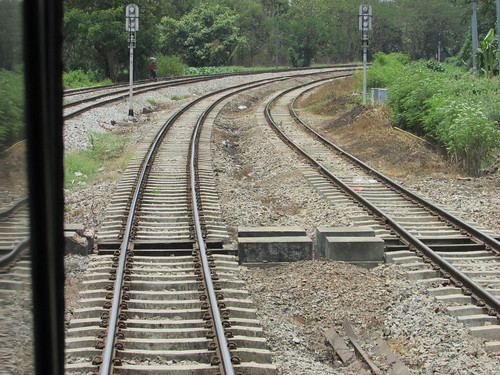 Four-track sweeping curves between Mahlwagon and Pazundaung.
At Pazundaung, two goods lines from Mahlwagon Marshalling Yard converge and run parallel. To the west of Pazundaung, there are complex junctions with various conflicting routes so it was no surprise to wait for signal 'P4' until DF.1220, hauling an Up Circle Line train, had snaked across the pointwork in front of us.
 Pazundaung, looking towards Yangon Central Station, as our train waits for DF.1220 to cross to the Up Circle Line. On the left, DF.2081 heads for Yangon on the Down Goods.
Once the signal cleared, we slowly completed our journey back to Yangon Central Station. The journey had taken just under two and three quarter hours and had given us a fascinating insight into the operation of this suburban railway and the lives of those who use it.
All the pictures in this article are in the album Around the Circle line in 2016.
Related posts in my blog
The Circle Line, Yangon (2008).
Exploring Yangon's railways (2012).
Yangon Area Railways (2013).
Railway Signalling in Burma - Part 2: Colour Light Signals & Motor Points.
All my Myanma Railways posts.
My Pictures
Around the Circle line in 2016.
Kyee Myin Daing.
The Circle Line, Yangon (2013).
Cab Ride on the Circle Line (2014).
Circle Line Revisited (2012).
The Circle Line by DMU (2015).
The Circle Line, Yangon, Myanmar (2009).
Burma: Colour Light Signals & Motor Points.
Yangon Central Station.
Railways in Myanmar (2008).
All my Myanma Railways Pictures.

