skip to main |
skip to sidebar
In my introductory post London Underground and Jan, I described how my interest in the Underground was sparked when my firm became involved in supplying tunnel telephone equipment.
One of the lines I've worked on is the Waterloo and City. At just under a mile and a half in length the Waterloo & City is the shortest of the London Underground railways now operated by Transport for London but it has a lot of interest.
In the post Waterloo Station, London (Part 2) I explained that the London & South Western Railway (L&SWR) which built the main line terminus at Waterloo had an ambition to extend their line eastwards. The Waterloo and City Railway Company was incorporated in 1893 by an Act of Parliament. Although independent from the L&SWR, no less than five of the eight directors of the new line were directors or employees of the L&SWR! Construction of the double-track Waterloo and City Line started in 1894 and it was opened, using electric traction, in 1898. It is 1 mile 46 chains long with two single-bore iron segment tunnels of varying diameter up to 12ft 9in.
The L&SWR operated the Waterloo and City railway from its opening, later purchasing the line outright. At the Grouping, the line passed to the Southern Railway and, upon Nationalisation, to British Railways, ending up part of London Underground in 2004. This history has produced a unique line.
Rolling stock has always been stabled and serviced at a cramped depot below ground level beyond Waterloo station. A siding just north of the Waterloo & City underground station was provided with a lift (built by Armstrong) to the main-line sidings, allowing underground vehicles to be transferred to and from the main lines. The railway generated its own electricity at a power station adjacent to the depot and the Armstrong Lift was also used to receive wagons of coal for the power station. The Armstrong Lift was removed to allow construction of the Waterloo International platforms to serve the Eurostar services, since when the Waterloo & City has been completely isolated from other railways.
The L&SWR started to electrify its suburban main line network from Waterloo in 1915, constructing a large, new power station at Wimbledon to supply the power. The sub-station at Waterloo main line station was arranged to also supply power to the Waterloo & City line.
As part of a comprehensive modernisation by the Southern Railway in 1940, the bare copper 'pinch-wires' which form part of the present tunnel telephone system were added. This system allowed the driver to communicate with the signalman at Waterloo (Waterloo & City) and the power supply operator in the main line substation at Waterloo. In 1972, control of the main line substation at Waterloo was transferred to Raynes Park. The original tunnel telephone control panels were left in Waterloo main line substation but the telephone circuits were extended to Raynes Park and a remote reset facility for the tunnel telephones was provided through the electro-mechanical telemetry system for power control.
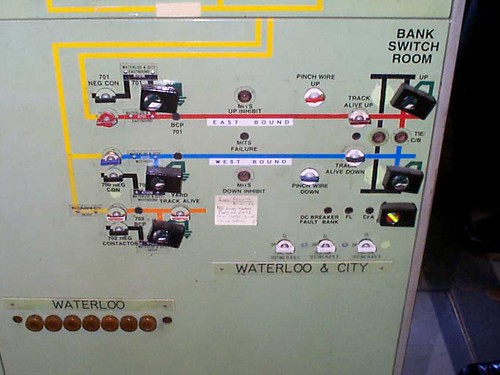 The Electric Control Room at Raynes Park presently controls traction power to the Waterloo & City. This view shows the small part of the large mimic diagram relating to the Waterloo & City.
At present, traction power is still provided from the Network Rail Main Line Traction Substation via d.c. track feeder cables. There are two tunnel traction sections, one for the Down or Westbound line (section 700), one for the Up or Eastbound line (section 701) line. The Waterloo Depot area, which is not provided with tunnel telephones, forms a third traction section (section 702). Traction sections are fed via high-speed d.c. circuit
breakers, similar to London Underground standard practice. At the remote end of the Up and Down lines, Bank, a Track Paralleling Hut was provided to minimise voltage drop. However, this feature was never commissioned and the railway operates as two single-end fed traction sections.
A new Traction Substation is being completed within Waterloo station near the Waterloo & City line and, once this is commissioned, the Network Rail Main Line Traction Substation will no longer be involved in the operation of the Waterloo & City line.
In 1989 Network South East, who were by then responsible for the line, ordered replacement rolling stock of the LUL Central Line pattern, providing five 4-car sets. Cranes were needed to remove the old rolling stock and deliver the new trains to the depot area, since the Armstrong Lift had been removed as mentioned above. Some civil works were needed to accommodate the new stock and the current collection system was changed from third rail to standard London Underground fourth rail pattern in 1992.

Present Waterloo & City vehicle.
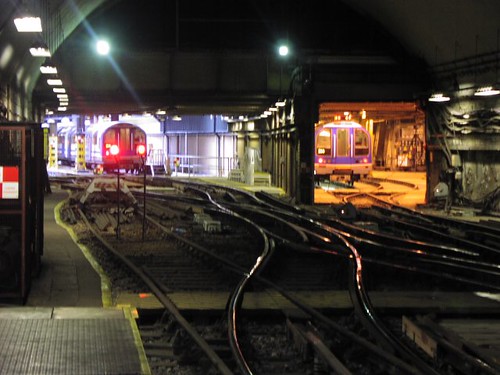 The depot at Waterloo, viewed from the Arrival platform, in 2004.
Westinghouse replaced the old signalling system in 1992 with a relay interlocking controlled from an 'NX' mosaic panel.
 The 'NX' signalling control panel at Waterloo in 2004.
Around 2007, a new Service Control Centre was constructed within Waterloo station. This was provided with a solid-state signalling interlocking system controlled from workstations. The 1992 Westinghouse signal box has been retained as an Emergency Service Control Centre.
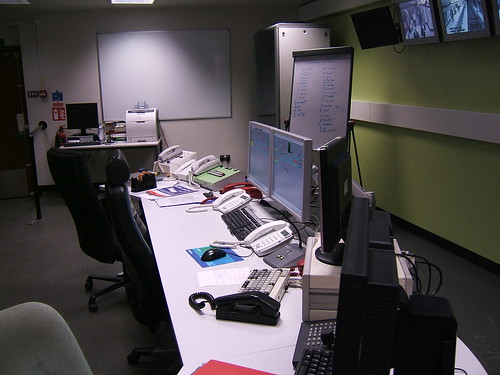 The present Service Control Centre at Waterloo.
Related information on other websites
Clive's UndergrounD Line Guides form an excellent reference to all of London Underground. The Guide for the Waterloo and City line is here.
There's a Wikipedia article here.
Related posts on this website
All my posts on London Underground can be found here.
Books
In my introductory post London Underground and Jan, there's a list of books about London Underground. From this list, these two are of particular relevance to the Waterloo and City Line:-
[ 1] 'The Waterloo & City Railway' (a very detailed history running to over 460 pages).
[ 2] ‘Railways of Waterloo’ (covers both the Waterloo & City and the main line station).
For a track diagram with other information, refer to another book included on the list in the introductory post here:-
[13] 'Railway Track Diagrams Book 5: Southern and TfL' Third Edition, published by TRACKmaps (ISBN 978-0-9549866-4-3).
Pictures
Waterloo & City.
[Flickr ref updated 3-May-2020]

(Click on map for larger view)
London Underground Map 2015 (Transport for London).
When I was quite young, I was introduced to the London Underground on a visit to London with my parents. I think I was terrified and fascinated in equal parts. Terrified by the speed, the noise and descending into the bowels of the earth to board the trains - fascinated by the frequency of trains and the relative ease of moving underground around London. As an adult, I was happy to utilise the tube but it never had the attraction of steam railways. Even after my firm started supplying special-purpose telephone equipment for railways in various countries, I saw the London Underground network merely as a means of transport, not a potential source of work.
That changed in, I think, 1995 when one of our major customers, who was bidding for a large telecommunications package in connection with the Jubilee Line Extension Project, asked us to quote for the design and supply of Tunnel Telephone equipment. Well, I had a vague idea of what was involved - most people travelling on the Tube notice the pair of bare wires carried on the tunnel wall forming part of the tunnel telephone system. These wires allow the driver to attach a portable telephone in case of emergency. None of the telephone systems we'd produced seemed adaptable to this tunnel telephone application and I thought that the costs of developing suitable equipment from scratch would make any offer we made unattractive. So we declined to quote, explaining our reason to our customer.
However, a few months later the customer came back to us, saying they'd really like us to quote, and this time we produced a quotation. Some time later (these things always seem to take an inordinate time to come to fruition - a large quotation we did for Brazil only produced an order after seven years!) we agreed a contract to design and supply the necessary tunnel telephone equipment for the Jubilee Line Extension. I then embarked on a fairly steep learning curve to better understand both the traction supply system on London Underground and the requirements for tunnel telephone systems. As we produced the necessary equipment, I became far more interested in the history and development of the London Underground system. Over the years since, I've worked on tunnel telephone systems for a number of the London Underground lines and, as time permits, I'll add more posts on this unique mass transit system.
Brief Introduction
The London Underground employs a fairly unusual fourth-rail system of electrification. I've written a little about how traction current is distributed in the post London Underground - Traction Power Distribution and there's a short background in the post Fourth Rail Electrification.
Tunnel Telephone systems used on London Underground have two functions - to discharge traction current in an emergency and allow the driver to talk to the Line Control Centre (now generally called the 'Service Control Centre'). The tunnel wires allow a driver to open the cab window and simply 'pinch' the two bare wires together (the bare tunnel wires are sometimes referred to as 'pinch wires'). This action automatically discharges the local traction section. Connecting a portable telephone to the exposed wires similarly discharges the traction section, after which a conversation with the control centre is possible. Fixed telephones with a similar function are provided at strategic locations (such as the Headwalls at stations). London Underground now call the Tunnel Telephone system the Emergency Traction Current Discharge System (ETCDS) to better-reflect its principal function. Providing speech with the control centre, in this age of Secure Cab Communication by radio, is the secondary role.
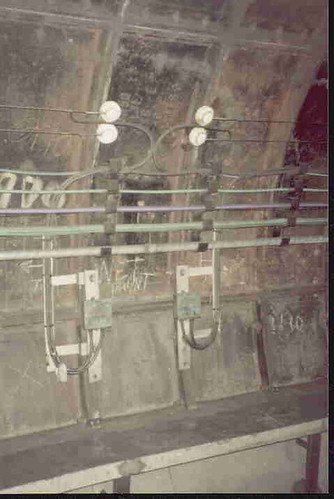
Jubilee Line: Tunnel wires mounted on cast iron tunnel lining at the junction of two adjacent Tunnel Telephone sections.
Clive's UndergrounD Line Guides form an excellent reference to all of London Underground.
For track diagrams of London Underground, refer to 'Railway Track Diagrams Book 5: Southern and TfL' Third Edition, published by TRACKmaps (ISBN 978-0-9549866-4-3).
Books
Here's a list of some of the books I've acquired dealing with London Underground:-
[ 1] 'The Waterloo & City Railway' by John C. Gillham (The Oakwood Press) ISBN 0 85361 544 6.
[ 2] ‘Railways of Waterloo’ by J. N. Faulkner (Ian Allen Publishing) ISBN 0 7110 2237 2.
[ 3] ‘London’s Local Railways’ by Alan A Jackson (David and Charles) ISBN 0-7153-7479-6.
[ 4] ‘Steam to Silver – An illustrated history of London Transport railway surface rolling stock’ by J. Graeme Bruce (London Transport) published 1970.
[ 5] ‘Inside Underground Railways’ by Alan A. Jackson (Ian Allen Ltd.) published 1964.
[ 6] ‘The London Underground – A diagrammatic history’ by Douglas Rose (Douglas Rose) 3rd edition ISBN 0 9507101 5 6.
[ 7] ‘Underground Train Overhaul – The Story of Acton Works’ by J. Graeme Bruce/Piers Connor (Capital Transport Publishing) ISBN 1 85414 134 1.
[ 8] ‘The Northern Line – An illustrated history’ by Mike Horne/Bob Bayman (Capital Transport Publishing) 2nd edition 1999 ISBN 1 85414 208 9.
[ 9] ‘The Story of London’s Underground’ (London Transport) revised edition 1966.
[10] ‘British Electric Trains’ by H. W. A. Linecar (Ian Allen) 2nd edition 1949.
[11] ‘Handling London’s Underground Traffic’ by J. P. Thomas (London Underground) published 1928.
[12] ‘The London Underground Tube Stock’ by J. Graeme Bruce (Ian Allen Ltd.) ISBN 0 7110 1707 7.
[13] 'Railway Track Diagrams Book 5: Southern and TfL' Third Edition, published by TRACKmaps (ISBN 978-0-9549866-4-3).
[14] ‘London Underground Guide 2015’ by Jason Cross (Train Crazy Publishing 2015) ISBN 978-1-907648-10-6.
Related posts on this website
All my posts on London Underground can be found here.
My pictures
My coverage of London Underground lines is very patchy and quality is generally rather poor, I'm afraid. All these albums are shown here.
[Book {14} added to book list 11-Apr-2021]
Jerome K. Jerome, best known as a humourist and writer, was born in Walsall in 1859. His most famous work 'Three Men in a Boat' was published in 1889.

Jerome K. Jerome in the 1890s (Photo: National
Media Museum @ Flickr Commons).
Jerome (whose middle name was Klapka) was given the Freedom of Walsall in 1926 (there's black-and-white film of the event here) and died the following year. Wikipedia has a useful biography here. For more information, go to the website of the The Jerome K Jerome Society.
Although I've known 'Three Men in a Boat' since childhood, I was only recently reminded that the book includes a description of taking the train from Waterloo during the period when the haphazard growth of the station had made it a laughing stock. Jerome's description is below:-
We got to Waterloo at eleven, and asked where the eleven-five started from. Of course nobody knew; nobody at Waterloo ever does know where a train is going to start from, or where a train when is does start is going to, or anything about it. The porter who took our things thought it would go from number two platform, while another porter, with whom he discussed the question, had heard a rumour that it would go from number one. The stationmaster, on the other hand, was convinced it would start from the local.
To put an end to the matter we went upstairs and asked the traffic superintendent, and he told us that he had just met a man who said he had seen it at number three platform, but the authorities thre said that they rather thought that train was the Southampton express, or else the Windsor loop. But they were sure it wasn't the Kingston train, though why they were so sure it wasn't they couldn't say.
Then our porter said the thought it must be on the high-level platform; said he thought he knew the train. So we went to the high-level platform and saw the engine-driver, and asked him if he was going to Kingston. He said he couldn't say for certain of course, but that he rather thought that it was. Anyhow, if he wasn't the 11.5 for Kingston, he said he was pretty confident he was the 9.32 for Virginia Water, or the 10 A.M. express for the Isle of Wight, or somewhere in that direction, and we should all know when we got there. We slipped half-a-crown into his hand, and begged him to be the 11.5 for Kingston.
'Nobody will ever know, on this line,' we said 'what you are and where you're going. You know the way, you slip off quietly and go to Kingston.'
'Well, I don't know, gents,' replied the noble fellow, 'but I suppose some train's got to go to Kingston; and I'll do it. Gimme the half-crown.'
Thus we got to Kingston by the London and South-Western Railway.
We learnt afterwards that the train we had come by was really the Exeter mail, and that they had spent hours at Waterloo looking for it, and nobody knew what had become of it.
In 1899 the London and South-Western Railway finally decided to rebuild the station (perhaps the gentle ribbing in 'Three Men and a Boat' played a part), although the work was not completed until 1922. There's a short description of the rebuilding of Waterloo Station here.
In 1956 'Three Men in a Boat' was made into a film which is described here. In 1975 the book was turned into a film for television, briefly described here. The television version can be watched on You Tube here.
Over the years, the reciprocating steam engine has appeared in many forms. None is more unusual than the Oscillating Cylinder Engine. As the name suggests, the cylinder is arranged so as to pivot on the mounting frame. The piston rod connects directly to the crank, causing the whole cylinder to swing to and fro. The abutting mounting faces of the cylinder and mounting frame are provided with ports so that the movement of the cylinder opens and closes the appropriate ports to admit and exhaust steam at the correct time without the necessity for valve motion. Wikipedia has an article here which outlines some early industrial applications for this design.
Many people were introduced to oscillating cylinder engines through their use in live-steam toys made by 'Mamod'. Although I never had one of the models, I was fascinated by the simplicity of construction. I didn't realise how extensive the 'Mamod' range was until I read the Wikipedia article here.
In May 2011, my Friend Keith visited the U.K. and, on a visit to Peak Rail, we studied the 'vacuum motor'. This is powered by an Oscillating Cylinder Engine operating on vacuum from the locomotive’s braking system and, through suitable reduction gearing, can effortlessly turn the largest locomotive. There's a collection of pictures here.
On 13th February 2013 I visited Keith at his home in Perth, Western Australia. Keith had always been impressed with the simplicity of the ‘Oscillating Cylinder’ engine and he ran (on compressed air) an ‘Oscillating Cylinder’ engine he built many years ago to demonstrate how powerful this type of engine can be when properly engineered. There's a description of this part of my visit here.

Keith's demonstration 'Oscillating Cylinder' engine.
It wasn't until September 2015, when I was preparing the post Railway Turntables that I found that Messrs. Cowans, Sheldon & Co. Ltd. of Carlisle held a patent for this method of driving turntables by either vacuum or air from the braking system of the locomotive being turned.
Introduction
In 1971, I acquired Brewood Hall. It was in a fairly sorry state but, having done what repairs and redecorations could be afforded at the time, it became my family home. Over the years, more extensive conservation and redecoration work has been carried out as possible.
I started to research the history of the Hall and produced a small pamphlet summarising my findings (printed using an obsolete type of stencil duplicator called a 'Gestetner'). Early in 2008, this information was transposed into the internet posting here. As time permitted, I've carried out more historical research, assisted by friends.
This post is a collection of more recent findings. Historical information frequently contains errors, for a variety of reasons. Transcription errors may occur - particularly with old documents. Many books 'borrow' from other sources, with or without acknowledgement, sometimes allowing errors to perpetuate. Writers should cite the sources for information quoted, so that readers can form a view as to its likely accuracy. I'm afraid this rigour has not (yet) been applied to these notes, in the interests of assembling the information I've come across in one place, but there is an informal Bibliography at the end. Brewood Hall was always a rather minor estate so not too much information is recorded. Little is known with complete certainty.
The Victoria County History (often referred to simply as 'VCH') was founded in 1899, dedicated to Queen Victoria, and intended as "an encyclopaedic record of England's places and people from earliest times to the present day". Since 1933, it has been based at the Institute of Historical Research, University of London, modestly claiming to be "without doubt the greatest publishing project in English local history." The VCH covers most of England and is organised on a county basis. Staffordshire (in which Brewood is located) is covered in 14 volumes! Brewood appears in Volume 5, covering the East Cuttlestone hundred (the 'hundred' is an archaic county division, described in Wikipedia here). Fortunately, a digital version of this information is available at British History Online which was founded in 2003 by the Institute of Historical Research and the History of Parliament Trust, to provide "a digital library of key printed primary and secondary sources for the history of Britain and Ireland, with a primary focus on the period between 1300 and 1800".
The index for the digital version of the 'A History of the County of Stafford: Volume 5, East Cuttlestone Hundred' is here. The two sections most relevant to Brewood are:-
Brewood: Introduction, manors and agriculture
Brewood: Churches, schools and charities
Some information is held at the Staffordshire Record Office and the William Salt Library, both located in Stafford.
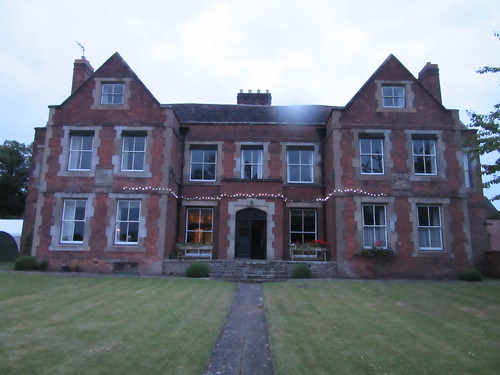 A summer evening at Brewood Hall in 2015.
Miscellaneous Notes
Hearth Tax
In the Hearth Tax Assessment of 1666, Brewood Hall was assessed at 10 hearths. There's an explanation of Hearth Tax here. Roehampton University, London runs the Centre for Hearth Tax Research and they maintain an on-line database at Hearth Tax Online covering some parts of England (but not Staffordshire).
Gardens and Orchards
Brewood Hall was a 'manor peculiar' without extensive land. Until the 1960s, there were about six acres of gardens and orchards. Following the sale to a property development company, around 5 acres were developed for housing, leaving about one acre with the Hall. Dr. Plot visited Brewood Hall, writing in 1686 that "In the whitethorn hedge, between the garden and the court before the house, were the figures of several animals, castles, etc., formed in topiary, and that in the orchard there was the whitethorn figure of a wren's nest, big enough to hold a man. In the garden was a yew tree, which formed an arbor, measuring five yards square outside and three and a half inside, cut on the top with loop and crest, like the battlements of a town, adorn'd at each corner with a pinnacle, over which is wrought a canopy two yards in diameter, which is carried up gradually to a small pinnacle". Near the pale of the orchard was a "fine yew tree, cut up gradually from greater to lesser rounds, to the number of twenty".
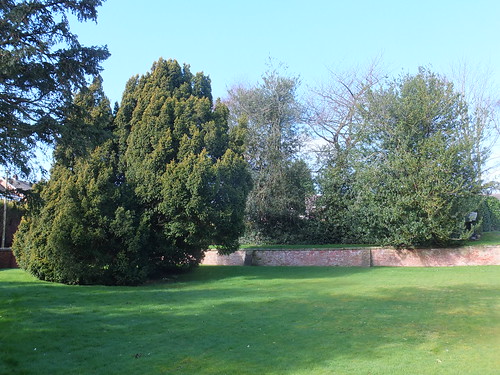 The Victorians swept away the topiary, but a massive, old yew tree still stands in remaining garden.
"The garden walls and gate pillars date from the late seventeenth century, as do some of the outbuildings. Stone fleurs-de-lis, about two feet high, which formerly surmounted each of the gate piers, are said to have been the origin of the mark used by John Turner, the famous Staffordshire potter, whose father once lived at the Hall. During the nineteenth century restoration, the fleurs-de-lis were removed to the back garden, and replaced by two large stone balls. On the north-east side of the Hall is a large early eighteenth century red brick farm building with king-post roof and exposed first floor beams. The building seems to have been used as a malthouse in the last century. The sandstone gateposts and steps of the former path to the rear of Brewood Hall still stand in Vicarage Road, a short distance from Sandy Lane. The house of Hall Farm Close stand on the site of a large pond which was filled in about 1960. The pond may have marked the site of Brewood Hall quarry, said to have been very deep, which was full of water before 1869." [reference 3].
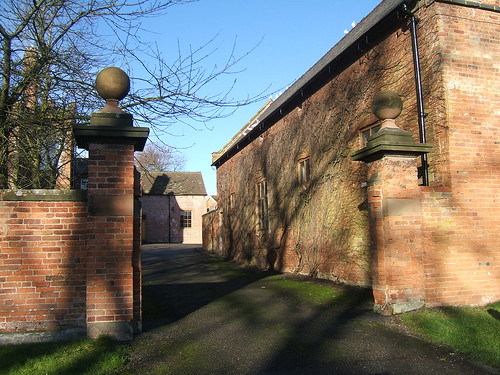 The main gate showing renovated gate piers with ball finials (prior to hanging of gates).
Period 1200 - 1786
Deer hunting was popular and King John is thought to have had a ‘Camera Regis’ (a temporary residence) on the site of Brewood Hall around 1204. The Fowke family became bailiffs of the Episcopal Manor of Brewood and Brewood Hall remained in this family for a number of generations. Brewood Hall was technically a 'Manor Peculiar' without extensive manorial lands. The Hall, gardens and orchards occupied only about six acres of land. "Brewood Hall is traditionally the site of King John's hunting lodge, and before the fourteenth century the semi-official residence of the bailiff of the Bishop's manor." [reference 3].
The pedigree of the Fowkes shows William Fowke living at Brewood Hall during the reign of Edward IV (1461-1483, with a brief interruption). During this period the ‘Leet’ (a Great Court) was held here.
Period 1786 - 1929
The Hall was owned by the Monckton's between 1786 and 1929 and the Turner family and others were tenants. In those times, landowners would often allow successive generations to be tenants, as long as the rent was paid.
Period 1929 - 1960
In 1929, Major R.P.F. Monckton sold Brewood Hall to Colonel C. O. Langley and it was the Langley family home for around 30 years. C.O. Langley was a partner in a solicitors practice (Fellows, Langley and Wright) in the town of Wolverhampton, about 8 miles from Brewood. He was also Borough Coroner and Stipendiary Magistrate in Wolverhampton. A son and daughter were brought up at Brewood Hall. Tragically, the son lost his life during the Second World War, whilst serving as a sub-mariner. His mother was unable to come to terms with the loss and became very reclusive. After the War, there were at least two part-time household staff. A housekeeper was accommodated in a modern cottage in Vicarage Road, about 5 minutes walk across the orchards which then lay at the rear of Brewood Hall. A gardner, handyman and chauffeur lived at Rambler Cottage, Sparrows End Lane, about two minutes walk from the Hall. Up until the 1960s, there was a substantial range of farm buildings next to Brewood Hall. Records indicate that Moncktons had an 'Estates Office' there in the 1950s, because they cite a fire at this office as the reason for not having the Title Deeds to a tract of disputed land in Coven.
Period 1960 - 1971
Following the death of his wife, C.O. Langley eventually decided to move to a smaller house in Wolverhampton. He disposed of Brewood Hall, with various outbuildings and the orchard, to Avion Properties in the 1960s. This company developed about five acres of the site for housing, resulting in the loss of some interesting buildings and all of the orchard, apart from one apple tree.
Until 1968, there was a large timber-framed barn with long straight braces to the lower panels. By the 1960s, it was in a very poor state of repair and, although there was an initiative to preserve the barn, it was not successful.
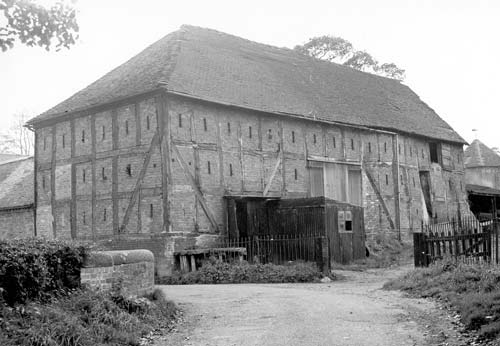 Large timber-framed barn at Brewood Hall, now demolished (Staffordshire Past Track).
The photograph below is taken from 'The Turners of Lane End' [reference 5] and shows the setting of Brewood Hall as it was prior to the development in the 1960s. The Hall itself, on the left, is little changed in appearance today but the remaining buildings are either swept away or altered. The large Barn on the right of the drive remains, but the twin gabled building in the foreground was demolished, along with the part 2-storey/part 1-storey barn extending to the right. Tragically, the large timber-framed barn on the right was also demolished. The gable roof of another, long barn runs across the rear of the picture. Only the left end of this barn survives.
 Brewood Hall circa 1960 (from 'The Turners of Lane End').
The photograph below, circa 1966 shows site as the changes were being made. The twin gabled building has been demolished, revealing the interior rear wall abutting the large barn. On the right, the part 2-storey and part 1-storey barn has gone. In the background, the long barn can been seen, but this was subsequently truncated.
 Brewood Hall circa 1966 during partial demolition of the outbuildings (Staffordshire Past Track).
This delightful hexagonal dovecote was also lost.
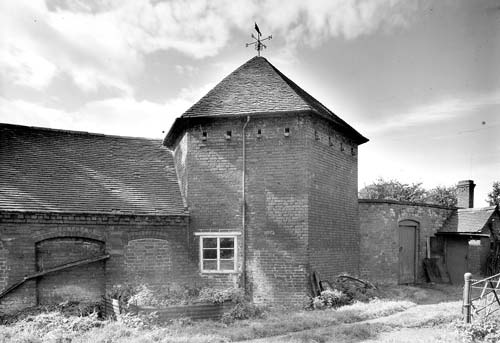 Dovecote at Brewood Hall, now demolished (Staffordshire Past Track).
Brewood Hall, the 'Big Barn', the truncated barn (now dubbed the 'Little Barn' and the brick garden walls had all been designated as 'Listed Buildings, Grade II' and the developers were thereby prevented from carrying out further demolition. However, the property remained empty for some time and significant vandalism had occurred. I have no doubt that, before long, the buildings would have mysteriously 'gone on fire', had not the property been purchased.
Period 1971 - Present
The Hall and remaining Big and Small Barns, with around an acre of gardens, were acquired by J. C. Ford in 1971. We didn't get the original deeds on purchase as C.O. Langley's Abstract of Title was sufficient. The Hall was in part-vandalised condition, so the priority was to preserve the fabric and try to get at least part of the building habitable. My mother, a close family friend and I lived here and did the initial redecorations ourselves. In 1979 my partner joined us so there were four of us here. Over the next ten years my mother and family friend died and a difficult financial period allowed the house to become rather run-down but then my fortunes revived. I nursed my partner through a long illness until he died in 1999. I then set about conserving and redecorating the house with professional help and my hope is that this very special place can be kept in its present reasonable condition.
The Monckton family are still major landowners in the area. Stretton Hall is now the 'family seat' but they still own Horsebrook Hall and Somerford Hall.
The Giffard family have been in continuous occupation of Chillington Hall (but not the same building) since the de Giffards settled after the Norman Conquest.
Photograph References
For my pictures around Brewood, including pictures of some of the tombs in the churchyard, click here.
Pictures of the interior of the Parish Church and some of its memorials are here.
To give an idea of the extent of the village, there is also a series of pictures taken from the tower of the church. These are here. A further set of pictures was taken from the roof of Brewood Hall and these are here.
For Historic Pictures of Brewood Village, click here.
For Historic Pictures of Brewood Hall, click here.
Links
Brewood (Wikipedia).
Brewood: A Short History by David Horowitz).
Fooks and Fowke Family Trees.
GENUKO Brewood Parish Register - 1834.
Brewood Genealogical Records (Forebears).
Free British Ancestry.
Dustydocs.com (Australia).
Staffordshire, England Genealogy (UKIsearch.com).
Staffordshire Past Track.
References
[1] 'A History of the County of Stafford: Volume 5: East Cuttlestone hundred' (1959), Victoria County History
[2] 'Brewood' by Mary E. Wakefield, published in 1972 by Praill (Cannock) Limited.
[3] 'Brewood' by David Horovitz, (ISBN 1 85421 175 7).
[4] 'History and Antiquities of Staffordshire' by Stebbing-Shaw'.
[5] 'Master Potters of the Industrial Revolution - The Turners of Lane End' by Bevis Hillier.
In the post Waterloo Station, London I gave a brief introduction to this important London terminus. The later post Visiting former 'Southern' stations in London describes the adjacent station of Waterloo East and its footbridge connection to the main station.
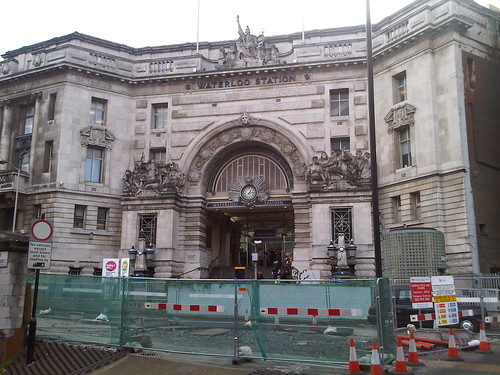 Waterloo: the imposing 'Victory Arch' is the main entrance for foot passengers, rather spoilt in this 2010 picture by the temporary works in the foreground. Three years later, there were still works going on in this area!
The entrance shown above leads to the main concourse through a passage lined with four dignified panels forming a 'Roll of Honour' in memory of London and South Western Railway employees who were killed in World War I.
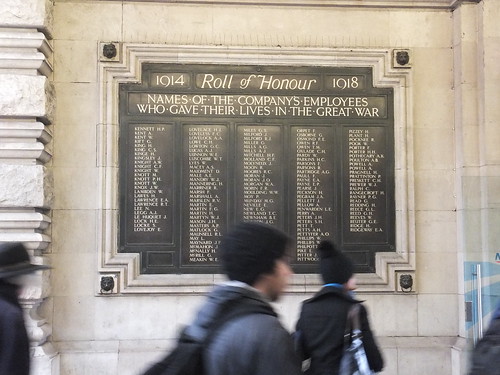 One of the four panels forming the WWI memorial.
The World War II memorial is a more modest affair.
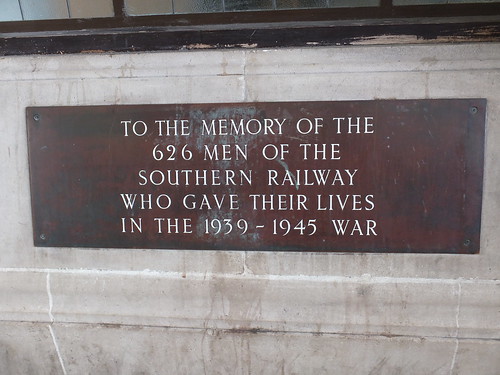 The WWII memorial.
There is also a memorial commemorating the 50th anniversary of 'D-Day', placed by Railtrack South East in 1994.
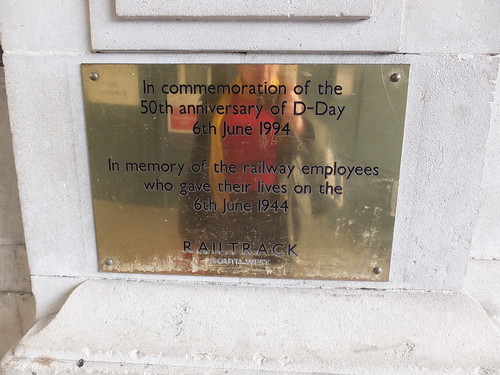 The 'D-Day' memorial.
My recent visit was on 13th September 2015 when I was involved in some alterations to the Tunnel Telephone system on the Waterloo and City Line. This time, I recorded the appearance of the 'Victory Arch' entrance from the concourse.

The main pedestrian entrance viewed from the concourse side.
The concourse side of the 'Victory Arch' is flanked by two imposing entrances leading to offices. The left hand entrance now leads to Network Rail offices but when I made a number of visits a few years ago it was the head office for 'Eurostar' and the words 'Eurostar House' can still be made out on the blue panel above the door.
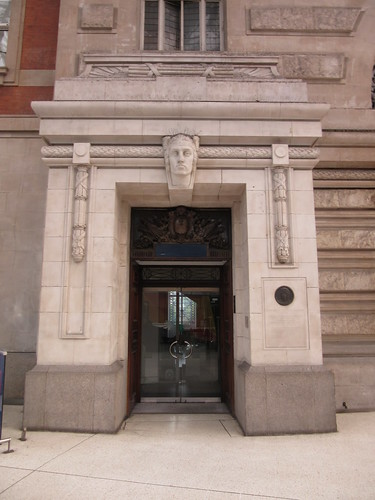
Entrance to what is now Network Rail offices, incorporating a memorial to Herbert Walker. The bust above the door now sprouts plastic spikes to discourage pigeons. The words 'Eurostar House' can just be made out on the blue panel above the door.

Detail of the memorial to Herbert Walker incorporating a stone cameo.
The memorial reads:-
HERBERT ASHCOMBE WALKER K.C.B.
LONDON & SOUTH WESTERN RAILWAY
GENERAL MANAGER 1911-1923.
SOUTHERN RAILWAY
GENERAL MANAGER 1923-1937.
DIRECTOR 1937-1947.
THIS STATION, THE DEVELOPMENT
OF THE DOCKS AT SOUTHAMPTON
& THE ELECTRIFICATION OF THE
SOUTHERN RAILWAY,
TO WHICH HE GAVE HIS GENIUS &
LEADERSHIP, ARE HIS MEMORIAL
This tribute gives a hint of this towering figure, who led first the L&SWR and then the Southern Railway from 1911-1937. There's a Wikipedia article here. The memorial lists Waterloo, Southampton Docks and electrification as his major achievements.
Regarding the first of these achievements, Waterloo: The L&SWR didn't intend the line to end here. The destination for many of their commuters was the City of London and the railway's ambition was to extend the line eastwards. But the best they could achieve was to operate the one and a half mile long Waterloo and City underground electric railway from 1898. They later purchased the railway (which subsequently passed to the Southern Railway and then British Railways, transferring to London Underground in 2004). Unwilling to accept that the station would remain a terminus, the L&SWR allowed the site to develop in a rather haphazard way which resulted in, effectively, three stations side-by-side - North, Central and South, as shown in the 1888 plan below.

Plan of Waterloo station in 1888 (Flickr Commons by the British Library).
Click on image above for larger view.
By the end of the 19th century the inadequacies of Waterloo had made it a laughing stock. A light-hearted description of the trials of catching the train at Waterloo appeared in the book 'Three Men in a Boat (written by Jerome K. Jerome and published in 1889)and is included in my post on Jerome here. In 1899, finally accepting that Waterloo would remain a terminus, the L&SWR obtained permission for a total rebuilding of the station. J W Jacomb-Hood (L&SWR Chief Engineer) was responsible for the structure and planning. After his death in 1914 A W Szlumper continued the work. James Robb Scott (L&SWR Chief Architectural Assistant) produced the architectural designs. The rebuilding was finally completed in 1922 with the erection of 'The Victory Arch'. This arch is the only part of the station buildings which are Listed (Grade II in 2002). The English Heritage description reads:-
The Victory or Memorial Arch was built 1919-22. It was designed as the main foot entrance to the station at the head of an impressive flight of steps, most of which is within the building. it is in the form of a triumphal arch some three storeys and attic in height, on the butterfly plan; the main arch being flanked by side bays and with one bay canted wings. It Was joined to the existing building on the left by a three bay section with recessed centre and giant order, this is not repeated to the right. Balustraded parapet with attic hidden behind. Stonework with heavy rustication in the centre. Sculpture - Bronze plaques under the arch bear the names of 585 LSWR employees who lost their lives in WWI, but the chief features are two sculptural groups, one dedicated to Bellona and dated 1914 and the other, dated 1918, to Peace, under the names of the greatest fields of battle set around a glazed arch set with a clock in a sunburst, and surmounted on the roof by Britannia. Prominent on the concourse side of the arch is the name of the company. The sculptor was the other wise little known Charles Whiffen. The special significance of the monument within the post-First World War genre is that the LSWR staff themselves were, uniquely, consulted on its design. Pylons with iron lamps flank the staircase.
The rest of the station is not of special architectural or historic interest.
The dismissal of the rest of the station as without interest is an unkind opinion shared by Nikolaus Pevsner who, in his 'Buildings of England: London' called the steelwork “sadly timid” and the facade “spoiled by a hopeless position”. Stuart Durant on The Victorian Web is more even in his judgement, writing "Waterloo, despite its architectural failings — in particular its vainglorious attempt at monumentality — is a pleasant and efficient station. For all the lack of bravura of the scheme, the glazed roofs of Jacomb-Hood and Szlumper give Waterloo some of the best natural lighting of any station." Personally, I consider Waterloo to be one of the more delightful survivals of London's railway terminals together with the rather more heavily modified candidates of King's Cross and St. Pancras. I certainly agree regarding the success of the glazed roofing.
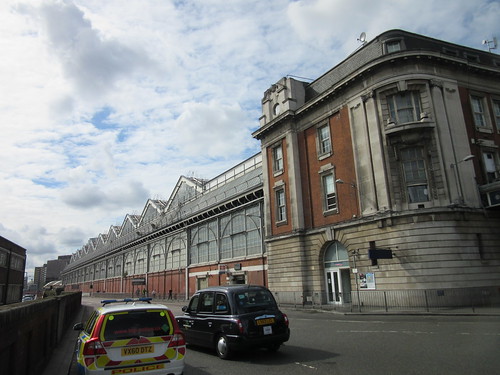 Station Approach looking south-west showing the curtain wall adjacent to platform 1 (left) and the east end of the main station building (right).
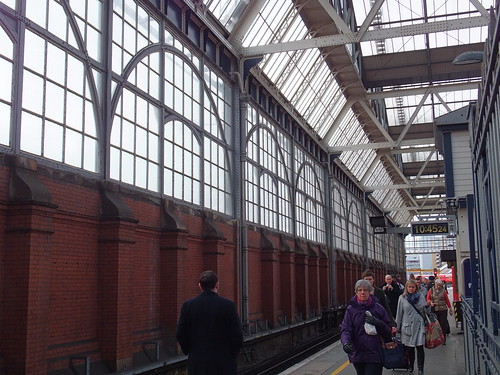 The curtain wall adjacent to platform 1.
I found one further war memorial: a simple tribute to the fourteen men of Nine Elms locomotive depot who "died by enemy action 1939-1945". I suspect that this memorial was originally located within the buildings of the Motive Power Depot and was re-sited at Waterloo when the Depot was abolished. It is now positioned on the wall adjacent to Starbuck's.
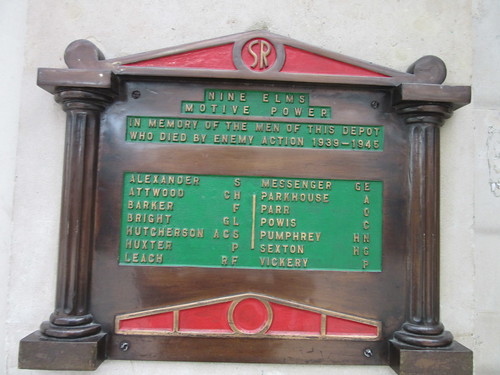 Nine Elms Motive Power memorial.
Before the rebuilding of the station, there was one little-used through line at the Central station which crossed Waterloo Road on a bridge and connected with the SE&CR line at what is now Waterloo East. The arrangement can be seen in the 1888 plan below.
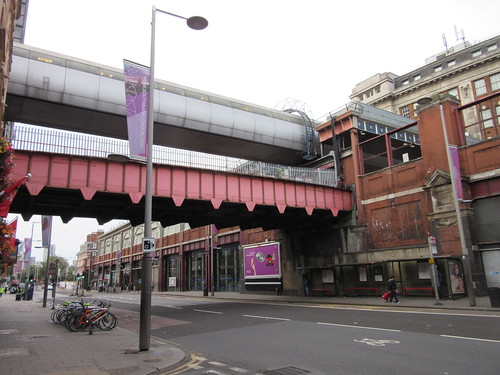 Waterloo Station, viewed from Waterloo Road. The overbridge originally carried a single line to Waterloo East and a footpath and now appears to be in use for cable drum storage. The more modern pedestrian bridge at a higher level now links Waterloo and Waterloo East.
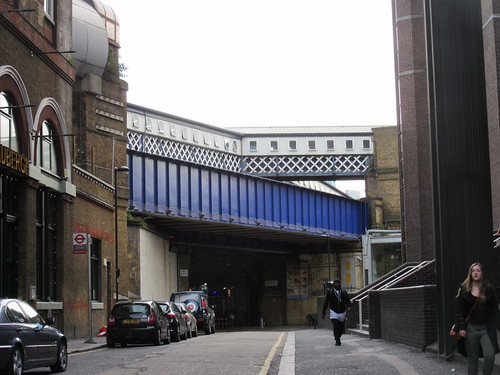 Sandell Street viewed from Waterloo Road. The blue bridge presumably carried the former connecting line to Waterloo East. The roof over the high level footbridge changes to the inelegant form shown, once clear of Waterloo Road!
There's a Wikipedia article on Waterloo Station here.
Network Rail are planning significant further expenditure to bring the rest of the International station back into use and extend platforms 1 to 4. The rather nice aerial view below accompanies their write-up here
 Waterloo Station from the air (Photo: Network Rail).
Click on image above for larger view.
My pictures
London: Waterloo Station
TURNTABLE ORIGINS
The turntable (or 'turnplate') appeared early in the development of railways, initially as a means of routing single wagons from one line to another at coal mines and similar installations and often narrow-gauge.
 A cast narrow-gauge wagon turntable preserved at Black Country Living Museum (without the approach tracks).
When the first steam railways were built, the size of turntables was increased to allow shunting of passenger coaches and turning of the small locomotives then in use. No passenger station lacked a battery of turntables to assist in marshalling each train. The 'Roundhouse' design of locomotive shed using a turntable to access a number of radiating stabling roads was used as early as 1846 by the London and Birmingham Railway (there's a very brief description of that line here). The building of the roundhouse locomotive shed built at Camden survives as a Grade II* listed building and is now used as a performing arts and concert centre called Roundhouse. There are brief details of the building on Jack Whitehead's Local History website here.
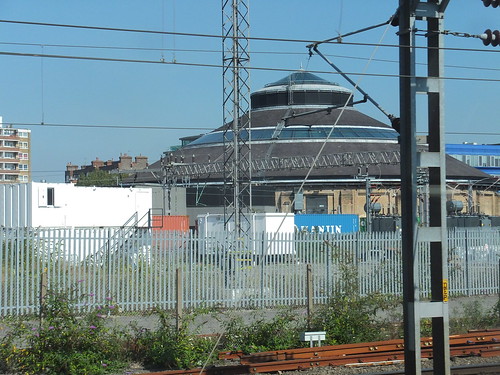 Camden, showing the London and Birmingham locomotive roundhouse of 1846 (now the Roundhouse Theatre).
Eventually, small turntables became confined to goods yards and canal interchanges. They were often provided in large numbers, sometimes associated with capstans so that haulage ropes could be arranged allowing horses to move the wagons. The sketch map below shows the sidings and wagon turntables at the canal interchange basins at Bloomfield in the West Midland area of England in the early years of the 20th century.
 A larger version of this sketch can be found here.
There's a brief write-up about the canals and sidings at Bloomfield in the post Rail and Canal at Bloomfield.
The picture below shows a typical standard-gauge wagon turntable, this one preserved in Birkenhead Docks.
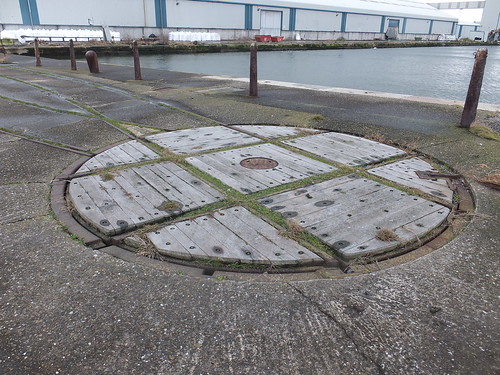 Birkenhead: Wagon Turntable adjacent to Duke Street Lifting Bridge.
There's a write-up of my exploration of Birkenhead's Docks in the post Birkenhead and New Brighton by train (Part 2).
LOCOMOTIVE TURNTABLES
Developments in locomotive design produced larger engines which required longer turntables. In Britain, turntables up to 70 feet in length were made. There's a Wikipedia article here.
The following description is based on an article published in The Locomotive Magazine and Railway Carriage and Wagon Review, dated 15th February 1937. This article, in turn, was 'a brief abstract of the main points mentioned' in a paper on Locomotive Turntables read to a meeting of the Institution of Mechanical Engineers on 27th January 1937 by Associate Member Mr. J. H. A. Wilkins.
Modern locomotive turntables conform to one of three types:-
1. The cantilever, or centre balanced type: either 'through' or 'deck' pattern.
2. Articulated or centre hinged type.
3. Continuous girder type supported at three points (Mundt type).
Of more than 900 turntables in use in 1936, most were centre-balanced type with only around 20 ar and 20 of the continuous girder (Mundt) pattern. In the U.K, the largest turntable in use is 70 ft. diameter.
1. Cantilever or centre balanced type supported on the centre pivot
The turntable is balanced in the centre, the main girders acting as cantilevers. Two strong wrought iron or steel plate main girders are braced together by stretchers and securely attached to a middle framework which rests on and revolves around a centre pin fixed to a solid foundation. Large carrying wheels which travel on a rail laid round the circumference of the pit are attached to both ends of the main girders.
In use, the locomotive to be turned is centred or 'set' so that the majority of the weight is taken by the centre pivot, and a small force applied to the ends of the main girders is able to turn the table. To assist in achieving the necessary balance, the length of the table should be several feet longer than the wheel base of the locomotive.
During erection, the large carrying wheels are given a slight clearance from the circumferential rail and carry that part of the weight not supported by the centre pivot.
If a locomotive is perfectly balanced, all the weight is carried by the centre pivot, otherwise part of the weight is supported by the large carrying wheels at one end of the turntable.
The centre pivot comprises a cap or yoke cast in steel which supports the main girders by large suspension bolts. The cap rests on a pivot bearing, typically made of 'UBAS' case hardening steel supporting a bronze, gun-metal, or steel cup ('UBAS' was a trade mark used by W. T. Flather who manufactured special steels). If an anti-friction thrust bearing is incorporated, this is enclosed in a steel housing resting on, and positioned on, the stump or centre pivot. The centre pivot takes the full load of the turntable and locomotive when in use and is usually cast iron, secured by rag bolts or similar to a solid, normally concrete, foundation.
Because of the clearance given to the large carrying wheels, 'blocking pads' are provided to take the weight of the locomotive when running on or off the turntable. In some cases the hand lever for operating these blocking pads also operates the locking bolts for holding the table in position opposite the various roads radiating from the pit. In its horizontal position this lever is sometimes used for turning the table manually.
In some designs, levers to operate the blocking pads and locking bolts are replaced by hand wheels at each end of a shaft running the whole length of the turntable girder, so that turning the hand wheel at either end operates the blocking pads and locking bolts at both ends. The locking bolts also serve as blocking pads in some designs, engaging in a cast iron locking rest fixed in the pit wall where each track radiates.
The centre-balanced main girder may be of 'deck' (under girder) or 'through' (over girder) design.
In the 'deck' type, the rails are laid upon the top of the main girders, simplifiying construction but requiring a deep pit to accommodate the height of the main girders.
In the 'through' type, the rails are laid between the main girders, carried on cross members. This allows the use of a shallower pit. The G.W.R. normally use the 'through' type in outside locations (a 65 ft. turntable on the GWR at Oswestry was cited as an example) where a notice visible to the engineman reads "All engines must stop before going on to the turntable." so as to avoid shock as the locomotive runs on to the table, due to the clearance on the large carrying wheels). The 'through' type, although possessing the advantage of requiring only a shallow pit, weighs considerably more itself due to the heavier construction and greater width, and costs more than the 'deck' type.
2. Articulated or centre hinged type supported at three points
This design is credited to a Chief Inspector of Locomotives on a German railway called Herr Klensch who sold his patent to Messrs. Julius Vogele in Mannheim. They, in turn, granted licences to manufacturers in Germany and elsewhere.
The articulated turntable is divided into two beams, supporting the load over the centre pivot and the large carrying wheels at each end of the turntable which are always in contact with the circumferential rail. The large carrying wheels take at least half of the load on the turntable and it can be driven from either end.
Because the large carrying wheels remain in contact with the rail, the ends of the table are not violently depressed when a locomotive runs on to it, reducing the shocks which occur with the cantilever or centre balanced type descried above in which, when correctly balanced, the large carrying wheels remain clear of the rail.
One advantage of dividing the main girders in this design is that girder height can be reduced, allowing the use of a shallower pit.
The articulated or centre hinged design found favour in the U.S.A. where lattice girders were often used. Elsewhere riveted plate girders or rolled girders were generally used.
With an evenly-distributed load, the thrust bearing of the centre support carries half the total load the balance being carried by the large carrying wheels. The centre joint must be sufficiently robust to prevent slackness occurring which allows the large carrying wheels to skew, increasing the resistance to turning when the table is driven from one end only. A number of designs of centre joint using flexible hinge plates and laminated spring joints were evolved.
3. Continuous girder type supported at three points (Mundt type)
Mundt was an engineer with the Dutch State Railways and his improvement of the centre-hinged type eliminated the centre hinge by allowing a continuous girder to deform under load. The continuous girders are not of uniform section throughout, but are reinforced from each end to a certain distance short of the centre pivot. This allows of sufficient flexibility to prevent the rising of the unloaded end of the table with a unbalanced load (for instance, a short locomotive at one end).
The turntable may be driven from either end and no balancing is required - the locomotive can be turned immediately the last wheels of the engine or tender run on to it a no blocking up of the table is required.
Again, the design allows the use of reduced girder height, shallower pits and a centre support required to carry only half the total load.
A variation of the Mundt pattern, widely used in the U.S.A., uses unreinforced girders where bending throughout the length is provided. To ensure proper adhesion, these types are normally driven at both ends by electric motors.
TESTING LOCOMOTIVE TURNTABLES
Testing of locomotive turntables is usually carried out at the manufacturer's own works using a temporary track. The table is manufactured in sections (as in steel bridge construction) assembled with bolts in place of rivets to allow the structure to be taken apart for despatch to the customer. The test load is usually made up iron castings of known weight which are built up to the total weight required. The test load is stipulated on the contract, and is usually 25% above the weight of the heaviest locomotive which the table is designed to carry. The individual Loads are arranged to represent the axle loading of the heaviest class of locomotive which will use the turntable. Deflection tests of the main girders are made at the ends and between the ends and the centre. After the test load is removed, observations are made for any permanent set which may have taken place. The locking gear is carefully tested. This testing is usually witnessed by representatives of the customer.
When the turntable has been re-erected on its permanent site, it is then tested again by running the heaviest locomotive which will use the table on to it, and any final adjustments are made.
TURNTABLE OPERATION
Early forms of turntable (before the use of anti-friction pivot bearings and carrying wheels became general) were operated by a winch driving gearing either fixed to the end carrier or directly to a toothed ring forming part of the wheel path. In some cases, the winch was driven by a small steam engine or hydraulic power.
Modern turntables may be operated:-
1. Manually
2. Electric motor
3. Vacuum motor
4. Compressed air motor.
1. Manual operation
The turntable is operated by a two-handled winch mounted at one end of the turntable deck. The crew of the engine to be turned provide the turning power. Extending beams are sometimes fitted to allow extra people to assist in pushing the turntable deck. In the 1930s, the majority of turntables in the UK were manually operated.
2. Electric operation
World-wide, this is the most common method of operation, particularly on larger turntables and almost universal in the U.S.A. At busy locations, the time saved by electric operation is significant. A control cabin is often mounted on the turntable deck and a man stationed in this cabin allows the engine crew to remain on the footplate during turning. In the U.K., both the GWR and LMS installed electrically-operated turntables but in 1935 there were under 30 in this country, compared with over 900 in the U.S.A. divided over 58 railway companies.
The electric motor is usually a totally-enclosed traction type. A tramway type controller with magnetic blowout, electric brake, current reverser and associated resistors is provided, often mounted within the control cabin. The controller usually has one handle for forward running and braking and another for reversing. A foot brake is provided working on a pulley keyed to the main or intermediate driving shaft.
Current collection to the rotating deck is either by electrical contacts in the pit or via an overhead cable to a gantry mounted at the centre of the deck provided with electrical slip-rings.
3. Vacuum operation
This method of driving is patented and manufactured by Messrs. Cowans, Sheldon & Co. Ltd. The apparatus consists briefly of a central valve chest mounting two double acting oscillating cylinders, each 4in. diameter by 6in. stroke, running at 350 rpm. and driving a crank shaft on which a pinion meshes with gearing which drives the large carrying wheels. All that is necessary when the locomotive is driven on to the table is for the vacuum brake pipe, either at the front or rear of the locomotive, to be connected to the flexible coupling of the tractor. The vacuum ejector on the engine is then opened and one of the engine men works the controls to operate the vacuum motor. There's a brief description of the 'Oscillating Cylinder Engine' here.
4. Compressed air operation
In the steam locomotive era, most British railway administrations used vacuum brakes but overseas air brakes were common. To cater for this market, the Cowans, Sheldon vacuum motor was adaptable to operate from the compressed air supply on an air braked locomotive.
BRITISH TURNTABLE MANUFACTURERS
There were two principal British manufacturers:-
Cowans, Sheldon and Company of Carlisle, perhaps better known as crane makers.
Ransomes and Rapier Limited of Norwich, also crane and machinery manufacturers.
Cowans, Sheldon and Company

A drawing of a Cowans, Shelton turntable in the collections of Tullie House Museum and Art Gallery, Carlisle. Click on the image for a larger view.
See also Grace's Guide.
Ransomes and Rapier Limited

A 1921 advert for 'Traversers and Turntables' (Grace's Guide).
See also Grace's Guide
Brief details of Ransomes and Rapier documents held by Ipswich Transport Museum on behalf of the National Archives are here.
EXAMPLES OF TURNTABLES IN USE
Birmingham Railway Museum, Tyseley
Tyseley retains its turntable with radiating stabling roads from its former life as a Briitish Rail Motive Power Depot, although the building which originally covered both turntable and stabling roads had gone (along with a second building, turntable and stabling roads). For years, we operated this turntable by hand, although it had originally been electrically operated. Eventually, electric operation was restored. The turntable, a 'Mundt' type, had been supplied by Ransomes and Rapier Ltd.
and the worksplate was marked:-
Rapier
146 tons Mundt Turntable
Made For B.R. Contract No.1114-M&E
Ransomes and Rapier Ltd.
OR.G.J.4985 Ipswich England 1957.
There's a picture (by Stuart Axe) of this worksplate here.
Peak Rail, Rowsley
The original turntable here had been removed and the pit filled in. In a major restoration, the pit was dug out, re-bricked and a 60-foot turntable originally supplied to Mold Junction M.P.D. was installed. This is a Cowans and Sheldon turntable, operated by the original 2-cylinder vacuum motor.
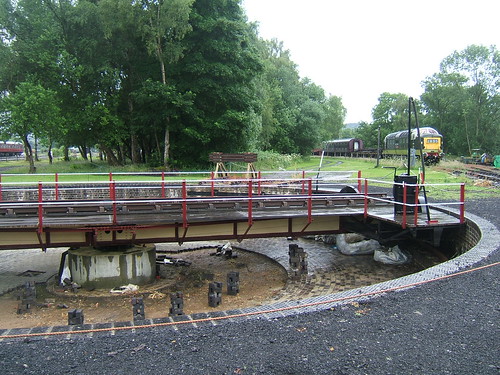 The 60-foot turntable at Rowsley during installation. This Cowans Sheldon Co. Ltd turntable (O/N 6181 5-Mar-1937) was originally supplied to Mold Junction M.P.D.
There's a little more information on the Peak Rail website here.
The re-commissioned turntable at Peak Rail was inaugurated by Pete Waterman on 1st May 2010, as described here.
 With Pete Waterman at the regulator, 8624 slowly reverses off the turntable (Photo: Sheila Rayson).
There is a collection of my pictures showing the Rowsley turntable in detail here.
Wolsztyn, Poland
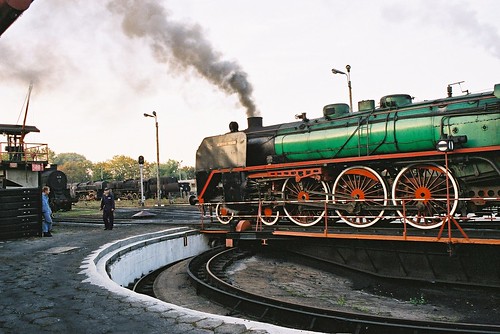 'Piekna Helena' on the turntable at Wolsztyn.
There's a brief description of my visit here and my pictures are here.
Kolomia, Ukraine
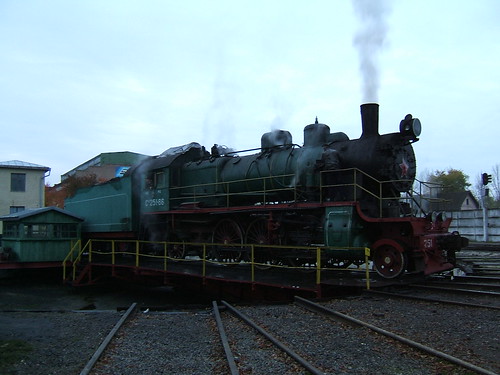 Su 251-86 on the turntable at Kolomiya.
There's an introduction to my trip to Ukraine, with links to other posts and pictures here.
Kiev, Ukraine
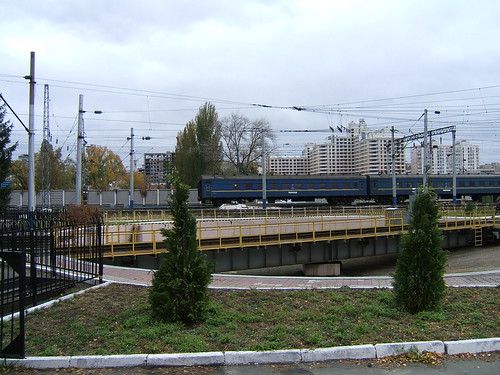 A large turntable in Kiev serving an 8-stall roundhouse and the works. Note the overhead catenary.
There's an introduction to my trip to Ukraine, with links to other posts and pictures here.
Mahlwagon, Yangon, Myanmar
 Mahlwagon Diesel Shed Turntable: 120 ton capacity metre gauge Mundt turntable built by Ransomes and Rapier in 1946.
There's a description of my visit to Mahlwagon Diesel Locomotive Shed here and my pictures showing the turntable at Mahlwagon are here.
A Model Turntable
 A model turntable in 4mm/foot scale.
There are more details of this model railway here.
There's an article on Wikipedia about railway turntables here.
[Link to 'The Oscillating Cylinder Engine' added 25-Oct-2015]