skip to main |
skip to sidebar
Click on any picture below to see an uncropped image.
Events of Sunday 4th May 2014
Introduction
This was my first visit to Rakhine State and I need to do more study to understand its turbulent history better. However, to be going on with, here’s what I gleaned from my Tour Itinerary:-
Mrauk U, once known as Myo Haung, was Rakhine’s capital in the 15th century and was one of the richest cities in Asia and a major trading centre, making it the envy of the Bengalis, the Moguls and the Burmese. During this period, the population of Mrauk U was at least 150,000. The decline was triggered by two major earthquakes in 1761 and 1762 and, by 1784, the famous King Bodawpaya of Burma had annexed Rakhine. Following the first Anglo-Burman war in 1826, the British moved the administrative centre to Sittway and Mrauk U became a backwater, its wealth gone but with a legacy of many monuments and pagodas hinting at its former glories.
Although Burmese is the official language, Rakhine is widely spoken. My best attempt at pronouncing Mrauk U is 'em-rah-oo'. The population is now only around 7,000 and there’s significant poverty. There are very few ‘sealed’ roads with tarmac. Most routes are crushed rock and sand, making the small ‘Jeep’ assembled in Myanmar a practical form of motor transport and, of course, there aren’t many of those. For our tours, we had a friendly driver with a second-hand ‘Jeep’ and my guide Mr. Myint Zaw.
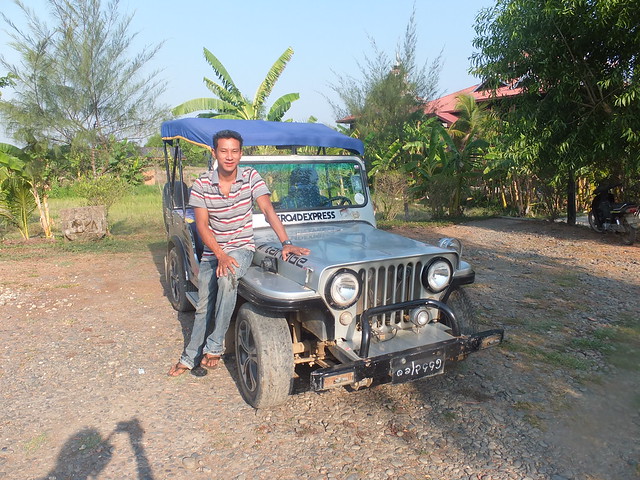 The 'Jeep' and driver which took me and my guide around Mrauk U.
Mrauk U Sunday Market
First, we had a walking tour of the local market. Anywhere in Asia, you can find these vibrant markets with a remarkable range of produce offered under conditions which would send any European Public Health Inspector into apoplexy. Most of the vegetables I couldn’t identify and I needed explanations for some of the other foods. There were live crabs, tree rats, dried fish, cows intestines, various cuts of beef, staples like eggs and lots and lots of curry powder.
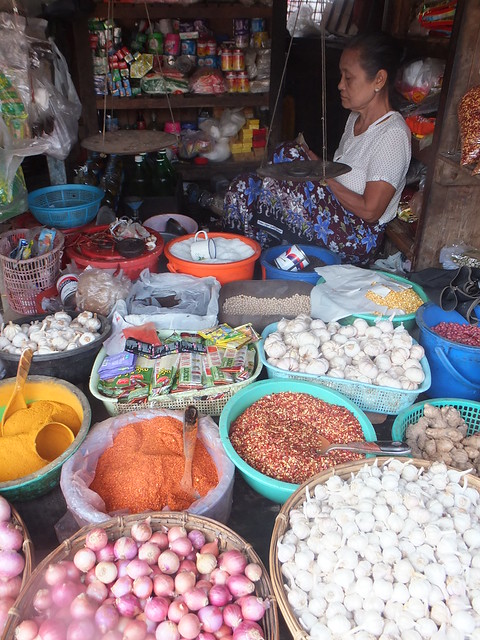
This well set-up stall holder had a conventional, 2-pan balance.
Some of the vendors used the familiar 2-pan balance to weigh the products but most seemed to prefer a more portable version with only a single pan and a balance arm made of wood, looking rather like a small truncheon. I think I’d be a little suspicious of the measurements provided by these single-pan balances.
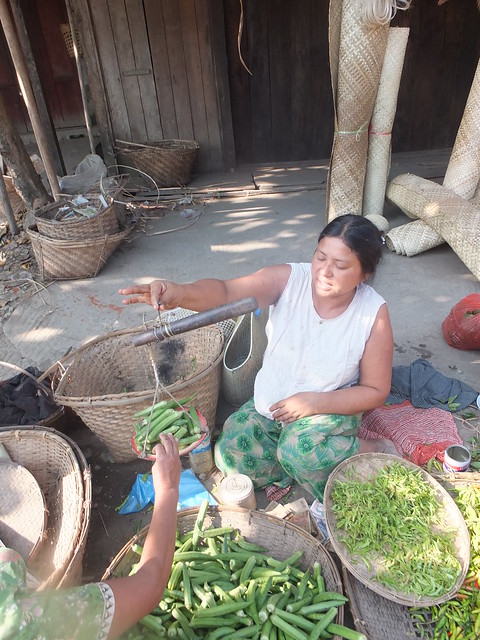
A single-pan balance in use.
New clothing, mainly from China or Thailand was on sale but there was also second-hand clothing which was displayed in heaps on sheets laid on the ground, for prospective customers to rummage through.
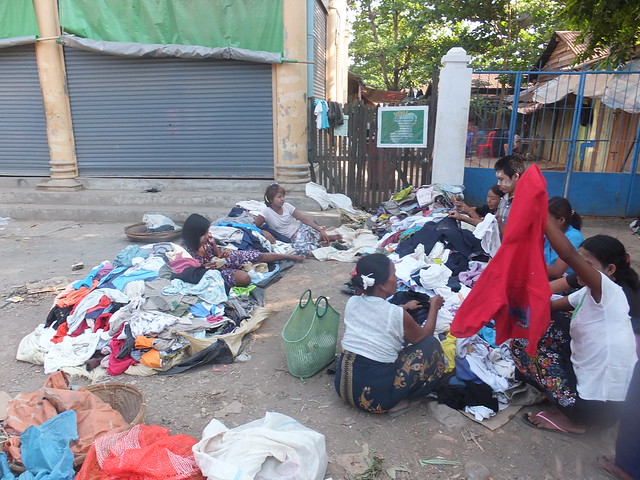 The second-hand clothing stall in Mrauk U market.
Football Ground
The Burmese are keen on football, although their enthusiasm sometimes exceeds their playing talent. As we left town, we passed a match in progress at the football ‘stadium’ - a large pitch of beaten earth with goalposts. With a local festival approaching, a series of fixtures had been arranged. A canopy had been provided over the V.I.P. seating area but most of the sizeable crowd were happy to stand along the touch line shouting their encouragement. A café with tables and chairs near one corner of the pitch seemed to be doing a good trade. There were also supporters sitting on top of an ancient wall on the far side of the road. This wall was actually the outer wall of the former Royal Palace.
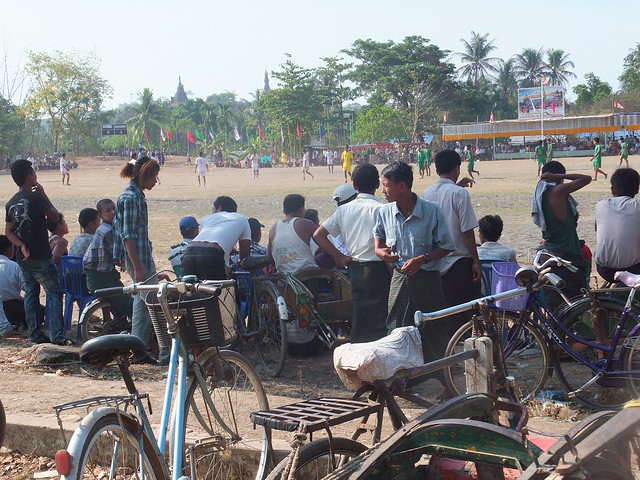 The football match drew a sizeable crowd.
Miphara-gri Cave Temple
The day then took on the familiar format that regular readers may recognise which I call "Jan looked at a load of old temples". We continued on dreadful roads to a hill topped with a ruined cave temple with two stone Buddha images. This was Miphara-gri, the Queen’s Cave Temple donated by Queen Saw Thandar. From the summit, we had splendid views of the Koe-thoung Pagoda a few hundred yards away, which was donated by the Queen's husband, King Tikkha.
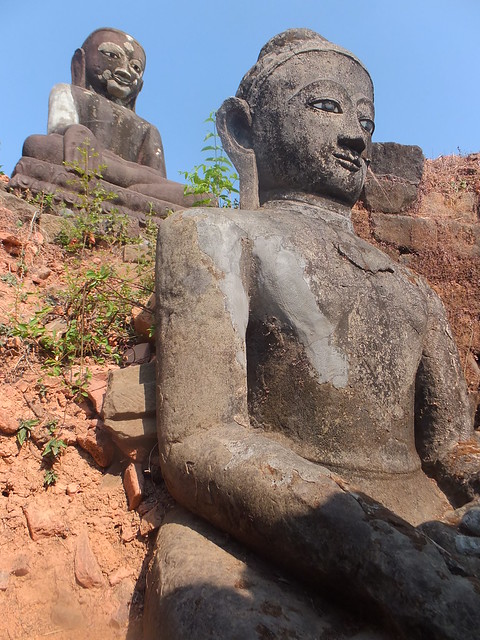 The two Buddha images at Miphara-gri.
We could also see the track bed of a new railway under construction, with a part-built station building. The local people are unhappy that this railway has been located so close to these important historic and religious sites.
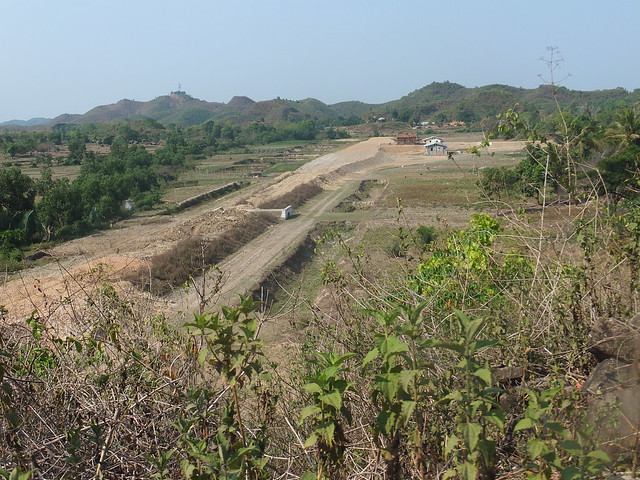 View of the new railway under construction from Miphara-gri.
Koe-thoung Temple
I was already tired from the heat and the climbing at Miphara-gri as the Jeep took us to nearby Koe-thoung Temple, a very impressive site on which excavation and restoration only started in the last twenty years. It was built by King Tikkha in 1553 and it's the largest temple in Rakhine State - the rectangular base measures 250 feet by 230 feet.
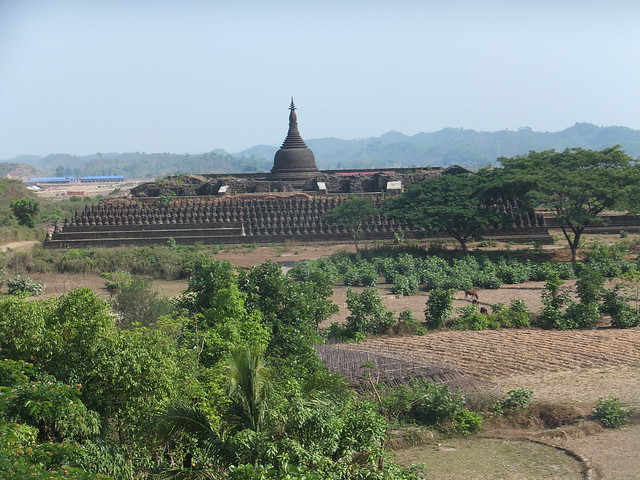 View of the Koe Thaung Pagoda from the Miphara-gri Temple.
Koe-Thaung is often referred to as the 'Rakhine Borobudur'. Whilst perhaps not as impressive as Borobudur, I can understand the naming (my own visit to Borobudur in Java is described here with a link to my photographs).
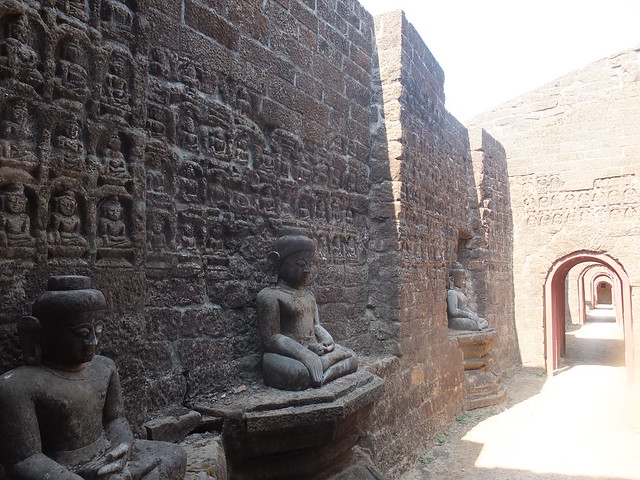 The Lower Vaulted Passage at Koe-thaung, with stone relief Buddha images 9 inches tall covering the walls.
Phra-ouk Pagoda
Returning to Mrauk U, we passed through wooded areas covered with pagodas, somewhat reminiscent of the Bagan pagodas but set in a hilly landscape and incorporating Rakhine architectural features. We paused at Phra-ouk Pagoda, donated by King Phalaung in 1571 (a few more steps for me to climb). The upper part of this pagoda had been destroyed but is now restored. It is notable for the 29 niches facing outwards on the lower terrace, each containing a Buddha image. The main chamber houses a sandstone Buddha image over 12-foot tall which, in recent times, has been painted gold.
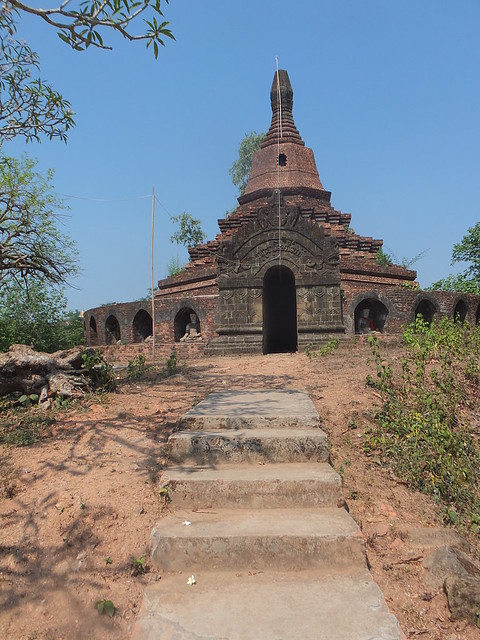
Phra-ouk Pagoda.
The Museum
Some of the more important relics from all the sites around Mrauk-U are now on display in the Museum, which has been built in the grounds of the former Royal Palace. Although the walls of the Royal Palace remain, all the buildings have been lost. After an interesting time in the Museum (alas unrecorded because photography was not allowed) it was agreed that the Guide and Driver would take me back to my Resort so that I could rest before continuing at 4.30 p.m. when the heat of the day was starting to abate.
Shaitthaung Temple
In the late afternoon, the tour continued at the extensive and impressive Shaitthaung Temple, noted for over 80,000 Buddha images, donated in 1535 by King Min Ba Kyi. The stone temple complex was built on a rectangular platform 225 feet by 180 feet by 1,000 workers. We entered via a covered flight of tiled steps leading to a large, fairly modern extension abutted onto the original complex.
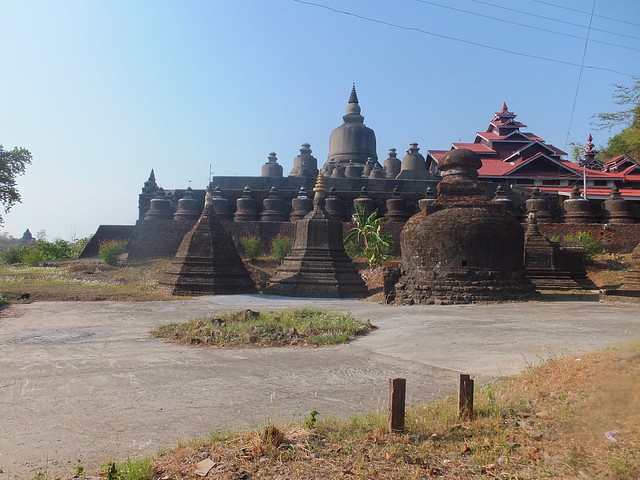 Shaitthaung Temple.
The original complex features a number of internal passages richly decorated with reliefs and carved figures.
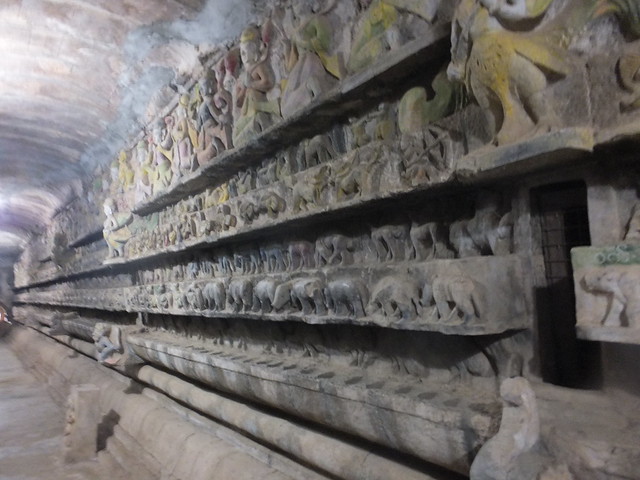 One of the richly-decorated internal passages.
The design and construction of this remarkable complex was supervised by the revered Shun-nge Sara U Mra Wah.
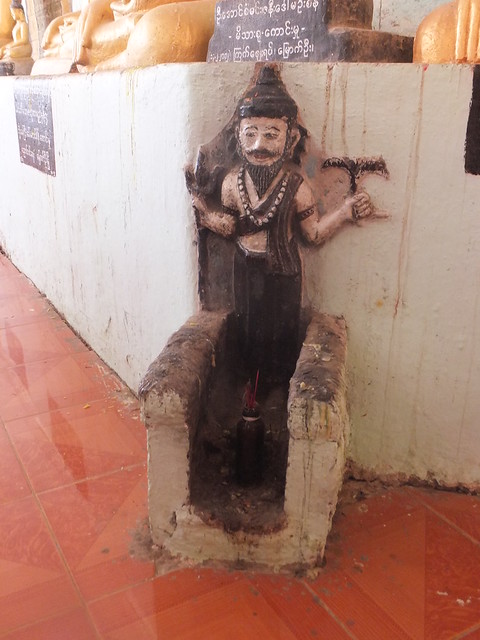 Statue of Shun-nge Sara U Mra Wah.
The temple contains many treasured relics. As an example, the Ananda Chandra Pillar is a square, stone pillar, over nine feet in height with each face 2 feet 4 inches wide. Three of the four faces are engraved with scripts dating, respectively, from the 6th, 8th and 10th century.
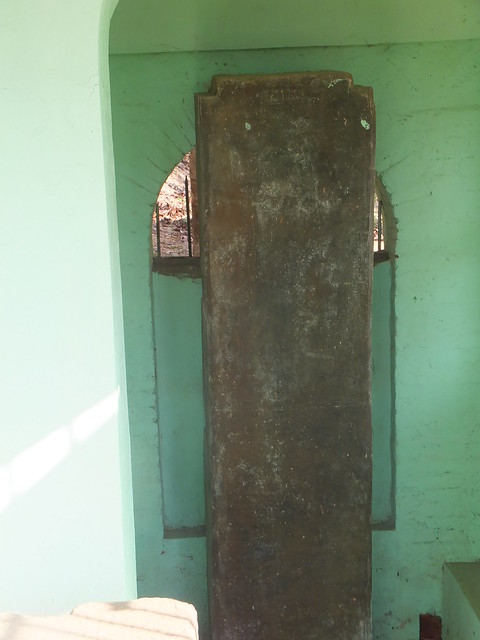
The Ananda Chandra Pillar.
Lay-myut-hna Temple
We then explored the Lay-myut-hna Temple nearby. This was built in 1430 by King Saw Mwan from sandstone blocks and has four entrances. The area was overlooked by the famous Htuk Kant Thein Temple but we agreed to defer our visit here until the following day. I was appalled that three helicopter landing pads had been built here, to allow visiting dignitaries ready access to Mrauk U from Sittwe.
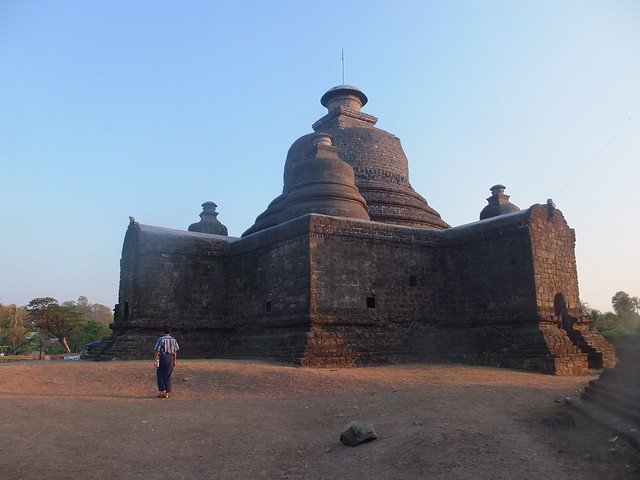 Lay-myut-hna Temple
There was a pleasant, almost holiday atmosphere – the locals who were able to gathered here to relax and chat towards the end of the day. A group of young men were engaged in a good-natured football match. But, for some people, evening meant going to obtain water for the following day in a daily ritual which becomes more problematic as sources of water, like rainwater ponds, become exhausted until the start of the next rainy season. Young women often carry two of the metal water pots - one on the head, one on the hip. Whilst one young man filled a series of water pots from the pond, the young boy with him enjoyed rides down a slope on the wooden water-cart which they'd shortly load with the water pots before returning home. I’ll return to the topic of ‘Water’ as soon as I can.
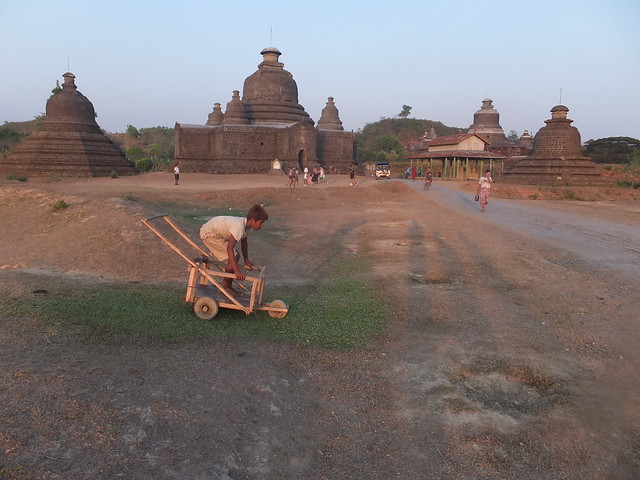 Evening at Lay-myut-hna Temple: A slope allows a young boy to ride in a water-cart whilst young men play football. Shaitthaung Temple is just visible in the background.
Tired, I was returned to the comfort of the Mrauk U Princess Resort and its obliging staff.
Books
'Famous Monuments of Mrauk-U' by Myar Aung (ISBN 951536172).
I purchased a copy of this useful and modestly-priced guidebook at one of the temples we visited.
'Burma's Lost Kingdoms: Splendours of Arakan' by Zaw Min Yu and Pamela Gutman (ISBN 9748304981).
I've not seen this book myself but second-hand copies are available at a price.
.
My Pictures
Mrauk U Princess Resort.
Mrauk U and its Market.
Mrauk U: Miphara-gri Temple.
Mrauk U: Koe Thaung Pagoda.
Mrauk U: Phra-ouk Pagoda.
Mrauk U: Shaitthaung Temple.
Mrauk U: Lay-myut-hna Temple
More
Next Post describing this trip.
[Revised 2-Jun-2014, 3-Jun-2014, 4-Jun-2014]
Click on any picture below to see an uncropped image.
Events of Saturday 3nd May 2014
I had a fairly leisurely start to the day with breakfast in the Strand Hotel. I had time to scan a couple of English-language Myanmar papers.
One article (which delighted me) reported that Jeremy Clarkson and the special ‘Top Gear’ program recorded in Myanmar (which I’d seen back in the U.K. before I left) were in hot water over alleged disparaging comments made during the program. I’m afraid I was unable to accept their defence that they were unaware that the language employed could be taken in a racially-critical manner.
Whilst I was getting ready, I had a message to say the lady from the local travel agents, ‘Sunbird’, was in reception. The charming young lady had slightly-revised flight times plus various vouchers for me to hand to my guide on arrival at Sittwe Airport.
Transfer by car to the Domestic Terminal at Yangon Airport was now to be at 10:15 a.m. to check in for the ‘Air KBZ’ flight K7 422 departing at 12:30. I’d packed enough clothes for three or four days into my smaller suitcase, allowing me to leave the larger suitcase in store at the Strand until my return on the 6th May. The car took a good hour to reach the airport but we’d still time in hand. They appear to have converted what was formerly the 'V.I.P. Terminal' into a significantly-improved Check-in and Departure Lounge area for ordinary passengers. Check-in was painless and then it was through security with my hand baggage (including my trusty ‘Fujitsu’ notebook computer) into the large air conditioned departure lounge now in use. There was even a flight information display screen for departures (I only found one!), allowing me to keep track of flights (public address announcements in the Domestic Terminal are only made in Burmese).
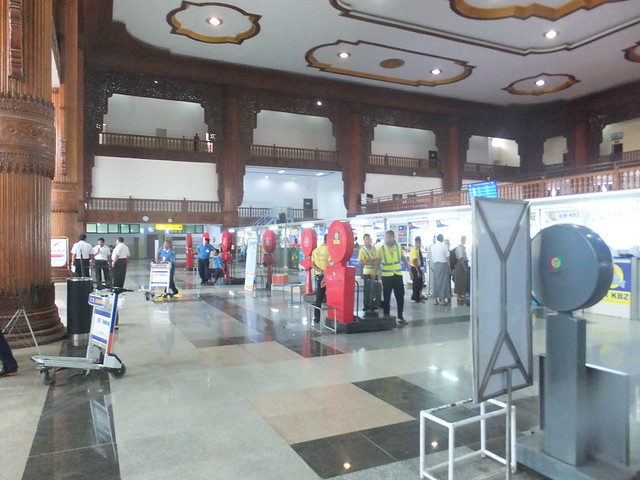 Check-in for the Sittwe flight.
At the expected time, we went through the gate onto the transfer bus which took us to the ’Air KBZ’ Advanced Turbo-Prop aircraft standing on the apron. The safety briefing (in English and Burmese) included use of lifejackets for our route was likely to take us near, if not over, the sea. The boarding pass indicated an intermediate stop at ‘SDY’. I didn’t recognise the ticketing code but realised afterwards that a straight route from Yangon to Sittwe would pass very close to Thandwe airport which, confusingly, is also called Ngapali. Ngapali is a popular beach resort – I’d considered staying there but was told that the recommended resort hotel would close at the end of the ‘High’ season, shortly before my trip. The British originally called the airport at Thandwe ‘Sandway’ which explains the ticketing code. ‘Sandway’ and ‘Thandwe’ are probably British and Romanised-Burmese spellings of the same name (like ‘Rangoon’ and ‘Yangon’).
We descended towards Thandwe airport at I could see a long, very attractive, sandy beach with waves breaking. This was the Bay of Bengal.
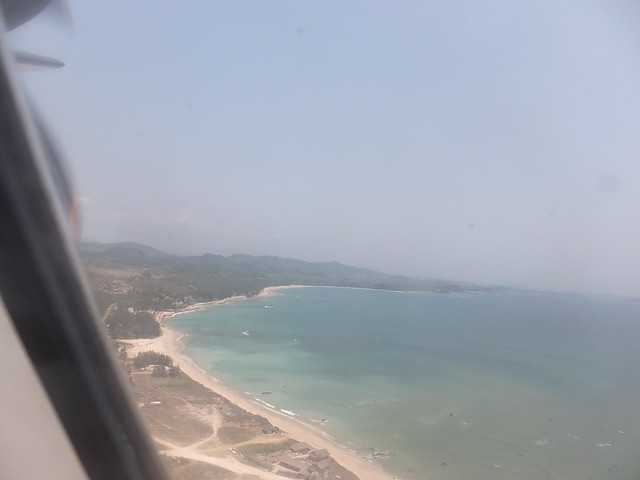 Attractive beaches visible on the approach to Thandwe Airport.
The aircraft landed and taxied to the terminal building. Ground staff erected a simple rope safety barrier around the area of the stopped port propeller before dragging out a luggage trailer with an imposing array of modern luggage, since the hatch to the baggage hold was adjacent to the propeller.
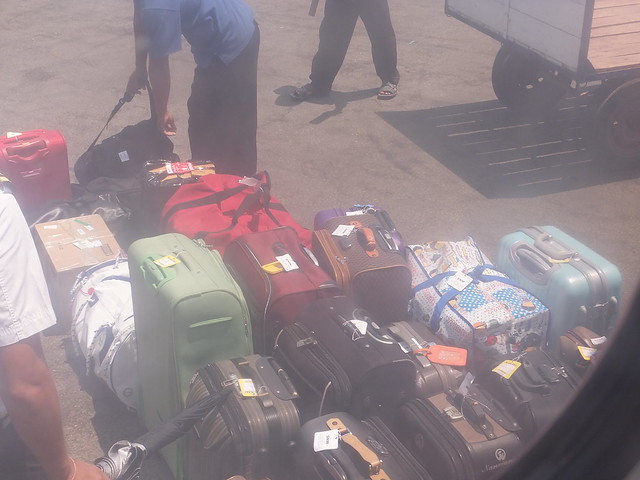 'Joiners' luggage about to be loaded at Thandwe Airport.
A number of Burmese passengers disembarked, making room for what appeared to be exclusively European ‘joiners’. They looked as if they’d just come from one of the beach resorts. A German lady sat next to me. She was travelling with her husband and two teenage daughters back home, currently Hong Kong. The ground crew finally managed to load all the baggage and we were soon airborne again, destination Sittwe.
The British abandoned Mrauk U as a regional capital (it is a fair way upstream from the sea, as I was about to discover), choosing instead to develop ‘Sittway’ (British spelling) as their administrative centre. After approaching over a series of islands and fishing villages, we landed at Sittwe airport. The German lady had told me that she was not too comfortable in small aircraft so it was unfortunate that we made one of the heaviest landings I’d experienced on this trip. The European passengers seemed to be continuing to Yangon – only a few passengers got off and we were trusted to walk the few yards across the apron to the terminal building.
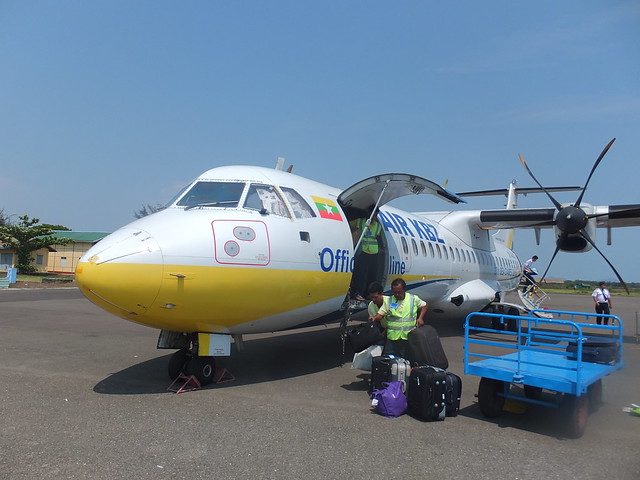 The 'Air KBZ' aircraft on arrival at Sittwe.
My guide was waiting and my small checked bag arrived safely.
The various States forming the Republic of the Union of Myanmar have a degree of autonomy and, since I was about to enter Rakhine State, my guide took my passport and arranged the formalities at a desk marked ‘IMMIGRATION’. A vehicle was waiting for us to take us the short drive to Sittwe town, where I’d board a private boat for the trip up river to Mrauk U. I’d no idea what sort of boat so I was wearing slacks to simplify matters although a longyi is much more comfortable.
The long, straight road took us through what was quite a busy and sizeable town (I believe the population is about 20,000), then we turned into a small ship repair yard with a covered slipway. The general air of dereliction suggested that this might have been abandoned by the British and unused since. But the glare of an electric arc welder confirmed that this was, in fact, a fully-functional, if unkempt, shipyard.
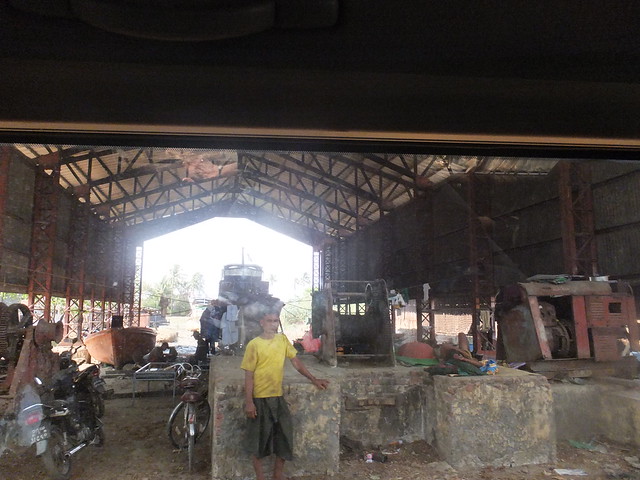 Arriving at the Ship Yard in Sittwe.
Our transport pulled up in a spot crammed with bits of boats and cargo. Various groups of people seemed to be engaged in different tasks. There was a wooden jetty thrusting into an adjacent waterway but the loose or missing planks of this twisted construction gave it more the appearance of a piece of modern art than a means of joining a boat. I’m an adherent to the dictum “If it ain’t broke, don’t fix it” myself, but the Burmese are expert in taking this philosophy to extremes. With some reservations, I carefully followed my guide across the obstacle course of the dilapidated jetty to a rather odd-looking, black-painted wooden boat. The hull had the re-assuring lines of something built by people who knew what they were doing but some curious wooden fish decorations, large circular cut-outs resembling portholes on the main deck and a wooden structure to support an awning (not fitted) on the upper deck combined to give a peculiar effect.
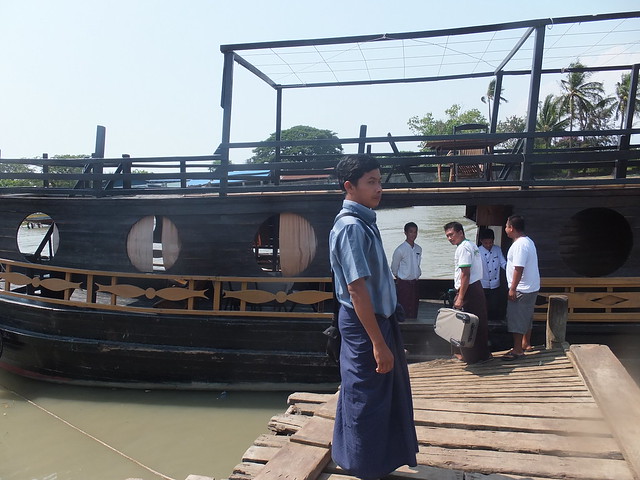 Boarding the boat to Mrauk U at the Ship Yard in Sittwe.
As soon as I and my luggage were aboard, we cast-off and carefully manoeuvred into the very congested creek. As we went downstream, we were followed by a familiar shape - it appeared to be a larger-version of the 'Express Boat' I'd been introduced to on the Rajang River in Sarawak (described in a post here and, indeed, my guide thought the design had come from Malaysia. As the creek emptied into the sea, the 'Express Boat' (operated by Malikha Travels) opened up his engines and overtook us.
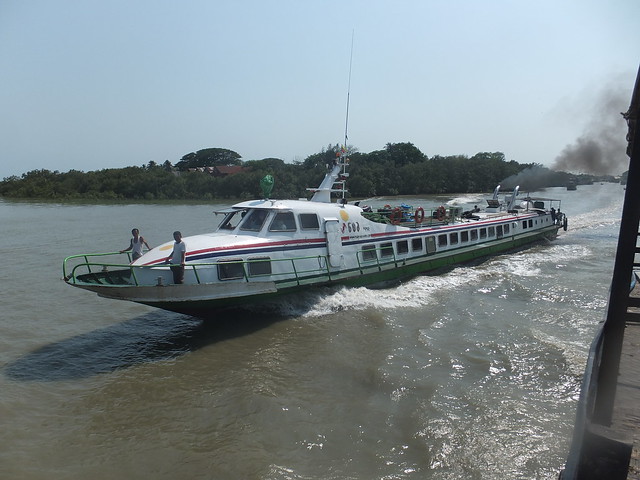 The 'Express Boat' heads for the offshore islands.
We traversed the sea for a while, keeping parallel to the shore, until we entered the broad estuary of the River Kaladan which would take us to Mrauk U and my hotel. Against the current, this would take around six hours.
There were at least three crew, all in nondescript longyi and tee shirts but with the confident gaze of boatmen everywhere. There were at least two hotel staff, in shirt and longyi which formed the hotel uniform. The one waiter sported a white jacket with black buttons, giving a very superior appearance. Then there was my guide and I finally realised that all of this effort was just for me.
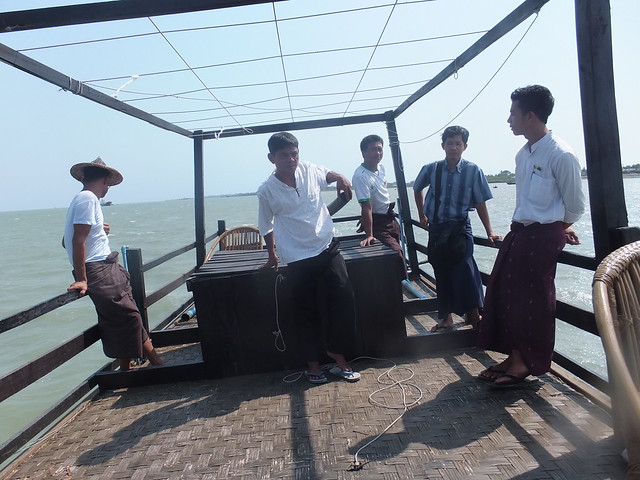 Some of the crew on the upper deck.
The boat was at least 40 feet long and 15 feet in the beam so it was quite spacious. Later, the hotel information informed me that these boats are “fully equipped” for 20-odd passengers and the hotel operates two or three of them. I tended to stay on the upper deck for its unrestricted views but after a while I was invited to take lunch. A small table was laid out on the main deck with a white tablecloth, flowers, heavy cutlery and a folded napkin.
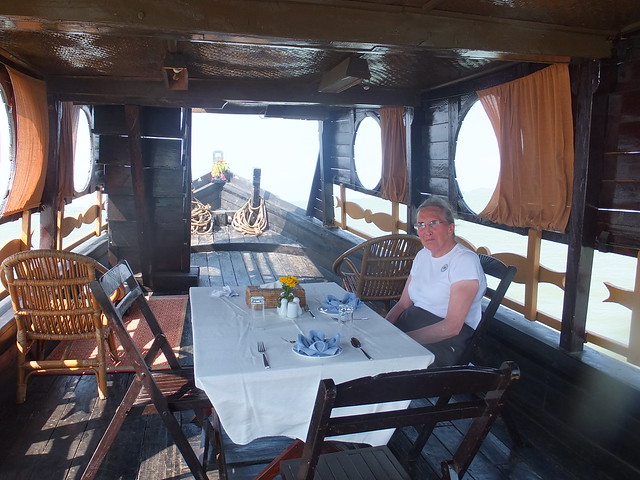 Relaxing on the main deck before lunch.
I declined both prawns and chicken and settled for steamed rice and cooked vegetables. It was delicious but I could only manage about half of the portion of rice which the Burmese consider essential for their own smaller frames.
Both river banks were farmed flatland with isolated or small groups of bamboo cottages, each with one or more traditional wooden longboats. These boats were variously propelled by a small engine driving a long propeller shaft ('longtail boat' style), by a rectangular sail or simply by paddles. Periodically, small herds of water buffalo grazed near the water's edge.
We continued upstream through a warm evening, the river meandering left and right and still quite wide. The darkness descended quite quickly, as it does in the tropics. We just kept going, occasionally with a lookout in the prow with a powerful torch swinging left and right. Then we came upon a vessel midstream and lamp signals were exchanged. As we passed, the crew of the other boat shouted and my guide explained their situation. The other boat had been taking two passengers upstream to our hotel when it lost power. From the design of the boat, it didn’t look like one of the standard hotel fleet. We circled around and gently came alongside the disabled vessel. Strong arms held the two boats together whilst luggage was transferred to our boat and then more strong arms helped the passengers scramble aboard.
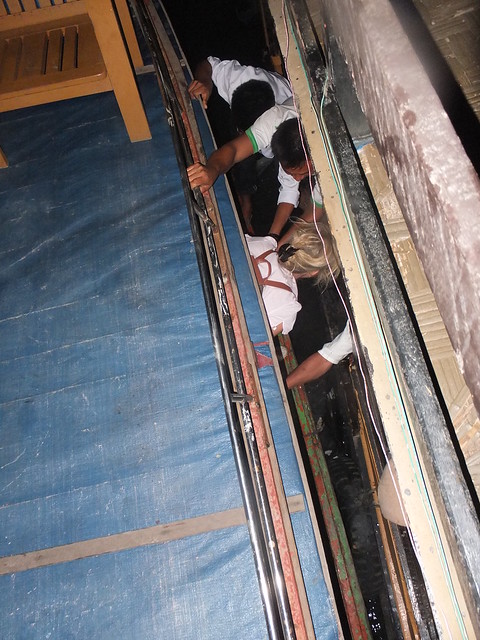 Carlotta is helped from the stranded boat (blue roof) to my boat (on the right).
The couple joined me on the top deck - a middle-aged couple from Milan, Marco and Carlotta, who were very relieved that their adventure had ended. The hotel staff on my boat provided tea and coffee and we continued through the dark, at last coming to the private jetty at the Mrauk U Princess Resort.
As is often the case in this type of resort, the accommodation was in the form of individual ‘ethnic’ cottages, here in Rakhine architectural style, but with very luxurious appointments. The ‘village’ effect was somewhat spoilt by the sound of ‘Gangham Style’ being played very loud. The hotel apologised that there was a wedding at one of the houses in the village next to the resort and the reception was clearly well in progress. The disco music continued, sometimes loud, sometimes quieter, for most of the night and during the next day but I found it amusing rather than irritating. On Saturday night, I was so tired I don’t think anything would have disturbed me.
Marco and Carlotta insisted that I had been their rescuer and, despite my protests, insisted on taking me to dinner in the hotel dining room which, fortunately, stayed open to midnight. A pleasant conclusion to an interesting, if exhausting, day.
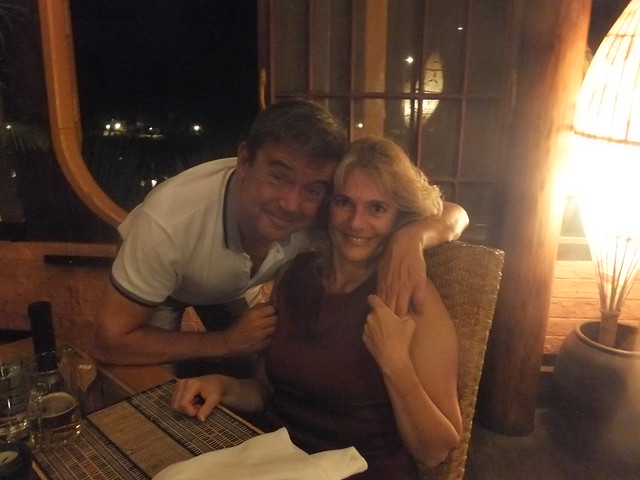 Dinner with Marco and Carlotta.
My Pictures
Yangon Airport.
Thandwe Airport.
Sittway Airport.
Sittwe, Myanmar.
By Boat to Mrauk U.
Mrauk U Princess Resort.
More
Next Post describing this trip.
[Revised 28-May-2014, 2-Jun-2014]
Click on any picture below to see an uncropped image.
Events of Friday 2nd May 2014
I had a simple breakfast served in my room on Friday morning. I then thought I’d spend some time writing up the previous few days activities for the Blog.
I’m afraid it takes some time to write even a “quick’n’dirty” account. It may read like a “stream of consciousness” but, believe me, if it were, it would put James Joyce to shame. Once again, I apologise for typographical errors. I actually proof-read the stuff before sending it but I’m invariably appalled to subsequently discover how many errors remain. I know people who tour with a notebook at the ready but I’m afraid I’m not one of them. I rely on taking more-than-enough pictures, which the camera conveniently stores in chronological order. Displaying the pictures one at a time gives me a clue as to what happened next and seeing the image often evokes a memory of what I thought at the time.
But I still think it’s desirable to write it up as soon after the event as possible.
Since leaving the Aye Yar Resort, I’d been unable to contact the internet directly from my Notebook so the procedure had been:-
Write the text using ‘Word’ on my Notebook, including the ‘html’ formatting tags I normally use.
Transfer the ‘Word’ file to a memory stick.
Go to the Hotel’s computer and try to open ‘Blogger’ for a new post.
Plug my memory stick into the Hotel’s computer and open my ‘Word’ file.
Copy the text to the Clipboard then copy it into the empty ‘Blogger’ new post.
Check the text in the new post is as required then publish.
If that sounds complicated, it sometimes is, especially if I’m tired and the hotel computer keyboard has re-arranged keys or non-standard labelling. You can e-mail a post to Blogger if all else fails.
By the time I’d published one post, I thought it was time I went out into the City. I’d never walked east along Strand Road, towards the Botataung Pagoda so that was my chosen direction, with the docks on my right between Strand Road and the river.
In the lobby of the Strand Hotel, there’s a framed copy of the ‘Rangoon Guide Map of 1930’. This map, at a scale of 3 inches to a mile, was published under the direction of Brigadier R. H. Thomas, D.S.O., Surveyor General of India. The way in which the series of jetties and quays had developed along the north bank of the river was very clear. Near Pazundaung, east of Yangon Central Railway station, a single line branch line still diverges to the docks. This line ran along the south side of Strand Road, throwing off numerous spurs to the various transit sheds and jetties. Eventually, this dock line originally re-joined the main railway west of Yangon Central. As far as I knew, the western and of the dock lines had been abandoned, but I didn’t know what remained in the direction of Botataung.
The development of the docks in Yangon were reminiscent of the history of both Liverpool and Birkenhead Docks and there are parallels in recent history, too.
The key was ‘Containerisation’ which transformed international shipping. The need for manual labour was dramatically reduced and theft of cargo, whilst not eliminated, became a much more sophisticated crime. Railways lost their advantage in carrying loads to and from the port as road lorries could transport containers directly to or from the consignee or to a shipping agent who could ‘stuff’ or ‘unstuff’ part container loads.
So, in Yangon docks as elsewhere, huge areas were concreted over to provide access to container lorries, storage for the lorries and storage for the huge numbers of shipping containers coming and going.
As I started to walk alongside the docks, I found that the original single line dock branch had been retained. In fact, it had been re-laid and ‘inset’ into the concrete to allow lorries to cross easily. I was briefly quite excited when I realised this relaid track was dual gauge providing not only Burma’s metre gauge but also ‘standard gauge’. I knew that some of the new lines being built in Burma were adopting ‘standard gauge’ (for instance, the one which will go into China). There was no sign that the standard gauge track had ever been used and I decided it probably resulted from a bit of ‘over-specifying’ in the contract for modifying the port approaches for container lorries.
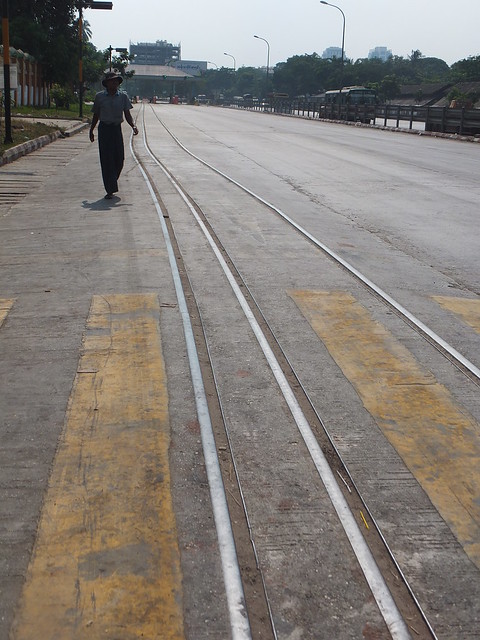 Modern dual-gauge track on the dock approach road.
As I passed the container handling area, I could see a couple of ‘straddle cranes’ and one large container crane at the quayside, with a large jib which can be lowered for loading and unloading. I think I saw at least one mobile crane with a container handling adapter but the docks are ‘enclosed’ behind substantial walls so it was hard to be sure.
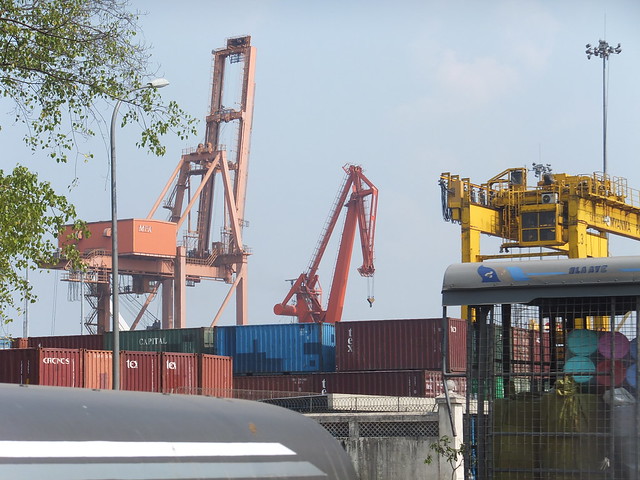 View of part of the Container Terminal from Strand Road.
I knew from the 1930 map that there used to be a general railway goods depot on the north side of Strand Road, but I assumed it was long gone. However, there it was, apparently in use and proudly labelled ‘BOTATAUNG GOODS SHED’ in English.
I passed the Botataung Pagoda but, instead of the isolated cone-shaped pagoda I’d expected from old photographs, it’s spawned a whole town of modern Buddhist-related buildings. I decided I’d give exploring a miss, this time.
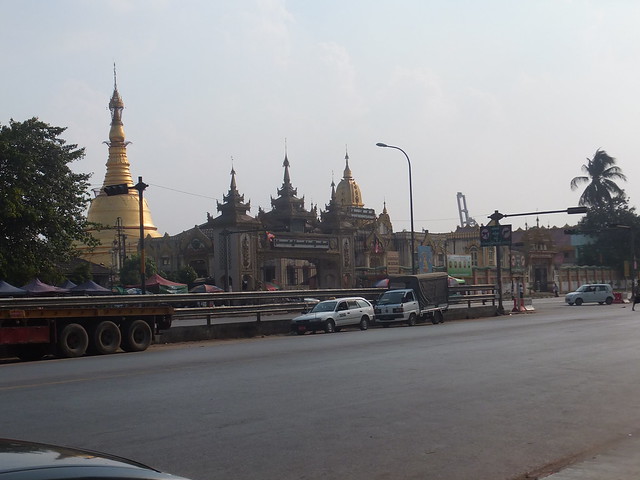 Botataung Pagoda viewed from Strand Road.
Fairly obviously, with large numbers of container lorries coming and going, there is need for tyre specialists and motor mechanics. But I found no garage premises – with the pragmatism often shown by the Burmese vehicles are simply parked at the kerb whilst receiving attention. I passed a number of large lorries and buses, some with a missing wheel, and gangs of mechanics carrying out quite major work (including welding) with the minimum of equipment.
At the east end of Botataung Goods shed, I found a siding which emerged, crossed the broad Strand Road and joined the single dock line on the south side of Strand Road. Like many railway lines in Burma, the poor condition of the permanent way would encourage you to think the connection was long-abandoned but the rail burns suggested that a diesel shunter probably still struggles this way on a regular basis.
Beyond the enclosed docks, a large, sandy area had been levelled and seemed to be in use as a lorry park. The sandy area extended to the river and a number of ships passed as I watched.
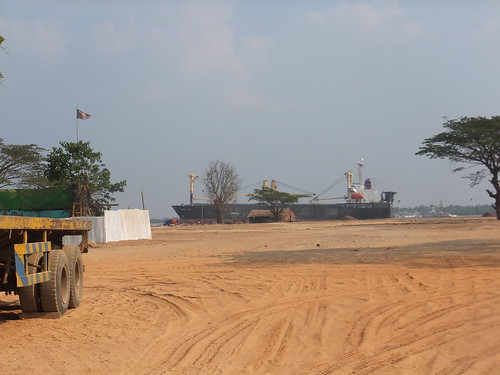 A cargo vessel on the Yangon River slips downstream.
I followed the dock branch until it turned inland and I was satisfied it would lead to the junction with the main line west of Pazundaung.
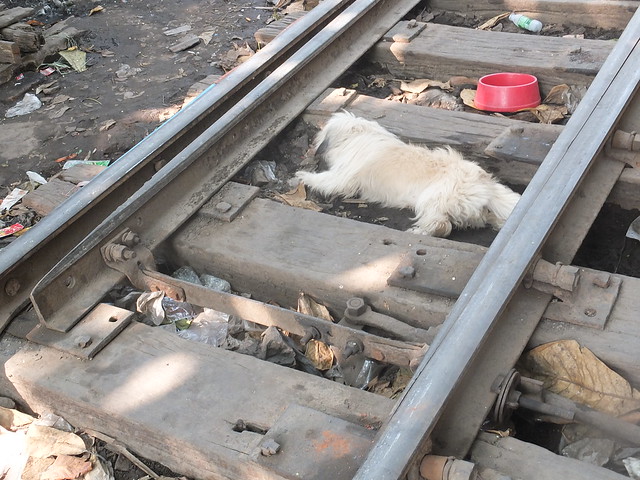 Dock Branch Sleepers (a) Wooden (b) Canine.
I was fairly exhausted by this time so I crossed to the north side of Strand Road and slowly headed west back to my hotel, past the Myanmar Red Cross Society premises and the British Embassy Chancery.
I spent the evening relaxing at the Strand. The following day, I was to fly to Rakhine State – an area I’ve not previously visited.
My Pictures
Strand Hotel, Yangon.
Rangoon Map (1930).
Around Yangon, 2014.
Yangon's Railways.
More
Next Post describing this trip.
[Revised 28-May-2014]
Click on any picture below for an uncropped image.
Events of Thursday 1st May 2014
So, once again it was back on the Air Bagan tubo-prop from Mandalay to Yangon. Shortly after take-off, I got a decent view of the North – South dual carriageway highway which now links Mandalay and Yangon. I’d used the road route last year, when I’d stopped off for one night at the new capital, Naypyidaw. Driving along that section of road is described here (that whole trip to Viet Nam, Australia and Burma is described in a series of posts here).
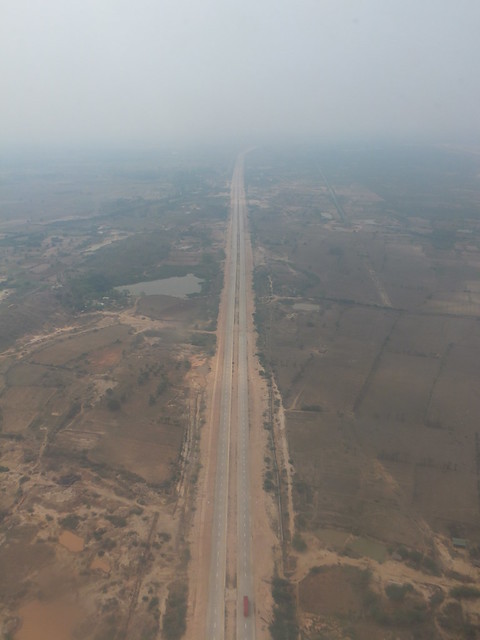
Leaving Mandalay - view of the North-South Highway.
I hadn’t realised until the ‘Fasten Seat Belt’ sign came on that my flight was making an intermediate stop at the attractively-named Heho. This is a gateway for air travellers to Shan State and, in particular, the amazing Inle Lake, which I’d visited on an earlier trip. Quite a few European tourists got off, a few passengers got on and within fifteem minutes we were airborne again, headed for Yangon’s Mingalardon Airport. On arrival, I was quickly re-united with my checked baggage and located my waiting driver who, having located me, disappeared to fetch the car. This time, I notice that the busy Pick-up and Drop-off area which is always a scrum had acquired a large steel portal framed shed – a transit shed for people. It at least makes the interchange cooler if not much more pleasant as you’re still likely to be assailed by freelance porters, taxi and hotel touts.
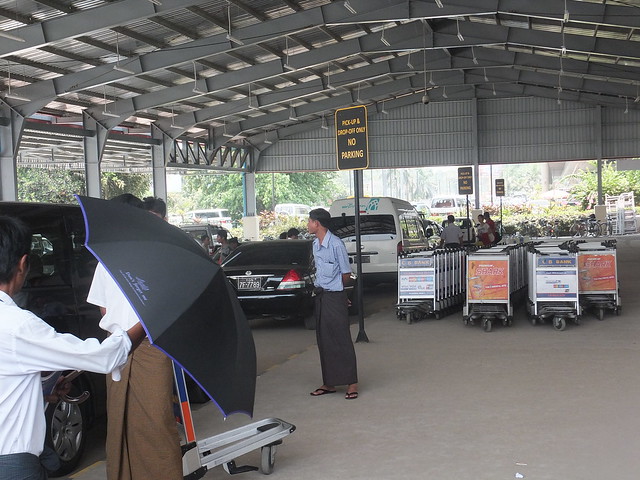 An unusually quiet moment at the Pick-Up & Drop-Off area at Yangon's Domestic Terminal.
It was only a short wait before my car appeared from the car park, my luggage was loaded and I was in the rear seat of a decent saloon imported from Japan. For once, I was happy to leave the air conditioning on.
I’ve always found the traffic in Yangon horrendous during the day but I’m sure it’s getting worse and it took us well over an hour to reach my home for the next two nights, the Strand Hotel.
For me the Strand is up there with the Oriental Hotel in Bangkok and the Raffles Hotel in Singapore. It’s regular guests included all the ‘usual suspects’ like Somerset Maugham and Noel Coward. I rather think the Strand is my favourite as it performs its tasks unobtrusively. I had room 210 on this occasion and immediately started to relax after my journey.
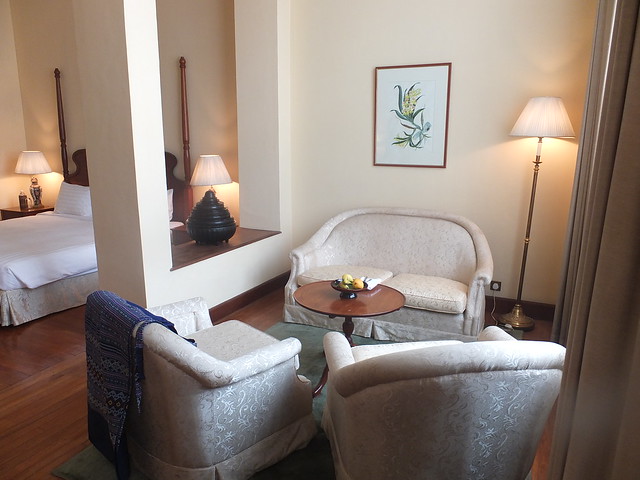 Room 210 at Yangon's Strand Hotel.
However, I always feel I should be outside, trying to look and learn about this fascinating country. I thought that a walk to Yangon Central railway station would enable me to combine “people watching” with making further study of the railways. There is always so much going on in the streets, all at once, that it simply defeats my attempts at description. Some people seem oblivious to their surroundings and sleep or get on with the minutiae of life apparently unaware of other people. But the majority of people seem industrious, engaged in the business of buying and selling to just get by. I noticed an elderly man sitting on the kerb, with a battered pair of bathroom scales in the gutter in front of him – bingo! You have a self-employed businessman.
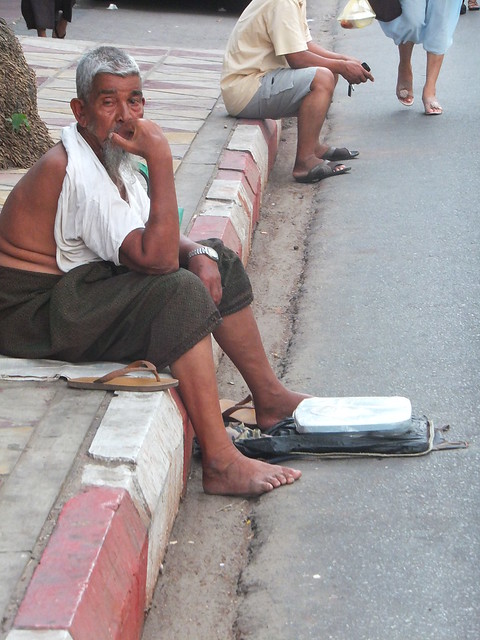
A novel 'I speak your weight' concept.
Of course, there’s always plenty to watch at Yangon’s Central Station. I’d read a report that the Station Master had placed a steam locomotive on a plinth at the station, since he thought it would be of interest to foreign visitors. I’d seen the exhibit from a distance but wanted to make a better record. It’s one of the handsome 4-6-4 ‘Baltic’ tanks, running number 'As 144'. My more technical thoughts, I’ll defer until another post.
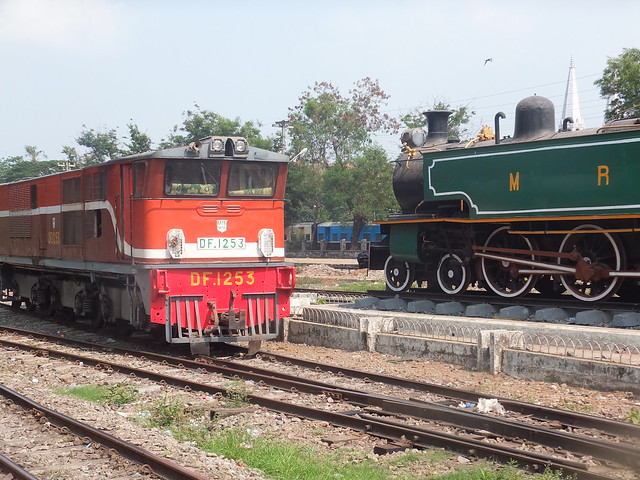 'Alsthom' Bo-Bo-Bo diesel-electric passing the plinthed steam locomotive.
Well-toasted by the afternoon sun, I started to walk (stagger?) back to my hotel, recording some of the architecture from the 1920s and earlier. When I reached the MahaBandoola Park, I noticed lots of people sitting in the shade of the various ornamental shrubs on the coarse grass so I selected a vacant bush and flopped down. The sight of an elderly European lady on the ground caused some amusement with passers by but my smile was invaribly returned.
Along one side of the park, protesters were encamped along the pavement, The pavement was covered by a flat fabric roof erected over a framework of bamboo supports apparently serving the kitchen and sleeping area. An adjacent strip of road had also been fenced off with string and traffic cones and most of the mainly middle-aged protesters were in this area, talking quietly. The encampment had the appearance of having been established for some time and the protesters appeared ready to continue for some time. Most of the banners were in Burmese (logical) but a couple were in English. One read:-
“Our land is our life” Compensation is NOT the solution!
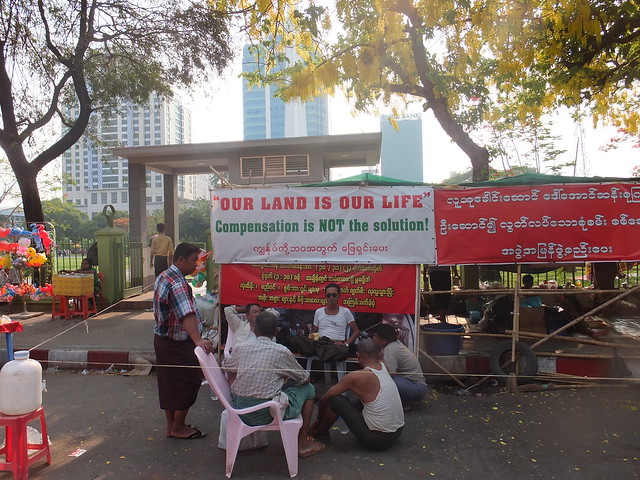 Protesters' encampment outside the MahaBandoola Garden.
I’m afraid the Myanmar Government still has a reputation for ‘land-grabs’, for instance, New Bagan came into being when the Government announced that Old Bagan was being requisitioned. Road, Rail and Industrial projects all appear to have ridden rough-shod over the wishes of local people.
Of course, we consider ourselves far more democratic in the U.K. (HS2, anyone?).
My Pictures
Mandalay International Airport.
Yangon Airport.
Strand Hotel, Yangon.
Around Yangon, 2014.
Yangon's Railways.
More
Next Post describing this trip.
[Revised 27-May-2014, 28-May-2014]
Click on any picture below for an uncropped image.
Events of Tuesday 29th April 2014
I was picked up promptly at the Aye Yar Hotel, sorry to leave the comfortable resort and the friendly staff. Although I wasn’t able to upload any photographs using their internet, after a bit of trouble initially logging onto their Wi-Fi, it gave me a reliable connection.
Although the itinerary had me booked on Air Bagan flight W9-143 departing Nyaung Oo at 08:25, a note attached to the itinerary which I didn’t properly understand until too late explained that I’d been “bumped” to the W9-201 leaving at 09:40, so I was at the airport rather early. Check-in was very rapid and painless and I was directed to a crowded departure lounge with my hand luggage. Air Bagan is only one of a number of local airlines using mainly turbo-props to ferry people between Yangon, Nyaung Oo, Mandalay and Heho. Depending upon the time of day, a flight may be direct or with intermediate stops although because Nyaung Oo and Mandalay are only about 35 minutes flying time apart, I think this is always ‘one hop’. There were lots of foreign tourists around and the waiting passengers kept changing as various aircraft arrived and departed.
Eventually, I boarded my flight and we quickly took off, leaving the friendly cabin crew just enough time to serve a cold drink to their passengers before we approached Mandalay Airport. Although Mandalay is an ‘International’ airport, most flights are still domestic, but I’m sure that’s changing. The runway is claimed to be the longest in South East Asia, certainly overkill for the turbo-props with their excellent STOL (Short Take Off and Landing) performance. I always seem to think of the use that an unfriendly foreign power might make of such a grand runway.
After we landed, a transfer bus took us to the rather grand, modern but largely deserted terminal. There is a baggage carousel at Mandalay and they were using it for my flight. The bags arrived promptly and I easily spotted my waiting driver in the arrivals hall. We went outside and made our way to the parked car for the drive to the Sedona Hotel.
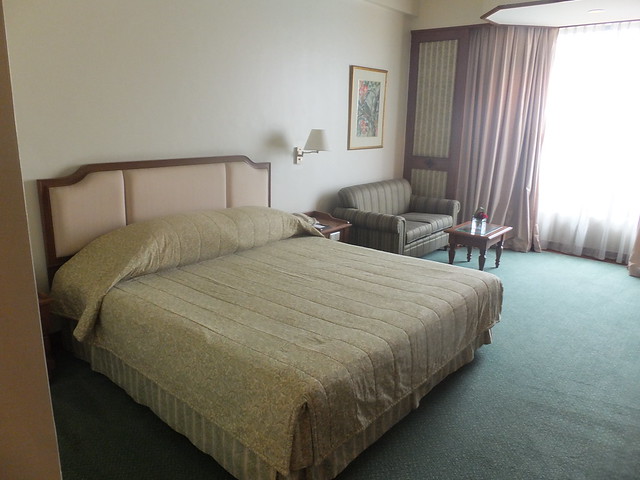 My room at the Sedona overlooked the Swimming Pool at the rear of the hotel.
With the help of the hotel, I contacted my friends Ko Hlaing (a Shipping Agent) and Htein Linn (an engine driver), two people I was hoping to meet up with. Ko Hlaing said he would meet me at the hotel Tuesday evening. Hteinn Linn said he would pick me up at 6.30 a.m. Wednesday.
Having made these arrangements, I had the afternoon free and decided to visit the railway station. Having walked there and back in the past, I foolishly decided to walk again. Walking gives you the chance to watch the life of the city in detail.
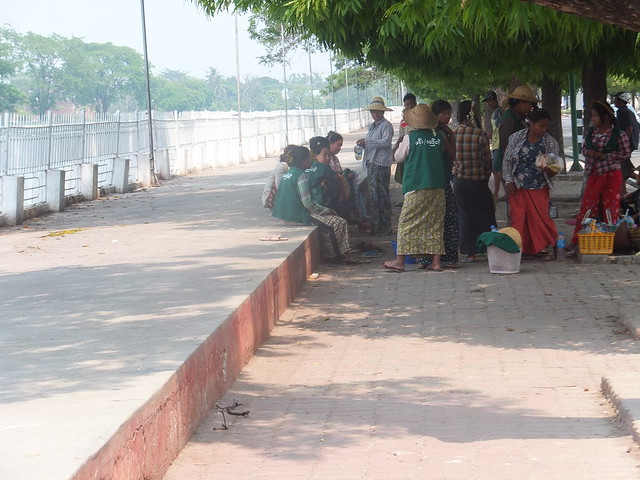 A group of female workers pause for lunch in the shade of a large tree. The moat around the Royal Palace site is on the left.
This time, I’d underestimated either the effect of the 42 degrees Celsius heat or my declining fitness because I almost collapsed at the railway station. I did my usual combination of ‘people watching’ and technical survey and concluded I needed a ride back to the hotel. A charming young man with a taxi motorcycle offered to take me. I was very tempted but, when wearing a longyi, men and women pillion passengers ride ‘side saddle’ and I was afraid I was still too ‘wobbly’ for that so he negotiated a rate with a pick-up truck taxi. As the only passenger, I got to ride in the cab but he would probably have been happy to take a dozen or more people.
Ko Hlaing arrived at teatime and we chatted happily for some time. He said he’d call again the following evening with his wife and daughter, whom I’d also met before.
Events of Wednesday 30th April 2014
Htein Linn arrived at 6.30 a..m., as arranged, with his wife and two daughters. He showed me a number of pagodas before we spent some hours at his family home in Myitinge, a few miles outside Mandalay. Then we went to his wife’s family home, also in Myitnge where there seemed to be a large extended family, calling for various photographs of family groupings. I was overwhelmed by their kindness and will describe the wonderful day in more detail when I can.
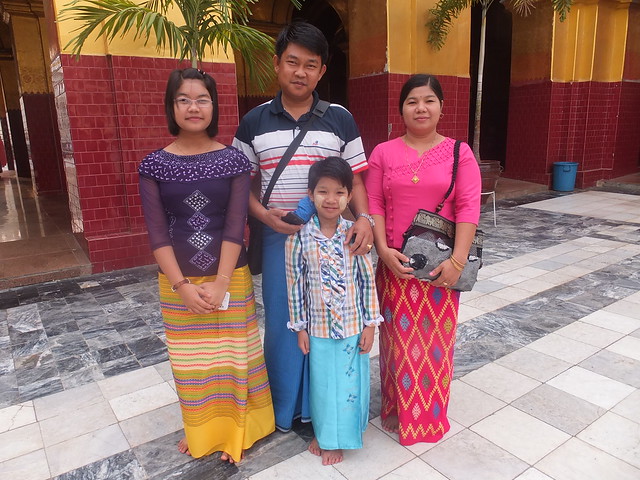 Htein Linn and Family at the Mahamuni Temple.
In the evening, Ko Hlaing came to the Sedona with his wife and five year old daughter who is about to start school. The first time I saw their daughter, she was still a babe in arms!
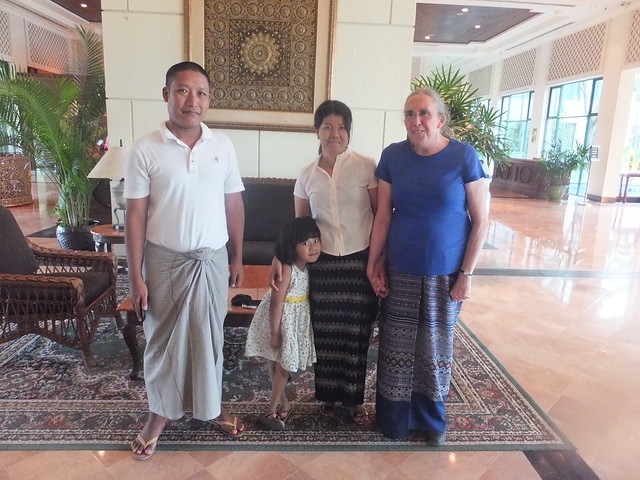 Ko Hlaing and Family visiting Jan at the Sedona Hotel.
Well, in brief, that was Mandalay. The next day I flew back to Yangon (with an intermediate stop at Heho, in Shan State), was met by a driver and taken to the Strand Hotel for a two night stop before the final section of my Myanmar tour to Sittwe and Mrauk U. More when I can.
My Pictures
Nyaung Oo Airport (pictures from an earlier trip).
Mandalay International Airport.
Sedona Hotel, Mandalay.
Around Mandalay, 2014.
A day with Htein Linn and Family.
Mandalay's railways.
More
Next Post describing this trip.
[Revised 27-May-2014]
Events of Monday 28th April 2014
Click on any picture below for an uncropped image.
The Monastery ‘Hi-Ace’ and driver picked me up at seven o’clock. We started on a series of sandy tracks, past dozens of pagodas including the famous Ananda Temple. At that time of day, the tourist operation hadn’t yet started but the army of sellers were beginning to get prepared. We turned onto the dual carriageway Anawrahta Road which, rather incongruously, slices across the Bagan Plain with its myriad pagodas from Old Bagan to the township of New Bagan, Nyaung Oo.
New Bagan, as its name implies, is a recent creation unashamedly partly devoted to tourism, with lots of restaurants and small guest houses. It has the administrative offices, a golf club and a District Hospital. There’s a major intersection controlled by traffic lights (and often a policeman, too) where we turned onto the dual carriageway leading towards the Mount Popa area. We passed the junction with the road to the airport and then the junction with the road to the railway station. But after our rather grand exit from the town, including passing through a pair of gaily-decorated reinforced concrete ceremonial arches, the road quickly deteriorated to the usual strip of tarmac barely wide enough for two vehicles to pass without using the unmetalled verges. Soon, we came to a section being worked on where the surface was loose sand. Women road workers armed with a simple wooden rake lined each side of the road – their function appeared to be to smooth the ruts as they appeared on this busy road.
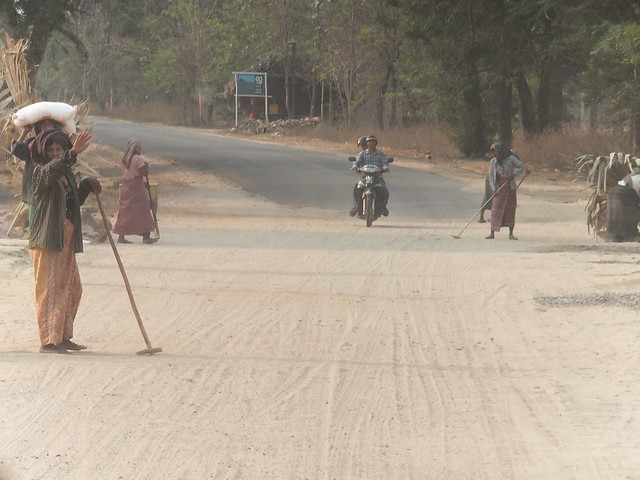 Women road workers with their rakes.
After a few hundred yards, we were back on the usual narrow tarmac strip until our left turn onto the road to Chauk Kan.
Chauk Kan
The road to the village was loose sand and deeply rutted in places without the benefit of anybody to rake out the ruts. It’s a mile or so to the main village from the turn-off but it seemed much further. The area is flat with a variety of trees dotted around. There are also very temporary-looking dwellings with woven walls, sometimes with a short brick chimney indicating a still for producing ‘Toddy’ - the local rum produced from the exudation of the ‘Toddy Palm’ tree. There's a brief description of the production of 'Toddy' in my earlier report here. Some of the land we were passing through was scrub but large areas were neatly tilled with regular narrow furrows produced by two ox hauling a wooden plough controlled by the farmer. I’ve never seen anything but animal power used for ploughing.
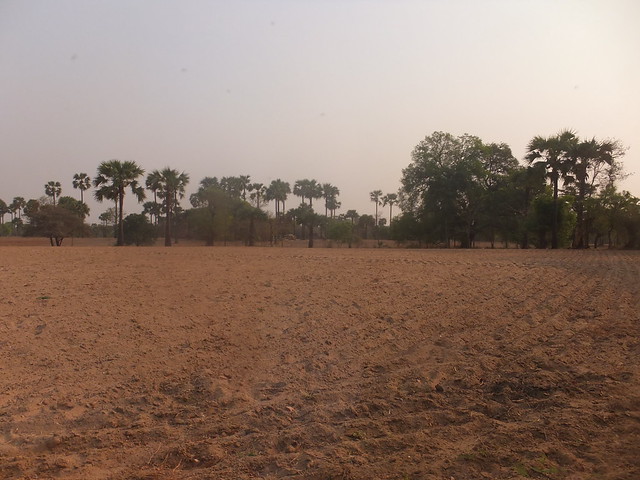 Neatly-tilled land flanks the road to Chauk Kan.
Equally, vehicles are normally carts hauled by two oxen – great wide things made wider by axles protruding from the cartwheel hubs. Wear in the hubs is often quite pronounced allowing wheels to wobble in an alarming manner as the oxen slowly drag their load. I noticed that some of the carts had been fitted with modern pneumatic tyres. There are few cars – the better-off have the ubiquitous motor bicycle, often with three or four people aboard but, other than the pick-up trucks which move goods, people (or, more often, both at once), walking is the standard method of getting around.
We arrived at Chauk Kan. I’d been before (October 2011 vist and February 2013 visit), helping with distributions to the enthusiastic children but, this time, the children were on holiday. The original building was Government-provided for basic education, but an additional building donated by Mr. and Mrs. Henseler via ‘Road to Mandalay’ opened in February 2010 (brief report here). I was greeted by the smiling headmaster. Builders were now doubling the size of the 2010 building. In one classroom, a wooden table had been set up with a plastic tablecloth, water, biscuits, grapes and a large bunch of bananas. The Burmese are a generous and hospitable people.
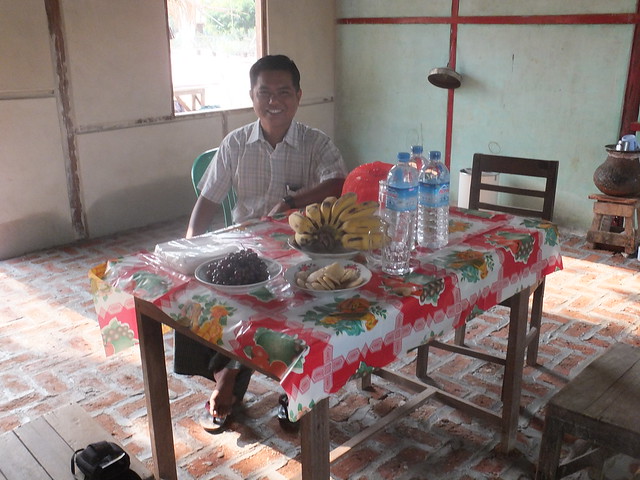 The Chauk Kan Headmaster.
The structure of the new extension was complete. Three builders were completing the brick floors. Bricks had been laid and levelled in a ‘parquet floor’ pattern. They were engaged in cementing the gaps between the bricks.
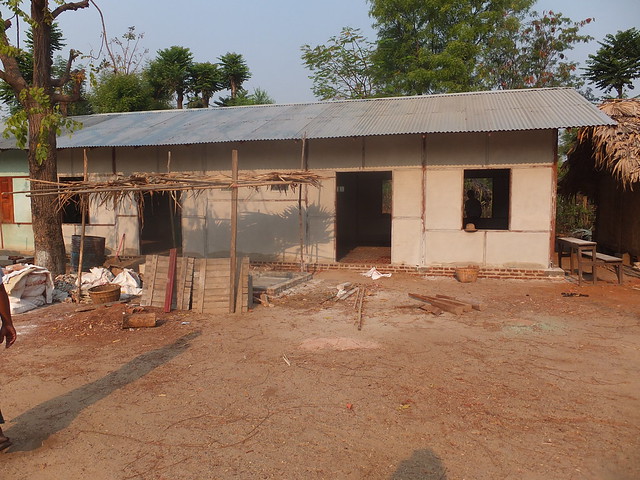 The New Extension at Chauk Kan.
I noticed that a large, new water tank had been installed adjacent to the original school building. Guttering had been added to one end of the school building and the adjacent building with blue plastic rainwater pipes delivering the water to the tank, which could alternately be filled via a hatch. A marble plaque on the tank confirmed that this was a donation from Margaret and Eric Knowlden in Sydney.
Htee Pu
Next, we were off to Htee Pu. I was a little surprised when the Chauk Kan headmaster jumped in the front of the vehicle – he was clearly coming with us. So it was back to the main road, carry on towards Mount Popa and then turn off on another rutted track to reach Htee Pu. I was invited into the monastery building where the Head Monk had arranged for water and food to be laid out on a low table. In addition, two girls were summoned to waft cooling air over their perspiring guest with hand fans. The Headmaster was away on a Training Course.
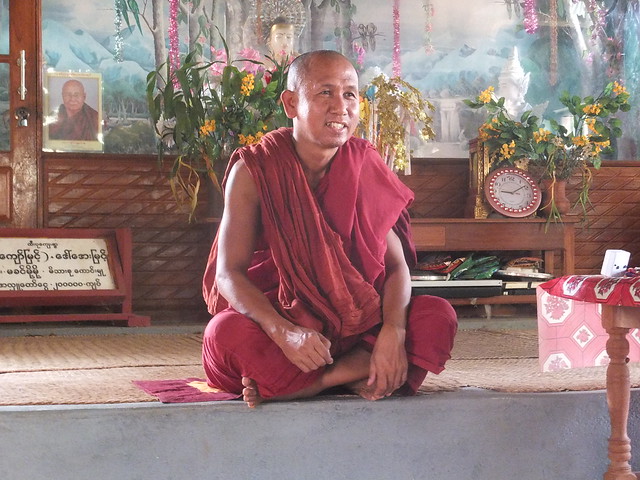 The Head Monk at Htee Pu.
Then we walked around what is becoming quite an extensive set of buildings. My first visit was in 2009). I've been back in 2010 (when a new building was officially opened), again in 2011 and again in
2012.
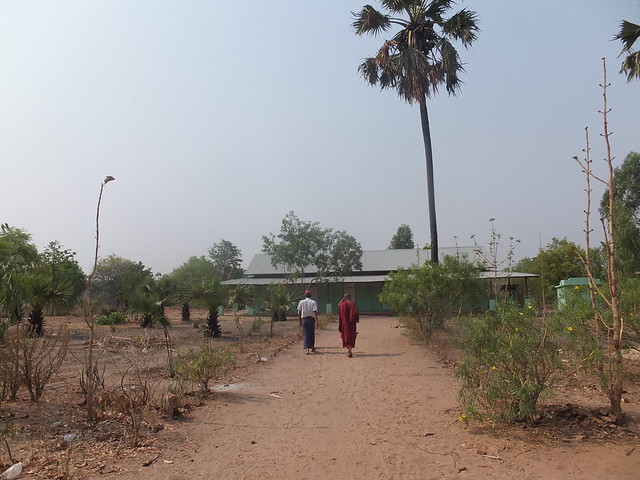 The 2010 School Building.
A large water tank had also been installed at Htee Pu, donated by the Clulees and friends from Samoa. There was a small set of excavations in progress for what looked like another toilet building with septic tank. I also noticed that the large Assembly Hall had received some external embellishment since I was last here.
The Chauk Kan headmaster was still with us when we left Htee Pu. There were a crowd of people around a parked pick-up truck which looked as if it had just arrived. Whether this was a scheduled ‘local bus’ or a special arrangement, I’m afraid I didn’t discover.
Nga Paing
When we reached the main road, we travelled along it to the junction with the sandy track to Nga Paing.
This was my first visit to Nga Paing and I was warmly welcomed by what I took to be the headmaster, although he was covered in spots of white paint and had clearly been involved in emulsioning. We passed existing school buildings – one had a roof of banana leaves whilst the other had a more durable ‘tin roof’. Both were partly open-sided and the remaining walls woven. It was clear that my host was, quite rightly, very proud of the new building – proper foundations supporting a substantial wooden frame with brick infill, cemented over to protect the face of the bricks and painted magnolia. A group of cheerful workers (or perhaps teachers) were completing the painting. Broad steps led up to a verandah at the front from which doors led to the school office and three separate classrooms. Concrete screed floors were provided throughout the building. Either side of the steps, balustrades with pre-cast concrete balusters were provided.
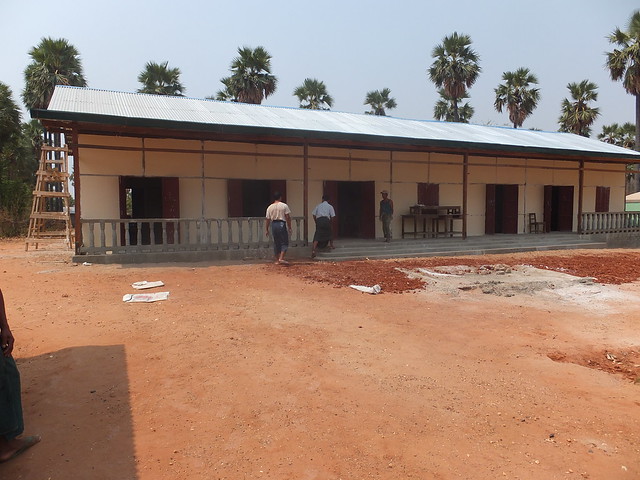 The New School Building at Nga Paing nears completion.
I was invited into the office, equipped with brand-new varnished wooden seating, a matching large storage cabinet and a low table loaded with water, food and green tea. The overall effect was most impressive. As requested, I added my name to an impromptu Visitors’ Book.
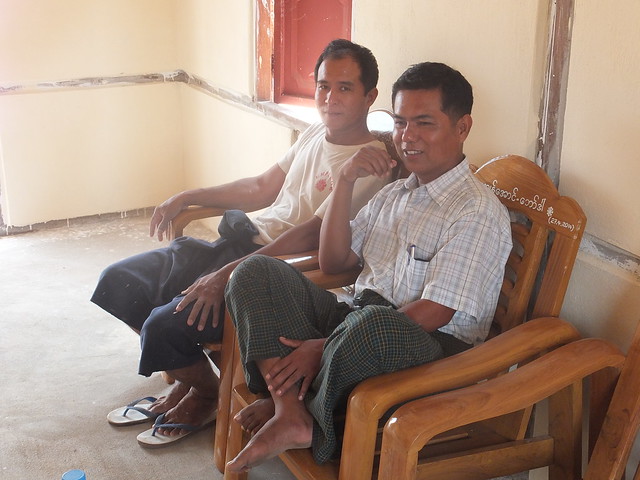 The Headmaster of Nga Paing and the Headmaster of Chauk Kan in the Office at Nga Paing.
The school had already constructed a water tank, similar to those seen at the other two schools. This water tank was donated by Laura Daley from Australia.
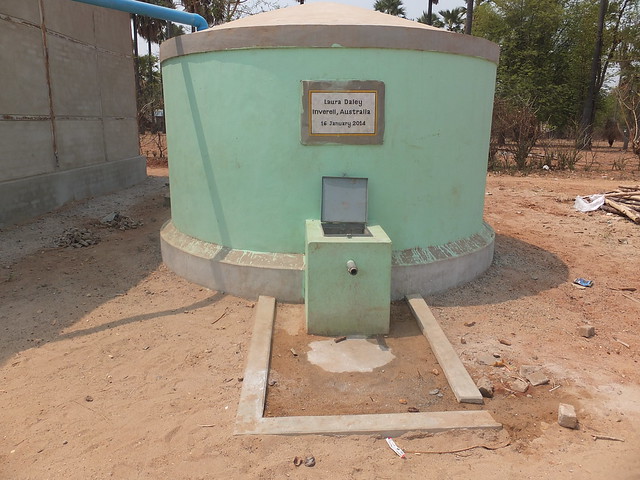 The Water Tank at Nga Paing School.
I’m always humbled to see the enthusiasm and commitment demonstrated by the Burmese, given some encouragement with really quite modest sums of money. Dr. Hla Tun’s watchword in determining which projects receive donated funds is always “effectiveness” – what in another area is called “getting the biggest bang for your buck”.
We set off back towards Bagan and dropped the Chauk Kan headmaster at the junction with the track to his village, then we retraced our route back to the Aye Yar River Resort.
The temperature had been around 42 degrees Celsius during the trip so, once back at my room, I was happy to stay there and relax. The ‘Pandaw’ was still at her moorings when I got back but, sometime during the afternoon, she quietly slipped away.
The following morning, I was to be transferred by road to Nyaung Oo Airport for the short flight to Mandalay and the next part of my adventure.
My Pictures
Aye Yar River Resort, Bagan.
Around Bagan, 2014.
Chauk Kan School.
Htee Pu, 2014.
Nga Paing, 2014.
More
Next Post describing this trip.
All my posts on Education Support in Burma.
[Revised 23-May-2014]

