Events of 5-Feb-2013
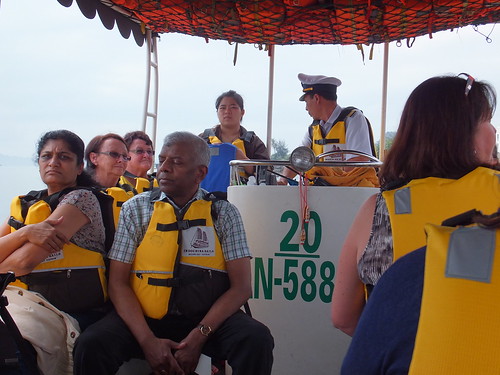
I arrived at Halong Bay after a three and a half hour road trip from Hanoi. Interesting trip but tiring. Halong Bay had dual carriageways and modern multi-storey hotels - not what I'd imagined. My driver pulled into a paved yard on our right in between the road and the sea. There were a number of porters milling around and tourists waiting. We’d clearly arrived at our embarcation point. A smartly-dressed young man checked my name on his list, had a porter remove my large case and invited me to wait in a modern café building. Within a few minutes, the young man was asking me to join a number of other passengers on a ship’s tender moored at the dock, where we donned bulky lifejackets for the short crossing to our boat.
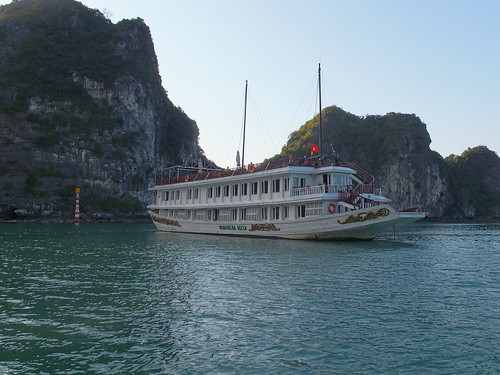
Our boat, the ‘INDOCHINA SAILS’ was moored in the bay, together with a bewildering array of other boats clearly intent on a similar tourist mission. I was told later that there are 200 hotel boats and 300 day boats serving the tourists!
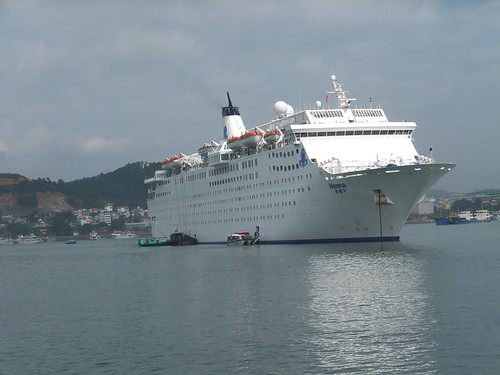
Once all the passengers were aboard, the anchor was ‘weighed’ and we set off across the bay, passing a fairly large cruise ship, the ‘Henna’ and various cargo ships at anchor. It hadn't occurred to me that the port we'd just left would be a destination for cruise ships nor that there would be significant cargo tonnage. The 'Wikipedia' article here suggests that I saw 'Henna' on one of her first cruises from China after a change of ownership.
Our boat took the marked channel which threaded through a proliferation of rocky islets characteristic of Hulong Bay. The smartly-dressed young man, I discovered, was Son, the cruise director, and after his safety briefing we were issued with keys to our cabins. I had cabin 101, nearest the bow on the starboard side (that’s front right). This cabin had one double bed rather than two singles (as some cabins had) so suited me very well. At one o’clock it was up one deck to the restaurant were we were served with numerous courses of Vietnamese food which (despite my conservative tastes in food) I enjoyed very much.
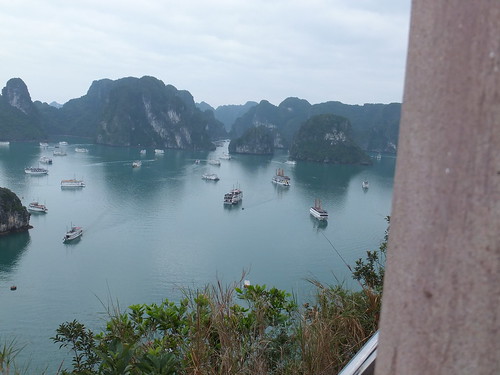
By half past two, we had arrived at a small, conical-shaped island called Titop. We were taken ashore by tender and invited to climb the 400-odd steps to the small pavilion on the summit. It was quite a pull but I made it. The views were good but I counted 25 tourist boats, similar to ours, anchored in the bay.
Returning to sea level, there was a small sandy beach and demarcated swimming area. I’d followed their advice and optimistically worn a swinsuit under a skirt and top but the water was too cold to do other than have a ‘deep paddle’. Nobody else was any more adventurous than that. After around an hour, the tender returned us to our boat.
The boat set off again for the Bat Cave (cue music … 'Duma duma duma duma duma duma BATMAN!'). There were two options for visiting the Bat Cave – by kayak or by rowing boat powered by a Vietnamese. The kayak was very tempting but since it’s 50 years since I paddled a kayak, I thought I’d better be sensible and go by rowing boat.
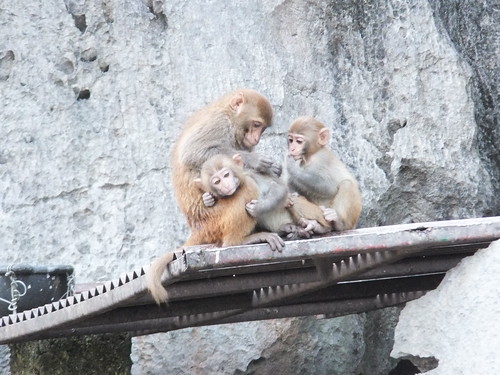
The Vietnamese rowing boat is powered by two slim oars each terminated in a ‘T’ handle and loosely tied to a short vertical wooden post attached to the gunwhale. The rower stands facing the bow and works the ‘T’ handles in a sort of circular movement so as to dip both oars in the water for the power stroke. The kayakers preceded us through the Bat Cave which is a tunnel leading to a pleasant lagoon surrounded by tall mountains. I was rather disappointed to learn that bats were not in occupation at the time of my visit. We did, however, see a troop of monkeys resting or scampering on the rock walls.
We returned to the boat by the same route and, once aboard, the ship cruised to our overnight mooring at Luon Bo where we anchored amongst a number of similar ships. We enjoyed a relaxed buffet dinner in the dining room after which various other entertainments had been arranged but, thoroughly exhausted, I retired early. Before I returned to my cabin, Son had explained to me that all the passengers on the boat, except one couple and myself, were on a one-night cruise and would return to the mainland the next day, whereas the couple and I would spend the next day on a Day Boat before meeting up with ‘INDOCHINA SAILS’ in the afternoon, by which time the boat would have disembarked the one-night passengers at the port and returned with a new complement of passengers!
Photographs
Halong Bay - Day 1.
[Expanded 7-Feb-2013, 27-Feb-2013]
Tuesday, 5 February 2013
Halong Bay - Day 1

Monday, 4 February 2013
Hanoi
The Hanoi guide, Joe, and driver picked me up at 8.30 a.m. from my hotel, the Metropole (Pictures). We first drove to the 'Hanoi Hilton' prison, now a museum. It was built by the French and was more widely used than I realised for suppressing dissent.

The entrance to the 'Hanoi Hilton'.
Its black humour title of 'Hanoi Hilton', of course, arises from the imprisonment of American airmen captured during the Vietnam War. Even allowing for some possible bias in presentation, I found it a moving visit (Pictures).
Next, we drove to the Ho Chi Minh Quarter. Ho Chi Minh (a nom du guerre, I believe) was born in the country and retained simple tastes but his success in establishing Vietnam as a viable state means that he is still widely revered and referred to as "Uncle Ho". A mausoleum has been erected and queues form on the days of the week when his body is displayed. My visit coincided with a 'closed' day.
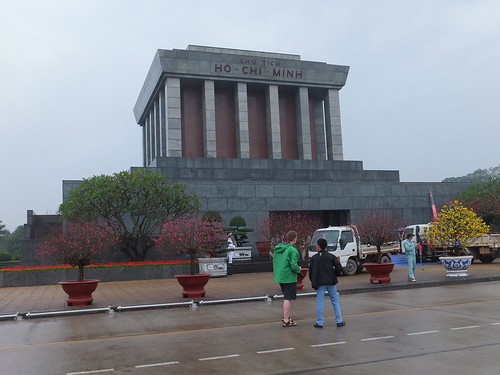 The Mausoleum.
Once in power, Ho Chi Minh could have lived in the former French Governor's Palace but he refused and at first established himself in three rooms of the nearby servants' buildings before moving to a specially-built wooden 'house on stilts' in the form seen in the countryside.
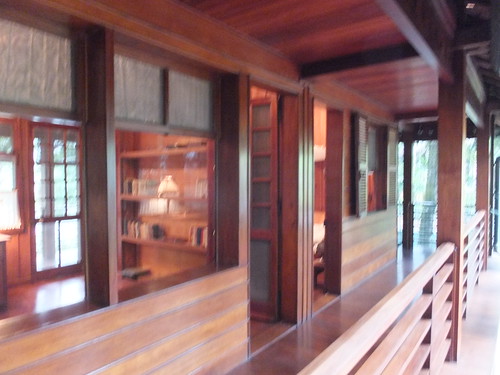 The upper floor of the 'house on stilts'. The lower floor served as a meeting room.
This house was near a small lake, allowing Ho Chi Minh to pursue his love of fishing. He regarded Marx and Lenin as his 'Brothers'. He was given three cars, which are displayed in their 'garage'. He died not in his house but a few feet away in a small hospital with attached air raid shelter. Pictures.
The 'One Pillar Pagoda' was a bit of a let-down. It's famous for being built over water and suspended by a single pillar but the original was erected elsewhere, was larger and now lost. What we can see now is a reduced size replica supported not by one massive wooden pillar but by a concrete pylon! It has to be admitted, it looks very quaint and draws the crowds. Three people were worshipping inside, leaving no room for tourists, who had to content themselves with standing at the top of the access stairs and looking inside. Pictures.
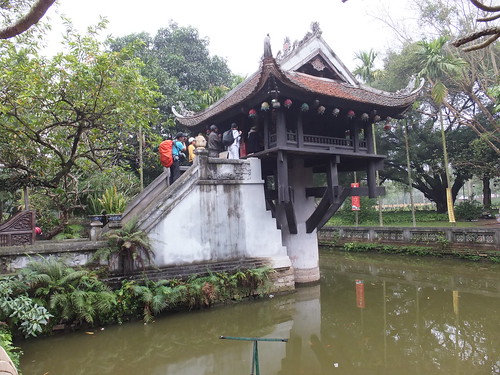 The reconstructed 'One Pillar Pagoda'.
We made our way through the crowded, noisy streets to the peace of the Temple of Literature. This venerable site is now dedicated to Confucian worship but was the first university in Vietnam. Names of the 'Old Boys' are not signwritten in gilded letters on wooden boards but carved on stone tablets ('stele') carried on the backs of turtles. (Pictures).
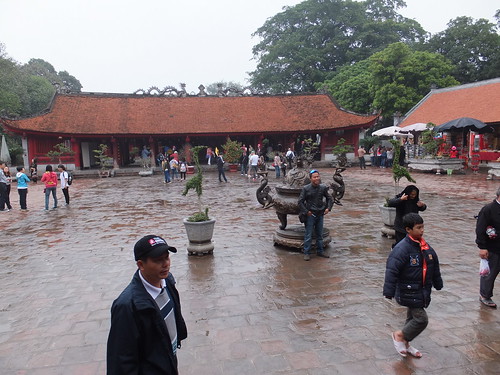 The Temple of Literature.
Joe and I then took a walking tour of the Old Quarter. Hundreds of street vendors serve hot food in passageways almost too narrow to allow the customers come and go.

Narrow passageways are home to countless eating places.
Some of the streets in the Old Quarter had been temporarily taken over by 'Pop-Up' markets where vendors sold items associated with the Chinese New Year - decorations, fruit trees. Space is always at a premium in cities but I found many candidates for 'narrowest house in Hanoi' award. The winner had three (rather ramshackle) stories but a frontage only about six feet wide.
After the walking tour, I was returned to the hotel. Armed with not-very-good free map, I set off on foot to see Hanoi railway station, a walk of around 2 kilometres (as a former French-ruled country, Vietnam is fully metricated). To my surprise, I found the station without error, mainly because at road intersections the names of the two streets are normally provided on a post. Modern Vietnamese uses the Roman alphabet in conjunction with a mass of accents so it's fairly readable by an English-speaking Foreigner. The system was introduced by a French monk, I believe. There's a set of pictures taken around the city here.
A final attraction in Hanoi was a visit to the Thanglong Water Puppet Theatre. I'd no idea what that was. My car delivered me to a conventional-looking theatre building and Joe conducted me to my seat in a normal auditorium, along with lots of other people, many of them foreign tourists like me. When the show started, instead of a stage, there was a large pool of water. Puppets appeared on the water (sometimes lots of them) doing all sorts of things and the plot was explained in English on a couple of screens on either side of 'stage'. It sounds odd, but it was strangely compelling. At the end of the show, the puppeteers, standing up to their waists in water, appeared from behind the curtains around the pool to loud applause. There are a few (not very good) pictures here.
The next day, I was to go to Halong Bay by car, to return to Hanoi on the 7th February and fly back to Bangkok.
Photographs
Hotel Metropole, Hanoi.
The 'Hanoi Hilton' Museum.
Ho Chi Minh Quarter, Hanoi.
One Pillar Pagoda, Hanoi.
Temple of Literature.
Around Hanoi.
Thanglong Water Puppet Theatre
These, and other pictures of Vietnam, form a Collection here.
[Revised 27-Feb-2013]
Railways in Vietnam - Part 1
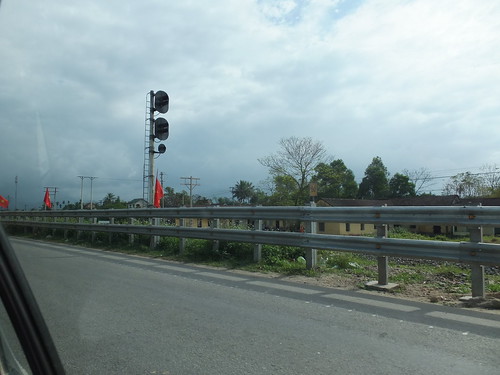
The French built Vietnam's metre gauge railway which links Ho Chi Minh City (which still seems to be called 'Saigon' by the railway) in the south to Hanoi in the north with some branches in the Hanoi area.
I travelled by road from Hoi An to Hue and the single-track main line accompanied us for part of the way, so I naturally started to look at the features of the line. There are some serious mountains on the route and the railway is tunnelled for part of the route. Whilst we were stopped for lunch, I watched a long southbound passenger train emerge from a tunnel and slowly make its way towards Da Nang. The train was too far away to get any details.As we got nearer to Hue, we travelled on a flat, coastal plain pierced by rice paddies. In this area, the railway was raised on a low embankment and looked in very good condition with solidly-built sloping walls to the embankment supporting ballast in good condition and fairly high-poundage flatbottom rail.
A reasonably well maintained open-wire telephone route, using mainly wooden telegraph poles, kept close to the track. Bridges over the numerous waterways were either of simple deck girder construction or, for the widers channels, one or more through girder trusses. It all looked in good condition and a spotted a number of staff apparently patrolling the track. Road-rail intersections were almost all level crossings, often with flashing lights and with motorised or hand-operated barriers. All had a neat crossing-keeper's hut and were staffed.
I did some 'drive by' shots of the arrangements at passing loops but its clearly difficult to gather details without stopping. All the signals I spotted were colour light, either a simple 2-aspect or fitted with two 2-aspect heads and a single-light subsidiary aspect. Some distance before each loop I found a 2-aspect signal which I presume is a yellow/green warning signal. At the loop points, I always spotted the 'four aspect plus subsidiary' type. Sometimes, there were 2-aspect signals leaving loops which I think must be red/green starting signals. I think this sort of configuration is typical of Russian and Chinese practice. I was surprised that all points appeared to be hand operated from single-lever frames fitted by the 'toe' of the points. Each frame had what I assumed was an electrical contact box to control signals but a lever lock is also possible.
In one town, I glimpsed the coaches of a southbound passenger train and shortly after we passed a slow-moving northbound passenger train, presumably re-starting after letting the southbound pass. The merest glimpse of a big diesel on the front suggested Chinese manufacture and my guide confirmed that both Russia and China have supplied railway equipment.
Once checked in to my hotel at Hue, I walked to the station to see what could be seen. My guide thought I should be able to purchase a platform ticket but I was on my own and my request totally baffled three girls in the ticket office and the station master or supervisor. In any case, they appear to keep everybody in the waiting room until they're ready to board. The main building is a nice French design but doesn't appear to be used for its original purpose. Instead, ticket sales and a waiting area are in a much simpler building alongside. By walking along public roads, I was able to find level crossings at the station throat at both ends of the station where the single line fans-out into a series of loops.
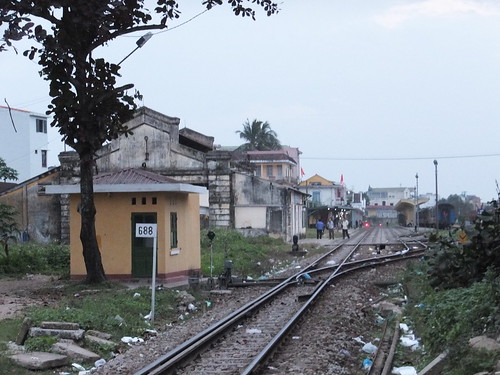
At Hanoi, I found a similar, if larger, arrangement. The large station building is utilised, although, again, the platforms are closed until required. The rather nice French architecture was somewhat spoiled by the Americans bombing the centre section. The Vietnamese cleared away the rubble and built an awful, modern centre section to rejoin the two remaining 'wings' and carried on regardless.
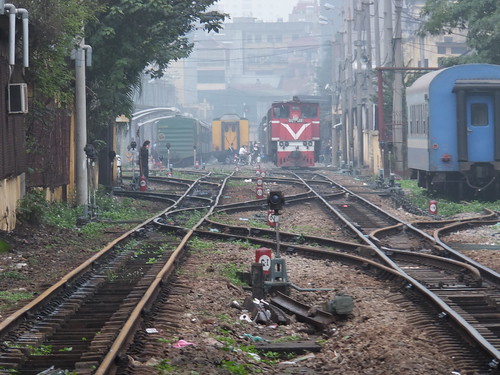
More when I can.
References
Vietnam Railways (Wikipedia).
David Gurnett's 'Railways in Vietnam'.
My pictures
Railways in Vietnam.
Hanoi Railway Station.
Sunday, 3 February 2013
Exploring Hue and then to Hanoi by Air
Events of Sunday, 3rd February 2013
After I returned to the Hotel Saigon Morin on Saturday evening, I pottered about uploading photographs and writing a very brief account of the day before having a relaxing bath and going to bed. I slept well and awoke to a dull, warm morning.

The hotel is very proud, and rightly so, of their buffet breakfasts, served in the open air in the courtyard surrounded by the white-painted hotel buildings. Most of the tables are provided with large umbrellas but they were not required against sun or rain as I took my meal.
After breakfast, I completed my packing and checked out for 9.0 a.m. Than and our driver picked me up and we drove to The Citadel. This was the Royal Palace until the last King abdicated. Then, during the Tet Offensive, the buildings were destroyed or damaged. Building work is going on to reconstruct the missing buildings.

Next, we drove out of the city to the famous Thien Mu pagoda situated on the river bank. There is a monastery here with, I think, around forty monks whom we saw eating lunch as we walked round the grounds.

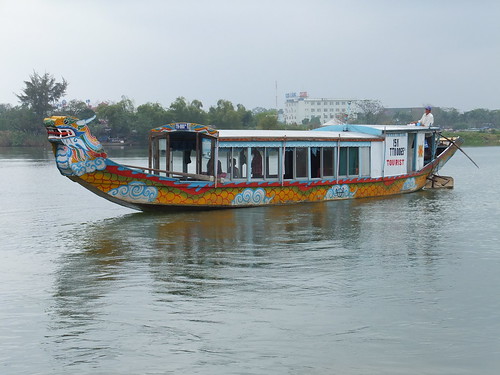
We then boarded one of the 'Dragon Boats' which take tourists on the Perfume River for a very enjoyable private cruise back to the city.
We left the boat and a short walk past large tourist hotels took us to the premises of a very modest cafe where we had an inexpensive tasty lunch. The cafe completely filled up whilst we were there. The owner of the cafe was clearly a friend of my guide Than.
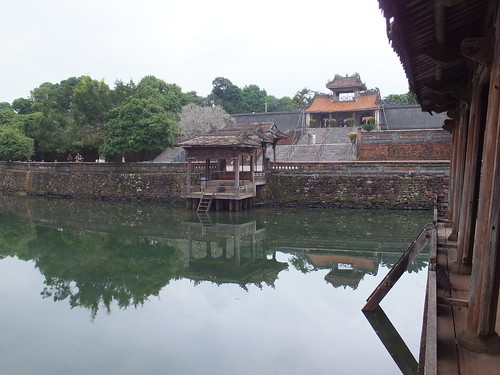
In the afternoon, we drove into the countryside again to look at the tombs of two kings - Khai Dinh and Tu Duc.

Before the driver took me to Hue Airport for the evening flight to Hanoi, Than invited me to his home, where (like all Vietnamese) they were getting ready to celebrate the approaching New Year. There's a brief report on this visit here.
The flight to Hanoi was on time and uneventful. A car was waiting to take me to the Metropole Hotel (a Sofitel Legend hotel) near the centre of the city and, after uploading my pictures, I managed to get to bed a little after midnight.
I've put links below to my pictures.
My Pictures
Hotel Saigon Morin in Hue.
Around Hue.
The Citadel, Hue.
Thien Mu Pagoda, Hue.
Dragon Boat on the Perfume River.
Khai Dinh Tomb, Hue.
Tu Duc Tomb, Hue.
Hotel Metropole, Hanoi.
[Revised 4-Feb-2013, 25-Feb-2013, 20-Mar-2013]
Saturday, 2 February 2013
Exploring Hoi An and to Hue by Road
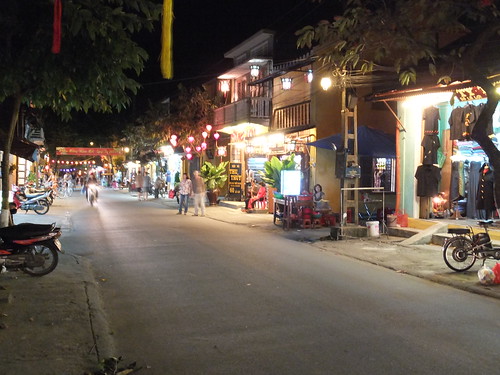
The restorative properties of a hot bath and a simple meal in the hotel are amazing. Having initially given up the idea of going out yesterday evening, I changed my mind and walked around the town before going to bed. There's always a conflict between getting the experiences and writing about them before the details fade. I've uploaded Saturday's pictures but here's just a short version of "What Jan did".
Events of Saturday, 2nd February 2013

My guide Than and I started at 8.00 a.m. with a walking tour of Hoi An. It's a charming place and World Heritage 'inscribed' (the posh folks at UNESCO don't just 'list' these places). I hadn't realised quite how dedicated to tourism the east coast of Vietnam had become - it's not to far from both Japan and Australia - but I still enjoyed my brief visit. Our walking tour was finished by 10.0 o'clock in the morning and then we set off by car along the coast road re-tracing our route back to Da Nang.
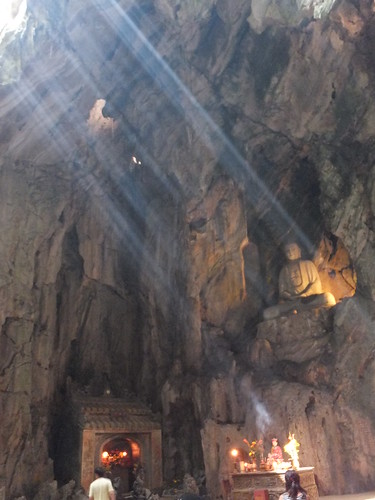
The caves at Marble Mountain.
On the way, we stopped at Marble Mountain, a massive outcrop of rock rearing up from the plain. An elevator lifted us up the mountain to a series of paths connecting various religious monuments and a large cave system (which rather reminded me of Batu Caves in Malaysia - my pictures of Batu Caves are here). As the name suggests, marble is extracted from the mountain and, at the base of the mountain, there are a number of marble carving workshops and showrooms.
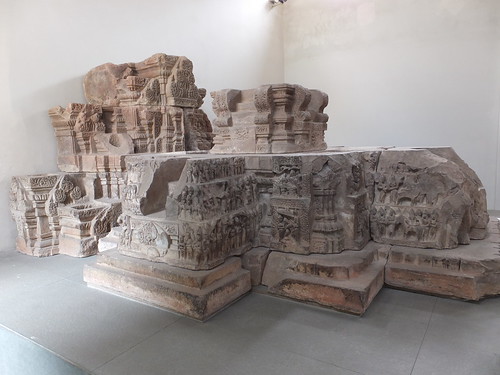
I saw a little more of the modern city of Da Nang where two large road bridges are under construction both, I believe, by American architects. I found the cable-stayed bridge impressive but the other, supported by a series of bright yellow arches each made from a cluster of five tubes and dubbed 'the Dragon River Bridge', I thought ugly. We visited the interesting museum of Cham temple stone carving.
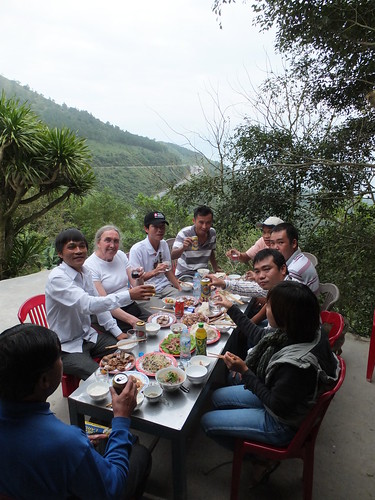
Then, we took the road over the mountains towards Hue. There is now a road tunnel which by-passes the mountain road but the views from the mountain road are stunning. Lorries carrying livestock or tankers of petrol still must use the mountain road. We stopped at a coffee shop commanding impressive views of the sea both looking south and looking north. Of course, Than knew the family who run the place. They were having a sort of informal lunch party to celebrate the New Year and insisted I join in the alfresco meal. They were so kind, I was sorry when we set off again.
Jan joins the family who run the mountain coffee shop in a celebratory lunch.
We were close to the single-line railway for a lot of the time, so I was trying to study that. I got a few 'drive by' shots on the way but couldn't do more until the evening.
I stayed at the Hotel Saigon Morin in Hue. It was opened in 1901 so, as you can guess, it's my kind of place.
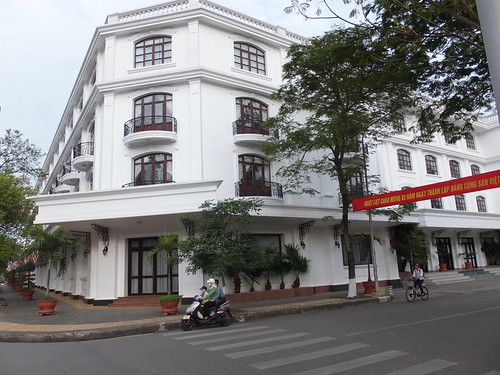
I had a simple meal in the hotel and then went out on foot, eventually ending up at the railway station. I'd been advised that I should be able to purchase a platform ticket to look around the station but nobody seemed to understand the concept and they keep passengers in the waiting room until there's a train to board.To understand the signalling and control, I explored the streets at both ends of the station to try and get near the railway. By the time I'd done that, I was quite exhausted so I returned to the hotel on a motor bike taxi, which was actually very comfortable and great fun.
Provided we don't suffer any more technical setbacks, I'll tell you more when I can.
Photographs
Hoi An.
Marble Mountain, Da Nang
Around Da Nang.
Over the Mountains to Hu
Railways in Vietnam.
Hotel Saigon Morin in Hue.
[Revised 25-Feb-2013]
Friday, 1 February 2013
Leaving England
'Leaving England'? No, not for ever (I hope) but another Far East Trip. After the cold of this winter, a little warmth would be nice.
Events of Thurday, 31st January 2013
I normally try to avoid Heathrow but, this time, Tim from my travel firm recommended the Thai flight from London so that brought me to Terminal 3 at Heathrow at 9.30 a.m. I had to travel to the airport without a passport because my passport, endorsed with suitable visas, did not get to Tim until the previous afternoon so he said he'd meet me at the airport and hand it to me. And, that's what happened.
Well, the attentions of the security staff at Heathrow got the trip off to a poor start (as often happens). They X-rayed my carry-on bag and everything I could with modesty remove, although this time they let me keep my shoes. The rest of me passed the metal detector but they decided the carry-on bag needed a hand search. They had neither the space nor the staff to do this decently. Soon there was a short queue of us waiting for inspection. We couldn’t avoid being spectators as the lady in front of me had the indignity of watching most of the contents of her case, including her spare underwear, laid out on the metal table while the security girl either passed the items as 'fit to travel' or piled them in a series of trays to be X-rayed again. The man behind me was worried the delay might cost him his flight. Eventually, a second security girl appeared but there was no room where we were waiting to do a second search so she led me off across the floor to another line where there was a desk spare. I went through the same treatment (at least my undies were in a plastic bag) then, to add insult to injury, she offered to help me re-pack, which I declined. As I slowly attempted to put things back where I’d originally put them, I could feel another security guy urging me on, as he was looking for a table too. Did I feel safer for all this security? No.
I made my way through the large Duty Free and found the lounge which Thai share with other Star Alliance Members. The disappointment here was that, despite a large number of Apple workstations with free internet, I couldn’t get a reliable connection, although I tried three different workstations. One problem was that they were right-handed workstations, with the mouse physically on the right of the keyboard and I'm left handed. Usually, I can cope by dragging the mouse towards the left (although there’s often insufficient slack in the cable to do the job properly) but in this case the worktop was shiny and white, with an inlaid black disk on the right for the mouse to sit on. The Apple infra-red mouse refused to work at all on a white background. I couldn’t reach across to the black disk on the next workstation to my left, so I ended up finding a folder in my bag with a texture/colour the mouse was happy with. I still experienced erratic performance (possibly network loading) so I pulled out my own Notebook computer and managed to get that to log-on. Sadly, the performance was still so erratic that I gave up and sulked.
They’d told me to allow 30 minutes to get from the lounge to the gate. Although it didn’t take me that long, it was a longer walk than I would have wished and I was quite relieved to clamber into my seat on the aircraft. The A340-600 was alright but not state-of-the-art and slightly careworn. Although the cabin crew were friendly, they didn’t strike me as meeting the standard I used to associate with Thai. Perhaps my judgement was coloured by my earlier experience with security. My seat allocation (18K) was immediately behind a bulkhead, which gives extra space. The only drawback was the T.V. screen was fixed to the bulkhead and a bit too far away, with a narrow angle of view and bad in sunlight. The aisle seat next to me remained empty so I travelled in splendid isolation.
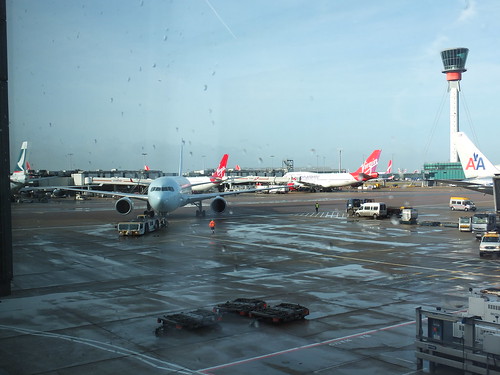
There are a few more pictures around Heathrow taken on this and previous flights here. We were a little late departing from runway 27 Left (I remember when it was 28 Left – magnetic variation of the poles is a remarkable thing). About a dozen aircraft managed to get away before us but then we were soon crossing the Channel and overflying Belgium. Where there were breaks in the cloud, it looked as if the snow was widespread on the Continent. They served quite a reasonable meal and by that time it was dark outside. The entertainment system was ‘video on demand’. I tried ‘The Bourne Legacy’, a bit of ‘Ted’ (quite funny but rude) and ‘The Candidate’ (intermittently funny or rude or both but very predictable). I managed to sleep a little, although the seat only provided an inclined sleeping position which doesn’t suit me too well. A couple of hours before getting to Bangkok, they served a hot breakfast. We arrived around 10.00 p.m. London time, but I’d already switched to local time – about 6.00 a.m. on an overcast but warm (about 23 degrees Celsius) morning.
Events of Friday, 1st February 2013
At Bangkok I transited to another Thai flight – the TG550 to Ho Chi Minh City (Saigon as was). I still have trouble with the signage at Bangkok airport. First, I had to go up one floor from the arrivals level to the departures level. But before you’re allowed out, you and your luggage are processed by security. This time, my hand baggage passed, but they insisted on X-raying my shoes. I was processed by their body scanner – a cubicle with power doors where you stand, feet apart, with arms in an ‘I surrender’ pose. At least the man and women manning the body scanner gave me a smile as they beckoned me out.
As I feared, gate E1a for my flight was a long, long walk. There are a number of moving pavements but it’s still a long way. Right time, I boarded the aircraft along with around 300 passengers, this time an A330 but I don’t know which of the three variants in service with Thai we flew in.
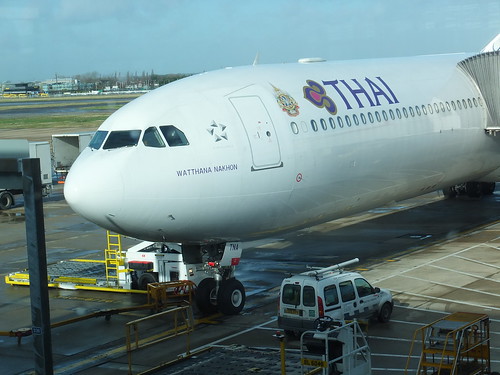
This flight was full and I didn’t get a window seat but the flight was only an hour and bit (although we must have taxied for best part of half an hour before we followed a 747 into the sky). They served a very basic lunchbox (this leg and others to follow were Economy) so I was fairly content by the time we arrived at the airport for Ho Chi
Minh City which is often identified simply as 'HCMC' although the airline ticketing code remains 'SGN' for the old French name, Saigon.
As I expected, the airport at Ho Chi Min City seems to have developed since my previous visit (described in the post Far East Tour, 2005). There was very little delay at immigation and my checked bag arrived quickly. Customs formalities comprised X-raying my bags, then I was disgorged into the Arrivals Hall, packed with ‘meeters and greeters’, a few of which held name labels. I wasn’t expecting to be met here as I was booked to transfer onto a Vietnam Airlines domestic flight to Da Nang, but I scanned the signs quickly before going outside. I think the temperature was in the low twenties. The pavement was also thronged. I guessed the direction to walk for the Domestic Terminal (and got it right). Although I had some hours before my flight left, I managed to check in and 'lose' the big bag, then I set off on foot for a little walk. One of the many security guys watching the traffic coming and going was worried to see me wandering around on foot but suggested a visit to ‘The Market’, actually a department store selling many famous names plus some others. He kindly conducted me across the busy junction and the store doorman opened the door for me. I made my way through five floors connected by escalators.
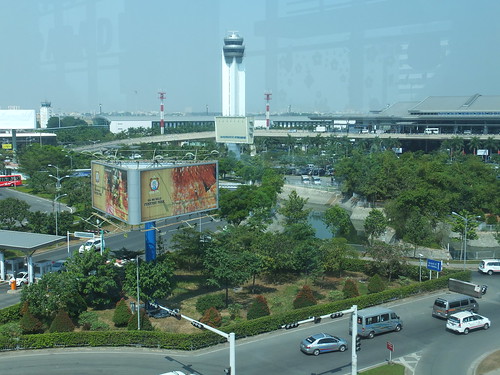
I spent at least an hour on the top floor which was mainly an eating area surrounded by lots of different cooked food vendors including a 'KFC' - a bit like motorway services in Britain but there must have been at least 15 vendors. I passed the time with a drink whilst taking in the view of all the coming and going road traffic at the Domestic and International Terminals and writing part of this post. Getting back to the domestic terminal on foot was quite tricky with all the traffic but I was too stubborn to accept any of the numerous offers of taxis or motor bike taxis, although I was a bit tempted by the motor bike taxis who even provided a crash helmet for the passenger. I arrived back at the domestic terminal under my own power safely but exhausted. I went through security and did a bit more on the computer, finished reading my Thursday 'Telegraph' or dozed.
We boarded our flight exactly on time, somewhat to my surprise. Again, the flight was full (or it was where I was, in economy). This time, the aircraft was an A341 (this one second hand but Vietnam Airlines are partway through accepting delivery of a small number of brand-new aircraft of this type). The flight to Da Nang took about an hour and we were soon in the Baggage Hall of the new terminal. I didn't have very long to wait for my checked bag and, being a Domestic flight, there were no immigration or customs formalities. There were quite a few 'Meeters and Greeters' in the arrivals hall, but my taxi driver was displaying a board with the name of the tour company and my name so we were soon driving to my hotel for one night in the historic city of Hoi An. Within about an hour, I was checking in at the 'Hoi An Historic Hotel'. I haven't found out yet how they justify the 'Historic' in the hotel's name - there are three wings and they all look pretty modern.
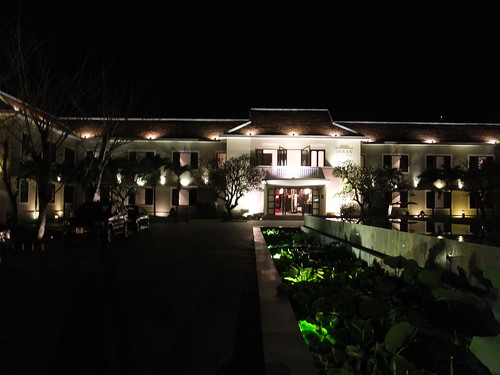
I was glad to get to my room (third floor and no elevator as they call 'lifts' in this territory) and have a bath. I abandoned my initial idea of exploring the area before it got dark and decided to sort out this post and my photographs. That's when I discovered that my 'preferred pointing device' (a tracker ball) would not work at all. After a half-hearted attempt at a repair, I decided to continue on the computer's touch-pad and buttons (which I don't find as convenient).
Provided we don't suffer any more technical setbacks, I'll tell you more when I can.
Photographs
Photographs taken on the dates given above either form new sets, or have been added to existing sets, as listed below:-
Heathrow Airport.
Bangkok (Suvarnabhumi) Airport.
Ho Chi Min City Airport.
Ho Chi Minh City Shopping Plaza.
Around Da Nang.
Hoi An Historic Hotel.
Hoi An.
[Revised 25-Feb-2013]
Saturday, 26 January 2013
The Battle of Brewood
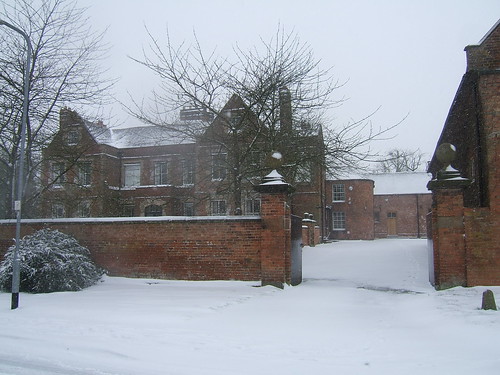
With the title's attractive alliteration, this ought to be an event from history. The truth is a little more prosaic.
The forces which regulate British Weather decided that Britain should have a "proper winter" in early 2013 and there was widespread snow on the 18th January and more on subsequent days. There are a few pictures around Brewood Hall here. Needless to say, the country was immediately plunged into chaos with road, rail and air transport dislocated or cancelled and schools closed.
Before the snow disappeared, it was decided that the Brewood Scouts would make use of the garden for a little snowball practice in 'The Battle of Brewood'. The Scouts had visited just over three years previously for a conducted tour of the principal rooms of the Hall and that visit is briefly described in the post Brewood Scouts visit Brewood Hall (with a link to pictures).
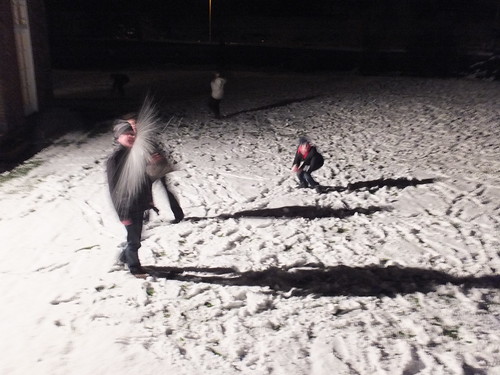
On the evening of Friday the 25th January 2013 it was dark and cold when thirteen scouts and two scout leaders arrived but soon snowballs were being lobbed in all directions.
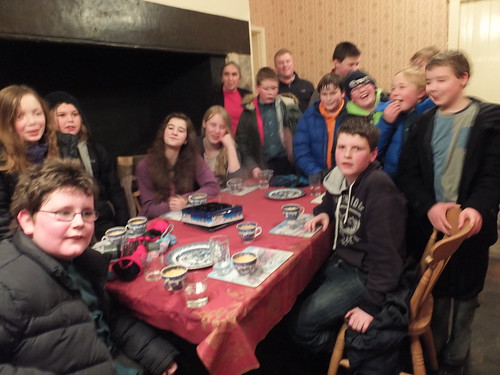
Once youthful energies were dissipated, everybody came into the kitchen at Brewood Hall for a cup of hot tomato soup with bread.
Perhaps this hastily-arranged event can be repeated in the future and the name 'The Battle of Brewood' may yet enter the history books. There are a few pictures of the evening in Fun in the Snow.
Monday, 21 January 2013
Yangon Area Railways
Introduction
Yangon Central (shown as a black square on the map below) is an important rail hub. A 30-odd mile long double-track 'Circle Line' serves the city. At Da Nyn Gone (left side of map) the line towards the west diverges. At Mahlwagone (a little to the right of Yangon Central) the double-track route to Bago diverges. At Bago, the main line continues north to Mandalay and a single line to Maylamyine and the south diverges.

List of stations on the Circle Line
Stations are listed in a clockwise direction, starting at the northern part of the Circle Line. Burmese words can be Anglicised in various ways, so alternative spellings of at least some of names may be found.
Golf CourseHistory
Kyait Ka Lei
Mingalardon Market
Mingalardon
Wai Bar Gi
North Okkalapa
Pa Ywet Seit Gone
Kyauk Yae Twin
Tadalay
Yaegu
Parami
Kanbe
Bauk Hlaw
Tarmwe
Myittar Nyuni
Mahlwagone (#1)
Pazundaung
YANGON CENTRAL
Pha Yar Lan
Lanmadaw
Pyay Road
Shan Road
Ahlone Road
Pan I Daing (or Pann Hlaing)
Kyee Myin Daing
Hanthawaddy
Hledan
Kamaryut
Thin Myaing
Oakkyin
Thamine
Gyogone
Insein
Ywa Ma
Phi Taw Thar
Phaw Khan
Aung San
Da Nyn Gone (#2)
#1: Before Mahlwagone the line from the north and east converges with the Circle Line.
#2: Beyond Da Nyn Gone the line to the west diverges from the Circle Line to Golf Course.
In the post Railway Signalling in Burma: Part 3 - Control of Trains I quoted a brief description of the signalling arrangements at the main station in the 1930s when the city was called Rangoon:-
The passenger station yard is controlled by three principal signal boxes, two of which have about a hundred levers each, and the third about seventy-five The Western Electric system of train control is installed throughout the Rangoon area and interlocking is very complete. All signal lamps are electrically lit.After the Second World War, the signalling of the whole area around Yangon has been modernised with colour light signals, track circuiting and motor operation of points.
Equipment supplied by Westinghouse Brake and Signal Company
According to [reference 1], in January 1946, an order was placed with Westinghouse Brake and Signal Company for two Style 'L' miniature lever frames for Burma Railways, intended for 'Rangoon' and 'Kemmendine'.
The Rangoon lever frame order called for 143 levers made up of 42 point levers, 76 signal levers, 6 spare levers and 19 spare spaces. The Kemmendine lever frame order called for 47 levers made up of 12 point levers, 28 signal levers, 6 spare levers and 1 spare space. The Yangon miniature lever frame remains in use and is described here. What happened to the other frame remains a puzzle at present.
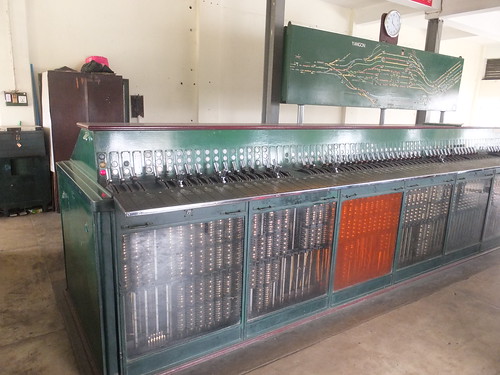 General view of the Westinghouse Power Frame at Yangon from the front.
Yangon Central Station
'Rangoon' is now known as 'Yangon' and the Central Station is currently signalled by a fairly elderly system of 2- and 3-aspect colour lights with power operation of points. Controlled signal numbers are prefixed 'R' (for Rangoon).
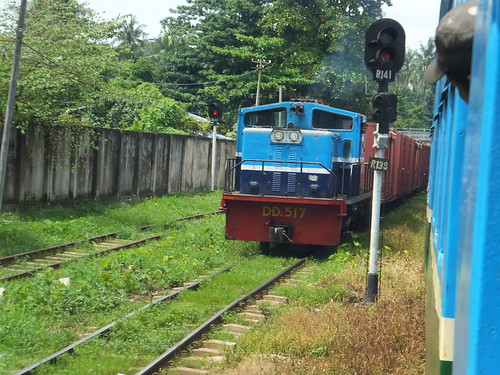
Kyee Myin Daing
'Kemmendine' is now usually known as 'Kyee Myin Daing' and remains controlled from two manual signal boxes, although colour light signals have replaced semaphores on the main line.'
Pazundaung
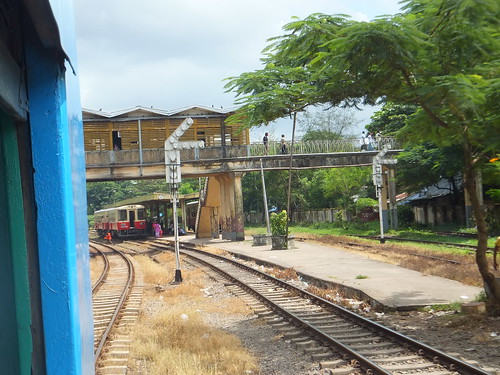
Pazundaung station is situated on the four-track section to the east of Yangon Central (Up/Down Main and Up/Down Local). It has colour light signals and motor points. Signal numbers in the area are prefixed 'P' and I believe a separate signal panel is situated in the station building (probably like the one I photographed at Da Nyn Gone).
Mahlwagone
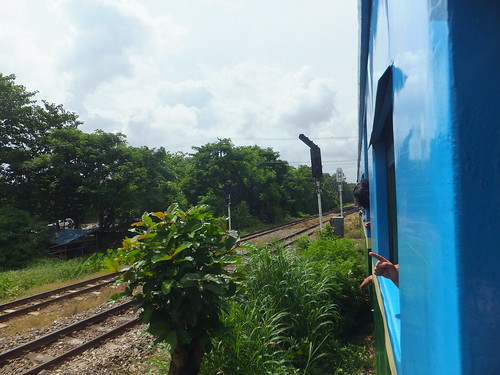
Mahlwagone is situated near the convergence of the Circle Line with the line from Bago and has colour light signals and motor points. Signal numbers in the area are prefixed 'M'. I'm told this area is now controlled from Mingalardon.
Pa Ywet Seit Gone
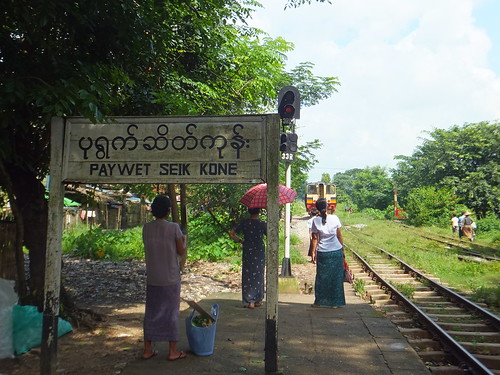
This station on the Circle Line is remotely controlled but of interest because there are trailing crossovers at each end of the station allowing a locomotive to run round its train. I travelled on an anti-clockwise Circle Line train which used this facility and continued as a clockwise Circle Line train.
Automatic signals
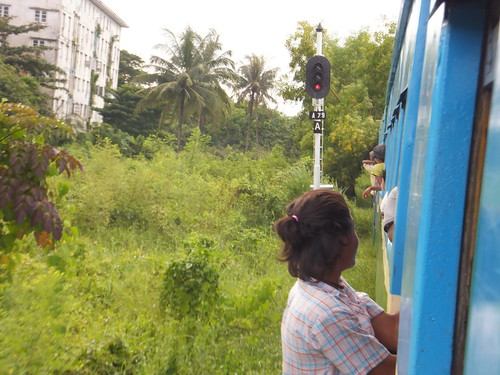
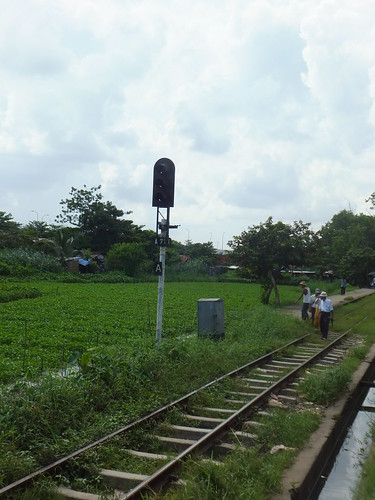
On areas of the Circle Line around Yangon which are not controlled from a signalling panel, there are a number of signals with numbers prefixed 'A' arranged for automatic operation. There are also automatic signals on the four-track section between Mahlwagone and Pazundaung.
Books
[reference 1] 'The Style L Power Frame' written and published by J. D. Francis 1989 (ISBN 0 9514636 0 8).
Wikipedia Links
Yangon Central Railway Station.
List of railway stations in Myanmar
Related posts in this blog
Exploring Yangon's railways.
The Circle Line Revisited (2012).
The Circle Line, Yangon (2008).
Railway Signalling in Burma - Part 2: Colour Light Signals & Motor Points.
All my Myanma Railways posts.
My Pictures
Cab Ride on the Circle Line (2014).
The Circle Line, Yangon (2013).
Circle Line Revisited (2012).
The Circle Line, Yangon, Myanmar (2009).
Burma: Colour Light Signals & Motor Points.
Yangon Central Station.
Railways in Myanmar (2008).
All my Myanma Railways Pictures.
[Revised 4-Jul-2014: Link to Index added 22-Jan-2020]
Thursday, 17 January 2013
Railway Signalling in Burma - Part 3: Control of Trains
Some of the posts referred to below are still in preparation.
Mike's Railway History includes a brief description of Burma's railways in the 1930s which appears to be from one of the contemporary railway magazines. One paragraph describes signalling:-
The standard interlocking used for all single-line crossing stations on important lines is known as the Simplex system, while there are also a few controlled by List and Morse interlocking. In the Rangoon area the lock and block system is installed on the double line, and about forty double-line stations are interlocked on the key and tappet system. Some twenty junctions and important stations have fully-interlocked cabin locking. On most branch lines the stations are not interlocked, facing points being secured by cotters and padlocks, the keys of which are kept in the custody of the station-master on duty.Another paragraph describes the principal station in Rangoon (now Yangon). At the time, this station was called 'Phayre Street':-
The passenger station yard is controlled by three principal signal boxes, two of which have about a hundred levers each, and the third about seventy-five The Western Electric system of train control is installed throughout the Rangoon area and interlocking is very complete. All signal lamps are electrically lit.I haven't traced other references to 'Simplex' interlocking but a Paper by R. C. Rose titled 'A Survey of Indian Signalling' in the 1924 Proceedings of the Institution of Railway Signal Engineers (available online here) seems similar.
Single-line crossing stations
The Indian system for controlling simple passing loops has a Station Master (of high integrity) in charge, with two Pointsmen who can be despatched to hand operated points at each end of the loop to set them as required. But if the pointsmen make errors, trains can arrive on the wrong track, departing trains can 'trail' incorrectly-set points or points can be changed as a train is passing over them.
So, various forms of key-locking apparatus were produced with the aim of giving the Station Master confidence that his instructions had been correctly carried out. The 'Trapped Key' method has two keys for each set of points which can be inserted in a Locking Box between the rails at the toe of the points. A point stretcher passes through the locking box arranged so that if the points are correctly fitted-up in the 'Main' position, the 'Main' key can be extracted from the Locking Box. Actually removing the key locks the points in that position. The other key remains 'trapped' in the Locking Box. Once the 'Main' key is replaced in the Locking Box, the points may be operated.
Similarly, with both keys present, if the points are operated to the 'Loop' position and are correctly fitted-up, the 'Loop' key can be extracted from the Locking Box and, once removed, locks the points in that position. Now, the 'Main' key remains 'trapped' in the Locking Box.
Thus, if the two Pointsmen each present 'Main' Keys to the Station Master, he may be confident that the points are set for the 'Main' at both ends of the loop. If the Station Master receives two 'Loop' keys, a train may be passed over the loop line. In India, a further development allowed splitting home signals to be worked from a ground frame on the platform.
The arrangements I've seen so far in Burma seem to conform to the above description, except that the splitting home signals are locally controlled by the pointsmen with a further 'Trapped Key' locking box being provided in the push rod to the signal arm (see Part 4 - Manual Control of Points and Interlocking for more information).
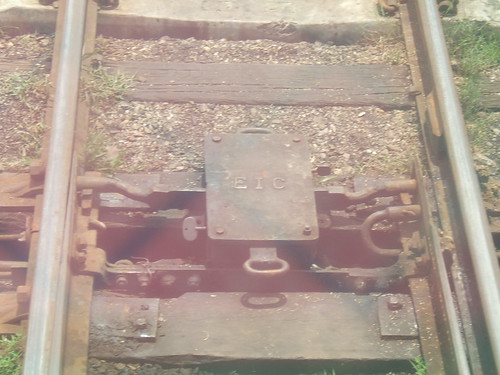
The picture below shows a partly-dismantled locking box no longer in use and is included to clarify the construction.
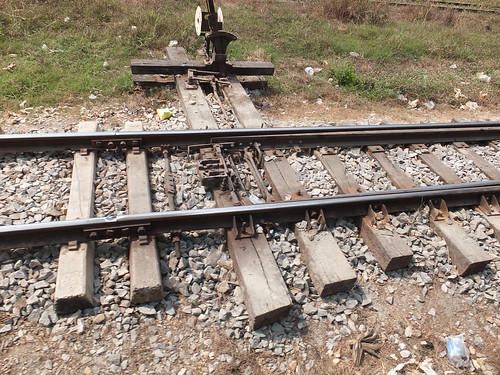 A single-lever ground frame and point indicator on the Circle Line at Yangon. The points are provided with a 'Trapped Key' Locking Box which has been partly dismantled but the points have been clipped and locked on the nearer rail to make them safe.
Click here for larger version of the above picture.
'Trapped Key' Interlocking is still widely used in industrial safety in the form of Castell Interlocks (introduced by James Harry Castell in 1922 adapting ideas first used on the railways).
Double-line control
The Circle Line in Yangon is double track, as is the line from Mahlwagon to Bago. Other parts of the system are also double-track (and doubling is being extended) but, at present, I've no information on the original arrangements.
The 1930s description quoted above says "The Western Electric system of train control is installed throughout the Rangoon area". This system originated in North America as an electro-mechanical secret party-line selective telephone system where a number of waystation telephones were all connected to the same pair of wires. A series of impulses sent to line from the control station normally selected only one telephone to speak to or hear the control. This secrecy made it a safe method for communicating train movement instructions as they could not be overheard (and misunderstood) by other waystations. In addition to Western Electric exports, the system was licensed by Standard Telephones and Cables in England and they not only exported systems (for instance, to Thailand) but also adapted the system for use as a Signal Post Telephone system in the U.K. For more information on this system, my friend Sam Hallas has produced a comprehensive article Control Telephone Systems.
Any form of telephone system needs telephone wires between the various instruments. Originally, this would be open wires on a system of poles but latterly multicore cables are used. See 'Part 7 - Telecommunications' for more information.
Regarding Rangoon, the 1930s description quoted above reports "The passenger station yard is controlled by three principal signal boxes". In 1946, an order was placed with Westinghouse Brake and Signal in Chippenham for two Style 'L' miniature lever frames. One, intended for Rangoon (now Yangon) had 143 levers, the other, for Kemmendine (now Kyee Myin Daing) had 47 levers. All signals in the Yangon area are currently colour light with power operation of points but, as yet, I've not determined whether the Westinghouse lever frames remain in use. See the post Yangon Area Railway Signalling for more information.
The 1930s description quoted above reports "About forty double-line stations are interlocked on the key and tappet system". This is presumably a variant of the 'Trapped Key' system where keys available physically control which signals can be operated. This may be similar to the method of signal release I've found in Burma (see Part 4 - Manual Control of Points and Interlocking for more information).
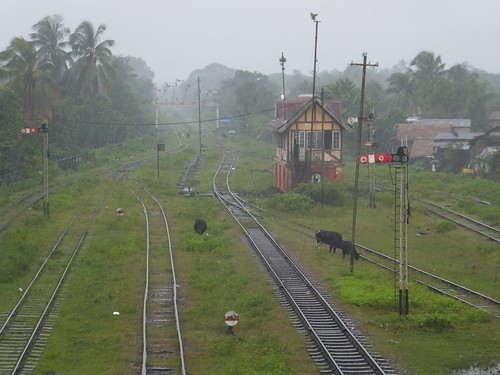
The 1930s description quoted above reports "Some twenty junctions and important stations have fully-interlocked cabin locking". Bago North and Bago South signal boxes are certainly 'fully interlocked'. See the post Railway Signalling in Burma: Part 5 - Signal Boxes with Interlocking Frames.
References
Mike's Railway History
Burma's Railway System.
(This PDF appears on the website of the Old Martinians Association U.K. forwarded by Peter R. Moore. Some of the text also appears on the Mike's Railway History Page but the Peter Moore article includes additional material and a number of more modern photographs showing steam locomotives).
Control Telephone Systems.
[Photograph of part-dismantled locking box added 20-Mar-2013]
Wednesday, 16 January 2013
The End of an Era
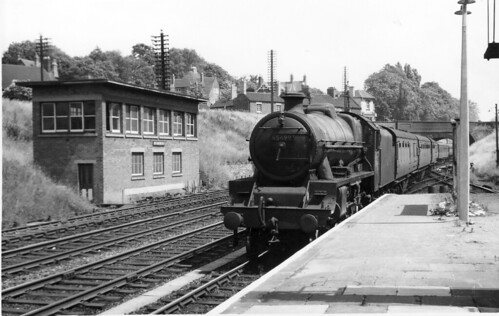
I consider myself lucky to have been growing up as the post-war railways went through the massive changes of the '50s and '60s. After the long period of wartime austerity, the railways, and the country, were run-down but the traditional pride of railwaymen in being involved in a vital national enterprise was still visible. The socialist government nationalised the 'Big Four' railways in 1948 and, of course, opinions varied about the consequences which would follow. Steam was still supreme, the handful of main-line diesel electrics were seen as curiosities and nobody on the railways had yet heard of Doctor Beeching.
B.R. Standard steam locomotives
But when change came, it came quickly. B.R. Standard steam locomotive designs were intended to replace the motive power which had become 'clapped-out' through the pressures of wartime. Riddles' designs were based on sensible principles of simplicity, two outside cylinders with Walschaerts valve gear and rocking grates with hopper ashpans. The 999 new locomotives turned out were intended to be a unifying influence, encouraging loyalty to the new 'British Railways' rather than the old 'Big Four'. This aim was only partly achieved: the new locomotives were thought 'the best thing that had ever happened' or 'not as good as our old engines', depending who you talked to.
Although the B.R. Standard locomotives incorporated modern design features, steam traction still involved a lot of hard, unpleasant physical work which became less acceptable to employees. At the same time, the political wind changed and it was felt that 'dieselisation' was the future.
B.R. Diesel Shunters
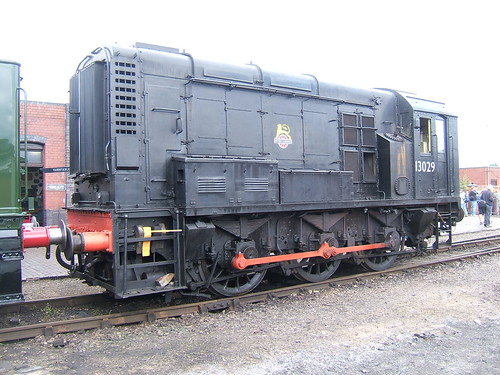
The excellent 350 h.p. diesel-electric shunters revolutionised shunting and trip work, with their ability to be rapidly shut down until required and be available for perhaps a week before returning to the depot. There were also various diesel-mechanical types.
B.R. Diesel Multiple Units
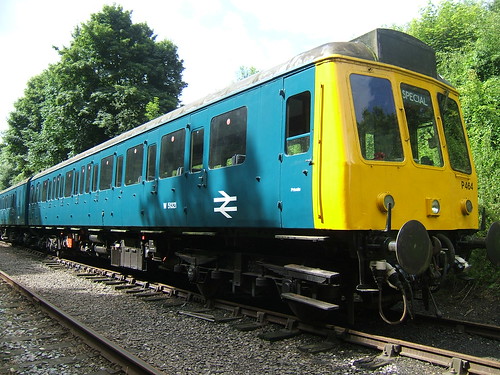
The various designs of Diesel Multiple Unit quite successfully replaced steam on local (and not-so-local services). Existing automotive technology was fairly successfully adapted to the railway environment and the ability to operate variable-length trains by coupling units together or splitting them, as required was quite effective. At the time, the new experience of being able to sit behind the driver and share his view ahead was amazing. My post Diesel Multiple Units has links to various sources of information (the British Railways Driver Training Films on YouTube are particularly recommend).
B.R. Main-line Diesels

British Railways and the various British locomotive builders had a fairly steep learning-curve in seeking to develop successful high-power diesel traction. One of the pioneer classes was the 'Peak' and, of course, 'Penyghent' is preserved at Peak Rail. My post D8 'Penyghent' has links to various sources of information on this class but, despite the interest of the more complex control systems, I've not written a great deal about other classes.
B.R. Electrification
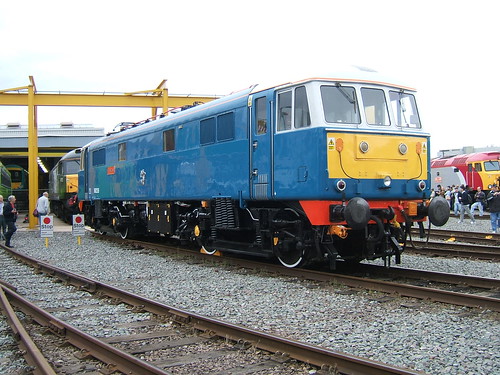
Having thrown away a modern 'stud' of steam locomotives in favour of diesel, British Railways then started to electrify. Of course, the Southern Railway had electrified much of their complex network radiating from London with 3rd rail, 750 volts d.c. before the war and there were other limited schemes (Manchester-Sheffield-Wath was started pre-war but couldn't be completed until after the war) but no major main-line route. Post-war, many other countries went straight for the electric option. At least when the first scheme was announced from Euston to Manchester, we chose a.c. rather than d.c. and high voltage, generally 25 kV, rather than low voltage. This decision was based on the success of a pilot scheme in the Morecambe area briefly outlined in my post Steam around Morecambe. Yet even today, much of the system is not electrified, resulting in a massive mileage by diesel trains even on routes which have been electrified.
Signalling
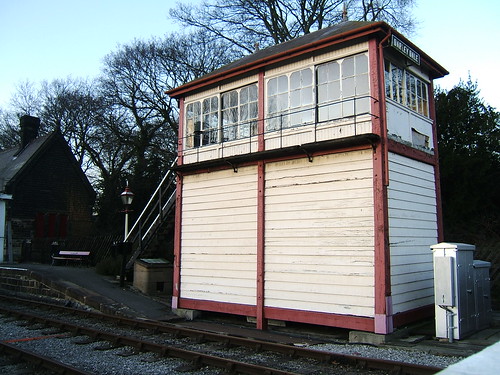
I was very lucky to get to work manual signal boxes (unofficially) in the late 'fifties and 'sixties before the great changes swept over British Railways. My post Visiting Signalboxes has links to more articles about some of the boxes I went to. The early manual signalling systems had had various electrical safeguards added piecemeal but the system still depended upon the integrity of a large band of signalmen. But over a period of time, boxes were abolished, and colour light signals, continuous track circuiting and Power Signal Boxes covering wide areas were introduced. Many of my posts are dedicated to signalling for railways 'Ancient and Modern' - you can find them under the label Railway Signalling.
