Tuesday, 23 July 2019

Brewood Hall Garden Party 2019

On Saturday, 13th July 2019, the Brewood Garden Party was held, for the seventh time, in the garden at Brewood Hall. The event is organised by 2nd Brewood Scouts, Brewood Parish Church and the informal group Friends of Brewood Hall. All of the work organising and running the event is carried out by volunteers.

Preparation

An organising committee representing the voluntary groups involved met a number of times in the months prior to the event to arrange the details. Publicity was displayed in the village and 'flyers' delivered to houses.

Setting Up

Starting on Wednesday, 10th July the tents, tables and chairs needed were ferried in over a number of trips using a car and trailer and erection of the main tents was carried out by Ian Morris and Gary Dunbar. On Friday evening erection of the smaller tents and arranging the seating areas was undertaken by the Scouts. An event of this nature, lasting just four hours, requires a lot of commitment from those involved but the Garden Party has established itself as a popular feature of village life.


Brewood Garden Party 2019: By late Friday evening, all the tents were erected.

On Saturday morning, volunteers arrived to complete the setting-up.


Brewood Garden Party 2019: Volunteers complete the setting-up on Saturday morning.


Brewood Garden Party 2019: Volunteers with a remarkable range of plants readying the Plants & Produce Stall on Saturday morning.

The Craft Tent featured the work of a number of talented people, including Fern Floating Fine Art, passing through Brewood on the Shropshire Union Canal and recruited by Ian Morris to appear alongside our established local artists and crafters.

Brewood Garden Party 2019: Crafters setting-up on Saturday morning.

Getting ready involved so many different tasks, I was worried that we'd not be ready for the published opening at noon but, somehow, it all came together in time.

The Event

With my friend Rita on the admissions gate, assisted by Peter, our visitors started to arrive, slowly at first, then in larger numbers.


Rita at the 'gate' (Photo: G. Hopwood)


Brewood Garden Party 2019: Visitors start to arrive.

After a few words from Phil Moon, the Vicar of Brewood, the Staffordshire Corps of Drums opened the proceedings with an impressive display of precision drumming, looking splendid in black trousers, red tunics and helmets.


Brewood Garden Party 2019: Staffordshire Corps of Drums perform the Official Opening.

There were the usual attractions, such as Tombola, Plants and Produce, Catapult Range, Coconut Shy and Toys and Books plus some innovations and variations such as 'Games and Names', 'Tuck Shop' and 'Crack the Code'.

The Refreshment Tent quickly became busy and remained busy. Both the local Midland Counties Co-op store and Brewood Post Office provided additional volunteers to provide welcome assistance to Beccy and the Scouts. This year, the local Spar store made a donation towards the cost of purchases for the Refreshment Tent.


Brewood Garden Party 2019: The Refreshment Tent.

Adjacent to the Refreshment Tent, Pimm's was available. The locally-brewed Slaters Ales 'One Hop' also proved popular.


Brewood Garden Party 2019: In addition to Pimm's, locally-brewed Slaters Ales 'One Hop' proved popular.

The Barbecue Tent completed the food and drink line-up. The picture shows a quiet moment as the Garden Party opened - from then on, there was no respite throughout the afternoon.


Brewood Garden Party 2019: Barbecue ready for business as the Garden Party opened.

We were delighted that Chase Ferret Rescue were able to join us again. The knowledge and care displayed by their volunteers was impressive.


Brewood Garden Party 2019: Chase Ferret Rescue ready to welcome visitors.

I find ferrets irresistible but not everybody relishes handling them so there was the option of walking ferrets on a lead!


Brewood Garden Party 2019: A 'paddock' adjacent to Ferret Rescue allowed children to walk ferrets on a lead.

Brewood Fire Station has 'Retained' Firefighters and they displayed their 'Big Red Fire Engine' in the drive. I was amazed at just how much specialist equipment was stowed in the many lockers and impressed by the capabilities of the computer display in the front cab which, for instance, can display a large scale map of the vehicle's current location showing adjacent Fire Hydrants. This attracted a lot of interest and we are grateful to the Fire Crew for their attendance.


Brewood Garden Party 2019: Staffordshire Fire and Rescue displayed Brewood's 'big red fire engine'.

There was also a 2-foot gauge steam locomotive as a static exhibit with Ann on hand to answer questions and this proved popular.

Brewood Garden Party 2019: Ann supervised a 2-foot gauge steam locomotive on static display which was popular with young (and not-so-young) people.

Everyone was delighted that, once again, the two bands based at the Cannock Performing Arts Centre - Cannock Big Band and Cannock Wind Band - returned to play for us.


Brewood Garden Party 2019: Cannock 'Big Band' gave another stunning performance.


Brewood Garden Party 2019: Cannock 'Wind Band' once again entertained with a 30-minute 'set'.

During the afternoon, the Staffordshire Corps of Drums gave a second display, for the benefit of later arrivals who had missed the opening ceremony.


Brewood Garden Party 2019: Staffordshire Corp of Drums gave an additional performance.


Brewood Garden Party 2019: General view.

The weather remained warm but the sun was not strong, making it more pleasant to walk around or just sit and enjoy the special atmosphere Brewood Hall seems to engender. All the comments I've received have been appreciative. Grateful thanks go to all those, from the village and elsewhere, who contributed to the success of the event by giving their time, or donating prizes or items for sale.

The organising committee have distributed the proceeds to the usual supported local charities: Brewood Parish Church, 2nd Brewood Scouts and the Jan Ford Foundation, with small donations to performing organisations.

Reports on other websites

Brewood 2nd Scouts have a report here.

Reports on previous garden parties at Brewood Hall

Brewood Vintage Garden Party 2013.
Brewood Vintage Garden Party 2014.
Brewood Garden Party 2015.
Brewood Garden Party 2016.
Brewood Garden Party 2017.
Brewood Garden Party 2018.

Pictures of the event

Where necessary, clicking on an image above will display an 'uncropped' view or, alternately, pictures above may be selected, viewed or downloaded, in various sizes, from the album below:-

Brewood Garden Party 2019.

Buxton by Rail

On the 18th April 2019, I made a journey by train to Dove Holes for a meeting. After the meeting, I continued to Buxton then, after a quick walk around the town, made the journey back home. I was surprised to find it was as long ago as 18th November 2013 when I'd previously visited Dove Holes by train and that journey is described in the post here.

I decided to travel to the Buxton branch via Crewe, involving a change at Crewe. The view below shows platform 5 looking north as I waited for the Euston-Piccadilly Virgin service. Down Manchester trains from London normally cross to platform 5 at Crewe South Junction so as to avoid conflicts with other routes at Crewe North Junction as they depart on the Manchester line.


Crewe: View from platform 5 looking north (Buxton by rail).

At Stockport, I changed again, catching the usual superannuated 'Northern Rail' diesel multiple unit from platform 0 which noisily ground its way up the hills to Dove Holes.


Stockport platform 0 looking south, showing 'OFF' and 'RA' indicators for Stockport No. 1 signal box signal 23 (Buxton by rail).


Dove Holes, looking north towards Stockport (Buxton by rail).

These were the published timings of the trains I used:-

Wolverhampton-Dove Holes-Buxton Arrive Depart
Wolverhampton 09:20
Crewe 09:55 10:12
Stockport 10:36 11:02
Dove Holes 11:41 13:41
Buxton 13:49

Not knowing how long my meeting would last, going on from Dove Holes to Buxton was only an aspiration. Trains stop at Dove Holes every two hours but I was lucky and, following my meeting, managed to get the 13:41 to Buxton.


Dove Holes, waiting for the 13:41 to Buxton: Looking north towards Stockport, as the 13:40 departs for Manchester (Buxton by rail).

Buxton was always special from the railway point of view, not least for the two parallel stone-built terminal stations, one Midland Railway the other London and North Western Railway with twin train sheds provided with imposing gable end walls featuring massive fan windows. Each railway provided its own extensive freight and locomotive facilities and complex junctions joined the various routes. Gary Dixon has shared this early track plan:-


Old Track Plan of Buxton (Shared by Gary Dixon)
Click here for larger size


When I was young, the railways at Buxton were still impressive but are now a pale shadow of what once was there. Sadly, the Midland station has been closed, demolished and the land redeveloped. Peak Rail was set up with the aspiration of re-instating the Midland route to Buxton as a tourist line and preservation activities were originally conducted from part of the old Midland station yard. Before I became a member at Peak Rail, I remember the 'steam shuttle' operating on a short demonstration line at Buxton.


Peak Rail 'steam shuttle' at Buxton

But, stymied by the removal of the original bridge over the road just outside the station it was decided that Peak Rail activities would be transferred to the Matlock end of the route. I've been a driver at Peak Rail for some years now and there are a number of posts in this blog with the label Peak Rail.

So, after my short journey from Dove Holes, my train arrived at the remaining, former L&NWR station, now shorn of its overall roof but retaining the magnificent gable end wall and fan window, with the name of the original owning company incised in the stonework.


The LNWR station building at Buxton which originally faced a similar Midland building (Buxton by rail).


7mm/ft scale model of the now-demolished Midland station, on display in the remaining (LNWR) station.

Buxton is full of impressive stone-built edifices befitting its history as a popular Spa Town. I went as far as the elegant Buxton Crescent, currently undergoing major restoration work.


Buxton Crescent under restoration. The building on the left is the pump room (Buxton by rail).

The Pump Room now doubles as a tourist information bureau.


The Pump Room, Buxton (Buxton by rail).

I would have liked to spent longer in Buxton but my walking is not brilliant and I decided to walk back to the station and travel back to Stockport on the 14:34 from Buxton.


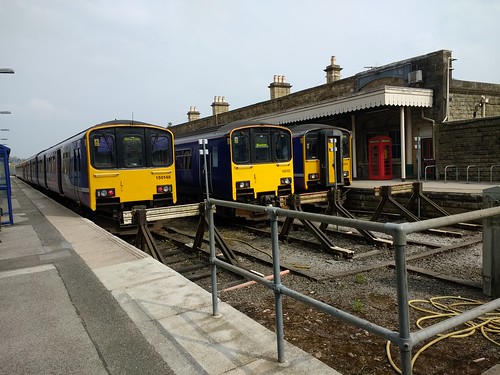
Buxton Station looking quite important with three DMU side-by-side (Buxton by rail).

Network Rail were in the final stages of completing an extension to sidings on a disused council trip to allow DB Cargo and Freightliner to increase the length of stone trains working through Buxton from 18 to 26 wagons, giving 2,500 tonnes trains. I believe the sidings were brought into use shortly after my visit.


Almost-complete siding extension at Buxton (Buxton by Rail)


Another view of the siding extension works at Buxton (Buxton by Rail)

At Stockport, I changed trains, taking a Cross Country 'Voyager' via Stoke back to Wolverhampton. As is often the case, the train was packed with commuters mainly travelling from Manchester as far as Macclesfield but, luckily, I managed to secure a seat at Stockport. But it's rarely a very pleasant passenger experience on the overcrowded trains which Train Operating Companies love to run.

These were the published timings of the trains I used on my return journey:-

Buxton-Wolverhapton Arrive Depart
Buxton 14:34
Stockport 15:20 15:36
Wolverhampton 16:39

References

You can find detailed signal box diagrams for the routes I used as they were back in steam days in the excellent series of publications from the Signalling Record Society 'British Railways Layout Plans of the 1950's'.

If you want to see what remains of the routes today, refer to 'Railway Track Diagrams Book 4: Midlands & North West', Second Edition (or preferably later), published by Trackmaps.

Related Posts on this Website

The following post describes a trip on the Buxton Branch as far as Dove Holes in 2013:-
The Buxton Branch

My pictures

I'm sorry, taking pictures in a modern train often gives poor results. Where necessary, clicking on an image above will display an 'uncropped' view or, alternately, pictures may be selected, viewed or downloaded, in various sizes, from the albums below:-
Buxton by Rail

Pictures from this album have been divided and added to various albums each covering a roughly-defined geographical area. Within each of these albums, photographs are normally arranged by date taken. Thus, by searching through the appropriate album, you can find changes through time. My trip to Buxton added pictures to a number of albums as I moved through various areas.

Railway pictures:
West Midland Railways (Wolverhampton).
Stafford Area rail.
Crewe Area rail.
Buxton Branch (Trips in 2013 and 2019).
Manchester Area Rail.


Buxton Town:
Buxton.

Monday, 22 July 2019

On to Mandalay

Sunday, 19th May 2019

I had decided to visit Mandalay at the end of my trip so that I could see friends in that city. I'd originally intended to make my own arrangements but, in the end, I merely arranged a hotel and my flights and Doctor Hla Tun took care of everything else. The Doctor estimated that he would have completed his consultations by noon on Sunday, so the monastery car and driver was arranged for that time to take the Doctor and I from Bagan to Mandalay. During the morning, I was able to continue to study the workings of the Clinic.

Individual patient treatment booklets are issued on registration at the clinic for the first time. These booklets comprise a number of plain, folded sheets stapled into a thicker, simply-printed cover. Each booklet is meticulously updated by the Doctor on the first and any subsequent visits in manuscript. Any associated test results (for instance blood tests, ECG) are usually stapled to this booklet which is retained by the patient.


Doctor Hla Tun updating a Patient Record Booklet.

The overall Clinic Records detailing patient registrations are also hand-written in ruled, bound books. The Clinic Accounts, including payments made by patients towards the cost of medication, comprise a series of plain ruled, stapled or bound books which are also completed in manuscript. The Clinic has a number of clear-sided donation boxes, similar to those seen at sites of religious pilgrimage (charitable giving is a fundamental part of Buddhist belief) and proceeds from these are also recorded in the Clinic Accounts. To keep figures aligned in each of the account books, vertical columns are manually added to each page in pencil.


Bagan Medical Clinic, May 2019: Two donation boxes outside the original clinic building.

Hla Win Ko showed me a 'PC' tower computer at the Clinic which he has programmed to produce various dosage labels for issue with medication dispensed to patients. Labels are produced in sheets of A4 size each containing multiple labels which are then cut to produce individual labels.


Around Bagan Clinic 2019: Sheet of medicine dosage labels, printed at the Clinic.

The design of the patient treatment booklet, the Clinic Accounting Books and the method of production of medicine labels have all been chosen so as to minimise the overhead costs in operating the clinic.

I also sat-in with Doctor Hla Tun to observe some of the treatments. Concepts of personal privacy are rather different in Myanmar so observing and even taking photographs during medical treatments, providing modesty is maintained, is acceptable. Patients are both old and young and represent many different ethnic groups but all have a natural dignity which is very impressive.


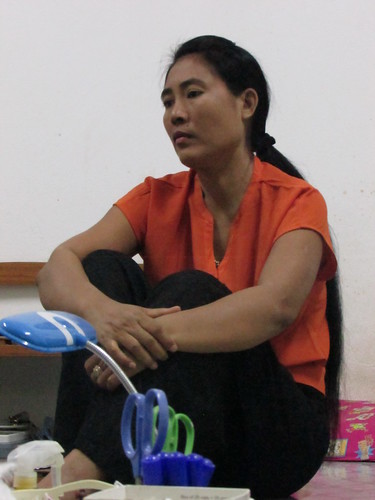
Around Bagan Clinic 2019: A patient in Doctor Hla Tun's consulting room awaits treatment.


Around Bagan Clinic 2019: A patient receiving pain-control injections from Doctor Hla Tun.

Inevitably, it was somewhat after twelve noon when the Doctor finished his last treatment. The Doctor, somewhat reluctantly, stopped for a light lunch after bullying from his Staff (and me) before we set of on the road journey to Mandalay which would take at least three and a half hours. We took the road through Myingyan we'd used the previous year when we travelled by road from Bagan to Pyin Oo Lwin (described in the post here).

Once again, I was fascinated as we passed over the crumbling concrete bridge over a broad, dry creek which incorporates a single-line metre gauge railway. Wind-blown sand covering the bridge deck increased the appearance of dereliction but both the road and the railway track are in regular use. I've only seen the creek dry but, in the rainy season, significant flood water must be channeled towards the Ayeyarwaddy River. A few yards away from the bridge, a parallel second road bridge was being constructed.


Bagan - Mandalay

Our route to Mandalay took us through Myitnge, where my friend Htein Lin lives. Myitnge is a 'railway town' where the British built the Carriage and Wagon workshops. The original workshops have been joined by a large, modern Chinese-built railway carriage building plant. The post Around Mandalay describes a day I spent with Htein Lin and his family when I visited both the original Wagon and Coach workshops and the new Chinese plant. I understand that the new Chinese plant, having produced an initial batch of air-suspension coaches, is currently 'mothballed' due to budgetary constraints.

Doctor Hla Tun arranged a rendezvous in Myitnge by mobile telephone with Htein Lin, who was waiting for us on his motor cycle. He then conducted us to a large restaurant where we met his wife and daughter. After taking photographs, we went to a private room for refreshments and conversation.


Bagan - Mandalay: Htein Lin, his wife and daughter with Jan at Myitnge.

My friend has opened a clothing shop in Myitnge which is proving successful and the family were keen that I should see it, so we climbed back into the car and Htein Lin conducted us there on his motor-cycle. Before I said 'good-bye' to the family, they generously presented me with a tee-shirt.


Bagan - Mandalay: Htein Lin and family at their shop in Myitnge with Jan.

We then finished the journey to Mandalay and I was taken to my hotel for two nights, the Hilton. This was formerly the Sedona Hotel and I've stayed there a number of times in the past but it has changed hands and been completely refurbished.

Hilton Hotel, Mandalay: View from my room with Mandalay Hill in background, Mandalay Palace and Moat and hotel's porte cochere on right.

Since the events often called the 'Rohingya Crisis', tourism from North America and Europe to Myanmar has sharply fallen. But I was surprised to discover that large numbers of visitors are now arriving from China and the Hilton Hotel seemed to be catering for many of them. After the rather packed programme of the previous weeks, I was content to relax in my spacious room on Sunday evening, watching dusk descend over the city and using the hotel's fast Wi-Fi to upload photographs to 'Flickr'.

Related posts on this website

This is one of a series of posts describing my 14th visit to Myanmar. The post Return to Burma is the first post in the series.
Clicking on the 'Next report' link displays the post describing the next events. In this way, you may read about the trip in sequence.
Next report
Alternately, clicking on the 'All my Burma 2019 reports' link displays all the posts on this trip in reverse date-of-posting order.
All my Burma 2019 reports.

My pictures

My pictures including this part of the trip are in the albums:-
Burma 2019.
Hilton Hotel, Mandalay.


All my pictures on this trip are in the collection of albums also called Burma 2019

Tuesday, 9 July 2019

Caldicot by Train

On Wednesday, the 1st May 2019, I made a journey by train to Caldicot for a meeting. The timings of the outward trains I used were:-

Wolverhampton-Cheltenham-Caldicot Arrive Depart
Wolverhampton 07:16
Cheltenham 08:24 08:46
Caldicot 10:36 11:02

My journey started at Wolverhampton, joining a Cross Country service from Manchester to Bristol, reporting number 1V43, as far as Cheltenham. The 'Voyager' was crowded but made good time to Birmingham and continued on the Camp Hill line until the approach to Kings Norton where we had to wait for a Class 323 to cross in front of us from the Bournville Line to the slow line to Bromsgrove.


Kings Norton Station with foliage on disused island platform obscuring an EMU heading for New Street (Caldicot by train).

We had no booked stops and were soon descending the famous Lickey Incline at speed. Suburban 25 kV a.c. electrification now extends as far as Bromsgrove and it still seems strange to me to see Overhead Line Equipment on this stretch. Even odder is the new multi-platform Bromsgrove Station, so different from the previous modest facilities.


Bromsgrove Station, expanded and rebuilt (Caldicot by train).

Just over an hour after leaving Wolverhampton, we slowed on the approach to Cheltenham Spa station. Looking left, I was surprised to see a GWR (that's the modern 'GWR' title adopted by FirstGroup plc) 'bi-mode' Class 800 in green livery waiting on the adjacent line. I left the 'Voyager' and made my way to the footbridge to take in the layout of the two-platform station set in a cutting on a gentle curve. By that time, my 'Voyager' had left and the Class 800 had moved into platform 1, to form the next London service. I didn't take much notice of the Diesel Multiple Unit arriving in platform 2 but afterwards I realised that this was the terminating Transport for Wales service from Maesteg which would form my connection to Caldicot. The line I'd seen the Class 800 waiting on is now a 'turnback siding', and is frequent use bu both GWR and Transport for Wales services.


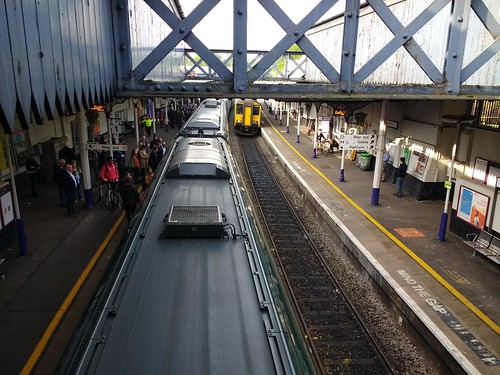
Cheltenham Spa Station view from footbridge looking towards Bristol, showing GWR 'bi-mode' Class 800 in platform 1 and DMU from Maesteg arriving in platform 2 (Caldicot by train).

I exited through the automatic barriers on the Queen's Road side to briefly explore. The station road approach is at the level of the footbridge so the neat, stuccoed buildings are not particularly impressive.


Cheltenham Spa station building, facing Queen's Road (Caldicot by train).

Cheltenham formerly boasted a number of stations. Perhaps best-known (and most conveniently-located) was the long-gone G.W.R. terminus Cheltenham Spa St. James, starting point of the famous 'Cheltenham Flyer' express. I don't believe I ever visited this station but I remember the road bridge and junctions adjacent to the surviving station which was then called Cheltenham Spa Lansdown. The Queen's Road Bridge is still in use, now carrying the road over an urban cycle track. At 'Lionsmeet 2015', I saw a splendid 4 m.m. scale model of Cheltenham Spa St. James built by the Guildford Model Engineering Society and mentioned in my report here.

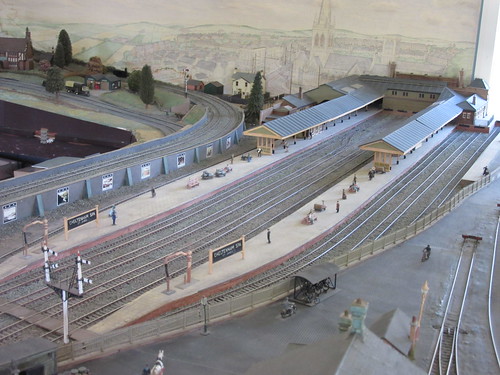
A view of part of the 4mm scale layout of Cheltenham Spa St. James.

After my brief excursion outside the station, I caught reporting number 2L49 (Transport for Wales service from Cheltenham to Maesteg) and alighted at Caldicot. It's a leisurely journey, stopping frequently, but not without interest. The first stop is at Gloucester which for a long time had separate Midland and Great Western stations. Closure of the Midland station and its connections meant that Birmingham-Bristol trains then needed to use the triangle from the main line in order to call at the former Great Western station and then change direction. For some years, I remember most Cross Country 'Voyagers' making this detour but changes to the timetable mean that it now may be necessary to change to reach Gloucester. Because of its importance, Gloucester was equipped with a Western Region style power signal box which remains in use.


Gloucester Power Signal Box (Caldicot by train).

Leaving Gloucester, there were good views of the medieval cathedral before the line crossed the River Severn near Over, later turning south west to run close to the broadening River Severn at Newnham.


Gloucester Cathedral (Caldicot by train).


The River Severn near Newnham (Caldicot by train).

Caldicot station is less than 1 kilomtre east of the better-known Severn Tunnel Junction. The double-track route from the Tunnel runs in a cutting just north of Caldicot station and in the picture below, you can just make out, in the distance, the Overhead Line structures on the parallel tunnel route.


Caldicot Station, looking towards Newport (Caldicot by train).

I don't believe I'd visited Caldicot before - it's an interesting, rather modern small town. The two halves of my meeting were divided by a visit to a cafe within walking distance which furnished a very enjoyable all-day breakfast. When the meeting finished, I was driven to Caldicot station to make sure I didn't miss the return service.

The return timings were:-
Caldicot-Cheltenham-Wolverhampton Arrive Depart
Caldicot 15:42
Cheltenham 16:31 16:41
Wolverhampton 17:48


The return train was reporting number 2G52 which had left Maesteg at 14:15. After off-loading its passengers, the empty stock went through the facing crossover on the main lines and entered the 'turnback siding', under the control of Gloucester signal G45, a 3-aspect colour light with a line-of-lights route indicator reading to the Up Goods Loop when lit. The movement to the turnback siding was authorised by a subsidiary aspect of two diagonal white lights and an illuminated 'S'.


Cheltenham Spa: View from platform 2 showing signal G45 displaying a subsidiary proceed and 'S' allowing the stock from my arrival to cross to the Turnback Siding (Caldicot by train).


Cheltenham Spa Station: View of platform 1 from platform 2 (Caldicot by train).

After a down Cross Country Voyager had paused briefly at platform 1 and noisily deported, the Transport for Wales stock emerged from the turnback siding to form train reporting number 2L65, booked to leave at 16:46 and due in Maesteg at 19:08. Whilst 2L65 was boarding passengers, my own up train, another Cross-Country 'Voyager' arrived in platform 2. I managed to find a seat in the heavily-loaded train so the journey back to Wolverhampton was not too bad, then a taxi returned me home.

Related Posts on other Websites

Cheltenham (Wikipedia). Population around 117,000
Gloucester (Wikipedia). Population around 129,000
Caldicot (Wikipedia). Population around 11,000


Book References

[1] 'Regional History of the Railways of Great Britain: Vol. 11, Thames and Severn' by Rex Christiansen (ISBN: 0715380044)

My pictures

I'm sorry, taking pictures in a modern train often gives poor results. Where necessary, clicking on an image above will display an 'uncropped' view or, alternately, pictures may be selected, viewed or downloaded, in various sizes, from the albums below:-
Caldicot by Train

Gradient Diagrams.