skip to main |
skip to sidebar
Wednesday, 2nd May 2018
I slept well in the comfortable surroundings of the Hotel Moe, Kalay. Breakfast was in an open-sided restaurant on the fifth floor, reached by a lift. Breakfast was laid out buffet style and items were even labelled in English. There was an Egg Station attended by a young girl and a 6-slice ‘Dualit’ toaster. It was clear that the Hotel Moe was bidding for International Travellers so I was unsurprised when three young European tourists came in , although it had been a few days since I’d seen anyone not from Myanmar. There is a small airport here so it’s relatively easy for tourists to reach Kalay by the scheduled service from Yangon. The Doctor had already ordered an omelette for me with a side dish of steamed rice. The Doctor and his wife enjoyed chicken, fish and vegetable dishes with their rice. My companions enjoyed help-yourself coffee whilst I was able to make a cup of Lipton’s tea with milk powder and a little sugar.
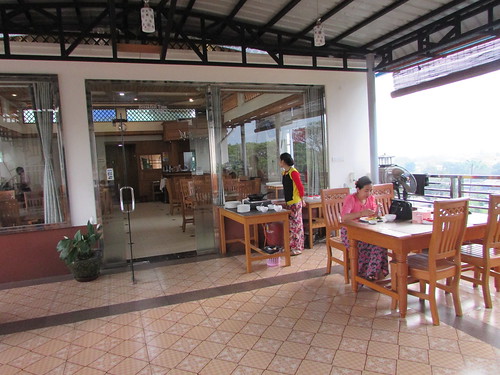
Trip to Tamu 2nd May 2018: Dining Room at Hotel Moe, Kalay.
With the Monastery car awaiting a replacement air bag for the rear suspension, the Doctor had arranged to hire another car and driver so that our trip to Tamu could go ahead and at 8.45 a.m., a large Nissan saloon arrived. We loaded up and set off through the back streets stopping after a few minutes at a terrace of shops. We’d stopped at the sort of petrol station which used to be ubiquitous in Myanmar, without electric pumps, where fuel is transferred manually from a large plastic container using a tundish. Buying fuel is another area which has been transformed since I first came to Myanmar in 2008. Now, every main road has frequent, American-style filling stations. However, self-service has not been instituted and a gang of, usually young female, assistants ‘pump gas’. Generally, 92 RON, 95 RON and PREMIUM grades of petrol are available plus Diesel. Even our more modest traditional petrol station offered the three grades of petrol. Very quickly, we were on our way again, taking the road north to Tamu.
We’d already visited one border crossing with India at Rihkhawdar. In the north of Chin State, at Tamu, there is a second border crossing with India and that was our destination. In contrast with the unsealed mountainous road to Rihkhawdar, the road to Tamu is a tarmac road running across the plain almost level with long, straight sections straight for 131 km called the ‘India Myanmar Friendship Road’.
The only problem is negotiating more than 100 bridges over the various channels which pass through the plains. At this time of year, these are mainly dry or carrying little water but, when the rains come, prodigious volumes flow. Although there are some examples of modern reinforced concrete bridges which are wide, sealed with tarmac and provide little impediment to traffic flow, most of the bridges are either elderly large girder truss spans or truss bridges of the ‘Bailey’ bridge pattern. The larger girder truss bridges are almost certainly British and appear to have been delivered in ‘kit’ form and bolted together on site. The bridges have a carriageway just wide enough for a single vehicle so traffic in opposite directions has to implement an informal one-way system where the first vehicle to arrive at the bridge has priority. The vehicle deck sits on cross beams and is either a series of flat steel plates bolted to each truss or substantial wooden timbers similarly bolted in place. When in good condition, this arrangement is very satisfactory but these are old bridges (apart from a few apparently-recent ‘Bailey’ bridges) and most vehicle deck fixings are worn, loose or broken. As each vehicle crosses, the movement of steel deck plates produces a deafening clanging or, on wooden decks, the timbers jump around in an alarming manner, producing a loud clattering. There’s usually a gap between the roadway on the abutment on either side of the bridge and the vehicle deck so vehicles, particularly cars, have to ease on and off the bridge very slowly as first the front wheels then the rear lurch into the gap.
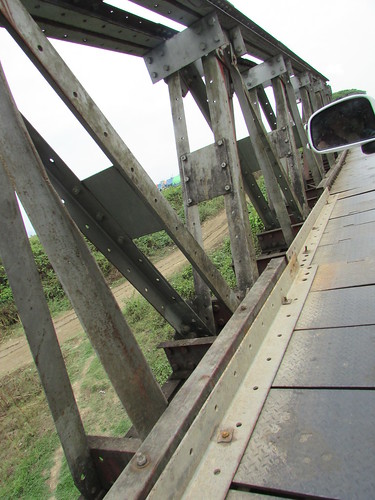
Trip to Tamu 2nd May 2018: Large girder truss span of bolted construction with steel decking in fairly good condition.
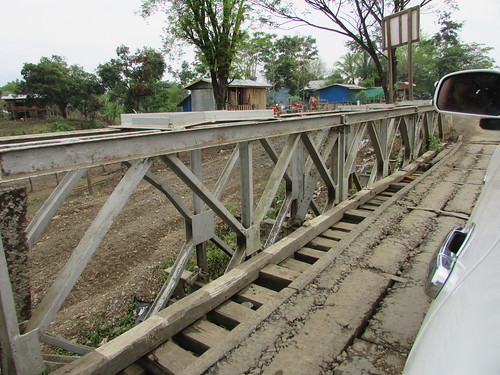
Trip to Tamu 2nd May 2018: A Bailey Bridge with a once-tarmaced wooden deck
Despite these problems, we made good progress, passing through a series of villages which each gave fleeting glimpses of life in Myanmar. This part of Myanmar was largely converted to Christianity and I’ve still not become used to the proliferation of Christian churches, although there were also Buddhist pagodas and monasteries. As we passed, I managed to identify some of the sects but there were lots more I either didn't see or couldn't read the signage. I identified Catholic, Baptist, Evangelical Baptist, Fundamental Baptist, Presbyterian, Presbyterian Kohhran, Christian Missionary Alliance and Believers' Church Myanmar.
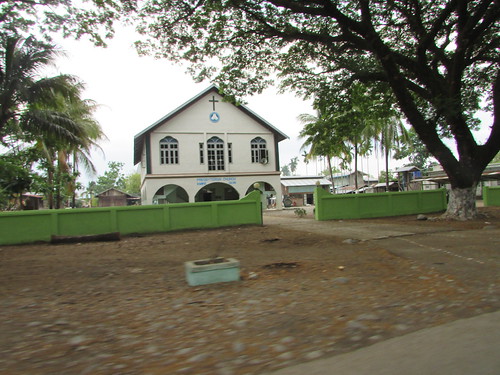
Trip to Tamu 2nd May 2018: Presbyterian Church, Khampat.
As we approached Tamu, it was clear that it was a town of some importance. Three big lorries we’d been following turned into some sort of Trading Zone, and I guessed that all the lorries to and from India cleared customs here.
We parked near the town centre and, as it was the appointed time for monks to take lunch, 11.30 a.m., we all went into a tea-shop where our monk was treated with great respect, seated at a separate table and plied with a range of foods. Afterwards, the Doctor, his wife and the writer were separately seated and our food was ordered.
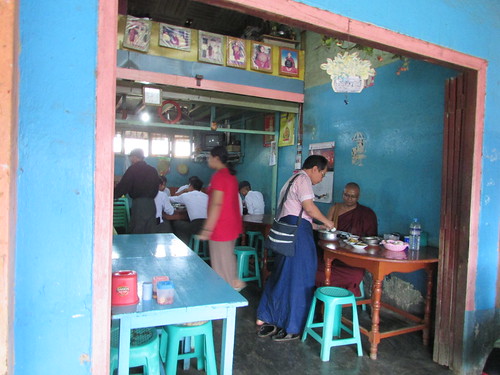
Trip to Tamu 2nd May 2018: Lunch at a teashop in Tamu.
When we’d all taken lunch, we walked to nearby Tamu Market. I never cease to be amazed by the range of products offered and the wide variety of fresh vegetables on offer at these markets.
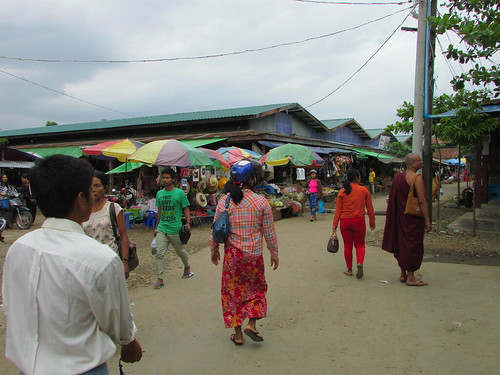
Trip to Tamu 2nd May 2018: Exploring Tamu Market.
One corner shop was selling a range of cosmetics under the Pond’s name. With a tastefully-lit glass-fronted display of products, a counter labelled “Pond’s Beauty Council” and a group of young, pretty assistants in matching uniforms (white top with black piping and black trousers), it all looked very professional.
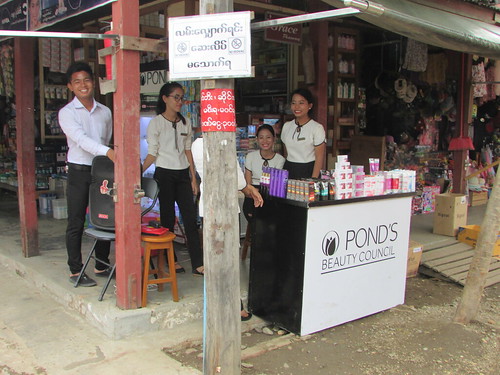
Trip to Tamu 2nd May 2018: Exploring Tamu Market: Pond's Beauty Council.
At the junction of two market streets, there was a deep well. The concrete top was marked ’15.4.07’ which I assume was the date and a simple beam overhead carried a pulley and cable for drawing water manually. A blue water pipe reaching down into the water appeared to be connected to an emergency water pump and fire hose.
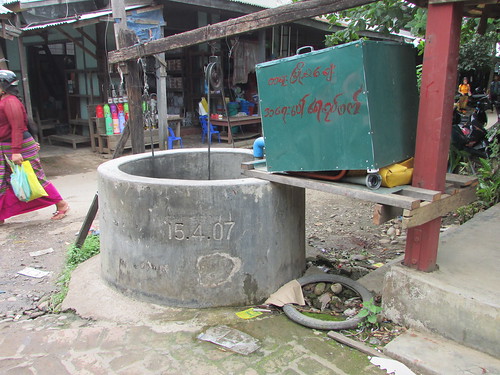
Trip to Tamu 2nd May 2018: Exploring Tamu Market. The Well.
A short distance away there was a lot of activity in what looked a pedestrian street lined with shops on both sides but the Doctor pointed out that this street led to the border crossing into India. Crowds of people were moving in both directions, a cosmopolitan combination of Indians and Myanmar people. Numerous boxes and sacks were being moved along the street by porters, some using big, two-wheeled carts who cleared pedestrians aside with their shouted warnings. But most of the porters I saw were women, who could balance three large boxes on their heads, apparently effortlessly, and then wend their way through the throng silently.
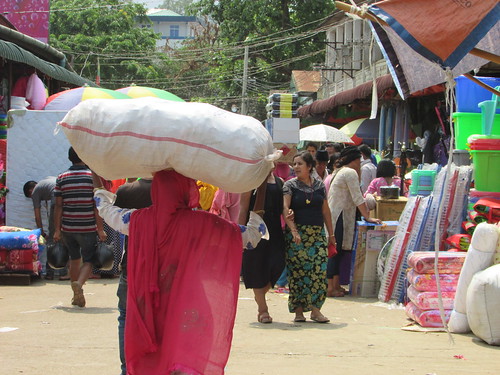
Trip to Tamu 2nd May 2018: the road to the Indian Border with an Indian lady porter.
At the end of the street, there was an Indian Immigration Checkpoint. Presentation of a Myanmar Identity Card gained entrance without further formality but I was unsurprised that my British Passport would require an interview with the Chief Immigration Officer and, without guarantee that permission would be quickly granted, I remained in Myanmar with the Doctor’s wife while the Doctor and the Monk made a brief visit to India. As well as the individual shops fronting the street, there was also a large covered market.
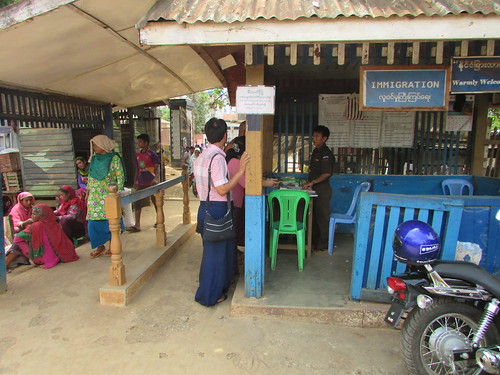
Trip to Tamu 2nd May 2018: The Indian Border Crossing for pedestrians at Tamu.
Having explored the market, I had a cold can of orange drink awaiting the Doctor’s return, upon which the Doctor and his wife had the milk from a fresh coconut. The vendor slices the top of the coconut with a vicious-looking panga, to expose the inside and the milk is drunk through a straw. When the milk is consumed, the vendor slices the coconut open to expose the soft, white flesh which can be torn off and eaten.
Having boarded our hired Nissan, we set off back along the ‘India Myanmar Friendship Road’. Part way along this road, we turned right to look at the Yazagyo Dam. Our driver assured us that its intended function was power generation although he admitted that was “for the future”.
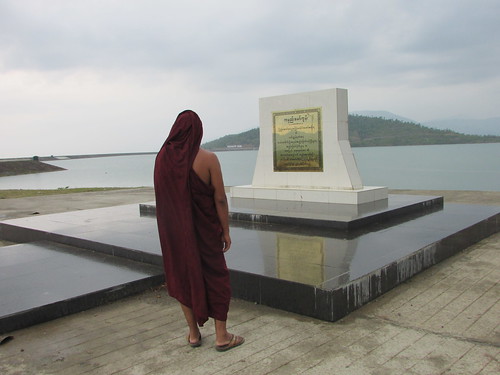
Trip to Tamu 2nd May 2018: Yazagyo Dam.
It was a pleasant spot and we were able to walk across the top of the Spillway.
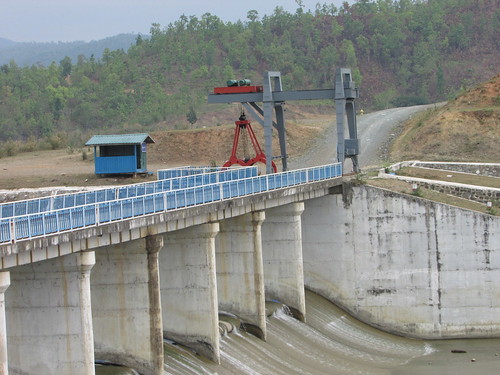
Trip to Tamu 2nd May 2018: Yazagyo Dam showing Spillway. The Gantry Crane is presumably for removing floating logs or flotsam.
The Doctor was the first to realise that the birds perched on the spillway were on the lookout for fish, swept out of the main lake.
We returned to the main road, continued south and then turned onto an unsealed road which we followed for some distance until we reached the modern temple called Gandhakuti Taik where a carved teak log presents four Buddha images.
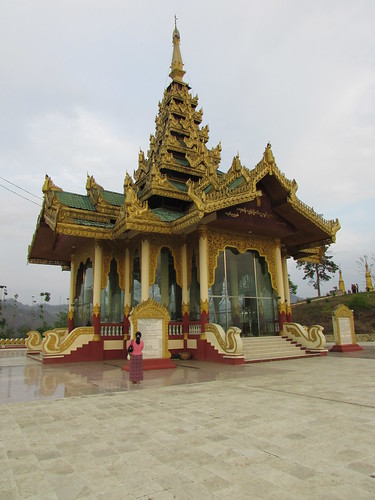
Trip to Tamu 2nd May 2018: Gandhakuti Taik on Raj Giri hill, housing the sacred carved teak log.
Our road now twisted and turned as it passed through a series of very rural villages. By this time, it was dark and I was completely bemused as to where we might be going. Then the car headlights picked out the recognisable gates of the Sel Taw Oo Monastery where we had spent one night earlier in our travels.
We were greeted warmly and told that dinner had been prepared for us just outside the monastery. I assumed that it would be at the rice mill house house where we’d had a meal when we first arrived, but it was at another, similar wooden house where the usual Myanmar Hospitality was extended to us.
After the meal, I expected us to return to our Kalaw Hotel by car but, instead, we were shepherded further along the lane on foot, with our car slowly following using its headlights to light the uneven stone roadway for us. We entered a second house which had a shop at the front and I was amazed to discover that we were at the home of our friends Ko Thein Shwe and Hlaing Hlaing Htay who had accompanied us the previous day to Rith Lake.
Most of the children were in another room but their ten-year old daughter came to sit by me and we both giggled, which we’d got quite good at on the Trip to Rith Lake. Food was again offered and we talked for a while.
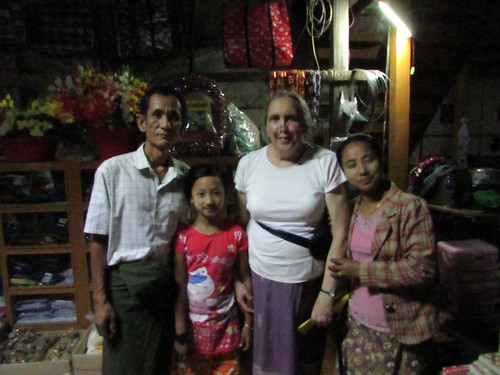
Trip to Tamu 2nd May 2018: A late evening visit to the home of Ko Thein Shwe and Hlaing Hlaing Htay.
A tropical rainstorm started as we said our “good byes” and even with umbrellas on hand, I was a bit wet by the time I sat in the car. Then I learnt that we had one more call to make, at the rice mill house.
By the time I was in the rice mill house, I was fairly wet. Then, I discovered that the Doctor was going to treat two of the family for long-term pain relief and a box of medication and paraphernalia was brought from the car. I’ve mentioned before that whilst, for instance, modesty in dress is important in Myanmar there is no concept of personal privacy so each treatment had an audience of eleven watching in fascination.
Treatments completed, we finally returned to the Hotel Moe after an absorbing, if long, day.
Related posts on this website
This is one of a series of posts describing my 13th visit to Myanmar.
The post Travelling again is the first post in the series.
Clicking on the 'Next report' link will show the post describing the next events. In this way, you may read about the trip in sequence.
Next report
Alternately, clicking on the 'All my Burma-2018 reports' link displays all the posts on this trip in reverse date-of-posting order.
All my Burma-2018 reports
My pictures
Trip to Tamu
Christian Churches in Myanmar
Hotel Moe, Kalay, Myanmar
All my pictures on this trip to Myanmar can be found at Burma 2018.
[Pictures linked 10-May-2018, minor edits and pictures embedded 11-Jun-2018]
Tuesday, 1st May 2018
I'd enjoyed the stay at Rith Lake but we now faced the return journey with a 'disabled' vehicle. The Doctor must have been discussing my problems because, when we loaded up to leave, the pick-up with our friends appeared and I was directed to the passenger seat in the pick-up. This meant that Hlaing Hlaing had to travel in the covered rear section with her children but everybody seemed happy so the two vehicles moved off back to the small town of Rhikhawdar where we parked alongside a tea-shop and everybody from the two vehicles piled in for breakfast. During breakfast, the Doctor asked me "Which vehicle do you prefer?" and, remembering my misery the previous afternoon, I told the truth. So it was agreed that I would travel back to Kalay in the pick-up. I felt sorry for my friends who had to suffer in the car.
After breakfast, we didn't immediately set off but all walked down the hill to the rusting Bailey prefabricated truss bridge with double side panels which led over the Hathya River to India.
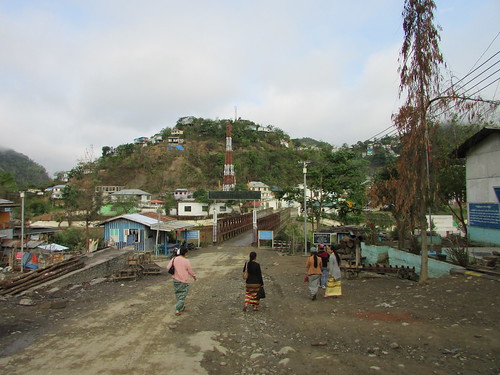
Back to Kalay 1st May 2018: Walking into India across the bridge at Rihkhawdar.
Checking my pictures afterwards, I noticed that the Indian half of the bridge had been painted far more recently than the Myanmar side! The bridge had the occasional motor cycle or pedestrian but it was fairly quiet. There was an official-looking wooden building on the Myanmar side of the bridge but nobody showed any interest as we all walked onto the bridge. At the far side, a concrete arch proclaimed 'Welcome to India'. The Doctor spoke briefly to the Indian border guards and it was all smiles as we sauntered into India with an imposing building in front of us, with signs for the State Bank of India and the Trade and Commerce Department of the Government of Mizoram.
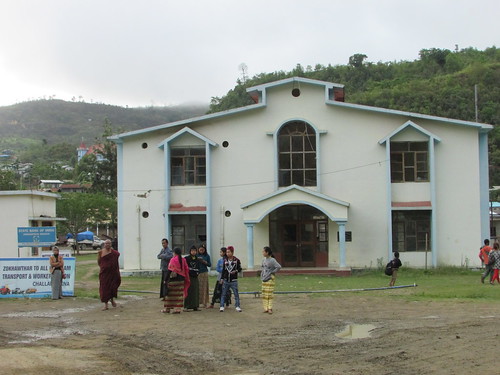
Our party outside the Trade and Commerce Department of the Government of Mizoram, 1st May 2018
We made our way through the quiet area past the Hotel Paradise, which looked a touch run-down and probably unlikely to live up to its name. Lots more pictures were taken by the young people (and me). The Doctor studied the offerings in the retail shop forming part of the imposing warehouse/shop labelled 'C. Lallawmzuala and Family' as a couple of gaily-painted public carrier trucks made by Tata passed us as they manoeuvred to a parking area. After this fascinating, if brief, visit to India, we strolled back to Myanmar. Before we boarded our two vehicles, I examined examples of the rather curious unpowered but steerable trucks I'd seen in the area.
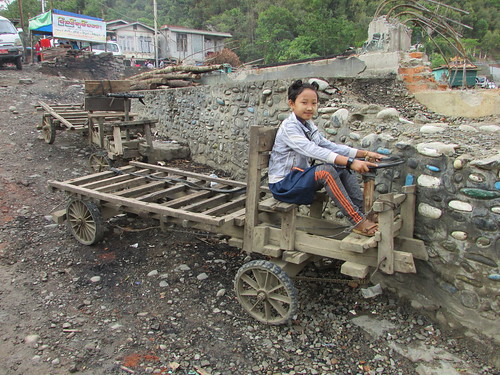
Back to Kalay 1st May 2018: Rhikhawdar, showing examples of the unpowered, steerable trucks used in the area.
We set off on our 119 km return to Kalay over what, I think, is the most remarkable road I've travelled on. After around 90 minutes, we stopped at a tiny village high up in the mountains with commanding views. The houses, either all-wood or wood with corrugated sheeting, perched right on the edge of the steep hillside below.
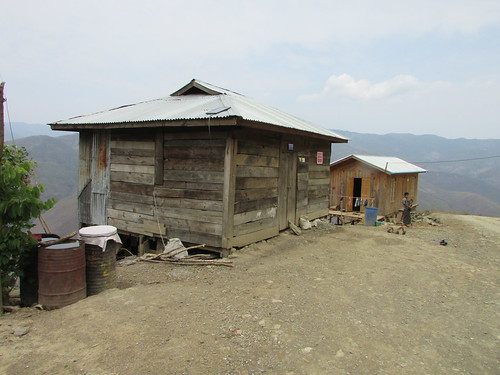
Back to Kalay 1st May 2018: "We stopped at a tiny village high up in the mountains with commanding views".
The Doctor and I admired a handcrafted wooden tricycle for a child. After a while, the owner came and gave us a demonstration, dragging the tricycle up a small slope then speeding downhill. The Doctor talked to one of the men. He was on childcare duties with a young baby slung in front of him in a baby sling. Nearby, a group of eight children of mixed ages played happily. This section of the route is, as yet, unimproved so, despite the frightening drops at the side of the road, there is no 'Armco' barrier. Occasionally, used steel drums used to transport road tar are filled with rocks and set up at the side of the road, particularly near hairpin bends. Generally, these are painted white to improve sighting.
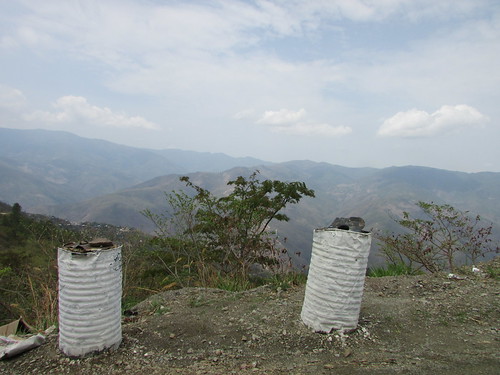
Back to Kalay 1st May 2018: Used bitumen drums as edge-of-road markers.
We came over the yellow-painted suspension bridge over the Manipur River then continued back to Tedim. We all went to a tea-shop about 11.45 a.m. where the monk was treated with great respect, seated at a separate table and promptly served with his lunch. Then, everybody else was served.
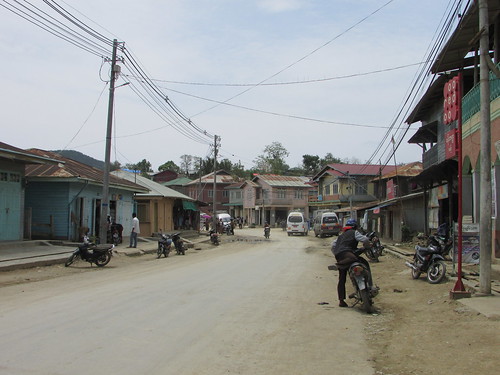
Back to Kalay 1st May 2018: View outside the teashop where we took lunch.
After lunch, we continued through the mountains, pausing briefly at a simple roadside stall selling plants. Once Hlaing Hlaing had completed her purchase, the journey continued to a viewpoint overlooking Mount Kennedy, the peak already shrouded in mist which would later descend to road level.
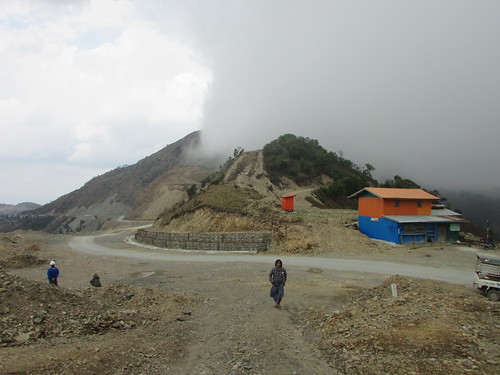
Back to Kalay 1st May 2018: Mount Kennedy, its peak already shrouded in mist.
A memorial had been placed here to commemorate the deaths of soldiers involved in skirmishes with Chin at the end of the 19th and early 20th centuries. Inscriptions were in Myanmar language, Chin language and English. On the other side of the road was a simple stone memorial commemorating the deaths of soldiers in World War 2.
Our convoy carried on but after thirty minutes we found ourselves stopped at the end of a short queue of vehicles. Ahead, rocks were coming down the high upper cliff, bouncing off the road and then careering down the lower cliff. At first, I thought it was a natural rock slide but then I spotted two excavators moving around at the top of the cliff and pushing rock and occasionally uprooted trees downhill.
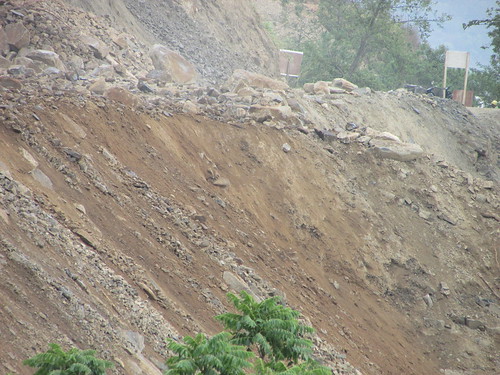
Back to Kalay 1st May 2018: Our road ahead completely blocked by fallen rocks.
At the end of the 30 minute work period, two massive front loading shovels moved along the road, one from near us, one from the other side of the obstruction. Within a few minutes, they had cleared a path through the rubble. Traffic in the opposite direction was the first to move but soon we were on our way again.
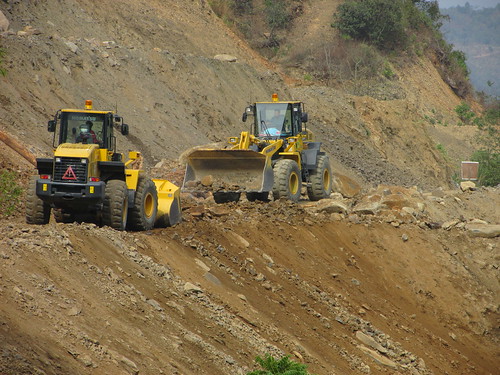
Back to Kalay 1st May 2018: Two massive front loading shovels shifting the rubble from the road.
The pick-up reached the Kalay Industrial Zone, to the north of the town, without further delay and we pulled up at a large vehicle repair garage where the crippled Monastery car was already parked.
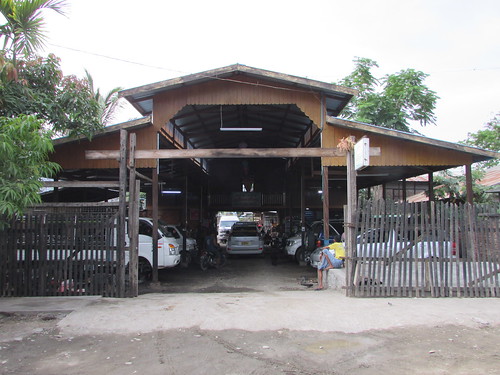
Back to Kalay 1st May 2018: The vehicle repair garage in Kalay Industrial Zone.
It took a while to make arrangements for a replacement air bag suspension unit to be shipped overnight from Mandalay and hire a car and driver for the following day whilst the monastery car was being repaired but, within an hour, the Monk, the Doctor and his wife and I were ferried in the monastery car to the Hotel Moe in Kalay which turned out to be an excellent choice. This was a modern, 5-storey building with electric lift and everything a European tourist might expect - and the internet worked, too.
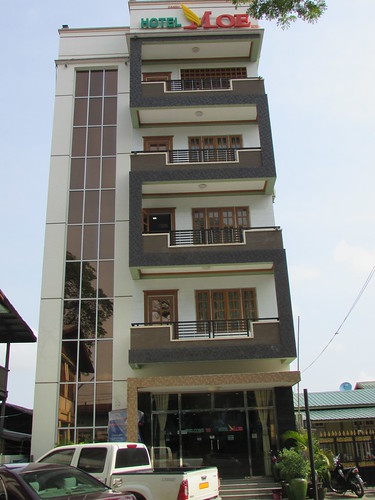
Hotel Moe, Kalay.
Related posts on this website
This is one of a series of posts describing my 13th visit to Myanmar.
The post Travelling again is the first post in the series.
Clicking on the 'Next report' link will show the post describing the next events. In this way, you may read about the trip in sequence.
Next report
Alternately, clicking on the 'All my Burma-2018 reports' link displays all the posts on this trip in reverse date-of-posting order.
All my Burma-2018 reports
My pictures
Back to Kalay 1st May 2018
All my pictures on this trip to Myanmar can be found at Burma 2018.
[Pictures linked 10-May-2018, minor edits and pictures embedded 8-Jun-2018]
Monday, 30th April 2018
Roused by the wooden 'bells' at 4.00 a.m., we saw the monks taking breakfast and performing their ablutions.
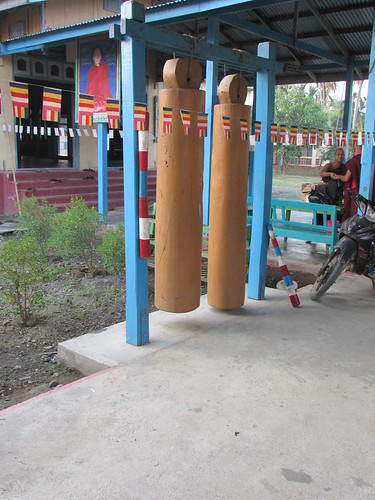
Sel-Taw-Oo Monastery: The wooden 'bells' which announce the start of the monastic day: 30th April 2018
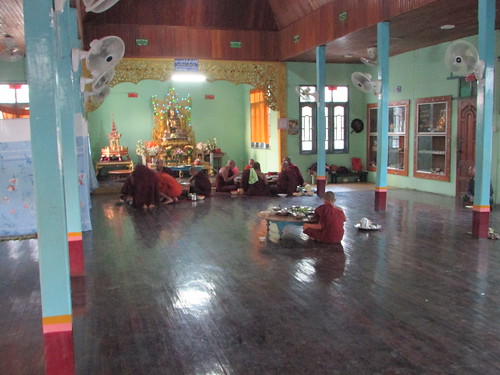
Sel-Taw-Oo Monastery: Monks taking breakfast. The curtained area on the left was our sleeping quarters: 30th April 2018
Befire we left Sel-Taw-Oo Monastery, we looked at the local rice mill. This was a delightful 'Heath-Robinson' affair and it will take me a while to understand the pictures I took. Outside the mill itself, there was a huge pile of rice husks. Even these can be used as a fuel, instead of wood.
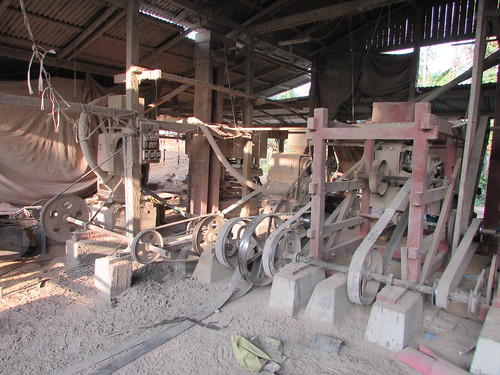
Sel-Taw-Oo Rice Mill: 30th April 2018
Then we headed along a minor road through paddy fields of mainly sunflower. In 2015 unusually heavy rain caused serious flooding and many villagers had to evacuate to higher ground. The Doctor said the aftermath was 7 feet of mud which damaged crop growth.
We passed through a number of villages, each with a Christian church. Many of the Chin people are Baptist (of one or other of the many ‘flavours’ of this denomination). Eventually, we came to the main road into Kalay and stopped at a Tea Shop where various items of pastry were being prepared in woks or griddles, all wood fired. I thought that this was one of the cleanest tea shops I’d seen in Myanmar and we took breakfast here.
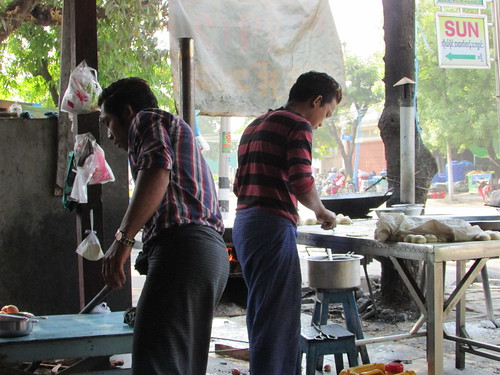 Breakfast in preparation at a Kalay Tea Shop: 30th April 2018
Having stopped in Kalay for petrol we then met up with a charming lady, Hlaing Hlaing Htay, her husband Ko Thein Shwe and her children who were waiting in their pick-up for us to pass. Everybody we met was a friend or relative of our Monk from Bagan, but I wasn't able to sort out the details. In convoy, our car and the pick-up took a left turn onto the mountain road which generally heads west. When we were a few hundred feet above the plain on which Kalay is built, we stopped at a viewpoint. I was fascinated by all the memorials there, partly because they were all Christian, partly because, although there were fragments of English, most were written in the Chin language which uses the Roman alphabet, rather than the characters used to write the Myanmar language.
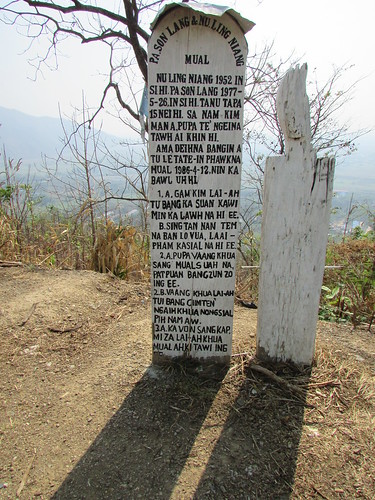
Memorials in the Chin language, overlooking the plain.
Our route then continued into the mountains. Sometimes the road followed the contours of the hills, snaking left and right, sometimes machines had cut a ledge for the road where the mountainside was too steep. As well as twisting left and right, we were often going downhill but the overall trend was upwards, upwards.
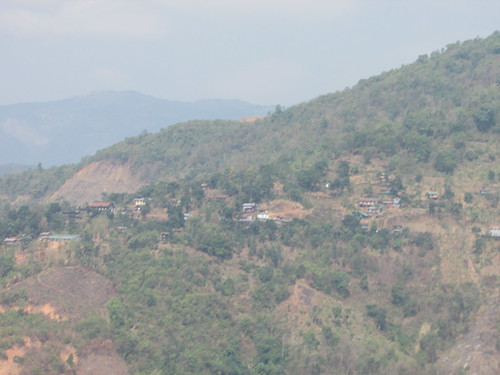
Visit to Chin State 30th April 2018: The road we were on threaded its way through the mountains.
There were frequent signs of the road improvement programme being provided by the Japanese organisation J.I.C.A. under its friendship programme. Since there was normally a precipitous drop on one side of the road and a rock face on the other, modern 'Armco' style barriers had been installed on the side with the drop, periodically fitted with coloured metal markers, red on one side, yellow on the other. The rock face showed the signs of having be shaped by a large excavator. Sometimes a retaining wall had been built, extending upwards from the roadway and there was often a substantial concrete channel to run water downhill to the nearest natural channel running down the mountain side. Each channel was culverted to cross the roadway, necessitating retaining walls on both sides of the roadway.
We passed a number of villages. Their approach was heralded by coming across large woodpiles neatly stacked at the roadside. The buildings themselves were generally of a different style - wooden-framed, clad with horizontal planks and sometimes windowless. The ubiquitous 'tin roof' of galvanised corrugated iron sheeting provided a durable roof. This was a design adapted for the much lower temperatures encountered at higher altitudes, and remined me of parts of Tibet. The Chin people, too, differed in appearance from the typical Burmese, being darker-skinned and often with a rather fierce appearance.
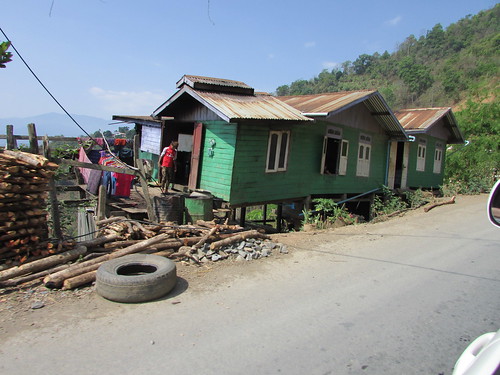
Visit to Chin State 30th April 2018: Typical wooden housing, built on wooden piles on the mountain side, with the woodpile on the left.
Then, we stopped at the end of a queue of waiting vehicles. Up ahead, I could see a large excavator gouging the cliff face and blocking the road with mounds of stone in the process. Apparently, the roadbuilders are given 30 minute 'slots' to work on gouging the cliff face. Next, loading shovels clear a path through the excavated rock for vehicles then finally one-way traffic is instituted over the narrowed section. While we were waiting, the Doctor chatted to a group of male and female roadbuilders laying rocks to widen the carriageway.
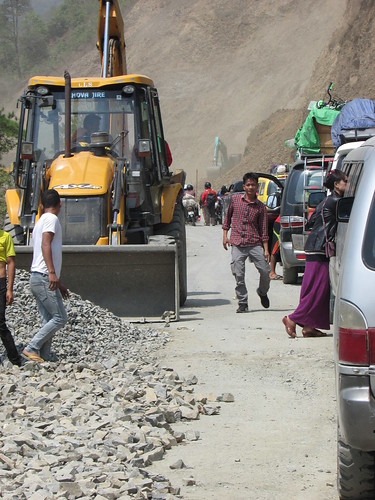
Visit to Chin State 30th April 2018: An enforced wait as a blue-painted excavator gouges the mountain side during road improvements.
Eventually, we were let through and we continued until 11.30 a.m. when we stopped so that the monk could eat his second, and last meal of the day, which had been pre-prepared and packed in metal multi-section food containers and a plastic basket. The family from the pick-up squatted on the ground nearby to eat their picnic.
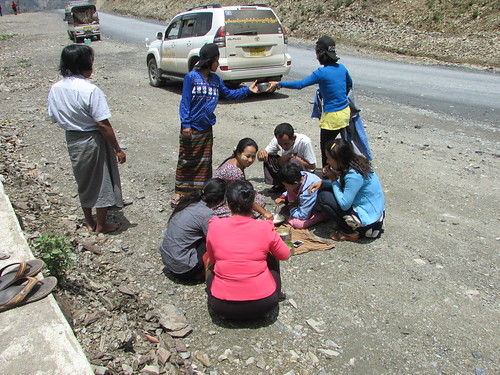
Visit to Chin State 30th April 2018: A roadside packed lunch high in the mountains.
When we reached Tedim, our elevation was 5,600 feet above sea level so we made a photographic stop at a viewpoint next to a petrol station.
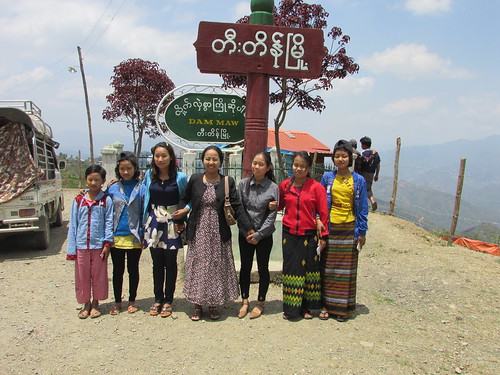
Hlaing Hlaing Htay and her children at Tedim.
We continued but the tarmac road soon gave way to graded and rolled rock and the ride wbecame significantly less comfortable. After a while there were signs of problems with our vehicle and each bump in the road triggered a slow up and down motion which could throw passengers quite violently around. We stopped and a failed suspension air bag was diagnosed but we were in a remote location so there was no alternative to carrying on although nobody enjoyed it. I ended the day was in a fairly bad way, aching and bruised.
We crossed a river on an imposing yellow-painted suspension bridge and eventually came to Rihkhawdar where a rusty truss bridge on a side road led to the other side of the river, which is in India. Our journey from Kalay had been around 119 km.
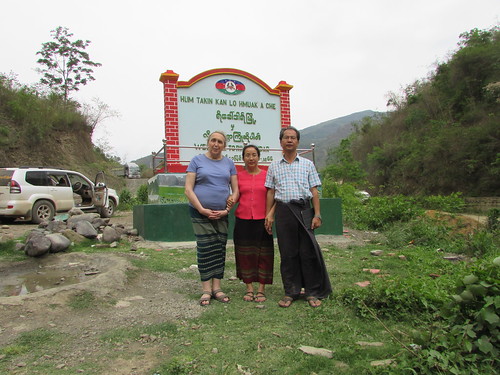
Visit to Chin State 30th April 2018: Doctor Hla Tun, his wife and Jan on arrival at Rihkhawdar.
We paid a brief visit to a small monastery but as there were no monks present, our visit was confined to talking to a group of men working around the monastery garage. Our final destination for the day was a few miles away at a small, pretty lake called Rith Lake. There was a cafe and a number of chalets.
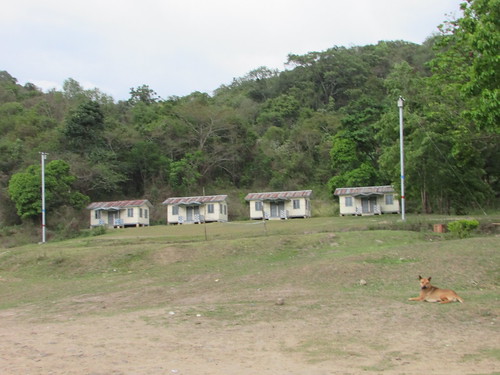
Visit to Chin State 30th April 2018: The chalets overlooking Rith Lake.
Apparently, with the border so near, it's a popular spot for Indian tourists. The Doctor secured two rooms, one for me and one for himself and his wife. Later the pick-up arrived so there was an extensive picture-taking session. The chalets themselves were typical guest house standard with wooden beds and a hard mattresses about 30 m.m. thick. A small extension at the rear of each chalet featured a Western-style flush toilet, although washing facilities were confined to the usual large plastic bucket which the guest re-filled as required from a cold water tap mounted above. After a meal in the cafe, the owner started his petrol electric generator so there were electric lights and I was able to re-charge my various electrical items. I was very content.
Related posts on this website
This is one of a series of posts describing my 13th visit to Myanmar.
The post Travelling again is the first post in the series.
Clicking on the 'Next report' link will show the post describing the next events. In this way, you may read about the trip in sequence.
Next report
Alternately, clicking on the 'All my Burma-2018 reports' link displays all the posts on this trip in reverse date-of-posting order.
All my Burma-2018 reports
My pictures
Visit to Chin State 30th April 2018
All my pictures on this trip to Myanmar can be found at Burma 2018.
[Pictures linked 10-May-2018, pictures inserted 31-May-2018, minor changes and more pictures inserted 7-Jun-2018]
Sunday, 29th April 2018
On Sunday morning, there were about twenty patients carried forward to a 'short' Sunday morning list.
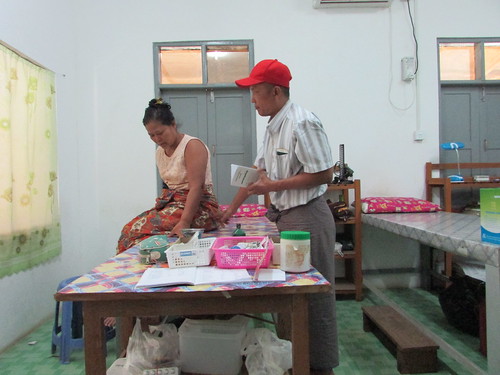
Bagan Medical Clinic 29th April 2018
However, there seemed to be some more complex issues amongst them and it was after 2.00 in the afternoon before the Doctor completed the last case and took a light lunch.
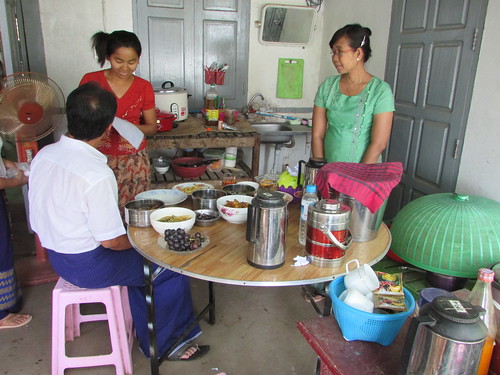 Bbr>
Lunch at Bagan Medical Clinic before departing for Chin State
Bbr>
Lunch at Bagan Medical Clinic before departing for Chin State
During the morning, the Doctor's wife had arrived from Yangon, for we were about to start a sightseeing trip to Chin State. Earlier in the year, when I told the Doctor I was planning a trip to Chin State, he insisted he would make arrangements on my behalf. The kind monk who manages the clinic has friends in Chin State so it had been decided that the monk, Doctor Hla Tun, his wife and I would make the visit in the Monastery/Clinic car, with one of the monastery drivers.
The Doctor made up a large box of medication to take with us and we set off on the familiar road to Nyaung Oo. After Nyaung Oo, we headed north east on the Myitnge Road and the road was new to me. Photography from a moving car is rarely satisfactory so I confined myself to making shaky notes which I still have to decipher. We crossed the Ayeyarwaddy on the Pakokku Bridge, a long multi-span truss design which I'd sailed under when aboard 'Road to Mandalay'. Before Pakokku itself, we turned left onto the road to Kalay, some 376 km distant.
It was dark before we arrived at our destination for the night which turned out to be Sel Tan Oo Monastery where our monk had arranged accommodation overnight. In the large assembly room where monks have their meals, a corner had been temporarily screened-off and two large mosquito nets had been erected, one for me, one for the Doctor and his wife. A pillow and blanket had been provided for each of us.
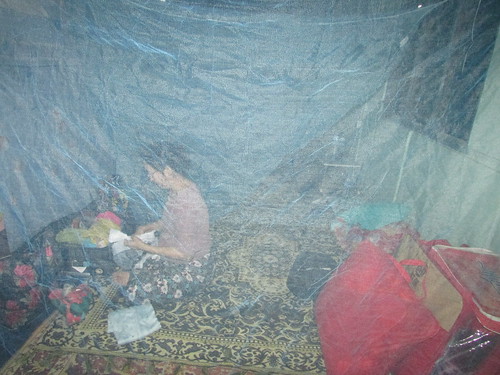
Our sleeping accommodation in Sel Tan Oo Monastery, with Mosquito nets deployed.
The only problem? Monastery life started at 4 a.m. the following morning with the sounding of a deep-toned wooden bell just outside.
Related posts on this website
This is one of a series of posts describing my 13th visit to Myanmar.
The post Travelling again is the first post in the series.
Clicking on the 'Next report' link will show the post describing the next events. In this way, you may read about the trip in sequence.
Next report
Alternately, clicking on the 'All my Burma-2018 reports' link displays all the posts on this trip in reverse date-of-posting order.
All my Burma-2018 reports
My pictures
Bagan Medical Clinic and into Chin State
All my pictures on this trip to Myanmar can be found at Burma 2018.
[Pictures linked 10-May-2018, pictures inserted 28-May-2018]
Saturday, 28th April 2018
I slept well and decided to walk around the monastery compound. I found a large party of Japanese tourists arriving by pony cart to visit the historic wooden monastery of Nat-Taung Kyaung at Taung Be.
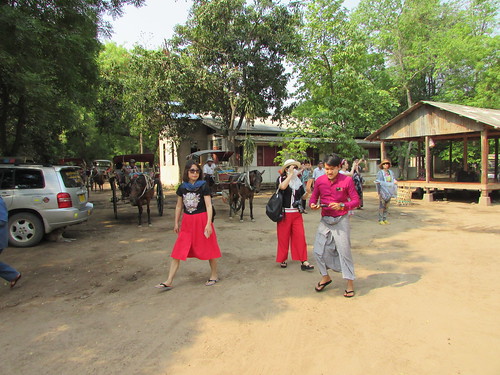
Bagan Medical Clinic Saturday 28th April 2018: Japanese tourists arrived in pony carts to visit the old wooden monastery, Nat-Taung Kyaung.
The previous year, I had only been able to survey the outside of this 200-year old building but I knew from the internet that repairs were in hand so I was pleased to find that it was possible to go inside and determined to make a visit myself later.
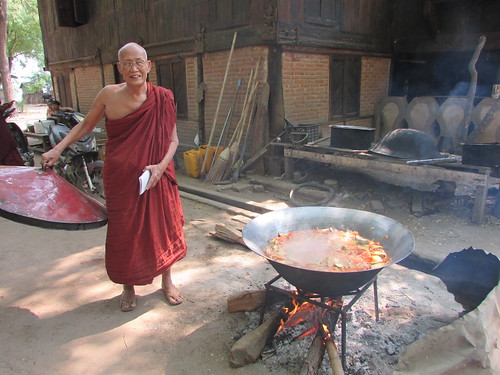
As usual, I found the Abbott checking on the preparations for the free lunch. Two young monks were ‘dicing’ vegetables with scissors whilst an older man was tending the wood fires.
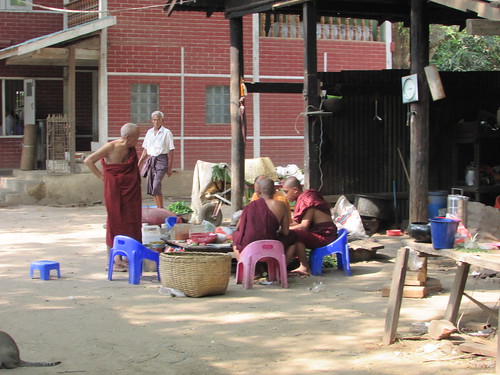 Bagan Medical Clinic Saturday 28th April 2018: Lunch preparation
In the Doctor’s consulting room, I observed the variety of patients for a time. Mobility problems and joint pain are common, particularly amongst the elderly, but all kinds of ailment present themselves.
On Saturday, the free lunches were being presented by a relative of the Taung Be Abbott who is Abbott of a monastery in the Mandalay area. In addition to the 330 registered patients, lunches are given to accompanying relatives and friends so the stream of eager diners seemed endless.
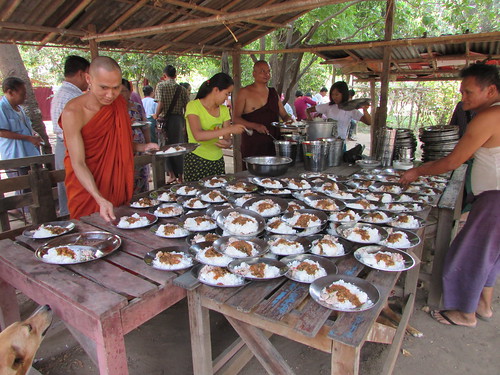
Bagan Medical Clinic Saturday 28th April 2018: Free lunches, ready for distribution.
In the afternoon, I visited the richly-carved wooden monastery of Nat-Taung Kyaung which lies just a few yards beyond Bagan Medical Clinic.
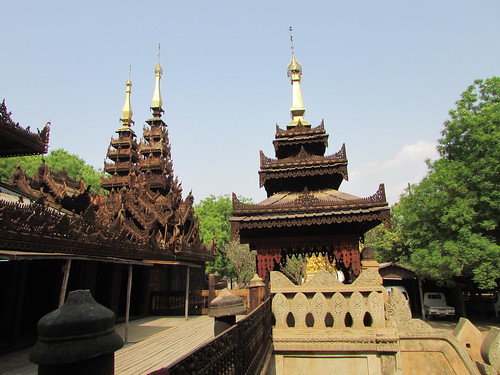
Nat-Taung Kyaung Monastery: Saturday 28th April 2018
Tired by my perambulations, I returned to the Doctor's Consulting Room to watch, although from time-to-time, I found myself falling asleep briefly, much to the amusement of the Doctor's female assistants.
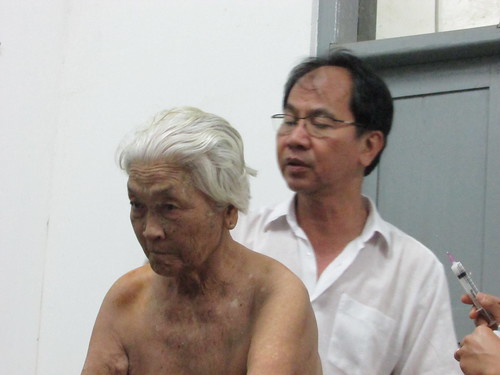
Bagan Medical Clinic Saturday 28th April 2018
The Doctor carried on to 7.30 p.m. and then took dinner with his assistants and the writer before continuing. I went to bed not long after dinner, thoroughly shattered, and I'm not sure what time the Doctor eventually finished but I think there were about twenty patients carried forward to a 'short' Sunday morning list.
Related posts on this website
This is one of a series of posts describing my 13th visit to Myanmar.
The post Travelling again is the first post in the series.
Clicking on the 'Next report' link will show the post describing the next events. In this way, you may read about the trip in sequence.
Next report
Alternately, clicking on the 'All my Burma-2018 reports' link displays all the posts on this trip in reverse date-of-posting order.
All my Burma-2018 reports
My pictures
Bagan Medical Clinic Saturday 28th April 2018
Nat-Taung Kyaung Monastery, Bagan (includes pictures from 2017)
All my pictures on this trip to Myanmar can be found at Burma 2018.
[Pictures linked 10-May-2018, pictures inserted 28-May-2018]
Friday, 27th April 2018
The Bagan Medical Clinic opens every weekend of the year except for Thingyan, the Water Festival celebrating the Lunar New Year and the following weekend. In 2018, Friday 27th April represented the first day that the Clinic would be open after the two week shutdown. The previous evening, the Doctor had been told by telephone that 150 patients had already arrived and registered and that 60 of those were from Chin State.
So the Doctor and I were aware, as we left his house in Yangon by taxi at 5.30 a.m. for the airport, that he was in for a busy weekend. The Doctor is always keen to save Clinic expenditure, so he had taken advantage of a special, reduced air fare to Nyaung Oo available to him. But, if I had accompanied him, my fare, as a foreigner, would have been expensive so, instead, he had booked me with a different airline on a flight ten minutes later.
Another sign of the changes since my first visit was that we left from the modern Domestic Terminal, similar to hundreds of airports world-wide, in marked contrast to the rather eccentric arrangements of 2008. I counted twelve ATR-72 turbo-props from various competing airlines on the Domestic Apron.
Both flights were on time and I met the Doctor in the Baggage Hall at Nyaung Oo. Simpler, manual arrangements for handling passenger’s luggage still suffice here. We were met by one of the Clinic staff and driven to the Clinic. Even in the few months since my last visit, a number of new hotel building projects were evident. Unfortunately, the rise in planned accommodation has coincided with the collapse of foreign visitor numbers following international consternation at around 750,000 Rohingya Muslims fleeing to Bangladesh in what has been characteristed by the United Nations as ‘Ethnic Cleansing’.
The Clinic was buzzing with activity and I was able to greet many old friends. The Doctor immediately started Consultations. During Friday, a further 230 patients arrived and registered. The first 160 arrivals were added to Friday’s list, making a commitment to 310 consultations for Friday. The remaining 70 patients formed the start of Saturday’s list, but this number was expected to swell with more patients arriving on Saturday.

Bagan Medical Clinic Friday 27th April 2018: The main waiting area faces the original clinic building of 2011, now provided with an illuminated LED sign.
I toured the busy compound, noting the changes and examining the progress of various building works although there were no builders at work that day.
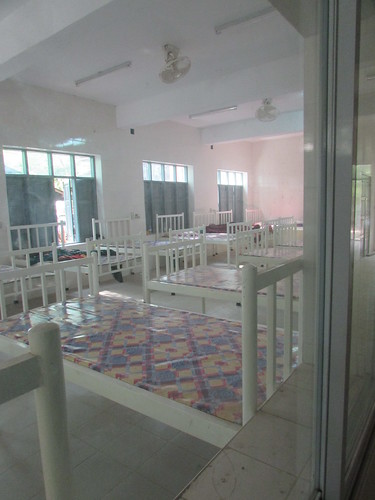
Bagan Medical Clinic Friday 27th April 2018: The 28-bed recovery unit is nearing completion.
I found the Abbott in the open-air kitchen area and we greeted one another warmly, although he has no English and I have no Myanmar language. He was checking on the progress of vegetable preparation and cooking (over wood fires) for the free lunch which would be given to patients and their companions.
Bagan Medical Clinic Friday 27th April 2018: The Abbot, checking on progress of lunch for the patients
For long periods, I sat-in with the Doctor observing, as always amazed at his ability to process three patients at a time with his lady assistants, together with frequent telephone calls and review of patients returning with test results or E.C.G. printouts.
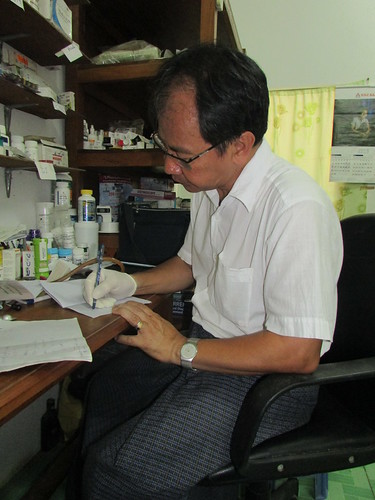
Bagan Medical Clinic Friday 27th April 2018: Doctor Hla Tun.
At 11.30 a.m., the Doctor suggested I go to see the lunch donation. As soon as the announcement was made over the public address, a long queue of patients formed at the donation point where a number of staff were rapidly making up meals on stainless steel plates.
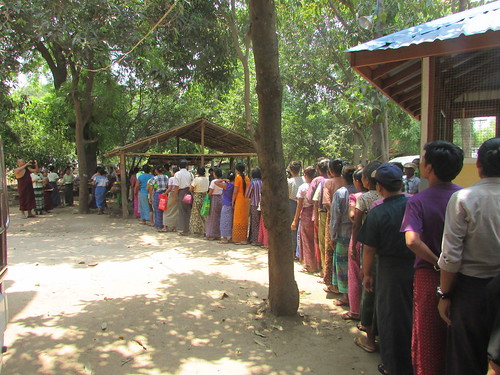
Bagan Medical Clinic Friday 27th April 2018: Queuing for the free lunch.
The final handing of each plate the recipient was being done by the Abbott. After dealing with, as I thought, the majority of lunches the Abbot invited me to take over whilst he observed benignly. But the people kept coming, until we were literally scraping the saucepans to complete the last few meals, with a small number of ‘seconds’ where requested. A wonderful, joyful event illustrating one of the Buddhist tenets I admire.
Then I spent more time in the Doctor’s consulting room as the ‘tide of humanity’ passed through.
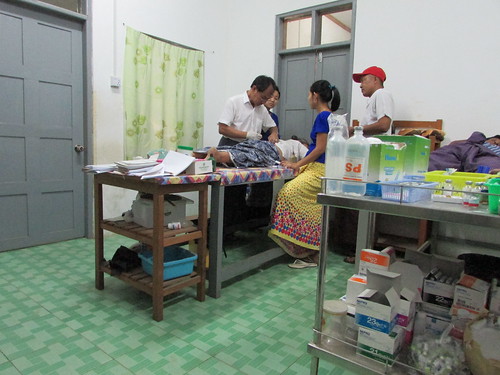
Bagan Medical Clinic Friday 27th April 2018
With so many patients to see, the Doctor did not stop for lunch but just ‘snacked’. His assistants took it in turns to break for a quick meal, and I was summoned for my ‘special menu’ of congee, plain omelette and Coca Cola.
During the afternoon, there was a brief thunderstorm. Shortly afterwards, at 4.40 p.m., the electricity went off. It was restored a minute or two later and, when I went outside to check, I was delighted to find the package generator running the site, as intended.
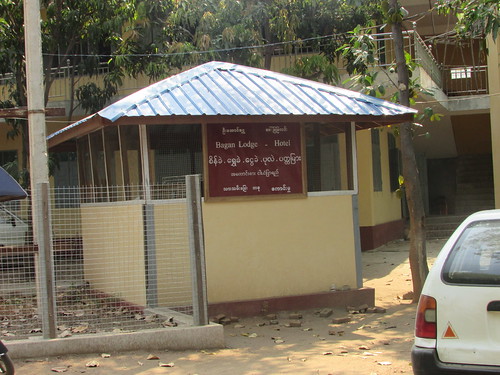
Bagan Medical Clinic Friday 27th April 2018: The vital Standby Generator was donated by a local hotel.
After half an hour, the mains electricity must have been restored and there was a brief ‘blackout’ as we switched back to the mains.
At 7.0 p.m.the Doctor paused briefly to take dinner with his assistants and the writer before continuing until after midnight. I’m afraid I took to my bed much earlier.
Related posts on this website
This is one of a series of posts describing my 13th visit to Myanmar.
The post Travelling again is the first post in the series.
Clicking on the 'Next report' link will show the post describing the next events. In this way, you may read about the trip in sequence.
Next report
Alternately, clicking on the 'All my Burma-2018 reports' link displays all the posts on this trip in reverse date-of-posting order.
My pictures
Bagan Medical Clinic Friday 27th April 2018
All my pictures on this trip to Myanmar can be found at Burma 2018.
[Pictures linked 10-May-2018, pictures inserted 28-May-2018]

