skip to main |
skip to sidebar
Events of Saturday 22nd April 2017
Before 7.00 a.m., the people carrier had dropped us and our luggage at the house of the Doctor's relative who had accompanied us.

A street scene in Dawei.
A walk to the nearby market was decided upon. The range of fruit, vegetables, fish and meat on offer in Myanmar never ceases to amaze me, although the conditions would probably cause a European food inspector to expire on the spot.
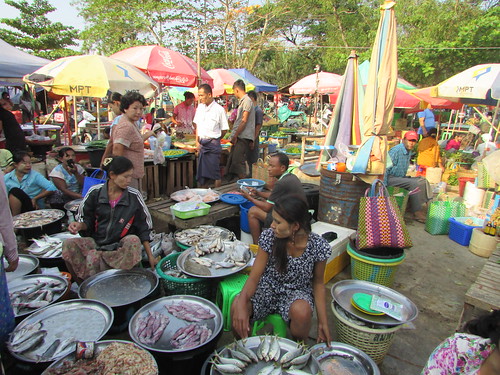
Around Dawei: Dawei Market.
After our market tour, we stopped at one of the Tea Houses that are such a feature of Myanmar life, where we took breakfast. By the time we returned to the house, a Toyota saloon and driver had appeared. With the Dawei relative acting as our guide, we set off to see a little of Dawei.
Our first visit was to a famous wooden Buddhist pagoda with a natural spring believed to have health giving properties.

Around Dawei: Visiting a local pagoda.
Another Buddhist pagoda of wooden construction featured a series of old paintings depicting scenes from the Life of Buddha.
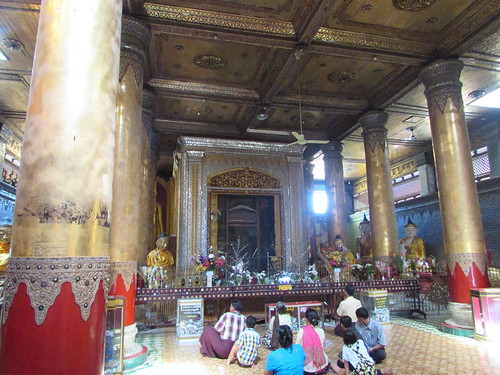
Around Dawei: Visiting second pagoda.
Up in the hills, we visited a large, reclining Buddha image, protected from the weather (as at similar sites) by a huge steel framework supporting a massive roof.
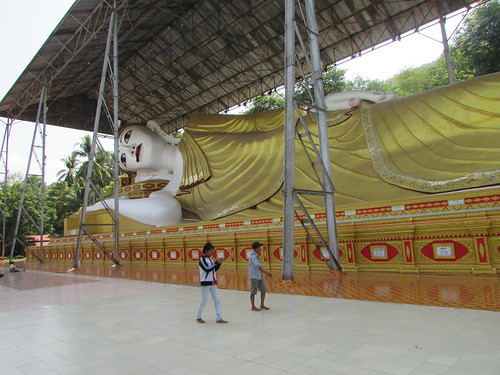
Around Dawei: Reclining Buddha image.
Various 'flavours' of the Baptist Church remain active in Myanmar. We visited the Karen Baptist Church, founded in 1922 and dedicated as a memorial to Marion Sutton.
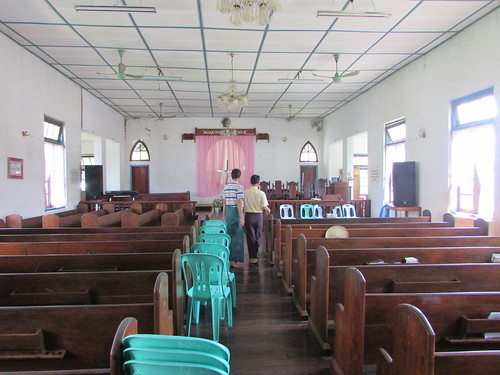
Karen Baptist Church, Dawei.
We paused at a large British Colonial style building now serving as Dawei Education College. Whilst schools were currently on their summer break, the college grounds were crowded with teachers undertaking training.
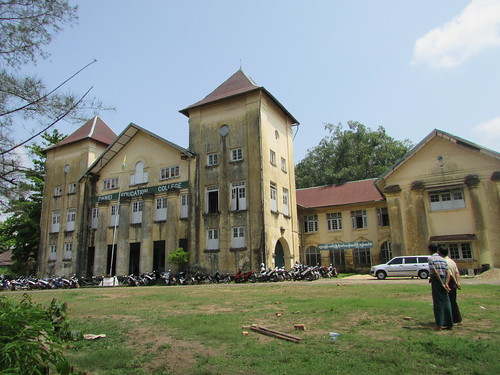
Dawei Education College.
Finally, we visited perhaps the most famous Buddhist complex in the area at Pha Yar Gyi, including the Shwe Taung Sar Pagoda. There's a website here.
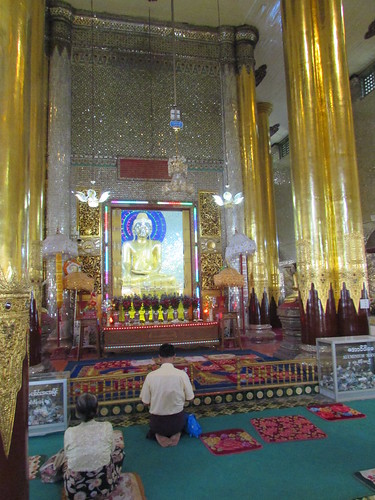
Shwe Taung Sar Pagoda.
Back in the town centre, we took lunch at the Daw San Family Rice and Curry Shop. The food and service was excellent but I was fascinated that a traditional wooden building is in course of being rebuilt into a reinforced concrete structure, with all sorts of trip and other hazards whilst this work proceeds.
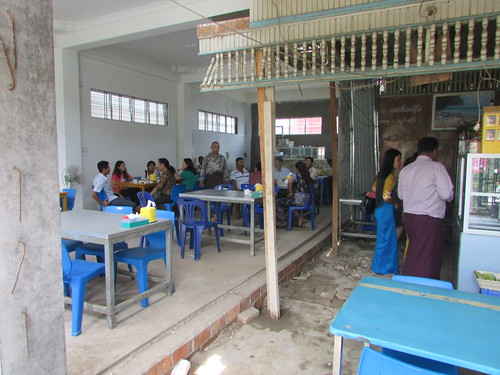
Around Dawei: Daw San Family Rice and Curry Shop (new construction on left, old on right).
I discovered that we were to spend the weekend at wooden beach cottages at Maung Makan Beach so, with our luggage transferred to the Toyota, we set off through the hills to reach the beach, a beautiful white sand expanse fringed with palm trees. But also quite popular with day trippers, as attested by the number of stalls and beach restaurants we passed on an exploratory walk.
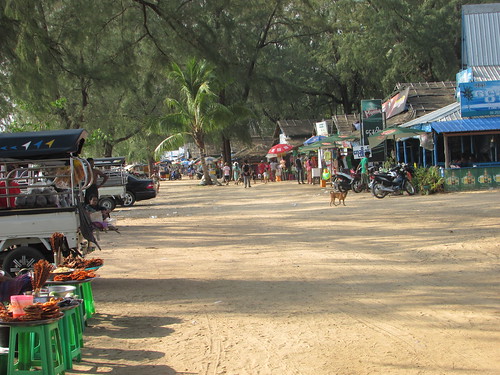
Maungmakan Beach.
We occupied two of the four or five cottages which had been erected on a private strip of land and I was allocated my own cottage. It was a lovely spot but, although my cottage had a raised bed, the plywood base with a thin sleeping mat on top was, shall I say, rather firm for my taste.
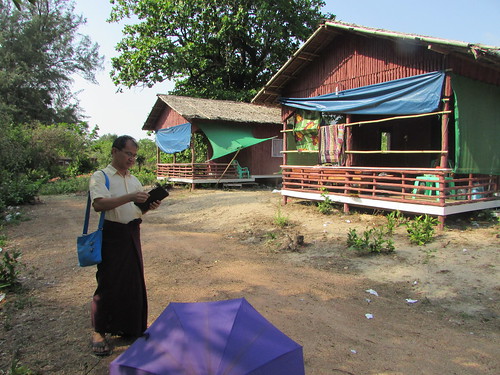
Maungmakan Beach: I was given the cottage in the background to myself.
I managed a paddle in the ocean on Saturday evening but Dr. Hla Tun and his Dawei relative had a lengthy swim. Later, we all had dinner at a beach restaurant near our cottages. Fish was on the menu!
Related Posts on this Website
Next post describing the 2017 Burma trip.
All 2017 Trip posts.
My Pictures
Where necessary, clicking on an image above will display an 'uncropped' view or, alternately, pictures may be selected, viewed or downloaded, in various sizes, from the albums listed:-
Around Dawei.
Maungmakan Beach.
All my albums for Burma 2017.
[Minor additions: 1-May-2017, Links to pictures added 2-May-2017, Pictures added 12/13-Jun-2017]
More of Friday 21st April 2017
We actually left Doctor Hla Tun's home at 3.45 p.m. In the car were the Doctor, his elderly mother, his relative from Dawei (who had made the local arrangements), the writer and his elder son (to return the car having dropped us off).
In fairly-heavy traffic, it took us about 45 minutes to drive across Yangon to the Highway Bus Terminal situated in the east of the city. Here, all was the usual chaos as cars, taxis, motor cycles and the trunk coaches themselves vied for space to enter or leave through one of four Gates. Somehow, we found our bus and unloaded our luggage and a couple of large cartons of goods to be donated when we arrived in Mon State.
 Doctor Hla Tun and his Mother with some of our luggage prior to boarding the coach.
The bus was a huge, modern Scania painted white but with most of the bodywork (and windows) disfigured by computer-printed self-adhesive decals in the modern way. The text was in a mixture of English and Myanmar characters. However, our vehicle was an example of restrained good taste in self-advertising, compared with some of the others. Like all buses in Myanmar, ours came with a Driver and Driver's Assistant. The assistant, a wiry youth with 'two-tone' dyed hair in the fashion currently adopted by many young men in Myanmar, was stowing passengers' luggage in the large hold of the bus under the instructions of a third member of the team, a dark-haired young man whose status was indicated by his coach company shirt with epaulettes, a name badge and a clip board with a passenger seating plan for the journey. The Doctor had arranged two adjacent seats for me, for which I was grateful. The seating pitch was certainly suited better to the oriental frame rather than my larger, European build.
To my surprise, at five p.m., the advertised departure time, the bus started to extricate itself from the loading point and enter the throng of traffic entering and leaving the bus terminal. After ten minutes of stuttering progress, we were headed east on the dual carriageway out of Yangon.
Then, we suddenly turned right onto a suburban street and the explanation was soon apparent as we turned into a yard used by our bus company with a number of similar buses (and a few less-distinguished) being prepared for future journeys. The yard area had once had a roof of green, woven-plastic matting suspended from a system of overhead cables which had long-since been shredded by the wind, leaving an erratic series of streamers looking like tattered flags. A group of about eight young men workers started carrying large plastic containers, two at a time, to our bus, stowing them in our luggage hold. We took on thirty of these containers, apparently full of diesel fuel. I noticed that a small plastic bag had been laid across the filler of each container before screwing-on the cap, apparently to 'seal' the threads and prevent loss of fuel in transit.
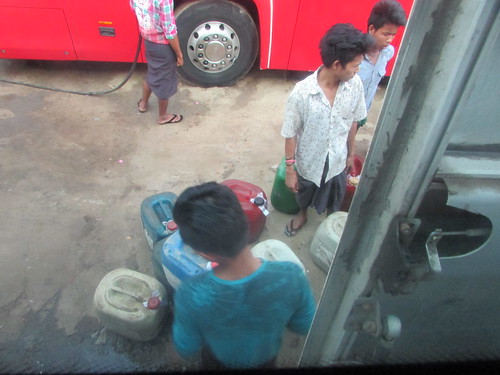 By Coach to Dawei: Loading plastic containers of diesel fuel.
After a few minutes, this unexpected operation was complete and the coach made its way back to the dual carriageway which then turned into a modern highway with an excellent surface towards Bago, along which we made good speed. All too soon, we were back on single carriageway roads where speed dropped but these Highway Buses are driven quite aggressively to maintain their schedules.
As we continued east and then south, darkness descended and the approaching headlights became quite blinding. Our driver didn't see any need to slacken speed, even when overtaking on the wrong side of the road.
I knew from previous trips that there was a major restaurant stop for coaches near Kyaikto and, after around three hours travelling, we stopped for 30 minutes so that passengers could answer the call of nature or take food. With everybody collected back onto the bus, we continued our long journey. We dropped a couple of passengers off at a roundabout on the approach to Mawlamyine and were well south into the mountains before we made another refreshment stop.

By coach to Dawei: Refreshment stop in the mountains.
The road became quite exciting: narrow and twisting and, of course, we met large vehicles heading north at the most inconvenient locations. Nor was this the only challenge. The route was receiving major roadworks to improve and widen the carriageway so at times we were travelling on a temporary surface of rolled stone before tarmac was applied.
I rather lost track of time on this seemingly interminable journey and managed only short periods of sleep. When we stopped again and alighted from the bus, I was initially puzzled because I could see no hint of a restaurant. Then I spotted a sign saying (in English and Myanmar language) "Welcome to Tanintharyi Division". The degree of independence some areas of Myanmar have been given means that immigration checks may be provided, as here moving from Mon State to Tanintharyi. Local people offer their Identity Card for inspection, whilst foreigners submit their passport, to have the details solemnly entered in a log book. The check seemed friendly enough but it was odd to be part of a stream of pedestrians walking across the border in the middle of the night, crossing a similar stream heading in the opposite direction. We then had to wait at the roadside until our bus caught up with us, having been let through a single lane barrier.
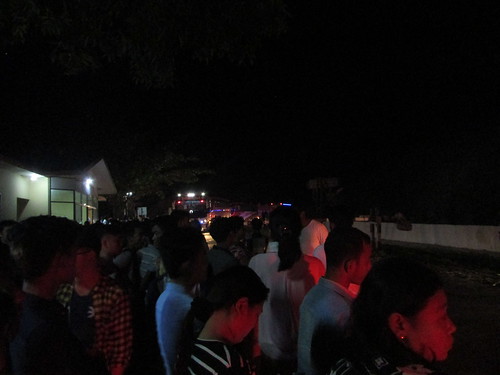
By Coach to Dawei: Waiting for our coach at the immigration station.
The major road works continued after the border crossing and our final stop was at a restaurant high in the mountains shrouded in mist, although it was still warm enough to walk around without a jacket.
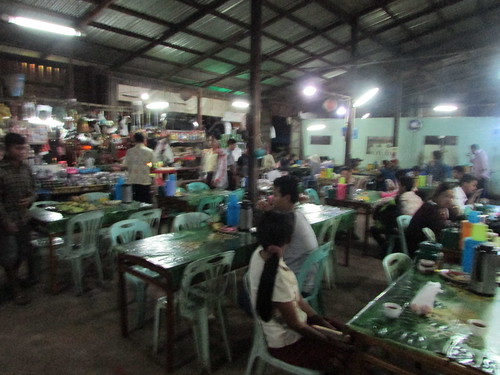
By Coach to Dawei: Our final refreshment stop.
Then, the sky lightened and by the time we arrived at Dawei Bus Station, it was fully light after our marathon of more than thirteen hours. The expected chaos reigned but, somehow, our luggage was extracted and we were seated in a people carrier with some complete strangers on a sort of shared taxi arrangement which took us into the town.
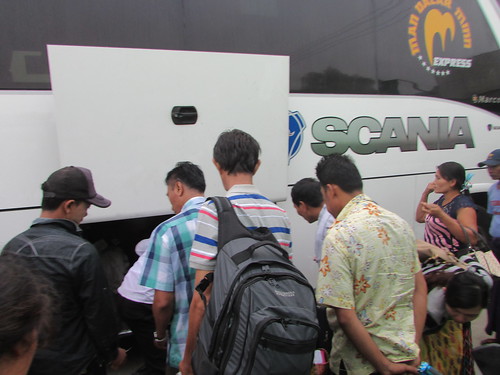
By Coach to Dawei: Arrival at Dawei Bus Station.
Related Posts on this Website
Next 2017 Trip post.
All 2017 Trip posts.
My Pictures
Where necessary, clicking on an image above will display an 'uncropped' view or, alternately, pictures from may be selected, viewed or downloaded, in various sizes, from the album listed:-
By Coach to Dawei.
All my albums for Burma 2017.
[Pictures added: 2-May-2017, 6-Jun-2017]
Events of Friday 21st April 2017
Breakfast was taken at 7.00 a.m. Doctor Hla Tun had planned for us to set off by coach in the afternoon, on the long journey to Dawei, in the south of Myanmar, some 600 km from Yangon. Accordingly, I thought it might be prudent to have a restful morning at the Doctor's house, working on the computer and trying to compress enough changes of clothes for the trip into a small rucksack, which I attempted without conspicuous success. I was summoned to lunch at around 11.15 a.m., a time when at home I would be thinking about a morning cup of tea! Various departure times were mooted, which finally settled at 3.15 p.m. and I tried to prepare myself for another long journey.
Related Posts on this Website
Next 2017 trip post.
All 2017 Burma Trip posts.
My Pictures
Pictures from may be selected, viewed or downloaded, in various sizes, from the collection listed:-
All my albums for Burma 2017.
Events of Thursday 20th April 2017
Emirates gave me an excellent journey to Yangon, both in the air and on the ground. Emirates operate a 'hub' structure, so the first flight was Birmingham - Dubai, followed by a Dubai - Yangon 'leg', both operated by Boeing 777-300ER. The flight to Yangon was then going on to Hanoi. We were a few minutes early arriving in Yangon, using the new section of terminal which had still been under construction on my last trip. Formalities were quickly completed, my luggage arrived promptly and my host, Doctor Hla Tun, was waiting for me. We drove through fairly heavy traffic to the Doctor's home where I was made very welcome.
Lunch was the usual friendly affair, with my food and portion sizes adapted to my preferences, as discovered by my hosts during my previous visits. But, however much I eat, there is always encouragement to have an extra portion, or try an extra item. The legendary hospitality of the people of Myanmar has not been exaggerated.
It's become a ritual that I travel on Yangon's Circle Line suburban railway on my visits and I decided that, despite being fairly tired after the long trip from England, I would make a railway trip in the afternoon since, the following day, we would be setting off by coach to the south of Myanmar. The Doctor insisted on taking me to Yangon Central Station and making arrangements for my return to his home. Over the years, I've used clockwise Circle Line trains more often than anti-clockwise, so I decided to wait for the next anti-clockwise service. The wait was longer than planned but there's always train movements around the station worth watching.
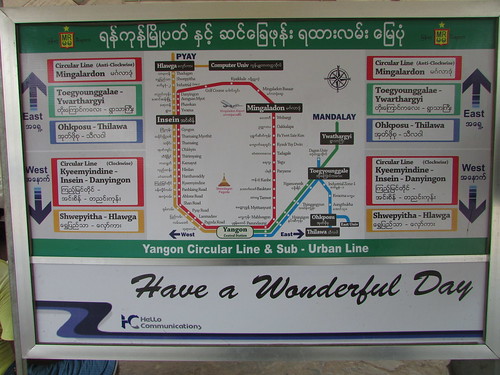
Yangon's Circle and Suburban Lines.
A major project has started under which Japan will modernise the Circle Line and I was eager to look for visible signs of this work and record the earlier methods of working before it changes.
When my train arrived, I was pleased that it was locomotive-hauled stock, with one of the elderly, hard-working 900 h.p. Bo-Bo locomotives at the front (I failed to get the number, sorry). Circle Line trains were formerly all locomotive-hauled but, as I've documented in earlier posts, second-hand Japanese Diesel Multiple Units now share the work. Late afternoon, we were well into the rush hour and there were lots of standing passengers.
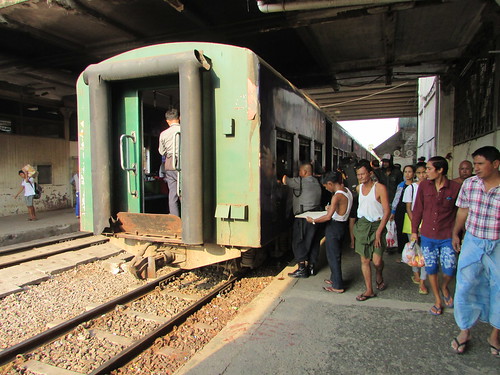
Circle Line - 2017: Yangon Central Station.
It didn't seem to discourage the food and drink hawkers who work their way up and down trains, noisily shouting their services. Air temperature was in the mid- to high-thirties and there's no air conditioning on these old passenger coaches (often no continuous brake, either) so electric fans mounted on the coach ceiling did their best to stir up the air and all sliding windows were kept permanently open. Although I found plenty of interest in studying the railway infrastructure, 'people-watching' can also be undertaken. I think that my first trip on Yangon's Circle Line in 2008 helped to lead to my fascination with Myanmar and its wonderful people. It's certainly rather different from London's Circle Line!
It was dark by the time I returned to the Doctor's house after my rail trip. I was very tired and retired to bed early.
Related Posts on this Website
Next 2017 Trip post.
All 2017 Trip posts.
There are a number of posts describing Myanma Railways and my previous trips on the Circle Line. You can find them all here.
There's a brief introduction to railway diesel traction in Myanmar, and the various classes in use, here.
My Pictures
Where necessary, clicking on an image above will display an 'uncropped' view or, alternately, pictures may be selected, viewed or downloaded, in various sizes, from the album listed:-
Circle Line - 2017.
All my pictures of Myanma Railways and the Circle Line can be found here (photographs can be selected, viewed or downloaded, in various sizes).
[Pictures added 2-May-2017]
I send this short report from the Emirates Lounge at Birmingham Airport, prior to boarding the afternoon flight to Dubai with an onwards connection to Yangon (which the British used to call 'Rangoon').
Regular readers will be aware that I have established a pattern of an annual visit to Myanmar (as we should now call what was once 'Burma'). On my first visit in 2008, the people and the location captured my heart and I became involved in supporting, in a small way, charitable initiatives there. Initially, these initiatives were concerned with education, helping to build new schoolrooms and contributing to the running costs of schools. This work continues but, in 2011, a long-held ambition of Doctor Hla Tun and the Abbott of Bagan Monastery was fulfilled with the opening of Bagan Medical Clinic to provide medical care to poor people. Although intended purely as a local clinic for the Bagan area, its fame has resulted in patients travelling large distances - even 200 and 300 miles - to receive treatment. This success has attracted both local and overseas donors, allowing additional buildings to be constructed accommodating different facilities so that the site is becoming more hospital than simply 'clinic'.
So, it is with some excitement that I set off from England on a journey which will re-unite me with friends in Burma, take me to a number of educational and support organisations receiving charitable donations and spend a few days closely studying the work of the Bagan Medical Clinic. In addition, I intend to make a 'side trip' to an area of Myanmar I've not previously visited. I'll also spend a little time looking at the railway system, still antiquated but with initiatives in hand to upgrade the network.
My 2017 Trip
As I am able, I will add posts describing my progress but the format of the journey will be similar to that in previous years (such as Burma-2016, Burma-2015).
Next 2017 Trip post.
All 2017 Trip posts.
You can find all my posts on Education Support in Burma here and those on Medical Support here.
My Pictures
Pctures from may be selected, viewed or downloaded, in various sizes, from the collection listed:-
All my albums for Burma 2017.
This report is based on information received from Doctor Hla Tun on 14-Jul-2016 and 20-Oct-2016 and 12-Jan-2017. He also supplied the photographs. The delay in posting this report is, I'm afraid, down to me.
My previous report showed monthly statistics up to the end of March, 2016, when the total number of treatments since the Clinic opened on August 6, 2011 was 169,211.
Treatment Summary
The table below summarises the number of treatments per month from April 2016 to December 2016 and the total number of treatments.
| Month |
Treatments in month |
Total treatments |
| April 2016 |
1,243 |
170,454 |
| May 2016 |
1,676 |
172,130 |
| June 2016 |
1,812 |
173,972 |
| July 2016 |
2,958 |
176,930 |
| August 2016 |
2,416 |
179,346 |
| September 2016 |
3,366 |
182,712 |
| October 2016 |
3,096 |
185,808 |
| November 2016 |
1,989 |
187,797 |
| December 2016 |
2,233 |
190,030 |
Bagan Medical Clinic Opening
The Bagan Medical Clinic is open throughout the year except for one or two weeks during April because of the Water Festival and Myanmar New Year.
Doctor Hla Tun is also Chief Medical Officer aboard the 'Road to Mandalay' river cruise ship operated by Belmond. During much of the season, this ship shuttles between Shwe Kyet Yet (near Mandalay) and Bagan, mooring at Bagan (close to the Bagan Clinic) from Friday to Monday, whilst the ship's guests explore the wonders of the pagodas spread across the Bagan Plain. This allows Doctor Hla Tun to open the Bagan Clinic on Friday, Saturday and Sunday. Working from 08:30 to 23:00 (with short breaks for food) Doctor Hla Tun typically sees 90 patients each day the Clinic is open. Less complex cases are seen by other doctors.
Free Lunches
A free lunch is served to patients and their companions on the clinic days (Friday, Saturday, Sunday).
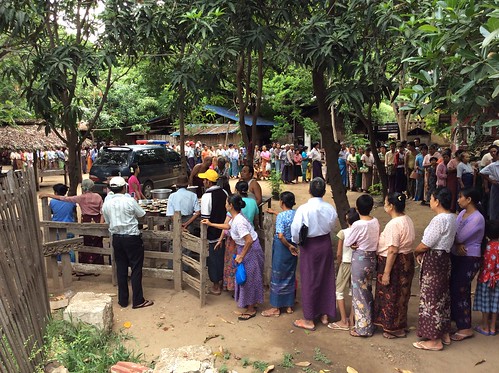
Free lunch being served to patients and their companions.
Donation of Children's Clothing
Donations of children's clothing are occasionally made to young patients.
Donation of Reading Glasses to elderly patients
Donations of Reading Glasses are occasionally made to elderly patients.
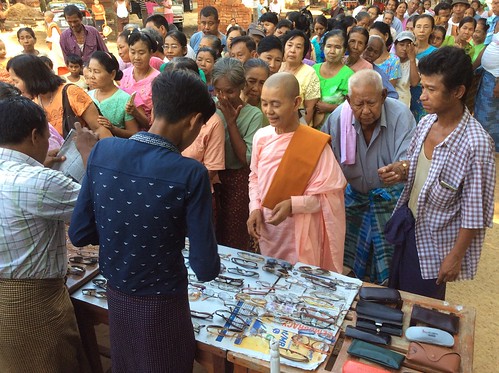
Bagan Clinic 2016: Distribution of reading glasses to elderly patients.
Health education talks
Health education talks are occasionally given to patients in the clinic by Doctor Hla Tun.
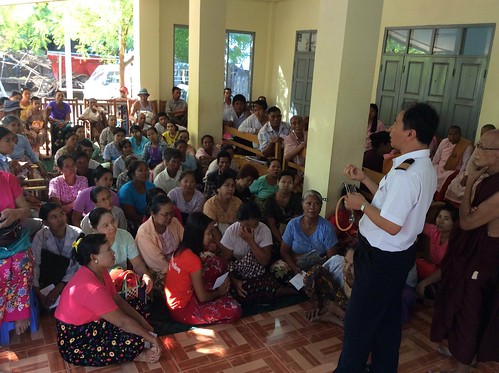
Doctor Hla Tun giving health education advice to patients at the clinic.
br>
Need for translators
Some patients travel long distances from the Delta, Rakhine State and Chin State to the Clinic. Translators are required for some of these ethnic groups because of the local dialects they use rather than standard Myanmar language.
Chin State, in Western Myanmar, is close to the Indian border and a patient from that area required a translator, as she couldn't understand the Myanmar language. This patient had facial tattoos, once common in the area.
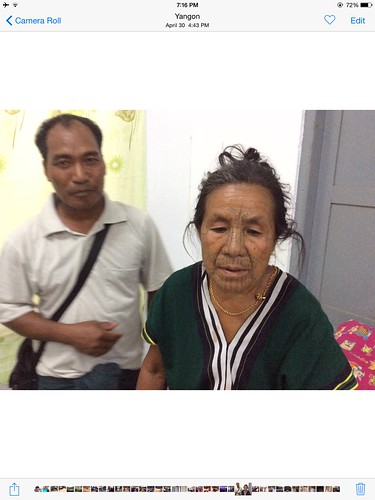
Patient from Chin State with facial tattoos.
New Equipment for Bagan Clinic
In May 2016, the generosity of two Guests funded the purchase of a new dental chair.

Bagan Clinic, May 2016: New Dental Chair.
Opening of Two Storey Clinic Building
Donors have provided funds for a 2-storey clinic building at the Bagan Clinic.

2-storey building under construction.
On 23rd September 2016, the two storey clinic building was opened. It includes rooms for a Dental Surgery, Eye Clinic, X-Ray Machine, UltraSound Machine, two Operating Theatres (one for eye surgery, one for general surgery) and two rooms to accommodate visiting doctors.

Opening of Two Storey Clinic Building
The opening was celebrated by a concert given by students.
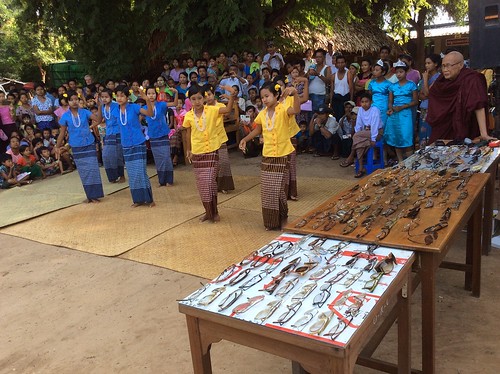
Opening of Two Storey Clinic Building, concert by students.
Individual Patient Stories
A lady who suffered from drooping of her upper eyelids could not afford to buy medicine and so she used tape or plaster between forehead and eyebrow at one end and upper eye lid at the other end to open her eyes. She was treated with eye drops.
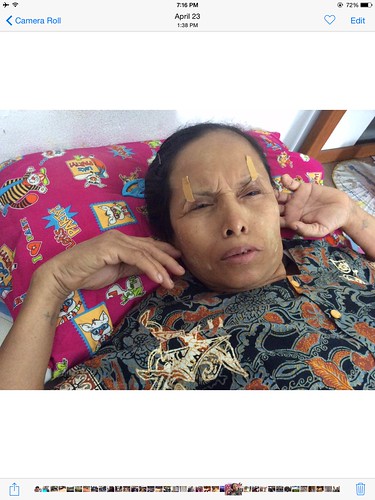
Patient with drooping eyelids.
A boy with muscle weakness on his right side improved his condition after medicine and physical exercise. He showed that he could kick a football.
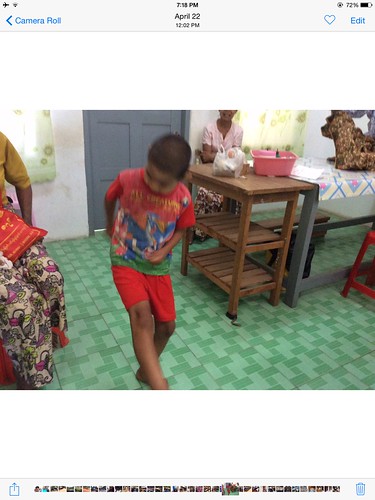
Young boy's improved condition after treatment.
In the previous update on Bagan Clinic here, we reported donations of anti-snake venom to hospitals. A particularly tragic case involving a snake bite concerns a lady from Chauk who earns a living collecting plums from under trees. Whilst collecting plums from a hole in the ground, she was bitten by a cobra. The local hospital injected anti-snake venom then she continued treatment with traditional medicine but developed a necrotic ulcer with exposed bone. Relatives and friends gave her money for transportation to Magway Divisional Hospital (about four hours away) for wound debridement treatment but she could not afford the transport costs for the necessary 3 or 4 follow-up treatments. Instead, she attended Bagan Medical Clinic where the cost of transport for further treatment at Magway (the equivalent of 8 Dollars U.S. per trip) was donated.
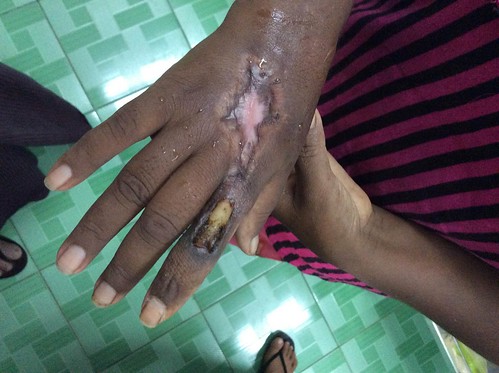
After-effects of a snake bite.
A 93 year old lady from SeikPhyu (about 60 miles from Bagan clinic) received supportive treatment and a donation of her transportation
fee and accommodation cost to allow her to receive treatment in Magway Divisional Hospital.
Patients with joint stiffness and pain can be helped by electrical stimulation of nerve and muscle and the use of a traction machine.
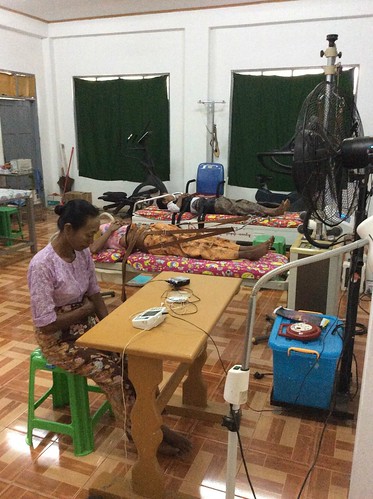
Electrical stimulation and traction treatment.
Special Medical Clinic Opening
On Monday, 26th September 2016 the 'Road to Mandalay' ship was 'stopped' at Bagan for a week, giving the Doctor the opportunity to open the clinic for a whole week. On the evening of Sunday 25th September, there were still some 350 patients waiting at the Clinic. Appointments were made for these waiting patients to return on a specific day to receive treatment. Patients who had travelled long distances were temporarily accommodated in the Bagan Monastery or at nearby monasteries. The Bagan Monastery was able to provide a free lunch every day and at least one free breakfast and one free dinner but patients accommodated elsewhere had to buy breakfast, lunch and dinner each day for up to five days, adding to the cost of their visit.
One couple from a remote area had borrowed money for food whilst waiting against the security of their gold ring but, when Doctor Hla Tun discovered this, he gave them the money to recover their ring.
Depending upon the distance travelled to reach the Clinic, transport can cost the equivalent of 5 - 20 Dollars U.S. per person and it's common to hear of a pig, goat, chicken or duck being sold to pay for transport.
During this week, Doctor Hla Tun asked a group of old ladies, who waited four days for treatment, why they had not gone back to their village about 50 miles away and returned on the day of the appointment. Their answer was that, once they'd paid to go home, they would be left with no money to return to the Clinic. Most of the group suffered from joint pain but the waiting additionally produced colds and coughs.
Other reports on medical support in Myanmar
There are a number of posts in this Blog describing medical support in Myanmar provided by the RTM Social Contribution with help from donors around the world. You can find them all here.
Photographs
There's a collection of pictures showing the Bagan Clinic from its inception here.
Doctor Hla Tun's photographs showing the work of the Bagan Clinic can be accessed by the following links:-
2014
2015
2016
As I wrote in the post 'Single-Wheeler' locomotives, early locomotives for passenger trains tended to have just a single-pair of driving wheels. This made the mechanism simpler and more free-running. Locomotives like 'Rocket' and the 'Planet' class had a single pair of moderately-large driving wheels to achieve fairly high-speed running on passenger trains. There's a little more in the post 'Planet' in Perspective, which outlines the use of four coupled wheels for freight locomotives where load haulage was more important than speed. There's much more about the history of the 'Planet' class (and the modern replica locomotive at the Museum of Science and Industry in Manchester) here.
Later designers used even larger driving wheels to achieve higher speed without increasing piston speed. But large driving wheels required great skill on the part of the driver to get trains started under less than ideal conditions without excessive slipping.
Patrick Stirling of the Great Northern Railway remained a staunch advocate of 'Singles', such as his famous class of 4-2-2 engines with 8 foot 1 inch diameter driving wheels, introduced in 1870.

Preserved Stirling 4-2-2 displayed at Doncaster in 2003 (Photo: Our Phellap).
When Dugald Drummond was at the Caledonian Railway, he too produced very successful 'Singles', like the 4-2-2 '123' with 7 foot drivers built in 1886.
 Preserved Drummond 4-2-2 '123' (Photo: Glasgow Museums).
The growth of passenger demand meant that there was continual pressure to increase the loads hauled and many locomotive designers turned to four-coupled designs, where the torque delivered to the two wheels of the driving axle by the connecting rods was shared, through coupling rods, with a similar pair of wheels which became 'coupled wheels'.
The locomotive designer Patrick Stirling was not convinced, famously claiming, in his Scottish accent, that "A coupled engine is like a laddie running with his breeks [trousers] down". Certainly, the success of coupling wheelsets together depends upon the accuracy with which the crankpins are set, referred to as 'quartering' - inaccuracies will produce a 'stiffness' in the mechanism which may be tolerable in a freight engine not expected to travel at high speed but is unacceptable in an express design.
In the early days of locomotive building there were problems in achieving the desirable accuracy but by 1896, when Johnson produced his handsome '115' class 'Singles' for the Midland Railway, production techniques had evolved sufficiently for the four-coupled passenger locomotive to have become common. Johnson's later designs for the Midland featured the 4-4-0 wheel arrangement which persisted for express locomotives on the Midland and L.M.S. until the Stanier era.
Dugald Drummond
Dugald Drummond (1840-1912) was born in Ardrossan and served an engineering apprenticeship in Glasgow before gaining further exoerience on Scottish railways. After managing the Birkenhead boiler shop of Thomas Brassey, in 1864 he moved to Cowlairs railway works under Samuel Waite Johnson (later of the Midland Railway). He then became Foreman Erector at the Inverness works of the Highland Railway under William Stroudley. When Stroudley moved to the L.B.S.C.R., Drummond followed as his assistant before taking up the post of Locomotive Superintendent of the North British in 1875. In 1882 Drummond moved to the Caledonian Railway before an unsucessful private locomotive building venture in Australia, followed by a time back in Scotland at the Glasgow Railway Engineering Company. He was Locomotive Engineer (later titled Chief Mechanical Engineer) of the London and South Western Railway from 1895 until his tragic death in 1912. He appears to have been outspoken and difficult throughout his career but is recognised as an important locomotive engineer.
His younger brother, Peter, also had a significant career as a locomotive designer.

Picture of the older Dugald Drummond (Wikipedia).
The Drummond 'T9'
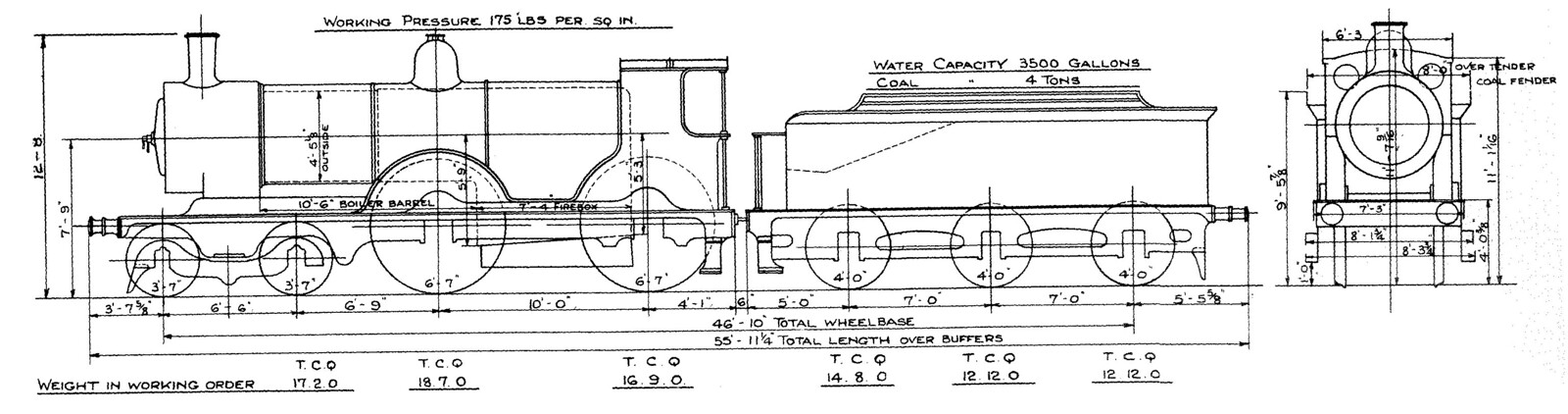
In the 'C8' class, Drummond designed an inside-cylinder 4-4-0 with 6 foot 7 inch diameter coupled wheels and a 9 foot coupled wheelbase, similar to earlier designs he'd produced for the North British and Caledonian railways. The 'T9' which immediately followed was intended to increase steaming capacity by lengthening the coupled wheelbase to 10 feet, allowing a larger grate. In Scotland, Drummond had learnt the value of rugged, reliable construction and the 'T9' embodied these principles with 1 inch thick steel frames. Between 1899 and 1901, 66 engines were built in three batches, paired with either a 6-wheel or 8-wheel 'Watercart' tender. Early engines featured a narrow cab and in addition to normal splashers on the coupled wheels which incorporated sandboxes, smaller splashers were provided to clear the coupling rods and crankpins. The third batch of engines built had wider cabs with matching splashers, removing the need for coupling rod splashers and conventional sandboxes were substituted. Vacuum brakes were standard (although at least two had air brakes as well).
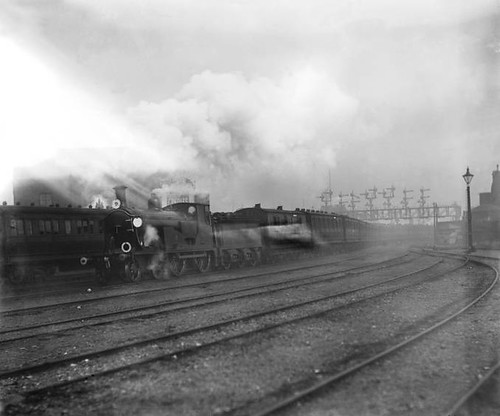
'T9' number 307 as originally built and running with a 6-wheel tender seen leaving Waterloo with a Southampton Boat Train, around 1902 (Photo: NRM Nine Elms Collection: Creative Commons)
Drummond had acquired from Stroudley a dislike of unnecessary boiler piercings so the two lock-up safety valves were placed atop the dome - a very distinctive feature. Drummond was not enthusiastic about superheating but he did increase the boiler working pressure on the 'T9' to 175 p.s.i. Enginemen were then encouraged to adjust the 'cut off' to achieve best economy by using the steam expansively. Drummond was an "engineman's engineman", familiar with work on the footplate, although his demeanour could be fierce. He gave lectures to footplatemen at a number of sites. These lectures were later published as a pocket reference book.
The Drummond arrangement of Stephenson Link Motion operating slide valves was regarded as particularly successful and free-running. The fitting of a steam reverser made frequent adjustments to the 'cut off' an easy task.
Eastleigh drawing E34 below shows the original appearance of the first batch of twenty locomotives, built at Nine Elms.
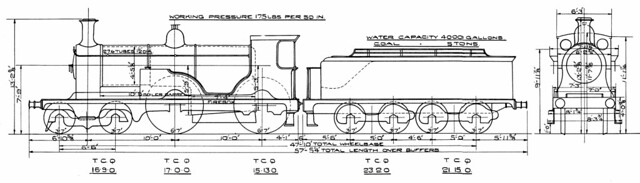
Eastleigh drawing E34: 'T9' (shows 8-wheel tender).
Click here for larger view.
Although Drummond did not embrace superheating, he was anxious to maximise steam generation and he introduced various water tube arrangements to his boilers. The second batch of thirty 'T9', built by Dubs (there's a short history of Dubs here) incorporated two groups of water cross tubes in the firebox. With or without water tubes, the class performed well.
In 1922, Urie rebuilt number 314 with an Eastleigh pattern superheater, extended smokebox and stovepipe chimney. Subsequently, the rest of the class received these changes, generally giving the appearance shown in Eastleigh drawing E34B below. After 1925, the Maunsell superheater replaced the Eastleight pattern.
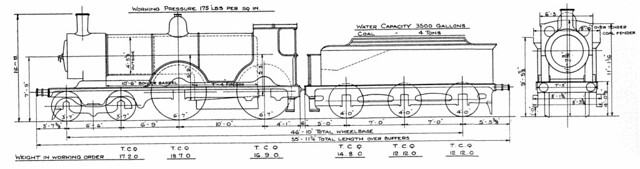
Eastleigh drawing E34B: 'T9' as rebuilt (shows 6-wheel tender).
Click here for larger view.
The T9 was liked by enginemen and came to be regarded as Drummond's 'masterpiece'. The class had a long life - none were withdrawn until the 1950s and the last (number 120 from 1899, renumbered 30120 by British Railways) survived until 1963 when it became part of the National Collection managed by National Railway Museum.
On Saturday 8th April 2017, I finally got to drive the National Collection's 'T9' at the Battlefield Line. But that's another story.
 Drummond 'T9': 30120 being prepared at Shackerstone on 8th April 2017.
Book References
[1] ‘Drummond Locomotives – A Pictorial History’ by Brian Haresnape and Peter Rowledge (Ian Allen 1982) ISBN 0 7110 1206 7.
[2] ‘A Pictorial Record of Southern Locomotives’ by J. H. Russell (Haynes Publishing 1991).
[3] ‘Great Locomotives of the Southern Railway’ by O. S. Nock (Guild Publishing).
Related posts on other sites
Dugald Drummond (Wikipedia).
Dugald Drummond (Grace's Guide).
Dugald & Peter Drummond (Steam Index).
Related posts on this site
'Single-Wheeler' locomotives.
'Planet' in Perspective.
My Pictures
Where necessary, clicking on an image above will display an 'uncropped' view or, alternately, pictures may be selected, viewed or downloaded, in various sizes, from the album listed:-
Drummond 'T9'.
[Old picture added, corrections: 17-Apr-2017]
Once the 2016 'Santa Specials' were over (there's a brief report here), railway operations ceased for two months of 2017, giving the volunteers who work on permanent way maintenance an opportunity to prepare the route for the 2017 season.
Peak Rail Working Volunteers Lunch
My first trip to the Matlock area in 2017 was on Saturday, 18th February when I didn't get beyond Matlock Bath. I was attending the Peak Rail Working Volunteers Lunch which was held at the elegant Matlock Bath Hotel. As this engagement didn't involve the usual pre-dawn start needed when I'm rostered for the footplate, I travelled by train. There were existing photograph albums covering part of the route I took, from Wolverhampton to Birmingham New Street, then on to Derby. These albums are West Midland Railways and Derby - Birmingham. The last leg of my journey was by East Midland Trains single unit DMU to Matlock Bath, one station before the last stop at Matlock. I've added a new album Derby - Matlock to cover this area.

Class 153 355 on arrival at Matlock Bath.
The effort involved by working volunteers in running an operation like Peak Rail could be judged from the crowded dining room. In addition to the convivial lunch, Peak Rail Management took the opportunity to update members on some of the developments in hand.
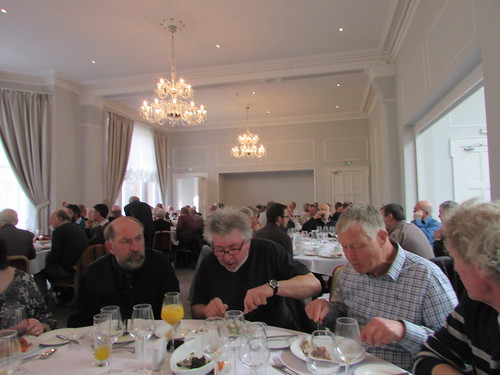
Peak Rail Volunteers' Lunch: 18-Feb-2017
Events of Sunday, 26th March 2017
Saturday and Sunday services re-started in March, with a timetable of four top-and-tailed services between Rowsley and Matlock Town.
My first driving turn of the year was on Sunday, 26th March. This time, it was an early start, made worse by the clocks going forward an hour on Saturday night. So my alarm had to be set for 3.0 a.m. when I retired which, of course, would be 4.0 a.m. when I got up on Sunday morning.
The motive power was 'Jennifer', an outside-cylinder six-coupled Hudswell Clarke side tank, built the same year that I was born. With Mike S. as Fireman and Jacob as cleaner, we were ready to come 'off shed' at 8.30 a.m. ready for two one-hour Driving Experience Courses before taking the first service train at eleven o'clock. The combination of outside cylinders and the characteristics of the drawgear had been found to cause oscillations at some speeds so an instruction was in place that 'Jennifer' should not exceed 15 miles per hour.

Locomotive 'Jennifer' at Matlock Town.
I used the first trip to experiment with methods of driving to try to minimise the 'surging' effect, particularly since the 'Palatine' Restaurant Cars were being 'laid-up' by waiting staff for the diners who would board before the second round trip to enjoy the Mothering Sunday Lunch. This season, the beautifully-restored L.M.S. coach 7828 forms the main dining coach of the 2-car dining set.
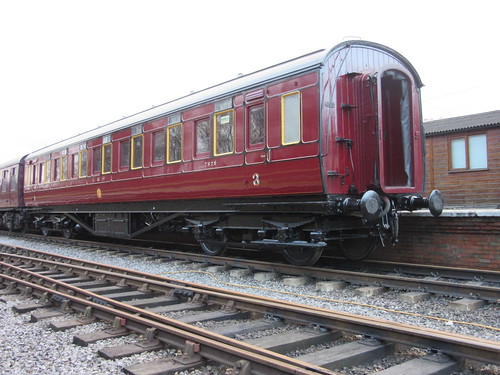
Restored coach 7828 at Rowsley.
'Jennifer' proved a strong engine and a free-steamer and we completed the day without additional difficulties.
Events of Sunday, 2nd April 2017
Just a week later, I was back again, this time with Dave P. as fireman but with no Cleaner, starting the day with a two-hour driving experience before 'hooking onto' our train. Normally, it's good practice to tighten up the screw coupling between engine and train leaving two turns of thread visible on either side but, in order to provide as much buffer compression as possible to limit the tendency to 'surge', we tightened the screw fully and it seemed to help.
Now we were into April, the timetable called for five top-and-tailed services between Rowsley and Matlock Town, which we completed without problems.
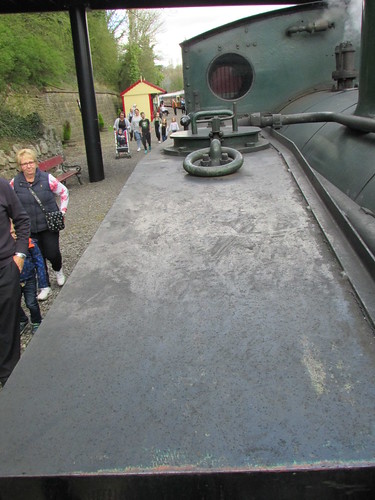
'Jennifer' at Matlock Town, showing the 'bevelled' front of the side tank to assist the driver's forward visibility.
Events of Wednesday, 6th April 2017
Three days later I was back yet again because April also introduced a service on Wednesdays. Keiron was firing with John M. as our Cleaner. At 08:45 we started the first of two 1-hour Driving Experience Courses, leaving us very little time before taking the first service train at 11:00. During the day, further experiments were carried out on the coupling between locomotive and train. I was sure that the use of the engine coupling onto the coach drawhook would be tighter than the other way round (coach coupling onto engine drawhook), and so it proved. But we also tried the Emergency Coupling which is kept in the Guard's compartment. These have a D-hook on both sides of the screw and are used to connect the two drawhooks, as the name suggests, in emergency. However, this offered no improvement so we reverted to the engine coupling onto the coach drawhook with the screw fully tightened. The weather was warm all day and we were gratifyingly busy for a mid-week steaming. Incidentally, there's a short description of the business of hooking a locomotive onto a passenger train in the post On the Footplate (Part 2). At the end of an enjoyable day, Keiron coaled the engine using the bucket loading shovel and 'Jennifer' was stabled in the shed. The method of disposal varies from railway to railway and from locomotive to locomotive but an idea of what's involved can be gained from the post MIC - Disposal.
My Pictures
Where necessary, clicking on an image above will display an 'uncropped' view or, alternately, pictures from may be selected, viewed or downloaded, in various sizes, from the albums listed:-
West Midland Railways.
Derby - Birmingham.
Derby - Matlock.
Peak Rail 2017.
'Jennifer'.
Restored coach 7828.
The East London Line has a fascinating and varied history which I'm afraid I had almost completely overlooked until my firm became involved in supplying replacement Tunnel Telephone equipment for the section of the line which passes through the Thames Tunnel.
The Initial Vision
The rapid growth of London and its docks gave rise to a need for better communication across the Thames but early attempts to construct a tunnel met with difficulties owing to the geology. Marc Brunel (father of the better-known I.K. Brunel), having patented a 'tunnelling shield', obtained finance in 1824 for the ultimately-successful project to build the Thames Tunnel. The project suffered a succession of problems and Marc's 20-year old son Isambard became involved and was awarded a silver medal by the Royal Humane Society in 1828 for his bravery in saving lives during serious floodings of the workings (Royal Humane Society Report). Eventually, in 1843, the tunnel was completed as a twin tunnel with frequent cross-passages between Wapping and Rotherhithe. A plaque erected by London Transport at Wapping Station announces the tunnel's pioneering status:-
The tunnel which runs under the Thames from this station was the first tunnel for public traffic ever to be driven beneath a river.
It was designed by Sir Marc Isambard Brunel 1769-1849 and completed in 1843
His son Isambard Kingdom Brunel 1806-1859 was engineer-in-charge from 1825 to 1828.
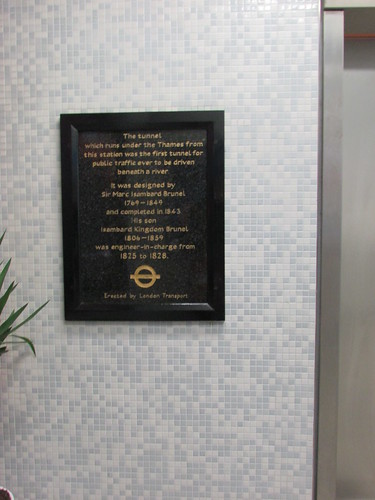
Commemorative plaque in Wapping station.
The cost overruns meant that approach ramps allowing the tunnel to be used by horse drawn carriages as originally intended could not be financed so, by placing stairways in the construction shafts on either side of the river, the tunnel was opened only to pedestrians. It was not a commercial success, despite becoming a major tourist attraction with numerous stalls in the tunnel selling souvenirs.
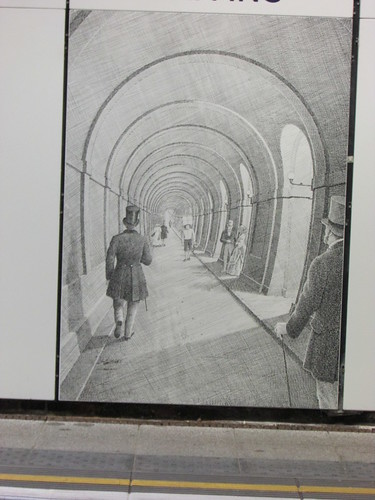
Wapping station: Modern mural showing Thames Tunnel as a pedestrian tunnel.
The building at Rotherhithe which originally housed the pump for the Thames tunnel is now The Brunel Museum Thames Tunnel, with a website here.
Conversion to railway use
Although the Tunnel had not achieved its aim of providing a cross-river link for horse-drawn vehicles, its dimensions allowed it to be adapted for rail traffic and, in 1865, the tunnel was purchased by the East London Railway. This was a joint venture by six railways hoping to profit from better freight and passenger connections across the river:-
Great Eastern Railway
Metropolitan Railway
District Railway
London, Brighton & South Coast Railway
London, Chatham and Dover Railway
South Eastern Railway
(The last three railways ultimately formed part of the Southern Railway and there are brief histories of these lines in two posts 'Origins of the Southern Railway' listed in 'Related posts on this site' below).
With Sir John Hawkshaw as engineer, the tunnel was converted and approaches built allowing its use as a double-track railway which was extended on both side of the Thames with a number of stations and making connections with the participating railways. The work was carried out in stages and completed by 1884.
The Great Eastern terminus at Liverpool Street was the northern extremity of the East London Line passenger service. Rather inconveniently, freight trains to and from the Great Eastern had to reverse at Liverpool Street. Alternately, there was provision for transferring wagons (two at a time) a hoist at Spitalfields. North of the river, stations were provided at Shoreditch, Whitechapel, Shadwell and Wapping. South of Whitechapel station, St. Mary's Curve provided a connection to the route operated jointly by the Metropolitan and Metropolitan District railways.
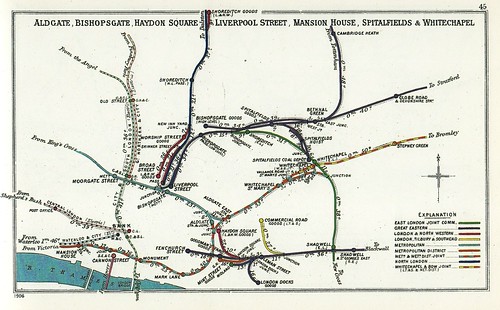
Northern section of East London Railway in 1906 (Railway Clearing House).
Click here for larger view.
South of the river, the line passed through Rotherhithe and Deptford Road stations before dividing into three branches which joined the L.B.S.C.R. South London Line to Victoria, the L.B.S.C.R. Croydon and Brighton Line from London Bridge and the S.E.&C.R. line from London Bridge.
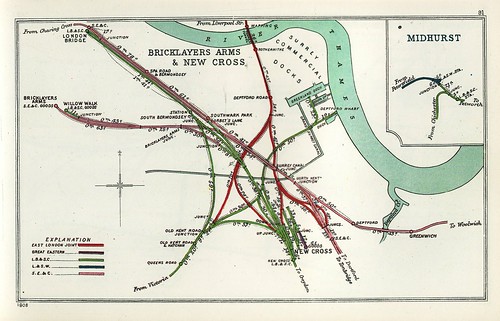
Southern section of East London Railway in 1908 (Railway Clearing House).
Click here for larger view.
The well-known 'Brighton Terriers' were one of the locomotive types commonly used on passenger trains on the East London Line.

A modern mural at Wapping showing a steam-hauled Northbound passenger train arriving at Wapping station.
London Underground
In 1933, the East London Line was taken over by the London Passenger Transport Board and was operated by London Underground. Between Shoreditch and two southern termini at New Cross Gate and New Cross gate the line was electrified using the standard Fourth Rail Electrification arrangements (as outlined in the post here) and Metropolitan Line rolling stock based at a depot at New Cross. When heavy repairs were required, the trainsets travelled to Neasden, accessing the main Metropolitan route using St. Mary's Curve. Freight trains continued to use the line until the 1960s. Apart from a morning and evening 'rush', the East London Line was fairly quiet and it continued as a rather 'forgotten line'.
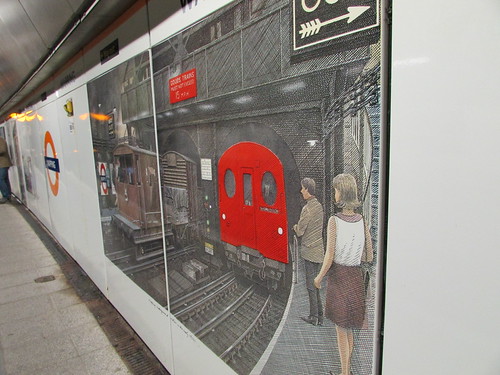
A modern mural at Wapping showing a Northbound electric train arriving at Wapping station, passing a freight train.
Temporary closure in 1995
In 1995 the line was completely closed to allow repairs to the Thames Tunnel itself and the building of an interchange station at Canada Water with the Jubilee Line which was being constructed. The use of 'shotcreting' in the Thames Tunnel proved contentious and a short section was preserved as-built. The repair work included replacement of the elderly Tunnel Telephone system required on the underground sections of the line and my firm supplied the new equipment. In 1998, the East London Line re-opened, continuing the earlier services from Whitechapel (Shoreditch during the 'rush') and either New Cross or New Cross Gate.
London Overground Era
In 2007, the London Overground had taken over operation of a number of mainly North London services including Euston to Watford, Clapham Junction to Willesden, Stratford and Barking. More ambitious plans were accepted to add an extended and modernised East London Line to the London Overground Network. The East London Line closed again in 2007 allowing re-signalling, station upgrades and building of a depot for the new trains at New Cross Gate. The electrification system was converted to third rail 750 volts d.c. and the technical changes necessitated replacement of the Tunnel Telephone equipment on the East London Line which, again, my company supplied.
Rolling Stock
The London Overground is operated by various versions of Class 378, built by Bombardier at Derby. There were originally three variants - 378/0 3-car, 378/1 4-car d.c. and 378/2 4-car a.c./d.c.
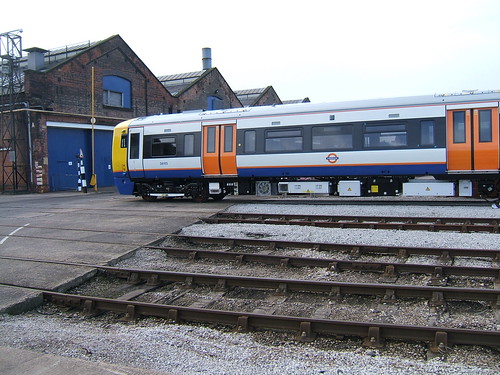
Newly-built Class 378 at Bombardier, Litchurch Lane, Derby in 2009.
East London Line re-opening
The East London Line re-opened in 2010 with modern, full-size trains through the Thames Tunnel from Highbury & Islington in the North to New Cross and, via New Cross Gate and existing Network Rail lines, to West Croydon and Crystal Palace in the south. I travelled on part of the new line in June 2010 and there's a short post here.
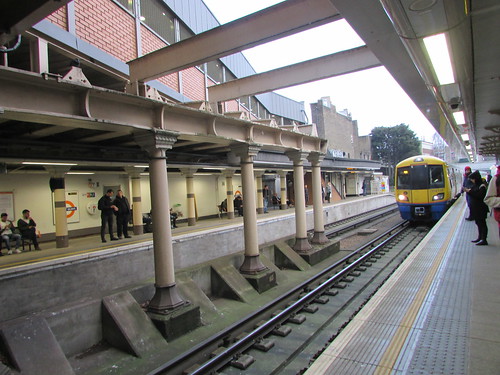
East London Line: Up train entering Surrey Quays station.
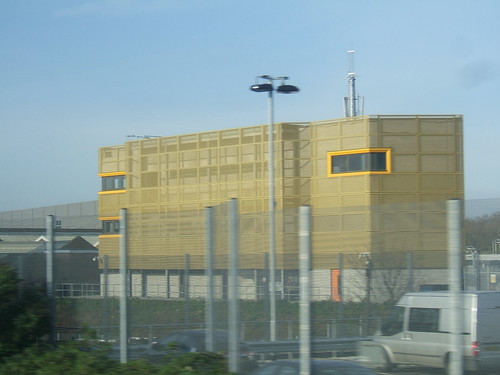
East London Line Service Control Centre ('OBC'), viewed from a London Bridge - East Croydon train.
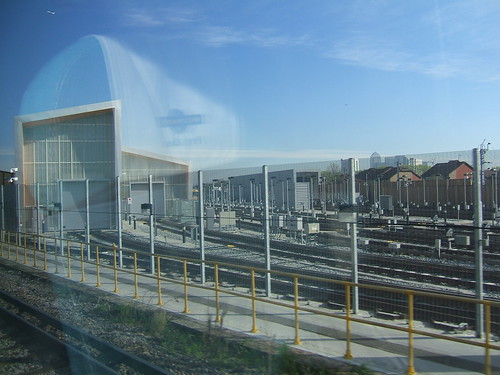
New Cross Gate London Overground Depot, viewed from a London Bridge - East Croydon train.
London Overground Expansion
The new services have proved popular. There are now 57 trainsets - the 378/0 were converted to 378/1 and both 378/1 and 378/2 have been augmented to 5-car sets in an attempt to meet increased demand, necessitating elective door opening at certain East London Line stations with short platforms.
The abandoned connection south of Surrey Quays with the former South London Line has been re-instated (with a grade-separated junction at Silwood Junction, South of Surrey Quays), adding a service via the Thames Tunnel to Clapham Junction. With change of trains, the London Overground now provides a 'ring' service around London.
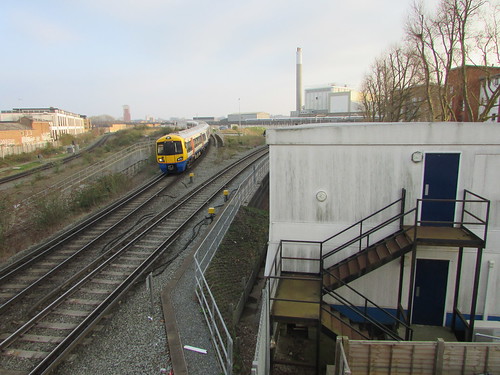
Silwood Junction looking south. Trainset 378 149 on Up passing over the bridge carrying the Down South London. The line converging from the right is the Up South London.
Book References
Track diagrams showing the early stages of the redevelopment of the East London Line as part of the London Overground system are shown in the 2008 publication:-
‘Railway Track Diagrams Book 5: Southern and TfL’ (TRACKmaps: 3rd edition) ISBN 978-0-9549866-4-3.
Related posts on other sites
Thames Tunnel (Wikipedia).
East London Line Extension (Wikipedia).
East London Line (Wikipedia).
British Rail Class 378 (Wikipedia).
Clive's UndergrounD Line Guides: East London Line.
Related posts on this site
East London Line (2010 re-opening).
Origins of the Southern Railway: Part 2: L.B.S.C.R.
Origins of the Southern Railway: Part 3 - S.E.C.R.
Fourth Rail Electrification.
My Pictures
Where necessary, clicking on an image above will display an 'uncropped' view or, alternately, pictures from may be selected, viewed or downloaded, in various sizes, from the album listed:-
London: East London Line.
Railway Clearing House Junction Diagrams.