skip to main |
skip to sidebar
Just before the outbreak of World War II, the United States developed a sectional steel 'mat' which could be used for the rapid construction of temporary aircraft landing strips. It was originally called 'Marsden Matting' (after the first location of manufacture) but it's also known as 'PSP', short for 'Pierced' (or 'Perforated') 'Steel Planking' or 'Landing Mat'. There's a description in Wikipedia here.
Large quantities were produced during the war and there was a later aluminium version which, of course, was a lot lighter. Whilst some of this useful material is still retained by the military, large amounts became 'Army Surplus'. Calumet Industries in the USA offered PSP when I first published this post but they seem to have disappeared. But etp-trade.de have information here (including installation instructions in English and Russian!).
I've spotted 'PSP' finding a secondary use in a number of places, particularly in the far East. The most common use is for fencing, where 'PSP' can form the horizontal rails joining brick pillars, like the example below from a private house in Yangon, Myanmar.
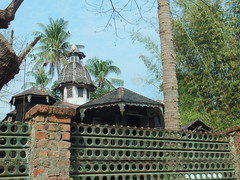
Yangon (2013).
The boundary fence at Thandwe Airport in Myanmar seems to be entirely made from 'PSP' horizontal rails fastened to concrete posts, as below.
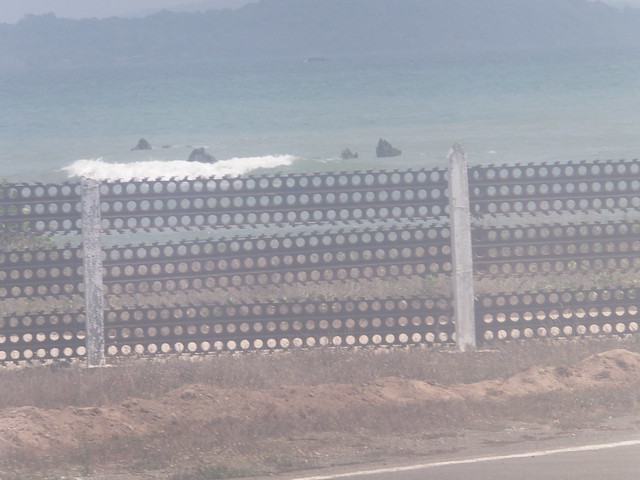 Thandwe Airport (2014).
Perhaps the oddest use I've spotted was during a visit to Sittwe, in Myanmar. I visited a former Merchant's House (described in the section 'Merchant's House' of my post Sittwe, Myanmar) where 'PSP', enamel painted white, is used to panel-in the staircase.
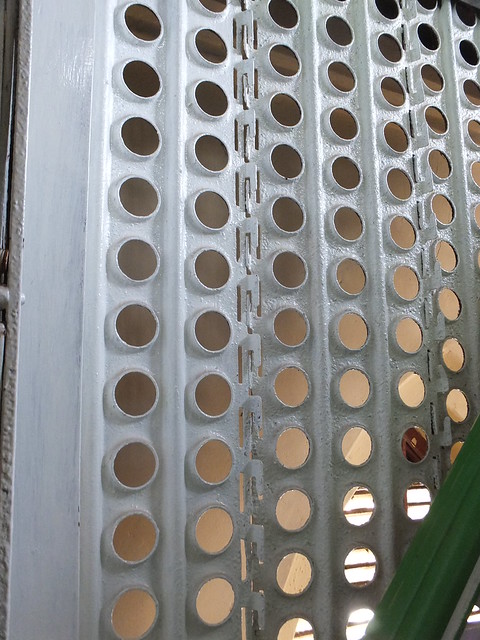
Air conditioned-cladding for the staircase in the Merchant's House.
There are more pictures of the Merchant's House here.
I'm confident that there must be more outlandish uses for 'PSP' out there - I just haven't noticed them. Can anybody help?
[Dead link to Calumet Industries updated 10-Jul-2019]
This post is adapted from an article I wrote for the Summer 1989 edition of 'Lionsheart' - the newsletter of the Old Locomotive Committee (OLCO) which is the supporters group for the locomotive 'Lion'.
Locomotive building in the early days was restricted to a handful of locations. Everybody knows the importance of Tyneside, but Leeds was early into the game. ‘Lion’, of course, was built in 1838 by the partnership of Todd, Kitson and Laird in Leeds. But, shortly afterwards, the partnership was dissolved and Charles Todd joined with John Shepherd trading from the Railway Foundry in Leeds. This enterprise survived until 1858. Meanwhile, James Kitson and David Laird set up the Airedale Foundry which opened on 13th May 1839. This enterprise ultimately becoming Kitson and Company Limited and contined a proud record of locomotive building into the 1930s.
Mr. E. F. Clark, one of the founder members of OLCO, is a descendent of James Kitson and he suggested that the sesquicentenary of the opening of the Airedale Foundry should be marked by a luncheon on 13th May 1989, exactly 150 years later. Initially, the Kitson College of Technology in Leeds was chosen as the venue but, at short notice, this had to be changed to Leeds Industrial Museum at Armley Mills which made us very welcome. At the time, I was secretary of OLCO so I was involved in the organisation of the event.

The ‘flyer’ which advertised the event
(Click on image for larger view).
On the day, forty or so Guests attended the Luncheon. In 'Lionsheart' at the time I reported:-
"The weather, venue, food and, most importantly, the guests combined to produce a most happy and enjoyable occasion. Various memorabilia from the Airedale Foundry were on display. Mr. E. F. Clark appropriately described the event as 'an extended family occasion'. Later in the afternoon the Assistant Curator of the Museum, Mr. Ron Fitzgerald, gave guests a private tour of the Museum".
Some years later, in 2004, Mr. E. F. Clark donated ephemera from the Airedale Foundry Luncheon to the OLCO Archives. I remember the occasion as being very enjoyable. There was an excellent meal and plenty of good conversation (not quite all about railways). The guests were able to tour the galleries - the Museum has a wide range of displays relating to the area's industrial, mining and railway past. I particularly enjoyed a preview of a new mining gallery featuring mine locomotives which was just being readied for public exhibition.

Jan Ford and the much-missed Mike Satow (he passed away in 1993) during the lunch.
(Click on image for larger view).
Mike Satow was one of the guests at the Airedale Foundry Luncheon. He made a major contribution to the study of early locomotives and left us with a series of full-size, working replicas, such as 'Locomotion' and 'Sans Pareil'. He developed an unobtrusive emergency air brake system for the 'Locomotion' project which has been used on a number of replicas and formed the basis of the emergency braking system used on ‘Lion’ to allow her to give public rides. He was also closely-involved in the setting up of New Delhi Railway Museum. I made my first visit to this museum in 1992 (there's a brief description in my post My First Trip to India (continued) and an album of pictures here. I made another visit to the museum in February 2006 (in a hectic trip described in a long post here) which produced a second set of pictures here.
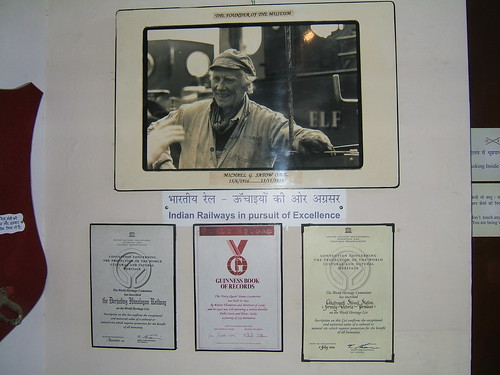 Photograph of Mike Satow displayed in New Delhi Railway Museum.
Events of Saturday 21st June 2014
In Furness and the Cumbrian Coast (Part 1), I described my travels as far as Whitehaven Bransty on what's now marketed as the Cumbrian Coast Line. There's a Wikipedia article here.
Whitehaven
I arrived at Whitehaven Bransty around 12:39 with the weather still hot. This was a modern station with one through platform which I'd just arrived on and one empty Bay platform. I left the station and looked down the hill. A short walk would take me to the harbour but I could see that it had been modernised into a boat marina. On my right sat a large Tesco store. Knowing that there was a train north at 12:54, I decided to defer my exploration of Whitehaven to another trip and returned to study the station.
The driver of the 2-car diesel multiple unit I'd arrived on was 'changing ends' prior to forming the 12:54 back to Lancaster. The driver had unlocked a Token Cupboard on the platform and was working the electric token machine whilst talking to the signalman on the telephone. After he'd extracted the token which authorised him to travel on the single line back to St. Bees, the signalman cleared the 2-aspect modern colour-light signal from red to green.
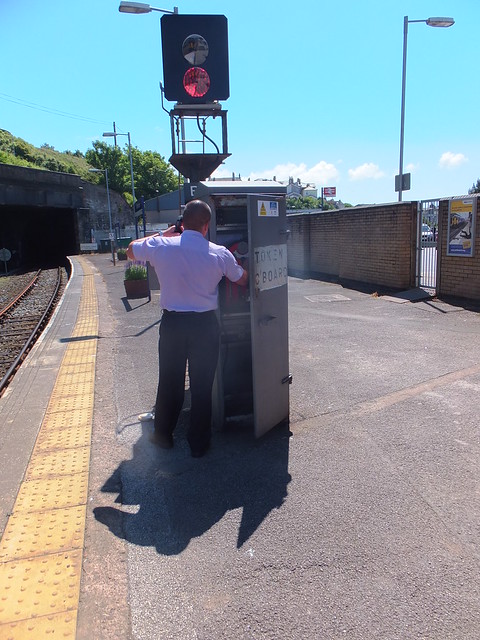
Whitehaven through platform, looking south towards the tunnel mouth. The driver is extracting the single line token.
There were a number of passengers waiting in the sun so it was clear that another train was due and, after a few minutes, a Class 156 2-car diesel multiple unit appeared from the north and rolled into the bay platform. After the arriving passengers had left the train, the waiting passengers clambered in. The step-up from platform to train on the bay platform was quite large and there was a yellow-painted set of wooden steps on the platform to assist. There were four doors on the side of the train and only one set of steps so most people just had to manage the large step-up. Although there were at least two railway staff manning the modern booking office, I noticed that there was no member of staff on the platform to assist boarding passengers.
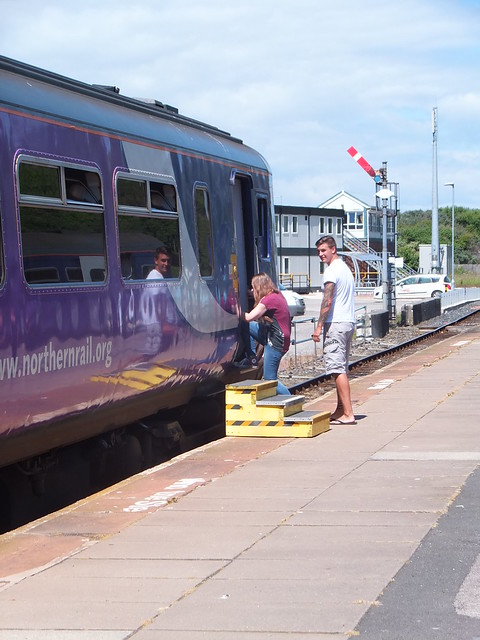
Passengers boarding the Carlisle train at Whitehaven.
On to Workington
We departed on time, passed the remaining signal box (formerly 'Whitehaven Bransty No. 2', now just labelled 'Bransty') and entered the double-track line which ran along the sea wall to our first station stop at Parton. Looking back, I could see the jetty at the approach to Whitehaven Harbour and, beyond, St. Bees Head.
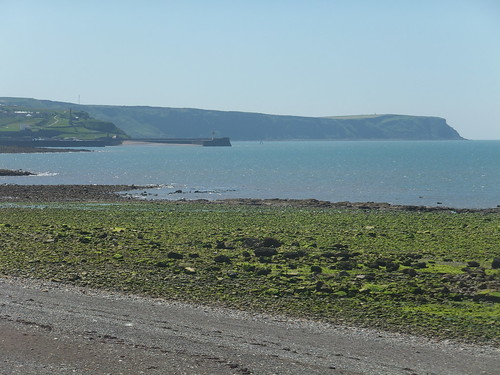 View of Whitehaven and St. Bees head from Parton.
About 700 yards beyond Parton, the line singled. We continued for about 1400 yards on the single line, hugging the sea wall and then double track resumed. The track changes appeared fairly recent and the necessary points and signals seemed to be remotely controlled from Bransty. I assumed the alteration had been made because of problems with the 'shelf' on which the track is laid, squeezed between sea wall on our left and low cliffs on our right. We made a brief stop at Harrington then Workington was just two and a half miles away.
The line was still running close to the beach and I noticed a long row of vaguely pyramidal objects dotted along the head of the beach - dozens and dozens of them. They reminded me of the sort of concrete objects deployed on beaches in WWII to hamper invasion. The colour was too dark for concrete but then I realised - they were lumps of solidified steel-making slag and the shape was that of the slag ladle car which had transported the slag from the steelworks. Then, I was able to see the trackbed of what appeared to be a single siding running parallel to the beach. There were even a couple of small stone underbridges where the siding crossed footpaths.
I knew that steelmaking had ceased in Workington but, on my previous visit to Workington in the 1990s, I'd been impressed with the scale of the remaining rolling mills which specialised in the manufacture of railway rails. But, in 2014, little remains here except the double track main line. There's a most useful site which gives a good idea of Workington's industrial history here. Tata Steel Projects still have a presence in Workington (described on their website here) but, as recently as December 2013, another 75 jobs were lost locally.
The tangle of sidings and additional running lines has gone and signal boxes at Moss Bay Iron Works, Derwent Haematite Works, and Workington Main No. 1 have been abolished. Workington Main No. 2 signal box remains, heavily modified externally like virtually all the dwindling number of signal boxes remaining on Network Rail, as does Workington Main No. 3 signal box at the north end of the station.
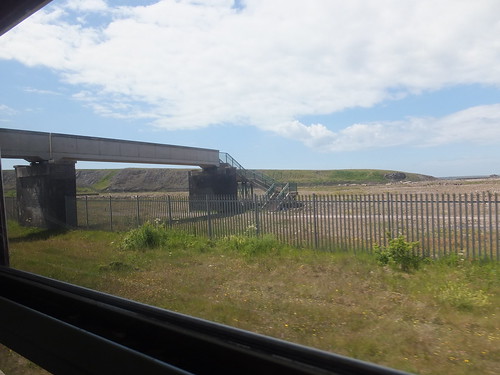 The long pedestrian footbridge shows where the sidings were: the bare yard shows where the mills once stood.
Workington Main station retains its two long platforms with quite nicely restored ranges of buildings on both platforms. With a service of only about one train an hour each way, I only saw one member of staff and he was in the booking office. But I was cheered that it at least looked like a railway station rather than a bus shelter.
 Workington: Station buildings on the Up Platform.
I'd a little under an hour to explore before there was another train northwards. Leaving the station, I decided to walk towards the sea. The River Derwent reaches its estuary in two channels. I followed the narrower one - a muddy creek with stone-built houses along the Town Quay with dozens of small boats waiting for the returning tide.
 The Town Quay at Workington.
The Port of Workington is a more modern enclosed dock (the Prince of Wales Dock) on the opposite side of the river. I took I different route to backtrack to the station, noting that part of the old steelworks site had been converted into a series of modern factory units. I then made my way towards the town centre along Station Street., with the Parish Church of St. Michael on my left.
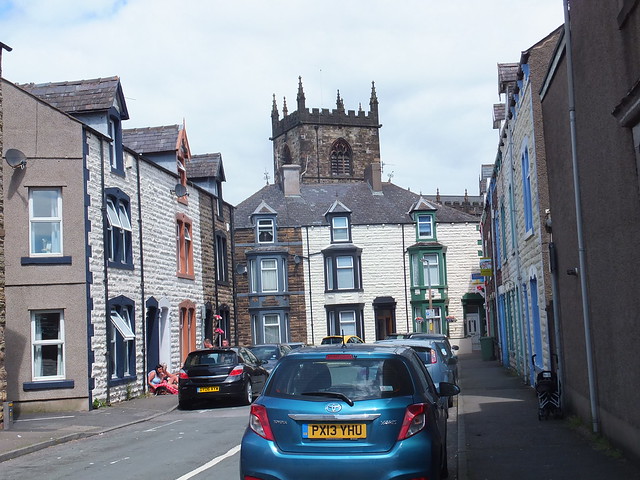 St. Michael's slumbers in the heat of the afternoon. One of the two women on the left enjoying the sun has donned a swimsuit!
I passed a variety of shops and was tempted by a fish and chip shop, enjoying an excellent portion of chips served in a cardboard box, like a small pizza box. One detached stone building is now a sports injury clinic, but what caught my eye was the carefully-preserved signwriting on the end wall proclaiming 'OXFORD HOTEL TEMPERANCE LUNCHES AND TEAS'. I think the last line may have been the name of the proprietor, but I couldn't make it out. When I reached the small bus station, I retraced my route back to the station, in plenty of time to catch the 14:08 northbound service. Workington has a population of about 25,000 and I'd found the place far more appealing than I expected but the loss of jobs must have created ongoing problems. There's a Wikipedia article on the town here.
Maryport
I decided I'd make a stop at the smaller town of Maryport (population around 12,000) which I'd visited before and has always been something of a tourist destination. The 14:08 train from Workington took only eight minutes to reach Maryport. Although the line is double track, there's only one platform at Maryport (I think this was always so). I remembered the L.M.S. standard composite signal box from my earlier visit (now heavily modified, of course) but signals are now colour light and points are power operated. The station 'building' is a very upmarket bus shelter in wood and glass. For some reason, it looked Japanese to me.
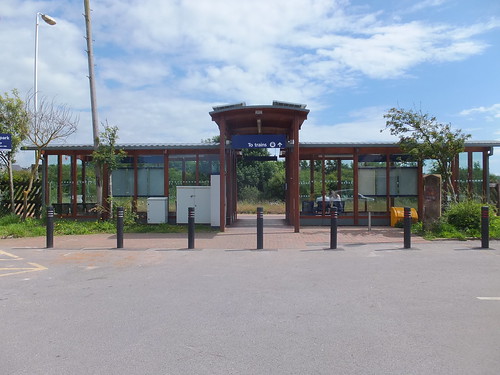 Maryport Station, viewed from the car park.
I set off for the harbour, knowing I had a little over an hour before there was a train onwards to Carlisle. The inevitable Station Street led me across the River Ellen and Curzon Street, busy with traffic. Then I walked through Mill Street car park and took an attractive footpath which led me to Senhouse Street - a main shopping street sloping down to the harbour. A fairly elaborate brick and stone frontage still proclaimed 'Empire Theatre' and, in a laurel wreath, the build date (1911, I think).The building has now been converted into two shops. Another shop building (currently empty) still had the signwriting "Ogni's Ices" on the end wall - I assumed the Ognis were Italians for Italians were widely involved in popularising ice cream in England.
I passed the 'White Star Pub'. I discovered that Thomas Henry Ismay (1837 - 1899) was born in a cottage at Maryport and went on to run the White Star Line. His son Joseph Bruce Ismay (1862 - 1937) is known for surviving the maiden voyage of the 'Titanic'.
I found the harbour area very attractive. Having purchased an ice cream, I walked around the nearer harbour, used by a number of fishing boats. I didn't go to the further harbour, which appeared to be another marina for pleasure craft. There were certainly tourists about but it wasn't crowded. I decided it was time to return to the station (I was certainly getting tired with all the walking).
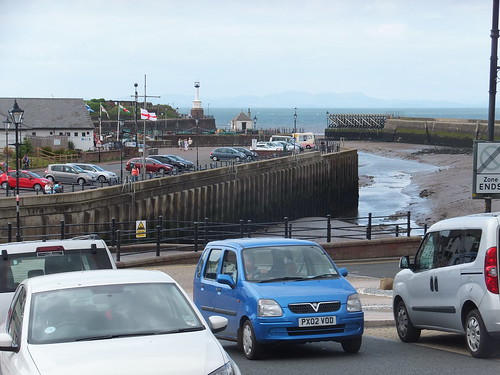 Maryport Harbour.
Returning up Senhouse Street, I noticed a residential side street temporarily closed to traffic because of excavations in the road. One of the houses in the street had brought folding chairs out onto the pavement and a family of eleven, including children, were having a picnic and soaking up the sun!
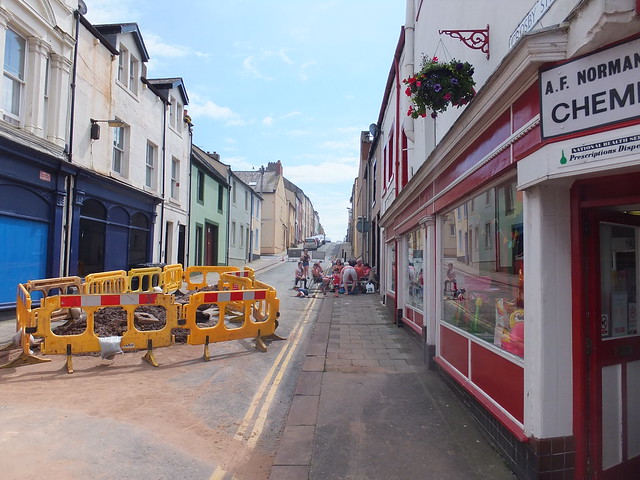 An unusual venue for a picnic in Maryport.
On to Carlisle
Back at Maryport station, I boarded a stopping train for Carlisle. When we stopped at Wigton station, I spotted a marvellous old photograph of the original stone station building, complete with its row of Ionic Order columns on the platform side.
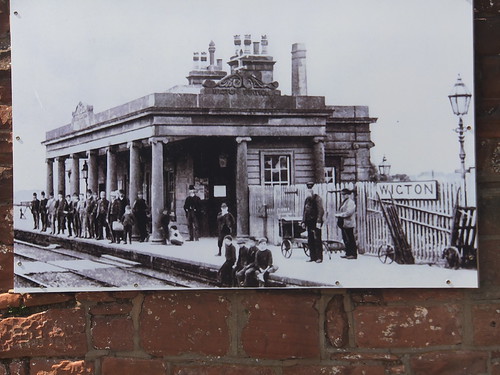 A marvellous photograph of the original Wigton Station Building, displayed on today's more modest station.
Whilst railway architects have often provided impressive facades on the road approach side, the railway side is usually simpler and often hidden under platform roofing arrangements. I was reminded of the rather grand elevation on the railway side of the station at Delyatin, in Ukraine, which similarly featured Ionic Order columns.
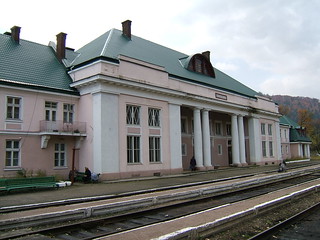
Not Cumbria, but Delyatin station in Ukraine.
Approaching Carlisle we were routed into Bay 2 of this important station. I joined the throng of passengers and crossed the broad footbridge to the main Up Platform to study the possibilities for onward travel.
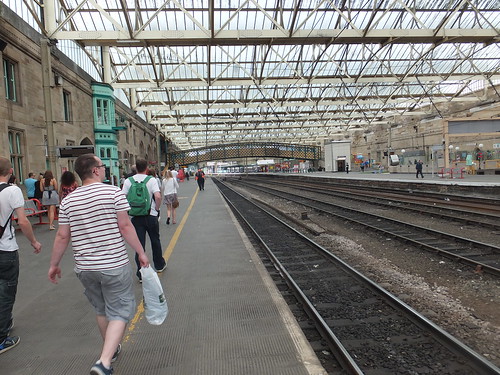 Carlisle Station, viewed from platform 3 showing the footbridge and overall roof.
Virgin operate a frequent service of 'Pendolino' trains between Glasgow/Edinburgh and London Euston. Some of these trains take the Trent Valley Line from Stafford to Rugby, others take the Stour Valley Line through Wolverhampton (my destination) and Birmingham New Street (offering a host of connections, particularly to the south-west). I decided to catch the next southbound service (which would take the Trent Valley Line) as far as Wigan where I would change to the following train which would deliver me to Wolverhampton.
This allowed time for a brief walk around Carlisle, with its population of around 72,000. The local government district is the City of Carlisle, bringing the population up to around 100,000. After a brief foray into the city, I was quite tired and quite happy to return to return to the station for my chosen train.
The Journey Home
I didn't pay the usual attention as the 'Pendolino' sped south on the West Coast Main Line. We stopped at Penrith, Lancaster, Preston before I alighted at Wigan (North Western) to await the following train. I often pass through Wigan by train but don't often actually get off - this is why I'd chosen to change here. I mustered sufficient energy to leave the station and walk up the hill as far as the second station - Wigan (Wallgate). Back at Wigan (North Western), I explored a little but my camera battery finally gave up (I'd omitted to bring a spare) so I quietly waited for my train. Fortunately, the journey was uneventful so I arrived back home very tired but pleased with what I'd managed to fit in.
My pictures
General pictures
Cumbrian Coast Scenes.
Maryport, Cumbria
Railway pictures
Cumbrian Coast Line.
Whitehaven railways.
Workington Main station.
Maryport & Carlisle Railway.
Carlisle's Railways.
Events of Saturday 21st June 2014
I'm not very familiar with the North West Coast of England although, over the years, I've made various visits. On the Longest Day in 2014, with the prospect of good weather, I decided to make a one-day trip by rail at least as far as Barrow-in-Furness and, possibly, beyond. I made an early start from home allowing me to catch the 06:37 Virgin 'Pendolino' service to Edinburgh which deposited me at Lancaster station in about 90 minutes.
Lancaster
From a railway point of view, Lancaster is the gateway to Furness and the Cumbrian Coast, if you are travelling from the south. The station is an imposing structure in stone which I briefly described in the earlier post Return to Heysham.
I had a little time to wait before the next onward service to Barrow-in-Furness, which gave me an opportunity to explore on foot the area around Lancaster Castle and the Priory Church of St Mary (which they confusingly now refer to as 'Lancaster Priory'). The Castle, of course, is built on a hill offering splendid views in various directions. It was a perfect morning, warming up nicely but still with a haze over the hills. Looking seawards, the two nuclear Power Stations at Heysham (described in Return to Heysham) were clearly visible. In another direction, the rooftops of the town were spread out, with attractive stone-built houses meandering down the hill from the Castle.
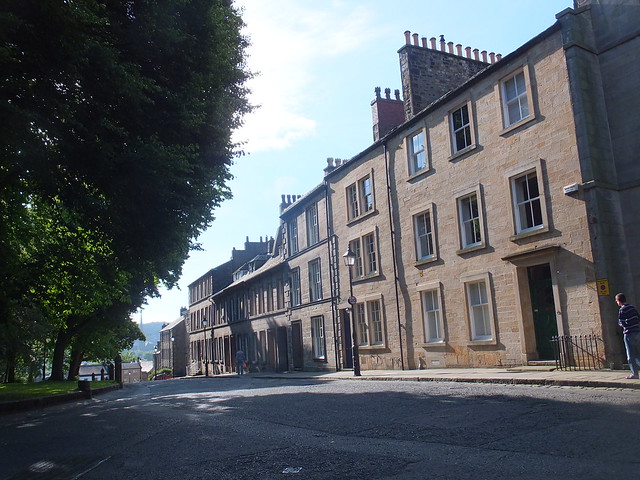 "...attractive stone-built houses meandering down the hill..."
I descended the steep footpath past the site of the Roman Bath House (which I skipped on this brief visit) to the Town Quay on the River Lune. The Lune Millennium Bridge crosses the river here - a curving pedestrian bridge in a very modern style, cable-stayed from two massive pylons.
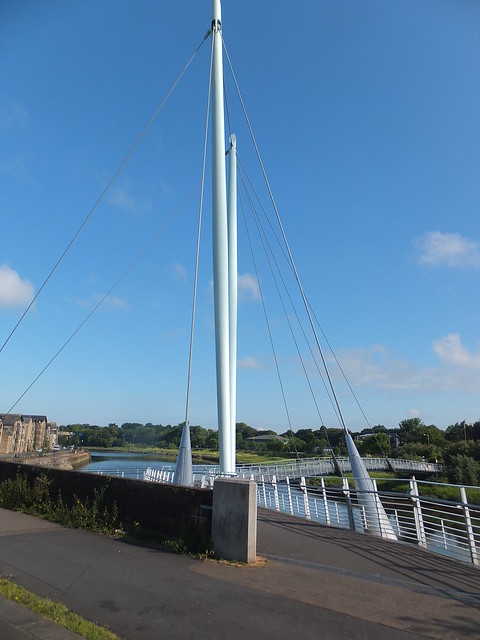
The Lune Millennium Bridge.
A little upstream, there was already plenty of traffic on the road bridge across the river. The 'Greyhound Bridge' had originally carried the former Midland railway line from Lancaster Green Ayre to Morecambe but, when the line was abandoned, the bridge was retained and converted for road traffic. I returned up the steep hill to the station and caught the slightly-delayed 09:02 stopping train to Barrow-in-Furness.
Carnforth and beyond
Our first station stop was at Carnforth. This was where many of the location scenes for the 1945 film 'Brief Encounter' were shot and the station still draws visitors because of that association, in fact, it has its own Heritage Centre and Refreshment Room. There's an interesting commentary on the film's continuing attraction on the 'Guardian' site here.
My train carried on, making brief stops at Silverdale, Arnside and Grange-Over-Sands (where the station is next to the sea front and a broad footpath extending along the coast encourages walkers). We continued, stopping at Kents Bank, Cark, Ulverston (with its rather elegant station buildings, featuring a tall clock tower), Dalton and Roose.
Barrow-in-Furness
As we approached Barrow, the broad, now apparently unused, expanse of Cavendish Dock appeared on our left. Beyond, there were signs of activity in Ramsden Dock with a couple of cargo ships. The port of Barrow is one of 21 operated by ABP (Associated British Ports) in Great Britain. There's a brief summary of Barrow's port facilities here and a plan of the port here. I believe there are still occasional trains from Ramsden Dock to the processing plant at Sellafield, carrying nuclear waste from nuclear power stations in Japan and the Netherlands for treatment.
Soon, my train was passing between rows of houses of a typical industrial town and stopping at Barrow, where I alighted, intending to spend about an hour looking around the town before continuing north on a later train. After Carlisle, Barrow is the second largest population centre in Cumbria with a present population of around 70,000.
I knew that the discovery of iron ore in Cumbria, together with coal, triggered the ironmaking and steelmaking industry in Barrow. I didn't realise that, around 1900, Barrow had the largest steelworks in the world, operated by the Barrow Hematite Steel Company Limited. Local iron ore deposits became exhausted in 1963 and steelmaking finally ceased in 1980.
Shipbuilding started in Barrow in 1871 but I didn't know that around 700 vessels had been built - there's a Wikipedia list here. Submarines are still constructed in Barrow by BAe Systems, see Wikipedia article. Shipbuilding now takes place under cover in the huge Devonshire Dock Hall (DDH). There's no traditional launch slipway - vessels are lowered into the water on a huge shiplift which can handle 24,300 tonnes!
For more information on Barrow, see the Wikipedia article.
Barrow-in-Furness railway station is modern but houses the original memorial to railwaymen who lost their lives in the Great War. The memorial shows obvious signs of damage - a small sign added below the memorial explains "THE DAMAGE TO THIS MEMORIAL WAS CAUSED BY ENEMY ACTION IN WORLD WAR II 1939-1945."
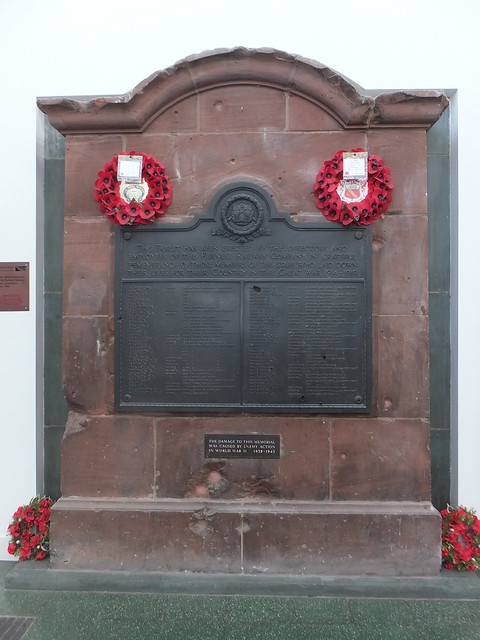
Click for larger size.
The War Memorial at Barrow-in-Furness railway station.
I quickly realised that Barrow's steelworks and shipbuilding yard had made the town an important target for the Luftwaffe in World War II. I learned afterwards that, in a series of air raids in 1941, 83 people in Barrow were killed and hundreds injured. There's a Wikipedia article on the Barrow Blitz.
I set off on foot towards the centre of the town, aiming for the sandstone clocktower of the tallest building around, which turned out to be the neo-Gothic Town Hall, completed in 1886. Although I passed a number of new buildings (the Courts, a modern shopping area including Debenhams and The Forum Entertainment Centre), sufficient older buildings remained to leave a sense of identity. A number of streets had been pedestrianised, which helps to give a human scale so I quite enjoyed my perambulation.
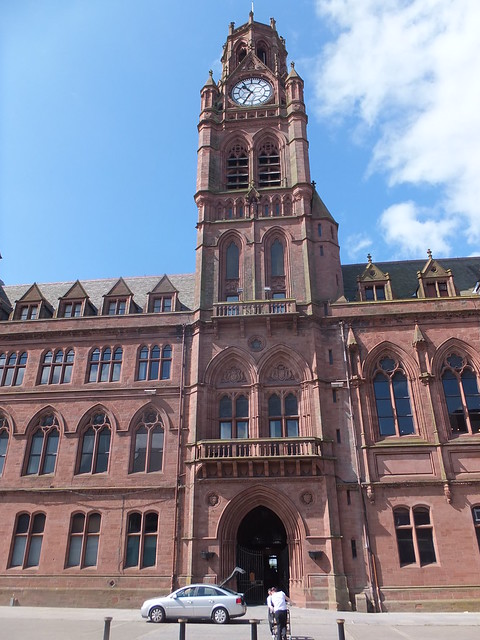
Barrow-in-Furness Town Hall.
One long area of water pierces through the town: this is Buccleuch Dock on the seaward end (including the Town Quay which berths two superannuated ships one of which served as the 'Blue Lagoon Night Club' until 2010) and Devonshire Dock at the landward end (terminated in the massive Devonshire Dock Hall mentioned above). The bridge carrying Michaelson Road divides the two docks.
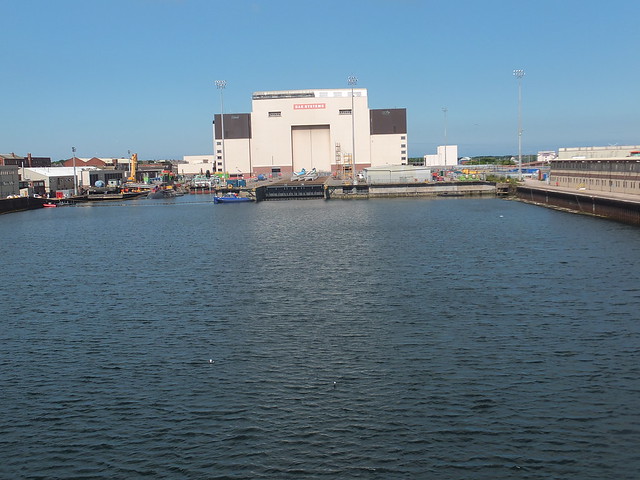 BAe System's covered shipbuilding hall at the end of Devonshire Dock, with the Shiplift visible outside the doors.
I retraced my route back to the station in time to catch the next northbound train.
Beyond Barrow
I joined the 11:22 to Whitehaven which had earlier come from Carlisle along what's presently marketed as 'The Cumbria Line' and was timed to arrive in bay platform 3 at Barrow at 11:08. Around the same time, the 09:45 from Preston was due in Platform 1 at 11:04, then returning to Lancaster at 11:20.
My train was allowed 77 minutes for the 46 mile journey to Whitehaven with a number of stops on the way. Some of these stations were request stops - tell the Guard if you want to get off, handsignal the approaching train if you want to get on. I don't remember 'missing out' any of the stops - it was a summer Saturday and there were plenty of passengers. In the following station list, the request stops are marked with an (x).
Askam
Kirkby-in-Furness (x)
Foxfield (x)
Green Road (x)
Millom
Silecroft (x)
Bootle (x)
Ravenglass
Drigg (x)
Seascale
Sellafield
Braystones (x)
Nethertown (x)
St. Bees
Corkickle (x)
The railway continues to rely upon largely traditional operating methods with mainly semaphore signals, frequent signal boxes and even more frequent level crossings of various styles - User Worked, Manual Gates, the occasional Automatic Barrier.
With excellent weather, the appeal of the area was obvious - on our right the mountains, on our left either low, rocky embankments dividing the railway from the sea or fields with grazing cows reaching to the sea shore. There did seem to be rather a lot of wind turbines but, I afterwards discovered, this is Britain's Energy Coast with the Mission Statement "To lead the transition of West Cumbria into an economy that will flourish in a low carbon future."
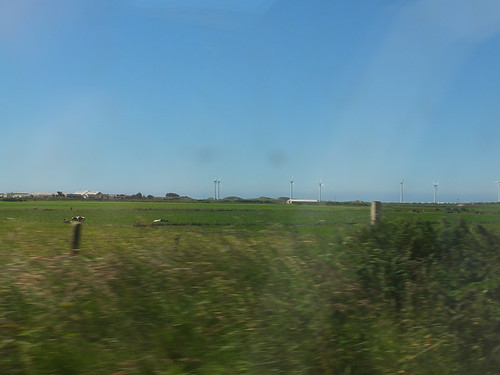 Green fields, cattle grazing ... and windfarms.
Ravenglass is a widely-known station, because a short walk leads to the terminus of the famous 'Ratty' - the Ravenglass and Eskdale 15-inch gauge steam railway which extends seven miles to Dalegarth.
About one and a half miles beyond Ravenglass, we stopped at Drigg station, with its signal box, manually-worked crossing gates and a siding trailing off on the Down side into an anonymous-looking well-fenced area. This remote area opened in 1940 as a wartime Royal Ordnance Factory for the manufacture of TNT explosive.
The next station is at Seascale - an almost-perfect seaside village with a population of around 1800. I say 'almost' because, as the picture below shows, around one mile north of the village is the industrial complex now known as Sellafield.
 Aerial view of Seascale with Sellafield in the background (Photo: Visit Cumbria).
Sellafield
Sellafield has a small station next to the shore. On the landward site, the industrial complex stretches for some distance with a network of rail sidings where I spotted numerous odd-looking goods wagons and a couple of diesel locomotives. This site has a long and convoluted history which I'll outline below.
The industrial complex at Sellafield originated in 1942 as a wartime Royal Ordnance Factory. In 1950, Windscale Pile No. 1 was built here, followed by Windscale Pile No. 2 the following year. These were graphite-moderated, air-cooled nuclear reactors designed to produce weapons-grade plutonium for Britain's independent atomic (fission) bomb. Weapons technology advanced quickly and the Windscale facility was then adapted to produce Tritium for thermo-nuclear (fusion) weapons. In 1954 the United Kingdom Atomic Energy Authority took over the site.
The Magnox nuclear reactor (see Wikipedia) was British-designed. In 1953 building commenced on Calder Hall Power Station which had four Magnox reactors. See the Wikipedia article Calder Hall Power Station. Electricity was first fed to the National Grid in 1956 and the official opening was carried out by Queen Elizabeth II. There's a contemporary article published in 'The Engineer' here. I remember the optimistic publicity at the time, with talk of electricity being so cheap, it would no longer need to be metered. The Magnox reactor design is now obsolete and there's just one remaining commercial Magnox reactor in the U.K. (Wylfa on Anglesey, mentioned in the section 'Valley' of my article Trip to Holyhead).
In 1957, Windscale No. 1 suffered a fire which proved difficult to control and resulted in a major release of radio-activity (reduced by the filters included at the top of the stacks installed at the insistence of John Cockcroft which had previously been dubbed "Cockcroft's Folly"). Both reactors were taken out of use and No. 1, following a lengthy and expensive operation, has now been dismantled. See the Wikipedia article Windscale Fire.
The Windscale Advanced Gas Cooled Reactor (with its distinctive 'golf ball' shape) was built in 1962 as a prototype for later AGR reactors, for instance, Heysham (outlined in the section 'Heysham Nuclear Power Stations' in my post Railways around Morecambe). The Windscale AGR was taken out of use in 1981 and now serves as a 'demonstrator' for safe decommissioning procedures.
In 1971, most of the site was transferred to a Government-owned company, British Nuclear Fuels Limited (BNFL). Under BNFL, the 'THORP' (Thermal Oxide Reprocessing Plant) was approved in 1978 but only brought into use in 1994. In 2005 it stopped operating following a serious leak, but was restarted in 2007. See the Wikipedia article Thermal Oxide Reprocessing Plant. A major reorganisation of the site in 1981 also adopted the name 'Sellafield' but failed to transform operations into the anticipated commercial success. The First Generation Reprocessing Plant, the later Magnox Reprocessing Plant and the associated storage Ponds all now await decommissioning. The problems of dealing with radioactive waste have given rise to various other intiatives, all of which have proved expensive and not particularly satisfactory since high-level radioactive waste needs to be safely stored for thousands of years.
In 2004 the Nuclear Decommissioning Authority (NDA) took over from BNFL. This body is a Quango. Their website is here and there's a Wikipedia article here.
Sellafield: The actual work on the Sellafield site is carried out by Sellafield Limited, a company owned by Nuclear Management Partners Limited which is a consortium formed by URS (a large American engineering public company), AMEC (a large English engineering public company) and Areva (a large French engineering public company). Cynics might suggest that this convoluted arrangement ensures profit for the contractors without attracting the liabilities inherent in nuclear operations.
Drigg: In a similar manner, the former Royal Ordnance Factory at nearby Drigg (mentioned above) is also within the NDA remit and is now the National Low Level Waste Repository operated by LLW Repository Limited, a wholly-owned subsidiary of UK Nuclear Waste Management Ltd which is a consortium formed by URS (see above), Studsvik (a large Swedish engineering public company), Areva (see above) and Serco (a large English services public company).
Direct Rail Services: I hadn't realised that Direct Rail Services was owned by the Nuclear Decommissioning Authority. Originally, it solely operated nuclear flask trains, but its work has now expanded.
Capenhurst: My earlier post Birkenhead and New Brighton by train (Part 1) outlined the work of the Nuclear Decommissioning Authority at Capenhurst (although uranium enrichment on that site is carried out by Urenco UK.
Related sources:
Committee on Medical Aspects of Radiation in the Environment.
World Nuclear News.
On to Whitehaven
On leaving Sellafield, the railway line became single as we ran along an embankment a few yards from the beach. We passed a long line of houses on the beach huddled against the embankment with marvellous sea views. The older properties were wooden, large beach-huts but frequently extended and apparently cared for with neat gardens. Some of the houses were modern and brick built. Access to this curious village was by a sandy track running in front of the houses which dived under a railway bridge to reach normal roads.
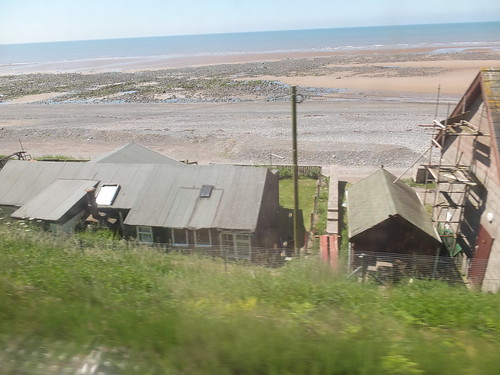 Beach Houses near Sellafield.
The train continued along the embankment through the village of Braystones and along the sea wall through Nethertown to St. Bees. Just north of the station we passed St. Bees School which has a history going back to 1587.
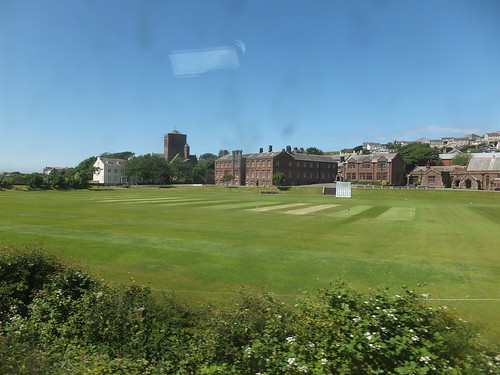 St. Bees School.
The line remained inland approaching Whitehaven. I was surprised at the size of the housing estate spread across the hill to our left - mature semi-detached and blocks-of-four housing. The population of Whitehaven, I later discovered, is around 23,000. We stopped at the first of Whitehaven's two stations, Corkickle. This was once the junction with a double-track line to Moor Row although, even then, the two routes converged onto a single platform serving Corkickle with a single line tunnel to the second station, Bransty. The junctions and sidings around Corkickle are long gone but the single platform and Whitehaven Tunnel (1,320 yards long, still single line) remain in use.
The rest of my travels that day are in the post Furness and the Cumbrian Coast (Part 2)
My pictures
Lancaster.
Barrow-in-Furness.
Cumbrian Coast Scenes.
Railway pictures
Carnforth railways.
Furness Line & Barrow.
Cumbrian Coast Line.
Whitehaven railways.
[Link to Part 2 added 1-Jul-2014]
In an earlier post titled simply 'Liverpool', I talked about my introduction to this remarkable city, with brief information about the electrified Liverpool Overhead Railway. The City has clearly continued to hold a fascination for me because quite a number of posts have followed set in or around Liverpool or describing journeys to and from Liverpool.
I've summarised each of these Liverpool-themed posts below, with links to the full post. Links from each full post lead to my photographs.
Liverpool viewed from the River Mersey.
'Lion' and OLCO
Part of my interest in Liverpool has been through my involvement with the 'Lion' locomotive 'supporters group', the Old Locomotive Committee (OLCO). 'Lion' is in the care of National Museums on Merseyside and is now a major exhibit at the Museum of Liverpool. You can find all my posts about OLCO and 'Lion' here.
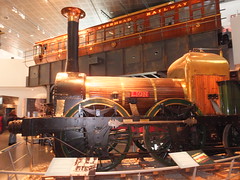
'Lion' and the Liverpool Overhead coach
in the Museum of Liverpool.
By steam to Birmingham
The post 'Black 5' to Birmingham describes what I can remember of a journey in the steam era from Liverpool Lime Street in the 1950s, taking the former L&NWR route via Runcorn, Weaver Junction, Crewe and Stafford to Wolverhampton.

This evocative Ben Brooksbank shot
shows 'Patriot' 45515 at Lime Street.
By train in 2010
To attend an OLCO A.G.M. at the Museum of Liverpool Exhibit Store, I took the L&NWR route to the to the wonderfully-named modern station at Liverpool South Parkway (for Liverpool John Lennon Airport), formerly the rather prosaic 'Allerton' where I was able to change to what was formerly the Cheshire Lines Committee route to Liverpool but which had become part of the 'Merseyrail' network. A Class 350 EMU (25 kV a.c. overhead electrified) took me to Liverpool South Parkway, changing there to a Class 508 EMU (750 V d.c. third-rail electrified) to Bank Hall.
At the Exhibit Store, I was able to study 'Lion' (being readied for display in the new Museum), 'Cecil Raikes' (the massive Beyer-Peacock 0-6-4T which operated on the Mersey Railway prior to electrification), the 'Avonside' 0-6-0T saddle tank (one of the Mersey Docks and Harbour Board shunters) and the preserved Liverpool Overhead Railway Driving/Motor car (also being prepared for display in the new Museum). This trip is briefly described in the post Day Trip to Liverpool.

Bank Hall station (former L&Y Railway).
By train in 2012
Once again, I was attending an OLCO A.G.M., this time held in the new Museum of Liverpool. The A.G.M. is described here. The journey was via the former L&NWR route by a 'London Midland' Class 350 both ways. There's a brief description in the post Liverpool by Train.
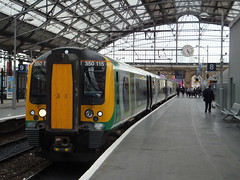
Class 350 at Liverpool Lime Street.
Birkenhead and New Brighton by train
For this trip, I took a Virgin 'Pendolino' service to Crewe, a DMU from Crewe to Chester and then a 'Merseyrail' EMU to Birkenhead. I indulged my interest in Scherzer Rolling Lift Bridges by walking extensively around the dock area, looking at three remaining examples of this ingenious design of moveable bridge. 'Merseyrail' then took me on to New Brighton, by which time the weather had deteriorated. I returned to Wolverhampton via Birkenhead and Chester, as my outward journey. The trip is described in three posts - the first is Birkenhead and New Brighton by train (Part 1), with links to the other parts.
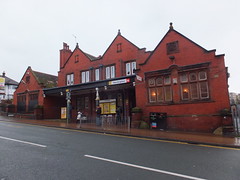
New Brighton station from the roadside.
By train in 2014
This time, I took the former Great Western Railway route from Wolverhampton to Shrewsbury (change) then on to Wrexham General. Another change let me travel on the former Great Central Railway to Bidston. The route from Wrexham to Bidston is now marketed as 'the Borderlands Line. The first three trains had been DMU but at Bidston, I joined a Merseyrail EMU on to Liverpool. I wandered around the city, called in to see if 'Lion' was still safe in the Museum of Liverpool (she was) and then couldn't resist taking the iconic Mersey Ferry to Birkenhead. Another Merseyrail EMU took me to Bebington, where I visited the Lady Lever Art Gallery before taking another EMU to Chester. I returned home via the former Great Western Railway via Wrexham and Shrewsbury. Two posts describe this trip:-
By rail to Liverpool (Part 1)
By rail to Liverpool (Part 2).
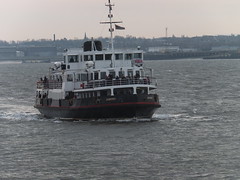
Mersey Ferry 'SNOWDROP'.
Early Days of the Mersey Railway
There's a little history about the Mersey Railway here.
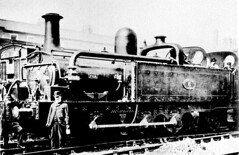
Mersey Railway 0-6-4T 'Fox'.
The Mersey Docks and Harbour Board
There's a short post here.
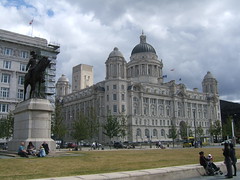
The Dock Office, Pierhead.
Edge Hill, Liverpool
The Edge Hill area of Liverpool has been associated with railways since 1830, when the Liverpool and Manchester Railway opened its first passenger terminus at Crown Street. There's a little about the history and growth of the railways around Edge Hill in the post Edge Hill, Liverpool.
Intrigued to know how much of the original railway infrastructure survived, I re-visited Edge Hill in June 2013 and carried out a fairly extensive walking tour. I reported on what I found in the post Railways around Edge Hill in 2013.
On the Edge Hill Station Site I found a series of photographs which I concluded showed a 'Steam Special' changing engines at Edge Hill in 1954. The post Northern Rubber Special gives my suggested explanation of these intriguing photographs.
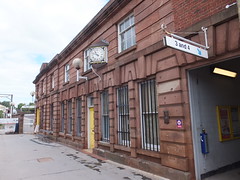
Edge Hill Station Buildings (1836).
Liverpool Lime Street Station
The former L&NWR terminus in Lime Street still retains much of its former grandeur and the two massive trainsheds have been quite well restored. My post Liverpool Lime Street Station gives a little history.
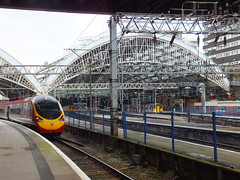
Liverpool Lime Street station.
The other principal stations in Liverpool have not fared so well. The L&Y Liverpool Exchange survives only as a frontage (albeit a handsome one) and little remains of the Cheshire Lines Committee terminus at Liverpool Central High Level. The excellent 'Disused Stations' site features both Liverpool Exchange and Liverpool Central High Level.
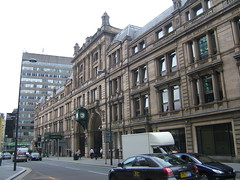
The facade of Liverpool Exchange station today.
More recent posts in this blog
Notes on Liverpool and its Docks.
Merseyside in December.
My pictures
Liverpool area rail.
Merseyrail.
Liverpool.
Birkenhead and its Docks.
New Brighton.
Port Sunlight, Wirral.
Museum of Liverpool.
Royal Visit to the Museum of Liverpool.
Audio Visual Systems at the Museum of Liverpool.
[Updated 30-Dec-2016]
The Old Locomotive Committee (OLCO) is the 'Supporters Club' for the 1838 locomotive 'Lion' and 'Lion' models. The 30th Annual General Meeting of OLCO was held in the Museum of Liverpool on Saturday, 14th June 2014.
Through the courtesy of the Museum's Curator of Land Transport & Industry, Sharon Brown, this was the third time that the A.G.M. had been held at the Museum. There's are brief reports on the A.G.M. in 2012 here and the A.G.M. in 2013 here.
On the day of the 2014 OLCO A.G.M., the Museum was also hosting an International Conference titled The Un-Straight Museum. The conference ran in conjunction with a year-long exhibition at the Museum titled April Ashley: Portrait of a lady. It was also the weekend of the The International Mersey River Festival: On The Waterfront (the music for which provided various 'noises off' from time to time).
The A.G.M. was accommodated in Education Room 2 on the first floor. Sharon had provided tea, coffee and biscuits for which members were very grateful. The Chairman of OLCO, John Brandrick, opened the formal A.G.M. at 1.00 p.m. and welcomed those attending. The Agenda items were dealt with promptly and the Election of Officers (once again) resulted in no changes to those serving in the previous year. There was lively discussion during 'Any Other Business' and the Chairman closed the meeting at 3.05 p.m. Members of the Old Locomotive Committee will receive formal minutes of the proceedings in due course.

The 30th A.G.M. in progress.
Those attending then moved to the Great Port Gallery, where 'Lion' is on display, for technical discussions and a group photograph. We couldn't help noticing that the audio-visual presentations about 'Lion' (briefly described in an earlier post here), had stopped, although they'd been working in the morning.

Alan, John, Jan, Jon, David, Sharon and John in front of 'Lion'.
More on this website
The Old Locomotive Committee (an introduction to 'Lion' and OLCO).
All my posts about OLCO activities are here.
More on other websites
Lion & Old Locomotive Committee (the website of the Old Locomotive Committee).
My Pictures
OLCO A.G.M. 2014.
All my pictures showing OLCO events are in the collection The Old Locomotive Committee and Lionsmeet
Click on any picture below to see an uncropped image.
In 2008 I made my first visit to Myanmar (formerly Burma) and travelled on Yangon's suburban railway. The railway trip is described in the post The Circle Line, Yangon.
In a later post, Yangon Area Railways, I described the colour light signalling on the railways around Yangon. I'd discovered that in January 1946, following severe damage to the railways around Yangon during World War II, an order was placed with Westinghouse Brake and Signal Company for two Style 'L' miniature lever frames for Burma Railways. They were intended for 'Rangoon' and 'Kemmendine'. At that time, I hadn't found the signal box at Yangon (as Rangoon is now called) and I was puzzled about Kyee Myin Daing (as Kemmendine is now called) because I'd seen two mechanical signal boxes there, still apparently in use.
In February 2013, shortly after writing the Yangon Area Railways post, I made another visit to Yangon. This time, I located Yangon Central Power Signal Box and, although confined to public areas, confirmed that the Style 'L' miniature lever frame was still in use. I wrote about this discovery in a post here.
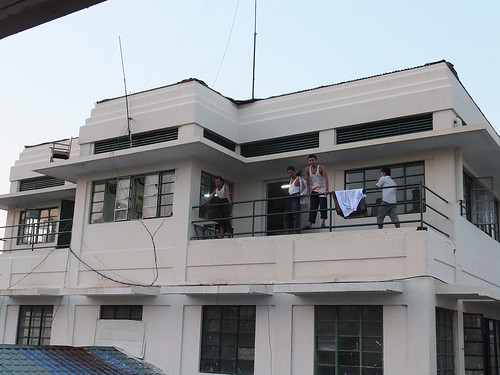 Yangon Central Power Signal Box in 2013.
On my next trip to Burma, my friend Doctor Hla Tun made arrangements on 25th April 2014 for me to visit Yangon Central Signal Box and make a cab ride around the Circle Line. The day is briefly described in the post Exploring Yangon's railways.
The Style L Power Frame
Early miniature-lever Power Frames retained mechanical interlocking between the levers, in a similar fashion to purely mechanical lever frames. But as installations became more complex, the problems of providing mechanical interlocking in the limited space available increased. The Style L Frame introduced by Westinghouse Brake and Signal in 1929 interlocked the miniature levers electrically. This meant that a large frame could be installed in two or more sections, if that was operationally more convenient. For instance, the frame at Waterloo was divided into three sections and that at Crewe North Junction into two sections. In addition, all the interlocking was on the operating floor of the signal box. In front of each lever an engraved description or lead plate was provided. Behind each lever, on an almost vertical panel, are the repeater lamps.
Movement of a lever has two actions:-
1) Through a link piece, the lever moves a horizontal lock slide extending to the rear of the frame. Suspended below the lock slide is a sealed Interlocking Magnet which allows or prevents lever movement. A second, smaller Indication Magnet is also provided.
2) Through bevel gearing, movement of the lever rotates a vertical shaft through 120 degrees. Each shaft can mount up to 36 phosphor-bronze electrical contact bands. Where additional contacts are required, a further bevel gear is provided at the rear of the lock slide, rotating a second vertical shaft at the rear of the frame, allowing a further 36 contacts to be fitted.
For more detailed information, refer to Mr. Francis' excellent book [reference 1].
My visit to Yangon Central Power Signal Box
I was made very welcome by two signalmen, a senior signalman, a regulator and a train announcer. Most had some English. Just as well, because the frame, the illuminated diagram and all the lever description plates were in English. That made it a lot easier for me to work out what was going on. I've noticed before when overseas that because most railways work in similar ways, it's possible to work out quite a lot even if you can't ask questions of the local staff, so I quickly felt at home.
The lever frame dominated the signal box - 143 minature levers in one straight line with an illuminated track diagram behind.
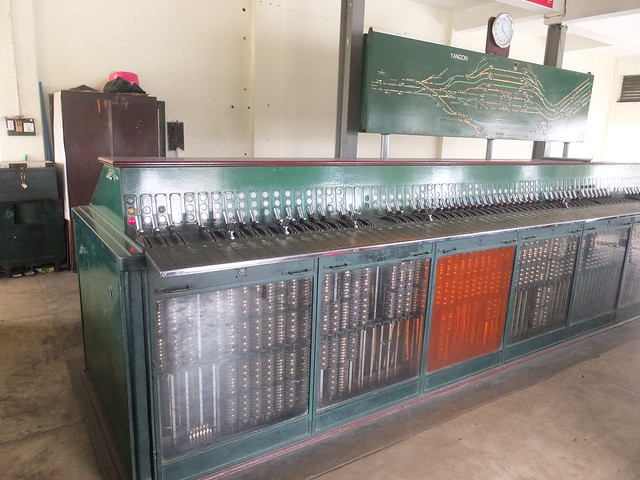 General view of the Style L Power Frame and Illuminated Track Diagram at Yangon.
There were some signs that the frame might be getting 'tired' - occasionally a signalman would 'jiggle' a lever, perhaps because of a sticky lock. The lever description plates appeared to be engraved brass, filled white. All the repeater lamps were, as normal, fitted on the nearly-vertical panel behind the levers. Points displayed the usual 'N' (normal) or 'R' (reverse).
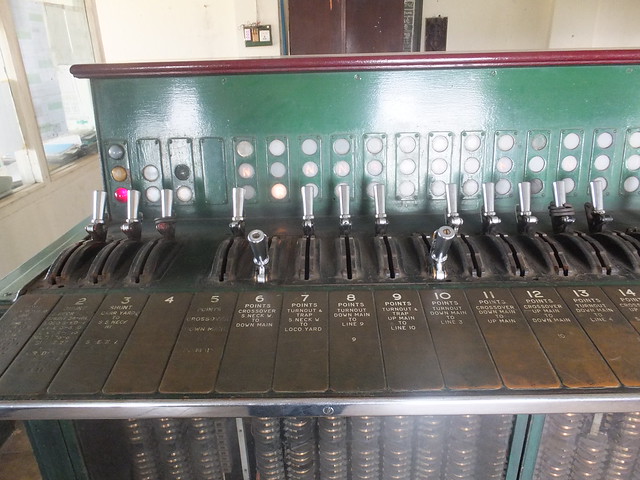 Detail of left end of the frame.
The front access panels were plastic glazed, so all the electrical contacts on the front vertical shafts were visible.
 Vertical contact shafts at the front of the frame.
Looking from the rear of the frame, there were similar access panels plastic glazed across the top allowing the lock slides and the associated mechanics to be seen. The interlocking magnets themselves were below the top plate but the positions they occupied were visible. Finally, there were vertical rear access panels, plastic glazed (similar to those at the front), allowing inspection of the electrical contacts on the rear vertical shafts.
Conventionally, the relay room was below the operating floor but I was only able to see it through the vision panel on the padlocked door.
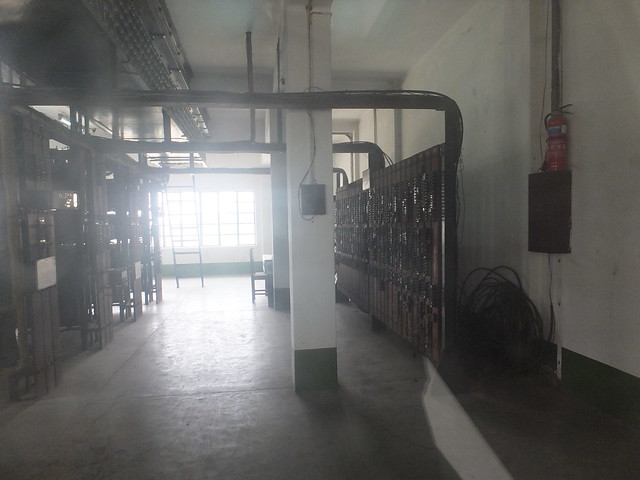 View of the relay room. Racking with large shelf-type relays on the left and cable termination panel on the right.
Operations at Yangon Central Station
It's always interesting to watch operations around Yangon Central station but, of course, the Power Signal Box gives the best view. There are two balconies at the front of the signal box and the signalmen make frequent use of them to check exactly where trains are.
Subsequent changes
Since the visit in 2014 described in this post, the signalling around Yangon has been modernised. The new arrangements are described in the post Railway Operation Control Center, Yangon.
Books
[reference 1] 'The Style L Power Frame' written and published by J. D. Francis 1989 (ISBN 0 9514636 0 8).
My Pictures
Yangon Central Power Signal Box.
You can find all my albums of pictures showing Burma Railways here.
More
Myanma Railways (Index)
You can select all my posts about railways in Burma (in reverse date-of-posting order) here.
There's a post about Crewe North Junction Signal Box here with a little more information about (and more photgraphs of) the Style L Power Frame.
[Minor update & link to 2020 post added 31-Mar-2020]
Click on any picture below to see an uncropped image.
I returned from a trip to Burma on 9th May 2014. There's a series of posts describing the trip (starting at Back to Burma with links to later posts in order). This wasn't a railway holiday but I did manage a visit to the power signal box in Yangon and a diesel cab ride around Yangon's Circle Line (there's a brief description in Exploring Yangon's Railways with links to my pictures).
I had a few days to recuperate before my next footplate turn at Peak Rail on Sunday 18th May.
Events of Sunday 18th May 2014
I was booked with Harvey and we started the day with a footplate experience course. Our trainee was a very pleasant young man who, we discovered, had just married and was with his charming wife. It seemed an odd format for a honeymoon but after the course, they both enjoyed a ride on the train and I managed a picture of them both on 'Lord Phil' at Matlock Town. We extend our best wishes for the future to this couple.
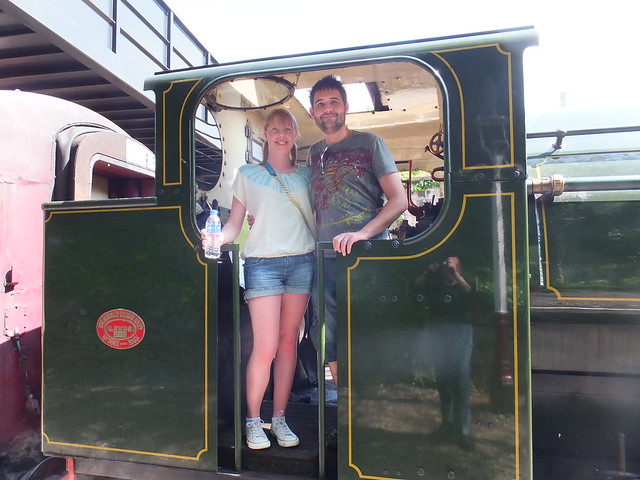 Newly-weds Mr. and Mrs. Yeend on the footplate of 'Lord Phil' at Matlock Town.
The format for the passenger service was five rounds between Rowsley and Matlock Town, top and tailing with 'Penyghent'. The only exceptional event was that the weather remained hot all day and at times it was a bit warm on the footplate.
Before our final departure of the day from Rowsley, the station staff asked us to do our best to be 'right time' at Matlock Town as two lady passengers were hoping to make the connection with the East Midland Trains service at Matlock and make a further connection at Derby as they were travelling back to London. We didn't let them down.
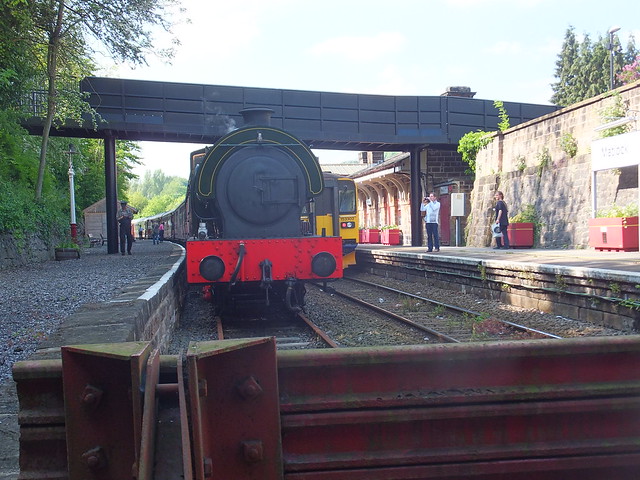 'Lord Phil' at Matlock Town standing next to an East Midlands Trains Class 153.
Events of Sunday 26th May 2014
My next turn was with Dave on Sunday 26th May. We were joined by Jacob, on his first Cleaning Turn. The weekend had been advertised as the Mixed Traffic Weekend. Heritage Shunters Trust were running brake van rides at Rowsley, and they rang the changes on the motive power in use, providing an excellent attraction. But shortage of motive power for the service trains meant than it had been decided to operate only the normal service of five top and tailed round trips between Rowsley and Matlock. 'Lord Phil' was on the south end of the train, with Peter Briddon's preserved 'Teddy Bear' locomotive 14 901 on the north end. Wikipedia has a description of the 'Class 14' here.
It was as well I'd taken my heavy overcoat because the weather was quite different from that on my previous turn described above. On my arrival, the rain was sluicing down and it remained pretty wet all day. When it's raining, it's impossible to prepare a steam locomotive standing in the open without getting thoroughly bedraggled and it took me some time to dry out afterwards. But, leaning out of the cab for better visibility when on the move and taking water periodically during the day at Rowsley means that, as soon as you've dried out, you get drenched again. As I often say "Anyone can work on a locomotive when it's fine but it takes an engineman to do it when it's wet".
Fortunately, by the time we arrived back at Rowsley on the last trip, the rain had stopped, so we were able bring the light engine 'on shed' and dispose without another soaking. Disposal is unattractive enough at the best of times - the fire has to be 'knocked out', ash removed from the ashpan, char removed from the smokebox. There's a brief description of the process in the post MIC - Disposal
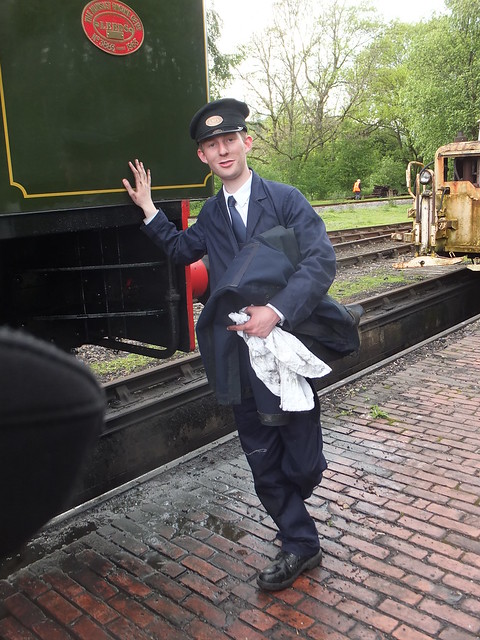
Jacob beside 'Lord Phil' at the end of his first turn as a Cleaner.
My Pictures
Peak Rail, May 2014.
You can find all my Peak Rail Pictures here.
More
You can find all my Peak Rail Posts here.


