skip to main |
skip to sidebar
Click on any picture below for an uncropped image.
Events of Thursday 1st May 2014
So, once again it was back on the Air Bagan tubo-prop from Mandalay to Yangon. Shortly after take-off, I got a decent view of the North – South dual carriageway highway which now links Mandalay and Yangon. I’d used the road route last year, when I’d stopped off for one night at the new capital, Naypyidaw. Driving along that section of road is described here (that whole trip to Viet Nam, Australia and Burma is described in a series of posts here).
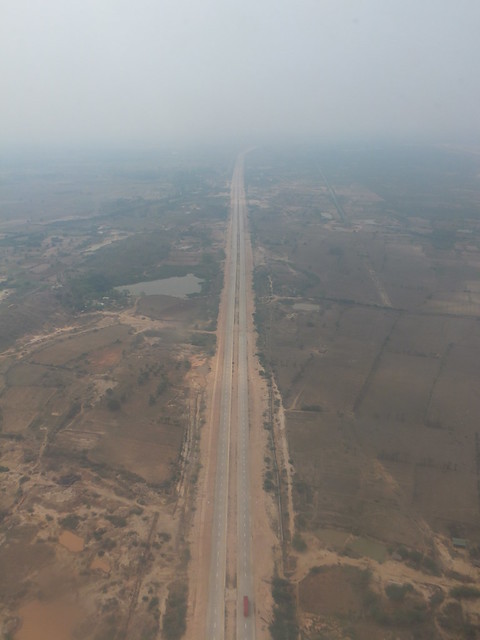
Leaving Mandalay - view of the North-South Highway.
I hadn’t realised until the ‘Fasten Seat Belt’ sign came on that my flight was making an intermediate stop at the attractively-named Heho. This is a gateway for air travellers to Shan State and, in particular, the amazing Inle Lake, which I’d visited on an earlier trip. Quite a few European tourists got off, a few passengers got on and within fifteem minutes we were airborne again, headed for Yangon’s Mingalardon Airport. On arrival, I was quickly re-united with my checked baggage and located my waiting driver who, having located me, disappeared to fetch the car. This time, I notice that the busy Pick-up and Drop-off area which is always a scrum had acquired a large steel portal framed shed – a transit shed for people. It at least makes the interchange cooler if not much more pleasant as you’re still likely to be assailed by freelance porters, taxi and hotel touts.
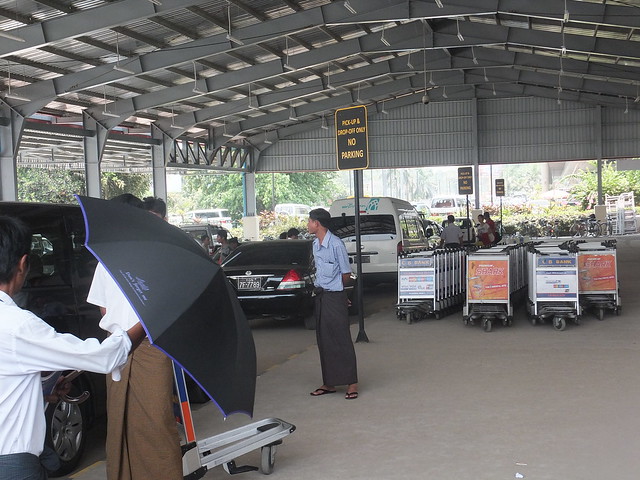 An unusually quiet moment at the Pick-Up & Drop-Off area at Yangon's Domestic Terminal.
It was only a short wait before my car appeared from the car park, my luggage was loaded and I was in the rear seat of a decent saloon imported from Japan. For once, I was happy to leave the air conditioning on.
I’ve always found the traffic in Yangon horrendous during the day but I’m sure it’s getting worse and it took us well over an hour to reach my home for the next two nights, the Strand Hotel.
For me the Strand is up there with the Oriental Hotel in Bangkok and the Raffles Hotel in Singapore. It’s regular guests included all the ‘usual suspects’ like Somerset Maugham and Noel Coward. I rather think the Strand is my favourite as it performs its tasks unobtrusively. I had room 210 on this occasion and immediately started to relax after my journey.
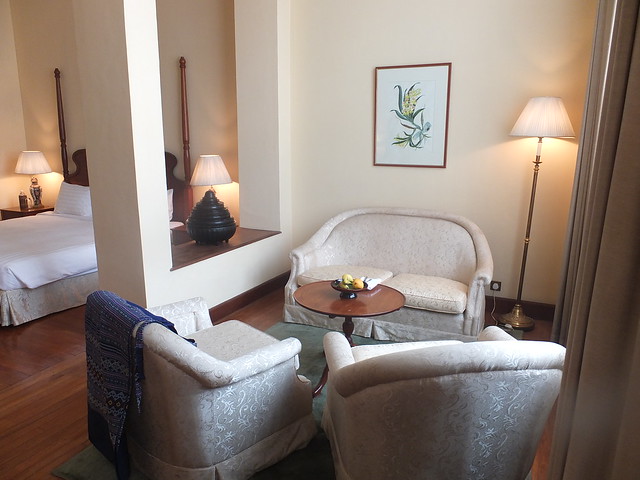 Room 210 at Yangon's Strand Hotel.
However, I always feel I should be outside, trying to look and learn about this fascinating country. I thought that a walk to Yangon Central railway station would enable me to combine “people watching” with making further study of the railways. There is always so much going on in the streets, all at once, that it simply defeats my attempts at description. Some people seem oblivious to their surroundings and sleep or get on with the minutiae of life apparently unaware of other people. But the majority of people seem industrious, engaged in the business of buying and selling to just get by. I noticed an elderly man sitting on the kerb, with a battered pair of bathroom scales in the gutter in front of him – bingo! You have a self-employed businessman.
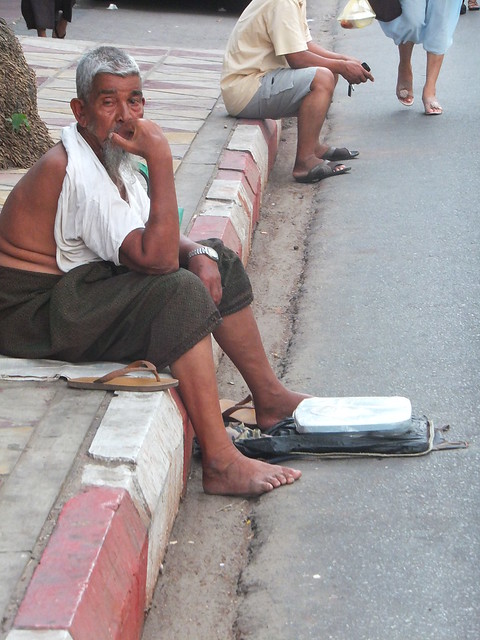
A novel 'I speak your weight' concept.
Of course, there’s always plenty to watch at Yangon’s Central Station. I’d read a report that the Station Master had placed a steam locomotive on a plinth at the station, since he thought it would be of interest to foreign visitors. I’d seen the exhibit from a distance but wanted to make a better record. It’s one of the handsome 4-6-4 ‘Baltic’ tanks, running number 'As 144'. My more technical thoughts, I’ll defer until another post.
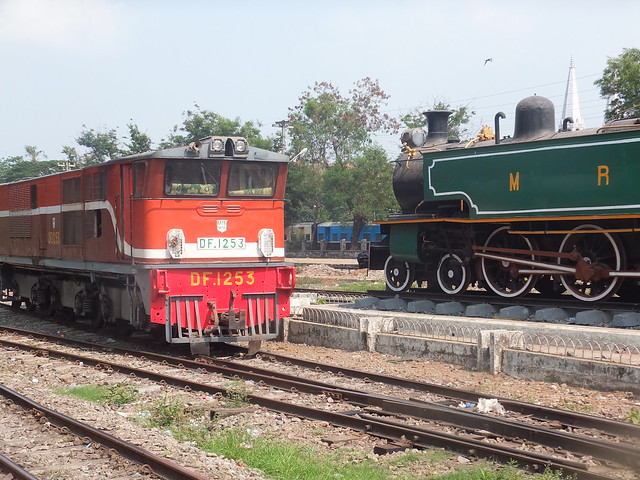 'Alsthom' Bo-Bo-Bo diesel-electric passing the plinthed steam locomotive.
Well-toasted by the afternoon sun, I started to walk (stagger?) back to my hotel, recording some of the architecture from the 1920s and earlier. When I reached the MahaBandoola Park, I noticed lots of people sitting in the shade of the various ornamental shrubs on the coarse grass so I selected a vacant bush and flopped down. The sight of an elderly European lady on the ground caused some amusement with passers by but my smile was invaribly returned.
Along one side of the park, protesters were encamped along the pavement, The pavement was covered by a flat fabric roof erected over a framework of bamboo supports apparently serving the kitchen and sleeping area. An adjacent strip of road had also been fenced off with string and traffic cones and most of the mainly middle-aged protesters were in this area, talking quietly. The encampment had the appearance of having been established for some time and the protesters appeared ready to continue for some time. Most of the banners were in Burmese (logical) but a couple were in English. One read:-
“Our land is our life” Compensation is NOT the solution!
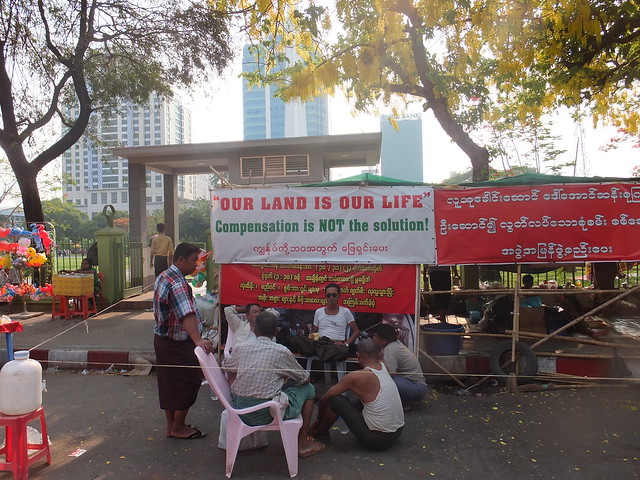 Protesters' encampment outside the MahaBandoola Garden.
I’m afraid the Myanmar Government still has a reputation for ‘land-grabs’, for instance, New Bagan came into being when the Government announced that Old Bagan was being requisitioned. Road, Rail and Industrial projects all appear to have ridden rough-shod over the wishes of local people.
Of course, we consider ourselves far more democratic in the U.K. (HS2, anyone?).
My Pictures
Mandalay International Airport.
Yangon Airport.
Strand Hotel, Yangon.
Around Yangon, 2014.
Yangon's Railways.
More
Next Post describing this trip.
[Revised 27-May-2014, 28-May-2014]
Click on any picture below for an uncropped image.
Events of Tuesday 29th April 2014
I was picked up promptly at the Aye Yar Hotel, sorry to leave the comfortable resort and the friendly staff. Although I wasn’t able to upload any photographs using their internet, after a bit of trouble initially logging onto their Wi-Fi, it gave me a reliable connection.
Although the itinerary had me booked on Air Bagan flight W9-143 departing Nyaung Oo at 08:25, a note attached to the itinerary which I didn’t properly understand until too late explained that I’d been “bumped” to the W9-201 leaving at 09:40, so I was at the airport rather early. Check-in was very rapid and painless and I was directed to a crowded departure lounge with my hand luggage. Air Bagan is only one of a number of local airlines using mainly turbo-props to ferry people between Yangon, Nyaung Oo, Mandalay and Heho. Depending upon the time of day, a flight may be direct or with intermediate stops although because Nyaung Oo and Mandalay are only about 35 minutes flying time apart, I think this is always ‘one hop’. There were lots of foreign tourists around and the waiting passengers kept changing as various aircraft arrived and departed.
Eventually, I boarded my flight and we quickly took off, leaving the friendly cabin crew just enough time to serve a cold drink to their passengers before we approached Mandalay Airport. Although Mandalay is an ‘International’ airport, most flights are still domestic, but I’m sure that’s changing. The runway is claimed to be the longest in South East Asia, certainly overkill for the turbo-props with their excellent STOL (Short Take Off and Landing) performance. I always seem to think of the use that an unfriendly foreign power might make of such a grand runway.
After we landed, a transfer bus took us to the rather grand, modern but largely deserted terminal. There is a baggage carousel at Mandalay and they were using it for my flight. The bags arrived promptly and I easily spotted my waiting driver in the arrivals hall. We went outside and made our way to the parked car for the drive to the Sedona Hotel.
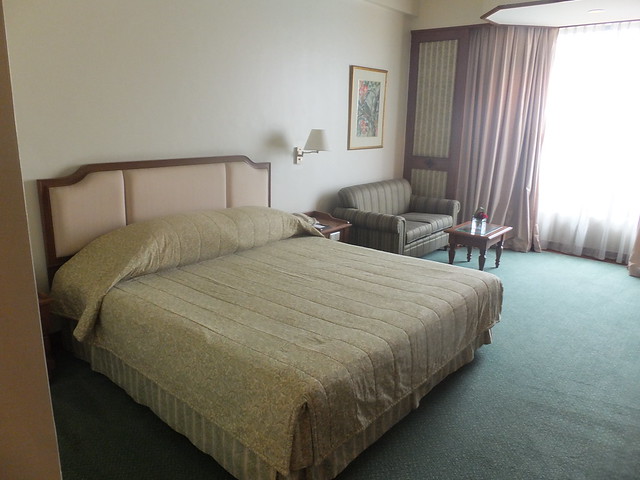 My room at the Sedona overlooked the Swimming Pool at the rear of the hotel.
With the help of the hotel, I contacted my friends Ko Hlaing (a Shipping Agent) and Htein Linn (an engine driver), two people I was hoping to meet up with. Ko Hlaing said he would meet me at the hotel Tuesday evening. Hteinn Linn said he would pick me up at 6.30 a.m. Wednesday.
Having made these arrangements, I had the afternoon free and decided to visit the railway station. Having walked there and back in the past, I foolishly decided to walk again. Walking gives you the chance to watch the life of the city in detail.
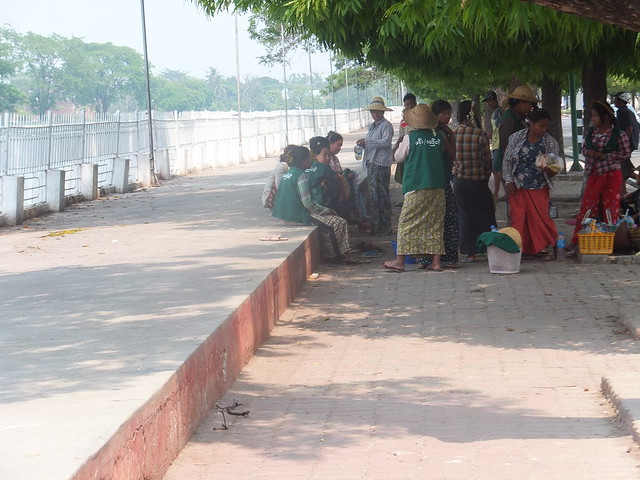 A group of female workers pause for lunch in the shade of a large tree. The moat around the Royal Palace site is on the left.
This time, I’d underestimated either the effect of the 42 degrees Celsius heat or my declining fitness because I almost collapsed at the railway station. I did my usual combination of ‘people watching’ and technical survey and concluded I needed a ride back to the hotel. A charming young man with a taxi motorcycle offered to take me. I was very tempted but, when wearing a longyi, men and women pillion passengers ride ‘side saddle’ and I was afraid I was still too ‘wobbly’ for that so he negotiated a rate with a pick-up truck taxi. As the only passenger, I got to ride in the cab but he would probably have been happy to take a dozen or more people.
Ko Hlaing arrived at teatime and we chatted happily for some time. He said he’d call again the following evening with his wife and daughter, whom I’d also met before.
Events of Wednesday 30th April 2014
Htein Linn arrived at 6.30 a..m., as arranged, with his wife and two daughters. He showed me a number of pagodas before we spent some hours at his family home in Myitinge, a few miles outside Mandalay. Then we went to his wife’s family home, also in Myitnge where there seemed to be a large extended family, calling for various photographs of family groupings. I was overwhelmed by their kindness and will describe the wonderful day in more detail when I can.
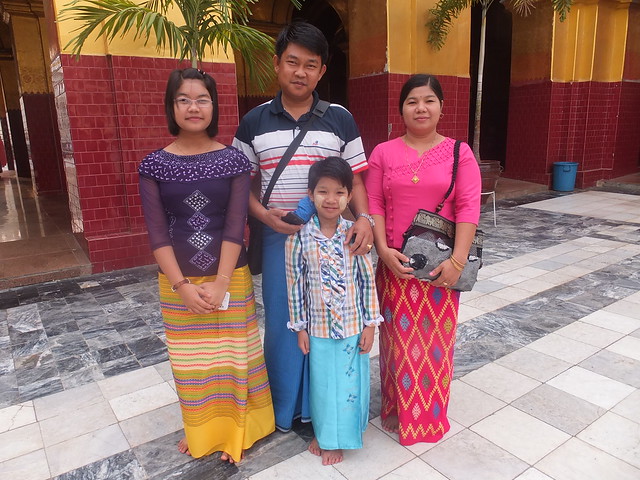 Htein Linn and Family at the Mahamuni Temple.
In the evening, Ko Hlaing came to the Sedona with his wife and five year old daughter who is about to start school. The first time I saw their daughter, she was still a babe in arms!
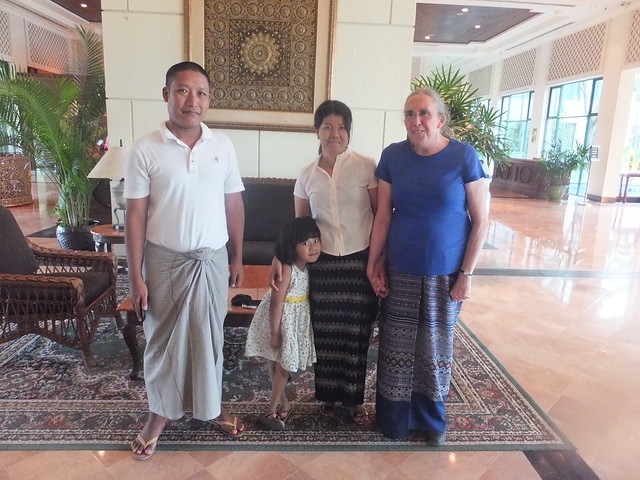 Ko Hlaing and Family visiting Jan at the Sedona Hotel.
Well, in brief, that was Mandalay. The next day I flew back to Yangon (with an intermediate stop at Heho, in Shan State), was met by a driver and taken to the Strand Hotel for a two night stop before the final section of my Myanmar tour to Sittwe and Mrauk U. More when I can.
My Pictures
Nyaung Oo Airport (pictures from an earlier trip).
Mandalay International Airport.
Sedona Hotel, Mandalay.
Around Mandalay, 2014.
A day with Htein Linn and Family.
Mandalay's railways.
More
Next Post describing this trip.
[Revised 27-May-2014]
Events of Monday 28th April 2014
Click on any picture below for an uncropped image.
The Monastery ‘Hi-Ace’ and driver picked me up at seven o’clock. We started on a series of sandy tracks, past dozens of pagodas including the famous Ananda Temple. At that time of day, the tourist operation hadn’t yet started but the army of sellers were beginning to get prepared. We turned onto the dual carriageway Anawrahta Road which, rather incongruously, slices across the Bagan Plain with its myriad pagodas from Old Bagan to the township of New Bagan, Nyaung Oo.
New Bagan, as its name implies, is a recent creation unashamedly partly devoted to tourism, with lots of restaurants and small guest houses. It has the administrative offices, a golf club and a District Hospital. There’s a major intersection controlled by traffic lights (and often a policeman, too) where we turned onto the dual carriageway leading towards the Mount Popa area. We passed the junction with the road to the airport and then the junction with the road to the railway station. But after our rather grand exit from the town, including passing through a pair of gaily-decorated reinforced concrete ceremonial arches, the road quickly deteriorated to the usual strip of tarmac barely wide enough for two vehicles to pass without using the unmetalled verges. Soon, we came to a section being worked on where the surface was loose sand. Women road workers armed with a simple wooden rake lined each side of the road – their function appeared to be to smooth the ruts as they appeared on this busy road.
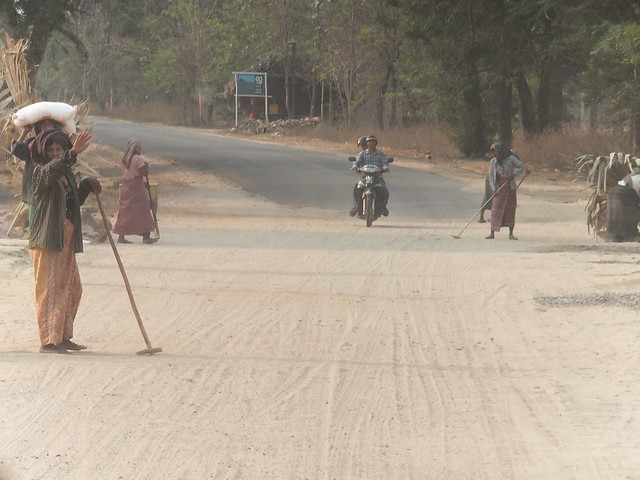 Women road workers with their rakes.
After a few hundred yards, we were back on the usual narrow tarmac strip until our left turn onto the road to Chauk Kan.
Chauk Kan
The road to the village was loose sand and deeply rutted in places without the benefit of anybody to rake out the ruts. It’s a mile or so to the main village from the turn-off but it seemed much further. The area is flat with a variety of trees dotted around. There are also very temporary-looking dwellings with woven walls, sometimes with a short brick chimney indicating a still for producing ‘Toddy’ - the local rum produced from the exudation of the ‘Toddy Palm’ tree. There's a brief description of the production of 'Toddy' in my earlier report here. Some of the land we were passing through was scrub but large areas were neatly tilled with regular narrow furrows produced by two ox hauling a wooden plough controlled by the farmer. I’ve never seen anything but animal power used for ploughing.
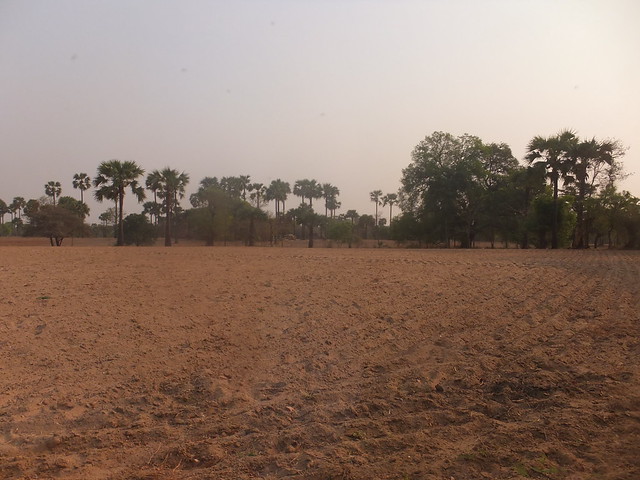 Neatly-tilled land flanks the road to Chauk Kan.
Equally, vehicles are normally carts hauled by two oxen – great wide things made wider by axles protruding from the cartwheel hubs. Wear in the hubs is often quite pronounced allowing wheels to wobble in an alarming manner as the oxen slowly drag their load. I noticed that some of the carts had been fitted with modern pneumatic tyres. There are few cars – the better-off have the ubiquitous motor bicycle, often with three or four people aboard but, other than the pick-up trucks which move goods, people (or, more often, both at once), walking is the standard method of getting around.
We arrived at Chauk Kan. I’d been before (October 2011 vist and February 2013 visit), helping with distributions to the enthusiastic children but, this time, the children were on holiday. The original building was Government-provided for basic education, but an additional building donated by Mr. and Mrs. Henseler via ‘Road to Mandalay’ opened in February 2010 (brief report here). I was greeted by the smiling headmaster. Builders were now doubling the size of the 2010 building. In one classroom, a wooden table had been set up with a plastic tablecloth, water, biscuits, grapes and a large bunch of bananas. The Burmese are a generous and hospitable people.
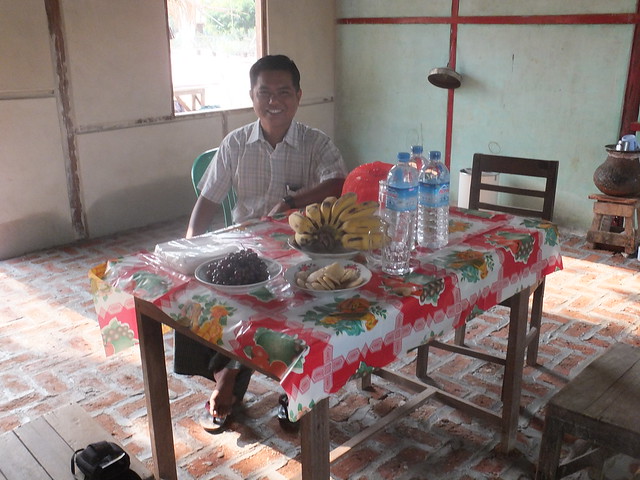 The Chauk Kan Headmaster.
The structure of the new extension was complete. Three builders were completing the brick floors. Bricks had been laid and levelled in a ‘parquet floor’ pattern. They were engaged in cementing the gaps between the bricks.
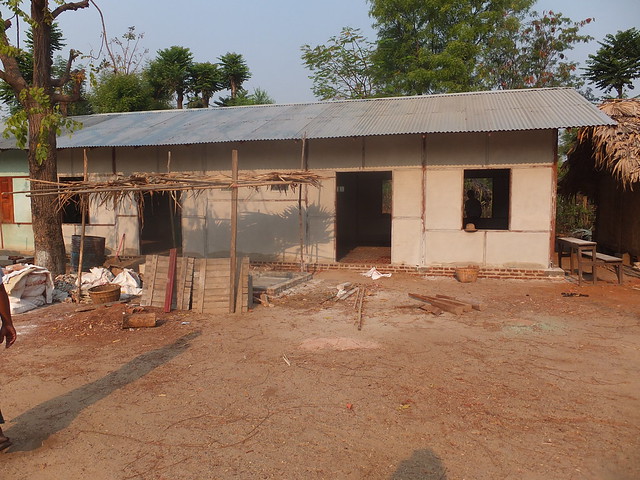 The New Extension at Chauk Kan.
I noticed that a large, new water tank had been installed adjacent to the original school building. Guttering had been added to one end of the school building and the adjacent building with blue plastic rainwater pipes delivering the water to the tank, which could alternately be filled via a hatch. A marble plaque on the tank confirmed that this was a donation from Margaret and Eric Knowlden in Sydney.
Htee Pu
Next, we were off to Htee Pu. I was a little surprised when the Chauk Kan headmaster jumped in the front of the vehicle – he was clearly coming with us. So it was back to the main road, carry on towards Mount Popa and then turn off on another rutted track to reach Htee Pu. I was invited into the monastery building where the Head Monk had arranged for water and food to be laid out on a low table. In addition, two girls were summoned to waft cooling air over their perspiring guest with hand fans. The Headmaster was away on a Training Course.
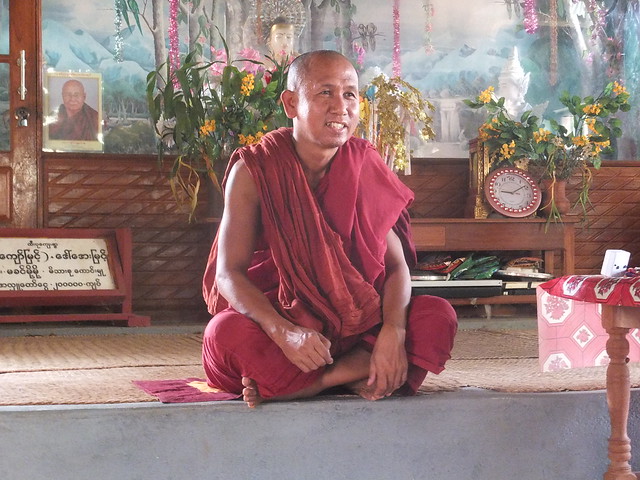 The Head Monk at Htee Pu.
Then we walked around what is becoming quite an extensive set of buildings. My first visit was in 2009). I've been back in 2010 (when a new building was officially opened), again in 2011 and again in
2012.
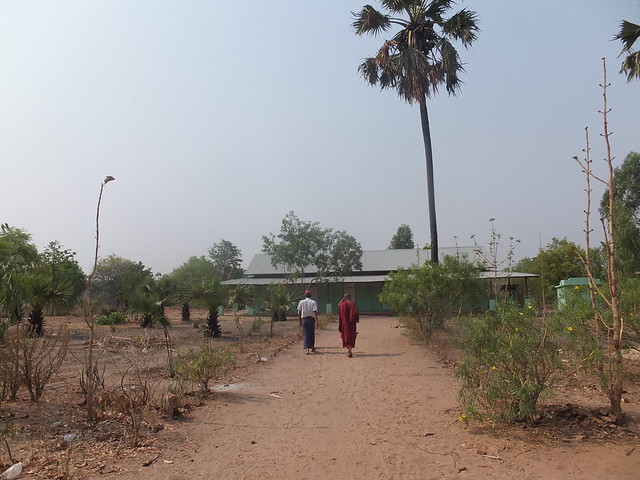 The 2010 School Building.
A large water tank had also been installed at Htee Pu, donated by the Clulees and friends from Samoa. There was a small set of excavations in progress for what looked like another toilet building with septic tank. I also noticed that the large Assembly Hall had received some external embellishment since I was last here.
The Chauk Kan headmaster was still with us when we left Htee Pu. There were a crowd of people around a parked pick-up truck which looked as if it had just arrived. Whether this was a scheduled ‘local bus’ or a special arrangement, I’m afraid I didn’t discover.
Nga Paing
When we reached the main road, we travelled along it to the junction with the sandy track to Nga Paing.
This was my first visit to Nga Paing and I was warmly welcomed by what I took to be the headmaster, although he was covered in spots of white paint and had clearly been involved in emulsioning. We passed existing school buildings – one had a roof of banana leaves whilst the other had a more durable ‘tin roof’. Both were partly open-sided and the remaining walls woven. It was clear that my host was, quite rightly, very proud of the new building – proper foundations supporting a substantial wooden frame with brick infill, cemented over to protect the face of the bricks and painted magnolia. A group of cheerful workers (or perhaps teachers) were completing the painting. Broad steps led up to a verandah at the front from which doors led to the school office and three separate classrooms. Concrete screed floors were provided throughout the building. Either side of the steps, balustrades with pre-cast concrete balusters were provided.
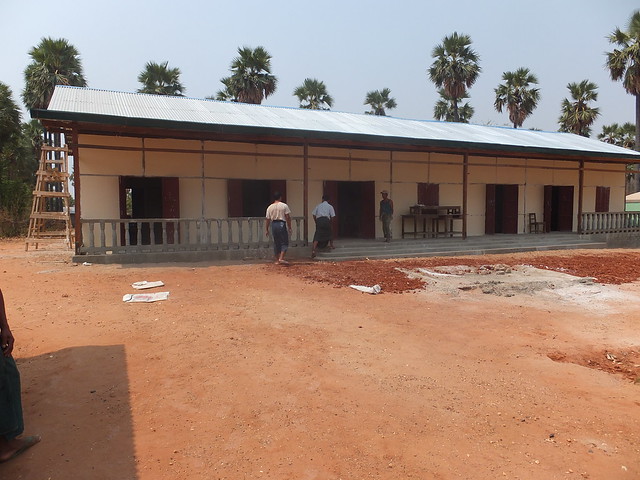 The New School Building at Nga Paing nears completion.
I was invited into the office, equipped with brand-new varnished wooden seating, a matching large storage cabinet and a low table loaded with water, food and green tea. The overall effect was most impressive. As requested, I added my name to an impromptu Visitors’ Book.
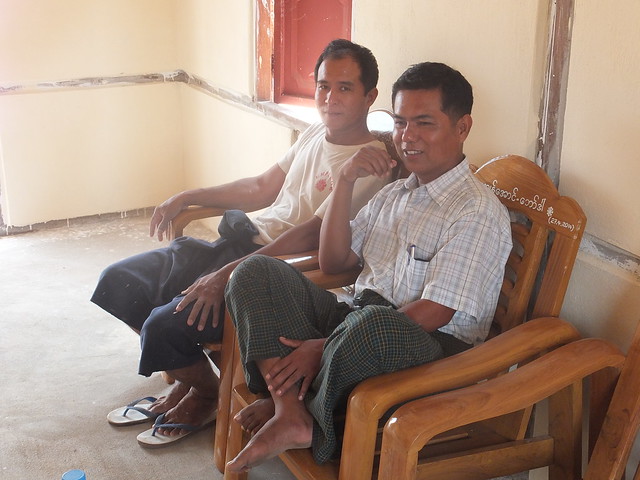 The Headmaster of Nga Paing and the Headmaster of Chauk Kan in the Office at Nga Paing.
The school had already constructed a water tank, similar to those seen at the other two schools. This water tank was donated by Laura Daley from Australia.
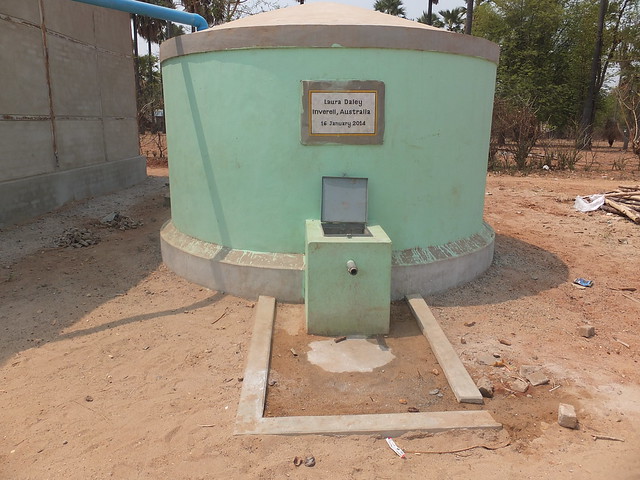 The Water Tank at Nga Paing School.
I’m always humbled to see the enthusiasm and commitment demonstrated by the Burmese, given some encouragement with really quite modest sums of money. Dr. Hla Tun’s watchword in determining which projects receive donated funds is always “effectiveness” – what in another area is called “getting the biggest bang for your buck”.
We set off back towards Bagan and dropped the Chauk Kan headmaster at the junction with the track to his village, then we retraced our route back to the Aye Yar River Resort.
The temperature had been around 42 degrees Celsius during the trip so, once back at my room, I was happy to stay there and relax. The ‘Pandaw’ was still at her moorings when I got back but, sometime during the afternoon, she quietly slipped away.
The following morning, I was to be transferred by road to Nyaung Oo Airport for the short flight to Mandalay and the next part of my adventure.
My Pictures
Aye Yar River Resort, Bagan.
Around Bagan, 2014.
Chauk Kan School.
Htee Pu, 2014.
Nga Paing, 2014.
More
Next Post describing this trip.
All my posts on Education Support in Burma.
[Revised 23-May-2014]
Events of Sunday 27th April 2014
Click on any picture below for an uncropped image.
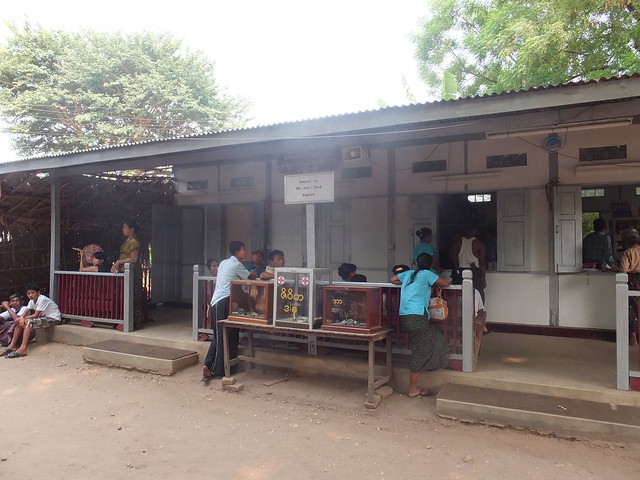
On Sunday morning, I walked from my hotel to the Clinic in time to chat to Doctor Hla Tun briefly before he started his consultations. There were noticeably fewer waiting patients.
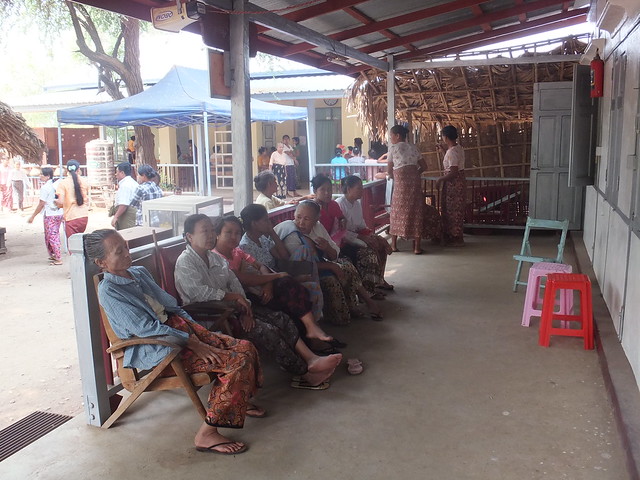 Sunday: Patients waiting outside the original clinic building. The new clinic building, currently used for physiotherapy, is in the background.
I sat in the small staff area in the clinic for a time watching the activities. An elderly lady looking very poorly was slowly assisted through the clinic and outside at the rear of the building. Palms had been planted here when the clinic was built giving a shaded area cooled by a breeze from the river.
The lady was placed in a folding chair and the staff commenced an infusion, using a nearby palm as a convenient attachment for the infusion bag. What appeared to be two relatives, a boy and a girl looking concerned, stayed with the patient.
A range of fresh fruit and biscuits was placed on the table in the staff area and the Head Monk, on one of his regular patrols of the clinic, urged me to eat.
I returned to my hotel for the rest of the morning and indulged in a can of ‘Coca Cola’. I’m always intrigued in the way western marketing and the use of English has impacted Burmese society. All the writing on the familiar ‘ring-pull’ can was in English. Amongst other things, it claimed “Proudly Produced in Myanmar. Manufactured for you with Love and Passion”.
Later, I made my way back to the clinic at the time the Doctor paused for lunch and a short break, taken in the adjacent Monastery. I joined him there with the Monastery’s car driver and the kind lady I always regard as Chief Nurse at the clinic.
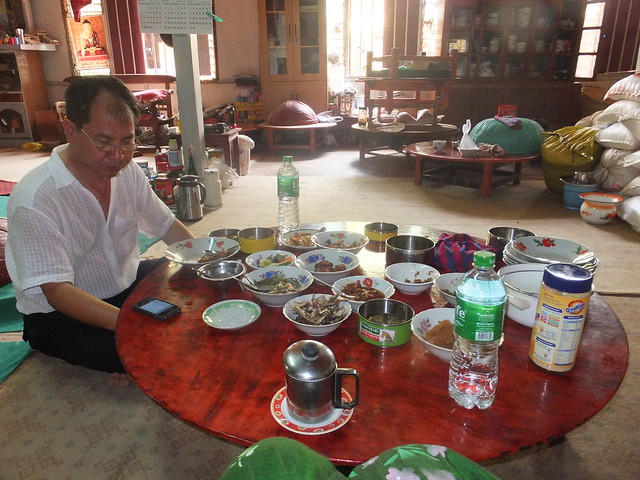 Doctor Hla Tun takes lunch in the Monastery before completing his consultations.
Once again, I was struck by the contrast between the range of fresh fruit and freshly-prepared food provided at meal times and the apparently-increasing use of modern ‘convenience’ products. On the table there were three different makes of ready-mixed drinks, all in gaily-coloured plastic sachets printed in English. ‘All-Time’ produce a 3 in 1 tea mix and a 3 in 1 coffee mix but there’s a similar coffee mix revelling in the name ‘BLingBLing’ with its curious capitalisation. Knowing my odd tastes, the nurse offered me Ovaltine which is slightly more traditionally packaged in a glass jar. This time, the printed English text modestly claimed “Complete Nutrition for Every Healthy Day – 14 Vitamins and 10 Minerals”.
The Doctor apologised that we would have to change our plans. He and I had intended to spend the following day, Monday, looking at new building work being funded by the Education Support project (no distributions as the schools were in the Summer Holiday shutdown). However, he’d been asked to be in Yangon on Monday to meet a visiting party from ‘Rotary’. Instead, he’d arranged with the Head Monk that I could still make the visits using the Monastery’s ‘Hi-Ace’ and driver. We said our farewells and the Doctor returned to his remaining patients, after which he would catch the overnight bus to Yangon.
I’m afraid I merely returned to my well-appointed hotel and the Monastery ‘High-Ace’ was provided for that journey as well, people being concerned for my well-being. Temperatures of 42 degrees Celsius were rather knocking me about and even the locals were complaining that it was “too hot”.
At times, even the five minute walk from the reception at the Aye Yar Hotel across the manicured lawns to the River View rooms seemed a long way but the benefit was the views of the ever-changing Ayeyarwaddy River with its boat traffic – the ‘Road to Mandalay’ written about by Kipling and, of course, the name also adopted by the modern luxury river vessel which formed my first introduction to Burma.
The ‘Road to Mandalay’ cruises don’t operate through the hot season but, as I watched, the modern ‘Pandaw’ vessel berthed just a few yards away. The original ‘Pandaw’ was one of the flat-bottomed river craft forming the 'Irrawaddy Flotilla' used by the British to develop communications between Rangoon and Mandalay. The ‘Pandaw’ I watched is a modern version providing luxury accommodation and cruises for tourists. The boat had tied up parallel to the shelving river bank and it took the crew some minutes to construct a substantial gangway to the shore, complete with handrails. Then the guests were able to come ashore and, in the afternoon sun, they walked away from the boat. Presumably, transport was waiting to show them some of the glories of the temples of Bagan.
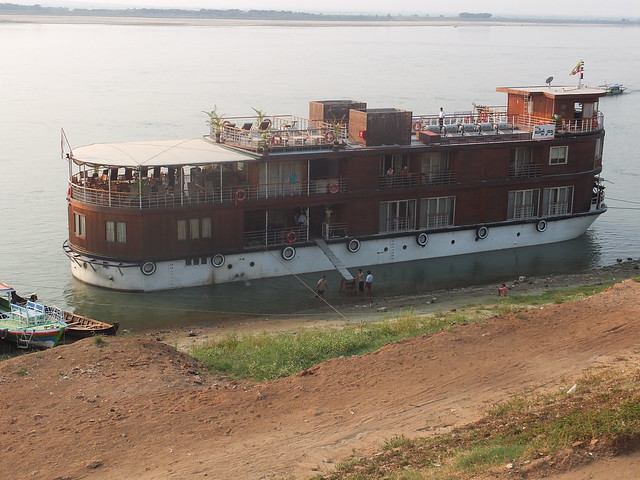 'Pandaw' berthing outside my hotel in Bagan.
In the evening, 'Pandaw' was brightly lit and the guests were presumably enjoying dinner on board but I’m afraid my appetite had not yet recovered and I was content to rest in preparation for my visit to three schools the following day.
My Pictures
Bagan Medical Clinic (My visit, April 2014).
Aye Yar River Resort, Bagan.
Around Bagan, 2014.
More
Next Post describing this trip.
All my posts on Medical Support in Burma.
[Revised 20-May-2014, 22-May-2014]
Events of Saturday 26th April 2014
Click on any picture below for an uncropped image.
I spent Friday night in the Guest Room at Dr. Hla Tun’s house in Yangon. In a ‘Western style’ bed I started to catch up on sleep but still had to get up at 04:45 on Saturday because the Doctor and I were flying to Nyaung Oo to get to the Bagan Clinic. The Doctor’s charming wife had specially prepared oatmeal for my breakfast (my intolerance to even mildly spicy food is becoming well-known).
Around 05:20, I think, we set off by car, with the Doctor driving (together with his son, presumably to return the car after we’d left). At the Domestic Terminal, we were quickly checked-in for our flight by small turbo-prop to Nyaung Oo. I didn’t spot a single computer but the system usually works smoothly (albeit with a lot of manual checking and note-writing). Since this is the hot season, I was quite surprised to see that a lot of our passengers were European or Japanese tourists together with their guides. A few minutes later, we were shepherded to a waiting bus for a transfer of only a few yards to our waiting aircraft. Deparure time was 07:20 but, as has happened before, we were airborne before 07:10. The flight took around 75 minutes, in which time the friendly cabin crew had distributed daily newspapers, a pre-packed sandwich breakfast and hot and cold drinks.
Once landed, we disembarked, leaving passengers who were destined for Mandalay and Heho on board. No carousel, no belts, but the checked baggage very quickly arrived.
The Bagan Monastery ‘People Carrier’ was waiting to take us to the clinic. On the way, we paused at a tea shop in the town for the inevitable Sweet Tea before continuing past various 1000-year old temples to our destination.
On our arrival, the elderly Head Monk was waiting to greet us. The Clinic is on Monastic land and the active support of the Head Monk is essential.
When I first visited Bagan in 2008, there was no clinic in the dusty monastery compound. I became involved in the vision of the Head Monk and Doctor Hla Tun to provide a Free Medical Clinic for the people of this rural area. The original clinic building opened for business in 2011 and I attended the official opening ceremony on 30th October 2011 (Opening of the Bagan Medical Clinic). I'd certainly not realised the scale of demand which would be unleashed and there are a series of posts (Medical Support in Burma) showing just how many patients arrive on clinic days, sometimes travelling huge distances to seek affordable health care.
 The original Clinic Building, formally opened on 30th October 2011, remains in use for consultations and dispensing medication.
As the clinic became better known, local and overseas donors have provided further support and I was impressed to see the New Clinic Building which has been built a few yards away from the first building. This building was brought into use in February 2014 as a temporary Physiotherapy Unit since the majority of patients attending can benefit from physiotherapy.
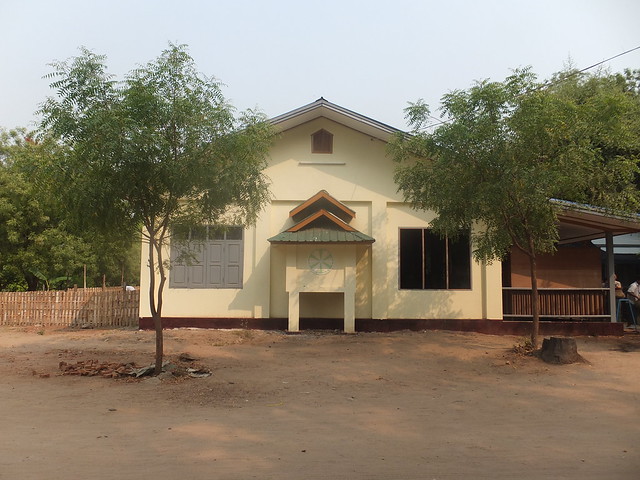 The New Clinic Building.
A Permanent Physiotherapy Unit, donated by a United Kingdom Travel Company and their clients, is currently being constructed.
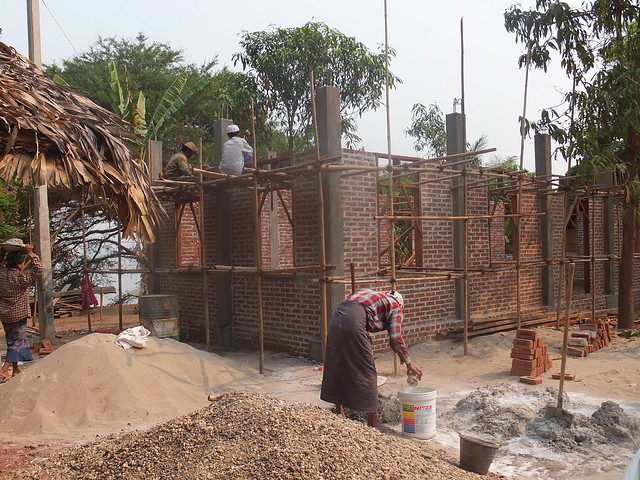 Builders at work on the new Physiotherapy Unit.
On Saturdays, a free lunch is prepared by the monastery and distributed to waiting patients.
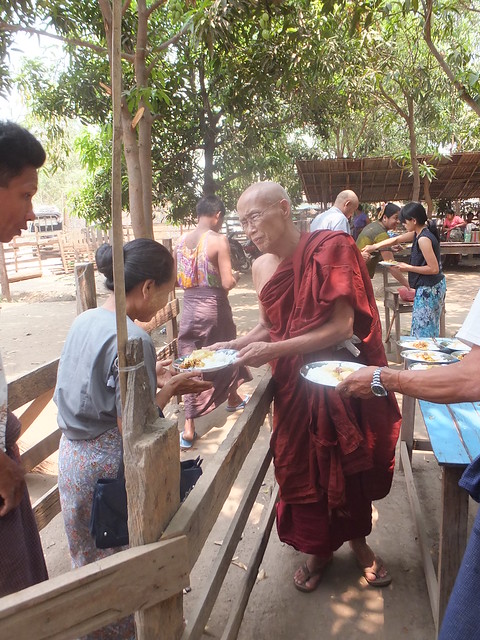
The Head Monk distributing free lunch to waiting patients.
Having taken plenty of pictures of the event, I said I'd walk back to my hotel and try to return when Dr. Hla Tun took his lunch at around two o'clock.
However, it was 42 degrees Celsius outside and by the time I'd arrived at my hotel, I was fit for nothing but resting, so I abandoned the idea of visiting the Doctor during his lunch. I knew that the Doctor normally took an evening meal in the Monastery about ten o'clock in the evening. I arrived back at the clinic around 9.30 p.m. when the Doctor was just breaking-off for food.
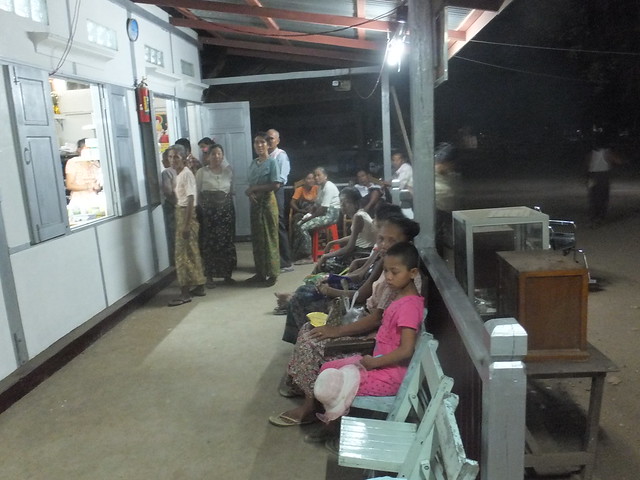 9.30 p.m. and now much quieter, but there are still patients waiting to be seen by a doctor.
Doctor Hla Tun said he would then continue to work until about 11.30 p.m. to deal with the remaining 15 waiting patients but I'm afraid I left him to it and slowly made my way back to the Aye Yar Resort and bed.
My Pictures
Bagan Medical Clinic (My visit, April 2014).
Aye Yar River Resort, Bagan.
More
Next Post describing this trip.
All my posts on Medical Support in Burma.
[Revised 17-May-2014, 20-May-2014]
Events of Friday 25th April 2014
Click on any picture below for an uncropped image.
Although I’d slept a fair bit of the way back from Mawlamyine, the coach seats were really designed for a smaller, oriental frame. This, combined with a fairly intensive few days meant that I was not at my best when we disembarked in Yangon in the early morning.
Once back at Doctor Hla Tun's house, I managed a couple more hours sleep in the guest room before the Doctor took me to Yangon Central station. The Doctor knew of my interest in Myanmar Railways and he had kindly arranged for me to visit Yangon Central Signal Box to confirm what I'd previously written (Railway Signalling in Burma - Part 6: Signal Boxes with Electrical Interlocking). I spent a happy hour or so watching the complex moves around the station.
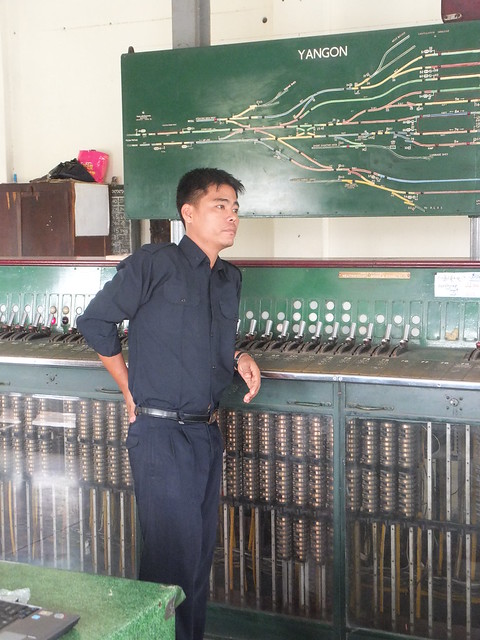
One of the young signalmen pauses by the power frame at Yangon Central Signal Box.
I could have easily spent longer here but the Station Master then casually offered a trip around the Circle Line, either on the train or in the locomotive cab. Perhaps you can guess my choice. I was invited to wait in the stationmaster's office whilst arrangements were made. I was to ride in the cab of the 13:00 clockwise Circle Line train, scheduled to complete the 32-mile round trip in 3 hours! I was conducted across to the waiting train and introduced to the friendly driver and his secondman. The locomotive was DF.1263, one of the Alstom Bo-Bo-Bo diesel electrics.
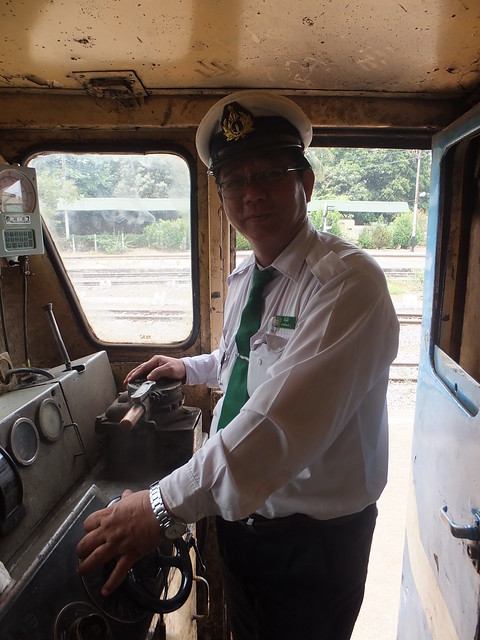 The friendly driver of DF.1263
It had been my first trip on Yangon's Circle Line back in 2008 which got me interested in Burma's railways, so I welcomed the opportunity to repeat the trip from the vantage point of the locomotive cab.
My Pictures
Yangon Central Power Signal Box.
Cab Ride on the Circle Line, Yangon.
More
Next Post describing this trip.
Yangon Central Power Signal Box.
All my posts on Burma's Railways.
[Revised 17-May-2014]
Events of Thursday, 24th April 2014
Click on any picture below for an uncropped image.
After a second night sleeping on the floor of Ko Dut DIC, we shared breakfast with the volunteers. We said our 'goodbyes' to our friends at Ko Dut and embarked on a little sightseeing.
We drove to Thanbyuzayat which I'd first visited in 2012 (blog post here, supposedly named after the ‘tin shelter’ in the town centre which looks like a Victorian bandstand.
During the Second World War the area achieved notoriety because of the construction of the 'Death Railway'. To support the large Japanese Army which occupied Burma, the Japanese forced Commonwealth, Dutch and American prisoners of war to construct a metre gauge railway line over 400 km long connecting Siam (now Thailand) with the existing railway line through Thanbyuzayat. Work commenced late in 1942 and Thanbyuzayat became a Base Camp and Prisoner of War administration headquarters. In January 1943, a Hospital was added. Heavy prisoner casualties were also sustained during Allied bombing raids on the railway infrastructure in March and June 1943, resulting in prisoners and the sick being marched to dispersal camps along the new railway. Owing to the dreadful conditions, over 13,000 prisoners of war died during the construction, together with up to 100,000 conscripted or forced labourers from Malaya, Dutch East Indies, Siam and Burma. The railway was completed in December 1943.
After the War, graves were transferred to War Cemeteries in Chungkai and Kanchanaburi in Thailand and Thanbyuzayat in Burma. The remains of American prisoners were repatriated to the United States. We spent a few minutes at the War Cemetery at Thanbyuzayat, which has 3,149 Commonwealth and 621 Dutch graves maintained by the Commonwealth War Graves Commission. Their web page for this cemetery is here.
 Thanbyuzayat War Cemetery.
Just south of the town, there's a commemorative plaque and a short length of track displaying what is claimed to be the first Japanese steam locomotive to run on the 'Death Railway'. In 2012, waterlogged ground made close inspection impractical but in 2014 I was able to study the rather battered locomotive. I was intrigued that bronze fittings had been replaced by wooden replicas, painted yellow.
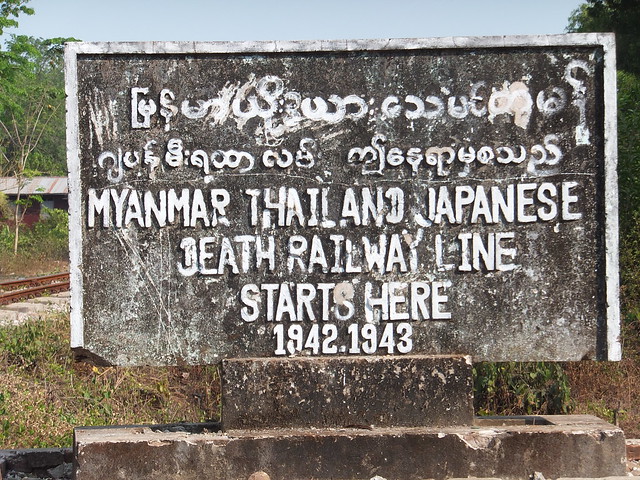 Plaque marking the end of the 'Death Railway'.
Next, we travelled west to Khaikhami Yele Paya temple built in the sea. On my earlier trip, construction of the concrete pier leading to the temples was being completed and the original wooden pier was still standing. By 2014 the old wooden pier had been removed. It was good to re-visit with the Doctor and his son.
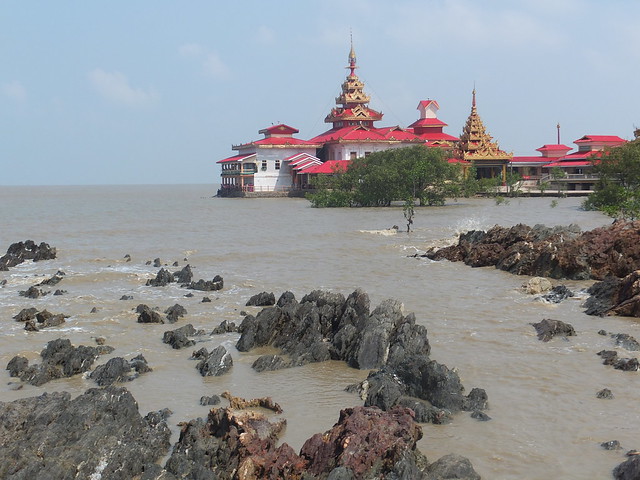 Khaikhami Yele Paya
After visiting the temple, Doctor Hla Tun decided to purchase some fish to take back to Yangon. This involved some pretty serious discussion involving at least three of the stallholders and multiple weighings of the fish.
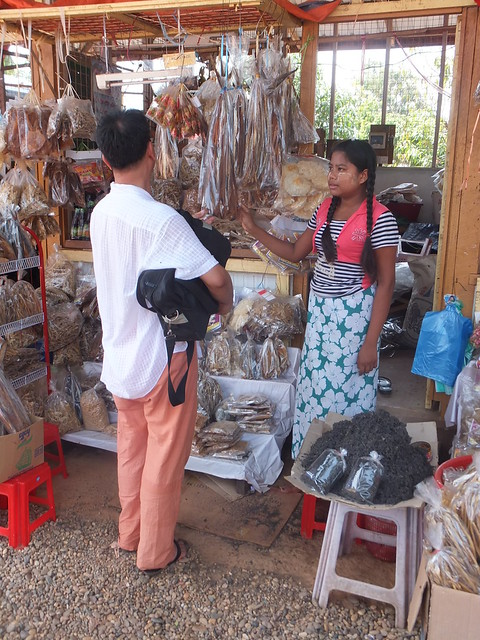
Purchasing fish.
Nearby, we visited an orphanage called 'Mirror Image' run by Sister Martha, a Catholic nun. Her English was excellent (she'd worked for 18 months in Moss Side, Manchester). Doctor Hla Tun donated medication. There were plaques crediting the assistance provided by the 'Grassroots Grant Assistance Scheme' in Japan and the Government of the Federal Republic of Germany. Three assistants were engaged in preparing monthly prescriptions of Anti Retroviral Treatment for issue to patients in their care.
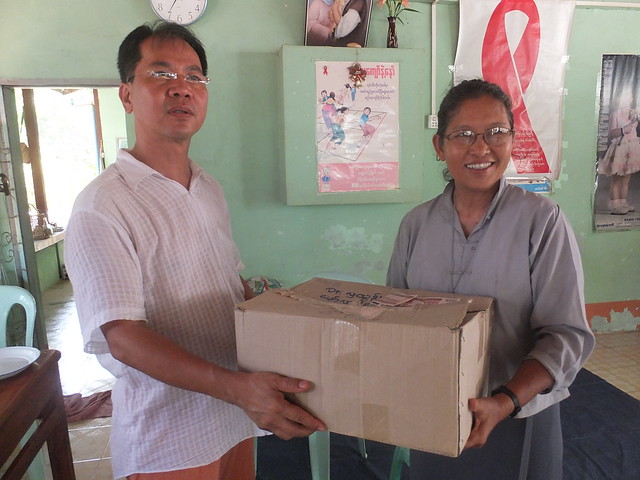 Doctor Hla Tun donates medication to Sister Martha at 'Mirror Image'.
Finally, we detoured to the popular beach at Setse, where I was able to paddle in the Andaman Sea and enjoy fresh coconut milk with the Doctor and his Son. There were lots of people enjoying the beach but, this far from Yangon, traditional modesty prevails. A group of laughing young women running across the hot sand were dressed more for a Sunday School Outing than for the beach.
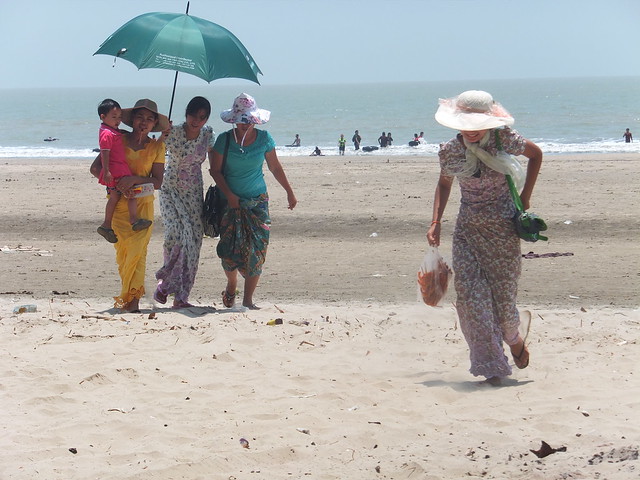 Setse Beach.
We made our way back north to Mawlamyine, pausing to buy fruit from a roadside stall. We visited two more DICs in the Mawlamyine area - Hlaing and 'Future Generation'. The population of Mawlamyine is around 300,000 and there are some decidedly poor areas.
At Hlaing, we were almost physically overwhelmed by around 400 youngsters (less than 300 had been expected). 'SKYNET' had a television cameraman and lady interviewer there and the Doctor recorded an improptu interview for them before we started the distribution. As before, there were some donations of financial assistance before the umbrellas and stationery were given out. The sheer numbers meant that the organisation did not always run smoothly but it all worked out, I think. Some rapid re-allocation had to be made of the stationery we had with us so that everybody received something on the day and the Doctor intended to send more items once he was back in Yangon.
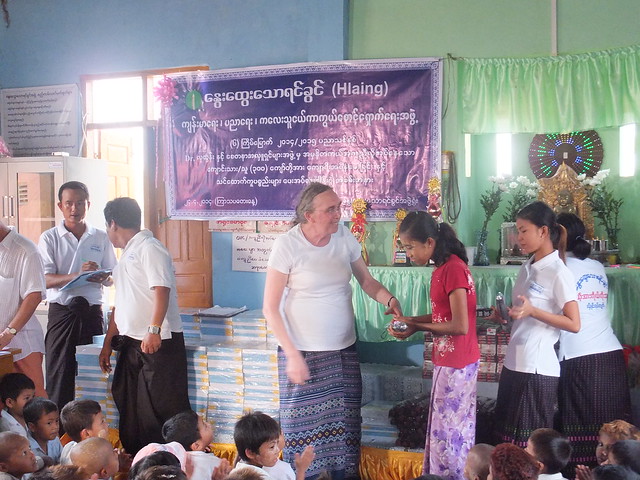 Distributions in progress at Hlaing.
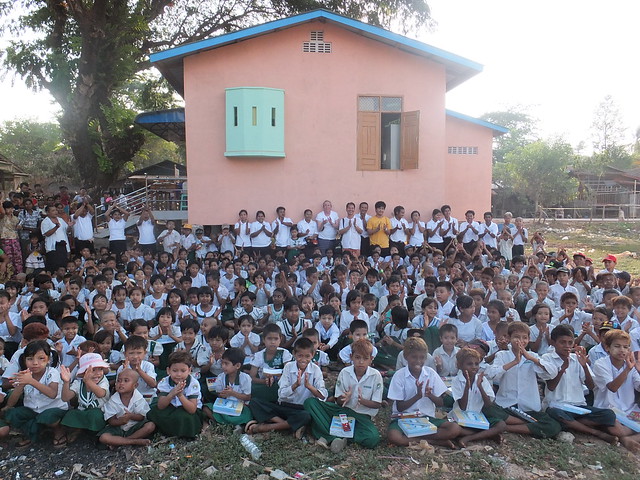 The 'Group Shot' at Hlaing.
Our last distribution was at 'Future Generation' - a small DIC in a new building run by a charming lady. Both she and one of her assistants had computer science degrees. Once again, I was impressed by the commitment of all the volunteers who run these centres.
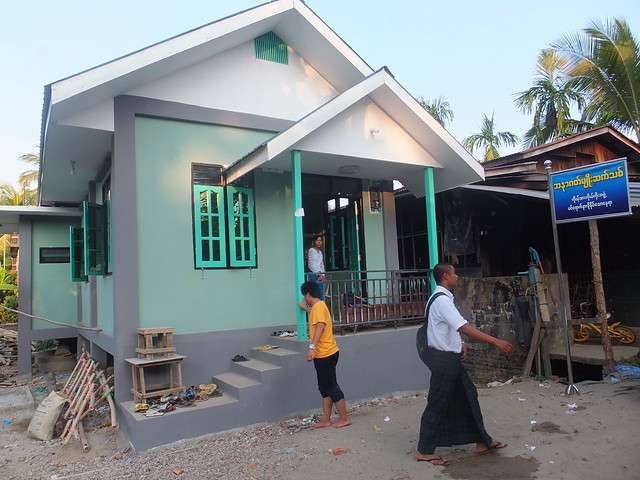 'Future Generation', Mawlamyine.
Our arrival was eagerly awaited by the young children who filled the D.I.C. and we soon completed the final distribution of our trip to Mon State.
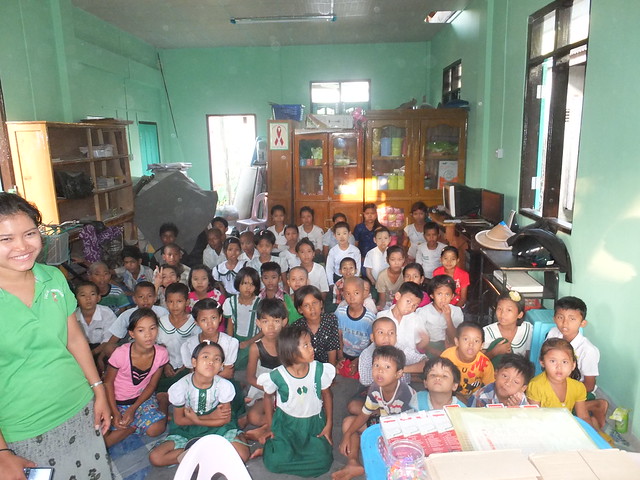 Young children eagerly awaiting the distribution at 'Future Generation'.
The children departed for the day and we chatted to the volunteers for a while before they, too, got ready to leave. By this time it was getting dark. We drove to the famous Strand at Mawlamyine which always takes on a holiday atmosphere at sunset. We strolled for a while amongst the happy crowds before driving to visit one of the famous hill-top temples. Finally, we drove to the P.T.T. Bus terminal in time to catch the 21:30 overnight bus to Yangon.
My Pictures
Thanbyuzayat area, Myanmar.
Khaikhami Yele Paya Shrine, Myanmar.
'Mirror Image' Orphanage.
Hlaing Drop In Centre, Mawlamyine.
'Future Generation' Drop In Centre, Mawlamyine.
Mawlamyine, Myanmar.
Mawlamyine - Yangon by Coach.
More
Next Post describing this trip.
[Revised 15-May-2014, 16-May-2014]
Events of Wednesday, 23rd April 2014
I woke at about 5.30 a.m. at Ko Dut D.I.C. to the curious sound of the first ox-cart of the day. On the earth roads, there was no sound from the hooves of the oxen but an unfamiliar clattering sound from the large, wobbly wheels as they turned on the axle. I think I'm getting a bit old for sleeping on the floor, dormitory style, so I was a bit fragile.
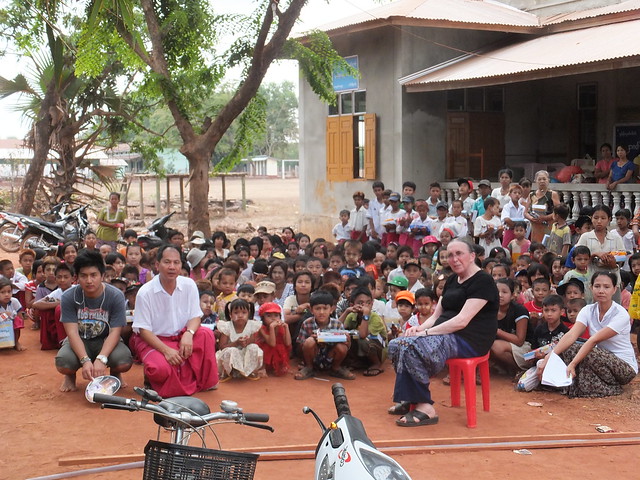
For breakfast, we were driven to the nearby home of one of the volunteers at Ko Dut D.I.C., a retired school mistress. As we left the D.I.C., there was already quite a large group of children gathered outside the D.I.C., waiting for the distribution to start. After an enjoyable breakfast (our hostess had made porridge especially for me), we drove back to the D.I.C., which was now full of excited children.
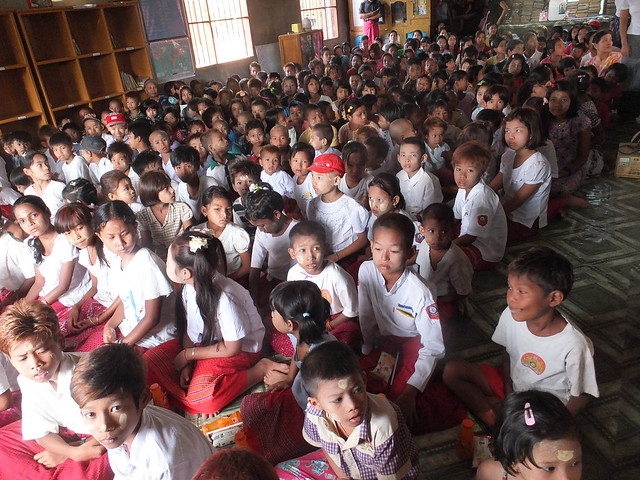 Children awaiting the distribution at Ko Dut D.I.C.(click on any picture for an uncropped view).
Even with the Doctor, his Son and Jan distributing the umbrellas and stationery, assisted by volunteers from the D.I.C., it took some time to complete the process.
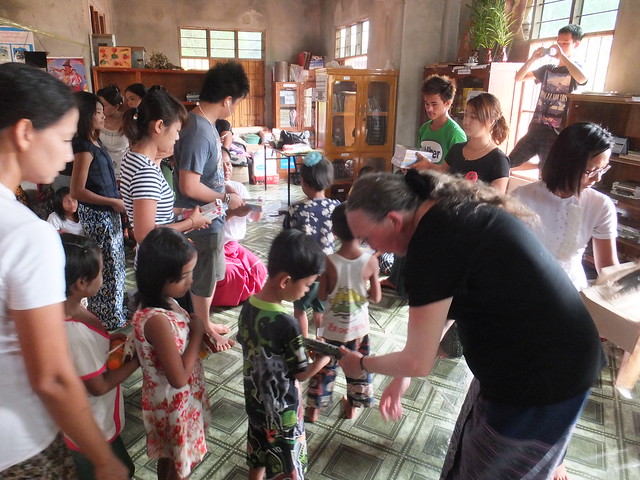 Distributing umbrellas and stationery at Ko Dut.
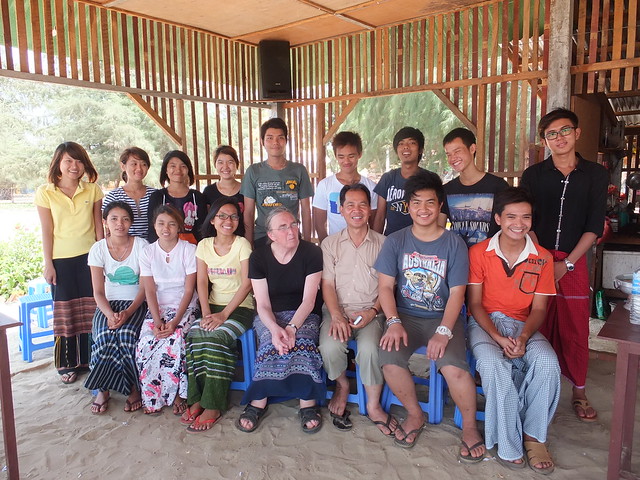
Then, we all re-grouped outside for the mandatory 'Group Shot'. In deference to the problems I'm now having squatting, I was provided with a moulded plastic stool.
 The 'Group Shot' at Ko Dut D.I.C.
The work that the volunteers do in these D.I.Cs is impressive. I was delighted to discover that all the volunteers were to have a couple of hours off and have a meal at the beach with us. The volunteers divided themselves up between various motor cycles and our car set off in convoy with the light-hearted volunteers. After around fifteen minutes, we arrived at the beach, looking out across the Andaman Sea. We took over a beachfront cafe, famous for seafood and orders were placed. In view of my still-delicate digestion, I was circumspect about what I tried.
 Ko Dut Volunteers at the Beach.
After this delightful interlude, the car took us to the two other Drop In Centres we'd arranged to visit. The first was La Mine D.I.C., around 7 km east of Ko Dut. This was a neat, modern building with a sign that read "Lamine Town Community Learning Center - LIBRARY" in English and Burmese. The centre seemed well-equipped with good quality tables, glass-fronted bookcases, plastic moulded chairs.
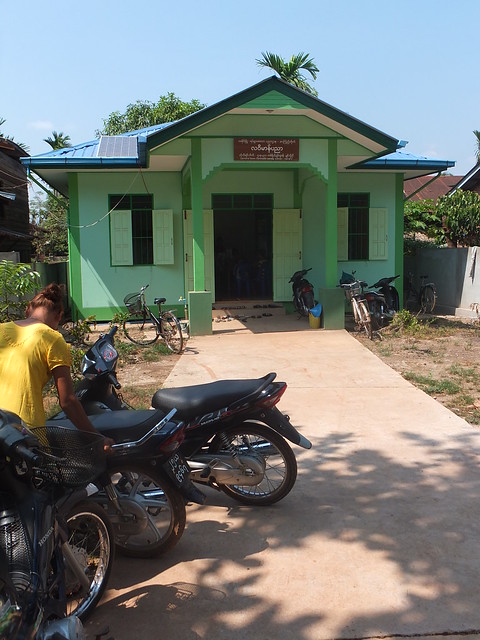 La Mine D.I.C.
This multi-function centre again relies on volunteers for staffing. The commitment of these, mainly young, volunteers impressed me at each centre we visited. Where young pupils are being given financial support to help pay for schooling, the Doctor normally carried out an interview first. Then, we proceeded with the distribution of umbrellas and stationery to the grateful children.
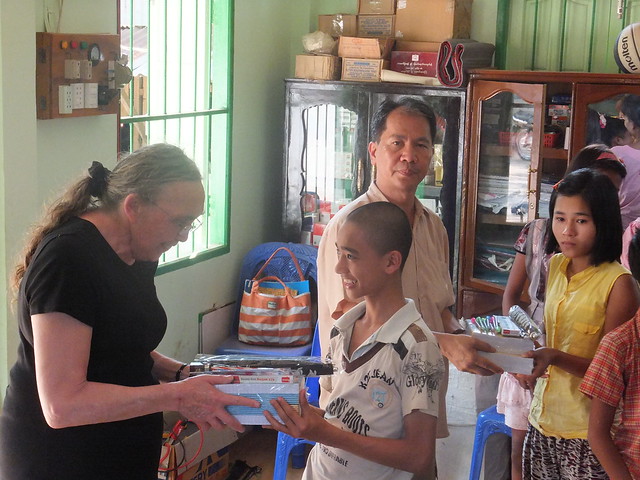 Distributing umbrellas and stationery at La Mine D.I.C.
Then, we were off again to Mot Ka Nin, a further 3 km further east and situated on the main north-south road designated '8'. Equipment included glass-fronted bookcases, an exercise machine (!), an electronic keyboard, a treadle-operated sewing machine and a treadle-operated overlocking sewing machine (overlocking is explained in a Wikipedia article here. At this D.I.C., as usual, we distributed folding umbrellas and stationery.
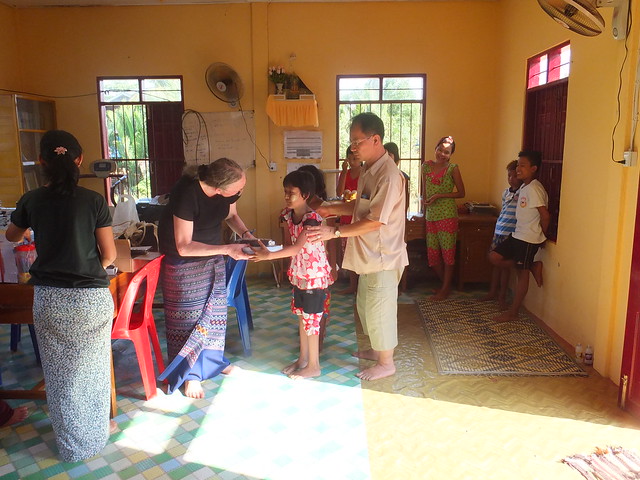 The distribution at Mot Ka Nin D.I.C.
We started to make our way back towards Ko Dut. On the way, we paused to look at a new Monastic school being built. A monk was supervising a number of builders, some of whom were constructing a well adjacent to the school building.
Next, we looked at a small fishing village near the mouth of the Winyaw River. The single road ended abruptly at the waters edge and, on the opposite bank, the road could be seen continuing north. There was a vehicle ferry on the other side, but nothing was stirring until an electric machine started up nearby. It sounded like a wood-chipper but clearly wasn't. After a short while, I worked it out. A worker was feeding large chunks of ice into the machine which was producing crushed ice. This was used to fill large expanded polystyrene boxes into which the fish landed at the village would be packed for onward transmission. I spotted a sign relating to US AID-ASIA and IOM-OIM but I don't know what support was provided. US AID has a Bilateral-Mission in Burma and there's more on their website here, plus a 'Fact Sheet' here.
A few minutes drive from the fishing village took us to the Mon Ethnic Temporary School. Dr. Hla Tun visited this school during his visit to Mon State in 2013 (described in the post Orphans and Vulnerable Children Project in Myanmar. It was founded by a Monk, has five classrooms and is recognised by the government. We went to the site to see the progress on constructing a permanent school building. We found an impressive building on a difficult, sloping site.
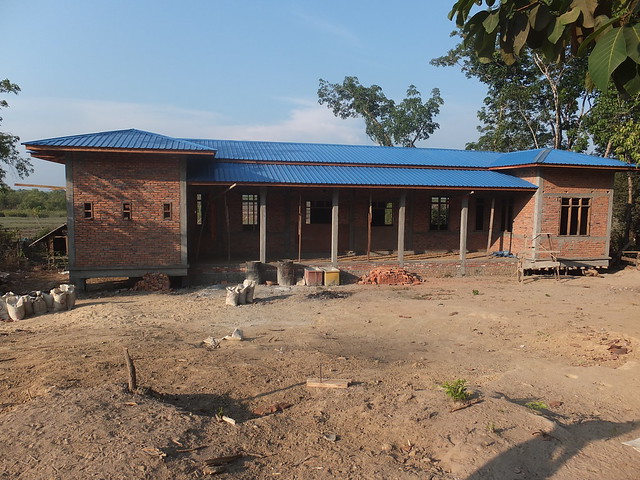 The Permanent Mon Ethnic School under construction,
We had just one more stop to make - at a small orchard just outside Ko Dut. It has been planted with a tree which, after about seven years, produces a commercial crop used medicinally. The whole area has been provided with a network of irrigation pipes, fed from a concrete water tank in the middle of the site. A locked 'manhole' nearby puzzled me until it was unlocked to reveal secure storage for a portable petrol-engined pump. This is apparently used to re-fill the water tank, drawing water from a deep well near the orchard boundary. A rope-and-bucket is also provided so that water can be drawn manually (I tried this out myself). Whilst the petrol pump was filling the water tank, the two D.I.C. staff filled plastic watering cans and carefully checked the crop. It was a delightful tranquil few minutes.
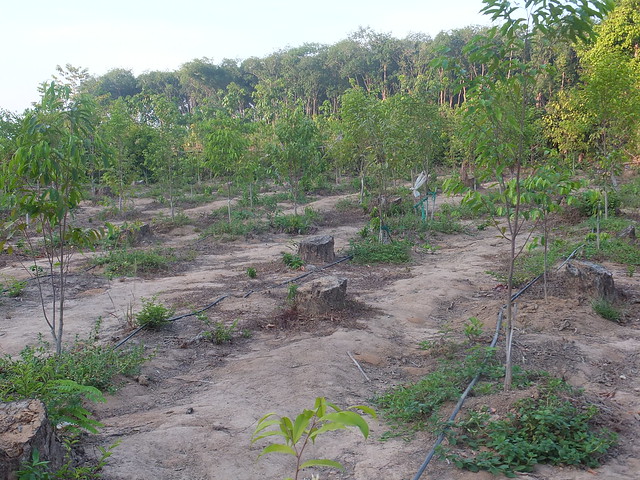 Orchard looked after by staff from Ko Dut D.I.C.
Then it was back to Ko Dut for a second night sleeping on the floor.
My Pictures
Ko Dut Drop In Centre.
La Mine Drop In Centre.
Mot Ka Nin Drop In Centre.
Around Ko Dut.
A Trip to the Sea.
More
Next Post describing this trip.
[Revised 14-May-2014, 15-May-2014]
Events of Tuesday 22nd April 2014
Click on any picture below for an uncropped image.
Only slightly revived by a couple of hours sleep at Mawlamyine, I prepared for our departure. We briefly met the Organiser's husband. He was a professional writer on archaeology and history and had just been discharged from hospital. He graciously gave me a copy of his latest work on Mon History.
It’s important to realise that early Burmese history was the history of a number of distinct ethnic groups who could be quite belligerent. Various kings attempted to unify the warring tribes and, when the British took over, they considered the problem solved which, of course, it wasn’t. The exploits of the Japanese in Burma during WWII probably did more to unify the various factions than any previous event. Mon National Day was created after the conclusion of WWII and, when the British granted independence in 1948, the Union of Myanmar specifically recognised the existence of these ethnic groups. For more information, try Wikipedia here.
Mon State, remote from the centre of the land mass, seems to suffer from the problem that in England is called “the North-South Divide”. It is, in general, poorer and in greater need of assistance. We were to visit the network of Drop In Centres (DICs) which are supported by Dr. Hla Tun.
First call was to the ‘Largest Reclining Buddha in the World’ which I’d visited before (there's a report here). There was a network of scaffolding around the head to facilitate maintenance. There’s a second, even larger, Buddha image being constructed on the other side of the valley – it hadn’t obviously changed a lot since my previous visit.
Then it was on to our first Drop-In Centre (DIC) at Kot Kha Pon, this one supported by aid from the Government of Australia and the Care International charity. The Doctor and his son distributed a folding umbrella and various items of stationery to the young people. The D.I.C. has a PC Computer and a treadle-operated sewing machine. A donation of cash was made to the volunteers whose time is essential to the running of the DICs.
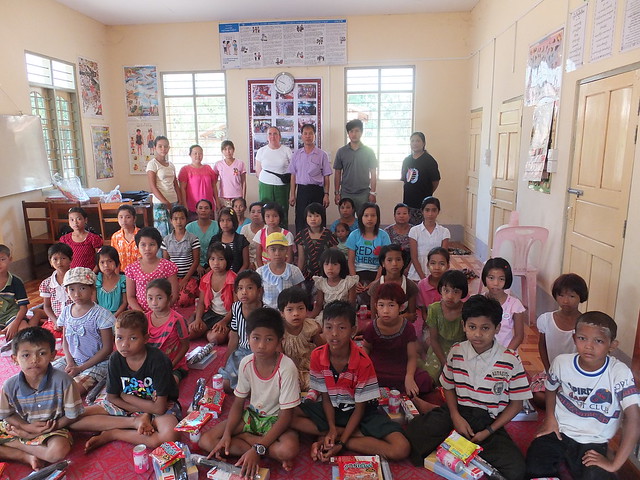 Kot Kha Pon Drop In Centre.
We then made our farewells and moved onto another DIC at Nyaung Kyo Mae. Again, there was a PC Computer and Sewing Machine. There was also a television set, I think arranged for playing videos. The Doctor made a donation of cash to students who are being assisted through Government Schools. Jan then assisted in distributing an umbrella and stationery to all the children.
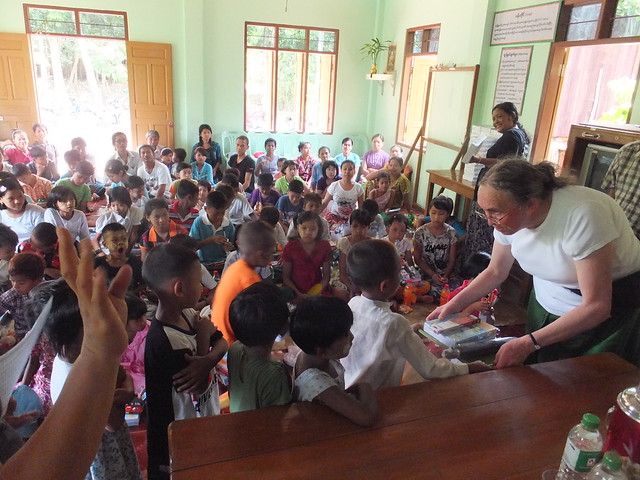 The distribution in progress at Nyaung Kyo Mae Drop In Centre.
The next DIC was at Ka Mar Wet. All the umbrellas and stationery had already been selected into individual piles, ready for distribution.
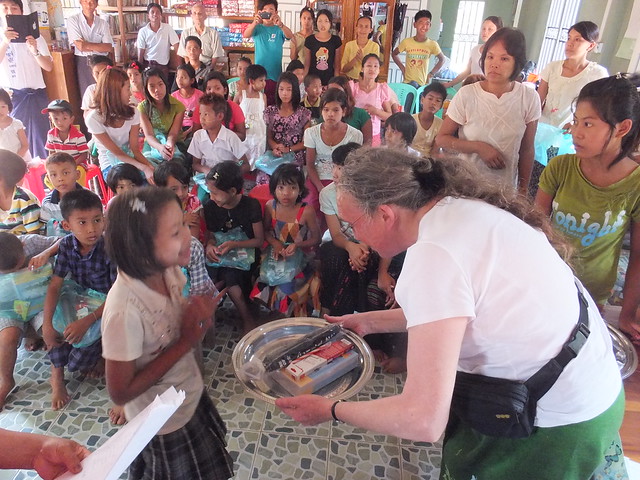 Jan assisting with the distribution at Ka Mar Wet.
We then drove to Ko Dut, where we would sleep overnight in the DIC, prior to making distributions the following morning.
My Pictures
Kot Kha Pon Drop In Centre.
Nyaung Kyo Mae Drop In Centre.
Ka Mar Wet Drop In Centre.
Ko Dut Drop In Centre.
More
Next Post describing this trip.
[Revised 13-May-2014, pictures added 20-May-2014]
Events of Monday night/Tuesday morning 21st/22nd April 2014
Dr. Hla Tun had said he’s pick me up at 7.30 p.m. to go for dinner at his house. Because of my fragile state, I was reluctant to be too ambitious but I nibbled some food before the doctor, his son and I drove downtown to where our P.T.T. bus to Mawlamyine was due to leave at 9.00 p.m.
Apart from out personal luggage, we were taking various heavy cartons of some of the items to be distributed on our visits, which all had official ‘P.T.T.’ luggage labels attached.
 The Coach.
The coach seating was 2+1 and we had a complete row with the doctor and his son on the left of the aisle and me on the right. We set off a few minutes after nine and made fairly slow progress leaving the city. The sky was completely dark but the lights on the almost continuous chain of houses, shops and tea houses lining our route illuminated the apparently innocuous night life of the city.
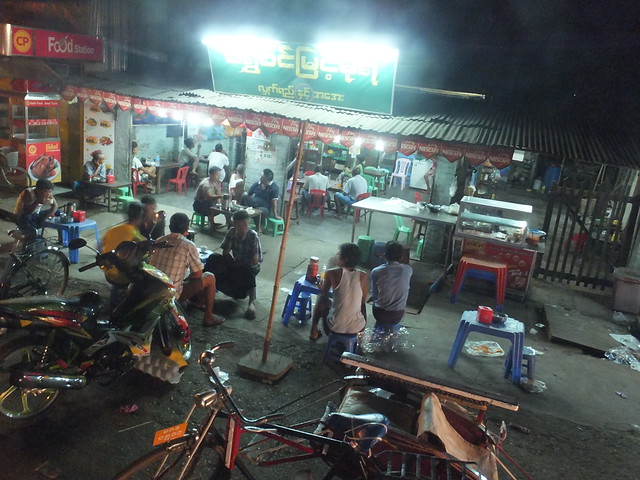 A Tea House on the road out of Yangon.
It was clear than we were following the road through Bago and Kyaikto to Mawlamyine, which I’d taken (in the opposite direction) returning from Mawlamyine on an earlier trip. Crossing a broad waterway, I looked immediately to my left and had a decent view of the Rolling Lift Bridge I’d commented on on my earlier trip (Bago to Kyaikto by Train).
After about four hours, we passed through Kyaikto and shortly the bus pulled into the car park of the large restaurant I’d seen on my earlier trip. At 1 o’clock in the morning, the place was thronged as there were already about four buses parked. My priority was a visit to the washroom then I had a cup of sweet tea with the Doctor and his Son, who were ready for more substantial food.
Our stop was less than half an hour and then we continued south. I think it was only around two hours later when we rumbled onto the long road and rail bridge which has transformed access to the south of Myanmar.
The bus took the main road through Mawlamyine furthest away from the sea and came to a stop at the brightly-lit bus office. We got off and retrieved our luggage, as did other passengers. By the time we were clear of the bus other passengers were boarding and, with a new driver, the bus departed but I didn’t find out the destination although I imagine it was further south.
We had a few minutes to wait in the oppressive heat of the night before the People Carrier which Dr. Hla Tun had arranged turned up. The we loaded everything aboard and set off inland towards to suburbs. The Doctor explained that the Orphans and Vulnerable Children (OVC) Project organiser for Mon State had offered to let us sleep at her house for a few hours until morning. However, our driver had trouble finding the address despite the Doctor phoning the lady and seeking “better and further particulars”. We eventually arrived when the lady walked from her house to the nearest junction, to direct our wandering People Carrier.
br>
The house was modern and brick built with the main room occupying the full width of the building approached from outside by a couple of steps (where footwear is discarded). There was a modern ceiling with a raised section featuring various electric light fittings and a polished parquet floor. A passage led towards the rear of the house, with partitioned sections left and right providing various bedrooms. This passage then opened out into a complex of kitchen, W.C. and Shower Room.
The intention had been to set out bedding (and mosquito nets) in the large main room for us all but they decided to set up two beds like this for the Doctor and his Son, giving me one of the bedrooms which I think involved turfing one of the daughters out of her room in the middle of the night. There was a simple raised bed with a mosquito net and the top of the small storage unit certainly contained a girl’s beauty products, including a large disk for Thanaka grinding. Thanaka is the white cream still applied by most girls and young boys intended as a sunscreen and beautifier. Personally, I find it rather astringent and uncomfortable.
I quickly collapsed into the bed but I only had a couple of hours before it was time to set off further south by car – Mawlamyine was only a ‘staging post’ to the parts of Mon State we were to visit, accompanied by the OVC Organiser.
This was to be my first visit to see for myself the work of the OVC Project, but there are earlier reports on the visits made by Dr. Hla Tun in 2013 here and in 2012 here.
My pictures
Mawlamyine - Yangon by Coach.
Rest Stop at Mawlamyine.
More
Next Post describing this trip.

