skip to main |
skip to sidebar
In Part 1, I described some of the features along the line from Crewe as far as Llandudno Junction. In this Part, I'll continue describing the journey to Holyhead.
Conwy
Conway lies on the opposite bank of the river Conwy from Llandudno Junction. The first bridge here - the Conwy Suspension Bridge - was built by Thomas Telford in 1826 as part of his improved road route to Holyhead. By 1849, the Conwy Railway Bridge had been built by Robert Stephenson for the Chester and Holyhead Railway. This was a double track bridge, of wrought iron tubular construction. Both road and rail bridges were designed to blend with the imposing bulk of the adjacent castle. When I was young, these were the only bridges over the river but a modern road bridge and later a tunnel (opened in 1991) improve road conditions. Telford's venerable suspension bridge is now restricted to pedestrians, but the only concession to the age of the railway bridge is the effective shortening of the spans by building supporting pillars either side of the river.
 The bridges across the River Conwy, with Conwy Castle on the right, viewed from Deganwy.
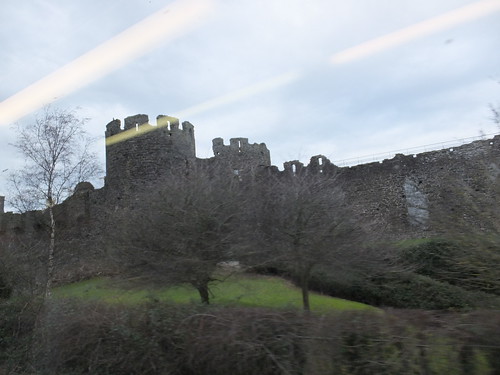
Conwy Castle was built by King Edward the First between 1283 and 1289. It's a 'proper castle' which still impresses in the way that the French fortified town of Carcassone impresses (it's only recently I've discovered that the 'rehabilitation' of Carcassone by Eugène Viollet-le-Duc
in the 19th century is not altogether authentic).
 Conwy Castle towers above the railway.
Penmaenmawr
Our next stop was at Penmaenmawr, known for quarrying and tourism. Here the railway is forced close to the sea and there are three tunnels - Penmaenbach, Moel Llys and, after our stop, Pen-y-Clip Avalanche Tunnel. The weather seemed to be deteriorating, making the area appear rather bleak. Railway sidings remain for taking away aggregates and railway ballast by rail but there was no sign of current activity. I've had a soft spot for the place ever since spending a holiday there as a child.
We carried on another ten miles to Bangor, with an intermediate stop at Llanfairfechan.
Bangor
Approaching Bangor there are two more tunnels - Llandegai Tunnel then, after a short open air section where Bethesda Junction used to be, Bangor Tunnel. The layout at Bangor is now considerably simplified. There are Up and Down 'Through' lines and Up and Down platform loops. There are a few sidings on the Down side but it's hard to recall just what a busy station this was in steam days.
However, I was cheered to find that the original 1870 station building on the Up side, designed like all the original structures for the Chester and Holyhead line by Francis Thompson, remains. Although the building has suffered various modifications during its life, its origins remain clear.
 Francis Thompson's handsome 1870 building on the Up platform at Bangor.
Leaving Bangor, we passed the remaining signalbox (formerly Bangor No. 2) which is perched on the embankment on the Up side overhanging the line. The train then plunged into the darkness of Belmont Tunnel.
Entering Anglesey
Soon after emerging from Belmont Tunnel, Telford's Menai Suspension Bridge, opened in 1826, was visible on the right. These days, the view of this famous bridge is impaired because of the numerous trees which have been allowed to grow. The railway then curves to the right, high above the waters of the Menai Strait prior to making its own leap across the water to Anglesey. The Britannia Bridge was designed by Robert Stephenson and, like the Conwy Railway Bridge described earlier, originally used wrought iron rectangular tubes. After its opening in 1850, the design carried the increasing loads of the railway until 1970 when boys playing inside the tubes set fire to the pitch-covered wooden roof of the tubes, compromising the structural integrity of the bridge.

Click on above image for a larger view.
The Britannia Railway Bridge circa 1852 (Wikimedia Commons).
Fortunately, it was decided to rebuild the bridge, retaining the original stone piers (another feature designed by Francis Thompson) but the tubes have been replaced by steel arches - a practical solution but, sadly, lacking the simple elegance of the original conception. Although the redesign accommodated the original two tracks, only one was provided. The bridge re-opened to rail traffic in 1972 but it was also decided to piggy-back a road on top of the railway (the road opened in 1980), leaving only rather claustrophobic views from passing trains (but still, I suppose, an improvement on when the trains ran through the rectangular tubes!) The bridge retains its four carved stone guardian lions but the modern steelwork supporting the road diminishes their impact. On leaving the bridge in Anglesey, the railway reverts to double track for the remaining 21 miles to Holyhead.
Llanfair P. G.
The first railway station in Anglesey, once closed but happily re-opened, benefitted from an extended name sometimes abbreviated to 'Llanfairpwll' or 'Llanfair P. G.'. The National Rail Enquiries site gives both names here. I've written briefly about Llanfair P. G. here.
Gaerwen
Gaerwen retains its signal box but has lost its station. When I was young, it was the junction for a seventeen mile long branch to Amlwch, with a second branch from Holland Arms to Red Wharf Bay. I travelled on both lines during the holiday at Penmaenmawr I mentioned above. Freight traffic survived for some years to a chemical works at Amlwch but the whole infrastructure is currently disused and the connection to the main line at Gaerwen has been severed. Various schemes have been mooted for bringing the line back into use.
After Gaerwen, there are intermediate stations at Bodorgan (with its two tunnels), Ty Croes and Rhosneigr.
Valley
This location is probably best known for its R.A.F. Station which has a very informative website here. Valley is the last railway station before Holyhead and it retains its signal box which controls a level crossing with barriers and a number of sidings.
The sidings are the nearest railhead to Wylfa Nuclear Power Station. This power station currently has one operational 'Magnox' reactor rated at 980MW (a second was shut down in 2012) and is operated by Horizon Nuclear Power, a wholly-owned subsidiary of Hitachi Limited. The Horizon Wylfa website outlines their aspirations for new nuclear generation on the site. There's also a Wikipedia article here.
The sidings at Valley have one further 'claim to fame'. The line from Crewe to Holyhead is used by a number of Steam Charter trains so, to allow locomotives to be turned at Holyhead prior to returning to Crewe, a triangle or 'wye' was constructed within the Valley sidings in 1989.
Holyhead
The Inner Harbour remained as I remember it, in the shape of a 'V' pointing south, embraced by railway platforms on both sides. But no passenger ferries berth in this area now. The Stena ferry which most railway passengers head for has a new berth (Terminal 1), on the east quay, further towards the outer harbour, supported by a modern passenger terminal leading off the concourse area at the buffer-stops end of the railway station.
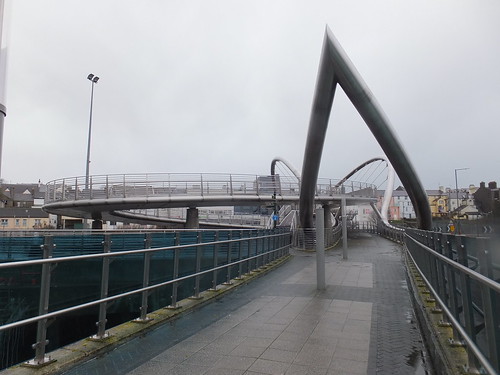
Additional terminals have been build on Salt Island, near the old Admiralty Pier. To get vehicles to these new terminals from the road entrance which is on the east side of the railway, a concrete road bridge has been constructed right across the Inner Harbour, cutting off the old quays. A second bridge for pedestrians has also been built across the Inner Harbour, leading from the concourse area at the buffer-stops end to the west quay, where a futuristic spiral ramp and bridge takes people across the railway sidings and a road, to emerge directly into the old town.
The weather had deteriorated as we approached Holyhead and the town was being lashed by driving rain and high winds. I was wearing the padded coat and thick gloves I'd used during my visit to the Antarctic (part of my Round the World trip described here so, having deployed the rain hood, I set off to explore the area.
I decided to tour the station itself first, so I made my way across the pedestrian bridge to the west quay and platform 1. The bridge had stainless steel handrails with blue tinted glass panels coming up to shoulder height, offering no protection against the wind-driven rain. I was amused to notice that the tinted glass panels gave an attractive tropical hue to the waters of the Inner Harbour, which were actually dark green. The weather conditions discouraged me from properly appreciating the artistic embellishment - a sort of cairn of slate with an inlaid message in Welsh and English. I did notice that, rather than being a boring straight bridge, it described a gentle 'S' curve (a windy, winding bridge, but not a wobbly bridge).
 View of the pedestrian bridge and spiral ramp, looking towards the town.
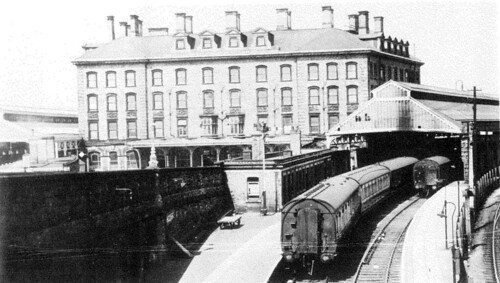
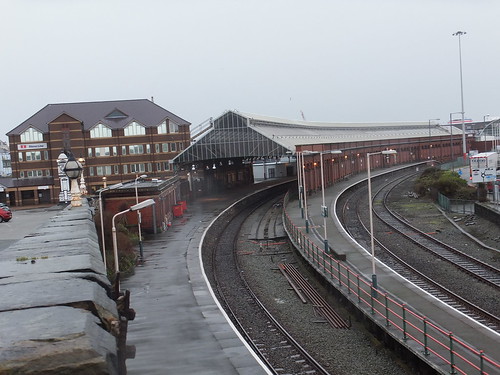
Platform 1 has lost its train shed and the modern awning offered scant protection to the gusting, horizontal rain. Years ago, this platform was numbered '3' (I've mentioned in the post Zen and the Art of Platform Numbering the British approach to 'modernising' platform numbers). At the landward end of the station, there's another concourse area for passengers arriving by road. This concourse was rather dark and uninviting on my visit, but at least seemed to be appreciated by a group of local skateboarders practising there. This concourse forms part of a modern building (replacing the railway hotel) principally occupied by Stena Line who are now the Holyhead Port Authority. The Stena Line website for Holyhead is here with a very good map here.
 Holyhead Station in steam days showing the railway hotel (Photo: 'A Pictorial Record of L.M.S. Architecture' by V. R. Anderson and G. K. Fox).
 Holyhead Station in 2014.
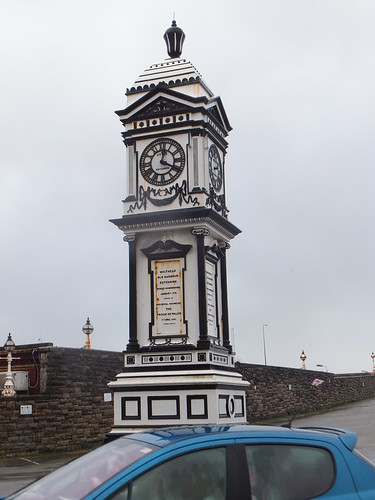
The railway hotel may have gone, but the elaborate cast-iron clock turret commemorating the opening of the 'Old Harbour Extension' in 1880 by the then Prince of Wales is now Grade II listed and remains in the turning circle outside the modern building.
 Commemorative clock turret outside Holyhead station.
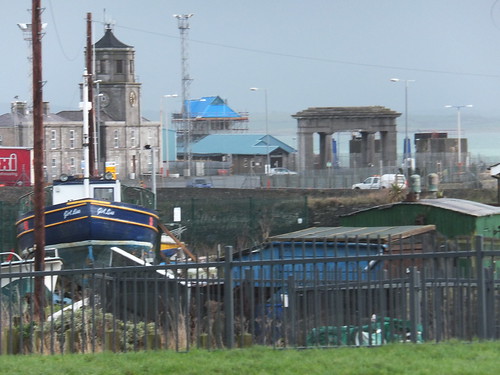
I left the station by the ramped approach leading to the road bridge crossing the railway. This bridge is always busy with traffic between the A55 Expressway and the entrance to the port on the east side of the railway. Turning right, I continued along Victoria Road in between the West Dock and, at a higher level, the town. Pelham Emergency Gate was as near as I could get to Salt Island, which hosts Terminals 2, 3, 4 and 5. I'd seen pictures of the commemorative arch at the entrance to the Admiralty Pier, but I'd assumed it had been lost to the redevelopment. But no, it survives listed Grade II, together with adjacent features. Usually called the Admiralty Arch, it's also known as the George IV Arch and marks the end of Telford's road from London to Holyhead, completed in 1826 with the opening of the Menai Bridge. There's a useful history of the road we now call 'the A5' in Wikipedia here.
 Holyhead, Salt Island: Custom House (Grade II*) and Admiralty Arch.
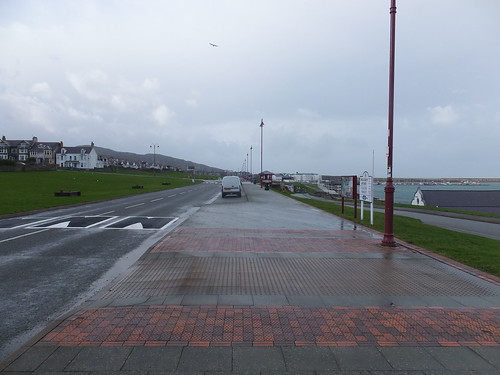
Turning left into Prince of Wales Road, Holyhead immediately took on the appearance of a seaside resort. The rain had almost stopped, but it restarted later. I would have visited the Maritime Museum, but it was closed until Easter.
 Prince of Wales Road, Holyhead.
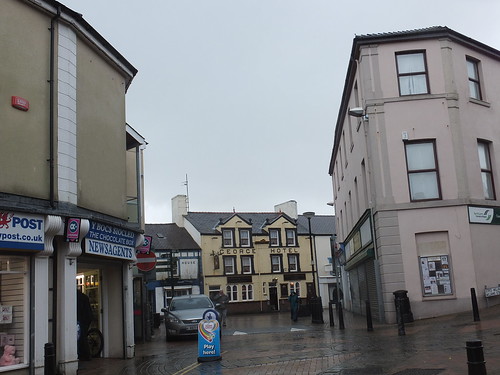
I turned inland, passing rows of neat houses offering bed and breakfast before coming to the town centre. With a town population of only around 12,000, this had a very relaxed feeling, even on a Saturday afternoon. I detected the aroma of fish and chips before I spotted the small shop. Even a small portion of chips to take out was very generous. Eating my chips, I passed the offices of the town council, the cinema, the magistrates court and various shops. The Cash Machine at the bank offered two languages, reminding me that I was in a different country.
 Holyhead town.
My route back to the railway station took me through the churchyard of the Church of St. Cybi which is within the walls of an earlier Roman Fort, then over the futuristic, stainless steel bridge crossing the Inner Harbour. I decided to take a Virgin train to Crewe. This comprised two 5-coach 'Voyagers' and should have given me a quicker journey than on my outward leg. However, after setting off on time, we stopped at Valley for about 10 minutes, reportedly because of a signalling fault and we then suffered various checks afterwards. However, I still thoroughly enjoyed the trip.
Maritime Matters
Throughout my visit the 'Stena Explorer' was berthed at Terminal 1. The Stena Line site for this catamaran is here and Wikipedia have an article here.
 'Stena Explorer' at Terminal 1, Holyhead.
I didn't identify the Stena Line vessel at Terminal 5 but it was probably Stena Adventurer. There's brief information on Wikipedia.
Irish Ferries also operate from Holyhead, and one of their ships (MS 'Ulysses', I think) was at Terminal 3. They operate:-
Dublin Swift (Johnathan Swift) (a catamaran).
Ulysses.
Epsilon (introduced in December 2013).
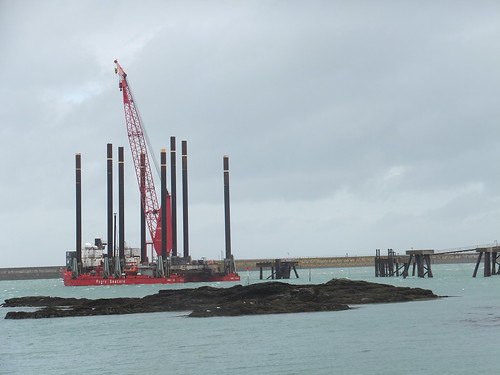
Near Terminal 4, there was a Jack-up Barge operated by Fugro Seacore.
 Jack-up Barge operated by Fulgro Seacore.
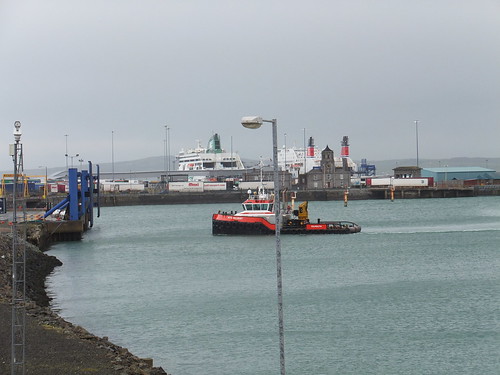
As I was returning to the railway station, the 'MTS Valiant' came into the Inner Harbour heading for the Refit Berth in the West Dock. The tug is operated by Marine & Towage Services and the specification is here.
 'MTS Valiant'.
Related posts in this blog
A Trip to the Seaside (Part 2) (Describes a 2011 trip along the North Wales Coast line to Llandudno).
Trip to Holyhead (Part 1: Crewe to Llandudno) (Describes the first part of this trip).
My pictures
North Wales Views.
Holyhead: Town and Harbour.
My railway pictures
North Wales Line (Crewe - Llandudno).
North Wales Line (Llandudno - Holyhead).
Holyhead railway station.
It had been some years since I'd been to Holyhead so on Saturday, 25th January 2014 I made a trip by train to see how the place had changed. When I left home, it was cold and dry but we'd had heavy rain during the night. The first bus of the day into Wolverhampton was on time so I was able to catch the 08:37 Virgin 'Voyager'. For the first part of the journey, I was re-tracing the route I described in the post A Trip to the Seaside (Part 2), when I visited Llandudno. The Virgin 'Voyager' delivered me to Crewe 'right time' and there was a connection to Chester within a few minutes. At Chester, I had over half an hour to wait for the Arriva service onward to Holyhead so I decided to explore the area around the station.
Chester
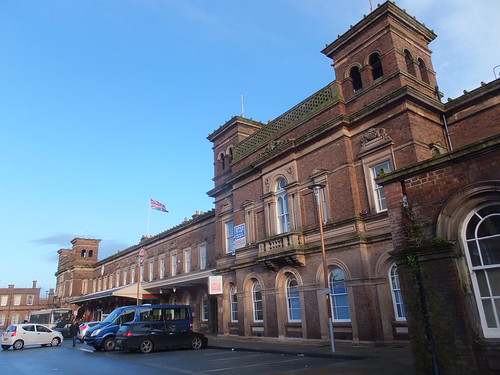
The station has an impressive range of elegant buildings in brick and stone built by the Chester and Holyhead Railway. Despite some modern depredations, I find the result pleasing.
 Chester station buildings.
Immediately opposite the station is the large Queen Hotel (unusually, lacking the possessive in the name) which hints at a more gracious age. The long, straight road connecting the station to the city is called, logically enough, City Road and it has a multitude of hotels and boarding houses. Even on a cold and rather dull January morning, there seemed to be quite a few tourists emerging from their accommodation for a day sight-seeing. When I reached the bridge over the Shropshire Union Canal, I stopped and recorded the view looking east before returning to the station.
 Chester: View of Shropshire Union Canal looking east. Left: Inevitable apartment development with Shot Tower behind, right: former Steam Mill.
I was a bit downhearted at "Mee Too" design of the apartment buildings on the left which could have been anywhere. I didn't realise until later that they formed part of the 'regeneration' of the old leadworks site, although I correctly identified the Shot Tower visible in the background.
I'd first learnt about Shot Towers (which manufacture lead shot for cartridges) in 1951 when I'd seen the Lambeth Shot Tower which was retained as part of the Festival of Britain South Bank site and converted to bounce radio signals off the Moon! After the Festival the Lambeth Shot Tower was demolished to make way for the concrete bunker of the Queen Elizabeth Hall which still disfigures the South Bank. The Chester Shot Tower is Grade II listed so may have better luck, although the appearance is rather spoilt by a 1971 lift shaft attached to the outside.
The Steam Mill is also Grade II listed and has been expensively converted into the Steam Mill Business Centre. There's an informative website on the Steam Mill Business Centre here.
I made my way back to the station in time for the 10:23 to Holyhead which was on time. This modest 2-coach train had started from Cardiff a little after six and, although it batted along between stations, because it stopped apparently at all stations it was a little after noon by the time we finally reached Holyhead.
Airbus UK, Broughton
Travelling on the 'seaward' side, I didn't see much of the Airbus UK plant at Broughton, next to Hawarden Airport. This plant produces wings for Airbus products. They were originally shipped by 'Super Guppy' aircraft to Toulouse for final assembly and I spotted one here some years ago. However, as the 'Super Guppy' aged and became uneconomical, Airbus introduced the Airbus Beluga. However, even the 'Beluga' cannot cope with the massive wings for the Airbus A380 and these (I discovered later) are shipped from the Port of Mostyn. Incidentally, I've described A380 flights in the posts Big Jet to Johannesburg and East Again!.
Connah's Quay Power Station
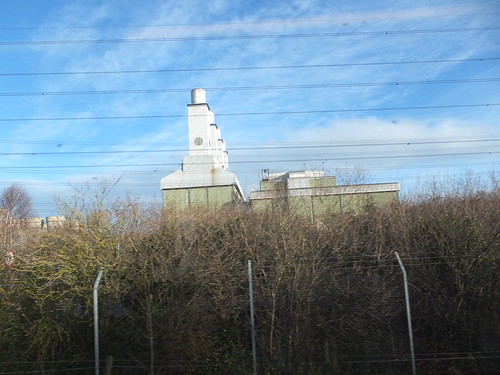
We followed the River Dee towards the sea, passing Connah's Quay Gas Power Station. Being more used to seeing coal or oil fired plants, with their attendant large cooling towers, the gas-powered version with Hybrid Cooling Towers looks rather strange. This time, when I returned home, I found out a bit more.
 Connah's Quay Gas Power Station
This power station is operated by E-ON, who publish some information here. There's also a Wikipedia article here. The site runs on natural gas from the Liverpool Bay Field, generating electricity using Combined Cycle Gas Turbines (CCGT). Hybrid Cooling Towers are used at Connah's_Quay. These reduce visible plume and need less water. The SPX site here has more information about Hybrid Cooling Towers.
Holywell Junction
The station here closed years ago but the imposing station building on the Down side survives and the signal box of the same name is still in use.
TSS 'Duke of Lancaster'
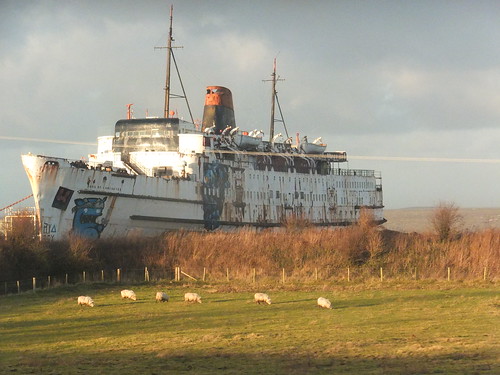
Since 1979, passengers between Holywell Jn. and Mostyn have had the curious sight of a large passenger ferry beached in a small creek in the grassy foreshore. The ship is getting rather scruffy now but has an interesting story which is told on the 'Duke of Lancaster' website. In 1956, TSS 'Duke of Lancaster' replaced an earlier ferry on the Heysham - Belfast route. On a recent visit to Heysham (described here), I was reminded that I'd seen the ferry at Heysham years ago, although I never sailed on her.
 TSS 'Duke of Lancaster'.
Mostyn
Mostyn is recognisable by its port, but I can remember a time when there was also an iron and steel industry here, complete with one or two mechanised blast furnaces. Originally, 'Mostyn Quay', as it was then known, was operated by the Mostyn Coal and Iron Company. There's a short history in Wikipedia here. The colliery closed in 1884 after serious flooding but iron and steel making continued until 1965.
 Mostyn Iron Works, around 1908, showing two hand-charged blast furnaces (Photo: Flintshire Record Office)
A quick search has not found much about the modernisation of the blast furnaces to the form I remember, but there's an interesting historical survey in the Flintshire Historical Society Publications which appears on the internet (in a slightly garbled form) here.
The Port of Mostyn has survived, and prospered, by adapting its services to modern needs. There's an informative website here.
It supports Offshore Windfarm construction and Operation & Maintenance projects. After initially serving as the base for the North Hoyle and Rhyl Flats schemes, it has gone on to cater for a number of other, larger, schemes. There's more information here.
 The Port of Mostyn viewed from Mostyn Sea Wall, showing pre-assembly of towers for Wind Turbines.
The Port of Mostyn is also involved in delivering wings for the Airbus A380, which are too large to be flown by Airbus Beluga. The process is described here.
Point of Ayr Gas Terminal
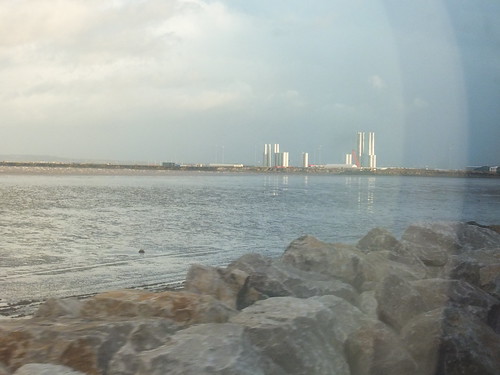
The gas for Connah's_Quay comes ashore at Point of Ayr, and reaches the power station via a pipeline around 17 miles long. Wikipedia also have an article here on the Point of Ayr Gas Terminal. So, my ignorance is exposed (once again). What I though was a 'chemical plant' at Point of Ayr is actually the Gas Terminal where, I discover, the delightfully-named process called "gas sweetening" is carried out (see Amine gas treating). The Gas Terminal was built in 1994 near the site of the Point of Ayr Colliery. This deep mine was finally closed in 1996 but I remember seeing it on previous trips.
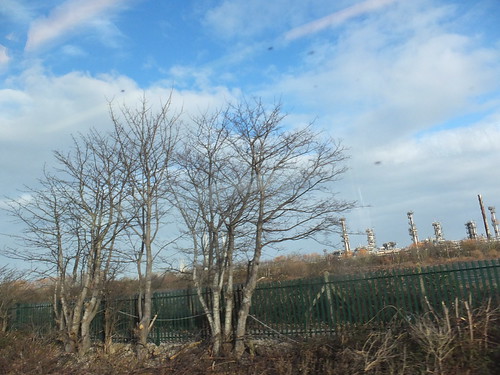
 A hasty picture showing Point of Ayr Gas Terminal, partly obscured by trees.
The Holiday Resorts
We now passed through the string of holiday resorts which were so well-served by the railway in the days when few people had cars and foreign holidays for ordinary people were unheard of. We made brief stops at Prestatyn, Rhyl, Abergele (which I remember having railway Camping Coaches, almost on the beach) and Colwyn Bay. My favourite resort, Llandudno, remains served by a short branch line from Llandudno Junction.
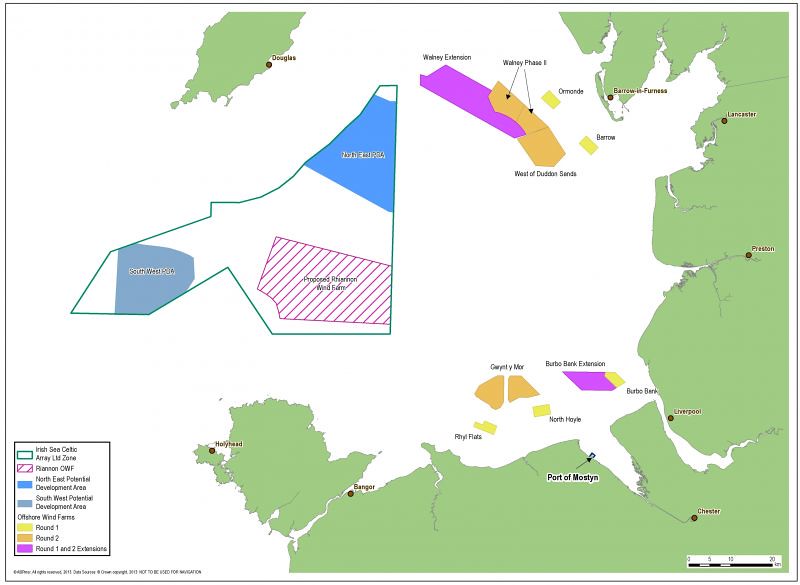
Offshore Wind Farms
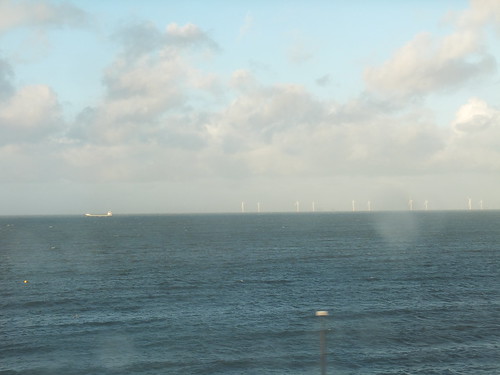
The sea off the North Wales Coast is becoming home to an increasing number of wind turbines. The North Hoyle and Rhyl Flats wind farms are clearly visible from the train.
 Part of the Rhyl Flats Offshore Wind Farm viewed from the train near Colwyn Bay.
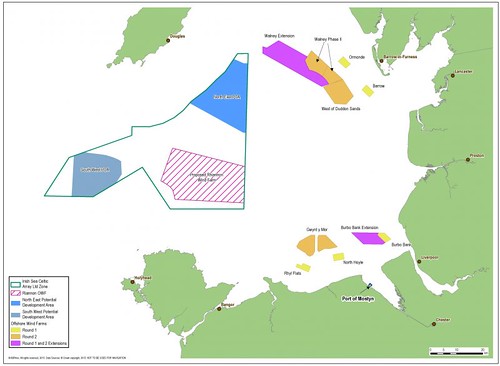
Until I checked, I'd no idea just how many windmills are being built.

Click for larger view
Map of the Celtic Array Wind Farms.
The description of this journey beyond Llandudno Junction is continued in Trip to Holyhead (Part 2: Llandudno to Holyhead)
Related articles on other sites
Chester Shot Tower (Wikipedia).
Steam Mill Business Centre.
Connah's Quay Power Station (E-ON).
Connah's Quay Power Station (Wikipedia).
Point of Ayr Gas Terminal.
Related posts in this blog
A Trip to the Seaside (Part 2 (Describes a trip in 2011 along the North Wales Coast line to Llandudno)
Trip to Holyhead (Part 2: Llandudno to Holyhead) (Describes the second part of this trip).
My pictures
Chester.
North Wales Views.
North Wales Line (Crewe - Llandudno).
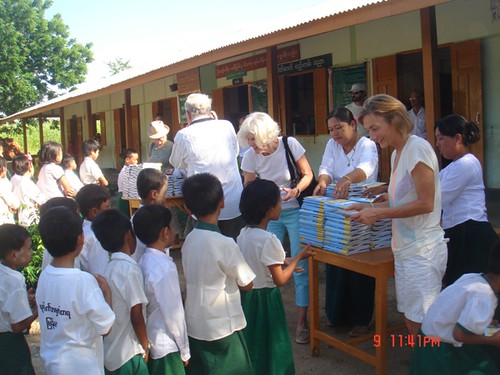
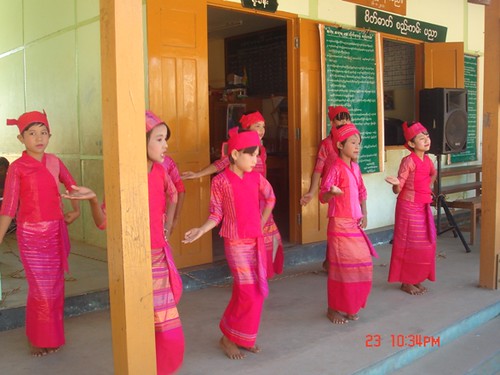
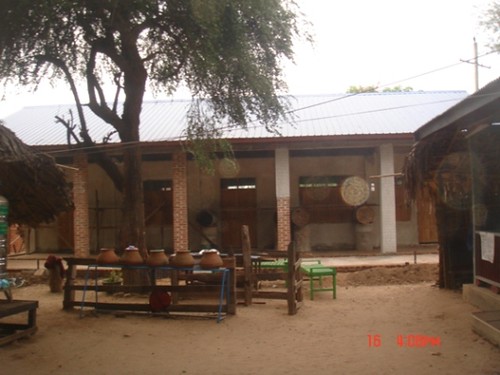
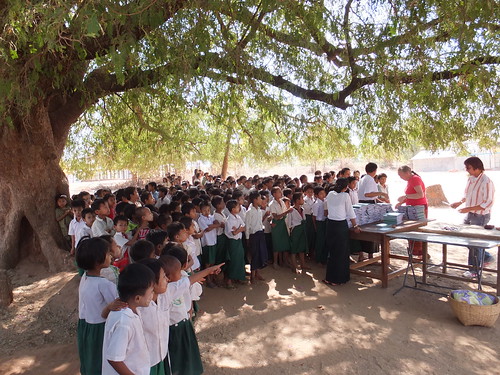
On 1st November 2013, Guests from the 'Road to Mandalay' river cruise ship accompanied Dr. Hla Tun to Bagan School, to distribute stationery to the 347 students in Grades 1 to 8. The Government originally provided a school covering Grades 1 to 5 only. In 2000, the 'Road to Mandalay' Social Contribution donated a building which catered for Grades 6, 7 and 8. The school is still supported by 'Road to Mandalay' and on the 1st November, the students received exercise books, rulers and pencils. Students also performed dances for their visitors.
On the 15th December, a similar visit was made with, of course, different Guests. On this occasion, the students received exercise books, pencils, sharpeners and erasers and, again, dances were performed for the visitors.
 On the 1st November, the students received exercise books, rulers and pencils.
 On the 15th November, students wearing Shan costume performed a Shan dance.
 On 15th November, students in Myanmar costume perform a Myanmar dance.
There are a number of posts in this Blog on education support in Myanmar provided by the RTM Social Contribution with help from donors around the world. You can find them all here.
This report is based on information from Doctor Hla Tun, who also supplied the photographs.
The Bagan Clinic treated 4,465 patients in November 2013, bringing the total number of treatments since the Clinic opened on 6th August 2011 to 88,167.
Treatment Summary
The table below summarises the number of treatments per month in 2013 and the total number of treatments since the clinic opened on August 6, 2011.
| Month |
Patients treated |
Total treatments |
| February 2013 |
2,713 |
49,850 |
| March 2013 |
2,713 |
49,850 |
| April 2013 |
2,061 |
54,924 |
| May 2013 |
3,303 |
58,227 |
| June 2013 |
5,586 |
63,813 |
| July 2013 |
6,079 |
69,892 |
| August 2013 |
5,337 |
75,229 |
| September 2013 |
4,826 |
80,055 |
| October 2013 |
3,647 |
83,702 |
| November 2013 |
4,465 |
88,167 |
Monthly notes
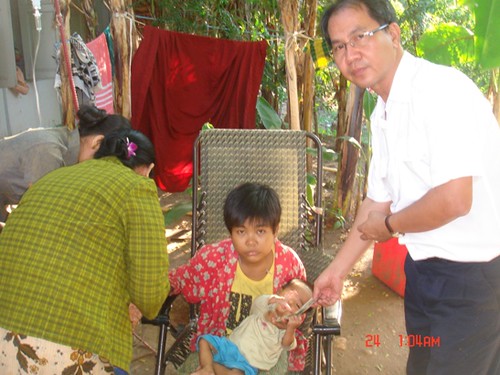
The 23 year old lady pictured below travelled from TaungTwinGyi (about 140 to 150 km from Bagan) by train, being unable to afford the fee using a truck. She suffered from anaemic heart failure and was treated by Dr. Hla Tun and then referred her to the Hospital for packed cell transfusion because of her pallor. She had brought her 7 month old daughter who was also sick with her but had left her 4 year old son at home. Her husband had left home to seek work one year previously and had not returned so she was accompanied by her elder brother to Bagan Clinic. Whilst in Bagan, she and her borther had offered her daughter to other patients for adoption. The Clinic made a donation for transportation and accommodation for hospitalization.
 23 year old mother with her 7 month old daughter.
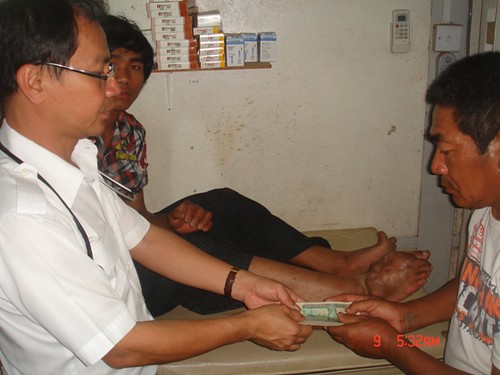
An 18 year old boy from ThaMinChan Village had had two previous operations to treat a fibrous growth of tissue on his right calf and foot but it was still growing larger. The patient's father explained that they had borrowed money with interest to make the journey to the Clinic. Doctor Hla Tun referred the patient to Hospital for further management and made a donation.
 18 year old boy with a fibrous growth.
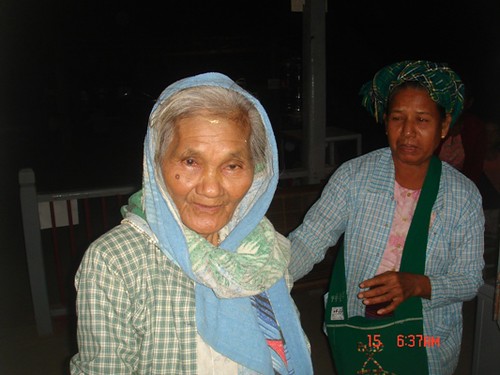
A 79 year old lady from SeikPhyu suffering from muscular weakness was the last but one patient seen by Dr. Hla Tun on December 6th (at twenty minutes before midnight). She was given tablets intended for chewing but she then explained that she'd had no teeth for over 12 years.
 79 year old lady with muscular weakness.
The picture below shows the new clinic building under construction. There are plates for lunch on the tables and five drinking water pots filled on each clinic day by a donation from a local hotel.
 The new clinic building under construction.
There are a number of posts in this Blog on medical support in Myanmar provided by the RTM Social Contribution with help from donors around the world. You can find them all here.
Here we go with my eighth 'Review'. At the beginning of the year, we had snow which deterred me from being too adventurous so I was able to catch up with various posts - Preparing the locomotive 'Sapper', Working in India, Railway Signalling in Burma (included in the series of posts labelled Myanma-Railways).
OVERSEAS TRAVEL
Trip to Vietnam, Western Australia and Burma
On the 31st January, I set off on another Far East Trip. The complete set of trip reports can be found here.
Vietnam
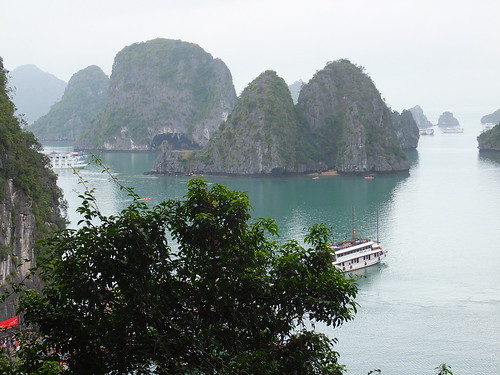
I flew by Thai from Heathrow to Bangkok, then changed for a second Thai flight to Ho Chi Minh City in Vietnam. I'd been to Ho Chi Minh City once before, in 2005, so I was happy to catch a Vietnam Airlines flight on to Da Nang, where a taxi met me and took me to Hoi An. I explored Hoi An in the evening and, the following day, toured the town with a guide, Than. We returned to Da Nang by car, making various visits, and then took the mountain road to Hue. I was invited to join a simple celebratory meal at a coffee shop up in the mountains - a delightful experience. That night, I stayed at the Hotel Saigon Morin in Hue. I went out exploring in the evening, returning by motor cycle taxi. Hue is very historic - we visited The Citadel, Thien Mu Pagoda and returned by a 'Dragon Boat' on the Perfume River. After lunch at a small, popular cafe we visited two tombs of former kings at Khai Dinh and Tu Doc. Than invited me to his home where preparations for the New Year were in progress, then I had to leave to catch the evening flight to Hanoi where I was taken to my hotel, the Metropole. Then next day, my guide Joe showed me the teeming city. After an interesting visit to the 'Hanoi Hilton' prison (now a museum), we saw the outside of Ho Chi Mihn's mausoleum and the simple country-style house where he chose to live. We saw the 'Temple of Literature' and similar sights. In the afternoon, I went off on my own to look at the railway station (surprise!) and more of the city. In the evening, I was taken to see a Water Puppet Theatre show (no, I'd not heard of water puppets either, but the show was good). The following day, we drove to Halong Bay where I was to join one of the 200 hotel boats. There are also 300 day boats. Halong Bay was as interesting as the films I'd seen, but it's quite hard to get away from crowds of tourists. Fortunately, with the 2-night tour I was on, the second day was spent on a dayboat able to seek out quieter locations (and do some canoeing). On the final day, the Hotel Boat returned me to the mainland for the drive back to Hanoi and the Metropole Hotel. After a couple of hours, it was off to Hanoi airport for the evening flight to Bangkok.
 Halong Bay, Vietnam.
Western Australia
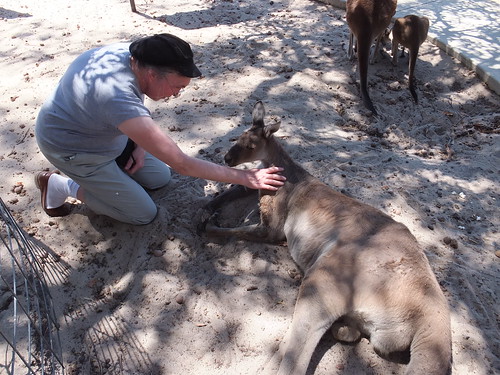
Thai provided the night flight from Bangkok to Perth, arriving about 7.30 a.m. My last visit to Perth had been in 2007. My friend Keith met me and we went to his home, where I was staying. Later in the day, we went into Fremantle and I was glad that the pace was a little more relaxed than Vietnam. The next day, I went with Keith walking his dog, Sasha, quite early. Later, we went shopping. In the afternoon, we visited my friend Captain Myo Lwin and his wife, who are staying with their daughter and her husband at their home in Perth, following the arrival of their first grandchild, Wyatt. Next day, after dog walking, Keith took me to Cohunu Koala Park which is now open to the public. I drove one circuit of the 7.25-inch gauge railway, with the petrol-hydraulic locomotive 'Joan'. The following day, we were able to visit the Steam Museum in Fremantle, followed by the Shipwreck Museum. In the evening, we went to a Chinese restaurant. The next day was very hot so, after dog walking and a bit of shopping, Keith left me at a railway station so that I could explore by train. I took the train to Perth then made a journey to Midland and back, then a train to Fremantle. I visited the Matime Museum, watched the cruise ship 'Silversea Whisper' disgorge its tourists for a brief view of Fremantle and finally caught the train to Perth, changed and returned to my starting station where Keith picked me up. On my last day in Perth, there was time to look at Keith's latest locomotive in his well-equipped workshop before heading to the airport for the Thai flight to Bangkok. I'd been booked into the Novotel at Bangkok Airport. I only managed about 3 hours sleep before getting ready for the morning Thai flight to Yangon.
 Jan and Kangaroo in Cohunu Koala Park, Western Australia.
Burma
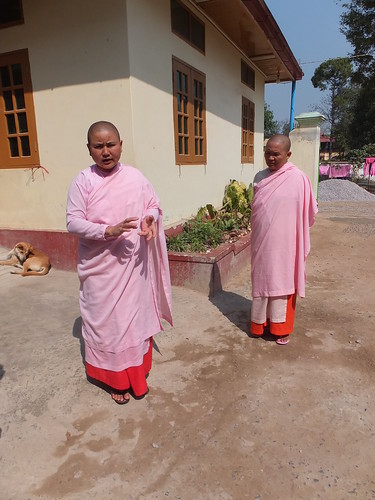
On arrival at Yangon, I was met by my guide but the journey into the city took 90 minutes because of congestion. My hotel room was not ready so I walked to the station and caught the train to Da Nyn Gone. By the time I arrived back at the hotel, I was happy to relax for the rest of the day. The next day required an early start - I was to catch a domestic flight to Nyaung Oo. At Nyaung Oo I met another guide and we drove to Bagan and the Medical Centre. I met up with my friend Mr. Hla Tun then checked in at my nearby hotel whilst the Doctor was completing his work. After lunch in the Monastery, we loaded stationery into the car and set off for the school at Nga-Minn-May. After a tour of the school buildings, the Doctor and I presented stationery to all the pupils. We repeated the process at Chauk-Kan School. The following day, I explored the Pagodas of Bagan with my guide and driver. Next morning, I was taken by car to Nyaung Oo airport for the morning flight to Mandalay. At Mandalay, I was met by a new guide and driver and transferred to the Sedona Hotel where I'd stayed before.Low water on the Ayeyarwaddy meant that 'Road to Mandalay' would not reach Mandalay, but would anchor downstream at Myin Mu. After a good night's sleep I went with my guide and driver to Myin Mu, where we arrived a little before 'Road to Mandalay'. After spending a little time with the Doctor and other friends from the ship, the car took me to nearby Bodhi Tataung, home of 10,000 Buddha images. Then we went to the 167 metre tall standing Buddha, climbing to the 10th floor (higher floors had been closed temporarily). Next stop was the Thanboddhay Temple, boasting over half a million small Buddha images! Then back to Mandalay with a very early start the next day in order to catch the 4.00 a.m. train to Maymyo (which actually left at 6.17 a.m.). My guide and driver met up with me at Maymyo station and we made a visit to the Shwe Sin Minn girls' orphanage. We visited Pwe Kauk Waterfalls - 'touristy' but aimed at Burmese, not foreign tourists. We visited the impressive, modern Aung Htu Kan Tha shrine, returned to Maymyo and descended from the hills to Mandalay. The following morning, we went into the Sagaing Hills, with a short detour to look at the railway station at Ywa Taung. Returning to Mandalay, we met the 'Road to Mandalay' guests taking lunch at the Sedona Hotel, and I was able to spend a little more time with Doctor Hla Tun. The next morning, I was met by a young lady guide who had travelled from Yangon with a car and driver the previous day. We set off on the Highway going south (with a slight detour to look at Paleik station) and arrived at the new capital city, Naypyidaw. I was determined to find the railway museum but, after some delay, we arrived to find the museum closed. However, the guide found some people to open the museum for me. After photographing all I could in the museum, we found my hotel - the Aureum Palace Hotel where I had a pleasant semi-detached 'cottage'. Despite being tired, I agreed to go with my guide that evening to see the Uppatasanti Pagoda, which proved a fascinating visit, marred only by seeing the 'White Elephants' of Naypyidaw. The following morning, we continued south on the Highway to Yangon. When we arrived at the city, we diverted to the Tab Book Centre before checking into my hotel. I'd not intended to go out again but, being my last evening in Burma, couldn't resist going back to the station and walking east, eventually arriving at Pazundaung station. Tired and hot, I bought a ticket to travel back to Yangon Central station by rail. The next morning, I returned home via Bangkok.

The nuns who founded the Shwe Sin Minn girls' orphanage in Maymyo, Burma.
Trip to China and Tibet
On the 9th July, I set off on another trip East. The complete set of trip reports can be found here.
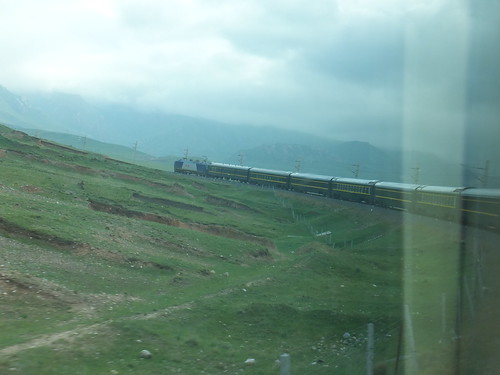
Tibet is now administered by China as the 'Tibetan Autonomous Region'. British Airways took me to Beijing, arriving on 10th July. Here, I was met and transferred by car to a Domestic Terminal, where I caught a flight to Xining. Once again, I was met and taken by road into the city, where I stayed one night. The following morning, there were various alarms in connection with my booking on the train to Lhasa but, eventually, everything was resolved. The journey to Lhasa is remarkable, not least because, at its highest point, the railway is some 15,000 feet above sea level (oxygen is available on the train). On arrival in Lhasa, I was met and taken to the very comfortable St. Regis Lhasa Resort. Next day, the 13th, I visited the famous Potala Palace and the Sera Monastery in Lhasa. On the Sunday, we went to Drepung Monastery, then onto Norbulingka - gardens and palace intended as a summer residence for the Dalai Lama. After lunch, we visited the revered Jokhang Temple. Next morning, we left Lhasa by road for Shigatse. The Chinese are currently extending the railway from Lhasa, the present terminus, to Shigatse - a major engineering task. Following lunch at the Songtsen Tibetan Restaurant, we visited the Tashi Lhunpo Monastery. I was impressed by a hand-knotted carpet factory which is run on profit-sharing lines then it was on to the Shigatse Hotel to overnight. Next morning, we set off east, on a lesser-road to Gyangtse. It was hot by the time we arrived at Pelkor Chode Monastery. After touring the monastery itself, it took some time to explore the myriad chapels of the Great Stupa Kubum. We overnighted in the Gyangtse Hotel and next morning continued back towards Lhasa. the road passed adjacent to snow-capped mountains and there were prayer flags everywhere. We took lunch in the town of Nangartse before taking the road past Yamdrok Yumtso lake. This is a popular tourist stop but the majority of tourists were Chinese. I was booked in the St. Regis Lhasa Resort for my last night in Tibet, allowing me to explore the city on my own. I was picked up at 11.00 a.m. on Thursday 18th and taken to the modest airport which serves Lhasa. China Eastern flight MU2260 took me in comfort to Shanghai, where I was met and taken to my city-centre hotel. The contrast with Tibet could hardly have been greater. Shanghai is a huge, modern, confident city embracing the ways of the western world. On Friday, 19th, I'd arranged to visit the Railway Museum first then we visited the Jade Buddha Temple and a major showroom selling cultured pearls. There were more western tourists in that one showroom than I'd seen in the whole of my time in Tibet!
 The Potala Palace, Lhasa, Tibet.
TRAVEL IN THE UK
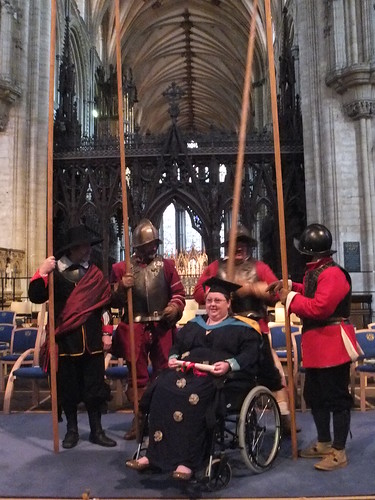
During the year I made various trips (mainly by rail) to London, Manchester and other destinations. The trip to Ely described here was to see Ann receive her Degree.
A trip to Morecambe and Heysham described here was to see how the places had changed since my previous visits.

Ann with Members of the 'Sealed Knot' in Ely Cathedral.
RAILWAYS
Railways, General
On 12th March 2013, volunteers from MOSI (the Museum in Manchester) had a fascinating visit 'Behind the Scenes' at Manchester Piccadilly Station arranged by Adrian. The full report is here.
On 11th April, through the courtesy of Orient Express, I was able to visit Stewarts Lane and walk through the luxurious 'British Pullman'. The full report is here.
On 17th June, there was another meeting at Brewood of the informal group of enthusiasts with particular interest in railways in the West Midlands. There's a report on the meeting here. During the year, the group shared many questions and responses by e-mail, encouraging me to post:-
Catchem's Corner Signal Box.
Life in the Signal Box.
Railways in the UK
I still use what remains of our national railway network for getting around and this will often prompt me to write about the network as it is or as I remember it:-
Liverpool Lime Street Station.
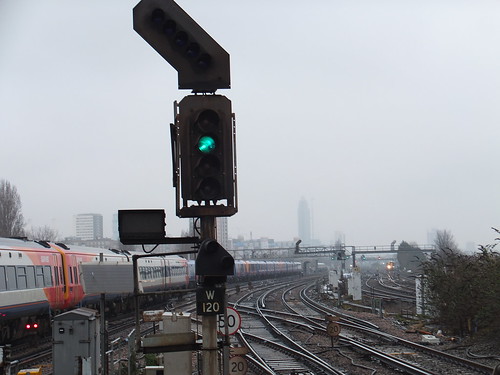
Clapham Junction Station.
Victoria Station, London.
Waterloo Station, London.
Edge Hill, Liverpool.
The Liverpool Overhead Railway.
'Black 5' to Birmingham.
Day Trip to Ely.
'Flying Scotsman'.
Railways around Edge Hill in 2013
A Busy Week.
The Mersey Docks and Harbour Board.
Early Days of the Mersey Railway.
Crewe South Junction Signal Box ('Crewe' All Electric System).
Crewe North Junction ('Crewe' All Electric System).
The Buxton Branch.
Railways around Morecambe.
 Clapham Junction.
Railways in China and Tibet
The set of 17 trip reports here includes some 'railway technical' content and links to my railway pictures. The two posts below describe my journey on the QingHai - Tibet Railway:-
The Train to Lhasa – Part 1.
The Train to Lhasa – Part 1.
 On the QingHai - Tibet Railway.
Railways in Burma
During my trip to Burma described above, I used the railway from Mandalay to Pyin-Oo-Lwin and made more journeys on Yangon's Circle Line. In addition, I visited Myanma Railway Museum and various stations by road. You can find all my posts on railways in Burma here.
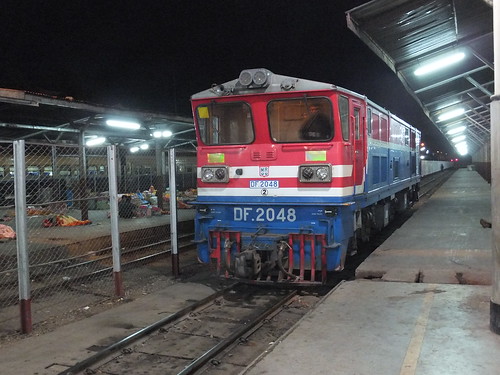
 Bo-Bo-Bo locomotive DF2048 at Mandalay Station, prior to hauling my train to Maymyo.
RAILWAY PRESERVATION
During 2013, I remained Secretary of the Old Locomotive Committee and an active volunteer at MOSI, The Battlefield Line and Peak Rail. I also met the Trustees of the Ashover Light Railway Society, described here.
The Old Locomotive Committee
Once again, the OLCO Annual General Meeting was held in Liverpool Museum. There's a report here. Other commitments meant that I was unable to attend the 'Lionsmeet' gathering in 2013. You can find all my posts about OLCO here.
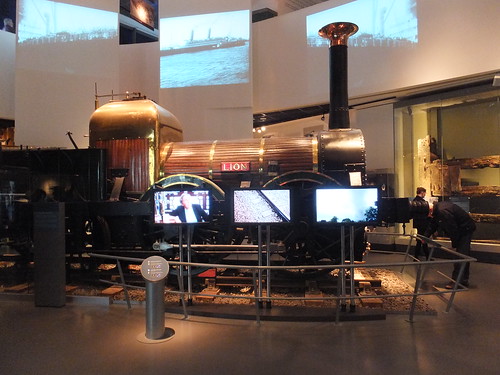
 The 'Lion', now 'caged' in Liverpool Museum.
MOSI
During the year, I had various operating 'turns' at the Museum of Science and Industry in Manchester, some of which resulted in a blog post:-
Saturday Steam
Easter Week at MOSI.
A Saturday in Manchester.
Manchester Mini Maker Faire 2013.
Another Saturday in Manchester.
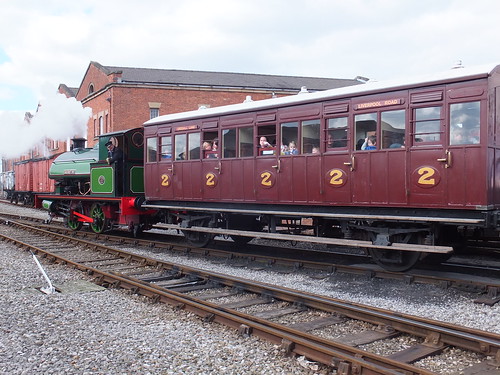
 'Agecroft No. 1' with the visiting 'North London' coach at MOSI.
The 'Planet' replica celebrated 21 years of service in 2013. That prompted a few posts:-
The Planet Replica.
'Planet' at MOSI - The First 21 Years.
'Planet' in Perspective.
Loco-profile 6: 'Planet' replica.
Happy Birthday 'Planet'!.
The Battlefield Line
During the year, I had a number of turns on the diesel railcar and a couple of steam turns:-
Sunday Diesel
Easter at Shackerstone
Battlefield Line 1940s Weekend
Midweek at the Battlefield Line.
Santa at Shackerstone.
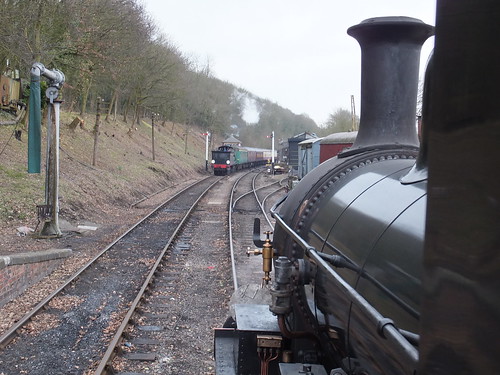
 At Easter, two visiting engines were in traffic - the Drummond 'T9' and a Beattie 'Well Tank'.
Peak Rail
I was a fairly regular driver at Peak Rail during the year. In March, the 'Blazing Saddles' event featured two-train working and no less than five 'Austerity' tank locomotives in steam. In April, the 'Peak Forester' steam charter visited, hauled by 'Tangmere'. The popular '1940s Weekend' took place in August and, of course, there was heavy demand for the 'Santa' Trains in December. In addition to these highlights, trains were operated throughout the year, top-and-tailed between Rowsley and Matlock Town until the introduction of the Winter Timetable when 'Lord Phil' worked the service unaided between Rowsley and Matlock Riverside, running round at each end.
Blazing saddles.
Easter at Peak Rail.
The 'Peak Forester'.
A Sunday in the Peak District.
Peak Rail 1940s Weekend.
A Heavy Load.
Vintage Commercial Vehicles at Peak Rail.
Winter Timetable at Peak Rail.
Peak Rail 'Santa' Trains 2013.
 The Down 'Peak Forester' approaching Church Lane Signal Box.
BREWOOD HALL
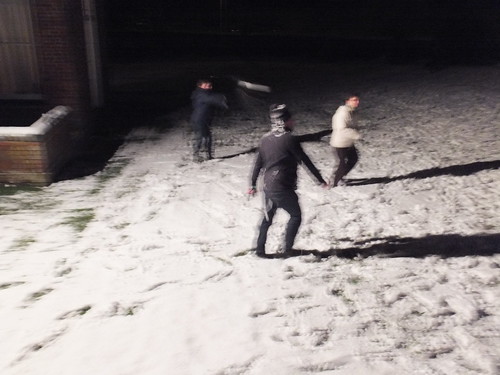
While the snow was on the ground in January, Brewood Scouts visited for a traditional snowball event which I called 'The Battle of Brewood'. August saw a very successful Vintage Garden Party in the gardens at Brewood Hall which is set to be repeated in 2014. In September, groups of visitors people were taken on a conducted tour of the principal rooms at Brewood Hall. During the year, a new set of aerial views of Brewood Hall were produced commercially.
The Battle of Brewood.
Brewood Vintage Garden Party 2013.
Conducted Tours of Brewood Hall.
Aerial Photography showing Brewood Hall.

Fun in the Snow at Brewood Hall.
'ROAD TO MANDALAY' SOCIAL CONTRIBUTION
For a number of years, I've tried to support the charitable initiatives operated under the above name in Burma. When I visit Burma, I try to see as much as possible of the work in hand. When I'm in the U.K., I receive regular e-mails about the work which (with permission) I report in my blog. The work is principally Educational Support and Medical Relief (centred on the wonderful Bagan Medical Clinic). You can find my posts on Educational Support here and those on Medical Relief here.
 Distributing stationery at Nga-Minn-May School, Burma.
PREVIOUS ANNUAL REVIEWS
2012
2011
2010
2009
2008
2007
2006
When I was young, there was a steam-hauled 'Push-Pull' service directly between Wolverhampton and Walsall. With dieselisation, the service progressively deteriorated in frequency until direct services were withdrawn altogether. A few years ago, a limited direct service from Wolverhampton to Walsall using Class 323 EMU was introduced but passenger numbers were disappointing and this, too, was withdrawn.
The railway route was always in competition with road transport for passengers. In the 1950s, both Wolverhampton and Walsall operated electric trolley buses. Wolverhampton's green and yellow buses alternated with Walsall's pale blue buses on the Wolverhampton to Walsall route. Of course, the "trollies" were eliminated in favour of diesel buses.
Development of the railways around Walsall
The South Staffordshire Railway was formed in 1846 to connect Walsall with Lichfield and construct associated branches. The Grand Junction Railway line, opened in 1837, had been built to link Birmingham (at one end of the London and Birmingham Railway) with Earlestown (at the midpoint of the Liverpool and Manchester Railway). This was the start of Britain's railway network. By 1847, Walsall was linked to the Grand Junction at Bescot. Two years later, the line to Lichfield and Wychnor Junction came into operation, followed by a branch to Cannock ultimately extended to Rugeley where it made a connection with the L&NWR Trent Valley Line. In 1879, the Midland Railway opened a line from Castle Bromwich (on the Birmingham - Derby line) to Wolverhampton and triangular junctions accessed the South Stafford Line at Ryecroft Junction, just north of Walsall station.
Railways to Walsall in the 1950s
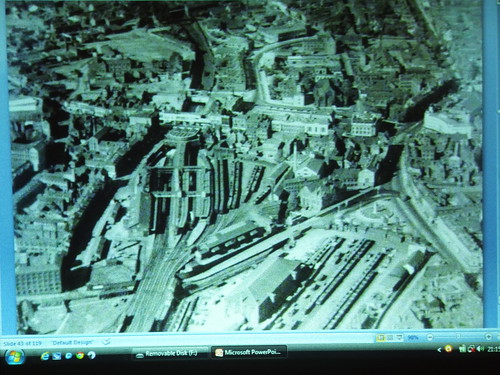
The railways around Walsall always impressed me - between Pleck Junction and Ryecroft Junction there were four running lines and extensive sidings. Pleck Junction controlled three diverging routes (Bescot on the Grand Junction, the South Stafford line to Dudley and Darlaston on the Grand Junction). Ryecroft Junction controlled no less than four diverging routes (Wolverhampton via the Midland line, the line to Cannock and Rugeley, the line to Lichfield and Wychnor Junction and Sutton Park and Castle Bromwich via the Midland Line). At a Railway Group Session at Brewood in June 2013, Keith had shown his presentation 'Black Country Railways from the Air' which included the picture below showing Walsall station in steam days.
 A screenshot from Keith's presentation showing Walsall station, with its round booking hall.
I'm old enough to remember the distinctive large, round booking hall at Walsall station which is clearly visible in the above picture. It had become very shabby in its latter days (like most of our railway system post-war) and was demolished to create the Saddlers Shopping Centre which opened in 1980. I particularly remember the mechanical signalling and the impressive signal gantries that were needed to control the many routes through Walsall. There were two routes regularly used by trains between Birmingham New Street and Walsall (via the Soho Road line and via Aston) and I've listed the signal boxes which controlled these routes below.
Signal boxes between New Street and Walsall, via Soho Road line:
Birmingham New Street No. 5
Sheepcote Lane
Monument Lane
Harborne Jn.
Winson Green Jn.
Soho East Jn.
Soho Road
Handsworth Jn.
Perry Barr North Jn.
Great Barr
Newton Road
Newton Jn.
Bescot No. 1
Bescot No. 2
Bescot No. 3
Pleck Jn.
Walsall No. 1
Walsall No. 2
Walsall No. 3
Signal boxes between Perry Barr North and New Street, via Aston:
Perry Barr Station Junction
Witton Goods
Aston No. 2
Aston No. 1
Vauxhall
Proof House Jn.
Birmingham New Street No. 1
You can find detailed signal box diagrams of all the above signal boxes in the Signalling Record Society publication 'British Railways Layout Plans of the 1950's - Volume 11: LNW Lines in the West Midlands (excluding Trent Valley Line)' (ISBN: 1 873228 13 9).
I'd become familiar with the line through Bescot and Aston in the 1950s, briefly described in the post 9:17 a.m. to Birmingham. In the post My First Steam Special, I summarised a trip from New Street to Walsall via the Soho Road Line in 1960 behind the preserved Midland Compound '1000', on our way to Stoke. By July 1962, modernisation was well in hand and I described a roundabout trip to Stafford via Walsall in the post A Sunday Stroll to Stafford.
Railways to Walsall in recent times
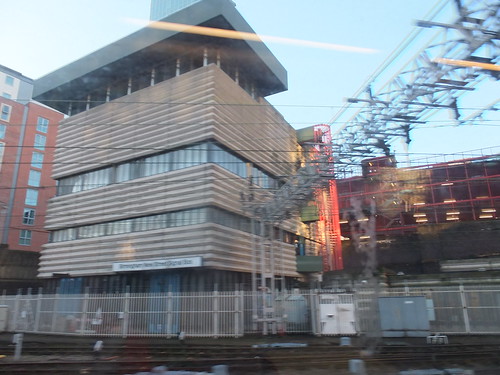
In the 1960s, all the above signal boxes were abolished, first with the introduction of Walsall Power Box at Pleck Junction (provided with 'Westpac' modular interlocking and an 'NX' signalling panel) in 1965, then, the following year, with the commissioning of the Birmingham New Street Power Signal Box (similarly equipped with Westinghouse equipment). The striking architectural design of the New Street signal box has led to the building being Listed Grade II in 1995 (listing details).
 Birmingham New Street Signal Box
During 2013, Walsall Power Box was, in turn, made redundant and control is now from the West Midlands Signalling Centre at Saltley.
 The part-commissioned West Midlands Signalling Centre, Saltley, Birmingham now controls Walsall area.
To see what remains in 2013, refer to 'Railway Track Diagrams Book 4: Midlands & North West', Third Edition, published by Trackmaps (ISBN: 978-0-9549866-7-4).
A trip to Walsall in January 2014
Provided you're in no hurry, it's still possible to go from Wolverhampton to Walsall by train, using the Stour Valley Line from Wolverhampton to Birmingham New Street, changing there to a Walsall train. On Saturday, 11th January 2014, I decided to do just that.
I arrived at Wolverhampton station in time to see an Arriva Trains Wales DMU depart for Birmingham. A few minutes later, I boarded the following well-loaded Cross-Country 'Voyager' from Manchester which would take the Bristol line after Birmingham New Street. Following on the heels of the earlier DMU, we suffered a signal check on the way and then stood for a couple of minutes in New Street North Tunnel.
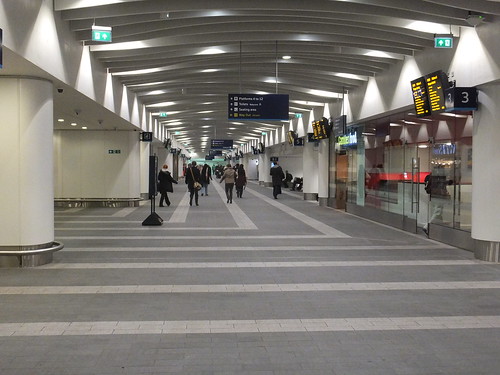
The 'Way out' signs at Birmingham's 'half-rebuilt' station were very confusing but I made my way to the concourse and decided that platform 5 offered a DMU to Rugeley via Walsall.
 The rebuilt concourse at the 'half-rebuilt' Birmingham New Street Station.
There was already a Wolverhampton EMU in one end of platform 5 and, after a few minutes, a train arrived from New Street South Tunnel and stopped behind the EMU, discharging a heavy load of passengers. This train claimed to be from Rugeley but the waiting passengers were warned not to board - I don't know why - because, a few minutes later, the Passenger Information Display screens decided we were to board for Rugeley. I noticed that there are now two public address systems giving passenger announcements, one with a female voice, one with a male. I didn't find the two message streams easy to follow, I'm afraid.
The arriving train had clearly been routed via Aston but the unit did not reverse so as to retrace the same route. Rather, once the Wolverhampton EMU had left, we followed in the same direction, receiving a number of single yellow and double yellow signals before branching right at Winson Green to take the Soho Road line to Perry Barr.
At Perry Barr, we joined the Grand Junction line, always called 'The Old Road' once the Stour Valley Line was opened. This is the limit of New Street Power Box control area - beyond here, control is now from the West Midlands Signalling Centre at Saltley. A tall aqueduct leads the Tame Valley Canal over the railway. The canal was not built until 1844 so the railway got here first! We stopped at Tame Bridge Parkway - a modern invention dating from 1990 described by Wikipedia here.
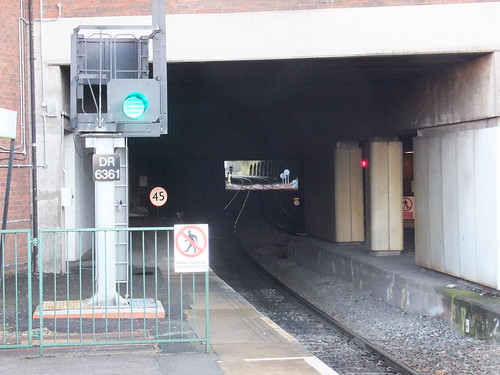
We passed the large marshalling sidings at Bescot with both Down and Up sides provided with Hump Yards for dealing with the formation of single wagon loads into complete trains. The Down Hump Yard was fully automated in the 1960s, around the time British Railways abandoned the idea of being a 'full service' freight operator accepting single wagon loads and concentrated on 'block loads'. The line to Walsall diverges to the right and plunges under the elevated M6 motorway, where the remains of the abandoned route to Bescot Curve Junction and the South Stafford Line are visible. At Pleck Junction, the truncated South Stafford line to Dudley is now arranged as a siding with run-round. The line from Darlaston Junction joined on our left, we passed the Network Rail Training Centre and came to a stand in platform 1 at Walsall, where I alighted. Looking north, the short Park Street Tunnel was as gloomy as I remember but, of course, Walsall No. 3 signal box which was sited in the tunnel is long gone.
 Park Street Tunnel viewed from platform 1. Note the new signal, controlled from the West Midlands Signalling Centre. The control code 'DR' stands for 'Droitwich - Ryecroft'!
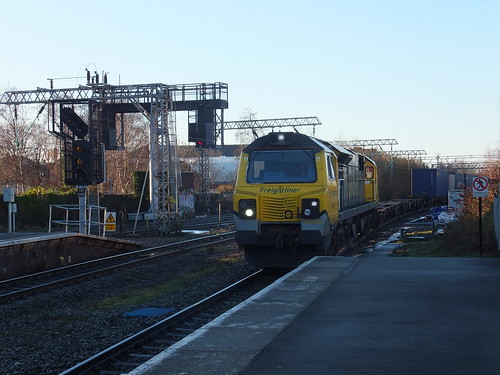
After a brief stop, my DMU departed for Rugeley on what is now marketed as 'The Chase Line'. Within a few minutes, a Class 70 on a container train followed.
 Bescot end of Walsall station showing a Class 70 with a container train. Note the new signals on the Up Fast, Platform 3 and Platform 2 (showing double yellow for a DMU which will shortly depart for Birmingham).
I wandered around Walsall town for a while. Although it retains a fairly traditional open market, the actual shopping areas feature the usual high street names which make one town indistinguishable from any other. I found the Saddler Shopping Centre as depressing as I expected so I hurried back to the station to catch the next EMU to Birmingham, so as to return to Birmingham by a different route.
After re-tracing my outward route as far as Perry Barr North Junction (noting with delight that the station building on the Up platform at Hamstead is still the L&NWR standard pattern wooden building), we continued on the Grand Junction Route. The line from Lichfield joined on our left at Aston (this line, also electrified, forms one end of the 'Cross-City Line').
 Aston North Junction, showing converging line from Lichfield. Note the elevated M6 motorway in the background.
The four-track section from Aston towards Birmingham is now two track (with the remains of the former Goods Lines). After pausing at Duddeston Station (which used to be called Vauxhall and Duddeston), we passed the Aston Signalling Control Centre which controls the Lichfield Line beyond Aston. The building is a composite B.R. signal box design which used to be Vauxhall Signal Box and, more recently, Vauxhall Shunt Frame. At Proof House Junctions, we croseds to the Down Stour and were soon running into platform 6 at New Street. Although my train would continue All-stations to Wolverhampton, it was booked to stand for about 15 minutes first, so I found an earlier departure to complete my journey back to Wolverhampton.
Related articles on other sites
Grand Junction Railway (Wikipedia).
South Staffordshire Line Website.
Walsall Railway Station (Wikipedia).
Trolleybuses in Wolverhampton (Wikipedia).
Trolleybuses in Walsall (Wikipedia).
Related posts in this blog
9:17 a.m. to Birmingham.
My First Steam Special.
A Sunday Stroll to Stafford.
My pictures
West Midland Railways
I've always been fond of Blackpool. Whilst it lacks the elegance of some British seaside resorts, it has an energy that appeals to me. It also has a tramway system and, when I was young, two large terminal stations both with excursion platforms to handle heavy railway traffic in the season.
There's a brief description of a trip I made by train in 1957 in the post Halfex to Blackpool, when the return fare was 14 shillings (70p) and the journey took 2 hours 40 minutes.
Over the years, I've been back to Blackpool a number of times and my latest trip was on Friday, 3rd January 2014, described briefly in the post A Trip to the Seaside. In 2014, the return fare was £52.00 and, despite a change at Preston each way and with some station stops because I was travelling on normal service trains, the journey was around 20 minutes faster than in 1957.
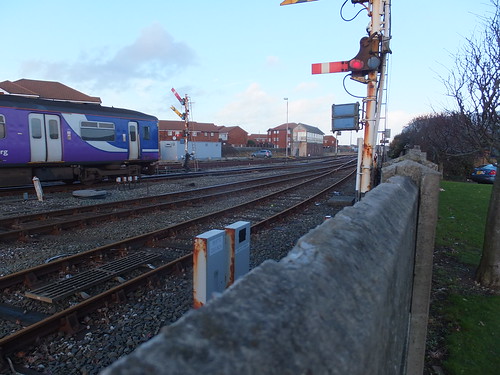 In 2014, a DMU leaves Blackpool North, with Blackpool North No. 2 signal box in the background.
Development of Railways from the Fylde Peninsula to Preston
The first railway from Preston to the Fylde Peninsula was opened by the Preston and Wyre Railway in 1840. It went to Fleetwood, via Kirkham and Poulton-le-Fylde. This aided the development of Fleetwood as a resort, as a ferry port and as a fishing port. In 1846 a branch was constructed from Poulton to a station which became known as Blackpool Talbot Road (renamed Blackpool North in 1932). The Blackpool line joined the Fleetwood line via a severe curve and, following a serious derailment in 1693, the layout at Poulton was completely re-designed to improve the alignment of the Blackpool route. Also in 1846, another branch opened from Kirkham to Lytham. By 1874, the separate railway from Lytham to Blackpool had been joined to the Kirkham to Lytham branch, providing a roundabout route to Blackpool following the coast which ended at a well-situated terminus appropriately called Blackpool (Central).
The growth of tourist traffic led to four running lines being provided from Kirkham North Junction to Preston, paired by use, in 1889. Even on the four track sections, congestion was a problem and additional signal boxes were installed with running signals and either no points or just emergency trailing crossovers as a means of 'shortening the block', allowing trains to follow one another more closely. The circuitous route from Kirkham North Junction to Blackpool Central limited capacity, so a 'New Line' was built in 1903, running in a virtually straight line from Kirkham North Junction to a junction at Blackpool South No. 3 from where four running lines were provided to Blackpool Central. Four running lines were also provided through Poulton-le-Fylde station.
 Approach to Blackpool Central Station in 1921 (Photo: N.R.M.)
Blackpool (and Fleetwood) to Preston in the 1950s
In the 1950s, the routes were controlled by semaphore signals, manual signal boxes (of Lancashire and Yorkshire Railway pattern) and Absolute Block working. The signal boxes on the various lines are listed below.
Fleetwood Branch:
Fleetwood
Wyre Dock Station
Wyre Dock Jn.
Wyre Power Station
Burn Naze North
Burn Naze South
Thornton Cleveleys
Tarn Gates L.C.
Poulton No. 5
Blackpool North to Preston:
Blackpool North No. 3
Blackpool North No. 2
Blackpool North No. 1
Layton
Carleton L.C.
Poulton No. 4
Poulton No. 3
Poulton No. 2
Poulton No. 1
Singleton
Singleton Bank
Weeton
Bradkirk
Kirkham North Junction
Kirkham
Kirkham South Junction
Treals
Spen Lane
Salwick No 2
Salwick No 1
Constable Lane
Lea Road
Ashton
Maudland Viaduct
Blackpool Central to Kirkham (via Lytham):
Blackpool Central
Spen Dyke
Bloomfield Road
Blackpool South No. 3
Blackpool South No. 1
Squires Gate
St. Annes
Lighthouse Intermediate Block Signals
Ansdell
Lytham
Lytham Goods Yard
Warton
Moss Side
Wrea Green
Blackpool South No. 3 to Kirkham (via New Line):
Blackpool South No. 2
Watsons Lane Bridge
Marton
Plumpton
Bradkirk
You can find detailed diagrams for these signal boxes in the 1950s in the excellent series of publications from the Signalling Record Society 'British Railways Layout Plans of the 1950's' - 'Volume 5: ex-Lancashire & Yorkshire Railway Lines in West Lancashire' (ISBN: 1 873228 04 X).
Blackpool to Preston in recent times
As car and coach travel grew, the demand for trains reduced. The impressive railway infrastructure which had allowed large numbers of passengers to be transported was either reduced or abandoned. The direct line from Kirkham North Junction to Blackpool Central was abandoned (apart from around one mile at the Kirkham end which was retained as a Tip Siding). The M55 motorway was built on the rest of the trackbed. At Blackpool, destruction of Blackpool Central station and its extensive sidings in 1964 released significant real estate for commercial redevelopment or (the ultimate irony) road vehicle parking.
The branch from Kirkham to Lytham and Blackpool was cut back to Blackpool South in 1970 and, from 1982, a single uninviting windswept platform has terminated a singled line from Kirkham operated as a 'long siding'.
In 1966, Fleetwood station was closed but a passenger service continued to operate to Wyre Dock until 1970. The branch from Poulton was then used by freight trains as far as the chemical works at Burn Naze. Today, the whole branch is 'Out Of Use'.
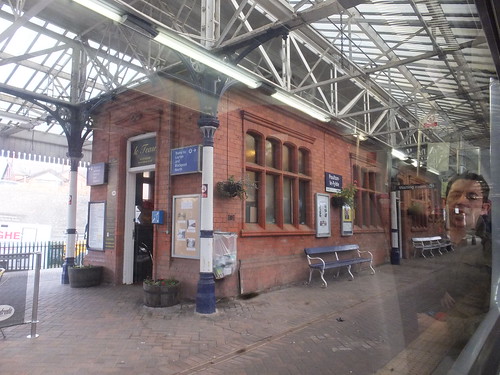 The L&Y island platform, canopy and brick station buildings at Poulton-le-Fylde have been triumphantly restored (apologies for the reflections).
Double track remains from Blackpool North through Poulton and Kirkham (which retains a short section of four-track line) to Preston. The remaining signal boxes are listed below.
Blackpool North No. 2
Carleton L.C.
Poulton No. 3
Kirkham North Junction
Salwick
I visited Salwick box some years ago. It served as a 'fringe' box to Preston Power Signal Box with Track Circuit Block working to Preston and (I think) to Kirkham. I believe the signal boxes further north still use Absolute Block working - they certainly retain upper-quadrant semaphore signals. However, this line is being electrified at 25 kV a.c. and by 2016 these few signal boxes will be abolished. On my trip in 2014, work was in hand raising a number of overbridges to provide clearance for the overhead lines.
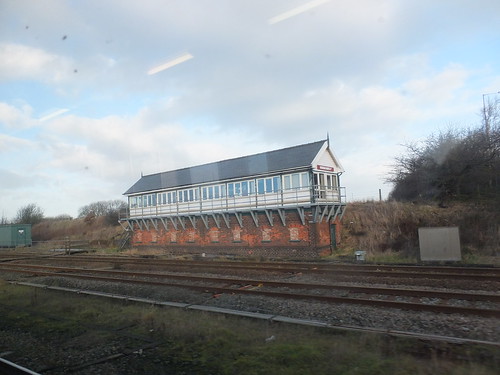 The L&Y signal box at Kirkham North Jn. is just recognisable despite significant alteration but the heavy-duty landing allowing access to the windows seems rather over-kill.
To see what remained on my visit in 2014, refer to 'Railway Track Diagrams Book 4: Midlands & North West', Third Edition, published by Trackmaps (ISBN: 978-0-9549866-7-4).
Book References
[1] 'A Regional History of the Railways of Great Britain: Volume 10 The North West by Geoffrey O. Holt, published by David & Charles (ISBN 0-946537-34-8).
[2] 'Rails to the Lancashire Coast' by Richard Kirkman and Peter van Zeller, published by Dalesman Books (ISBN: 1 85568 027 0).
[3] 'Railways to the Coast' by Michael H. C. Baker, published by Patrick Stephens (ISBN 1-85260-058-6).
[4] 'Lost Railways of Lancashire' by Gordon Suggitt, published by Countryside Books (ISBN 1 85306 801 2).
[5] 'Railways of the Fylde' by Barry McLoughlin, published by Carnegie Publishing,1992 (ISBN 0-948789-84-0).
Related articles on other sites
Preston and Wyre Joint Railway (Wikipedia).
Blackpool North Railway Station (Wikipedia).
Blackpool North (National Rail.
Blackpool tramway (Wikipedia).
Related posts in this blog
Halfex to Blackpool.
A Trip to the Seaside.
Track Sketch: Fleetwood.
My pictures
Blackpool Trams.
Blackpool's Railways.
Railways around Preston.
[Reference [5] added 12-Feb-2014]
 The bridges across the River Conwy, with Conwy Castle on the right, viewed from Deganwy.
 Conwy Castle towers above the railway.
 Francis Thompson's handsome 1870 building on the Up platform at Bangor.

 View of the pedestrian bridge and spiral ramp, looking towards the town.
 Holyhead Station in steam days showing the railway hotel (Photo: 'A Pictorial Record of L.M.S. Architecture' by V. R. Anderson and G. K. Fox).
 Holyhead Station in 2014.
 Commemorative clock turret outside Holyhead station.
 Holyhead, Salt Island: Custom House (Grade II*) and Admiralty Arch.
 Prince of Wales Road, Holyhead.
 Holyhead town.
 'Stena Explorer' at Terminal 1, Holyhead.
 Jack-up Barge operated by Fulgro Seacore.
 'MTS Valiant'.