Events of Monday 18th February, 2013
With a car, driver and guide at my disposal, I'd decided to try to meet up with the 'Road to Mandalay' ship at its temporary upstream limit of Myin Mu. The plan was then to go on from Myin Mu to the fairly large town of Mon Ywa before returning to my hotel in Mandalay.
Myin Mu is a fairly typical small town where a flattish stretch of riverbank behind a group of houses is used as a 'dock' where passengers can board the various river services and massive amounts of freight are interchanged between river craft and large lorries drawn up on the shore. We'd arrived before the 'Road to Mandalay' but the logistics manager, Mr. Soe Soe, and his team of ground staff were already hard at work making the site ready for the landing of the Guests. Because of the low water level, the 'Road to Mandalay' would moor mid-stream and a couple of ferry boats were on hand to bring people ashore to join the six or seven buses already lined-up which would be used for the Guests' activities that day.
Mr. Soe Soe invited me to join him for a drink in a typical tea shop, just across the road from the dock.
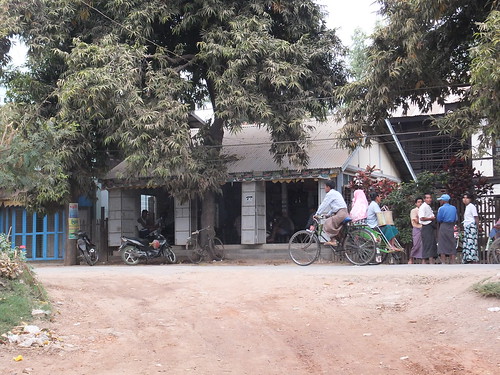
Whilst we were sitting and chatting, I was amazed when the Head Monk from the Bagan Monastery came in. Apparently, he had business to conduct in one of the Monasteries in Mandalay but it was a very unexpected reunion.
Soon, the 'Road to Mandalay' ship was sighted and she anchored midstream. The first of the two ferry boats moved out to pick up Guests and, in a short while, all the guests for the road trip had come ashore and been seated in the appropriate coach.
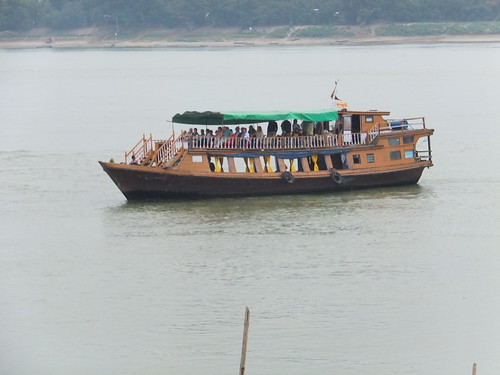
I was able to greet a number of old friends from the ship's hotel staff and the team of guides. Doctor Hla Tun came ashore for a while and we went to (another) tea shop for a drink and a chat.

However, there were guests still on the ship whom the Doctor needed to look after, so the Doctor and I said "goodbye". He returned to the ship using one of the ferry boats and I continued on to Mon Ywa with my driver and guide.
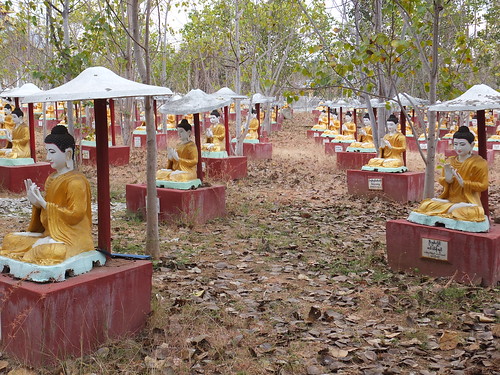
In the Po Khaung Hills, east of Mon Ywa, is the sprawling site of Bodhi Tataung, home to around 10,000 Buddha images. I wandered amongst the statues whilst my driver and guide took lunch.
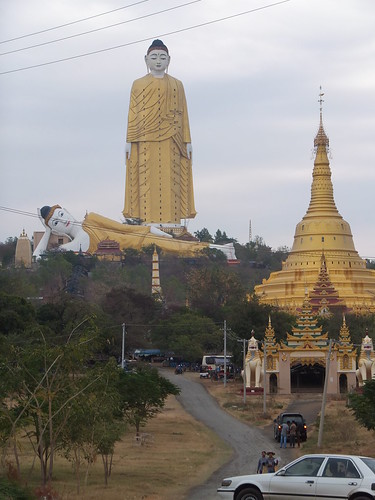
Then, we drove the short distance to the 90 metre reclining Buddha and 167 metre standing Buddha. You can climb up inside the standing Buddha - each floor forms an elaborately-decorated temple. I was a little disappointed that we could only get to the 10th floor as the higher floors had been temporarily closed for some reason.
The reclining and standing Buddhas.
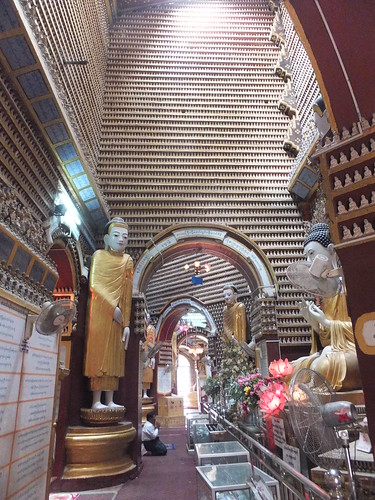
If 10,000 Buddha images of Bodhi Tataung seems a lot, try half a million. We drove to the Thanboddhay Temple which was started in 1939 by a monk called Mo Hnyin Sayadaw. There are now well over 500,000 Buddhas decorating the building - mostly small, unpainted clay figures. My guide said that the Monk's aim was to allow even poor people to be able to donate a Buddha image to the temple.
Every surface within the temple is crammed with small Buddha images.
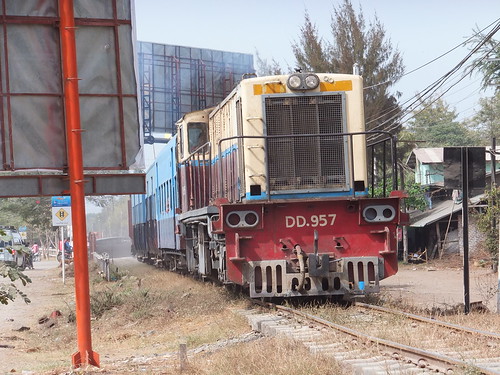
We then moved onto the town of Mon Ywa which my 'Lonely Planet' guide characterises as "a scrappy trade town of some 300,000 people". I didn't see anything to warrant disputing that opinion. Whilst photographing a lattice post semaphore signal on the railway, I saw a passenger train heading for Mandalay, having passed another passenger train heading in the opposite direction at the nearby station.
In the town centre, there's a suitably triumphant statue of General Aung San on horseback. He is considered the 'Father of Modern Burma' (see Wikipedia article). With nothing further to detain us, we started back towards Mandalay ourselves. We stopped for a few minutes at one village where I took some pictures and, by arrangement, paused at Myin Mu where I briefly saw Doctor Hla Tun. Then it was on to Mandalay, pausing only at the road toll stations. I needed to get to bed early as I had an early start the following day in order to catch the train to Maymyo.
My Pictures
Myin Mu, Burma.
Mon Ywa Buddhas.
Thanboddhay Paya, Mon Ywa.
Mon Ywa Station, Burma.
By road from Mon Ywa to Mandalay.
Tuesday, 19 February 2013
Myin Mu and Mon Ywa

Mandalay
Events of Sunday 17th February, 2013
My guide and driver took me to Nyaung Oo airport for the short flight to Mandalay International Airport.
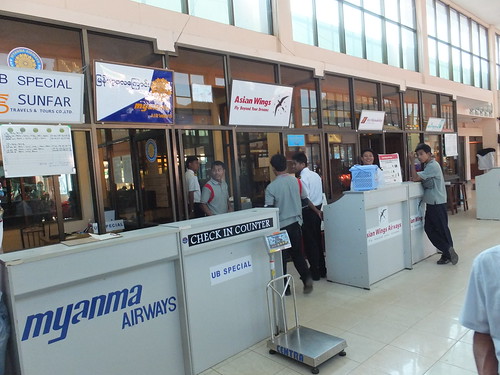
My guide checked in for me and said I should go through security to the Departure Hall. We said goodbye and, by that time, the door he'd indicated had been closed. Further down the building I found a similar door clearly marked 'Departures', so I went through into a crowded waiting area. It slowly dawned on me that the people around me were arriving and not departing. The lack of movement was because their bags had not been made available. Eventually, I made it to the aircraft and flew to Mandalay Airport safely.
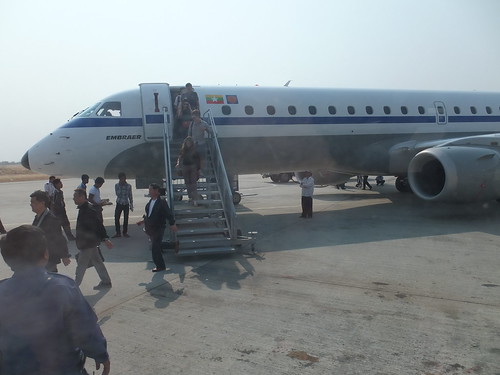
I was met by a new guide, Ko Aung Khaing (the 'Ko' is an honorific) and a new driver. We drove to the city which sprawls in the unattractive way of most large cities. The population is thought to be around 1.2 million. Mandalay is redeemed by also having some fine historical sites, such as the moated Royal Palace.
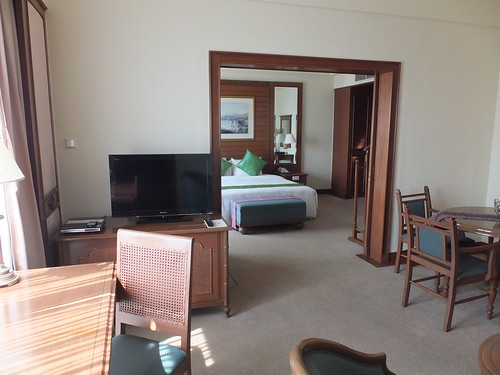
I checked into the Sedona Hotel, where I'd stayed before as described here. This earlier visit was part of a Far East trip with posts given the label 'FE2'. As on my previous visit, the accommodation was spacious, the service excellent. Just as well, as I was booked in for four days, allowing some scope for various trips around the area.
More later ...
My pictures
Nyaung Oo Airport.
Mandalay International Airport.
Sedona Hotel, Mandalay.
[Revised 6-Mar-2013]
Sunday, 17 February 2013
The Pagodas of Bagan
Events of Saturday 16th February, 2013
Although I've visited Bagan a number of times, the impact of thousands of pagodas spread across the Plain of Bagan is undiminished.
So the short version of the 'events of today' is definitely "Jan looked at a load of old temples". I'll expand the post a little when I can.
The Pagodas of Old Bagan.
The Pagodas of Bagan.
More Temples of Bagan.
Nga-Minn-May and Chauk-Kan Schools
Events of Friday, 15th February 2013
Nga-Minn-May School
I had visited Nga-Minn-May once before in September 2012. That visit is described here.
The roads we took were initially not bad but once we turned off the Mount Popa Road to take the long, sandy lane to the village of Nga-Minn-May, progress became more difficult. The weather had been extremely dry and the road had a lot of loose sand. The most common vehicle is the bullock cart and their narrow, widely-spaced wheels produce deep ruts in the surface. Motor bicycles can normally negotiate these ruts but it is problematic for 4-wheel cars like our Toyota.
Nga-Minn-May is a substantial village with around 370 houses and a population of around 1800. We arrived safely and parked in the shade of a large tree, as on the previous occasion. We could hear the excited chatter of children from the schoolrooms as the sacks of exercise books and boxes of pencils, rulers and erasers were unloaded.
Doctor Hla Tun took me into each classroom in turn in the large classroom block re-furbished by the village people with support from the RTM Social Contribution.
In 2012 a donation from RTM Social Contribution helped pay for a large brick and cement water tank next to the refurbished school building. The tank was covered by a corrugated steel roof supported on wooden framing to reduce contamination and evaporation losses. High-capacity aluminium guttering fitted along the verandah collected rain water and a substantial plastic pipe delivered the collected water to the tank. I presumed there were, as in other places, a series of outlets controlled by cocks but that area had been covered by a protective box, secured in place by a padlock. One of the village men experimented with keys for a time so that I could look at the arrangement but, after a few unsuccessful attempts, we moved on to spare him embarrassment.
There remained one school building in use which, although having a reasonable wooden frame, had only woven wall panels. Doctor Hla Tun had agreed to fund the work to replace the woven wall panels with more durable brick and cement, just as had been done on the other, larger building. Because the villagers agreed to do most of the work themselves, the cost of this refurbishment is mainly the cost of materials.
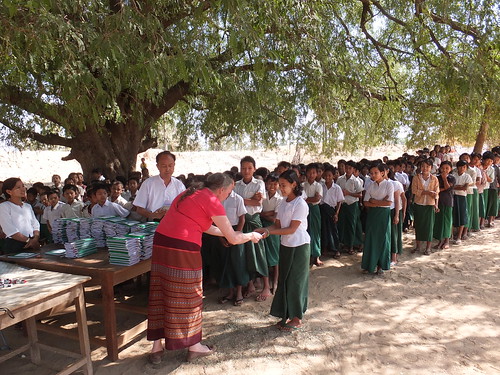
By the time the tour had finished, the stationery had been unpacked and sorted into sets - normally two exercise books and two pencils per pupil, from youngest to oldest. All the children now lined up and Jan and the Doctor presented the stationery, enthusiastically supported by my Guide and Driver.
A table and chairs had been set up under the large tree near where our car was parked and we were invited to eat before we left. The Burmese take hospitality very seriously.
Pictures of the visit are here.
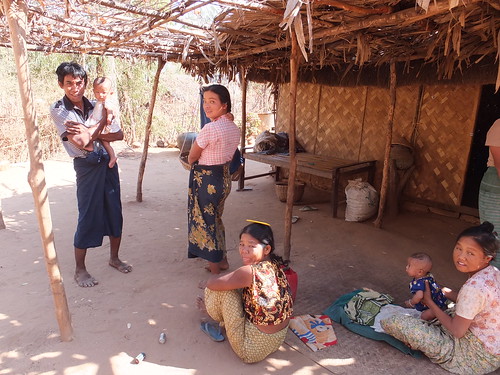
I'd expressed interest in seeing one of the typical village houses and we visited a small compound where one family were happy for me to look around at their house, their cowshed and the different methods used for roofing. The Toddy Palms grow in this area and the village was surrounded by fields dotted with these trees. The lower branches of these trees are cut-off and used to form the substantial palisade fences around each compound. More pictures.
As we drove away from the village, we passed one of the teachers walking towards the main road and we gave her a lift to the junction. This girl lives in Nyaung Oo so that she can look after her elderly parents. To reach the school each school day, it takes 45 minutes to one hour on a bus from Nyaung Loo followed by a walk of around 45 minutes along the sandy track we'd used to get to the school. Then, after school, she reverses the process to get home. You cannot fail to admire the quiet determination of these people.
Chauk-Kan School
We travelled along the main road for a short while and then turned onto a sandy track which was even longer, even more rutted and with more loose sand than the track we'd used to reach Nga-Minn-May. This was the way to Chauk-Kan. I'm afraid that, at one point, we got bogged-down in the sand but the Doctor, Guide and a villager who appeared quickly had us moving again.
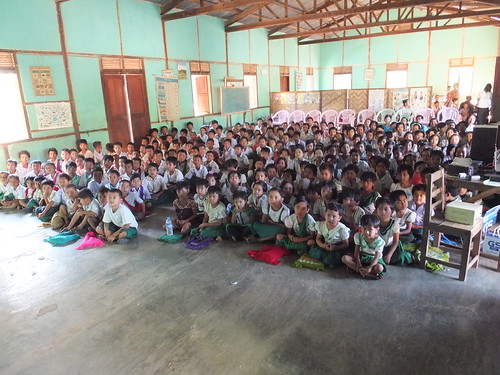
Road to Mandalay Social Contribution had previously built a new school room here. There's a report on this building and on the official opening here. My own first visit was in September 2011. In February 2013, we had refreshments on the Staff Room, followed by a splendid concert and then, finally, we made the presentation of stationery to all the pupils. Pictures taken on our visit are here.
Revised 20th February 2013
Friday, 15 February 2013
Bagan
Events of Friday 15th February, 2013
I slept well at the Park Royal, but not for too long. I decided to get up and use the excellent response of the internet to upload some of the backlog of pictures. I had a shower, completed my re-packing (always a major problem) and was in reception in good time to meet my guide. It was too early to have the hotel's breakfast but they gave me a 'breakfast box' to take away with me.
We had the same driver but a larger 'people mover'. We made excellent time to the airport, arriving about 6.20 just as it was growing light. After checking in and passing through an X-ray (my hand luggage) and a metal detector (me), I found myself in the crowded departures hall. Three or four flights left before my Myanma Airways flight (yes, they spell 'Myanma' without the 'r').
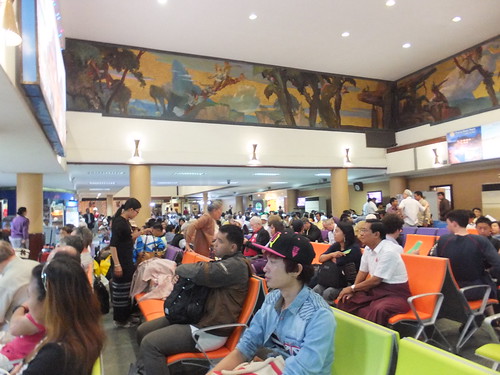
As usual, first we were ushered onto a bus which transferred us across the apron to our waiting aircraft. It wasn't the expected Advanced Turbo Prop but a 2-engined jet. I flew with Air Bagan once on one of their two 'Fokker 100' (people were killed a short while ago when one of these crashed. I could see the aircraft I was boarding wasn't a 'Fokker' but I couldn't see what it was until I was seated and checked the safety instructions. It was a Brazilian 'Embraer 190', described in a Wikipedia article here. It looked quite nice but I checked the evacuation drill carefully, particularly as I (and the Guy next to me) were next to an Emergency Exit. I thought perhaps they didn't observe the rule about not putting the aged and infirm (or just unwilling) next to emergency doors but shortly the stewardess came along and explained the position succinctly. I had no doubt that in a life-threatening situation, I'd be equal to the task.
Slowly, we taxied to the very end of the runway. "Taking no chances" I thought. After a short power check, the take-off roll started. The acceleration was impressive and we had used less than one third of the runway length when we became airborne and started our climb at an equally impressive rate. The aircraft took us to Nyaung Oo in fine style whilst the friendly cabin staff issued breakfast boxes and a choice of drinks.
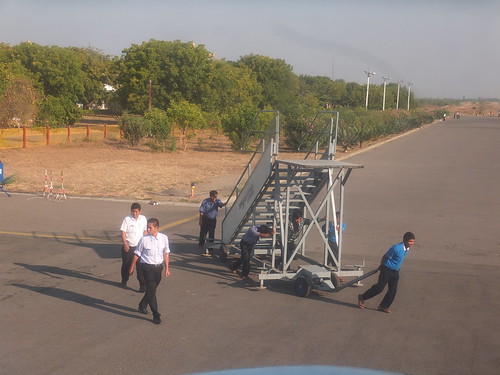
On landing, I met my guide and we chatted whilst waiting for the checked bag. This took so long, we went to the car and deposited my hand baggage, returning to the baggage hall just as my bag arrived. Many of the other passengers were still awaiting bags as we set off from the airport towards my hotel in Old Bagan - the Aye Yar River View Resort. I was startled at the number of foreign tourists around - there seemed to be more than on any of my previous visits to Bagan.
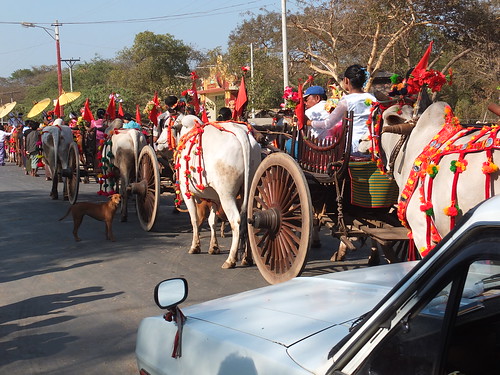
Near Taung Bi village, there was serious road congestion around a procession with a carnival atmosphere. Of course, all the tourists had stopped to take pictures and we joined them. It was only in September of the previous year that I'd seen my first Noviciation Ceremony which I talked about in my post Monastic Noviciation Ceremony at Moe Dar and now I'd seen another Noviciation Procession.
We decided to call in at the Bagan Medical Clinic before going to my hotel. The clinic was quieter than I'd seen previously - there were 'only' around 100 patients waiting! The staff confirmed that Doctor Hla Tun had not yet arrived but was expected and they passed a message to the ship moored on the river below us to say that I'd arrived. We walked to the 'Road to Mandalay' landing steps to meet the Doctor but he appeared behind us - appararently has had a 'back way' up the river bank directly to the clinic. We greeted one another warmly and I later realised that our meeting was at almost exactly the place where we had first met (when I suffered the indignity of falling off a bicycle) almost five years earlier and described here.
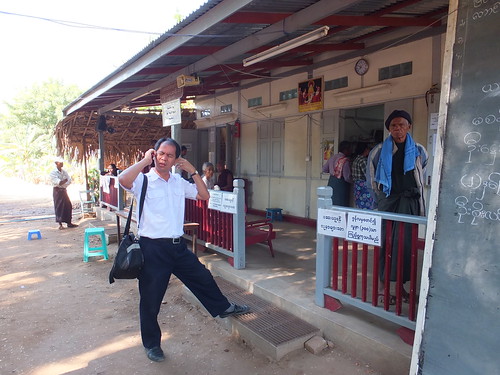
The Doctor had, apparently, made plans for us to visit one or two of the schools supported by the RTM Social Contribution. He just had to see some patients who had travelled long distances and then we could depart - 15 minutes he said. Nobody was surprised when he had not emerged after about three quarters of an hour. It's always interesting watching the life of the Clinic, the activity of the pressured clinic assistants contrasting with the quiet stoicism of the waiting patients. The Young Monk who had done so much for the Clinic disappeared on the pillion of a motor cycle on some errand elsewhere. The monk I've titled the Calling Monk would periodically break the stillness with an announcement over the loudspeaker system, tucking the radio microphone into the waistband of his robe when he'd finished. One of the doctors arrived on a motor cycle and immediately went into the clinic to start seeing patients.
We sent a message to Doctor Hla Tun to say I would check-in at my hotel and then return, allowing him to continue his work without being distracted. Then, we took the car and negotiated a dirt road connecting the clinic to the Aye Yar River View Resort.
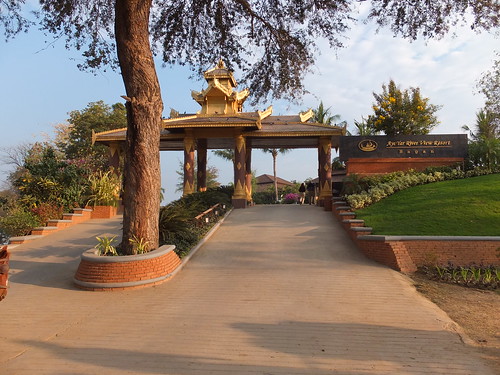
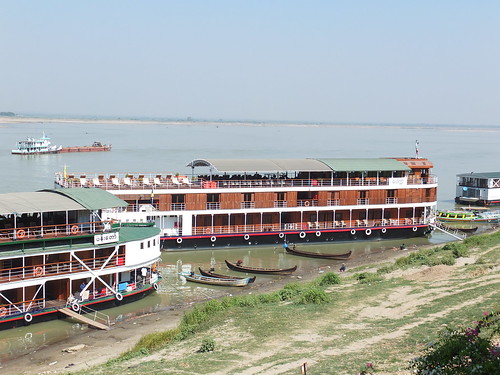
I was given a Welcome Drink and a Guest Registration Form to sign and told there would be about 30 minutes delay before my room was available so I set down in the reception area and started to work on my notebook computer. The Wi-Fi connected me to the internet, to my delight. Eventually, my guide asked if I was aware my room was now ready. "No", I replied, "Nobody said anything". A porter showed me to my room, 718. This involved quite a lengthy walk across manicured lawns past a number of resort-style blocks of guest rooms. We were heading towards the river and descending to reach the River View Wing - a series of 2-storey guest rooms laid out on the banks of the Irrawaddy and commanding good views of the activity. The actual waters edge was filled with a number of small boats together with 'Pandaw-style' larger boats, one of which seemed to be embarking its tourist passengers.
The accommodation was spacious and attractive and I knew I'd be comfortable there. I stopped for a quick wash then simplified the contents of my Burmese handbag before finding my way back to reception where my guide was waiting. We made the short journey back to the clinic and discovered that the Doctor was still engaged.
There are some procedures that Doctor Hla Tun carries out personally, such as the removal of fluid to relieve joint pain, so I was happy to wait. This gave me the opportunity to see free lunches being distributed to waiting patients. A table had been set up in the open near the clinic and a number of people were starting to 'dish-up' the steamed rice and boiled meat prepared by the monastery kitchen into metal bowls. It was the head monk himself who handed the food bowl to each recipient. Once the food had been eaten, the helpers had a fair amount of washing-up to carry out which they did cheerfully and quickly. The unused food was then carried back to the monastery itself.
At this point Doctor Hla Tun appeared and a plan started to emerge. We would drive the car which I was using the short distance to the monastery so that the stationery we would distribute in the afternoon could be loaded. Dr. Hla Tun would take lunch in the monastery and my guide, my driver and myself were invited to eat. I presumed that the monks had already eaten because we were alone in the fairly large refectory building where we sat on the floor as monastery helpers brought a range of foods set in front of us. Despite encouragement, I didn't experiment but the steamed rice and chicken I had were excellent. The head monk came and sat beside me and encouraged me to take more food. Although he had no English, we exchanged smiles as I admitted that I can no longer squat properly because of the arthritis in my knees, since the elderly head monk also has problems with his knees. A young man and woman wandered in with their guide - Rollo from Mexico and Veronica from Cuba. The head monk immediately invited them to take food with us, but I think they were a little embarrassed to have interrupted our meal. I was able to chat with them for a few minutes before they left. When everyone had finished, we made our way back to the car and, with Dr. Hla Tun beside me in the rear of the car, we took the now-familiar road to Nyaung Oo and then the road towards Mount Popa. Our first destination was to be Nga-Minn-May.
My Pictures
Park Royal Hotel, Yangon.
Yangon Airport.
Nyaung Oo Airport.
Noviciation Procession, Bagan.
Bagan Medical Clinic (2013).
Aye Yar River Resort, Bagan.
[Additions 16-Feb-2013, 5-Mar-2013]
Thursday, 14 February 2013
On to Yangon
Events of Thursday 14th February 2013
I managed about three hours good sleep at the Novotel Bangkok and decided I might as well start getting ready. My computer found the hotel’s Wi-Fi system but I declined to pay the 150 Baht for one hour asked for. Back in the lobby, there was a large restaurant with a wide range of foods set up buffet style. There were quite a few diners, but no sign of any staff. I had a very simple breakfast and, whilst examining the items on offer, spotted a single member of hotel staff in a darkened corner apparently doing paperwork. Most curious. Checkout was very quick because my booking had been prepaid. Outside the hotel I was directed to one of the hotel’s Shuttle Buses. After a short time, another five people joined the bus and we were taken to the airport.
I’d been issued with my boarding pass for the TG303 from Bangkok to Yangon on departure from Perth, so it only remained for me to pass through security and immigration and wait. I'm not good at waiting but, eventually, boarding time arrived and we made our way to another 'Airbus' A330 for the short flight to Yangon.
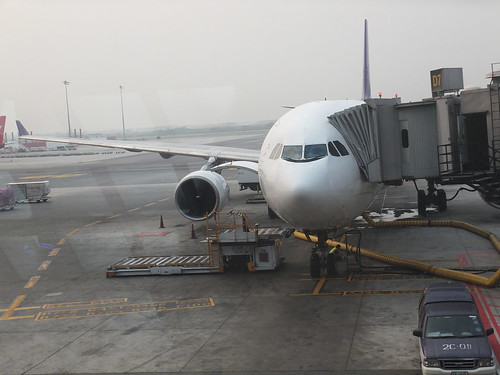 The A330 which took me from Bangkok to Yangon.
On arrival at Yangon, immigration was quite fast, my case arrived and customs formalities comprised surrendering a filled-out customs form and having the big bag (but not hand luggage) X-rayed. I found the young lady from Sun Bird easily and she summoned the car. Then, it slightly unravelled as it took us 90 minutes to get to the city. They assumed the congestion was caused by the building of a flyover to reduce the congestion. In the lobby of the Park Royal Hotel, I was given all the paperwork for the next few days. The hotel regretted than my room would not be available for another hour. A pity but, even after our increased journey time, it was only 10.30 in the morning so I was not surprised. I left all my luggage with the hotel and, armed with a (traditional Burmese) bag and a camera, set off for Yangon Central Station.
The station was only about ten minutes walk from the hotel and I was familiar with the process for obtaining a one-dollar 'Foreigner Ticket'. There was one adventurous lady from New Jersey also travelling on the train. She was going to Insein to check-out the famous market. I'd decided to go five stations further, to see the junction station at Da Nyn Gone and the return by the same route to Yangon. So that's what I did. It turned out that the actual station at Da Nyn Gone had some fame as a low-price market for fresh foods and the station remained permanently busy with people coming and going and buying and selling.
 The impromptu market on Da Nyn Gone station.
By the time I'd travelled back to Yangon Central station by train and walked to my hotel, I was hot and tired and glad to be able to relax in a decent room at the Park Royal Hotel. I was delighted to find that the internet was reliable and fast.
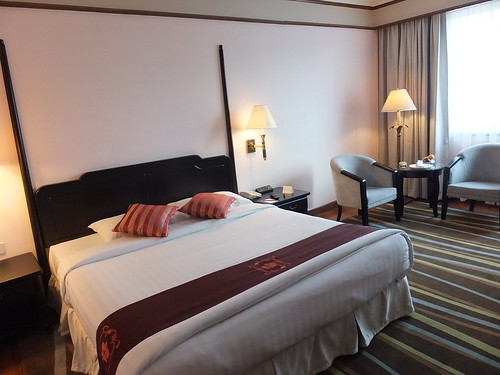 My room at the Park Royal Hotel.
In the evening, I had a simple early dinner in the restaurant, which was specially decorated for Valentine's Day. As I left the restaurant after my meal, I saw that lots of young couples had arrived for a 'special dinner'.
My pictures
Novotel, Bangkok Airport.
The Circle Line (2013).
Park Royal Hotel, Yangon
[Revised 5-Mar-2013]
Perth to Bangkok
Events of Wednesday 13th February 2013
The day started with the usual walk to the Dog Walking Area where the dogs of Williton (and their people) get together before the day gets insufferably hot. Although I’m usually fairly tolerant of heat, temperatures in the low forties Celsius were beginning to take their toll on me so most of the morning I was happy to alternate between trying to get packed and just sitting around.
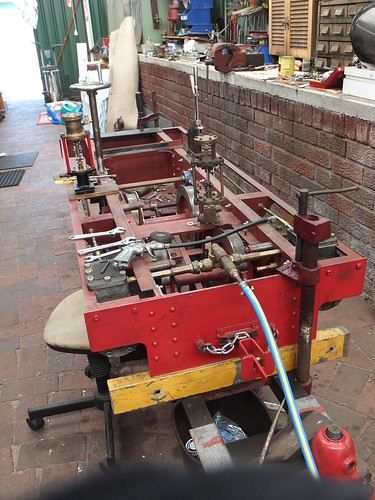
Keith demonstrated his new ‘Tinkerbell’ locomotive operating on air. Keith’s modified design has a particularly neat arrangement of the Heywood motion.
'Tinkerbell' being operated on compressed air.
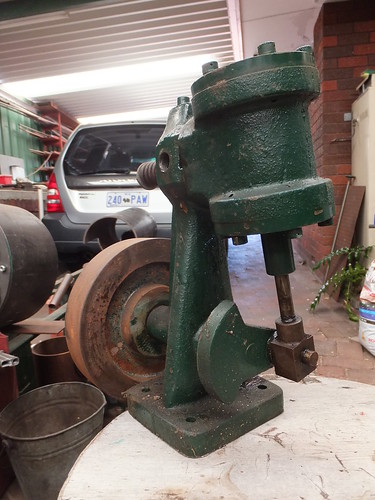
He also fetched out an ‘Oscillating Cylinder’ engine he built many years ago and demonstrated how powerful that can be when properly engineered. Keith had always been impressed with the simplicity of the ‘Oscillating Cylinder’ engine, where the piston rod is connected directly to the crank, causing the whole cylinder to swing to and fro. This movement is used to open and close the appropriate ports without the necessity for valve motion. There's a brief post on the oscillating cylinder engine here.
Keith's demonstration 'Oscillating Cylinder' engine.
On Keith’s last visit to England, we were able to look at Peak Rail’s turntable at Rowsley. This is powered by an Oscillating Engine operating on vacuum from the locomotive’s braking system and, through suitable reduction gearing, can effortlessly turn the largest locomotive.
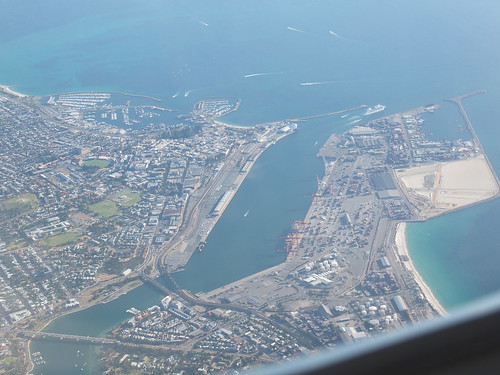
Keith had offered to drive me to Perth Airport for the next leg of my journey – by Thai to Bangkok taking about seven hours. Whilst waiting for departure, I was able to upload to ‘Flickr’ a few of the large backlog of photographs I’d amassed. Shortly after take-off, we passed over Fremantle and I spotted 'Silver Whisper', which I'd watched arriving the day before (see post), leaving the port.
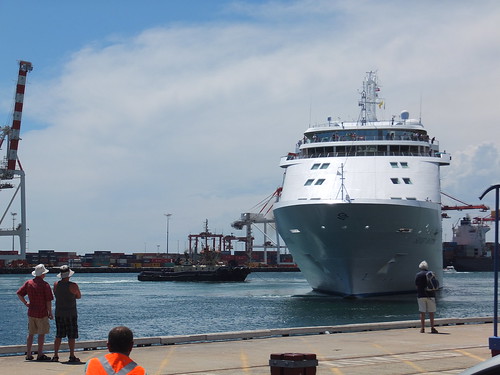
Fremantle Port, with 'Silver Whisper' departing.
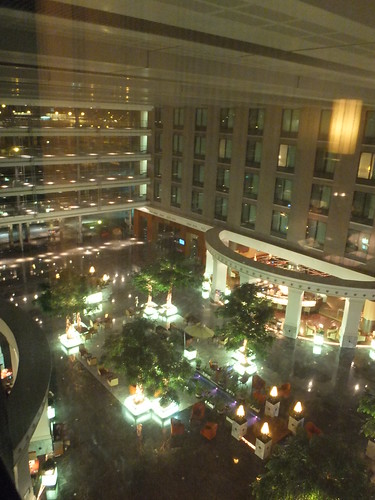
I managed some sleep during the flight and was through Immigration at Bangkok around midnight. I’d been booked into the ‘Novotel’ at the airport since I’d an early start on the next day. I wouldn’t normally stay at an airport hotel but the timings of my connections made it the best chance to get some sleep in a ‘real’ bed. I managed to find the Pick-up Point for the hotel’s shuttle bus and was quickly transferred to the hotel. They located my booking and I was soon in the lift going up to the fifth floor. I found my well-appointed room and quickly prepared for bed. The bedrooms were in four blocks forming a square where the covered ‘courtyard’ in the middle formed an impressive hotel lobby. Half the rooms (including mine) overlooked this ‘courtyard’, the other half face outward. The Novotel at Bangkok claims to be “the fifth most popular airport hotel in the world” but it all seemed too impersonal for my taste.
View of the Atrium from my bedroom at the Novotel, Bangkok Airport.
My pictures
Williton Dog Walking Area.
Keith Watson, Engineer.
Perth Airport, Western Australia.
Novotel, Bangkok Airport.
[Revised 5-Mar-2013: Link to 'The Oscillating Cylinder Engine' added 25-Oct-2015]
Wednesday, 13 February 2013
Railways in Vietnam - Part 2
In an earlier post Railways in Vietnam - Part 1 I described the observations I made on my way from Ho Chi Minh City to Hanoi.
On Tuesday 5th February 2013, I travelled from Hanoi to Halong Bay by car. About 7 km outside the city, a single track rail line appeared on our right and stayed with us for a while. We came to a passing loop which was signalled as all the others I’d seen (see Part 1). I didn’t spot a warning signal but got a photo of the usual 2-aspect plus 2-aspect plus subsidiary at the loop points for trains heading away from Hanoi. On the double track section, there were two signals side-by-side for trains towards Hanoi – a high-level 2-aspect on the nearer line, a 2-aspect low-level signal on the further. At the far end of the passing loops, there was a 2-aspect low-level for trains from Hanoi, then the usual usual 2-aspect plus 2-aspect plus subsidiary for trains towards Hanoi. This time, I caught the warning signal – the lower aspect was displaying yellow. I lost sight of this railway line as we negotiated one of the clover-leaf road junctions.
A little further on I noticed a new embankment under construction on the right, followed by a forest of rebar standing vertically, presumably the start of a series of bridge piers. Then there was more embankment work and a long bridge formed of a series of through trusses crossing a wide river but the bridge still connected nowhere to nowhere. The dimensions confirmed that this was for a new railway.
After a few more kilometres, a railway approached from our left and I could hardly believe my eyes – there was a semaphore lower quadrant distant signal! I then looked out for a home signal and just caught a tubular post signal with a semaphore lower quadrant ‘stop’ arm at the top of the post sticking out horizontally to the left of the post in a conventional ‘stop’ position. Lower down the post, there was a second ‘stop’ arm, this time hanging vertically down. Predictably, there was a second similar signal at the other end of the loop. I didn’t see any ‘starting’ signals.
On Thursday 7th February 2013, I travelled back to Hanoi using the same road as a couple of days earlier and I was able to take a few more pictures, mainly of the semaphore signals. But I also saw a morning train from Hanoi on the move.
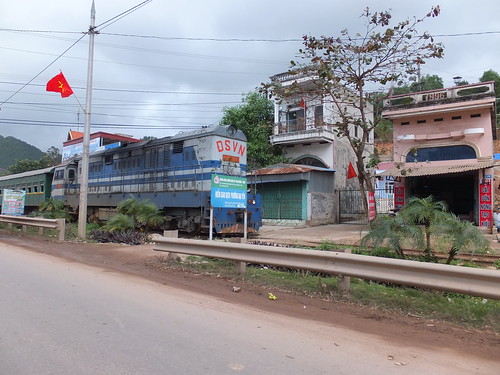
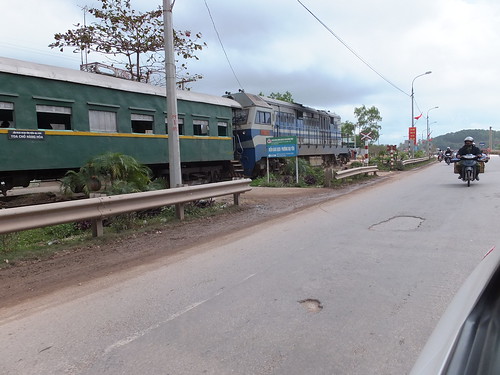
References
Vietnam Railways (Wikipedia).
David Gurnett's 'Railways in Vietnam'.
My pictures
Railways in Vietnam.
[Revised 28-Feb-2013]
Tuesday, 12 February 2013
Perth WA - Day 5
Events of Tuesday 12th February 2013
The day started, as usual, by taking Sasha the dog to the Dog Walking Area for about half an hour with the usual dogs and dog owners. On our return to Keith’s home, we had breakfast. Keith wanted to pay a bill at the local Post Office. This was part of the Shopping Mall we’d visited a few days before. After dealing with the bill, we walked across the car park to reach the Library. This was a modern, well-laid out facility and the staff were very helpful. Keith ordered a local history book he wanted to read and we both riffled through their collection of books on railways.
As temperatures in the forties Celsius were forecast, Keith decided to return home but he was happy to drop me at the nearest railway station - Bull Creek on the Mandurah Line. This line had been built since I first explored the railways around Perth. Keith arranged to collect me from the same station at four o’clock in the afternoon.
The station, of course, was modern and provided only with ticket machines. After a few minutes, I’d obtained a Day Concession Ticket for $4.40 and I made my way onto the island platform. The platform was built on the central reservation of a new dual carriageway, as I’d found on other new suburban lines around Perth.
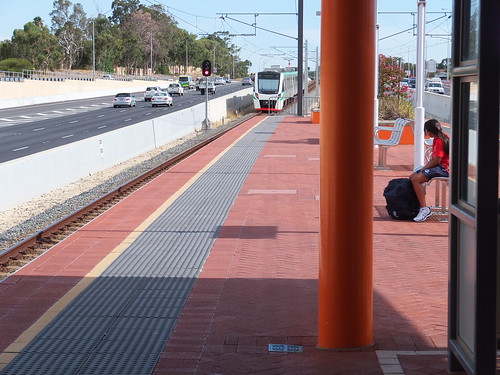
A Perth train arrived after a few minutes and it was already well-filled. Apparently, the local trains are a victim of their own success and additional trains are on order. The next station was Canning Bridge, after which the tracks ran alongside the broad Swan River as far as Esplanade station. The line then ran in a tunnel to an new island platform called Perth Underground which has been constructed underneath the original station.
At the time of my visit, temporary arrangements were in use for interchange with the original station where major works were also ongoing and the previous pattern of services was somewhat deranged. I decided to catch a train to Midland (a journey I’d made before briefly described in the post Leaving Perth).
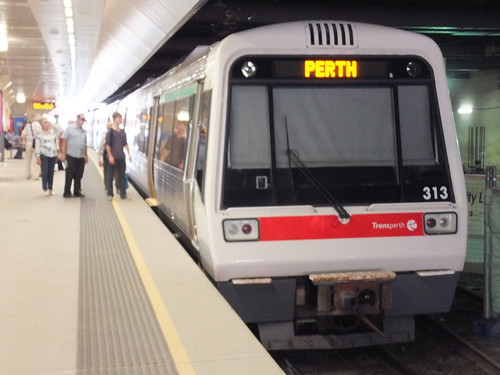
Our route took us through East Perth, where there’s a separate station for standard-gauge inter-state services. From here to Midland, there's dual-gauge track. On arrival at Midland after a journey lasting around half an hour, I walked across to the remains of the famous railway works which were being converted to find new uses. The incumbent state premier was facing a re-election battle and had suggested building a new hospital and medical training university at Midland but this idea had not met universal support.
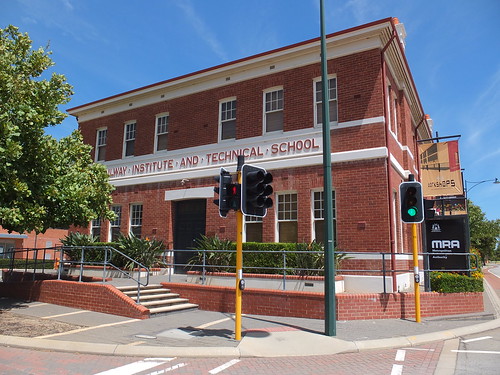
I was certainly warm in Midland during my visit so I was happy to return to the station and catch an EMU back to Perth – all the suburban trains are quite effectively cooled.
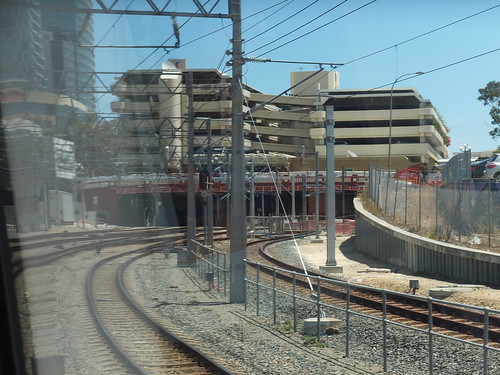
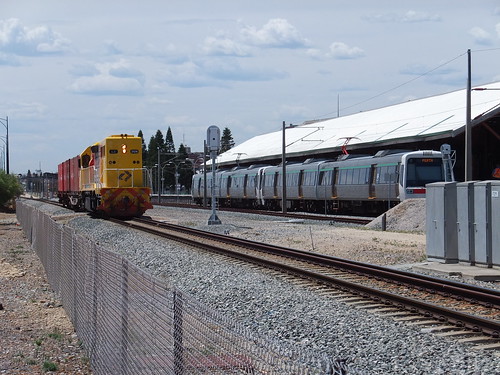
I then decided to make a trip on the electrified railway to Fremantle - another journey of about half an hour. There were interesting views on the approach to Fremantle first of ships anchored in the ‘Roads’ off Fremantle then of the Container Terminal. A number of the old transit sheds have been converted for other uses. In particular, Shed ‘E’ had been converted into a destination for souvenirs. There is more dual-gauge trackwork around Fremantle and I saw a standard-gauge diesel electric LZ 3106 transferring four loaded container wagons on dual-gauge track whilst a 3 foot 6 inch gauge 'Transperth' service comprising two 2-car EMU waited in Fremantle station. The Wikipedia article here describes these locomotives.
I decided to have a look at the main Maritime Museum (the previous day I’d enjoyed visiting the separate Steam Museum described here). On the day of my visit to the Maritime Museum, no admission charge was levied. I discovered that there were conducted visits to the large submarine on display next to the museum building but I decided that I’d not time to take the tour and get back to Bull Creek for the arranged time. However, there was a working submarine periscope set up as part of the ‘DEFENCE’ exhibits.
The ‘Silversea Whisper’ cruise ship was approaching the dock as I arrived by train and, once turned with the aid of a tug to face the sea, moored opposite Shed ‘E’. I decided to have some chips at a small café in Shed ‘E’, almost opposite the cruise ship where I watched a number of groups of her passengers leave the ship to visit the Maritime Museum or explore Fremantle.
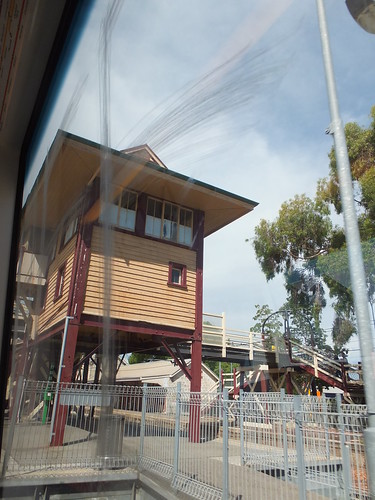
It only remained for me to travel back to Bull Creek to meet Keith. I caught a service from Fremantle to Perth, passing through Claremont where one of the original mechanical signal boxes has been preserved. Later, Keith told me that a group of railway enthusiasts meet regularly in this unusual 'clubroom'.
The preserved signal box at Claremont.
On arrival back at Perth, I followed the signage to the underground platforms and boarded a Mandurah Line train which took me to Bull Creek. I met up with Keith without a problem and returned to Keith’s home tired but satisfied. That was my last full day in Perth – on the following day I was to fly to Bangkok.
My pictures
Railways in Western Australia.
Former Railway Works, Midland, WA.
Fremantle, West Australia.
Maritime Museum, Fremantle, WA.
[Revised 1-Mar-2013, 5-Mar-2013]
Monday, 11 February 2013
Perth WA - Day 4
Monday, 11th February 2013
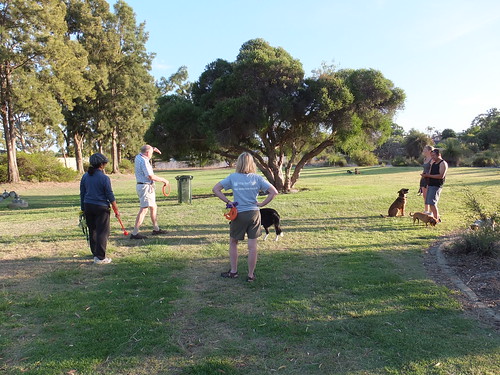
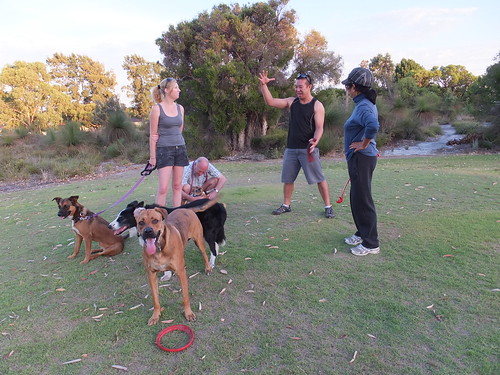
The day started by walking Keith’s dog around the 'Dog Walking Area'. Presumably because it was a weekday, we saw more dogs and owners than on the previous days. All the dogs played happily chasing an assortment of balls, rings and frisbees.
On our arrival back at Keith's home, we took breakfast. Keith had a telephone message that the Steam Museum we'd failed to get into in Fremantle on the previous Saturday would definitely be open, so we drove down to the city again.
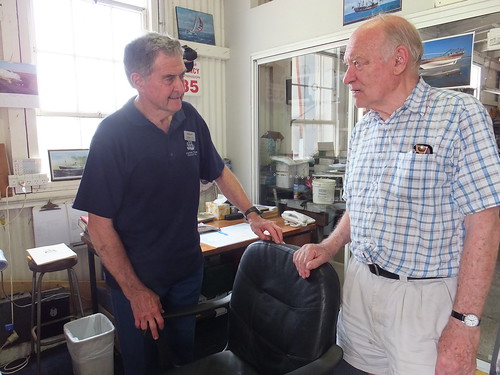
Adrian Pope was the volunteer in charge of the Steam Museum, which operates as an annexe to the futuristic-looking building of the Maritime Museum Fremantle next door. The steam exhibits are housed in a conventional steel-framed workshop building clad in corrugated iron. Adrian was an enthusiastic and knowledgeable host and we spent over three hours there.
We learnt that the air compressor which normally operates the exhibits had failed and, whilst repairs were being carried out, the Museum was being opened on a more irregular basis.
The only exhibit working was the Robinson version of a 'Stirling-Cycle' engine. The base of this engine houses a heater to power the engine. This was originally gas-powered but is now an electric heater. There's an excellent article in Wikipedia here about the Stirling engine.
Robinson's implementation of a 'Stirling Cycle' hot-air engine.
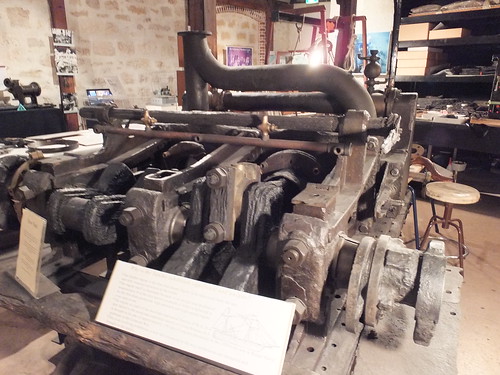
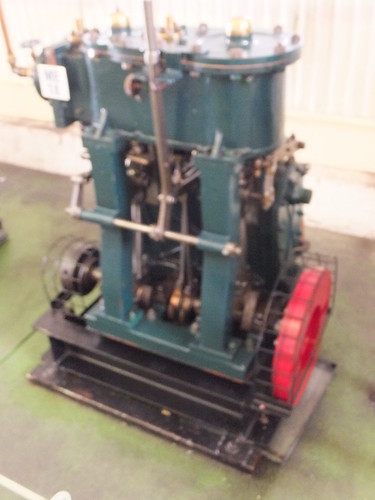
It will take me a while to sort out the details of all the models and preserved mechanisms on display, but the set Steam Museum, Fremantle gives an impression of the range of exhibits. I'll just mention the marine engine on display which reputedly powered the "Cygnet', the launch used by C. Y. O'Connor (1843-1902) during development of Fremantle Harbour.
The engine from the 'Cygnet' (apologies for the poor focus).
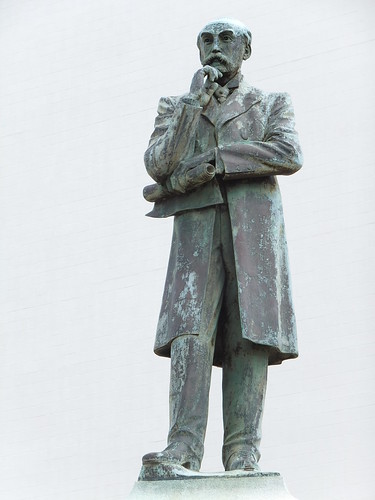
There is a statue to C. Y. O'Connor by Pietro Porcelli a short distance from the museum commemorating his work on the development of the harbour together with his role in the development of the water supply for the Goldfields area, the railways of Western Australia and other public works. Sadly, C. Y. O'Connor took his own life in 1902. There's more about this remarkable man in a Wikipedia article here.
The C. Y. O'Connor statue near the Steam Museum.
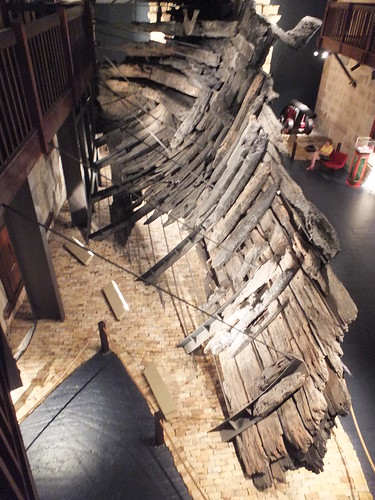
We then moved on to the Ship Wreck Museum where, amongst a large collection of smaller artefacts, the is a large preserved section of hull from the 'Batavia' which was wrecked in 1629.
The preserved section of the hull of the 'Batavia'.
The remains of a 2-cylinder steam engine from the 'Xantho' are currently being conserved after over 100 years under the sea. This engine was built by J. Penn and Son in Greenwich, England.
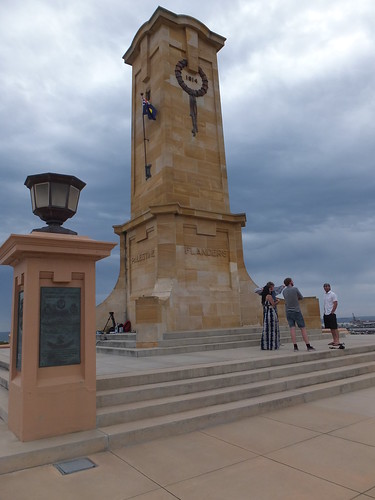
After browsing a second-hand bookshop, Keith drove to the highest point in Fremantle which commands splendid views both to sea and towards the city. There are a number of War Memorials here, including (rather improbably) a periscope made in Scotland. We then returned home.
The oldest of the War Memorials overlooking Fremantle. The three young people were making a video.
In the evening, Keith, Fhines and I drove to a nearby Chinese Restaurant for a very enjoyable meal.
My Pictures
Williton Dog Walking Area.
Steam Museum, Fremantle.
Shipwreck Museum, Fremantle, WA.
Fremantle, West Australia.

Perth WA - Day 3
Sunday, 10th February 2013
As the previous day, we walked Keith’s dog early in the morning before returning home for breakfast. Around 7.00 a.m., it was fully light but there was a cooling wind to make the exercise pleasant.
When I was in Perth last in 2007, Keith took me to see Byford Wildlife Park which, at the time, was still being built. My post describing that earlier visit is here and the pictures I took then are in the set Byford Nature Park.
We returned to Byford on 10th February 2013 to what is now called Cohunu Koala Park and open to visitors. We had principally returned to see the ‘Pioneer Steam Museum’, the locomotive sheds and the 7.25-inch railway.
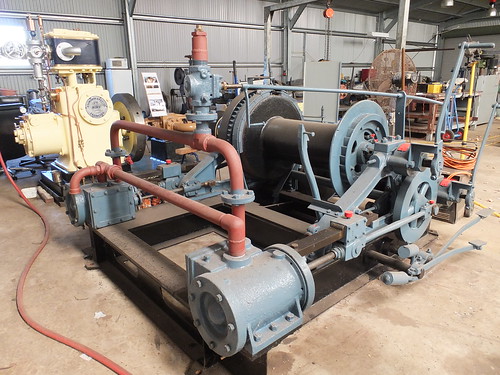
In the Steam Museum there were various steam driven pumps, a ship’s mooring winch made in Renfrew in 1898, a Worthington high-capacity pump, Weir feed pump, Stuart ‘Cygnet’ marine engine. There were also products made by The Austral Otis Engineering Company Limited, The Geo. F. Blake Mfg. Co. New York, Mumford of Colchester and British Steel Piling Co. Ltd. Finally, there were three Portable Engines made by Marshalls of Gainsborough, Ruston and Hornsby of Lincoln and a ‘Britannia’ Engine.
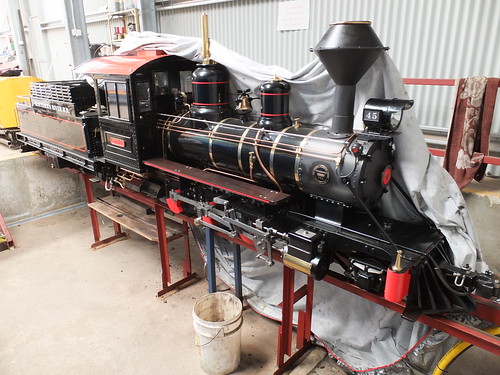
In the locomotive shed there was a rather nice electrically operated rail-mounted crane. Modern traction was represented by a diesel-electric outline Co-Co numbered 1561, a diesel outline shunter carried on six wheels named ‘Terrier’ and a diesel-electric outline ‘Oakford Express’ numbered 4850. There were also three live-steam locomotives – a mogul named ‘Cohunu Queen’ carrying running number 3 and in the crimson livery of the Cohunu Park Railway, an impressive mogul with the outlines of a typical American locomotive in black with running number 45 named ‘Dixie’ and marked ‘Southern River R. R.’ and a 4-4-0 in blue accurately portraying the West Australian Government Railways design.
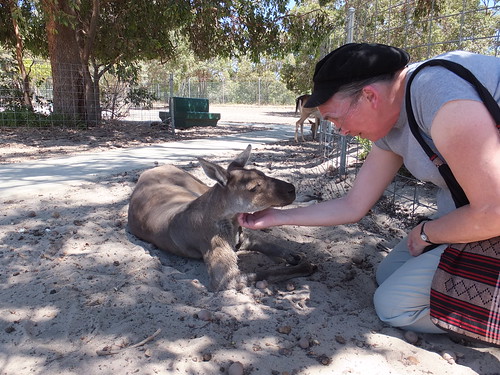
Before looking at the operating railway, Keith showed me some of the animals. I was able to stroke a koala, wander amongst a number of kangaroos who seemed happy to be stroked, watch the black swans and pelicans on the small lake and marvel at the improbable appearance of the ostriches. An astronomical observatory building was still being completed but the ground floor was already in use as a toilet block.
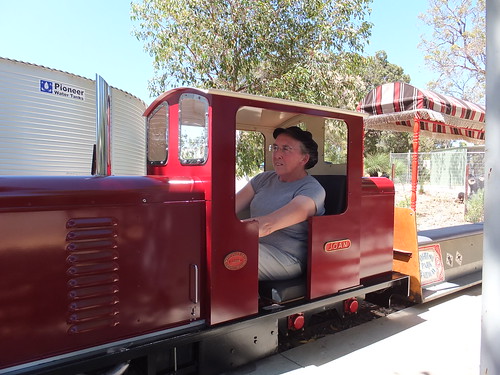
The 7.25-inch passenger line forms a continuous circuit which threads itself through the park, at one point climbing in a curve to cross over itself. There are lots of ungated level crossings and a short tunnel. There is one station where passengers board and alight. The 3-coach train was being hauled by ‘Joan’ – a crimson Bo-Bo with a ‘Hunslet’ plate on the front but with the makers plate on the cab side more accurately crediting ‘Wato, Green and Jowitt Locomotive Works’ in 2006. The locomotive is powered by a Morris Minor petrol engine with a fully hydraulic drive. During a lull in passengers, I was allowed to drive a ‘staff train’ around the line. It’s the first time I’ve had “Ostriches on the Line"! Instead of moving away from the line, the three creatures insisted on racing us to the underbridge so I let them pass through first before continuing.
My thanks to Keith, Anthony and the staff at Cohunu Koala Park for their hospitality.
On the way back to Keith’s home, we called in to see one of Keith’s friends, Birgit, a charming lady with two dogs and a fascinating home. I was made very welcome.
My pictures
Williton Dog Walking Area.
Cohunu Koala Park.
[Revised 1-Mar-2013]
Perth WA - Day 2
Saturday, 9th February 2013
We walked Keith’s dog, Sasha early in the morning. A few hundred metres from Keith’s home, there’s an open space designated as a ‘Dog Walking Area’. There are a number of dogs and their owners who regularly exercise here so it becomes something of a social affair. After the walk, we returned home for breakfast.
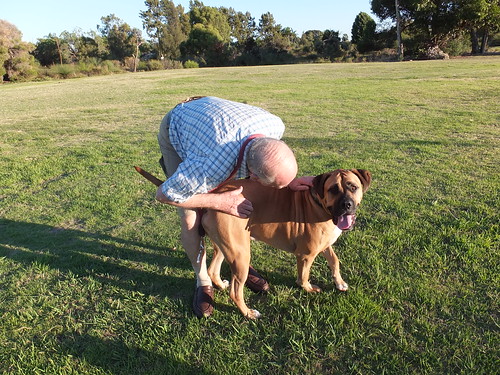
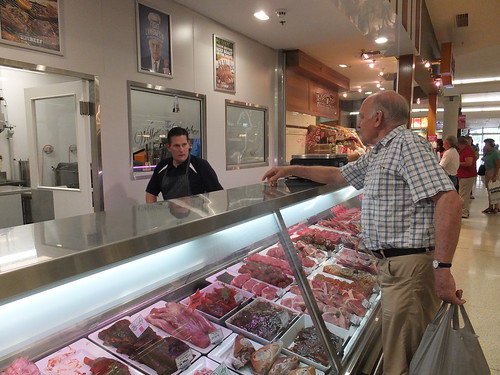
Later in the morning, I went shopping with Keith to his local shopping centre. One popular store for grocery and the like is Coles where we spent some time. The experience is not so different from shopping in the U.K., although it's much warmer in Perth! Whereas everyone in England complains about just how cold and damp it is, it seems everyone in Perth complains about how insufferably hot it is (around 40 degrees Celsius on Saturday and expected to be a degree or two hotter on Sunday). Needless to say, the shopping malls ensure they are well air conditioned to encourage customers.
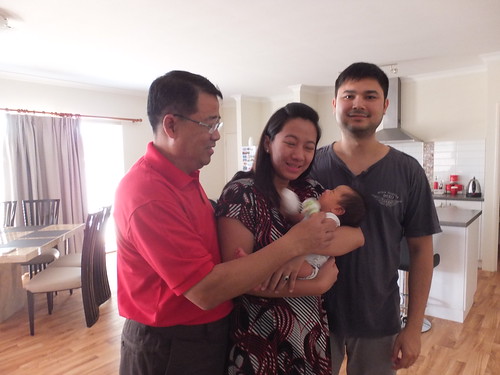
In the afternoon, I'd arranged to meet my friend Captain Myo Lwin, former captain of the 'Road to Mandalay'. He had flown to Perth to join his wife who had been in Perth for a little while to support her daughter during delivery of the daughter's first child, Wyatt. The Captain's charming daughter and her husband had kindly invited me to visit them in Perth to see the Captain's new grandson. Keith provided transport and, with Keith's interest in matters Nautical (he is a former Ship's Engineer), Keith and the Captain were soon engaged in heavy discussions. We were made most welcome and young Wyatt is a most handsome addition to the family.
My pictures
Williton Dog Walking Area.
Around Williton.
Wyatt.
[Revised 1-Mar-2013]
Saturday, 9 February 2013
Perth WA - Day 1
Events of Friday, 8th February 2013
My last visit to Perth, Western Australia was almost six years ago, on my fourth 'Round the World' trip which you can read about here.
On my return in 2013, our Thai flight made an on-time arrival at Perth around 7.30 a.m. I said goodbye to my friend Captain Myo Lwin in the baggage hall, promising to visit he and his wife in Perth during my visit. My friend Keith was waiting for me in the arrivals hall and we were soon on our way to his home where I'd been invited to stay with Keith and his wife Fhines. Fhines had to go to work but we met later in the day. Keith now has a dog called Sasha I'd not met. Fortunately, we quickly became firm friends.
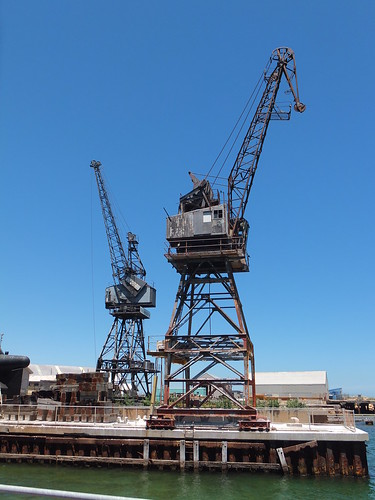
Later in the morning, we drove to Freemantle and pottered around the remains of the old docks where there are a number of preserved Stothert and Pitt dockside cranes.
Stothert and Pitt electric cranes preserved on the dockside.
The old transit sheds have found new uses, one as a 'shopping experience', principally selling souvenirs to tourists. We'd hoped to visit the nearby Steam Museum which houses various model steam-powered stationary engines including a number actually made by Keith. Unfortunately, the museum was closed but we planned to return later in my visit. We returned to Keith's home, going into 'Subway'on the way to buy a filled roll for lunch.
After the pressures of my tour through Vietnam, I was happy to have a quieter day to recuperate.
Halong Bay - Day 3
Events of 7th February, 2013
My last day on the boat. Early morning tea in the dining room as the boat made its way to Surprise Cave Bay where we anchored and transferred to the shore by tender.

All the Hotel Boats seemed to have sails - either two-masted or three-masted 'Junk Rigs'. However, I never saw them used for propulsion. All our sailing was done under engine power with sails lowered but, whenever we anchored, the sails were hoisted by the crew, presumably as a bit of advertising.
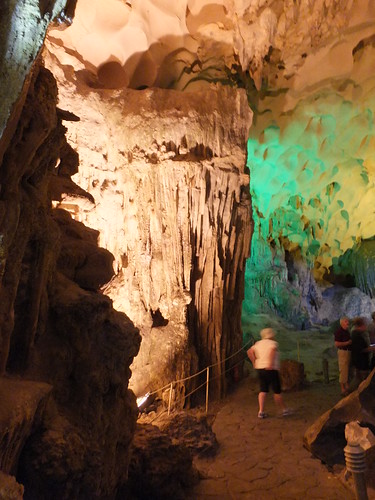
There were quite a few other boats in the bay and we could see their passengers climbing a set of 100-odd steps leading from the landing area up to the entrance of the first of the three Surprise Caves. The path through the caves wound around various impressive rock formations which were quite well illuminated with coloured spotlights to bring out the features.
Surprise Caves.
There was a lot of up and down steps and I emerged at the end of the three caves quite tired but very satisfied by the experience. About 100 steps took us down to the departure jetty (the caves have a one-way system).

Our tender was waiting at the jetty to return us to the Hotel Boat in time for us to clear our bedrooms before taking a buffet full breakfast in the dining room.
The Hotel Boat retraced its outward track from a couple of days previously and returned to our landing jetty on the mainland, passing a number of cargo vessels anchored in the Roads and a different cruise ship, the 'Superstar Gemini' (see the Wikipedia article here). We dropped anchor close to a number of other vessels from the Indochina Sails fleet and, for the last time, boarded the tender which took us ashore. I quickly spotted my car and driver and, within a few minutes, was re-united with my large case, said my final goodbye to Son and set off for the drive back to Hanoi.
My driver dropped me and my hand baggage at the Metropole Hotel a little after 3.00 p.m. and we arranged for the car to return at 5.00 p.m. for my final journey to the airport. I was able to use my computer in the hotel's business centre, allowing me to deal with some e-mails, upload my pictures of the Surprise Caves and re-charge my camera battery. I was so engrossed with these tasks that I failed to have any lunch as I'd originally intended. I walked out of the hotel a few minutes before five, just as my car drew up, so we were soon on our way.
Hanoi traffic is pretty scary at the best of times - on that evening it seemed particularly horrendous. My driver took a very devious route which I'm sure saved a lot of time. The pace seemed to be becoming more frenetic as the Lunar New Year approached and the hordes of motor bikes and scooters, many bearing bonsai cherry trees or fruit trees used as New Year decorations, often gave the appearance of a whole of a forest on the move. We arrived at the airport in good time and I checked in and made my way to the departure lounge for the Thai evening flight to Bangkok.
My flight was right time into Bangkok but the airport was very busy. Just getting from the arrivals level to the departure level involved using a number of moving walkways and enduring another thorough security check. As I approached the departure gate, I was delighted to see my friend Captain Myo Lwin whom I knew was on my flight to Perth. He'd arrived a little earlier on a flight from Yangon. After a few "alarums and excursions" we both made the flight. Thai served a good dinner and I watched a 'video on demand' film, based on real events, about smuggling American Embassy staff out of Baghdad. I managed to get a little sleep during the six-hour flight to Perth.
My pictures
Halong Bay - Day 3.
By road Hanoi - Halong Bay and return.
[Revised 28-Feb-2013]