Monday, 11th February 2013
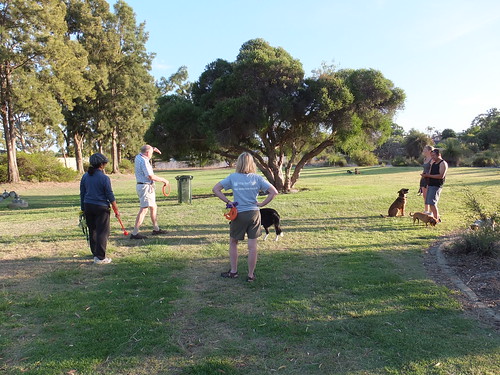
The day started by walking Keith’s dog around the 'Dog Walking Area'. Presumably because it was a weekday, we saw more dogs and owners than on the previous days. All the dogs played happily chasing an assortment of balls, rings and frisbees.
On our arrival back at Keith's home, we took breakfast. Keith had a telephone message that the Steam Museum we'd failed to get into in Fremantle on the previous Saturday would definitely be open, so we drove down to the city again.
Adrian Pope was the volunteer in charge of the Steam Museum, which operates as an annexe to the futuristic-looking building of the Maritime Museum Fremantle next door. The steam exhibits are housed in a conventional steel-framed workshop building clad in corrugated iron. Adrian was an enthusiastic and knowledgeable host and we spent over three hours there.
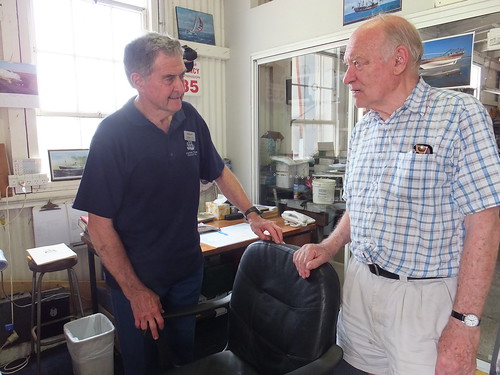
We learnt that the air compressor which normally operates the exhibits had failed and, whilst repairs were being carried out, the Museum was being opened on a more irregular basis.
The only exhibit working was the Robinson version of a 'Stirling-Cycle' engine. The base of this engine houses a heater to power the engine. This was originally gas-powered but is now an electric heater. There's an excellent article in Wikipedia here about the Stirling engine.
Robinson's implementation of a 'Stirling Cycle' hot-air engine.
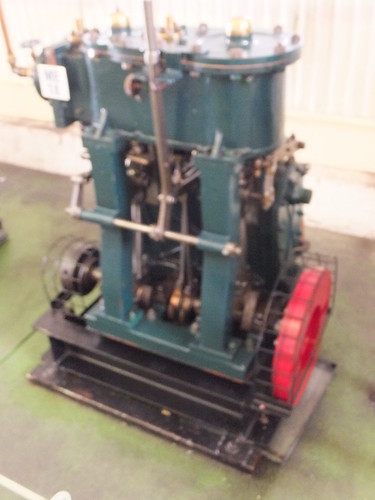
It will take me a while to sort out the details of all the models and preserved mechanisms on display, but the set Steam Museum, Fremantle gives an impression of the range of exhibits. I'll just mention the marine engine on display which reputedly powered the "Cygnet', the launch used by C. Y. O'Connor (1843-1902) during development of Fremantle Harbour.
The engine from the 'Cygnet' (apologies for the poor focus).
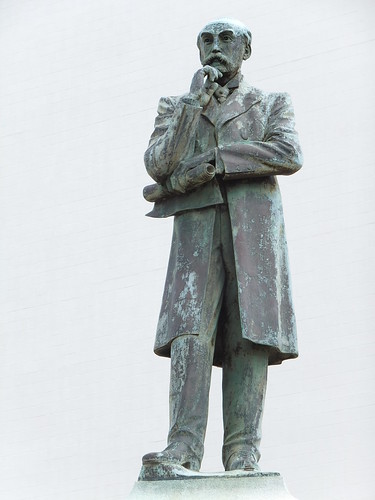
There is a statue to C. Y. O'Connor by Pietro Porcelli a short distance from the museum commemorating his work on the development of the harbour together with his role in the development of the water supply for the Goldfields area, the railways of Western Australia and other public works. Sadly, C. Y. O'Connor took his own life in 1902. There's more about this remarkable man in a Wikipedia article here.
The C. Y. O'Connor statue near the Steam Museum.
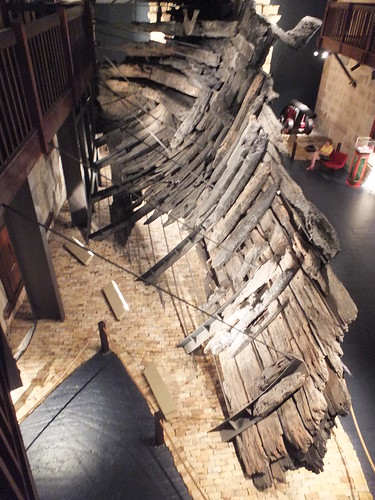
We then moved on to the Ship Wreck Museum where, amongst a large collection of smaller artefacts, the is a large preserved section of hull from the 'Batavia' which was wrecked in 1629.
The preserved section of the hull of the 'Batavia'.
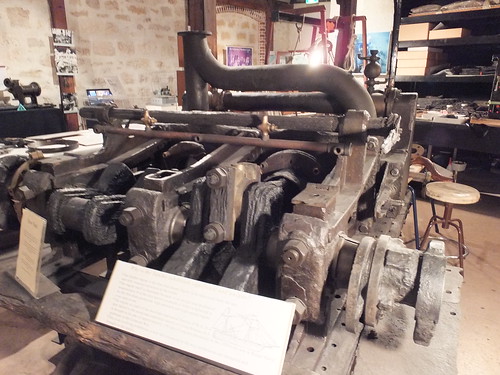
The remains of a 2-cylinder steam engine from the 'Xantho' are currently being conserved after over 100 years under the sea. This engine was built by J. Penn and Son in Greenwich, England.
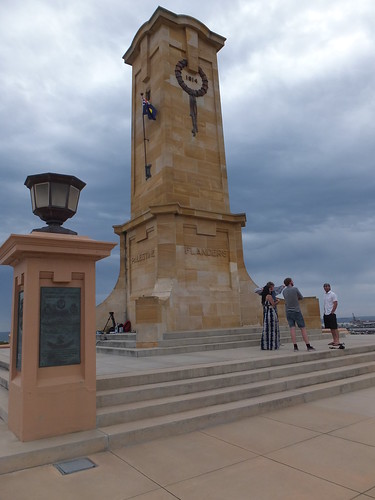
After browsing a second-hand bookshop, Keith drove to the highest point in Fremantle which commands splendid views both to sea and towards the city. There are a number of War Memorials here, including (rather improbably) a periscope made in Scotland. We then returned home.
The oldest of the War Memorials overlooking Fremantle. The three young people were making a video.
In the evening, Keith, Fhines and I drove to a nearby Chinese Restaurant for a very enjoyable meal.
My Pictures
Williton Dog Walking Area.
Steam Museum, Fremantle.
Shipwreck Museum, Fremantle, WA.
Fremantle, West Australia.
Monday, 11 February 2013
Perth WA - Day 4


Perth WA - Day 3
Sunday, 10th February 2013
As the previous day, we walked Keith’s dog early in the morning before returning home for breakfast. Around 7.00 a.m., it was fully light but there was a cooling wind to make the exercise pleasant.
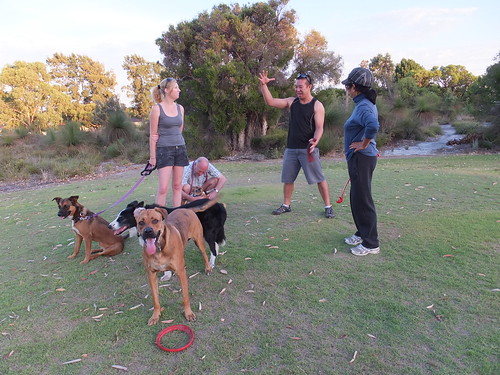
When I was in Perth last in 2007, Keith took me to see Byford Wildlife Park which, at the time, was still being built. My post describing that earlier visit is here and the pictures I took then are in the set Byford Nature Park.
We returned to Byford on 10th February 2013 to what is now called Cohunu Koala Park and open to visitors. We had principally returned to see the ‘Pioneer Steam Museum’, the locomotive sheds and the 7.25-inch railway.
In the Steam Museum there were various steam driven pumps, a ship’s mooring winch made in Renfrew in 1898, a Worthington high-capacity pump, Weir feed pump, Stuart ‘Cygnet’ marine engine. There were also products made by The Austral Otis Engineering Company Limited, The Geo. F. Blake Mfg. Co. New York, Mumford of Colchester and British Steel Piling Co. Ltd. Finally, there were three Portable Engines made by Marshalls of Gainsborough, Ruston and Hornsby of Lincoln and a ‘Britannia’ Engine.
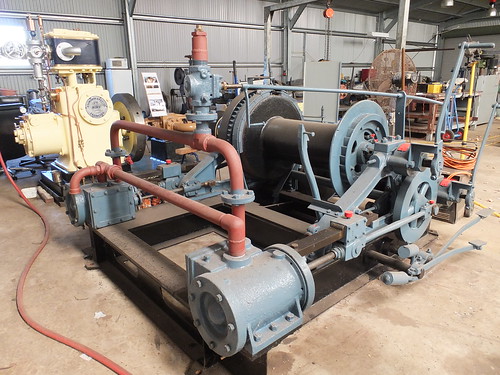
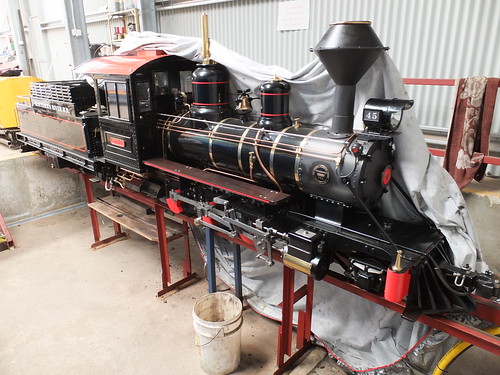
In the locomotive shed there was a rather nice electrically operated rail-mounted crane. Modern traction was represented by a diesel-electric outline Co-Co numbered 1561, a diesel outline shunter carried on six wheels named ‘Terrier’ and a diesel-electric outline ‘Oakford Express’ numbered 4850. There were also three live-steam locomotives – a mogul named ‘Cohunu Queen’ carrying running number 3 and in the crimson livery of the Cohunu Park Railway, an impressive mogul with the outlines of a typical American locomotive in black with running number 45 named ‘Dixie’ and marked ‘Southern River R. R.’ and a 4-4-0 in blue accurately portraying the West Australian Government Railways design.
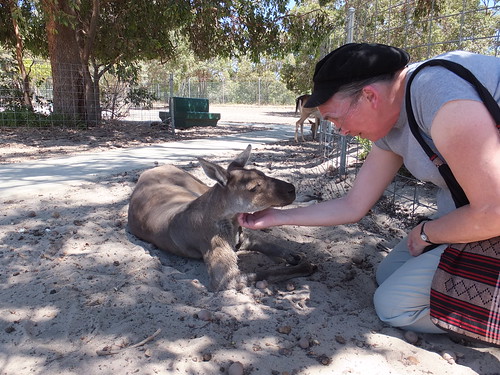
Before looking at the operating railway, Keith showed me some of the animals. I was able to stroke a koala, wander amongst a number of kangaroos who seemed happy to be stroked, watch the black swans and pelicans on the small lake and marvel at the improbable appearance of the ostriches. An astronomical observatory building was still being completed but the ground floor was already in use as a toilet block.
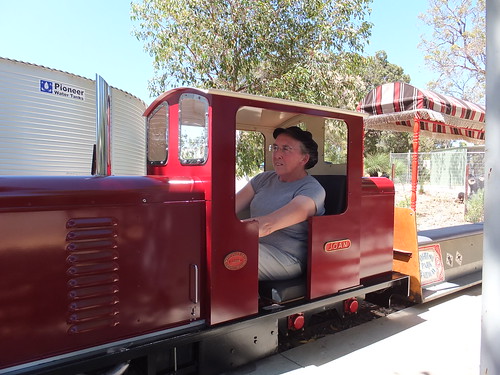
The 7.25-inch passenger line forms a continuous circuit which threads itself through the park, at one point climbing in a curve to cross over itself. There are lots of ungated level crossings and a short tunnel. There is one station where passengers board and alight. The 3-coach train was being hauled by ‘Joan’ – a crimson Bo-Bo with a ‘Hunslet’ plate on the front but with the makers plate on the cab side more accurately crediting ‘Wato, Green and Jowitt Locomotive Works’ in 2006. The locomotive is powered by a Morris Minor petrol engine with a fully hydraulic drive. During a lull in passengers, I was allowed to drive a ‘staff train’ around the line. It’s the first time I’ve had “Ostriches on the Line"! Instead of moving away from the line, the three creatures insisted on racing us to the underbridge so I let them pass through first before continuing.
My thanks to Keith, Anthony and the staff at Cohunu Koala Park for their hospitality.
On the way back to Keith’s home, we called in to see one of Keith’s friends, Birgit, a charming lady with two dogs and a fascinating home. I was made very welcome.
My pictures
Williton Dog Walking Area.
Cohunu Koala Park.
[Revised 1-Mar-2013]
Perth WA - Day 2
Saturday, 9th February 2013
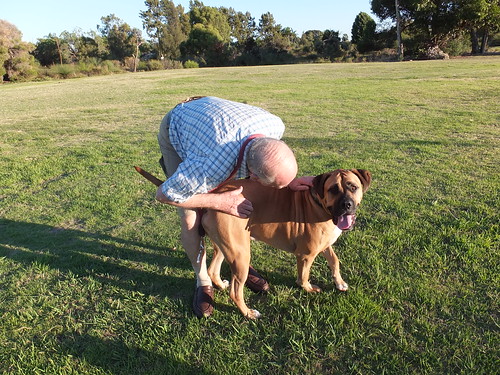
We walked Keith’s dog, Sasha early in the morning. A few hundred metres from Keith’s home, there’s an open space designated as a ‘Dog Walking Area’. There are a number of dogs and their owners who regularly exercise here so it becomes something of a social affair. After the walk, we returned home for breakfast.
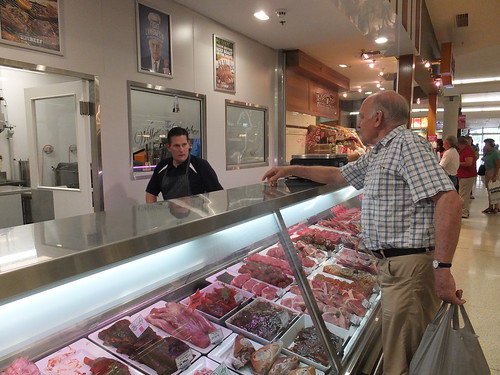
Later in the morning, I went shopping with Keith to his local shopping centre. One popular store for grocery and the like is Coles where we spent some time. The experience is not so different from shopping in the U.K., although it's much warmer in Perth! Whereas everyone in England complains about just how cold and damp it is, it seems everyone in Perth complains about how insufferably hot it is (around 40 degrees Celsius on Saturday and expected to be a degree or two hotter on Sunday). Needless to say, the shopping malls ensure they are well air conditioned to encourage customers.
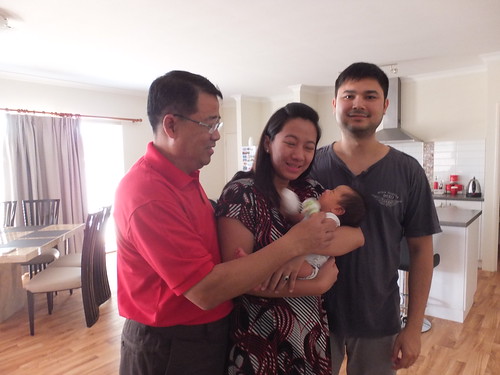
In the afternoon, I'd arranged to meet my friend Captain Myo Lwin, former captain of the 'Road to Mandalay'. He had flown to Perth to join his wife who had been in Perth for a little while to support her daughter during delivery of the daughter's first child, Wyatt. The Captain's charming daughter and her husband had kindly invited me to visit them in Perth to see the Captain's new grandson. Keith provided transport and, with Keith's interest in matters Nautical (he is a former Ship's Engineer), Keith and the Captain were soon engaged in heavy discussions. We were made most welcome and young Wyatt is a most handsome addition to the family.
My pictures
Williton Dog Walking Area.
Around Williton.
Wyatt.
[Revised 1-Mar-2013]
Saturday, 9 February 2013
Perth WA - Day 1
Events of Friday, 8th February 2013
My last visit to Perth, Western Australia was almost six years ago, on my fourth 'Round the World' trip which you can read about here.
On my return in 2013, our Thai flight made an on-time arrival at Perth around 7.30 a.m. I said goodbye to my friend Captain Myo Lwin in the baggage hall, promising to visit he and his wife in Perth during my visit. My friend Keith was waiting for me in the arrivals hall and we were soon on our way to his home where I'd been invited to stay with Keith and his wife Fhines. Fhines had to go to work but we met later in the day. Keith now has a dog called Sasha I'd not met. Fortunately, we quickly became firm friends.
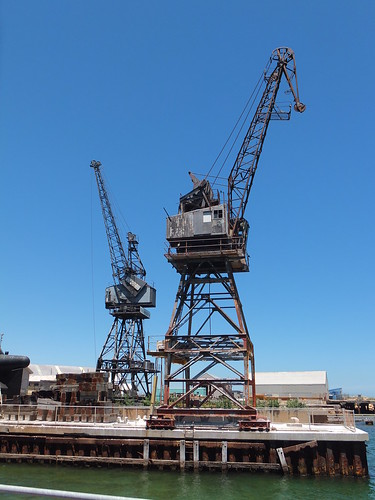
Later in the morning, we drove to Freemantle and pottered around the remains of the old docks where there are a number of preserved Stothert and Pitt dockside cranes.
Stothert and Pitt electric cranes preserved on the dockside.
The old transit sheds have found new uses, one as a 'shopping experience', principally selling souvenirs to tourists. We'd hoped to visit the nearby Steam Museum which houses various model steam-powered stationary engines including a number actually made by Keith. Unfortunately, the museum was closed but we planned to return later in my visit. We returned to Keith's home, going into 'Subway'on the way to buy a filled roll for lunch.
After the pressures of my tour through Vietnam, I was happy to have a quieter day to recuperate.
Halong Bay - Day 3
Events of 7th February, 2013
My last day on the boat. Early morning tea in the dining room as the boat made its way to Surprise Cave Bay where we anchored and transferred to the shore by tender.

All the Hotel Boats seemed to have sails - either two-masted or three-masted 'Junk Rigs'. However, I never saw them used for propulsion. All our sailing was done under engine power with sails lowered but, whenever we anchored, the sails were hoisted by the crew, presumably as a bit of advertising.
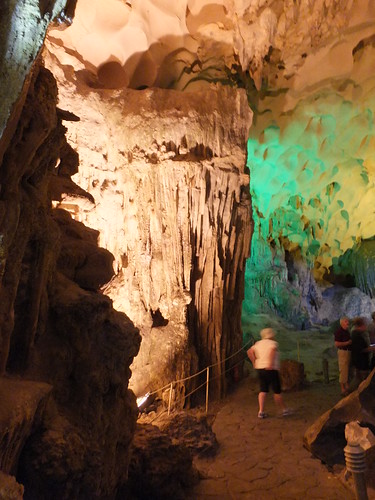
There were quite a few other boats in the bay and we could see their passengers climbing a set of 100-odd steps leading from the landing area up to the entrance of the first of the three Surprise Caves. The path through the caves wound around various impressive rock formations which were quite well illuminated with coloured spotlights to bring out the features.
Surprise Caves.
There was a lot of up and down steps and I emerged at the end of the three caves quite tired but very satisfied by the experience. About 100 steps took us down to the departure jetty (the caves have a one-way system).

Our tender was waiting at the jetty to return us to the Hotel Boat in time for us to clear our bedrooms before taking a buffet full breakfast in the dining room.
The Hotel Boat retraced its outward track from a couple of days previously and returned to our landing jetty on the mainland, passing a number of cargo vessels anchored in the Roads and a different cruise ship, the 'Superstar Gemini' (see the Wikipedia article here). We dropped anchor close to a number of other vessels from the Indochina Sails fleet and, for the last time, boarded the tender which took us ashore. I quickly spotted my car and driver and, within a few minutes, was re-united with my large case, said my final goodbye to Son and set off for the drive back to Hanoi.
My driver dropped me and my hand baggage at the Metropole Hotel a little after 3.00 p.m. and we arranged for the car to return at 5.00 p.m. for my final journey to the airport. I was able to use my computer in the hotel's business centre, allowing me to deal with some e-mails, upload my pictures of the Surprise Caves and re-charge my camera battery. I was so engrossed with these tasks that I failed to have any lunch as I'd originally intended. I walked out of the hotel a few minutes before five, just as my car drew up, so we were soon on our way.
Hanoi traffic is pretty scary at the best of times - on that evening it seemed particularly horrendous. My driver took a very devious route which I'm sure saved a lot of time. The pace seemed to be becoming more frenetic as the Lunar New Year approached and the hordes of motor bikes and scooters, many bearing bonsai cherry trees or fruit trees used as New Year decorations, often gave the appearance of a whole of a forest on the move. We arrived at the airport in good time and I checked in and made my way to the departure lounge for the Thai evening flight to Bangkok.
My flight was right time into Bangkok but the airport was very busy. Just getting from the arrivals level to the departure level involved using a number of moving walkways and enduring another thorough security check. As I approached the departure gate, I was delighted to see my friend Captain Myo Lwin whom I knew was on my flight to Perth. He'd arrived a little earlier on a flight from Yangon. After a few "alarums and excursions" we both made the flight. Thai served a good dinner and I watched a 'video on demand' film, based on real events, about smuggling American Embassy staff out of Baghdad. I managed to get a little sleep during the six-hour flight to Perth.
My pictures
Halong Bay - Day 3.
By road Hanoi - Halong Bay and return.
[Revised 28-Feb-2013]
Thursday, 7 February 2013
Halong Bay - Day 2
Events of 6-Feb-2013
After a good night’s sleep, I awoke early to a very dull day. Early morning tea was available followed by Tai Chi on the Sundeck. I had the tea but passed on the Tai Chi. The boat moved to the Surprise Cave Location where the 2-night passengers transferred to the Day Boat. At 7.45 a.m. the 2-night couple and I had an early cooked breakfast, prior to transferring by tender to the Day Boat. We shared the Day Boat with a family of three from Toronto who were also on the 2-night trip, but based on another Hotel Boat (the tour company operates a number of similar Hotel Boats). The Day Boat was a smaller version of the main boat without bedrooms but with a similar standard of fittings and service.
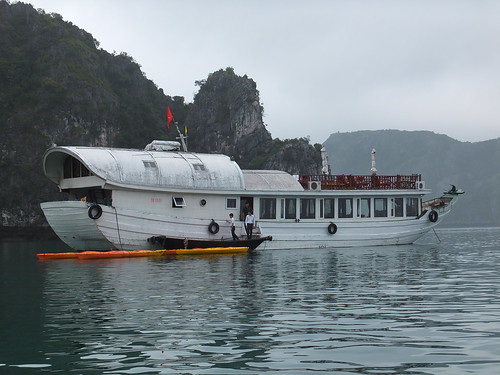
The Boat Manager, Dai, and his staff made the six of us welcome and we cruised to parts of Halong Bay inaccessible to the larger boats. We moored a few hundred yards (oh, alright, metres) from another Bat Cave and here there was no choice of transport, it was kayak or not go. We used four kayaks (which I’d not previously noticed had been towed in a line by the Day Boat, together with a rowing boat which, tied alongside the Day Boat, served as a landing stage to assist us in getting into the kayaks).
I was in the front of one kayak with Dai in the back. I’d taken his advice to wear a swimming costume and leave outer wear and shoes on the Day Boat to keep dry. Inevitably, each time one blade of the paddle is raised from the water so that the other blade can enter the water, water drips onto the paddler. I tied my camera case to my lifejacket and that got a little damp but the camera was unharmed. I found that I enjoyed the experience as much as I had all those years ago. As we approached to dark entrance to a short tunnel forming the first Bat Cave, I was surprised at the strength of the current flowing towards us which made steering difficult. But we all got through successfully, entering a large lagoon embraced by tall crags on all sides.

As we carried on, the water became shallower but Dai said that we should be able to pass through a second tunnel. The channel seemed very narrow and a rock outcrop near the middle made it harder. The current was difficult to counteract and we occasionally scraped on a very shallow bottom. Dai and I got through as the first boat and waited for the others. After a short wait, all the kayaks were in the second lagoon and we stayed for a while, enjoying the tranquility where only the occasional cry of a bird could be heard. Although the current was strong passing through the Bat Cave, once in the lagoon the kayak just remained in place without any effort needed to hold a position.
Dai said that the water level would still be falling so we should make out way back again. By the time we got to the cave entrance, more kayaks from a different boat were trying to enter the second lagoon and were having some problems. One guy clambered out of his boat into the water to haul the hull over the high spot whilst the girl with him paddled. When the passage was clear, we just managed to get through.
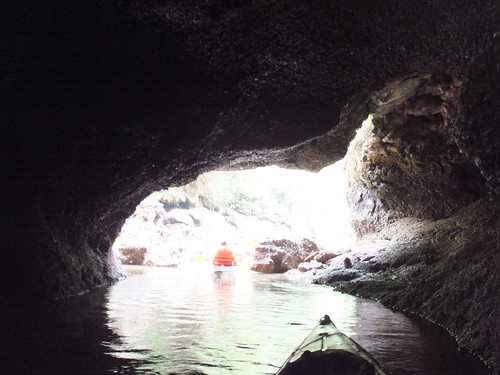
There was similar fun at the other tunnel and Dai got out of the kayak to make sure everyone got through. On the last stretch back to the Boat, I got a little stuck not on rocks but on a reasonably flat sandy bottom not realising just how shallow the water had become. A little judicious pushing on the bottom with the paddle got us free without leaving the kayak. We returned to the Day Boat safely after what I found an exhilarating experience. The boat was equipped with two shower rooms so after a hot shower and with dry clothes waiting, I was soon revived from my exertions.
The boat next cruised to Cua Van. This is a fishing village set in an inlet well-protected by nature by high cliffs and rock outcrops on the seaward side from the devastation of the annual typhoons.
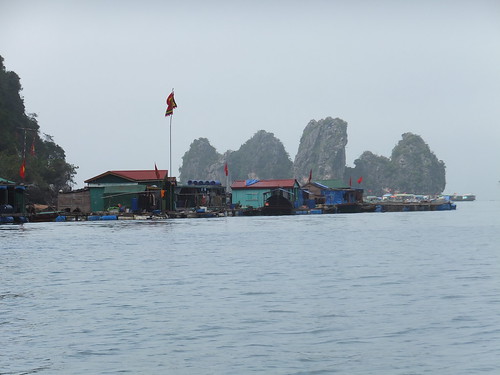
Protected it may be, but there is precious little land so the 600 residents live in wooden houses set on bamboo rafts, made buoyant by massive blocks of polystyrene wrapped in blue plastic sheet which are secured underneath the raft. A few posh people are able to afford large moulded plastic drums, also blue in colour, as buoyancy aids for their rafts. Special rafts, like those for the school, also used plastic drums. There was one large raft which appeared to be a water bus station.

We were told that there were three televisions in the village. Mobile ‘phones, however, appeared to be much more common and eventually I spotted a tall antenna mast on a nearby rocky islet which appears to bring this 21st century necessity (?) to this otherwise rather remote village. Life goes on generally at a fairly relaxed pace and a number of hammocks were in use by relaxing residents. There were a few larger deep-sea fishing boats with long bamboo booms which extend out from the boat and presumably support huge nets for drift fishing. A number of these vessels were festooned with electric lights presumably for night fishing. I’d seen similar arrangements on my first trip to Vietnam at My Tho. I was fascinated by one large rowing boat fitted with engines – a couple of elderly ‘one-pot’ diesels mounted on deck each with a gearbox driving a long propeller shaft which could be lowered into the water.
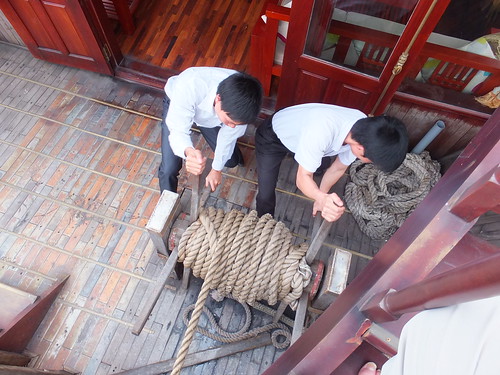
After this fascinating tour, we returned to the Day Boat and got under way. Whereas our main boat had an electric anchor winch and anchor chain, the smaller Day Boat had a wooden windlass and anchor rope. It took Dai and a member of crew some effort to raise the anchor. When a ‘knot’ in the anchor rope appeared through the hawse pipe, they knew the anchor was properly raised (on the main boat scarlet spray paint on the chain served the same purpose).
After some time relaxing on deck (by this time the day was pleasantly warm) a splendid, multicourse meal was served. A little spicy for me and I’m not a fan of squid but, nontheless, a most enjoyable meal. We spent another spell relaxing on the sundeck before arriving at another ‘floating island’ – this time a cultured pearl factory operated by Vinapearl. There were already two tourist boats tied up at the dock, so we moored in clear water and were ferried to the island by our rowing boat.
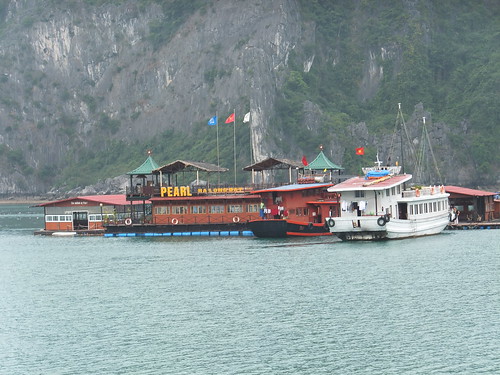
There was a small museum and an area where the various types of oyster are grown, suspended in the sea. This was followed by a demonstration showing the ‘micro-surgery’ needed to induce the oyster to produce a pearl. Sadly, my camera battery gave up at this point. Finally, we looked at a large showroom of finished products before being ferried back to our waiting Day Boat. The Day Boat then rendezvoused with our Hotel Boat and we were collected by the ship’s tender. The day finished with another fine meal on our Hotel Boat – this time a buffet dinner.

Once again, I was totally exhausted and went to bed fairly early after a most enjoyable and varied day.
Photographs
Halong Bay - Day 2.
[Revised 28-Feb-2013]
Tuesday, 5 February 2013
Halong Bay - Day 1
Events of 5-Feb-2013
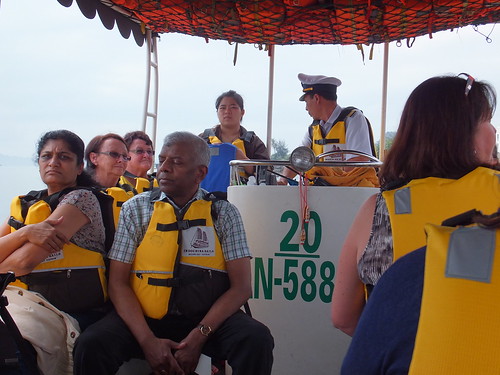
I arrived at Halong Bay after a three and a half hour road trip from Hanoi. Interesting trip but tiring. Halong Bay had dual carriageways and modern multi-storey hotels - not what I'd imagined. My driver pulled into a paved yard on our right in between the road and the sea. There were a number of porters milling around and tourists waiting. We’d clearly arrived at our embarcation point. A smartly-dressed young man checked my name on his list, had a porter remove my large case and invited me to wait in a modern café building. Within a few minutes, the young man was asking me to join a number of other passengers on a ship’s tender moored at the dock, where we donned bulky lifejackets for the short crossing to our boat.
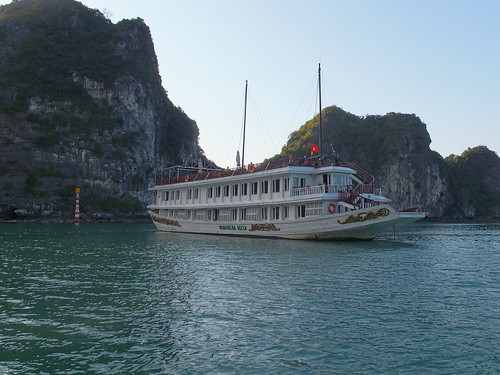
Our boat, the ‘INDOCHINA SAILS’ was moored in the bay, together with a bewildering array of other boats clearly intent on a similar tourist mission. I was told later that there are 200 hotel boats and 300 day boats serving the tourists!
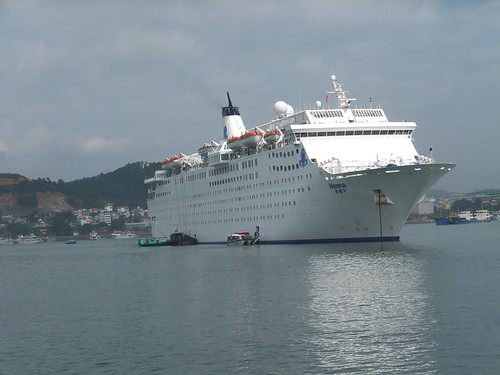
Once all the passengers were aboard, the anchor was ‘weighed’ and we set off across the bay, passing a fairly large cruise ship, the ‘Henna’ and various cargo ships at anchor. It hadn't occurred to me that the port we'd just left would be a destination for cruise ships nor that there would be significant cargo tonnage. The 'Wikipedia' article here suggests that I saw 'Henna' on one of her first cruises from China after a change of ownership.
Our boat took the marked channel which threaded through a proliferation of rocky islets characteristic of Hulong Bay. The smartly-dressed young man, I discovered, was Son, the cruise director, and after his safety briefing we were issued with keys to our cabins. I had cabin 101, nearest the bow on the starboard side (that’s front right). This cabin had one double bed rather than two singles (as some cabins had) so suited me very well. At one o’clock it was up one deck to the restaurant were we were served with numerous courses of Vietnamese food which (despite my conservative tastes in food) I enjoyed very much.
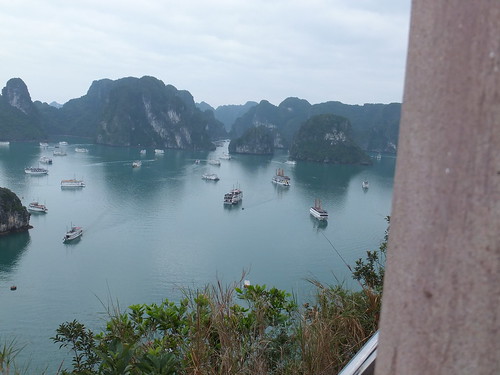
By half past two, we had arrived at a small, conical-shaped island called Titop. We were taken ashore by tender and invited to climb the 400-odd steps to the small pavilion on the summit. It was quite a pull but I made it. The views were good but I counted 25 tourist boats, similar to ours, anchored in the bay.
Returning to sea level, there was a small sandy beach and demarcated swimming area. I’d followed their advice and optimistically worn a swinsuit under a skirt and top but the water was too cold to do other than have a ‘deep paddle’. Nobody else was any more adventurous than that. After around an hour, the tender returned us to our boat.
The boat set off again for the Bat Cave (cue music … 'Duma duma duma duma duma duma BATMAN!'). There were two options for visiting the Bat Cave – by kayak or by rowing boat powered by a Vietnamese. The kayak was very tempting but since it’s 50 years since I paddled a kayak, I thought I’d better be sensible and go by rowing boat.
The Vietnamese rowing boat is powered by two slim oars each terminated in a ‘T’ handle and loosely tied to a short vertical wooden post attached to the gunwhale. The rower stands facing the bow and works the ‘T’ handles in a sort of circular movement so as to dip both oars in the water for the power stroke. The kayakers preceded us through the Bat Cave which is a tunnel leading to a pleasant lagoon surrounded by tall mountains. I was rather disappointed to learn that bats were not in occupation at the time of my visit. We did, however, see a troop of monkeys resting or scampering on the rock walls.
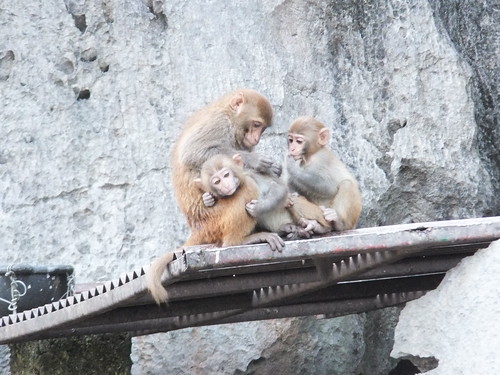
We returned to the boat by the same route and, once aboard, the ship cruised to our overnight mooring at Luon Bo where we anchored amongst a number of similar ships. We enjoyed a relaxed buffet dinner in the dining room after which various other entertainments had been arranged but, thoroughly exhausted, I retired early. Before I returned to my cabin, Son had explained to me that all the passengers on the boat, except one couple and myself, were on a one-night cruise and would return to the mainland the next day, whereas the couple and I would spend the next day on a Day Boat before meeting up with ‘INDOCHINA SAILS’ in the afternoon, by which time the boat would have disembarked the one-night passengers at the port and returned with a new complement of passengers!
Photographs
Halong Bay - Day 1.
[Expanded 7-Feb-2013, 27-Feb-2013]
Monday, 4 February 2013
Hanoi
The Hanoi guide, Joe, and driver picked me up at 8.30 a.m. from my hotel, the Metropole (Pictures). We first drove to the 'Hanoi Hilton' prison, now a museum. It was built by the French and was more widely used than I realised for suppressing dissent.

The entrance to the 'Hanoi Hilton'.
Its black humour title of 'Hanoi Hilton', of course, arises from the imprisonment of American airmen captured during the Vietnam War. Even allowing for some possible bias in presentation, I found it a moving visit (Pictures).
Next, we drove to the Ho Chi Minh Quarter. Ho Chi Minh (a nom du guerre, I believe) was born in the country and retained simple tastes but his success in establishing Vietnam as a viable state means that he is still widely revered and referred to as "Uncle Ho". A mausoleum has been erected and queues form on the days of the week when his body is displayed. My visit coincided with a 'closed' day.
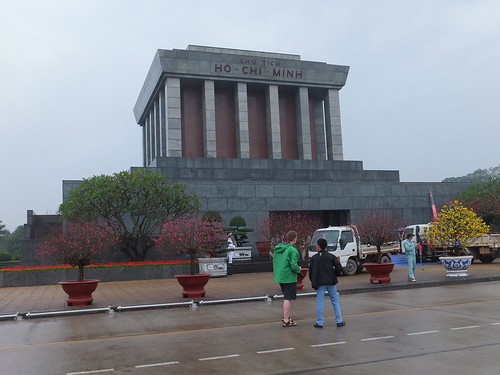 The Mausoleum.
Once in power, Ho Chi Minh could have lived in the former French Governor's Palace but he refused and at first established himself in three rooms of the nearby servants' buildings before moving to a specially-built wooden 'house on stilts' in the form seen in the countryside.
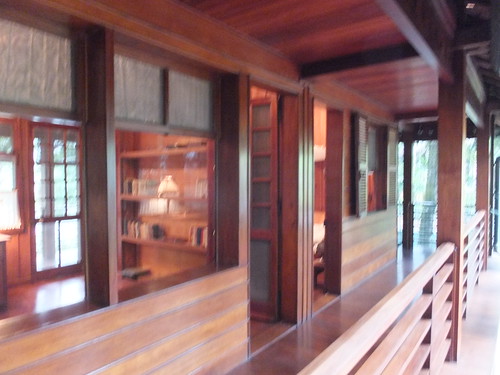 The upper floor of the 'house on stilts'. The lower floor served as a meeting room.
This house was near a small lake, allowing Ho Chi Minh to pursue his love of fishing. He regarded Marx and Lenin as his 'Brothers'. He was given three cars, which are displayed in their 'garage'. He died not in his house but a few feet away in a small hospital with attached air raid shelter. Pictures.
The 'One Pillar Pagoda' was a bit of a let-down. It's famous for being built over water and suspended by a single pillar but the original was erected elsewhere, was larger and now lost. What we can see now is a reduced size replica supported not by one massive wooden pillar but by a concrete pylon! It has to be admitted, it looks very quaint and draws the crowds. Three people were worshipping inside, leaving no room for tourists, who had to content themselves with standing at the top of the access stairs and looking inside. Pictures.
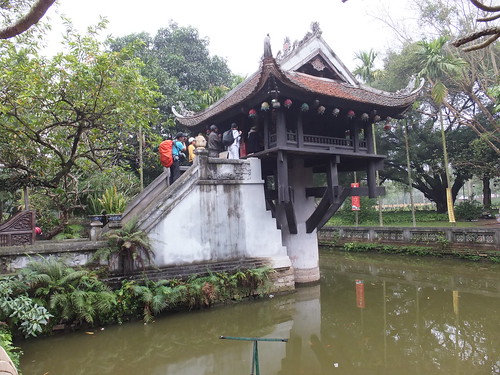 The reconstructed 'One Pillar Pagoda'.
We made our way through the crowded, noisy streets to the peace of the Temple of Literature. This venerable site is now dedicated to Confucian worship but was the first university in Vietnam. Names of the 'Old Boys' are not signwritten in gilded letters on wooden boards but carved on stone tablets ('stele') carried on the backs of turtles. (Pictures).
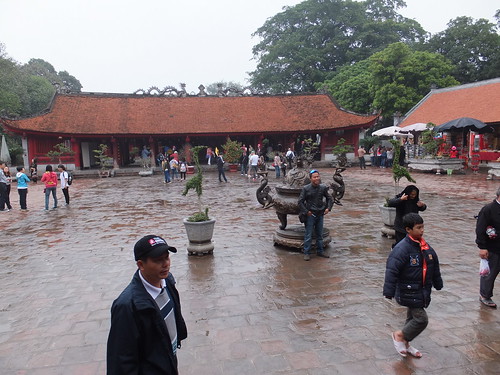 The Temple of Literature.
Joe and I then took a walking tour of the Old Quarter. Hundreds of street vendors serve hot food in passageways almost too narrow to allow the customers come and go.

Narrow passageways are home to countless eating places.
Some of the streets in the Old Quarter had been temporarily taken over by 'Pop-Up' markets where vendors sold items associated with the Chinese New Year - decorations, fruit trees. Space is always at a premium in cities but I found many candidates for 'narrowest house in Hanoi' award. The winner had three (rather ramshackle) stories but a frontage only about six feet wide.
After the walking tour, I was returned to the hotel. Armed with not-very-good free map, I set off on foot to see Hanoi railway station, a walk of around 2 kilometres (as a former French-ruled country, Vietnam is fully metricated). To my surprise, I found the station without error, mainly because at road intersections the names of the two streets are normally provided on a post. Modern Vietnamese uses the Roman alphabet in conjunction with a mass of accents so it's fairly readable by an English-speaking Foreigner. The system was introduced by a French monk, I believe. There's a set of pictures taken around the city here.
A final attraction in Hanoi was a visit to the Thanglong Water Puppet Theatre. I'd no idea what that was. My car delivered me to a conventional-looking theatre building and Joe conducted me to my seat in a normal auditorium, along with lots of other people, many of them foreign tourists like me. When the show started, instead of a stage, there was a large pool of water. Puppets appeared on the water (sometimes lots of them) doing all sorts of things and the plot was explained in English on a couple of screens on either side of 'stage'. It sounds odd, but it was strangely compelling. At the end of the show, the puppeteers, standing up to their waists in water, appeared from behind the curtains around the pool to loud applause. There are a few (not very good) pictures here.
The next day, I was to go to Halong Bay by car, to return to Hanoi on the 7th February and fly back to Bangkok.
Photographs
Hotel Metropole, Hanoi.
The 'Hanoi Hilton' Museum.
Ho Chi Minh Quarter, Hanoi.
One Pillar Pagoda, Hanoi.
Temple of Literature.
Around Hanoi.
Thanglong Water Puppet Theatre
These, and other pictures of Vietnam, form a Collection here.
[Revised 27-Feb-2013]
Railways in Vietnam - Part 1
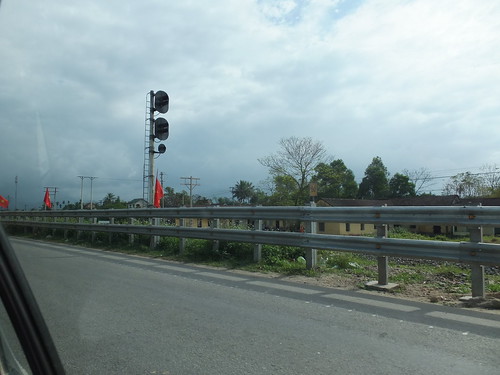
The French built Vietnam's metre gauge railway which links Ho Chi Minh City (which still seems to be called 'Saigon' by the railway) in the south to Hanoi in the north with some branches in the Hanoi area.
I travelled by road from Hoi An to Hue and the single-track main line accompanied us for part of the way, so I naturally started to look at the features of the line. There are some serious mountains on the route and the railway is tunnelled for part of the route. Whilst we were stopped for lunch, I watched a long southbound passenger train emerge from a tunnel and slowly make its way towards Da Nang. The train was too far away to get any details.As we got nearer to Hue, we travelled on a flat, coastal plain pierced by rice paddies. In this area, the railway was raised on a low embankment and looked in very good condition with solidly-built sloping walls to the embankment supporting ballast in good condition and fairly high-poundage flatbottom rail.
A reasonably well maintained open-wire telephone route, using mainly wooden telegraph poles, kept close to the track. Bridges over the numerous waterways were either of simple deck girder construction or, for the widers channels, one or more through girder trusses. It all looked in good condition and a spotted a number of staff apparently patrolling the track. Road-rail intersections were almost all level crossings, often with flashing lights and with motorised or hand-operated barriers. All had a neat crossing-keeper's hut and were staffed.
I did some 'drive by' shots of the arrangements at passing loops but its clearly difficult to gather details without stopping. All the signals I spotted were colour light, either a simple 2-aspect or fitted with two 2-aspect heads and a single-light subsidiary aspect. Some distance before each loop I found a 2-aspect signal which I presume is a yellow/green warning signal. At the loop points, I always spotted the 'four aspect plus subsidiary' type. Sometimes, there were 2-aspect signals leaving loops which I think must be red/green starting signals. I think this sort of configuration is typical of Russian and Chinese practice. I was surprised that all points appeared to be hand operated from single-lever frames fitted by the 'toe' of the points. Each frame had what I assumed was an electrical contact box to control signals but a lever lock is also possible.
In one town, I glimpsed the coaches of a southbound passenger train and shortly after we passed a slow-moving northbound passenger train, presumably re-starting after letting the southbound pass. The merest glimpse of a big diesel on the front suggested Chinese manufacture and my guide confirmed that both Russia and China have supplied railway equipment.
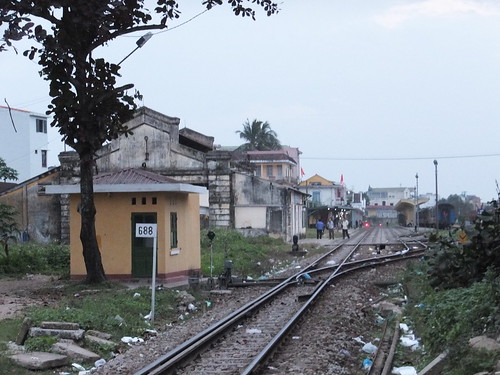
Once checked in to my hotel at Hue, I walked to the station to see what could be seen. My guide thought I should be able to purchase a platform ticket but I was on my own and my request totally baffled three girls in the ticket office and the station master or supervisor. In any case, they appear to keep everybody in the waiting room until they're ready to board. The main building is a nice French design but doesn't appear to be used for its original purpose. Instead, ticket sales and a waiting area are in a much simpler building alongside. By walking along public roads, I was able to find level crossings at the station throat at both ends of the station where the single line fans-out into a series of loops.
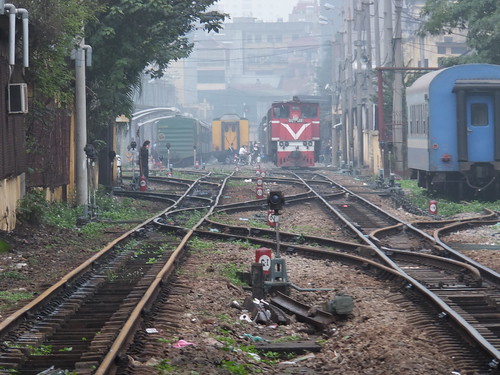
At Hanoi, I found a similar, if larger, arrangement. The large station building is utilised, although, again, the platforms are closed until required. The rather nice French architecture was somewhat spoiled by the Americans bombing the centre section. The Vietnamese cleared away the rubble and built an awful, modern centre section to rejoin the two remaining 'wings' and carried on regardless.
More when I can.
References
Vietnam Railways (Wikipedia).
David Gurnett's 'Railways in Vietnam'.
My pictures
Railways in Vietnam.
Hanoi Railway Station.
Sunday, 3 February 2013
Exploring Hue and then to Hanoi by Air
Events of Sunday, 3rd February 2013
After I returned to the Hotel Saigon Morin on Saturday evening, I pottered about uploading photographs and writing a very brief account of the day before having a relaxing bath and going to bed. I slept well and awoke to a dull, warm morning.

The hotel is very proud, and rightly so, of their buffet breakfasts, served in the open air in the courtyard surrounded by the white-painted hotel buildings. Most of the tables are provided with large umbrellas but they were not required against sun or rain as I took my meal.
After breakfast, I completed my packing and checked out for 9.0 a.m. Than and our driver picked me up and we drove to The Citadel. This was the Royal Palace until the last King abdicated. Then, during the Tet Offensive, the buildings were destroyed or damaged. Building work is going on to reconstruct the missing buildings.

Next, we drove out of the city to the famous Thien Mu pagoda situated on the river bank. There is a monastery here with, I think, around forty monks whom we saw eating lunch as we walked round the grounds.

We then boarded one of the 'Dragon Boats' which take tourists on the Perfume River for a very enjoyable private cruise back to the city.
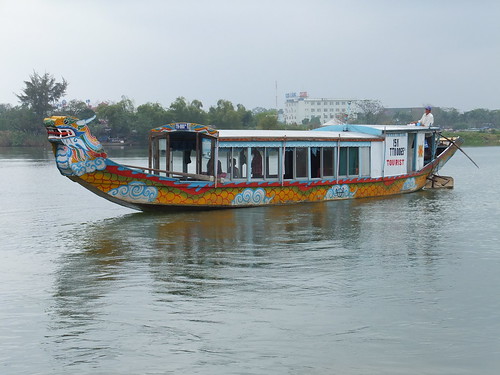
We left the boat and a short walk past large tourist hotels took us to the premises of a very modest cafe where we had an inexpensive tasty lunch. The cafe completely filled up whilst we were there. The owner of the cafe was clearly a friend of my guide Than.
In the afternoon, we drove into the countryside again to look at the tombs of two kings - Khai Dinh and Tu Duc.

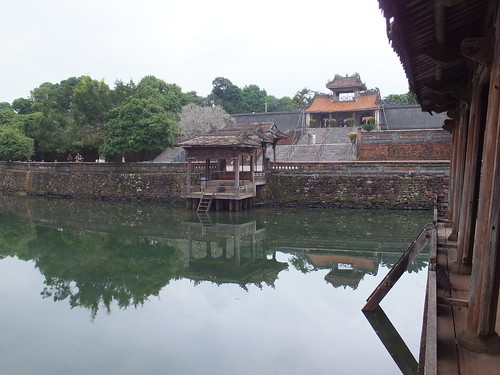
Before the driver took me to Hue Airport for the evening flight to Hanoi, Than invited me to his home, where (like all Vietnamese) they were getting ready to celebrate the approaching New Year. There's a brief report on this visit here.
The flight to Hanoi was on time and uneventful. A car was waiting to take me to the Metropole Hotel (a Sofitel Legend hotel) near the centre of the city and, after uploading my pictures, I managed to get to bed a little after midnight.
I've put links below to my pictures.
My Pictures
Hotel Saigon Morin in Hue.
Around Hue.
The Citadel, Hue.
Thien Mu Pagoda, Hue.
Dragon Boat on the Perfume River.
Khai Dinh Tomb, Hue.
Tu Duc Tomb, Hue.
Hotel Metropole, Hanoi.
[Revised 4-Feb-2013, 25-Feb-2013, 20-Mar-2013]
Saturday, 2 February 2013
Exploring Hoi An and to Hue by Road
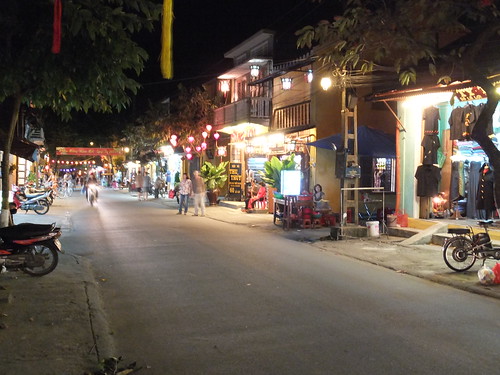
The restorative properties of a hot bath and a simple meal in the hotel are amazing. Having initially given up the idea of going out yesterday evening, I changed my mind and walked around the town before going to bed. There's always a conflict between getting the experiences and writing about them before the details fade. I've uploaded Saturday's pictures but here's just a short version of "What Jan did".
Events of Saturday, 2nd February 2013

My guide Than and I started at 8.00 a.m. with a walking tour of Hoi An. It's a charming place and World Heritage 'inscribed' (the posh folks at UNESCO don't just 'list' these places). I hadn't realised quite how dedicated to tourism the east coast of Vietnam had become - it's not to far from both Japan and Australia - but I still enjoyed my brief visit. Our walking tour was finished by 10.0 o'clock in the morning and then we set off by car along the coast road re-tracing our route back to Da Nang.
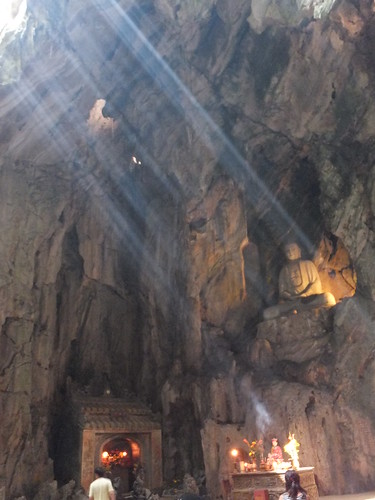
The caves at Marble Mountain.
On the way, we stopped at Marble Mountain, a massive outcrop of rock rearing up from the plain. An elevator lifted us up the mountain to a series of paths connecting various religious monuments and a large cave system (which rather reminded me of Batu Caves in Malaysia - my pictures of Batu Caves are here). As the name suggests, marble is extracted from the mountain and, at the base of the mountain, there are a number of marble carving workshops and showrooms.
I saw a little more of the modern city of Da Nang where two large road bridges are under construction both, I believe, by American architects. I found the cable-stayed bridge impressive but the other, supported by a series of bright yellow arches each made from a cluster of five tubes and dubbed 'the Dragon River Bridge', I thought ugly. We visited the interesting museum of Cham temple stone carving.
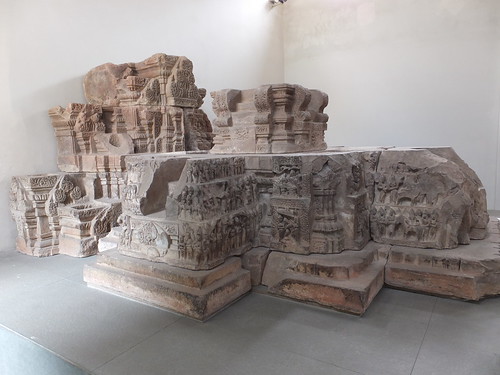
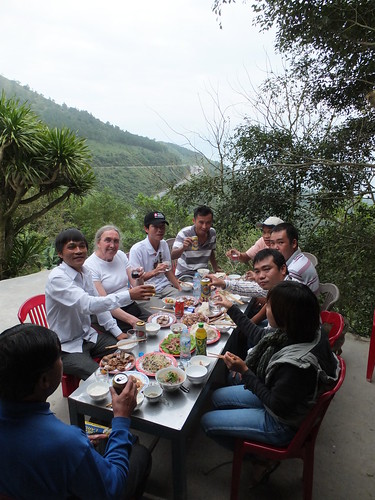
Then, we took the road over the mountains towards Hue. There is now a road tunnel which by-passes the mountain road but the views from the mountain road are stunning. Lorries carrying livestock or tankers of petrol still must use the mountain road. We stopped at a coffee shop commanding impressive views of the sea both looking south and looking north. Of course, Than knew the family who run the place. They were having a sort of informal lunch party to celebrate the New Year and insisted I join in the alfresco meal. They were so kind, I was sorry when we set off again.
Jan joins the family who run the mountain coffee shop in a celebratory lunch.
We were close to the single-line railway for a lot of the time, so I was trying to study that. I got a few 'drive by' shots on the way but couldn't do more until the evening.
I stayed at the Hotel Saigon Morin in Hue. It was opened in 1901 so, as you can guess, it's my kind of place.
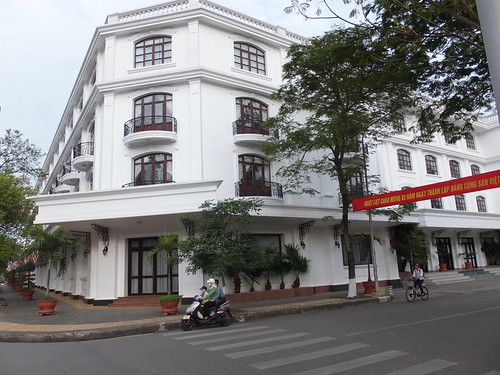
I had a simple meal in the hotel and then went out on foot, eventually ending up at the railway station. I'd been advised that I should be able to purchase a platform ticket to look around the station but nobody seemed to understand the concept and they keep passengers in the waiting room until there's a train to board.To understand the signalling and control, I explored the streets at both ends of the station to try and get near the railway. By the time I'd done that, I was quite exhausted so I returned to the hotel on a motor bike taxi, which was actually very comfortable and great fun.
Provided we don't suffer any more technical setbacks, I'll tell you more when I can.
Photographs
Hoi An.
Marble Mountain, Da Nang
Around Da Nang.
Over the Mountains to Hu
Railways in Vietnam.
Hotel Saigon Morin in Hue.
[Revised 25-Feb-2013]